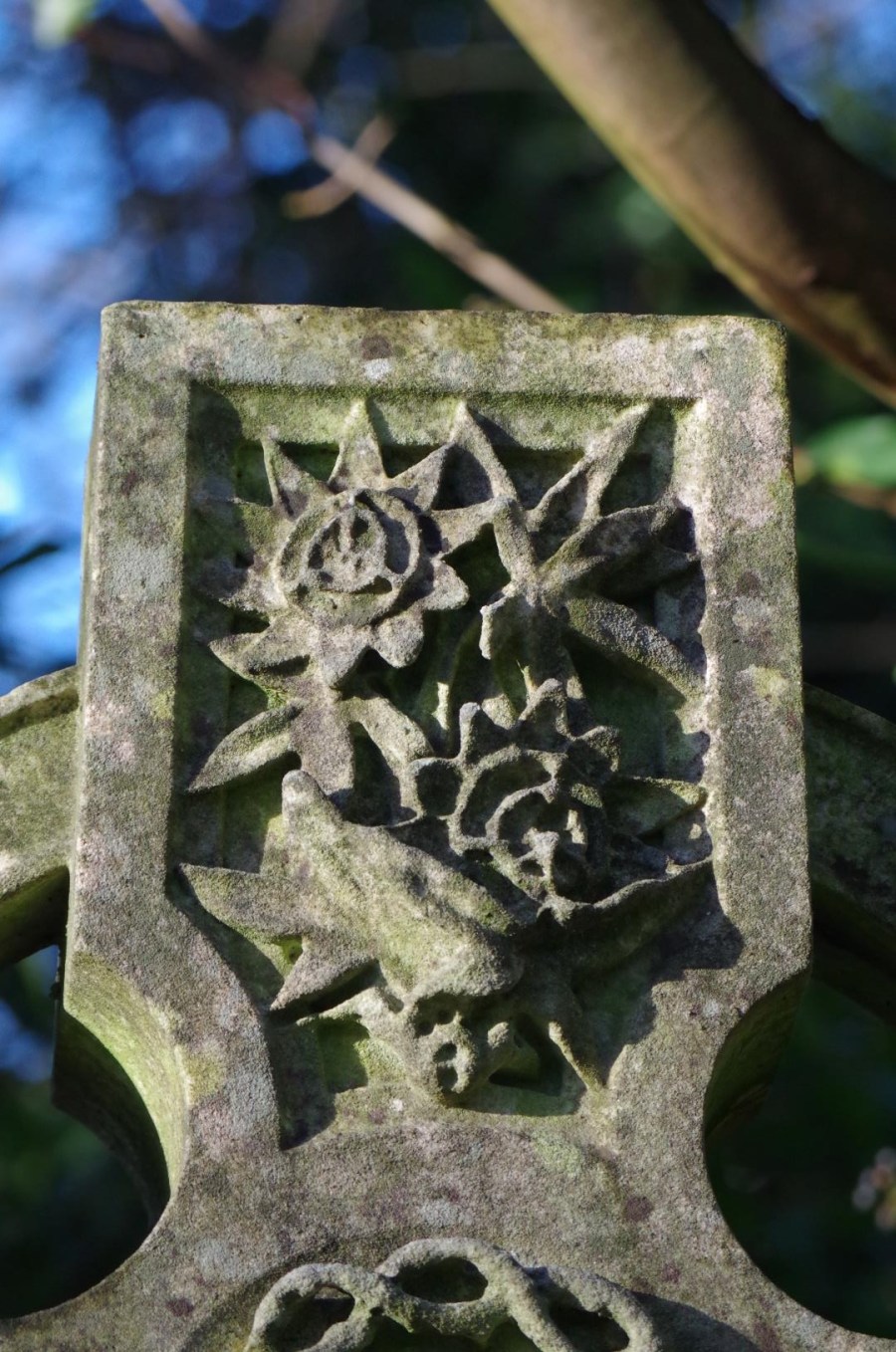
This month I am looking at the passionflower as a symbol. It is so called because it’s been claimed that it symbolised Christ’s suffering on the cross.
But first, let’s digress for a moment and discuss Floriography or the language of flowers. This is very pertinent to the study of Victorian funerary symbols although some visitors may just see them as charming and pretty decoration.
Floriography is a way of communicating through the use of arrangement of flowers. It has been used for thousands of years in various cultures, most notably in 17th century Turkey and throughout the Middle East.
But it reached its zenith in Victorian England. The Victorians love of flowers coincided with their love of cyphers and coded messages. Anyone who has ever watched TV’s Antiques Roadshow jewellery expert, Geoffrey Munn, revealing the hidden meanings behind the seemingly innocuous combination and arrangement of stones in a brooch will know what I mean.
The strict etiquette of the 19th century that was expected of the upper and middle classes meant that people had to find other, more secretive means to express feelings and messages that couldn’t be openly shared. And so flowers became the most popular method. Floral decoration was already extremely popular in the home with William Morris’s wallpapers, for example, so they became the preferred choice.
Floral dictionaries were extremely popular. The first official one, entitled The Language de Fleurs, was published in Paris in 1819. It was written by Louise Contambert who wrote under a pen name. However, in 1879 a Scotswoman, Miss Carruthers, wrote one that rapidly became an essential guide.
Today some of the original meanings have been lost but eventually I hope to post a guide to Victorian floral funerary decoration and its meanings.
Now back to the Passionflower. It is a symbol of faith and suffering. The story goes that it is so named, because of a Scholar in Rome called Jacomo Bosio who was writing a treatise on the Crucifixion. A Mexican friar showed him a passionflower and Jacomo included it in his work.
These are the symbols of Christ’s Passion within the passionflower:
.
| The unique corona | Christ’s crown of thorns |
| The sepals and petals | The Apostles excluding Judas and peter who distanced themselves from Christ before the Crucifixion. |
| The five anthers | The five wounds on Christ’s body. |
| The three stigmas | The three nails that pierced Christ’s body on the Cross |
| The leaves | The spears that pierced Christ’s side |
| The tendrils | The scourges which flayed Christ’s flesh. |
It’s a deeply religious flower and I include two well carved examples on memorials from Nunhead Cemetery, one of London’s Magnificent Seven, UK.

This is the Mills memorial. A Celtic Cross filled with sculpted blooms which are beginning to erode under an inner city climate.

This is the Blackburn tombstone with a lovely 2 dimensional frieze of the flowers.

This is the real thing.
Sources:
Text and photos copyright Carole Tyrrell
 shadows fly away