

It was on a cold, wet day in April when I visited St Anne’s church in Limehouse, East London. Again, I had been enticed there by ‘strange symbols’ according to a reader in Fortean Times. Headstones and altar tombs sulked in the abundant cow parsley as the traffic sloped along Commercial Road. It didn’t appear to be very gentrified there – yet.
Headstones lined the churchyard walls, piled up three deep. I could just about discern symbols and scenes on them but maybe on a sunnier day they would be more obvious. The churchyard is now a park with the aforementioned altar tombs and urns in one area near the road.
St Anne’s is one of London’s six Hawksmoor churches and was sadly closed when I visited. It is a very large church and was consecrated in 1730. After it was gutted by fire in 1850 it was restored to its original beauty and has a Baroque style interior from what I could see from photos on the church’s website.
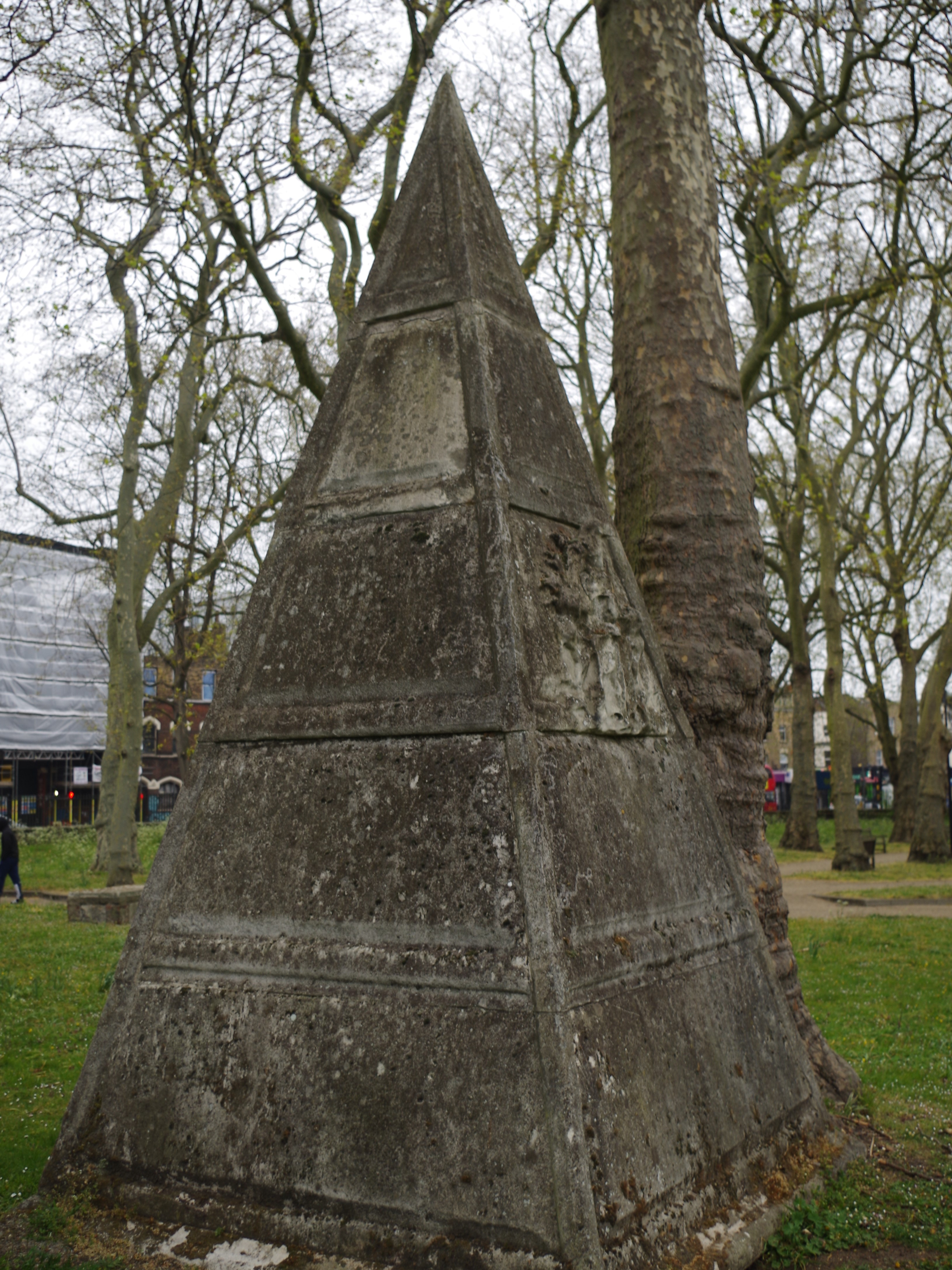
Then I saw the pyramid – well, I could hardly miss it as it’s 9 feet high and nestles up to a tall tree. No one’s sure if it’s an actual grave marker or was originally intended to be the pinnacle on top of the church tower. It is reputed that the builders may have just left it there.
On one side it has an eroded crest and coat of arms with ‘the Judgement of Solomon’ inscribed on it in both English and Hebrew. Nicholas Hawksmoor, who designed St Anne’s, was known as ‘the Devil’s architect’ and worked with Christopher Wren on various buildings.

However, It wasn’t the only pyramid that Hawksmoor designed as he’s also responsible for the Pyramid at Castle Howard in Yorkshire.

He designed it in 1728 and it contains the
‘colossal bust of Lord William Howard, the 3rd Earl’s great, great, great grandfather which sits on a stone plinth.’
David Castleton says in his fascinating blog post on pyramid tombs that,
‘Hawksmoor was a noted Freemason and fond of peppering his buildings with pagan symbols such as obelisks and pyramids.’
The Solomon reference could be a nod to King Solomon who Freemasons revered. Again, according to David Castleton
‘Hawksmoor apparently made plans for a full reconstruction of Solomon’s Temple, a monument that was thought to express the universe’s secrets with its geometry.’
It would have been an amazing building!
As I said in my post on the Darnley Mausoleum, the pyramid fascinated architects of the 18th century. They may have been inspired by the tomb of Caius Cestius in the Protestant Cemetery in Rome.

There is also a building with a pyramid roof in the background of a 1647 painting by Nicholas Poussin, ‘The Sacraments of Ordination’. He was a highly regarded painter in the 18th century and may have been one of the inspirations for the Darnley Mausoleum.

According to symbolsage:
‘The word ‘pyramid’ may have come from the Egyptian hieroglyph for pyramid which was ‘MR’ which was often written as mer, mir or pimar. However, another theory is that it may come from the Roman word ’pyramid’ which itself came from the Greek word ‘puramid’ which meant ‘a cake made out of roasted meat’. The Greeks were mocking the Egyptian burial monuments as resembling stony cakes.’
Pyramids can also be seen as representing the struggle to reach the top either in earthly ambition or the ascent to Heaven. They are also supposed to represent enlightenment and spiritual attainment.
However, the one that I like best is that a pyramid shaped tomb prevented the devil from reclining on a grave and you can’t argue with that!
We’ll never know why Hawksmoor placed his enigmatic symbol in St Anne’s churchyard so it is destined to remain as one of London’s little mysteries.
©Photos and text Carole Tyrrell unless otherwise stated
References and further reading:
About Us
https://www.davidcastleton.net/english-pyramid-tombs-mad-jack-fuller/ a wonderful selection of pyramid tombs throughout the UK.
http://www.thecemeteryclub.com/symbols.htmlhttps://churchmonumentssociety.org/resources/symbolism-on-monuments#p
https://www.castlehoward.co.uk/DB/news-archive/restoring-the-pyramid
http://www.thecemeteryclub.com/symbols.html
 shadows fly away