

Grave rail, St Mary’s church, Higham, Kent. © Carole Tyrrell
Last month Heritage Open Days took place in the Medway towns. These are brilliant opportunities to explore places that are not always open to the public – last year I was lucky enough to finally see inside the Darnley Mausoleum!
This year I revisited St Mary’s church in Higham, Kent which is built on the site of a medieval priory with a dubious reputation. It was the home of the ‘naughty nuns’ of Higham and it would seem that their reputation lasts up to the present day. It would have been a thriving community in contrast to the rather isolated spot it is now.
Refreshments and tours of the church and churchyard were on offer and it was on one of the hottest weekends of the year! The church is now closed and is the care of the Churches Conservation Trust. It’s the church where Charles Dickens daughter, Katy, married the great novelist, Wilkie Collins.
There are still traces of the Priory to be seen today and our guide pointed them out. According to him, the landscape surrounding St Mary’s has not changed much since the Priory’s day. Fields stretched on into the distance and at the end of Church Lane the Priory’s fishpond could be seen. Last summer I saw huge blue Emperor dragonflies darting through the reeds but on this visit there were huge majestic bulrushes.
Despite the heat I decided to explore the churchyard and found this rare 19th century wooden grave rail. Wood doesn’t often survive as it obviously rots but this is in great condition. Unfortunately the epitaph hasn’t survived and so I visited the Kent Archaeological Society’s website to see if they had recorded one.
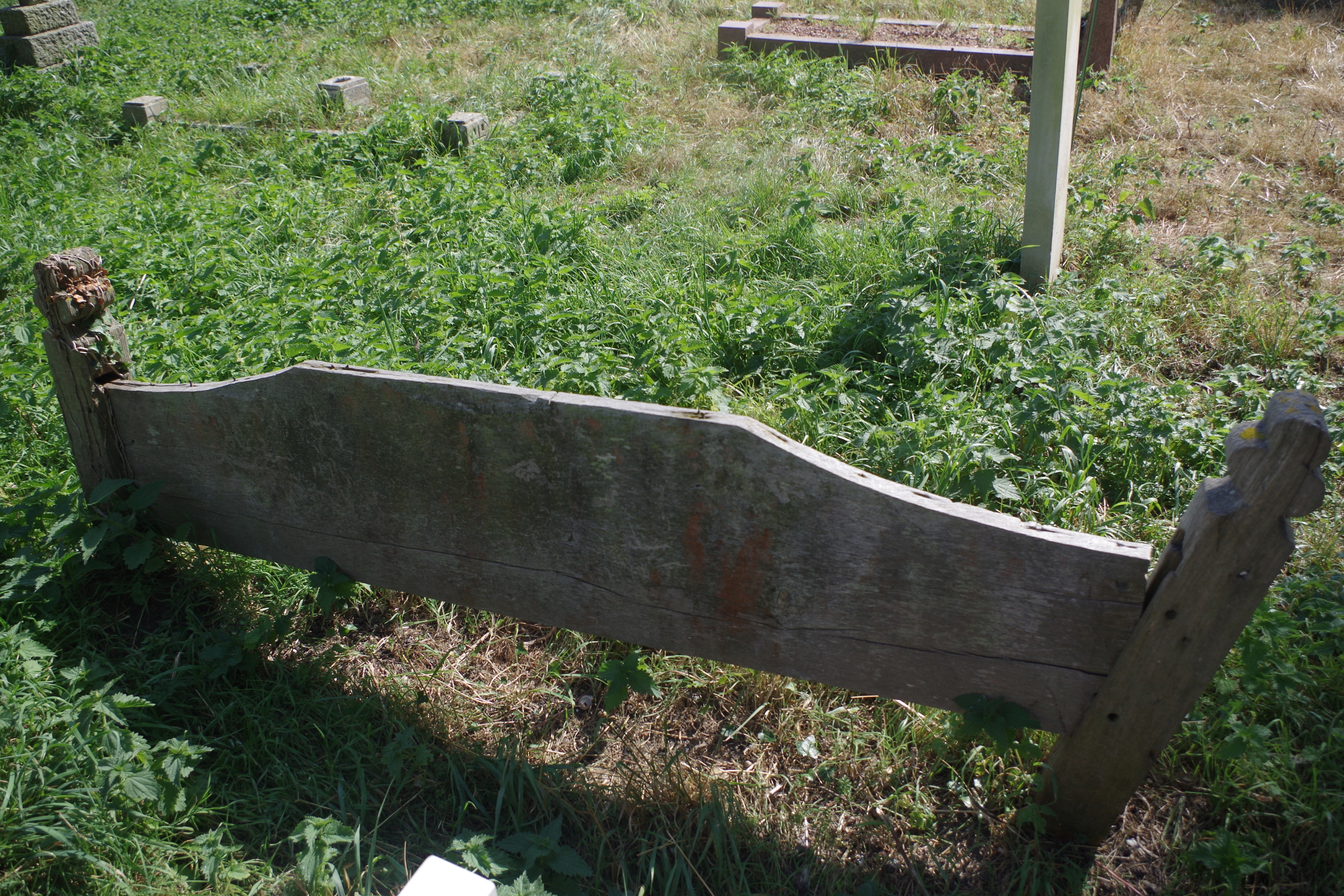
Another view of the grave rail, St Mary’s churchyard, Higham, Kent. © Carole Tyrrell
They had two surveys of the churchyard; one from 1922 and another from 2012. In the first survey, several wooden crosses were recorded but none of these have survived in the present churchyard. The wooden cross I had seen at the front of the churchyard by the road on my first visit in 2022 has collapsed and partially fallen into the grass.
The Society have presumed that the rail may have been dedicated to George Chapman who was a carter in Cobham Kent. He died on 10 December 1868 aged 38 and his daughter, Ann who died in 1860 aged 3 years and is presumably buried with him.
The rail consists of wooden boards set between upright posts. According to Roger Bowdler in his book ‘Churchyards’ they are also known as
‘graveboards or deadboards…these were the last common form of wooden churchyard memorials, and they form a link with the centuries old tradition of temporary timber grave markers.’
Frederick Burgess in ‘English Churchyard Memorials’ describes them as:
‘an inscribed horizon post by upright posts resembles part of a fence. The grave board was a later form of grave rail. It was also called bed head, dead board and leaping board.’
I can’t think how I missed it on my earlier visit as it’s a reminder that not everyone could afford a permanent marker and that it was generally the emerging merchant class and the wealthy who could.
However, I was visiting St John’s church In Hampstead as part of London Month of the Dead earlier in October 2023 and saw the George du Maurier grave rail in the churchyard extension. This still has its inscription. It also has Celtic Revival influenced end posts featuring elaborate Hiberno Saxon strapwork. This is in itself a sign of eternity as it has no beginning or end. Du Maurier is better known these days perhaps for being the grandfather of the novelist Daphne Du Maurier. However, he wrote the novel, ‘Trilby’ in 1894 in which
‘a poor artist’s model, Trilby O’Ferrall, is transformed into a diva under the spell of an evil musical genius, Svengali. Soap, songs, dances, toothpaste, and even the city of Trilby, Florida, were named after her, as was the variety of soft felt hat with an indented crown worn in the London stage dramatisation of the novel. The plot inspired Gaston Leroux ‘s 1910 novel ‘Phantom of the Opera’ and innumerable works derived from it. Du Maurier eventually came to dislike the persistent attention the novel was given. Wikipedia

George du Maurier (1834-1896) Shared under Wiki Creative Commons

The Du Maurier grave rail, St John’s, Hampstead, London © Carole Tyrrell

The epitaph on the Du Maurier grave rail. St John’s Hampstead, London © Carole Tyrrell

An example of Hiberno-Saxon strapwork. Du Maurier grave rail. © Carole Tyrrell

Metal epitaph on Du Maurier grave rail, St John’s Hampstead. © Carole Tyrrell
However, Du Maurier certainly wasn’t poor and his grave rail has been associated with the Arts and Crafts movement that flourished from 1880 – 1920. This movement declared a belief in craftmanship that stressed the the beauty of the material used within it and also its simplicity, utility and beauty.
There is another grave rail in the churchyard of St Peter and St Paul, Chaldon, Surrey.

Grave rail, St Peter & St Paul churchyard, Chaldon. Surrey. Shared under Wiki Commons. © Berat.
And here are some others in not such good condition.
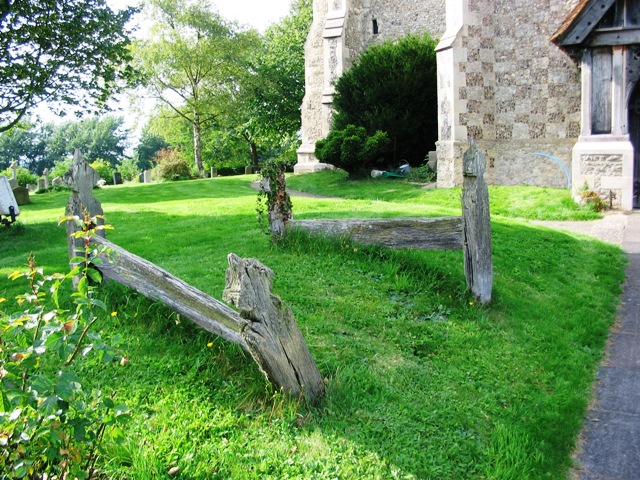
Grave Board Marsworth churchyard ©Chris Reynolds shared under Creative Commons Licence Geograph
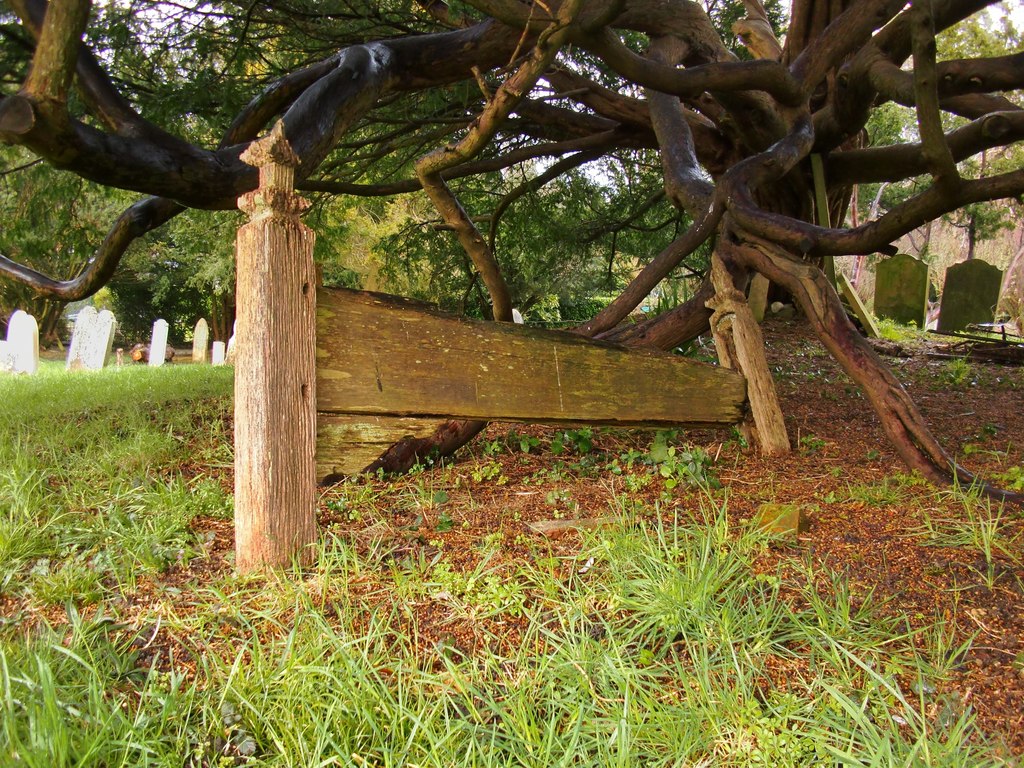
Grave Board, Ewhurst churchyard, © Stefan Czapski. Shared under Creative Commons Licence, Geograph
It may well be that there was an abundance of timber in these communities which led to grave rails becoming so popular as well as a lack of suitable stone or, indeed stone masons. But the fact that they have survived at all is incredible. So I will be looking out for more examples on my churchyard visits in future.
Text and photos © Carole Tyrrell unless otherwise stated.
References and further reading:
Roger Bowdler, Churchyards, Amberley Books, 2019
Fredrick Burgess, English Churchyard Memorials, The Lutterworth Press, 1963,2004
Grave Boards in Marsworth Churchyard © Chris Reynolds cc-by-sa/2.0 :: Geograph Britain and Ireland
Grave-board under a yew tree, Ewhurst… © Stefan Czapski :: Geograph Britain and Ireland
 shadows fly away