
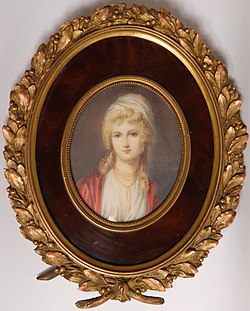
Lady Augusta Murray by Richard Cosway shared under Wiki Creative Commons
Part 2 the aftermath and the move to Ramsgate
By now Augusta was deeply in debt and in 1806 she finally gave up the title of the Duchess of Sussex. On 15 October 1806 George III authorised her to take the name of D’Ameland, one of the titles of the House of Orange with which Lord Dunmore’s family was connected. On 31 October 1806, the Treasury agreed to pay off her debts of £29,457 but with three conditions. She was to abandon the chancery case and not use the Duke’s coat of arms or livery. The Duke, Augustus, settled all of her debts that had been incurred prior to 25 March 1802 and from that date she was entitled to a £4000 pension p.a. deemed to be £1,000 p.a. at the time of the settlement. Thereafter she would receive an income of £4000 p.a. of which her existing pension of £1,200 would form a part. £700 was awarded for the maintenance of the children. Neither George III or Queen Charlotte ever saw their grandchildren from the marriage.
Augusta had been in debt for 13 years but by 1807 she was finally financially solvent and would be generously supported for the rest of her life. But at what a cost. Excluded from society, doubts cast on Emma’s parentage and the ruination of her family. But I do admire her as she didn’t fade away in shame but fought for herself and her children as much as she was able to.
After considering other seaside resorts, Augusta moved to Ramsgate and bought a house there which she developed into an estate. She named it Mount Albion and it totalled 16 acres. At 45 she had another child, a son, Henry Hamilton, whom she never acknowledged. He was born in 1805 and died in 1824. She died on 4 March 1830 and was interred with her parents in the vaults at St Laurence in Thanet. Mount Albion was sold off for development and Holy Trinity Church now stands on what was her shrubbery. She is commemorated by street and road names named after her: Augusta Road, Augusta Steps and Augusta Place.

Augustus D’Este as a young man by Simon Jacques Rochard. Shared under Wiki Creative Commons
Augusta’s son, Augustus, joined the army and the 9th Light Dragoons. He took part in the Battle of New Orleans but was an unpopular officer. Although he never married he was reputed to have had several romantic liaisons. Eventually his father broke off any contact with him. Augustus was constantly frustrated by his unsuccessful attempts to achieve his rightful status and so decided to create the mausoleum in Augusta’s memory. By 1822 his health was failing and he had contracted multiple sclerosis. In fact his diaries, begun in that year, are the earliest recorded experiences of someone living with the disease and its effects. But he was determined to give his mother the status in death that she had been denied in life. The mausoleum was built in the shape of a Greek cross and cost £212. George White who had worked on the repairs to the York Minster Chapter House carved the stones. When it was completed the coffins of Augusta and her parents were moved from the vaults in the church and placed inside it. D’Este died on 18 December 1848 a month before his 55th birthday.

Augusta Emma Wilde, Baroness Truro (1801-1866) by Henri-Francois Riesener shared under Wiki Creative Commons
Augusta Emma married Sir Thomas Wilde who later became Lord Truro making her a Lady. They married on 13 August 1845 when she was 44. It was a low key ceremony as she would have also been subject to the Royal Marriages Act due to her being a descendant of George III, acknowledged or not. Lord Truro died in 1855 and she died in 1866. Truro Road in Ramsgate is named after her.
Lady Dunmore, Augusta’s mother, died on 11 November 1818. She never disowned her and supported her financially. Prince Augustus regarded her as a second mother:
‘although she had been excluded from royal circles and shared Augusta’s disgrace and isolation.’
Queen Charlotte died in 1818 and, two years later, George III died on 29 January 1820. Times were changing and the new King and Queen, William IV and Queen Adelaide, conferred a knighthood and pension on Augusta’s son and a title to Emma which she refused. But she was a bridesmaid at the wedding to the King’s youngest daughter’s wedding. Queen Victoria gave them both pensions.
The Duke of Sussex, Prince Augustus, remarried privately after Augusta’s death to Lady Cecilia Buggin, the daughter of the Earl of Arran and his countess. He wrote to Duke of Hamilton:
‘When one looks back to events thirty seven years ago one cannot do it without a sigh. My intentions were and always have been honest and for the best. I could not fight more than I did against established Laws and a Power greater than my own. Peace to her soul do I say from the bottom of my heart.’
He was a favourite uncle to Queen Victoria and died on 21 April 1843 from a bacterial infection, erysipelas , and his son was not mentioned in his will. However, Emma who he described as ‘his delight’ inherited £10,000 and a house in Mayfair. In an obituary his children were acknowledged and the Royal Marriages Act was railed against. It would not be repealed until 26 March 2015. Augustus, the Duke of Sussex, was buried in Kensal Green Cemetery in London after refusing a State Funeral.

The grave of Prince Augustus, The Duke of Sussex, in Kensal Green Cemetery, London. February 2025.
It’s a sad tale as Augusta, due to her aristocratic background, would have made a suitable consort for Prince Augustus. But circumstance created by The Royal Marriages Act and possibly George III’s mental health problems conspired against them. They never met again after 1800.

View of mausoleum October 2025.© Carole Tyrrell

Grafitti on the illegible panels. © Carole Tyrrell

Damaged stones on mausoleum. © Carole Tyrrell
The mausoleum is crumbling now and looking the worse for wear as it nestles behind tall yew trees. But who would have thought that a decaying mausoleum at the back of an overgrown churchyard would have such a dramatic and fascinating story to tell?
Text and photos © Carole Tyrrell unless otherwise stated.
References and further reading
St. Laurence Churchyard booklet and information boards
Augusta Emma Wilde, Baroness Truro – Wikipedia the daughter
St Lawrence, Laurence, Ramsgate, Thanet – Churchyard M.I.’s by Charles Cotton 1895 the inscriptions on the Mausoleum
Prince Augustus Frederick, Duke of Sussex – Wikipedia
Lady Augusta Murray – Wikipedia
https://en.wikipedia.org/wiki/Augustus_d%27Este
Forbidden Wife: The Life and Trials of Lady August Murray, Julia Abel Smith, The History Press, 2020.
 shadows fly away