Symbol of the Month – the yew tree

A few fine yew trees in St Margaret’s churchyard, Rochester. © Carole Tyrrell

They are the sentinels of the silent cities, standing tall and spreading out their branches to shade the last resting places of the permanent residents.  Yew trees can often be older than the churches which they nestle beside in the churchyard and may predate Christianity as many churches were built on pagan sites of worship. In fact there are reputed to be at least 500 yew trees of this vintage!  And incredibly, there are 10 yew trees in Britain that are believed to predate the 10th century.

These venerable trees have many associations and traditions.  I will try and concentrate on a few but they are usually associated with churchyards and burial grounds. The most common one is that they are nourished by the decaying bodies beneath them and, as they can grow up to 20 metres high, this could seem plausible.  Another tradition states that yews were planted on plague victims graves to protect and purify them – if this were true than some churchyards would resemble a forest!

Another common tradition is that they were planted to prevent ‘commoners’ from grazing their cattle on church ground.  This was because yews are very poisonous to livestock.  The needles are deadly, and Shakespeare used this in Macbeth when the three witches conjure up a deadly brew that contains, amongst other unpleasant ingredients:

‘Gall of goat, and slips of yew
Silver’d in the moon’s eclipse,’

However, the Celts saw the yew as a symbol of immortality, death and resurrection. The yew’s drooping branches are able to root and form new trunks where they touch the ground.  The one at St James in Cooling was living inside its dead ancestor which demonstrates its ability to renew itself.

Ancient yew tree in St James, Cooling, Kent © Carole Tyrrell

Another ancient yew with a new tree growing inside the old one. © Carole Tyrrell

In fact, they are one of the most long lived trees in Western Europe but are not considered ancient until at least 900 years old.  The oldest tree in Scotland, and possibly Europe, is the magnificent Fortingall yew in Glen Lyon.  It has been suggested that it is over 2000 years old and maybe even 9000 years old.  It has numerous legends attached to it and in 1769 was reputed to have a girth of over 56ft.  In 1854, funeral processions were reputed to be able to pass through the arch formed by its split trunk.  The yew in St Cynog’s churchyard in Wales is a mere stripling at a reputed 5000 years old. One of the world’s oldest surviving wooden artifacts is a yew spear head which is estimated to be around 450,000 years old. They are evergreens with red berries which although are edible, the seed in the berry is extremely dangerous.

Fortingall Yew in 2011 ©Paul Hermans. Shared under Wiki Creative Commons

A trunk of the Fortingall Yew. ©Mogens Engelund Shared under Wiki Creative Commons

One of my favourite churchyards is that of St Marys in Painswick, Gloucestershire.  It has 99 clipped yew trees but according to Roy’s blog post, attempts to grow a 100th tree have always failed.  They are a dramatic sight to see!

The scenic avenue of 99 yew trees at St Mary’s Painswick ©Carole Tyrrell

I must admit that I would feel disappointed if I visited a churchyard and didn’t see a tall, majestic yew or two keeping watch over the dead as potent symbols of resurrection and immortality.

© Text and photos Carole Tyrrell unless otherwise stated

References and further reading

https://www.woodlandtrust.org.uk/blog/2018/01/ancient-yew-trees/

https://tree2mydoor.com/pages/information-trees-tree-directory-yew-trees

https://en.wikipedia.org/wiki/Taxus_baccata

https://en.wikipedia.org/wiki/Fortingall_Yew oldest yew tree in Britain.
A little beauty! – the Pepper family, St Laurence in Thanet, Ramsgate, Kent

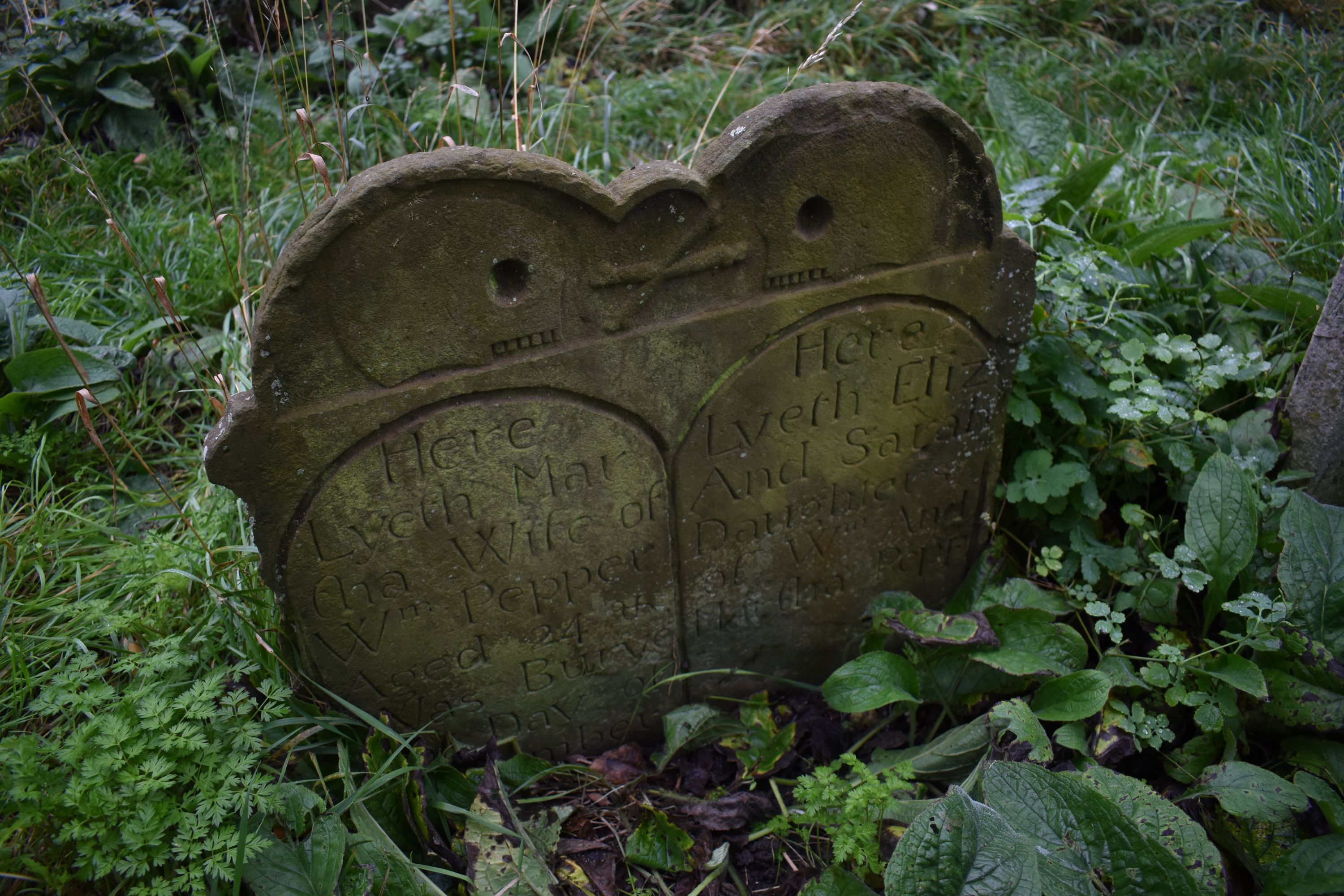
The headstone dedicated to Mrs Martha Pepper and her two daughters, Elizabeth and Sarah. © Carole Tyrrell

Firstly, Happy New Year to you all! Winter is always a good time to explore cemeteries and churchyards due to the winter die back of vegetation and last November was no exception.

Now, a word of warning, never assume when you’re out exploring churchyards that all headstones are facing in a certain way.  I have visited this churchyard several times, saw this headstone and had dismissed it as being weathered and unreadable.  How wrong I was! I had thought that it was facing me when in fact the opposite was true.

On this visit, it was a terrible November day, cold and wet, and the evening chill was beginning to close in as the evening began to draw on. The winter die back had revealed headstones along the churchyard’s front wall and boundary wall that I hadn’t previously able to previously see displaying a multitude of ‘winged souls’.  

Headstones placed along a boundary wall displaying ‘winged souls’. © Carole Tyrrell

These have featured in a previous Symbol of the Month dated 29 April 2025. But as I was gingerly stepping over wet leaves to look at them more closely by the front entrance, I looked down and saw this one!

The women of the Pepper family. © Carole Tyrrell

It  is actually facing the churchyard wall and I had been looking at its back on my other visits. It still looks as crisp and clear as when it was carved with two stylised skulls and bones facing each other displaying teeth.

On the right hand side there is a dedication to:

‘Here lyeth

Martha, wife of Wm Pepper

Aged 24 Was Buryed on

11th day of November 1705’

On the left hand side there is another dedication is to their two daughters:

‘ Here lyeth Eliz {abeth}

and Sarah

daughters of

Wm and Martha Pepp’

I couldn’t see any dates but they may be obscured by damp vegetation.

What’s interesting about this headstone is, that if you look closely, you can see that the stonemason has run out of space with some of the letters and had to put the rest of them on the next line.  This happens with ‘Martha’ and also ‘Pepper’ on the left hand side near the bottom when both words become split. I haven’t seen this before on a headstone although I knew that it did happen.

Full view of William Pepper’s headstone. © Carole Tyrrell

William Pepper is also buried in the churchyard but I couldn’t find his tombstone on this visit. Instead, I had to consult Charles Cotton’s 1895 book, ‘History and Antiquities of the Church and Parish of St Laurence (Lawrence) Thanet (Ramsgate) which I found on the Kent Archaeological Society website under their Monumental Inscriptions page.

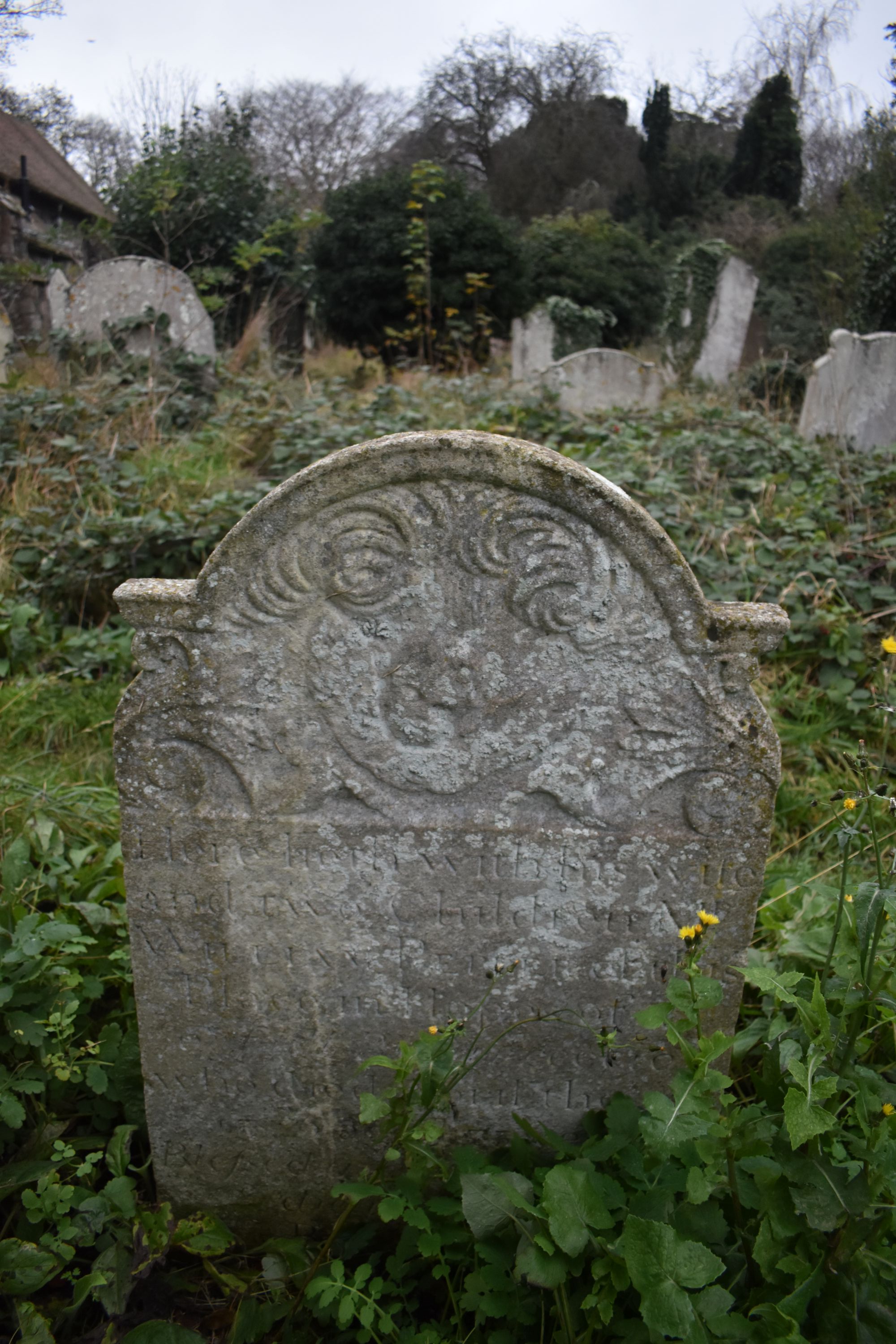
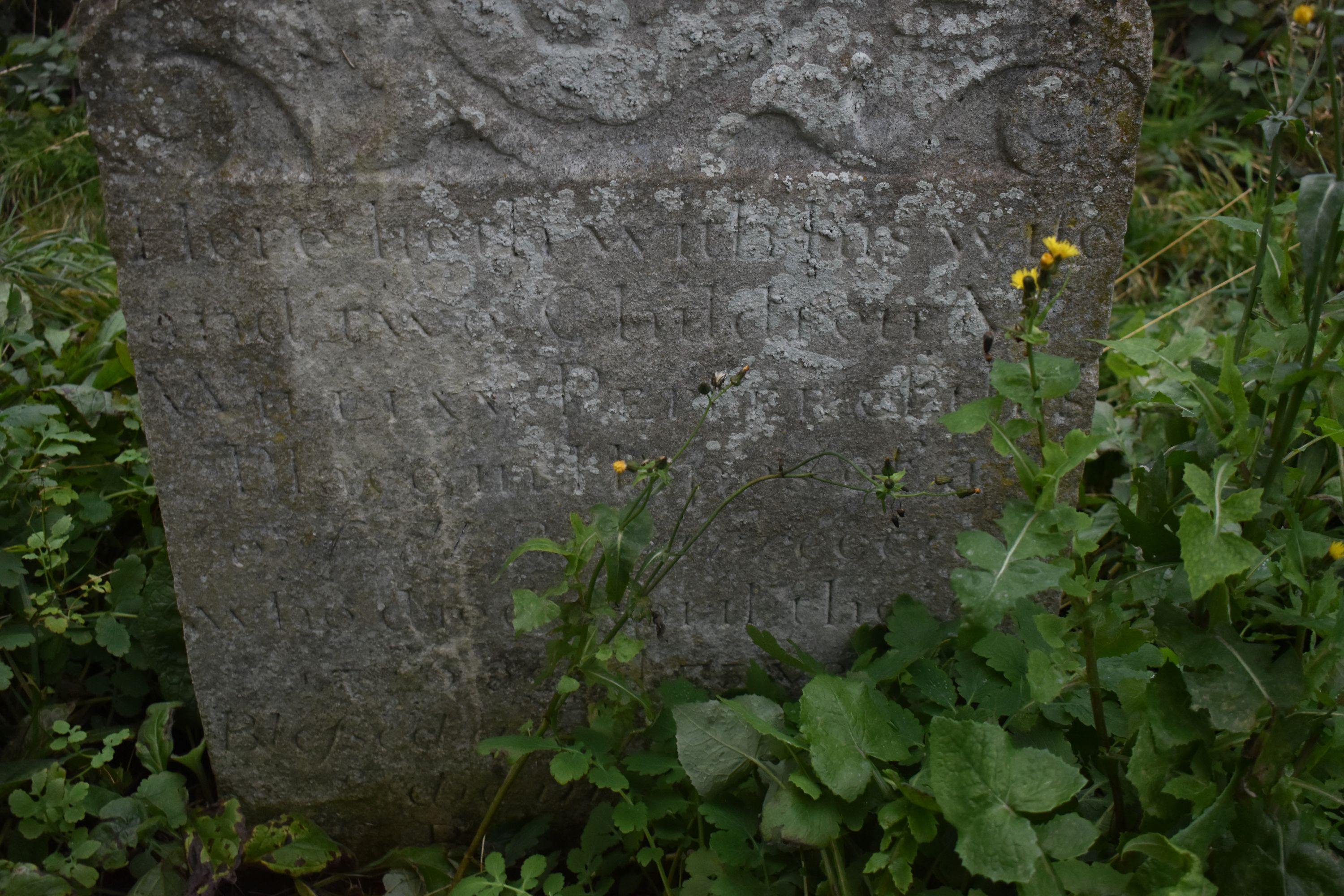
As a result, I did make a return visit to the churchyard and located William’s tombstone which is beside Martha’s. As you can see it is much larger with a winged soul at the top and what I assume to be clouds above that.

A full view of William Pepper’s epitaph. © Carole Tyrrell

There is also a more fulsome epitaph although much of it wasn’t readable. What I could read said:

‘Here lyeth with his wife

and two Children

Wm Pepper…..the rest is illegible

who died on the 15th April 1746 aged 73 years….the rest is illegible.’

It may be easier to read on a better day. The headstone seems to have been more professionally carved but of the two I do prefer his wife’s.

But Martha’s tombstone had been such a wonderful find on such a terrible day weatherwise and it was good to be able to find her husband’s headstone as well to complete the family group.

The two tombstones encapsulate the change that took place in churchyard symbols during the 18th century. It began with the very stark reminder of death with the skull and crossbones to a more comforting message for those left behind towards the end of the century. This emphasised that there might be eternal life on ‘the other side’ as the soul flies heavenward.

©Text and photos Carole Tyrrell unless otherwise stated.

References:

History and Antiquities of the Church and Parish of St Laurence (Lawrence)Thanet (Ramsgate) – reference taken from the Kent Archaeological Society website under Monumental Records, Charles Cotton 1895.