Firstly, Happy New Year to my readers and happy symbol spotting!! This month I have two symbols for you to read about.
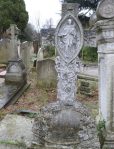
The Crown
I first saw this symbol during a visit to Beckenham Cemetery. It’s a less well-known symbol and stands for victory or truimph over death. It has, from earliest times, been a symbol of leadership, distinction and royalty. A variety of saints also wore crowns to indicate that they were either a martyr or of royal blood. Also, according to Julian Litten, it is ‘The Crown of Life’ which is a reward for those who stayed faithful until death. There are 3 biblical quotes which illustrate this:
James 1:12 New International Version (NIV)
‘Blessed is the one who perseveres under trial because, having stood the test, that person will receive the crown of life that the Lord has promised to those who love him.’ https://www.biblegateway.com/passage/?search=James%201:12
and also Revelation 2 10 and Corinthians 24:27
Interestingly enough, J C Cooper says that it is also ‘an architectural emblem of the celestial world and form the point of exit from this world and entry into the divine.’ So the crown has several interesting connotations.
In the Jewish faith it’s known as ‘The Crown of Good Name’ which alludes to the deceased as being of ‘exceptionally noble character.’ However, it can also be a representation of the head of the family or of a household.
This eye-catching example comes from Beckenham Cemetery.
This example comes from Brompton where it is at the top of a very ornate and beautiful memorial. This is a radiate crown and, according to J C Cooper, it can represent ‘ the energy and power contained in the head which was regarded as the seat of life-soul, …an attribute of sun gods,….of supernatural people and the points of the crown symbolise the rays of the sun…’ or it may just be an attractive decorative device.
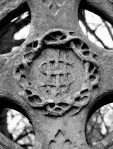
This is a variant on the crown as it is a representation of suffering, passion and martyrdom. It’s based on the ‘crown plaited by the soldiers and imposed upon Jesus during his trial before Pontius Pilate’ according to Julian Litten. J C Cooper asserts that this was a ’parody of the Roman Emperor’s crown of roses’. The soldiers then mocked Jesus by kneeling in front of him and hailing him as ‘Hail, King of the Jews!’ A potent emblem of royalty and power had been turned into one of pain and degradation. But the crown of thorns is a prelude to Jesus being given a far worthier crown in Heaven. This is confirmed in Hebrews 2:9: “
But we see Him who for a little while was made lower than the angels, namely Jesus, crowned with glory and honourbecause of the suffering of death, so that by the grace of God He might taste death for everyone”
In a famous painting of the executed King Charles 1, the Eikon Basilike, he has abandoned his earthly crown, the symbol of majesty, for the crown of thorns that he is holding in his hand as a representation of his suffering.
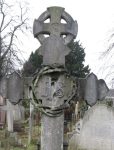
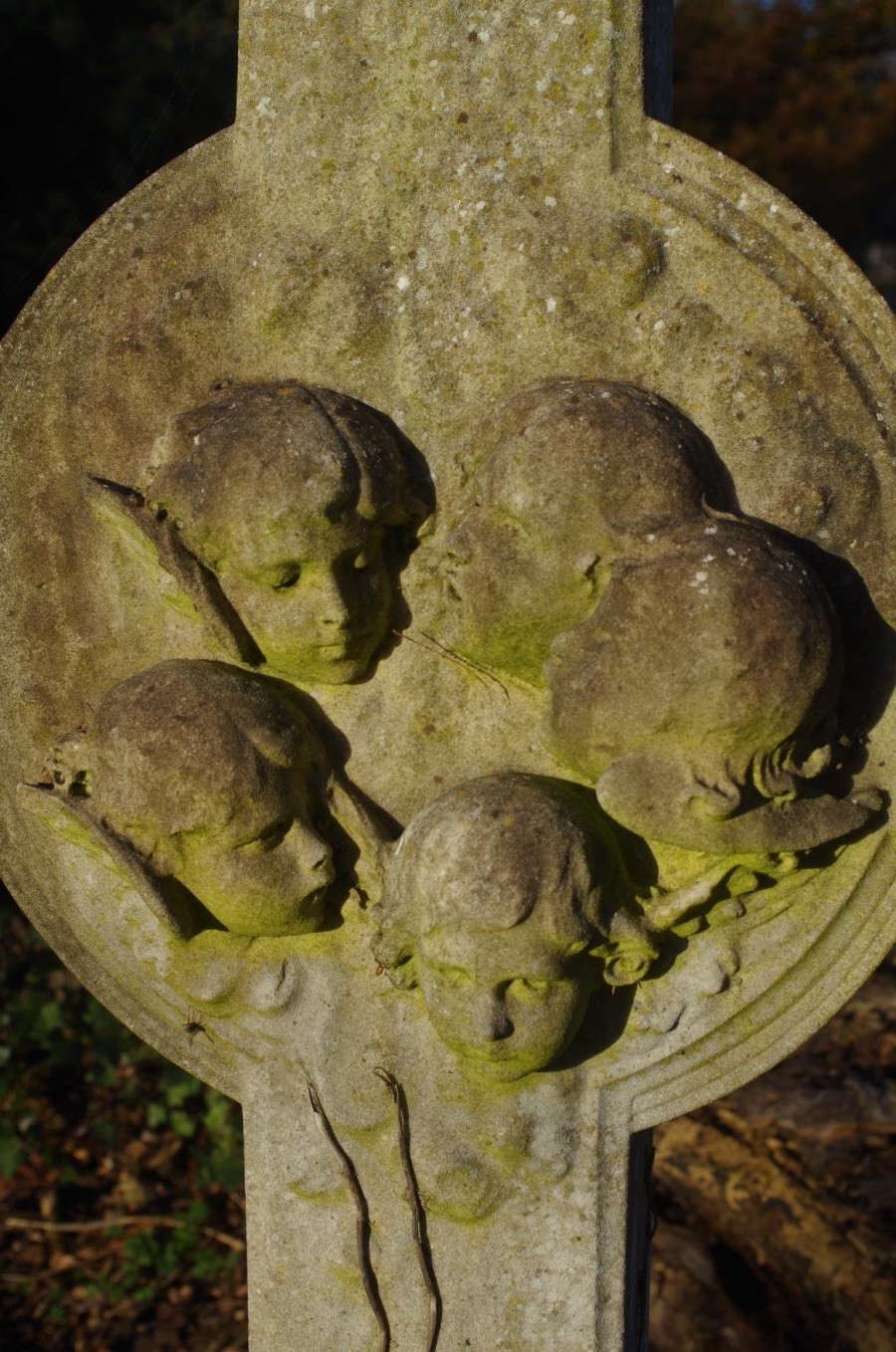
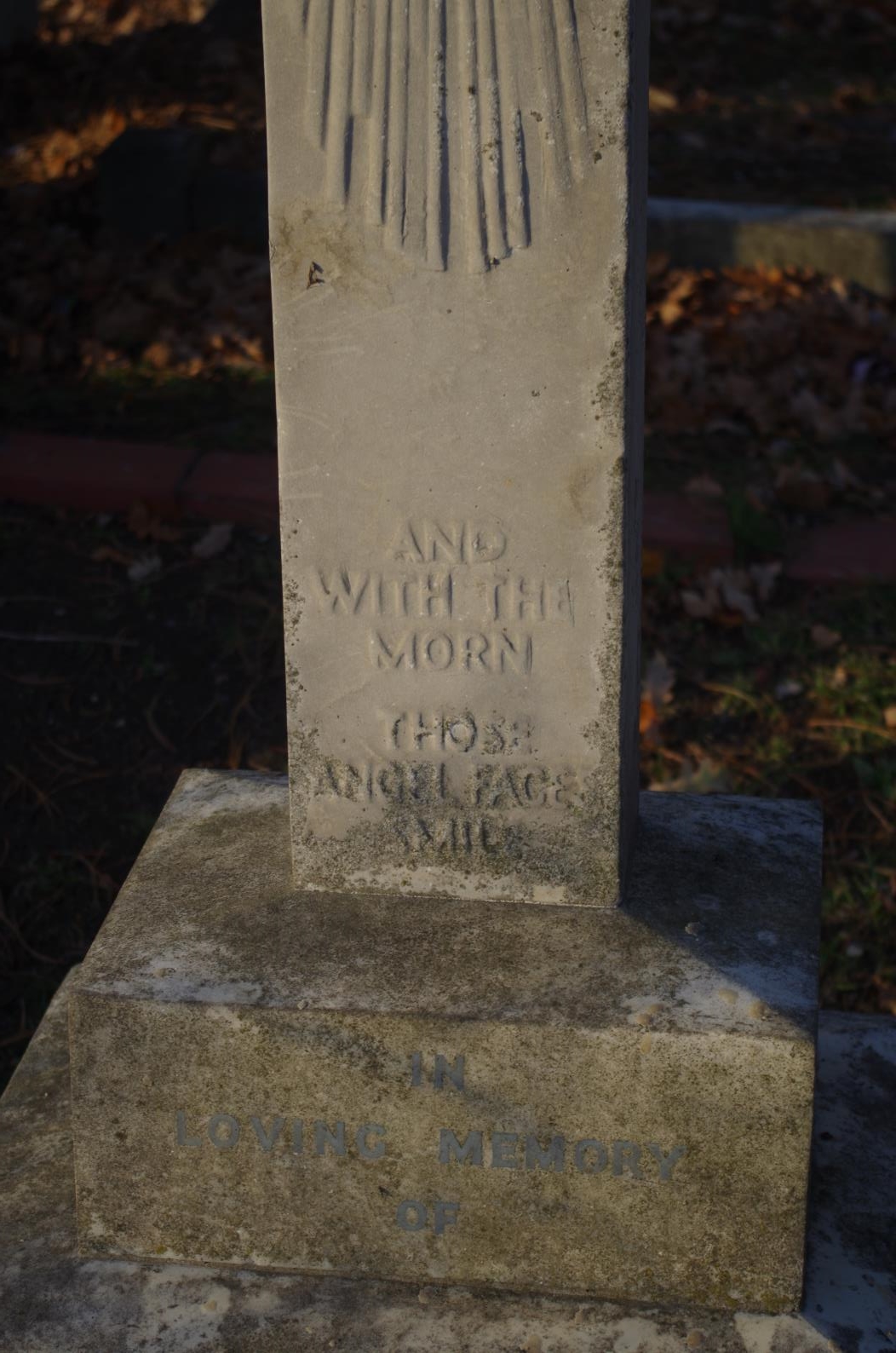
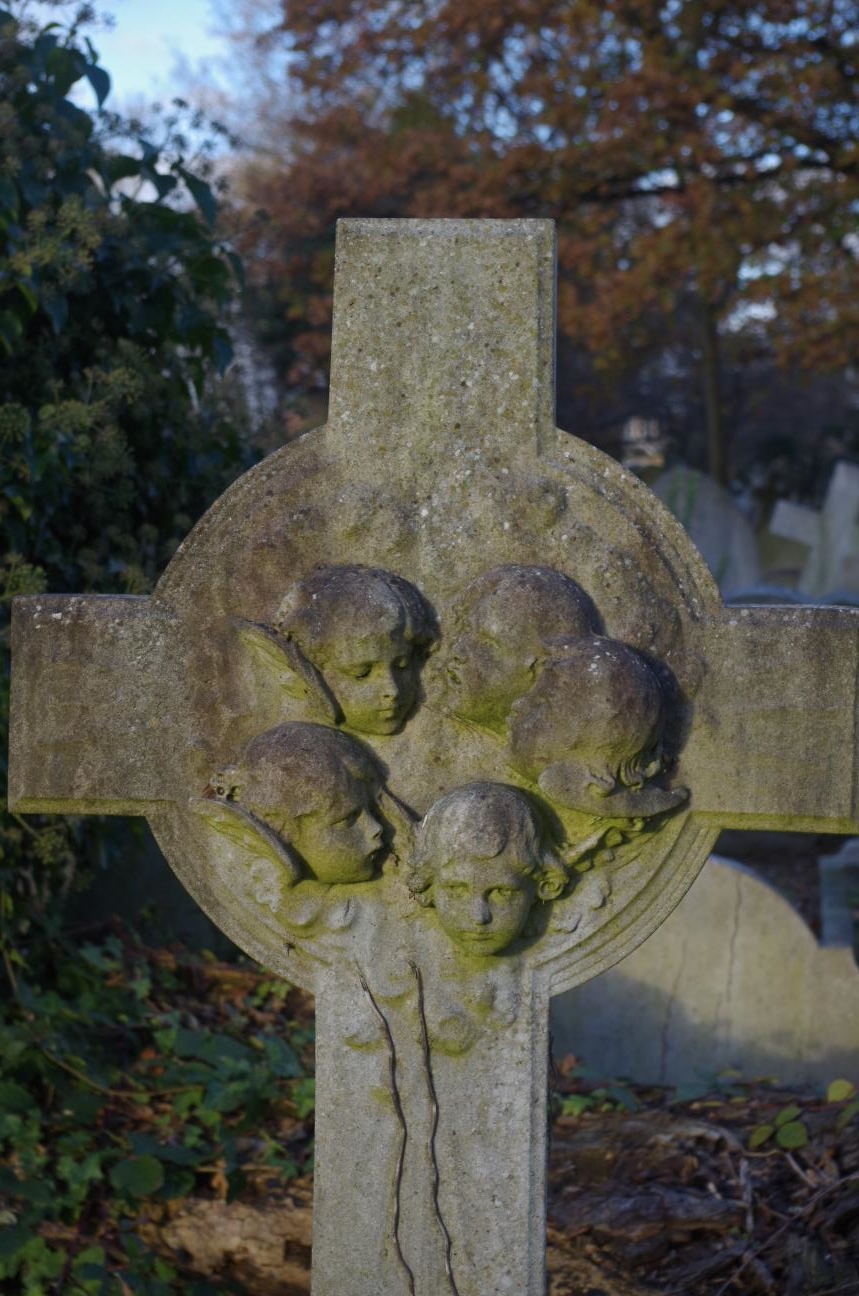
Five child angels, their faces turned to each other, framed by small wings, except for one that was staring out at me, I wanted to reach out and touch them but didn’t want to damage them. They formed a roundel at the centre of a tall cross with the phrase ‘And with the morn those angel faces smile’ inscribed at the base of its stem. I was on a tour of Beckenham Cemetery when I first saw them.
Our guide didn’t comment on them but the monument is in a prominent place on the main road through the cemetery and I often wondered about this pretty and poignant memorial.
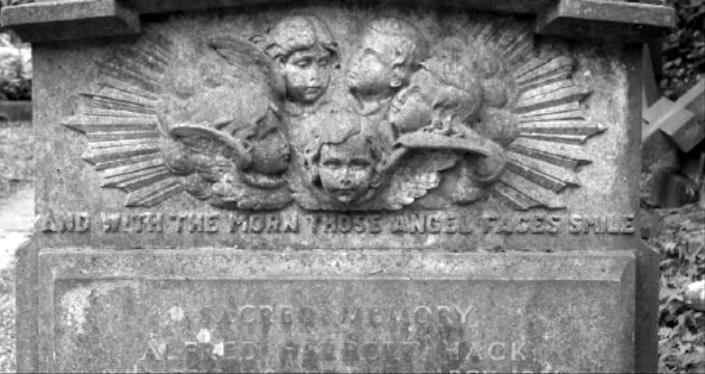
On a visit to Highgate East in 2014 I found another example but on a smaller scale on a tombstone in the name of Alfred Hack and dated 1956. There is a distinctly 1930’s look about the angels from their hairstyles.
I also found another version which featured cherubs faces instead of childrens on a visit to Knebworth this summer.
Then , on a more recent visit to Beckenham Cemetery, I found another similar one which was only a short distance away from the first. In this the child angels seem to have more definite, individual faces and the one that has her head towards the viewer is looking down instead of outwards. Now I wanted to find out more about the quotation and the angels and my research led me to a Victorian hymn that was sung on the Titanic at its final service on board and by the inmates of Ravensbruck concentration camp as the S.S led them in. The ‘angel faces’ is a quotation from ‘Lead, kindly Light’, in fact it’s the penultimate line and like ‘Rock of Ages’ it caught the mood of its time.
These are the lyrics:
‘Lead, kindly Light, amid the encircling gloom
Lead thou me on;
The night is dark, and I am far from home,
Lead thou me on.
Keep thou my feet; I do not ask to see
The distant scene; one step enough for me.
I was not for ever thus, nor prayed that thou
Shouldst lead me on;
I loved to choose and see my path; but now
Lead thou me on,
I loved the garish day, and, spite of fears,
Pride ruled my will: remember not past years.
So long thy power hath blessed me, sure it still
Will lead me on,
O’er moor and fen, o’er crag and torrent, till
The night is gone;
And with the morn those angel faces smile,
Which I have loved long since, and lost awhile.’
However, the writer John Henry Newman (1801-90), always refused to reveal the meaning of the ‘angels faces’ or what the ‘kindly light’ actually was.
Originally a poem, it was written by Newman in 1833. He was then a young theologian and Anglican vicar and was going through a challenging time in his life. Struck down by a fever which nearly killed him while travelling in the Mediterranean, Newman’s servant was so convinced that he would die that he asked him for his last orders. But in his autobiography, Newman told him ‘I shall not die, for I have not sinned against light’.
Newman recovered but that wasn’t the end of his troubles. Desperate to return to England he then took a boat from Palermo to Marseilles only to end up stranded and becalmed in the Straits of Bonifacio. Exhausted and frustrated Newman wrote the poem, ‘The Pillar of the Cloud’ that, in 1845, became ‘Lead, Kindly Light’. Newman was not happy about this as by then he’d converted to Catholicism and hymn singing wasn’t included as part of divine service. He went onto become Cardinal Newman, one of the most important figures in English Catholicism, and also an important writer. In 1900 Elgar set Newman’s poem ‘The Dream of Gerontius’ to music.
Cardinal Newman as John Newman eventually became after his conversion to Catholicism. This celebrated portrait is by Sir John Everett Millais. In the public domain in UK – from the National Portrait Gallery wkipedia
‘Lead, Kindly Light’ has struck a chord with those in danger or about to enter the endless dark realm and needed the comfort of a light leading their way through it. Miners awaiting rescue from deep underground during the 1909 Durham mining disaster sang it as did the passengers on one of Titanic’s lifeboats when the rescue ship, Carpathia, was sighted the morning after. It caught the Victorian mood perfectly as did ‘Rock of Ages’ and Queen Victoria asked for it to be read as she lay dying. It also inspired a celebrated painting by the Scottish artist, Sir Joseph Noel Paton in 1894 in which the angels are pensive young woman.
But why did one line from this song inspire two monuments in Beckenham Cemetery and one in Highgate East? I noticed that both of the Beckenham monuments were on children’s graves and that the carved angels were also children. Perhaps the mourning relatives left behind may have wanted the consolation that their beloved children would be waiting for them when their time came.
The first one is the Foster family monument. The epitaph is now virtually unreadable but I could make out the name ‘Francis Frederick’ carved along the base. There are two inscribed ‘Books of Life’ placed on top of the grave. One is dedicated to John Francis Foster and Alice Gladys Alice Chapman and the other is dedicated to John Francis Foster and Alice Emma Foster.
The second one is the Pace family monument and is to the two daughters of Henry William and Elizabeth Pace. These were Lilian Alice who died in 1888 and Grace Irene who died in 1903. Strangely enough they both died at the same age and Elizabeth herself is commemorated here as she died at 33 in 1912.
So, a line from a hymn that even its writer was unsure of its meaning, became a symbol of comfort to sorrowing families.
However the symbol has been adapted to feature cherubs as in St Mary’s, Knebworth’s churchyard. These are on the tombstone of the Lutyens family’s nanny, Alice Sleath.
But I am indebted to Douglas Keister’s Stories in Stone for the possible origins on the image of the angels.
The composition of the five heads may have been adapted from a painting by Sir Joshua Reynolds PRA entitled ‘Heads of Angels Miss Frances Gordon’ which was painted during July 1786 – March 1787. The sitter was the then 5 year old Frances Isabella Keir Gordon (1782-1831) who was the only daughter of illustrious parents. They were Lord William Gordon (1744-1823) and his wife Frances Ingram (1761-1841), second daughter of Charles, 9th Viscount Irvine (1727-78), who were married on 6 March 1781. Her uncle was Lord George Gordon (1751-93), whose political activities had sparked the anti-Catholic riots of 1780.
‘Heads of Angels Miss Frances Gordon’ by Sir Joshua Reynolds PRA 1786-1787. . This is in public domain wiki creative commons
Frances’ mother outlived her by 10 years and the painting was then presented to the National Gallery. It was enormously popular and was reproduced on numerous decorative items and photographic reproductions such as ‘The Cherub Choir.’
And so a poignant and powerful symbol was created from the combination of a great painting, an inspirational hymn and Victorian taste and led to these three lovely memorials to much missed children.
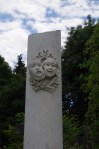
The two masks of comedy and tragedy, or Sock and Buskin as they are also known for reasons I’ll explain later, are not often found in cemeteries. And as you might expect, when they are there’s a theatrical association.
But what is the history behind this two faced symbol and how did these icons from Ancient Greece come into Victorian cemeteries?
It began with the custom of actors wearing masks, an essential part of the performance, in early Greek theatre. It was a vital part of Greek culture and civic pride. However, Comedy and Tragedy were viewed as completely separate genres and no plays ever combined them.
Tragedy
This genre began in Athens around 532 BC with Thespis, the earliest recorded tragic actor. He was known as ‘Father of Tragedy’ and it has been suggested that his name inspired the English term, thespian, for a performer.
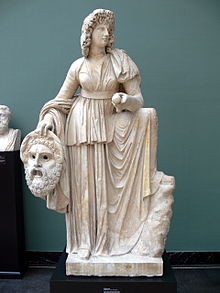
Muse of Tragedy:
Melpomene is the Muse and is often depicted holding the Mask of Tragedy. She often also holds a knife or club and also wears the ‘cothurni ‘or buskin boots that elevated her above other actors. She was a daughter of Zeus and Mnemosyne as was Thalia, the Muse of Comedy, and there were also 7 other daughters who were all Muses.
After the defeat of Athens by the Spartans in the Peleponnesian War and the subsequent decline in its power, comedy became more important than tragedy. I imagine that people wanted some relief after a protracted war and these were comic episodes about the lives of ordinary Greek citizens. Maybe they were similar to today’s comedy sketches. Greek comedy is reputed to have had a major influence on Roman humour as well. Perhaps they had an early version of Up Pompeii…..
Muse of Comedy:
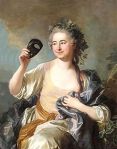
She is called Thalia but can also be sometimes spelled as Thaleia and is depicted holding the Mask of Comedy in one hand. She’s generally depicted as a young woman crowned with ivy. Thalia wears the thin-soled shoe known as the ‘sock’ from the Latin soccus. It may seem strange but it’s the footwear of the two Muses that led to them being called ‘sock and buskin’.
Thalia, Muse of Comedy – Louise-Michel Van Loo (1707-1771) Domain USA Licenced under Wikipedia Creative Commons 2.0
And so both Comedy and Tragedy became two sides of the theatre world.
Tragic Comic masks Hadrian’s Wall mosiac 2nd Century AD. Domain USA . Located in Capitoline Museum, Rome, Italy. Licenced under wikipedia Creative Commons 2.0
Masks:
They were seen as one of the iconic conventions of classical Greek theatre and date back to the time of Aeschylus (525-456 BC) commonly considered to be the father of Greek tragedy. The Ancient Greek term for mask is ‘prosopon’ or face. There are paintings on vases, such as the 5th century BC Pronomos vase, depicting actors preparing for performance with masks. However none have survived due to the organic materials from which they were created such as stiffened linen, leather or cork with wigs of human and animal hair. After the performance they were dedicated at the altar of Dionysus.
It was mainly the chorus that used masks on stage of which there could be up to 12-15 members. Masks created a sense of unity when representing a single character or voice. They always created a sense of mystery and were also a method of disguise. The actor would use the mask to totally immerse himself in his role and become someone else. It also allowed him to appear and reappear in several different roles instead of only being seen as one character. The exaggerated features of the mask also enabled audience members who were sitting at a distance to see characters emotions.
I have found four monuments featuring Tragedy and Comedy each in differing styles, in London Victorian cemeteries: Fred Kitchen in West Norwood Cemetery with a link to Charlie Chaplin. There are two in Brompton Cemetery: Gilbert Laye and Augustus Henry Glossop Harris’s elegant monuments and the exuberant Andrew Ducrow tomb in Kensal Green.
Fred Karno 1018 – unknown photographer. Licenced via Wiki Commons.
The graceful Kitchen memorial was recently restored by the Music Hall Guild of Great Britain & America in March 2016 with the Heritage Lottery Fund’s support. It almost dazzles under a summer sky. Both Fred and his father, Richard (1830-1910) rest here and note the broken column on which the Sock and Buskin are placed. This denotes that the head of the family as a broken column indicated that the support, or head of the family, rests here.
Fred came from a theatrical family in that his father, Richard, was the Ballet Master and Dancer at the Theatre Royal Drury Lane. Fred worked mainly in the music halls which were considered a low form of entertainment but many famous comedians learned their craft in them. He was discovered by the legendary impresario, Fred Karno, while playing in a production at Glasgow’s Princess Theatre. It was the stuff of showbiz legend, or cliche depending on your point of view, as Fred was standing in for the chief comedian and so, as a result, a 50 year career theatrical career began. From 1897-1910 Fred was a member of Fred Karno’s Army along with such legends as Laurel and Hardy and Charlie Chaplin. Kitchen had a unique style which featured a splayed walk as he had flat feet and scruffy costume. Chaplin later admitted that this had influenced or he had simply ‘borrowed’ it for his iconic tramp character. In 1913 Fred appeared in a Royal Command Performance for King George V and continued to work until 1945 aged 73. But the music hall circuit was beginning to vanish but his son, Fred Kitchen Jr, continued the family tradition in film and theatre.
This is a striking memorial with ‘Comedy & Tragedy’ of either side of a stylised young woman who is holding what appears to be a lyre. There isn’t much known about Gilbert Laye, the incumbent, and I could only find one credit for him online. This was as the director of ‘My Lady Molly’ at Daly’s Theatre on New York’s Broadway. It was a musical comedy and opened on 5 January 1904 and closed on 16 January 1904. He was also briefly the manager of the Palace Pier in Brighton. Both he and his wife, Evelyn Stuart were known as struggling minor actors/ However, she was known as a respected provincial Principal Boy. However, it was their daughter, Evelyn Laye (1900-1995) who became a huge star on stage in musical comedy roles. She made her stage debut in 1915 and acted until well into her nineties. Evelyn worked with Noel Coward and made her first appearance on Broadway in 1929 in his Bitter Sweet. However, her parents disapproved of her first marriage to
actor Sonnie Hale in 1926 which ultimately ended in divorce when he left her for actress Jessie Matthews. Evelyn attracted public sympathy over this with the divorce judge branding Matthews ‘an odious creature.’
Augustus Harris By Henri Brauer (1858-1936) – Joseph Uzanne, Figures contemporaines tirées de l’Album Mariani, Librairie Henri Floury, Paris, vol II, 1896, Bibliothèque nationale de France, Public Domain, https://commons.wikimedia.org/w/index.php?curid=3181870
This is a very sophisticated monument with a barefoot mourning woman in robes and her hair tied back resting one outstretched arm on the cenotaph. In vintage photos, the other is raised towards a bust of Harris which tops the plinth. However, the bust is no longer in place and neither is the hand that seemed to stroke it. There are three people commemorated on the monument: Augustus himself, his wife Florence Edgcumbe and their daughter, Florence Nellie Cellier. None of them appear to be buried in Brompton as Augustus died at Folkestone and Florence’s ashes were scattered elsewhere. Florence remarried after Augustus’s death so she may actually be buried with her second husband.
Augustus was a British actor and impresario who came from another theatrical family. Born in Paris his father was a dramatist, Augustus Glossop Harris, and his mother was Maria Ann Bone, a theatrical costumier. The Brompton Augustus Henry was known as ‘the Father of British pantomime’. He co-wrote and produced scripts for large scale pantos that were performed at the Theatre Royal Drury Lane every Christmas. They attracted a popular cast including the legendary Dan Leno. Augustus was also involved in local politics and, in 1890, represented the Strand division in the London County Council. In 1891 he was appointed a sheriff and was also knighted. He married Florence Edgcumbe Rendle in 1881 and after his death she remarried and died in 1914.
Florence Nellie Harris Cellier was their daughter. She married Frank Cellier in 1910 and divorced him in 1925. He was an actor who both appeared and directed in numerous plays and acted in Hitchcock’s ‘The 39 Steps’ in 1948.
‘Comedy and Tragedy’ lie beneath a laurel wreath and violin on top of a carved cloth at the base of the cenotaph.
On one of the most desirable and prominent plots in Kensal Green Cemetery lies Andrew Ducrow. To call his blue painted tomb flamboyant is an understatement although the 19th century magazine ‘The Builder’ described it as a piece of ‘ponderous coxcombry‘ . It was supposedly created for his first wife but as the epitaph states
‘Within this tomb erected by genius for the reception of its own remains are deposited those of Andrew Ducrow’
It’s a feast of symbols ranging from 4 Egyptian style 4 sphinxes and columns on the mausoleum and a Greek style roof. A relief over the door depicts Pegasus, the winged horse and a weeping woman in Grecian dress with ‘Comedy and Tragedy’ beside her on clouds.
A pair of gloves and hat lie almost just discarded waiting for their owner to don them again on part of a broken column. There’s also beehives, shells, flowers and downturned torches. Two angels flank the now bricked up entrance which are the closest to any Christian symbolism.
However, Pegasus and an urn decorated with horses heads and garlands are not just mere emblems but direct references to Ducrow’s profession which was as a renowned circus performer. He was known as the ‘Father of British Circus Equestrianism’. Modern day horse acts owe a huge debt to him as he created many horse feats and acts that are still in use today. For example, his most famous act ‘Courier of St Petersburg’ is still performed to this day at equestrian events. In this a rider straddles 2 cantering horses while other horses bearing the flags of the countries through which a courier would pass on his way to Russia passed between his legs.
Ducrow owned a circus called Astley’s Amphitheatre and had learned his skills from his Belgian father who had emigrated to England in 1793. However, Ducrow also had another act that attracted and thrilled audiences. This was the ‘plastique’ or physique performances in which he and his sons would wear ‘fleshings’ or flesh coloured body stockings and pose on white stallions as they carried them around the amphitheatre several times. It must have been quite a sight to see under the lights and it’s a shame that no-one has yet attempted to revive it. There was a black performer in the company called Pablo Fanque who is mentioned in the Beatle Sgt Pepper Lonely Hearts Club Band track, ‘Being for the Benefit of Mr Kite’ which is one of my favourites.
As you can imagine Ducrow and his company were incredibly popular but bad luck dogged him. The Amphitheatre burned down 3 times and after the last one in 1841 he had a nervous breakdown. He died soon after in 1842 and the Amphitheatre and circus were taken over by others who had worked with him.
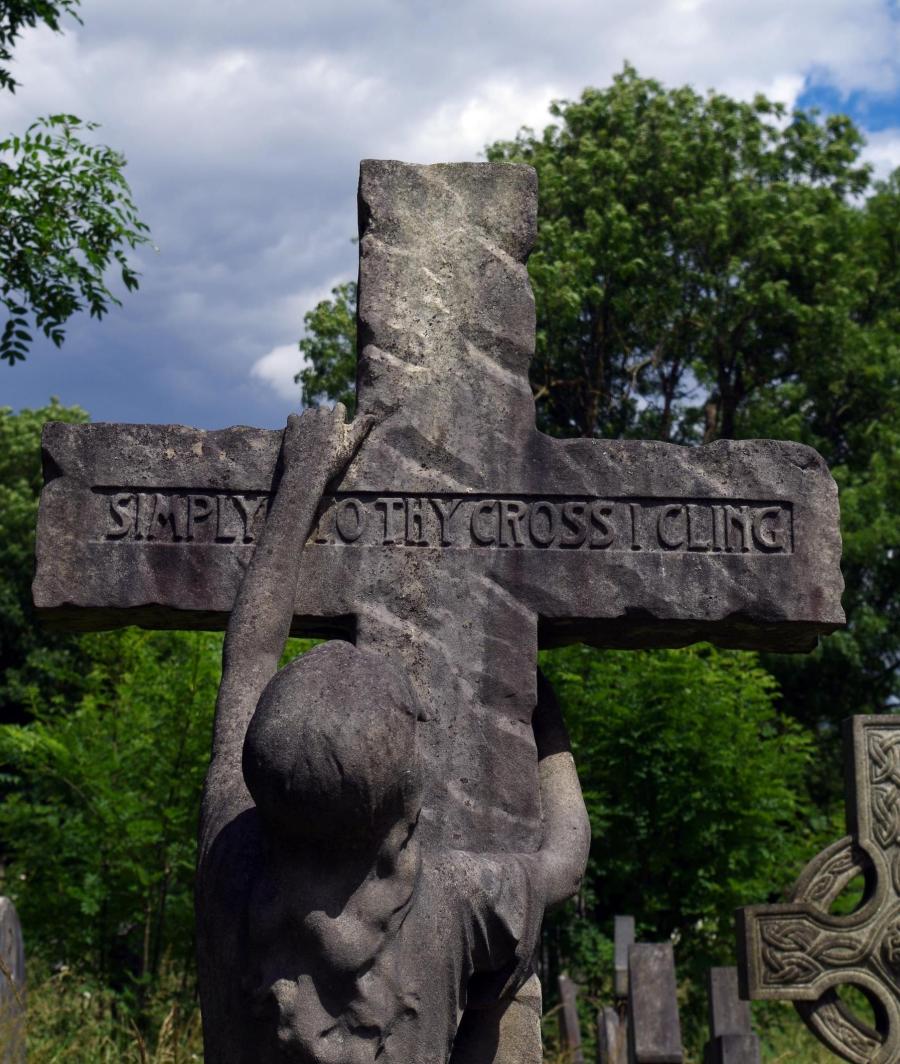
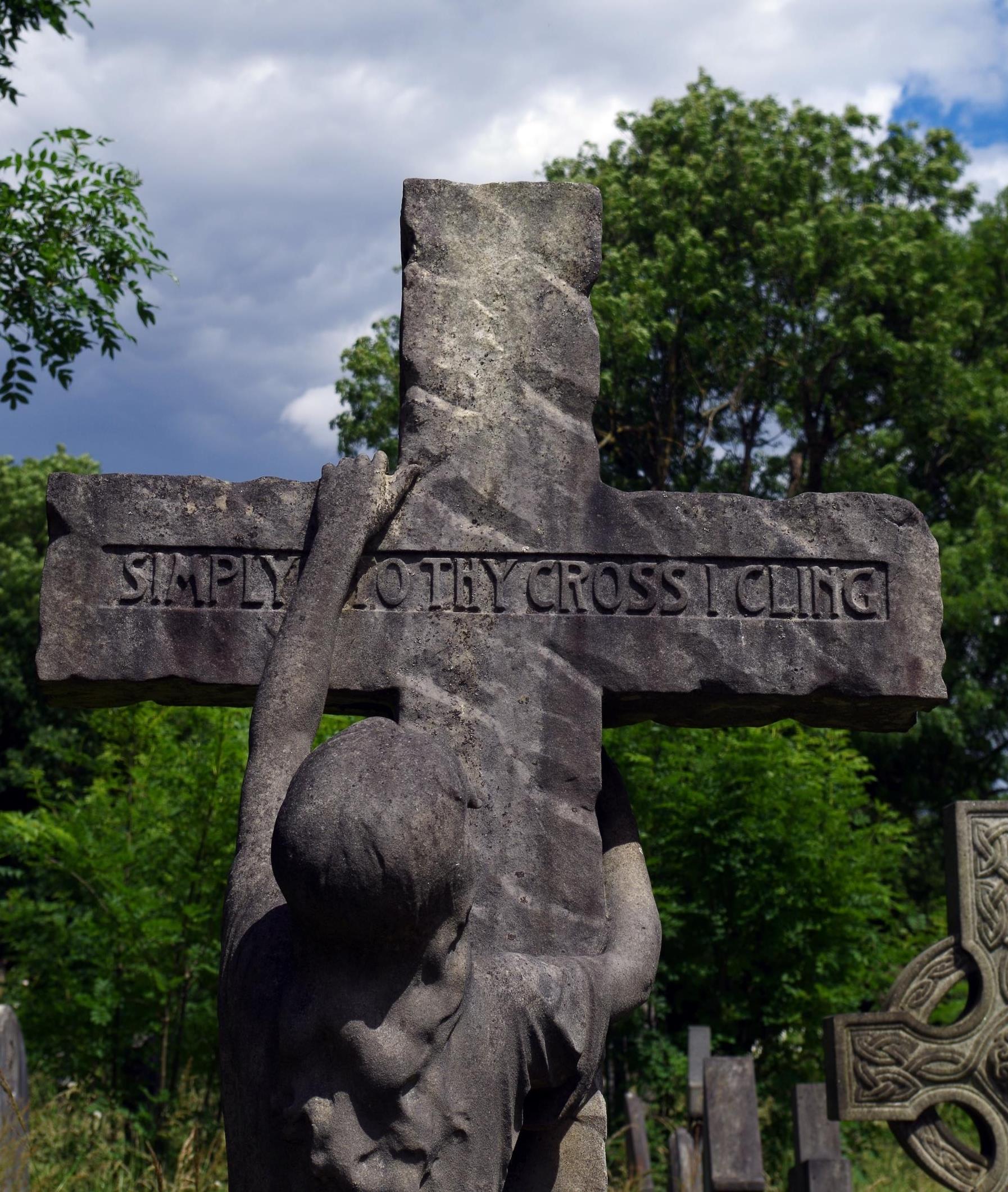
What does a woman clinging to a cross, seemingly for dear life, have in common with the film ‘Merry Christmas Mr Lawrence’ and heavy metal group Def Leppard?
Strangely enough, the connection is an 18th century Protestant hymn written by a fiercely Calvinist minister which has entered the Western cultural consciousness in the same way as ‘Abide With Me’.
‘Rock of Ages’ is a hymn with an enduring message of hope and ultimate salvation. So no wonder it inspired a potent funerary symbol which is still used today. However, it’s the second line in the third verse, ‘Simply to Thy cross I cling.’ that has proved most inspirational to Victorian monument masons.
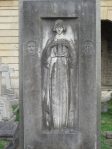
A variant is a pensive young woman leaning on a cross for support as at West Norwood. This cemetery contained several examples and here is a selection:
They’re not angels as they don’t possess wings and angels didn’t begin to appear in Victorian cemeteries until the late 19th century. But they are one of the few cemetery symbols inspired by a popular hymn. It’s also a Protestant motif and was the only way in which a cross would have been permitted in a Victorian cemetery until near the end of the 19th century. This was due to the religious wars that were raging at the time.
When the Victorians created their large municipal cemeteries there was still a fierce Anti-Catholic prejudice within Britain. This dated back to Henry VIII and the Reformation and had resulted in several anti-Catholic laws being passed during the 17th and 18th centuries. But the cry was still ‘No Popery’ in the 19th century and any symbols that were associated with Catholicism weren’t welcome in the new marble orchards. These included crosses, figures of saints and also angels. Instead, there was a return to Classicism using Roman and Greek motifs and architecture. Then, as the 19th century progressed, funerary monuments reflected the tastes of the time. So you could walk through one and see Arts & Crafts, Celtic Revival, Art Nouveau until eventually towards the end angels did being to fly in.
‘Rock of Ages’ was written by a Calvinist minister, the Reverend Augustus Toplady, in 1763 and was first published in a religious magazine, ‘The Gospel’, in 1775. It’s allegedly based on an incident in Toplady’s life. He was a preacher in a village named Blagdon and was travelling along the gorge of Burrington Combe in Somerset’s Mendip Hills when he was caught in a storm. He managed to find shelter in a gap in the gorge and was struck by the name of the crevice that had saved him. It’s still marked as ‘Rock of Ages’ both on the rock itself and maps. He is reputed to have written the hymn’s lyrics on the back of a playing card although one wonders what a minister was doing with a deck of cards. However, no-one’s sure if this incident actually happened or if it’s apocryphal….
Toplady wasn’t a popular man and in an article by Rupert Christensen of the Daily Telegraph he was described as ‘fanatical, in a gross Calvinism and most difficult to deal with.’ John Wesley avoided him. Toplady was also fond of writing bizarre articles, one of which proposed that a spiralling National Debt could never be paid off due to the extent of human sinfulness. Something for the new Chancellor to ponder on I’m sure. Toplady died in 1776 from TB and would undoubtedly have been forgotten were it not for his rousing hymn.
‘Rock of Ages’ caught the popular imagination. Gladstone translated it into Latin and Greek and asked for it to be played at his funeral. Prince Albert reputedly requested it on his deathbed and it has appeared in several feature films. These include ‘Merry Christmas Mr Lawrence’ where it’s sung by David Bowie as Major Jack Celliers and both ‘Paper Moon’ and ‘The Silence of the Lambs’ where it’s played at a funeral. It’s also inspired musicians such as Def Leppard and the writer of the film score for ‘Altered States.’ John Congliano. It’s also the title of the long running musical stage show.
These are its lyrics:
Rock of Ages, cleft for me,
Let me hide myself in Thee;
Let the water and the blood,
From Thy riven side which flowed,
Be of sin the double cure,
Cleanse me from its guilt and power.
Not the labour of my hands
Can fulfill Thy law’s demands;
Could my zeal no respite know,
Could my tears forever flow,
All for sin could not atone;
Thou must save, and Thou alone.
Nothing in my hand I bring,
Simply to Thy cross I cling;
Naked, come to Thee for dress;
Helpless, look to Thee for grace;
Foul, I to the fountain fly;
Wash me, Saviour, or I die!
It was also popular as a print and these are two examples:
This is a particularly effective one dating from 1876 and is by Johannes Adam Simon Oertel. Again from Pinterest.
I found this on Pinterest with no details of artist. The only information was that it dated from 1909.
Both seem to clinging to a cross in a raging sea – a sea of sin perhaps?
The symbol has reappeared in more recent years and there is a much smaller, modern version at Beckenham Cemetery. This is on the grave of a 16 year old who died in 1965.
An inspirational hymn to the Victorians and also well into the 20th Century but what could have the same effect these days? I’ve always fancied a video of Sid Vicious singing ‘/My Way’ on my tombstone…..
Most people associate Knebworth with huge rock concerts and as a Gothic backdrop to many well-known films including The King’s Speech.
But it has other claims to fame apart from gargoyles and lovely gardens. It also has a wonderful mausoleum in its own field and the Lytton Chapel which, according to Pevsner and Simon Jenkins, has the finest 18th century memorials in England.
The Knebworth church is officially known as St Mary’s although it’s actually dedicated to the Virgin Mary and St Thomas of Canterbury or Thomas a Becket. It sits facing the House with its own small graveyard and surrounded by trees and railings. This is where many of the past owners of Knebworth are buried and you enter under a lovely lychgate. But why is it there?
St Mary’s was originally part of the medieval village of Knebworth and was first recorded in the Domesday Book. But when the village was moved after the creation of Knebworth Park in the late 1300’s , St Mary’s stayed in its place. It’s a church steeped in history and an architectural jigsaw as so much of it comes from different periods. The nave and chancel, for example, date from 1120 AD. When you first enter, the interior appears very plain but St Mary’s real glory is the Lytton Chapel in a side room near the altar.
However, amongst its impressive marble monuments was a memorial tablet mounted on a side wall, to the left as I entered.
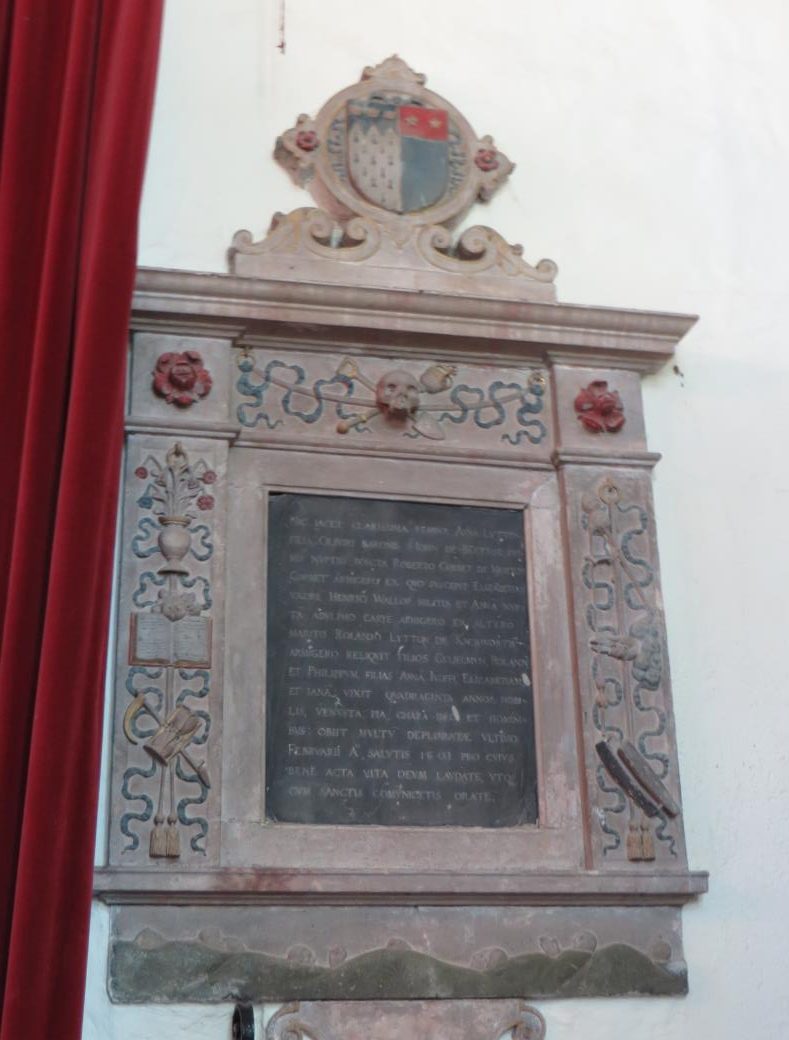
This is dedicated to a woman who died on the last day of February 1601, Anne St John, and for anyone fascinated by iconography it has a rich display of symbols. She was the wife of Sir Rowland Lytton who was her second husband. Sir Rowland’s memorial slab is on the church’s floor and he died in 1674 at 59. Anne died comparatively young at 40 and I wondered if this is why there are so many references to death on her tablet. The motifs on Anne’s memorial are beautifully carved and delicately coloured. It’s a wonderful example of a memento mori. According to J C Cooper:
‘This was an image or item that urged people to remember their death. It was a reminder that death was an unavoidable part of life and to be prepared at all times.’
Memento Mori is a Latin phrase which translates as: ‘Remember you must die’ and often expressed in art through symbols as in this memorial.
The epitaph is in Latin but, helpfully, there is an English translation provided. It reads:
‘Here lies the most illustrious Lady Anne Lytton, daughter of Oliver, Lord St John who had previously married Robert C – of Morton C—— Esquire, by whom she had two daughters, Elizabeth, who married Sir Henry Walop, and Anne, who married Adolphus Carye, Esqre, by her second husband, Rowland Lytton, Esqre of Knebworth, she had 3 sons, William, Rowland and Philip, and four daughters, Anne, Judith, Elisabeth and Jane. She lived 40 years, a noble, handsome and pious lady, beloved alike by God and men. She died, greatly d—– on the last day of February 1601 for the fulfilment of whose noble life give praise to God, and pray that you may be in communion with her among the blessed ones.’
NB: The gaps are where my camera decided to play up and rendered the words unreadable.
This was my favourite memorial in the Lytton Chapel because of its modest size and unusual iconography. I apologise for the quality of the photos – the light levels are low in the Chapel and I didn’t have much time.
It’s no accident that the skull takes centre stage, as it, Death. is the ultimate conqueror of life. There is no escape and one recalls Hamlet and Yorick’s skull. The crossed mace and spade beneath it are representations of both high and humble stations in life. The mace is a representation of absolute power whereas the spade indicates a labourer. This demonstrates that it doesn’t matter what your status was in life as Death makes us all equal.
Vase of broken or drooping flowers: According to Howgate, this signifies ‘the brief transience oflifebefore death intervenes, even in the first flowering of youth.’ I have discussed in a previous post the significance of roses in funerary iconography and broken rose blossoms also indicate a life cut short as the flower never blooms. But flowers are a representation of the brevity of life. Beneath is a Bible which is open at Daniel, chapter 10 which refers to Daniel going through 3 weeks of mourning. At the bottom of the panel is an Hourglass. This has been discussed in a previous post but it means that the ‘sands of time’ have run out. J C Cooper describes it as indicating
‘Time is passing quickly…everyday comes closer to the hour of their death, Life and Death is the attribute of the Grim Reaper, Death and Father Time.
When the Grim Reaper or Death is depicted as a skeleton he is often holding an hourglass and a scythe which is the next symbol. This is one of the most potent symbols of Death as the Grim Reaper is always depicted as holding one. He cuts down lives like cutting down crops or grass. Cooper adds:
‘…also symbolises the harvest which, in turn, implies death, rebirth, destructive and creative powers of the Great Mother.’
However, Keister says: ‘…form of a scythe is a union of the masculine, upright and cutting with feminine as curved and reaping.
At the top is a spindle on which is wound the thread of life. Beneath it, the Hand of God or, as one commentator has suggested, the Hand of Fate, emerges from a cloud with a fearsome pair of shears to cut the thread and indicate that life is at an end. He is in charge of making that decision. Underneath is an empty coffin with the lid slightly ajar awaiting its next incumbent.
Due to time constraints I didn’t look at the bottom of the memorial in detail. But Howgate reveals that it is an ‘image of the resurrection of the dead on the day of judgement.’ He goes onto to say that ‘The lumpy looking resurrected dead, some with hands joined in prayer, appear to be gasping for breath as they emerge with difficulty from the earth.’ Although this isn’t a very good photo I can see one person with their hands in prayer at least and I have to admit that when I saw the panel, it didn’t register as an image of people. A return visit to have a closer look is undoubtedly in the offing.
Two of Anne’s 4 daughters, Judith and Anne, are commemorated nearby in the church with floor memorials. They both lived to ripe old ages.
I am indebted to Revd Jim Pye who very kindly emailed me an informative article based on a talk given in 2008 by Michael E Howgate on the St John Memorial and the contentious panel on William Robinson Lytton Strode’s monument. My grateful thanks to him and to the 2 very helpful volunteers who were on duty in St Mary’s on my visit.
NB: Due to malicious thefts St Mary’s is only open during services and on Sundays 2-4pm during July and August – check the St Marys or Knebworth House websites for info in 2017.
The Gordon monument butterfly motif in all its glory. Kensal Green Cemetery. copyright Carole Tyrrell
Cemeteries and graveyards can be happy hunting grounds for butterflies. But not just the bright, dancing summer jewels, borne on the breeze, but also the much rarer kind which perches in them for eternity.
So far I’ve only discovered two of this particular species which were both in London. One was in Brompton and the other was in Kensal Green. But I have also seen others online in American cemeteries.
But I’m surprised that the butterfly symbol isn’t more widely used as it is a deep and powerful motif of resurrection and reincarnation. It has fluttered through many cultures which include Ancient Egypt, Greece and Mexico.
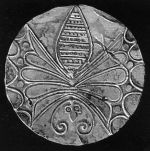
Gold disc found at Myceanae near Greece – possibly dating from 1350 BC
In classical myth, Psyche, which translates as ‘soul’, is represented in the form of a butterfly or as a young woman with butterfly wings. She’s also linked with Eros the Greek God of love. It is also a potent representation of rebirth and in this aspect, the Celts revered it. Some of the Ancient Mexican tribes such as the Aztec and Mayans used carvings of butterflies to decorate their buildings as certain butterfly species were considered to be reincarnations of the souls of dead warriors. The Hopi and Navaho tribes of Native American Indians performed the Butterfly Dance and viewed them as symbols of change and transformation.
The butterfly is an archetypal image of resurrection in Christianity and this meaning is derived from the 3 stages of a butterfly’s life. These are: 1st stage = the caterpillar, 2nd stage = the chrysalis and 3rd and final stage = the butterfly. So the sequence is life, death and resurrection. The emergence of the butterfly from the chrysalis is likened to the soul discarding the flesh. It has been depicted on Ancient Christian tombs and, in Christian art, Christ has been shown holding a butterfly. It is supposed to appear chiefly on childrens memorials but the two that I’ve seen were on adult memorials.
Butterflies also feature in Victorian mourning jewellery and there is a fascinating article on this with some lovely examples at:
In the 20th century, butterflies appeared in the flowing, organic lines of Art Nouveau and often featured in jewellery and silverware.
Face and butterfly on exterior of chapel.
copyright Carole Tyrrell
This example is from the Watts Chapel in Surrey and shows the flowing lines and stylised butterfly. They also appear in vanitas paintings, the name given to a particular category of symbolic works of art and especially those associated with the still life paintings of the 16th and 17th centuries in Flanders and the Netherlands. In these the viewer was asked to look at various symbols within the painting such as skulls, rotting fruit etc and ponder on the worthlessness of all earthly goods and pursuits as well as admiring the artist’s skill in depicting these. Butterflies in this context can be seen as fleeting pleasure as they have a short life of just two weeks.
Vanitas Still Life – Maria van Oosterwijck (1630-16930
Maria van Oosterwijck [Public domain], via Wikimedia Commons
The Nature as a Symbol of Vanitas Abraham Mignon created between 1665-1679.
Abraham Mignon [Public domain], via Wikimedia Commons
Butterfly traditions
There are many superstitions and beliefs associated with butterflies. They are often regarded as omens, good and bad, or as an advance messenger indicating that a visitor or loved one is about to arrive. In Japan, they are traditionally associated with geishas due to their associations with beauty and delicate femininity.
Butterfly & Chinese wisteria by Xu Xi Early Sing Dynasty c970. By Xü Xi (Scanned from an old Chinese book) [Public domain], via Wikimedia Commons
The Chinese see them as good luck and a symbol of immortality. Sailors thought that if they saw one before going on ship it meant that they would die at sea . In Devon it was traditional to kill the first butterfly that you saw or have a year of bad luck as a result. In Europe the butterfly was seen as the spirit of the dead and, in the Gnostic tradition, the angel of death is often shown crushing a butterfly underfoot. In some areas in England, it’s thought that butterflies contain the souls of children who have come back to life. A butterfly’s colours can also be significant. A black one can indicate death and a white one signifies the souls or the departed. It’s also a spiritual symbol of growth in that sometimes the past has to be discarded in order to move forward as the butterfly sheds its chrysalis to emerges complete. So it can indicate a turning point or transition in life. There are also shamanistic associations with the butterfly’s shapeshifting and it has also been claimed as a spiritual animal or totem.
Another view of the Brompton Butterfly surrounded by an ivy wreath.
copyright Carole Tyrrell
An example of a stylised butterfly on a tombstone in Brompton Cemetery in London. Unfortunately the epitaph is now unreadable. copyright Carole Tyrrell
Brompton Cemetery, tomb unknown
This example with its wings outstretched is from Brompton Cemetery in London. Alas, the epitaph appears to have vanished over time and the surrounding vegetation was so luxuriant that I will have to return in the winter to investigate further. Note the wreath of ivy that surrounds it. Ivy is an evergreen and is a token of eternal life and memories. The wreath’s ribbons are also nicely carved.
The Gordon monument, Kensal Green
The second one is perched on the tomb of John Gordon Esquire, a Scotsman from Aberdeenshire who died young at only 37. As the epitaph states ‘it was erected to his memory as the last token of sincere love and affection by his affectionate widow’. Gordon came from an extended family of Scottish landowners who had estates in Scotland and plantations in Tobago amongst other interests. The monument is Grade II listed and is made of Portland stone with a York stone base and canopy supported by the pillars. There was an urn on the pedestal between the four tapering stone pillars but this was stolen in 1997.
John Gordon’s epitaph – he was only 38 when he died and it was erected by his affectionate widow as ‘last token of sincere love and esteem.’ Kensal Green Cemetery
copyright Carole Tyrrell
The Gordon Monument in Kensal Green Cemetery. There are traces of something once being in place – perhaps an urn – on the platform between the pillars.
copyright Carole Tyrrell
The butterfly also has an ouroboros encircling it so, not only a symbol or resurrection, but also of eternity with the tail devouring snake. It is a little hard to see but it is there.
The butterfly symbol of the roof of the Gordon monument Kensal Green Cemetery. copyright Carole Tyrrell
The pharaonic heads at each corner are Egyptian elements within an ostensibly classically inspired monument. Acroteria, or acroterion as is its singular definition, are an architectural ornament. The ones on this monument are known as acroteria angularia. The ‘angularia’ means at the corners.
Detail of the rood of the monument – note the Pharaonic head, one at each corner, and another glimpse of the butterfly. Kensal Green Cemetry
copyright Carole Tyrrell
Close- up of one of the four Pharaonic heads on the Gordon monument. Kensal Green Cemetery
copyright Carole Tyrrell
The entire monument is based on an illustration of the monument of the Murainville family in Pugin’s Views of Paris of 1822 and also on Moliere’s memorial which are both at Pere Lachaise in Paris.
The Gordon memorial incorporates elements of the Egyptian style and symbolism that influenced 19th century funerary monuments after the first Egyptian explorations. Kensal Green contains many significant examples and there are others to be found in Brompton, Highgate and Abney Park. The Victorians regarded the Egyptians highly as it was also a cult of the dead.
So when you next see a butterfly fluttering on the breeze or even perched on a memorial for eternity remember its importance within the tradition of symbols, religions and cultures. Who knows it might be one of your ancestors…..
A pelican in her piety. Detail of monument, The Drake Chapel, St Mary’s Amersham.
copyright Carole Tyrrell
This is a more unusual symbol to find in cemeteries and dates from pre-Christian times. There are two versions of the legend. In one, the pelican pierces her own breast to feed her children with her own blood and in the second she feeds her dying children with her own blood to bring them back to life but as a result she dies herself. In both of them the pelican is a potent motif of self-sacrifice and charity. It’s also seen as a powerful representation of Christ’s Passion in that he gave his life for us and rose again. The symbol is known as a pelican in her piety.
However, the legend of the pelican is found in Physiologies, an anonymous Christian work from Alexandria which dates from the 2nd century. It contained legends of animals and their allegorical interpretations which is where the attribution of the pelican’s sacrifice to the Passion of Christ come from. It states that
‘ the pelican is very fond of its brood, but when the young ones begin to grow they rebel against the male bird (the father) and provoke his anger, so that he kills them, the mother returns to the nest in three day, sits on the dead birds, pours her blood over them, revives them, and they feed on the blood.
The pelican in its piety was very popular during the Middle Ages and can be found on altar fronts, fonts and misericords in churches. Also, when tabernacles were occasionally suspended over the altar, they were shaped like pelicans as was one in Durham Cathedral.
Later, in St Thomas Aquinas’s hymn ‘Adoro te devote.’ or Humbly we adore thee’, in the penultimate verse he describes Christ as:
‘the loving divine pelican able to provide nourishment for his breast’
In Nicholas Hilliard’s famous 1573 portrait of Elizabeth I which is known colloquially as the Pelican portrait she wears a prominent piece of jewellery which features a pelican feeding her young with her blood which symbolised her role as Mother of the Nation.
Detail of The Pelican Portrait showing pelican piercing her own brhttp://www.npg.org.uk/research/programmes/making-art-in-tudor-britain/the-phoenix-and-the-pelican-two-portraits-of-elizabeth-i-c.1575.phpeast to feed young.
The pelican also appears in Shakespeare’s Hamlet in Act IV in which Laertes says:
‘To his good friend thus wide,
I’ll open my arms.
And, like the kind life-rendering pelican
Repast them with my blood.’
The renowned bird appears in key Renaissance literature. For example, Dante in The Divine Comedy refers to Christ as ‘our Pelican’. John Lyly in Euphues of 1606 also wrote:
‘Pelicane who striketh blood out of its own owne bodye to do others good.’
John Skelton wrote in 1529 in his Armorie of Birds:
‘They sayd the Pellycan’
When my Byrds be slayne
With my bloude I them nevyve. Scripture doth record the same dyd as our Lord
And rose from deth to lyve.’
However, the belief that the pelican nourishes her children with her own blood is a myth. It may have arisen from the fact that pelicans have a large pouch attached under their bill. When the parent is about to feed its chicks, it macerates small fish in this pouch and then whilst pressing the bag against its breast, it transfers the food to the babies.
However, its use in Victorian cemeteries may indicate a resurrection motif in that the pelican gives er life to her children so that they are resurrected. It is quite a rare one to find although it does appear within churches especially on wall memorials, altars and fonts.
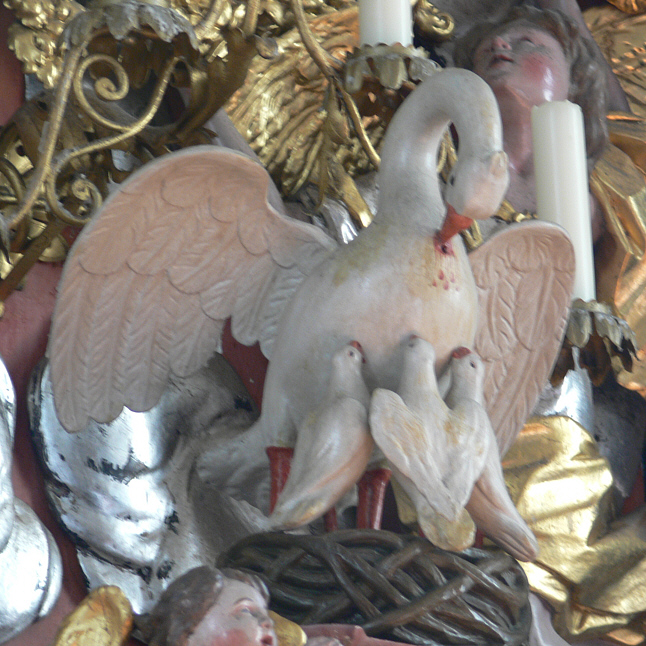
This is a sculpture from a church in Germany. copyright Andreas Praefcke
This is a magnificent impressive pelican sculpture from a church in Germany.
There is an impressive monument in a Cuban cemetery which has a large marble pelican and children carving on it and there is also one on a memorial in Arnos Vale Cemetery near Bristol. This is an especially poignant one as is it is to a young doctor, Joseph Williams, who insisted on treating the local workhouse inmates for cholera, during the 1849 Bristol epidemic. Sadly, and perhaps inevitably, he succumbed to it himself and subsequently died. Here the pelican and her young are a true representation of self-sacrifice.
This is one is in my local church, St Georges in Beckenham and appears on a monument to Dame Ann Frances Hoare who died in 1800 at 64.
A pelican feeding her brood wit her own blood. Detail of monument in St George’s Church, Beckenham.
copyright Carole Tyrrell
The pelican in its piety. The Hoare memorial, St Georges, Beckenham.
copyright Carole Tyrrell
The Hoare memorial, St Georges church, Beckenham.
copyright Carole Tyrrell
And this one is from the Drake Room in St Mary’s Church Amersham.
A pelican in her piety. Detail of monument, The Drake Chapel, St Mary’s Amersham.
copyright Carole Tyrrell
Monument to Rev Frank in the Drake Chapel, St Mary’s Amersham with pelican at the right hand side.
copyright Carole Tyrrell
Here is a more recent use of the Pelican in her piety on a World War II blood donor appeal.
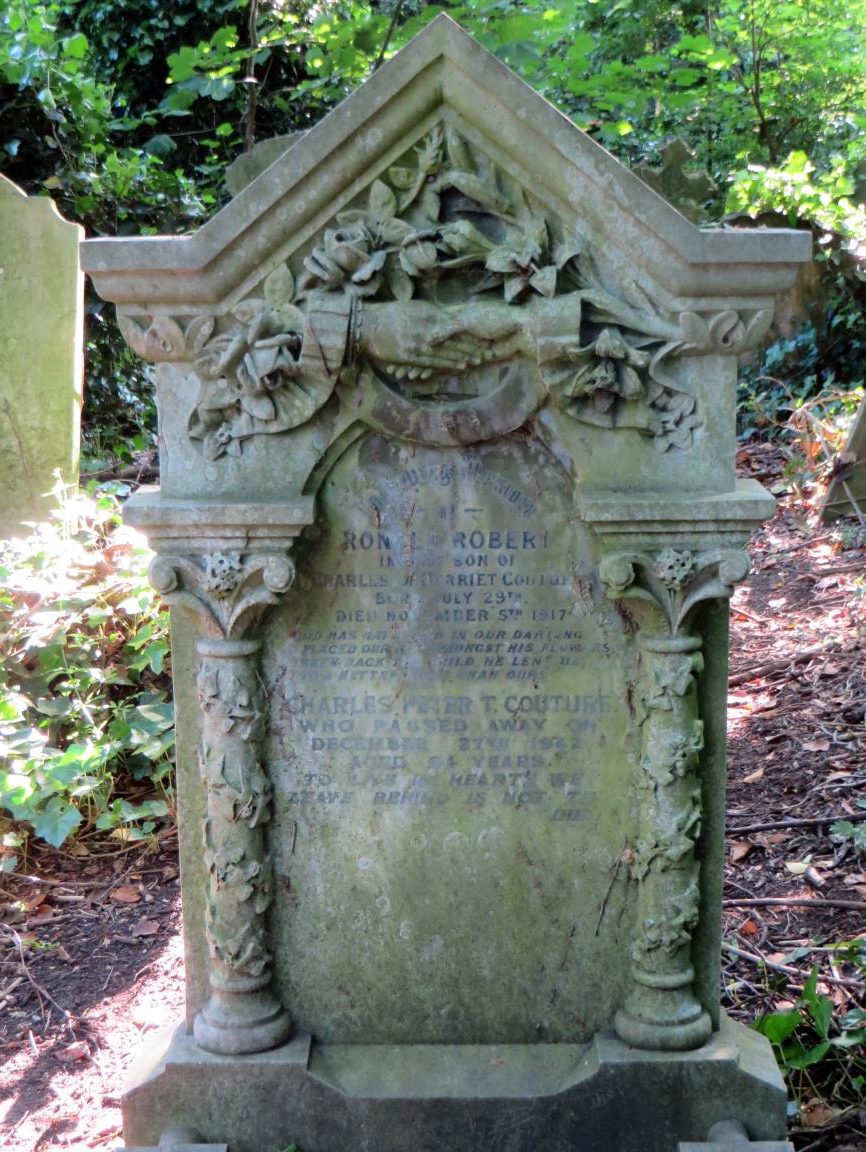
The Couture memorial in Nunhead Cemetery – very ornate and to a son who died in infancy. copyright Carole Tyrrell
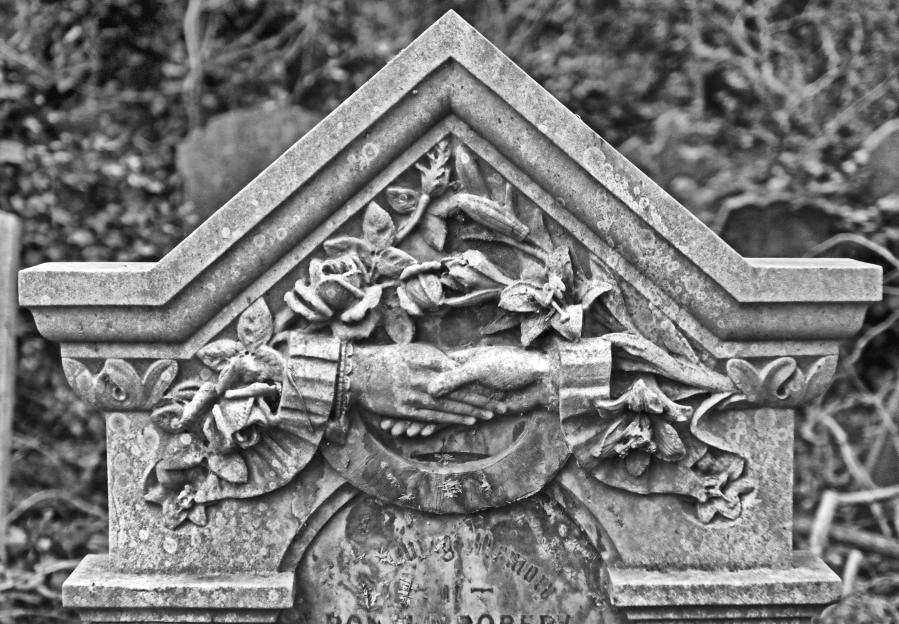
This is one of the most common symbols in a Victorian cemetery and visitors on my tour often ask about it. Initially the handshakes may all look the same but, if you look carefully, there are differences. Although a handshake is a traditional way of saying goodbye or farewell, as with other funerary motifs, it can have several meanings.
For example, it can signify the parting of a wife from her husband or vice versa and this is demonstrated by the fact that on several examples that I’ve seen there are two carefully delineated cuffs. One will have a more attractive, perhaps a frilly one, with the other having a plainer one to indicate the husband. This emphasises a marital connection or at the very least a close bond. It has also been suggested that the deceased person is holding the other’s hand to guide them to heaven.
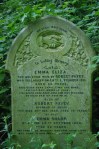
The full tombstone to Emma Eliza Pavey with ivy for evergreen surrounding the handshake. Nunhead Cemetery. copyright Carole Tyrrell
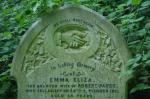
Emma Pavey’s tombstone in Nunhead Cemetery. Note the inscription above the handshake saying ‘We shall meet again’. A comforting thought to those left behind.
copyright Carole Tyrrell
This epitaph is to Eliza Pavey and the differentiation of the cuffs can be seen quite clearly on the handshake. Also his right hand clasps her open right hand with his fingers overlapping. On this tombstone it confirms marriage or a close bond between individuals, unity and affection even after death. There is also a saying above it which reads ‘We shall meet again’. Eliza left behind a sorrowing husband who clearly wanted the comfort of knowing that they would meet again in the after-life. Note the ivy leaves surrounding the handshake which indicate evergreen or everlasting. She died at 54, which is quite a young age at which to die, and her husband, Robert, outlasted her by another 20 years.
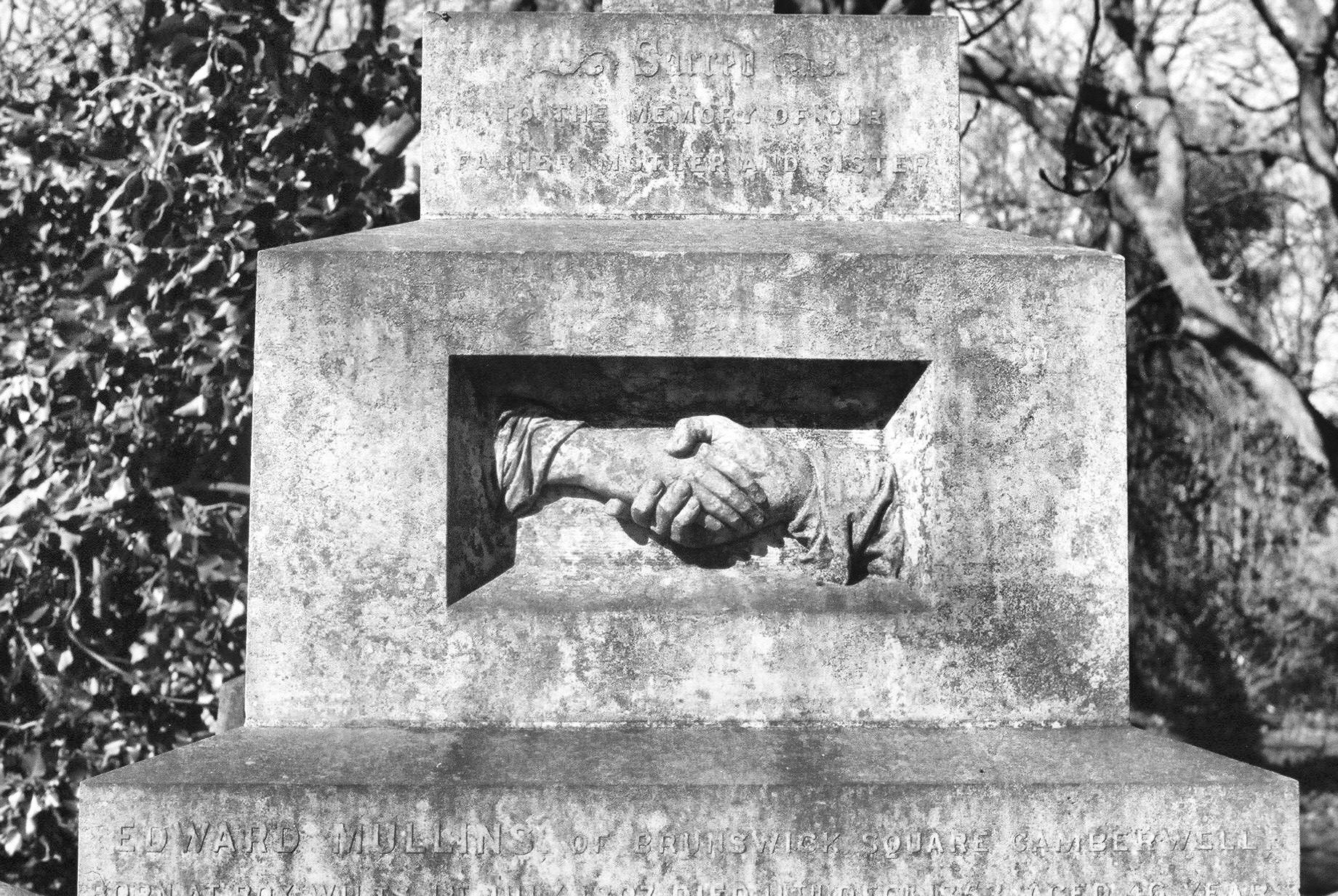
This is on the monument to Edwin Roscoe Mullins a 19th century sculptor. copyright Carole Tyrrell
A particularly striking and beautifully carved example is on the Edward Roscoe Mullins vault. There are several examples within Nunhead Cemetery but these are the best in my opinion. Mullins was a Victorian sculptor and began his career working with classical themes and then moved onto municipal sculpture such as on Croydon Town Hall amongst others. This has been extremely well sculpted, in my opinion, with the two hands and cuffs being sharply defined.
The handshake can also be a representation of hope as there is a suggestion of meeting again in the afterlife.
The full memorial – note the ivy for evergreen or everlasting on the lower pillars. A lovely monument to a much loved child who died in infancy copyright Carole Tyrrell
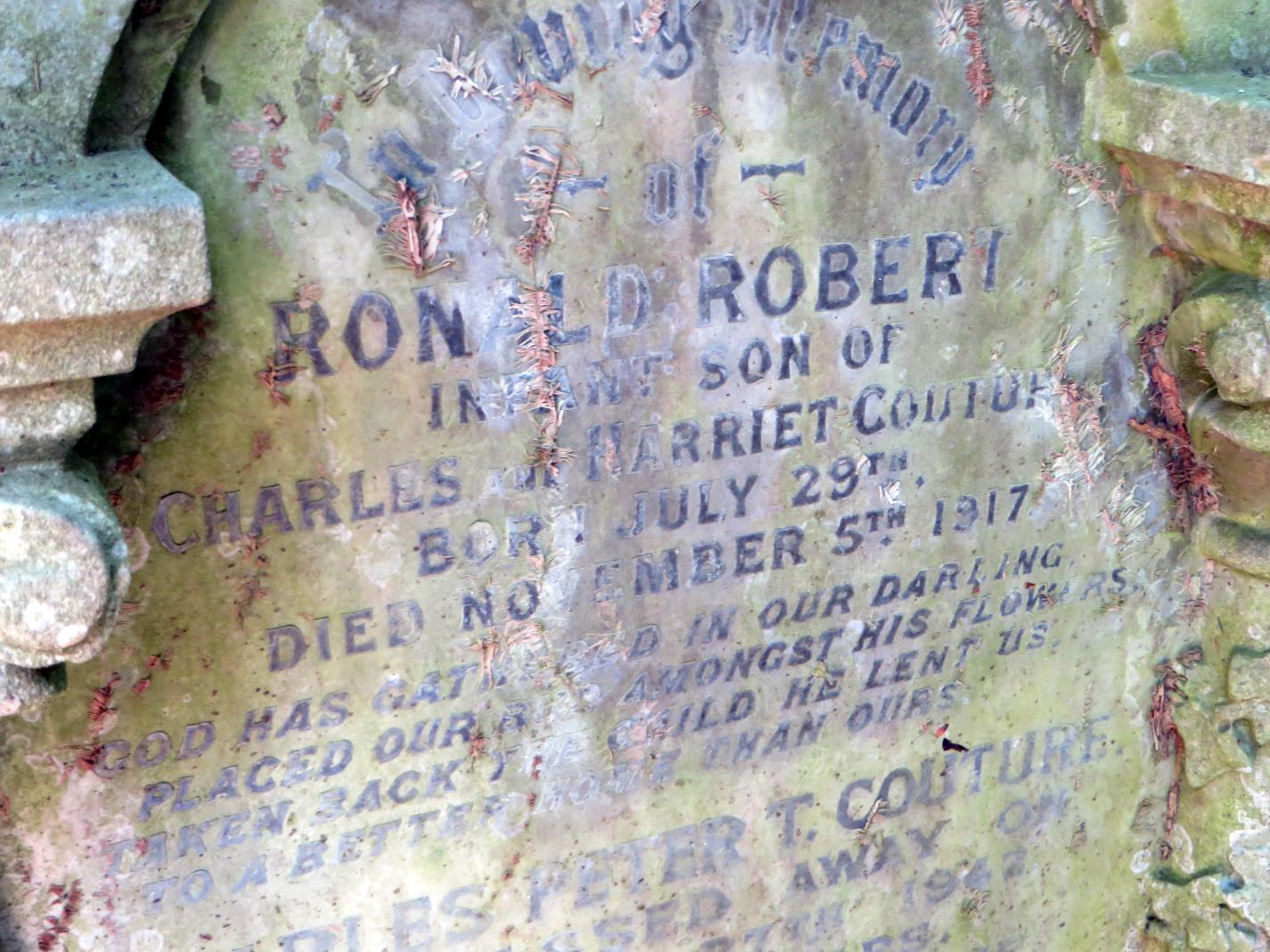
This is the poignant memorial to Ronald Robert Couture who died in his infancy at just over 3 months old. The handshake is garlanded with flowers; roses which represented love, beauty and hope and also daffodils which meant regard in floriography, the language of flowers. There is a rosebud in the garland which often appears on childrens memorials. It represents a life unfulfilled, a rose that never opened and bloomed. There is also ivy entwined around the two pillars. This beautiful and elegant monument to an obviously much wanted and much missed child would indicate that here the handshake is a hopeful sign.
The handshake may also be a reminder of ‘see you soon’ from the deceased to their sorrowing close relatives which may not be as comforting as it sounds with the Victorians high mortality rate.
Ultimately, the handshake is a symbol of comfort and reassurance from the departed to those left behind and in the case of Ronald Couture, that his brief life was not forgotten.
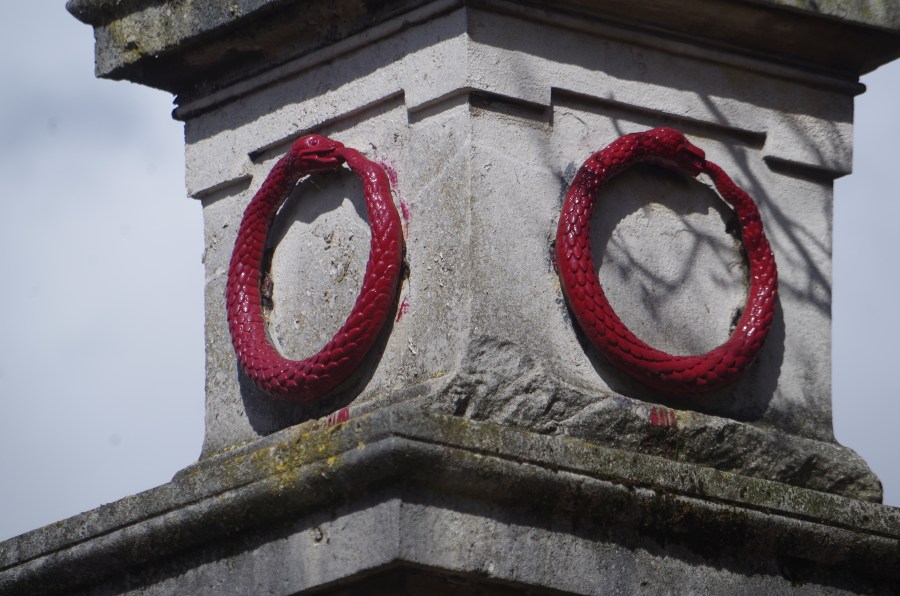
A fine ouroboros on top of one of the piers at Nunhead Cemetery’s imposing Linden Grove entrance.
copyright Carole Tyrrell
Another view of the ouroboros – one on each side -Nunhead Cemetery.
copyright Carole Tyrrell
For every end there is a beginning.
This is only one of the several positive and powerful meanings of the ouroboros which is one of the most ancient symbols known to man. It’s depicted as a snake eating its own tail to sustain its life in an eternal cycle of renewal and it usually forms a full circle. It occurs in many cultures, religions and beliefs. The psychologist, Jung, called it an archetype which is best described as
‘a primitive mental image inherited from the earliest human ancestors, and supposed to be present in the collective unconscious.’
The ouroboros appears in Victorian cemeteries as a symbol of resurrection. The snake is reborn as it sheds its skin and this fine example is on each of the 4 sides on top of the columns at the imposing entrance to Nunhead Cemetery, London. Victorian visitors would have understood its meaning. As a resurrection image it can be very positive as some of its other attributes are immortality, eternity and wisdom. However, as with most symbols , it can have several meanings. These include the Universe’s cyclic nature and life out of death. It constantly appears to return as it sheds its skin and, Phoenix-like, has a cycle of life, death and rebirth.
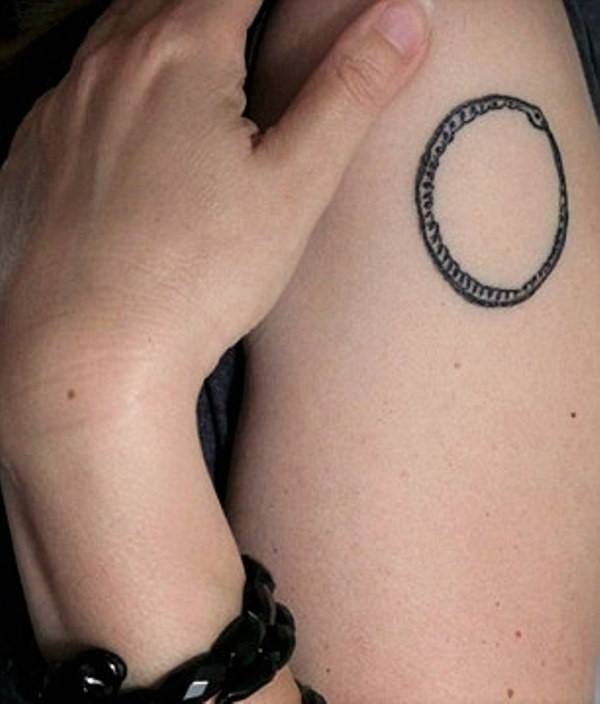
There is also a magnificent ouroboros on the gates of Sheffield General Cemetery and one in Highgate Cemetery West on the doors to a mausoleum. It inspired the tattoo worn proudly by Jeane Trend-Hill a photographer and fellow cemetery explorer.
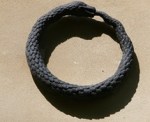
Photographer and fellow cemetery enthusiast, Jeane Trend-Hill’s ouroboros tattoo and Whitby mourning bracelet based on one in Highgate. copyright Jeane Trend-Hill Used with kind permission.
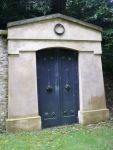
This is the mausoleum to which the ouroboros belongs.
Note downturned torches on doors.
copyright Jeane Trend-Hill and used with kind permission.
A lovely picture of an ouroboros on a mausoleum in Highgate West.
copyright Jeane Trend -Hill – used with kind permission
But the ouroboros’ origins lie in either ancient Greece or Egypt as both cultures have claimed it. In Greece, Plato described it as ‘the first living thing, a self-eating, circular being’. In fact, the Greek translation of ouroboros is ‘tail devouring snake’ and it’s associated with something constantly recreating itself and the eternal return.
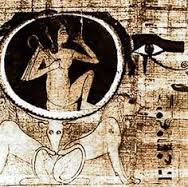
In Egypt, the ouroboros reputedly appears for the first time in the 14th century BC in Tutenkhamen’s tomb on an ancient funerary text. This depicts the Sun God Ra and his union with Osiris in the underworld and is illustrated with two serpents , holding their tails in their mouths, coiled around hands and feet. This may be a representation of the unified Ra-Osiris. Both serpents are reputedly the manifestation of the god Mehen, who in other funerary texts protect Ra in his underworld journey. I haven’t been able to find an image of this particular representation but I did find this one which purports to be even older.
It’s from a papyrus dated 1077 – 943BC, from the papyrus of Dama and is of the ouroboros surrounding the Sun-Ra.
The ouroboros appears in Hindu, Norse, Aztec and Chinese religions. It’s also a significant alchemical symbol as well and features in Cleopatra the Alchemist’s work. There are also Masonic associations from seals dating from the 17th century.
In fact, on a recent edition of BBC TV’s Antiques Roadshow shown on Sunday 1 May 2016, a triangular Masonic clock was shown and among its several motifs was an ouroboros. In China it can also take the form of a dragon. In the Waite deck of Tarot cards it features on the Magician card.
I found this quote online:
‘In other myths the ouroboros encircles the whole world, a circumference of the waters surrounding the earth. It can support and maintain the world and also inject death into life and life into death. Although apparently immobile, it’s actually in perpetual motion, forever recoiling upon itself.’
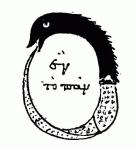
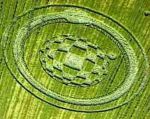
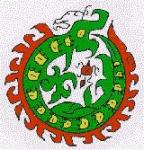
Here is a selection of ouroboros representations from other cultures:
Gnostic gem from Roman-era Egypt (1st century AD), with an ouroboros surrounding a scarab and voces magicae, characters representing magic words Wikipedia.com
Early alchemical ouroboros illustration. From the work ofCleopatra the Alchemist (Greco-Roman Egypt).
wikipedia.com
One of the many fascinating myths surrounding the ouroboros is the experience of the chemist, August Kekule, who was trying to discover the structure of benzene. This is how he described his Eureka moment :
‘I was sitting, writing at my text-book; but the work did not progress; my thoughts were elsewhere. I turned my chair to the fire and dozed. Again the atoms were gambolingbefore my eyes. This time the smaller groups kept modestly in the background. My mental eye, rendered more acute by the repeated visions of the kind, could now distinguish larger structures of manifold conformation: long rows, sometimes more closely fitted together; all twining and twisting in snake-like motion. But look! What was that? One of the snakes had seized hold of its own tail, and the form whirled mockingly before my eyes. As if by a flash of lightning I awoke; and this time also I spent the rest of the night in working out the consequences of the hypothesis.’
As I said earlier, Jung would see this dream as evidence of the ouroboros and its effect on the collective unconscious.
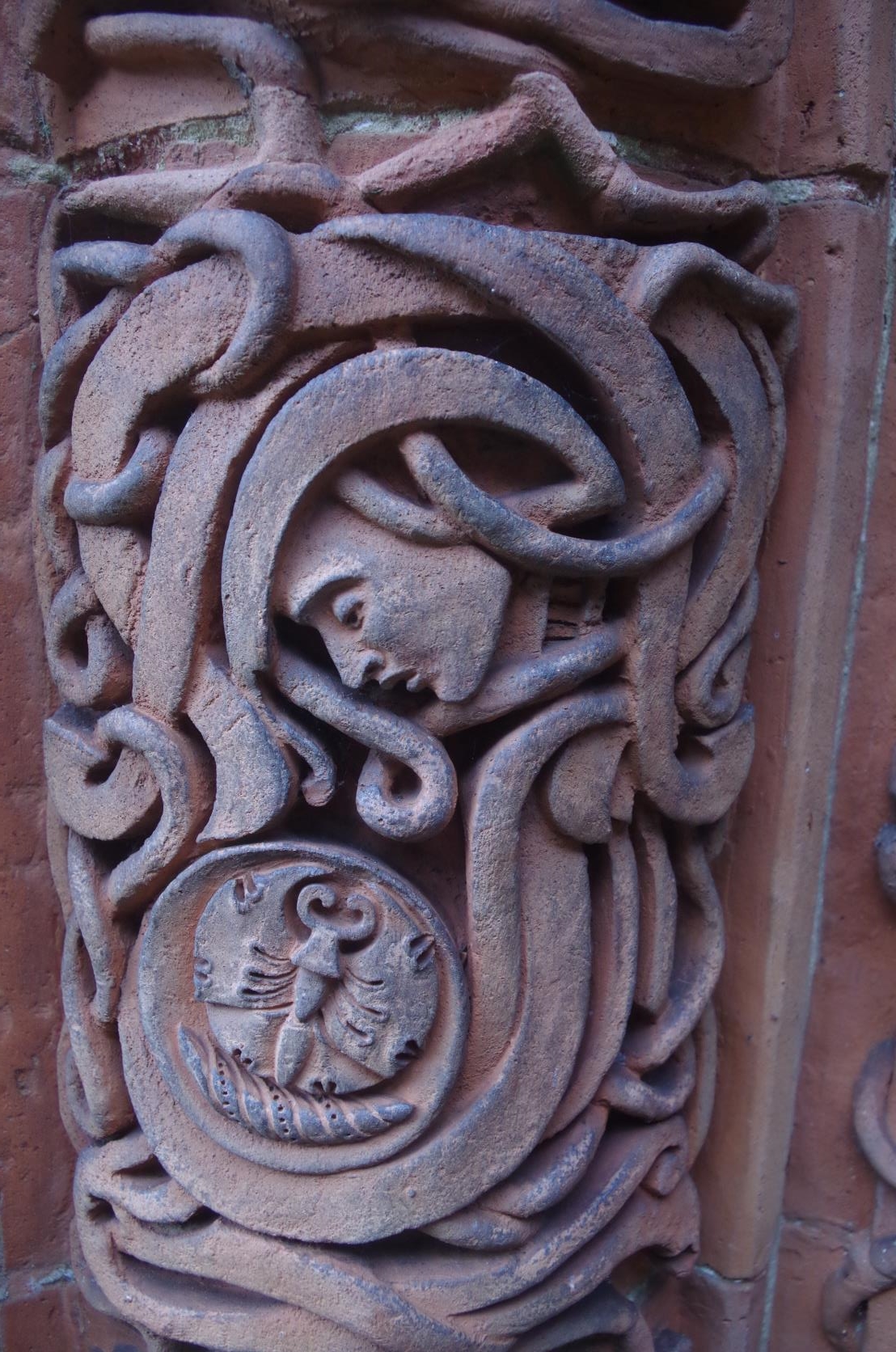
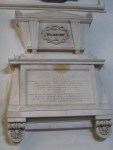
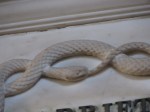
Although the ouroboros is usually depicted as a full circle, this is one that I found in my local church. On first glance, it merely looks like an attractive, rippling border around the name Harriet and It dates from 1815. But on a recent visit, I looked closer and realised that it was actually composed of 2 entwined snakes, each biting their own tail. When I spoke to a churchwarden, she had always thought that, due to the patterning on the snakes’ bodies, that it was two entangled pieces of rope. It is a memorial to a young wife who died aged 25 after suffering the ‘most acute and lingering pains.’ So it would have been a potent reminder of resurrection.
What initially looks like a simple pattern is two snakes entwined – tail to head. copyright Carole Tyrrell
The entire monument to Harriet.
copyright Carole Tyrrell
Close-up of the snakes.
copyright Carole Tyrrell
Harriet’s epitaph and obviously much missed.
copyright Carole Tyrrell
The ouroboros is one of the most intriguing and interesting symbols that I have researched so far. A universal image of rebirth and hope.
A unique symbol in Nunhead Cemetery – a carriage spring. copyright Carole Tyrrell
This is one of the most intriguing and baffling symbols to be found in any cemetery. Visitors are mystified as to its meaning and inspiration and there has been a lengthy discussion about it recently on a cemetery related Facebook page.
It’s tucked away in Nunhead Cemetery and, despite being given directions by Robert Reinhardt, a Facebook friend, I couldn’t find it. He had posted images of it online and I was immediately intrigued. But I couldn’t locate it despite making several visits.
But, as luck would have it, I was in Nunhead Cemetery again, looking for another memorial altogether when there it was, hiding in plain sight.
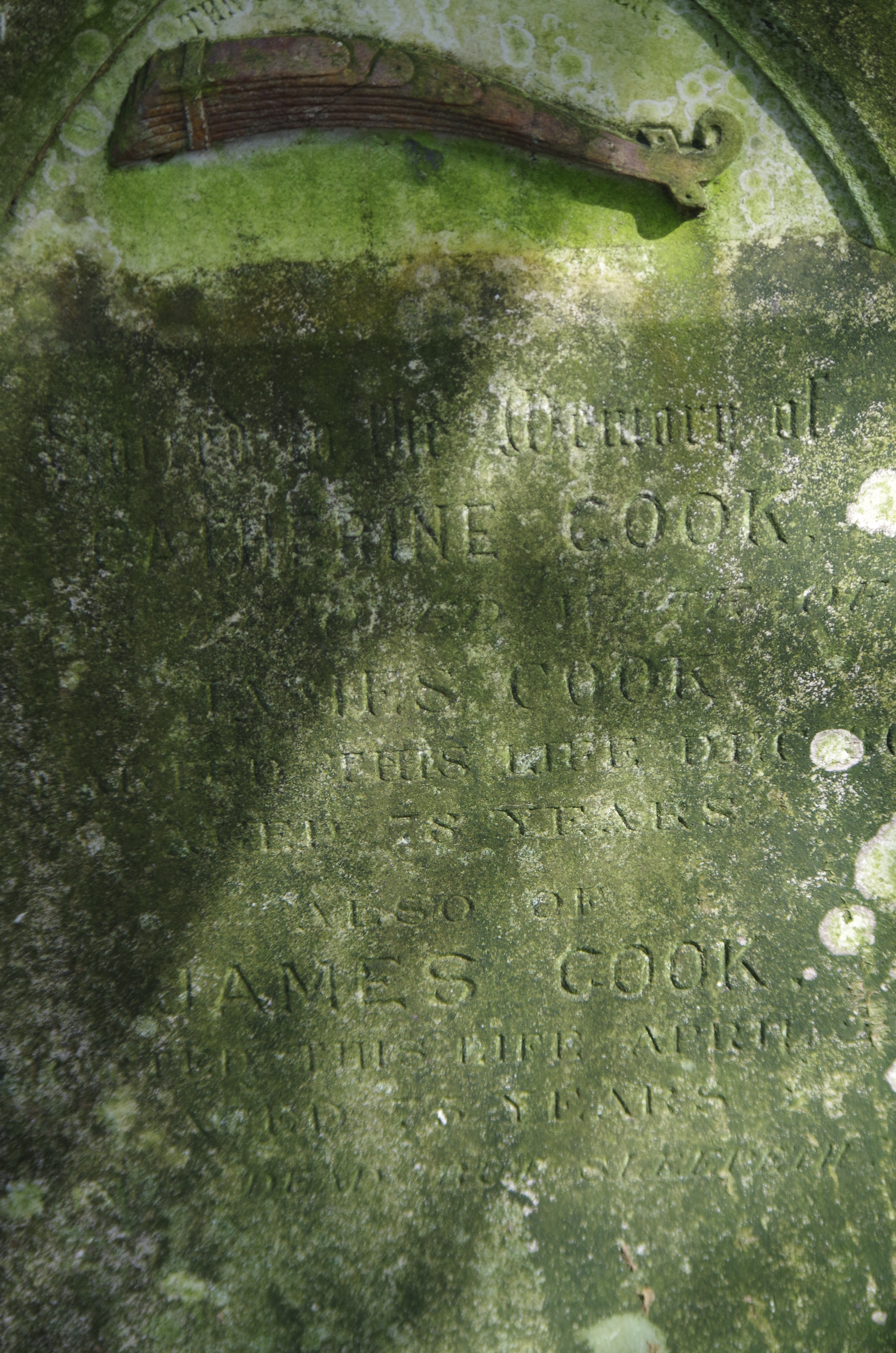
Epitaph on Catherine Cook’s tombstone – beloved wife of James Cook. copyright Carole Tyrrell
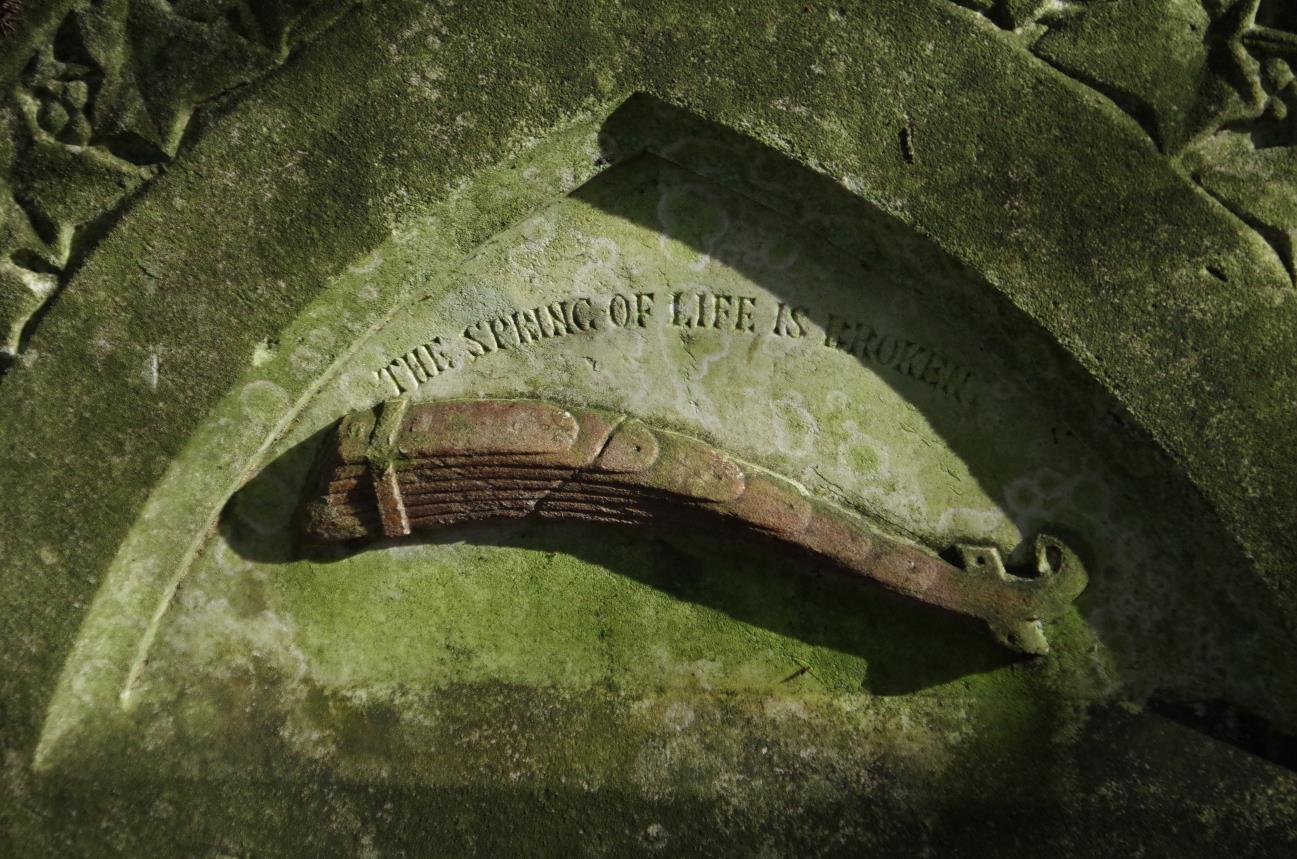
It’s a memorial to Catherine Cook, beloved wife of James Cook as it says on the epitaph, with the motto ‘The Spring of Life is broken’ and the carving above it with a lovely border of carved ivy leaves representing ‘evergreen’ or ‘eternal.’
But let’s digress for a moment. This is a well carved leaf spring which is one of the earliest forms of suspension in a wheeled vehicle. Leonardo da Vinci used them in his own design for a self-propelled car. The one of Mrs Cook’s tombstone is an example of a multi-leaf spring in which leaf springs of varying lengths have been stacked on top of each other, sometimes up to 20 at a time, to enable the vehicle’s load to spread more widely.
I found the above diagram of a leaf spring online on various sites and it explains how it works.
But why is it depicted on an obviously much missed wife’s tombstone?
My own theory, and it is only my theory is that it’s a variant on the broken column.
This is an example of a broken column from Nunhead Cemetery.
copyright Carole Tyrrell
The column isn’t the result of vandalism but has been deliberately created like this. It indicates that the departed, often a male, was the head of the house and now the support of the family, or its backbone, had gone.
So I feel that this could be a female version. Mrs Cook was obviously the support to her husband and family in that the suspension, the object that made the family load easier to manage, has gone.
Since finally discovering it, I’ve come to admire it as a unique and affectionate tribute to a much loved woman.
You are completely free to disagree and to offer your own interpretation and I’d be very interested to receive them.


























![Butterfly & Chinese wisteria by Xu Xi Early Sing Dynasty c970. By Xü Xi (Scanned from an old Chinese book) [Public domain], via Wikimedia Commons](https://shadowsflyaway.blog/wp-content/uploads/2016/07/butterfly-chinesewiki.jpg)

















 shadows fly away
_1935.jpg)
