Nine symbols for the price of one! – The Daniel Vault, Nunhead, London,


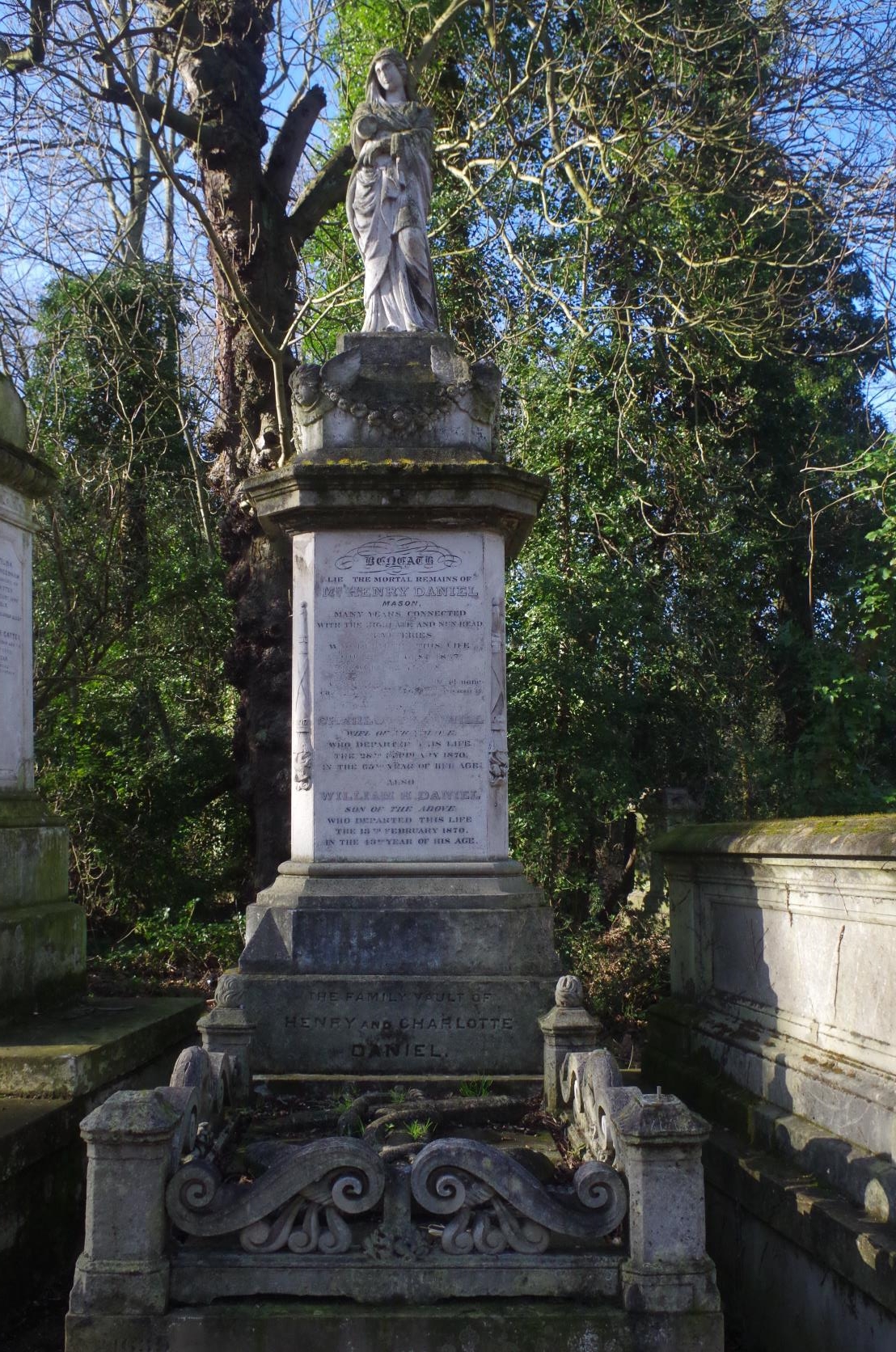
The Henry Daniel vault at Nunhead Cemetery, UK. He was a monumental mason who worked at the cemetery. copyright Carole Tyrrell

The Henry Daniel vault at Nunhead Cemetery, UK. He was a monumental mason who worked at the cemetery.
copyright Carole Tyrrell

This month instead of Symbol of the month I will be discussing a monument which is a gift to anyone interested in symbols and their meaning. Not one symbol but nine!

When you first look at the Daniel vault you may well be impressed by its extravagant decoration.  It’s absolutely studded with symbols and, due to its advantageous location close to the chapel and thus nearer to God, you can’t miss it.   In fact some of the larger monuments are in this area and the idea appeared to be that, even if you couldn’t take your money with you, at least you’d had it while you were alive and could prove it.

But there’s an interesting story behind each of the symbols and also of Henry Daniel himself.  He founded a dynasty of monumental masons who were closely associated with Nunhead Cemetery until its closure.  He established the first mason’s yard at Nunhead and two other firms followed.  These were Preston & Company and A Stogden.  Henry and his family lived opposite Nunhead’s imposing Linden Grove entrance gates in the imposing and rambling Gothic style residence that he built surrounded by his workshops and lived in it with his family until he died in 1867 aged 62.

The newly established large Victorian cemeteries meant that masons were kept busy and had a steady income.  They not only created monuments and memorials but also maintained graves and constructed vaults.    If you look along the edges and the bottom of graves and monuments in Nunhead and Highgate cemeteries you may well find the Daniel name.

Henry also had a workshop in Swains Lane at Highgate and according to an inscription on one of the monuments that his workmen helped to create, he was at one time the London Cemetery Company’s mason.  They owned both Nunhead and Highgate Cemeteries.

Daniel’s was in business until Nunhead closed, or was abandoned depending on your point of view, in 1969.  Afterwards, Henry’s  family home and yard was demolished after being a local landmark for over 100 years. It’s interesting to speculate if it would be preserved today after the fight to preserve the attractive and historic Lander monumental masons showroom near Kensal Green Cemetery’s imposing entrance.   It too was destined to be replaced by another bland apartment block.

It has been suggested that the vault is an advert for Daniel’s masons and I haven’t been able to find any proof of this.  However, to anyone interested in symbols it is a wonderful teaching aid as it has so many.

We begin at the top of the memorial with a woman swathed in draperies with her head looking down.  This is a mourning woman and a return to classical, especially Roman, themes.    They are often portrayed as leaning on an urn or a cross but as you can see this one stands alone.  The Historic England, formerly English Heritage, describes her as ‘a heavily swathed vestal figure.’
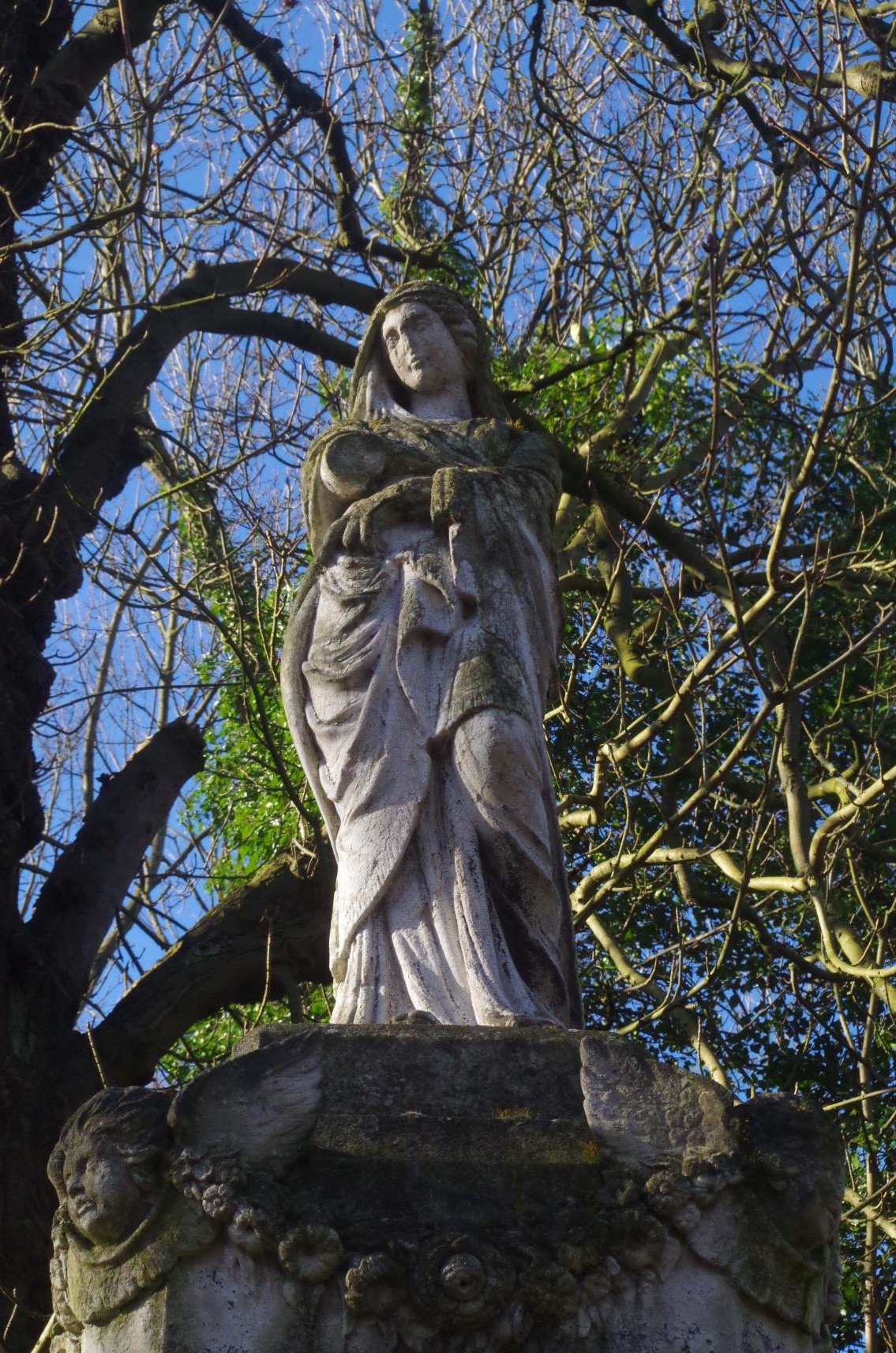
A classical Roman mourning figure swathed in robes on top of Daniel vault.. copyright Carole Tyrrell
A classical Roman mourning figure swathed in robes on top of Daniel vault..
copyright Carole Tyrrell

Now look beneath her feet.  There are winged cherubs or putti, one at each corner.  They have wings and so that makes them putti. They too are of classical origin and represent Eros or Cupid.   The flower garland than surround the base of the mourning woman features roses.

This is one of the four cherubs - one at each corner of the base on which the mourning woman stands.. Note flower garland. copyright Carole Tyrrell
This is one of the four cherubs – one at each corner of the base on which the mourning woman stands.. Note flower garland. copyright Carole Tyrrell

Garlands are a symbol of victory over death.

Roses:  This is one of the most popular flowers and means love, beauty and hope.  It has been said that they are associated with the rose without thorns – the Virgin Mary.  A rose is also known as the queen of flowers due to its fragrance and beauty.  Unopened roses still in their bud form often appear on children’s graves.  The longer a person lived, the more full blown the rose would be.  However I think that roses are used more as decoration these days.

Another view of the mourning woman, cherubs and garland. copyright Carole Tyrrell
Another view of the mourning woman, cherubs and garland.
copyright Carole Tyrrell

Now look at the two torches on either side of the epitaph.  These are downturned torches and you will also see cast-iron version on Nun head’s Linden Grove entrance pillars.  This is a common symbol and, when the flame which would normally go out when torch is inverted, it symbolises the eternal flame of life and the resurrection.  There is a variant with a torch that remains upright on a memorial in Kensal Green cemetery which I assume means eternal life.

Close-up of one of the downturned torches. copyright Carole Tyrrell
Close-up of one of the downturned torches.
copyright Carole Tyrrell

Now look down at the elegant Grecian style scrolled decoration and in particular the two very stylised wreaths.  I see them as laurel wreaths and they are again a return to classical symbols.  They symbolise eternal life as they are circular with no beginning or end and also made of evergreens which never die.   A symbol of victory over death and also military or intellectual glory. The word ‘laureate’ come from these and meant poetical or musical achievements.

Note the wreaths at the centre of the scrolling - stylised laurel wreaths. copyright Carole Tyrrell
Note the wreaths at the centre of the scrolling – stylised laurel wreaths.
copyright Carole Tyrrell

At each corner is an Eternal Flame which stands for everlasting life.
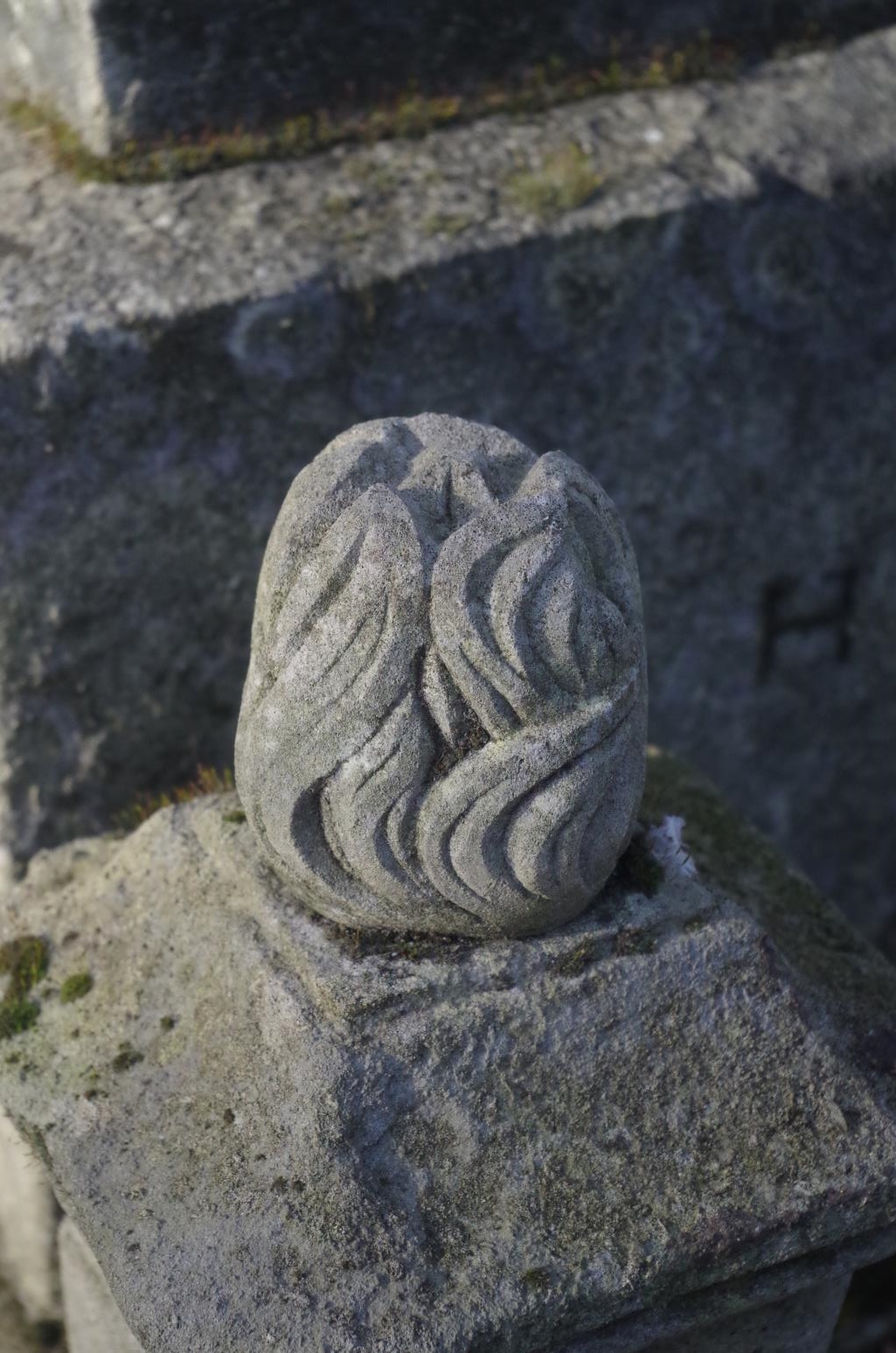
The Eternal Flame - originally there were 4 - one at each corner but now there are only 2. copyright Carole Tyrrell

Then we come to the snake wrapped around the anchor. A snake is a symbol of immortality and as such appears in many cultures over thousands of years. .  It’s not an ouroboros as are the ones on Nunhead cemetery’s  entrance pillars.  It has various associations including tattoos in which snakes are seen as potent symbols.

The Grecian scrolling along the sides. copyright Carole Tyrrell
The Grecian scrolling along the sides and the snake and anchor.
copyright Carole Tyrrell

Anchor:  This is a Biblical symbol and is a Christian one of hope.  The early Christians were reputed to have used the anchor as a disguised cross. It’s often set against a rock and so people often assume that it has a sea-faring connection but this isn’t always true.  The Hope and Anchor is a common pub name in the UK.  An anchor with a broken chain represents the end of life.

It’s rare to find so many symbols on one monument and also extremely well carved as well. Although the epitaph is now wearing thin the sentiments of eternal life, love, mortality and victory over death still remain for all to see.

Text and photos copyright Carole Tyrrell


Sources:

How to read Symbols, Clare Gibson, Herbert Press, 2008

Nunhead’s Monumental Masons, Ron Woollacott, Nunhead Cemetery An Illustrated Guide, FONC 1988

Stories in Stone, Douglas Keister, Gibbs Smith, 2004

http://historicengland.org.uk/listing/the-list-entry/1385649

http://www.lsew.org.uk/funerarysymbolism

http://www.oakdalecemetery.org/funerary-art-symbolism.asp

http://tchevelier.com/fallingangels/bckgrnd/cemeteries

http://www.thecemeteryclub.com  – useful resource, currently being updated (Feb 20160

http://www.whats-you-sign.com/snake-meaning-and-snake-tattoo-ideas.html    – tattoo site


Symbol of the Month – The Passionflower

This month I am looking at the passionflower as a symbol.  It is so called because it’s been  claimed that it symbolised Christ’s suffering on the cross.

But first, let’s digress for a moment and discuss Floriography or the language of flowers.  This is very pertinent to the study of Victorian funerary symbols although some visitors may just see them as charming and pretty decoration.

Floriography is a way of communicating through the use of arrangement of flowers.   It has been used for thousands of years in various cultures, most notably in 17th century Turkey and throughout the Middle East.

But it reached its zenith in Victorian England.  The Victorians love of flowers coincided with their love of cyphers and coded messages.  Anyone who has ever watched TV’s Antiques Roadshow jewellery expert, Geoffrey Munn, revealing the hidden meanings behind the seemingly innocuous combination and arrangement of stones in a brooch will know what I mean.

The strict etiquette of the 19th century that was expected of the upper and middle classes meant that people had to find other, more secretive means to express feelings and messages that couldn’t be openly shared.  And so flowers became the most popular method.   Floral decoration was already extremely popular in the home with William Morris’s wallpapers, for example, so they became the preferred choice.

Floral dictionaries were extremely popular.  The first official one, entitled The Language de Fleurs, was published in Paris in 1819. It was written by Louise Contambert who wrote under a pen name. However, in 1879 a Scotswoman, Miss Carruthers, wrote one that rapidly became an essential guide.

Today some of the original meanings have been lost but eventually I hope to post a guide to Victorian floral funerary decoration and its meanings.

Now back to the Passionflower.  It is a symbol of faith and suffering.  The story goes that it is so named, because of  a Scholar in Rome called Jacomo Bosio who was writing a treatise on the Crucifixion.  A Mexican friar showed him a passionflower and Jacomo included it in his work.

These are the symbols of  Christ’s Passion within the passionflower:

.

The unique corona Christ’s crown of thorns
The sepals and petals The Apostles excluding Judas and peter who distanced themselves from Christ before the Crucifixion.
The five anthers The five wounds on Christ’s body.
The three stigmas The three nails that pierced Christ’s body on the Cross
The leaves The spears that pierced Christ’s side
The tendrils The scourges which flayed Christ’s flesh.


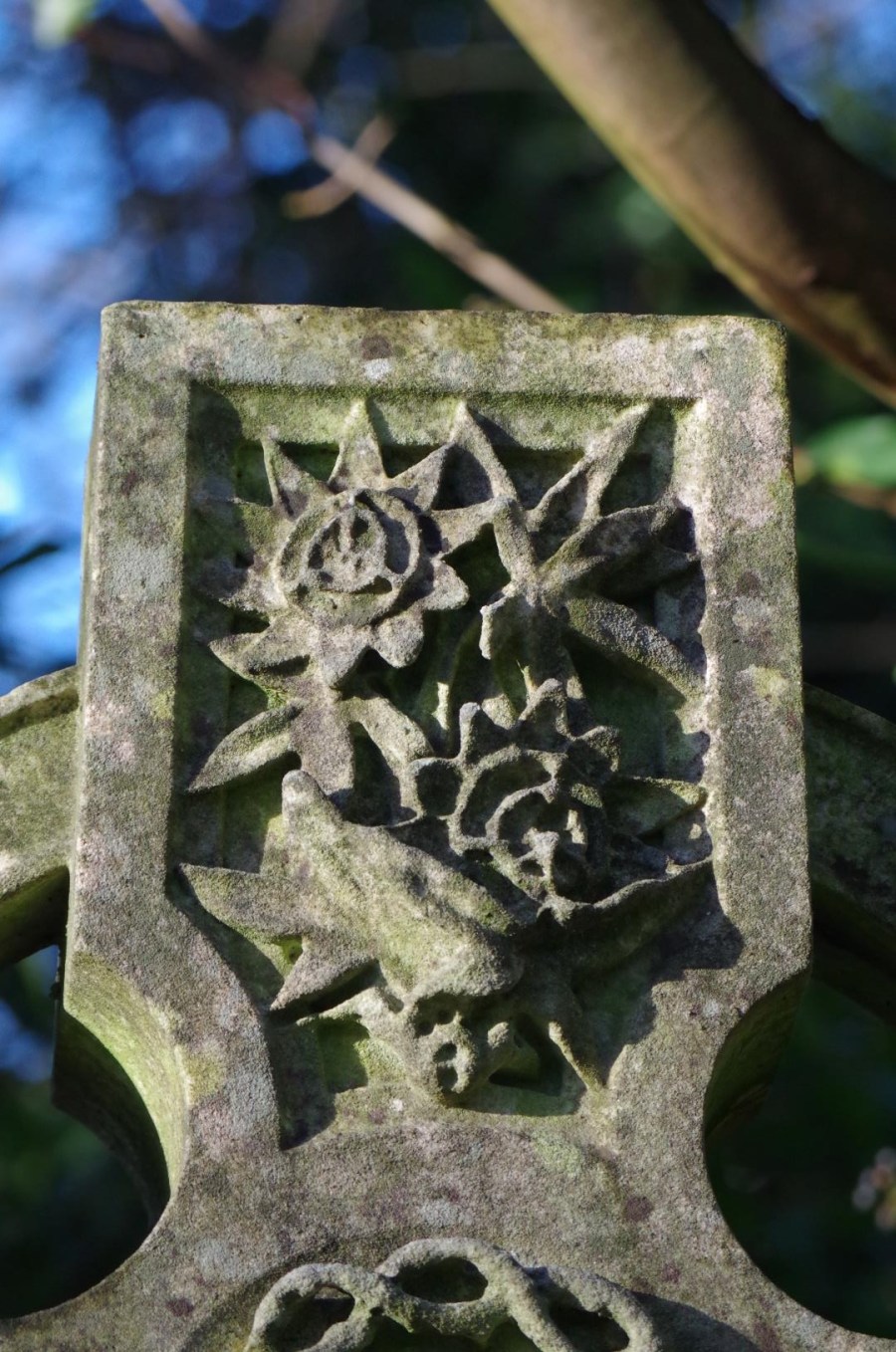
It’s a deeply religious flower and I include two well carved examples on memorials from Nunhead Cemetery, one of London’s Magnificent Seven, UK.

Mills1
Another good example of passionflowers – Mills Nunhead Cemetery UK copyright Carole Tyrrell

This is the Mills memorial.  A Celtic Cross filled with sculpted blooms which are beginning to erode under an inner city climate.

Blackburn
A well carved border of passionflowers on a tomb in Nunhead Cemetery UK copyright Carole Tyrrell

This is the Blackburn tombstone with a lovely 2 dimensional frieze of the flowers.

passionflower
An actual passionflower displaying the elements that have made it such a powerful religious symbol. copyright Carole Tyrrell

This is the real thing.

Sources:

www.wikipedia

www.proflowers.com

www.fleursantamonica.com

Text and photos copyright Carole Tyrrell


Symbol of the month – the Hourglass

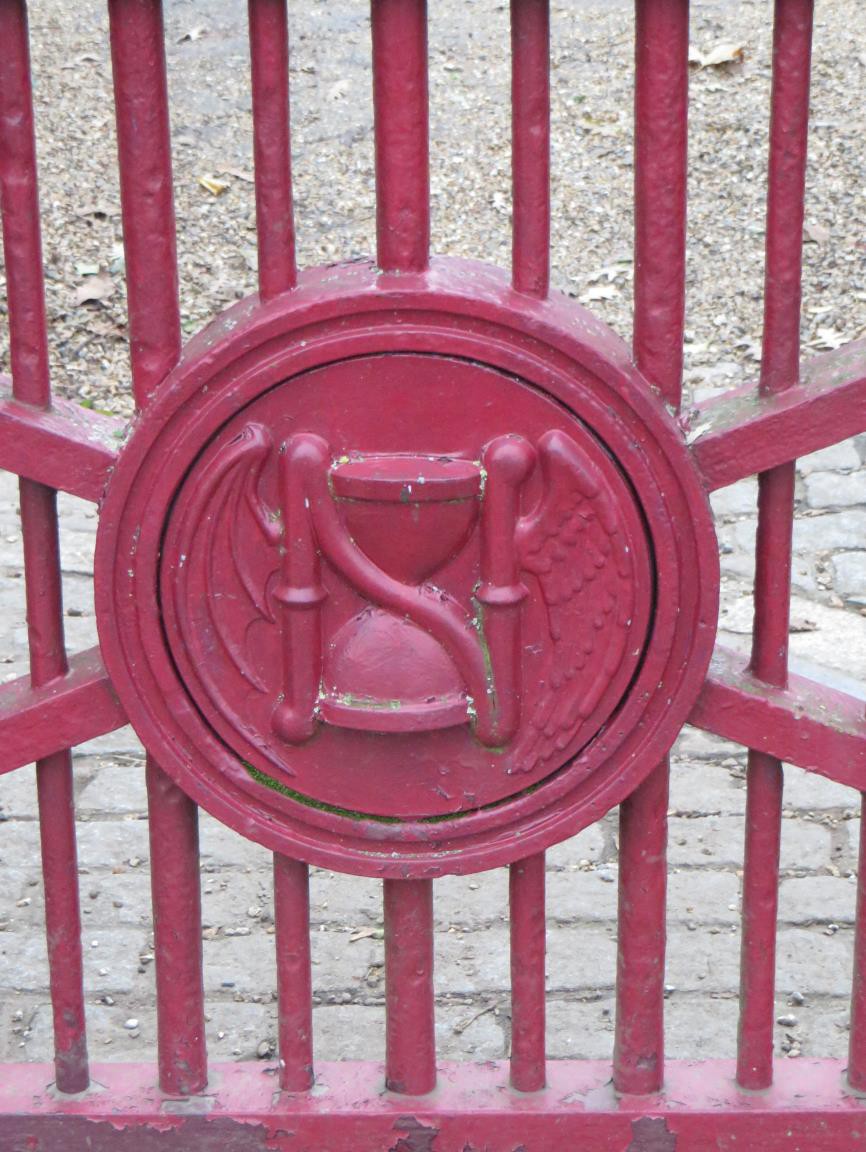
Nunhead winged hourglass
A splendid, modern example of a winged hourglass . copyright Carole Tyrrell

Nowadays, most people associate the hourglass symbol  with the irritating little symbol on your computer screen that announces that the PC or laptop is thinking about doing something or the one that times the boiling of your egg to boil.  It’s a traditional symbol of waiting nowadays.

But an hourglass, sometimes with wings, on a tombstone is different.  Instead, it’s a reminder of mortality in that the ‘sands of time’ have run out.    A winged hourglass reminds us that time waits for no-one as time flies literally.  It can often be seen in vanitas paintings as a reminder that life is fleeting, that time is passing rapidly and that every day, one comes closer to death.

StillLifeWithASkull
Philppe de Champaigne Vanitas, 1671

Still Life with Skull ‘Life, Death & Time’

Vanitas, from the Latin for vanity, is a genre of art that flourished in the Netherlands during the early 17th century.  It’s a particular form of still-life and contains collections of objects that are symbolic of the inevitability of death, the transience of life and vainglory of earthly pursuits and pleasures.  The viewer is invited to look at the picture and to be reminded of their own mortality.  They also provided a moral justification for painting attractive objects. As in much moralistic genre painting  the enjoyment evoked by the sensuous depiction of the subject is in a certain conflict with the moralistic message.  Vanitas pictures evolved from earlier simple paintings of skulls and other symbols of death which were frequently painted on the back of portraits during the late Renaissance. It’s height of popularity was from 1620 – 1650 and was centred in Leiden in the Netherlands, Flanders.


Very few vanitas picture contain figures; instead they contain certain standard items.  These are: symbols of arts and sciences (books, maps, and musical instruments), wealth and power (purses, jewellery, gold objects), and earthly pleasures (goblets, pipes, and playing cards); symbols of death or transience (skulls, clocks, burning candles, soap bubbles, and flowers); and, sometimes, symbols of resurrection and eternal life (usually ears of corn or sprigs of ivy or laurel).   And of course hourglasses to reflect the passing of time and the need to make the most of it.  Objects were often tumbled together in disarray, suggesting the eventual overthrow of the achievements they represent.


However, Douglas Keister, author of Stories in Stone, has suggested another, bolder interpretation. ‘The hourglass can also be turned over or inverted over and over again which symbolises the cyclic nature of life and death, heaven and earth.’    Inversion can be seen as the interplay of opposites in death giving rise to life and vice versa. ‘

In fact it wasn’t until I started researching for this piece that I realised how many interpretations the hourglass symbol could have. Pirates are reputed to use it on their flags as a warning that their time, or lives, were about to run out, to scare their victims and enemies.  Hourglasses were often placed in coffins.  They can also feature in tattoos especially in prison where a tattoo of an hourglass can mean no parole.

There is also an association with old movies in that the hero/heroine has one span of the sad in which to make a decision or rescue.  The dramatic turning over of the great hourglass down to the spiralling of that last grain of sand adds to the mystery and drama.

A quick online search revealed masonic and spiritual associations.  2 saints are pictured with hourglasses; St Ambrose and St Magdalene.   And Chronos, the personification of time,  is also associated with it.  But always with the same connotation of time passing and the need to be aware that life is fleeting and to make the most of it. The Grim Reaper or Death when depicted as a skeleton often holds an hourglass with his scythe.

The splendid example at the top of this page is on the roundels on the Linden Grove entrance gates to Nunhead Cemetery.  This is one of London’s Magnificent 7 Victorian cemeteries.  They were created and cast by Robert Stephenson who is a lecture on death and funerary commemoration  and is also known as ‘Dr Death’.

Sources:

How to read symbols, Clare Gibson, A C Black, 2009

A Guide to the Grave Symbols in Nunhead Cemetery, Ron Woollacott, FONC Publications, 2004, republished 2006.

Stories in Stone – A Field Guide to Cemetery Symbolism and Iconography, Douglas Keister, Gibbs Smith, USA 2004

An Illustrated Encyclopaedia of Traditional Symbols, J C Cooper, Thames & Hudson, 1978

Wikipedia

http://www.britannica.com

Text and photos copyright Carole Tyrrell unless indicated otherwise.


Symbol of the month – Skull and Crossbones

Skulls and crossbones copyright Carole Tyrrell
Skulls and crossbones
copyright Carole Tyrrell

The skull and crossbones symbol is a ‘memento mori’ which is Latin for ‘Remember that you have to die’ or ‘Remember that you are mortal.’ It’s a reminder of the temporary, transient nature of human life. We are all born to die and should try to make the most of life.
The skull and long bones crossed together are the survivors after death along with the other bones as they are the body parts that survive after the flesh has gone. It originated in ‘The Danse Macabre’, a medieval European allegory, in which the universality of death invites everyone, from all walks of life, to dance along to the grave. They are often accompanied by a pope, emperor, king, child, or

The Danse Macabre
The Danse Macabre Nobleman and Physician from the Lübeck Totentanz courtesy UT Southwestern

labourer as key symbols and people. It was intended to remind people of the fragility of their lives and that earthy glories were i n vain. Skeletons lead them to their death. The images of the Danse Macabre were not only reminders of the ultimate fate for us all but they were often humourous as well. But its most powerful theme is of death’s indiscriminate nature. In the Danse, Death wears many faces, as he brandishes his scythe, sounds the death toll bell or plays a violin – he is a friend as well as the inevitable.
The skull and crossbones was also a reminder that, on the Day of Judgement, the bones and skull would attach themselves together and the deceased would be able to walk again.
This symbol has appeared in other, more ancient cultures such as the Mayans. This example comes from Mexico.

Uxtal, Central Yucatan, Mexico courtesy greenclogdancer. blogspot

The skull and crossbones was also appropriated in the 18th century by sea pirates and rechristened as The Jolly Roger. This emphasises the skull’s eternal wide open grin. There are also military connections and also counter culture with Hells Angels etc claiming it for their own. According to blogger, Amy Johnson Crow, there is also a Christian connection as she claims that the crossed long bones resemble the Christian cross.
The skull and crossbones is one of the most potent and universal symbols that has come down through the centuries. It will always remind us that the skull looking back at us reveals our own ultimate fate.
Sources:
Wikipedia
‘Death’ Richard Harris, Wellcome Collection
An Illustrated encyclopedia of traditional symbols, J C Cooper, Thames & Hudson, 1978
UT Southwestern Digital Services website

Text and photos copyright Carole Tyrrell unless indicated otherwise.

The Lion. The Ox, the Eagle and the Angel – the 4 sacred symbols of the Evangelists

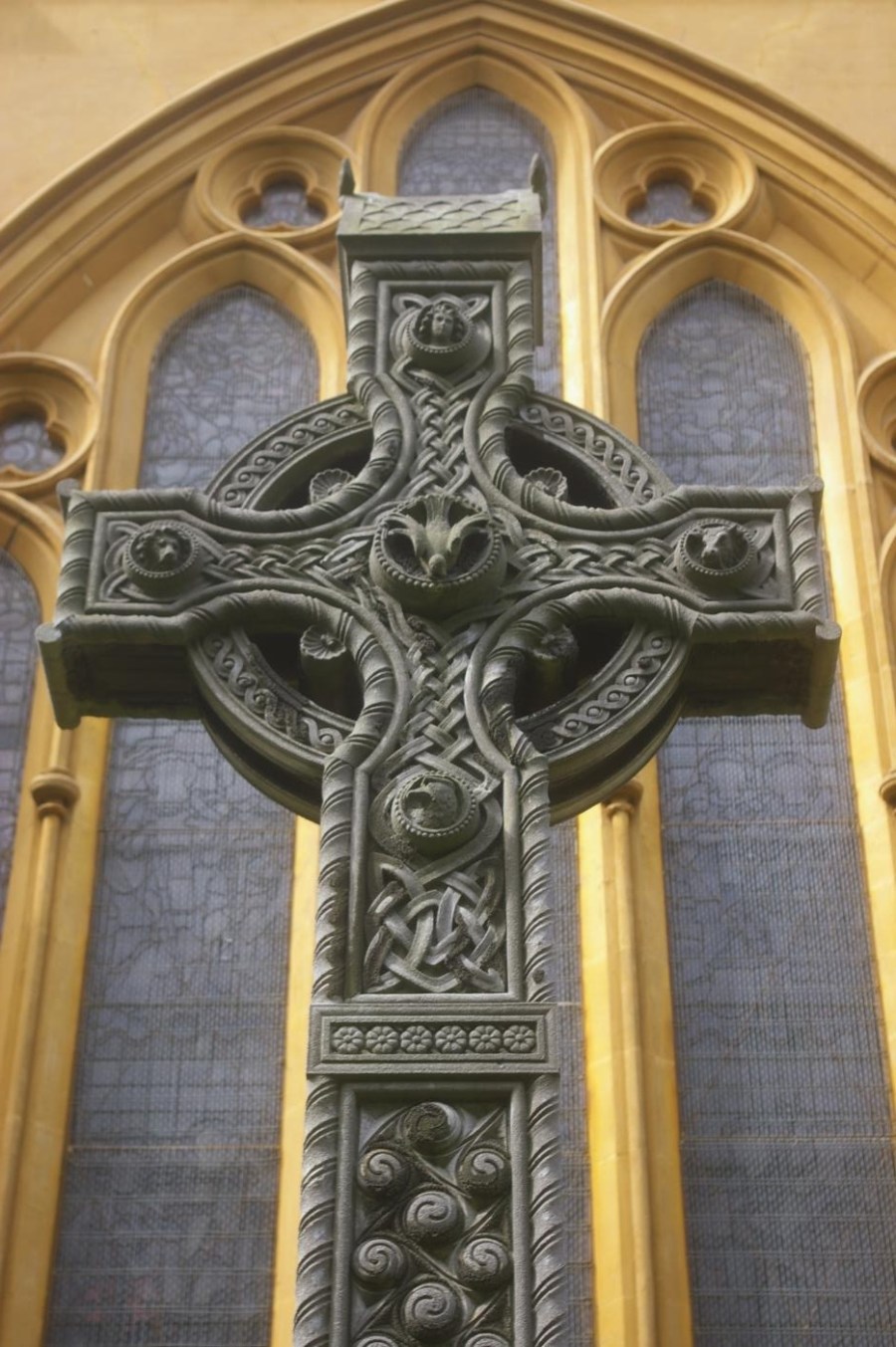
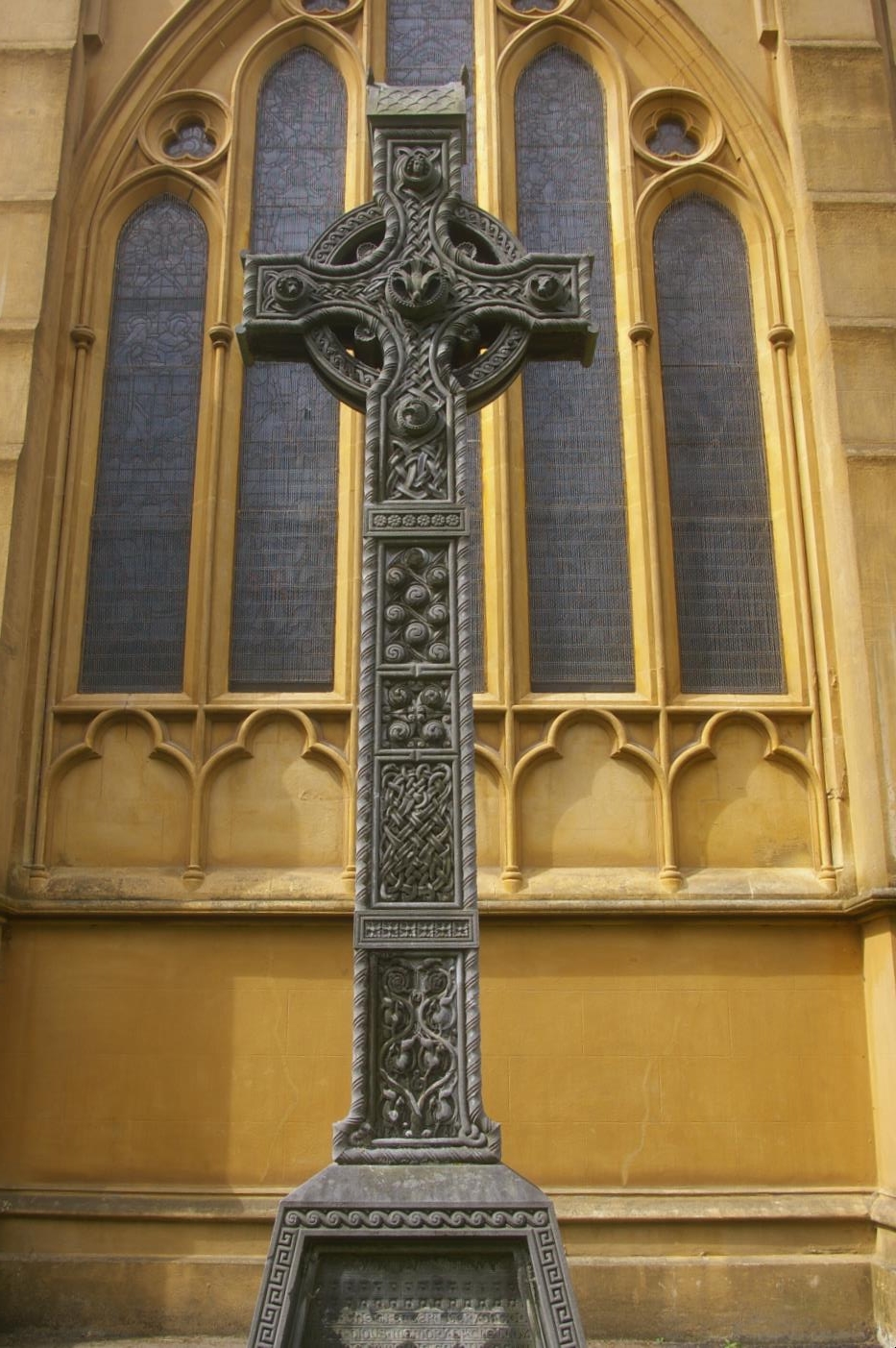
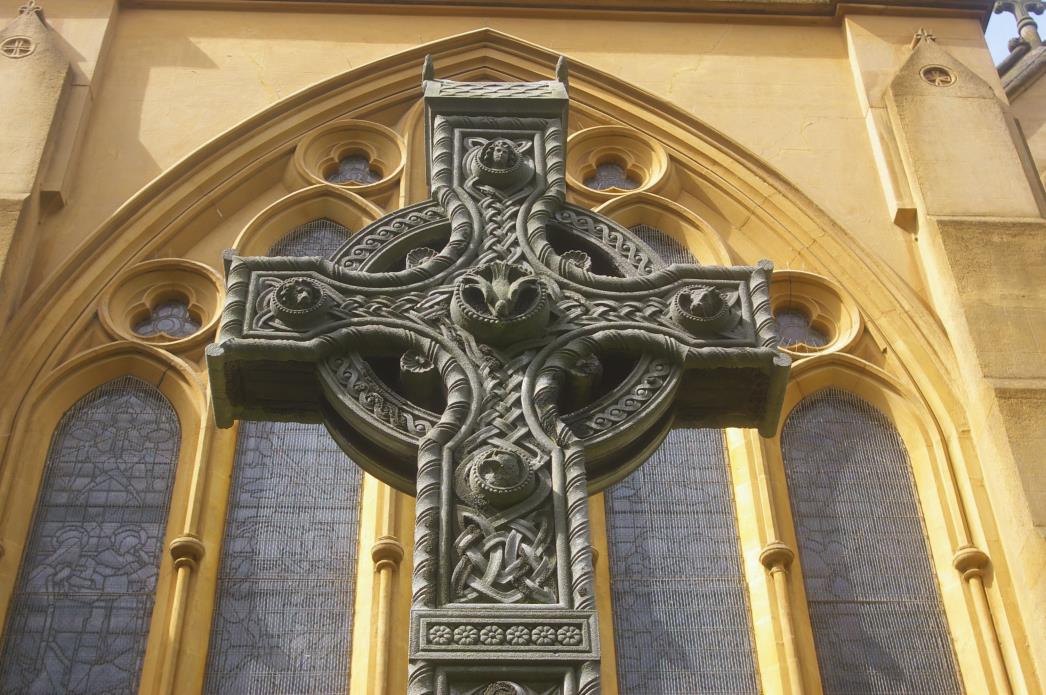
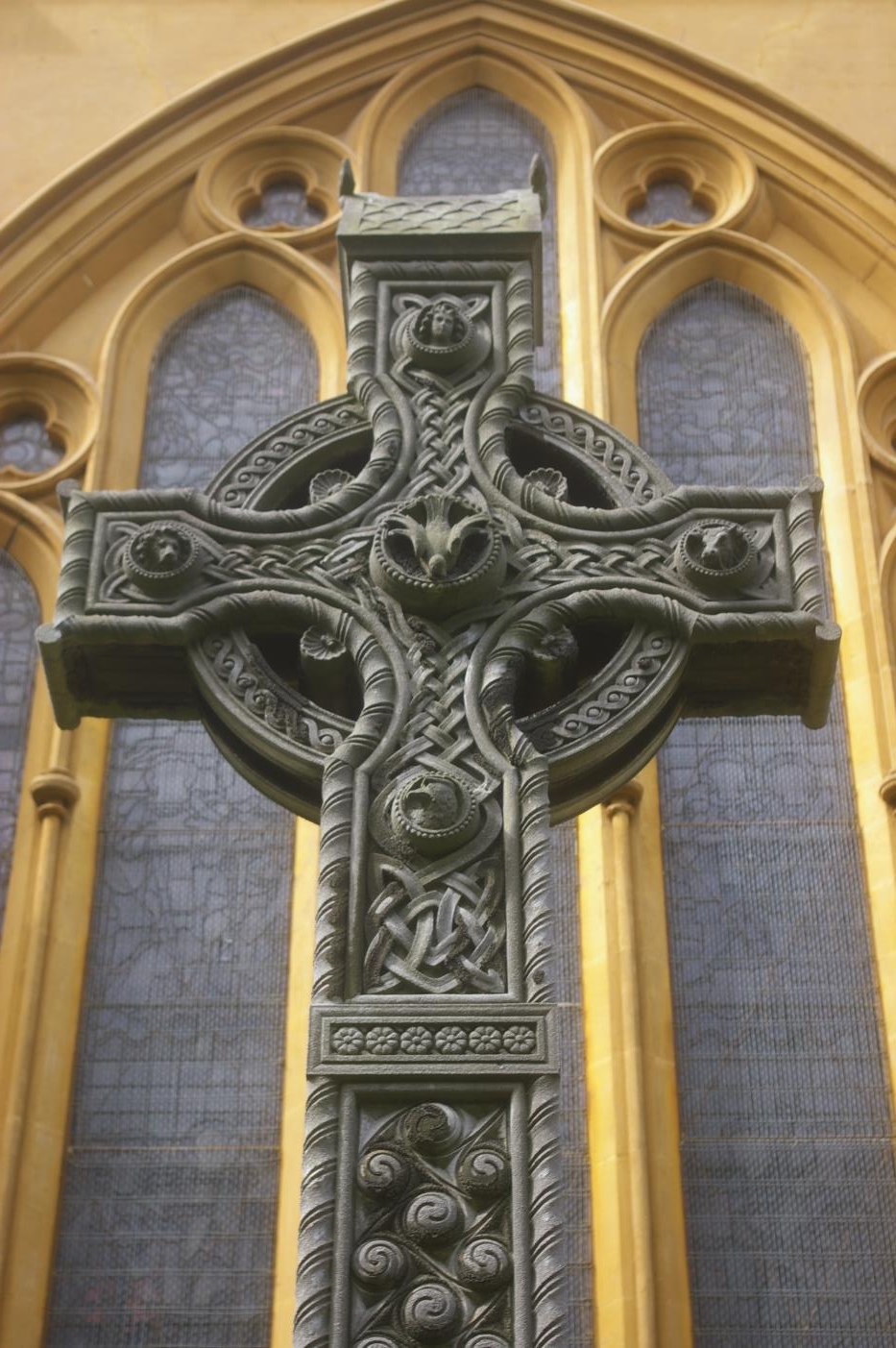
An imposing Celtic Cross Copyright Carole Tyrrell

An imposing Celtic Cross
Copyright Carole Tyrrell

This beautiful and large Celtic Cross was found in St Margarets Churchyard in Lee, SE London. I had been exploring the old St Margarets churchyard which is across the road. This contained the original St Margarets church, now a ruin, and some very interesting tombstones and memorials.
But the current St Margarets is a large Victorian building with some very colourful 19th century stained glass and, more unusually, beautiful wall paintings. These are pre-Raphaelite in style and well worth seeing if you’re in the area and the church is open. St Margarets also has windows made from pieces of broken stained glass which gives a jigsaw effect and kaleidoscope patterns on the floor when the sun shines through.
This memorial is a Celtic Cross in style and a symbol of the Arts & Crafts movement that was popular from 1880-1910 when there was a Celtic revival. The epitaph is written in curvy Art Nouveau writing and was well worn which rendered it virtually indecipherable. All I could make out was that it was in memory of a deceased wife. This was a real pity as I would have liked to have known more about the person who was buried there.

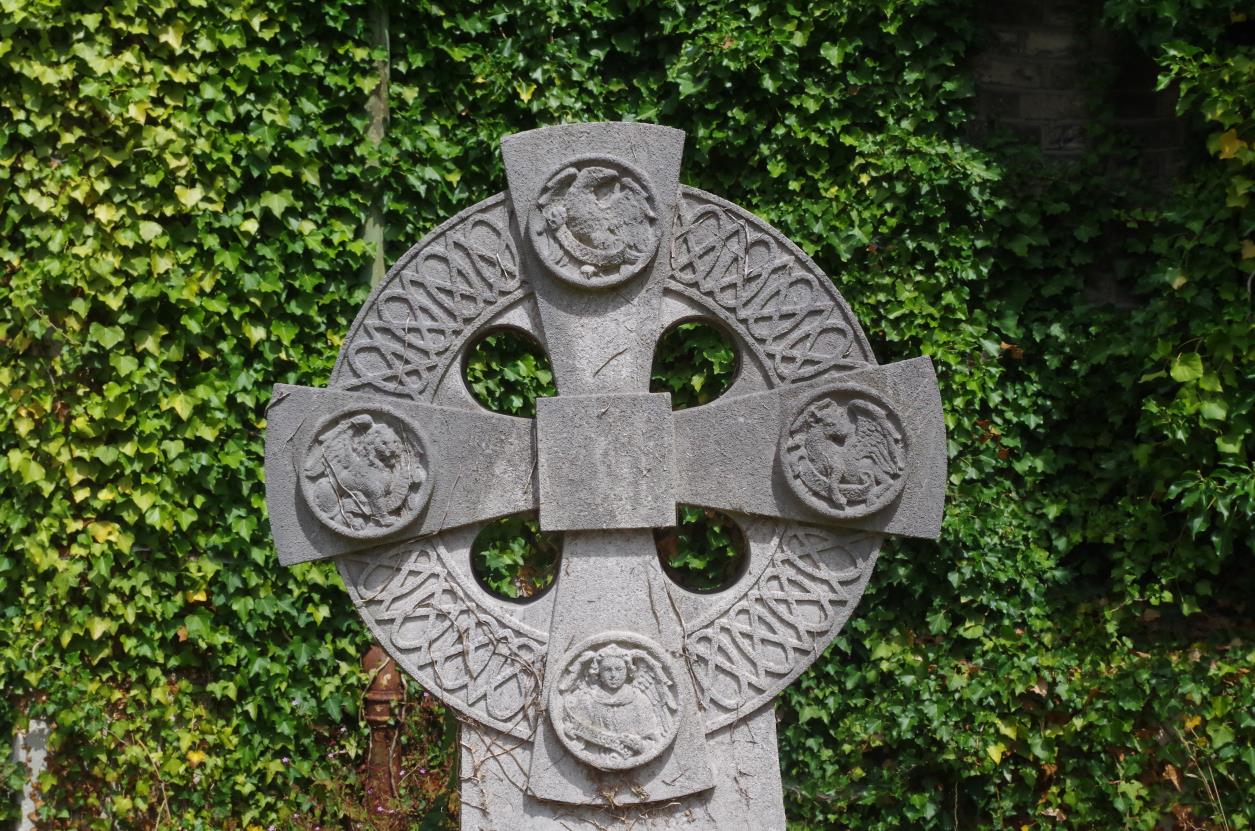
A closer view of the memorial .Copyright Carole Tyrrell
The for symbols of the Evangelists in each corner Copyright Carole Tyrrell
The for symbols of the Evangelists in each corner
Copyright Carole Tyrrell

I noticed the four symbols; one on each corner of the cross within the wheel. An ox, an eagle, a lion and an angel.. I’d never previously seen this combination on a funerary monument and thought, in my ignorance, that it might have meant that the deceased had loved animals.
But, after posting my photos of the memorial onto The Cemetery Club Facebook page a fellow member, Connie Fairchild, replied saying that she thought that the symbols might represent the four evangelists. She was kind enough to post a link to a relevant site which was enormously helpful.
The four symbols are:
Human/Angel = Matthew
Lion = Mark
Ox = Luke
Eagle = John

These were the four canonical gospels with the for living creatures that surround God’s throne. In the Book of Revelations chapter 4: verses 5-11
‘Around the throne, and on each side of the throne, are four living creatures, full of eyes in front and behind .
Verses 4:7 Apocalypse of Revelation of John

‘…the first living creature, like a LION, the second living creature like an OX, the third living creature with a face like a HUMAN face, and the fourth living creature like a flying EAGLE.

The four living creatures are also mentioned in Ezekiel Chapter One verses 1-14, Ezekiel, Chapter 10, verses 1-22 and Daniel Chapter 7, verses 1-8. The creatures are also mentioned in other religious texts such as St Irenaeus of Lyons and St Augustine of Hippo.
Wikipedia has quite a lot to say on tetramorphs

‘The four symbols are also known as a tetramorph. This is a symbolic arrangement of four different elements. Tetramorph is derived from the Greek tetra, meaning four, and morph, shape. Also four forms or shapes.
In Christian art, the tetramorph is the union of the symbols of the Four Evangelists, the four living creatures derived from the Book of Ezekiel into a single figure, or more commonly, a group of four figures. The Evangelists portraits are often accompanied by the tetramorphs or the symbols often used to represent them. Each symbol can be described as a tetramorph in the singular, and a group as ‘the tetramorphs but usually only when all four are together. Tetramorphs were very common in early medieval art especially in illuminated Gospel books, They are still common in religious art up to the present day.

Other examples of the combination of different elements are the Sphinx in Egypt which has the body of a lion and the head of a human.’

The animals associated wit the Christian tetramorph originate in the Babylonian symbols of the four fixed signs of the zodiac; the Ox representing Taurus; the lion representing Leo, the eagle representing Scorpio; the man or angel representing Aquarius. In Western astrology the four symbols are associated with the elements of, respectively Earth, Fire, Water and Air. The creatures of the Christian tetramorph were also common in Egyptian, Greek and Assyrian mythology. The early Christians adopted this symbolism and adapted it for the four Evangelists as the tetramorph, which first appears in Christian art in the 5th century.’

You can read more about tetramorphs here https://en.wikipedia.org/wiki/Tetramorph

I have also personally seen a tetramorph in Ely Cathedral.

So this is a deeply religious monument. The Cross and the evangelistic symbols are beautifully carved and it really stands out in the churchyard due to its size and position.
Since seeing this one I have found two more in Brompton Cemetery but not as well carved and, although large, not as imposing.

This was the nicer of the Brompton ones. Copyright Carole Tyrrell
This was the nicer of the Brompton ones.
Copyright Carole Tyrrell

Text and photos copyright Carole Tyrrell