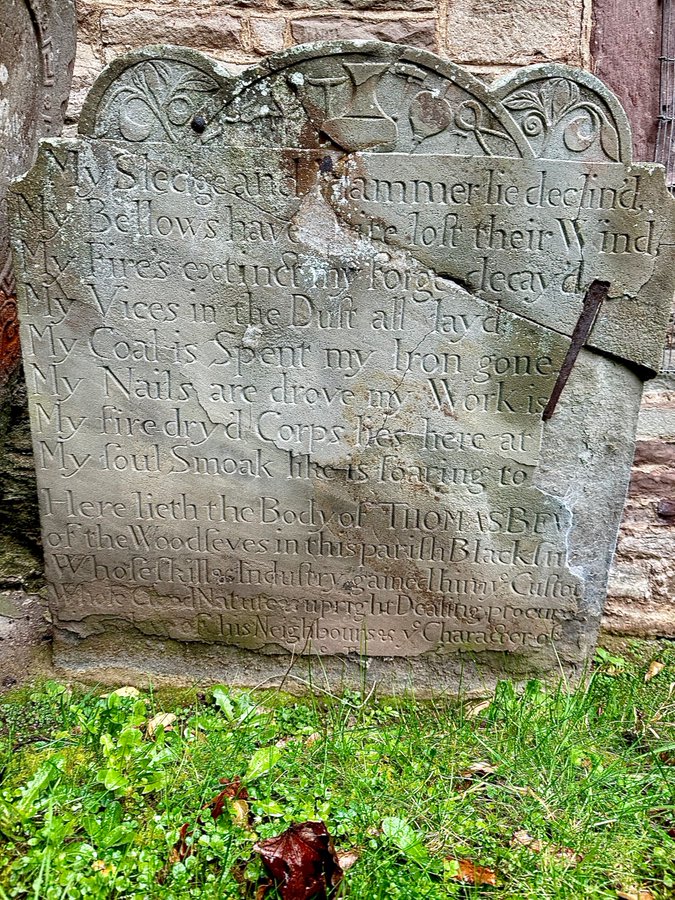
This is a fine and expressive epitaph to a blacksmith, Thomas Bevan, who died in 1774 in Eardisley, Herefordshire. Under the carvings of blacksmith tools at the top of the headstone is this epitaph:
‘My sledge and hammer lies declined.
My bellows have quite lost its wind;
My forge’s extinct, my fires decayed
My vices in the dust all laid.
My coal is spent, my iron is gone,
My nails are drove, my work is one.
My fire-dryd corps lies here at rest
My foul (soul) smoak like is soaring to be blest.’
I found this on stonemason Andrew Ziminski’s Twitter or X (whatever it’s called now) and is used with his permission. He has an interesting account and he has published 2 books on his work and his travels around country churches. ‘Stonemason: A History of Building Britain’ and a forthcoming on in October 2024, ‘Churchgoing; A Stonemason’s Guide to the Churches of the British Isles.’ Always interesting posts – this is his address. https://twitter.com/natchjourneyman
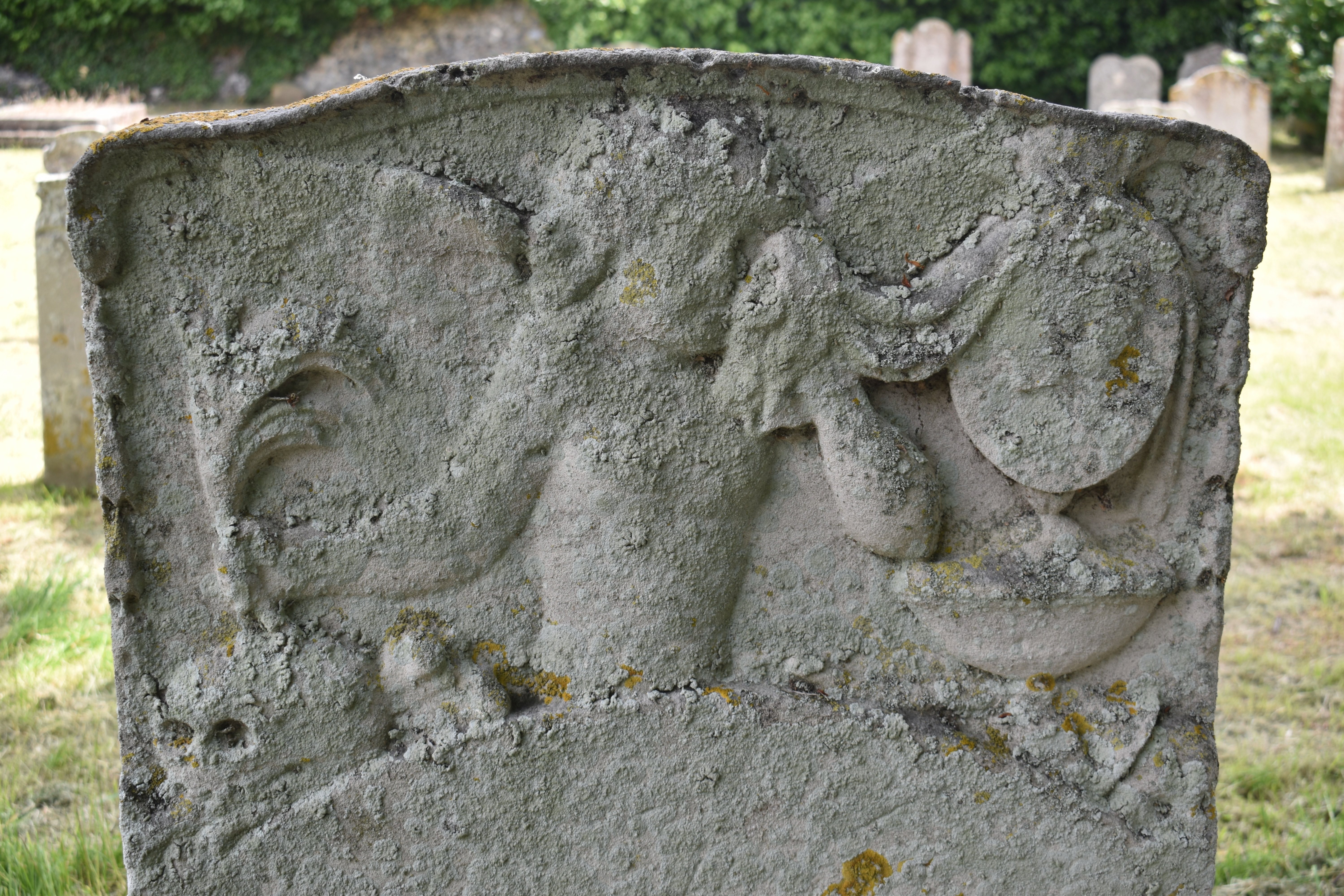
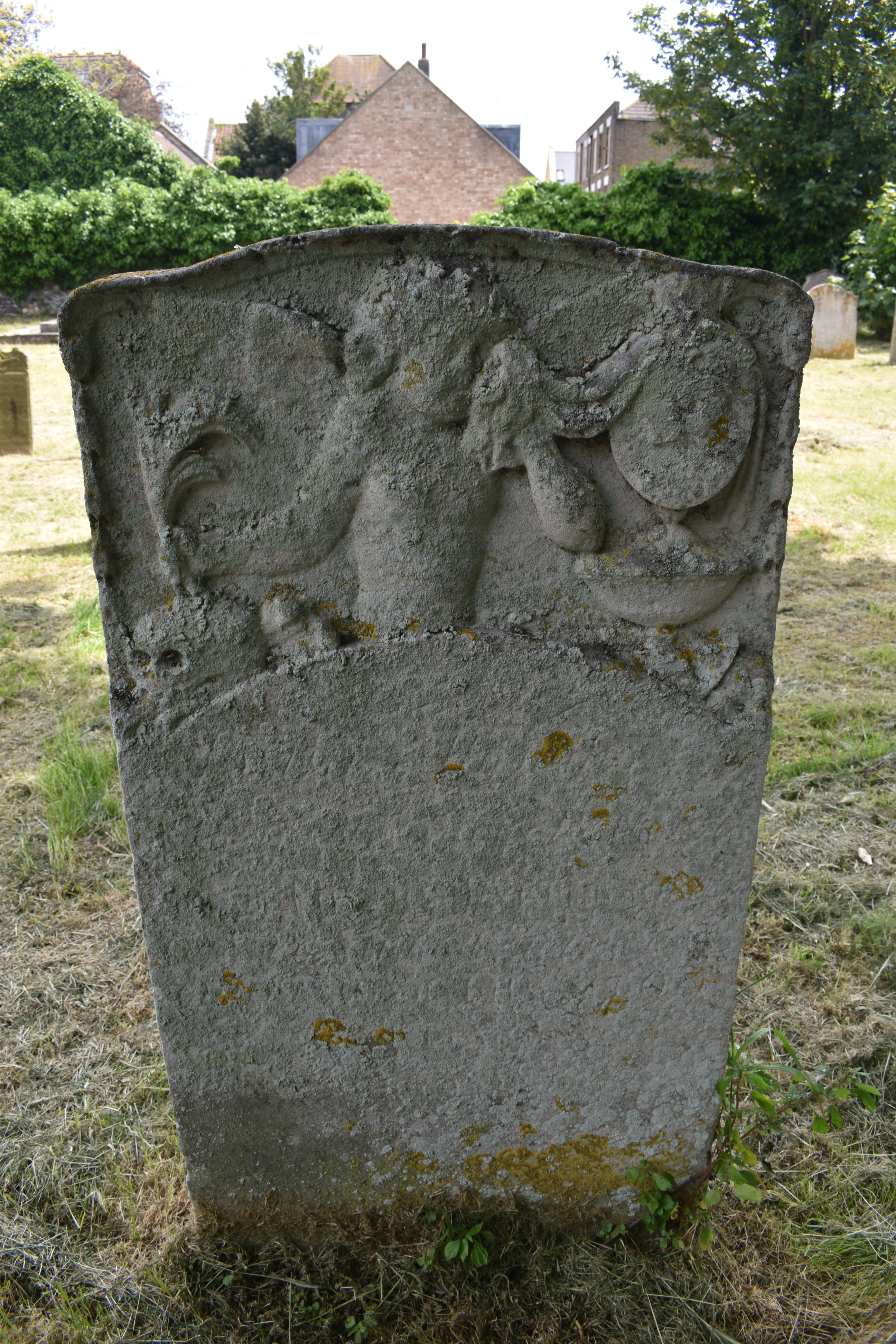
I was visiting Margate on the Kent coast and, after a paddle in the glittering sea, followed a sign that pointed the way to the 14th century church of St John the Evangelist. It was an interesting churchyard with some fascinating headstones including this one. It depicts a weeping cherub, but, despite weathering by the elements, the figure can still be seen clearly but sadly the epitaph is illegible.
It’s carved in 3D relief and shows a male cherub with its wings behind him, dabbing his eyes with a piece of cloth draped over an oval tablet. I think I can just about see a head carved on it which is presumably the deceased. This surmounts an urn in the classical style which appears to be on a plinth.
On the other side the figure holds what appears to be a either a bunch of flowers or palm leaves which are on top of a human skull with its lower jaw missing. There may be bones protruding from underneath the skull but it’s a little difficult to be sure.
It must have been very impressive when first carved and it’s testament to the stonemason’s skills that so much of it has survived. Despite there being no readable epitaph, I would estimate that this dates back to the 18th century. The church itself was closed on my visit so I couldn’t enquire further.
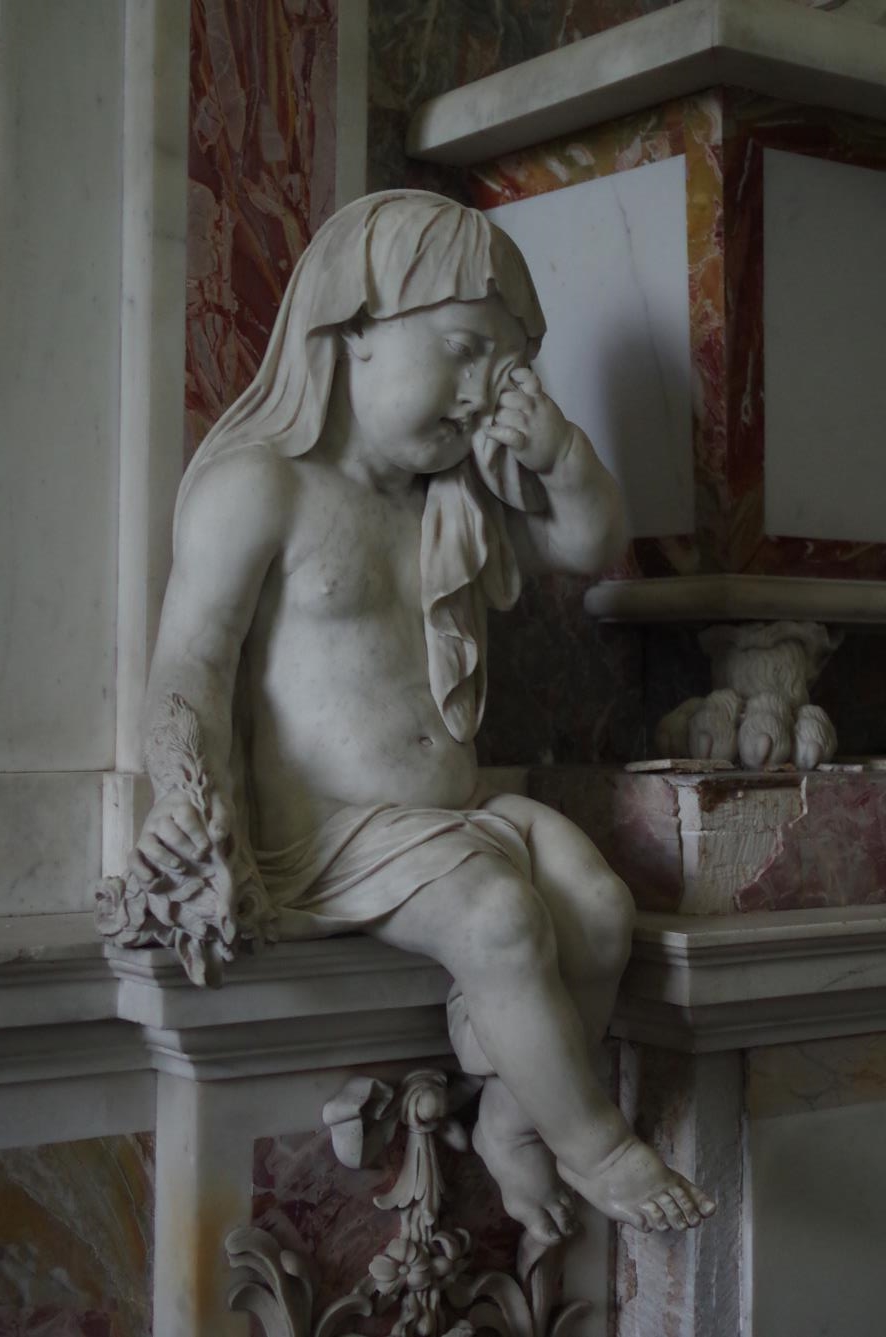
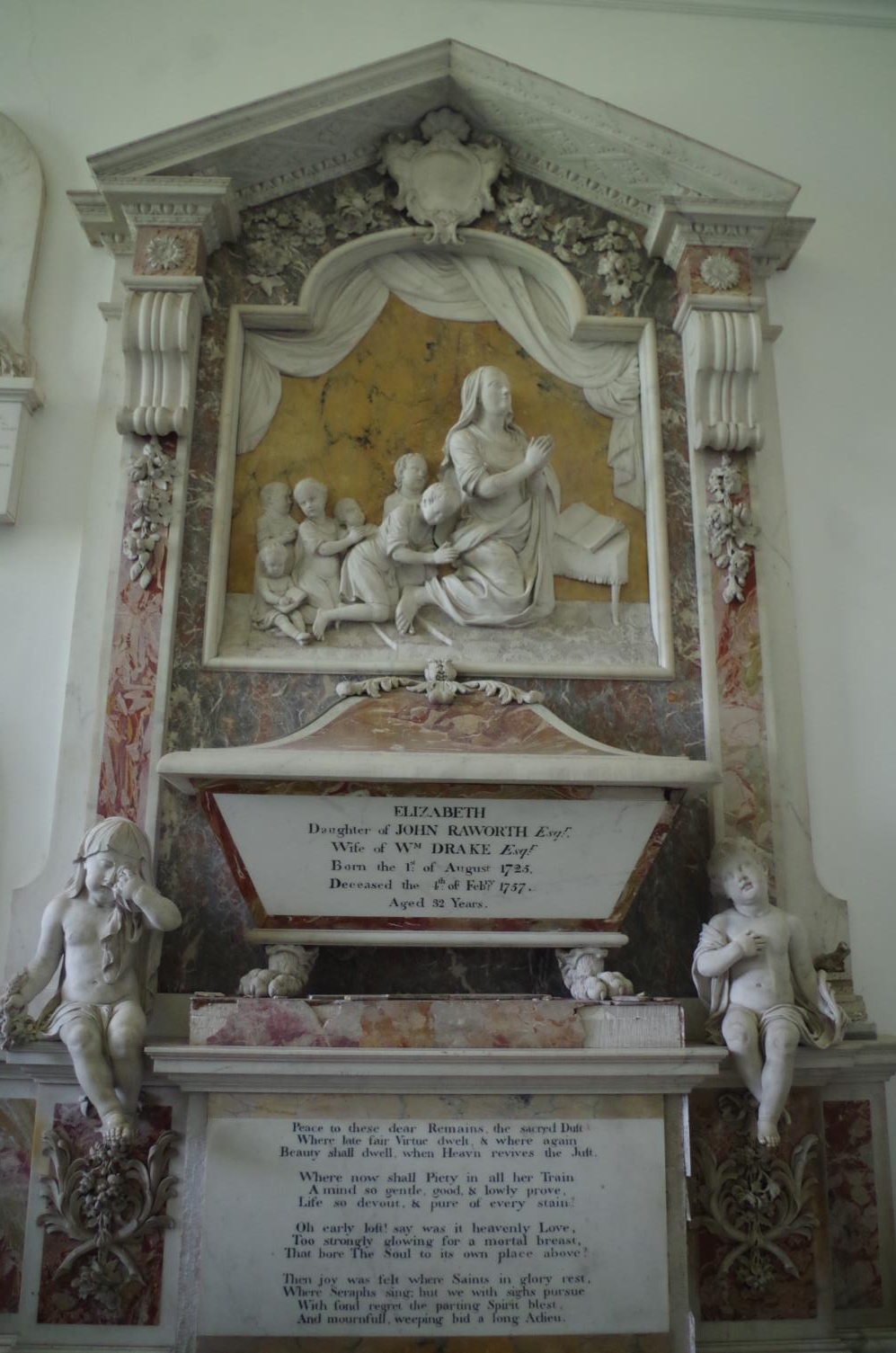
This is an unusual symbol to find in a churchyard as weeping cherubs are generally found inside a church and not outside. For example,this is a fine example from St Mary and All Saints in Amersham and is on the monument to Elizabeth Drake who dies young in 1757 aged only 32. She appears in a carved panel praying with her six surviving children and two deceased children. The weeping cherub sits alongside a sarcophagus on a shelf and is using a piece of cloth draped over his head to dry his tears.
The other one is in All Saints Herstmonceux and he stands on a freestanding short pillar sorrowing with an agonised expression over an urn, again in the classical style, which is partly draped with a piece of cloth and one hand is on a garland of roses. Beside the urn there seems to be a flaming torch on its side. Please follow link to view the photos:
Others can be found in St Stephen’s Norwich, St John the Evangelist in Burford and All Saints Church, Spetchley on the tomb of Robert Berkeley (1650-1694). There is also a pair on a painting on glass dedicated to Lord Nelson and is described as a monumental design to perpetuate his memory.
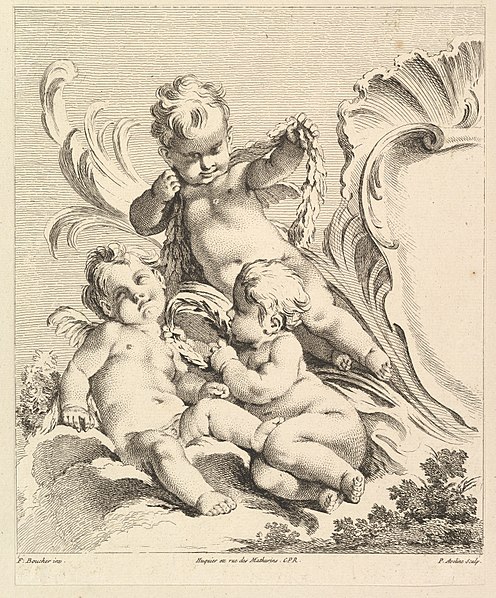
Cherubs are usually seen as plump, male small boys, usually naked, with small wings protruding from their shoulders as below:
Three Putti next to a cartouche Pierre Alexandre Aveline after Francois Boucher 1727-60 shared under Wiki Commons
But they had begun to appear in churchyards when the very stark skull and crossbones fell out of fashion. There was a sense that a more inspiring and sensitive image would be more appropriate for those left behind and so the winged messengers appeared (see my post Symbol of the Month – The winged soul 27/09/20).
These were the heads of what appeared to be children with wings around them that emphasised a rebirth of the soul in heaven which was a kinder view of death. Cherubs are supposedly found on childrens graves and a walk through any churchyard or cemetery would confirm this. But cherubs can be confused with putti which is the Italian word for cherub but they are very different. Cherubs are powerful figures in the hierarchy of angels whereas putti are childlike and playful.
Cherubs
The word ‘cherub’ is derived from the Hebrew word ‘Kěrub’ which means ‘to draw near’ or ‘to bless’. However it has also been associated with the Assyrian word, ‘karibu’ which means one that intercedes’. Cherubs can be viewed:
‘as divine messengers drawing near to humans to deliver blessings or divine messages. They also symbolise the spiritual closeness between the divine realm and the human world.’ Spiritualityshepherd.com
In the Bible cherubs are seen as powerful figures that guard sacred spaces such as the Ark of the Covenant in the Old Testament. There are several references to them in the Bible particularly in the Book of Genesis 3:24:
‘So he drove out the man: and he placed at the east of the garden of Eden Cherubims, and a flaming sword which turned every way, to keep the way of the tree of life.’ King James Version.
In the Book of Ezekiel 10:14, they are described as angelic beings with four faces; a human, a lion, an eagle and a human. These derives from ancient Mesopotamian and Assyrian art which depicted winged creatures with multiple faces which often guarded temples or palaces. These influenced early Christian artist who used them in their images of cherubim. The multiple faces represent different aspects of creation or divine attributes such as wisdom, strength, courage and swiftness and the wings are a reminder of their celestial nature and ability to move quickly between heaven and earth.
Putti
Wikipedia defines putti as:
‘a putto or putti is a figure in a work of art depicted as a chubby male child usually naked and very often winged….came to represent a sort of baby angel in religious art, often called cherubs or cherubim.’
In fact the Italian word ‘putto’ derives from the Latin word ‘putus’ meaning boy or child. Today in Italy, ‘putto’ means ‘toddler winged angel’ and there are similar words or meanings in other languages. Putti were believed to influence human lives in the ancient classical world and in the 2nd century they could be found dancing and playing amongst other activities on child sarcophagi. Their role as messengers were emphasised by them being seen as between the realms of the human and divine by being Roman spirit guardians or the Greek daimon. During the Renaissance they were revived due to the painter Donatello. Putti also became associated with the Greek and Roman goddesses of love, Aphrodite and Venus by becoming Eros and Cupid.
Now putti are largely decorative and feature extensively on Victorian and Edwardian buildings – just look up and you’re bound to see one at least. Please visit Bob Sheel’s invaluable page on these for examples – just follow the link: http://www.speel.me.uk/gp/cherubs.htm
Weeping cherubs
They could be interpreted as weeping angels which immediately brought to mind one of Dr Who’s most brilliant and intimidating villains – the Weeping Angels -don’t blink! There are several prominent weeping angel statues in cemeteries such as Friendship Cemetery, Columbus, Mississippi, USA where a life size female angel is prostrate across the monument:
and the Haserot bronze figure in Lakeview cemetery, Cleveland, Ohio, USA where the rain has discoloured it and made it look resemble tears running down its face.
But why are there weeping cherubs? I haven’t found a definitive explanation but the edenbengals website has a theory:
‘They openly express the sorrow that the ones left behind feel, and in their role of divine messengers take it heavenwards to God.’
It’s a very poignant symbol in that a small child is seen openly weeping. I hope to find others in my explorations of churchyards and cemeteries as I’m sure that the Margate one can’t be the only one. If I know these places as well as I do – there is at least another one waiting to be found – hopefully by me!
Yes, fans of the dark side and all things macabre, the London Month of the Dead is taking bookings now! Some have sold out already but there’s such a choice of lectures, walks, musical performances, tours, workshops, screenings and even a magic lantern show I’m sure you’ll find an event to enjoy! I have attended several London Month Of The Dead events over the years and each one has been fascinating and entertaining.
Now in its 11th year and with reasonable prices and 20% of each ticket is directed towards the cemeteries and venues that take part or hold London Month Of The Dead events. So what are you waiting for: visit https://londonmonthofthedead.com/
St Peter & St Paul’s, Boughton on Blean, Kent. copyright Carole Tyrrell.
Yes dear readers, It is 9 years to the day since I began shadowsflyaway on a wing and a prayer having no idea of how to do a blog but jumped in both feet first anyway. It’s been an interesting 9 years as I have explored the byways, churches, churchyards and cemeteries of Kent and London’s cemeteries looking for symbols.
However, I never know what to expect when I open a church door. For a start, will it be open? And what awaits? Tiptoeing past champers still asleep – these are people camping out overnight in a church. Being dazzled by a glittering pavement of medieval brasses at St Mary Magdalene, Cobham or a brass sign on a wall at St Peter & St Paul at Headcorn from Philadelphia commemorating that their ancestors had originated from the village. I love exploring churchyards and so far the oldest markers I have found dated back to the medieval period.
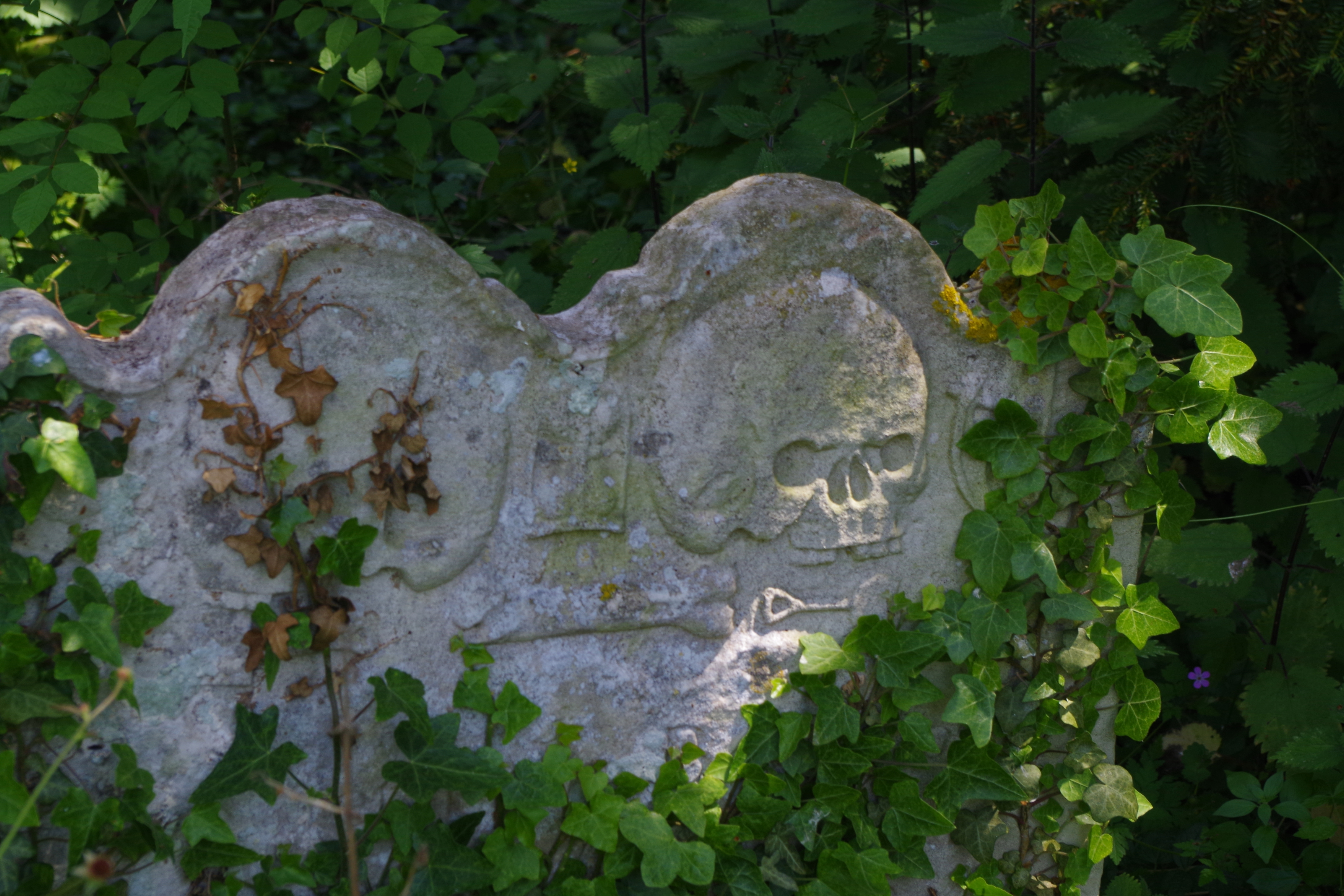
The headstone on the card above was the happy result of being misdirected by a passing dog walker. I was looking for St Mary the Virgin in Selling Kent. It was in the middle of nowhere as was St Peter and St Paul’s in Boughton in Blean. A lot of Kent churches are in isolated spots but it keeps me fit. I tramped past hop fields and a few houses here and there and then found it on top of a small hill, its surrounding churchyard almost climbing up to the church. It was as pretty a churchyard as you could wish to find with some ancient tombstones poking up through the vegetation which was part of ‘God’s Own Acre’, an initiative to leave churchyards unmown to encourage wildlife. I ate my lunch overlooking hop fields.
I found this one under a tree. If you look closely you may be able to see an hourglass, a long bone and a spade as in the close-up below.
St Peter & St Paul’s, Boughton on Blean, Kent. copyright Carole Tyrrell
There is a corpse road nearby situated on the golf course so I am determined to find it as I’ve never walked on one. These were for transporting bodies, often from remote communities, to cemeteries that had burial rights such as parish churches and chapels of ease. The roads have long fallen out of use but may have just have become footpaths. But this is the first time I may have a chance to walk on one. There are many legends associated with them involving ghosts and spirits and the living were not supposed to walk on the pathway of the dead.
So here’s to 9 years of shadowsflyaway – thank you to my readers for your company! I really appreciate your likes and comments and let’s look forward to 2025 when shadowsflyaway will be 10 years old.
Text and photos copyright Carole Tyrrell unless otherwise stated
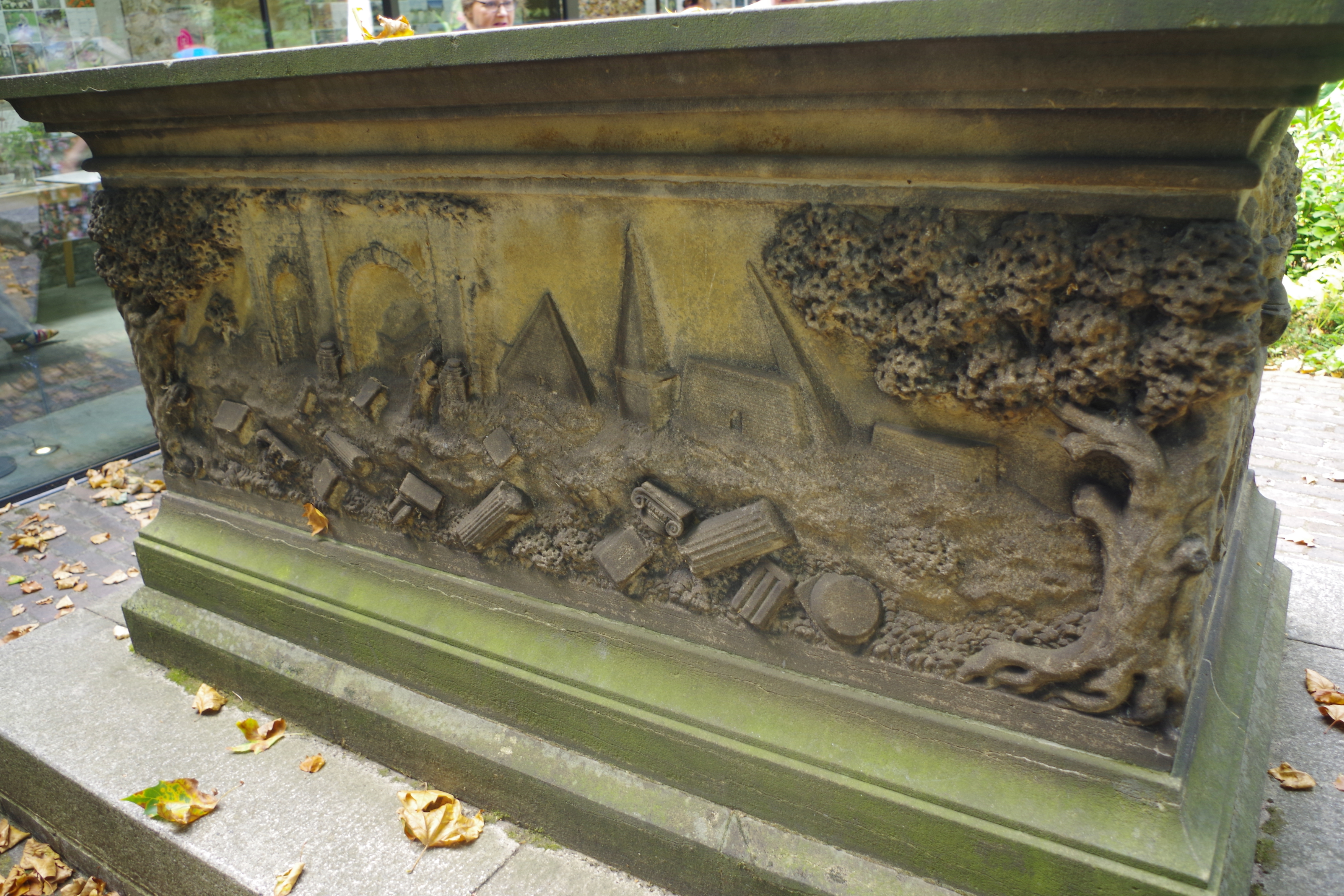
It was the drawings made by Wenceslaus Hollar for Samuel Pepys (see above) that were used as guidance for the recarving of the reliefs in 1773 and 1853. These allow the viewer to see what the tomb originally looked like and to compare them with the changes that successive sculptors have made. For example, G P White in 1853 seemed to have his own interpretation of the hydra.
But, as you might imagine with pollution and the London atmosphere, the tomb being outside and at the mercy of the elements, the carvings have deteriorated and changed over the centuries. As the gardentrust.blog says:
‘The casual viewer is not seeing the original carvings. As it was outside in what would have originally been the churchyard, the elements soon did their work. The tomb was so badly damaged by 1773 that a public subscription was raised for its restoration. Lambeth Archives still have the ledger that recorded the donations.
But in 1853, 70 years later, the public funded a further restoration. It was the sculptor G P White who undertook this restoration.’
The 1853 restoration cost £110. The Victorians were enthusiastic restorers, perhaps too enthusiastic in some ways.
At one end of the tomb is a coat of arms which comprises of three fleur de lys on a diagonal bar and with a lion holding up its paw. A helmet with a closed visor is meant to be a sign of gentility and is topped with the crest of another fleur de lys and 2 wings. However, the Tradescants had no official grant from the College of Arms and may just have adopted it as a ‘rising’ family. It was a standard item on a monument and is the most conventional symbol.
At the other end, the west end, is a fearsome looking hydra which is a mythical ancient Greek creature associated with the 10 Labours of Hercules. It lived in the murky waters of Lake Lerna which was reputed to be the entrance to the underworld. Each time one of the hydra’s heads were cut off , two more would grow in its place so it was a deadly enemy. The hydra in the Pepys drawings is almost friendly and certainly non threatening whereas the 1853 version, carved in high relief, is much more dramatic with its bat like wings, female breasts., seven bird like heads and a long forked reptilian tail.
There were other changes as well and the gardenstrust.blog commented on the skull in the lower part of the panel.
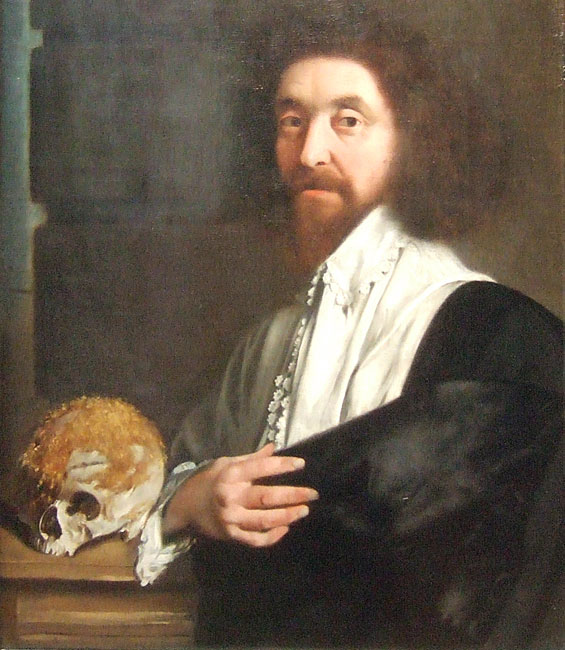
‘It lacks the lower jaw and is presumably the same one that appears in the younger John’s portrait where it is covered with skull moss, much sought after as a powerful medicine.’
This portrait appears in Part 1. The significance of the skull may be a reminder of vanitas paintings which flourished during the 16th and 17th centuries and came from the Netherlands. They often featured a skull and invited the viewer to ponder on the fleeting quality of life.
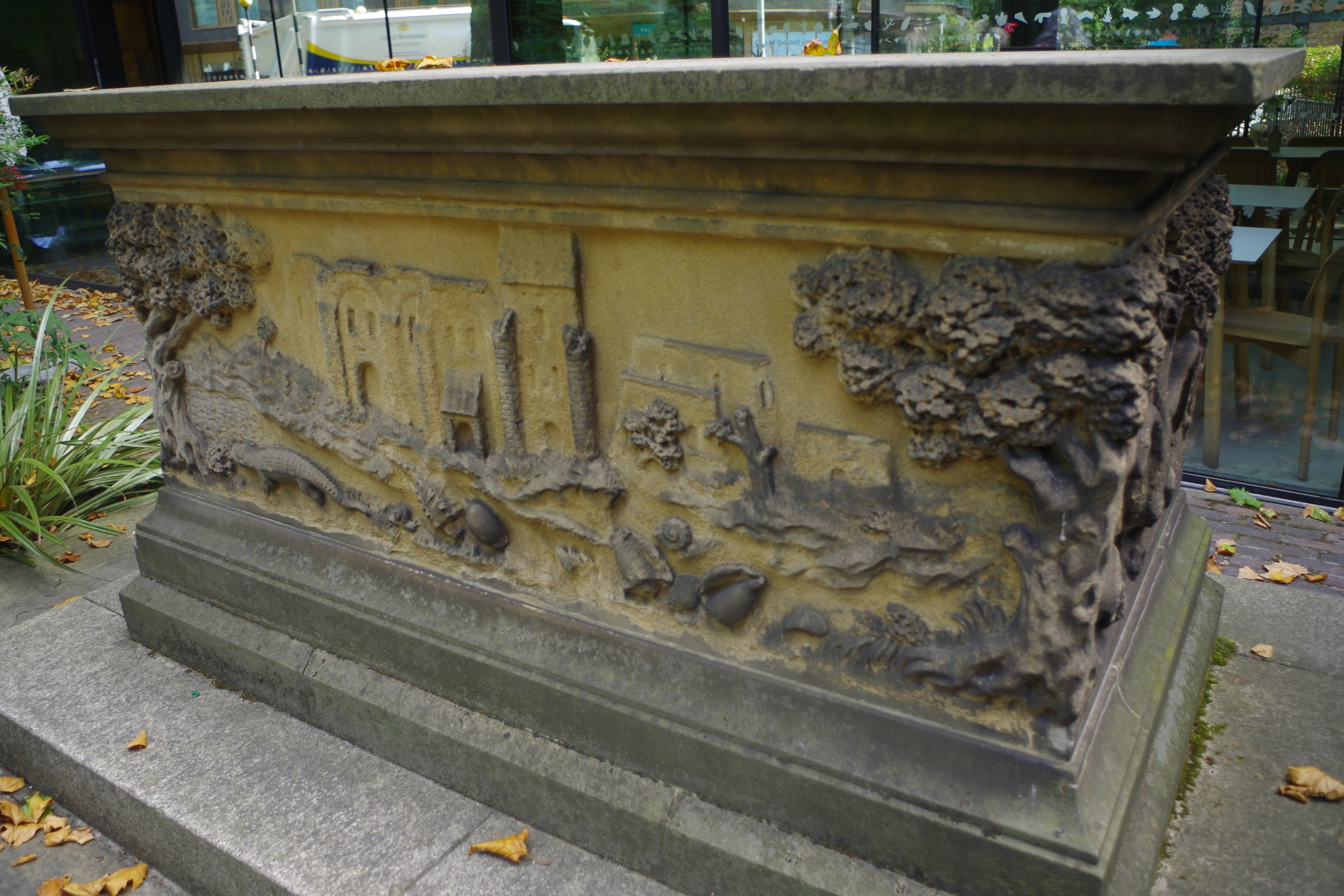
‘ruined buildings in the background and architectural detritus in the foreground together with a crocodile and shells and fossils. The corners are formed by gnarled and stunted trees with heavy foliage.’Cabinet.ox.ac.uk
The depiction of the ruins have been debated as the restorations may have changed their appearance. They have been described as Egyptian or Greek with obelisks and a pyramid amongst others. There are also fragments of Corinthian capitals. The shells may refer to specimens that were in the Tradescant collection and the large reptile in the lower part of the north panel could refer to the ‘Crocodile from Aegypt’ that was listed in the exhibits of the ‘Ark.’ It was also seen as a symbol of the early modern culture of collecting as seen in the oldest depiction of a ‘cabinet of curiosities’, the museum of Ferrente Imperato.
In order to link all the sides of the tomb together, the mason carved a set of large trees in deep relief. They hold up the ledger with its epitaph:
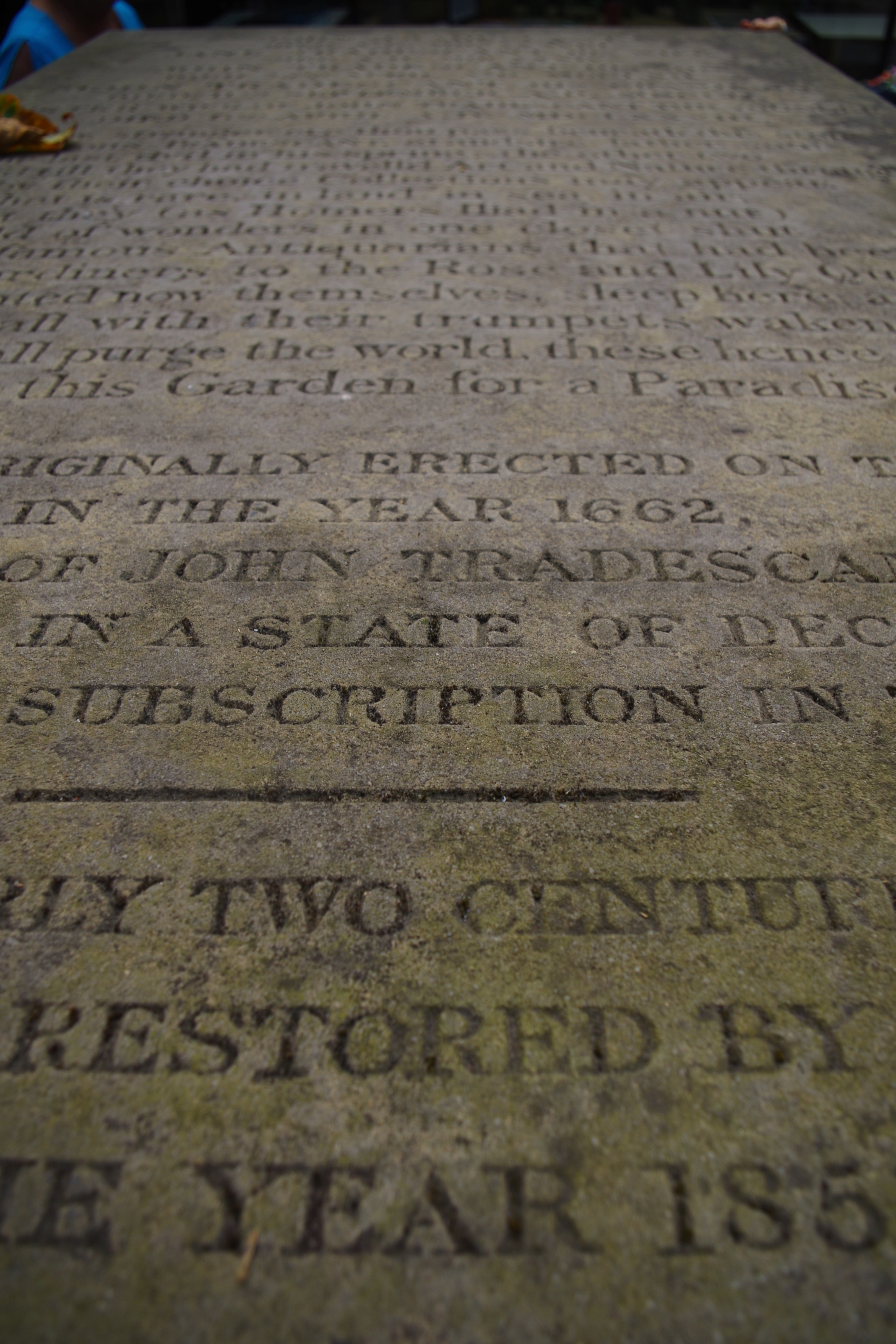
‘Know, stranger, ere thou pass, beneath this stone Lie John Tradescant, grandsire, father, son The last dy’d in his spring, the other two, Liv’d till they had travelled Art and Nature through, As by their choice Collections may appear, Of what is rare in land, in sea, in air, Whilst they (as Homer’s Iliad in a nut) A world of wonders in one closet shut, These famous Antiquarians that had been Both Gardeners to the Rose and Lily Queen,* Transplanted now themselves, sleep here & when Angels shall with their trumpets waken men, And fire shall purge the world, these three shall rise And change this Garden then for Paradise.’
It has been suggested that the line ‘A world of wonders in one closet shut’ may refer to the Ark.
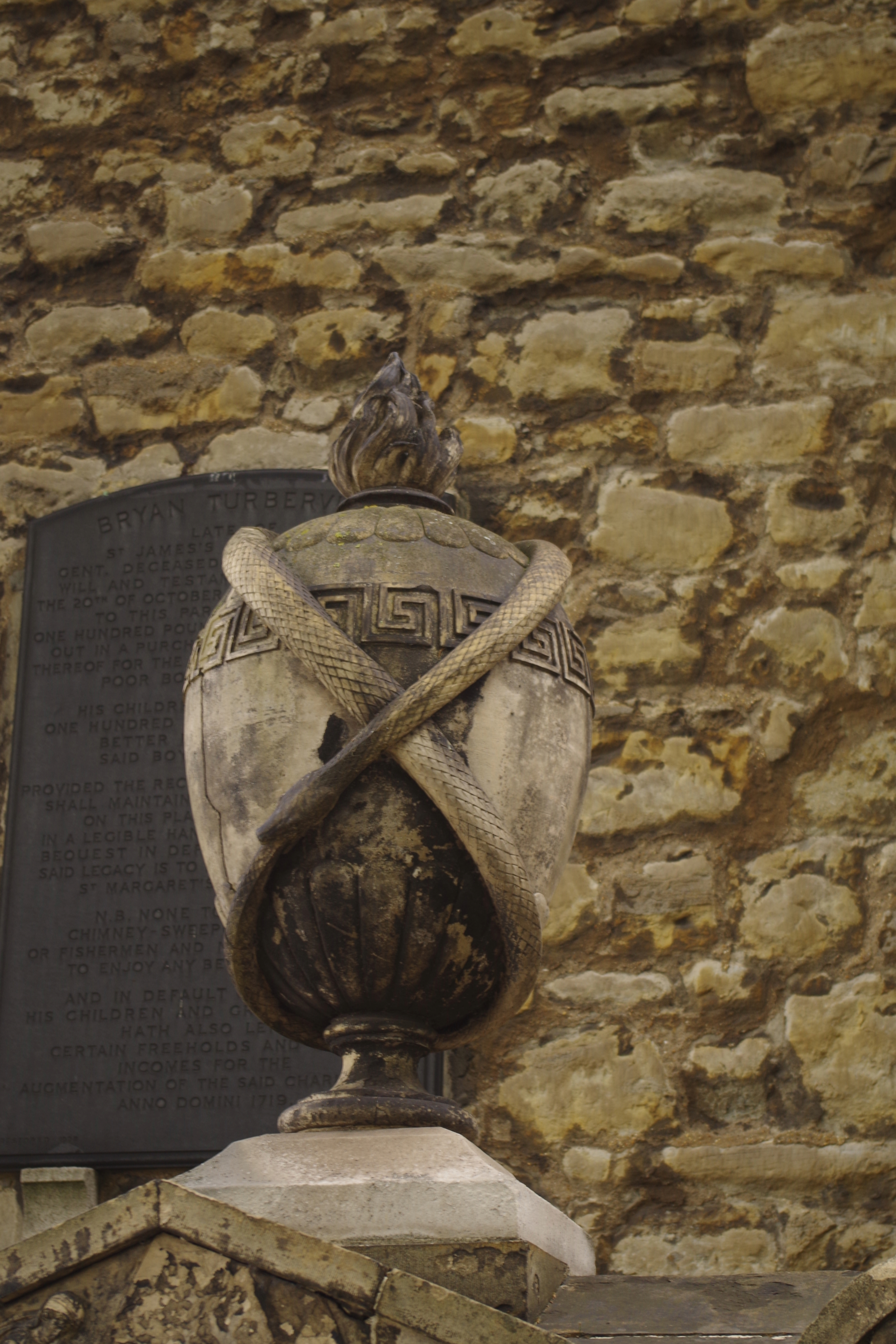
Despite the changes to the carvings, the Tradescant tomb is a magnificent survivor with five members of the family being commemorated. The enigmatic carvings, the epitaph and one woman’s determination have all added to the legendary Tradescant reputation. It’s a real sight to see and there are other interesting memorials in the ex-churchyard as well. For example, there is one dedicated to Admiral Bligh of Mutiny on the Bounty fame and there is a wonderful ouroboros on another, the Sealy family monument.
A large, ancient chest tomb is not what you expect to see from the window of a central London restaurant. However, I’d seen pictures of it before and, for me, a dedicated Symbols enthusiast, it was the icing on the cake while enjoying a fantastic meal.
It is the Tradescant tomb and it sits in the courtyard of The Garden Museum in Lambeth which is housed within the deconsecrated church of St Mary at Lambeth. The Museum was founded in 1977 by Rosemary Nicholson in order to preserve the tomb. She and her husband saved St Mary’s from demolition and it is the second oldest structure within the borough of Lambeth. A church has existed on the site for over 950 years.
John Tradescant the elder attributed to Cornelis de Neve (1668-1665) Shared under Wiki Commons
John Tradescant the elder (1570-1638) is one of the most important figures in English gardening and he founded a dynasty of horticultural experts. In 1623 he became head gardener to royal favourite George Villiers, 1st Duke of Buckingham. After his assassination Tradescant became keeper of his Majesty’s Gardens, Vines and Silkworms at his queen’s minor palace in Oatlands Place, Surrey in 1630. He was the Royal Gardener at the court of Charles 1st and worked with his wife, Queen Henrietta Maria. In search of new plants, he travelled widely including trips to the Arctic which was no mean feat at the time. He even took part in an expedition to Algeria to fight Barbary pirates! One of the earliest records of him is a letter that he wrote while on a journey to the Netherlands, to buy plants for the 1st Earl of Salisbury’s garden at Hatfield House. He seems to have been a man possessed of indefatigable energy. In 1629 he moved to Lambeth near where the Museum is now situated and created the first museum in Britain to be open to the public. It was known as the ‘Ark’ and was formed from his own collection of natural history and ethnography.
John Tradescant the younger Thomas de Critz 1652 Shared under Wiki Commons
But the tomb commemorates his son, also called John, (1608-1662)as well. It was his widow Hester who commissioned it after his death. They were married at St Mary’s and he succeeded his father as the Royal Gardener. He also travelled widely to collect specimens. John Tradescant the younger went to America for plants and seeds during the early 1600s and introduced trees such as magnolias, tulip trees and garden plants such as phlox and asters.
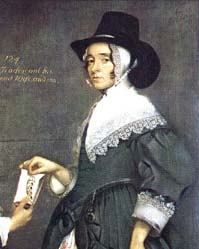
In addition, it celebrates four other family members including his father, his two daughters in laws, Jane Hurte (died 1634) and Hester Pookes (died 1678) and his grandson, another John, who died in 1652 in his late teens. The Tradescant dynasty died out in 1678 with Hester’s death.
Hester Thomas Thomas de Critz, Ashmolean Museum, Oxford. Shared under Wiki Commons
The sarcophagus is made from hard sandstone and has suffered deterioration over the centuries and it would have originally been in St Mary’s churchyard. The inscription on the tomb states that it was originally erected in 1662, repaired in 1773 and then restored in 1853 by the sculptor G P White. It’s an unusual tomb, not just because of its size, but in its carvings and enigmatic symbols. However, unusually for the time, there are no religious references on it except for the final lines of the inscription:
‘Angels shall with their trumpets waken men,
And fire shall purge the world, these three shall rise
And change this Garden then for Paradise.’
It’s an intriguing tomb and is a visible sign of the Tradescants standing and aspirations. Hester was asked to pay £50 to the Lambeth church wardens of the time towards the parish poor relief. This was the equivalent of 6 months wages for John as the Royal Gardener. And this was only for permission to site the tomb as everything else was extra.
But it’s the enigmatic carvings that attracted me to the Tradescant tomb and in Part 2 I will discuss these further. However, these are not the original carvings as after two restorations, in 1773 and 1853, the scenes and creatures depicted have subtly changed especially the Hydra sculpture.
The lychgate to Compton Churchyard, Guildford, UK.
copyright Carole Tyrrell
English country churches and lychgates seem to go hand in hand. There is something rustic and romantic about them. Perhaps you’ve seen one at the entrance to a church and thought that they were created as handy shelters or been lucky enough to see a bridal couple paying local children to untie the gates and allow them through.
But the picturesque lychgate has a darker side as it’s also the gate through which the happy couple could be entering in a few decades but on a more sombre occasion.
The word lychgate is derived from the old English or Saxon word, lich, which means corpse. In medieval times, the body would have already been carried along footpaths or the local corpse road to the church. Corpse roads can still be seen in the countryside if you know where to look and I found one last year by chance on a golf course in deepest Kent! Coffins were for the wealthy until the 1700’s and so the less well to do deceased would have been wrapped in a shroud and then laid on a bier under the lychgate. The priest would have then come out of the church to the bier to conduct the first part of the funeral service. while the pall bearers sheltered under the gate. Some lychgates have large, flat stones under them on which the shrouded body would be laid. These are known as lich stones.
St George’s Church Beckenham
copyright Carole TyrrellSide view of lychgate showing construction.
copyright Carole Tyrrell
A lychgate is a roofed porch-like, almost shed-like, construction over a gate and were often built of wood. They were usually made of 4 or 6 upright wooden posts in a rectangular shape. Above are beams to hold up a pitched roof covered either in thatch or wooden or clay tiles.
Although usually plain, they can sometimes have decorative carvings. For example, St Oswald’s in Peover, Cheshire has these words inscribed on its lychgate:
‘Grant O Lord that through the grave and gate of death we may pass to our joyful resurrection.”
A sobering though for all those who passed beneath.
Some lychgates also have recessed seats in either side of the gate and lychgates were often erected in a local person’s memory. In 2000, the Millenium year, several lychgates were erected to commemorate it. Lychgates are thought to date from the 7th century but were more widely popular in the 15th century.
As they were usually made from wood many lychgates have vanished over the centuries or the remains have been incorporated into modern reproductions.
Whilst researching this article I discovered that my then local church, St Georges in Beckenham, may have the oldest lychgate in the country as parts of it date from the 13th century. In 1924, it was restored by a local man who had lost both of his sons in the 1st World War. There is an information panel on a roof beam to commemorate it which reads:
“To the glory of God and in proud memory of Hedley and Stanley Thornton who gave their lives for King and Country in the Great War. This ancient Lych Gate was restored by their father. A.D. 1924”
Dedication panel on roof beam.
copyright Carole Tyrrell
and there is another panel which informs the reader of its age and restoration work done on the lychgate:
“This lychgate is probably the oldest remaining in England. Was erected in the 13th century and repaired in August 1924, when the framework was left untouched. But the decayed ground cillsand the bottoms of the side posts were renewed on new foundations and the spurs to the brackets which had long been absent were restored.”
Information panel inside lychgate.
copyright Carole Tyrrell
St Georges is a Victorian church which is built on the site of an earlier church and there are some interesting 18th century tombstones in the churchyard.
However, lychgates aren’t often found in big city churchyards and so have become associated with picturesque, romantic country and small town churchyards. At St Nicholas church in Chislehurst Kent, there is a lychgate which features a device at the top of it to enable a coffin around.
A lychgate is ultimately the entrance by which all must pass to enter the church. Christenings, weddings, funerals; all the stages of life and death go through the gate. It is one of the most enduring and unique symbols and image of Britain.
I was looking for Marbled White butterflies in Brompton Cemetery when I found this memorial on a side path. I was intrigued by the two Aladdin style lamps above the epitaph. Should I rub one and see if a genie appeared to grant me three wishes? And so began my research for this month’s symbol – The Lamp.
The grave is that of Marie Cordelia Winfield who died young at the age of 19. There is another family member commemorated on the headstone who is James Alfred Winfield. But it’s very lowdown on the stone and the encroaching summer vegetation made it difficult to read.
Lamps are an unusual symbol to see in a cemetery but Light as a motif in itself has been used in many forms. Often, it’s represented by the eternal flame or a downturned or upturned torch but lamps are rare.
Obviously now I’ve said that I’ll see lamps in every cemetery on every tombstone but so far it’s just been this one.
The Winfield lamps appear to be oil lamps and these have been used as illumination for thousands of years. In Arabian folklore a genie’s lamp contained a magical spirit known as a djinn or genie. This mythical being could help or hinder those who were brave enough to rub the lamp as in the story of Aladdin.
An example of an Aladdin Lamp.
In this story the lamp was seen as a gateway to another world of mystery and other gods. The symbol of the lamp was later adopted by Christianity, as many pagan motifs were, and it came to symbolise Jesus as the ‘light of the world’. There is a famous passage in the New Testament in Matthew 25:1-13 of the parable of the 10 virgins:
‘Then shall the kingdom of heaven be likened unto ten virgins, which took their lamps, and went forth to meet the bridegroom.
And five of them were wise, and five were foolish.
They that were foolish took their lamps, and took no oil with them:
But the wise took oil in their vessels with their lamps.
While the bridegroom tarried, they all slumbered and slept.
And at midnight there was a cry made, Behold, the bridegroom cometh; go ye out to meet him.
Then all those virgins arose, and trimmed their lamps.
And the foolish said unto the wise, Give us of your oil; for our lamps are gone out.
But the wise answered, saying, Not so; lest there be not enough for us and you: but go ye rather to them that sell, and buy for yourselves.
And while they went to buy, the bridegroom came; and they that were ready went in with him to the marriage: and the door was shut.
Afterward came also the other virgins, saying, Lord, Lord, open to us.
But he answered and said, Verily I say unto you, I know you not.
Watch therefore, for ye know neither the day nor the hour wherein the Son of man cometh.
King James version
There are several other references as well: Matthew 6:22-23, Revelation 22:5 and also John 5:35 in which John the Baptist is described as
‘a burning and shining lamp, and you were willing to rejoice for a while in his light.’
And let’s not forget God appearing to Moses in the burning bush. There is also a famous quotation from Psalms 119:105:
‘Thy word is a lamp unto my feet, and a light unto my path.’
The lamp as a representation of God and faith appears in other religions including the Jewish Feast of Dedication or Festival of Lights and also Diwali which is the Hindu Festival of Lights. In Judaism lamps are seen as a way of lighting the way for the righteous and the wise. This is represented by the seven branched ritual Jewish oil lamp which is known as a menorah. Lamps are also an integral part of the Orthodox and other Eastern Catholic churches as they are used on the Holy Table or altar and to illuminate icons. In Chinese religions an oil lamp is always lit at traditional Chinese shrines before either an image of a deity or a plaque in classical Chinese characters with the name of the deity. Islam also mentions lamps in the Koran. There is also a strong element of self-sacrifice associated with the lamp as it consumes itself in order to bring light to the world.
Lamps also have a tradition of representing purity and virginity as well as love. So it’s highly appropriate for the Winfield tombstone which is dedicated to a young girl. When I looked more closely at the Winfield memorial I noticed that both of the lamps were pointing towards the cross in the centre with, what I presumed, were the rays of the sun coming from it almost like a halo. The lamps are obviously lit as they have fumes coming from them and, to me, they seemed to be illuminating the way through eternal darkness towards the light of a new life. In other words a symbol of resurrection. I thought that it would have been comforting to those left behind to mourn the loss of a daughter who had been taken too soon. As the epitaph says:
‘Greatly loved and sadly missed.’
As I explored further in Brompton I noticed lamps placed on top of graves or alongside them. These were mainly on the graves of Polish people who have a tradition of lighting lamps and candles on their All Saints’ Day which is held on November 1st each year. This is the day before the Christian festival of All Souls Day which is traditionally held on November 2nd. I visited Brompton Cemetery on November 1st 2015 and witnessed the local Polish community’s celebration of All Saints with lit tea candles and lamps on top of Polish and non-Polish graves alike. The lights were again being used as a way to help the souls of the departed on their way and so the tradition continues.
I had 10 attendees and four Friends of Brompton Cemetery volunteers on my 11 May 2024 Introduction to Cemetery Symbols tour. A good crowd I thought and they kept up with me until the end. An extra bonus was when one of the volunteers very kindly opened up the Brompton Chapel for us. It’s normally only open for funerals and exhibitions so we were very fortunate to see inside. I like tour participants to see as many symbols as possible within the cemetery and to give them enough knowledge to enable them to return. They were all kind enough to give me a round of applause at the end by the catacomb doors!
A guided tour led by me! So if you’re in London and want to know more about cemetery symbols then come along!
Date and time: Sat, 11 May 2024, 14:00
Leaving from: Information Centre (Old Brompton Road entrance) Duration: approx. 1 hour 30 minutes Tickets are £10 per person (plus £1.50 booking fee if booked on Eventbrite (refundable up to 1 day before event but Eventbrite’s fee is non-refundable.
The lost language of death is all around us in Brompton Cemetery in the symbols on headstones and monuments. But have you ever wondered if they have meaning and what it might be?
This is a subject that has always fascinated Carole Tyrrell and in this tour she will introduce you to many of the symbols that can be seen in Brompton cemetery and discuss their meanings. From Celtic crosses to Egyptian gods and updated 18th century memento mori, there’s plenty to see.
Carole Tyrrell has her own blog which features ‘Symbol of the Month’ at http://shadowsflyaway.blog and is currently researching and writing a book on cemetery symbols.










 shadows fly away