

copyright Carole Tyrrell
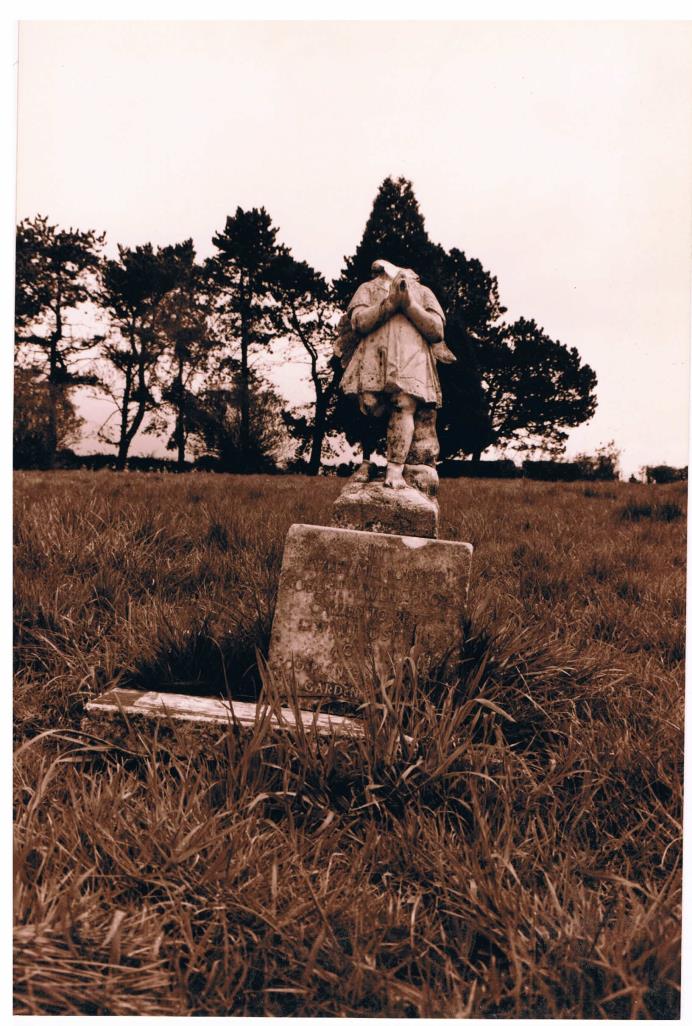
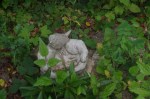
Where were we? We’d come into a neatly mown clearing with a small statue of a headless angel on a plinth at its centre. There were large stones arranged around the perimeter with names and ages inscribed on them. I don’t recall seeing any signs anywhere that indicated what it was. The tall black trees seemed to whisper to each other around us but otherwise it was silent. My companion wanted us to move on deeper into the surrounding countryside and so we did. We’d already roamed around Happy Valley and he was keen to do more. But I had enough time to take one photo and it became an important, and the only, reminder of our visit.

©Carole Tyrrell
This was in 1990 and I had no idea where we were. In later years I discovered that we had been on Farthing Downs, near Coulsdon in Surrey. Although I made several return visits and tried to retrace our walk I could never find the exact place. What was it? A farmer’s cemetery for beloved animals? The ages on the stones had been very young but I could never find it or any information online about it. Was it attached to one of the nearby asylums? Cane Hill Asylum wasn’t that far away across the valley. I was nearly there. In 2013 a magazine article and a map reference revealed it to be St Lawrence’s hospital burial ground. At last I knew where it was and what it was.
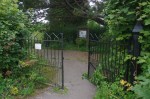


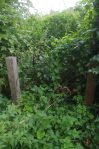
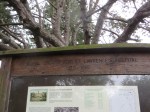
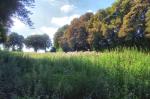
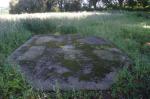
As the wind blew eerily through the bordering pine trees and passing, but invisible golfers, chatted to each other I knew that this was the place that had intrigued me for nearly 30 years. No tidy clearing now and any memorials were half submerged in the overgrown undergrowth. But at last I knew that I was standing in St Lawrence’s Hospital burial ground at Caterham which was now in the middle of a very upmarket golf course. The golf course hadn’t been there in 1990 but its manicured lawns, water features and clubhouse surrounded the burial ground. St Lawrence’s long, late summer overgrown grass, straggling and profuse bushes of blackberries and rose hips and uneven ground made a sharp contrast. I trod very carefully. There were now two black painted metal gates at the entrance and an information board with photos and pictures of St Lawrence’s Hospital and the chapel. This had long since been demolished, but the foundations and base could still be found amongst the long grass and clover. An overcast day and spits of rain combined with the mournful wind made the burial ground feel abandoned.
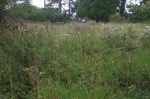

As I stood there it seemed impossible that over 3100 people lay buried under my feet in this spot underneath the tussocks and unkempt long grass. A burial register from 1916-1948 records 3100 people buried in 276 plots with 10-15 in each grave. However, the 1949 -1965 burial register is still missing so there may be 1000’s more buried here. The burial ground is the only surviving part of the Hospital as it closed in 1994 and was demolished to make way for a housing estate.

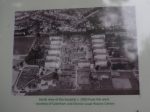
St Lawrence’s was originally the Caterham Metropolitan Asylum which opened in September 1870. It had a sister asylum at Leavesden, Herts. They both took in the pauper insane from London’s workhouses as it was felt that the country air would be good for them and help improve their condition. This is probably why there is such a concentration of asylums in the Surrey area. However their location often led to staff shortages due to their remoteness.
According to Lost Hospitals of London:
‘There were 1560 patients which were housed in 6 three storey blocks for 860 females and 5 blocks for 700 males. The sexes were segregated as they were in all asylums. Children were also admitted and in 1881 St Lawrence’s also become known as the Caterham Lunatic Asylum for Safe Lunatics and Imbeciles. The Victorians weren’t very PC and we would now say that these people had ‘learning difficulties’. In 1913 under the Mental Deficiency Act it became responsible for mentally defective children pauper children or again children with learning disabilities. Children from another hospital and a Training Colony were also sent to Caterham. It also had a large proportion of older patients who had no chance of improvement. 23.6% of its patients were epileptic. (Treatment for epilepsy was non-existent in the 19th century and even 40 years ago it was still in its infancy)
In 1981, St Lawrence’s and another hospital featured in a documentary called ‘Silent Minority’ which drew attention to the poor conditions in these places exacerbated by staff shortages. The media took an interest and patient care, amongst other areas, were investigated by government Inquiries. It focused on the scant and impersonal natures of the wards, deficiencies in nursing care and staffing ratios for profoundly disabled patients. It was said that the hospital management had sanctioned the programme in the hope that public awareness of the extent of the problem might bring about change for the institution. Patients began to be moved out into homes and hostels and into the community.’
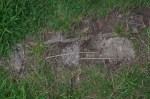
When the burial ground was closed for burials in 1965 the memorial stones were removed from the main burial area and placed on the perimeter so that the grass could be mown. This is how it looked when I saw it in 1990 when the hospital was still in operation. Like Netherne, the burial ground was almost forgotten and became overgrown and abandoned until in 2008, concerned locals took matters into their own hands and started tidying it up. Local residents, cub packs and schools all wanted to be involved and in 2010 13 memorials had been located either intact or in pieces.
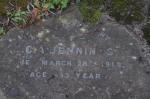
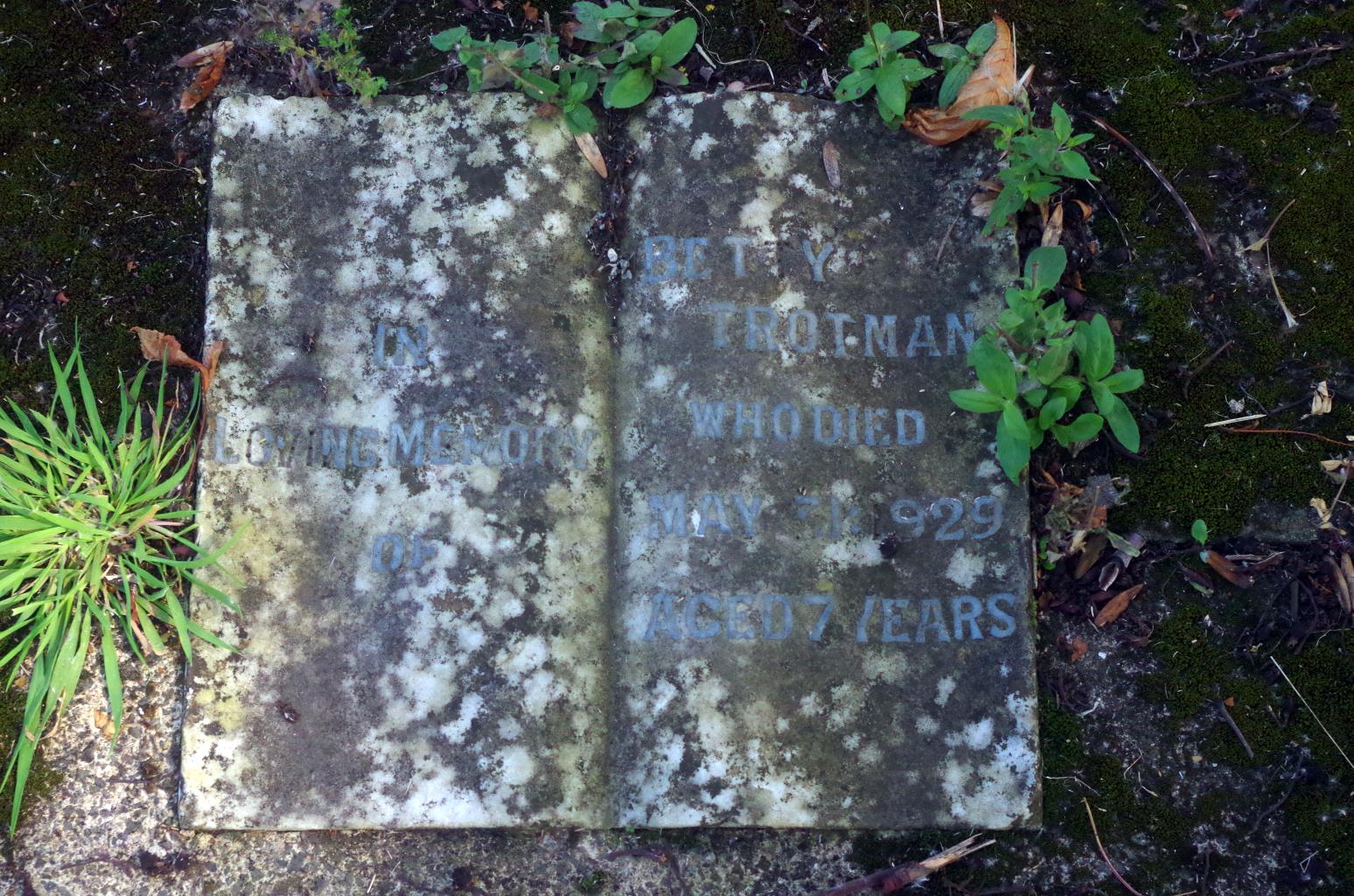
Here is a selection of the memorials that I saw:


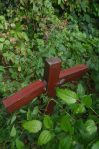
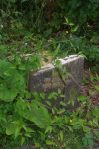

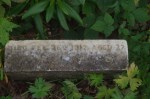
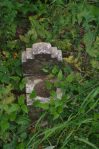
The overgrown uneven ground was obviously due for one of its two annual brush cuts and I trod carefully as I explored. I found a few memorials which were clustered in the overgrown memorial rose bed. I could make out dates and names on some of them and they were poignant reminders of the hospital’s patients. According to the information board, these were the memorials that were found in 2011:
John 1945-1960
Valery Muriel Ann Howcroft 1953-1962
Graham W Cleghorn 1936-1957
Brian W Udy 1889-1917
Frederick Albert Houghton 1948-1957
Ann Margaret Hazell
Bobby Wise
Terry aged 6 years
George Henry Hale 1884-1961
Edna Phyllis Millward 1909-1953
Percy Herbert Goddard Barnes 1891-1963
Leslie Charles Alfred Nash 1924-1963
Pattie (Patricia) Hill 1912-1934
Donald Douglas Chamberlin 1907-1924
Joseph H Wenderott 1926-1942
Malcom Dow 1929-1938
I am indebted to The Downlander for information on two of the memorials:
‘Percy Barnes was in the 1890 Census where he was living at 98 Farringdon Road where his parents kept a coffee house. By 1911 he was a kitchen porter and lived in Shoreditch with his parents, 2 sisters and 3 brothers. But nothing is known of him from 1911-1963 so how did he end up being admitted to St Lawrence’s?
Leslie Nash’s memorial is under the black pines but I didn’t see it on my visit. ‘The burial ground restoration team were contacted by a cousin. He told them that Leslie’s brother was still alive and had been searching for Leslie’s memorial for many years. You can imagine how thrilled he was to know its location at last. Apparently Leslie had epilepsy and cerebral palsy and was sent to St Lawrence’s in 1938 when he had become too heavy for his parents to lift. They had three other children as well. Leslie’s epitaph reads:
Leslie Charles Alfred Nash
Born 6.6.24 – Died 20.9.63
Sweet the sleep you so much needed
Free from suffering care and pain on thy face so peaceful.’
The restoration team managed to make contact with a small number of relatives of those buried here so that they are not forgotten. As I wrote this, a relative was trying to trace her aunt who had been admitted to the hospital aged 18 and died there at 35. I was glad that the burial ground had been reclaimed by local people and that a few of the relatives had been located. As at Netherne they seemed to vanish once they were in the system unless a determined relative decided to look for them.
However, there would have been very few memorials and these would originally have been wooden markers which rot or simple metal markers bearing a number. Originally there were two angels marking the graves of two children and the one that I saw in 1990 may have been one of them. I found another one in the luxuriant undergrowth but it wasn’t the one in my photograph. . The bodies of those who died without friends or family were given to the School of Anatomy to help doctors with medical research and training.
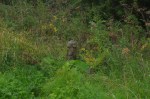


The information board also records:
‘that the Chapel was demolished in 1971 (and from the photo wasn’t a particularly decorative building). However it was large enough to house 8 coffins. The burial service took place in St Lawrence’s Hospital Chapel. A horse drawn hearse with a tarpaulin cover was led by the hospital porters through the gate at the back of the hospital farm and crossed the field to the burial ground. In later years the Head Gardener’s truck was used. It had an iron frame with a hood over the top and rollers for the coffin. But a former head Gardener recalled that the burials were ‘always done with dignity, never rushed.’


The burial ground is in an isolated spot and is reached by walking up a long, secluded lane. So unfortunately it attracts vandalism.

©Carole Tyrrell
The lovely, very solid seat that I saw on my visit in 2017, surrounded by carved wooden animals, was set alight in an arson attack in 2019. It had been carved with a chainsaw by a local sculptor, Andris Bergs and weighed over a ton. The main seat was made from London Plane and its supports from oak wood. The animals were created from Douglas Fir and it seemed sad that these lovely creations were destroyed for no reason. They had been part of the burial ground’s restoration. It’s also seen as a haven for wildlife and newts have been found here.
However, I’m always surprised that asylum graveyards and burial places survive at all. Netherne Hospital Cemetery is also located in an out of the way place and maybe this is why it’s survived. The hospitals to which they were attached no longer exist and in time they might have been forgotten or just built over. In 1990 on my first visit all the big asylums in the area were about to close due to ‘care in the community’. They had become too large, too overcrowded and once inside people seemed to find it difficult to get out of them and so became institutionalised.
But I had finally found the place that had haunted me since 1990. The Royal Surrey Golf Club didn’t open until 1999 and at that time it was just countryside for miles. Paupers surrounded by posh golfers. It seemed almost ironic. Maybe after lockdown it’s time to make a return visit and pay my respects to the permanent residents of St Lawrence’s Burial Ground.
©Text and photos Carole Tyrrell unless otherwise stated.
References and further reading
The Downlander issue 51 Spring-Autumn 2011
http://www.countyasylums.co.uk/caterham-mental-hospital/
http://www.aim25.ac.uk/cgi-bin/vcdf/detail?coll_id=11891&inst_id=118
https://www.countyasylums.co.uk/caterham-mental-hospital/
https://ezitis.myzen.co.uk/stlawrence.html









 shadows fly away