Symbol of the Month – Lion’s Paws


This month’s Symbol is a little bit of fun.

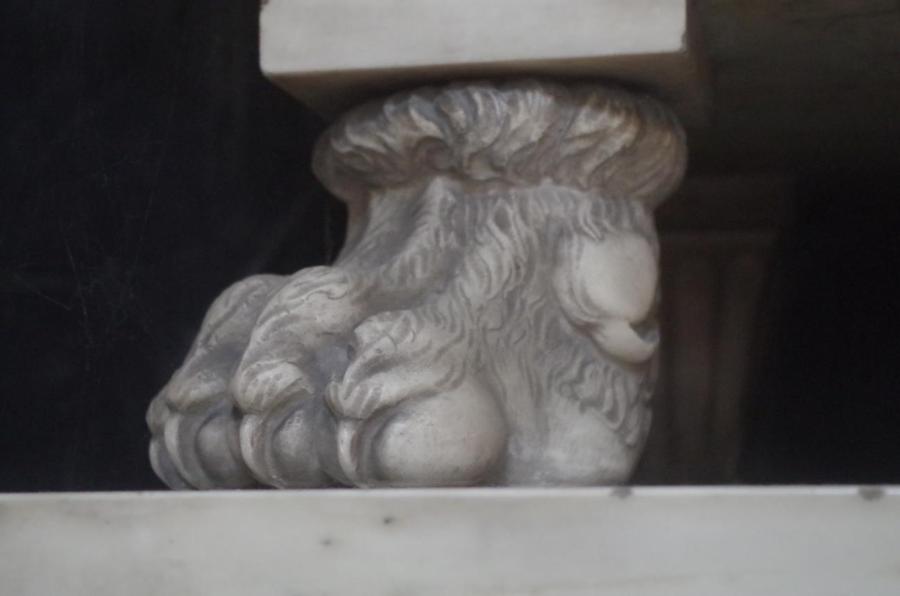
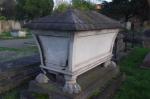
These lion’s feet supporting two sarcophagi within London’s Brompton Cemetery almost look comical – it’s as if they may just get up and run away at any moment carrying their cargo!

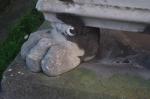
But, if you look closely, then you can see how detailed they are especially with the hair around the ankles and the claws. They are unusual as I don’t see them that often. But there are examples to be found in other cemeteries. For example, there is one within Norwich’s Rosary Cemetery.
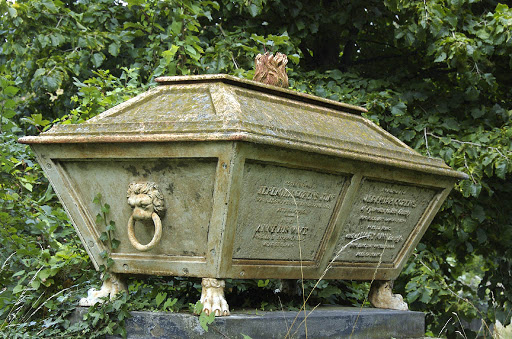
The Cozens monument in the Rosary cemetery, Norwich. It’s made from cast iron which was originally painted black. It records Jeremiah Cozens and other members of the Cozens family.
© Recording Archive for Public Sculpture in Norfolk and Suffolk

The sarcophagus is made from cast iron and was originally painted black.  It is dedicated to the memory of Jeremiah Cozens who died aged 32 in 1849.  There are other members of the Cozens family commemorated on different sides of the sarcophagus.  Also, Mrs Bradley’s monument in Elmwood Cemetery, Memphis, Tennessee, USA features a magnificent set of paws.

The lion represents strength which is demonstrated by the paws supporting the sarcophagus. They have appeared as decorative devices in Ancient Greece and Rome. These were often known as ‘claw feet’ or ‘paw feet’ and were usually either a lion or a bear’s foot.  They also appeared during the Renaissance and into the 17th and 18th century in French and English furniture.  This magnificent example dates from the Renaissance.  Although this sarcophagus has been dated to the 5th century the lions paws were added after the 15th century. It comes from Ravenna, Italy.
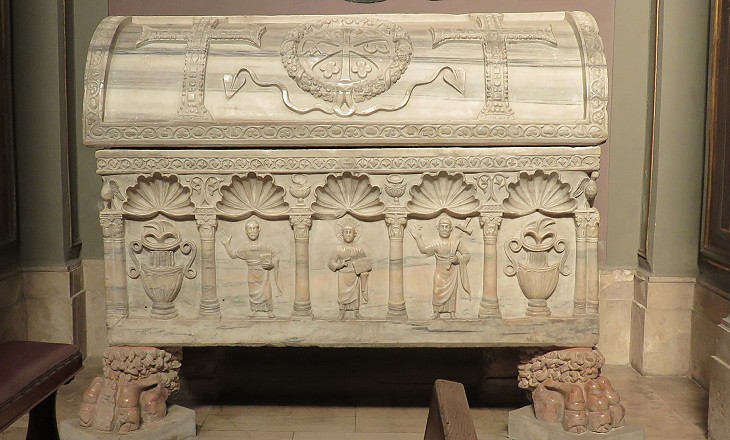
This sarcophagus was used as a grave for an Archbishop of Ravenna. The lion’s paws were added after the 15th century although the sarcophagus dates from the 5th century.
©://www.romeartlover.it/Ravenna4.html


So the use of lion’s paws probably originated in the Classical world as did the sarcophagus form itself. It’s a stone coffin that was used for burials and the word ‘sarcophagus’ comes from the Greek for ‘flesh-eater’.  With the rediscovery and use of Classicism within Victorian cemeteries such as Brompton it’s appropriate to find two elements from it.  Ancient Greece and Ancient Rome motifs appeared in many Victorian cemeteries and Classicism was one of the first major artistic movements to be represented within them.

These two examples are very plain apart from the wildly extravagant carved hair on the ankles of the paws.  They are both dedicated to women; Catherine Ferrall Carmichael and Charlotte Hooffstetter.

Catherine who died, aged 88, on 21 April 1853 was the widow of Major Hugh Lyle Carmichael.  He was the Lieutenant Governor of British Guiana from 1812 until his death, aged 49, in 1813. According to Wikipedia:

 ‘He was a strong proponent of giving native Caribbean troops the same rights as ordinary British soldiers.’

He is buried in Demerara where there is a monument to him. This is the link to the wikipeadia page about him: https://en.wikipedia.org/wiki/Hugh_Lyle_Carmichael

Sadly, I’ve been unable to discover anything much about Catherine. There is an epitaph on one side of the sarcophagus of which I can only read two lines so she may have to be a Work in Progress.
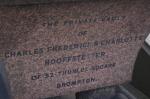
Charlotte Hooffstetter is recorded on one side of her sarcophagus as being:

…’the 2nd wife of Charles Hooffstetter Esq

Nee Charlotte Gasquet

Obt on 31st August 1861 at 77.


According to an inscription on side of the sarcophagus she lived in Thurloe Square with Charles at what is still a swanky address.  They had one daughter, Sophia, who died in 1854 and Charles Hooffstetter died on 30 September 1870. The names of other family members are inscribed on the other sides of the sarcophagus.  But, again, I can find out nothing more about her. According to Find a Grave even her birth date is unknown and Charles proved to be just as illusory. So Charlotte will have to be another Work in Progress.


I also found a magnificent example on the Henniker monument within Rochester Cathedral.

The sarcophagus and lion’s feet were immensely popular and could be adapted to many other decorative uses.  I found several examples of much smaller sarcophagi and lion’s paws on vintage and antique websites where they were being offered as wine coolers and collarettes amongst other uses.  They would look very good on a sideboard or in a gentleman’s study.

But nowadays lion’s paws are more likely to be supporting an ‘antique’ revival bath tub which is a different container for a body altogether!

©Text and photos Carole Tyrrell unless otherwise stated

References and further reading

https://books.google.co.uk/books?id=X3FjAgAAQBAJ&pg=PA143&lpg=PA143&dq=paw+foot+furniture&source=bl&ots=adue3S9yfZ&sig=VPhDuMvb76W8LHyy02CZ-wzZKNE&hl=en&sa=X&ved=0ahUKEwi0yOu48NvYAhWjKMAKHWLfDFo4ChDoAQhRMAk#v=onepage&q=paw%20fo

https://en.wikipedia.org/wiki/Paw_feet

https://www.si.edu/ahhp/smithsons_symbolism

https://www.google.com/search?q=lsarcopahgi+with+lions+paws&tbm=isch&ved=2ahUKEwiYy63th9LnAhXF_IUKHZLEAy8Q2-cCegQIABAA&oq=lsarcopahgi+with+lions+paws&gs_l=img.3…190039.196641..197488…0.0..0.62.1335.27……0….1..gws-wiz-img…….0i67j0j0i131j0i5i10i30j0i5i30j0i24j0i10i24.peZ9RteRhGY&ei=IBtHXpi7GcX5lwSSiY_4Ag&bih=969&biw=1920#imgrc=r4Ue1MRSDSt5KM

https://www.romeartlover.it/Ravenna4.html

http://www.racns.co.uk/sculptures.asp?action=getsurvey&id=940

https://fineartamerica.com/featured/elmwood-cemetery-lions-paw-jon-woodhams.html

Part 3 – a nurse’s enduring love and a patient’s remarkable artistic legacy – Netherne Hospital cemetery Aug 17.

One of  the most poignant stories from Netherne Cemetery is  that of Jean Barboni. He was an 8 year old who died in the hospital in 1915 and whose death haunted his nurse, Elizabeth Martin, for the rest of her life.   Ms Martin’s niece, Edith Kelly,  contacted her local paper to share her aunt’s memories and her own outrage at the then state of the cemetery.   Elizabeth had shared her still vivid memories of Jean with Edith 30 years later after his death.  She had devotedly nursed Jean who was born with what we would now call learning difficulties but then was classed as mentally defective.  Edgard Barboni, his father, was an officer in the French army and a physicist engaged in top secret chemical warfare work during the First World War.  They had had another little boy named Pierre and were finding it difficult to cope as Jean required specialist care.   Eventually he was admitted as a private patient in a house for the ‘mentally subnormal’ as the Victorians classed him at Netherne.  Edith discovered, through her aunt’s diaries that she had always felt that she had contributed to Jean’s death by allowing him to be put in a pauper hospital, Netherne, where he contracted TB.  After Jean’s  parents returned to France with Pierre Elizabeth tended Jean’s grave until her own death. Edith was quoted as saying

‘ For as long as I could remember, she regarded him as her own child.  I suppose the emotional involvement must have been that much greater because the parents were in France and possibly never visited the grave again.’

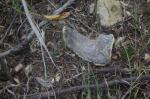
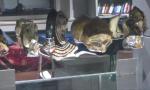
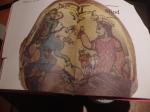
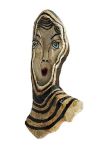
As I left the cemetery and walked back around the border of the field again I noticed the large number of flints on the ground.  I was tempted to take one home as a souvenir but it was too heavy. However, the local flints provided inspiration for a Netherne patient, Gwyneth Rowlands, who painted faces, usually of women directly onto the ones that she found in the fields around the hospital. She might have even found some in this very field.

Sadly, I could discover very little about Gwyneth, despite her work being on display at the Wellcome Collection recently.  She was admitted as a patient in 1946 and stayed there for 35 years probably until it closed in the 1990’s. But on a recent visit to the Wellcome Collection Reading Room I spoke with one of the volunteers, Rock, who told me that Gwyneth may still be alive and she had been in contact with a staff member up until 3 or 4 years ago.  She is considered to be part of the Outsider art movement.   Gwyneth’s technique was to paint directly onto the flint using watercolour, indian ink and varnish.

Art therapy which subsequently  became part of the Outsider or Art Brut movement began at Netherne in 1948 when the pioneering Edward Adamson (1911-1996) became the first artist to be employed full time as an Art Director.

Edward Adamson
Shared under Wikipedia Creative Commons licence.

He formed a huge collection of over 4000 pieces of artwork which is now housed at The Wellcome Collection in London. He believed that the creation of art was a healing process especially for those who could not speak or express themselves in any other way.  However, Adamson wasn’t a teacher or someone who used the artworks as a diagnostic tool.  Instead his approach was as a facilitator artist.  He worked at Netherne until his retirement in 1981. Art therapy was also called  ‘psychiatric art’ . The Outsider Art movement is concerned with artists who are outside the mainstream, usually self-taught and often living within institutions.  It often has no meaning except to the artist themselves although the raw power and emotion of some of these artworks can be really impressive as with Gwyneth’s flint heads.

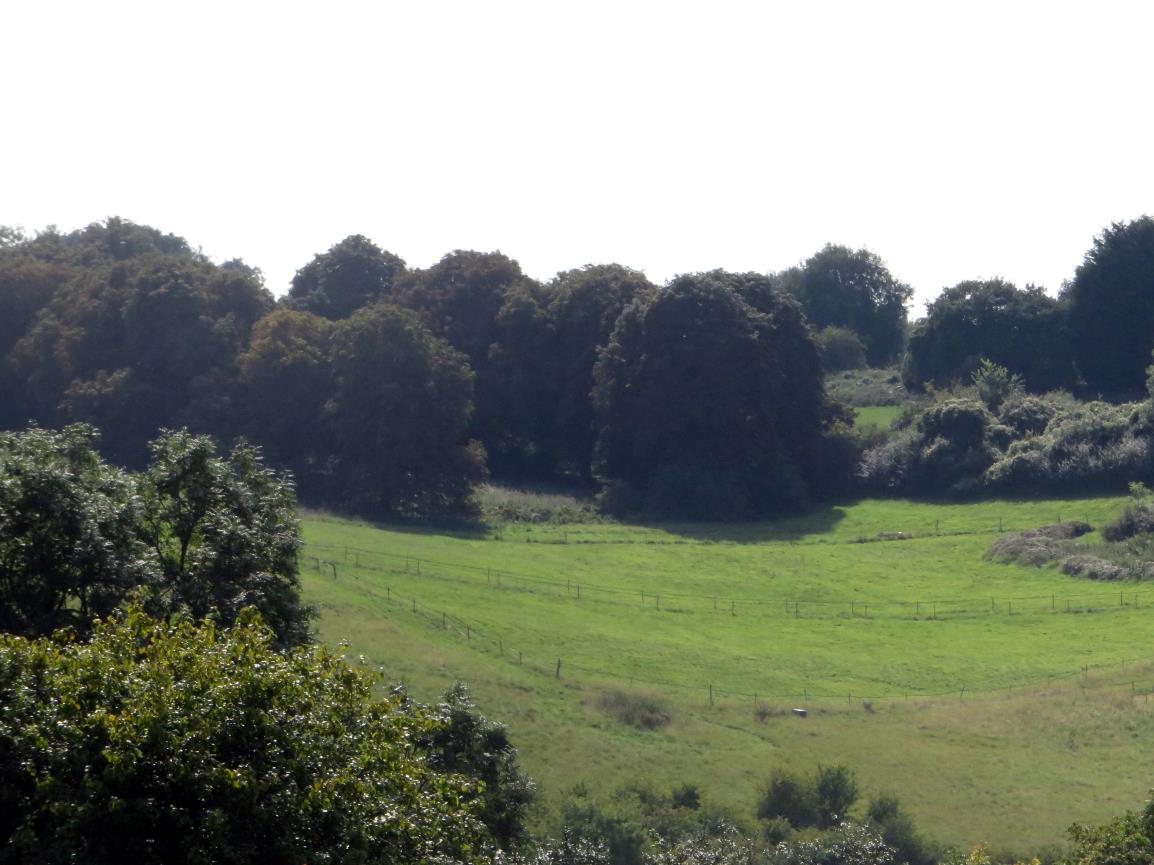
View from Farthing Downs, 500ft up, across to Neherne Cemetry.
©Carole Tyrrell

As I walked over the top of Farthing Downs later on that afternoon heading for Sunday afternoon tea and cakes at Chaldon church I saw the cemetery on the opposite slope.   I hoped that it would always be surrounded by large green fields and that its incumbents would always rest in peace under the chestnut trees and wildflowers.

©Text and photos Carole Tyrrell unless otherwise stated.

Further Reading:

Outsider Art: From the Margins to te Marketplace, David Maclagan Reaktion Books 2009

Art as Healing, Edward Adamson, Coventure 1984

https://wellcomecollection.org/adamson-collection

http://www.mendiphospitalcemetery.org.uk/history.html

http://www.yourlocalguardian.co.uk/news/10494304.Campaign_victory_after_cemetery_with_war_dead_finally_cleared/

https://billiongraves.com/cemetery/Netherne-Asylum-Cemetery/292853

http://www.simoncornwell.com/urbex/hosp/n/e140106/1.htm

http://www.thisislocallondon.co.uk/indepth/nostalgia/8392020.Forgotten_graves_of_the_war_dead/

http://www.suttonguardian.co.uk/news/8437328.Diaries_of_Catholic_nun_reveal_tale_of_child_buried_at_Netherne_asylum/

 http://beyondthetrenches.co.uk/the-other-war-dead-asylum-patients-during-the-first-world-war/

 http://www.croydonguardian.co.uk/news/8421298.Developer_s_broken_promise_over_asylum_cemetery/

 https://www.genesreunited.co.uk/boards/board/ancestors/thread/1314646