A love supreme? The Allen memorial, All Saints Birchington

Full view of the Allen memorial. © Carole Tyrrell

There are so many stories within a churchyard. They are truly repositories of a community’s history in their recording of births, deaths and the history of local families. A simple epitaph can say so much about the people buried beneath it.


I almost missed the Allen headstone as it’s lying down on the grass. This would have been a shame as it is one of the loveliest and most poignant memorials in the churchyard and must have looked imposing when it was standing upright.

A closer view of the epitaph. © Carole Tyrrell

It’s dedicated to a married couple, Janet Lormie Allen or ‘Cissie’ who died young aged 23 on 10 October 1914, and her husband, Ernest August Allan, who died 45 years later aged 79. I don’t know why Cissie died so young: it may have been in childbirth, due to illness or to another cause. But she was greatly missed as the sentiment on the headstone shows.

At one side of the tombstone, beside the epitaph, stands a young woman, a maiden, dressed in a diaphanous, long flowing robe from which one strap has fallen, exposing a bare shoulder. The hair is untied and falls to her shoulders. Behind her is a tall, slender rose stem whose blossoms reach over her head. She looks upwards to the blooms above her as, with one hand, she reaches up to pluck a rosebud. In her other hand she already holds a single bloom half open. There is a hint of the waning of the Art Nouveau movement in the flowing lines of her dress and the romance of the image.

The significance of the rose being plucked is that it’s a bud and so not yet in bloom which indicates a life cut short.

I don’t know if Ernest remarried but he was buried with his wife in 1959 and so they were reunited. It’s such a shame that as the headstone is lying down as rainwater gathers on the carving of the young woman and, for example, there has been erosion on her face.

Closer view of the maiden’s face. © Carole Tyrrell

Despite my research I have not been able to find out any further details about the couple. But it’s one of the most beautiful memorials that I’ve seen, not just because of the carving, but, as I like to think of it, a love story written on an epitaph in a country churchyard. And as we approach St Valentine’s Day what could be more appropriate?


©Text and photos Carole Tyrrell
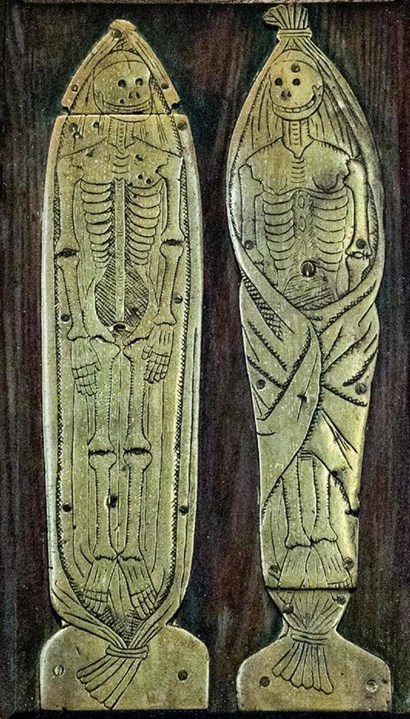
The mystery of two wonderful examples of medieval memento mori

I found the article below in the Church Times and thought that I would share it with you.  Although on first glance they may look a little macabre, I saw them as lovely examples of medieval iconogrpahy.  In many ways they are also very touching.  I love the mystery surrounding them as well.

Shrouded skeletons on brasses in medieval Durham church investigated

02 MARCH 2018


FRIENDS OF ST EDMUND’S CHURCH

The two shrouded figures displayed on brasses at St Edmund’s, Sedgefield

PUBLIC curiosity about two shrouded skeletons in a medieval church has led to an investigation into their origins.

The figures — believed to be male and female — are depicted on brasses displayed on the wall at 13th-century St Edmund’s, Sedgefield, in Co. Durham, which is Grade I listed. The plates are singular in that they portray skeletons: normally, the figure is a likeness of the person in the tomb.

Little is known about them, and the Friends of St Edmund’s are trying to find out more. “We are asked about the origin of the skeletons on a fairly regular basis, and it would be nice to have an explanation for people who visit the church,” Alison Hodgson, a local historian and the secretary of the group, said.

They hope that documents held in the archives of the Society of Antiquaries of Newcastle upon Tyne will shed some light, and are aware of one record which says that the two figures were once on a tomb that had a shield and ribbon above, and a border — probably with an inscription — around the edge.

Brian Mutch, a churchwarden and the Friends’ membership secretary, is leading the investigation. “We don’t know how long they have been in the church,” he said. “One document from 1896 says they were there then; so we will have to go further back. There is no indication as to how old they are, but all the others in the church date from the 1300s; so it is quite likely they come from then.

“It is possible they were on a tomb in the north transept, but that has been altered two or three times over the years. However, we do have two stone effigies in the south transept — one of a man and the other of a woman — and I wonder if it is them. There are records of noble families in the area giving patronage to the church, but we have yet to examine them.

“There is a lot more work to do. I don’t know how long it will take, but we shall persevere.”