What does a woman clinging to a cross, seemingly for dear life, have in common with the film ‘Merry Christmas Mr Lawrence’ and heavy metal group Def Leppard?
Strangely enough, the connection is an 18th century Protestant hymn written by a fiercely Calvinist minister which has entered the Western cultural consciousness in the same way as ‘Abide With Me’.
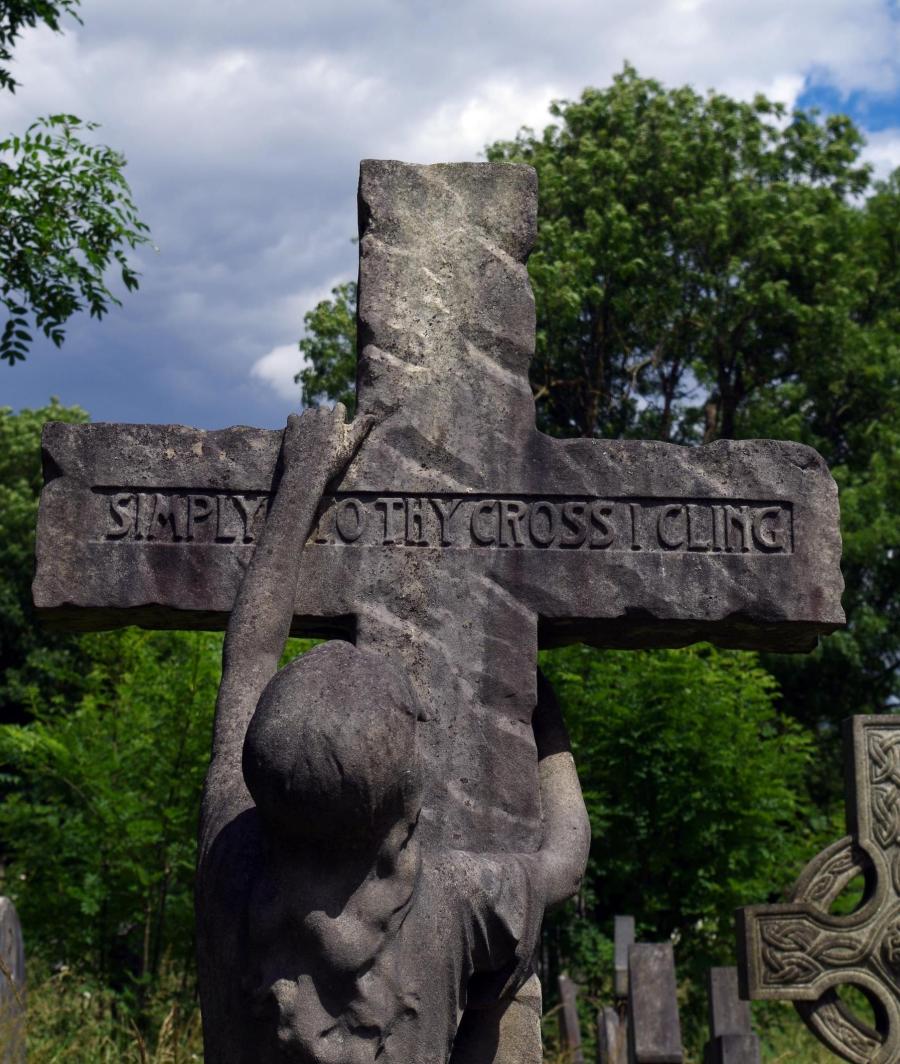
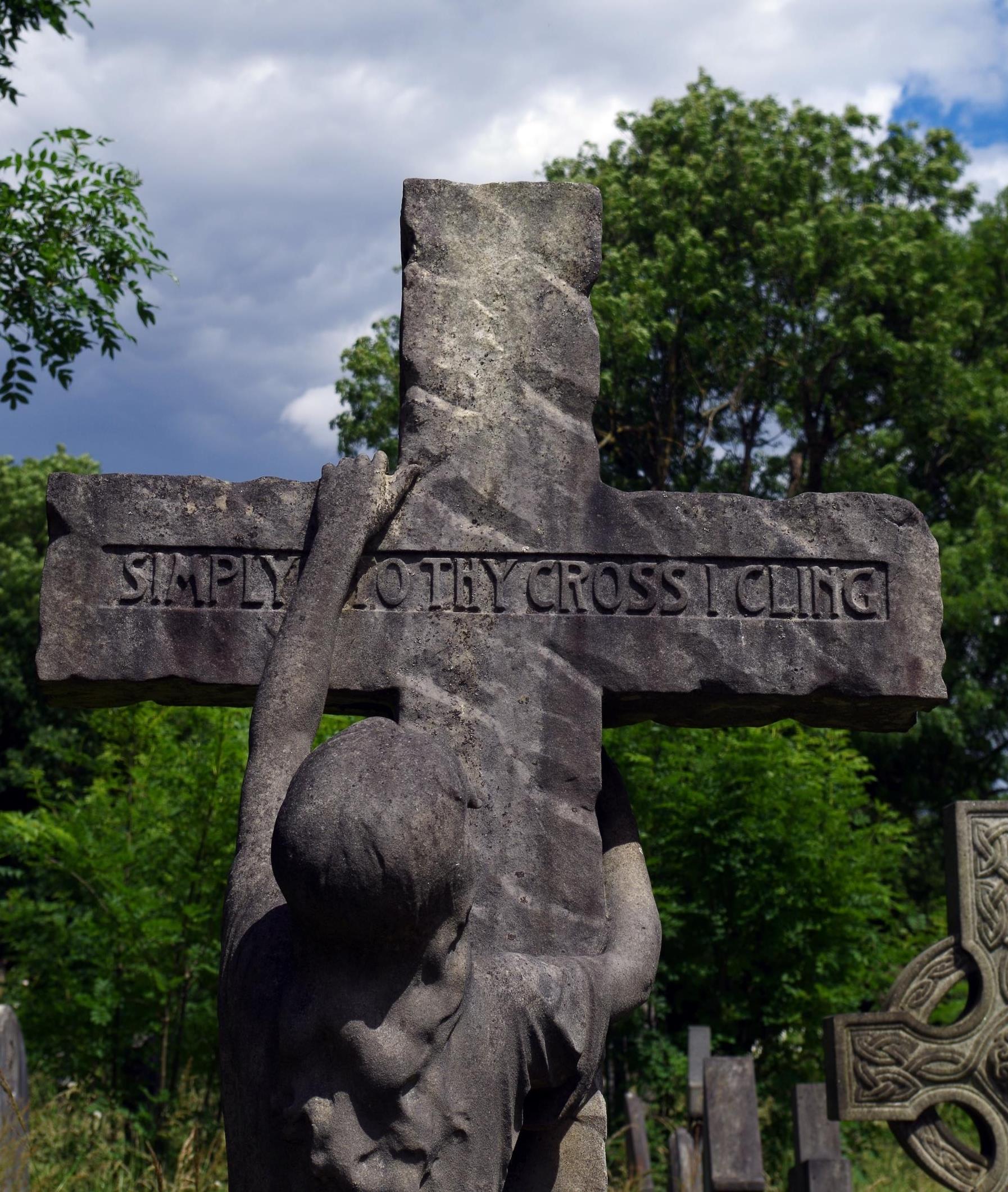
‘Rock of Ages’ is a hymn with an enduring message of hope and ultimate salvation. So no wonder it inspired a potent funerary symbol which is still used today. However, it’s the second line in the third verse, ‘Simply to Thy cross I cling.’ that has proved most inspirational to Victorian monument masons.
A variant is a pensive young woman leaning on a cross for support as at West Norwood. This cemetery contained several examples and here is a selection:
They’re not angels as they don’t possess wings and angels didn’t begin to appear in Victorian cemeteries until the late 19th century. But they are one of the few cemetery symbols inspired by a popular hymn. It’s also a Protestant motif and was the only way in which a cross would have been permitted in a Victorian cemetery until near the end of the 19th century. This was due to the religious wars that were raging at the time.
When the Victorians created their large municipal cemeteries there was still a fierce Anti-Catholic prejudice within Britain. This dated back to Henry VIII and the Reformation and had resulted in several anti-Catholic laws being passed during the 17th and 18th centuries. But the cry was still ‘No Popery’ in the 19th century and any symbols that were associated with Catholicism weren’t welcome in the new marble orchards. These included crosses, figures of saints and also angels. Instead, there was a return to Classicism using Roman and Greek motifs and architecture. Then, as the 19th century progressed, funerary monuments reflected the tastes of the time. So you could walk through one and see Arts & Crafts, Celtic Revival, Art Nouveau until eventually towards the end angels did being to fly in.
‘Rock of Ages’ was written by a Calvinist minister, the Reverend Augustus Toplady, in 1763 and was first published in a religious magazine, ‘The Gospel’, in 1775. It’s allegedly based on an incident in Toplady’s life. He was a preacher in a village named Blagdon and was travelling along the gorge of Burrington Combe in Somerset’s Mendip Hills when he was caught in a storm. He managed to find shelter in a gap in the gorge and was struck by the name of the crevice that had saved him. It’s still marked as ‘Rock of Ages’ both on the rock itself and maps. He is reputed to have written the hymn’s lyrics on the back of a playing card although one wonders what a minister was doing with a deck of cards. However, no-one’s sure if this incident actually happened or if it’s apocryphal….
Toplady wasn’t a popular man and in an article by Rupert Christensen of the Daily Telegraph he was described as ‘fanatical, in a gross Calvinism and most difficult to deal with.’ John Wesley avoided him. Toplady was also fond of writing bizarre articles, one of which proposed that a spiralling National Debt could never be paid off due to the extent of human sinfulness. Something for the new Chancellor to ponder on I’m sure. Toplady died in 1776 from TB and would undoubtedly have been forgotten were it not for his rousing hymn.
‘Rock of Ages’ caught the popular imagination. Gladstone translated it into Latin and Greek and asked for it to be played at his funeral. Prince Albert reputedly requested it on his deathbed and it has appeared in several feature films. These include ‘Merry Christmas Mr Lawrence’ where it’s sung by David Bowie as Major Jack Celliers and both ‘Paper Moon’ and ‘The Silence of the Lambs’ where it’s played at a funeral. It’s also inspired musicians such as Def Leppard and the writer of the film score for ‘Altered States.’ John Congliano. It’s also the title of the long running musical stage show.
These are its lyrics:
Rock of Ages, cleft for me,
Let me hide myself in Thee;
Let the water and the blood,
From Thy riven side which flowed,
Be of sin the double cure,
Cleanse me from its guilt and power.
Not the labour of my hands
Can fulfill Thy law’s demands;
Could my zeal no respite know,
Could my tears forever flow,
All for sin could not atone;
Thou must save, and Thou alone.
Nothing in my hand I bring,
Simply to Thy cross I cling;
Naked, come to Thee for dress;
Helpless, look to Thee for grace;
Foul, I to the fountain fly;
Wash me, Saviour, or I die!
It was also popular as a print and these are two examples:
This is a particularly effective one dating from 1876 and is by Johannes Adam Simon Oertel. Again from Pinterest.
I found this on Pinterest with no details of artist. The only information was that it dated from 1909.
Both seem to clinging to a cross in a raging sea – a sea of sin perhaps?
The symbol has reappeared in more recent years and there is a much smaller, modern version at Beckenham Cemetery. This is on the grave of a 16 year old who died in 1965.
An inspirational hymn to the Victorians and also well into the 20th Century but what could have the same effect these days? I’ve always fancied a video of Sid Vicious singing ‘/My Way’ on my tombstone…..
The first Symbol of the Month of 2020 – a little later than I planned but more to come….
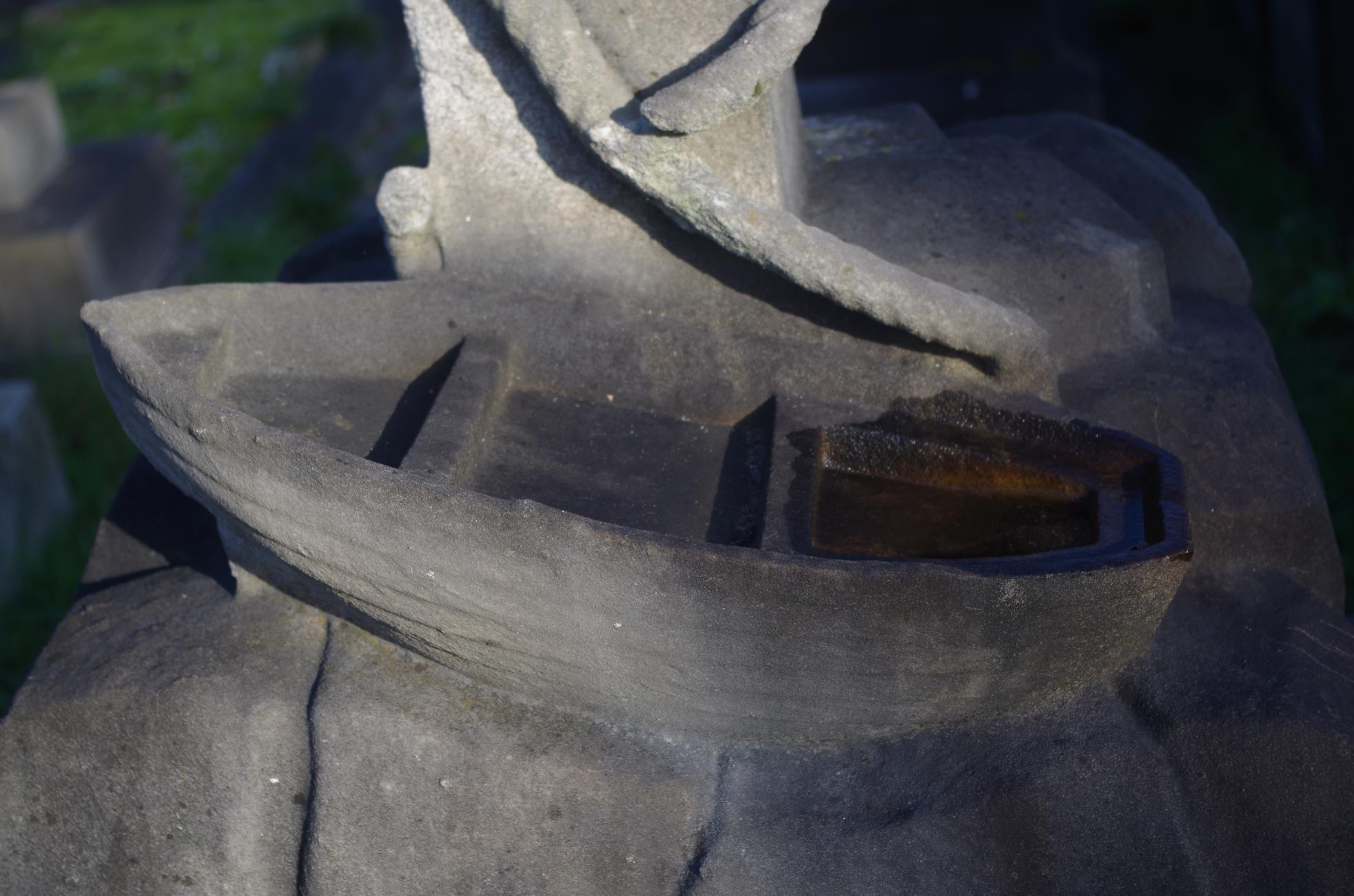
Close-up of boat, Caig monument Brompton Cemetery Side view of boat
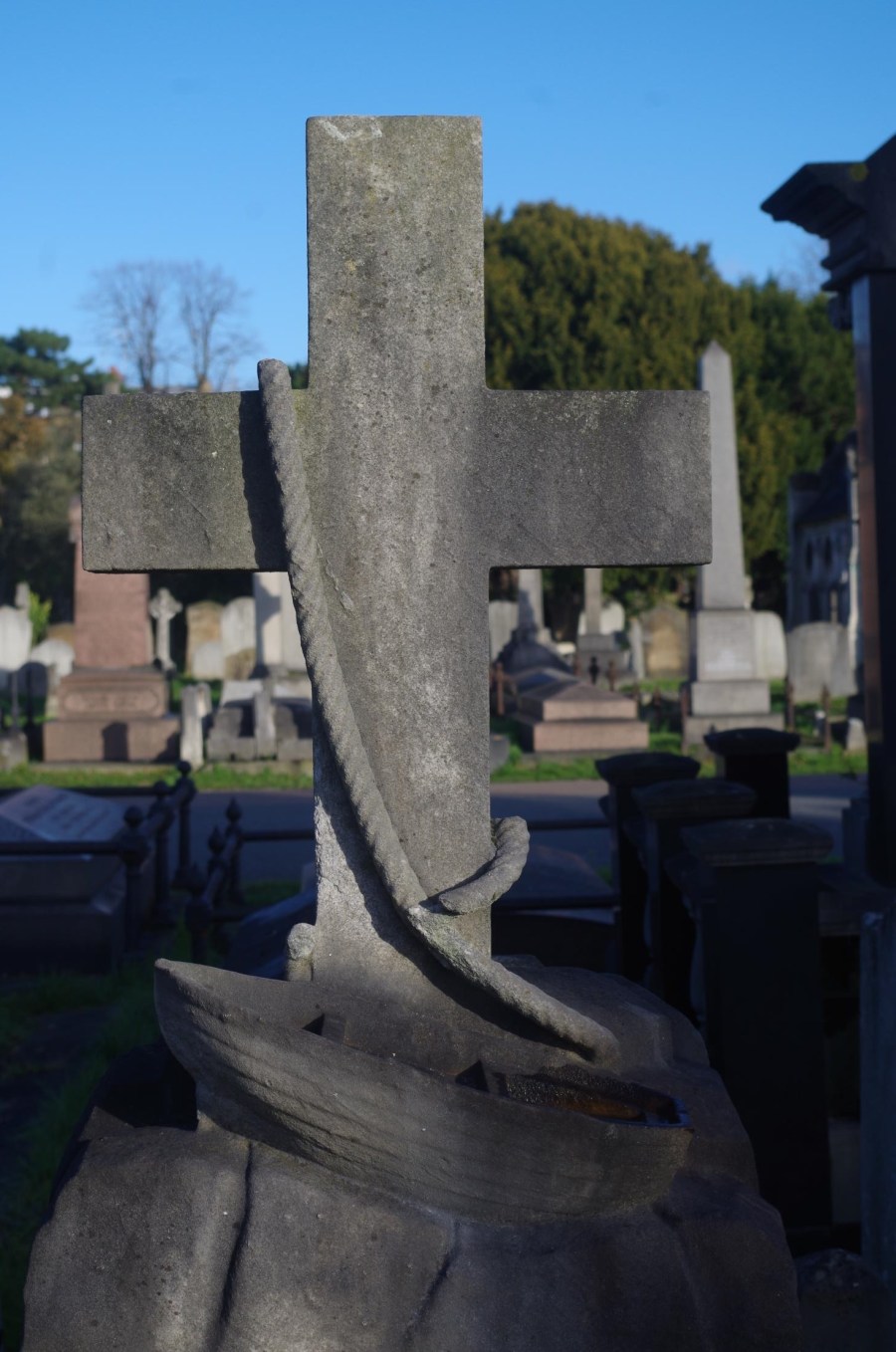
There are many sailing vessels in cemeteries. Ships, boats and the occasional yacht, becalmed on headstones or monuments forever sailing on a marble or granite sea. Often they reveal the incumbent’s former occupation as on this fine example on the grave of Captain Edward Parry Nisbet in Brompton Cemetery. Note the cross formed by the mast which is one of the central symbols of Christianity. There’s also the magnificent and exuberant monument to Captain Wimble and his indomitable wife on the appropriately named Ship Path in West Norwood Cemetery.
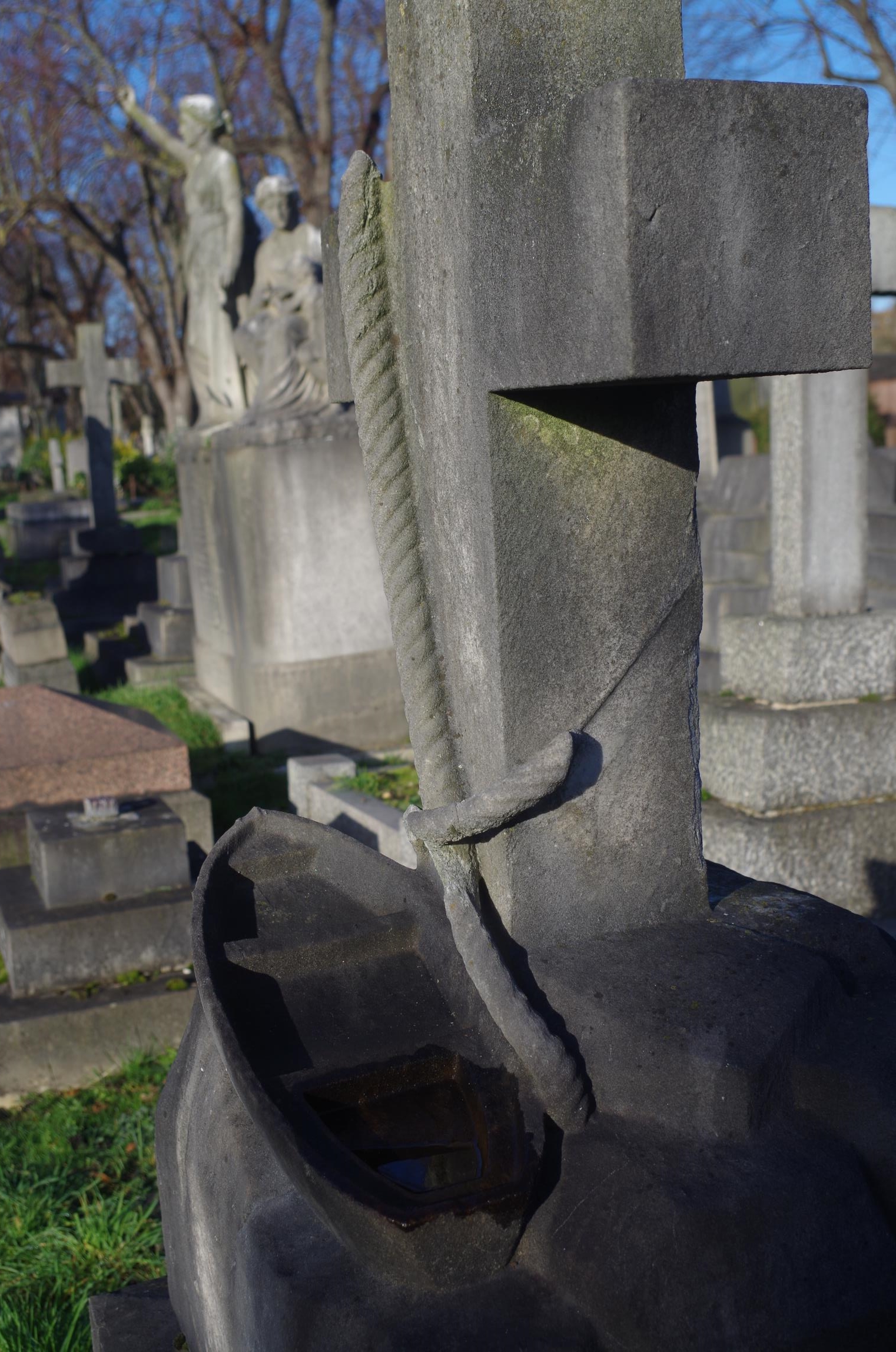
But this little boat tied up and apparently moored at the base of a large cross is symbolic of a journey that has reached its final destination.
Side Side view of boatview of boat showing detail as it’s been carved to resemble a wooden boat.
The monument is located within Brompton Cemetery and is a representation of the journey of life. This is a small sculpture of a rowing boat that has been carved to resemble a wooden one and there are seats inside but no oars. It could be interpreted as coming to the end of your life or journey and entering another life of eternity symbolised by the cross. In other words, the crossing to the ‘other world’ as Douglas Keister calls it. Also as www.stoneletters says:
‘…it’s a symbol of our last journey, it embodies the voyage of life, of coming full circle and taking us back to the waters of our beginning.’
However a boat can also be seen as an emblem of safety and refuge as it carries us over life’s often choppy seas and takes us home. In this context, another boat that springs to mind is Noah’s Ark. It protected and saved all that were on it and was a metaphor for the church as it weathered the storm against all odds. However, Keister also suggests that the shape of a boat can resemble that of a cradle or a womb which would again emphasise shelter and protection. It holds us secure above the chaos of life.
Boats and death are a central theme in many other religions and cultures in that they carry the souls of the dead to eternity. For example, King Arthur was transported by boat on death and, most famously, the Vikings people also used funerary boats. This was granted to important people of the tribe as they and their possessions would be sent out across the water in one after it had been set ablaze. A symbolic mimicking of the soul’s journey to Valhalla. Also in Greek mythology, Charon was the ferryman who took the souls of the dead by boat into the Underworld by crossing the River of Woe, Acheron.
But boats and death also feature in literature, especially poetry and there is the famous quotation by F Scott Fitzgerald:
‘So we beat on, boats against the current, borne back ceaselessly into the past.’
‘Crossing the Bar’ by Alfred Lord Tennyson also features a sea voyage which will end in death,
Sunset and evening star,
And one clear call for me!
And may there be no moaning of the bar,
When I put out to sea,
But such a tide as moving seems asleep,
Too full for sound and foam,
When that which drew from out the boundless deep
Turns again home.
Twilight and evening bell,
And after that the dark!
And may there be no sadness of farewell,
When I embark;
For tho’ from out our bourne of Time and Place
The flood may bear me far,
I hope to see my Pilot face to face
When I have crost the bar.
There is also The Ship of Death by D H Lawrence amongst others.
I said earlier that a boat or ship is an important Christian symbol due to the mast forming a cross. Also, the Latin for ‘nave’ ,the central aisle of a church, means ‘ship’ and there are several Biblical references to boats and ships. After all, Christ told his disciples to “follow me and I will make you fishers of men”.
But let’s not forget that a boat or ship can also indicate a love of sailing and freedom.
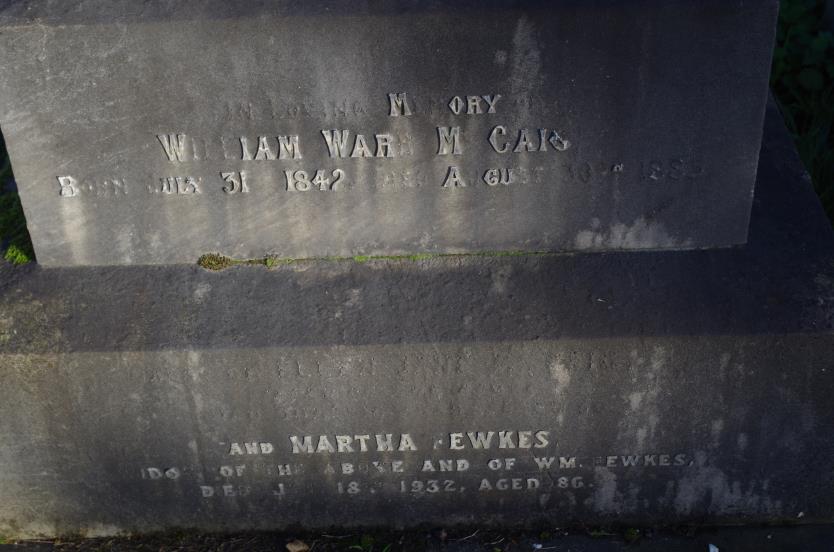
Some of the letters on the epitaph beneath the boat and cross have worn away so I can only assume tha the name commemorated is Walter Ward M Cais but it seems incomplete. He died young at only 43 and his widow, Martha, married again and lived well into the 20th century. It must have been a message of comfort that Walter’s small boat was moored safely for eternity.
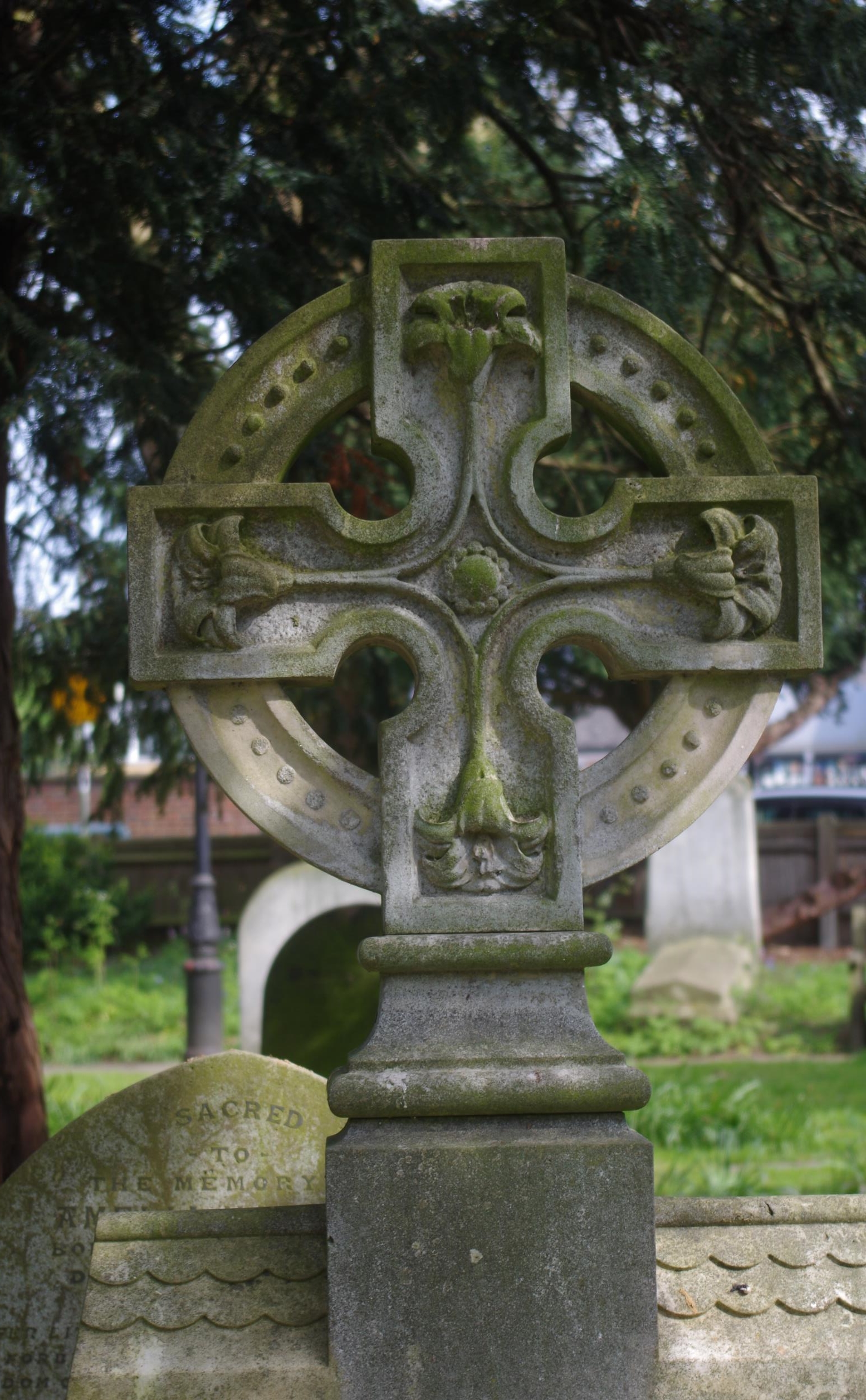
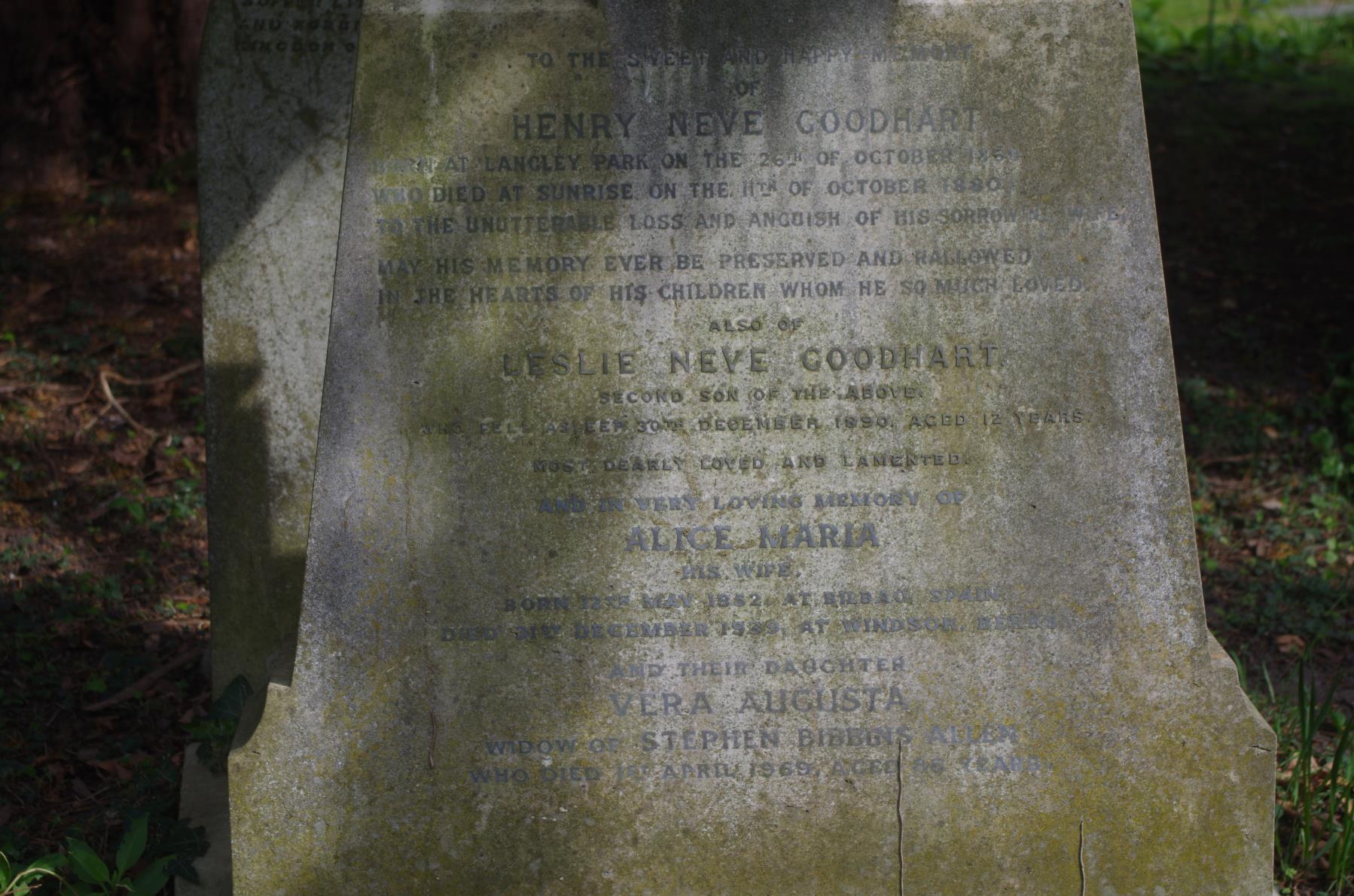
I have always loved the magnificent Lily Cross in St George’s churchyard, Beckenham as it’s such a bold and well carved one. It’s also one of the largest memorials with the churchyard and is dedicated to a prominent local family, the Goodharts. There is a poignant epitaph as well.
The Lily Cross is in the form of a Celtic Cross with the four arms of the Cross each ending in a lily flower.
Lilies have always had a special and long significance with death. In the 19th century their pungent, heady aroma was purportedly used to disguise the smell of the recently deceased’s body when it was the custom to have them rest at home prior to the funeral. But the lily has also been seen as a representation of the soul’s return to innocence after death.
This is because of the lily’s strong associations with purity and innocence and with its colour of pure white it’s especially linked with the Virgin Mary. Hence its other name the Madonna Lily. In Christian Art, the Archangel Gabriel and the Virgin Mary are often depicted as holding a lily.
But there are other variants on the Lily Cross and these are:
The Flore Cross
The Patonce Cross
The Fleur de Lys Cross
These are more stylised versions of the Lily Cross. In the Flore or Fleury Cross the arms end in a representation of flower petals and usually a lily. They often have three points at the end of each arm which represent three petals which is the version that I have usually seen without realising it. A variation may be two points or horns or crowns but I haven’t seen this variation yet.
The Patonce Cross is any form of cross which has expanded end in which each arm ends in floriated points like the Flore or Fleury Crosses. In heraldry, the three petals represent faith, wisdom and chivalry and the four arms of the cross spread these to the four corners of the world. As a Christian Cross, the three petals represent the Trinity and the total of twelve petals symbolise the Apostles.
According to seiyaku.com, it’s claimed that the term Patonce is derived from the French word for the paw of an ounce or Snow Leopard. However it looks nothing like the paw print of a leopard but has been interpreted as the French being whimsical or romantic.
The Fleur-de-Lys Cross has similarities to both the Fleurie and Patonce Crosses in that it has liliform ends to the arms of the cross as they do. But these represent barbed fighting spears which are used in French heraldry. The entire cross is a very stylised lily that has heraldic associations especially in France where it was traditionally connected with royalty. When Pope Leo II crowned Charlemagne as Emperor he was reputed to have presented him with a blue banner emblazoned with a golden fleur de lys. However, after the French Revolution the fleur de lys was less obviously associated with royalty. Edward II is said to have used it in his coat of arms to emphasise his claim to the French throne. Iwww.senyaku.com it’s claimed that this cross has been adopted by modern sub cultures such as the Goth movement who know it as the Gothic cross and New Agers who call it the Lotus Cross.
But a brief word on the cross as symbol. It wasn’t always the primary emblem of Christianity and in fact, it wasn’t adopted until after the 2nd century. Prior to this it was the fish symbol, the ichthys, that was used by early Christians to identify fellow believers and often appears carved or written on their tombs.
The Ichthys, the symbol used by the early Christians prior to adopting the cross. Shared under Wiki Creative Commons
In Christianity, the cross represents the Crucifixion and is a sign of Christ and faith.
But the cross also appears throughout many cultures and civilisations in several forms. The cross of Horus, or the ankh, was used by the ancient Egyptians and, as it was often held in the hand of a god or powerful person, it’s a symbol of power.
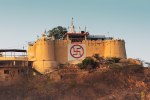
The swastika was another ancient form of the cross. But is now unfortunately associated with death and destruction due to its adoption by the Nazis. But originally it was seen as a sign of good fortune and came from the East as these two examples show:
Goa Lawah Hindu Temple entrance, Bali Indonesia
Shared under Wiki Creative Commons
A Hindu Temple, Rajasthan, India
Shared under Wikimedia Commons
However, even for Christians, there were uncomfortable connotations to the cross. For centuries, it had been used as a method of punishment, not only for early Christians, but also for wrongdoers such as criminals. However, its adoption as the central symbol of the Christian symbol is attributed to a dream of the Roman Emperor, Constantine, in AD 320. In this he decided to abandon the Roman pagan gods and pray to the Christian god. According to Douglas Keister:
‘During a midnight prayer Constantine gazed towards the heavens and saw a group of star that looked like a huge, glowing luminous cross. After he fell asleep, Constantine had a dream in which he saw Christ holding the same symbol and instructing Constantine to affix it to his standards. He defeated Maxentius. As a result he had the emblem applied to all of his standards and emblems’
When I began researching this post, even I had no idea of how many variants there were on the Lily Cross or, indeed, on crosses in general. It makes a stroll through a churchyard or cemetery even more intriguing now that I can spot the subtle differences between the various types. Although I have often seen lilies carved on headstones and memorials I have yet to see one as lovely as the St George’s Lily Cross.
However, I have also previously seen crosses with real cloth draped on them in two big London cemeteries One was in the Greek Section of West Norwood. At that time I thought that perhaps it was to commemorate an anniversary or a particular religious festival. However, during my research for this post. I have discovered that the colour of the West Norwood cloth, white, is associated with Easter Sunday.
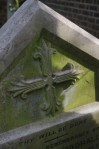
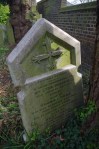
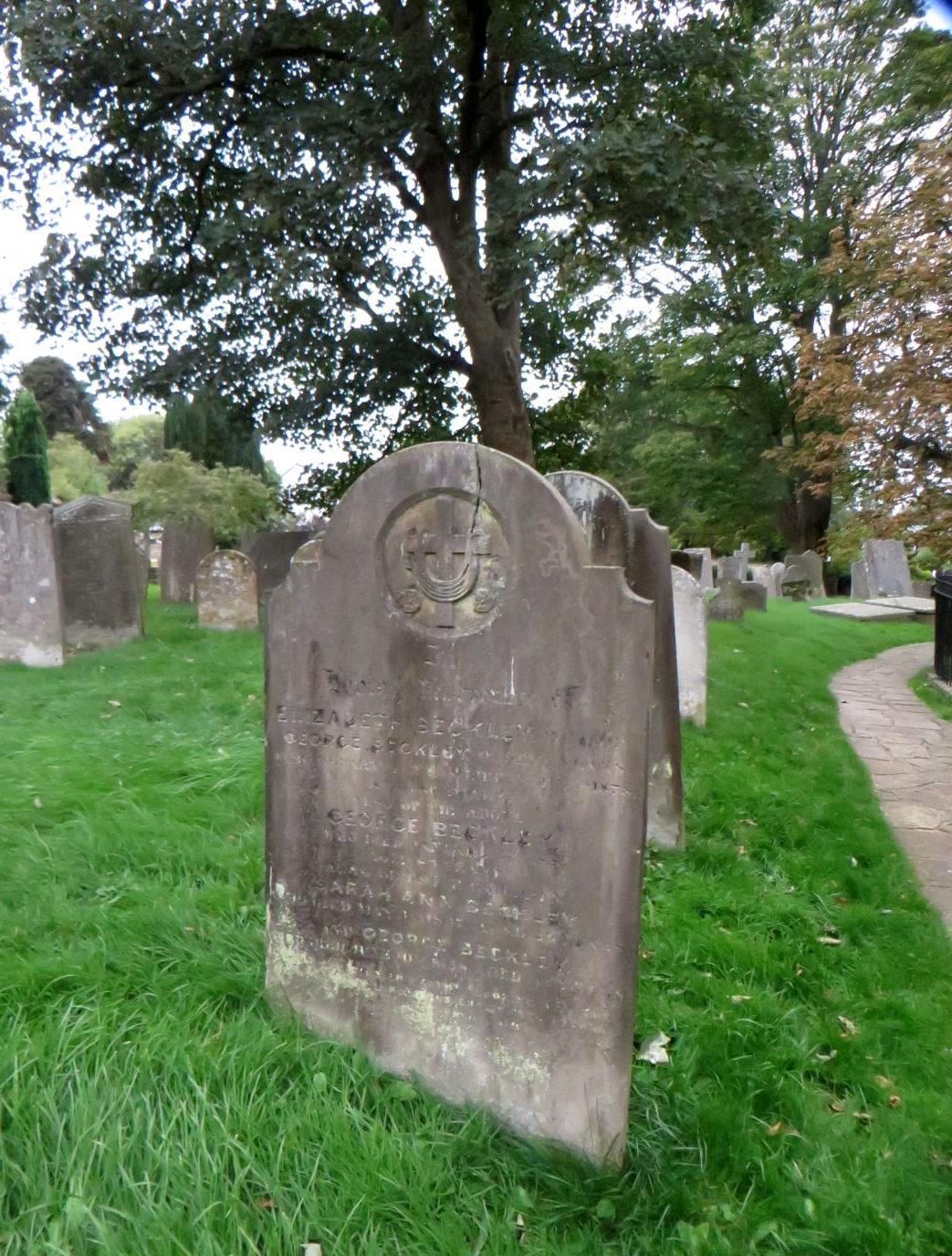
As you can see from the above photo of the Beckley headstone, the cloth is wrapped loosely around the cross and, according to my research, it’s a resurrection symbol. In fact it’s known as the Resurrection Cross or the Shrouded Cross. Some of its other names are: the Draped Cross, the Empty Cross, the Risen Cross or the Deposition Cross. The latter is a further reminder of Christ’s descent from the cross
It’s intended to be a representation of Jesus no longer being on the cross. Although there are also plain crosses on graves unless they have the cloth they are not Resurrection crosses. The cloth is a supposed reference to Christ’s grave clothes or shroud that were found in the tomb after he rose from the dead. It emphasises to the bereaved left behind that death isn’t the end.
Within the church calendar, the cloth draped around a cross during important dates in the Christian calendar particularly Easter has special significance according the colours of the fabric. These are white, purple – the colour of royalty, and black. The latter is used from Palm Sunday (the week prior to Easter) until Good Friday and denotes mourning after Christ’s death on the cross.
The shrouded cross on the Beckley headstone is a striking image which caught my attention and really stood out in a churchyard containing several headstones with fascinating symbols on them.
So this one may be an affirmation of faith on behalf of the deceased or a strong belief in the afterlife with death being seen as the beginning of a new life.
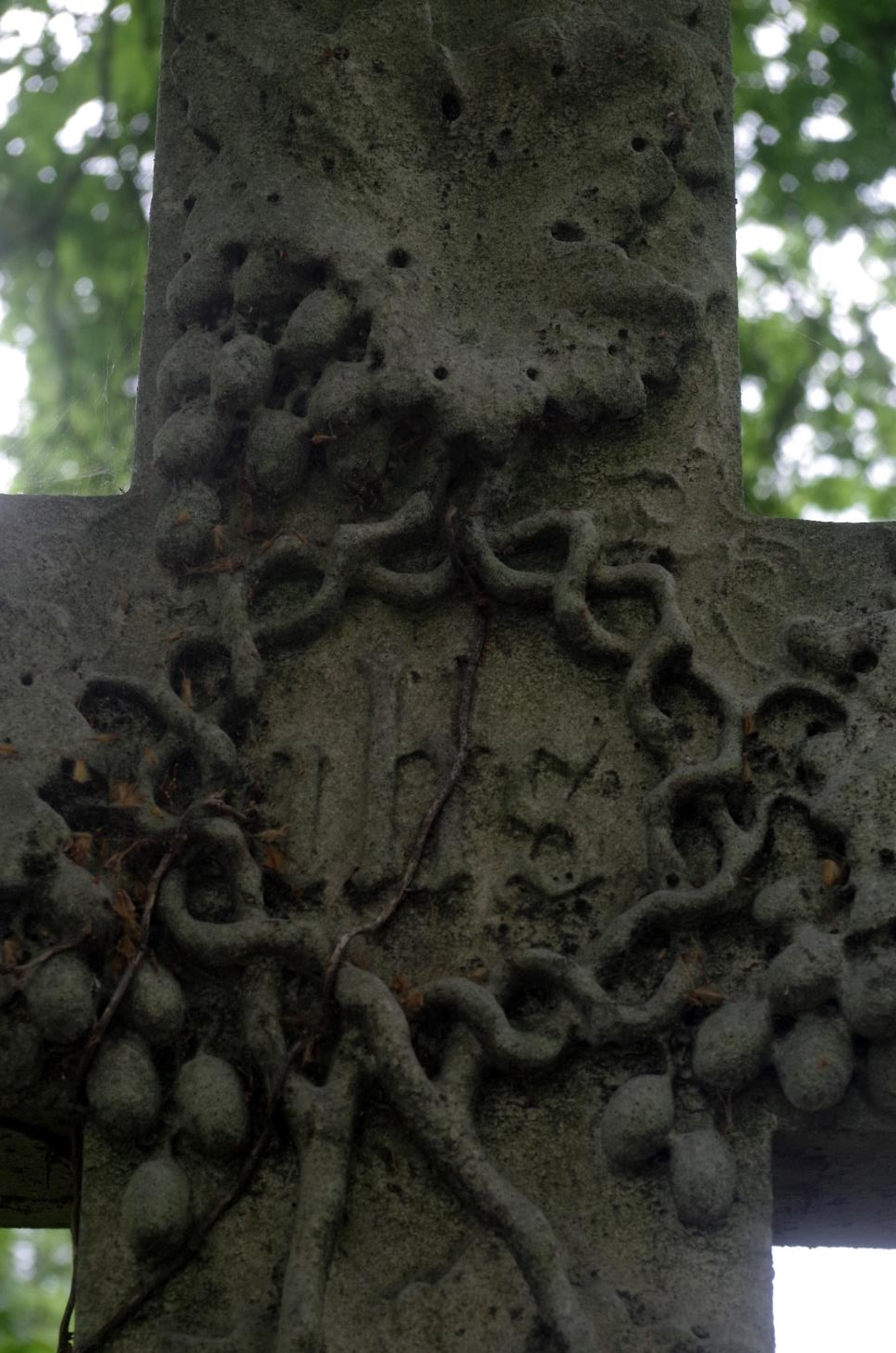
This is another less well known symbol but, in my opinion, a very attractive one. I found two examples of a grapevine climbing up a cross during a recent visit to Kensal Green cemetery together with another that only featured grapes as decoration and a fourth which had trailing vine leaves on a Celtic cross. The first two in Kensal Green really make good use of the cross on which they are carved to its fullest advantage with the vines sinuously climbing up the stem and then the leaves almost hanging from the crosspiece. In fact the form of a grapevine almost resembles a cross with the long stems stretching up and then branching out horizontally with the grapes hanging from them. I also found a cross in Brompton Cemetery which had a design of grapes and vine leaves as a border around its edges.
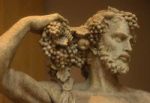
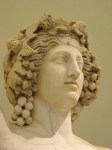
For the source of this symbol we have to go back to the ancient Greeks and the god Dionysus. He was also known to the ancient Romans as Bacchus and both of them are always represented in paintings and sculptures as holding grapes. The latter were often depicted on Greek wine cups in tribute to Dionysus. Both of them were seen as the god of the vine and were associated with wine-making, celebration and ecstasy. Dionysus was also associated with rebirth in that, after his dismemberment by the Titans, he came back to life in an echo of the winter pruning of grapevines so they may bear fruit again during the next year. He was unique in that he could bring a dead person back from the underworld.
As you may imagine, the early Christians adopted the less bacchanalian side of Dionysus and Bacchus. There are many similarities between Dionysus and Jesus in that both were supposed to have been born from a mortal woman but fathered by a god, to have returned from the dead and to have transformed water into wine. The early Christians took the latter and transformed it into a miracle. They also used the powerful symbol of the grapevine with Christ calling himself ‘the vine.’ In John 15:5 there is the famous quotation:
‘I am the vine and you are the branches. If a man is in me and I in him, he will bear much fruit.’
In fact a vine and its branches are traditionally seen as depicting Christ and his followers, the Church and its faithful. He also uses the analogy of the Kingdom of Heaven as being similar to that of a manager hiring workers for his vineyard. The grapevine was also adopted by the ancient Roman Christian converts and appears on their graves and in their mosaics.
Grapes are an abundant crop and are one of the earliest cultivated crops known to us. It bears fruit for the harvest and so is associated with celebration and good times. The artofmourning website has suggested that there is also an element of birth/rebirth with the representation of the grapes and also a connection with victory.
‘The ripe harvest shows the promise of the fruits rewards being reaped and turned into the production of sustenance for the future.’
An interesting theory within the context of a funerary symbol as it hints at resurrection. There is also the theme of sacrifice. Wine, which comes from the grape, has always traditionally been seen as representing the blood of Christ and this is particularly symbolic during the service of Holy Communion within the Catholic church. Also, during the Last Supper, Christ gave wine to his disciples and told them to drink it in remembrance of him.
But what does this age-old symbol mean within a Victorian London cemetery? As I see it, it can be a representation of the deceased becoming part of an eternal vineyard i.e. the Kingdom of Heaven or that their earthly lives were full of abundance and achievement. But it can also be a motif of resurrection in that the grapes are crushed underfoot to be reborn as wine and this would be highly appropriate for use within a cemetery. In fact I’m surprised that it doesn’t appear more often as it is very eye-catching amongst more restrained classical symbols especially when combined with a cross.
These two fine examples come from Kensal Green cemetery and demonstrate how well a grapevine translates onto a cross. Note the three letters in the centre of the Cross which are IHS combined together. This is a Greek abbreviation for Jesus Christ, Man and Saviour which is ‘Iesus Honinum Salvator’ which translates as ‘Jesus the Saviour of Man’.
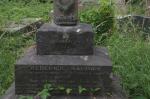
The first is to Frederick Salmon and the other to George Gordon Moir. I haven’t been able to find out anything on Moir but research is ongoing. However, he obviously liked Salmon’s cross and embellishment as his is identical.
But Frederick Salmon (1796 – 1859) was a renowned and pioneering surgeon and he has a fascinating story to tell.
Salmon was a restless Victorian medical man out to make his mark and improve the lives of his fellow citizens. In many ways he was a maverick destined to rebel against and work outside the medical establishment of the time. As you can see from his epitaph he founded St Mark’s Hospital which is still in existence, based in Harrow and is part of the St Bart’s and the London NHS Trust.
He was born in Bath in 1796 and, at 15, was apprenticed to a surgeon-apothecary. Somewhere along the line he met William White, one of the earliest surgeons to write on rectal disease. Salmon always credited White with the direction in which his own career went which was in the field of proctology.
However, the medical establishment frustrated Salmon. Training depended on money and influence as posts had to be bought and so were often earmarked for friends and relations of surgeons and physicians. In 1817 he paid £8.15s.0d to become a house surgeon at St Barts and then rose to a surgeon’s post. He also wrote a book on intestinal disease in 1828 which ran to four editions. But Salmon became part of a medical scandal when, in 1833 aged 37, he resigned with other staff members from the General Dispensary in protest. They were angry at the plans of the hospital governors to revert to a system in which posts were up for sale to those who could afford to pay. The Lancet declared in the same year that the practice was ‘one of money, of favour and of family interest.’ Salmon was now a free man and obviously one of considerable charisma and talent. He founded St Mark’s in 1835 with the City of London providing much of the finance. It was in one room with seven beds and 2 other staff members at 11 Aldersgate Street in the City. A plaque still marks its location. It had the less than catchy name of St Mark’s Infirmary for the Relief of the Poor afflicted with Fistula and other diseases of the Rectum. But it soon acquired a nickname: The Fistula Infirmary. Despite several moves and expansions of premises St Mark’s remained in the City until 1995 when it moved to its present location.
From the beginning St Mark’s filled a desperate need for London’s poor to be able to access treatment. Salmon was not only able to attract significant funding but also wealthy patrons and supporters. Sir William Copeland, Lord Mayor of London, was a grateful patient who became St Mark’s first President and Charles Dickens presented several autographed copies of his latest book, The Pickwick Papers, and 10 guineas in gratitude. This was after having undergone a rectal operation without anaesthetics. Salmon was reputed to have performed 3500 operations without a single fatality which was an incredible achievement at a time when antiseptics were unknown and anaesthetics were only just coming into use.
Salmon retired, due to ill health, in 1859 and died at Ombersley near Droitwich on 3 January 1868 aged 72. St Mark’s was his lasting legacy and there is a ward named after him. Today the hospital is one of only 14 worldwide hospitals to be recognised as a centre of excellence by the Worldwide Organisation of Digestive Endoscopy.
Salmon was a vine that bore fruit as did John Edward Taylor (1830-1905)
Mr Taylor’s magnificent Art Nouveau style monument is tucked away on a lower path in Kensal Green Cemetery. It dwarves the far more recent surrounding graves and headstones. Such unashamedly Art Nouveau memorials are rare within cemeteries. There’s one in Streatham cemetery, a lovely gem in West Norwood, another in Hendon and there are undoubtedly others scattered across London.
Here the grapes are carved on the left hand side sidepiece flanking the main memorial. These reflect the Art Nouveau love of natural forms and structures. The movement used the curving, organic lines taken from plants and flowers. But, by the time Mr Taylor’s widow Martha died in 1912, Art Nouveau was about to be replaced by the angular lines of Art Deco.
Taylor was another restless Victorian man who was involved in many areas. He was the second son of John Edward Taylor senior who founded the Manchester Guardian in 1821 backed by a group of local liberals known as The Little Circle. They had successfully lobbied for parliamentary reform in the era of rotten boroughs and as a result of their efforts Parliament passed the Reform Act of 1832. Taylor senior witnessed the Peterloo massacre in 1819 but been unimpressed by its leaders. The Manchester Guardian is still in business but now renamed the Guardian and Taylor edited it until his death at the early age of 52.
After the death of his older brother, Russell, in 1848 Edward became co-owner and then sole owner of his father’s paper in 1856. He also edited it from 1861-1872. Newspaper ink was in his blood and he also became owner and then co-owner of the Manchester Evening News until his death. He was also a philanthropist and believed in education which led him to become a trustee of Manchester College from 1854 until his death. He founded the Manchester Aid Society in 1863, advocated temperance and free trade and was also involved in the British and Foreign Bible Society. On top of this he was also a director of the Buenos Aires Great Southern Railway Company.
Taylor remained a lifelong liberal and in 1895 he refused a baronetcy offered to him by Lord Rosebery. But he was also known as a great art collector and a generous one. He often lent out some of his collection to local exhibitions in Manchester or at Burlington House. After his death, Christie’s held a sale of his collection over 12 days and achieved record prices for the time. Taylor lived in London after his marriage in 1861 to Martha Elizabeth, the sorrowing wife, recorded on the monument. The newspapers passed to other members of the extended family.
This is less ornate and, instead, features vine leaves cascading on a Celtic cross with again the very ornate combined letters of IHS in the centre of the cross, or the nimbus, with a dedication below to Matilda Morris who died on 10 December 1881. Again I haven’t been able to find out anything about her but research is ongoing.
This is an example from Brompton Cemetery and here the grapevine and leaves form an intricate pattern around the cross. I may not be able to read the epitaph on the flat slab beneath until the winter die-off.
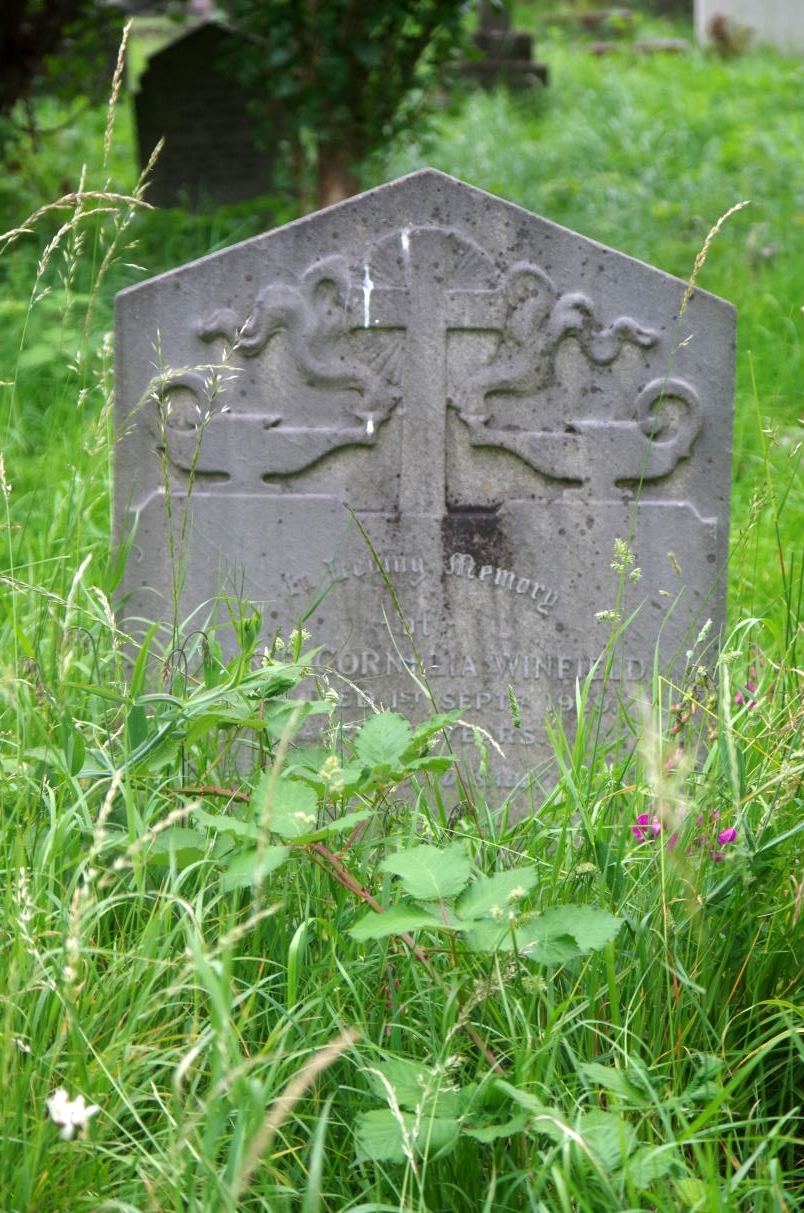
I was looking for butterflies, the Marbled White to be exact, on a side path in Brompton Cemetery when I found this memorial. Should I rub one of the Aladdin style lamps and see if a genie appeared to grant me three wishes? I was intrigued as to why they were on the stone and so began my research for this month’s symbol – The Lamp.
The grave is that of Marie Cordelia Winfield who died young at the age of 19. There is another family member commemorated on the headstone who is called James Alfred Winfield. But it’s very lowdown on the stone and the encroaching summer vegetation obscured it making it difficult to read.
Lamps are an unusual symbol to see in a cemetery but Light as a motif in itself has been used in many forms. Often it’s represented by the eternal flame or a downturned/ upturned torch but lamps are rare. Obviously now I’ve said that, I’ll see lamps in every cemetery on every tombstone but so far it’s just been this one.
The Winfield lamps appear to be oil lamps and these have been used as illumination for thousands of years. In Arabian folklore a genie’s lamp contained a magical spirit known as a djinn or genie. This mythical being could help or hinder those who were brave enough to rub the lamp as in the story of Aladdin.
An example of an Aladdin Lamp.
In this story the lamp was seen as a gateway to another world of mystery and other gods. The symbol of the lamp was later adopted by Christianity as many pagan motifs were and it came to symbolise Jesus as the ‘light of the world’. There is a famous passage in the New Testament in Matthew 25:1-13 of the parable of the 10 virgins:
‘Then shall the kingdom of heaven be likened unto ten virgins, which took their lamps, and went forth to meet the bridegroom.
And five of them were wise, and five were foolish.
They that were foolish took their lamps, and took no oil with them:
But the wise took oil in their vessels with their lamps.
While the bridegroom tarried, they all slumbered and slept.
And at midnight there was a cry made, Behold, the bridegroom cometh; go ye out to meet him.
Then all those virgins arose, and trimmed their lamps.
And the foolish said unto the wise, Give us of your oil; for our lamps are gone out.
But the wise answered, saying, Not so; lest there be not enough for us and you: but go ye rather to them that sell, and buy for yourselves.
And while they went to buy, the bridegroom came; and they that were ready went in with him to the marriage: and the door was shut.
Afterward came also the other virgins, saying, Lord, Lord, open to us.
But he answered and said, Verily I say unto you, I know you not.
Watch therefore, for ye know neither the day nor the hour wherein the Son of man cometh.
King James version
There are several other references to lamps in Matthew 6:22-23, Revelation 22:5 and also John 5:35 in which John the Baptist is described as
‘he was a burning and shining lamp, and you were willing to rejoice for a while in his light.’
And let’s not forget God appearing to Moses in the burning bush. There is also a famous quotation from Psalms 119:105:
‘Thy word is a lamp unto my feet, and a light unto my path.’
The lamp as a representation of God and faith appears in other religions including the Jewish Feast of Dedication or Festival of Lights and also Diwali which is the Hindu Festival of Lights. Judaism sees lamps as a way of lighting the way for the righteous and the wise. This is represented by the seven branched ritual Jewish oil lamp which is known as a menorah. Lamps are also an integral part of the Orthodox and other Eastern Catholic churches as they are used on the Holy Table or altar and also to illuminate icons. In Chinese religions an oil lamp is always lit at traditional Chinese shrines before either an image of a deity or a plaque in classical Chinese characters with the name of the deity. Lamps also feature in the Koran. There is also a strong element of self-sacrifice associated with the lamp as it consumes itself in order to bring light to the world.
There is long tradition of lamps representing purity and virginity as well as love. So it’s highly appropriate for the Winfield tombstone which is dedicated to a young girl. When I looked more closely at the Winfield memorial I noticed that both of the lamps were pointing towards the cross in the centre with what I presumed were the rays of the sun coming from behind it almost like a halo. The lamps are obviously lit as fumes are coming from their spouts and, to me, they seemed to be illuminating the way through eternal darkness towards the light of a new life. I thought that it would have been comforting to those left behind to mourn the loss of a daughter who had been taken too soon. As the epitaph says:
‘Greatly loved and sadly missed.’
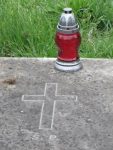
However, as I explored further in Brompton I noticed actual lamps placed on top of graves or alongside them. These were mainly on the graves of Polish people.
In Poland, there is a long tradition of lighting lamps and candles on their All Saints’ Day which is held on November 1st each year. This is the day before the Christian festival of All Souls Day which is traditionally held on November 2nd. I visited Brompton Cemetery on November 1st 2015 and witnessed the local Polish community’s celebration of All Saints with lit tea candles and lamps on top of Polish and non-Polish graves alike. The lights were again being used as a way to help the souls of the departed on their way and so the tradition continues.
What does a woman clinging to a cross, seemingly for dear life, have in common with the film ‘Merry Christmas Mr Lawrence’ and heavy metal group Def Leppard?
Strangely enough, the connection is an 18th century Protestant hymn written by a fiercely Calvinist minister which has entered the Western cultural consciousness in the same way as ‘Abide With Me’.
‘Rock of Ages’ is a hymn with an enduring message of hope and ultimate salvation. So no wonder it inspired a potent funerary symbol which is still used today. However, it’s the second line in the third verse, ‘Simply to Thy cross I cling.’ that has proved most inspirational to Victorian monument masons.
A variant is a pensive young woman leaning on a cross for support as at West Norwood. This cemetery contained several examples and here is a selection:
They’re not angels as they don’t possess wings and angels didn’t begin to appear in Victorian cemeteries until the late 19th century. But they are one of the few cemetery symbols inspired by a popular hymn. It’s also a Protestant motif and was the only way in which a cross would have been permitted in a Victorian cemetery until near the end of the 19th century. This was due to the religious wars that were raging at the time.
When the Victorians created their large municipal cemeteries there was still a fierce Anti-Catholic prejudice within Britain. This dated back to Henry VIII and the Reformation and had resulted in several anti-Catholic laws being passed during the 17th and 18th centuries. But the cry was still ‘No Popery’ in the 19th century and any symbols that were associated with Catholicism weren’t welcome in the new marble orchards. These included crosses, figures of saints and also angels. Instead, there was a return to Classicism using Roman and Greek motifs and architecture. Then, as the 19th century progressed, funerary monuments reflected the tastes of the time. So you could walk through one and see Arts & Crafts, Celtic Revival, Art Nouveau until eventually towards the end angels did being to fly in.
‘Rock of Ages’ was written by a Calvinist minister, the Reverend Augustus Toplady, in 1763 and was first published in a religious magazine, ‘The Gospel’, in 1775. It’s allegedly based on an incident in Toplady’s life. He was a preacher in a village named Blagdon and was travelling along the gorge of Burrington Combe in Somerset’s Mendip Hills when he was caught in a storm. He managed to find shelter in a gap in the gorge and was struck by the name of the crevice that had saved him. It’s still marked as ‘Rock of Ages’ both on the rock itself and maps. He is reputed to have written the hymn’s lyrics on the back of a playing card although one wonders what a minister was doing with a deck of cards. However, no-one’s sure if this incident actually happened or if it’s apocryphal….
Toplady wasn’t a popular man and in an article by Rupert Christensen of the Daily Telegraph he was described as ‘fanatical, in a gross Calvinism and most difficult to deal with.’ John Wesley avoided him. Toplady was also fond of writing bizarre articles, one of which proposed that a spiralling National Debt could never be paid off due to the extent of human sinfulness. Something for the new Chancellor to ponder on I’m sure. Toplady died in 1776 from TB and would undoubtedly have been forgotten were it not for his rousing hymn.
‘Rock of Ages’ caught the popular imagination. Gladstone translated it into Latin and Greek and asked for it to be played at his funeral. Prince Albert reputedly requested it on his deathbed and it has appeared in several feature films. These include ‘Merry Christmas Mr Lawrence’ where it’s sung by David Bowie as Major Jack Celliers and both ‘Paper Moon’ and ‘The Silence of the Lambs’ where it’s played at a funeral. It’s also inspired musicians such as Def Leppard and the writer of the film score for ‘Altered States.’ John Congliano. It’s also the title of the long running musical stage show.
These are its lyrics:
Rock of Ages, cleft for me,
Let me hide myself in Thee;
Let the water and the blood,
From Thy riven side which flowed,
Be of sin the double cure,
Cleanse me from its guilt and power.
Not the labour of my hands
Can fulfill Thy law’s demands;
Could my zeal no respite know,
Could my tears forever flow,
All for sin could not atone;
Thou must save, and Thou alone.
Nothing in my hand I bring,
Simply to Thy cross I cling;
Naked, come to Thee for dress;
Helpless, look to Thee for grace;
Foul, I to the fountain fly;
Wash me, Saviour, or I die!
It was also popular as a print and these are two examples:
This is a particularly effective one dating from 1876 and is by Johannes Adam Simon Oertel. Again from Pinterest.
I found this on Pinterest with no details of artist. The only information was that it dated from 1909.
Both seem to clinging to a cross in a raging sea – a sea of sin perhaps?
The symbol has reappeared in more recent years and there is a much smaller, modern version at Beckenham Cemetery. This is on the grave of a 16 year old who died in 1965.
An inspirational hymn to the Victorians and also well into the 20th Century but what could have the same effect these days? I’ve always fancied a video of Sid Vicious singing ‘/My Way’ on my tombstone…..


























 shadows fly away