Symbol of the Month -the dark side of the snowdrop

Snowdrops in St George’s churchyard, Beckenham. ©Carole Tyrrell

On February 2, tomorrow in fact, it will be Candlemass, an important day in the church calendar. Already snowdrops are appearing, nodding their tiny white heads in the breeze and making people feel that Spring is on its way.

It’s always at this time of year that I repeat this post. For these delicate little flowers have another darker side to them and a long association with churchyards and death.

Imagine yourself in a gloomy medieval church on the festival of Candlemass. You, and your fellow parishioners, have each brought your candles to be blessed by the priest and, after the procession which will fill the church with light, they will all be placed in front of a statue of the Virgin Mary.   Candlemass marked the end of winter and the beginning of Spring. The blessing is to ward off evil spirits.  It traditionally falls on February 2 and is shared with the Celtic festival of Imbolc.  And in the churchyard outside you can see green shoots forcing their way up through the hard winter earth.  The snowdrop’s milk-white flowers show that spring is on its way as they begin to emerge into the light.

The placing of the lit candles in front of the Virgin Mary’s statue gave the snowdrop one of its many other names – Mary’s Tapers.  But there are many others such: Dingle Dangle, Candlemas Bells, Fair Maids of February, Snow Piercer, Death’s Flower and Corpse Flower.
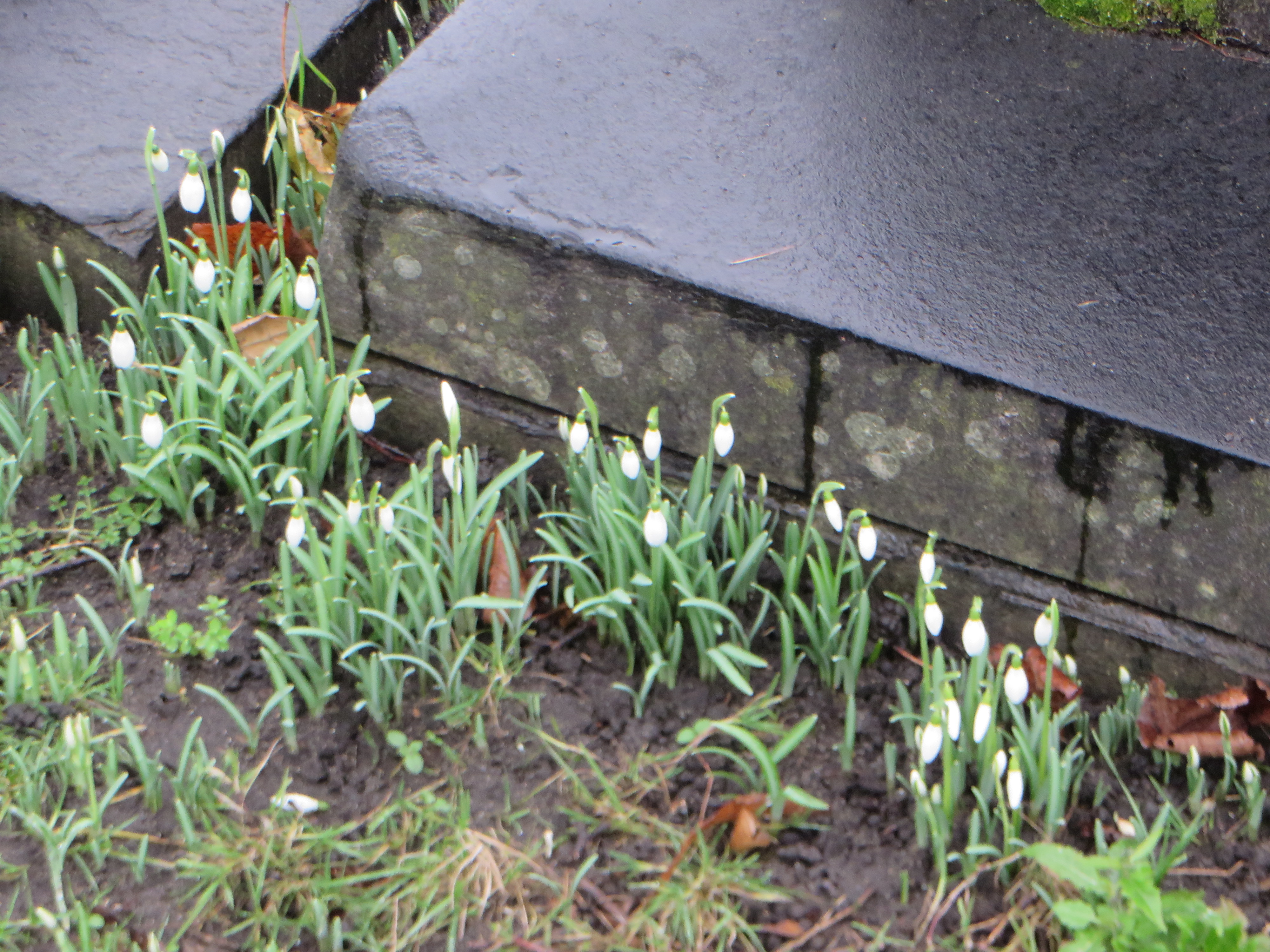
Snowdrops, Kensal Green Cemetery, January 2018
©Carole Tyrrell

The snowdrop’s appearance has also inspired many comments . According to the Scottish Wildlife Trusts website they have been described as resembling 3 drops of milk hanging from a stem and they are also associated with the ear drop which is an old fashioned ear ring.  Anyone who has seen a group of snowdrops nodding in the wind will understand what they mean.   The snowdrop’s colour is associated with purity and they have been described as a shy flower with their drooping flowers.  However, the eco enchantments website reveals that the flower is designed in this way due:

to the necessity of their dusty pollen being kept dry and sweet in order to attract the few insects flying in winter.’

Snowdrops have been known since ancient times and, in 1597, appeared in Geralde’s ‘Great Herbal’ where they were called by the less than catchy name of ‘Timely Flowers Bulbous Violets’.  Its Latin name is Galanthus nivalis.  Galanthus means milk white flowers and the nivalis element translates as snowy according to the great botanist, Linnaeus in 1753.   In the language of flowers they’re associated with ‘Hope’ and the coming of spring and life reawakening.

However, yet despite all these positive associations, the elegant snowdrop has a much darker side. Monks were reputed to have brought them to the UK but it was the ever enthusiastic Victorians who copiously planted them in graveyards, churchyards and cemeteries which then linked them with death.  Hence the nickname name ‘Death’s Flower.’

They were described by Margaret Baker in the 1903 ‘Encyclopedia of Superstitions, Folklore and the Occult of the World’ as:

‘so much like a corpse in a shroud that in some counties  the people will not have it in the house, lest they bring in death.‘

So that’s where the ‘Corpse Flower’ nickname came from.
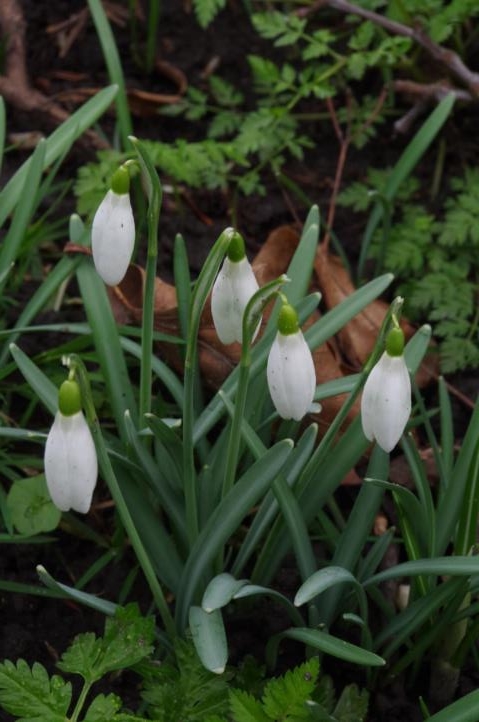
Snowdrops, St George’s Beckenham. ©Carole Tyrrell

Snowdrops are also seen as Death’s Tokens and there are several regional folk traditions of connecting death with them. For example in the 19th and early 20th centuries it was considered very unlucky to bring the flower into the house from outside as it was felt that a death would soon occur.  The most unlucky snowdrop was that with a single bloom on its stem.    Other folk traditions were described in a 1913 folklore handbook which claims that if a snowdrop was brought indoors it will make the cows milk watery and affect the colour of the butter.  Even as late as 1969 in ‘The Folklore of Plants’  it was stated that having a snowdrop indoors could affect the number of eggs that a sitting chicken might hatch.  A very powerful plant if these are all to be believed – you have been warned!

It’s amazing that this little flower has so many associations and legends connected with it but I always see it as a harbinger of spring, rebirth and an indication of warmer days to come.

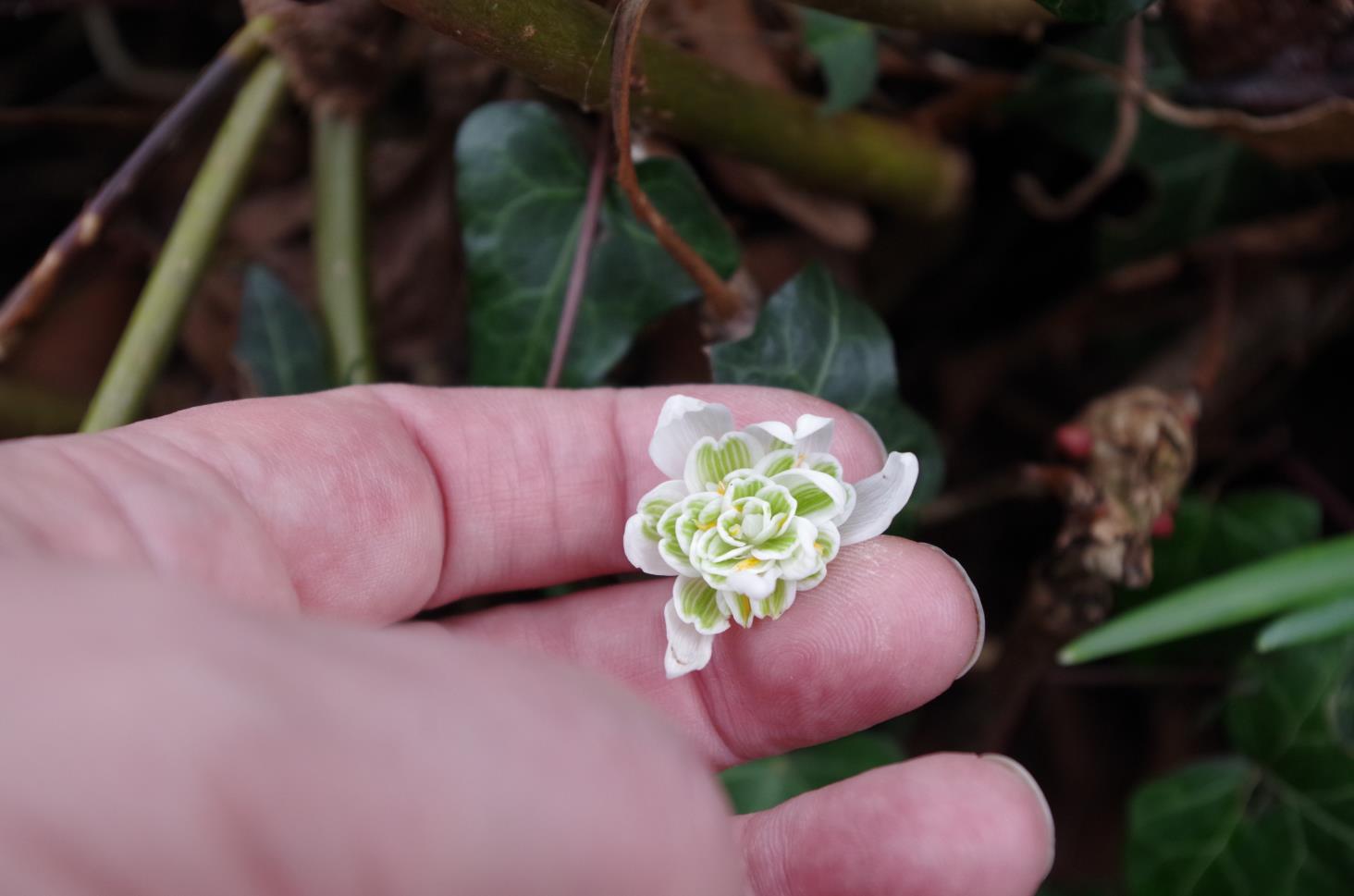
But the snowdrop also has a surprise.  This came courtesy of the Urban Countryman page on Facebook – not all social media is time wasting!  If you very gently turn over a snowdrop bloom you will find that the underside is even prettier and they also vary depending on the snowdrop variety.

Here is a small selection from my local churchyard and one from Kensal Green cemetery.

The underside of a snowdrop, St George’s churchyard Beckenham ©Carole Tyrrell
Another underside of a snowdrop. ©Carole Tyrrell
Another snowdrop underside. ©Carole Tyrrell
Underside of snowdrop in Kensal Green Cemetery March 2017 ©Carole Tyrrell

So don’t underestimate the snowdrop – it’s a plant associated with life and death but watch out for your hens and the colour of your butter if you do decide to tempt fate…..

©Carole Tyrrell text and photos unless otherwise stated

References:
http://www.plantlore.com

http://www.independent.co.uk/environment/naturestudies/bright-in-winters-depths-why-the-flawless-flower-of-candlemas-is-ajoy-forever-8483967

http://www.flowermeaning.com/snowdrop-flower-meaning

http://www.ecoenchantments.co.uk/mysnowdropmagicpage.html

The Tradescant tomb Part 2 -its enigmatic carvings.

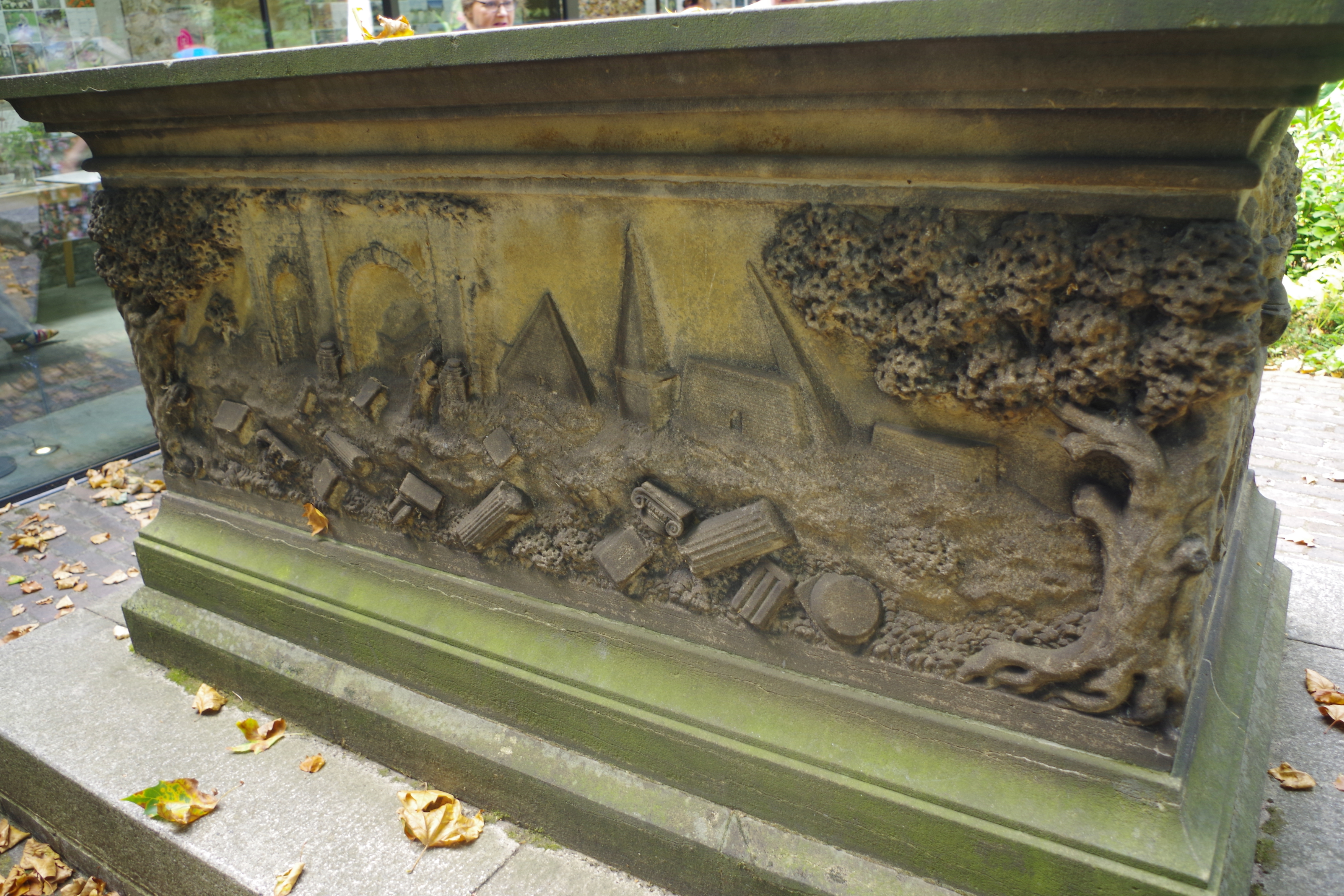
The north side of the tomb showing ruined buildings and discarded architectural features © Carole Tyrrell

It was the drawings made by Wenceslaus Hollar for Samuel Pepys (see above) that were used as guidance for the recarving of the reliefs in 1773 and 1853. These allow the viewer to see what the tomb originally looked like and to compare them with the changes that successive sculptors have made. For example, G P White in 1853 seemed to have his own interpretation of the hydra.

But, as you might imagine with pollution and the London atmosphere, the tomb being outside and at the mercy of the elements, the carvings have deteriorated and changed over the centuries. As the gardentrust.blog says:

‘The casual viewer is not seeing the original carvings. As it was outside in what would have originally been the churchyard, the elements soon did their work. The tomb was so badly damaged by 1773 that a public subscription was raised for its restoration. Lambeth Archives still have the ledger that recorded the donations.

But in 1853, 70 years later, the public funded a further restoration. It was the sculptor G P White who undertook this restoration.’

The 1853 restoration cost £110.  The Victorians were enthusiastic restorers, perhaps too enthusiastic in some ways.

The East end of the tomb. © Carole Tyrrell

At one end of the tomb is a coat of arms which comprises of three fleur de lys on a diagonal bar and with a lion holding up its paw. A helmet with a closed visor is meant to be a sign of gentility and is topped with the crest of another fleur de lys and 2 wings.  However, the Tradescants had no official grant from the College of Arms and may just have adopted it as a ‘rising’ family.  It was a standard item on a monument and is the most conventional symbol.

The west face of the sarcophagus. © Carole Tyrrell

At the other end, the west end, is a fearsome looking hydra which is a mythical ancient Greek creature associated with the 10 Labours of Hercules. It lived in the murky waters of Lake Lerna which was reputed to be the entrance to the underworld. Each time one of the hydra’s heads were cut off , two more would grow in its place so it was a deadly enemy. The hydra in the Pepys drawings is almost friendly and certainly non threatening whereas the 1853 version, carved in high relief, is much more dramatic with its bat like wings, female breasts., seven bird like heads and a long forked reptilian tail. 

There were other changes as well and the gardenstrust.blog commented on the skull in the lower part of the panel.

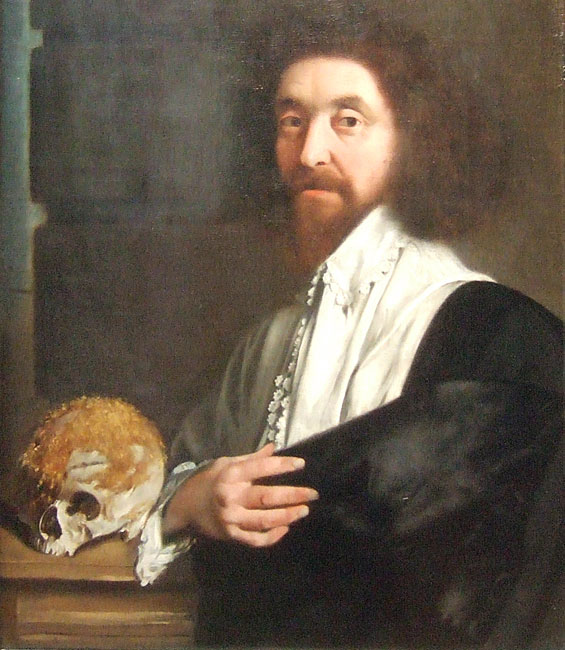
‘It lacks the lower jaw and is presumably the same one that appears in the younger John’s portrait where it is covered with skull moss, much sought after as a powerful medicine.’

This portrait appears in Part 1. The significance of the skull may be a reminder of vanitas paintings which flourished during the 16th and 17th centuries and came from the Netherlands. They often featured a skull and invited the viewer to ponder on the fleeting quality of life.

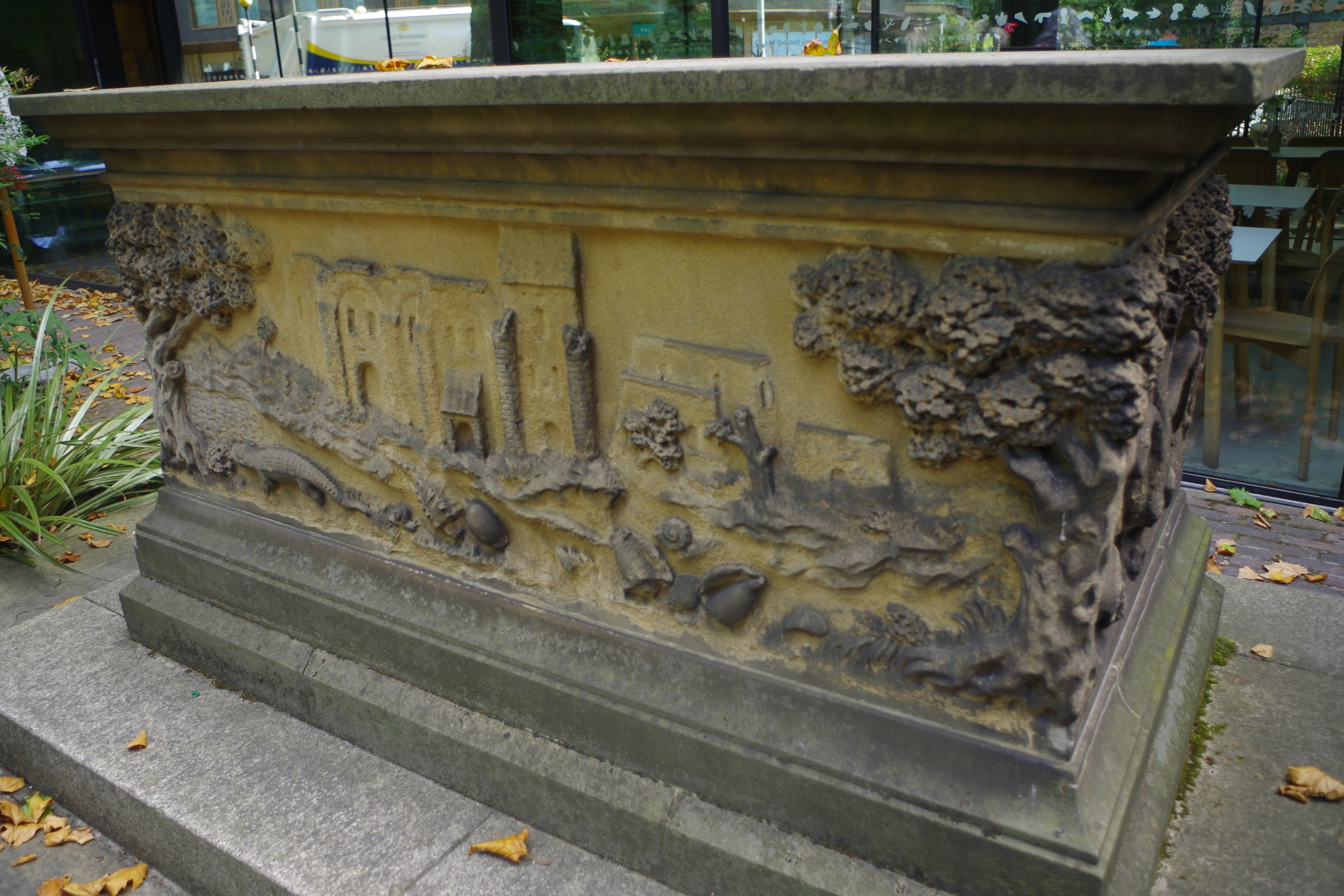
The north side of the tomb. © Carole Tyrrell

The south side of the tomb. © Carole Tyrrell

The longer north and south sides depict:

‘ruined buildings in the background and architectural detritus in the foreground together with a crocodile and shells and fossils. The corners are formed by gnarled and stunted trees with heavy foliage.’ Cabinet.ox.ac.uk

The depiction of the ruins have been debated as the restorations may have changed their appearance. They have been described as Egyptian or Greek with obelisks and a pyramid amongst others. There are also fragments of Corinthian capitals. The shells may refer to specimens that were in the Tradescant collection and the large reptile in the lower part of the north panel could refer to the ‘Crocodile from Aegypt’ that was listed in the exhibits of the ‘Ark.’ It was also seen as a symbol of the early modern culture of collecting as seen in the oldest depiction of a ‘cabinet of curiosities’, the museum of Ferrente Imperato.

Detail showing one of the trees that appear on each of the tomb’s corners.© Carole Tyrrell

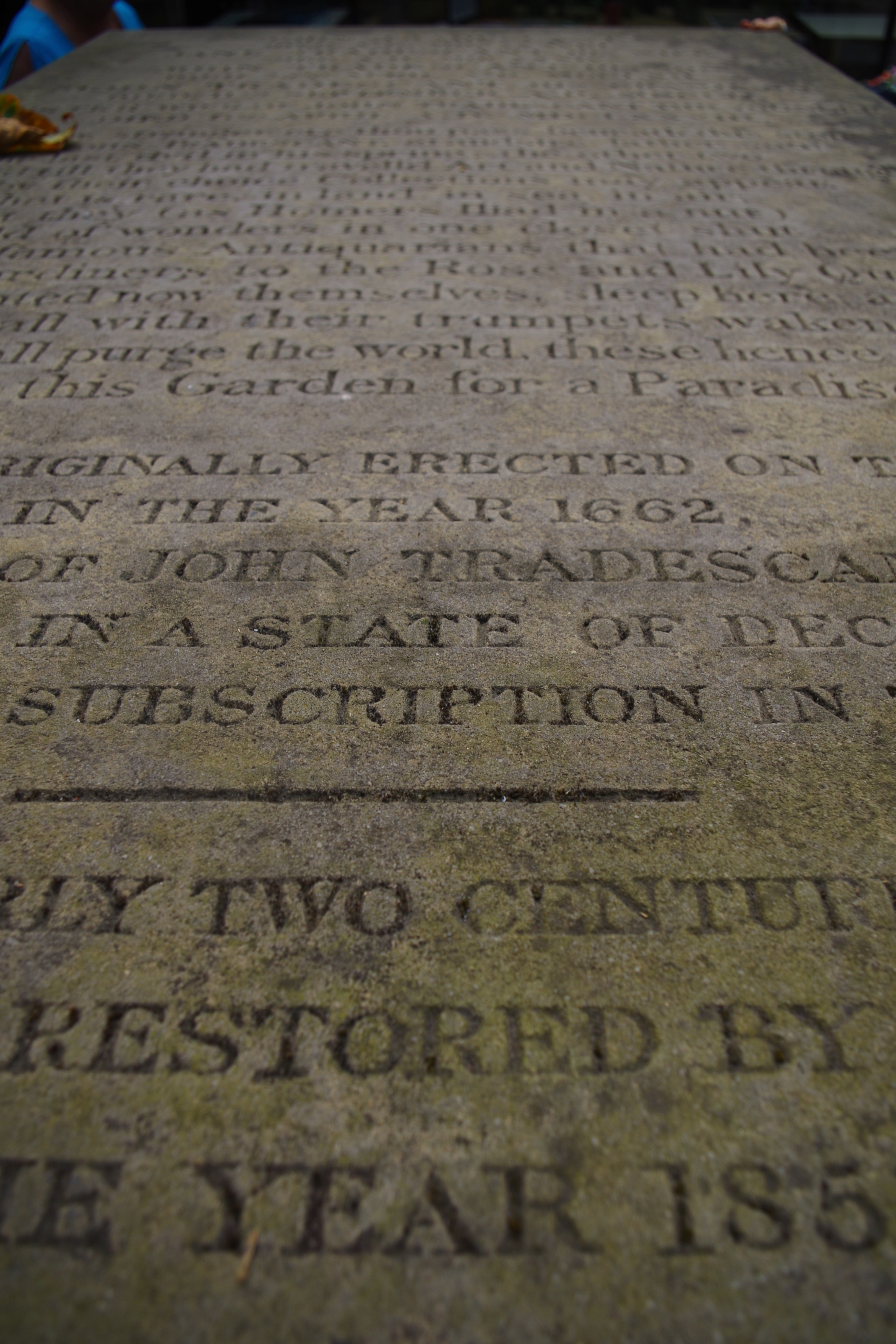
In order to link all the sides of the tomb together, the mason carved a set of large trees in deep relief. They hold up the ledger with its epitaph:

 ‘Know, stranger, ere thou pass, beneath this stone
Lie John Tradescant, grandsire, father, son
The last dy’d in his spring, the other two,
Liv’d till they had travelled Art and Nature through,
As by their choice Collections may appear,
Of what is rare in land, in sea, in air,
Whilst they (as Homer’s Iliad in a nut)
A world of wonders in one closet shut,
These famous Antiquarians that had been
Both Gardeners to the Rose and Lily Queen,*
Transplanted now themselves, sleep here & when
Angels shall with their trumpets waken men,
And fire shall purge the world, these three shall rise
And change this Garden then for Paradise.’

It has been suggested that the line ‘A world of wonders in one closet shut’ may refer to the Ark.

A section of the epitaph on the Tradescant tomb. ©Carole Tyrrell

Despite the changes to the carvings, the Tradescant tomb is a magnificent survivor with five members of the family being commemorated. The enigmatic carvings, the epitaph and one woman’s determination have all added to the legendary Tradescant reputation.  It’s a real sight to see and there are other interesting memorials in the ex-churchyard as well. For example, there is one dedicated to Admiral Bligh of Mutiny on the Bounty fame and there is a wonderful ouroboros on another, the Sealy family monument.

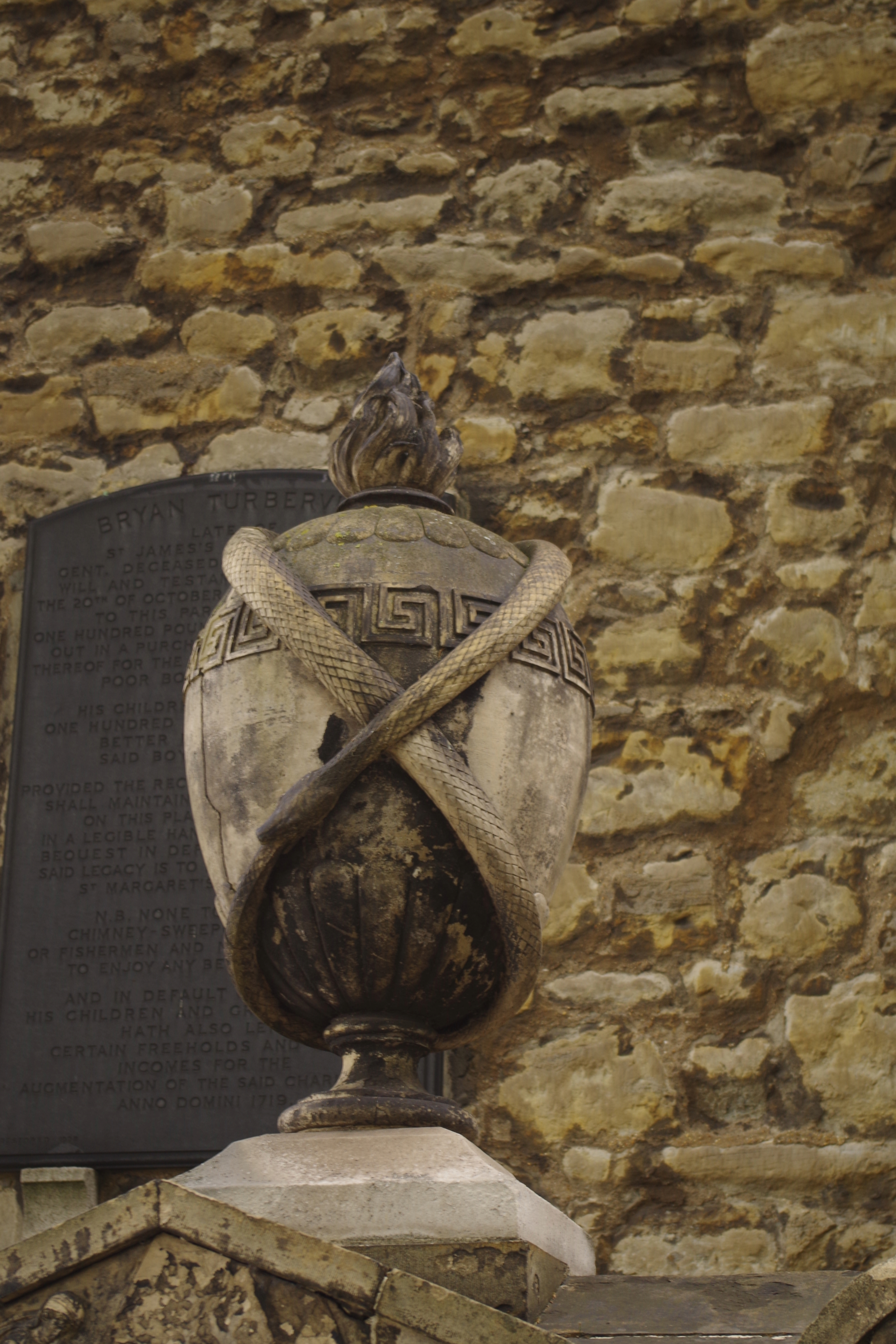
The elegant ouroboros on the Sealy monument topped by an eternal flame. © Carole Tyrrell

The Sealy family had connections with Eleanor Coade, the inventor of Coade or artificial stone and the monument is made from it.

Inside the museum there are several memorials on its walls and some fine skulls. Well worth a visit if you’re in the area. 

©Text and photos Carole Tyrrell unless otherwise stated.

The Tradescant family tomb | cabinet (ox.ac.uk)

The Tradescants and their Tomb | The Gardens Trust( a lot more information on the Tradescants and the tomb)

The Tradescants – Garden Museum

The spectacular Tradescant tomb: “a world of wonders in one closet shut” – Flickering Lamps

Garden Museum – celebrating British gardens and gardening

John Tradescant the Elder – Wikipedia

John Tradescant the Younger – Wikipedia

The Garden Museum: Trandescant Tomb | Londonist

The spectacular Tradescant tomb: “a world of wonders in one closet shut” – Flickering Lamps

The enigmatic Tradescant tomb Part 1- The Garden Museum, London

The Tradescant tomb, The Garden Museum, London. © Carole Tyrrell

A large, ancient chest tomb is not what you expect to see from the window of a central London restaurant. However, I’d seen pictures of it before and, for me, a dedicated Symbols enthusiast, it was the icing on the cake while enjoying a fantastic meal.

It is the Tradescant tomb and it sits in the courtyard of The Garden Museum in Lambeth which is housed within the deconsecrated church of St Mary at Lambeth. The Museum was founded in 1977 by Rosemary Nicholson in order to preserve the tomb. She and her husband saved St Mary’s from demolition and it is the second oldest structure within the borough of Lambeth. A church has existed on the site for over 950 years.

John Tradescant the elder attributed to Cornelis de Neve (1668-1665) Shared under Wiki Commons

John Tradescant the elder (1570-1638) is one of the most important figures in English gardening and he founded a dynasty of horticultural experts. In 1623 he became head gardener to royal favourite George Villiers, 1st Duke of Buckingham. After his assassination Tradescant became keeper of his Majesty’s Gardens, Vines and Silkworms at his queen’s minor palace in Oatlands Place, Surrey in 1630. He was the Royal Gardener at the court of Charles 1st and worked with his wife, Queen Henrietta Maria. In search of new plants, he travelled widely including trips to the Arctic which was no mean feat at the time. He even took part in an expedition to Algeria to fight Barbary pirates! One of the earliest records of him is a letter that he wrote while on a journey to the Netherlands, to buy plants for the 1st Earl of Salisbury’s garden at Hatfield House. He seems to have been a man possessed of indefatigable energy.  In 1629 he moved to Lambeth near where the Museum is now situated and created the first museum in Britain to be open to the public. It was known as the ‘Ark’ and was formed from his own collection of natural history and ethnography.

John Tradescant the younger Thomas de Critz 1652 Shared under Wiki Commons

But the tomb commemorates his son, also called John, (1608-1662)as well. It was his widow Hester who commissioned it after his death. They were married at St Mary’s and he succeeded his father as the Royal Gardener.  He also travelled widely to collect specimens. John Tradescant the younger  went to America for plants and seeds during the early 1600s and introduced trees such as magnolias, tulip trees and garden plants such as phlox and asters.

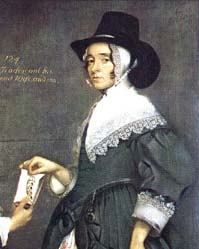
In addition, it celebrates four other family members including his father, his two daughters in laws, Jane Hurte (died 1634) and Hester Pookes (died 1678) and his grandson, another John, who died in 1652 in his late teens.  The Tradescant dynasty died out in 1678 with Hester’s death.

Hester Thomas Thomas de Critz, Ashmolean Museum, Oxford. Shared under Wiki Commons

The sarcophagus is made from hard sandstone and has suffered deterioration over the centuries and it would have originally been in St Mary’s churchyard.  The inscription on the tomb states that it was originally erected in 1662, repaired in 1773 and then restored in 1853 by the sculptor G P White. It’s an unusual tomb, not just because of its size, but in its carvings and enigmatic symbols. However, unusually for the time, there are no religious references on it except for the final lines of the inscription:

‘Angels shall with their trumpets waken men,

And fire shall purge the world, these three shall rise

And change this Garden then for Paradise.’

It’s an intriguing tomb and is a visible sign of the Tradescants standing and aspirations. Hester was asked to pay £50 to the Lambeth church wardens of the time towards the parish poor relief. This was the equivalent of 6 months wages for John as the Royal Gardener. And this was only for permission to site the tomb as everything else was extra.

But it’s the enigmatic carvings that attracted me to the Tradescant tomb and in Part 2 I will discuss these further. However, these are not the original carvings as after two restorations, in 1773 and 1853, the scenes and creatures depicted have subtly changed especially the Hydra sculpture.  

Part 2 – the carvings of the Tradescant tomb

©Text and photos Carole Tyrrell unless otherwise stated.

The Tradescant family tomb | cabinet (ox.ac.uk)

The Tradescants and their Tomb | The Gardens Trust

The Tradescants – Garden Museum

The spectacular Tradescant tomb: “a world of wonders in one closet shut” – Flickering Lamps

Garden Museum – celebrating British gardens and gardening

John Tradescant the Elder – Wikipedia

John Tradescant the Younger – Wikipedia

The Garden Museum: Trandescant Tomb | Londonist

The spectacular Tradescant tomb: “a world of wonders in one closet shut” – Flickering Lamps