It was dark in the chancel as I explored St John’s and then five small figures set into stones in the floor glinted at me. Four of them were dressed in the clothes or armour of their time and one depicted a former priest, Sir Thomas Cardiff who was in post from 1460-1415. In fact Kent has the largest number of remaining monumental brasses depicting the human form than any other county. These total 400. But one in particular caught my eye. How could I resist its smiling, gleeful face?
It was a skeleton, standing upright and tall with its arms at its sides facing the viewer, and a label underneath in Latin. This was the language of the church pre-Reformation.
The inscription reads:
‘Orate pro anima Ricardi Notfelde qui obiit penultimo die mensis marcii anno domini millesimo ccccxlvi.’
which translates as:
‘Pray for the soul of Richard Notfelde, who died on the last day of March 1446 AD‘
The skeleton’s creator has some knowledge of anatomy as the ribs have been sketched in and there are also leg and arm bones. There is a rubbing of the brass in the Wellcome Collection that dates from 1880 and depicts the bones much more clearly.
Wellcome Collection rubbing of the skeleton. Shared under Wiki Commons Brass rubbing by F.Q. Hawkes Mason, 1880.
But it was its face that caught my attention. That grin! The little eyes and nose! It’s obviously not intended to resemble a proper skull but the effect was impressive. As the brasses are in such a dark place within the church, when I stood over the skeleton to take my photos, my shadow fell on it and the grin would disappear. So it was quite difficult to take a decent picture of any of the brasses.
The skeleton is a memento mori which derives from the Latin, ‘remember you must die.’ It is intended to remind the viewer that the skeleton is all that will remain of them after death. Rich or poor, high or low, all will be the same.
According to the guide on duty, the brasses and their labels have been moved and it’s not known where they originally were within the church. But they also have a secret. They’re not actually made of brass. Instead, they were made from a cheap alloy called ‘Latten’. The guide helpfully reminded me of Chaucer’s Pardoner’s Tale in which he sold fake relics to simple, innocent people to extort money from them. These included a cross made of ‘Latoum’ a cheap alloy that he pretends is made of gold.
Latten was an alloy that
‘contained varying amounts of copper, tin, zinc and lead which gave the characteristics of both brass and bronze.’ Wikipedia.
These alloys were used for monumental brasses in churches, decorative effects on borders, rivets or other metalwork details as on armour for example. They were also used for livery and pilgrim badges. Canterbury Museums have the largest collection of pilgrims badges in the UK so please follow the link to see a selection.
The skeleton was an unexpected find on a Heritage Open Day and I enjoyed making its acquaintance. A rare survivor in any church although I have seen other brasses made from Latten when visiting other Kent churches.
As we are still in lockdown, I thought that I would repost an earlier blog about a flower that is traditionally associated with cemeteries and churchyards. This is the time of year when they start to make a welcome appearance as signs of Spring and this year, especially, I think that we need to know that better days are coming.
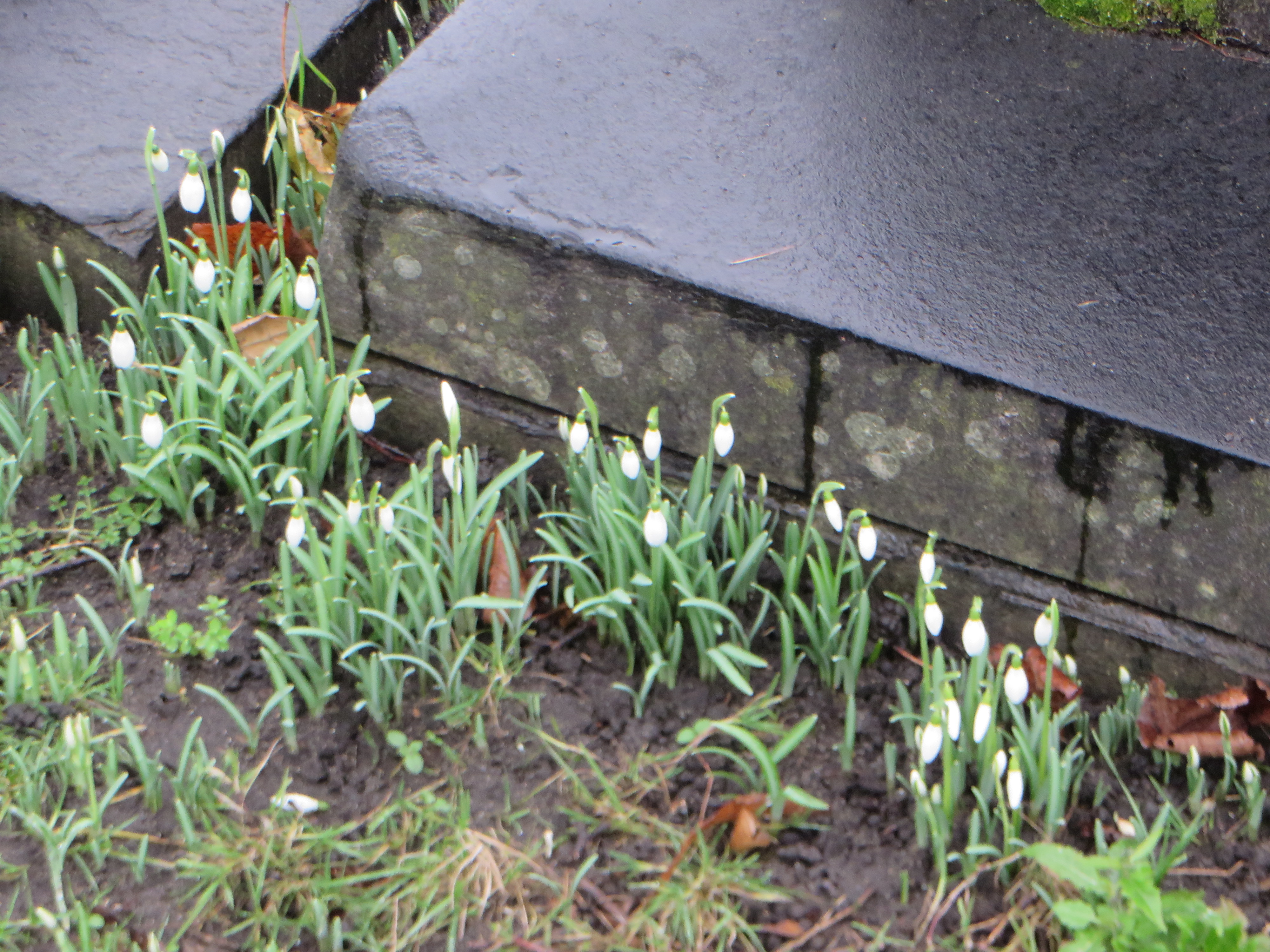
Imagine yourself in a gloomy medieval church on the festival of Candlemass. You, and your fellow parishioners, have each brought your candles to be blessed by the priest and, after the procession which will fill the church with light, they will all be placed in front of a statue of the Virgin Mary. Candlemass marked the end of winter and the beginning of Spring and the blessing is to ward off evil spirits. It traditionally falls on February 2 and is shared with the Celtic festival of Imbolc. And in the churchyard outside you can see green shoots forcing their way up through the hard winter earth. The snowdrop’s milk-white flowers show that spring is on its way as they begin to emerge into the light.
The placing of the lit candles in front of the Virgin Mary’s statue gave the snowdrop one of its many other names – Mary’s Tapers. But there are many others such: Dingle Dangle, Candlemas Bells, Fair Maids of February, Snow Piercer, Death’s Flower and Corpse Flower.
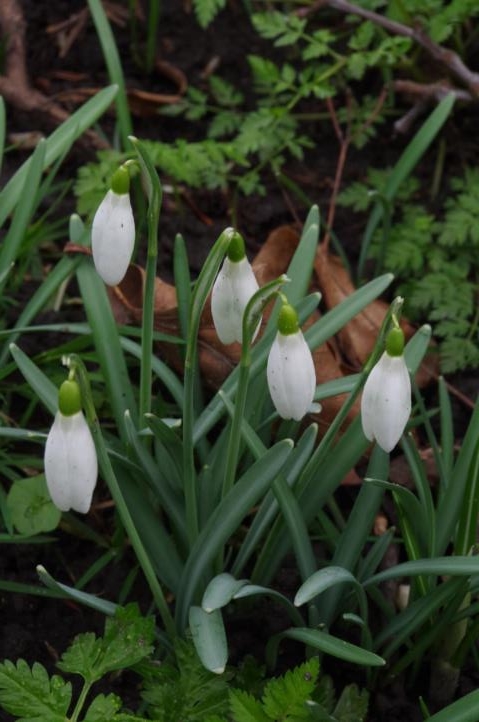
The snowdrop’s appearance has also inspired many comments . According to the Scottish Wildlife Trusts website they have been described as resembling 3 drops of milk hanging from a stem and they are also associated with the ear drop which is an old fashioned ear ring. Anyone who has seen a group of snowdrops nodding in the wind will understand what they mean. The snowdrop’s colour is associated with purity and they have been described as a shy flower with their drooping flowers. However, the eco enchantments website reveals that the flower is designed in this way due:
‘to the necessity of their dusty pollen being kept dry and sweet in order to attract the few insects flying in winter.’
Snowdrops have been known since ancient times and, in 1597, appeared in Geralde’s ‘Great Herbal where they were called by the less than catchy name of ‘Timely Flowers Bulbous Violets’. Its Latin name is Galanthus nivalis. Galanthus means milk white flowers and the nivalis element translates as snowy according to the great botanist, Linnaeus in 1753. In the language of flowers they’re associated with ‘Hope’ and the coming of spring and life reawakening.
However, yet despite all these positive associations, the elegant snowdrop has a much darker side. Monks were reputed to have brought them to the UK but it was the ever enthusiastic Victorians who copiously planted them in graveyards, churchyards and cemeteries which then linked them with death. Hence the nickname name ‘Death’s Flower.’
They were described by Margaret Baker in the 1903 ‘Encyclopedia of Superstitions, Folklore and the Occult of the World’ as:
‘so much like a corpse in a shroud that in some counties the people will not have it in the house, lest they bring in death.‘
So that’s where the ‘Corpse Flower’ nickname came from.
Snowdrops are also seen as Death’s Tokens and there are several regional folk traditions of connecting death with them. For example in the 19th and early 20th centuries it was considered very unlucky to bring the flower into the house from outside as it was felt that a death would soon occur. The most unlucky snowdrop was that with a single bloom on its stem. Other folk traditions were described in a 1913 folklore handbook which claims that if a snowdrop was brought indoors it will make the cows milk watery and affect the colour of the butter. Even as late as 1969 in ‘The Folklore of Plants’ it was stated that having a snowdrop indoors could affect the number of eggs that a sitting chicken might hatch. A very powerful plant if these are all to be believed – you have been warned!
It’s amazing that this little flower has so many associations and legends connected with it but I always see it as a harbinger of spring, rebirth and an indication of warmer days to come.
But the snowdrop also has a surprise. This came courtesy of the Urban Countryman page on Facebook – not all social media is time wasting! If you very gently turn over a snowdrop bloom you will find that the underside is even prettier and they also vary depending on the snowdrop variety.
Here is a small selection from my local churchyard and one from Kensal Green cemetery.
So don’t underestimate the snowdrop – it’s a plant associated with life and death but watch out for your hens and the colour of your butter if you do decide to tempt fate…..
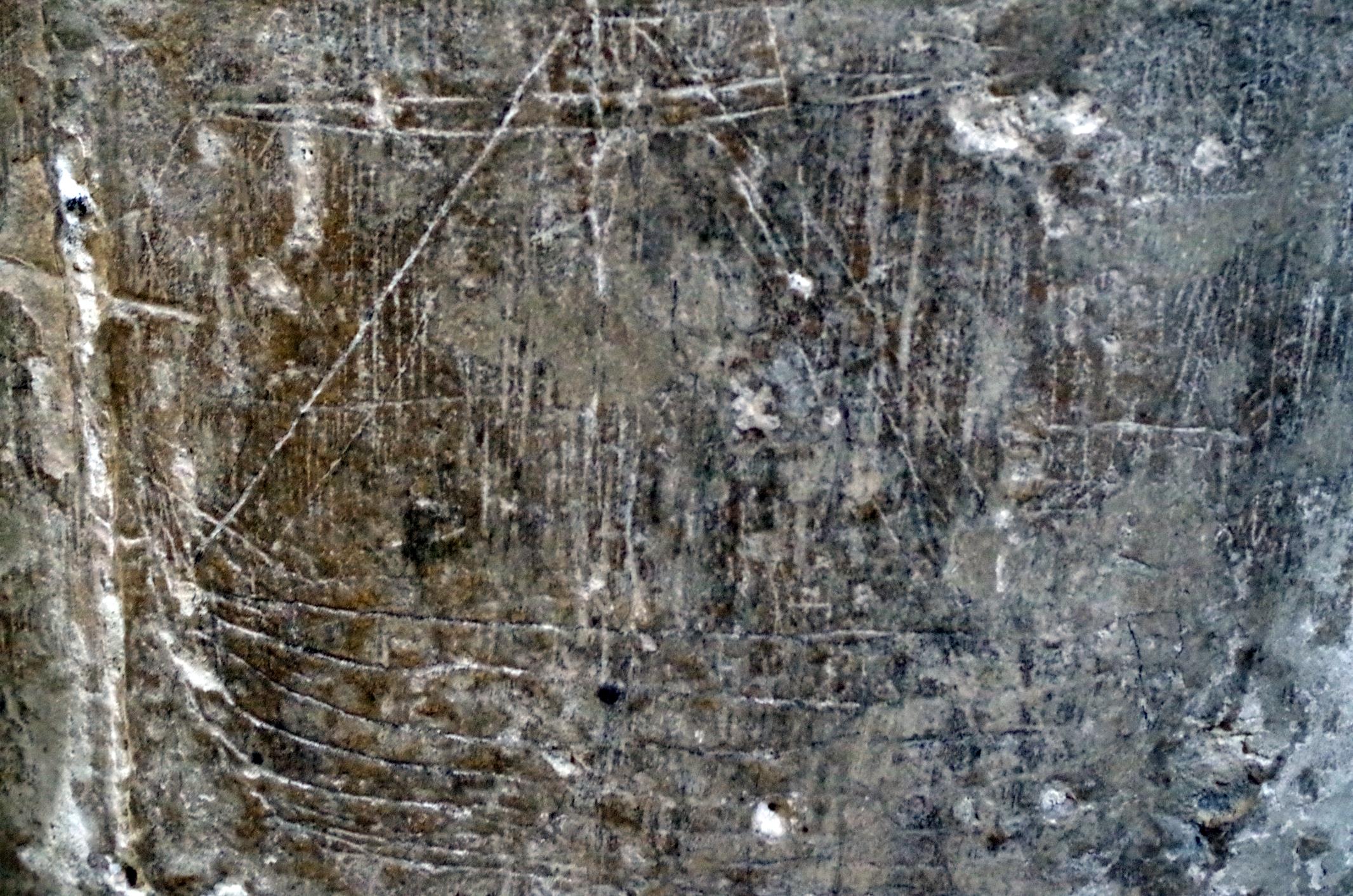
Last month’s Symbol of the Month was devoted to the ship. It’s a central symbol of Christianity and recently, on a visit to Rochester Cathedral, I found more evidence of this in the medieval graffiti etched on several of its pillars.
They are in the nave of the Cathedral and consist of at least a dozen scratched images of sailing ships. They look almost as if a child has drawn them and you have to look very closely to see them. Th eone above is the only one that I could find easily.
According to the Cathedral’s information board these were often drawn by :
‘…..crew members and sea captains with proximity to an altar, image or shrine dedicated to St Nicholas, the patron saint of those in peril on the sea. At times of trouble on a sea voyage, such as storm, a vow could be made to St Nicholas that, if they survived, a votive offering would be made in thanks, sometimes in the form of a model ship of wax and wood. Some of these models survive in coastal churches today but at Rochester this graffiti is the only surviving trace of this once common tradition.;
It goes onto add:
‘……..All recorded designs are located on the south face of the pillar, (this) may indicate the suspected position of an altar or shrine to St Nicholas in the south nave aisle in the 12th of 13th centuries.’
There is a church dedicated to St Nicholas adjacent to the Cathedral but this is now the offices of the Board of Education of the Diocese of Rochester. According to their website, there was a shrine to the saint within the Cathedral at which people worshipped until the 15th century. It was consecrated on 18 December 1423. The current church dates from the 17th century with 19th century restoration.
So these little ships, symbols of protection, will sail on a sea of stone for as long as the Cathedral stands. Let’s hope that all of the crews and captains, they who go down to the sea in ships, who created them came home safely back to port.
The priest’s sermon has made you feel a little drowsy as you sit in your pew. Then, as your eyelids begin to droop, suddenly you can smell burning and hear crackling flames….faint screams as well and devilish chuckling interspersed with angels singing…..there’s a sudden warmth behind your back and when you turn around, you’re confronted with gleeful demons faces on the whitewashed wall. Is one turning round and beckoning to you? Instantly you’re wide awake again with a nudge from your mother to sit up straight and you turn to face the priest again. But you can still hear the flames and the laughter…..
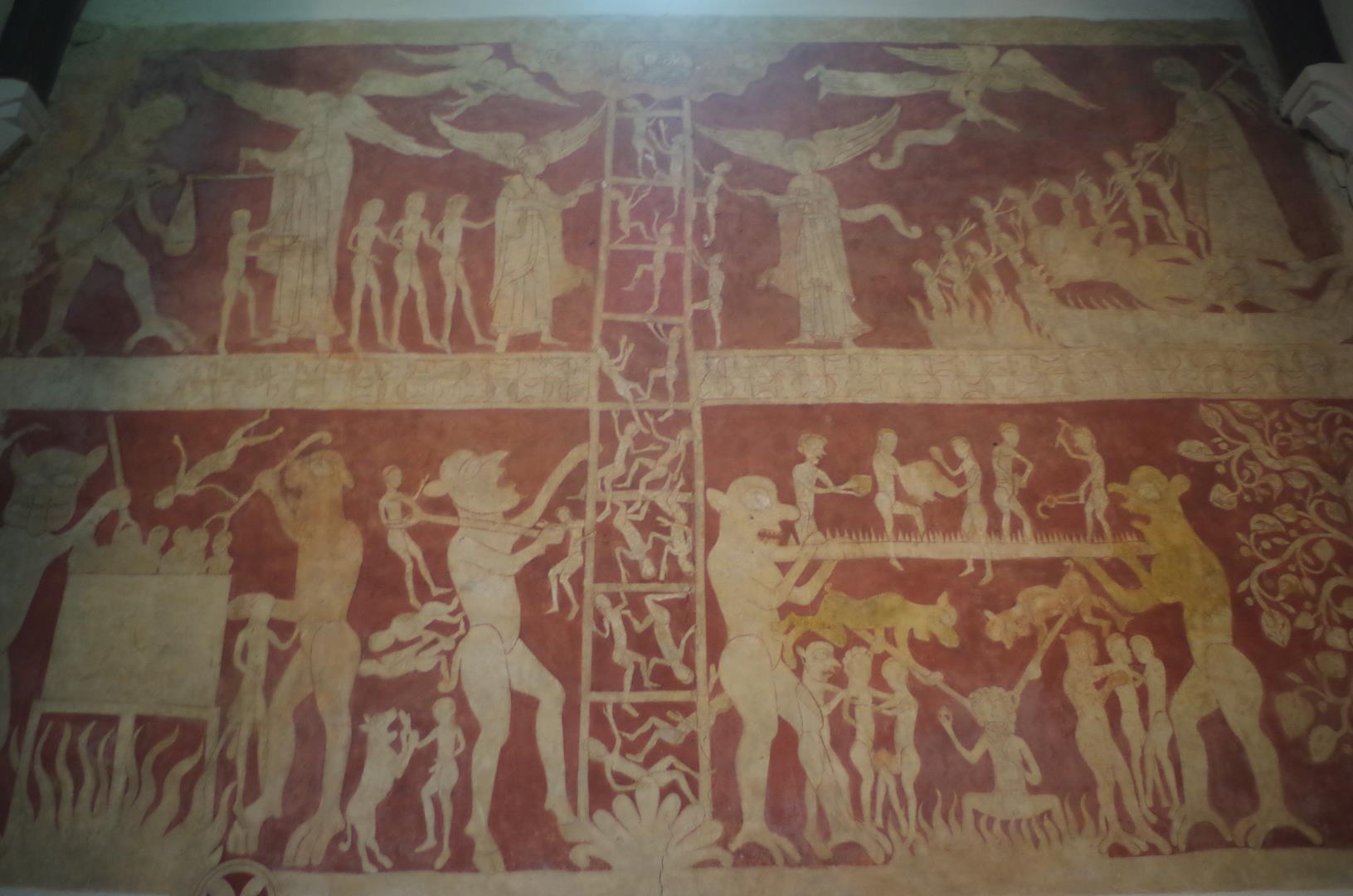
Chaldon’s Doom painting, or mural as the church prefers to call it, is reputed to be the oldest in England and has been dated to at least the 12th century. It’s believed to be the work of an anonymous artist monk. Until the 17th century it taught the local parishioners which was the right path to follow if you wanted to be going upwards to eternal bliss instead of down to hell for endless torment. The mural’s official title, according to the church’s website is The Purgatorial Ladder, or Ladder of Souls, with the Seven Deadly Sins. However tastes and doctrines change and after the Reformation many of England’s Dooms were whitewashed over. It was felt by zealous reformers that they didn’t follow strict Bible doctrine and were also considered to be ‘Popish’.
But Dooms have a habit of re-surfacing and so it was with the Chaldon Doom. In 1869, the then Rector, Reverend Henry Shepherd was having the church walls prepared for whitewashing when he suddenly noticed signs of colour and halted the work. The mural was then cleaned and preserved. There was a further conservation in 1989 by the Conservator and Director of the Canterbury Wall Paintings Workshop.
According to the painted church website, Dooms were the most commonly painted subject in the Middle Ages. Dooms were often placed on a church’s west wall as a reminder to parishioners as they were leaving the church. But, as at Chaldon, they were also on the back wall or at the front on the chancel arch as at St Thomas’s Salisbury. The Chaldon mural has the disturbing effect of constantly looking over your shoulder when you turn your back on it…..
The Chaldon Doom is large and measures 17ft x 11ft and stands out against the plain white washed walls. It’s painted entirely in red whereas other Dooms are in full colour. However it’s the only image in England of the Ladder of Salvation although it’s common in the Eastern Orthodox tradition. It’s behind the pews and would have been a constant reminder to the parishioners to be thinking of the afterlife. A medieval congregation would have been illiterate and the Doom would have resembled a picture book or public information film on what could happen to sinners in eternity. They needed to prepare for the Final Judgement and, due to a shorter lifespan, the afterlife was much more to the forefront of the medieval mind than ours. A Doom is a traditional English term for a pictorial rendition of the Last Judgement or Doomsday which is the moment when Christ decides the eternal destination of human souls. This is because the Church was very concerned with how to portray the afterlife in a visual way that could be easily understood. After all a picture is worth a 1000 words…
There are roughly 40 surviving Dooms in Britain but in the 1880’s over 100 were recorded. They can often combine several themes: the parable of the sheep and the goats, assorted Biblical prophecies and other medieval traditions. The Chaldon mural uses the Seven Deadly Sins.
There’s only two choices for the dead as they arise from their graves to go up to Heaven and sitting around on clouds playing harps or down to Hell and the eternal flames. However Purgatory was also uppermost in the medieval mind as people believed that, prior to going to Heaven, a soul would have to spend time there before going up to Heaven. Chaldon’s Ladder represents Purgatory.
To interpret the Chaldon Doom and its crowded canvas you need to begin at the lower right of the painting and look for the serpent in the tree of life which is a metaphor for the fall of man. This is a rough guide from a Chaldon church pamphlet and imagine the priest using it to preach to his flock:
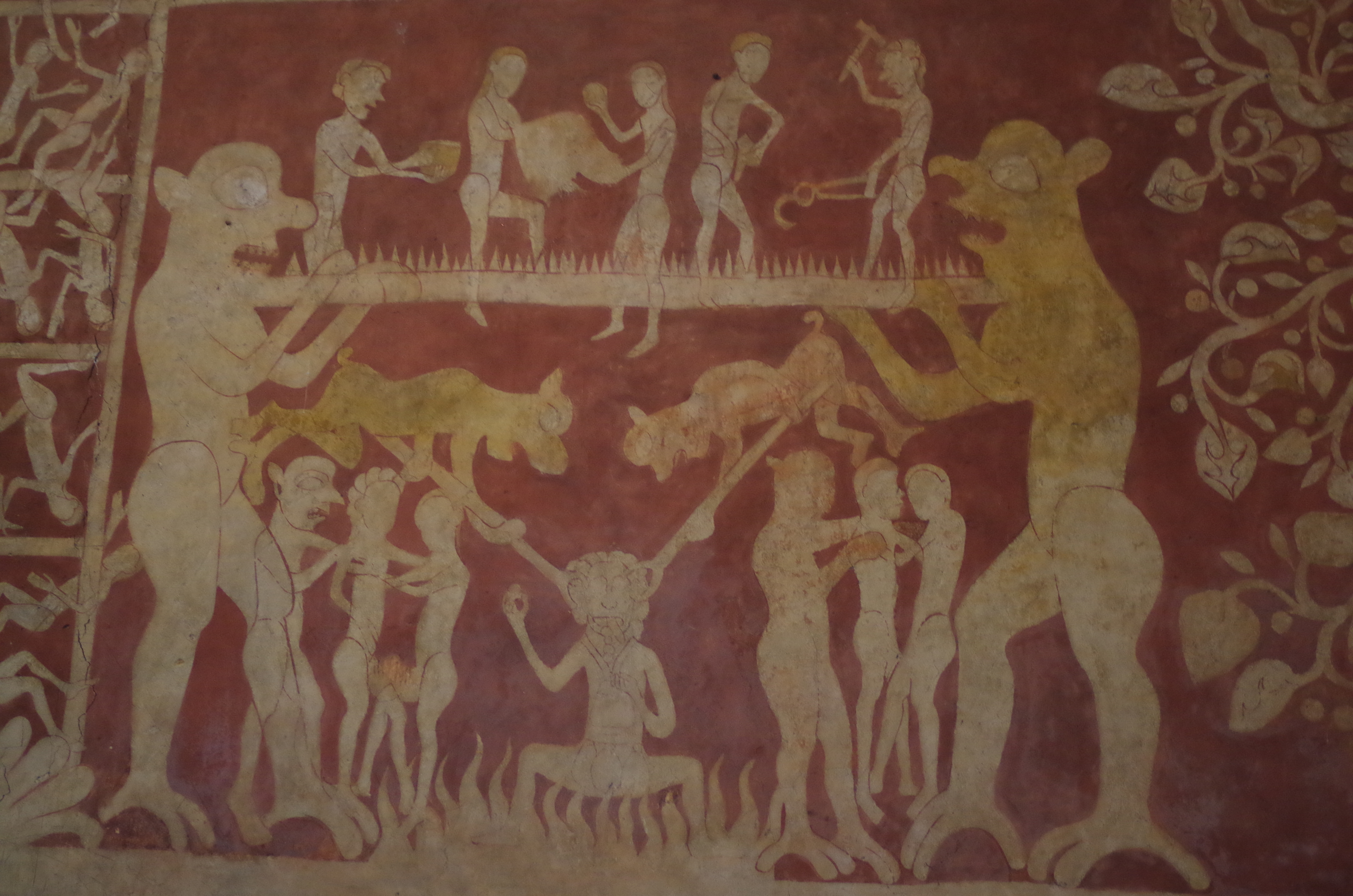
Two demons hold up a bridge of spikes over which dishonest tradesmen have to cross. These include a blacksmith, spinner, potter and mason who are all missing essential tools. The cheating milkman is about to climb the ladder with a brimming bowl of milk due to having given short measure in life.
Then we come onto the 7 Deadly Sins:
Avarice: A moneylender sits in flames as two demons hold him upright. He’s blind and money pours from his mouth. He has to count it all as it flows into his pouch.
Envy: There are two figures on the right hand side of the moneylender. One of them has longer hair than the other.
Lust: On the moneylender’s left hand side are two figures embracing.
On the left hand side of the ladder a demon plucks souls from the ladder of salvation.
Pride: A woman is beside a demon as a devil wolf gnaws at her hands. This could indicate either pride in her hands or that she fed her pets too well in life while ignoring the starving.
Anger: Above the woman two figures fight over a hunting horn. Two demons throw what are considered to be murderers into a cauldron.
Gluttony: A drunken pilgrim lies at the feet of a demon. He’s sold his cloak or badge of office in order to buy wine.
Sloth: At the far left 3 women dawdle.
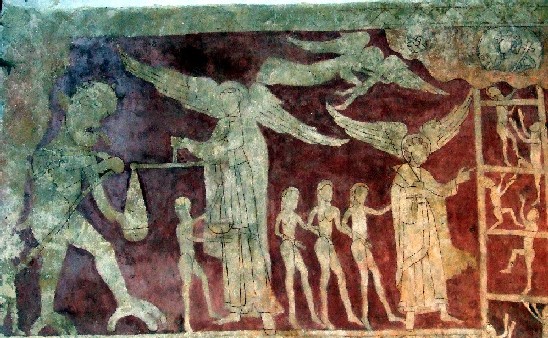
A cloud bisects the picture to form a cross and the foot of the Ladder is the symbol of life. The Archangel Michael is weighing the good and bad deeds as the Devil slyly has a hand on the scales trying to weigh it down with bad deeds as he holds a rope dragging souls to hell. A penitent tries to point out to St Michael what the Devil is up to. The 3 Marys are being led to Heaven by an angel as another one above them helps a remorseful thief ascend to the Pearly Gates.
Elijah and Enoch are also going upwards to bliss on the right of the ladder as an angel holds up a scroll of their good deeds. Above them another of the heavenly host hold up a scroll which says ‘open ye the gates that the righteous may enter.’
On the far right the Lord is mesmerizing the Devil with his cross while welcoming Old Testament characters into Heaven and finally above the ladder is the demi figure of Christ in the act of benediction.
He has the sun on his right hand side and the moon on the left.
It’s a lovely picture, postcard church with a candle snuffer tower but it’s in the middle of nowhere except for a scattering of nearby houses. There’s no village attached to it and it’s on the notorious Ditches Lane which leads off Farthing Downs. This can be a lonely road for walkers as there are no houses along it until you reach the church. Chaldon church is rumoured to have been built on a pagan site and there has been a church here since 1086 AD. Its foundations have been dated back to 727AD. I find it strange that such a magnificent and dramatic mural was located in such an out of the way place. It really took me by surprise when I first saw it as it’s so in your face. But as I turned away from it I thought I heard devilish sniggering and wondered what it must have look like under flickering candlelight.
There are other Doom paintings to be seen in England and these are:
South Leigh, Checkendon and Coombe – Oxfordshire
Wenhaston, Sufoollk
Dauntsey, Wilts
Patcham, Sussex
Penn, Bucks
Oddington, Glos
Symington, Beds
Lutterworth, Leics
Stratford upon Avon, Worcs (this is in glass)
York Minster (a crypt carving)
St Thomas’s church, Salisbury
I have seen the one in Salisbury and was really impressed. It’s in full colour and is over the chancel arch to greet worshippers. Christ sits on a rainbow at the centre of the chancel arch with the godly rising from their graves with angels whereas on the left the sinners are being helped by demons to go down below. This again was whitewashed over and then re appeared. Here are a small selection of images from it:
This month’s symbol is a cadaver or pardon tomb from St Mary’s in Bury St Edmunds. These medieval tombs were an extremely visual way of reminding everyone that, despite what you had achieved during life, death would make you equal with all men.
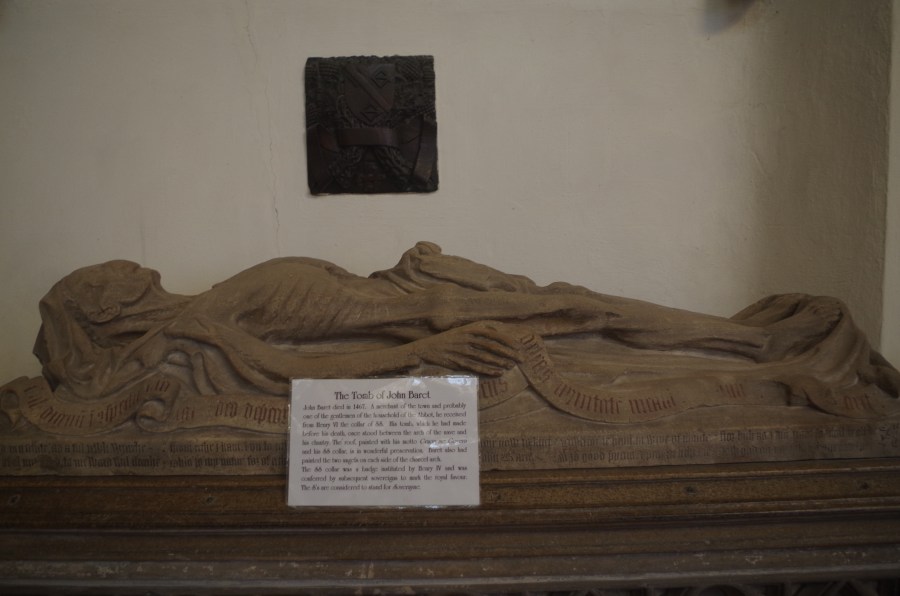
It was as I stood in St Mary’s church, Bury St Edmunds after having admired its magnificent hammerbeam with lifesize angels pinned to it like exotic butterflies that I saw John Benet’s tomb resting against a side wall.
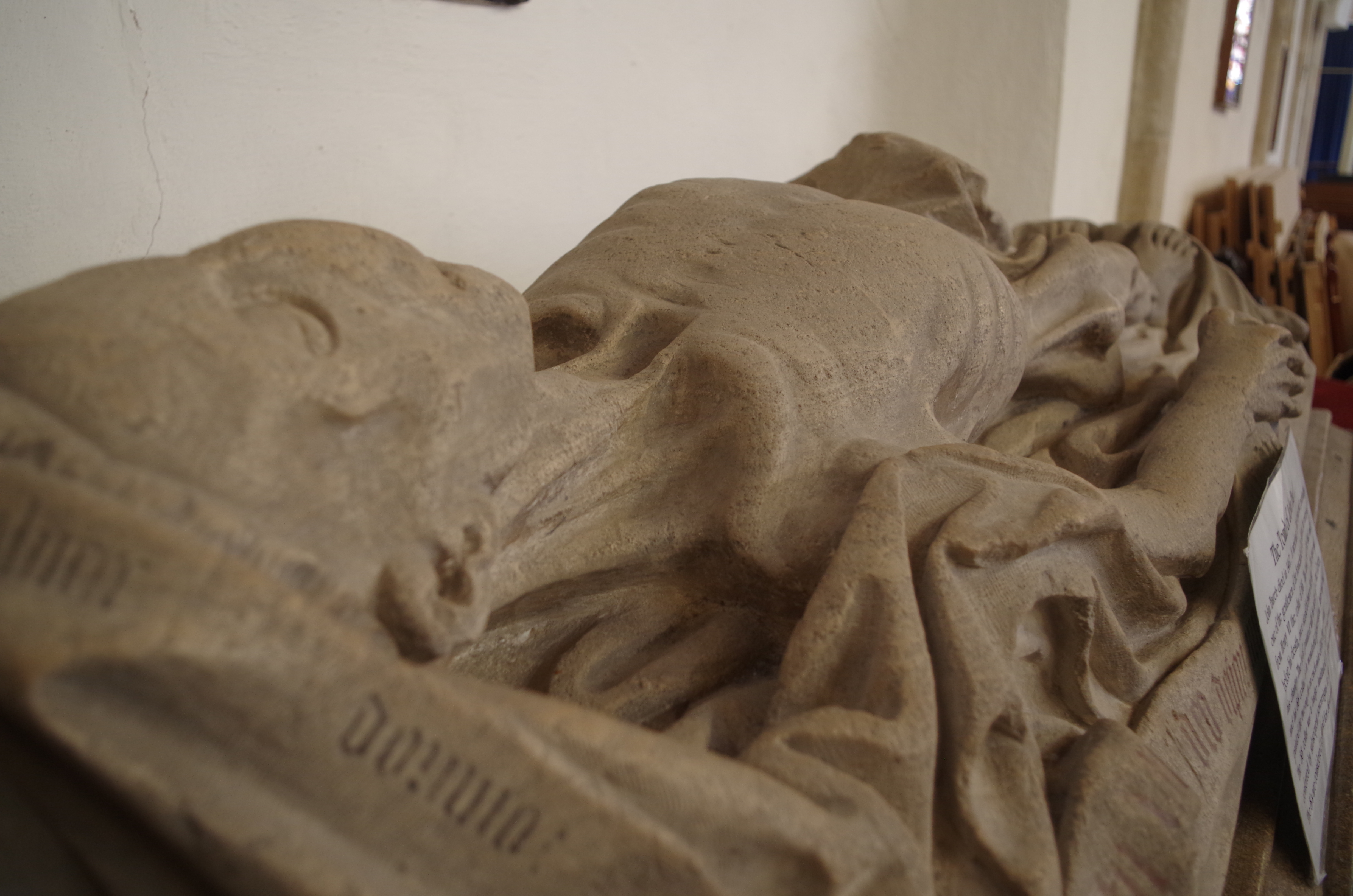
I’d seen two, somewhat worn, cadaver tombs in Winchester Cathedral but not one so close up and so well carved. Even now it’s still crisp and detailed but due to its current location it was difficult to take a full length photo. The tomb depicts John Benet lying on his back as a lifesize corpse with a shroud or towel protecting his modesty.
Although St Mary’s guidebook describes Benet’s tomb as a Pardon tomb, they are more often known as a transi or cadaver tomb. This definition comes from Wikipedia who describe a transi or cadaver tomb, as a ‘memento mori’. This is Latin for ‘remember you will die’ and a reminder of the inevitability of death. Wiki goes onto add that this type of tomb is in the form of:
‘…a type of gisant or recumbent effigy tomb featuring an effigy in the macabre form of a decomposing corpse…’
This type of tomb is particularly associated with the Middle Ages which is roughly when Benet’s tomb was created and I’ve always known them as cadaver tombs. However, they’re not always in the form of a decomposing corpse as they can also be in the form of skeletons or the body of the deceased wrapped in a shroud. I am indebted to the flickeringlamps blog which featured transi tombs in the form of ‘double-deckers’. This is where the top layer of the tomb portrays the gisant of the deceased as they were when alive and then below on the bottom layer as a decomposing corpse. This is an extremely visual reminder of what the person once was and what they will inevitably become as earthly glory is fleeting and all must die.
Cadaver tombs can be found in several UK cathedrals and parish churches. The earliest surviving one is in Lincoln Cathedral and is dedicated to Richard Fleming. It dates from the 1430’s. St Pauls’ cathedral has a later example from the 17th century which commemorates the poet John Donne. Cadaver tombs are also known in Europe and particularly in Italy, France. Germany and the Netherlands.
But who was John Benet?
According to St Mary’s guidebook, John Benet was a medieval cloth trader and one of St Mary’s most important benefactors. He financed the very ceiling that I’d been admiring and also his own private chancel chapel and tomb. Within his lifetime, Bury St Edmunds was a thriving town built on the local wool trade. This led to the creation of a rising merchant class who were able to use their money to leave a lasting memorial to themselves in their local church as proof of their good and pious life. Surely admittance to the Pearly Gates would be assured if you provided your church with some embellishments…. After they couldn’t take it with them but they could definitely prove that they’d had it while alive….
John Benet was a rich and powerful man within his local town which is why he was able to afford to have a cadaver tomb made for him and one that was so well sculpted. It originally lay in his own private chapel. This has now gone but if you look up you can still see its glittering ceiling which was restored in 1968. You may just be fortunate enough to see the light glisten on the tiny pieces of concave mirror glass inserted into the gold stars to give the illusion of real stars twinkling. Benet’s motto, ‘Grace me Governe’, his initials, coat of arms and SS collar are also part of the intricate decoration. The latter, again from St Mary’s guidebook:
’….was a gift from the Lancastrian kings in recognition of a special or personal services. It was in the form of a collar or chain in which the letter ‘S’ was engraved. The letter ‘S’ which presumably stood for ‘Sovereign.’
So Benet moved in high circles and wasn’t afraid to shout about it for all eternity.
There are Latin prayers on the ceiling’s edges which include ‘Pray for the soul of John Benet, ‘Let us praise the Lord gloriously’, Alleluia, Honour and glory to the only God.’, ‘My soul shall delight in the Lord’, ‘Seek only the highest’ and finally ‘May the pure Virgin Mary bless us with issue.’ Benet was not a man who stinted where his soul was concerned.
The tomb has moved around the church interior several times. But not of its own volition as far as I know. It has been surmised that the effigy of him portrayed as a decaying corpse was made during his lifetime.
Now there’s an interior design feature for you…it would have been intended as a constant reminder of his own inevitable death and the need to make preparations for the afterlife. It’s in remarkable condition and is the best one that I’ve seen. It may have been created in the nearby Abbey’s master mason’s workshops. This seems very likely given Benet’s powerful connections and the quality of the carving would also confirm this.
Originally he was positioned with his feet facing the east but, in 1884, the tomb was turned around so that the side inscription could be read. In this, Benet’s motto is carved and a small figure of himself is in the middle of it, dressed in his finest clothes, and holding up the word ‘Me’. Under one hand of the decaying corpse are the words:
‘He that will sadly beholde me with his ie, May he hyd own mirrour (and) lerne for to die. ‘
A lifesize memento mori if you will. The guidebook, however, describes it as a Pardon Grave’ which isn’t a term that I’ve heard before. It’s meant to indicate that the person who was being commemorated has obtained a pardon or remission from purgatory. Benet had also left instructions for his papal pardon to be displayed near his tomb for all to see. I had the impression that Mr Benet was a bit of a show-off but if you don’t blow your own trumpet…. I sincerely hope that all this piety and expense achieved its aim.
The cadaver tomb iconography is based on the medieval Dance of Death or Danse Macabre.
Nobleman & Physician from the Lubeck Totentanz courtesy of UT Southwestern
This depicted a long line of people from Emperors to Popes right down to a beggar, each of whom had death in the form of a skeleton at their shoulder. This was a reminder that Death made all men equal. The first one was recorded in St Paul’s Cathedral and in Long Melford, Suffolk, according to St Mary’s guidebook, long cloths were displayed depicting ‘the dance of Pauls’
It’s amazing that this survived the Reformation and Cromwell’s wrecking crews and still sits in St Mary’s reminding visitors of their inevitable fate. But Mr Benet has a further claim to fame as, in 2003, he was loaned out to the Victoria and Albert Museum as part of their ‘Gothic: Art of England’ exhibition. Apparently, during conservation, traces of flesh coloured paint were discovered on the figure which included red and green veins especially in the neck. So try and imagine Mr Benet in his original colouring – it must have quite a sight to see. I think that he’d be very proud that his tomb, the hammerbeam ceiling and also his chapel ceiling are still in St Mary’s for all to enjoy and remember him.
St Mary’s, Bury St Edmunds A guidebook, Clive Paine, Honey Hill Publishing 1986.
Metamorphosis of a Death Symbol’ The Transi Tomb in the Late Middle Ages an d the Renaissance, Kathleen Cohen (Berkeley: University of California Press) 1973
Imagine yourself in a gloomy medieval church on the festival of Candlemass. You, and your fellow parishioners, have each brought your candles to be blessed by the priest and, after the procession which will fill the church with light, they will all be placed in front of a statue of the Virgin Mary. Candlemass marked the end of winter and the beginning of Spring and the blessing is to ward off evil spirits. It traditionally falls on February 2 and is shared with the Celtic festival of Imbolc. And in the churchyard outside you can see green shoots forcing their way up through the hard winter earth. The snowdrop’s milk-white flowers show that spring is on its way as they begin to emerge into the light.
The placing of the lit candles in front of the Virgin Mary’s statue gave the snowdrop one of its many other names – Mary’s Tapers. But there are many others such: Dingle Dangle, Candlemas Bells, Fair Maids of February, Snow Piercer, Death’s Flower and Corpse Flower.
The snowdrop’s appearance has also inspired many comments . According to the Scottish Wildlife Trusts website they have been described as resembling 3 drops of milk hanging from a stem and they are also associated with the ear drop which is an old fashioned ear ring. Anyone who has seen a group of snowdrops nodding in the wind will understand what they mean. The snowdrop’s colour is associated with purity and they have been described as a shy flower with their drooping flowers. However, the eco enchantments website reveals that the flower is designed in this way due:
‘to the necessity of their dusty pollen being kept dry and sweet in order to attract the few insects flying in winter.’
Snowdrops have been known since ancient times and, in 1597, appeared in Geralde’s ‘Great Herbal where they were called by the less than catchy name of ‘Timely Flowers Bulbous Violets’. Its Latin name is Galanthus nivalis. Galanthus means milk white flowers and the nivalis element translates as snowy according to the great botanist, Linnaeus in 1753. In the language of flowers they’re associated with ‘Hope’ and the coming of spring and life reawakening.
However, yet despite all these positive associations, the elegant snowdrop has a much darker side. Monks were reputed to have brought them to the UK but it was the ever enthusiastic Victorians who copiously planted them in graveyards, churchyards and cemeteries which then linked them with death. Hence the nickname name ‘Death’s Flower.’
They were described by Margaret Baker in the 1903 ‘Encyclopedia of Superstitions, Folklore and the Occult of the World’ as:
‘so much like a corpse in a shroud that in some counties the people will not have it in the house, lest they bring in death.‘
So that’s where the ‘Corpse Flower’ nickname came from.
Snowdrops are also seen as Death’s Tokens and there are several regional folk traditions of connecting death with them. For example in the 19th and early 20th centuries it was considered very unlucky to bring the flower into the house from outside as it was felt that a death would soon occur. The most unlucky snowdrop was that with a single bloom on its stem. Other folk traditions were described in a 1913 folklore handbook which claims that if a snowdrop was brought indoors it will make the cows milk watery and affect the colour of the butter. Even as late as 1969 in ‘The Folklore of Plants’ it was stated that having a snowdrop indoors could affect the number of eggs that a sitting chicken might hatch. A very powerful plant if these are all to be believed – you have been warned!
It’s amazing that this little flower has so many associations and legends connected with it but I always see it as a harbinger of spring, rebirth and an indication of warmer days to come.
But the snowdrop also has a surprise. This came courtesy of the Urban Countryman page on Facebook – not all social media is time wasting! If you very gently turn over a snowdrop bloom you will find that the underside is even prettier and they also vary depending on the snowdrop variety.
Here is a small selection from my local churchyard and one from Kensal Green cemetery.
So don’t underestimate the snowdrop – it’s a plant associated with life and death but watch out for your hens and the colour of your butter if you do decide to tempt fate…..














 shadows fly away