It was dark in the chancel as I explored St John’s and then five small figures set into stones in the floor glinted at me. Four of them were dressed in the clothes or armour of their time and one depicted a former priest, Sir Thomas Cardiff who was in post from 1460-1415. In fact Kent has the largest number of remaining monumental brasses depicting the human form than any other county. These total 400. But one in particular caught my eye. How could I resist its smiling, gleeful face?
It was a skeleton, standing upright and tall with its arms at its sides facing the viewer, and a label underneath in Latin. This was the language of the church pre-Reformation.
The inscription reads:
‘Orate pro anima Ricardi Notfelde qui obiit penultimo die mensis marcii anno domini millesimo ccccxlvi.’
which translates as:
‘Pray for the soul of Richard Notfelde, who died on the last day of March 1446 AD‘
The skeleton’s creator has some knowledge of anatomy as the ribs have been sketched in and there are also leg and arm bones. There is a rubbing of the brass in the Wellcome Collection that dates from 1880 and depicts the bones much more clearly.
Wellcome Collection rubbing of the skeleton. Shared under Wiki Commons Brass rubbing by F.Q. Hawkes Mason, 1880.
But it was its face that caught my attention. That grin! The little eyes and nose! It’s obviously not intended to resemble a proper skull but the effect was impressive. As the brasses are in such a dark place within the church, when I stood over the skeleton to take my photos, my shadow fell on it and the grin would disappear. So it was quite difficult to take a decent picture of any of the brasses.
The skeleton is a memento mori which derives from the Latin, ‘remember you must die.’ It is intended to remind the viewer that the skeleton is all that will remain of them after death. Rich or poor, high or low, all will be the same.
According to the guide on duty, the brasses and their labels have been moved and it’s not known where they originally were within the church. But they also have a secret. They’re not actually made of brass. Instead, they were made from a cheap alloy called ‘Latten’. The guide helpfully reminded me of Chaucer’s Pardoner’s Tale in which he sold fake relics to simple, innocent people to extort money from them. These included a cross made of ‘Latoum’ a cheap alloy that he pretends is made of gold.
Latten was an alloy that
‘contained varying amounts of copper, tin, zinc and lead which gave the characteristics of both brass and bronze.’ Wikipedia.
These alloys were used for monumental brasses in churches, decorative effects on borders, rivets or other metalwork details as on armour for example. They were also used for livery and pilgrim badges. Canterbury Museums have the largest collection of pilgrims badges in the UK so please follow the link to see a selection.
The skeleton was an unexpected find on a Heritage Open Day and I enjoyed making its acquaintance. A rare survivor in any church although I have seen other brasses made from Latten when visiting other Kent churches.
The skull and crossbones was one of the central motifs of 18th century Memento Mori and intended to be a stark and macabre reminder of the viewer’s inevitable destination. They would be all that would remain of you after death.
However it wasn’t a very comforting message to either the loved ones left behind or to the living.
But fashions and tastes change, even in funerary symbolism, and the skull and crossbones had served their purpose.
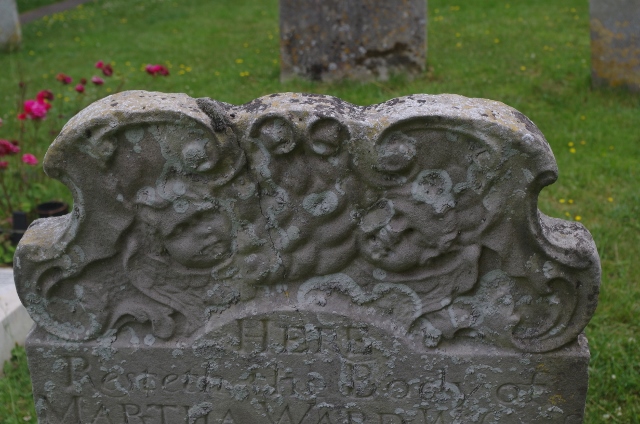
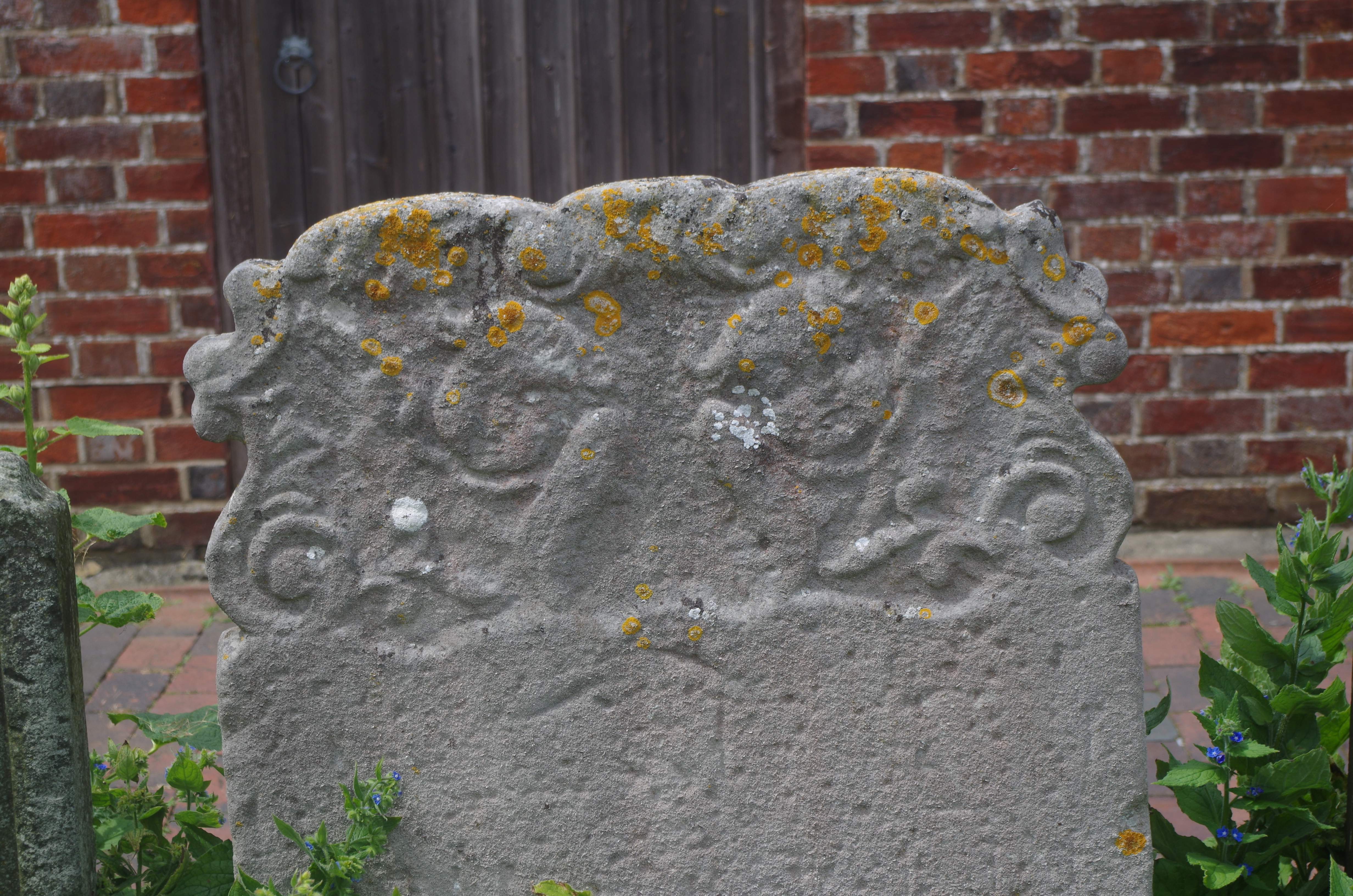
Instead they were replaced by the winged soul. This consisted of a small child’s head flanked by a pair of wings or a garland of leaves. They have the faces of babies with big, round eyes, plump cheeks and pouting lips and resemble Renaissance putti which are child-like. Putti represent the sacred cherub as they are known in England.
The winged soul may have been intended to be a more comforting image as the wings represented the soul of the deceased ascending to heaven. This could also give hope of a resurrection to those left behind. According to headstone symbols:
‘In the USA the winged soul is known as a soul effigy.’
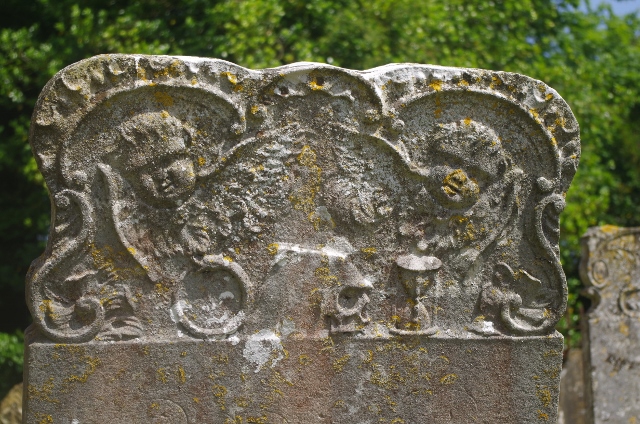
It was immensely popular and in my explorations of medieval Kent churches and their churchyards I found many examples. In fact, in one or two churchyards they outnumbered the skull and crossbones symbol. They mainly had one winged soul on a headstone but there were sometimes two or three clustered together as in these examples:
They can also appear in several combinations with other classic memento mori symbols as here:
In addition, every mason seemed to have his own interpretation of feathers as they can be carved as typical fluffy feathers, to resemble broad leaves or be very stylised.
With wings in general they are an important symbol of spirituality. They express the possibility of flying and rising upwards to heaven. For example, in the Hindu faith, they are:
‘the expression of freedom to leave earthly things behind…..to reach Paradise.’
New Acropolis
However, as the full flowering of the Victorian language of death in the 19th century began to appear the emblems of memento mori were retired. Although a couple, such as the hourglass and ouroboros, were revived.
But I did find two modern examples of the winged soul in the churchyard of St Martin of Tours in Eynsford, Kent and one is featured above. For years I had always thought of the winged soul as being a more general symbol and merely a decorative feature. I called them winged cherub heads or death heads and never considered that they might have had a specific meaning or purpose. It was exciting to see so many variations and interpretations, sometimes within the same churchyard. But it depended on the skills of the mason as to how well they were carved and whether they were 2 dimensional or 3 dimensional.
But, as a message of comfort, it is one of the most poignant in memento mori. The other central motifs emphasise time running out and what will be left behind. The winged soul suggests an eternal life and a more uplifting message.
Poking about in churchyards as is my wont is how I discover symbols to write about. It was while exploring two churchyards in Kent, All Saints in Frindsbury and St Martin of Tours in Eynsford, that I discovered this month’s symbol.
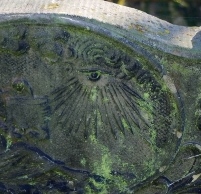
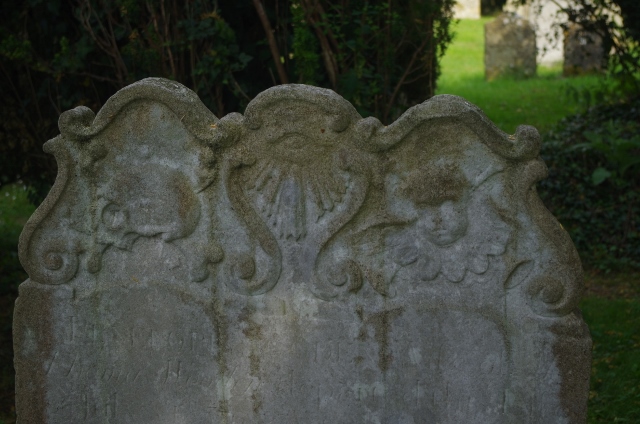
This is the All Seeing Eye, also known as The Eye of Providence, and is usually depicted as a single realistic eye within a triangle or within a burst of light. I’ve always associated it with Freemasons as it appears on their documents. But neither of these headstones had any other symbols linked with Freemasons such as the square and compass. So what was the story?
The one in the churchyard of St Martin of Tours in Eynsford was bordered by what looked like two snakes with a skull and crossbones and a winged spirit on either side, familiar memento mori symbols. Sadly the epitaph is now illegible.
The second one is in the churchyard of All Saints in Frindsbury and this intriguing version is on the grave of the Caryer family. The Kent Archaeological Society thought that it might represent the Woman of Samuria as featured in John 4.4-26 but I’m not sure about that. (see Symbol of the month – the womand from Samaria or a Greek goddess? 27 January 2021) The epitaph reads: ‘Sacred To the memory of Hannah wife of John Caryer Died 9th Sept 1809 aged 30 years Also Robert her son Died 28th June 1801 aged 8 years Also the above John Caryer Died 11th March 1814 aged (4)2 years.’
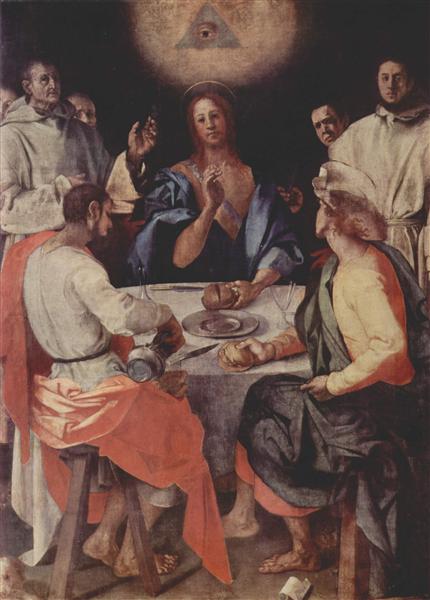
The earliest known representation of The Eye is in a painting called ‘The Supper at Emmaus’ by the Italian painter Jacopo Pontormo in 1525. This was painted during the Renaissance and it depicts the second part of the Second Appearance story in Luke 24: verses 13.35:
‘And they drew nigh unto the village, whither they went: and he made as though he would have gone further. But they constrained him, saying, Abide with us: for it is toward evening, and the day is far spent. And he went in to tarry with them. And it came to pass, as he sat at meat with them, he took bread, and blessed it, and brake, and gave to them. And their eyes were opened, and they knew him; and he vanished out of their sight. And they drew nigh unto the village, whither they went: and he made as though he would have gone further. But they constrained him, saying, Abide with us: for it is toward evening, and the day is far spent. And he went in to tarry with them. And it came to pass, as he sat at meat with them, he took bread, and blessed it, and brake, and gave to them. And their eyes were opened, and they knew him; and he vanished out of their sight.’
As you can see the Eye is above Christ’s head which shows that God is watching the event and so can be seen as a Christian symbol. On the Ancient Origins website it’s claimed that
‘the elements surrounding the eye also have a Christian meaning. For example, the triangle surrounding the eye also have a Christian meaning in that it’s a clear reference to the Holy Trinity – the Father, the Son and the Holy Spirit. The burst of light is meant to symbolise divinity, holiness and God himself’
Within the Bible there are many references to The Eye in the context of God keeping watch and observing in Proverbs and Ecclesiasticus and also from Psalms 33: verse 18:
‘The LORD is in his holy temple, the LORD’s throne is in heaven: his eyes behold, his eyelids try, the children of men. Behold, the eye of the LORD is upon them that fear him, upon them that hope in his mercy . . . . The eyes of the LORD are upon the righteous, and his ears are open unto their cry.’
But older religions and faiths such as Hinduism and the Ancient Egyptians also had an important eye symbol.
In Egypt it was known as the Eye of Horus. Even today it’s still used as an emblem of protection and good health. The Eye was also known as a wadjet (the whole one), wedjat or udjat. Sailors would often paint the Eye of Horus on the prows of their ships to ensure a safe voyage. I’m sure that I’ve seen this on a boat or two in some of Hollywood’s classic sword and sandal epics! The depiction of the Eye of Horus is said to resemble the markings on a falcon’s eye due to the teardrop marking which is sometimes found below the eye as here. This would make sense as Horus is usually shown as a falcon. There are several myths about Horus and his eye. For instance, in one of them Horus fought with Set who gouged out Horus’s left eye which was later restored by a goddess.
The Eye also appears on the US one dollar bill. But it made its first appearance as a Freemason symbol on the personal seal of Robert Moray (1609-1673) who was a Scottish Freemason. Then during the 18th century it appeared again in two Freemason books, one of which was Thomas Smith Webb’s ‘Freemasonry Monitor’ and, by the 19th century, it had become part of the permanent hieroglyphical emblems of the Freemasons. There are other associations with the Illuminati and, if you’re interested, there is more information online.
But with these two All Seeing Eye symbols I think that they were meant, as they often are, to be a comforting message. The departed, and the bereaved, were all being watched over and supported at a time of sorrow and grief.
It’s often on a winter’s night, just as dusk begins to fall and the lamp lights in St Georges churchyard come up, that the fine selection of 18th century tombstones are at their best. Carved skulls leer at you, an hourglass emphasises time passing and the gravedigger’s tools stand ready for the next interment. And perhaps there is still a phantom schoolteacher using his sculpted globe to teach geography to his spectral students.
There has been a church on this site since the 14th century and, in one place in the graveyard the number of burials over the centuries has made the ground rise up on both sides. But, as well as 18th century examples of funerary symbolism, there are also some wonderful 19th century ones as well. Inside the church there’s also a good selection of impressive wall monuments dedicated to prominent local families dating back to the 1600’s. They are buried in the vaults beneath the church. St George’s also has the country’s oldest lych gate in that the current one incorporates elements from a far older one. The churchyard is a pretty one for a short walk through to the bustling High Street especially when the spring flowers begin to appear, carpeting the grass between the stones with bluebells and flitting butterflies.
However for this month’s Symbols post I will concentrate on the 18th century memorials within the churchyard. These tombstones are topped with classic memento mori symbols. This is Latin for ‘remember (that you have) to die.’ They are the visual accompaniment to the immortal epitaph from Dundee’s Howff graveyard:
‘Remember Man as you pass by
As you are now so once was I
As I am now so must you be
Remember man that you must die.’
Graveyard symbolism, according to Douglas Keister, began when the well to do could no longer be buried with in their local church due to lack of space. Instead, they took up their eternal residence in the newly consecrated burial grounds outside and surrounding the church walls. These were often known as ’God’s Acres’ and gave the wealthy the opportunity to erect a lasting memorial or tombstone in their memory.
St George’s churchyard became the last resting place of prominent local families, some of whose descendants still live in the area. The oldest tombstone dates from 1668 and the 18th century ones are nearest to the church walls which in effect meant that they were ‘Nearer my God to Thee.’
I’ve always enjoyed walking through the churchyard as it can feel like walking through a gallery of funerary symbols. There’s something very exuberant about these 18th Century motifs of mortality even though some have eroded and only one epitaph is still fully readable. However, the skull and crossbones, the Death’s Heads and others have, in several cases, lasted better than the epitaph below them.
The skull and crossbones are an effective, if macabre, reminder of what is left of a body after it decomposes and there are several good examples in St Georges.
This one is near the church entrance and features a skull and crossbones with what appear to be protruding palm fronds. It also seesm to be resting on something whch may be a shield. All that can now be read on the epitaph is…who dep….’
Nearby is another skull and crossbones with a winged hourglass above it. This is a reminder that ‘Time flies’ or ‘Tempus Fugit’ and that the onlooker will soon be bones and dust. So it’s important to make the most of their time on earth. On the left hand side is a pick and shovel. These are a sexton’s tools which made me wonder if this was a sexton’s grave but the epitaph is now illegible. The sexton’s role not only encompassed maintaining and looking after the church but also the churchyard. In larger graveyards the sexton would have been more of a manager but in smaller ones he would have had sole responsibility for preparing the ground, digging and closing the grave, mowing the lawn and also maintaining the lawn and paths.
Skulls also feature prominently on two other tombstones on the other side of the church very near the wall. One seems to have a very sharp pair of horns and a definite smirk. On each side of it there appear to be small trumpets but it’s too weathered to see if anyone’s blowing them. Maybe he’s keenly anticipating the Last Day of Judgement.
Nearby is a large tombstone with what seem to be two somersaulting skulls on them although one is more eroded than the other. Below them is a small worn hourglass. I believe that these two examples of skulls may be unique to St Georges as I’ve haven’t yet seen them anywhere else.
Douglas Keister has suggested that the skull and crossbones slowly began to be replaced by the much less stark and macabre ‘Death’s Head.’ This is a human face with wings on either side of it. I’ve always known it as the ‘winged cherub’ and there are also several good examples within the churchyard. These are symbols of resurrection intended to give those left behind some hope.
I am also a huge fan of calligraphy having studied it for two years at evening classes and it has undergone a revival on late 20th and early 21st century tombstones. However 18th century calligraphy has a style all of its own and is instantly recognisable. The only legible 18th century epitaph in St Georges is the one dedicated to a John Saxby. It reads:
‘Here lyeth the body of John Saxby of the Parish who Departed this life…year of May 1731 aged 41 years.’
A fine example of a Death’s Head is on top with an open book beside it which may be the Bible or the Book of Life and there’s a stylised flower on the other side. The open book may be a depiction of the incumbent offering their life to God for judgement as an ‘open book’. People are sometimes described as an ‘open book’ as they have their feelings and thoughts open to the world with no attempt to hide them.
On another memorial two small faces, presumably from the angelic host, peer out from either side of the clouds surrounding a crown. It’s a representation of the reward that awaits the faithful in heaven. This verse from the Bible refers to it:
James 1:12 New International Version (NIV)
‘Blessed is the one who perseveres under trial because, having stood the test, that person will receive the crown of life that the Lord has promised to those who love him. ‘
A plump faced death’s head is surrounded by another open book and what I think maybe a small skull in the far corner of the stone.
But one of the most unique and impressive tombstones in St George’s, or perhaps anywhere, is that of John Kay. He was an 18th century schoolmaster and his life and talents are recorded by the tools of his trade that have been carved on his stone. There’s a globe on a stand, a trumpet, what appears to be a cornet, an artists palette, a pair of compasses and other items which are now too indistinct to read. He was obviously very erudite and much appreciated by his students. Sadly his fulsome epitaph is now virtually unreadable. He lies near Mr Saxby under a spreading yew tree.
On the other side of the graveyard is a large chest tomb. There is a dedication and an armorial on its top and I feel that some patient research in St George’s burial registers may reveal the incumbent’s identity. There are blank cartouches on each side with death’s heads on top and two skulls beneath each one. At one end are palm fronds which are a Roman symbol of victory which were then adapted by the Christians as a martyr’s triumph of death. The palm as a symbol originated in the ancient Near East and Mediterranean region and is a powerful motif of victory, triumph, peace and eternal life. It’s traditionally associated with Easter and Palm Sunday and Christs’ resurrection and victory over death. On the other end of the tomb are what appear to be olive flowers. The olive’s association with wisdom and peace originally came from Greek mythology when the goddess, Athena, presented an olive tree to the city that was to become Athens. Successive Greek ambassadors then continued the tradtion by offering an olive branch of peace to indicate their goiod intentions. The olive tree is also associated with longevity, fertility, maturity, fruitfulness and prosperity. In the Bible, Noah sent the dove out after the Flood to see if the floodwaters had receded and when it returned with an olive leaf in its beak Noah knew that the Flood had ended. Even today the phrase ‘ offering an olive branch’ means the someone wants to make peace. But in this context the olive branch may mwean that the soul has departed with the peace of God. So one memorial incorporates powerful motifs of mortality and resurrection.
St George’s has also used old tombstones to pave two of the pathways within the churchyard of which some are still readable. It always feels as if I’m walking over someone’s grave although they are buried elsewhere in the graveyard. However, although the 19th and 20th century memorials are rather more restrained and far more legible I prefer the more ‘in your face’ 18th century symbols. But in the case of the horned skull I can only frustratingly only guess at its meaning and the person who lies beneath…..
The skull and crossbones. One of the central motifs of 18th century Memento Mori and intended to be a stark and macabre reminder of the viewer’s inevitable destination. This would be all that would remain of you after death.
However it wasn’t a very comforting message to either the loved ones left behind or to the living.
But fashions and tastes change, even in funerary symbolism, and the skull and crossbones had served their purpose.
Instead they were replaced by the winged soul. This consisted of a small child’s head flanked by a pair of wings or a garland of leaves. They have the faces of babies with big, round eyes, plump cheeks and pouting lips and resemble Renaissance putti which are child-like. Putti represent the sacred cherub as they are known in England.
The winged soul may have been intended to be a more comforting image as the wings represented the soul of the deceased ascending to heaven. This could also give hope of a resurrection to those left behind. According to headstone symbols:
‘In the USA the winged soul is known as a soul effigy.’
It was immensely popular and in my explorations of medieval Kent churches and their churchyards I found many examples. In fact, in one or two churchyards they outnumbered the skull and crossbones symbol. They mainly had one winged soul on a headstone but there were sometimes two or three clustered together as in these examples:
In addition, every mason seemed to have his own interpretation of feathers as they can be carved as typical fluffy feathers, resemble broad leaves or be very stylised.
With wings in general they are an important symbol of spirituality. They express the possibility of flying and rising upwards to heaven. For example, in the Hindu faith, they are:
‘the expression of freedom to leave earthly things behind…..to reach Paradise.’
New Acropolis
However, as the full flowering of the Victorian language of death in the 19th century began to appear the emblems of memento mori were retired. Although a couple, such as the hourglass and ouroboros, were revived. But I did find two modern examples of the winged soul in the churchyard of St Martin of Tours in Eynsford, Kent.
I had always previously thought of the winged soul as being a more general symbol and just a decorative feature. I called them winged cherub heads or death heads and never considered that they might have had a specific meaning or purpose. It was exciting to see so many variations and interpretations sometimes within the same churchyard. But it depended on the skills of the mason as to how well they were carved and whether they were 2 dimensional or 3 dimensional.
But as a message of comfort it is one of the most poignant in memento mori. The other central motifs emphasise time running out, think about your life now and this is all that will be left. The winged soul suggests an eternal life and a more uplifting message.
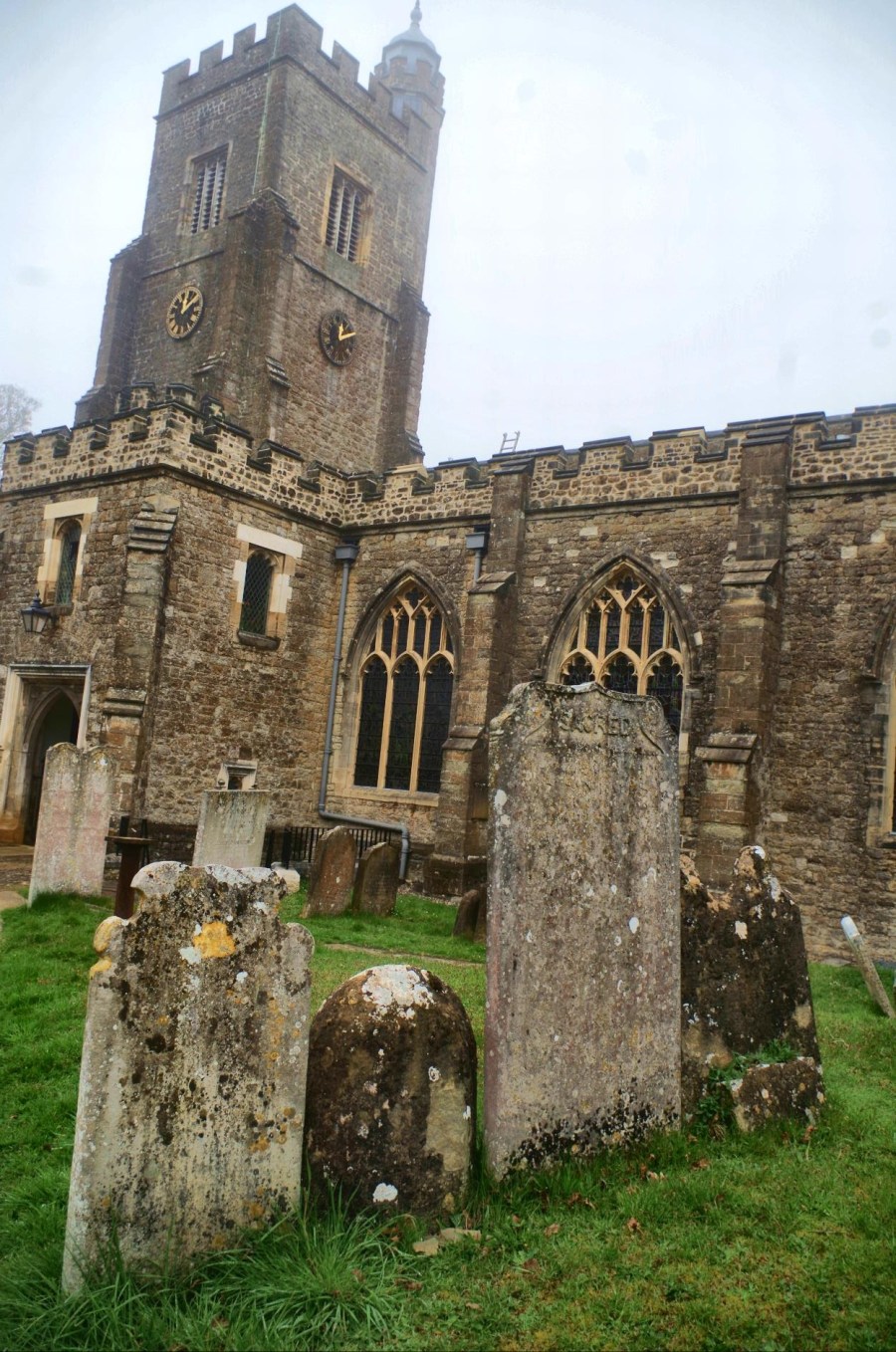
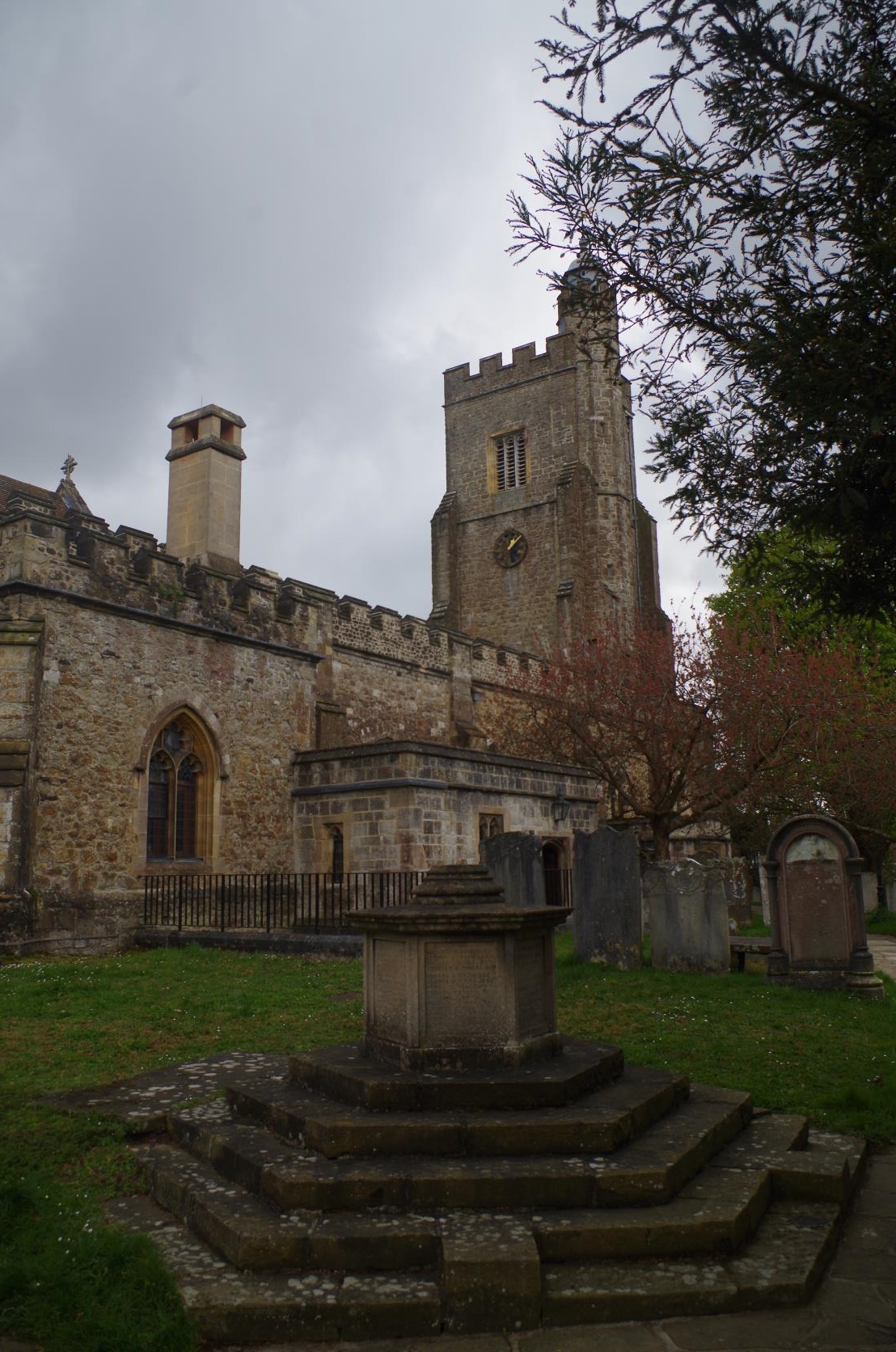
On my previous spring saunters I’ve wandered through two of London’s large, sprawling cemeteries; Kensal Green and West Norwood but this year I thought I’d stay nearer to home. St Nicholas is my local church and within walking distance of my home. It’s in a prominent position in the town as it’s at the top of the hill and opposite the entrance to Knole Park, another local landmark. One of its most famous Rectors was the preacher and poet, John Donne, who was in post from 1616 until 1631 and is commemorated with a metal plate on the pavement outside. Every time I visit its churchyard I find something new and at a time when Nature is beginning to awaken again what better excuse did I need?
The present building’s shape dates from the 13th century and in fact the present nave dates from 1270. It replaces an earlier church. The north aisle was added in 1320 and the chancel south aisle and tower around 1450. There have been many later alterations but the basic 15th century structure and style remains. In 1995 excavations took place to create more meeting rooms in what may have been the crypt. The interior of the church has some monuments dedicated to prominent local families.
But it’s the churchyard that fascinated me. Intertwined with plain Victorian headstones are some wonderful examples of 18th century tombstones adorned with memento mori. A couple are naively executed but others are finely carved with the wonderful 18th century calligraphy accompanying them.
The Spring sunlight illuminated the thick patches of moss and lichens that had carefully draped itself over the monuments and memorials. It made the subtle hues and shades really stand out; the combination of green and gold or browns seemed to gleam amongst more subtle hints.
Some of the lichens looked as if someone had taken a paintbrush loaded with colour and then dabbed it onto the stones. Moss has the effect of softening the edges of stones and letters and, where it replaces letters completely, gives a more organic feel to the epitaph.
A spreading horse chestnut tree was laden with sticky buds already beginning to burst into leaf. ‘How many years has it stood near the church door marking the seasons and years?’ I thought.
A chaffinch called loudly for its mate from the closed part of the churchyard. I had explored this in October and seen its large carpet of prickly sweet chestnuts as a fox had turned tail and run back to where it had come from. There has been a piece of bone abandoned on top of a flat headstone and I hoped that the fox had brought it in from a nearby butchers rubbish bin…….now alas this part of the churchyard is closed due to Health and Safety as it’s so overgrown. On this visit I disturbed a fluffy ginger and white cat who soon fled in the same direction as the fox.
Three large patches of snowdrops clustered protectively around the base of a tree, their pristine heads nodding in the breeze as if deep in conversation. Primroses had begun to stud the grass and I saw my first ever cowslip amid headstones.
The tiny bright blue flowers of Speedwell blossomed beside a small tombstone and a red-tailed bee, one of the first signs of Spring, buzzed along the top of the grass. Dog violets, a much underrated flowers in my opinion, frothed plentifully beside the iron entrance gate.
Nearby, was not so much a carpet of Spring flowers, but more of a small rug of them. More Primroses, the bright yellow of Lesser Celandine, another harbinger of Spring, and more dog violets all combined to make a wonderful collection of green, yellow and purple.
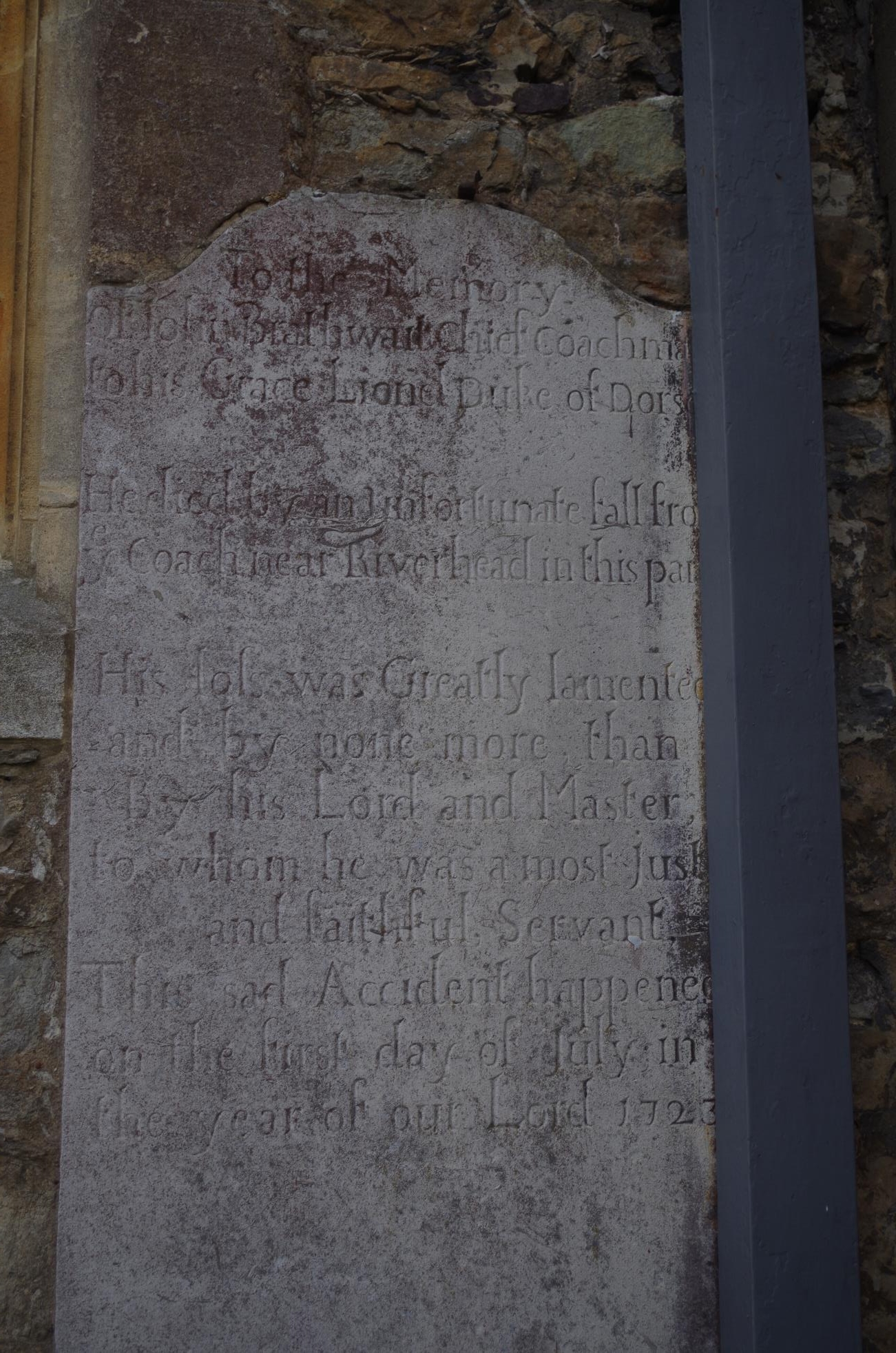
There are some remarkable epitaphs in St Nicholas churchyard and this one which has now been incorporated into the fabric of the church caught my attention.
The epitaph reads:
To the Memory
of John Braithwaite Chief Coachman
to his Grace Lionel Duke of Dorset
He died by an unfortunate fall from
Ye coach near Riverhead in this parish.
His loss was greatly lamented
and by none more than
by his Lord and Master
to whom he was a most just and faithful servant
This sad accident happened
on the first day of July in
the year of our Lord 1723
With the Caring for God’s Acre project which is linked with the bio diversity recording site, irecord, biodiversity within cemeteries is being examined more closely. They are real havens for wildlife especially in big cities as they are an invaluable green space that’s accessible to everyone. I’ve always enjoyed exploring cemeteries partly for this reason whether it be standing waist high in wild flowers on a hot July day in the meadow at Kensal Green cemetery or counting butterflies along the side paths leading to the Courtoy Mausoleum in Brompton Cemetery.
Sadly the Spring sunshine was replaced by April showers but Mother Nature ignored this and kept bursting forth regardless. I’m already looking forward to my summer saunter within St Nicholas.
At last the endless sorting out of boxes is over after the move. I’ve found some money I’d forgotten about, family photos and a lot of books. The Cancer r Research charity shop in the High Street is groaning under the weight of my donations and I have recycled a lot of stuff.
And now down to the important things in life – shadowsflyaway! I didn’t have an internet connection for a few weeks which was probably a good thing as it made me concentrate on emptying boxes and organising rooms.
But let’s begin with Symbol of the Month!
This month’s symbol comes from a post on Facebook’s Folk Horror Revival page and I was intrigued enough to make this one Symbol of the Month. I would describe it as a memento mori which is Latin for ‘Remember you must die.’
It’s a carving on a tombstone featuring a skeleton and a woman or girl facing the viewer. She is holding three flowers in one hand. In this photo, although the skeleton almost seems to be rising from the ground, he is actually holding a scythe in one hand and an hourglass in the other. This can be seen more clearly in the clipping from Northumberland’s Hidden History by Stan Beckensall which another reader on the strand of the post kindly attached.
Clipping on headstone from Falstone churchyard, Northumberland. taken from Northumberland’s Hidden History by Stan Beckensall used without permission.
She is wearing a tightly belted dress, perhaps fashionable in her time, and seems carefree despite having Death standing next to her in all his glory. I had the impression that this might have been on the grave of a young girl due to her dress and the flowers.
They reminded me of roses and I immediately thought of the famous phrase, ‘Gather ye rosebuds while you may’ which is a quotation from a poem by Robert Herrick, a 16th century poet.
The poem is entitled: To the Virgins to make much of time and the quotation comes from the first verse:
Gather ye rosebuds while ye may,
Old Time is still a-flying;
And this same flower that smiles today
Tomorrow will be dying.
So this little scene could be saying Enjoy life while you can as death will soon be here.’ It sounds a little depressing but life was shorter in earlier times. In the 19th century, for example, the average life of a working man was until their late 40’s and women often died in childbirth. I wander around cemeteries a lot as you can imagine and there are many monuments and memorials to wives and often children who have died young as a result. On the other hand it can be seen as uplifting in that it encourages the onlooker to enjoy life to the fullest.
Sadly I don’t know who’s buried here but she or he was obviously much missed to have such an impressive scene carved on their tombstone.
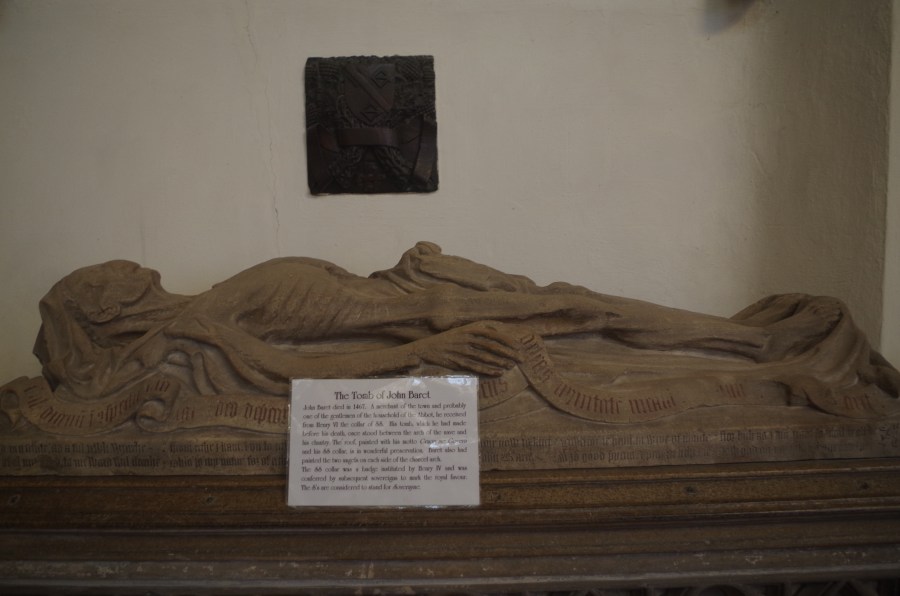
This month’s symbol is a cadaver or pardon tomb from St Mary’s in Bury St Edmunds. These medieval tombs were an extremely visual way of reminding everyone that, despite what you had achieved during life, death would make you equal with all men.
It was as I stood in St Mary’s church, Bury St Edmunds after having admired its magnificent hammerbeam with lifesize angels pinned to it like exotic butterflies that I saw John Benet’s tomb resting against a side wall.
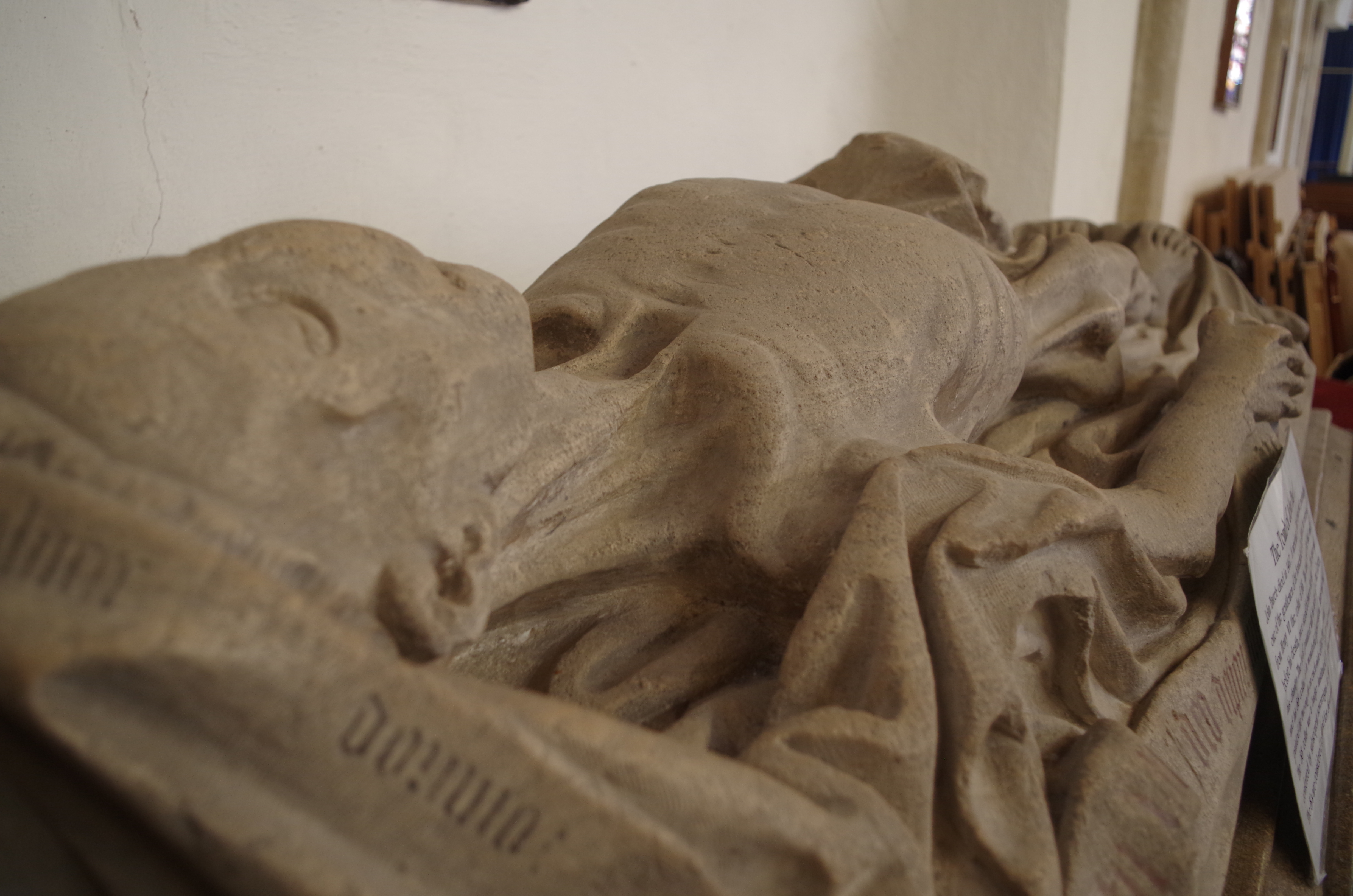
I’d seen two, somewhat worn, cadaver tombs in Winchester Cathedral but not one so close up and so well carved. Even now it’s still crisp and detailed but due to its current location it was difficult to take a full length photo. The tomb depicts John Benet lying on his back as a lifesize corpse with a shroud or towel protecting his modesty.
Although St Mary’s guidebook describes Benet’s tomb as a Pardon tomb, they are more often known as a transi or cadaver tomb. This definition comes from Wikipedia who describe a transi or cadaver tomb, as a ‘memento mori’. This is Latin for ‘remember you will die’ and a reminder of the inevitability of death. Wiki goes onto add that this type of tomb is in the form of:
‘…a type of gisant or recumbent effigy tomb featuring an effigy in the macabre form of a decomposing corpse…’
This type of tomb is particularly associated with the Middle Ages which is roughly when Benet’s tomb was created and I’ve always known them as cadaver tombs. However, they’re not always in the form of a decomposing corpse as they can also be in the form of skeletons or the body of the deceased wrapped in a shroud. I am indebted to the flickeringlamps blog which featured transi tombs in the form of ‘double-deckers’. This is where the top layer of the tomb portrays the gisant of the deceased as they were when alive and then below on the bottom layer as a decomposing corpse. This is an extremely visual reminder of what the person once was and what they will inevitably become as earthly glory is fleeting and all must die.
Cadaver tombs can be found in several UK cathedrals and parish churches. The earliest surviving one is in Lincoln Cathedral and is dedicated to Richard Fleming. It dates from the 1430’s. St Pauls’ cathedral has a later example from the 17th century which commemorates the poet John Donne. Cadaver tombs are also known in Europe and particularly in Italy, France. Germany and the Netherlands.
But who was John Benet?
According to St Mary’s guidebook, John Benet was a medieval cloth trader and one of St Mary’s most important benefactors. He financed the very ceiling that I’d been admiring and also his own private chancel chapel and tomb. Within his lifetime, Bury St Edmunds was a thriving town built on the local wool trade. This led to the creation of a rising merchant class who were able to use their money to leave a lasting memorial to themselves in their local church as proof of their good and pious life. Surely admittance to the Pearly Gates would be assured if you provided your church with some embellishments…. After they couldn’t take it with them but they could definitely prove that they’d had it while alive….
John Benet was a rich and powerful man within his local town which is why he was able to afford to have a cadaver tomb made for him and one that was so well sculpted. It originally lay in his own private chapel. This has now gone but if you look up you can still see its glittering ceiling which was restored in 1968. You may just be fortunate enough to see the light glisten on the tiny pieces of concave mirror glass inserted into the gold stars to give the illusion of real stars twinkling. Benet’s motto, ‘Grace me Governe’, his initials, coat of arms and SS collar are also part of the intricate decoration. The latter, again from St Mary’s guidebook:
’….was a gift from the Lancastrian kings in recognition of a special or personal services. It was in the form of a collar or chain in which the letter ‘S’ was engraved. The letter ‘S’ which presumably stood for ‘Sovereign.’
So Benet moved in high circles and wasn’t afraid to shout about it for all eternity.
There are Latin prayers on the ceiling’s edges which include ‘Pray for the soul of John Benet, ‘Let us praise the Lord gloriously’, Alleluia, Honour and glory to the only God.’, ‘My soul shall delight in the Lord’, ‘Seek only the highest’ and finally ‘May the pure Virgin Mary bless us with issue.’ Benet was not a man who stinted where his soul was concerned.
The tomb has moved around the church interior several times. But not of its own volition as far as I know. It has been surmised that the effigy of him portrayed as a decaying corpse was made during his lifetime.
Now there’s an interior design feature for you…it would have been intended as a constant reminder of his own inevitable death and the need to make preparations for the afterlife. It’s in remarkable condition and is the best one that I’ve seen. It may have been created in the nearby Abbey’s master mason’s workshops. This seems very likely given Benet’s powerful connections and the quality of the carving would also confirm this.
Originally he was positioned with his feet facing the east but, in 1884, the tomb was turned around so that the side inscription could be read. In this, Benet’s motto is carved and a small figure of himself is in the middle of it, dressed in his finest clothes, and holding up the word ‘Me’. Under one hand of the decaying corpse are the words:
‘He that will sadly beholde me with his ie, May he hyd own mirrour (and) lerne for to die. ‘
A lifesize memento mori if you will. The guidebook, however, describes it as a Pardon Grave’ which isn’t a term that I’ve heard before. It’s meant to indicate that the person who was being commemorated has obtained a pardon or remission from purgatory. Benet had also left instructions for his papal pardon to be displayed near his tomb for all to see. I had the impression that Mr Benet was a bit of a show-off but if you don’t blow your own trumpet…. I sincerely hope that all this piety and expense achieved its aim.
The cadaver tomb iconography is based on the medieval Dance of Death or Danse Macabre.
Nobleman & Physician from the Lubeck Totentanz courtesy of UT Southwestern
This depicted a long line of people from Emperors to Popes right down to a beggar, each of whom had death in the form of a skeleton at their shoulder. This was a reminder that Death made all men equal. The first one was recorded in St Paul’s Cathedral and in Long Melford, Suffolk, according to St Mary’s guidebook, long cloths were displayed depicting ‘the dance of Pauls’
It’s amazing that this survived the Reformation and Cromwell’s wrecking crews and still sits in St Mary’s reminding visitors of their inevitable fate. But Mr Benet has a further claim to fame as, in 2003, he was loaned out to the Victoria and Albert Museum as part of their ‘Gothic: Art of England’ exhibition. Apparently, during conservation, traces of flesh coloured paint were discovered on the figure which included red and green veins especially in the neck. So try and imagine Mr Benet in his original colouring – it must have quite a sight to see. I think that he’d be very proud that his tomb, the hammerbeam ceiling and also his chapel ceiling are still in St Mary’s for all to enjoy and remember him.
St Mary’s, Bury St Edmunds A guidebook, Clive Paine, Honey Hill Publishing 1986.
Metamorphosis of a Death Symbol’ The Transi Tomb in the Late Middle Ages an d the Renaissance, Kathleen Cohen (Berkeley: University of California Press) 1973

































 shadows fly away