This is where Rev Jordan came in and he became known as the parson detective. Such was the feeling in the community that he became determined to find the murderer and bring them to justice. So he set about disproving George White’s alibi.
At the time, George had claimed to have met one of his father’s employees, Joseph Green, who he had invited him to come with him. But a few yards away from the house, George had said that he had to return home to fetch his handkerchief. As a result, he was gone at least ten minutes which would have given him enough time to put the hurdle in place for the perpetrator’s gun to rest on. Joseph attested that the hurdle had not been standing at the pantry window during the day. Afterwards they had walked to the Chequers pub and Joseph said that it was the last time he saw George that night. Joseph had added that he had seen George ‘sitting up about upon the stiles’ near the murder scene before it was dark. Even more damning was that George didn’t get the handkerchief that he had said he went back home to get as, when everyone was assembled in the house after the murder, he hadn’t got one and had to go and find one.
A gun had been found in a clover stack near William’s house about a month prior to the murder and an employee called Francis Smith had put it in the hayloft. A short time afterwards he couldn’t find it and was told by George that William had taken it away, destroyed it the stock and lock of it and thrown the barrel into a lumber room.
Rev Jordan meanwhile had preached a sermon on the matter and opened a book, asking everyone in the congregation and village to write down exactly where they were at 8pm on that fateful Sunday evening.
‘Rev Jordan persuaded George to make a vestry statement and a meeting was then held to clear him of suspicion. So, he stood before 40 people on Easter Monday, 3 April 1809 after a dinner at the Five Bells Inn. After the parish accounts were settled, Rev Jordan insisted that George make a public statement. He told the audience what George had said in his vestry statement and demanded that George bring in witnesses to confirm that they had seen him at any time between 7.45-8.15 to which he said that he couldn’t as he hadn’t seen anyone at that time. Some of the audience questioned him and none were satisfied with his answers.‘
The Five Bells Hoo from Facebook photographer unknown
The Rev was able to prove that George had not bought a bag of nuts at 7.45pm as a witness had said that he had seen him cracking and eating them at 7.40pm. Also, George had claimed to be standing at the Five Bells Inn when the hulks guns were fired at 8.15pm but it had actually happened at 8.00pm. He had been seen coming from the farm at 8.20pm with laboured breathing when he reached the vicarage door. He had had enough time to murder his father and then double back to the village.
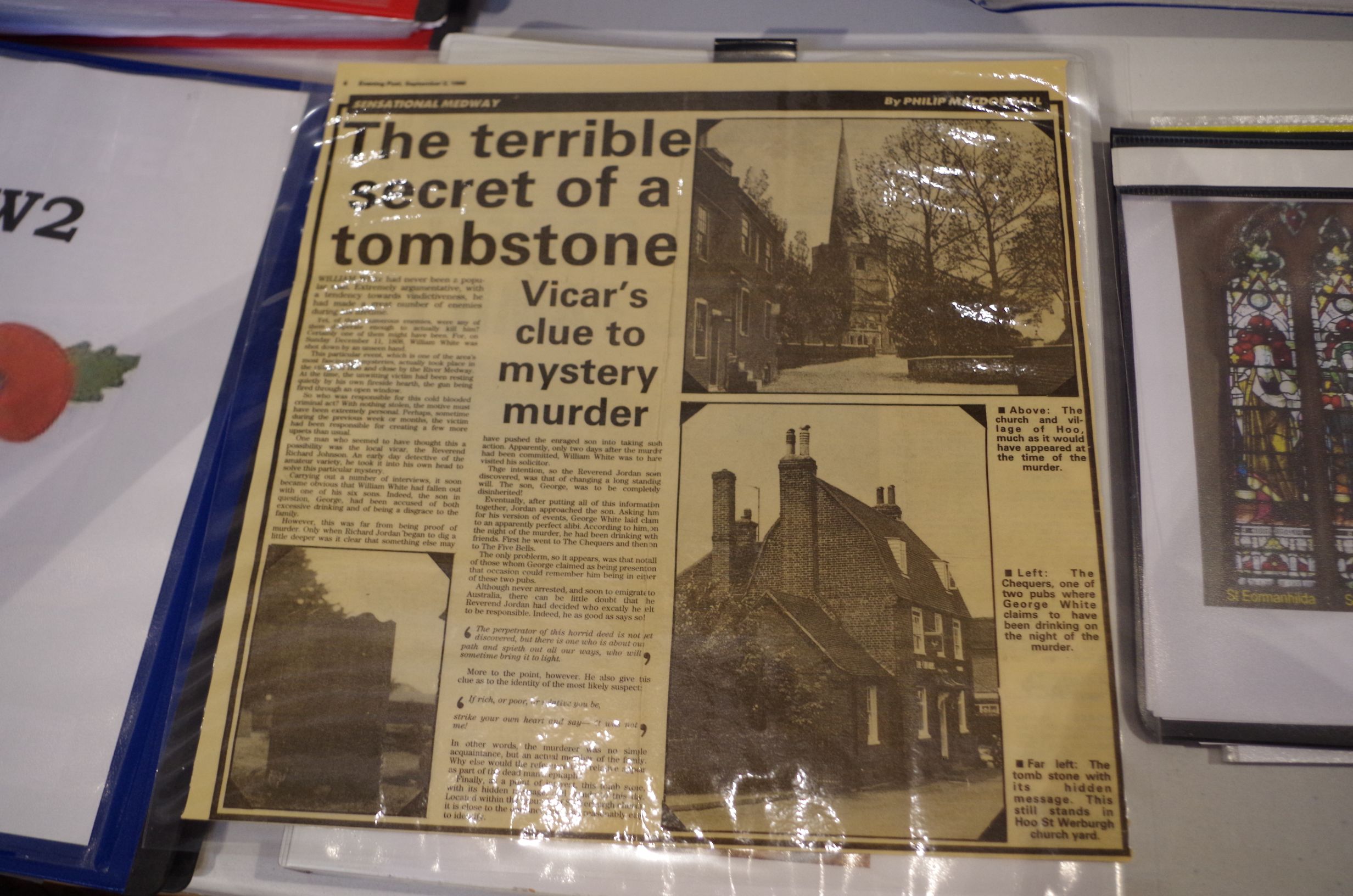
So what happened next? Nothing. No one was ever charged with William’s murder and the case is still unsolved. George emigrated to Australia and that is the end of his story. There seems to be nothing more on the auction or the fate of William’s children. I could not find an image of William or of Cookham Farm House.
The only reminders are the newspaper reports in florid Victorian language such as;
‘Dastardly murder.’
And, of course, the headstone. It’s a reminder of an event that happened over 200 years ago which shocked a community. It’s not recorded if Rev Jordan went on to do more sleuthing but I think that he made a convincing case against George. William’s grave is situated 20 yards east of the main North church door and not faraway from Thomas Aveling’s resting place.
The Dastardly Murder of William – this site contains Victorian newspaper reports of the murder including 2 in London papers. Also Rev Jordan’s thought on the murder and possible perpetrators.
You never know what you will find in a country churchyard; crumbling mausoleums associated with royalty, a fine selection of skulls on headstones and poignant memorials.
But what I didn’t expect at Hoo was to find one that revealed, positively shouted in fact, about a local unsolved murder from the early part of the 19th century. This is the headstone dedicated to William Walter White. This is the inscription:
‘IN MEMORY OF
WILLIAM WHITE OF THIS PARISH, YEOMAN
WHO WAS ON SUNDAY EVENING THE 11TH OF DECR.
1808 MOST INHUMANLY MURDERED
IN THE BOSOM OF HIS FAMILY
BY A GUN DISCHARGED AT HIM THRO A WINDOW
WHILST SITTING BY HIS OWN FIRESIDE
THE PERPETRATOR OF THIS HORRID DEED IS
NOT YET DISCOVERED BUT THERE IS ONE, “WHO
IS ABOVE OUR PATH AND ABOUT OUR BED
AND WHO SPIETH OUT ALL OUR WAYS”
WHO[O] [WI]LL SOMETIME BRING IT TO LIGHT
HE LIVED ESTEEMED BY ALL WHO KNEW HIM
[AND HIS] SAD END IS UNIVERSALLY REGRETTED HE
[LEFT ISSUE]6 SONSAND 5 DAUGHTERS TO BEWAIL
[HIS LOSS AND DIED [AT] THE AGE OF 58 YEARS
STONE WAS ERECTED JUNE THE 24TH 1809
“[By] whose Assa[ssinating} {H}and [I fell]
[Drop] Reader [o’er my Grave one] Silent Tear
[Live Well remembering that your God is Near]
[If Rich or Poor or Relative you be]
[Strike your own breast and say – It was not Me!]’
A more dramatic epitaph it would be hard to find and the stonemason certainly earned his money! The case shocked the farming community of Hoo especially as no one was ever brought to justice and suspicions ran rife. It even led to the local vicar of St Werbergh’s at the time, Rev Jordan, deciding to become an amateur sleuth and unmask the perpetrator.
Death had already visited the White family when William’s wife, Jane, dropped dead with no prior indication of illness on 24 March 1808 aged 44. The murder left the 11 children orphans within a short space of time and more about what happened afterwards later. William was a man of some standing in the village. He was a yeoman which meant that, although he was a farmer, he wasn’t part of the gentry. In 1790, he was one of only two franchised householders in the village and so was eligible to vote.
The facts are that, on Sunday 11th December 1808, William was sitting reading at home with his family when a shot rang out. A gun had been fired through an open pantry window which killed William outright. The shot entered the back of his head and exited under the right eye. The ‘cries and lamentations’ of his family could be heard in Hoo village a mile away after the body was found. An unsuccessful search was made immediately for the perpetrator. However, a recently discharged gun was found in a ditch roughly 200 yards away from the house near the River Medway which led to the assumption that the murderer had escaped by water.
Such was the notoriety of the case that reports of it appeared in London newspapers and the Bow Street Runners were called in. They were the forerunner of the modern police force.
Bow Street Runners c1800 from History UK website.
Whoever fired the fatal shot must have known the layout of the house and the family’s habits. It took place on a Sunday when there were no servants about and it would have been necessary for the pantry door to be open in order to have a good view from the window as the gun was fired at William sitting by the fire. It had been propped up on a hurdle in front of the window and this helped the murderer to have a good aim. The gun was an old musket-barrel which had nails in the breach fastening it to the stock. It was a very crude gun as the hammer would not hold at full cock but was fastened back by a piece of twine which was presumed to have been cut at the time of firing. The fatal shot was fired at the same as the nightly salvo of guns from convict hulks on the River Medway.
The suspects
The gun’s owner was a man called Driver and he and another man called Day were picked up in Bapchild near Sittingbourne, Kent. It was assumed that they were on the run. The Coroner, J Simmons Esq, questioned them but soon realised that he didn’t have enough evidence to prosecute them. He then had them removed to one of his Majesty’s ships which was a euphemism for being ‘press ganged’. The Kentish Gazette described it like this:
‘as they were unable to give a satisfactory account of their mode of obtaining a livelihood, they were sent to serve their country on board one of his Majesty’s ships of war.’
If that wasn’t enough, later on, they were marched back from Portsmouth to Rochester to be further questioned and then press ganged a second time before being finally released without charge.
As for motive, William had recently found a servant, possibly Driver, in the act of robbing a neighbour and had informed the appropriate authorities. He had sacked the man who had sworn to get his revenge. In fact, a week prior to the murder, the unnamed man, had purchased a gun:
‘for which he had no possible occasion, under some frivolous pretence’
according to newspaper reports at the time.
The inquest on William was held and a verdict was returned of:
‘Wilful murder against some per or persons unknown – Friday 23 December 1808.
Events began to gather pace as the executor of William’s will, Thomas Denton, was authorised to put William’s home, land, possessions and other assets up for auction. It was intended that the money raised would be distributed by him amongst the children as he thought best for them. Originally it had been intended that Jane White, William’s wife would be a joint executor but of course with her death it fell to Thomas alone. Understandably the children tried to stop him and suspicion began to fall on him. In the space of a few months they had been left orphans with the loss of both their parents and now they were to lose the family home as well.
But another suspect had appeared who was much closer to home. It was George White, William’s eldest son. He was known to be on bad terms with his father and had been seen to threaten him. George wanted the farm and the land but William was considering writing a new will leaving him and another relative out. However, his will dated 22 January 1808 did not indicate.
But George had convinced both the Mr Simmons, the coroner, and the Bow Street Runners that, during the vital thirty minutes between 7.45pm and 8.15pm he had been in Hoo village buying:
‘a penny’s worth of nuts.’
The shop was a good mile away from the farm. But someone else in the community had doubts about George’s alibi and was determined to disprove it as we shall see in Part 3.
Here’s another interesting piece from the BBC news website on murder memorials dating from the early 19th century. They are usually found in country areas as the victim and murderer would often be known to the community.
By Natalie GriceBBC News
26 October 2018
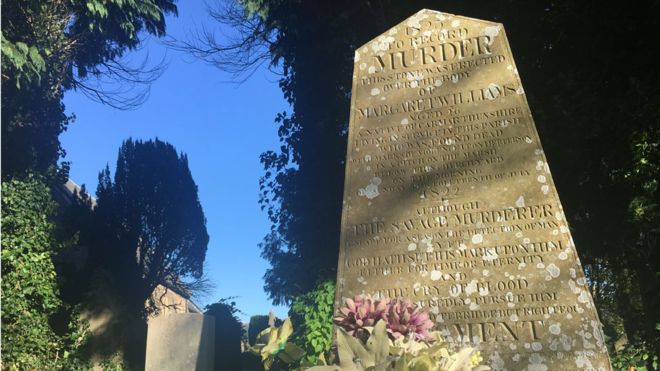
The tragic tale of Margaret Williams is hinted at on the stone which condemns her murderer
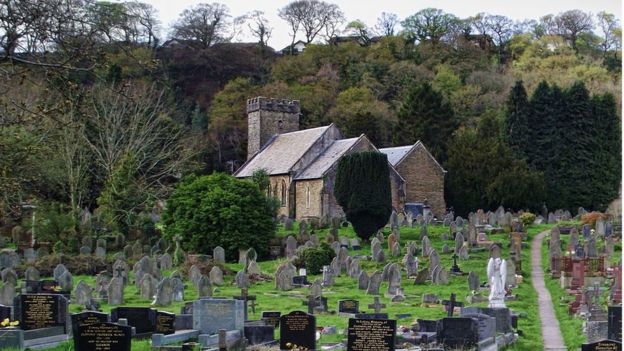
Wandering around the picturesque cemetery at St Catwg’s church in Cadoxton, Neath, a first-time visitor might be startled out of their gentle stroll by the stark message on top of one tall, weathered stone – MURDER.
This memorial in south Wales is one of a handful of “murder stones” erected around the UK, the majority over a period of about 100 years, to commemorate violent deaths that shocked the local communities.
The Cadoxton stone is dated 1823, and recounts the death of Margaret Williams, 26, who was from Carmarthenshire but was working “in service in this parish” and was found dead “with marks of violence on her person in a ditch on the march below this churchyard”.
Miss Williams’ story, such as is known from contemporary reports, tells of an unmarried young woman who had been working for a local farmer in Neath when she became pregnant.
Image copyrightCR LEWIS/GEOGRAPHImage captionThe peaceful graveyeard of St Catwg’s in Neath hides a harrowing tale in its midst
She had declared the father of the child was the farmer’s son, and when her apparently strangled body was discovered head down in a watery inlet in marshes near the town, he was the prime suspect.
But whatever local opinion may have believed, there was no evidence to tie him or anyone else to the crime, and her murder remained unsolved.
However, the murderer was left in no doubt as to the feelings of the local community after this stone, part gravestone and part warning, was erected over poor Margaret’s body.
Giving the details of her fate and the date of her death, the stone, erected by a local Quaker, continues: “Although the savage murderer escaped for a season the detection of man yet God hath set his mark upon him either for time or eternity, and the cry of blood will assuredly pursue him to certain and terrible righteous judgement.”
This unsolved killing is unusual in the history of the surviving murder stones in that the murderer escaped justice. Most of the other memorials are to people whose killers were quickly detected, sentenced and dispatched via the gallows.
Dr Jan Bondeson, a retired senior lecturer at Cardiff University and a consultant physician, has made a study of the history of crime alongside his medical career and has written a number of books on the subject.
He became interested in murder stones after editing a book which featured them.
He said: “The murder stone in Cadoxton is the only one in Wales. There are plenty of them in England.
“There was an instinct for the local people to erect them. There was a strong instinct to commemorate a tragic murder.”
Dr Bondeson has documented several further murder stones across the English counties, and one early example of the type in Scotland.
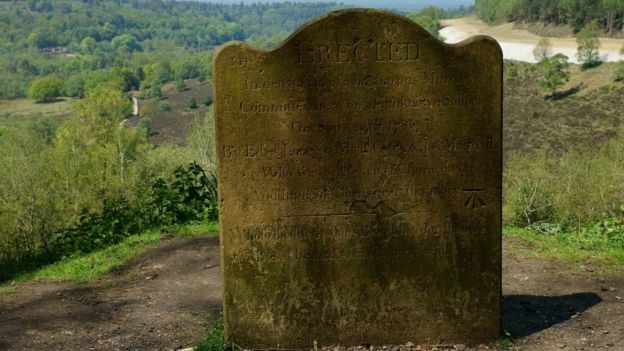
One murder stone has been immortalised by no less a writer than Charles Dickens himself. In the novel Nicholas Nickleby, the eponymous hero walks through the ominously named Devil’s Punch Bowl at Hindhead in Surrey.
Image copyrightPETER TRIMMING/GEOGRAPHImage captionThe murder stone at the Devil’s Punchbowl, Surrey, features in Charles Dickens’ Nicholas Nickleby
There, he and his companion come across the real-life stone marking the 1786 murder of a man known only as the Unknown Sailor.
The unnamed man was en route to his ship in Portsmouth when he visited a local pub in Thursley. There he fell in with three fellow sailors, and paid for their drinks and food before leaving with them.
The sailor was repaid for his generosity in the following way: They “nearly severed his head from his body, stripped him quite naked and threw him into a valley”.
The three did not get far. The sailor’s body was found soon after, and James Marshall, Michael Casey and Edward Lonegon were chased and captured after trying to sell the dead man’s clothes at a pub.
They were hanged from a triple gibbet near the murder scene, and the unknown man was buried in Thursley with a stone paid for by local people.
But the local mill owner, James Stillwell, went a step further. He placed a stone in Devil’s Punch Bowl itself, with this grim warning to future generations:
“ERECTED, In detestation of a barbarous Murder, Committed here on an unknown Sailor, On Sep, 24th 1786, By Edwd. Lonegon, Mich. Casey & Jas. Marshall
“Who were all taken the same day, And hung in Chains near this place, Whoso sheddeth Man’s Blood by Man shall his, Blood be shed. Gen Chap 9 Ver 6”
Dr Bondeson said the majority of the stones appeared around the 1820s, adding “That was the high level for the erecting of murder stones. All of them are in the country – none are in urban areas.”
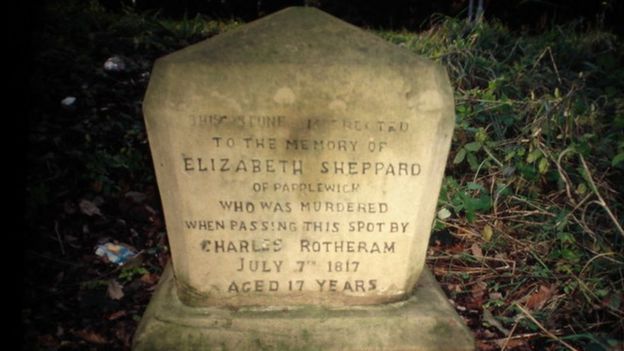
Image copyrightDEBORAH MCDONALD/GEOGRAPHImage captionBessie Sheppard was murdered on her way home after going to look for work
Elizabeth – Bessie – Sheppard was just 17 when she set out from her home in Papplewick, Nottingham, on 7 July 1817, to seek work as a servant in Mansfield, seven miles away. She found a job, but she never found her way back home, because on her return journey, a travelling knife grinder found her.
Charles Rotherham, a man in his early 30s, had served as a soldier in the Napoleonic wars for 12 years before beginning this new stage in his life.
He was seen on the road coming from Mansfield after drinking several pints where his path crossed Bessie’s.
Her severely battered body was found in a ditch by quarrymen the next day. Her shoes and distinctive yellow umbrella were missing and there was evidence her attacker had tried to remove her dress but had failed.
Rotherham had sold Bessie’s shoes and was on his way to Loughborough when he was arrested. He confessed to the crime and was returned to the scene where he showed a constable the hedge stake he had used to kill Bessie.
Like all murderers at the time, Rotherham swung for his crime. Local people, outraged by the attack, banded together to raise money for a stone to commemorate Bessie, which was placed on the site where she was attacked.
Bessie’s stone simply honours the memory of the dead girl, but another stone erected to a female victim of violence has more of a moral tone, seemingly warning women against certain behaviour as much as expressing anger with the killer.
“As a warning to Female Virtue, and a humble Monument to Female Chastity: this Stone marks the Grave of MARY ASHFORD, who, in the twentieth year of her age, having incautiously repaired to a scene of amusement, without proper protection, was brutally violated and murdered on the 27th of May, 1817.”
The story behind Mary Ashford’s death and its aftermath is one which left a permanent mark on English legal history.
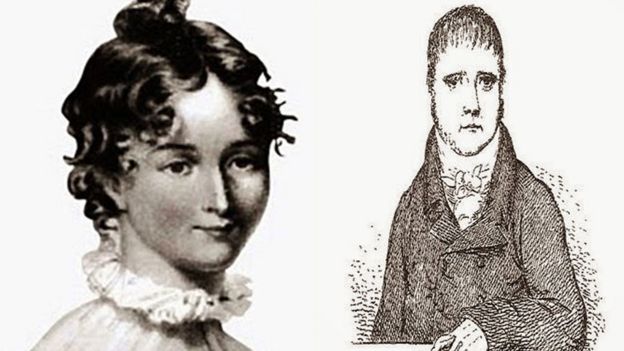
Mary Ashford and the man accused of her murder, Abraham Thornton
She had gone to a dance in Erdington, Birmingham, with her friend Hannah Cox, whom she planned to stay with overnight before returning to her place of work at her uncle’s house in a neighbouring village.
At the dance, she met a local landowner’s son, Abraham Thornton, and later reports confirmed the pair spent most of the night dancing together and having fun.
When they left the dance, Mary told her friend she would spend the night at her grandparents’ home – possibly a ploy to spend more time with Thornton – and Mary and he went off together.
Mary returned to Hannah’s house at 4am, changed her dancing clothes for her working clothes, collected some parcels and set out for her uncle’s home.
About two hours later a labourer found a bundle of clothing and parcels on the path leading to Mary’s home. The alarm was raised and her body was found submerged in a water-filled pit.
An autopsy showed she had drowned and had been raped shortly before her death.
People believed Thornton, having been rebuffed by Mary during their hours together, had lain in wait for her to return home and raped her before throwing her into the pit to drown.
He was duly arrested and tried, but a number of witnesses placed him at another location at the time of Mary’s death and he was acquitted.
But the story does not end there. Mary’s brother William Ashford began a private prosecution under an obscure ancient law, which allowed relatives of murder victims to bring an “appeal of murder” following an acquittal.
Thornton had a surprise up his sleeve though. In response, he demanded a trial by combat as was his right under that law, under which he could legally have killed Ashford, or if he defeated him, gone free.
Ashford was much smaller than Thornton, and declined the battle. Thornton was a free man, and the case was swiftly followed by a change in the law in 1819, banning such appeals and therefore trial by battle.
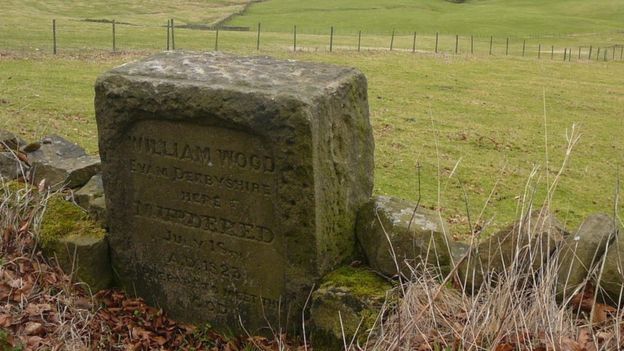
Image copyrightCOLIN PARK/GEOGRAPHImage captionThis murder stone at Disley in Cheshire commemorating William Wood was erected 50 years after the crime
Other victims include:
William Wood, of Eyam, Derbyshire, murdered by three men who robbed him of £100 in 1823 – his head was “beaten in the most dreadful manner possible”. Two men were caught, one escaped justice. A permanent memorial was erected over 50 years after the crime after earlier versions were destroyed or removed, which showed the strength of feeling still present in the community about the murder.
Father and son William and Thomas Bradbury, who were brutally attacked in William’s pub The Cherry Arms, known as Bill O’Jacks locally, on 2 April 1832 in Greenfield, Saddleworth. Their unsolved killings were recorded on a stone which noted their “dreadfully bruised and lacerated bodies”.
The Marshall family – the “special horror”, as noted in The Spectator at the time, of the Denham murders in Buckinghamshire, where a family of seven including three young girls were beaten to death at their home attached to their father’s blacksmith’s premises. The youngest, Gertrude, four, was found still clutched in her grandmother Mary Marshall’s arms. Killer John Jones was found a few days after the killings on 22 May 1870 and speedily tried and executed. They are buried in one grave in St Mary’s Church, Denham, where the original worn murder stone has been supplemented by a modern plaque to remember the victims.
The last word goes to those who chose to commemorate Nicholas Carter, a 55-year-old farmer from Bedale, Yorkshire, killed by a farm labourer as he rode home from market.
The stone laid at the murder site in Akebar – later to become a Grade II listed monument which hit the headlines earlier this year when it was badly broken in a car crash – had a very simple message, along with the date of his death, May 19, 1826.
On a recent visit to Brompton Cemetery to research animals on memorials my companion and I decided to explore a side path to find examples. On a corner where it met another side path we suddenly saw a very large gathering of crows perched on various tombstones, graves and memorials. There were so many that passers-by were stopping to look and take photos. My photo doesn’t do the scene justice as I couldn’t fit all the crows that were actually there in the picture.
Brompton’s crows have always been known for their photogenic and obliging qualities by posing on a nearby tombstone in suitably Gothic fashion but I’ve never seen that many gathered together in one place.
A group of crows is known as ‘a murder of crows’ and it only takes 2 crows to make one of these.
The phrase however, appears to date from the late Middle Ages and comes from the Book of Saint Albans or The Book of Hawking, Hunting and Blasing of Arms, which was published in 1486. This is a compendium of items for gentlemen of the time and had an appendix which consisted of a large list of collective nouns for animals. These were known as ‘company terms’ or the’ terms of hunting’. These include familiar ones such as ‘a gaggle of geese’ amongst other colourful and poetic names such as ‘a skulk of foxes’ or ‘an ostentation of peacocks’. There were also collective nouns for various professions such as ‘a melody of harpers’ etc. The ones that have survived to this day derive from this book include ‘a subtlety of sergeants’ and also ‘a murder of crows’. A crow gathering has often been the subject of folk tales and superstition and amongst these is the claim that crows will gather and decide the fate of another crow.
There are also other traditions, which considering that this was happening within a large London cemetery, are worth quoting ,
‘Many view the appearance of crows as an omen of death because ravens and crows are scavengers and are generally associated with dead bodies, battlefields, and cemeteries, and they’re thought to circle in large numbers above sites where animals or people are expected to soon die.’
Romain Bouchard, Etymology nerd
However, there are birdwatchers who insist that a group of crows should be known as a flock of crows and not a ‘murder’ so the jury’s out on that term.
A Facebook friend identified some of the crows as juveniles by the white patches on their breasts who may have just left the nest and are with their parents. The adults will defend their youngsters very aggressively. Crows are very social, live in tight knit families and they mate for life. They can roost in huge numbers of up to 1000+ as protection from other predators. Crows are also highly intelligent and have a repertoire of at least 250 different calls. A distress call will bring other crows to their aid as crows will defend other unrelated crows. A crow’s black plumage have led to them being associated with death and they are members of the Corvidae family which includes magpies and ravens. They are predators and scavengers and will eat virtually anything including roadkill, snakes, mice, eggs and nestlings of other birds amongst other delicacies. I often see crows inspecting the contents of large waste bins at supermarkets or communal litter bins and have seen them take young ducklings in a flash.
A couple of minutes after I took this photo the entire gathering took flight and scattered and I felt very privileged to have seen it at all.
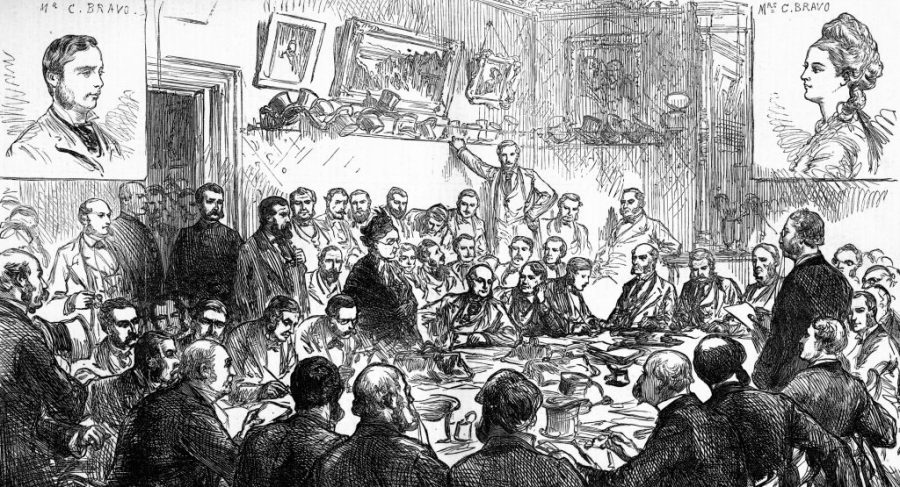
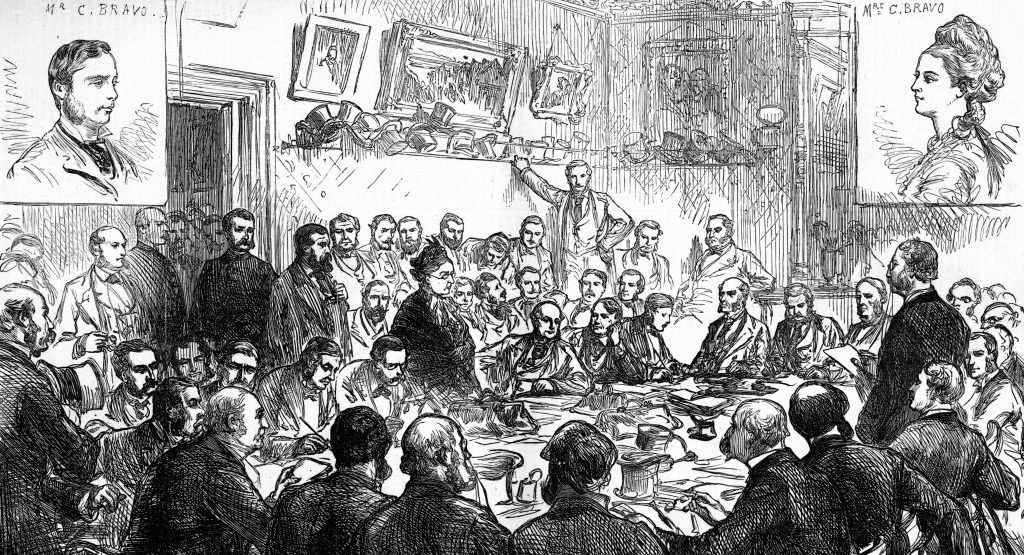
The second inquest began on 11 July 1876 and lasted 5 weeks. It was a public sensation and finally ended Florence’s doomed attempt to regain her place in respectable society. Only men and boys were allowed into the inquest as the details revealed were considered to be so shocking.
Both Florence and Mrs Cox spoke of Bravo’s controlling and bullying nature which was countered by family and friends who described him as good-natured and happy.
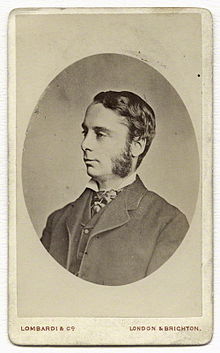
Charles Delaunay Turner Bravo Carte de Visite 1876 National Portrait Gallery, Lombardi Sahed under Wiko Creative Commons Attribute Share Alike 3.0
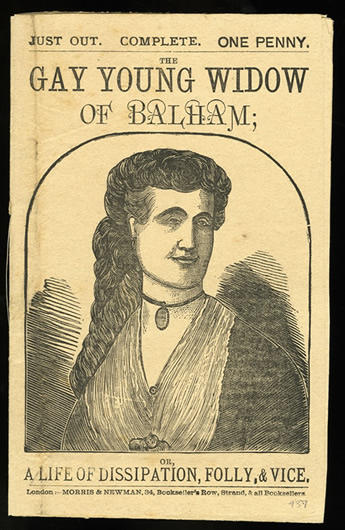
The affair between Florence and Dr Gully became public knowledge because of the inquest and the papers of the day revelled in it while ostensibly taking a moral high ground. The fact that she had enjoyed it and that it had been common knowledge throughout the area enraged the public and she was soon being pilloried. Much was made of its adulterous nature and the disparity in their ages – he was 67 to her 25. The Times dubbed Gully as her ‘lean and senile seducer’ whereas in fact he was described as being charismatic with Charles Darwin calling him ‘a friend.’ He was quickly discounted as a suspect as he had not been anywhere near the scene at the time.
Florence was questioned repeatedly about the affair until she finally broke down and tried to demand that the Coroner protect her from what she called ‘the impertinent’ cross examining.
‘I refuse to answer any more questions about Dr Gully!’ she shouted at one point to Joseph Bravo’s solicitor. ‘This inquiry is about the death of my husband and I appeal to the jury as men and Britons to protect me.’
Dr James Manby Gully ”Hydropathy’ cartoon in style of Spy from Vanity Fair 1876. Shared under Wiki Creative Commons Attribution 2.0 Generic
Dr Gully described the persistent questioning as ‘a gross impertinence’ and publicly denied any involvement or knowledge of Charles’ murder. Gully was now looking at the very likely destruction of all that he had built up – his good name, his practice and his clientele. The novelist George Eliot, who had been one of his patients, had described him as a ‘quack’. But Gully was very advanced for his time in his use of mesmerism to induce sleep and clairvoyance to diagnose internal conditions. These ideas may seem a little quaint to us today, as X-rays replaced clairvoyance, but they did indicate the way in which medicine might go. He had had a huge practice at Malvern between 1842-1871 but the inquest ruined him.
Joseph Bravo’s solicitor attempted to salvage Charles’ reputation by trying to prove that he had known nothing of Florence and Gully’s affair when he had married. Otherwise he would have been revealed as a mere fortune hunter who saw a wealthy widow with a dubious reputation as easy prey. But to no avail – Florence’s pre-nuptial confession proved otherwise.
The Times, somewhat sanctimoniously, declared the affair as ‘the most disgusting exhibition to have been witnessed in this generation.’ It was as if Florence and Gully were on trial and that Charles’ murder was a sideshow.
But the inquest was against the background of the role of women in Victorian society and Florence had been a rebel. At the time women had no rights and were expected to be only domestic goddesses; sexless, devoted to others and with no other outlets in their lives. However, thinkers such as William Acton thought differently and Gully himself saw womens neuroses as an unconscious response to the pressures of their lives and wrote ‘all these pressures are worsened by their boredom and lack of sexual satisfaction.’ This was very advanced for the time.
Florence, by contrast, ran her own household and managed her own financial affairs. She was independent of her parents and so could make choices which might have been denied to other women. She had been estranged from them when she left Ricardo and during her affair with Gully and seemed willing to accept this as the price of having her own life. However, her desire to be accepted into society again via marriage to Bravo was to bring about her downfall.
Middle-class Victorian women were fascinated by the sensational murder trials of the day and there were several prominent cases featuring wives who were accused of murdering their husbands or lovers – for example, Adelaide Bartlett, Madeline Smith and Florence Maybrick. They saw their own situations reflected in these women who had been driven to take action to take control of their lives.
At the end of the inquest the jury’s verdict was:
‘We find that Charles Delaunay Turner Bravo did not commit suicide, that he did not meet his death of misadventure, that he was wilfully murdered by the administration of tartar emetic. But there is insufficient evidence to fix the guilt upon any person or persons.’
The jury were all male and may have thought that a woman couldn’t be a murderess or there just wasn’t enough hard evidence to enable them to point the finger at anyone. No-one was ever charged with Charles Bravo’s murder although there has been much speculation even to this day.
Aftermath:
Florence sold the Priory and parted with Mrs Cox. She died less than 2 years later at Southsea where she was living under the name of Florence Turner. She died of alcoholism although the verdict at her inquest was ‘Death by Misadventure’. Florence’s exact burial place at Challow is unknown.
Florence’s family of wealthy Scottish landowners were utterly ruined, both financially and socially, by the scandal.
Mrs Cox died in 1913 aged 90 from ‘exhaustion’. She returned to Jamaica after inheriting an estate and properties there valued at £7000 which was a large sum at the time. She returned to England and was buried in Hither Green Cemetery. However, her grave is unmarked although the plot is registered. She had received death threats during the second inquest so maybe someone thought that she knew more than she was saying.
Dr Gully survived Florence by 5 years and died on 5 March 1883. He stayed in Orwell Lodge near the Priory with his unmarried sisters. But Susanna, his daughter, refused to have anything more to do with him. The Malvern Clinic closed in 1913 and is now a hotel. Dr Gully’s grave location is unknown as he was buried in secret.
Mrs Bravo supervised the building of a large stone surround over Charles’ grave at West Norwood and died a year later of grief.
Griffiths the coachman was quickly discounted as a suspect and faded from events.
Now only Charles himself still has a tangible reminder of this case which continues to fascinate. But the inscription is now almost unreadable and, from the path, appears blank. It’s as if everyone involved with the case just wanted to vanish from the world, such was the scandal, and eventually even Bravo’s stone may vanish into thick, encroaching vegetation or fall by subsidence leaving no reminder of him.
My own theory is the one proposed by Professor Mary Hartman in which she proposes that Bravo’s death was a tragic accident. Florence was recovering from a second miscarriage and a third pregnancy could have killed her. Charles, however, wanted to resume marital relations as soon as possible as he wanted an heir and this determination does indicate a ruthless streak in him. Florence knew where the antimony was kept and may have slipped it into his water jug to make him unwell so as to avoid having sex with him. Unfortunately on this occasion she got the dosage wrong as 3-4 grains were sufficient to make him ill and he’d taken 30-40 grams which was 10 times the lethal dose. It was noted that Florence seemed extremely agitated on the night of 18 April 1876 as events unfolded – did she suddenly realise what she’d done? 9 years later Adelaide Bartlett used chloroform to avoid conjugal relations with her husband and it may have been a common method employed by wives but not usually with such lethal results.
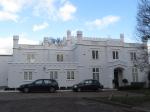
I visited The Priory prior to writing this post and in Florence’s time it must have appeared very imposing. At the time of Bravo’s murder it would have been surrounded by fields and on its own plot but now it seemed to be almost cowering between the newer houses and car parking that have sprung up around it and the unappealing line of large rubbish bins lined up in front of it. The Priory’s white walls and battlements contrasted with the blue sky as I tried to imagine the chaos and terror on that April night in 1876 as Bravo lay there, dying in extreme pain, in the shadowy candlelit rooms.
It was a tragic event for all concerned and one can only hope that they all now rest in peace.
This now almost illegible tombstone is the only visible reminder of one of the most notorious and still unsolved murder cases of the 19th century. It ruined reputations, destroyed great families and most of the chief suspects lie in unknown, unmarked graves such was the shame in being connected with it.
It’s the last resting place of Charles Delaunay Turner Bravo who died of antimony poisoning on 21 April 1876 aged 30. It took him nearly 3 days to die an agonising death as the poison was so lethal. The memorial was erected by his sorrowing mother who died a year later of grief. I first saw it on a guided tour of West Norwood when the guide indicated it and mentioned the name. It’s now set back from the path and jostles for space with the other memorials and monuments that have grown up around it as if hiding it. In fact I had to wait until the winter die-back to be able to avoid the clinging embrace of long barbed tentacles of brambles and have a closer look. I could just about see his name on the memorial but the stone surround that was originally around it has long since collapsed.
This is the story of one of the notorious cases of the 19th century set against a background of money, womens rights or lack of them, and society’s punishment for those who transgress the rules.
It began on the night of 18 April 1876 after the Bravo household had retired for the night at the Priory on Bedford Hill near Balham. At this time it was surrounded by fields and all would have been quiet. Suddenly the night was disturbed by Charles Bravo, the head of the household, shouting ‘Florence! Florence! Hot water! Hot water!’ before collapsing and vomiting. 2 doctors were then called to the scene and so events began. He had, as was his custom, drank water from his jug before retiring but on this night someone had added 30-40 grains of antimony, a deadly poison which is derived from tartar emetic. Antimony has no taste in water and is an unusual method of killing someone. It began by eating its way its way through his intestines which virtually disintegrated and his stomach. After 3 days his central nervous system began to fail and Bravo knew that he was dying. He managed to make a will in his wife, Florence’s favour which was witnessed by one of the doctors and the butler before being pronounced dead at 5.20am on 21 April.
It was a long and painful death and the post-mortem gave the cause of death as ‘heart failure from the effect of the poison on his central nervous system’. Incredibly it was first considered to be a suicide but I would have thought that there are far less painful methods. However the police soon decided that it was murder and soon began looking for suspects. These were:
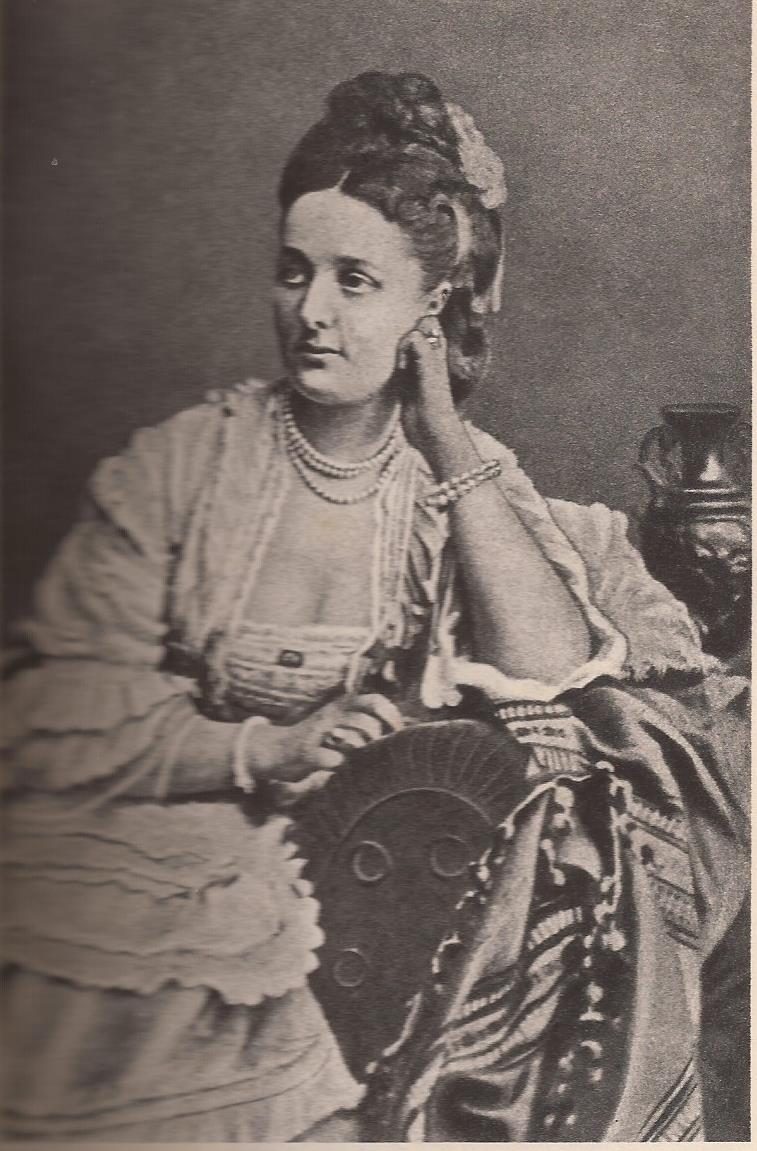
A contemporary photo of Florence Bravo. (source unknown)
Florence his widow: She and Charles had married on 7 December 1875 at All Saints Church Kensington and it has been rumoured that she may have already been pregnant as the marriage was brought forward and she had a miscarriage very shortly afterwards. It hadn’t been a happy marriage as she had already fled to her parents after 3 months alleging domestic abuse. She had had quite a colourful and somewhat provocative life prior to her marriage. Florence had been widowed before after her first husband, Captain Alexander Ricardo died in a Cologne hotel room of alcoholism in 1871 after 6 years of marriage. She had persuaded him to give up his Army career and he struggled to establish another one before taking to the bottle. However he left her £40,000 which was a huge sum when the average working man earned £30 p.a.
Unusually for the time, she was now an independently wealthy woman and soon established her own household at The Priory. She met Dr James Manby Gully when she took the ‘water-cure’ at his hydrotherapy clinic in Malvern. He had known her family for over 30 years and was the celebrity doctor of his day with several famous clients including Tennyson. He was in a miserable second marriage to a Mrs Kibble who was 17 years older than him and from whom he was legally separated. Nevertheless he and Florence embarked on a scandalous affair which made them notorious throughout the neighbourhood. Gully took a house on Bedford Hill Road, Orwell Lodge, which was conveniently near The Priory for secret trysts. As a result Florence was ostracised by local society as people refused to call. However she considered Gully to be ‘the cleverest man I have ever met.’ But she still yearned to be part of society again and after Gully performed an abortion on her the affair ended.
The only way that she could be admitted back into society and be reconciled with her parents was through marriage. She and Charles were introduced by Mrs Cox, her companion who knew his family. There has been a suggestion that he was a fortune hunter and certainly no gentleman would have considered marrying someone with her reputation. It was a marriage that proved to be a disaster.
Mrs Jane Cox Florence’s lady’s companion at the inquest. (Source unknown)
Mrs Jane Cox – She was a widow with 3 young sons at school and was employed by Florence as her ‘lady’s companion’ at The Priory. Mrs Cox had married in Jamaica and had returned to England after her husband had died. She had been privy to Gully and Florence’s affair and local shopkeepers had refused to serve her. She had jet black hair and an olive coloured complexion which had led to rumours that she had ‘coloured blood.’ She was facing dismissal by Bravo who was on a mission to reduce household expenses and she was poor to say the least. She didn’t want to be unemployed and destitute. There was also her behaviour during Bravo’s protracted death agonies. She told one doctor that he had swallowed chloroform whereas Bravo recovered consciousness long enough to refute this and instead claimed that he’d taken laudanum due to pain in his lower jaw. Mrs Cox then confused matters more when she told the second doctor, Harrison Royes Bell, that Bravo had also told her that ‘I have taken poison don’t tell Florence.’ One wonders if Bravo was in any fit state to confide this and it sounds as if Mrs Cox was trying to create a cover-up. She had also received a bottle clearly marked ‘Poison’ from Dr Gully after he’d vowed never to speak to her again.
Griffiths – the coachman – He had already been dismissed by Bravo two weeks before the wedding and as a result had lost his tied cottage. Griffiths had been heard making drunken threats in the Bedford Hotel on Bedford Hill in which he claimed that Bravo would be dead within a few months. He kept antimony in the coach house to which the entire household had access. A series of very insulting anonymous letters were received at The Priory over Christmas in which Charles was accused of being a fortune hunter and these stopped after Griffiths took a job in Kent.
Dr James Manby Gully (source unknown)
Dr James Manby Gully: He was never a serious suspect although if Bravo had died then perhaps his affair with Florence could resume. He publicly denied any involvement in the murder.
And what of Charles Bravo himself?
Charles Bravo (source unknown)
He was born in 1845 and was the only son of Augustus and Mary Turner. Augustus died when Charles was small and Mary married a wealthy merchant, Joseph Bravo, who was 15 years older than her. He’d made his money from fruit and tobacco and was well-off. After studying at Kings College, London Charles was called to the bar in 1868 and took on his stepfather’s surname when he was 23. But he wasn’t well off and was merely ‘jogging along’ on £200 p.a. This wasn’t the life that he craved.
Both he and Florence had something that the other wanted – she had money and he could give her respectability. Florence confessed all of her affair with Dr Gully pre-marraige and Charles admitted that he had supported a woman who had had his child in Maidenhead for 5 years.
But money was already an issue between them prior to marriage as Florence had invoked the right to keep her fortune after marriage. Until 1870 this would automatically have gone to Bravo but now women could keep any assets they brought into the marriage as long as a legal settlement confirming their intention to do so had been ratified in court prior before the union had taken place.
When Charles discovered this he had threatened not to go through with the marriage so she compromised by giving him The Priory’s lease and its furnishings, make her will in his favour and in return she would retain control of her money. Already he seemed to be after her money and displaying his domineering, ruthless side. However Bravo was determined to be in charge and decided to reduce household expenses by dismissing staff which Florence hated. It was also a subtle way of controlling her by getting rid of a support like Mrs Cox and her horses which she loved.
The first inquest was held on 28 April 1876 and concluded that Charles had died from the effects of poisoning but did not know who administered it. This was considered unsatisfactory. The stage was now set for the second 5 week public inquest which would change the lives of Florence, Dr Gully and Mrs Cox forever.












 shadows fly away