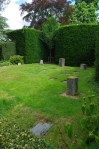
The pet cemetery of Lamb House, Rye, April 2025

View of Lamb House pets cemetery © Carole Tyrrell

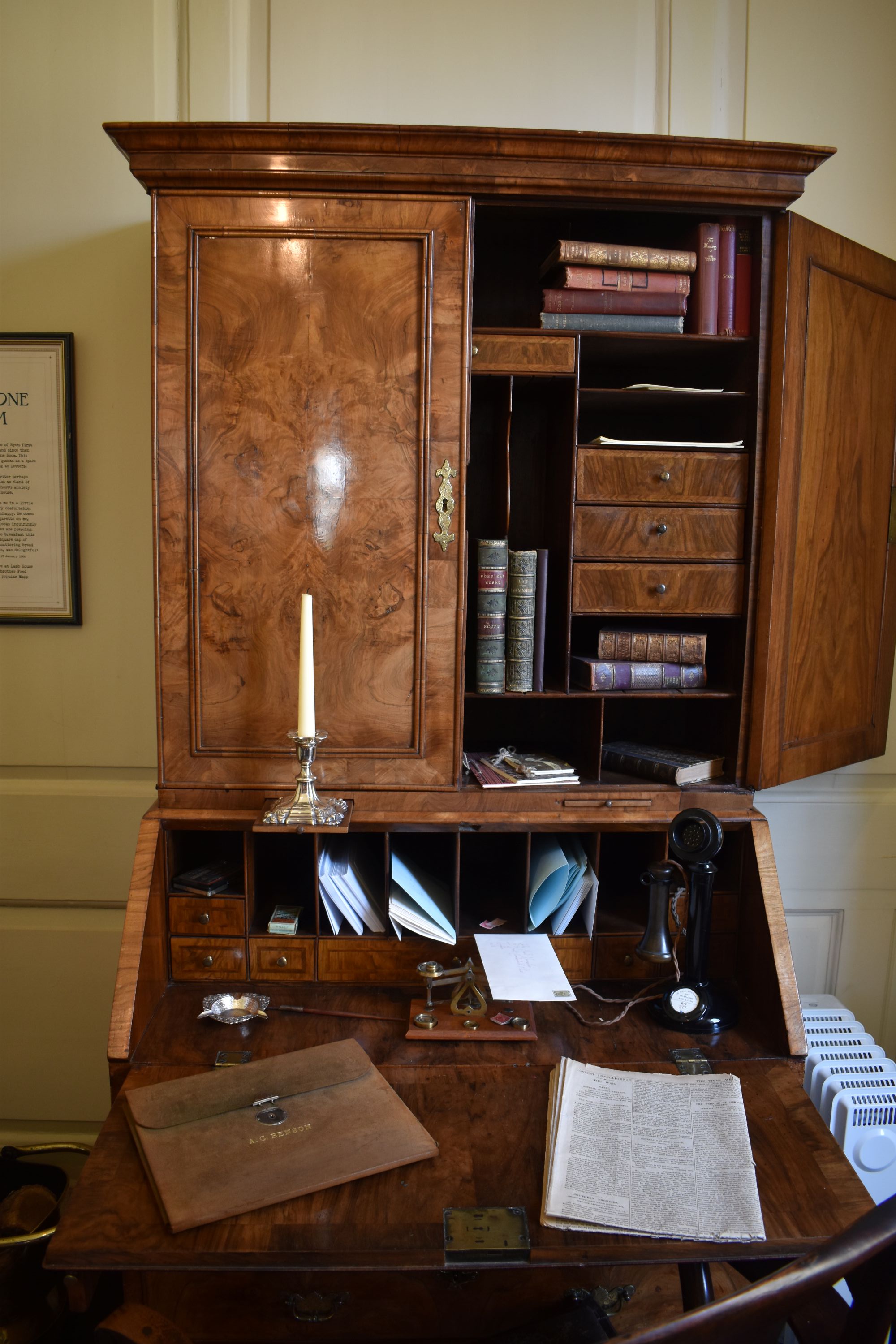
In April, I was on a literary weekend in Sussex and Kent. We made the town of Rye our base. The town has a rich literary tradition with several famous writers having lived there.  Several of them were lucky enough to live at Lamb House, a red brick Georgian house with spacious rooms and a garden that was just beginning to take shape on my visit. Neatly labelled rows of vegetable seedlings gave an indication of what was to come later in the year. There is a magnificent view of St Mary’s church from an upper window and Henry James is commemorated with his writing desk and ‘The Telephone Room’. I love finding pet cemeteries as I find them fascinating and touching.
© Carole Tyrrell

Lamb House is now owned by the National Trust and when I last visited over 20 years ago, it looked very different. There was an upstairs tenant – lucky them! Now the upstairs rooms have been opened to visitors and on my visit there was an exhibition, ‘Ghost Written’, which featured the house’s most well known writers through their ghost stories.

Lamb House Rye Shared under Wiki Commons © Jerrye & Roy Klotz, MD

The American writer, Henry James, (1843-1916) wrote three of his most famous books at Lamb House:  ‘The Wings of the Dove’, ‘The Ambassadors’ and ‘The Golden Bowl’. He discovered Lamb House while visiting a friend and instantly fell in love with it. He leased it in 1897 and, two years later, he finally bought it.

The house appears in his novel, ‘The Awkward Age’, where it is Mr Longdon’s home. During James’s time there a literary circle came into being that included Rudyard Kipling and H G Wells amongst others. In 1916, James was very ill in London and wanted to be taken back to Lamb House but he was too ill to be moved.

He was followed by E F Benson (Edward Frederic) Benson (1867-1940) who is known for his Mapp and Lucia novels which are set in a fictional town called Tilling that was based on Rye. They were adapted and made into a successful TV series. I know him through his ghost stories or ‘spook stories’ as he called them. He became Mayor of Rye twice and was awarded the Freedom of Rye which was the town’s highest award. He is buried in the local cemetery on the outskirts of town.  ‘Fred’ as he was known bequeathed two colourful windows, the East and the West, in the local church, St Mary’s. 

View of Fred Benson’s monument © Carole Tyrrell

Another view of Fred Benson’s monument.© Carole Tyrrell

Other writers who lived at Lamb House were Montgomery Hyde and the prolific author of ‘Black Narcissus’, Rumer Godden.

It was in the south western corner of the garden that I found the pet cemetery which was dedicated to Henry James and Fred Benson’s pet dogs. I remembered it from my first visit where it was hidden behind vegetation.  The cemetery is a small collection of headstones. There are no cats as, although Henry James, was;

A great lover of animals he would chase them (cats) away from the garden’

National Trust guidebook

The first headstone in what James called his:

‘domestic mortuary’

was dedicated to Tosca, his black and tan terrier who died in 1899.   

Tosca was followed by Tim who was another terrier, then came:

‘my admirable little Peter’

Then there was another terrier, Nick.  But James’s heart was undoubtedly given to Maximilian or Max, a red dachshund. According to his owner Max had

‘a pedigree as long as Remington Ribbon.’

He also described Max as:

‘the gentlest and most reasonable and well mannered as well as most beautiful small animal of his kind to be easily come across.’

Max loved being taken on long walks but, due to his love of chasing sheep, had to be kept on a long leash. 

Henry was very upset at having to leave Max behind when he went on an  extended trip to the US.  He wrote to his lodgers of his homesickness and how much harder it was when thinking of:

‘poor sweet pawing little Max.’

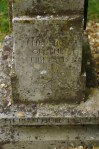
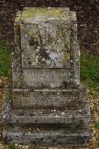
© Carole Tyrrell

© Carole Tyrrell

© Carole Tyrrell

Fred Benson also adored dogs and his favourite was a collie called Taffy. This is a photo of them together and Taffy is also commemorated in the East Window of St Mary’s church.

From the exhibition, ‘Ghostwritten’ at Lamb House
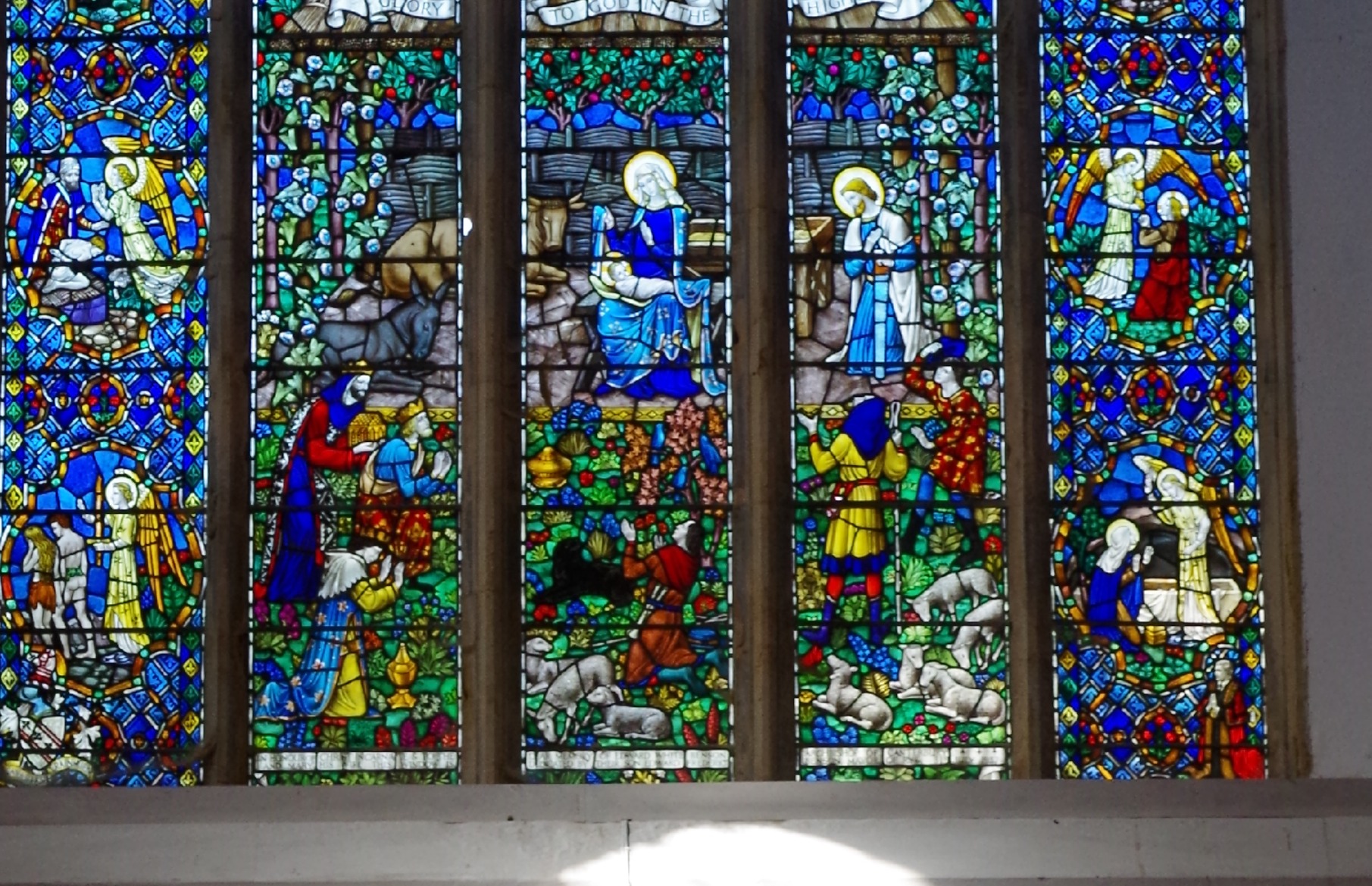
Taffy is the black dog in the lower part of the window, East window, St Mary’s, Rye. © Carole Tyrrell

© Carole Tyrrell

Rumer Godden loved Pekingese dogs and she owned several throughout her life.

I didn’t recall the pet cemetery being so large but the Trust’s intention is to recreate the garden so that it resembles

‘ the space that delighted and inspired Henry James and Fred Benson’

National Trust guidebook

I found the little cemetery with its little plain, simple stones very touching and a poignant reminder that these much loved pets were not forgotten.  And as I read the names on the stones they seemed to come alive again racing around the garden at play.

©Text and photos Carole Tyrrell unless otherwise stated.

References and further reading

National Trust guidebook

Lamb House, Rye | History & Photos

Lamb House – Wikipedia

A wandering ghost and a memorial to a favourite deer – Crawford Priory, Cupar, Fife

Crawford Priory in ruin shared via Wiki Creative Commons
©David Kelly

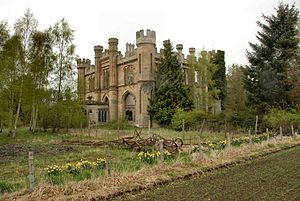
On windy nights, the derelict and romantic ruin that is Crawford Priory is reputed to have a familiar visitor.  A wandering spirit walks through the estate which she once owned accompanied by a retinue of the per animals that she knew and loved.  This is the ghost of Lady Mary Lindsay Crawford who is rumoured to walk the grounds when the wind is high.

Is she keeping a watch on the crumbling building or her crypt which is a mile away.  Or does she see the Priory as it once was with its fine furnishings and decoration and a butler opening the front door to visitors as she, smiling,  descends the sweeping staircase to meet them?

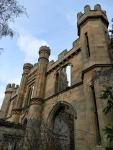
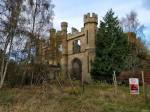
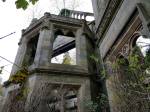
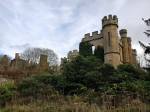
Deep in the Fife countryside lies the shell of a derelict, once grand country house.  For over 25 years it has been abandoned to nature which is fast obscuring it from memory and the world.  Ivy and saplings have thrust their way through broken windows and doors and a fire in 1995 was the final indignity. In 1997 its current owner applied to have it demolished but it may just eventually fall down by itself.

The cawing of crows or the wind whistling around what’s left of the Gothic styled Crawford Priory are the only sounds that the casual visitor will hear now.

However, it was never actually a priory and no religious order ever lived there.  But the name went with the romantic Gothic touches such as the pointed windows and the battlements and so it became one.

Lady Mary’s crypt, Crawford Priory in sad decline
©British Listed Buildings

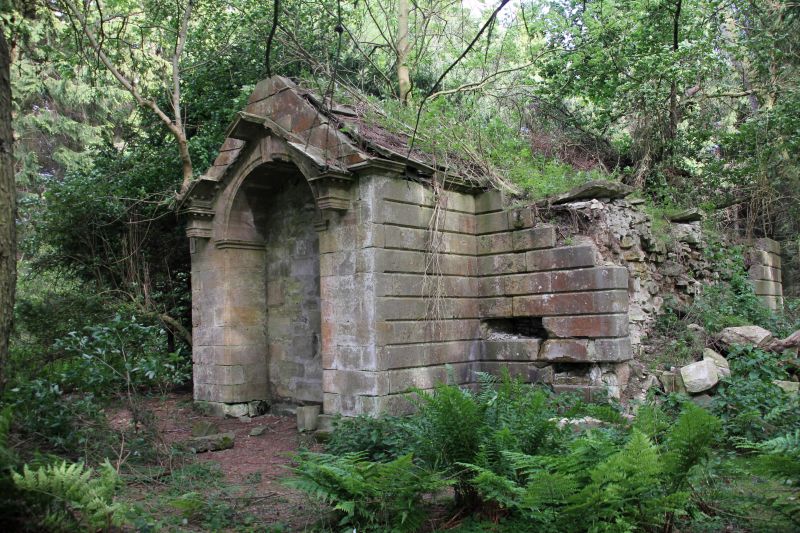
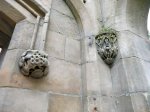
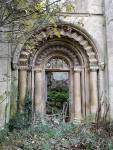
A mile away near Lady Mary’s Wood lies an equally ruinous crypt dedicated to the Priory’s creator and the last of her line, Lady Mary Lindsay Crawford. From urban explorers websites, the last great recorders and finders of the abandoned, the crypt is in no better state than the Priory.  Its door is now bricked up although a hole has been made in it and the crypt is falling in on itself. The pet cemetery is rumoured to be still there but I haven’t seen any photos of that while researching this article.

To add to the romance of the place there is also a belief that the pale wraith of Lady Mary drifts across the site as she gathers her pet animals around her.  She had the crypt built so that she would always have a good view of the Priory even in death.

I am indebted to a Facebook friend who lives in Scotland with her family. They like to go out and explore the local countryside and share their photos and adventures online.   They have been kind enough to give me permission to use their photos to illustrate this article.  Crawford Priory was a real gem as it’s the sort of place that I would like to explore myself.

Crawford Priory was originally merely a hunting lodge built by the Earl of Crawford in 1756 and then completely remodelled in the then  fashionable style in the early 1800’s. Lady Mary employed well known architects of the time to create it.  She died in 1833 and was known as a reclusive, religious woman. The pet cemetery was also created by her to remind her of her favourite animals.  They flocked to her and she was frequently attended by tame foxes, birds, dogs, cats and even a pet deer.  However, I have been unable to find any images of  Lady Mary but she must have been formidable as well as kind. There is a tombstone near the outer wall of the Priory dedicated to a pet deer which is what caught my attention and intrigued me enough to research further.

Lady Mary lived alone, except for her servants, and administered a large country estate as well as the Priory.  This included limestone kilns, coal mines and farms amongst other business interests.  This was remarkable in the 19th century for a woman alone.

This keen business sense and her managerial abilities led to Lady Mary being regarded as odd and her obituary, according to alex cochrane’s blog, considered her eccentricities as

‘lean’d to the virtue’s side for  the cause of humanity .’’

Also, according to adcochrane, a distant relative of the family, quotes from one of Lady Mary#s letters on his blog, in which she says:

‘this hall is raised under bad and awful auspices ‘

and then goes onto to describe how her dog:

‘howled in the most dreadful manner in the next room to the new building…yet in spite of its cries would not leave the dining-room’

It sounds like a page from a Gothic novel as the heroine eats her dinner at a candle-lit dining table while her dog howls and the wind picks up speed around the battlements.

Lady Mary left generous bequests to the local poor, friends, servants and her animals. The Priory then came into the possession of the Earls of Glasgow and the Cochranes   The photos on adcochrane’s blog and now in the possession of the Royal Commission on the Ancient and Historical Monuments of Scotland (rcahms for short) reveal how lavishly decorated The Priory’s interior was:

The grand hall was magnificently decorated with fan vaulting and hanging pendants; suits of armour stood under canopied gothic niches; medieval style stained glass lit the hall. The drawing room and morning room opened off a rib vaulted chamber decorated with gargoyles, both with gothic fireplaces inlayed with coloured marbles. The principal staircase…was decorated with gilded armorial panels and armorial stained glass of the Earls of Glasgow.” adcochrane

ADcochrane also goes onto recall that

‘The grand bedroom was hung with panels of wallpaper depicting the life of Psyche from the ancient Latin story by Apuleius.’

He adds that in 1990 a lot of the internal decoration was still there but now it’s all gone.  Even the sweeping staircase has finally collapsed.  To see archive photos of the Priory in its glamorous heyday please visit his blog:

https://adcochrane.wordpress.com/2014/01/06/crawford-priory-riddle-of-a-ruin/

Eventually the Priory became just too expensive to maintain like many country houses.  They usually required a retinue of servants to maintain them and after the Second World War these were in short supply. Adcochrane adds that both his godfather and cousin remembered exploring huge unused rooms and clambering about dusty piles of trunks.

In the 1960’s the Prior needed an expensive and major restoration but this never happened.   No use has been found for it since and so it was left to lie empty until it fell into its current state.

If Lady Mary does walk in her wood and the Priory grounds then one hopes that she sees the Priory as it was and not how it is now.

© Text and photos Carole Tyrrell unless otherwise stated.

References

https://www.derelictplaces.co.uk/main/rural-sites/35632-crawford-priory-revisit-scotland-october-2017-a.html

Helen Grant FB page

http://www.derelictplaces.co.uk


Lotta – the dachshund with the waggiest tail…….Knebworth House’s pet cemetery

Henna. ©Text and photos Carole Tyrrell
A poignant tribute to Henna.
©Text and photos Carole Tyrrell

As you enter the formal gardens at Knebworth, please take a moment to visit  the eternally slumbering residents of its pet cemetery which is nearby.   Although not signposted it does appear on the Knebworth map.Most stately homes have one if you know where to look and they give another insight into the lives of the owners and the animals who shared their lives however briefly.

However, although  Knebworth House has been the home of the Lytton family since the 1400’s it wasn’t until the 19th century that the family’s pets were formally interred in their own private resting place.

There are varying dates as to when the cemetery came into being.   Apparently it started in 1825. but the official Knebworth map has it as dating from 1852.  The cemetery not only contains the beloved pets of the Bulwer-Lytton family but also those of their tenants.  All are equal in the small well tended  graveyard.

But I’m sure that most visitors don’t notice it.  It nestles in front of the yew hedge which is known as the Iron Hedge.  Yew is traditionally associated with places of burial and death such as churchyards and there are supposedly many traditions associated with this.  It’s also seen as a symbol of everlasting life as yew trees have been known to live for centuries.  Most of the epitaphs are laid flat so can easily missed by the casual passer-by but a closer look reveals some marvellous memories.

As with other pet cemeteries, it’s the touching epitaphs that I find most interesting as well as the names that owners give their pets.

Beau was Edward Bulwer-Lytton’s cherished pet dog

A better view of Beau's epitaph. ©Text and photos Carole Tyrrell
A better view of Beau’s epitaph.
©Text and photos Carole Tyrrell

There is a small monument to ‘The first of the Tibetans’, Chumbi and Ruby.  It goes onto say that they were both found in the Chumbi Valley in 1929.  It also adds, sadly, that Chumbi was ‘Lost on the Great North Road 1929.’ and that Ruby ‘Died at Knebworth in 1929’.   There is also an inscription around the base of the monument.  It reads ‘May the love they had and gave help them even beyond the grave.’  Short lives but much missed.

© Text and photos Carole Tyrrell

Here is a selection of the epitaphs: