The pet cemetery of Lamb House, Rye, April 2025

View of Lamb House pets cemetery © Carole Tyrrell

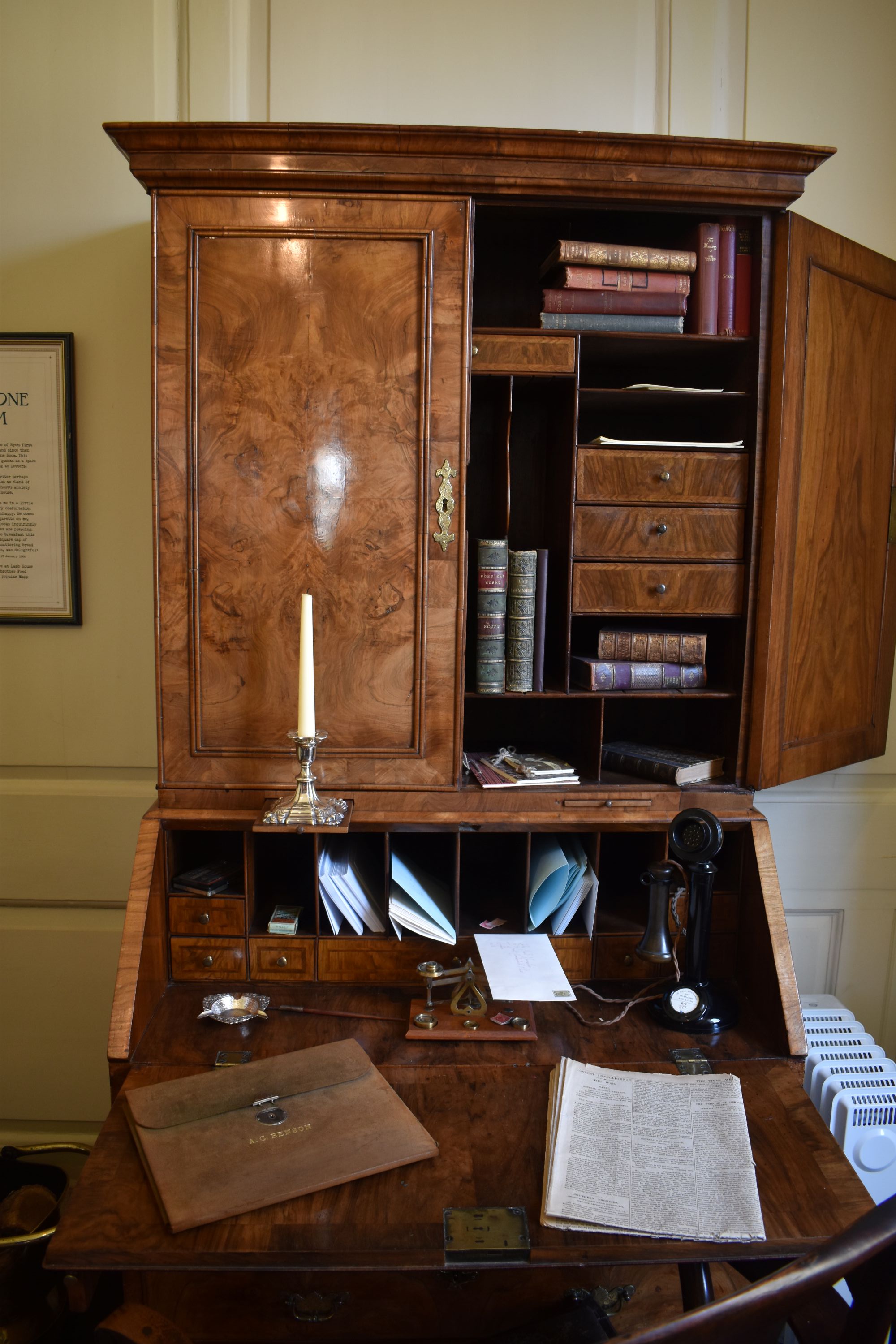
In April, I was on a literary weekend in Sussex and Kent. We made the town of Rye our base. The town has a rich literary tradition with several famous writers having lived there.  Several of them were lucky enough to live at Lamb House, a red brick Georgian house with spacious rooms and a garden that was just beginning to take shape on my visit. Neatly labelled rows of vegetable seedlings gave an indication of what was to come later in the year. There is a magnificent view of St Mary’s church from an upper window and Henry James is commemorated with his writing desk and ‘The Telephone Room’. I love finding pet cemeteries as I find them fascinating and touching.
© Carole Tyrrell

Lamb House is now owned by the National Trust and when I last visited over 20 years ago, it looked very different. There was an upstairs tenant – lucky them! Now the upstairs rooms have been opened to visitors and on my visit there was an exhibition, ‘Ghost Written’, which featured the house’s most well known writers through their ghost stories.

Lamb House Rye Shared under Wiki Commons © Jerrye & Roy Klotz, MD

The American writer, Henry James, (1843-1916) wrote three of his most famous books at Lamb House:  ‘The Wings of the Dove’, ‘The Ambassadors’ and ‘The Golden Bowl’. He discovered Lamb House while visiting a friend and instantly fell in love with it. He leased it in 1897 and, two years later, he finally bought it.

The house appears in his novel, ‘The Awkward Age’, where it is Mr Longdon’s home. During James’s time there a literary circle came into being that included Rudyard Kipling and H G Wells amongst others. In 1916, James was very ill in London and wanted to be taken back to Lamb House but he was too ill to be moved.

He was followed by E F Benson (Edward Frederic) Benson (1867-1940) who is known for his Mapp and Lucia novels which are set in a fictional town called Tilling that was based on Rye. They were adapted and made into a successful TV series. I know him through his ghost stories or ‘spook stories’ as he called them. He became Mayor of Rye twice and was awarded the Freedom of Rye which was the town’s highest award. He is buried in the local cemetery on the outskirts of town.  ‘Fred’ as he was known bequeathed two colourful windows, the East and the West, in the local church, St Mary’s. 

View of Fred Benson’s monument © Carole Tyrrell

Another view of Fred Benson’s monument.© Carole Tyrrell

Other writers who lived at Lamb House were Montgomery Hyde and the prolific author of ‘Black Narcissus’, Rumer Godden.

It was in the south western corner of the garden that I found the pet cemetery which was dedicated to Henry James and Fred Benson’s pet dogs. I remembered it from my first visit where it was hidden behind vegetation.  The cemetery is a small collection of headstones. There are no cats as, although Henry James, was;

A great lover of animals he would chase them (cats) away from the garden’

National Trust guidebook

The first headstone in what James called his:

‘domestic mortuary’

was dedicated to Tosca, his black and tan terrier who died in 1899.   

Tosca was followed by Tim who was another terrier, then came:

‘my admirable little Peter’

Then there was another terrier, Nick.  But James’s heart was undoubtedly given to Maximilian or Max, a red dachshund. According to his owner Max had

‘a pedigree as long as Remington Ribbon.’

He also described Max as:

‘the gentlest and most reasonable and well mannered as well as most beautiful small animal of his kind to be easily come across.’

Max loved being taken on long walks but, due to his love of chasing sheep, had to be kept on a long leash. 

Henry was very upset at having to leave Max behind when he went on an  extended trip to the US.  He wrote to his lodgers of his homesickness and how much harder it was when thinking of:

‘poor sweet pawing little Max.’

© Carole Tyrrell

© Carole Tyrrell

© Carole Tyrrell

Fred Benson also adored dogs and his favourite was a collie called Taffy. This is a photo of them together and Taffy is also commemorated in the East Window of St Mary’s church.

From the exhibition, ‘Ghostwritten’ at Lamb House
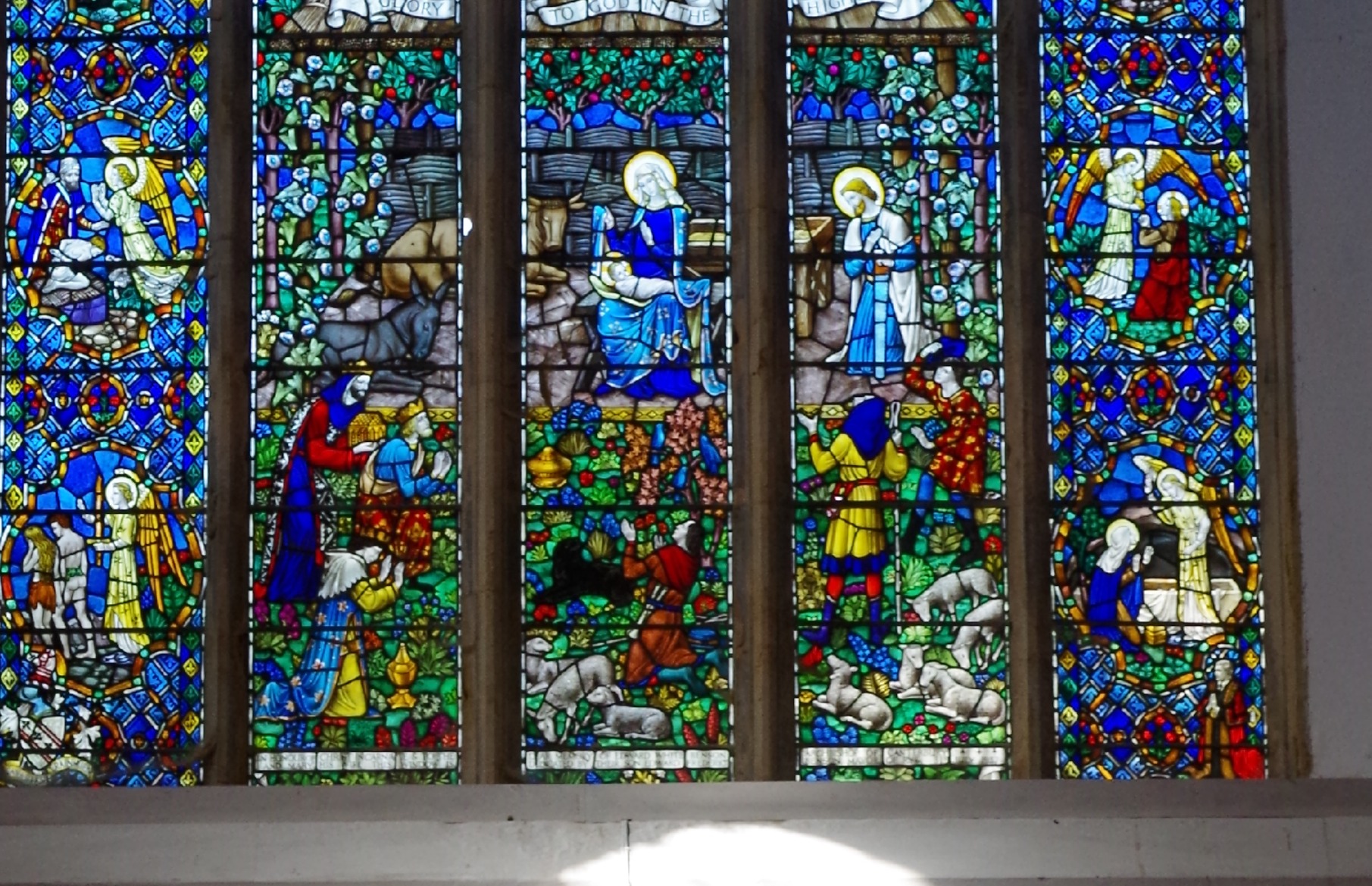
Taffy is the black dog in the lower part of the window, East window, St Mary’s, Rye. © Carole Tyrrell

© Carole Tyrrell

Rumer Godden loved Pekingese dogs and she owned several throughout her life.

I didn’t recall the pet cemetery being so large but the Trust’s intention is to recreate the garden so that it resembles

‘ the space that delighted and inspired Henry James and Fred Benson’

National Trust guidebook

I found the little cemetery with its little plain, simple stones very touching and a poignant reminder that these much loved pets were not forgotten.  And as I read the names on the stones they seemed to come alive again racing around the garden at play.

©Text and photos Carole Tyrrell unless otherwise stated.

References and further reading

National Trust guidebook
Lamb House, Rye | History & Photos

Lamb House – Wikipedia

A Margate Meander Part 1 – a visit to St John’s cemetery, Margate

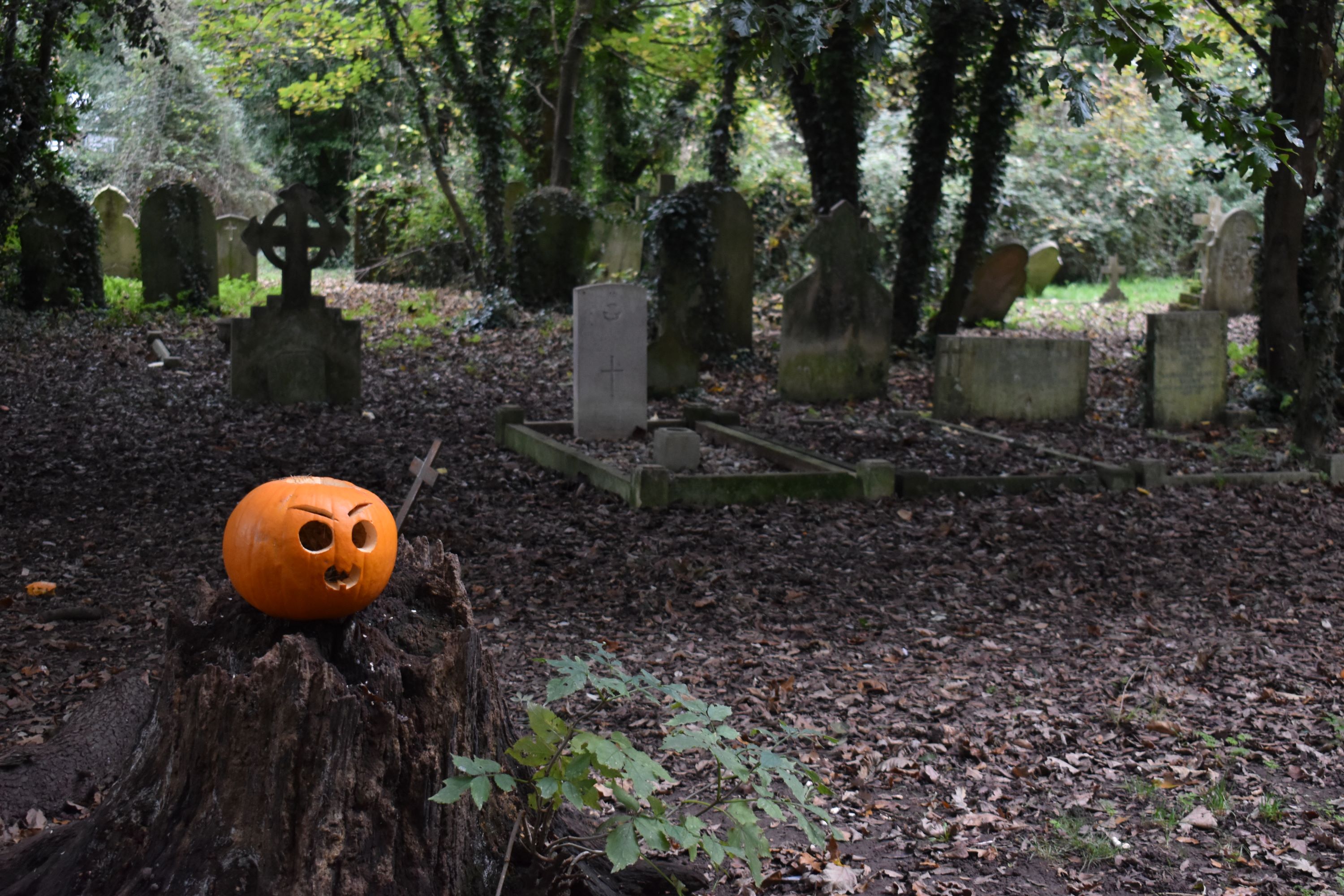
Pumpkins in Margate Cemetery. ©Carole Tyrrell

It was a dark, gloomy grey Sunday when I decided to explore the cemetery and walked up the impressive avenue of yew trees studded with bright red berries to the two cemetery chapels. But, by the entrance, I discovered a smaller building hidden behind bushes in the Gothic style of the chapels. I thought that it might have been a mortuary chapel but, on looking at the map, it may have been a more prosaic toilet block now locked up. The cemetery is officially known as St John’s cemetery and also houses a crematorium and associated gardens of rest.

Toilet or mortuary chapel? ©Carole Tyrrell

After the excitement of Halloween, people appeared to have donated their pumpkins to the local wildlife and I disturbed a squirrel scampering over one. However, although people may consider them to be a tasty treat. Forestry England doesn’t agree and suggests on their website that they be reused to make pumpkin soup or be added to compost.

Nothing prepared me for the size of the cemetery and, so far, I have been unable to discover its exact dimensions. I soon realised knew another visit or two would be necessary to explore it fully. The bright Autumn colours of the leaves were dulled by the greyness of the skies as I merrily kicked up leaves and looked for fungi. But all I could find were a couple of what I thought were parasol mushrooms lurking in the fallen leaves.

Presumed Parasol fungi in autumn leaves ©Carole Tyrrell

Autumn leaves. ©Carole Tyrrell

Placemarker of first burial ©Carole Tyrrell

The cemetery was opened in 1856 and a sign marks the place of the first burial which was a woman, Harriet Ross, on 1 November of that year. Most of the first section along the main avenue dates from the 19th century. As I neared the chapels, there was a large monument in a gap between the yew trees, set back from the path featuring an angel praying before a cross with, I assumed, a portrait of the deceased looking approvingly on. This was on the LeMair monument.

The LeMair monument ©Carole Tyrrell

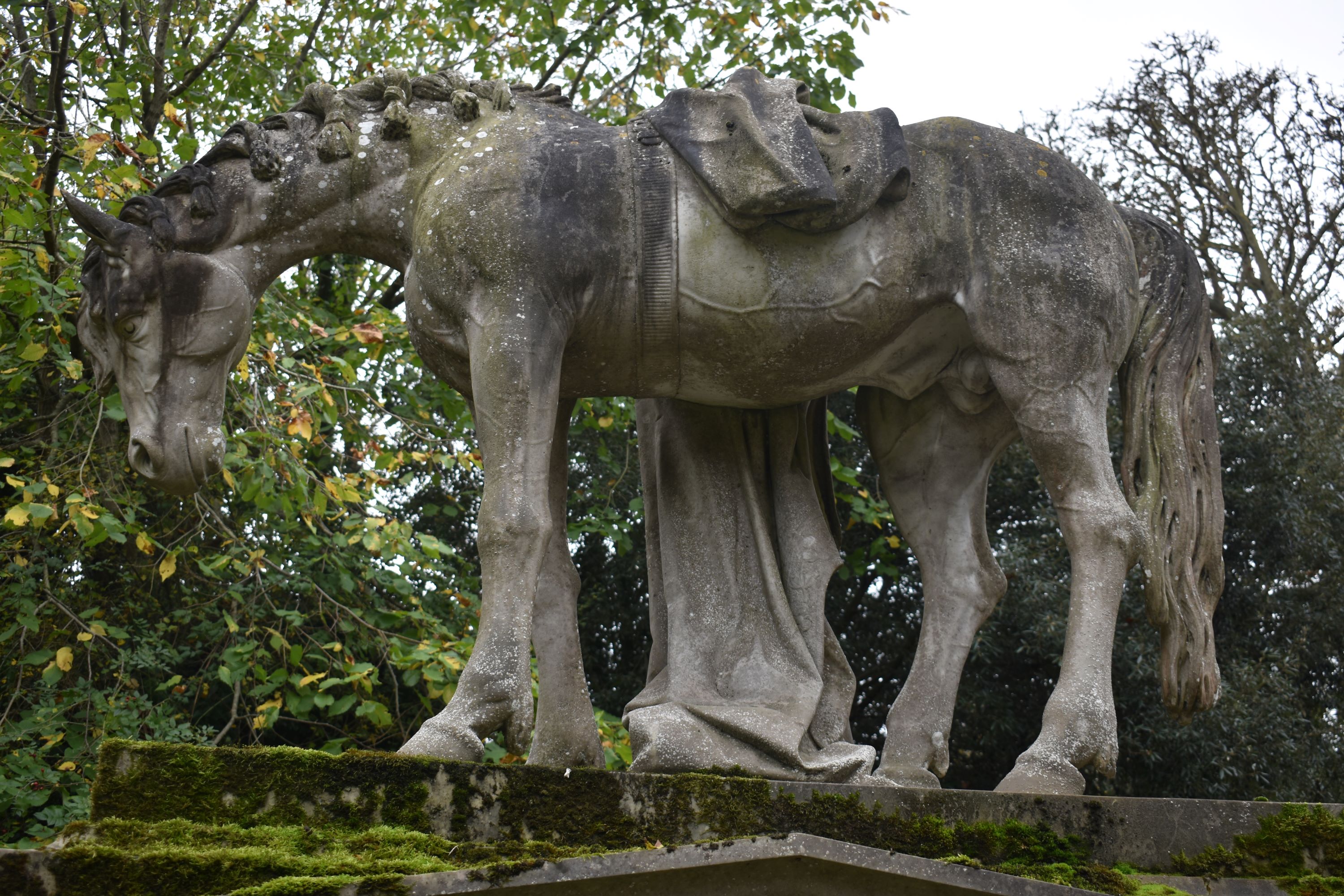
A sign announced ‘Sanger Path’, I wandered along it and came to my first surprise of the day. 4 angels forming a square, one at each corner, on the Reeve memorial. They are well sculpted with detail on the back as well. But then my eye was drawn, well I could hardly miss it, by the lifesize statue of a horse atop the Sanger monument. Beautifully sculpted, it is dedicated to a circus proprietor, John Sanger (1816-1899). He has a tenuous connection to one of my favourite Beatles songs. There is an upturned horseshoe above John Sanger’s epitaph for luck and his shows featured equestrian acts involving horses and ponies and a pantomime every Christmas. He originally went into partnership with his brother, George, but eventually they went their separate ways. George was brutally murdered in 1911 by an ex employee who then committed suicide. A photo album of George’s circus, its performers and animals came up for auction in 2017 and showed that a Victorian circus certainly was value for money! The Sanger circus appeared by royal command at Windsor Castle by Queen Victoria and they also took part in the annual extravaganzas at Crystal Palace.

The Sanger horse ©Carole Tyrrell

©Carole Tyrrell

One of George Sanger’s great granddaughters ashes are also interred in the family plot. This was Victoria Sanger Freeman (1895-1991) and she went under the sobriquet of ‘Queen of the Elephants’ with 4 of them under her charge. She was the last member of the Singer dynasty of circus performers. Beside John Sanger’s horse is another Sanger, Mary Rebecca, who married into the family. She is sandwiched between John and the Reeve ladies. She married William Sanger but I’m not sure at the moment where he stood within the Sanger hierarchy.

Mary Rebecca Sanger is on the left hand side with the Reeve ladies beside her. ©Carole Tyrrell

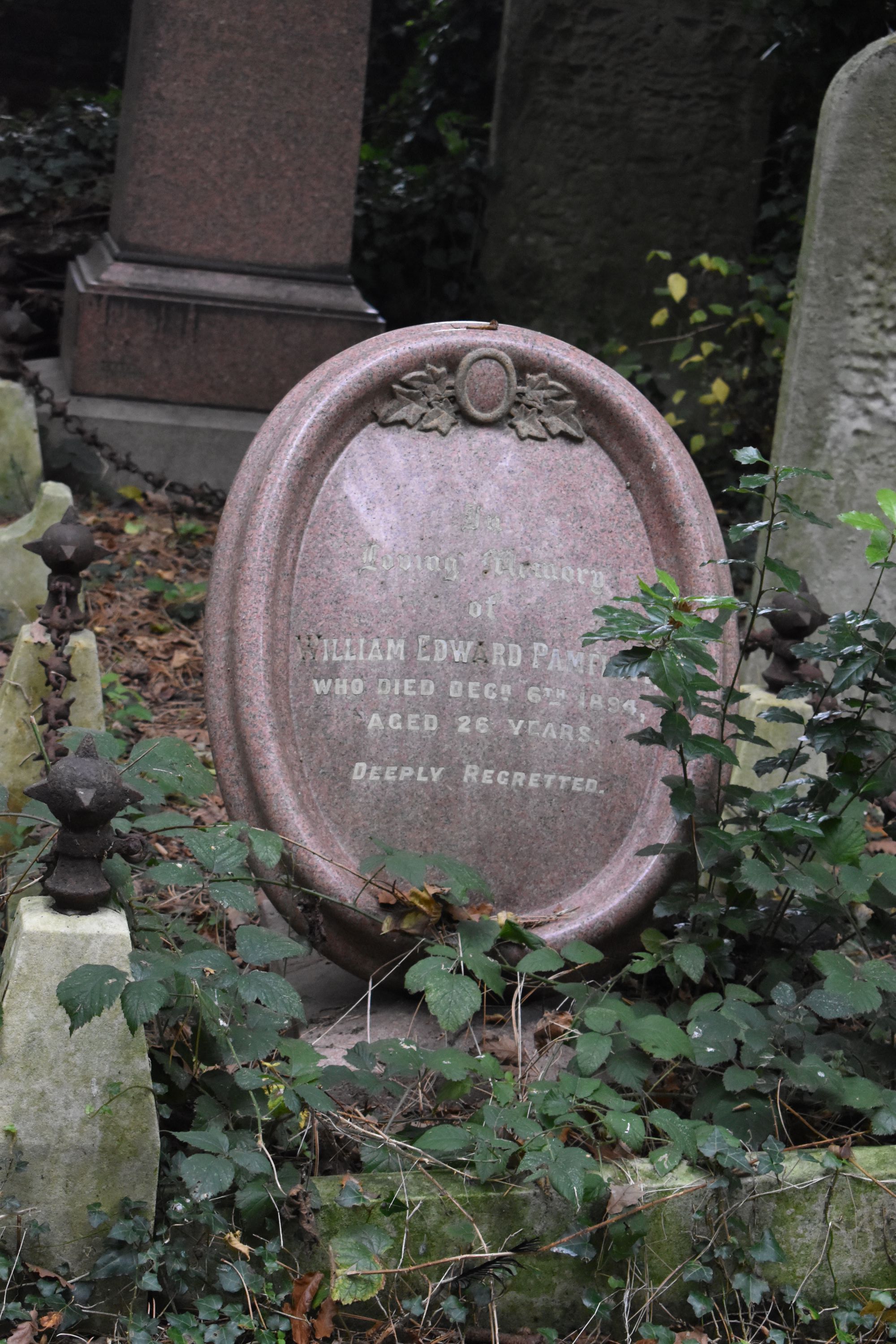
There was an interesting variation regarding epitaphs within the cemetery. On several graves, they were carved within an oval frame that was reminiscent of a portrait. I thought they looked very elegant.

©Carole Tyrrell
©Carole Tyrrell
©Carole Tyrrell

There was only one way to discover why another path was named ‘Surfboat Path’ and halfway down I came upon the Grade II listed memorial to the Surfboat Disaster. It commemorated the tragedy that killed 9 Margate boatman on 2 December 1887 and was restored by the Royal National Lifeboat Institute, 120 years later in 2017.
The town’s surfboat, ‘Friend to All Nations’, went out on that night in appalling weather to assist the sailing vessel, ‘Persian Empire’. Sadly, the surfboat capsized on the Nayland Rock in Margate with only 4 survivors. A surfboat is according to Wikipedia:
‘A surfboat (or surf boat) is an oar-driven boat designed to enter the ocean from the beach in heavy surf or severe waves. It is often used in lifesaving or rescue missions where the most expedient access to victims is directly from the beach’

A surfboat in action ©DonJeffFranky Shared under Wiki Commons
Full view of the Surfboat Disaster monument ©Carole Tyrrell

The 2017 memorial service was not only to acknowledge the tragic event but also as a reminder that the crews and elements still face the same challenges as emphasised in the sad loss of the crew of the Penless lifeboat in 1981. To say that it is impressive is an understatement as it is surrounded by more modest memorials. It’s in the shape of a huge rock with a lifesize mourning woman, her hands to her head, face turned away, in Victorian dress and carrying a laurel wreath, an evergreen that symbolises eternity. There is an epitaph to the disaster beside her and above, on the top of the rock, are a collection of nautical symbols: chains, anchors, ropes and a life belt with the surfboat’s name on it. I was stunned although I would have expected a few nautical graves due to Margate being on the coast.

A closer view of the mourning woman on the monument. ©Carole Tyrrell

Part 2 – A doomed air flight, an unusual angel and an art lover’s final resting place

©Text and photos Carole Tyrrell unless otherwise stated
References and further reading:

https://en.wikipedia.org/wiki/Victoria_Sanger_Freeman

https://en.wikipedia.org/wiki/Surfboat
https://courtauld.ac.uk/about-us/our-history/
https://en.wikipedia.org/wiki/Samuel_Courtauld_(art_collector)
https://www.britannica.com/biography/John-Sanger
https://en.wikipedia.org/wiki/John_Sanger
https://theisleofthanetnews.com/2017/12/15/a-service-has-marked-the-restoration-of-margates-surf-boat-memorial-and-the-loss-of-9-lives-in-the-tragedy/
https://margatelocalhistory.co.uk/Pictures/Pictures-Storms.html
https://theisleofthanetnews.com/2017/10/04/rare-collection-of-lord-george-sanger-circus-photos-sold-at-auction/
https://daily.jstor.org/vintage-circus-photos-sanger-circus-collection/
https://www.findagrave.com/memorial/46295073/edmund_leonard_george-betts

https://historicengland.org.uk/listing/the-list/list-entry/1396419