Symbol of the Month – Visitation stones.

Roadside shrine on the way to Minnis Bay, Kent © Carole Tyrrell

This summer I was out walking with a friend along the sea wall to Minnis Bay when we saw this little roadside shrine. It was on a popular  route  which is used by walkers and cyclists alike. On one side is the pebbly beach and on the other are marshes that stretch down to the railway line.   It was touching to see that people, friends or perhaps fellow passers-by, had left little tributes of a bunch of flowers and stones.

Stones left on a grave in a North London Jewish cemetery. © Carole Tyrrell

The placing of stones on graves is something that I’ve always associated with the Jewish faith (see blog post ‘Silently slumbering for remembrance Part 1 dated 14 April 2016). If you have ever visited a Jewish cemetery then you will have noticed stones placed on top of graves and headstones and there may be a basket of stones available for this purpose. But over the last few years I have noticed them being placed on the graves of people who aren’t Jewish and I was intrigued by their possible meaning.

In the Jewish faith, it is believed that the placing of stones ‘keeps the soul down.’ This comes from the Talmud

‘which is the central text of rabbinical Judaism and is the primary source of Jewish religious law and theology’   Wikipedia

In the Talmud, it is stated that:

‘souls continue to dwell for a while in the graves in which they are placed. The grave was called a beit olam or a permanent home and was thought to retain some aspects of the departed soul. By placing stones, it becomes a way of the living helping the dead to ‘stay put’.  

This may have brought comfort to those visiting the grave in that they may feel that their loved ones are still near.The Hebrew word for pebble is ‘tz’ror’ which can also mean ‘bond’. The placing of stones was also a mark of respect and a way of showing that someone had visited.
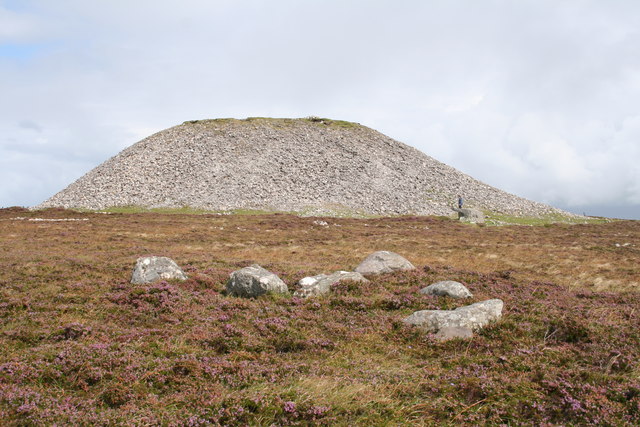
Maeve’s Cairn, the biggest one in Ireland, Knocknarea from geograph.org.uk © Bob Embleton. Shared under Wiki Commons.
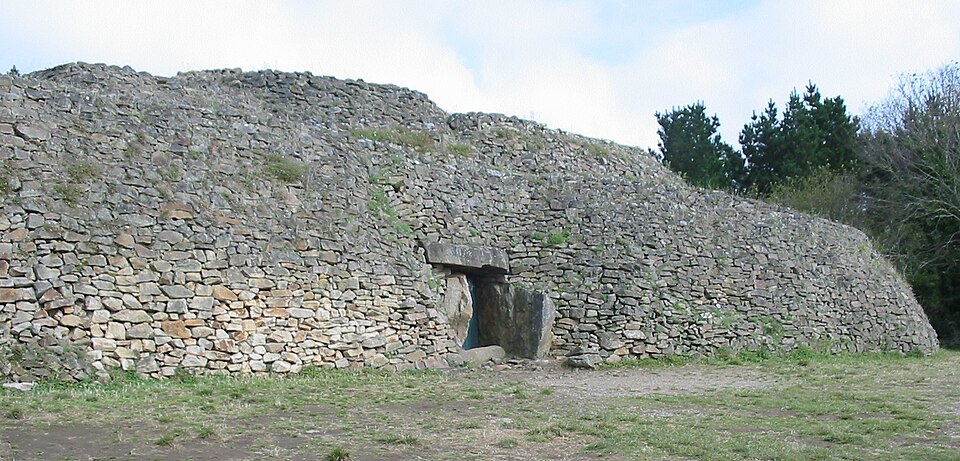
Gavrinis cairn, Brittany, France © Many vyi. Shared under Wiki Commons.

Ancient cairn, ruins of Qa’ableh, Saraag, Somalia. © Abdirisak Shared under Wiki Commons

Stones were used because of their durability. The Ancient Greeks believed that using stones to mark graves would ward off evil spirits and they also symbolised the soul’s eternal nature as they didn’t change over time. They associated them with the god, Hermes. However, stones and their associations with burials have been known to many ancient cultures especially Ireland, Scandinavia North Africa, the Middle East and Asia amongst others where they used them to mark sacred territories where communities would gather to honour their dead. Also the  Neolithic and Bronze periods in Europe in particular. Stones were used to create cairns.  These are usually placed on top of graves as markers and to protect the dead from predators.  In the Bronze Age they may have believed that the stones would stop the dead from rising as in the Jewish faith. Some of these still stand. The word ‘cairn’ comes from the Irish ‘carn’ with the plural being ‘cairn’ . In Scottish Gaelic ‘càrn’ translates to ‘heap of stones.’

They were also seen as a method of defence in that it would ward off predators from the burial site.

However, more recently, there has been controversy regarding the building of cairns on certain sites. This is due to the environmental damage that they can cause. Both the Hawaiian Volcano Observatory and the US National Park Service have complained about visitors prying off pieces from important geological features to make them as well as interfering with existing cairns and the destruction of important trail markers.  In the Peak District one man has made his mission to kick down the dozens of stacks that he finds. BBC News reported that:

‘Many have been created by taking stones from an old wall which may have damaged the habitats of the small creatures that live inside the wall and may have long term effects according to the National Trust who will also disassemble any stacks.

The stacks are seen as :

…. not to mark any burial sites or act as markers but just create unnecessary stacks for aesthetic purposes forgetting their original purpose as wayfinding tools and symbols rather than decorations.’

Stones taken to build stacks along the Great Wall were taken from an old wall which now looks like this. © Stuart Cox

The stones that have been left behind on the little seawall shrine, have presumably, come from the beach below and are a poignant symbol of remembrance signifying that the departed has been visited. The stones emphasise the enduring nature of memory and ite sbaility to enable the departed to live on. He is not forgotten by those who knew him and he died at one of his favourite places. RIP.

©Text and photos Carole Tyrrell unless otherwise stated

Why Jews Put Stones on Graves | My Jewish Learning

Why Do People Put Stones On Graves? Here Are 5 Reasons

Visitation stones – Wikipedia

Why Do People Put Rocks on Gravestones

Cairn – Wikipedia

The History of Cairns: Marking Paths, Memories, and Sacred Spaces – Magnolias + Fluff

Why I kick down Peak District stone stacks – BBC News

Please don’t stack rocks on your next hike. Here’s why. – Lonely Planet

Symbol of the Month – The Final Curtain

Full view of the impressive Raikes headstone, West Norwood Cemetery/
©Carole Tyrrell

The theatre is dark, the audience and backstage staff have all gone home or off to the pub and the final curtain has been brought down. The end of a show, the end of the evening and, in funerary symbolism, the end of a life.

This fine example is from West Norwood Cemetery where it commemorates the Raikes family.  Theatre was in their blood and so the sculpture of a theatrical curtain is very appropriate.

But curtains and draperies have always been associated with death and remembrance.  There is the old saying which is sometimes quoted on headstones and memorials that the deceased has ‘gone beyond the veil’.  An urn on top of a memorial will often have a sculpted piece of cloth draped across it which indicates the division between the living world and the realm of the dead.

In the 19th century and also well into the 20th century drapes were hung over mirrors with curtains and blinds drawn down at windows during the period of mourning. It was as if they were hiding death from the world or containing it within the family. On the Friends of Oak Grove Cemetery website they mention mirrors being covered with black crepe fabric in order to prevent the deceased’s spirit being trapped in the looking glass.

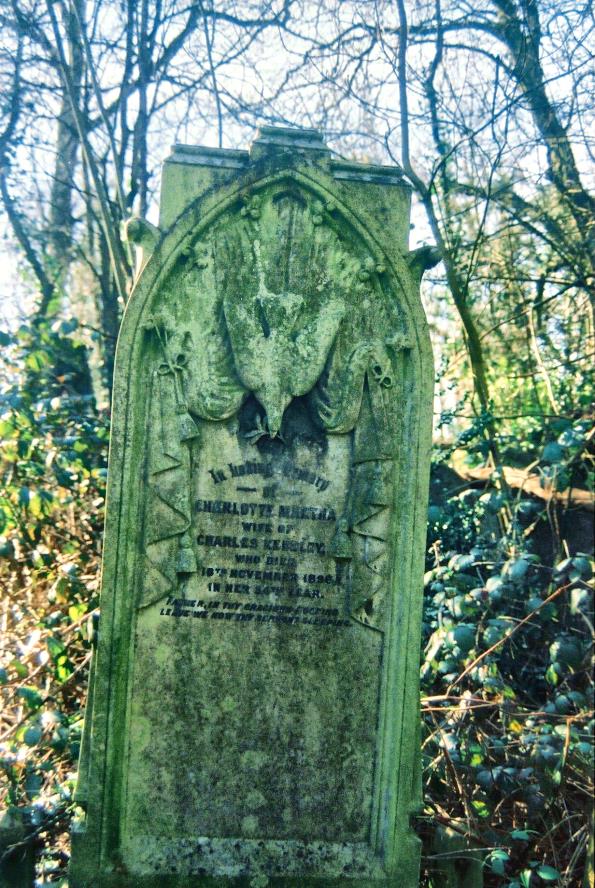
Parted curtains on a headstone to display a downturned dove and epitaph in the centre, Nunhead Cemetery
©Carole Tyrrell

Curtains also feature on headstones where they are depicted as parted in order to display a meaningful symbol or to draw attention to an epitaph that takes centre stage.  This example comes from Nunhead Cemetery where the curtains are parted to display a downturned dove which is a symbol of The Holy Ghost.

However the Raikes one is very obviously a theatrical curtain and it’s beautifully detailed.  They were powerful players in that flamboyant world and the curtain is a direct reference to this. For example, in 1889, they had Sir Edward Elgar and his new wife, Caroline, as guests in their house, Northlands in College Road, Dulwich.  This was just prior to his Salut D’Amour being performed at the Crystal Palace.

But the family home had a secret in its basement. This was where Charles Raikes (1879-1945) had constructed his own private theatre.  He lived there with his mother, Vera, (1858-1942) and two sons, Raymond and Roynon, from his former marriage. Roynon’s wife, Greta, and their daughter Gretha were also part of the household. Charles lived and breathed theatre and he was ahead of his time when he converted a large billiard room into the Northlands Private Theatre. Nowadays it would be a lavish home cinema with comfy seats and popcorn on tap with his own home movies onscreen.  He extended his pride and joy by removing a couple of inconvenient bay windows and then converting a coal cellar and wine cellar into dressing rooms. He was a talented scenic artist and stage carpenter and from 1924 – 1939 the Theatre put on nearly 23 productions a year to an invited audience. This was made up of the Raikes’ friends and relations and the actors and actresses friends as well. The lavish after show parties were renowned.

Charles’ sons continued the links to the entertainment world.  Raymond (1910-1998) became a professional actor in the 1930’s and played Laertes to Donald Wolfit’s Hamlet at Stratford upon Avon.

Raymond Raikes taken in 1945
Shared under Wiki Creative Commons

However he eventually became a BBC producer, director and broadcaster. He won several awards over a long career which included pioneering the use of stereo sound in radio drama.  In 1975 he retired and is known as one of the three greatest radio drama producers. Roynon became a professional photographer specialising in theatre pictures and also as a stills photographer for the BBC. Greta, his wife, became a theatrical costumier and drama teacher and her daughter, Gretha, in turn became a speech and drama teacher. In a 1997 Dulwich Society article she was also credited with being the curator of the archives of the Northlands Private Theatre.

View of the curtains and the quote from the Rubaiyyat of Omar Khayyam, Raikes headstone, West Norwood cemetery.
©Carole Tyrrell

The quotation below the curtain is from the Rubaiyat of Omar Khayyam.  It comes from the 21st, 22nd  or 23rd stanza depending on which version you read.   This is the verse in full and is taken from the 1859 translation by Edward Fitzgerald

Lo! some we loved, the loveliest and best

That Time and Fate of all their Vintage prest,

Have drunk their Cup a Round or two before,

And one by one crept silently to Rest.


He saw them as a selection of quatrains or Rubaiyats that had been attributed to the Persian poet who was also known as the Astronomer Poet of Persia.  Although Fitzgerald’s translation was initially unsuccessful, by the 1880’s, it had become immensely popular.  It has influenced many creative people over the years including the Pre-Raphaelites and especially Dante Gabriel Rossetti. Oscar Wilde was also a fan and mentions ‘wise Omar’ in The Picture of Dorian Gray.   Agatha Christie, Isaac Asimov, H P Lovecraft and Daphne Du Maurier are amongst many who may have borrowed a line a s a book title or used an Omar like figure within their works.  Interpretations of the Rubaiyat can be very free and as a result the quatrains can change their wording.  The underlying message of the Rubaiyat appears to be Seize the Day or Carpe Diem in Latin.  There are also several references to drinking with the implication that once drinking is over so is life.   But this particular line seems appropriate for its use on a headstone.

And so the curtain has bene brought down on the Raikes family but, as I took my photos, I thought I detected a faint smell of greasepaint and the appreciative sound of applause……

©Text and photos Carole Tyrrell unless otherwise stated

References and further reading:

 https://aeon.co/ideas/how-the-rubaiyat-of-omar-khayyam-inspired

 sleepinggardens.blogspot.co.uk/2011/06/fridays-funerarysymbols

https://en.wikipedia.org/wiki/Rubaiyat_of_Omar_Khayyam

schoolworkhelper.net

https://artofmourning.com/2010/11/14/symbolism-sunday-drapery/

Rubáiyát of Omar Khayyám Summary – eNotes.com

https://www.enotes.com/topics/rubaiyatomarkhayyam

https://dulwichsociety.com/2017-winter/1578-brief-encounter

https://en.wikipedia.org/wiki/Raymond_Raikes

www.suttonelms.org.uk/raymond-raikes.html

https://en.wikipedia.org/wiki/Rubaiyat_of_Omar_Khayyam