


©Carole Tyrrell
Part 1 The Church and the Hardy Tree
Despite their transformation into swish new, trendy areas of London, Kings Cross and St Pancras still retain their historical origins if you know where to look.
However, I can remember when St Pancras was the station that time forgot. In fact if Stephenson’s Rocket had puffed its way along a platform at one time I wouldn’t have been surprised, The MIdland Grand, an enormous rabbit warren of a building was still awaiting its Cinderella like transformation in 2003/4. Now, reborn as St Pancras Renaissance, it’s always a magnificent sight to see as you perambulate along the Euston Road.
But behind St Pancras International, as it’s now known, there is still a part of London that has welcomed visitors and immigrants from all over the world and is testament to the capital’s ever-changing history.
In this quiet part of North London, if you listen hard enough you can still hear the running feet of The Beatles or Mary and Percy Shelley discussing their elopement as they take a Sunday afternoon stroll. But, even more gruesomely, you might also hear body snatchers plying their trade.
This is St Pancras Old Church and churchyard. But it’s not to be confused with St Pancras New Church which is the one with the weirdly proportioned caryatids that face the Euston Road.
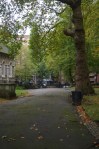
The Research History Group of Brompton Cemetery visited on an overcast September afternoon when the churchyard, or park, as it’s now known seemed sombre and silent under the canopy of the 160 year old tress. But it wasn’t always like this. Our knowledgeable guide, Lester Hillman, told us that during the 19th century, instead of the elegant iron railings that border the front of the churchyard , there had been pubs and adjacent to the church there had been a terrace of houses.
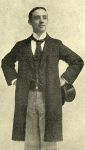
The famous music hall star Dan Leno had been born in one of them. During the 1850‘s there had been balloon ascents as well and I did wonder how the permanent residents of St Pancras had ever got any of their eternal rest.
Charles Dickens who lived opposite the churchyard as a child described it as:
‘ a desolate place surrounded by little else but fields and ditches’
This seems incredible now as the area is so built up. Dickens featured St Pancras in ‘A Tale of Two Cities’ in which one of the characters, Jerry Cruncher and his son, Jerry Jnr, visit the churchyard in order to ‘fishing’. This was a euphemism for body snatching which was rife at the time.

©Goodreads
Although the churchyard is now much smaller, during 1689-1845 88,000 burials took place in it and It’s estimated that 1.5% of the 66 million Londoners who have lived in the capital over the centuries have been buried here. It closed to burials in 1850 and was acquired by parish authorities becoming a public park in June 1877.
We first visited the church which is very attractive and to walk through its door is to walk into London’s past. Roman, Norman and Tudor brickwork are almost cheek by jowl with each other and the memorial of the very first burial is preserved on a wall near the altar. This is to a Mary Berisford who was interred on a very auspicious day, 21 August 1588, which was the day of the Spanish Armada. On the opposite wall is the memorial to Daniel Clark (died 1613) and his wife, Katherine (died 1627) and he was cook to Elizabeth 1st. This large monument is dedicated to William Platt and his wife and they look as if they’re sitting in a box at the theatre.

©Carole Tyrrell
A piece of a Roman altar is embedded in the top of the present one. It was found nearby and seems appropriate as St Pancras was a Roman saint.
According to the guidebook, the church:
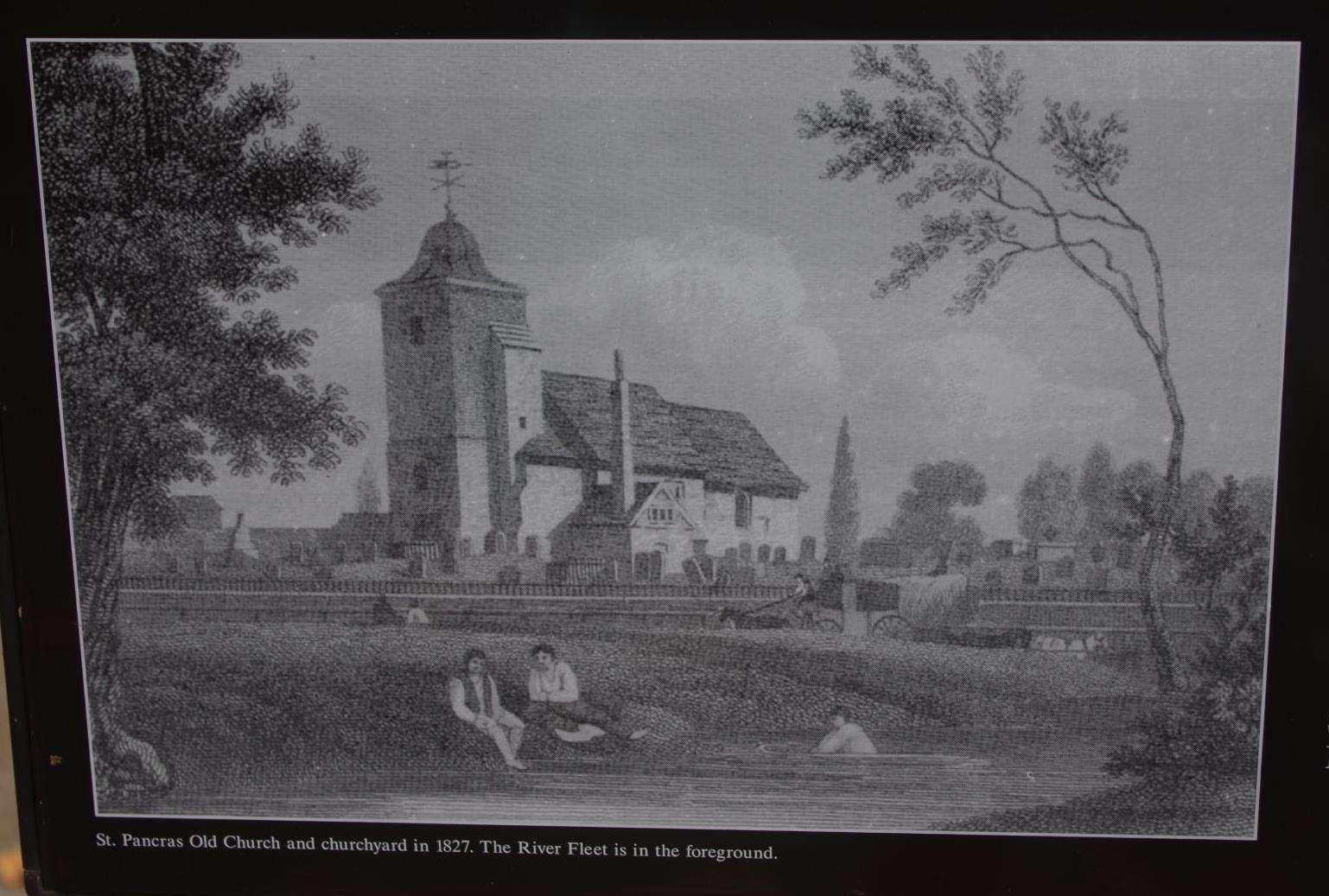
‘may possibly date back to the 4th century…..the present building has been here since the 11th or 12th century close to the River Fleet.’
©Carole Tyrrell
The river now runs underground but continues to supply Highgate Ponds. Lester informed us that the 17th generation descendant of Richard III swam in them daily. However, little remains of the medieval church.

©Carole Tyrrell
As we left the church to enter the churchyard I spotted a wall memorial to a Amelia Rogers whose occupation was given as ‘pew-opener’. This undoubtedly referred to the days when there were box pews with doors and she was obviously greatly valued.
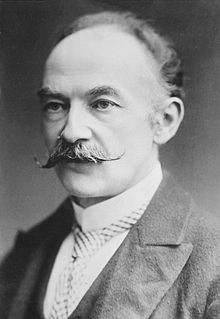
One of the features for which the churchyard is renowned is The Hardy Tree. This is an ash tree which has grown in and around the headstones placed around it. Sadly, the tree isn’t looking very healthy these days and an exclusion fence has had to be placed around it as branches have fallen from it. Fungus is clearly visible. The Hardy connection comes from the novelist Thomas Hardy.
Shared under Wiki Creative Commons
During 1862-67, as a young man, he studied architecture under Arthur Blomfield, in London. At this time, the Midland Railway was being built over part of the churchyard and Hardy was given the task of supervising the proper exhumation of human remains and the dismantling of tombs.
‘In The Early Life, Hardy recounts being involved with the overseeing of churchyards that were being cut through by railroad companies. His employer, Arthur Blomfield, described “returning from visiting the site on which all the bodies were said by the railway companies to be reinterred; but there appeared to be nothing deposited, the surface of the ground quite level as before” In order to make sure the bodies were actually buried properly, Hardy was asked to check one such job at irregular intervals. One evening, accompanied by Blomfield, he watched as a coffin fell apart. Out dropped a skeleton and two skulls. When years later he met Arthur Blomfield again, “among the latter’s first words were: ‘Do you remember how we found the man with two heads at St. Pancras?'” http://casterbridge.blogspot.com/2009/05/levelled-churchyard.html
In 1882, 20 years later, he wrote the poem ‘The Levelled Churchyard’ which may refer to this period.
‘O passenger, pray list and catch
Our sighs and piteous groans,
Half stifled in this jumbled patch
Of wrenched memorial stones!
“We late-lamented, resting here,
Are mixed to human jam,
And each to each exclaims in fear,
‘I know not which I am!’
“The wicked people have annexed
The verses on the good;
A roaring drunkard sports the text
Teetotal Tommy should!
“Where we are huddled none can trace,
And if our names remain,
They pave some path or p-ing place
Where we have never lain!
“There’s not a modest maiden elf
But dreads the final Trumpet,
Lest half of her should rise herself,
And half some local strumpet!
“From restorations of Thy fane,
From smoothings of Thy sward,
From zealous Churchmen’s pick and plane
Deliver us O Lord! Amen!”
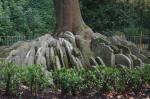
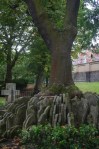
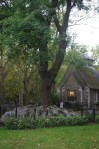
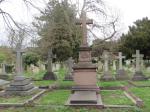
The Hardy Tree is a London legend but no-one’s quite sure if Hardy himself placed the headstones there. However, it was certainly created at the right time. With the Eurostar coming to St Pancras in 2007, another part of the churchyard was lost and there has been a Hardy Homage. A graceful swirl or half circle of headstones marks the spot

©Carole Tyrrell
Part 2: Escape from the Black Hole, the inspiration for a British icon and Frankenstein
©Text and photos Carole Tyrrell unless otherwise stated
References and further reading:
A Walk in the Past – a churchyard tour Of St Pancras Old Church – St Pancras Old church guidebook
https://en.wikipedia.org/wiki/St_Pancras_Old_Church
http://casterbridge.blogspot.com/2009/05/levelled-churchyard.html
https://www.theflyawayamerican.com/st-pancras-old-church-london/
http://thelondondead.blogspot.com/2014/06/polly-peachum-and-black-hole-of.html
https://en.wikipedia.org/wiki/Mary_Wollstonecraft
https://en.wikipedia.org/wiki/The_Man_Who_Never_Was
https://en.wikipedia.org/wiki/Angela_Burdett-Coutts,_1st_Baroness_Burdett-Coutts
https://www.historytoday.com/archive/months-past/angela-burdett-coutts-born-london
https://www.them.us/story/chevalier-d-eon-trans-woman




 shadows fly away