
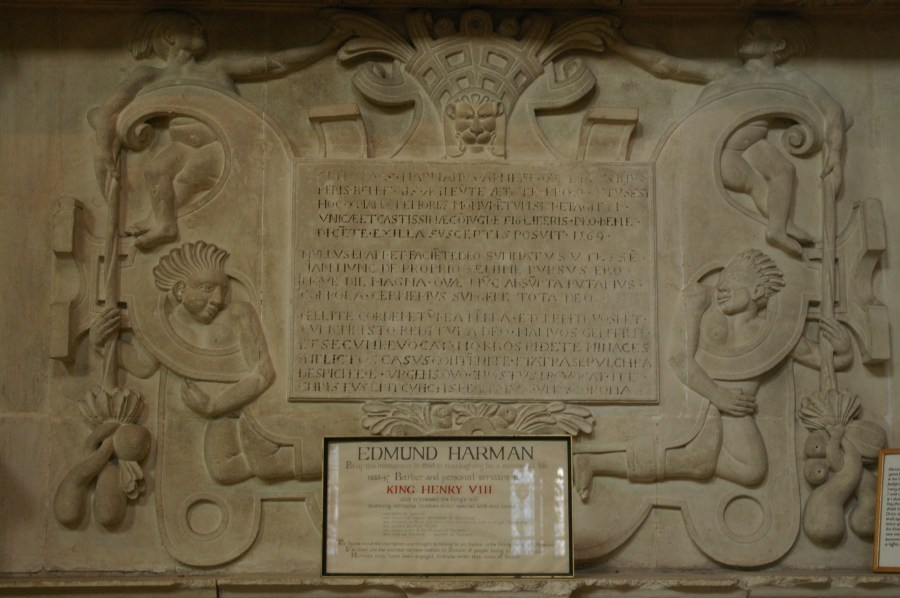

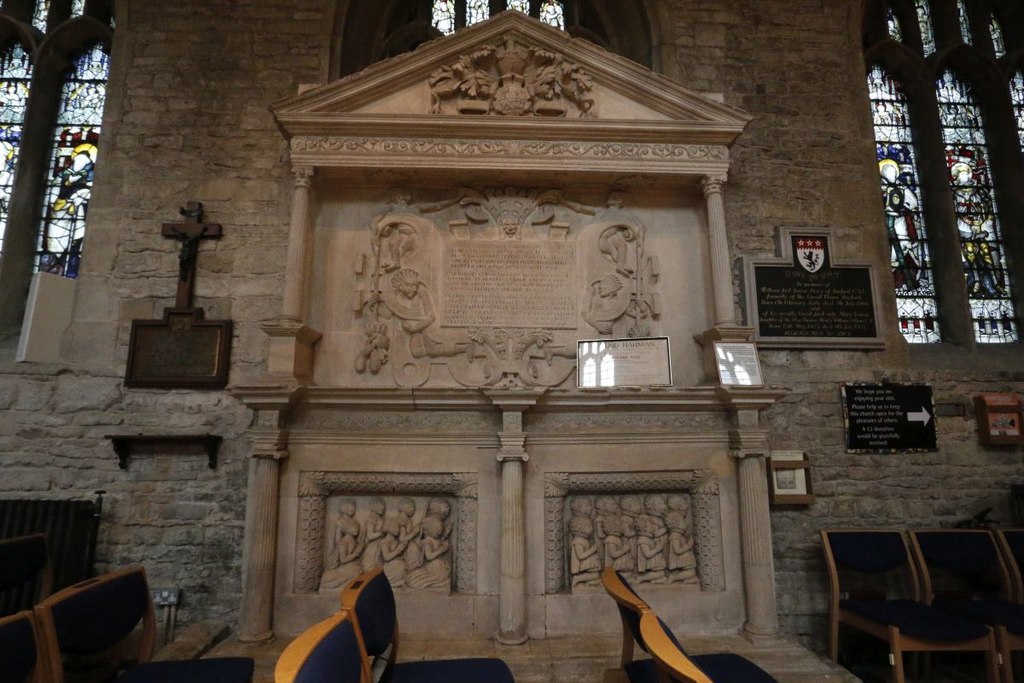
As a ‘church crawler’, or someone who likes to poke about in churches and churchyards, I didn’t expect to find this finely carved pair of South American Indians in an Oxfordshire church. They decorate the monument dedicated to Edmund Harman (1509-1577) and his ‘faithful’ wife, Agnes.
The Indians have been identified as belonging to the Tupinamba tribe who, in the early 1500’s, lived at the mouth of the Amazon. They are assumed to be the earliest known representation of South American Indians in England. The Tupinamba tribe were known to be cannibals and the carvings are believed to be the work of a Dutch carver, Cornelis Bos. However, no-one’s quite sure whether they’re there. It has been assumed that they are a reference to Edmund Harman’s Brazilian trade interests. But perhaps Bos might have seen a similar design in the Spanish Netherlands and decided to ‘borrow’ it.
Edmund Harman was an influential man at Henry VIII’s court. In fact, he was one of Henry’s most important and trusted servants. From 1533-1547, he was the King’s personal barber and servant, a position that gave him enormous influence at court as he was so near to the King. I’m sure that he didn’t spend his time asking Henry VIII if he’d been anywhere nice for his holidays……he was probably too busy bending the King’s ear with promoting his friends business schemes. In 1538, Edmund had risen so high that he was included in a list of people at court who were:
‘…to be had in the King’s most benign remembrance…’
Benign it certainly was, as it meant that Edmund was granted several pieces of land in Oxfordshire as well as Burford Priory. He was also one of the 15 servants who made up the Privy Chamber and their job was to attend to every aspect of the King’s comfort.
In 1546, Edmund was one of the witnesses to Henry VIII’s will which was a very important document. According to the Burford church website,
He makes an appearance with his King in Holbein’s last painting which is kept at The Barber’s Hall in London. The artist has helpfully labelled all the assembled men and Edmund is at the front on the right hand side.

Edmund and Agnes had sixteen children (!) but only two of them, both girls, survived their parents. There are representations of them on the lower half of the monument.


According to the Burford church website, Edmund’s epitaph:
‘…..is considered to be an early example of a Post-Reformation epitaph as there is no mention of Purgatory or saying prayers for the dead man’s soul to ease his way out of it. Purgatory and other religious practices had all been swept away by Henry VIII’s determination to divorce Katherine of Aragon and set himself up as the Head of the new Church of England.’
It is a lovely monument with beautiful, crisp carving and a wonderful example of the stone carver’s skill. Sadly, despite all the expense and the effort lavished in creating the monument, Edmund and Agnes were buried in Taynton which is 7 miles away from Burford.
However, it stands as a memorial to a man who rose from humble beginnings, moved in powerful circles and brought the New World closer to home.
©Text and Photos Carole Tyrrell unless otherwise stated
References and further reading
https://www.burfordchurch.org/harman-memorial
https://journals.sagepub.com/doi/pdf/10.1177/003591571600901610
https://www.oxfordmail.co.uk/news/3742667.barber-king-gentleman/
 shadows fly away