Symbol of the Month – The Empty Chair

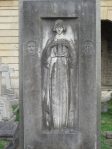
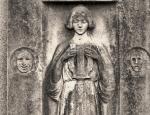
Mary Emden’s empty chair, Highgate West cemetery.
©Carole Tyrrell

When out exploring large Victorian cemeteries you may see the welcome sight of an empty chair on top of a grave.  However, please don’t give into the urge to perch yourself on it for a quick rest but instead, ponder on its meaning.

An empty chair is intended as a reminder of loss, absence and a memory of someone dear who has now gone.

It’s one of the most poignant symbols of loss and is a staple of old Hollywood movies and also some soap operas. There’s a large family gathering, preferably at Christmas, and everyone’s round the table. Then, in the middle of all of the jollity, the camera pans down to an empty space set with cutlery and china and a vacant chair. Then it all grows quiet as everyone looks at it and remembers the absent family member.

Douglas Keister has suggested that these memorials can often be found on childrens graves  with a tiny pair of shoes attached  and one usually on its side.  He considers that they are obviously associated with the death of a child or young person and, in his book, Stories in Stone, he cites a poem by Richard Coe, Jr that appeared in Godey’s Lady’s Book in January 1850.

THE VACANT CHAIR

by Richard Coe, Jr.

When we gather round our hearth,
Consecrated by the birth
Of our eldest, darling boy,
Only one thing mars our joy:
‘Tis the dreary corner, where
Stands, unfilled, the vacant chair!

Little Mary, bright and blest,
Early sought her heavenly rest.
Oft we see her in our dreams ­
Then an angel one she seems!
But we oftener see her, where
Stands, unfilled, the vacant chair.

But ’twere sinful to repine;
Much of joy to me and mine
Has the gentle Shepherd given.
Little Mary is in heaven!
Blessed thought! while gazing where
Stands, unfilled, the vacant chair.

Many parents, kind and good,
Lost to them their little brood,
Bless their Maker night and day,
Though he took their all away!
Shall we, therefore, murmur, where
Stands, unfilled, one vacant chair!

Little Mary! angel blest ‘
From thy blissful place of rest,
Look upon us! angel child,
Fill us with thy spirit mild.
Keep o’er us thy watchful care;
Often fill the vacant chair.

There is also a famous Civil War ballad dedicated to an 18 year old, John William ‘Willie’ Grant who was killed at Balls Bluff, Virginia in October 1861. This also mentions ‘the empty chair’ in the context of a departed loved one.

I haven’t yet seen one dedicated to a child or young person in my explorations of UK cemeteries. Instead, the examples that I have seen are dedicated to adults both men and women.  But I’m sure that I will see one dedicated to a child sooner or later.
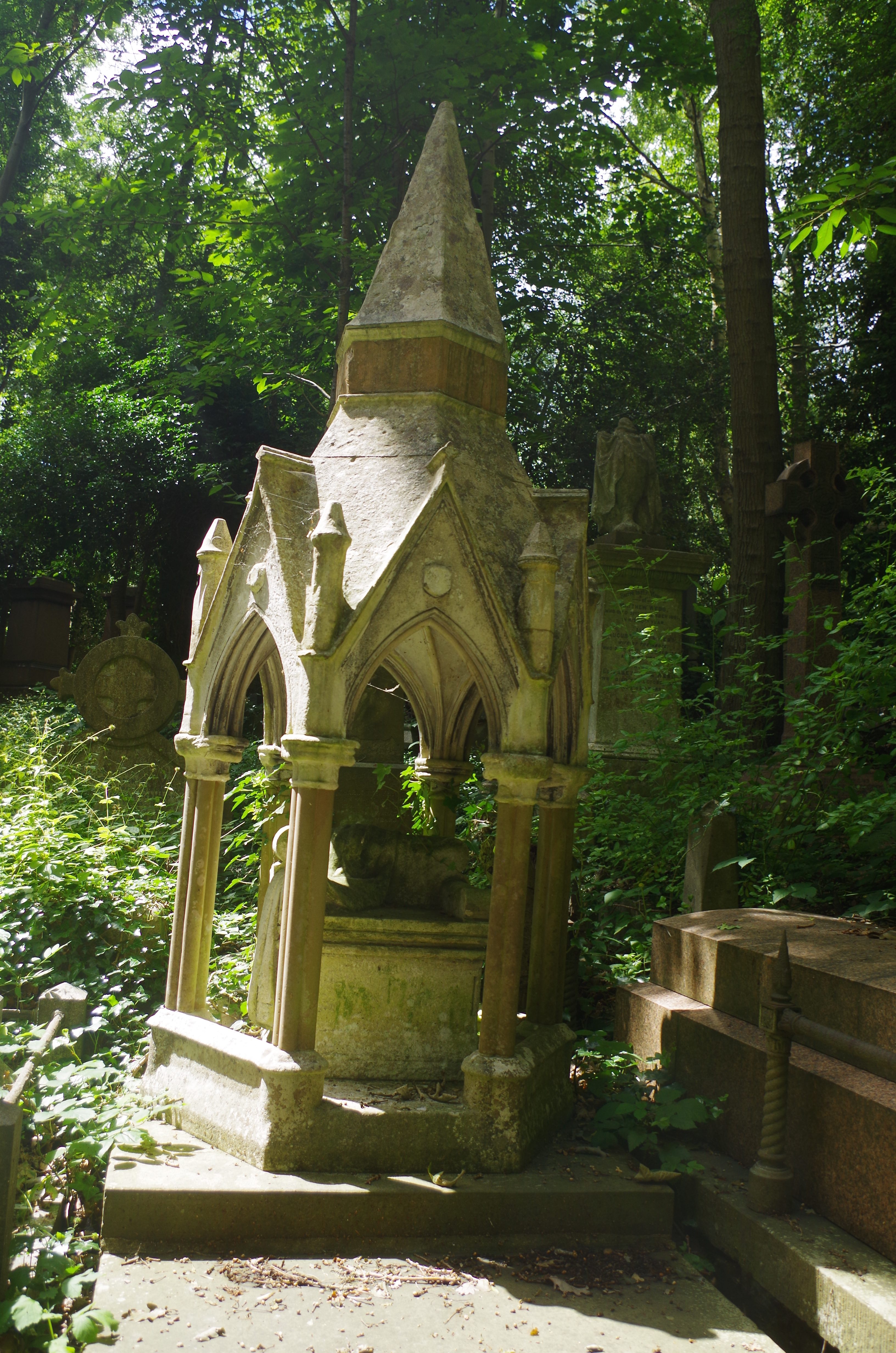
Full view of Mary Emden’s empty chair in Highgate West cemetery.
©Carole Tyrrell

This is in Highgate West Cemetery in London and is dedicated to Mary Emden (1853-1872). She was a 19 year old soprano who died young of TB.  Mary’s real name was Marie and she and her husband, Walter, had only been married a year and a glittering career would have lain ahead of her.  He was a successful architect of theatres and these include the Royal Court, the Garrick and the Duke of York’s theatres which are still standing today. Mary’s chair sits under a Gothic canopy with a sculpted stole draped across it as if she had just got up out of the chair and left it there intending to return.  To read more about Mary’s life please visit: https://misssamperrin.blogspot.com/search?q=mary+emden

These come from Kensal Green Cemetery in London and are on the graves of two distinguished men.

The empty chair or throne on MP Charles Middleton’s grave, Kensal Green Cemetery.
©Carole Tyrrell

This is almost a magnificent throne it’s so large! Sadly the epitaph is long gone although there appears to be a coat of arms at the top. I have been told by the Friends of Kensal Green that it’s dedicated to Charles Middleton MP. However the only Charles Middleton MP that I have found so far died in 1813 which is long before Kensal Green Cemetery was created.  But it is so imposing and dramatic.  When things are easier I will go back and see if I can get a better picture of the coat of arms as that may help.
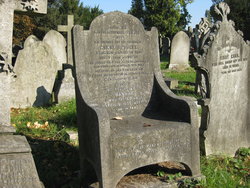
Henry Russell’s empty chair in Kensal Green Cemetery.
©Milky

This elegant chair is on the grave of Henry Russell and his wife Hannah. He was a prolific composer and one of his most celebrated works is still performed today. He was born in Sheerness on Sea in Kent which seems appropriate for the composer of ‘A Life on the Ocean Wave’.  Henry grew up in the Anglo-Jewish community of Blue Town and he started his musical carer early at the age of 3.  However, at 10 he was working in a local apothecary’s shop. This didn’t last long as it’s rumoured that he

‘gave a customer sufficient Epsom Salts to bring down an elephant’ www.jtrails.org.uk/trails/henry-russell-and-life-on-the-ocean-wave-at-sheerness

Clearly the apothecary shop wasn’t his calling in life. But music was in his blood and, after his voice broke, he travelled to Italy to study under Rossini. On his return to England he took up the post of chorus master at Her Majesty’s Theatre.

Henry Russell. Print shows Henry Russell, half-length portrait, facing slightly right, with right hand resting on piano keyboard, open sheet music in the foreground and a shipwreck on storm tossed waves in the background. Includes six lines of text from poem “Wind of the winter night, whence comest thou?” Shared under Wiki Commons.

But America was tempting him and it was there that he would discover his songwriting talent. He would also be able to collaborate with the songwriters and poets who would provide him with the lyrics that he set to music.  He arrived in Rochester, New York and became an organist and choirmaster at the First Presbyterian Church.

In total he composed 800 songs and another of his most well-known ones is ‘Woodman Spare That Tree’ which was based on an incident in the lyricist, Charles Wood’s life. Russell also collaborated with such luminaries as Longfellow, Tennyson, Dickens and Thackeray.   However it was Dickens who re-arranged another of Russell’s well known compositions ‘The Fine Old English Gentleman’ into a parody and satire based on the Tory government at the time. You can read it here: https://www.theguardian.com/books/2012/may/14/charles-dickens-gentlemen-poem-week

But with no copyright protection Henry didn’t reap the rewards of his success and instead it was the publishers that made the money. He had already lost the £10,000 that he had made in America by investing in the United States Bank which collapsed and took all its investors’ money with it.  However t was Henry’s performing that brought in the money as he was immensely popular.

Many of his works deal with social issues of the day such as slavery or private mental asylums and he raised over £7000 for victims of the Irish Famine.  He returned to England in 1844, married twice and gave his final performance in 1891 when he sang at a concert given in his honour.  Henry had 5 sons, two of whom followed him into the musical profession. Sir Landon Ronald Russell (1873-1938) became a conductor, pianist and composer and Henry Russell (1871-1937) who was an opera impresario.

Is it a coincidence that two of the empty chairs are on the graves of theatrical people?  The throne would have suited Macbeth! I found Mary Emden’s memorial to be the most poignant with the air of someone who had just left.

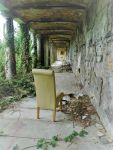
However there is a sinister side to the empty chair.  They often appear in urban explorer photos of derelict hospitals and asylums.  In these, for some reason, the chair looks menacing and if it’s lying in wait……….these two photos again come from Kensal Green and were taken by cemetery photographer, Jeane Mary.   An elegant chair in the middle of decay and dereliction why is it there? A prop for a photo shoot?  A discarded piece of furniture?


As I was writing this post I saw a series of photos by a photographer on the Folk Horror Revival Facebook page.  She had been out walking on a lonely moor and found a recliner style armchair sitting  in the middle of nowhere.  It could have just been just dumped there but it seemed a long way to go to do that.  The photographer emphasised that she had decided not to sit in it and it did look very creepy in her photos.

Next time I visit Kensal Green I may well be tempted to sit in the throne.  I only hope that it’s not already occupied……

©Text and photos Carole Tyrrell unless otherwise stated

References and further reading:

Douglas Keiser, Stories in Stone, Gibbs Smith, 2004

https://www.umass.edu/AdelphiTheatreCalendar/actr.htm

https://www.theguardian.com/books/2012/may/14/charles-dickens-gentlemen-poem-week – this contains Dickens’ parody of Russell’s’ The Fine old English Gentleman’

http://www.traditionalmusic.co.uk/songster/05-the-fine-old-english-gentleman.htmlyrics to Henry Russell’s The Fine Old English Gentleman

https://misssamperrin.blogspot.com/search?q=mary+emden – Grave Expectations and Doyennes of Death

http://www.jtrails.org.uk/trails/sheerness-and-blue-town/articles/c-889/henry-russell-and-life-on-the-ocean-wave-at-sheerness/


However there is a sinister side to the empty chair.  They often appear in urban explorer photos of derelict hospitals and asylums.  In these, for some reason, the chair looks menacing and if it’s lying in wait……….these two photos again come from Kensal Green and were taken by cemetery photographer, Jeane Mary.   An elegant chair in the middle of decay and dereliction why is it there?

A prop for a photo shoot?  A discarded piece of furniture?
 

As I was writing this post I saw a series of photos by a photographer on the Folk Horror Revival Facebook page.  She had been out walking on a lonely moor and found a recliner style armchair

sitting there in the middle of nowhere.  It could have just been just dumped there but it seemed a long way to go to do that.  The photographer said that she had decided not to sit in it and it did look very creepy in her photos.

Next time I visit Kensal Green I may well be tempted to sit in the throne.  I only hope that it’s not already occupied……

©Text and photos Carole Tyrrell unless otherwise stated

References and further reading:

Douglas Keiser, Stories in Stone, Gibbs Smith, 2004

https://www.umass.edu/AdelphiTheatreCalendar/actr.htm

https://www.theguardian.com/books/2012/may/14/charles-dickens-gentlemen-poem-week – this contains Dickens’ parody of Russell’s’ The Fine old English Gentleman’

http://www.traditionalmusic.co.uk/songster/05-the-fine-old-english-gentleman.htmlyrics to Henry Russell’s The Fine Old English Gentleman

https://misssamperrin.blogspot.com/search?q=mary+emden – Grave Expectations and Doyennes of Death

http://www.jtrails.org.uk/trails/sheerness-and-blue-town/articles/c-889/henry-russell-and-life-on-the-ocean-wave-at-sheerness/


Symbol of the Month – The Final Curtain

Full view of the impressive Raikes headstone, West Norwood Cemetery/
©Carole Tyrrell

The theatre is dark, the audience and backstage staff have all gone home or off to the pub and the final curtain has been brought down. The end of a show, the end of the evening and, in funerary symbolism, the end of a life.

This fine example is from West Norwood Cemetery where it commemorates the Raikes family.  Theatre was in their blood and so the sculpture of a theatrical curtain is very appropriate.

But curtains and draperies have always been associated with death and remembrance.  There is the old saying which is sometimes quoted on headstones and memorials that the deceased has ‘gone beyond the veil’.  An urn on top of a memorial will often have a sculpted piece of cloth draped across it which indicates the division between the living world and the realm of the dead.

In the 19th century and also well into the 20th century drapes were hung over mirrors with curtains and blinds drawn down at windows during the period of mourning. It was as if they were hiding death from the world or containing it within the family. On the Friends of Oak Grove Cemetery website they mention mirrors being covered with black crepe fabric in order to prevent the deceased’s spirit being trapped in the looking glass.

Parted curtains on a headstone to display a downturned dove and epitaph in the centre, Nunhead Cemetery
©Carole Tyrrell

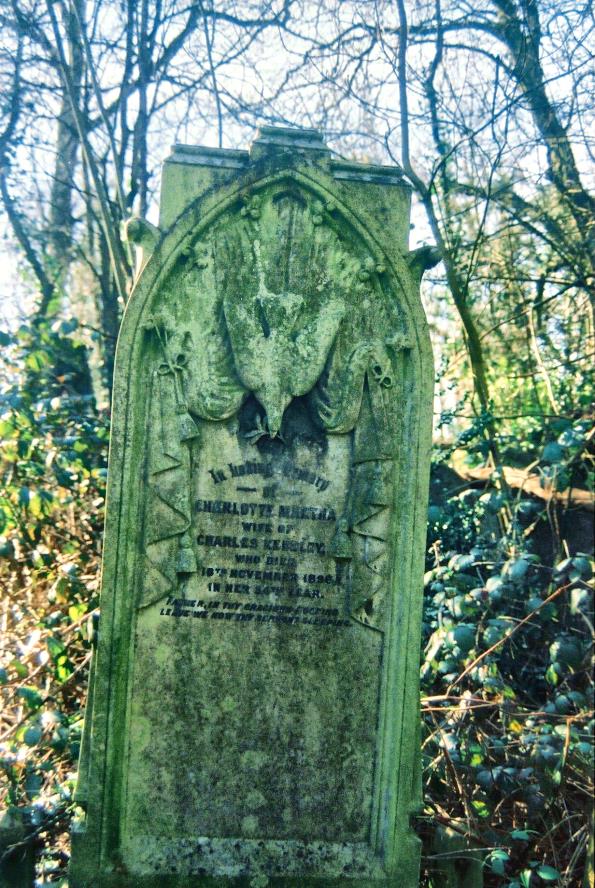
Curtains also feature on headstones where they are depicted as parted in order to display a meaningful symbol or to draw attention to an epitaph that takes centre stage.  This example comes from Nunhead Cemetery where the curtains are parted to display a downturned dove which is a symbol of The Holy Ghost.

However the Raikes one is very obviously a theatrical curtain and it’s beautifully detailed.  They were powerful players in that flamboyant world and the curtain is a direct reference to this. For example, in 1889, they had Sir Edward Elgar and his new wife, Caroline, as guests in their house, Northlands in College Road, Dulwich.  This was just prior to his Salut D’Amour being performed at the Crystal Palace.

But the family home had a secret in its basement. This was where Charles Raikes (1879-1945) had constructed his own private theatre.  He lived there with his mother, Vera, (1858-1942) and two sons, Raymond and Roynon, from his former marriage. Roynon’s wife, Greta, and their daughter Gretha were also part of the household. Charles lived and breathed theatre and he was ahead of his time when he converted a large billiard room into the Northlands Private Theatre. Nowadays it would be a lavish home cinema with comfy seats and popcorn on tap with his own home movies onscreen.  He extended his pride and joy by removing a couple of inconvenient bay windows and then converting a coal cellar and wine cellar into dressing rooms. He was a talented scenic artist and stage carpenter and from 1924 – 1939 the Theatre put on nearly 23 productions a year to an invited audience. This was made up of the Raikes’ friends and relations and the actors and actresses friends as well. The lavish after show parties were renowned.

Charles’ sons continued the links to the entertainment world.  Raymond (1910-1998) became a professional actor in the 1930’s and played Laertes to Donald Wolfit’s Hamlet at Stratford upon Avon.

Raymond Raikes taken in 1945
Shared under Wiki Creative Commons

However he eventually became a BBC producer, director and broadcaster. He won several awards over a long career which included pioneering the use of stereo sound in radio drama.  In 1975 he retired and is known as one of the three greatest radio drama producers. Roynon became a professional photographer specialising in theatre pictures and also as a stills photographer for the BBC. Greta, his wife, became a theatrical costumier and drama teacher and her daughter, Gretha, in turn became a speech and drama teacher. In a 1997 Dulwich Society article she was also credited with being the curator of the archives of the Northlands Private Theatre.

View of the curtains and the quote from the Rubaiyyat of Omar Khayyam, Raikes headstone, West Norwood cemetery.
©Carole Tyrrell

The quotation below the curtain is from the Rubaiyat of Omar Khayyam.  It comes from the 21st, 22nd  or 23rd stanza depending on which version you read.   This is the verse in full and is taken from the 1859 translation by Edward Fitzgerald

Lo! some we loved, the loveliest and best

That Time and Fate of all their Vintage prest,

Have drunk their Cup a Round or two before,

And one by one crept silently to Rest.


He saw them as a selection of quatrains or Rubaiyats that had been attributed to the Persian poet who was also known as the Astronomer Poet of Persia.  Although Fitzgerald’s translation was initially unsuccessful, by the 1880’s, it had become immensely popular.  It has influenced many creative people over the years including the Pre-Raphaelites and especially Dante Gabriel Rossetti. Oscar Wilde was also a fan and mentions ‘wise Omar’ in The Picture of Dorian Gray.   Agatha Christie, Isaac Asimov, H P Lovecraft and Daphne Du Maurier are amongst many who may have borrowed a line a s a book title or used an Omar like figure within their works.  Interpretations of the Rubaiyat can be very free and as a result the quatrains can change their wording.  The underlying message of the Rubaiyat appears to be Seize the Day or Carpe Diem in Latin.  There are also several references to drinking with the implication that once drinking is over so is life.   But this particular line seems appropriate for its use on a headstone.

And so the curtain has bene brought down on the Raikes family but, as I took my photos, I thought I detected a faint smell of greasepaint and the appreciative sound of applause……

©Text and photos Carole Tyrrell unless otherwise stated

References and further reading:

 https://aeon.co/ideas/how-the-rubaiyat-of-omar-khayyam-inspired

 sleepinggardens.blogspot.co.uk/2011/06/fridays-funerarysymbols

https://en.wikipedia.org/wiki/Rubaiyat_of_Omar_Khayyam

schoolworkhelper.net

https://artofmourning.com/2010/11/14/symbolism-sunday-drapery/

Rubáiyát of Omar Khayyám Summary – eNotes.com

https://www.enotes.com/topics/rubaiyatomarkhayyam

https://dulwichsociety.com/2017-winter/1578-brief-encounter

https://en.wikipedia.org/wiki/Raymond_Raikes

www.suttonelms.org.uk/raymond-raikes.html

https://en.wikipedia.org/wiki/Rubaiyat_of_Omar_Khayyam


Symbol of the Month – Laugh now, Cry Later or the Masks of Comedy and Tragedy

Coemdy and Tragedy at the base of the Augustus Henry Glossop Harris monument. ©Carole Tyrrell
Coemdy and Tragedy at the base of the Augustus Henry Glossop Harris monument.
©Carole Tyrrell

The two masks of comedy and tragedy, or Sock and Buskin as they are also known for reasons I’ll explain later, are not often found in cemeteries.  And as you might expect, when they are there’s a theatrical association.

But what is the history behind this two faced symbol and how did these icons from Ancient Greece come into Victorian cemeteries?

It began with the custom of actors wearing masks, an essential part of the performance, in early Greek theatre.  It was a vital part of Greek culture and civic pride.  However, Comedy and Tragedy were viewed as completely separate genres and no plays ever combined them.

Tragedy

This genre began in Athens around 532 BC with Thespis, the earliest recorded tragic actor.   He was known as ‘Father of Tragedy’ and it has been suggested that his name inspired the English term, thespian, for a performer.

Muse of Tragedy:

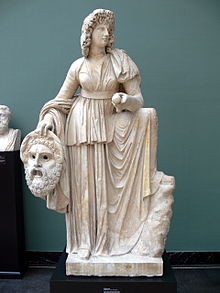
Melpomene is the Muse and is often depicted holding the Mask of Tragedy.  She often also holds a knife or club and also wears the ‘cothurni ‘or buskin boots that elevated her above other actors.  She was a daughter of Zeus and Mnemosyne as was Thalia, the Muse of Comedy, and there were also 7 other daughters who were all Muses.

Roman statue of Melpomene 2nd century DA - not tragic mask in hand and the wreath of vines and grapes on her head refers to Dionysus, god of theatre. ©Wolfgang Sauber Licensed under wikipedia Creative Commons Attribution 3.0
Roman statue of Melpomene 2nd century DA – not tragic mask in hand and the wreath of vines and grapes on her head refers to Dionysus, god of theatre.
©Wolfgang Sauber
Licensed under wikipedia Creative Commons Attribution 3.0

Comedy:

After the defeat of Athens by the Spartans in the Peleponnesian War and the subsequent decline in its power, comedy became more important than tragedy.  I imagine that people wanted some relief after a protracted war and these were comic episodes about the lives of ordinary Greek citizens.  Maybe they were similar to today’s comedy sketches.  Greek comedy is reputed to have had a major influence on Roman humour as well.   Perhaps they had an early version of Up Pompeii…..

Muse of Comedy:

She is called Thalia but can also be sometimes spelled as Thaleia and is depicted holding the Mask of Comedy in one hand.  She’s generally depicted as a young woman crowned with ivy.  Thalia wears the thin-soled shoe known as the ‘sock’ from the Latin soccus.  It may seem strange but it’s the  footwear of the two Muses  that led to them being called ‘sock and buskin’.

And so both Comedy and Tragedy became two sides of the theatre world.

Tragic Comic masks Hadrian's Wall mosiac 2nd  Century  AD. Domain USA . Located in Capitoline Museum, Rome, Italy. Licenced  under wikipedia Creative Commons 2.0
Tragic Comic masks Hadrian’s Wall mosiac 2nd Century AD. Domain USA . Located in Capitoline Museum, Rome, Italy. Licenced under wikipedia Creative Commons 2.0

Masks:

They were seen as one of the iconic conventions of classical Greek theatre and date back to the time of Aeschylus (525-456 BC) commonly considered to be the father of Greek tragedy. The Ancient Greek term for mask is ‘prosopon’ or face. There are paintings on vases, such as the 5th century BC Pronomos vase, depicting actors preparing for performance with masks.  However none have survived due to the organic materials from which they were created such as stiffened linen, leather or cork with wigs of human and animal hair.  After the performance they were dedicated at the altar of Dionysus.

It was mainly the chorus that used masks on stage of which there could be up to 12-15 members.  Masks created a sense of unity when representing a single character or voice.  They always created a sense of mystery and were also a method of disguise.  The actor would use the mask to totally immerse himself in his role and become someone else.  It also allowed him to appear and reappear in several different roles instead of only being seen as one character.  The exaggerated features of the mask also enabled audience members who were sitting at a distance to see characters emotions.

I have found four monuments featuring Tragedy and Comedy each in differing styles, in London Victorian cemeteries:  Fred Kitchen in West Norwood Cemetery with a link to Charlie Chaplin.  There are two in Brompton Cemetery: Gilbert Laye and Augustus Henry Glossop Harris’s elegant monuments and the exuberant Andrew Ducrow tomb in Kensal Green.

Fred Kitchen (1872-1951):

The graceful Kitchen memorial was recently restored by the Music Hall Guild of Great Britain & America in March 2016 with the Heritage Lottery Fund’s support.   It almost dazzles under a summer sky.  Both Fred and his father, Richard (1830-1910) rest here and note the broken column on which the Sock and Buskin are placed. This denotes that the head of the family as a broken column indicated that the support, or head of the family, rests here.

Fred came from a theatrical family in that his father, Richard, was the Ballet Master and Dancer at the Theatre Royal Drury Lane.   Fred worked mainly in the music halls which were considered a low form of entertainment but many famous comedians learned their craft in them.  He was discovered by the legendary impresario, Fred Karno, while playing in a production at Glasgow’s Princess Theatre.  It was the stuff of showbiz legend, or cliche depending on your point of view, as Fred was standing in for the chief comedian and so, as a result, a 50 year career theatrical career began.   From 1897-1910 Fred was a member of Fred Karno’s Army along with such legends as Laurel and Hardy and Charlie Chaplin.  Kitchen had a unique style which featured a splayed walk as he had flat feet and scruffy costume.  Chaplin later admitted that this had influenced or he had simply ‘borrowed’ it for his iconic tramp character.  In 1913 Fred appeared in a Royal Command Performance for King George V and continued to work until 1945 aged 73.  But the music hall circuit was beginning to vanish but his son, Fred Kitchen Jr, continued the family tradition in film and theatre.


Gilbert Laye (1855-1826) – Brompton Cemetery

This is a striking memorial with ‘Comedy & Tragedy’ of either side of a stylised young woman who is holding what appears to be a lyre.  There isn’t much known about Gilbert Laye, the incumbent, and I could only find one credit for him online. This was as the director of ‘My Lady Molly’ at Daly’s Theatre on New York’s Broadway.  It was a musical comedy and opened on 5 January 1904 and closed on 16 January 1904.  He was also briefly the manager of the Palace Pier in Brighton. Both he and his wife, Evelyn Stuart were known as struggling minor actors/ However, she was known as a respected provincial Principal Boy.   However, it was their daughter, Evelyn Laye (1900-1995) who became a huge star on stage in musical comedy roles.  She made her stage debut in 1915 and acted until well into her nineties.  Evelyn worked with Noel Coward and made her first appearance on Broadway in 1929 in his Bitter Sweet.   However, her parents disapproved of her first marriage to

actor Sonnie Hale in 1926 which ultimately ended in divorce when he left her for actress Jessie Matthews.  Evelyn attracted public sympathy over this with the divorce judge branding Matthews ‘an odious creature.’

Augustus Henry Glossop Harris (1852-1896)

Augustus  Harris By Henri Brauer (1858-1936) - Joseph Uzanne, Figures contemporaines tirées de l’Album Mariani, Librairie Henri Floury, Paris, vol II, 1896, Bibliothèque nationale de France, Public Domain, https://commons.wikimedia.org/w/index.php?curid=3181870
Augustus Harris By Henri Brauer (1858-1936) – Joseph Uzanne, Figures contemporaines tirées de l’Album Mariani, Librairie Henri Floury, Paris, vol II, 1896, Bibliothèque nationale de France, Public Domain, https://commons.wikimedia.org/w/index.php?curid=3181870

This is a very sophisticated monument with a barefoot mourning woman in robes and her hair tied back resting one outstretched arm on the cenotaph. In vintage photos, the other is raised towards a bust of Harris which tops the plinth. However, the bust is no longer in place and neither is the hand that seemed to stroke it.  There are three people commemorated on the monument: Augustus himself, his wife Florence Edgcumbe and their daughter, Florence Nellie Cellier.  None of them appear to be buried in Brompton as Augustus died at Folkestone and Florence’s ashes were scattered elsewhere. Florence remarried after Augustus’s death so she may actually be buried with her second husband.

Augustus was a British actor and impresario who came from another theatrical family.  Born in Paris his father was a dramatist, Augustus Glossop Harris, and his mother was Maria Ann Bone, a theatrical costumier.  The Brompton Augustus Henry was known as ‘the Father of British pantomime’.  He co-wrote and produced scripts for large scale pantos that were performed at the Theatre Royal Drury Lane every Christmas.  They attracted a popular cast including the legendary Dan Leno.  Augustus was also involved in local politics and, in 1890, represented the Strand division in the London County Council.  In 1891 he was appointed a sheriff and was also knighted.  He married Florence Edgcumbe Rendle in 1881 and after his death she remarried and died in 1914.

Florence Nellie Harris Cellier was their daughter. She married Frank Cellier in 1910 and divorced him in 1925.  He was an actor who both appeared and directed in numerous plays and acted in Hitchcock’s ‘The  39 Steps’ in 1948.

‘Comedy and Tragedy’ lie beneath a laurel wreath and violin on top of a carved cloth at the base of the cenotaph.

Andrew Ducrow(1793-1842)

Andrew Ducrow engraving by T C Wageman  ©Mander & Mitchenson Theatre Collection, London
Andrew Ducrow engraving by T C Wageman
©Mander & Mitchenson Theatre Collection, London

On one of the most desirable and prominent plots in Kensal Green Cemetery lies Andrew Ducrow.  To call his blue painted tomb flamboyant is an understatement although the 19th century magazine ‘The Builder’ described it as a piece of ‘ponderous coxcombry‘ .  It was supposedly created for his first wife but as the epitaph states

‘Within this tomb erected by genius for the reception of its own remains are deposited those of Andrew Ducrow’

It’s a feast of symbols ranging from 4 Egyptian style 4 sphinxes and columns on the mausoleum and a Greek style roof.  A relief over the door depicts  Pegasus, the winged horse and a weeping woman in Grecian dress with ‘Comedy and Tragedy’ beside her on clouds.

Relief on Durcow monument depicting weeping woman in Grecian dress with Comedy and Tragedy beside her. http://www.victorianweb.org/art/parks/kensalgreen/13.html ©Robert Friedus 2012
Relief on Durcow monument depicting weeping woman in Grecian dress with Comedy and Tragedy beside her as well as urn and downturned torch.
http://www.victorianweb.org/art/parks/kensalgreen/13.html
©Robert Friedus 2012

A pair of gloves and hat lie almost just discarded waiting for their owner to don them again on part of a broken column.  There’s also beehives, shells, flowers and downturned torches.  Two angels flank the now bricked up entrance which are the closest to any Christian symbolism.

Andrew Ducrow monument in Kensal Green. ©Stephencdickson Licenced under Wikipedia Creative Commons Attribution Share Alike 4.0 International
Andrew Ducrow monument in Kensal Green. ©Stephencdickson
Licenced under Wikipedia Creative Commons Attribution Share Alike 4.0 International

However, Pegasus and an urn decorated with horses heads and garlands are not just mere emblems but direct references to Ducrow’s profession which was as a renowned circus performer.  He was known as the ‘Father of British Circus Equestrianism’.  Modern day horse acts owe a huge debt to him as he created many horse feats and acts that are still in use today.  For example, his most famous act ‘Courier of St Petersburg’  is still performed to this day at equestrian events.  In this a rider straddles 2 cantering horses while other horses bearing the flags of the countries through which a courier would pass on his way to Russia passed between his legs.

Ducrow owned a circus called Astley’s Amphitheatre and had learned his skills from his Belgian father who had emigrated to England in 1793.  However, Ducrow also had another act that attracted and thrilled audiences.  This was the ‘plastique’ or physique performances in which he and his sons would wear ‘fleshings’ or flesh coloured body stockings and pose on white stallions as they carried them around the amphitheatre several times.  It must have been quite a sight to see under the lights and it’s a shame that no-one has yet attempted to revive it.   There was a black performer in the company called Pablo Fanque who is mentioned in the Beatle Sgt Pepper Lonely Hearts Club Band track, ‘Being for the Benefit of Mr Kite’ which is one of my favourites.

As you can imagine Ducrow and his company were incredibly popular but bad luck dogged him.  The Amphitheatre burned down 3 times and after the last one in 1841 he had a nervous breakdown.  He died soon after in 1842 and the Amphitheatre and circus were taken over by others who had worked with him.

©Text and photos Carole Tyrrell unless otherwise stated

http://symbolsproject.eu/explore/human/profession/civil/mask-sock-and-buskin-/-comedy-and-tragedy.aspx https://en.wikipedia.org/wiki/Fred_Kitchen_(entertainer)

http://www.victorianweb.org/art/parks/kensalgreen/13.html

http://peopleof.oureverydaylife.com/meaning-comedy-tragedy-masks-10924.html

http://breakofdawntheater.blogspot.co.uk/2012/02/story-behind-comedy-and-tragedy-masks.html

https://en.wikipedia.org/wiki/Theatre_of_ancient_Greece

https://en.wikipedia.org/wiki/Andrew_Ducrow

https://www.britannica.com/biography/Andrew-Ducrow

https://www.ibdb.com/broadway-cast-staff/gilbert-laye-463851

www.independent.co.uk/incoming/obituary-evelyn-laye-5628073.html

http://www.themusichallguild.com/news.php

Walk Like an Egyptian in Kensal Green Cemetery, Cathie Bryant, FOKGC publications, 2012