The enigmatic Tradescant tomb Part 1- The Garden Museum, London

The Tradescant tomb, The Garden Museum, London. © Carole Tyrrell

A large, ancient chest tomb is not what you expect to see from the window of a central London restaurant. However, I’d seen pictures of it before and, for me, a dedicated Symbols enthusiast, it was the icing on the cake while enjoying a fantastic meal.

It is the Tradescant tomb and it sits in the courtyard of The Garden Museum in Lambeth which is housed within the deconsecrated church of St Mary at Lambeth. The Museum was founded in 1977 by Rosemary Nicholson in order to preserve the tomb. She and her husband saved St Mary’s from demolition and it is the second oldest structure within the borough of Lambeth. A church has existed on the site for over 950 years.

John Tradescant the elder attributed to Cornelis de Neve (1668-1665) Shared under Wiki Commons

John Tradescant the elder (1570-1638) is one of the most important figures in English gardening and he founded a dynasty of horticultural experts. In 1623 he became head gardener to royal favourite George Villiers, 1st Duke of Buckingham. After his assassination Tradescant became keeper of his Majesty’s Gardens, Vines and Silkworms at his queen’s minor palace in Oatlands Place, Surrey in 1630. He was the Royal Gardener at the court of Charles 1st and worked with his wife, Queen Henrietta Maria. In search of new plants, he travelled widely including trips to the Arctic which was no mean feat at the time. He even took part in an expedition to Algeria to fight Barbary pirates! One of the earliest records of him is a letter that he wrote while on a journey to the Netherlands, to buy plants for the 1st Earl of Salisbury’s garden at Hatfield House. He seems to have been a man possessed of indefatigable energy.  In 1629 he moved to Lambeth near where the Museum is now situated and created the first museum in Britain to be open to the public. It was known as the ‘Ark’ and was formed from his own collection of natural history and ethnography.
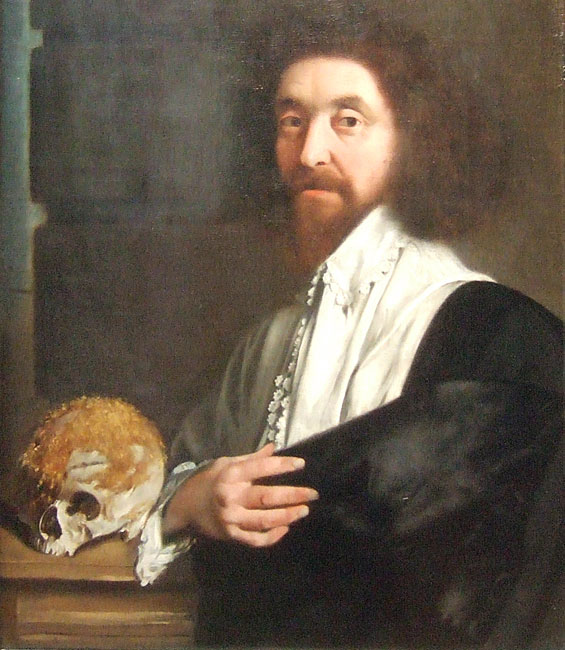
John Tradescant the younger Thomas de Critz 1652 Shared under Wiki Commons

But the tomb commemorates his son, also called John, (1608-1662)as well. It was his widow Hester who commissioned it after his death. They were married at St Mary’s and he succeeded his father as the Royal Gardener.  He also travelled widely to collect specimens. John Tradescant the younger  went to America for plants and seeds during the early 1600s and introduced trees such as magnolias, tulip trees and garden plants such as phlox and asters.

In addition, it celebrates four other family members including his father, his two daughters in laws, Jane Hurte (died 1634) and Hester Pookes (died 1678) and his grandson, another John, who died in 1652 in his late teens.  The Tradescant dynasty died out in 1678 with Hester’s death.
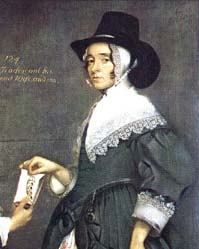
Hester Thomas Thomas de Critz, Ashmolean Museum, Oxford. Shared under Wiki Commons

The sarcophagus is made from hard sandstone and has suffered deterioration over the centuries and it would have originally been in St Mary’s churchyard.  The inscription on the tomb states that it was originally erected in 1662, repaired in 1773 and then restored in 1853 by the sculptor G P White. It’s an unusual tomb, not just because of its size, but in its carvings and enigmatic symbols. However, unusually for the time, there are no religious references on it except for the final lines of the inscription:

‘Angels shall with their trumpets waken men,

And fire shall purge the world, these three shall rise

And change this Garden then for Paradise.’

It’s an intriguing tomb and is a visible sign of the Tradescants standing and aspirations. Hester was asked to pay £50 to the Lambeth church wardens of the time towards the parish poor relief. This was the equivalent of 6 months wages for John as the Royal Gardener. And this was only for permission to site the tomb as everything else was extra.

But it’s the enigmatic carvings that attracted me to the Tradescant tomb and in Part 2 I will discuss these further. However, these are not the original carvings as after two restorations, in 1773 and 1853, the scenes and creatures depicted have subtly changed especially the Hydra sculpture.  

Part 2 – the carvings of the Tradescant tomb

©Text and photos Carole Tyrrell unless otherwise stated.

The Tradescant family tomb | cabinet (ox.ac.uk)

The Tradescants and their Tomb | The Gardens Trust

The Tradescants – Garden Museum

The spectacular Tradescant tomb: “a world of wonders in one closet shut” – Flickering Lamps

Garden Museum – celebrating British gardens and gardening

John Tradescant the Elder – Wikipedia

John Tradescant the Younger – Wikipedia

The Garden Museum: Trandescant Tomb | Londonist

The spectacular Tradescant tomb: “a world of wonders in one closet shut” – Flickering Lamps

Symbol of the Month – The Shrouded Cross

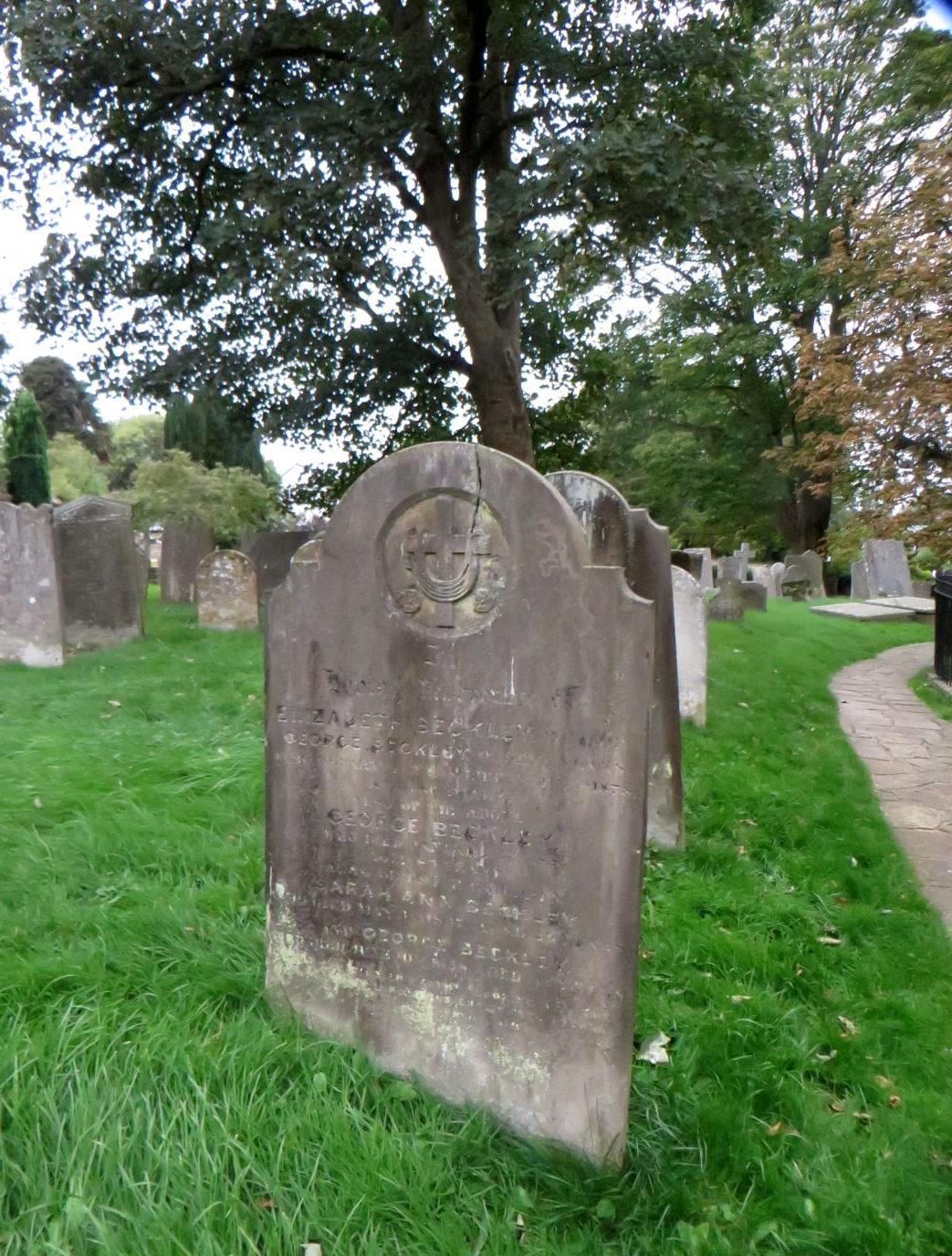
The Shrouded Cross on the family grave of the Beckley family, St Nicholas church, Sevenoaks
©Carole Tyrrell

This month’s symbol is a rare one and I discovered it in my local churchyard, St Nicholas in Sevenoaks. It’s on the grave of the Beckley family.

A draped cross in West Norwood Greek section.
©Carole Tyrrell

However, I have also previously seen crosses with real cloth draped on them in two big London cemeteries One was in the Greek Section of West Norwood.  At that time I thought that perhaps it was to commemorate an anniversary or a particular religious festival. However, during my research for this post. I have discovered that the colour of the   West Norwood cloth, white,  is associated with Easter Sunday.

As you can see from the above photo of the Beckley headstone, the cloth is wrapped loosely around the cross  and, according to my research, it’s a resurrection symbol.  In fact it’s known as the Resurrection Cross or the Shrouded Cross. Some of its other names are: the Draped Cross, the Empty Cross, the Risen Cross or the Deposition Cross. The latter is a further reminder of Christ’s descent from the cross

It’s intended to be a representation of Jesus no longer being on the cross. Although there are also plain crosses on graves unless they have the cloth they are not Resurrection crosses. The cloth is a supposed reference to Christ’s grave clothes or shroud that were found in the tomb after he rose from the dead. It emphasises to the bereaved left behind that death isn’t the end.

Within the church calendar, the cloth draped around a cross during important dates in the Christian calendar particularly Easter has special significance according the colours of the fabric. These are white, purple – the colour of royalty, and black.  The latter is used from Palm Sunday (the week prior to Easter) until Good Friday and denotes mourning after Christ’s death on the cross.

The shrouded cross on the Beckley headstone is a striking image which caught my attention and really stood out in a churchyard containing several headstones with fascinating symbols on them.

So this one may be an affirmation of faith on behalf of the deceased  or a strong belief in the afterlife with death being seen as the beginning of a new life.


©Text and photos Carole Tyrrell


References and further reading

https://www.seiyaku.com/customs/crosses/shrouded.html

http://www.thecemeteryclub.com/symbols.html

https://answers.yahoo.com/question/ind?qid=20170406140444AAUuXdc

Symbol of the Month   – The Cadaver tomb

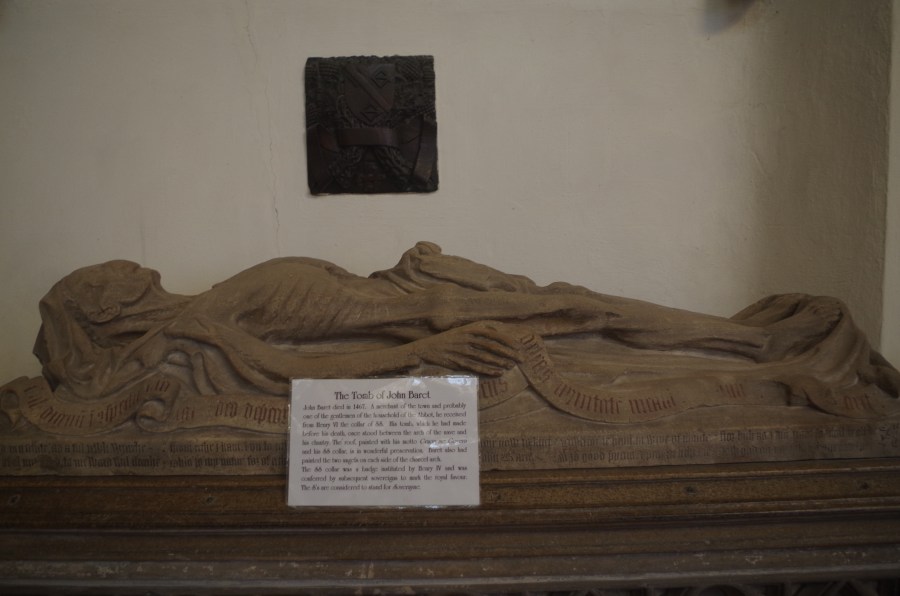
Full length view of John Benet’s cadaver tomb.
©Text and photos Carole Tyrrell

This month’s symbol is a cadaver or pardon tomb from St Mary’s in Bury St Edmunds.  These medieval tombs  were an extremely visual  way of reminding everyone that, despite what you had achieved during life, death would make you equal with all men.

It was as I stood in St Mary’s church, Bury St Edmunds after having  admired its magnificent hammerbeam with lifesize angels pinned to it like exotic butterflies that I saw John Benet’s tomb resting against a side wall.

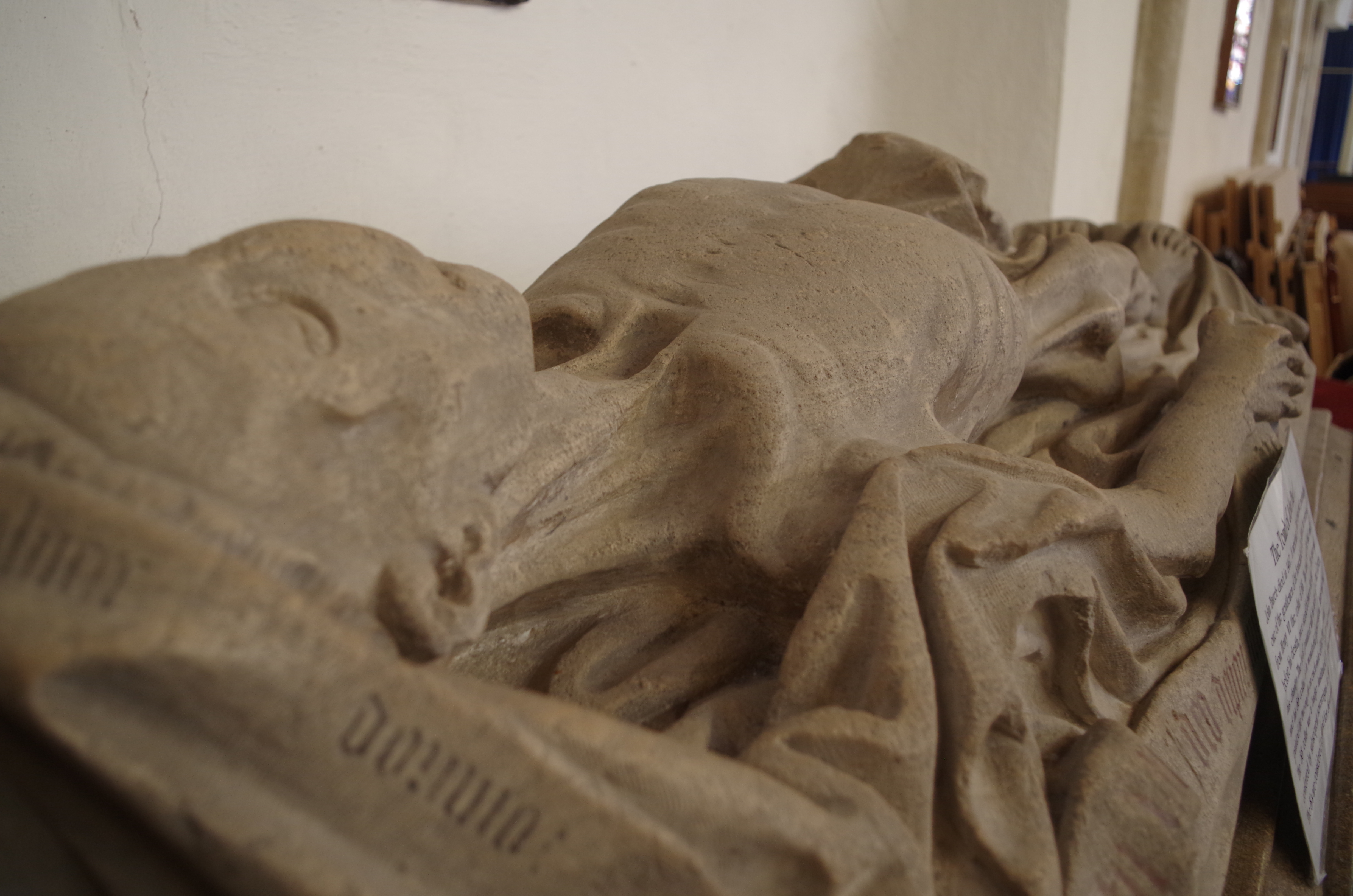
I’d seen two, somewhat worn, cadaver tombs in Winchester Cathedral but not one so close up and so well carved. Even now it’s still crisp and detailed but due to its current location it was difficult to take a full length photo. The tomb depicts John Benet lying on his back as a lifesize corpse with a shroud or towel protecting his modesty.

Another full length from the feet up of Benet’s cadaver tomb with the modesty cloth.
©Text and photos Carole Tyrrell

Although St Mary’s guidebook describes Benet’s tomb as a Pardon tomb, they are more often known as a transi or cadaver tomb.  This definition comes from Wikipedia who describe a transi or cadaver tomb, as a ‘memento mori’.  This is Latin for ‘remember you will die’ and a reminder of the inevitability of death.  Wiki goes onto add that this type of tomb is in the form of:

‘…a type of gisant or recumbent effigy tomb featuring an effigy in the macabre form of a decomposing corpse…’

This type of tomb is particularly associated with the Middle Ages which is roughly when Benet’s tomb was created and I’ve always known them as cadaver tombs. However, they’re not always in the form of a decomposing corpse as they can also be in the form of skeletons or the body of the deceased wrapped in a shroud. I am indebted to the flickeringlamps blog which featured transi tombs in the form of ‘double-deckers’.  This is where the top layer of the tomb portrays the gisant of the deceased as they were when alive and then below on the bottom layer as a decomposing corpse.  This is an extremely visual reminder of what the person once was and what they will inevitably become as earthly glory is fleeting and all must die.

Cadaver tombs can be found in several UK cathedrals and parish churches. The earliest surviving one is in Lincoln Cathedral and is dedicated to Richard Fleming. It dates from the 1430’s.  St Pauls’ cathedral has a later example from the 17th century which commemorates the poet John Donne.  Cadaver tombs are also known in Europe and particularly in Italy, France. Germany and the Netherlands.

But who was John Benet?

According to St Mary’s guidebook, John Benet was a medieval cloth trader and one of St Mary’s most important benefactors.  He financed the very ceiling that I’d been admiring and also his own private chancel chapel and tomb. Within his lifetime, Bury St Edmunds was a thriving town built on the local wool trade.  This led to the creation of a rising merchant class who were able to use their money to leave a lasting memorial to themselves in their local church as proof of their good and pious life.  Surely admittance to the Pearly Gates would be assured if you provided your church with some embellishments…. After they couldn’t take it with them but they could definitely prove that they’d had it while alive….

John Benet was a rich and powerful man within his local town  which is why he was able to afford to have a cadaver tomb made for him and one that was so well sculpted.   It originally lay in his own private chapel.  This has now gone but if you look up you can still see its glittering ceiling  which was restored in 1968.   You may just be fortunate enough to see the light glisten on the tiny pieces of concave mirror glass inserted into the gold stars to give the illusion of real stars twinkling.  Benet’s motto, ‘Grace me Governe’, his initials, coat of arms and SS collar are also part of the intricate decoration.  The latter, again from St Mary’s guidebook:

’….was a gift from the Lancastrian kings in recognition of a special or personal services.  It was in the form of a collar or chain in which the letter ‘S’ was engraved.  The letter ‘S’  which presumably stood for ‘Sovereign.’

The restored ceiling of what once was the ceiling of John Benet’s private chapel.
©Text and photos Carole Tyrrell

So Benet moved in high circles and wasn’t afraid to shout about it for all eternity.

There are Latin prayers on the ceiling’s edges which include ‘Pray for the soul of John Benet, ‘Let us praise the Lord gloriously’, Alleluia, Honour and glory to the only God.’, ‘My soul shall delight in the Lord’, ‘Seek only the highest’ and finally ‘May the pure Virgin Mary bless us with issue.’  Benet was not a man who stinted where his soul was concerned.

The tomb has moved around the church interior several times. But not of its own volition as far as I know. It has been surmised that the effigy of him portrayed as a decaying corpse was made during his lifetime.

Now there’s an  interior design feature for you…it would have been intended as a constant reminder of his own inevitable death and the need to make preparations for the afterlife. It’s in remarkable condition and is the best one that I’ve seen.  It may have been created in the  nearby Abbey’s master mason’s workshops.  This seems very likely given Benet’s powerful connections and the quality of the carving would also confirm this.

Originally he was positioned with his feet facing the east but, in 1884, the tomb was turned around so that the side inscription could be read.  In this, Benet’s motto is carved and a small figure of himself is in the middle of it, dressed in his finest clothes, and holding up the word ‘Me’.  Under one hand of the decaying corpse are the words:

‘He that will sadly beholde me with his ie, May he hyd own mirrour (and) lerne for to die. ‘

Full length view of John Benet’s cadaver tomb.
©Text and photos Carole Tyrrell

 A lifesize memento mori if you will. The guidebook, however, describes it as a Pardon Grave’ which isn’t a term that I’ve heard before. It’s meant to indicate that the person who was being commemorated has obtained a pardon or remission from purgatory.  Benet had also left instructions for his papal pardon to be displayed near his tomb for all to see.  I had the impression that Mr Benet was a bit of a show-off but if you don’t blow your own trumpet…. I sincerely hope that all this piety and expense achieved its aim.

The cadaver tomb iconography is based on the medieval Dance of Death or Danse Macabre.

Nobleman & Physician from the Lubeck Totentanz courtesy of UT Southwestern

This depicted a long line of people from Emperors to Popes right down to a beggar, each of whom had death in the form of a skeleton at their shoulder. This was a reminder that Death made all men equal.   The first one was recorded in St Paul’s Cathedral and in Long Melford, Suffolk, according to St Mary’s guidebook, long cloths were displayed depicting ‘the dance of Pauls’

It’s amazing that this survived the Reformation and Cromwell’s wrecking crews and still sits in St Mary’s reminding visitors of their inevitable fate.   But Mr Benet has a further claim to fame as, in 2003, he was loaned out to the Victoria and Albert Museum as part of their ‘Gothic: Art of England’ exhibition. Apparently, during conservation, traces of flesh coloured paint were discovered on the figure which included red and green veins especially in the neck.  So try and imagine Mr Benet in his original colouring – it must have quite a sight to see.    I think that he’d be very proud that his tomb, the hammerbeam ceiling and also his chapel ceiling are still in St Mary’s for all to enjoy and remember him.

©Text and photos Carole Tyrrell unless otherwise stated. 

References and further reading: 

St Mary’s, Bury St Edmunds A guidebook, Clive Paine, Honey Hill Publishing 1986.

Metamorphosis of a Death Symbol’ The Transi Tomb in the Late Middle Ages an d the Renaissance, Kathleen Cohen (Berkeley: University of California Press) 1973

https://flickeringlamps.com/2015/01/03/a-most-macabre-tomb-in-lincoln-cathedral/

https://en.wikipedia.org/wiki/Cadaver_tomb