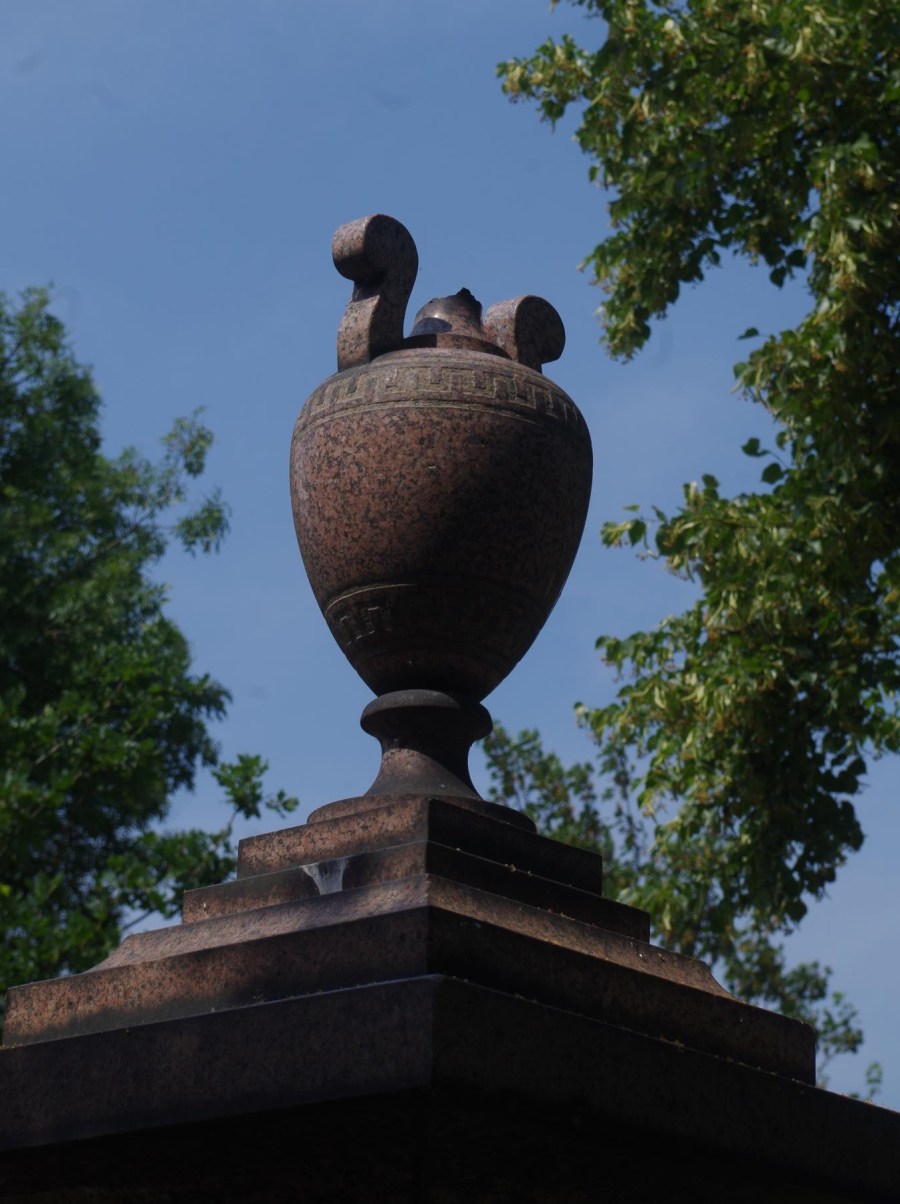
Symbol of the Month – The Urn

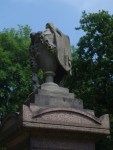
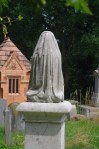
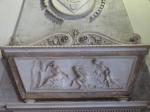
Another draped urn on the Richard Mosley monument, West Norwood.
©Carole Tyrrell

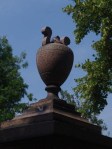
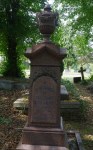
This month’s symbol is one that you frequently see in cemeteries. In fact, in most Victorian cemeteries you’re never more than a few steps from an urn… or two… or three……

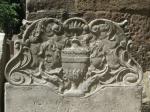
These elegant sculptures are usually placed on top of a monument or can appear in 2D relief on a tombstone.
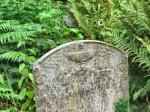
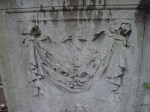
In marble, stone or plaster, they may also be draped with a sculpted piece of cloth or a flower garland. Urns may also have two handles, no handles or what looks like a lid to emphasise its use as a container. In Nunhead Cemetery there is a particularly elegant example with a lovely tassel on the sculpted drapery.

The Victorians loved urns which is why their cemeteries are clustered with them.  They are examples of the Classical movement which was very much in vogue at the time when these large municipal cemeteries were created.  This was an echo of the Greek and Roman eras but the urn as a funerary symbol was known long before them.  However, according to theartofmourning website:

‘…the word ‘urn’ comes from the Latin word ‘uro’ which  translates as ‘to burn’  so no matter what shape the vessel was, its title was always ‘urn’.

Urn was, therefore, the umbrella name for containers of ashes.  It may have been a small box or an elegant vase but as the above quotation says, it was always known as an urn.  Cremation was an early form of preparing the dead for burial as ancient civilisations cremated their dead and put the ashes into containers. In fact, some urns found in China have been dated to 7000BC.  In Central Europe there was what has been described as an Urnfield culture from 1300BC – 750BC which is due to the large cemeteries of urn burials that have been excavated.

The Greeks adopted the use of urns in around 1000BC and the scattering ashes blog has suggested that this may have been:

‘because of soldiers dying abroad in wars or campaigns abroad and this was the only way to return their bodies home to their loved ones.’

After the Greeks, the Romans used cremation as a method to bury the dead until it was superseded by interment within a sarcophagus. But, even then, the urn maintained its status as a symbol of death and the body’s decay into dust. A reminder that, ultimately, we will return to the dust from which we were originally created. So the urn is also a link to the ancient world and its burial practices However, there is an alternative theory put forward on the Lakewood cemetery website in which it’s suggested:

‘The urn is also a symbol of a house or dwelling.  When it’s draped this indicates a house of mourning.’

But, ironically, the Victorians weren’t all that enthusiastic about cremation, despite their love of urns,  until at least the late 1880’s. This is when it was introduced into large London cemeteries such as Kensal Green and West Norwood.

But why are some urns draped?  I often feel it’s almost as though the folds of the drapery are protecting the deceased from the world until Judgement Day although there’s nothing in the urns.   The artofmourning website considers it to be an indication of the death of an older person but I’m not sure that I’d agree with that due to its prevalence in Victorian cemeteries.
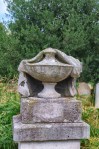
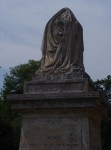
The draped cloth has also been seen as the division, the impenetrable curtain if you like, between life and death.  Some drapes can almost resemble shrouds and this can indicate that the soul has departed from the shrouded body.

The urn also appears as a popular motif in mourning jewellery and George Hepplewhite also used it as a symbol on neo classical influenced furniture. It was an indication of taste and of a classical education.

So the next time you’re in a Victorian cemetery why not try and count how many urns you can see or how many times a draped urn appears? It’s a simple symbol to sculpt with and calls down the millennia to our Prehistoric forefathers as they buried their dead in the same way that we do. The ones that I featured in this blog post nearly all came from West Norwood cemetery and were within a short distance of each other. I was spoilt for choice as to which ones I decided to feature.

And you’ll be pleased to know that I’ve managed to refrain by working in the classic Morecambe and Wise joke on a Greek urn….

©Text and photos Carole Tyrrell unless otherwise stated.

References:

https://artofmourning.com/2011/04/10/symbolism-sunday-the-urn/

https://artofmourning.com/2011/04/10/symbolism-sunday-the-urn/

https://www.lakewoodcemetery.org/styles-sculptures-symbolism

http://historyinstone.blogspot.com/2012/12/the-draped-urn.html

http://www.bbc.co.uk/london/content/articles/2005/05/10/victorian_memorial_symbols_feature.shtml

https://www.thoughtco.com/photo-gallery-of-cemetery-symbolism-4123061

https://symbolsproject.eu/explore/others/objects0/drapes-/-drapery/draped-urn.aspx

https://www.furniturelibrary.com/the-urn-logo-from-antiquity/


Eternally at rest amongst the sprouts and cabbages – a horse’s  tomb, Kelsey Park allotments


Patch’s plinth February 2017.
©Carole Tyrrell

My local allotments are very popular and there’s always half a dozen people working away and getting their hands dirty.  They’re watched closely by birds  looking for worms in the dug over soil before swooping down for their meal.   In summer the allotments burst forth with vegetables:  lines of runner beans, rows of cabbages , lettuces  and flowers and the occasional fox can be seen strolling through at dusk.

But, if you walk up the slope towards the chain link fence that divides the allotments   from the park, you’ll come to a large stone plinth at the top.  It nestles amongst the trees that have grown up around it.  On one end there is a sculpted swag containing roses for remembrance so it once had a farh more illustrious past.   I first saw the plinth from the other side of the fence while on the Kelsey park Woodland Trail looking for fungi to photograph.  I wondered what it was.   It was far too grand to be an allotment user’s display or flower pot stand. Maybe a small statue had been on top and had since disappeared as the empty pedestal was now in no man’s land. The plinth  has also puzzled and intrigued the casual passer-by, dog walker and jogger as they go past.  The local legend was that it marked the burial site of a horse which belonged to ‘one of the Burrell girls.’

But it wasn’t until I started researching this article that I managed to source a contemporary engraving of the plinth dating from the 1790’s which was entitled ‘Patch’s tomb’ that I had any evidence for the story. At last I had a name for the incumbent.  It looks very grand in the picture with an elegant urn on top which is being admired by a fashionably dressed gentleman with an equally well dressed couple nearby. The perspective looks a little strange as the tomb looks larger than the onlookers. This was a serious monument both in cost and the determination to remember Patch.  The location, on a small slope, was no idle choice and can be seen from the lakeside path 150 yards away below if you know where to look.  Trees and vegetation have grown up on the small hill obscuring the tomb so it’s much easier to see during the winter die-off.

PHLS_900 Patch’s Tomb Kelsey Park Beckenham 1790
©Bromley Historic Collections

The Burrells were a prominent, land-owning family in Beckenham during the 16th -19th centuries and some of their descendants are still in the area.   They have left a fine collection of monuments in the local church, St George’s.


The Burrells were also connected with Kelsey Park in Beckenham in that the site once formed part of Peter Burrell III’s 600 acre estate and it was a Burrell who built the first manor house there.  Confusingly, there were four Peter Burrells and, after exploring their various family lineage, I decided that one of Peter Burrell III’s four daughters was probably the most likely owner of Patch.  He also had a son who, strangely enough, became Peter Burrell IV but more of him later.  The third Peter Burrell (27/08/1724 – 06/11/1775) was a politician and barrister and in 1748 he married Elizabeth Lewis, daughter of John Lewis of Hackney.   There seem to be no pictures of him in existence and, instead,  photos of Paul Burrell, Princess Diana’s ex-butler popped up!

Peter Burrell III was called to the bar in 1749, became MP for Launceston in Cornwall 1759-1768 and then MP for Totnes in Devon from 1774 – 1752.  In 1769 Burrell was then appointed the Surveyor General of the Land Revenues  of the Crown.  So he was an ambitious man with considerable connections and wealth.  He was also involved with other prominent local land-owning families in Beckenham such as the Cators after whom  Cator Park is named.  Burrell’s estate in Beckenham is now buried under roads and desirable detached houses with large gardens. But there is a local road called Burrell Row after the family. Peter Burrell  I purchased the first Kelsey Park House and estate in 1690.  It was extended several times as can be seen in the 1790 watercolour and then became incorporated into the far grander, rambling Victorian Scottish baronial style mansion which replaced it.  The original house was a square, modest house which had several later additions.

The first Kelsey Park Manor House in the Georgian style. A square shape so easy to incorporate into the grander mansion that replaced it. This watercolour dates from 1790 and is the believed to be the earliest known picture of the Manor House which had been extended over the centuries. Friends of Kelsey Park newsletter Summer 2008

The four daughters were:

Elizabeth Amelia (1749-1837)      –            married a gentleman from Cambridgeshire.  Richard Henry Alexander Bennett

Isabella Susanna (1750 – 1812)    –             married Algernon Percy, Ist Earl of Beverley, ancestor to the Dukes of Northumberland

Frances Juliana (1752 – 1820)       –           In 1779 she married Hugh Percy, 2nd Duke of   Northumberland

Elizabeth Anne (1757 – 1837)        –              She married  twice – firstly to Douglas Hamilton, 8th Duke of  Hamilton and then secondly, to Henry Cecil, 1st Marquess of Exeter.

Marriages at that time were rarely for love but mainly for the joining of great houses, the exchange of land and also heirs. Frances had eleven children and Isabella had seven who all went onto more illustrious marriages and careers.

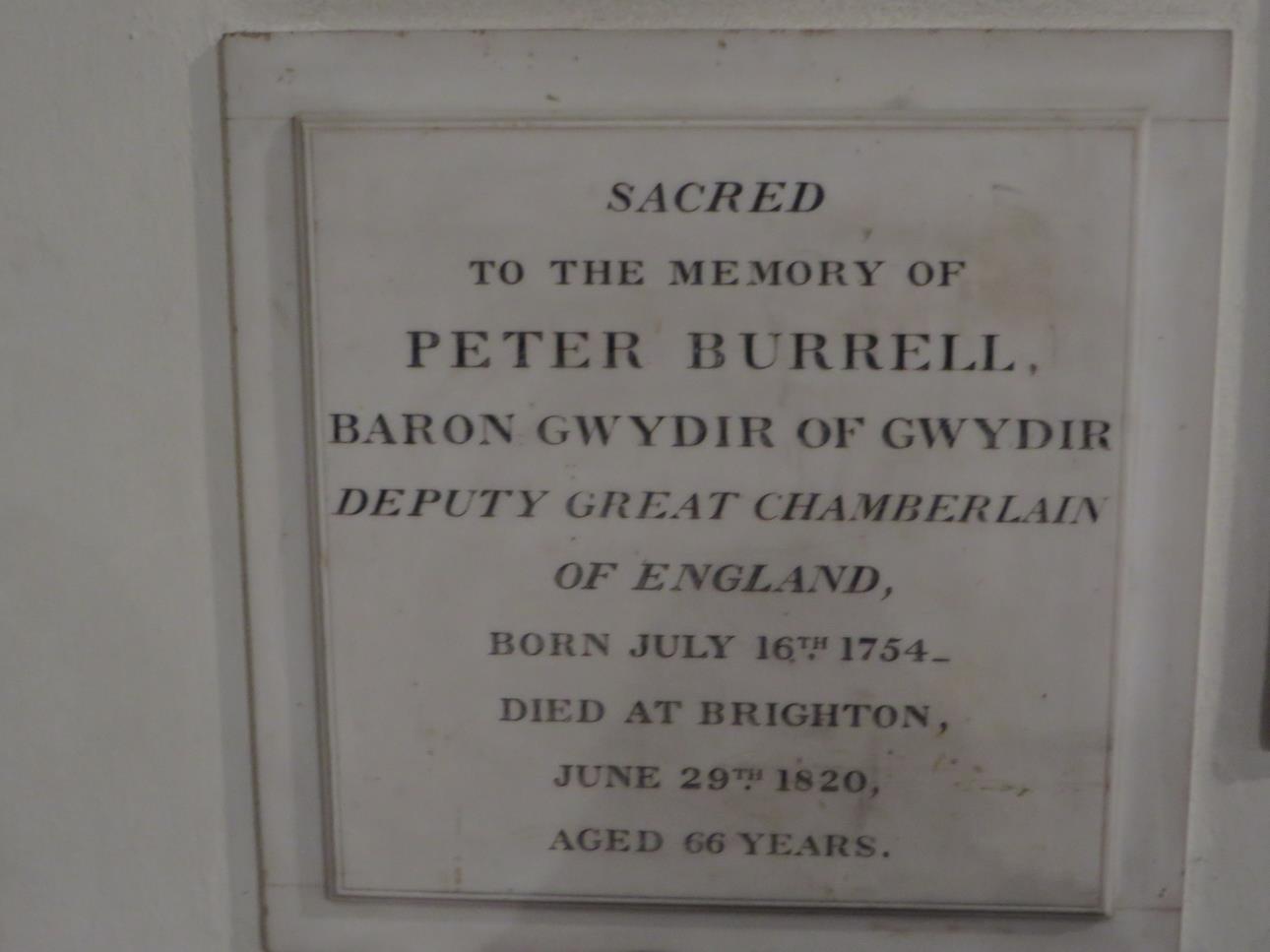
The Burrell girls seem to have been the ‘It’ girls of their day with their brilliant marriages into the aristocracy.  Peter Burrell IV, the son, achieved even more dizzying heights as he became the Lord Chamberlain of England and the 1st Baron Gwydir of Gwydir Castle.

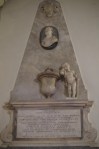
Peter Burrell IV’s memorial tablet, St George’s Beckenham. Very plain in comparison to the other Peter Burrells recorded here.
©Carole Tyrrell

But it’s the eldest one, Elizabeth Amelia, who may have been Patch’s owner. Peter Burrell III built a house for her on his Kelsey estate where she lived with her husband, Richard Bennett.   He was the MP for Newport from 1770-1774 but didn’t seem to have the same illustrious career as his father-in-law and the notes on his political career are brief.   Elizabeth would have seen Patch’s last resting place from the house every day of her life as a reminder.   I haven’t been able to find a picture of Elizabeth as it would have been interesting to see what she looked like.   There’s no clue on the contemporary engraving as to the architect of the tomb and I wondered if Burrell paid for it or did Elizabeth?

So was Patch a young girl’s pet or a teenager’s source of freedom? We’ll never know and I was unable to source any pictures of Patch. It may seem strange to us to lavish such attention and money on a horse’s memorial.  But in those days a horse almost certainly gave its owner a certain amount of freedom and independence.  An earlier form of horsepower and being a good horsewoman at the time was a major attribute.

I like to think that, maybe when Kelsey Park’s closed and the lights have all gone out in the surrounding houses and apartment blocks, a spectral galloping can be heard.  A passing badger or fox may prick up their ears at the sound as a young girl shouts ‘Hi, ho Patch and awaaay!’

©Text and photos Carole Tyrrell unless otherwise stated

http://www.beckenhamhistory.co.uk/locations/kelseyestate

http://boroughphotos.org/bromley/category/date/1700s/page/4/

http://www.nwkfhs.org.uk/nwkfhs-01-01.pdf

http://www.beckenhamhistory.co.uk/locations/kelseyestate

http://www.london24.com/beckenham_s_kelsey_park_prepares_to_mark_100_years_of_opening_to_the_public_1_2214063

http://www.london-footprints.co.uk/artbeckestates.htm

https://laurengilbertheyerwood.wordpress.com/2013/01/01/the-infamous-mrs-drummond-burrell/

Peter Burrell IIIhttp://www.historyofparliamentonline.org/volume/1754-1790/member/burrell-peter-iii-1754-1820

Peter Burrell II http://www.historyofparliamentonline.org/volume/1754-1790/member/burrell-peter-ii-1723-75

https://en.wikipedia.org/wiki/South_Sea_Company

http://www.beckenhamplaceparkfriends.org.uk/history.html

Isabella Burrell: https://www.geni.com/people/Susannah-Countess-of-Beverley/6000000006444764952

Elizabeth image https://www.wikitree.com/photo/jpg/Burrell-883

Elizabeth info https://www.wikitree.com/wiki/Burrell-1174

Richard Bennett info; https://en.wikipedia.org/wiki/Richard_Henry_Alexander_Bennet_(senior)

http://www.british-history.ac.uk/survey-kent/vol1/pp527-550