St Peter & St Paul’s, Boughton on Blean, Kent. copyright Carole Tyrrell.
Yes dear readers, It is 9 years to the day since I began shadowsflyaway on a wing and a prayer having no idea of how to do a blog but jumped in both feet first anyway. It’s been an interesting 9 years as I have explored the byways, churches, churchyards and cemeteries of Kent and London’s cemeteries looking for symbols.
However, I never know what to expect when I open a church door. For a start, will it be open? And what awaits? Tiptoeing past champers still asleep – these are people camping out overnight in a church. Being dazzled by a glittering pavement of medieval brasses at St Mary Magdalene, Cobham or a brass sign on a wall at St Peter & St Paul at Headcorn from Philadelphia commemorating that their ancestors had originated from the village. I love exploring churchyards and so far the oldest markers I have found dated back to the medieval period.
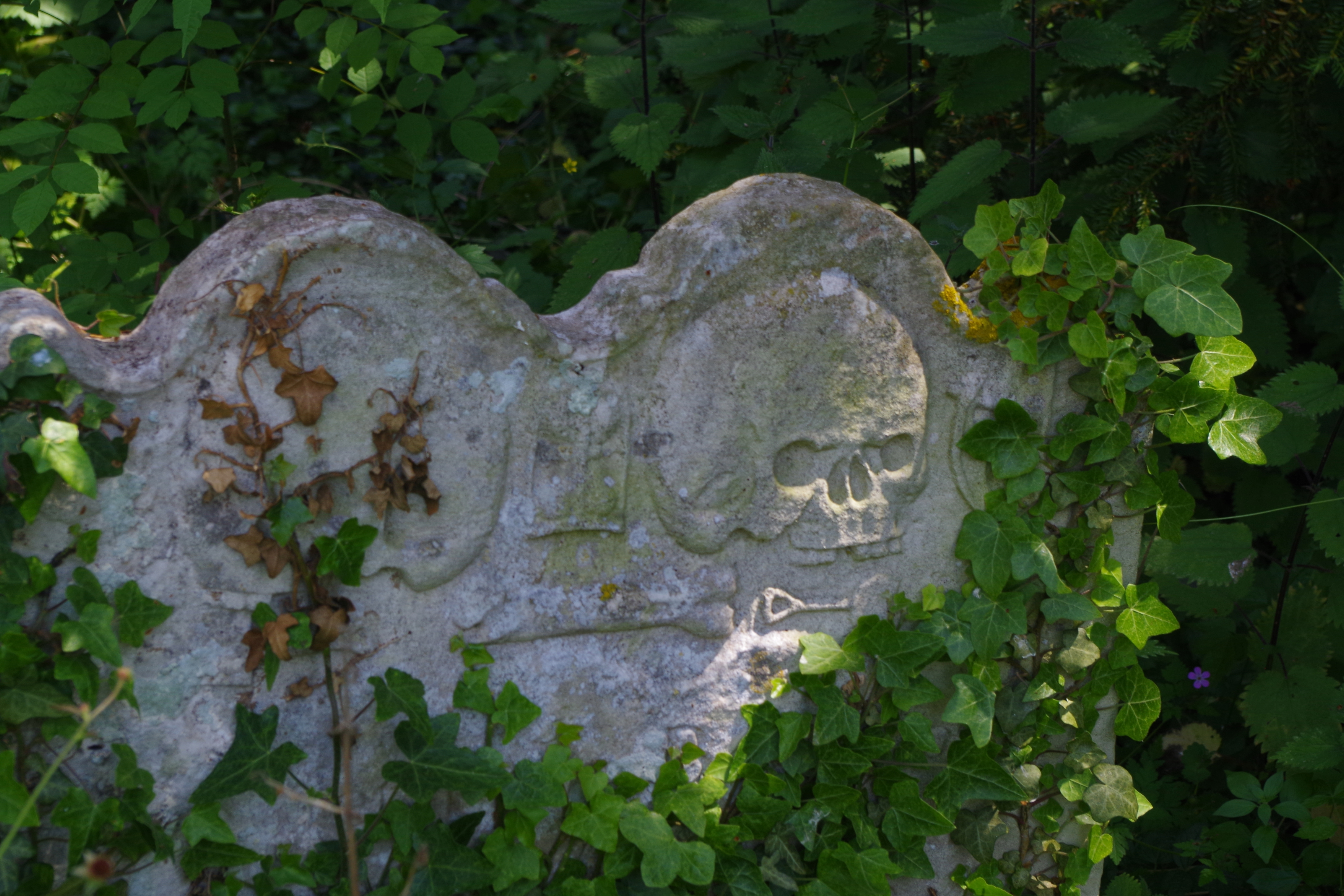
The headstone on the card above was the happy result of being misdirected by a passing dog walker. I was looking for St Mary the Virgin in Selling Kent. It was in the middle of nowhere as was St Peter and St Paul’s in Boughton in Blean. A lot of Kent churches are in isolated spots but it keeps me fit. I tramped past hop fields and a few houses here and there and then found it on top of a small hill, its surrounding churchyard almost climbing up to the church. It was as pretty a churchyard as you could wish to find with some ancient tombstones poking up through the vegetation which was part of ‘God’s Own Acre’, an initiative to leave churchyards unmown to encourage wildlife. I ate my lunch overlooking hop fields.
I found this one under a tree. If you look closely you may be able to see an hourglass, a long bone and a spade as in the close-up below.
St Peter & St Paul’s, Boughton on Blean, Kent. copyright Carole Tyrrell
There is a corpse road nearby situated on the golf course so I am determined to find it as I’ve never walked on one. These were for transporting bodies, often from remote communities, to cemeteries that had burial rights such as parish churches and chapels of ease. The roads have long fallen out of use but may have just have become footpaths. But this is the first time I may have a chance to walk on one. There are many legends associated with them involving ghosts and spirits and the living were not supposed to walk on the pathway of the dead.
So here’s to 9 years of shadowsflyaway – thank you to my readers for your company! I really appreciate your likes and comments and let’s look forward to 2025 when shadowsflyaway will be 10 years old.
Text and photos copyright Carole Tyrrell unless otherwise stated
It was the drawings made by Wenceslaus Hollar for Samuel Pepys (see above) that were used as guidance for the recarving of the reliefs in 1773 and 1853. These allow the viewer to see what the tomb originally looked like and to compare them with the changes that successive sculptors have made. For example, G P White in 1853 seemed to have his own interpretation of the hydra.
But, as you might imagine with pollution and the London atmosphere, the tomb being outside and at the mercy of the elements, the carvings have deteriorated and changed over the centuries. As the gardentrust.blog says:
‘The casual viewer is not seeing the original carvings. As it was outside in what would have originally been the churchyard, the elements soon did their work. The tomb was so badly damaged by 1773 that a public subscription was raised for its restoration. Lambeth Archives still have the ledger that recorded the donations.
But in 1853, 70 years later, the public funded a further restoration. It was the sculptor G P White who undertook this restoration.’
The 1853 restoration cost £110. The Victorians were enthusiastic restorers, perhaps too enthusiastic in some ways.
At one end of the tomb is a coat of arms which comprises of three fleur de lys on a diagonal bar and with a lion holding up its paw. A helmet with a closed visor is meant to be a sign of gentility and is topped with the crest of another fleur de lys and 2 wings. However, the Tradescants had no official grant from the College of Arms and may just have adopted it as a ‘rising’ family. It was a standard item on a monument and is the most conventional symbol.
At the other end, the west end, is a fearsome looking hydra which is a mythical ancient Greek creature associated with the 10 Labours of Hercules. It lived in the murky waters of Lake Lerna which was reputed to be the entrance to the underworld. Each time one of the hydra’s heads were cut off , two more would grow in its place so it was a deadly enemy. The hydra in the Pepys drawings is almost friendly and certainly non threatening whereas the 1853 version, carved in high relief, is much more dramatic with its bat like wings, female breasts., seven bird like heads and a long forked reptilian tail.
There were other changes as well and the gardenstrust.blog commented on the skull in the lower part of the panel.
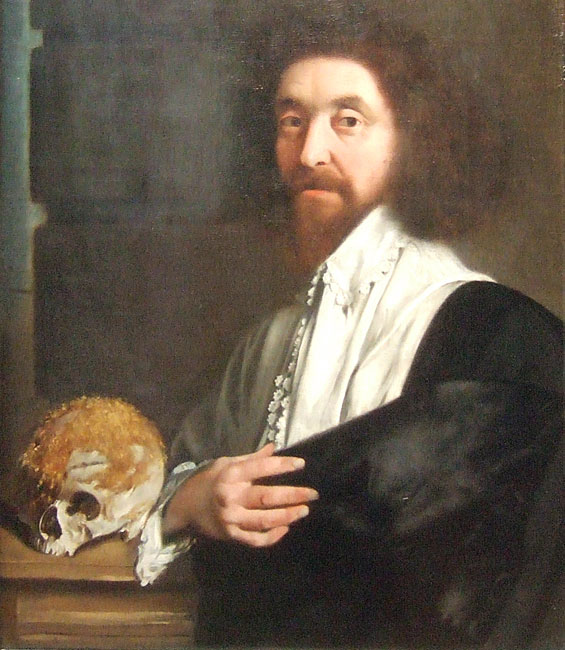
‘It lacks the lower jaw and is presumably the same one that appears in the younger John’s portrait where it is covered with skull moss, much sought after as a powerful medicine.’
This portrait appears in Part 1. The significance of the skull may be a reminder of vanitas paintings which flourished during the 16th and 17th centuries and came from the Netherlands. They often featured a skull and invited the viewer to ponder on the fleeting quality of life.
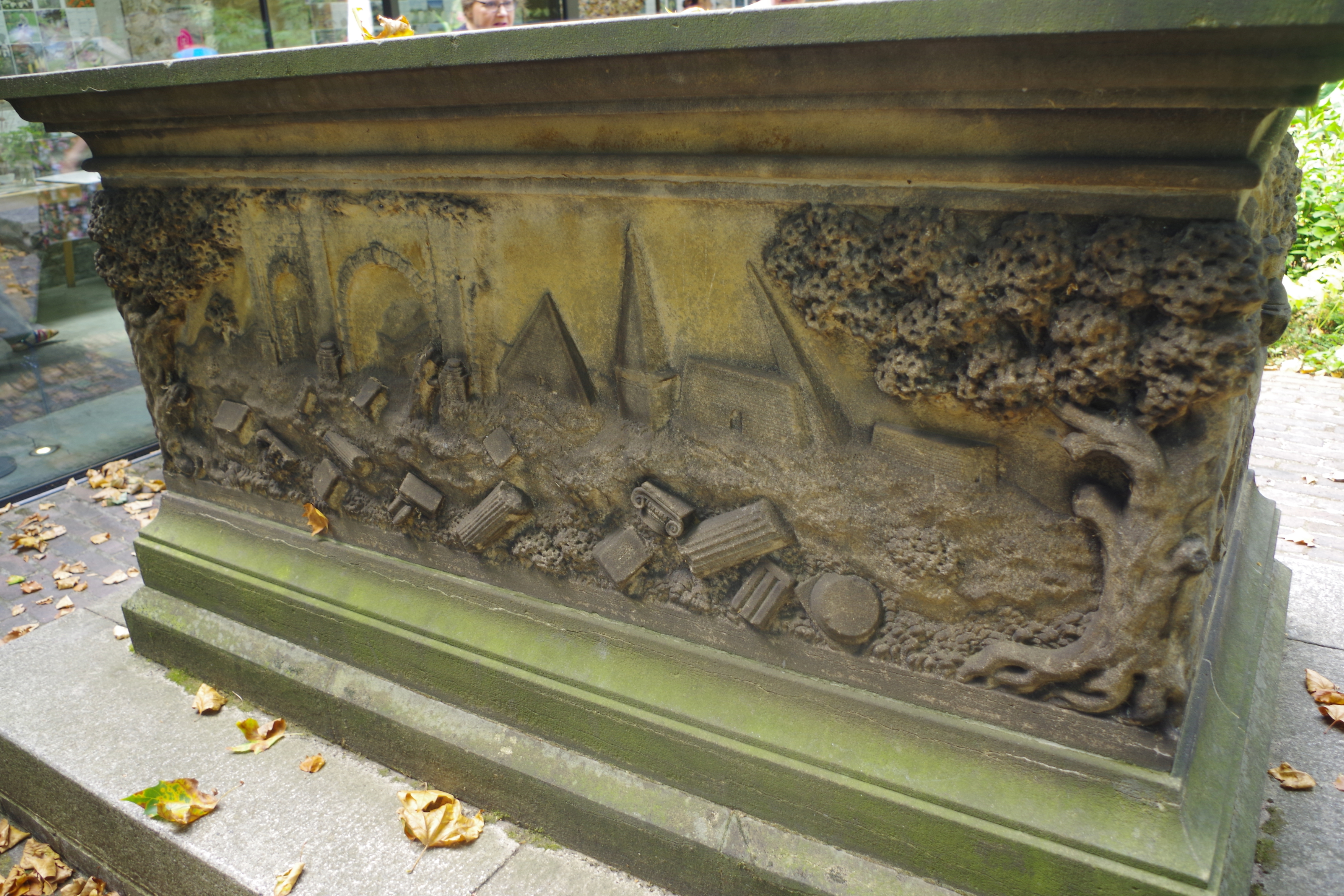
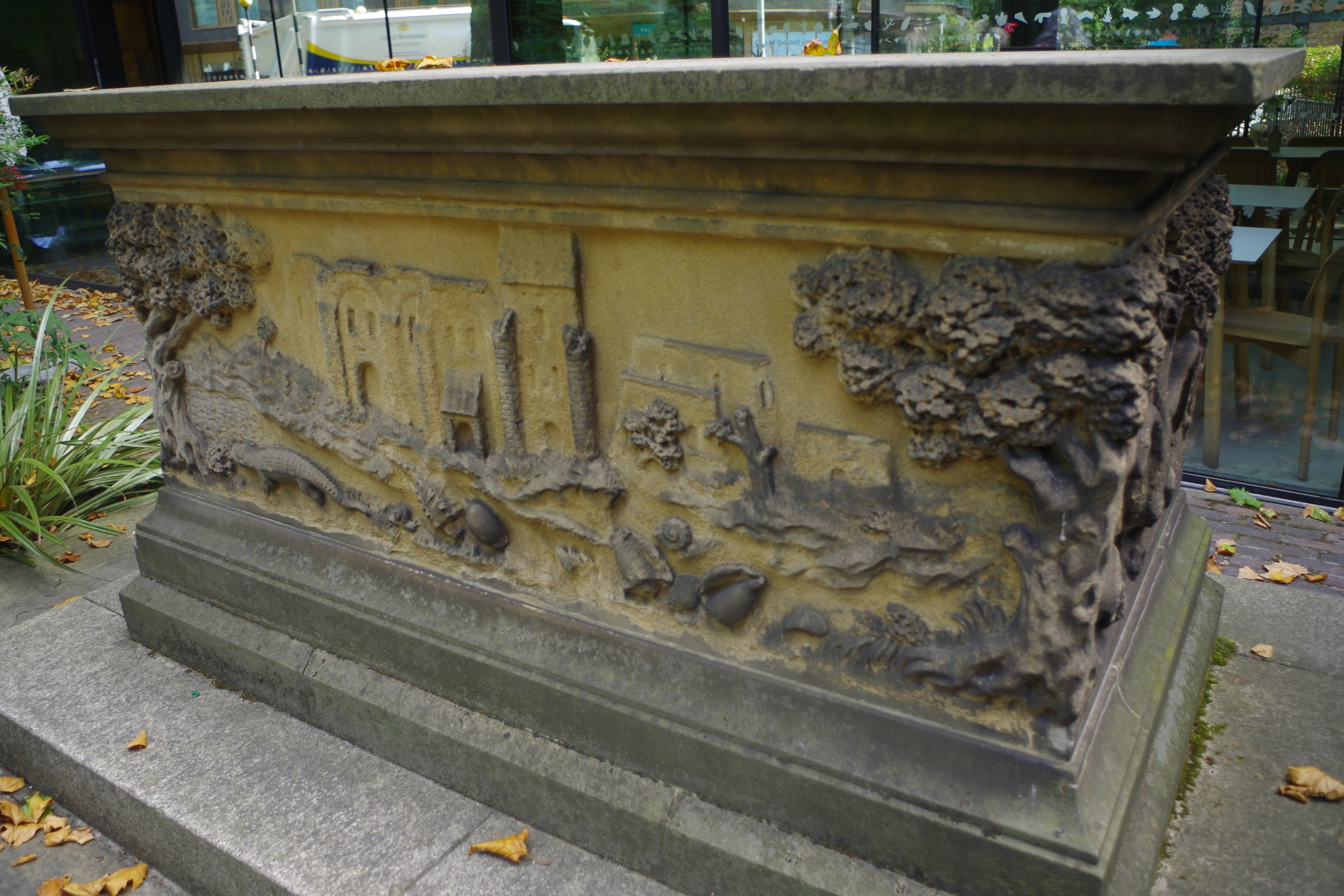
‘ruined buildings in the background and architectural detritus in the foreground together with a crocodile and shells and fossils. The corners are formed by gnarled and stunted trees with heavy foliage.’Cabinet.ox.ac.uk
The depiction of the ruins have been debated as the restorations may have changed their appearance. They have been described as Egyptian or Greek with obelisks and a pyramid amongst others. There are also fragments of Corinthian capitals. The shells may refer to specimens that were in the Tradescant collection and the large reptile in the lower part of the north panel could refer to the ‘Crocodile from Aegypt’ that was listed in the exhibits of the ‘Ark.’ It was also seen as a symbol of the early modern culture of collecting as seen in the oldest depiction of a ‘cabinet of curiosities’, the museum of Ferrente Imperato.
In order to link all the sides of the tomb together, the mason carved a set of large trees in deep relief. They hold up the ledger with its epitaph:
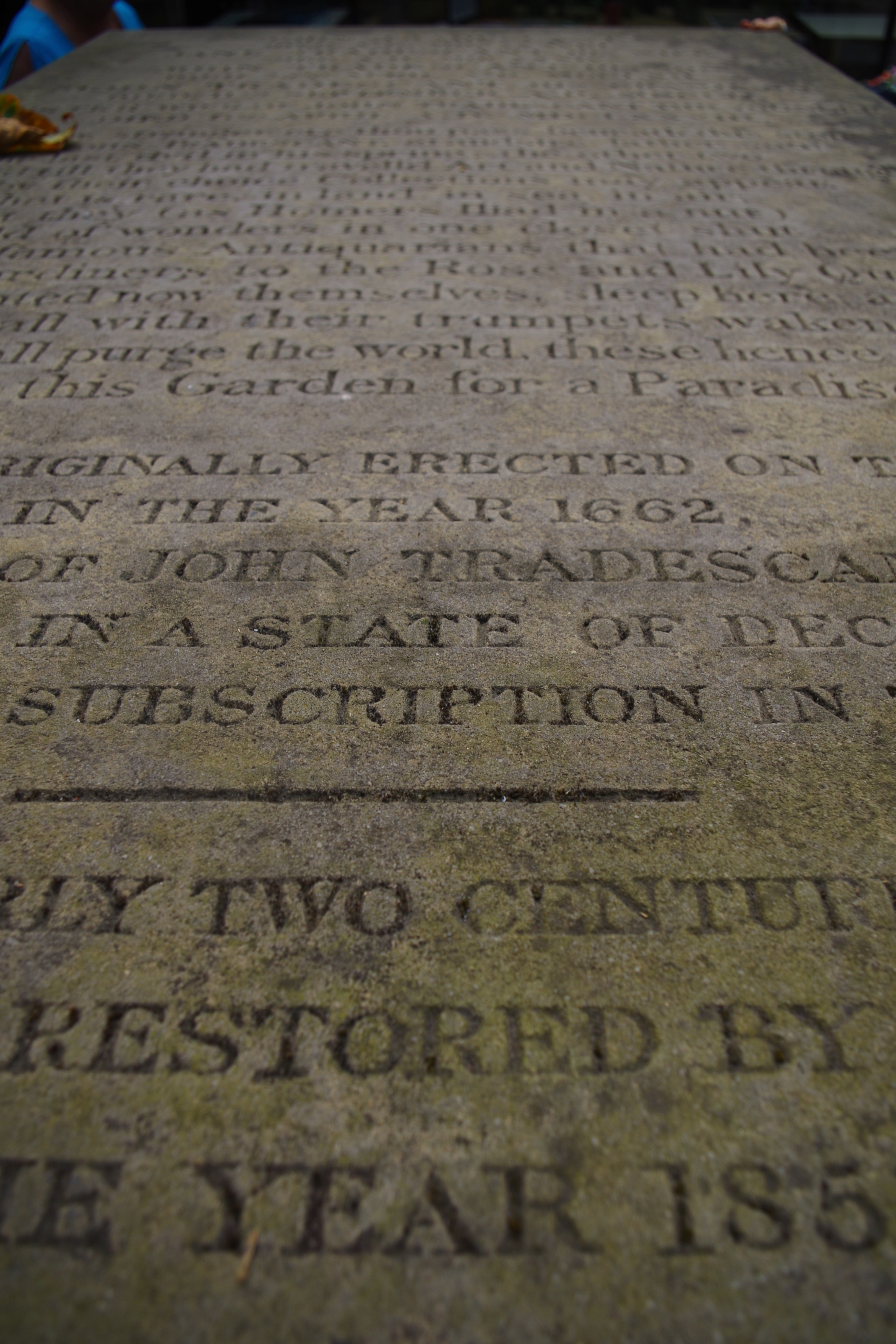
‘Know, stranger, ere thou pass, beneath this stone Lie John Tradescant, grandsire, father, son The last dy’d in his spring, the other two, Liv’d till they had travelled Art and Nature through, As by their choice Collections may appear, Of what is rare in land, in sea, in air, Whilst they (as Homer’s Iliad in a nut) A world of wonders in one closet shut, These famous Antiquarians that had been Both Gardeners to the Rose and Lily Queen,* Transplanted now themselves, sleep here & when Angels shall with their trumpets waken men, And fire shall purge the world, these three shall rise And change this Garden then for Paradise.’
It has been suggested that the line ‘A world of wonders in one closet shut’ may refer to the Ark.
Despite the changes to the carvings, the Tradescant tomb is a magnificent survivor with five members of the family being commemorated. The enigmatic carvings, the epitaph and one woman’s determination have all added to the legendary Tradescant reputation. It’s a real sight to see and there are other interesting memorials in the ex-churchyard as well. For example, there is one dedicated to Admiral Bligh of Mutiny on the Bounty fame and there is a wonderful ouroboros on another, the Sealy family monument.
A large, ancient chest tomb is not what you expect to see from the window of a central London restaurant. However, I’d seen pictures of it before and, for me, a dedicated Symbols enthusiast, it was the icing on the cake while enjoying a fantastic meal.
It is the Tradescant tomb and it sits in the courtyard of The Garden Museum in Lambeth which is housed within the deconsecrated church of St Mary at Lambeth. The Museum was founded in 1977 by Rosemary Nicholson in order to preserve the tomb. She and her husband saved St Mary’s from demolition and it is the second oldest structure within the borough of Lambeth. A church has existed on the site for over 950 years.
John Tradescant the elder attributed to Cornelis de Neve (1668-1665) Shared under Wiki Commons
John Tradescant the elder (1570-1638) is one of the most important figures in English gardening and he founded a dynasty of horticultural experts. In 1623 he became head gardener to royal favourite George Villiers, 1st Duke of Buckingham. After his assassination Tradescant became keeper of his Majesty’s Gardens, Vines and Silkworms at his queen’s minor palace in Oatlands Place, Surrey in 1630. He was the Royal Gardener at the court of Charles 1st and worked with his wife, Queen Henrietta Maria. In search of new plants, he travelled widely including trips to the Arctic which was no mean feat at the time. He even took part in an expedition to Algeria to fight Barbary pirates! One of the earliest records of him is a letter that he wrote while on a journey to the Netherlands, to buy plants for the 1st Earl of Salisbury’s garden at Hatfield House. He seems to have been a man possessed of indefatigable energy. In 1629 he moved to Lambeth near where the Museum is now situated and created the first museum in Britain to be open to the public. It was known as the ‘Ark’ and was formed from his own collection of natural history and ethnography.
John Tradescant the younger Thomas de Critz 1652 Shared under Wiki Commons
But the tomb commemorates his son, also called John, (1608-1662)as well. It was his widow Hester who commissioned it after his death. They were married at St Mary’s and he succeeded his father as the Royal Gardener. He also travelled widely to collect specimens. John Tradescant the younger went to America for plants and seeds during the early 1600s and introduced trees such as magnolias, tulip trees and garden plants such as phlox and asters.
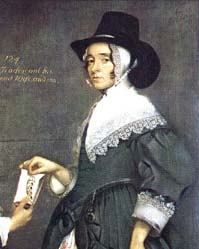
In addition, it celebrates four other family members including his father, his two daughters in laws, Jane Hurte (died 1634) and Hester Pookes (died 1678) and his grandson, another John, who died in 1652 in his late teens. The Tradescant dynasty died out in 1678 with Hester’s death.
Hester Thomas Thomas de Critz, Ashmolean Museum, Oxford. Shared under Wiki Commons
The sarcophagus is made from hard sandstone and has suffered deterioration over the centuries and it would have originally been in St Mary’s churchyard. The inscription on the tomb states that it was originally erected in 1662, repaired in 1773 and then restored in 1853 by the sculptor G P White. It’s an unusual tomb, not just because of its size, but in its carvings and enigmatic symbols. However, unusually for the time, there are no religious references on it except for the final lines of the inscription:
‘Angels shall with their trumpets waken men,
And fire shall purge the world, these three shall rise
And change this Garden then for Paradise.’
It’s an intriguing tomb and is a visible sign of the Tradescants standing and aspirations. Hester was asked to pay £50 to the Lambeth church wardens of the time towards the parish poor relief. This was the equivalent of 6 months wages for John as the Royal Gardener. And this was only for permission to site the tomb as everything else was extra.
But it’s the enigmatic carvings that attracted me to the Tradescant tomb and in Part 2 I will discuss these further. However, these are not the original carvings as after two restorations, in 1773 and 1853, the scenes and creatures depicted have subtly changed especially the Hydra sculpture.







 shadows fly away