

The Tradescant tomb, The Garden Museum, London. © Carole Tyrrell
A large, ancient chest tomb is not what you expect to see from the window of a central London restaurant. However, I’d seen pictures of it before and, for me, a dedicated Symbols enthusiast, it was the icing on the cake while enjoying a fantastic meal.
It is the Tradescant tomb and it sits in the courtyard of The Garden Museum in Lambeth which is housed within the deconsecrated church of St Mary at Lambeth. The Museum was founded in 1977 by Rosemary Nicholson in order to preserve the tomb. She and her husband saved St Mary’s from demolition and it is the second oldest structure within the borough of Lambeth. A church has existed on the site for over 950 years.

John Tradescant the elder attributed to Cornelis de Neve (1668-1665) Shared under Wiki Commons
John Tradescant the elder (1570-1638) is one of the most important figures in English gardening and he founded a dynasty of horticultural experts. In 1623 he became head gardener to royal favourite George Villiers, 1st Duke of Buckingham. After his assassination Tradescant became keeper of his Majesty’s Gardens, Vines and Silkworms at his queen’s minor palace in Oatlands Place, Surrey in 1630. He was the Royal Gardener at the court of Charles 1st and worked with his wife, Queen Henrietta Maria. In search of new plants, he travelled widely including trips to the Arctic which was no mean feat at the time. He even took part in an expedition to Algeria to fight Barbary pirates! One of the earliest records of him is a letter that he wrote while on a journey to the Netherlands, to buy plants for the 1st Earl of Salisbury’s garden at Hatfield House. He seems to have been a man possessed of indefatigable energy. In 1629 he moved to Lambeth near where the Museum is now situated and created the first museum in Britain to be open to the public. It was known as the ‘Ark’ and was formed from his own collection of natural history and ethnography.
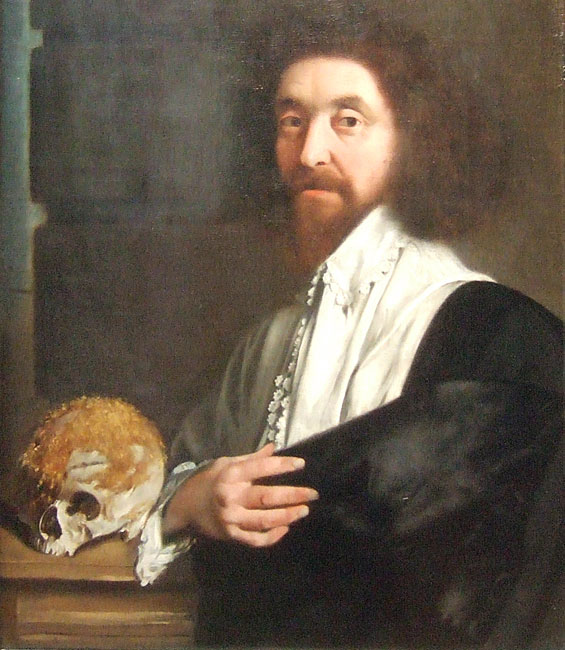
John Tradescant the younger Thomas de Critz 1652 Shared under Wiki Commons
But the tomb commemorates his son, also called John, (1608-1662)as well. It was his widow Hester who commissioned it after his death. They were married at St Mary’s and he succeeded his father as the Royal Gardener. He also travelled widely to collect specimens. John Tradescant the younger went to America for plants and seeds during the early 1600s and introduced trees such as magnolias, tulip trees and garden plants such as phlox and asters.
In addition, it celebrates four other family members including his father, his two daughters in laws, Jane Hurte (died 1634) and Hester Pookes (died 1678) and his grandson, another John, who died in 1652 in his late teens. The Tradescant dynasty died out in 1678 with Hester’s death.
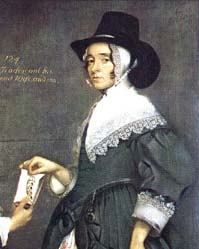
Hester Thomas Thomas de Critz, Ashmolean Museum, Oxford. Shared under Wiki Commons
The sarcophagus is made from hard sandstone and has suffered deterioration over the centuries and it would have originally been in St Mary’s churchyard. The inscription on the tomb states that it was originally erected in 1662, repaired in 1773 and then restored in 1853 by the sculptor G P White. It’s an unusual tomb, not just because of its size, but in its carvings and enigmatic symbols. However, unusually for the time, there are no religious references on it except for the final lines of the inscription:
‘Angels shall with their trumpets waken men,
And fire shall purge the world, these three shall rise
And change this Garden then for Paradise.’
It’s an intriguing tomb and is a visible sign of the Tradescants standing and aspirations. Hester was asked to pay £50 to the Lambeth church wardens of the time towards the parish poor relief. This was the equivalent of 6 months wages for John as the Royal Gardener. And this was only for permission to site the tomb as everything else was extra.
But it’s the enigmatic carvings that attracted me to the Tradescant tomb and in Part 2 I will discuss these further. However, these are not the original carvings as after two restorations, in 1773 and 1853, the scenes and creatures depicted have subtly changed especially the Hydra sculpture.
Part 2 – the carvings of the Tradescant tomb
©Text and photos Carole Tyrrell unless otherwise stated.
The Tradescant family tomb | cabinet (ox.ac.uk)
The Tradescants and their Tomb | The Gardens Trust
The Tradescants – Garden Museum
The spectacular Tradescant tomb: “a world of wonders in one closet shut” – Flickering Lamps
Garden Museum – celebrating British gardens and gardening
John Tradescant the Elder – Wikipedia
John Tradescant the Younger – Wikipedia
The Garden Museum: Trandescant Tomb | Londonist
The spectacular Tradescant tomb: “a world of wonders in one closet shut” – Flickering Lamps
 shadows fly away
The history nerd in me really enjoyed geeking out on this post as it is also relevant to my own novel WIP’s time period (btw, do you happen to know on which side of the Reformation fence Tradescants elder and younger sat?).
Meanwhile, there is a minor editorial correction you need to make: it should be ‘daughters in law’, not ‘daughter in laws’, because the subject is the plural rather than the qualifier (trust me, I’m an editor).
LikeLike
Hi Jane
That’s an interesting question as their prominent position within the Royal Court may have protected them. I will do some digging and see if I can find anything more. Thank you for pointing out the correction as well. Glad you enjoyed the post.
Best wishes
Carole
LikeLike
Dear Jane
Apologies for taking a while to reply re the Tradescants religious faith – it appears that they were Anglicans.
Best wishes
Carole
LikeLike