
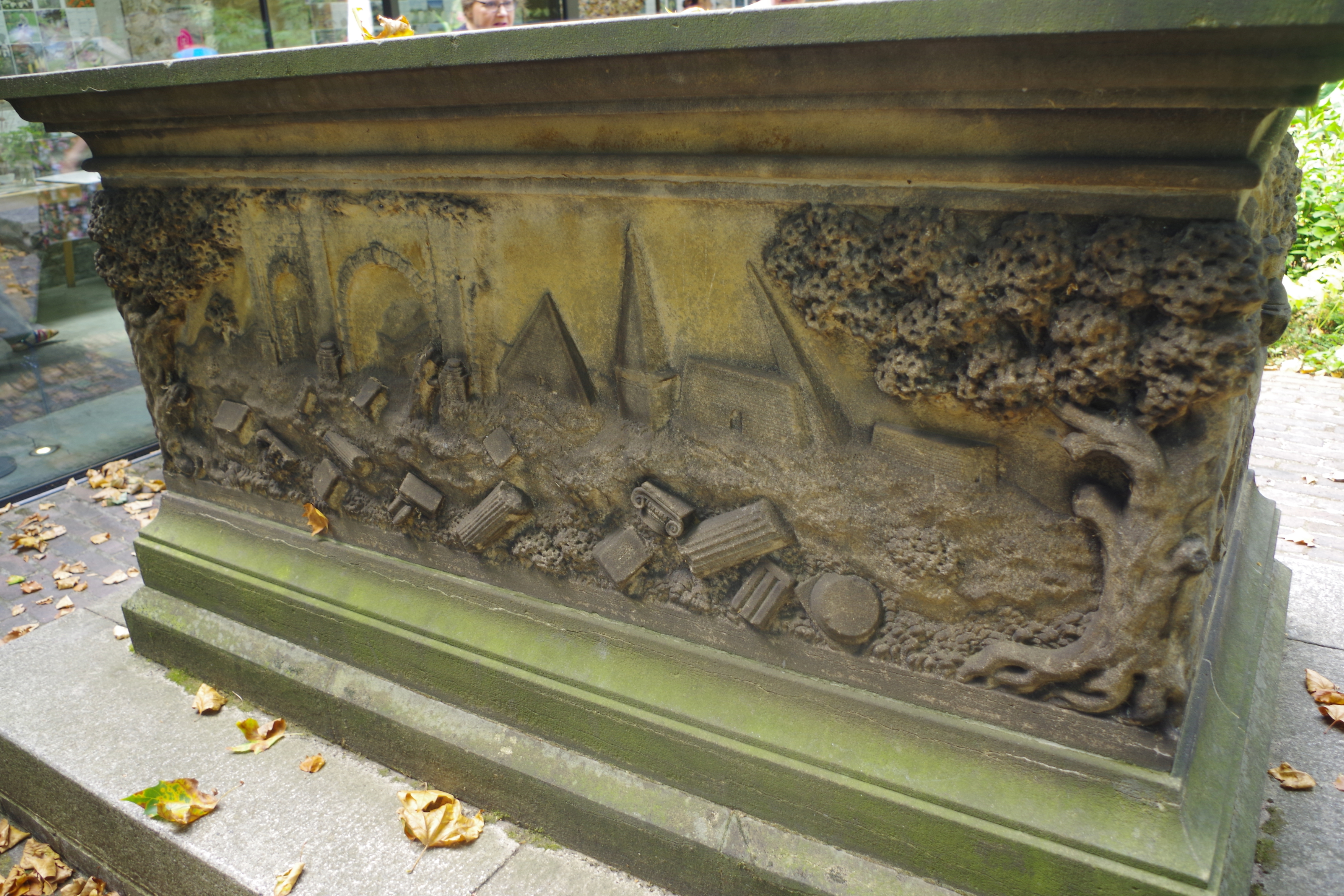
The north side of the tomb showing ruined buildings and discarded architectural features © Carole Tyrrell

It was the drawings made by Wenceslaus Hollar for Samuel Pepys (see above) that were used as guidance for the recarving of the reliefs in 1773 and 1853. These allow the viewer to see what the tomb originally looked like and to compare them with the changes that successive sculptors have made. For example, G P White in 1853 seemed to have his own interpretation of the hydra.
But, as you might imagine with pollution and the London atmosphere, the tomb being outside and at the mercy of the elements, the carvings have deteriorated and changed over the centuries. As the gardentrust.blog says:
‘The casual viewer is not seeing the original carvings. As it was outside in what would have originally been the churchyard, the elements soon did their work. The tomb was so badly damaged by 1773 that a public subscription was raised for its restoration. Lambeth Archives still have the ledger that recorded the donations.
But in 1853, 70 years later, the public funded a further restoration. It was the sculptor G P White who undertook this restoration.’
The 1853 restoration cost £110. The Victorians were enthusiastic restorers, perhaps too enthusiastic in some ways.

The East end of the tomb. © Carole Tyrrell
At one end of the tomb is a coat of arms which comprises of three fleur de lys on a diagonal bar and with a lion holding up its paw. A helmet with a closed visor is meant to be a sign of gentility and is topped with the crest of another fleur de lys and 2 wings. However, the Tradescants had no official grant from the College of Arms and may just have adopted it as a ‘rising’ family. It was a standard item on a monument and is the most conventional symbol.

The west face of the sarcophagus. © Carole Tyrrell
At the other end, the west end, is a fearsome looking hydra which is a mythical ancient Greek creature associated with the 10 Labours of Hercules. It lived in the murky waters of Lake Lerna which was reputed to be the entrance to the underworld. Each time one of the hydra’s heads were cut off , two more would grow in its place so it was a deadly enemy. The hydra in the Pepys drawings is almost friendly and certainly non threatening whereas the 1853 version, carved in high relief, is much more dramatic with its bat like wings, female breasts., seven bird like heads and a long forked reptilian tail.
There were other changes as well and the gardenstrust.blog commented on the skull in the lower part of the panel.
‘It lacks the lower jaw and is presumably the same one that appears in the younger John’s portrait where it is covered with skull moss, much sought after as a powerful medicine.’
This portrait appears in Part 1. The significance of the skull may be a reminder of vanitas paintings which flourished during the 16th and 17th centuries and came from the Netherlands. They often featured a skull and invited the viewer to ponder on the fleeting quality of life.

The north side of the tomb. © Carole Tyrrell
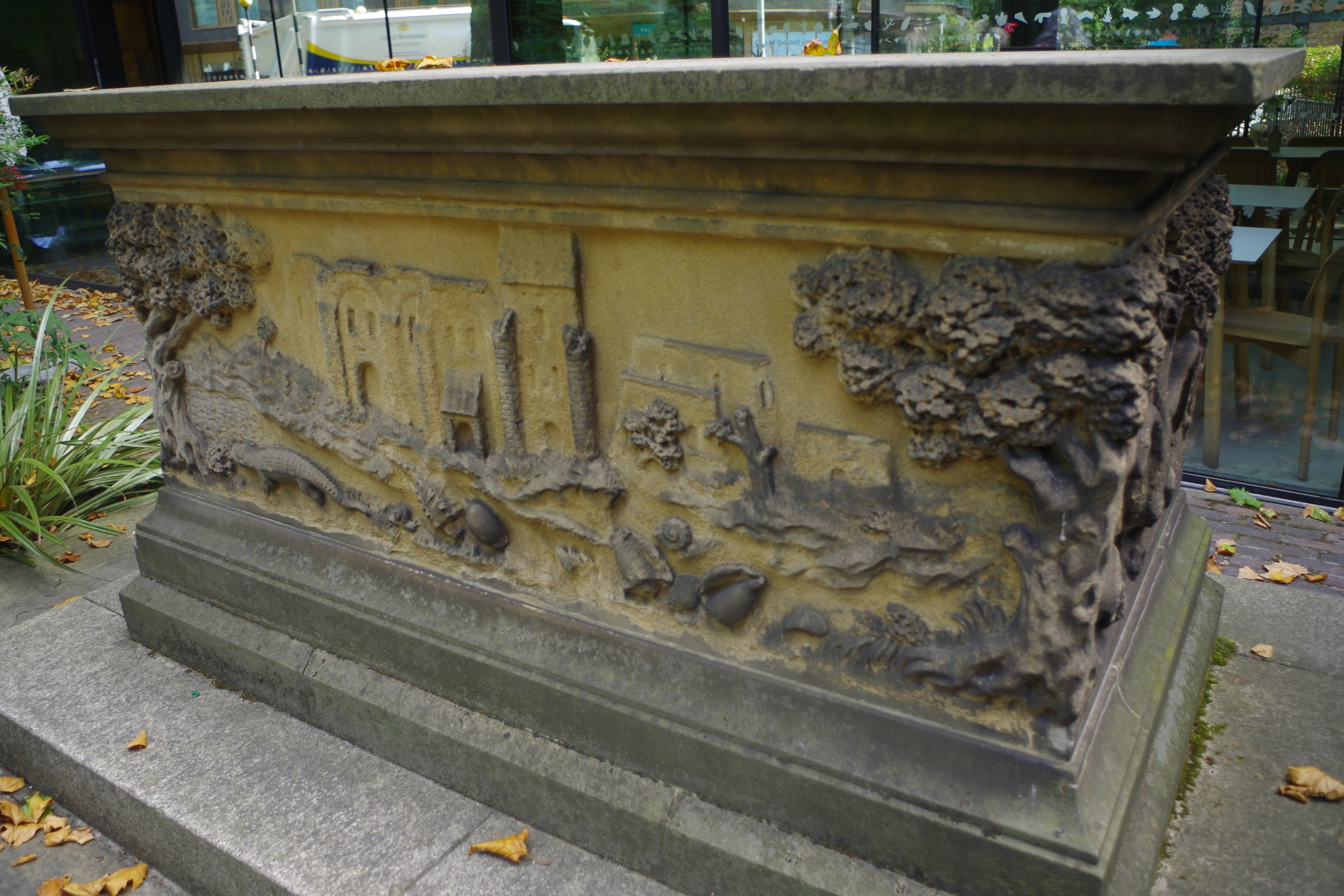
The south side of the tomb. © Carole Tyrrell
The longer north and south sides depict:
‘ruined buildings in the background and architectural detritus in the foreground together with a crocodile and shells and fossils. The corners are formed by gnarled and stunted trees with heavy foliage.’ Cabinet.ox.ac.uk
The depiction of the ruins have been debated as the restorations may have changed their appearance. They have been described as Egyptian or Greek with obelisks and a pyramid amongst others. There are also fragments of Corinthian capitals. The shells may refer to specimens that were in the Tradescant collection and the large reptile in the lower part of the north panel could refer to the ‘Crocodile from Aegypt’ that was listed in the exhibits of the ‘Ark.’ It was also seen as a symbol of the early modern culture of collecting as seen in the oldest depiction of a ‘cabinet of curiosities’, the museum of Ferrente Imperato.

Detail showing one of the trees that appear on each of the tomb’s corners.© Carole Tyrrell
In order to link all the sides of the tomb together, the mason carved a set of large trees in deep relief. They hold up the ledger with its epitaph:
‘Know, stranger, ere thou pass, beneath this stone
Lie John Tradescant, grandsire, father, son
The last dy’d in his spring, the other two,
Liv’d till they had travelled Art and Nature through,
As by their choice Collections may appear,
Of what is rare in land, in sea, in air,
Whilst they (as Homer’s Iliad in a nut)
A world of wonders in one closet shut,
These famous Antiquarians that had been
Both Gardeners to the Rose and Lily Queen,*
Transplanted now themselves, sleep here & when
Angels shall with their trumpets waken men,
And fire shall purge the world, these three shall rise
And change this Garden then for Paradise.’
It has been suggested that the line ‘A world of wonders in one closet shut’ may refer to the Ark.
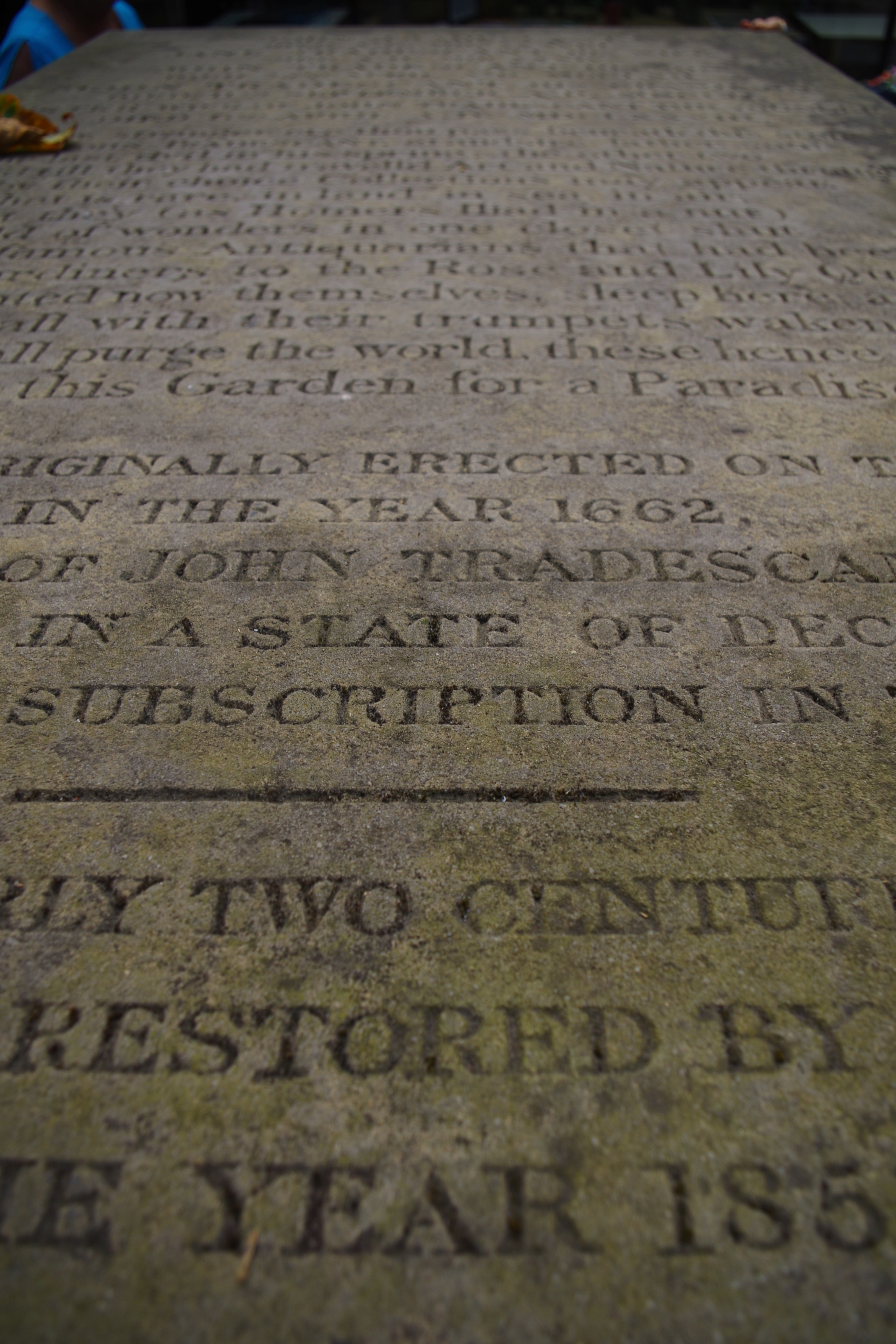
A section of the epitaph on the Tradescant tomb. ©Carole Tyrrell
Despite the changes to the carvings, the Tradescant tomb is a magnificent survivor with five members of the family being commemorated. The enigmatic carvings, the epitaph and one woman’s determination have all added to the legendary Tradescant reputation. It’s a real sight to see and there are other interesting memorials in the ex-churchyard as well. For example, there is one dedicated to Admiral Bligh of Mutiny on the Bounty fame and there is a wonderful ouroboros on another, the Sealy family monument.
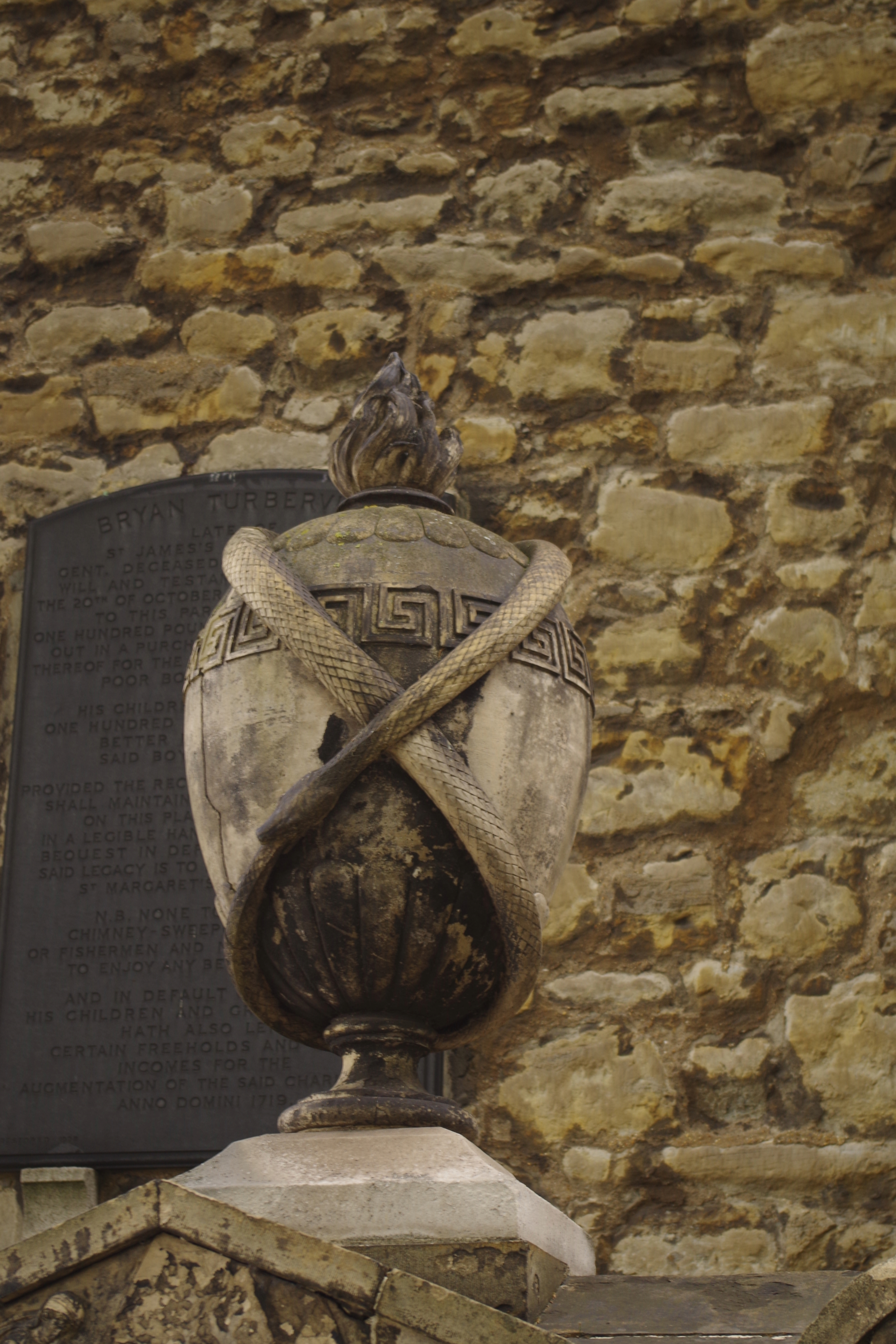
The elegant ouroboros on the Sealy monument topped by an eternal flame. © Carole Tyrrell
The Sealy family had connections with Eleanor Coade, the inventor of Coade or artificial stone and the monument is made from it.
Inside the museum there are several memorials on its walls and some fine skulls. Well worth a visit if you’re in the area.
©Text and photos Carole Tyrrell unless otherwise stated.
The Tradescant family tomb | cabinet (ox.ac.uk)
The Tradescants and their Tomb | The Gardens Trust( a lot more information on the Tradescants and the tomb)
The Tradescants – Garden Museum
The spectacular Tradescant tomb: “a world of wonders in one closet shut” – Flickering Lamps
Garden Museum – celebrating British gardens and gardening
John Tradescant the Elder – Wikipedia
John Tradescant the Younger – Wikipedia
The Garden Museum: Trandescant Tomb | Londonist
The spectacular Tradescant tomb: “a world of wonders in one closet shut” – Flickering Lamps
 shadows fly away