
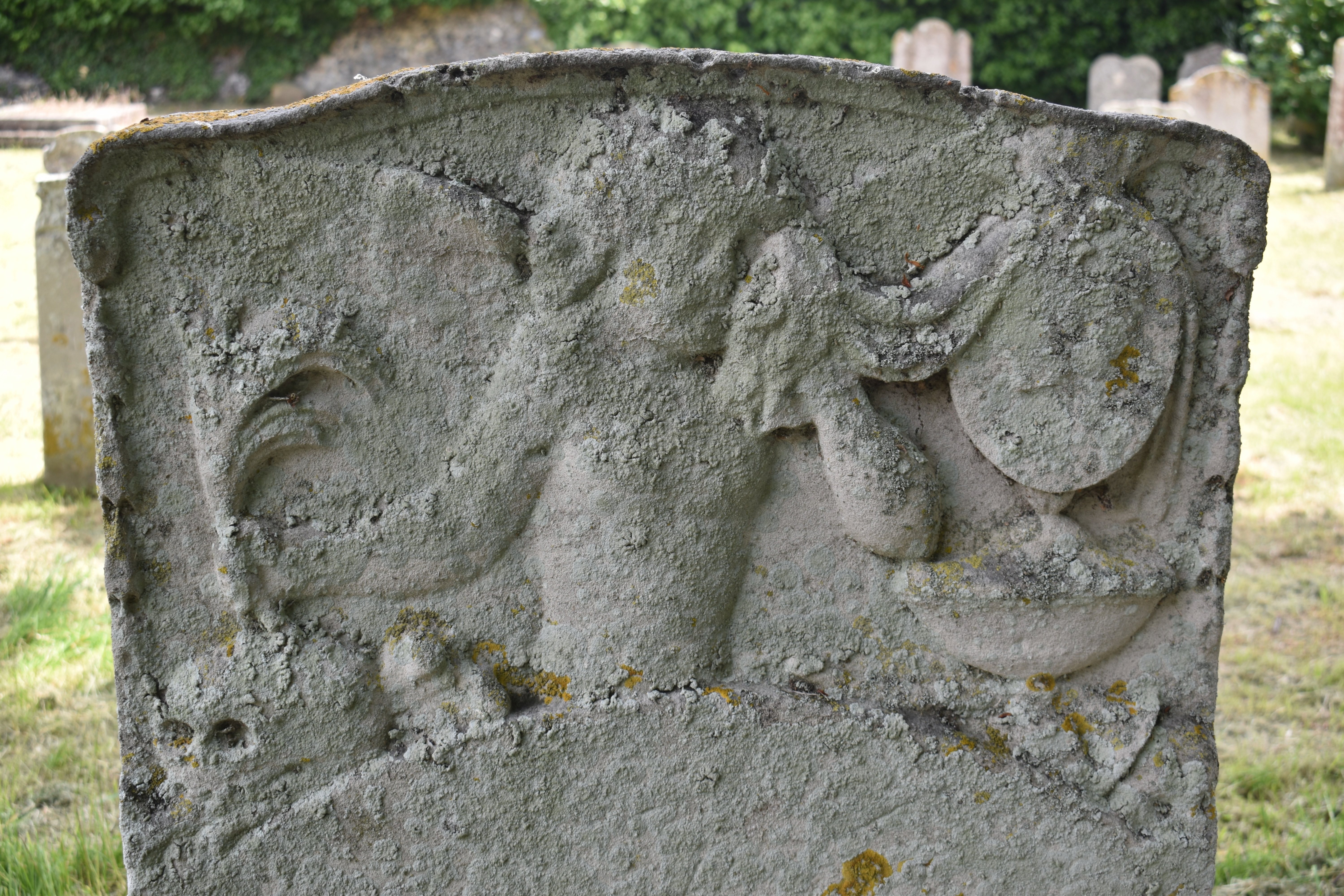
The weeping cherub, St John the Evangelist, Margate. © Carole Tyrrell
I was visiting Margate on the Kent coast and, after a paddle in the glittering sea, followed a sign that pointed the way to the 14th century church of St John the Evangelist. It was an interesting churchyard with some fascinating headstones including this one. It depicts a weeping cherub, but, despite weathering by the elements, the figure can still be seen clearly but sadly the epitaph is illegible.
It’s carved in 3D relief and shows a male cherub with its wings behind him, dabbing his eyes with a piece of cloth draped over an oval tablet. I think I can just about see a head carved on it which is presumably the deceased. This surmounts an urn in the classical style which appears to be on a plinth.
On the other side the figure holds what appears to be a either a bunch of flowers or palm leaves which are on top of a human skull with its lower jaw missing. There may be bones protruding from underneath the skull but it’s a little difficult to be sure.
It must have been very impressive when first carved and it’s testament to the stonemason’s skills that so much of it has survived. Despite there being no readable epitaph, I would estimate that this dates back to the 18th century. The church itself was closed on my visit so I couldn’t enquire further.
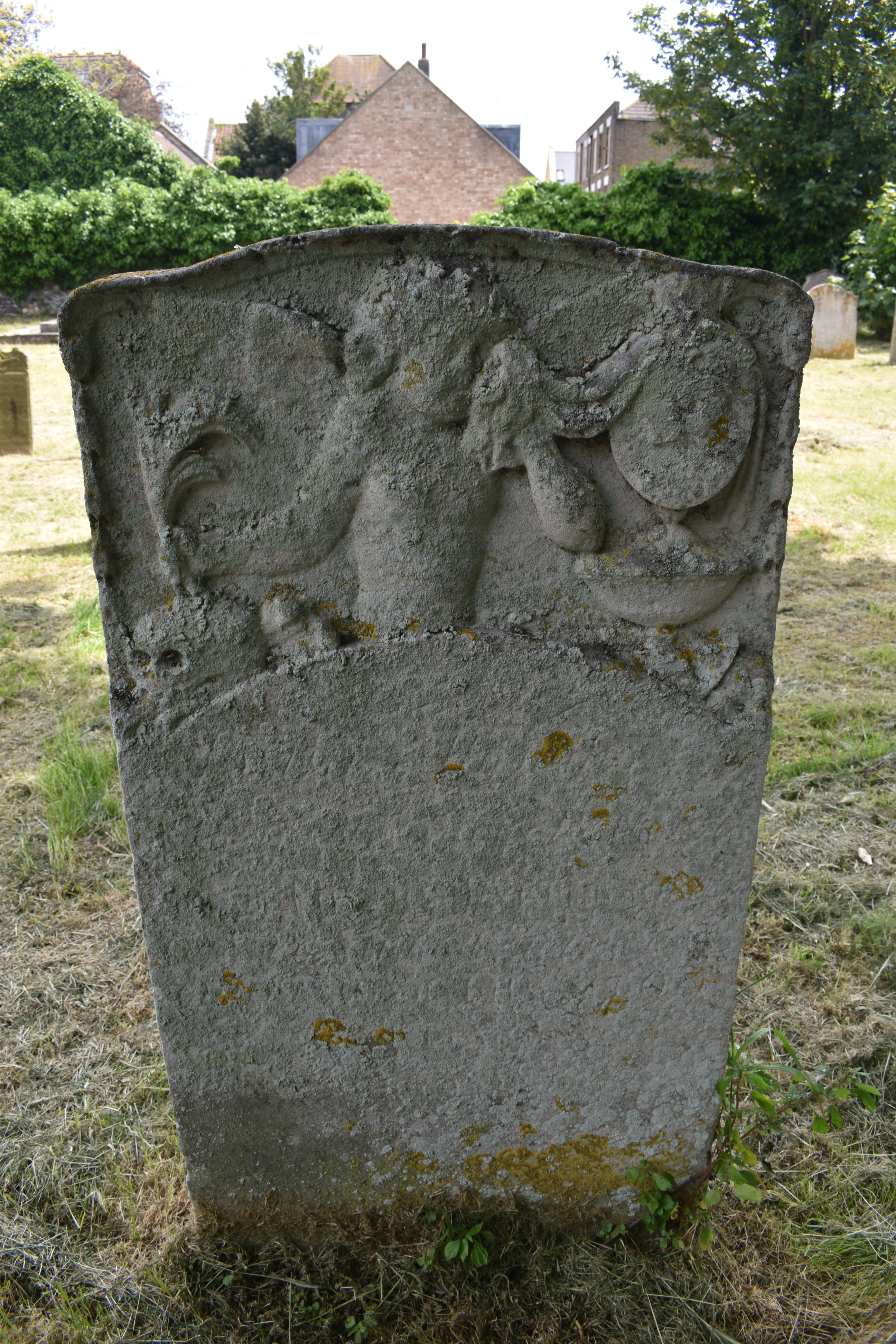
Full view of headstone, St John the Evangelist. © Carole Tyrrell
This is an unusual symbol to find in a churchyard as weeping cherubs are generally found inside a church and not outside. For example,this is a fine example from St Mary and All Saints in Amersham and is on the monument to Elizabeth Drake who dies young in 1757 aged only 32. She appears in a carved panel praying with her six surviving children and two deceased children. The weeping cherub sits alongside a sarcophagus on a shelf and is using a piece of cloth draped over his head to dry his tears.
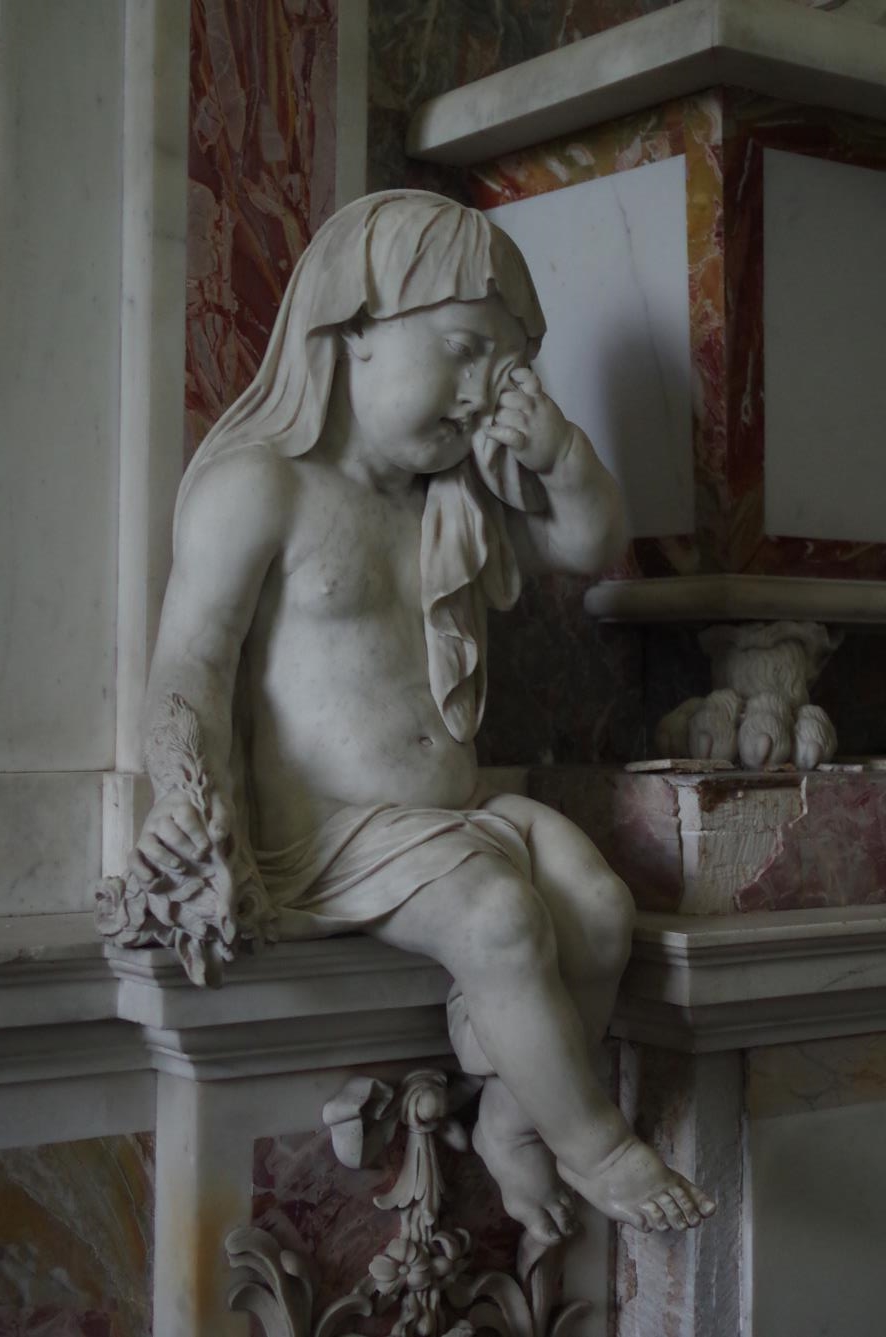
Weeping cherub at St Mary’s Amersham, on Elizabeth Drake monument. ©Carole Tyrrell
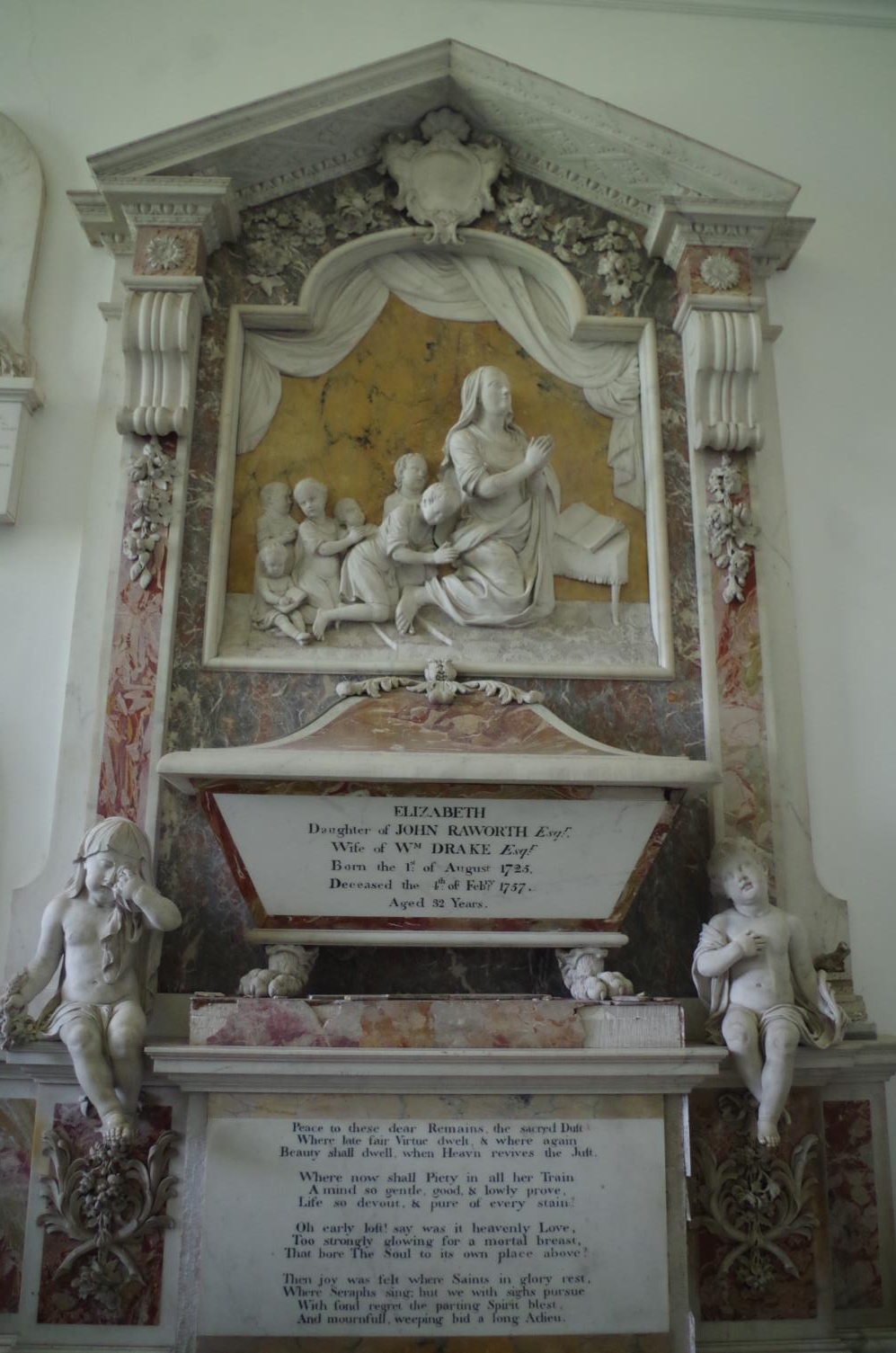
Elizabeth Drake monument in full view. ©Carole Tyrrell
The other one is in All Saints Herstmonceux and he stands on a freestanding short pillar sorrowing with an agonised expression over an urn, again in the classical style, which is partly draped with a piece of cloth and one hand is on a garland of roses. Beside the urn there seems to be a flaming torch on its side. Please follow link to view the photos:
Herstmonceux – All Saints’ Church | Weeping Putto/Cherub, le… | Flickr
Others can be found in St Stephen’s Norwich, St John the Evangelist in Burford and All Saints Church, Spetchley on the tomb of Robert Berkeley (1650-1694). There is also a pair on a painting on glass dedicated to Lord Nelson and is described as a monumental design to perpetuate his memory.
Cherubs are usually seen as plump, male small boys, usually naked, with small wings protruding from their shoulders as below:
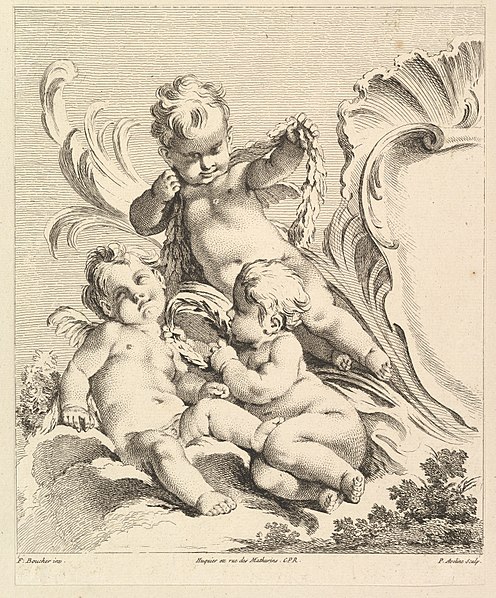
Three Putti next to a cartouche Pierre Alexandre Aveline after Francois Boucher 1727-60 shared under Wiki Commons
But they had begun to appear in churchyards when the very stark skull and crossbones fell out of fashion. There was a sense that a more inspiring and sensitive image would be more appropriate for those left behind and so the winged messengers appeared (see my post Symbol of the Month – The winged soul 27/09/20).
These were the heads of what appeared to be children with wings around them that emphasised a rebirth of the soul in heaven which was a kinder view of death. Cherubs are supposedly found on childrens graves and a walk through any churchyard or cemetery would confirm this. But cherubs can be confused with putti which is the Italian word for cherub but they are very different. Cherubs are powerful figures in the hierarchy of angels whereas putti are childlike and playful.
Cherubs
The word ‘cherub’ is derived from the Hebrew word ‘Kěrub’ which means ‘to draw near’ or ‘to bless’. However it has also been associated with the Assyrian word, ‘karibu’ which means one that intercedes’. Cherubs can be viewed:
‘as divine messengers drawing near to humans to deliver blessings or divine messages. They also symbolise the spiritual closeness between the divine realm and the human world.’ Spiritualityshepherd.com
In the Bible cherubs are seen as powerful figures that guard sacred spaces such as the Ark of the Covenant in the Old Testament. There are several references to them in the Bible particularly in the Book of Genesis 3:24:
‘So he drove out the man: and he placed at the east of the garden of Eden Cherubims, and a flaming sword which turned every way, to keep the way of the tree of life.’ King James Version.
In the Book of Ezekiel 10:14, they are described as angelic beings with four faces; a human, a lion, an eagle and a human. These derives from ancient Mesopotamian and Assyrian art which depicted winged creatures with multiple faces which often guarded temples or palaces. These influenced early Christian artist who used them in their images of cherubim. The multiple faces represent different aspects of creation or divine attributes such as wisdom, strength, courage and swiftness and the wings are a reminder of their celestial nature and ability to move quickly between heaven and earth.
Putti
Wikipedia defines putti as:
‘a putto or putti is a figure in a work of art depicted as a chubby male child usually naked and very often winged….came to represent a sort of baby angel in religious art, often called cherubs or cherubim.’
In fact the Italian word ‘putto’ derives from the Latin word ‘putus’ meaning boy or child. Today in Italy, ‘putto’ means ‘toddler winged angel’ and there are similar words or meanings in other languages. Putti were believed to influence human lives in the ancient classical world and in the 2nd century they could be found dancing and playing amongst other activities on child sarcophagi. Their role as messengers were emphasised by them being seen as between the realms of the human and divine by being Roman spirit guardians or the Greek daimon. During the Renaissance they were revived due to the painter Donatello. Putti also became associated with the Greek and Roman goddesses of love, Aphrodite and Venus by becoming Eros and Cupid.
Now putti are largely decorative and feature extensively on Victorian and Edwardian buildings – just look up and you’re bound to see one at least. Please visit Bob Sheel’s invaluable page on these for examples – just follow the link: http://www.speel.me.uk/gp/cherubs.htm
Weeping cherubs
They could be interpreted as weeping angels which immediately brought to mind one of Dr Who’s most brilliant and intimidating villains – the Weeping Angels -don’t blink! There are several prominent weeping angel statues in cemeteries such as Friendship Cemetery, Columbus, Mississippi, USA where a life size female angel is prostrate across the monument:
and the Haserot bronze figure in Lakeview cemetery, Cleveland, Ohio, USA where the rain has discoloured it and made it look resemble tears running down its face.
Weeping Angel, Lake View Cemetery, Cleveland, OH | Smithsonian Photo Contest | Smithsonian Magazine
But why are there weeping cherubs? I haven’t found a definitive explanation but the edenbengals website has a theory:
‘They openly express the sorrow that the ones left behind feel, and in their role of divine messengers take it heavenwards to God.’
It’s a very poignant symbol in that a small child is seen openly weeping. I hope to find others in my explorations of churchyards and cemeteries as I’m sure that the Margate one can’t be the only one. If I know these places as well as I do – there is at least another one waiting to be found – hopefully by me!
© Text and photos Carole Tyrrell unless otherwise stated
References and further reading:
Gravestone Symbols: Grave & Cemetery Symbolism – Funeral Guide
Cemetery symbols and the art of death (frazerconsultants.com)
The Symbolism of Victorian Funerary Art – Undercliffe Cemetery
Cherubim: The Powerful Angels of Abrahamic Religions – Symbol Sage
https://www.askdifference.com/cherub-vs-angel/
Cherub and Putti sculpture in Victorian and Edwardian architecture – Bob Speel’s Website
Charming Cherub – WikipediaCherubs – Symbols & Secrets (symbolsandsecrets.london)
Cherubim Guard God’s Glory and Spirituality (learnreligions.com)
 shadows fly away
Thank you! There’s so much I didn’t know about weeping cherubs but now do.
LikeLiked by 1 person