Symbol(s) of the Month – the exuberant 18th century symbols of St George’s churchyard

One of the skulls at base of blank cartouche on one side of large chest tomb, St George’s. ©Carole Tyrrell

It’s often on a winter’s night, just as dusk begins to fall and the lamp lights in St Georges churchyard come up, that  the fine selection of 18th century tombstones are at their best. Carved skulls leer at you, an hourglass emphasises time passing and the gravedigger’s tools stand ready for the next interment.  And perhaps there is still a phantom schoolteacher using his sculpted globe to teach geography to his spectral students.

There has been a church on this site since the 14th century and, in one place in the graveyard  the number of burials over the centuries has made the ground rise up on both sides.  But, as well as 18th century examples of funerary symbolism, there are also some wonderful 19th century ones as well.  Inside the church there’s also a good selection of impressive wall monuments dedicated to prominent local families dating back to the 1600’s.  They are  buried in the vaults beneath the church.  St George’s also has the country’s oldest lych gate in that the current one incorporates elements from  a far older one. The churchyard is a pretty one for a short walk through to the bustling High Street  especially when the spring flowers begin to appear, carpeting the grass between the stones with bluebells and flitting butterflies.

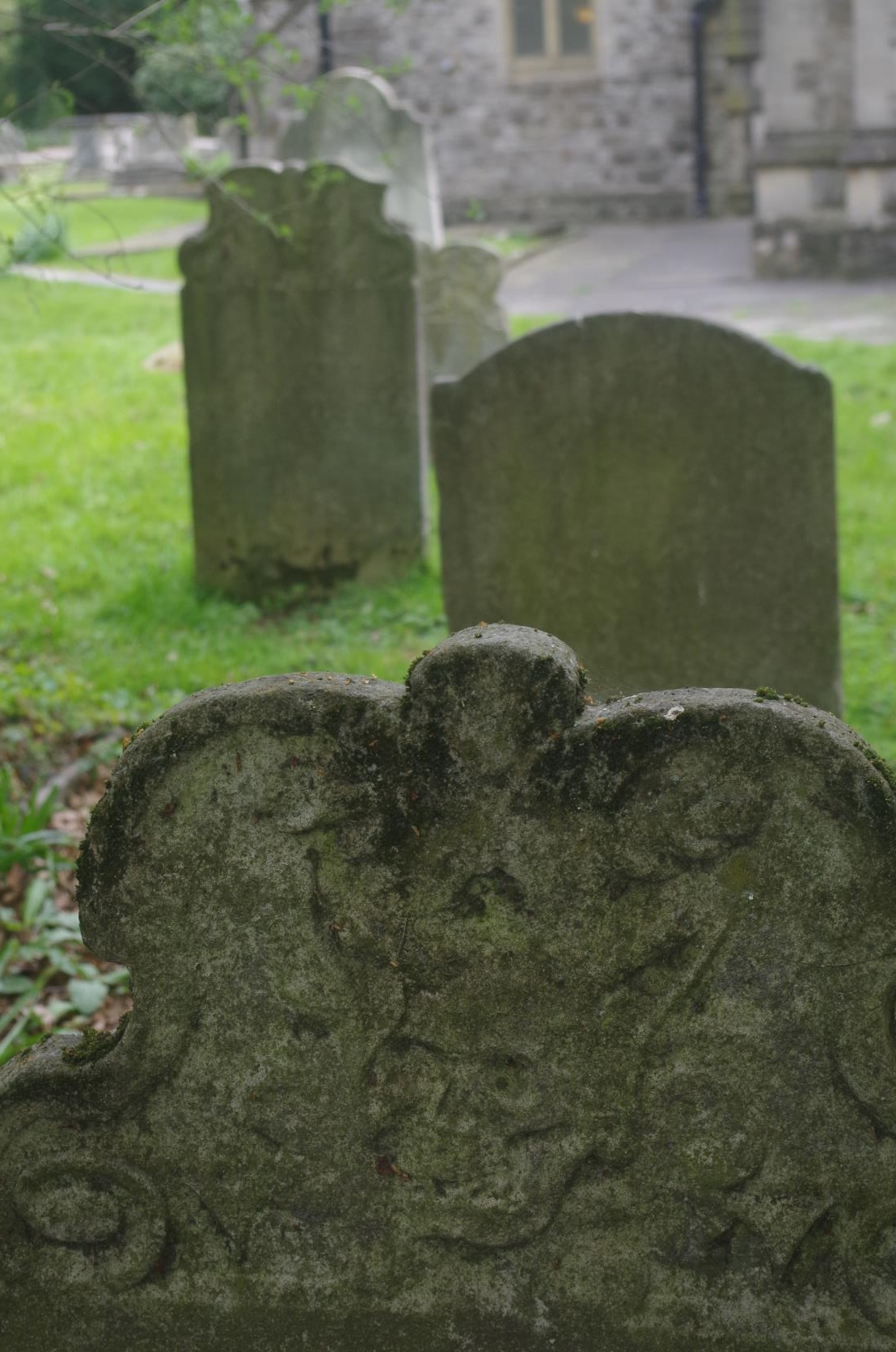
View of tombstones with horned skull in foreground. ©Carole Tyrrell

However for this month’s Symbols post I will concentrate on the 18th century memorials within the churchyard. These  tombstones  are topped with classic memento mori symbols.  This is Latin for ‘remember (that you have) to die.’  They are the visual accompaniment to the immortal epitaph from Dundee’s Howff graveyard:

Remember Man as you pass by

As you are now so once was I

As I am now so must you be

Remember man that you must die.’

Graveyard symbolism, according to Douglas Keister, began when the well to do  could no longer be buried with in their local church due to lack of space. Instead, they took up their eternal residence in the newly consecrated burial grounds outside and surrounding the church walls. These were often known as ’God’s Acres’ and gave the wealthy the opportunity to erect a lasting memorial or tombstone in their memory.

St George’s churchyard became the last resting place of prominent local families, some of whose descendants still live in the area. The oldest tombstone dates from 1668 and the 18th century ones  are nearest to the church walls which in effect meant that they were  ‘Nearer my God to Thee.’

I’ve always enjoyed walking through the churchyard as it can feel like walking through a gallery of funerary symbols.  There’s something very exuberant about these 18th Century motifs of mortality even though some have eroded and only one epitaph is still fully readable.  However, the skull and crossbones, the Death’s Heads and others have, in several cases, lasted better than the epitaph below them.

The skull and crossbones are an effective, if macabre, reminder of what is left of a body after it decomposes and there are several good examples in St Georges.

This one is near the church entrance and features a skull and crossbones with what appear to be protruding palm fronds.  It also seesm to be resting on something whch may be a shield.  All that can now be read on the epitaph is…who dep….’

© Carole Tyrrell

The skull and crossbones, a winged hourglass and a set of sexton’s tool on the left hand side.
©Carole Tyrrell

Nearby is another skull and crossbones with a winged hourglass above it.  This is a reminder that ‘Time flies’ or ‘Tempus Fugit’ and that the onlooker will soon be bones and dust. So it’s important to make the most of their time on earth. On the left hand side is a pick and shovel.  These are a sexton’s tools which made me wonder if this was a sexton’s grave but the epitaph is now illegible.  The sexton’s role not only encompassed maintaining and looking after the church but also the churchyard.  In larger graveyards the sexton would have been more of a manager but in smaller ones he would have had sole responsibility for preparing the ground, digging and closing the grave, mowing the lawn and also maintaining the lawn and paths.

Skulls also feature prominently on two other tombstones on the other side of the church very near the wall. One seems to have a very sharp pair of horns and a  definite smirk.  On each side of it there appear to be small trumpets but it’s too weathered to see if anyone’s blowing them.  Maybe he’s keenly anticipating the Last Day of Judgement.

© Carole Tyrrell

The horned skull tombstone showing trumpet detail. ©Carole Tyrrell

Nearby is a large tombstone with what seem to be two somersaulting skulls on them although one is more eroded than the other.  Below them is a small worn hourglass.  I believe that these two examples of skulls may be unique to St Georges as I’ve haven’t yet seen them anywhere else.

Somersaulting skulls and hourglass. ©Carole Tyrrell

Douglas Keister has suggested that the skull and crossbones slowly began to be replaced by the much less stark and macabre  ‘Death’s Head.’  This is a human face with wings on either side of it.  I’ve always known it as the ‘winged cherub’ and there are also several good examples within the churchyard. These are symbols of resurrection intended to give those left behind some hope.

© Carole Tyrrell A closer view of the Saxby Angel with what appears to be a faded open book on one side and a stylised flower on the other side.

I am also a huge fan of calligraphy having studied it for two years at evening classes and it has undergone a revival on late 20th and early 21st century tombstones.  However 18th century calligraphy has a style all of its own and is instantly recognisable.  The only legible 18th century epitaph in St Georges is the one dedicated to a John Saxby.  It reads:

Here lyeth the body of John Saxby of the Parish who Departed this life…year of May 1731 aged 41 years.’

A fine example of a Death’s Head is on top with an open book beside it which may be the Bible or the Book of Life and there’s a stylised flower on the other side.  The open book may be a depiction of the incumbent offering their life to God for judgement as an ‘open book’. People are sometimes described as an ‘open book’ as they have their feelings and thoughts open to the world with no attempt to hide them.

A crown on clouds with two small angelic faces on each side of it. ©Carole Tyrrell

On another memorial two small faces, presumably from the angelic host, peer out from either side of the clouds surrounding a crown.  It’s a representation of the reward that awaits the faithful in heaven.  This verse from the Bible refers to it:

James 1:12 New International Version (NIV)

Blessed is the one who perseveres under trial because, having stood the test, that person will receive the crown of life that the Lord has promised to those who love him.

A plump faced death’s head is surrounded by another open book and what I think maybe a small skull in the far corner of the stone.
 

A plump faced Death’s Head or winged cherub with an open book on one side and what I think is a small skull on the other. ©Carole Tyrrell

But one of the most unique and impressive tombstones in St George’s, or perhaps anywhere, is that of John Kay.  He was an 18th century schoolmaster and his life and talents are recorded by the tools of his trade that have been carved on his stone. There’s a globe on a stand, a trumpet, what appears to be a cornet, an artists palette, a pair of compasses and other items which are now too indistinct to read.  He was obviously very erudite and much appreciated by his students.  Sadly his fulsome epitaph is now virtually unreadable. He lies near Mr Saxby under a spreading yew tree.

© Carole Tyrrell

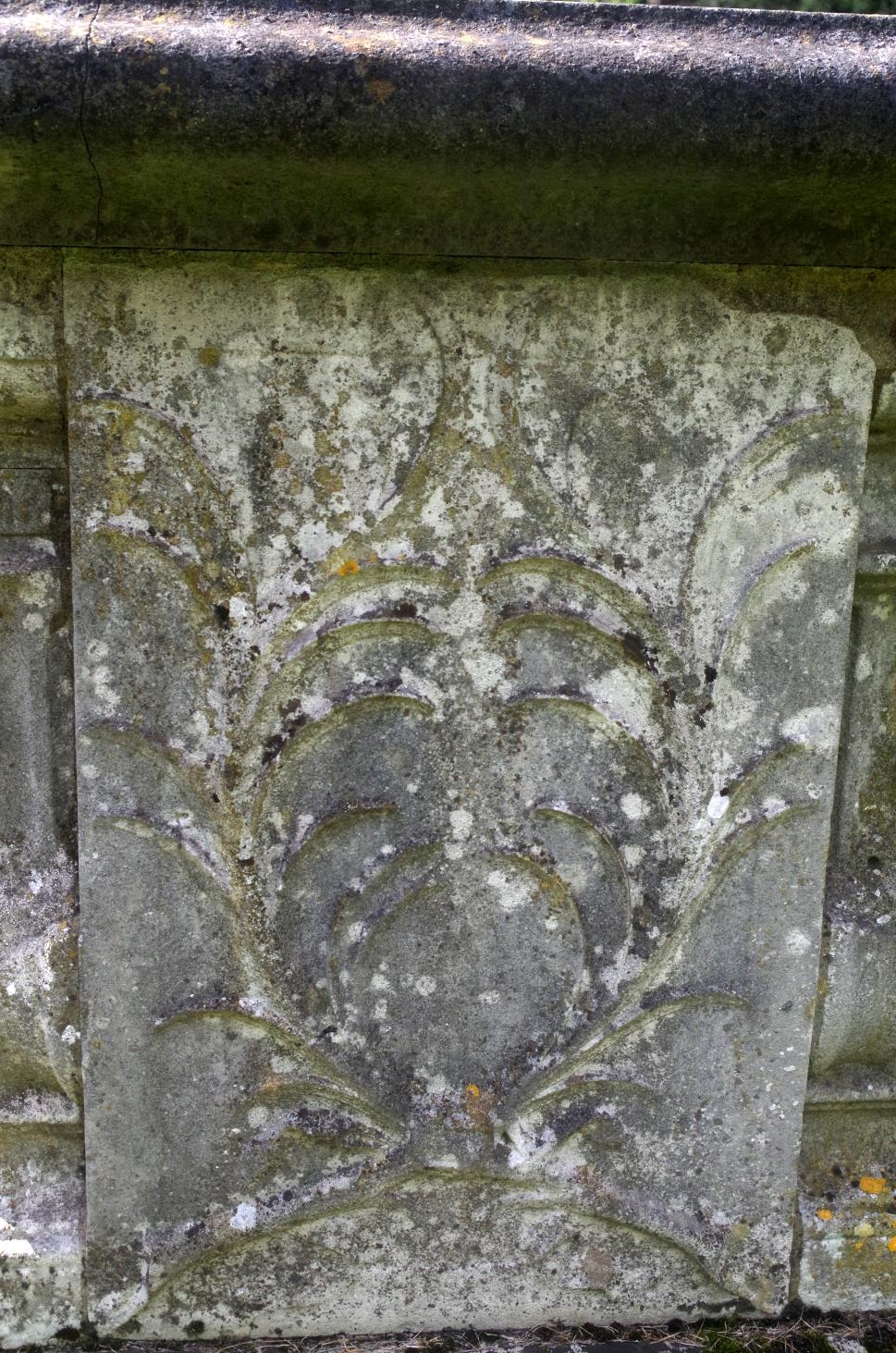
On the other side of the graveyard is a large chest tomb.  There is a dedication and an armorial on its top and I feel that some patient research in St George’s burial registers may reveal the incumbent’s identity.  There are blank cartouches on each side with death’s heads on top and two skulls beneath each one.  At one end are palm fronds which are a Roman symbol of victory which were then adapted by the Christians as a martyr’s triumph of death.  The palm as a symbol originated in the ancient Near East and Mediterranean region  and is a powerful motif of victory, triumph, peace and eternal life.  It’s traditionally associated with Easter and Palm Sunday and Christs’ resurrection and victory over death. On the other end of the tomb are what appear to be olive flowers.  The olive’s association with wisdom and peace originally came from Greek mythology when the goddess, Athena, presented an olive tree to the city that was to become Athens.  Successive Greek ambassadors then continued the tradtion by offering an olive branch of peace to indicate their goiod intentions. The olive tree is also associated with longevity, fertility, maturity, fruitfulness and prosperity.  In the Bible, Noah sent the dove out after the Flood to see if the floodwaters had receded and when it returned with an olive leaf in its beak Noah knew that the Flood had ended.  Even today the phrase ‘ offering an olive branch’ means the someone wants to make peace. But in this context the olive branch may mwean that the soul has departed with the peace of God. So one memorial incorporates powerful  motifs of mortality and resurrection.

View of chest tomb, St George’s churchyard. ©Carole Tyrrell
Palm fronds at one end of chest tomb, St George’s churchyard ©Carole Tyrrell
Blank cartouche on one side of chest tomb. Note Death’s Heads and skulls. ©Carole Tyrrell

St George’s has also used old tombstones to pave two of the pathways within the churchyard of which some are still readable.  It always feels as if I’m walking over someone’s grave although they are buried elsewhere in the graveyard.  However, although the 19th and 20th century memorials are rather more restrained and far more legible I prefer the more ‘in your face’  18th century symbols.  But in the case of the horned skull I can only frustratingly only guess at its meaning and the person who lies beneath…..

©Text and photos Carole Tyrrell otherwise stated.

References

Stories in Stone; A Field Guide to Cemetery Symbolism and Iconography, Douglas Keister, Gibbs M Smith, 2008

St George’s Churchyard, St George’s Parish Church, Beckenham, Revised June 2005

St George’s Parish Church, Beckenham, information leaflet,, October 2003

http://www.thecemeteryclub.com/symbols.html

http://www.catholictradition.org/Saints/signs4.htm

http://www.planetgast.net/symbols/plants/plants.html

https://stoneletters.com/blog/gravestone-symbols

http://www.graveaddiction.com/symbol.html

A Margate Meander Part 2- a visit to St John’s Cemetery, Margate

Samuel Courtauld and his wife. ©Carole Tyrrell

There are over 53 war graves and I found the plot containing most of them although there are others buried throughout the cemetery. The plot contains 18 German airmen, (one unidentified), and 50 British casualties. The others are Commonwealth service personnel of which 2 remain unidentified and I saw some of them as I explored.

Hebrew section of the cemetery. ©Carole Tyrrell


The Hebrew section is near the crematorium and I found other notable permanent residents although a chill was beginning to make its presence felt as the afternoon wore on. Samual Courtauld and his wife’s headstone seemed quite modest considering his achievements. He was the great art collector who founded the Courtauld Institute of Art in 1932 which continues to this day and, after a series of gifts during the 1930’s, bequeathed his entire collection to the Institute on his death. He also created a £50k acquisition fund for the Tate and National Gallery in London which enabled them to acquire works that helped create national collections of Impressionist and Post-Impressionist art.

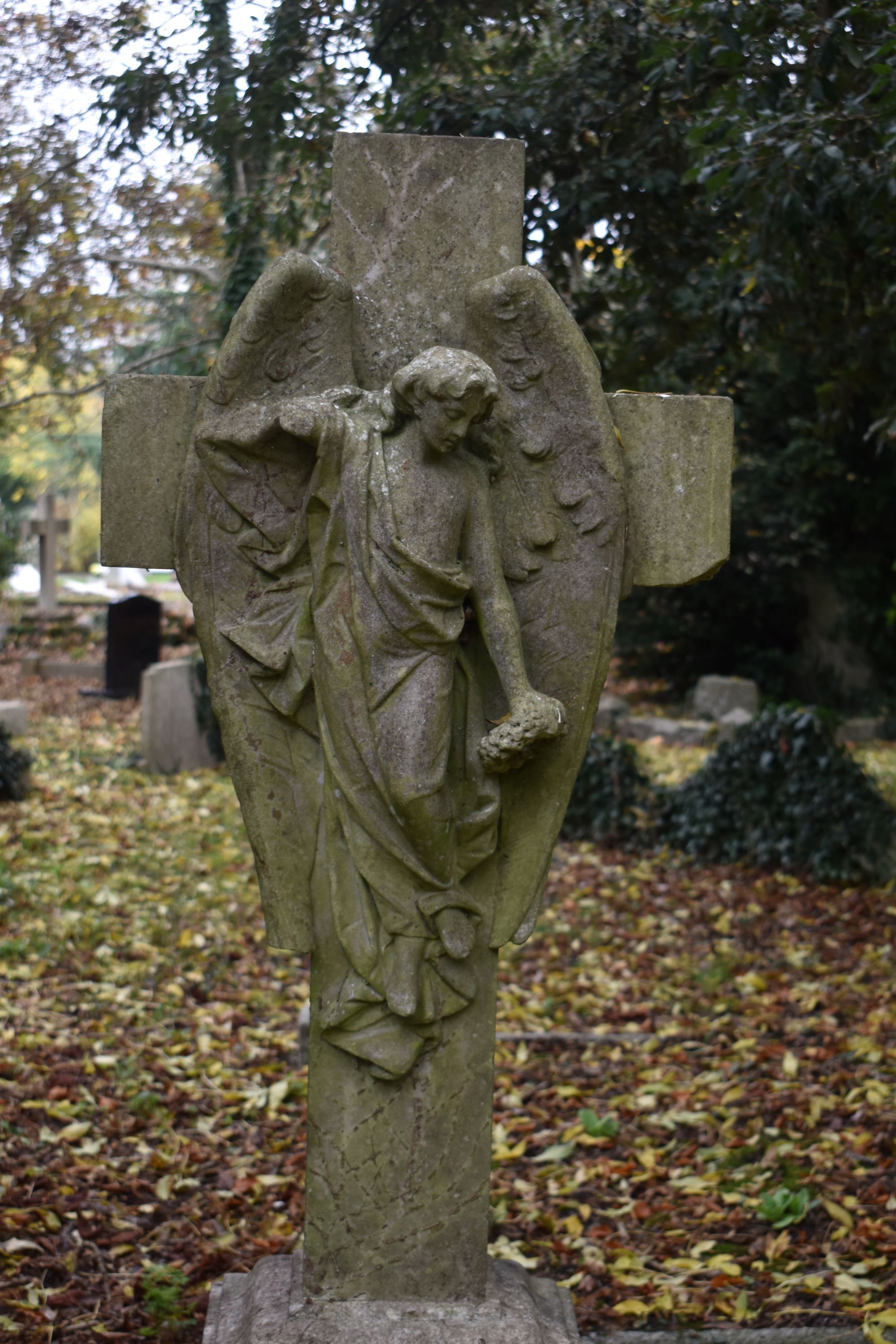
Male angel keeping watch on the Weston grave. ©Carole Tyrrell

Another surprise was finding a definitely male angel draped in what could be described as a toga (it looked chilly) keeping watch over the grave of Arthur and Ethel Weston. It’s unusual as most angels in cemeteries and churchyards appear to be pretty, pensive young women.

A 2D representation of ‘Simply to Thy Cross I cling.’ ©Carole Tyrrell

There was a 2D representation of ‘Simply To Thy Cross I Cling’ on the Holness headstone. I found a metal Lourdes medal that had been placed on a stone cross.

Lourdes medal placed over a grave. ©Carole Tyrrell

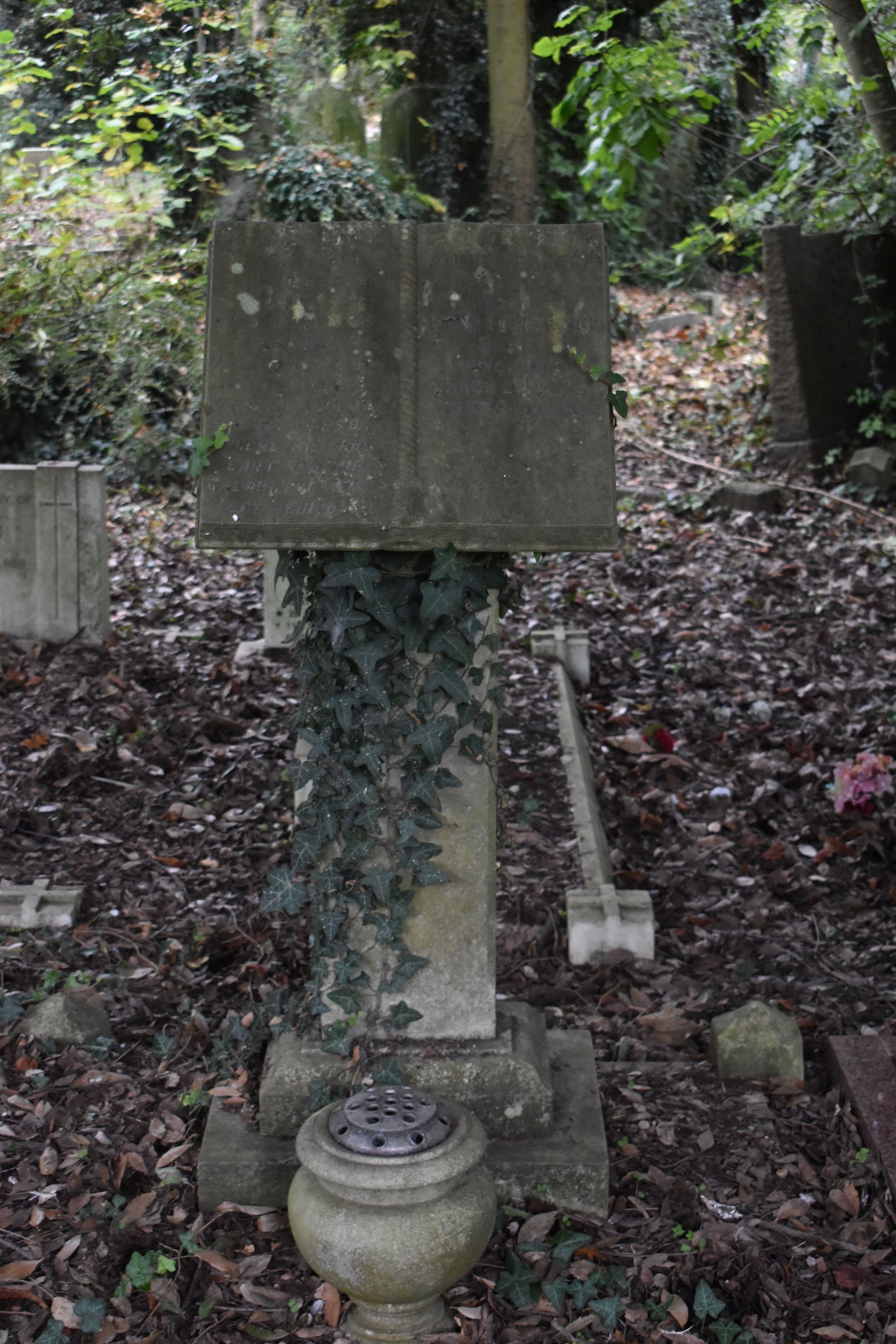
There was also a variant on the open book which was last month’s Symbol of the Month. Here it has been placed on a lectern style stand which made me think of the deceased standing up and telling all those around him of his or her good deeds or perhaps giving them a sermon.

The Open Book. ©Carole Tyrrell

On the elegant Devereux headstone dedicated to Thomas and his wife, Maria, I didn’t need to look at the epitaph to know that this was dedicated to a Royal Navy man. The two pillars have chains wrapped around them ending in two entwined anchors. There is also a Crown above them and the familiar shaking hands at the top.

The Deveraux headstone with naval symbols. ©Carole Tyrrell
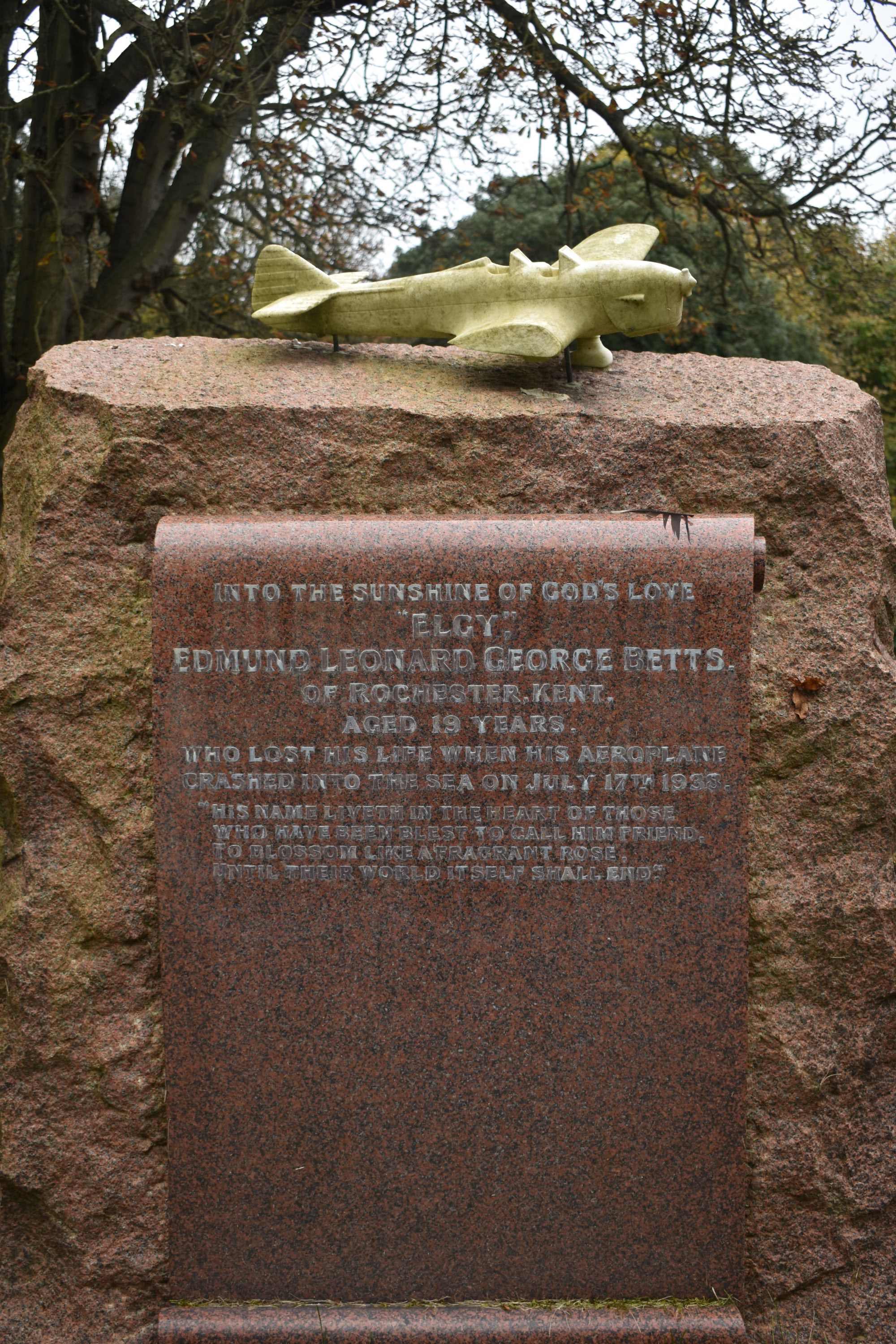
The model airplane on the Betts monument. ©Carole Tyrrell

I then came across my other surprise of the day when I found another Grade II listed monument. I was surprised that the small model airplane on top of it hadn’t been stolen although I saw very little vandalism in the cemetery. The monument is dedicated to Edward Leonard George ‘Elgy’ Betts who died aged 19 on 17 July 1938. I am indebted to Findagrave for the information about him:


….crashed into the sea with a 2 seater light aircraft after taking off from Ramsgate airport. He was flying a Miles Hawk Trainer airplane belonging to Thanet Aero Club and it crashed into the sea off Cliftonville, Margate, Kent. He and his passenger, 16 year old Marjorie Wall, were killed….. She is also buried in Margate Cemetery with her parents. The sculpture of the plane is and accurate representation of the plane in which he died, including the registration letters G-AEFU.’

Full view of the Betts monument. ©Carole Tyrrell

Ramsgate airport is long gone and has been replaced by an industrial. For a Sunday afternoon the cemetery was quite busy with visitors, mostly in cars, and a few like myself on foot. But I was aware that I didn’t have enough time on this visit to explore the entire cemetery so will do it in sections on future visits. I am already anticipating this although there is already plenty to write about!

©Text and photos Carole Tyrrell unless otherwise stated
References and further reading:

https://en.wikipedia.org/wiki/Victoria_Sanger_Freeman

https://en.wikipedia.org/wiki/Surfboat
https://courtauld.ac.uk/about-us/our-history/

https://en.wikipedia.org/wiki/Samuel_Courtauld_(art_collector)
https://en.wikipedia.org/wiki/John_Sanger
https://www.britannica.com/biography/John-Sanger
https://theisleofthanetnews.com/2017/12/15/a-service-has-marked-the-restoration-of-margates-surf-boat-memorial-and-the-loss-of-9-lives-in-the-tragedy/
https://margatelocalhistory.co.uk/Pictures/Pictures-Storms.html
https://daily.jstor.org/vintage-circus-photos-sanger-circus-collection/
https://www.findagrave.com/memorial/46295073/edmund_leonard_george-betts
https://historicengland.org.uk/listing/the-list/list-entry/1396419

https://victorianweb.org/history/education/ulondon/courtauld.html


A Margate Meander Part 1 – a visit to St John’s cemetery, Margate

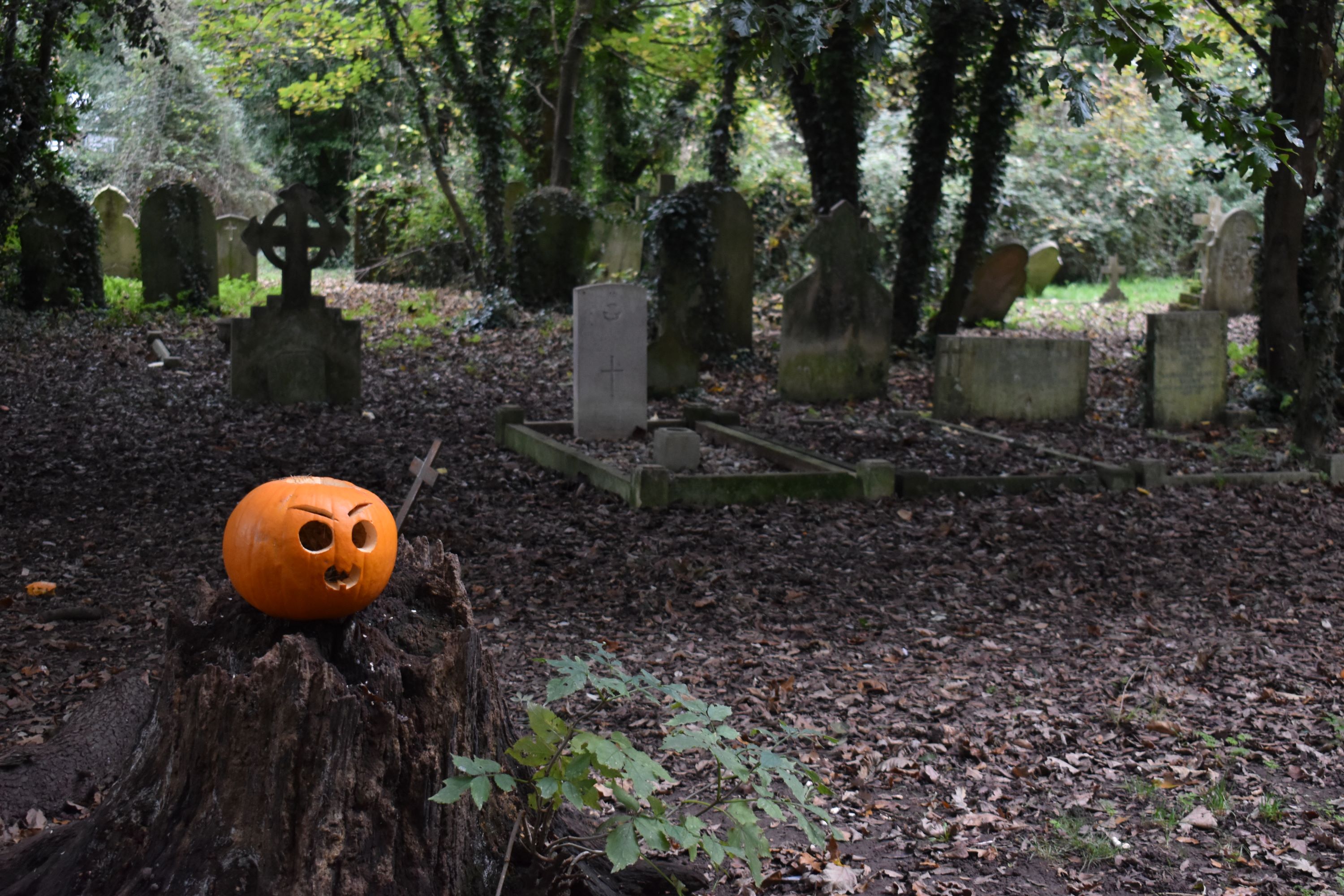
Pumpkins in Margate Cemetery. ©Carole Tyrrell

It was a dark, gloomy grey Sunday when I decided to explore the cemetery and walked up the impressive avenue of yew trees studded with bright red berries to the two cemetery chapels. But, by the entrance, I discovered a smaller building hidden behind bushes in the Gothic style of the chapels. I thought that it might have been a mortuary chapel but, on looking at the map, it may have been a more prosaic toilet block now locked up. The cemetery is officially known as St John’s cemetery and also houses a crematorium and associated gardens of rest.

Toilet or mortuary chapel? ©Carole Tyrrell

After the excitement of Halloween, people appeared to have donated their pumpkins to the local wildlife and I disturbed a squirrel scampering over one. However, although people may consider them to be a tasty treat. Forestry England doesn’t agree and suggests on their website that they be reused to make pumpkin soup or be added to compost.

Nothing prepared me for the size of the cemetery and, so far, I have been unable to discover its exact dimensions. I soon realised knew another visit or two would be necessary to explore it fully. The bright Autumn colours of the leaves were dulled by the greyness of the skies as I merrily kicked up leaves and looked for fungi. But all I could find were a couple of what I thought were parasol mushrooms lurking in the fallen leaves.

Presumed Parasol fungi in autumn leaves ©Carole Tyrrell

Autumn leaves. ©Carole Tyrrell

Placemarker of first burial ©Carole Tyrrell

The cemetery was opened in 1856 and a sign marks the place of the first burial which was a woman, Harriet Ross, on 1 November of that year. Most of the first section along the main avenue dates from the 19th century. As I neared the chapels, there was a large monument in a gap between the yew trees, set back from the path featuring an angel praying before a cross with, I assumed, a portrait of the deceased looking approvingly on. This was on the LeMair monument.

The LeMair monument ©Carole Tyrrell

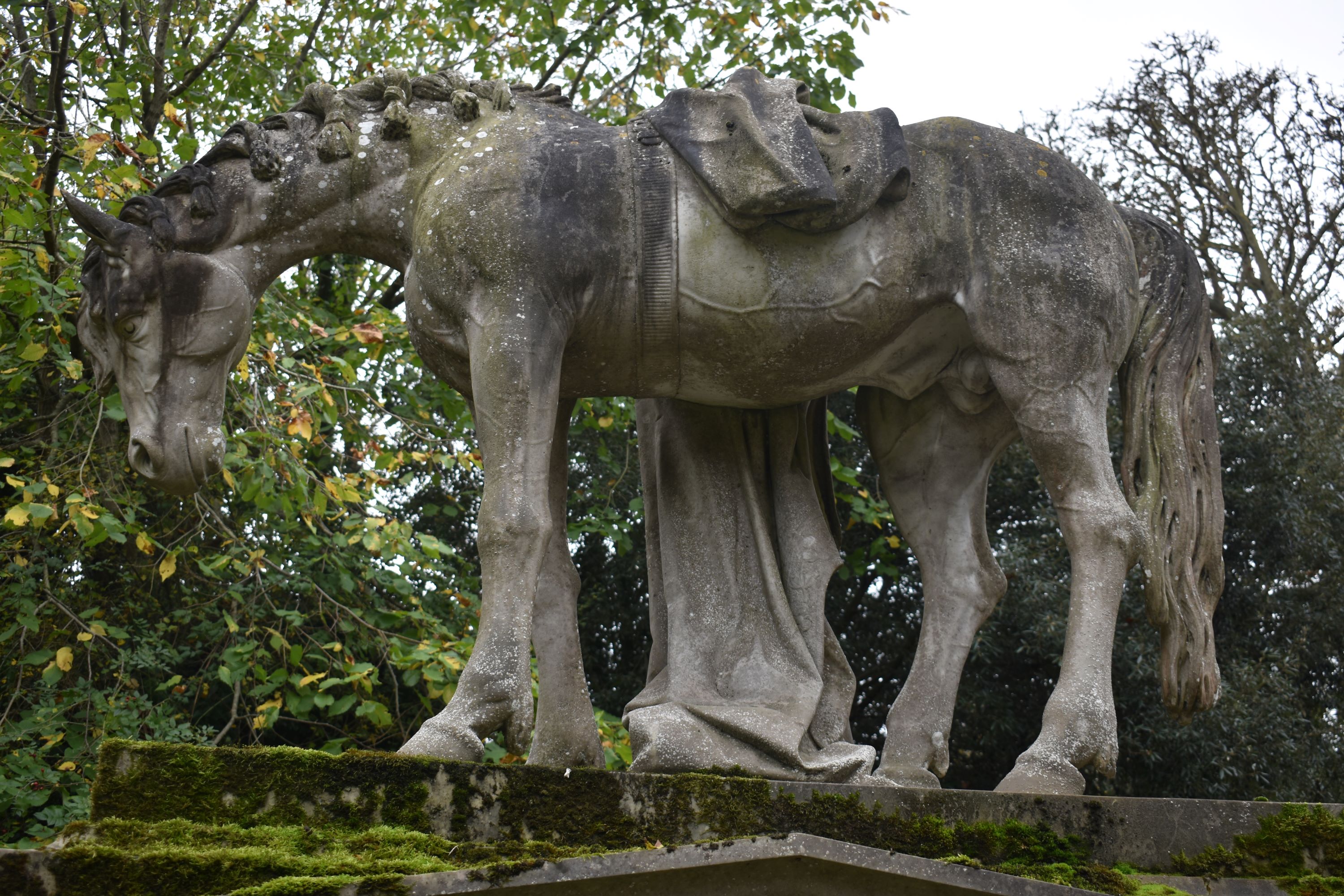
A sign announced ‘Sanger Path’, I wandered along it and came to my first surprise of the day. 4 angels forming a square, one at each corner, on the Reeve memorial. They are well sculpted with detail on the back as well. But then my eye was drawn, well I could hardly miss it, by the lifesize statue of a horse atop the Sanger monument. Beautifully sculpted, it is dedicated to a circus proprietor, John Sanger (1816-1899). He has a tenuous connection to one of my favourite Beatles songs. There is an upturned horseshoe above John Sanger’s epitaph for luck and his shows featured equestrian acts involving horses and ponies and a pantomime every Christmas. He originally went into partnership with his brother, George, but eventually they went their separate ways. George was brutally murdered in 1911 by an ex employee who then committed suicide. A photo album of George’s circus, its performers and animals came up for auction in 2017 and showed that a Victorian circus certainly was value for money! The Sanger circus appeared by royal command at Windsor Castle by Queen Victoria and they also took part in the annual extravaganzas at Crystal Palace.

The Sanger horse ©Carole Tyrrell

©Carole Tyrrell

One of George Sanger’s great granddaughters ashes are also interred in the family plot. This was Victoria Sanger Freeman (1895-1991) and she went under the sobriquet of ‘Queen of the Elephants’ with 4 of them under her charge. She was the last member of the Singer dynasty of circus performers. Beside John Sanger’s horse is another Sanger, Mary Rebecca, who married into the family. She is sandwiched between John and the Reeve ladies. She married William Sanger but I’m not sure at the moment where he stood within the Sanger hierarchy.

Mary Rebecca Sanger is on the left hand side with the Reeve ladies beside her. ©Carole Tyrrell

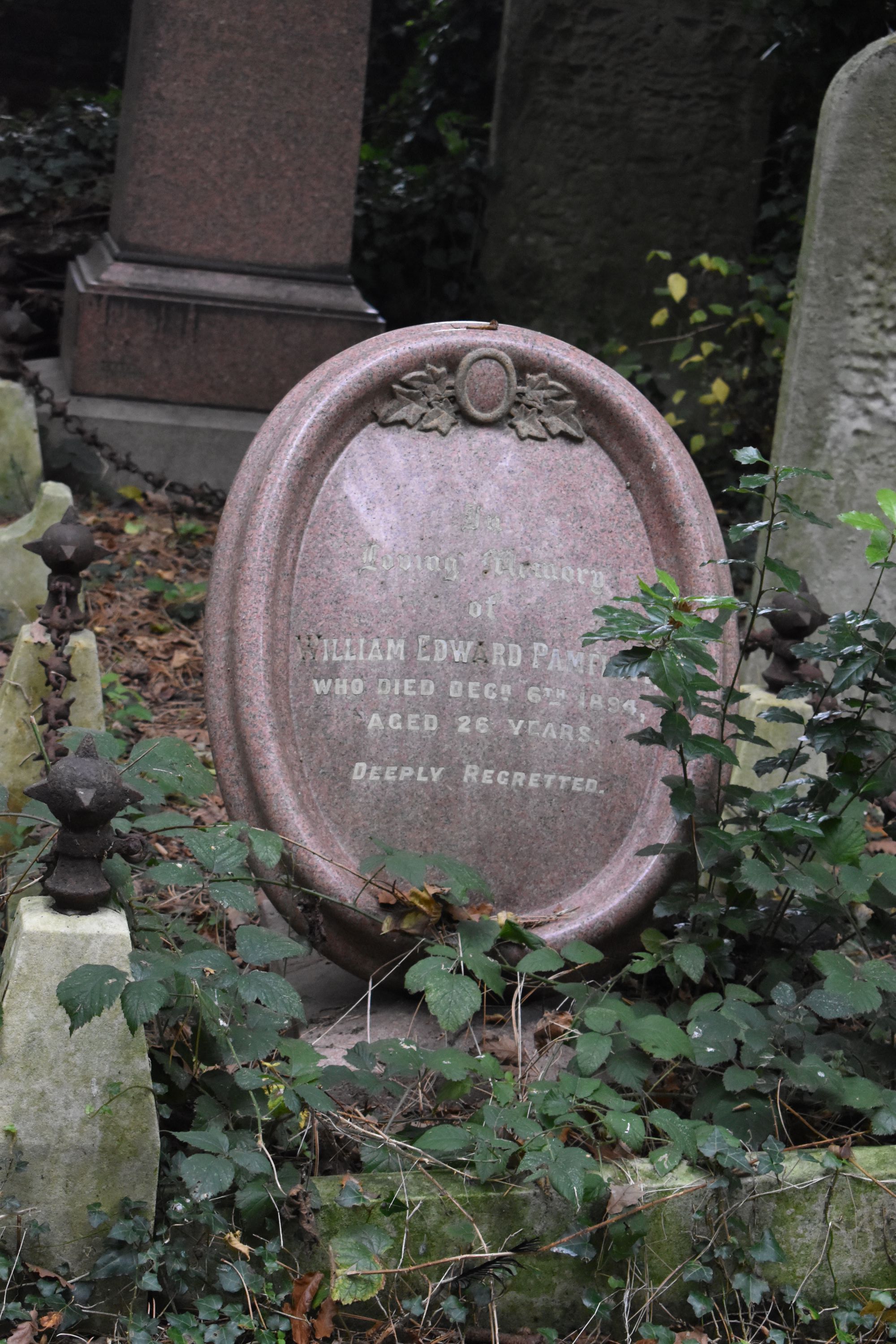
There was an interesting variation regarding epitaphs within the cemetery. On several graves, they were carved within an oval frame that was reminiscent of a portrait. I thought they looked very elegant.

©Carole Tyrrell
©Carole Tyrrell
©Carole Tyrrell

There was only one way to discover why another path was named ‘Surfboat Path’ and halfway down I came upon the Grade II listed memorial to the Surfboat Disaster. It commemorated the tragedy that killed 9 Margate boatman on 2 December 1887 and was restored by the Royal National Lifeboat Institute, 120 years later in 2017.
The town’s surfboat, ‘Friend to All Nations’, went out on that night in appalling weather to assist the sailing vessel, ‘Persian Empire’. Sadly, the surfboat capsized on the Nayland Rock in Margate with only 4 survivors. A surfboat is according to Wikipedia:
‘A surfboat (or surf boat) is an oar-driven boat designed to enter the ocean from the beach in heavy surf or severe waves. It is often used in lifesaving or rescue missions where the most expedient access to victims is directly from the beach’

A surfboat in action ©DonJeffFranky Shared under Wiki Commons
Full view of the Surfboat Disaster monument ©Carole Tyrrell

The 2017 memorial service was not only to acknowledge the tragic event but also as a reminder that the crews and elements still face the same challenges as emphasised in the sad loss of the crew of the Penless lifeboat in 1981. To say that it is impressive is an understatement as it is surrounded by more modest memorials. It’s in the shape of a huge rock with a lifesize mourning woman, her hands to her head, face turned away, in Victorian dress and carrying a laurel wreath, an evergreen that symbolises eternity. There is an epitaph to the disaster beside her and above, on the top of the rock, are a collection of nautical symbols: chains, anchors, ropes and a life belt with the surfboat’s name on it. I was stunned although I would have expected a few nautical graves due to Margate being on the coast.

A closer view of the mourning woman on the monument. ©Carole Tyrrell

Part 2 – A doomed air flight, an unusual angel and an art lover’s final resting place

©Text and photos Carole Tyrrell unless otherwise stated
References and further reading:

https://en.wikipedia.org/wiki/Victoria_Sanger_Freeman

https://en.wikipedia.org/wiki/Surfboat
https://courtauld.ac.uk/about-us/our-history/
https://en.wikipedia.org/wiki/Samuel_Courtauld_(art_collector)
https://www.britannica.com/biography/John-Sanger
https://en.wikipedia.org/wiki/John_Sanger
https://theisleofthanetnews.com/2017/12/15/a-service-has-marked-the-restoration-of-margates-surf-boat-memorial-and-the-loss-of-9-lives-in-the-tragedy/
https://margatelocalhistory.co.uk/Pictures/Pictures-Storms.html
https://theisleofthanetnews.com/2017/10/04/rare-collection-of-lord-george-sanger-circus-photos-sold-at-auction/
https://daily.jstor.org/vintage-circus-photos-sanger-circus-collection/
https://www.findagrave.com/memorial/46295073/edmund_leonard_george-betts

https://historicengland.org.uk/listing/the-list/list-entry/1396419