Symbol of the Month – The Winged Soul

A lovely example of a winged soul from St Peter & St Paul, Shoreham, Kent.
©Carole Tyrrell

The skull and crossbones was one of the central motifs of 18th century Memento Mori and intended to be a stark and macabre reminder of the viewer’s inevitable destination.  They would be all that would remain of you after death.

However it wasn’t a very comforting message to either the loved ones left behind or to the living.

But fashions and tastes change, even in funerary symbolism, and the skull and crossbones had served their purpose.

Instead they were replaced by the winged soul. This consisted of a small child’s head flanked by a pair of wings or a garland of leaves.  They have the faces of babies with big, round eyes, plump cheeks and pouting lips and resemble Renaissance putti which are child-like.  Putti represent the sacred cherub as they are known in England.

The winged soul may have been intended to be a more comforting image as the wings represented the soul of the deceased ascending to heaven.  This could also give hope of a resurrection to those left behind.  According to headstone symbols:

‘In the USA the winged soul is known as a soul effigy.’

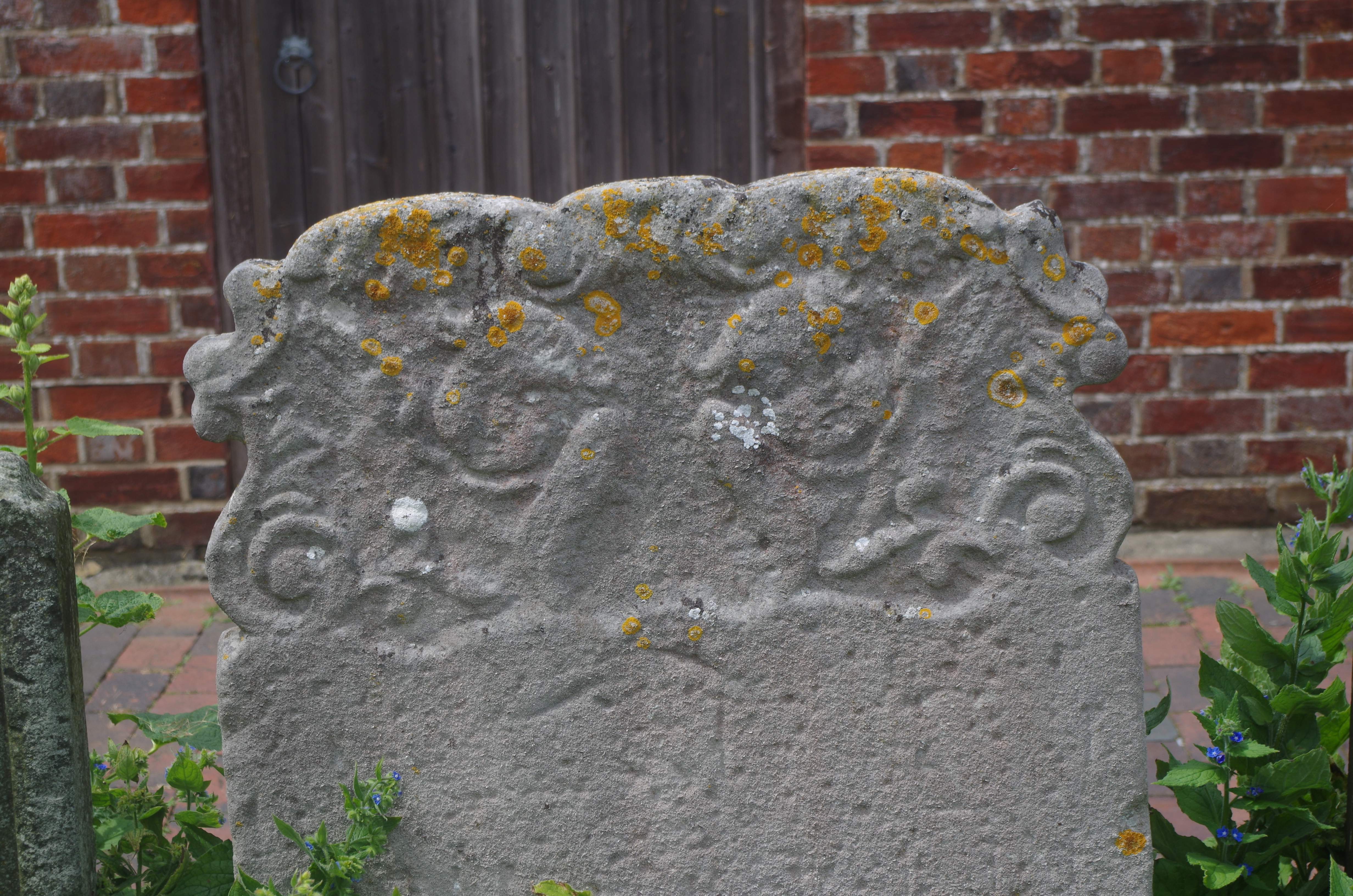
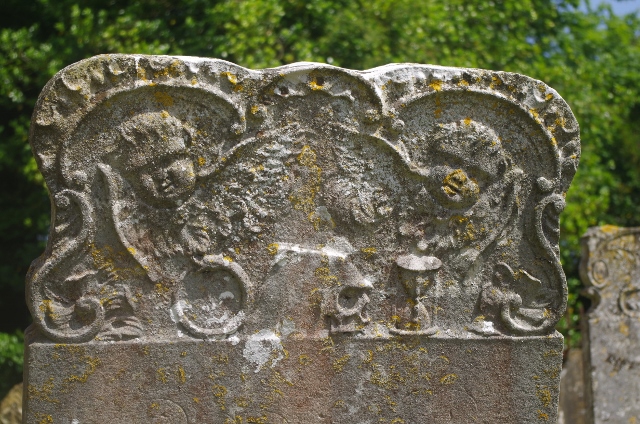
It was immensely popular and in my explorations of medieval Kent churches and their churchyards I found many examples. In fact, in one or two churchyards they outnumbered the skull and crossbones symbol. They mainly had one winged soul on a headstone but there were sometimes  two or three clustered together as in these examples:

They can also appear in several combinations with other classic memento mori symbols as here:
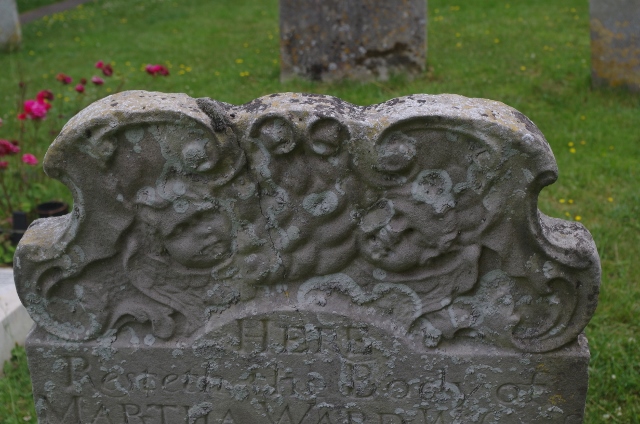
2 winged souls apparently in mid flight with clouds between them. St Martin of Tours, Eynsford, Kent.
©Carole Tyrrell


The winged soul’s head looks more like a skull with a fine pair of wings. St Peter & St Paul, Tonbridge, Kent ©Carole Tyrrell
2 winged souls in mid-flight, St Peter & St Paul, Tonbridge, Kent ©Carole Tyrrell
One of my personal favourites! Another stylised winged soul with skull and crossbones beneath and a cloud above as well as a pair of bones. St Peter & St Paul, Seal, Kent on the grave of a widow. ©Carole Tyrrell
A combination of memento mori symbols and a winged soul with one wing almost furled as if in mid-flight, St Peter & St Paul, Seal, Kent. ©Carole Tyrrell
A pair of winged souls with their wings almost in mid-flight with other memento mori symbols. St Peter & St Paul, Seal, Kent. ©Carole Tyrrell

In addition, every mason seemed to have his own interpretation of feathers as they can be carved as typical fluffy feathers, to resemble broad leaves or be very stylised.

With wings in general they are an important symbol of spirituality.  They express the possibility of flying and rising upwards to heaven.  For example, in the Hindu faith, they are:

the expression of freedom to leave earthly things behind…..to reach Paradise.’

New Acropolis

However, as the full flowering of the Victorian language of death in the 19th century began to appear the emblems of memento mori were retired. Although a couple, such as the hourglass and ouroboros, were revived.  

A modern interpretation of the winged Soul on a headstone from 1996, St Martin of Tours, Eynsford, Kent. ©Carole Tyrrell

But I did find two modern examples of the winged soul in the churchyard of St Martin of Tours in Eynsford, Kent and one is featured above. For years I had always thought of the winged soul as being a more general symbol and merely a decorative feature.  I called them winged cherub heads or death heads and never considered that they might have had a specific meaning or purpose.  It was exciting to see so many variations and interpretations, sometimes within the same churchyard.  But it depended on the skills of the mason as to how well they were carved and whether they were 2 dimensional or 3 dimensional.

But, as a message of comfort, it is one of the most poignant in memento mori. The other central motifs emphasise time running out and what will be left behind. The winged soul suggests an eternal life and a more uplifting message.

©Text and photos Carole Tyrrell unless otherwise stated

References and further reading:

http://www.thecemeteryclub.com/symbols.html

https://headstonesymbols.co.uk/headstone-meanings-and-symbols/deathheads/

https://stoneletters.com/blog/gravestone-symbols

https://www.boston.gov/departments/parks-and-recreation/iconography-gravestones-burying-grounds

https://en.wikipedia.org/wiki/Funerary_art_in_Puritan_New_England

http://www.speel.me.uk/gp/wingedcherubhead.htm
https://www.sacred-texts.com/lcr/fsca/fsca11.htm

A 200th birthday and an unsolved murder – Part 3 The parson detective comes on the scene – a visit to St Werbergh, Hoo, Kent

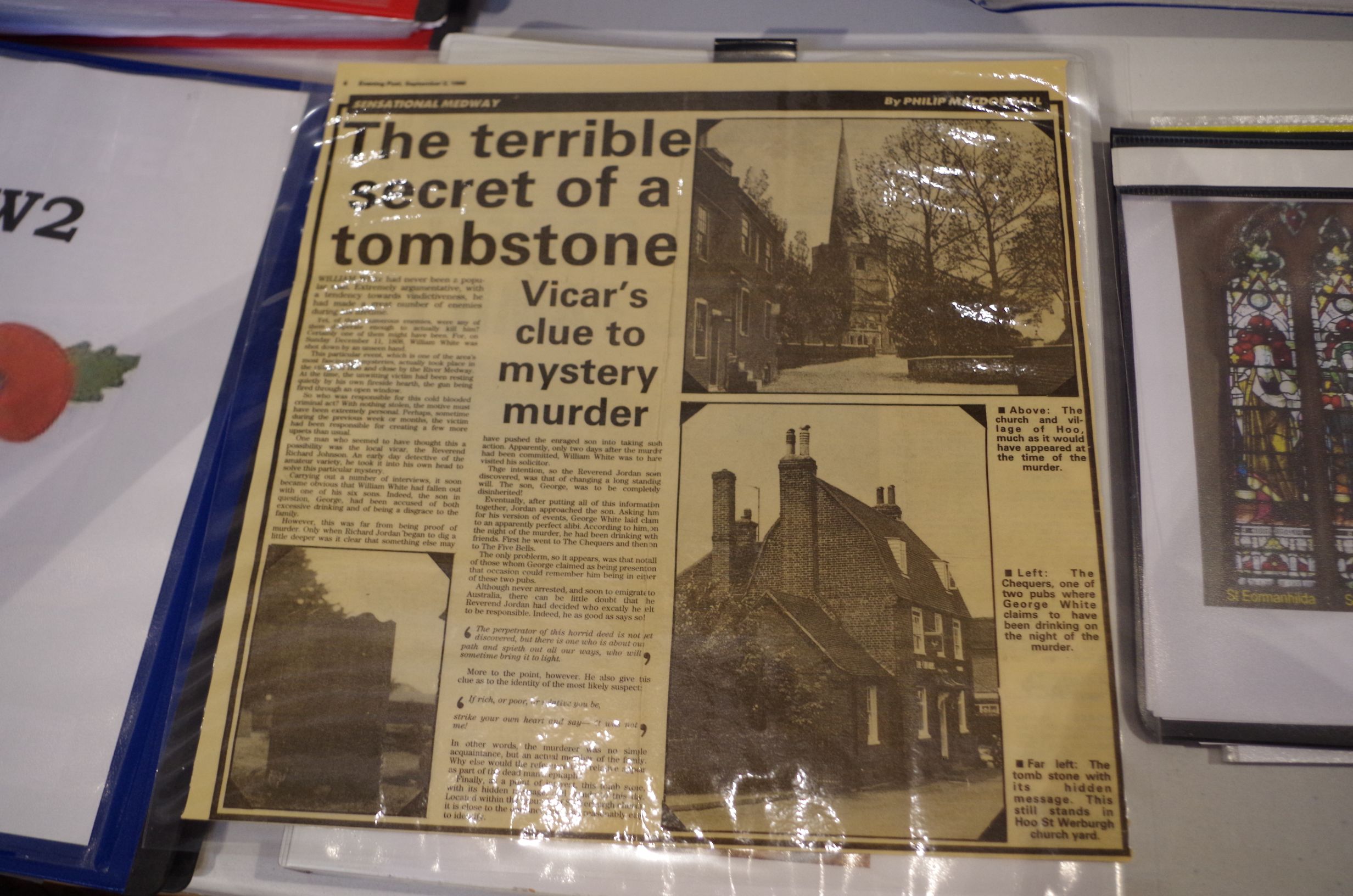
20th century headlines about the murder. © Carole Tyrrell

This is where Rev Jordan came in and he became known as the parson detective.  Such was the feeling in the community that he became determined to find the murderer and bring them to justice. So he set about disproving George White’s alibi.

At the time, George had claimed to have met one of his father’s employees, Joseph Green, who he had invited him to come with him. But a few yards away from the house, George had said that he had to return home to fetch his handkerchief. As a result, he was gone at least ten minutes which would have given him enough time to put the hurdle in place for the perpetrator’s gun to rest on. Joseph attested that the hurdle had not been standing at the pantry window during the day. Afterwards they had walked to the Chequers pub and Joseph said that it was the last time he saw George that night. Joseph had added that he had seen George ‘sitting up about upon the stiles’ near the murder scene before it was dark. Even more damning was that George didn’t get the handkerchief that he had said he went back home to get as, when everyone was assembled in the house after the murder, he hadn’t got one and had to go and find one.

A gun had been found in a clover stack near William’s house about a month prior to the murder and an employee called Francis Smith had put it in the hayloft. A short time afterwards he couldn’t find it and was told by George that William had taken it away, destroyed it the stock and lock of it and thrown the barrel into a lumber room.

Rev Jordan meanwhile had preached a sermon on the matter and opened a book, asking everyone in the congregation and village to write down exactly where they were at 8pm on that fateful Sunday evening.

Rev Jordan persuaded George to make a vestry statement and a meeting was then held to clear him of suspicion. So, he stood before 40 people on Easter Monday, 3 April 1809 after a dinner at the Five Bells Inn. After the parish accounts were settled, Rev Jordan insisted that George make a public statement. He told the audience what George had said in his vestry statement and demanded that George bring in witnesses to confirm that they had seen him at any time between 7.45-8.15 to which he said that he couldn’t as he hadn’t seen anyone at that time. Some of the audience questioned him and none were satisfied with his answers.

The Five Bells Hoo from Facebook photographer unknown

The Rev was able to prove that George had not bought a bag of nuts at 7.45pm as a witness had said that he had seen him cracking and eating them at 7.40pm. Also, George had claimed to be standing at the Five Bells Inn when the hulks guns were fired at 8.15pm but it had actually happened at 8.00pm. He had been seen coming from the farm at 8.20pm with laboured breathing when he reached the vicarage door. He had had enough time to murder his father and then double back to the village.

So what happened next?  Nothing. No one was ever charged with William’s murder and the case is still unsolved. George emigrated to Australia and that is the end of his story. There seems to be nothing more on the auction or the fate of William’s children.  I could not find an image of William or of Cookham Farm House.

The only reminders are the newspaper reports in florid Victorian language such as;

‘Dastardly murder.’

And, of course, the headstone.  It’s a reminder of an event that happened over 200 years ago which shocked a community. It’s not recorded if Rev Jordan went on to do more sleuthing but I think that he made a convincing case against George. William’s grave is situated 20 yards east of the main North church door and not faraway from Thomas Aveling’s resting place.

©Text and photos Carole Tyrrell unless otherwise stated.

Aveling and Porter – Wikipedia photos of steamrollers

Thomas Aveling Society

Thomas Aveling – Graces Guide

Celebrating the lifeNotable People – Hoo Parish Council Hoo, Rochester, Kent – Hoo St Werburgh and Chattenden Parish Council, Hoo, Rochester and legacy of Medway pioneer Thomas Aveling | Medway Council

Murder of William White 1808

 North Wales Gazette December 22 1808

Extracts from The Kentish Gazette

Monumental Inscriptions of St Werburgh Church, Hoo — Kent Archaeological Society

http://www.whitehousefarm.eclipse.co.uk/wwhite – a good selection of newspaper reports and Rev Jordan’s activities.

William Walter White (1751-1808) – Find a Grave Memorial

The Dastardly Murder of William – this site contains Victorian newspaper reports of the murder including 2 in London papers.  Also Rev Jordan’s thought on the murder and possible perpetrators.

GRIM HISTORIES: Premeditated Murder in South East England’s Medway Towns by Janet Cameron

A 200th birthday and an unsolved murder Part 2 – a visit to St Werbergh’s, Hoo

William White’s headstone and fulsome epitaph. © Carole Tyrrell

You never know what you will find in a country churchyard; crumbling mausoleums associated with royalty, a fine selection of skulls on headstones and poignant memorials.

But what I didn’t expect at Hoo was to find one that revealed, positively shouted in fact, about a local unsolved murder from the early part of the 19th century. This is the headstone dedicated to William Walter White. This is the inscription:

‘IN MEMORY OF

WILLIAM WHITE OF THIS PARISH, YEOMAN

WHO WAS ON SUNDAY EVENING THE 11TH OF DECR.

1808 MOST INHUMANLY MURDERED

IN THE BOSOM OF HIS FAMILY

BY A GUN DISCHARGED AT HIM THRO A WINDOW

WHILST SITTING BY HIS OWN FIRESIDE

THE PERPETRATOR OF THIS HORRID DEED IS

NOT YET DISCOVERED BUT THERE IS ONE, “WHO

IS ABOVE OUR PATH AND ABOUT OUR BED

AND WHO SPIETH OUT ALL OUR WAYS”

WHO[O] [WI]LL SOMETIME BRING IT TO LIGHT

HE LIVED ESTEEMED BY ALL WHO KNEW HIM

[AND HIS] SAD END IS UNIVERSALLY REGRETTED HE

[LEFT ISSUE]6 SONSAND 5 DAUGHTERS TO BEWAIL

[HIS LOSS AND DIED [AT] THE AGE OF 58 YEARS

STONE WAS ERECTED JUNE THE 24TH 1809

“[By] whose Assa[ssinating} {H}and [I fell]

[Drop] Reader [o’er my Grave one] Silent Tear

[Live Well remembering that your God is Near]

[If Rich or Poor or Relative you be]

[Strike your own breast and say – It was not Me!]’

A more dramatic epitaph it would be hard to find and the stonemason certainly earned his money!  The case shocked the farming community of Hoo especially as no one was ever brought to justice and suspicions ran rife. It even led to the local vicar of St Werbergh’s at the time, Rev Jordan, deciding to become an amateur sleuth and unmask the perpetrator.

Death had already visited the White family when William’s wife, Jane, dropped dead with no prior indication of illness on 24 March 1808 aged 44. The murder left the 11 children orphans within a short space of time and more about what happened afterwards later. William was a man of some standing in the village. He was a yeoman which meant that, although he was a farmer, he wasn’t part of the gentry. In 1790, he was one of only two franchised householders in the village and so was eligible to vote.

A typical farm house in Hoo. © eclipse

The Murder

The facts are that, on Sunday 11th December 1808, William was sitting reading at home with his family when a shot rang out. A gun had been fired through an open pantry window which killed William outright. The shot entered the back of his head and exited under the right eye. The ‘cries and lamentations’ of his family could be heard in Hoo village a mile away after the body was found. An unsuccessful search was made immediately for the perpetrator. However, a recently discharged gun was found in a ditch roughly 200 yards away from the house near the River Medway which led to the assumption that the murderer had escaped by water.

Such was the notoriety of the case that reports of it appeared in London newspapers and the Bow Street Runners were called in. They were the forerunner of the modern police force.

Bow Street Runners c1800 from History UK website.

Whoever fired the fatal shot must have known the layout of the house and the family’s habits. It took place on a Sunday when there were no servants about and it would have been necessary for the pantry door to be open in order to have a good view from the window as the gun was fired at William sitting by the fire. It had been propped up on a hurdle in front of the window and this helped the murderer to have a good aim. The gun was an old musket-barrel which had nails in the breach fastening it to the stock. It was a very crude gun as the hammer would not hold at full cock but was fastened back by a piece of twine which was presumed to have been cut at the time of firing. The fatal shot was fired at the same as the nightly salvo of guns from convict hulks on the River Medway. 

The suspects

The gun’s owner was a man called Driver and he and another man called Day were picked up in Bapchild near Sittingbourne, Kent. It was assumed that they were on the run. The Coroner, J Simmons Esq, questioned them but soon realised that he didn’t have enough evidence to prosecute them. He then had them removed to one of his Majesty’s ships which was a euphemism for being ‘press ganged’. The Kentish Gazette described it like this:

‘as they were unable to give a satisfactory account of their mode of obtaining a livelihood, they were sent to serve their country on board one of his Majesty’s ships of war.’

 If that wasn’t enough, later on, they were marched back from Portsmouth to Rochester to be further questioned and then press ganged a second time before being finally released without charge.

As for motive, William had recently found a servant, possibly Driver, in the act of robbing a neighbour and had informed the appropriate authorities. He had sacked the man who had sworn to get his revenge. In fact, a week prior to the murder, the unnamed man, had purchased a gun:

‘for which he had no possible occasion, under some frivolous pretence’

according to newspaper reports at the time.

The inquest on William was held and a verdict was returned of:

‘Wilful murder against some per or persons unknown – Friday 23 December 1808.

Events began to gather pace as the executor of William’s will, Thomas Denton, was authorised to put William’s home, land, possessions and other assets up for auction. It was intended that the money raised would be distributed by him amongst the children as he thought best for them. Originally it had been intended that Jane White, William’s wife would be a joint executor but of course with her death it fell to Thomas alone. Understandably the children tried to stop him and suspicion began to fall on him.  In the space of a few months they had been left orphans with the loss of both their parents and now they were to lose the family home as well.

But another suspect had appeared who was much closer to home. It was George White, William’s eldest son. He was known to be on bad terms with his father and had been seen to threaten him. George wanted the farm and the land but William was considering writing a new will leaving him and another relative out. However, his will dated 22 January 1808 did not indicate.   

But George had convinced both the Mr Simmons, the coroner, and the Bow Street Runners that, during the vital thirty minutes between 7.45pm and 8.15pm he had been in Hoo village buying:

‘a penny’s worth of nuts.’

The shop was a good mile away from the farm. But someone else in the community had doubts about George’s alibi and was determined to disprove it as we shall see in Part 3.

©Text and photos Carole Tyrrell unless otherwise stated.

Part 3 – the parson detective comes onto the scene