Symbol of the Month – The King of Terrors!

The King of Terrors headstone, St Larence in Thanet, Ramsgate. © Carole Tyrrell

It was in the churchyard of St Laurence in Thanet, Ramsgate that I found this gleeful skull wearing a crown. The churchyard has a plethora of winged souls or children’s heads with wings but there is also a scattering of fine skulls as well.  This particular skull has bat wings on either side of its head but more on these later.  I consider it to be a personification of The King of Terrors which is another name for Death.

The left hand side of the headstone showing the word ‘Mary’. © Carole Tyrrell

The words on the righthand side of the headstone are unreadable. © Carole Tyrrell

The headstone is very weathered and most of the epitaph has now gone. According to the 1895 book published by Charles Cotton on ‘St Lawrence (Laurence), Thanet (Ramsgate)’, it could be either the last resting place of:

‘Mary, wife of Cornelius Martin, died 15th December 1728 aged 57 years’

Or

‘Mary, wife of George Martin, died 10th January 1727 aged 38 years.’

On closer inspection, the name Mary can still be seen but what remains on the right-hand side of the headstone is illegible although I did spot an ‘i’. This is what led to my supposition that it might be one of these ladies who is buried there.

On first glance it doesn’t look like a very comforting symbol with its stark representation of death. There is a very sobering verse written by the Rev. George Crabb (1754-1832) in which he mentions the King of Terrors:

‘Death levels man – the wicked and the just,

The wise, the weak, the blended in the dust,

And by the honours dealt to every name,

The King of Terrors seems to level fame.’

This reminds the reader that Death makes all men and women equal despite their rank when alive.

The King of Terrors is usually depicted as a skeleton brandishing a scythe, an arrow, a spear or a dart.  This magnificent example comes from Cralling Old Parish churchyard in the Scottish Borders. It’s a gleeful skeleton holding a scythe which is the symbol most associated with death.

The King of Terrors, Crailing Old Parish Churchyard. © Walter Baxter shared under Creative Commons Licence Geograph NT6820

Also in Scotland, Greyfriars Cemetery in Edinburgh abounds with macabre symbolism on its monuments and is well worth a visit if you’re ever visiting the city. I have seen it for myself and it is an amazing place.  The lively skeleton depicted on the headstone of Surgeon James Borthwick is known as ‘the dancing skeleton’ and is very impressive. Please follow the link below and scroll down to see it.

Greyfriars Kirkyard, Edinburgh: The Ultimate Guide | My Macabre Roadtrip

The monument is large and measures 4m x 2m so you won’t miss it and is the largest one in Greyfriars.  The skeleton is not only holding the Book of Destiny but also a large scythe. It is ultimately a ‘memento mori’ which is Latin for ‘Remember you must die.’

There is also one in the celebrated Rosslyn Chapel, near Edinburgh (don’t be put off by the Dan Brown associations) as it is such a fascinating place to visit.’

Click on this liGenealogy Tours of Scotland: A Month of Scottish Gravestones – The Dance of Death

All of these images emphasis the role of The King of Terrors as the King of Death or the Grim Reaper.  For what else could Death be but a terror as it’s the unknown.

However, in this detail from Alice Stone’s headstone in the churchyard of All Saints, Staplehurst, Kent, a winged figure, presumably the Devil, is triumphantly holding a dart, is standing over a fallen skeleton whose crown has fallen from his head.  Has the Devil beaten Death? Is the incumbent doomed to a life in hell?
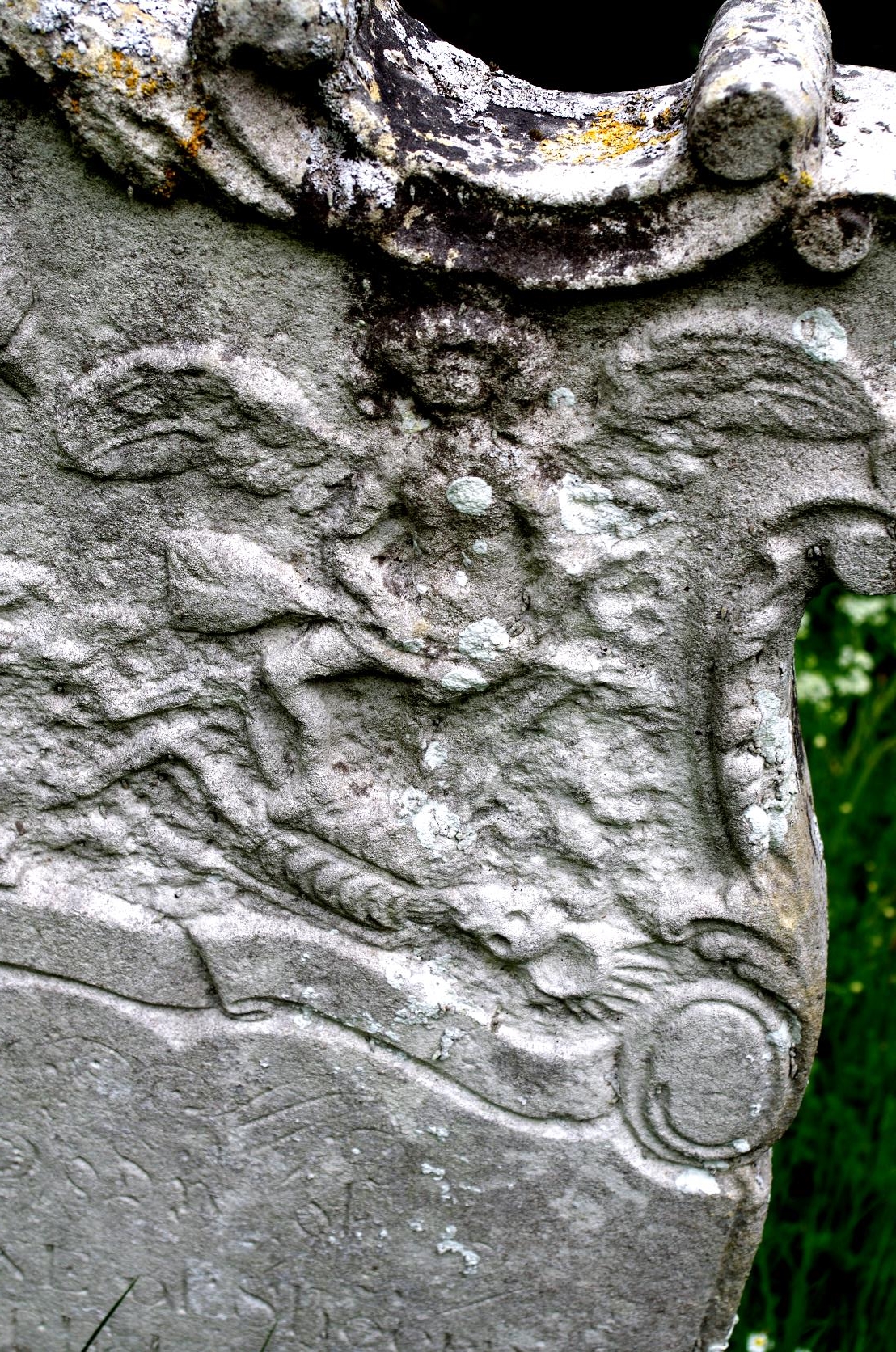
The Devil holding Death’s Dart standing over a skeleton that’s lost its crown. Could it be the King of Terrors? ©Carole Tyrrell

The King of Terrors is also a psychopomp. This comes from the Greek word, ‘psychopompos’ which means ‘the guide of souls.’ They appear in many religions and forms such as spirits, angels, demons and gods to guide the deceased to the afterlife.

Anubis and the King – tomb of Horemheb 1323-1295 BC Metropolitian Museum of Art. Shared under Wiki Creative Commons

Charon and his boat on a funerary relief ca 320s BC shared under Wiki Creative Commons.

The most obvious examples are Anubis, the ancient Egyptian god of the underworld, Charon the Greek ferryman, the Goddess Hecate and the Norse Valkyries amongst a host of others.  The psychopomp is also a personification of death and often represented with a scythe and given the title of ‘The Grim Reaper’ – the reaper of souls. This is one of the earliest images of him and dates from 1460.

One of the oldest paintings with conventional ‘Grim Reaper’ elements, a skeletal character with a scythe (circa 1460 by Jean Fouquet) shared under Wiki Creative Commons.

The King of Terrors first appears in the Bible in the Book of Job 18:14:

‘His confidence shall be rooted out of his tabernacle, and it shall bring him to the king of terrors.’

This is part of a chapter emphasising destruction and death for those who do not keep to the righteous path. However, I am indebted to the vastpublicindifference blog for the next earliest use of the name in a printed pamphlet. He is mentioned in William Prynne’s ‘Perpetuite of a Regenerate Man’s Estate’ in 1626:

‘If once you have the smallest dram of time and saving grace, you need not feare the very King of Terrors, hell and death, you need feare the most that men or divells (devils) can do to you. They cannot seuer (sever) you from the love of God, which is Christ Iesus (Jesus) your lord, not yet disturbe you from the state of Grace.’

He also appears in nearly 200 books in English pre-1700.

However, the King of Terrors, the Grim Reaper or whatever you choose to call him is not a very comforting image for those left behind. So, it’s no wonder that, as the years went on, these very stark symbols began to be replaced by the ‘winged souls’. They gave a more hopeful image of another life after death. There’s also the batwings on either side of the skull to consider.

Bats were considered to be the spirits of the dead and associated with evil as the Devil traditionally had the same type of wings. Sometimes the skulls are given two different types of wings; on one side they are feathered and on the other is the batwings.

Bats can also be seen as guardians between physical and spiritual worlds. They were supposed to guide souls through transformation or metamorphosis: renewal, death and rebirth.  So, the use of them is very appropriate on a funerary monument. In China, for example, they are seen as symbols of good luck, longevity and rebirth.

So, within this one symbol there are two meanings.  One is that the person has encountered the Grim Reaper and has died whereas the other suggests that they are going to be reborn to everlasting life. It was an interesting symbol to see on my churchyard visit although the skull does look a little too enthusiastic!

Text and photos © Carole Tyrrell unless otherwise stated

References and further reading

The History and Antiquities of the Church and Parish of St Laurence (Lawrence), Thanet (Ramsgate) Charles Cotton, 1895 via Kent Archaeological Society

King of Terrors | Gravely Speaking

King of Terrors Gravestone © Walter Baxter cc-by-sa/2.0 :: Geograph Britain and Ireland

Vast Public Indifference: Death: “King of Terrors”

Greyfriars Kirkyard, Edinburgh: The Ultimate Guide | My Macabre Roadtrip

The King of Terrors takes a rest | Gravely Speaking

Psychopomp – Wikipedia

Job 18 KJV – Then answered Bildad the Shuhite, and – Bible Gateway

Genealogy Tours of Scotland: A Month of Scottish Gravestones – The Dance of Death
Bats, a funerary fascination

What’s The Meaning Of Bat Symbol? – Ourspiritanimal.com

A doomed royal marriage and a mausoleum in Ramsgate – Part 2

Lady Augusta Murray by Richard Cosway shared under Wiki Creative Commons

Part 2 the aftermath and the move to Ramsgate

By now Augusta was deeply in debt and in 1806 she finally gave up the title of the Duchess of Sussex. On 15 October 1806 George III authorised her to take the name of D’Ameland, one of the titles of the House of Orange with which Lord Dunmore’s family was connected. On 31 October 1806, the Treasury agreed to pay off her debts of £29,457 but with three conditions. She was to abandon the chancery case and not use the Duke’s coat of arms or livery. The Duke, Augustus, settled all of her debts that had been incurred prior to 25 March 1802 and from that date she was entitled to a £4000 pension p.a. deemed to be £1,000 p.a. at the time of the settlement. Thereafter she would receive an income of £4000 p.a. of which her existing pension of £1,200 would form a part.   £700 was awarded for the maintenance of the children.  Neither George III or Queen Charlotte ever saw their grandchildren from the marriage.

Augusta had been in debt for 13 years but by 1807 she was finally financially solvent and would be generously supported for the rest of her life. But at what a cost. Excluded from society, doubts cast on Emma’s parentage and the ruination of her family. But I do admire her as she didn’t fade away in shame but fought for herself and her children as much as she was able to. 

After considering other seaside resorts, Augusta moved to Ramsgate and bought a house there which she developed into an estate. She named it Mount Albion and it totalled 16 acres. At 45 she had another child, a son, Henry Hamilton, whom she never acknowledged. He was born in 1805 and died in 1824. She died on 4 March 1830 and was interred with her parents in the vaults at St Laurence in Thanet. Mount Albion was sold off for development and Holy Trinity Church now stands on what was her shrubbery. She is commemorated by street and road names named after her: Augusta Road, Augusta Steps and Augusta Place.

Augustus D’Este as a young man by Simon Jacques Rochard. Shared under Wiki Creative Commons

Augusta’s son, Augustus, joined the army and the 9th Light Dragoons. He took part in the Battle of New Orleans but was an unpopular officer. Although he never married he was reputed to have had several romantic liaisons. Eventually his father broke off any contact with him. Augustus was constantly frustrated by his unsuccessful attempts to achieve his rightful status and so decided to create the mausoleum in Augusta’s memory. By 1822 his health was failing and he had contracted multiple sclerosis. In fact his diaries, begun in that year, are the earliest recorded experiences of someone living with the disease and its effects. But he was determined to give his mother the status in death that she had been denied in life. The mausoleum was built in the shape of a Greek cross and cost £212.  George White who had worked on the repairs to the York Minster Chapter House carved the stones.  When it was completed the coffins of Augusta and her parents were moved from the vaults in the church and placed inside it. D’Este died on 18 December 1848 a month before his 55th birthday.

Augusta Emma Wilde, Baroness Truro (1801-1866) by Henri-Francois Riesener shared under Wiki Creative Commons

Augusta Emma married Sir Thomas Wilde who later became Lord Truro making her a Lady. They married on 13 August 1845 when she was 44. It was a low key ceremony as she would have also been subject to the Royal Marriages Act due to her being a descendant of George III, acknowledged or not. Lord Truro died in 1855 and she died in 1866. Truro Road in Ramsgate is named after her.

Lady Dunmore, Augusta’s mother, died on 11 November 1818. She never disowned her and supported her financially. Prince Augustus regarded her as a second mother:

‘although she had been excluded from royal circles and shared Augusta’s disgrace and isolation.’

Queen Charlotte died in 1818 and, two years later, George III died on  29 January 1820. Times were changing and the new King and Queen, William IV and Queen Adelaide, conferred a knighthood and  pension on Augusta’s son and a title to Emma which she refused. But she was a bridesmaid at the wedding to the King’s youngest daughter’s wedding. Queen Victoria gave them both pensions.

The Duke of Sussex, Prince Augustus, remarried privately after Augusta’s death to Lady Cecilia Buggin, the daughter of the Earl of Arran and his countess.  He wrote to Duke of Hamilton:

‘When one looks back to events thirty seven years ago one cannot do it without a sigh. My intentions were and always have been honest and for the best. I could not fight more than I did against established Laws and a Power greater than my own. Peace to her soul do I say from the bottom of my heart.’

He was a favourite uncle to Queen Victoria and  died on 21 April 1843 from a bacterial infection, erysipelas , and his son was not mentioned in his will. However, Emma who he described as ‘his delight’ inherited £10,000 and a house in Mayfair. In an obituary his children were acknowledged and the Royal Marriages Act was railed against. It would not be repealed until 26 March 2015. Augustus, the Duke of Sussex, was buried in Kensal Green Cemetery in London after refusing a State Funeral.

The grave of Prince Augustus, The Duke of Sussex, in Kensal Green Cemetery, London. February 2025.

It’s a sad tale as Augusta, due to her aristocratic background, would have made a suitable consort for Prince Augustus. But circumstance created by The Royal Marriages Act and possibly George III’s mental health problems conspired against them. They never met again after 1800.

View of mausoleum October 2025.© Carole Tyrrell

Grafitti on the illegible panels. © Carole Tyrrell

Damaged stones on mausoleum. © Carole Tyrrell

The mausoleum is crumbling now and looking the worse for wear as it nestles behind tall yew trees.  But who would have thought that a decaying mausoleum at the back of an overgrown churchyard would have such a dramatic and fascinating story to tell?

Text and photos © Carole Tyrrell unless otherwise stated.

References and further reading

St. Laurence Churchyard booklet and information boards

Augusta Emma Wilde, Baroness Truro – Wikipedia the daughter

St Lawrence, Laurence, Ramsgate, Thanet – Churchyard M.I.’s by Charles Cotton 1895 the inscriptions on the Mausoleum

Prince Augustus Frederick, Duke of Sussex – Wikipedia

Lady Augusta Murray – Wikipedia

https://en.wikipedia.org/wiki/Augustus_d%27Este

Forbidden Wife: The Life and Trials of Lady August Murray, Julia Abel Smith, The History Press, 2020.

A doomed Royal marriage and a mausoleum in Ramsgate – St Laurence in Thanet.

View of the D’Este Mausoleum showing bricked up entrance. ©Carole Tyrrell

Part 1 – The love story and a terrible home coming

The churchyard of St Lawrence in Ramsgate contains 1400 graves and was consecrated in 1275. It is now closed to burials but as I explored in early October I found a huge mausoleum right at the very back, peeping out from behind yew trees. It is a little worse for wear to say the least but the mausoleum has royal connections.

It is the D’Este mausoleum according to an information board and the guidebook.  Its inscriptions are now illegible, the outer decoration has been smashed, its roof tiles stolen and the entrance has been bricked up but it has such a story to tell.

It contains 6 people hence its size. They are:

The Duchess of Sussex, wife of Prince Augustus Frederick.

The Duchess’s parents, the Earl and Countess of Dunmore

Two unacknowledged grandchildren of King George III, Augustus and Augusta. She is interred with her husband, Sir Thomas Wilde, The Lord High Chancellor.

Illustrious permanent residents indeed.  I was immediately intrigued and found an archive photo which showed that it had once had an imposing position within the churchyard. Please follow this link:

MMT – Gazetteer Mausoleum Details

It is now considered to be at risk.

The D’Este Mausoleum showing where the inscriptions would have been originally on all sides of the mausoleum. ©Carole Tyrrell

This is the original wording on the inscriptions from 1895:

324. D’Este Mausoleum. South side: Sacred to the beloved memory of The Right Honorable Thomas WILDE, 1st Baron TRURO, who began his professional life as an attorney, by great talent, perseverance, and integrity, unaided by patronage, became Lord Chief Justice of the Court of Common Pleas, and afterwards Lord High Chancellor of England. Born 7th day of July 1782, died 11th November 1855. He had by his first marriage with Mary WILEMAR three sons, the eldest of whom died in infancy, and one daughter. By his second wife Augusta Emma D’ESTE he left no issue. In this tomb are also enclosed the remains of The Right Honourable Augusta Emma, Baroness Truro, widow of Thomas, 1st Baron Truro. And only daughter of Augustus Frederick, Duke of SUSSEX, who died on the 21st day of May 1866. “May God mercifully receive her soul”.

On the west side of ditto: Erected by Augustus Frederick D’ESTE, to receive the mortal remains of his venerated and loved mother, the Lady Augusta MURRAY, 2nd daughter of John, Earl of DUNMORE. Married at Rome on the 4th day of April, A.D. 1793, to His Royal Highness, Prince Augustus Frederick, afterwards Duke of SUSSEX, 6th son of His Majesty KING GEORGE THE THIRD, a subsequent marriage was solemnized at St George’s Church, Hanover Square, London. Both marriages were held invalid in England, as contrary to an Act of Parliament entitled “The Royal Marriage Act”. Here also repose the remains of Augustus Frederick D’Este, the only son of Lady Augusta, and His Royal Highness the Duke of Sussex. Born 13th January 1794, died 18th December 1848.

North side of ditto: On this side are deposited the remains of John, 4th Earl of DUNMORE, died March 1809, and of his Countess, the Lady Charlotte STEWART, daughter of Alexander, 6th Earl of CALLAWAY, died November 1818.’   Kent Archaeological Society

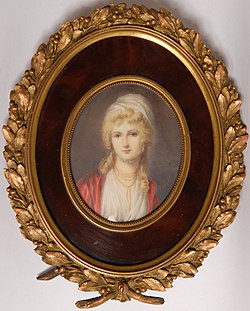
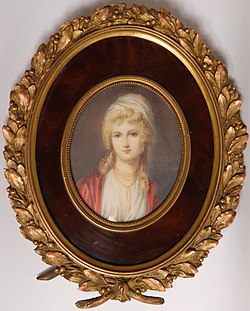
Lady Augusta Murray – portrait miniature by Richard Cosway. Image shared under Wiki Commons

It’s the inscription to Augusta, Duchess of Sussex that begins the story. This is the 18th century Royal marriage which fell foul of a punitive Act of Parliament, The Royal Marriages Act. A wife was denied and repudiated becoming a social outcast, her family ruined and her children nameless. Until eventually she ended up living in Ramsgate where several road and street names still commemorate her.  This the sad story of Lady Augusta Murray’s doomed marriage to Prince Augustus Frederick, the sixth son of George III.

I am indebted to Julia Abel Smith’s biography of Lady Augusta, ‘Forbidden Wife – the Life and Trials of Lady Augusta Murray’ which was published by The History Press in 2020.

She was the daughter of John Murray, the 4th Earl of Dunmore and his wife Lady Charlotte Stewart. Augusta was 32 when she met Prince Augustus, the sixth son of George III in Rome in 1793 . He was 20 and  largely estranged from his father. She was widely travelled and very accomplished which was unusual for a woman of her time. Her father had been the Governor of  New York,  and later Virginia, as the first stirrings of independence happened. In fact, she and her mother were in Gibraltar when news came of the French Revolution and the beheading of Marie Antoinette.  Augusta and Augustus then remarried in London.

Prince Augustus Frederick, portrait by Guy Head. Shared under Wiki Commons.

Augustus had not yet told his father of the marriages as he wanted to do it when he became of age. But neither he nor Augusta had any idea of how strictly the Royal Marriages Act of 1771 could be applied, and particularly to them, once George III and Queen Charlotte found out.

The Act declared that any descendants of George III would be prevented from marrying without his previous consent as well as his heirs and successors. Any marriage contracted without the King’s consent would be null and void.  The result of this would be ruin and rejection for both parties and any children would be illegitimate.  Anyone connected with the marriage would also be liable for prosecution.  However, it was different if the royal petitioner was aged over 25 and hadn’t received the King’s consent as they could give notice to the Privy Council and, if within a year the Houses of Parliament had no objection they would be free to marry.

The inquiry on the legitimacy of both of the marriages which was held on 27 January 1794, was scathing. The marriages were deemed ‘pretended’ and ‘absolutely null and void’ and Augusta was ‘falsely calling herself the wife of the said Royal Highness Prince Augustus Frederick.’  If that wasn’t enough she was also liable for the legal expenses. But Augusta always regarded her marriages as completely legal.

As a result of the inquiry she was awarded a pension of £1,000 p.a. but she, their children and her family became pariahs in the eyes of polite society.  But her parents never stopped supporting her.

Prince Augustus and Augusta continued to see each other and a daughter, called Augusta Emma, was born on 9 August 1801. She was always known as Emma. She and her brother were given the surname of Hanover and it was later changed to D’Este. But life was hard for Augusta with no income and no longer being part of society. She ended up in considerable debt.

However, after eight years of trying to have Augusta recognised as his wife, the final separation came on 7th December 1801 when Augustus finally conceded defeat. He wrote:

‘We are to meet no more. My whole wish now is to make her comfortable.’.

He then became the Duke of Sussex in England, Earl of Inverness in Scotland and Baron Arklow in Ireland. He also moved to Portugal and had a mistress.

Part 2 – The aftermath and the move to Ramsgate

Text and photos ©Carole Tyrrell unless otherwise stated.

References and further reading:

St. Laurence Churchyard

Augusta Emma Wilde, Baroness Truro – Wikipedia the daughter

St Lawrence, Laurence, Ramsgate, Thanet – Churchyard M.I.’s by Charles Cotton 1895 the sicriptions on the Mausoleum

Prince Augustus Frederick, Duke of Sussex – Wikipedia

Lady Augusta Murray – Wikipedia

Forbidden Wife: The Life and Trials of Lady Augusta Murray, Julia Abel Smith, The History Press, 2020.