A very seasonal post from The Cemetery Club blog – enjoy!

A very seasonal post from The Cemetery Club blog – enjoy!

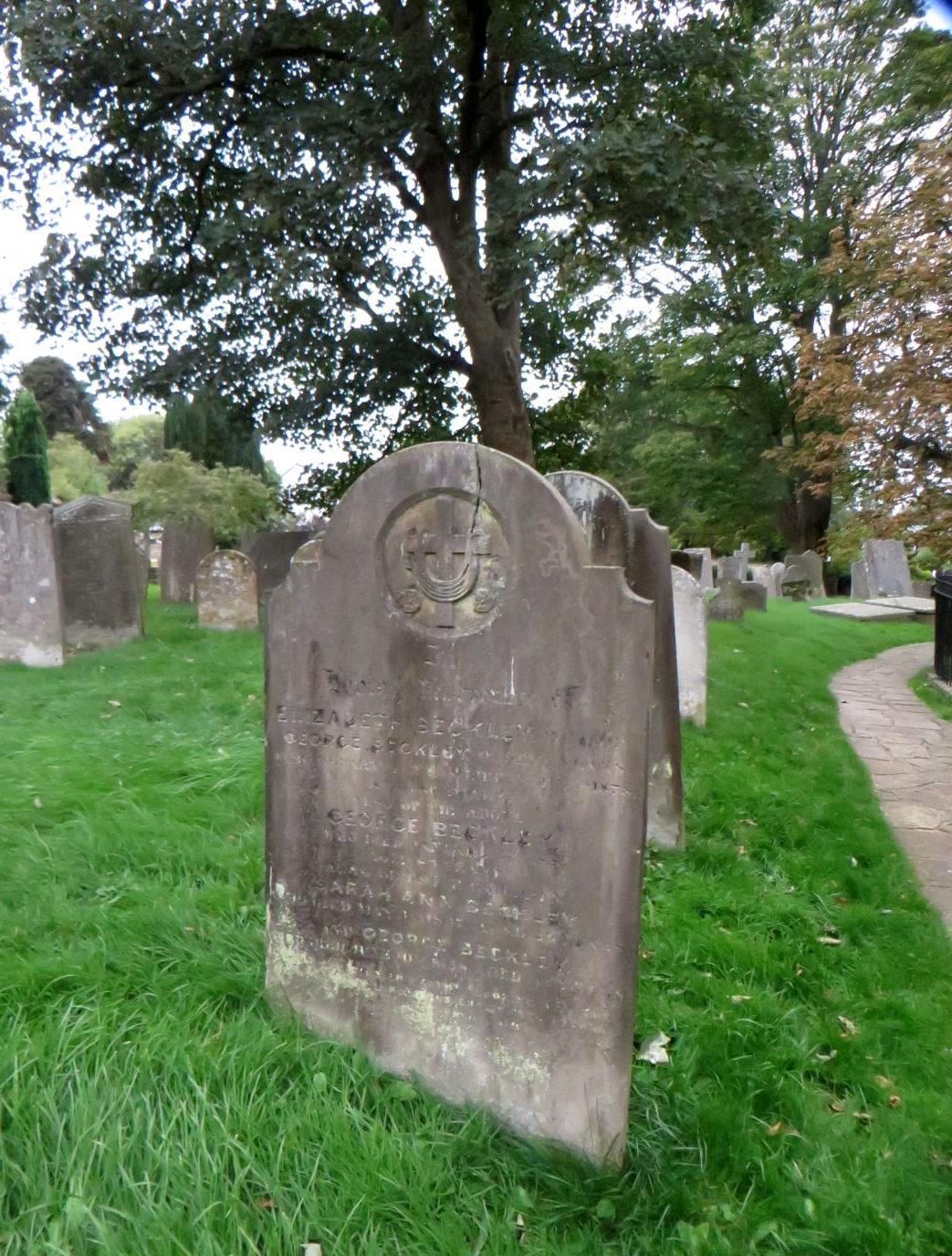
This month’s symbol is a rare one and I discovered it in my local churchyard, St Nicholas in Sevenoaks. It’s on the grave of the Beckley family.

However, I have also previously seen crosses with real cloth draped on them in two big London cemeteries One was in the Greek Section of West Norwood. At that time I thought that perhaps it was to commemorate an anniversary or a particular religious festival. However, during my research for this post. I have discovered that the colour of the West Norwood cloth, white, is associated with Easter Sunday.
As you can see from the above photo of the Beckley headstone, the cloth is wrapped loosely around the cross and, according to my research, it’s a resurrection symbol. In fact it’s known as the Resurrection Cross or the Shrouded Cross. Some of its other names are: the Draped Cross, the Empty Cross, the Risen Cross or the Deposition Cross. The latter is a further reminder of Christ’s descent from the cross
It’s intended to be a representation of Jesus no longer being on the cross. Although there are also plain crosses on graves unless they have the cloth they are not Resurrection crosses. The cloth is a supposed reference to Christ’s grave clothes or shroud that were found in the tomb after he rose from the dead. It emphasises to the bereaved left behind that death isn’t the end.
Within the church calendar, the cloth draped around a cross during important dates in the Christian calendar particularly Easter has special significance according the colours of the fabric. These are white, purple – the colour of royalty, and black. The latter is used from Palm Sunday (the week prior to Easter) until Good Friday and denotes mourning after Christ’s death on the cross.
The shrouded cross on the Beckley headstone is a striking image which caught my attention and really stood out in a churchyard containing several headstones with fascinating symbols on them.
So this one may be an affirmation of faith on behalf of the deceased or a strong belief in the afterlife with death being seen as the beginning of a new life.
©Text and photos Carole Tyrrell
References and further reading
https://www.seiyaku.com/customs/crosses/shrouded.html
http://www.thecemeteryclub.com/symbols.html
https://answers.yahoo.com/question/ind?qid=20170406140444AAUuXdc

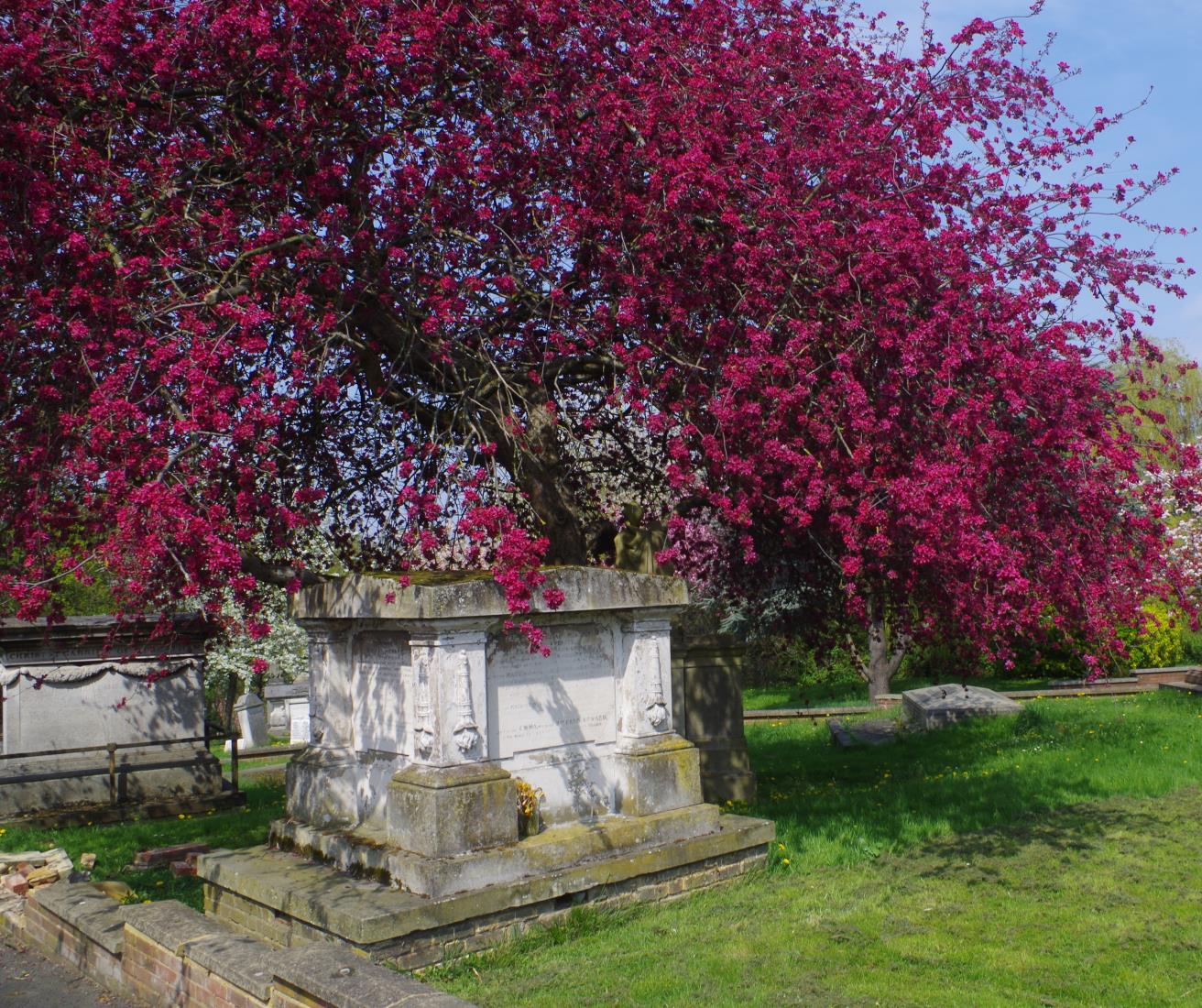
Where do you go to grieve when there’s no memorial with which to remember them?
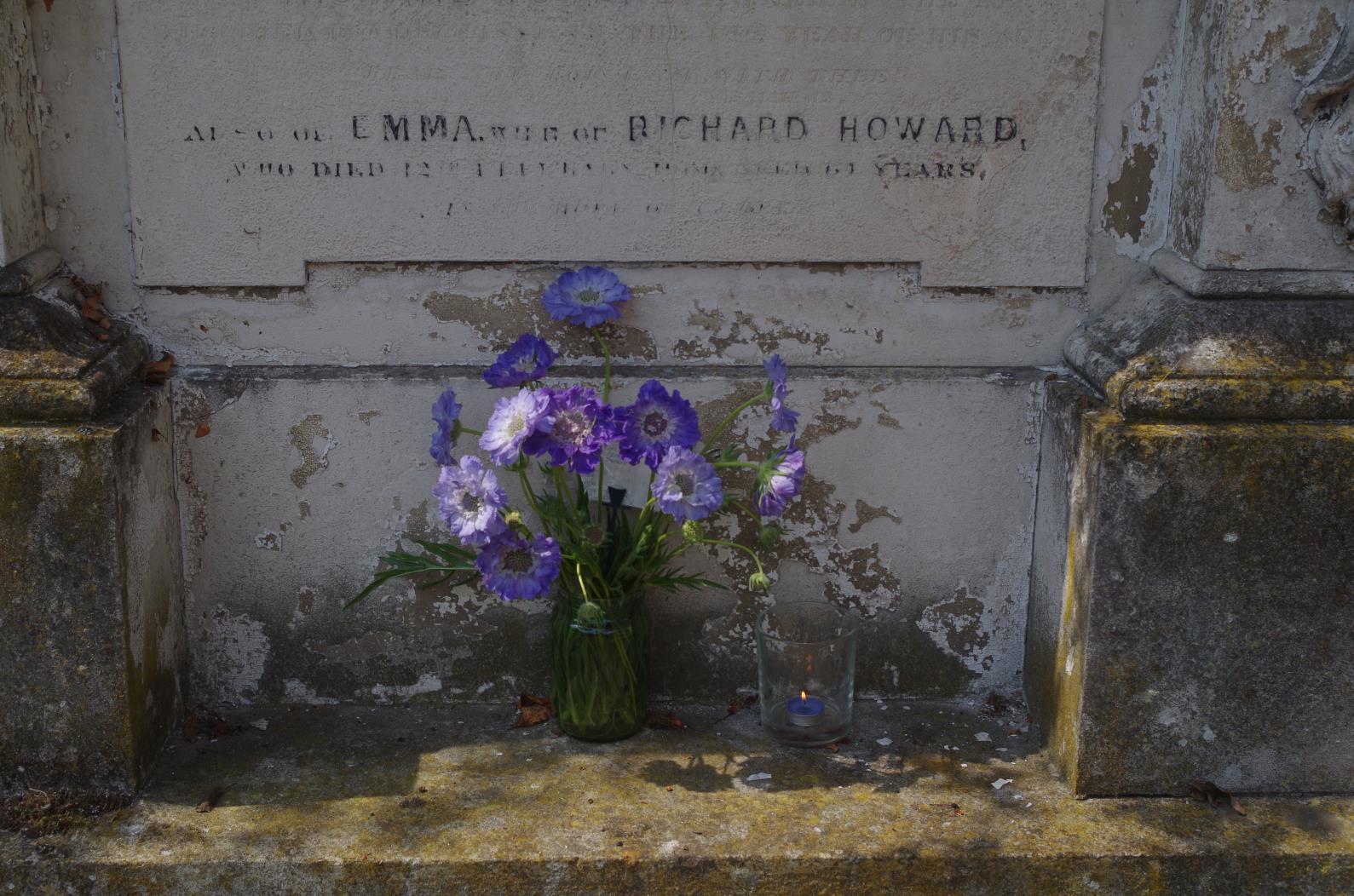
I can’t recall exactly when I first spotted the floral tribute in a jam jar placed on a ledge of the Howard monument in West Norwood Cemetery. The memorial is near the columbarium and over the last 2 or 3 years I began to make a habit of looking to see what flowers would be in the jam jar this time. There were never any accompanying cards or identification, just the flowers and sometimes a tea light. They were always fresh.
The bright colours of the flowers always stood out against the pale plaster on the monument behind them and often provided a wonderful photo opportunity.
The Howard monument is a handsome and large one with two magnificent downturned torches on each of its four sides and a fulsome epitaph above the flowers.


But who put them there? A mysterious mourner like the black clad visitor to Edgar Allan Poe’s grave? A descendant of the family marking a special day?
It was at the West Norwood Open Day in July 2018 I finally met the mystery mourner. As I walked past on my way to the columbarium, she was arranging a new bunch of flowers in their jam jar and we got chatting.
She was a local woman, let’s call her Mary, and was nothing to do with the Howards at all. Instead her flowers and tea lights commemorated a loved one who’d been cremated a long way away. We talked about where do you go to grieve if you have no permanent memorial or your deceased loved one is too faraway to visit.
She mentioned the mourning process and said that she used to come everyday but now it was less often. ‘It doesn’t mean that you don’t think about them but it’s not quite so raw. You start to move on.’ she said and added ‘You can get caught up in it.’ I mentioned Queen Victoria’s extended mourning period after Prince Albert died. At some point, at which only the mourning would know, they will become a cherished memory and the outward mourning begins to fade. I didn’t ask her why she’d chosen that particular monument but maybe she had her own reasons.
When my father unexpectedly died, it had been difficult for me to grieve as I had nowhere tangible to go and so, like Mary, I did adopt an angel in a nearby Victorian cemetery as my mourning place. There was something about being in a place where the outpouring of grief was unashamed and open with the need to have a permanent memorial that said I was here. It felt more appropriate that the neatly trimmed municipal cemeteries. I felt drawn to it although he’d never been there.
But the old cliché is true in that time is a great healer, life does go on and the dead live in our hearts in the ways in which we choose to remember them. With me I became a blood donor in my father’s memory as he had also been one.
One day Mary may no longer feel the need to leave a floral tribute to her departed friend and it will have served its purpose. I will miss passing the Howard monument to see what flowers are in the jamjar this time.
RIP Mary’s friend whoever and wherever you were. I hope you know that Mary always remembered you and that you were not forgotten.
©Text and photos Carole Tyrrell
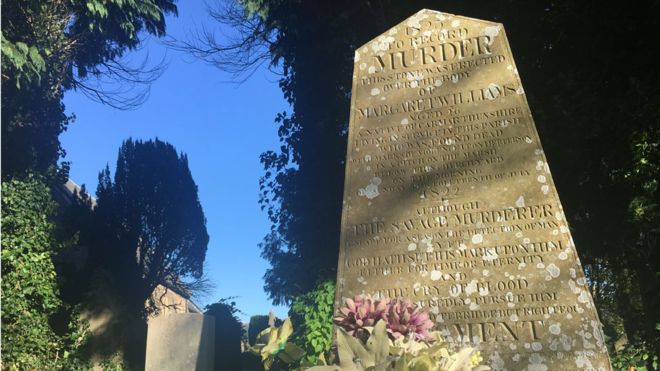
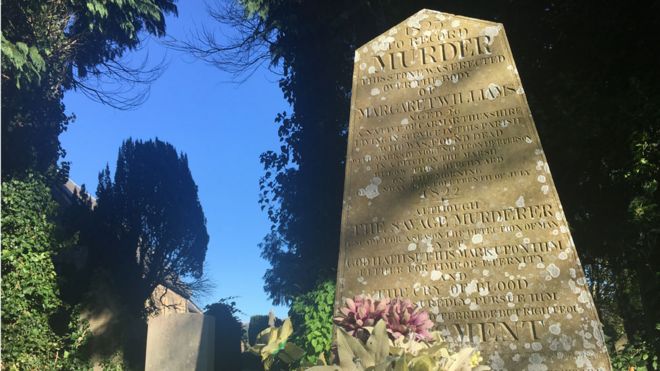
Wandering around the picturesque cemetery at St Catwg’s church in Cadoxton, Neath, a first-time visitor might be startled out of their gentle stroll by the stark message on top of one tall, weathered stone – MURDER.
This memorial in south Wales is one of a handful of “murder stones” erected around the UK, the majority over a period of about 100 years, to commemorate violent deaths that shocked the local communities.
The Cadoxton stone is dated 1823, and recounts the death of Margaret Williams, 26, who was from Carmarthenshire but was working “in service in this parish” and was found dead “with marks of violence on her person in a ditch on the march below this churchyard”.
Miss Williams’ story, such as is known from contemporary reports, tells of an unmarried young woman who had been working for a local farmer in Neath when she became pregnant.
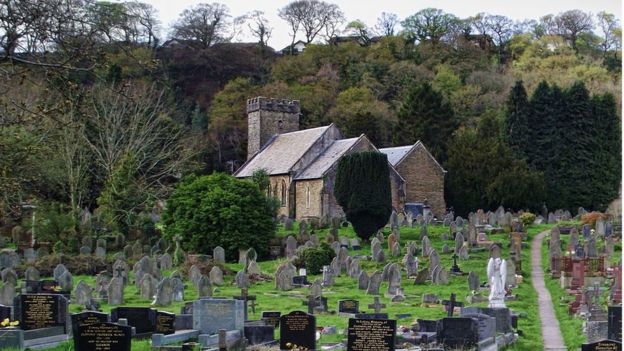 Image copyrightCR LEWIS/GEOGRAPH
She had declared the father of the child was the farmer’s son, and when her apparently strangled body was discovered head down in a watery inlet in marshes near the town, he was the prime suspect.
But whatever local opinion may have believed, there was no evidence to tie him or anyone else to the crime, and her murder remained unsolved.
However, the murderer was left in no doubt as to the feelings of the local community after this stone, part gravestone and part warning, was erected over poor Margaret’s body.
Giving the details of her fate and the date of her death, the stone, erected by a local Quaker, continues: “Although the savage murderer escaped for a season the detection of man yet God hath set his mark upon him either for time or eternity, and the cry of blood will assuredly pursue him to certain and terrible righteous judgement.”
This unsolved killing is unusual in the history of the surviving murder stones in that the murderer escaped justice. Most of the other memorials are to people whose killers were quickly detected, sentenced and dispatched via the gallows.
Dr Jan Bondeson, a retired senior lecturer at Cardiff University and a consultant physician, has made a study of the history of crime alongside his medical career and has written a number of books on the subject.
He became interested in murder stones after editing a book which featured them.
He said: “The murder stone in Cadoxton is the only one in Wales. There are plenty of them in England.
“There was an instinct for the local people to erect them. There was a strong instinct to commemorate a tragic murder.”
Dr Bondeson has documented several further murder stones across the English counties, and one early example of the type in Scotland.
One murder stone has been immortalised by no less a writer than Charles Dickens himself. In the novel Nicholas Nickleby, the eponymous hero walks through the ominously named Devil’s Punch Bowl at Hindhead in Surrey.
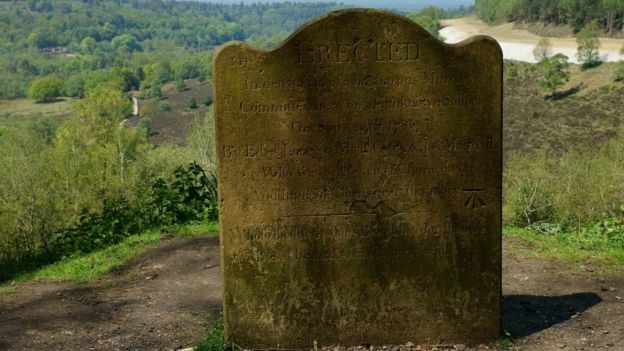 Image copyrightPETER TRIMMING/GEOGRAPH
There, he and his companion come across the real-life stone marking the 1786 murder of a man known only as the Unknown Sailor.
The unnamed man was en route to his ship in Portsmouth when he visited a local pub in Thursley. There he fell in with three fellow sailors, and paid for their drinks and food before leaving with them.
The sailor was repaid for his generosity in the following way: They “nearly severed his head from his body, stripped him quite naked and threw him into a valley”.
The three did not get far. The sailor’s body was found soon after, and James Marshall, Michael Casey and Edward Lonegon were chased and captured after trying to sell the dead man’s clothes at a pub.
They were hanged from a triple gibbet near the murder scene, and the unknown man was buried in Thursley with a stone paid for by local people.
But the local mill owner, James Stillwell, went a step further. He placed a stone in Devil’s Punch Bowl itself, with this grim warning to future generations:
“ERECTED, In detestation of a barbarous Murder, Committed here on an unknown Sailor, On Sep, 24th 1786, By Edwd. Lonegon, Mich. Casey & Jas. Marshall
“Who were all taken the same day, And hung in Chains near this place, Whoso sheddeth Man’s Blood by Man shall his, Blood be shed. Gen Chap 9 Ver 6”
Dr Bondeson said the majority of the stones appeared around the 1820s, adding “That was the high level for the erecting of murder stones. All of them are in the country – none are in urban areas.”
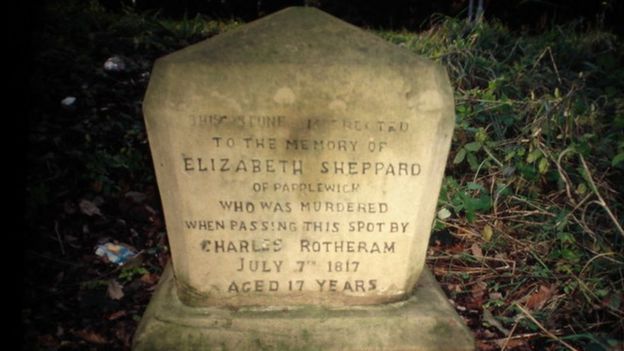 Image copyrightDEBORAH MCDONALD/GEOGRAPH
Elizabeth – Bessie – Sheppard was just 17 when she set out from her home in Papplewick, Nottingham, on 7 July 1817, to seek work as a servant in Mansfield, seven miles away. She found a job, but she never found her way back home, because on her return journey, a travelling knife grinder found her.
Charles Rotherham, a man in his early 30s, had served as a soldier in the Napoleonic wars for 12 years before beginning this new stage in his life.
He was seen on the road coming from Mansfield after drinking several pints where his path crossed Bessie’s.
Her severely battered body was found in a ditch by quarrymen the next day. Her shoes and distinctive yellow umbrella were missing and there was evidence her attacker had tried to remove her dress but had failed.
Rotherham had sold Bessie’s shoes and was on his way to Loughborough when he was arrested. He confessed to the crime and was returned to the scene where he showed a constable the hedge stake he had used to kill Bessie.
Like all murderers at the time, Rotherham swung for his crime. Local people, outraged by the attack, banded together to raise money for a stone to commemorate Bessie, which was placed on the site where she was attacked.
Bessie’s stone simply honours the memory of the dead girl, but another stone erected to a female victim of violence has more of a moral tone, seemingly warning women against certain behaviour as much as expressing anger with the killer.
“As a warning to Female Virtue, and a humble Monument to Female Chastity: this Stone marks the Grave of MARY ASHFORD, who, in the twentieth year of her age, having incautiously repaired to a scene of amusement, without proper protection, was brutally violated and murdered on the 27th of May, 1817.”
The story behind Mary Ashford’s death and its aftermath is one which left a permanent mark on English legal history.
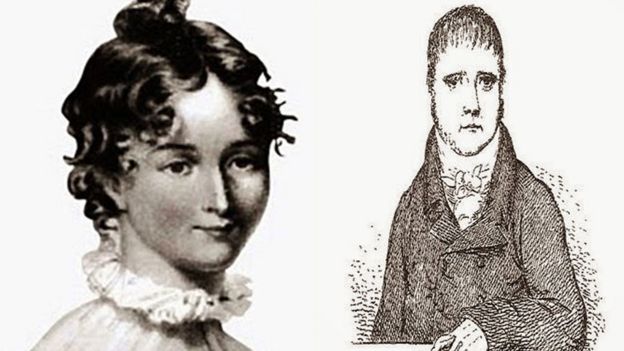
She had gone to a dance in Erdington, Birmingham, with her friend Hannah Cox, whom she planned to stay with overnight before returning to her place of work at her uncle’s house in a neighbouring village.
At the dance, she met a local landowner’s son, Abraham Thornton, and later reports confirmed the pair spent most of the night dancing together and having fun.
When they left the dance, Mary told her friend she would spend the night at her grandparents’ home – possibly a ploy to spend more time with Thornton – and Mary and he went off together.
Mary returned to Hannah’s house at 4am, changed her dancing clothes for her working clothes, collected some parcels and set out for her uncle’s home.
About two hours later a labourer found a bundle of clothing and parcels on the path leading to Mary’s home. The alarm was raised and her body was found submerged in a water-filled pit.
An autopsy showed she had drowned and had been raped shortly before her death.
People believed Thornton, having been rebuffed by Mary during their hours together, had lain in wait for her to return home and raped her before throwing her into the pit to drown.
He was duly arrested and tried, but a number of witnesses placed him at another location at the time of Mary’s death and he was acquitted.
But the story does not end there. Mary’s brother William Ashford began a private prosecution under an obscure ancient law, which allowed relatives of murder victims to bring an “appeal of murder” following an acquittal.
Thornton had a surprise up his sleeve though. In response, he demanded a trial by combat as was his right under that law, under which he could legally have killed Ashford, or if he defeated him, gone free.
Ashford was much smaller than Thornton, and declined the battle. Thornton was a free man, and the case was swiftly followed by a change in the law in 1819, banning such appeals and therefore trial by battle.
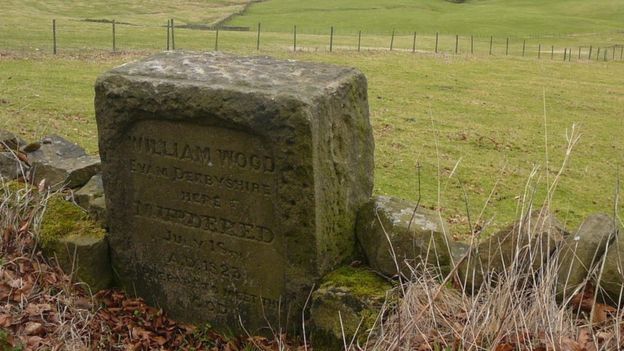 Image copyrightCOLIN PARK/GEOGRAPH
Other victims include:
The last word goes to those who chose to commemorate Nicholas Carter, a 55-year-old farmer from Bedale, Yorkshire, killed by a farm labourer as he rode home from market.
The stone laid at the murder site in Akebar – later to become a Grade II listed monument which hit the headlines earlier this year when it was badly broken in a car crash – had a very simple message, along with the date of his death, May 19, 1826.
Do No Murder.

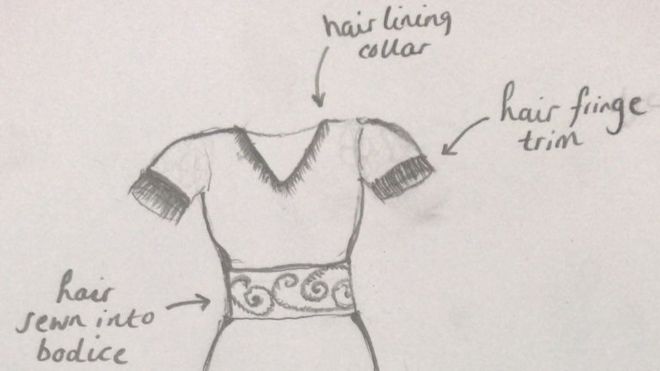 Image copyrightHAIR DRESS DESIGN
A woman is searching for a dressmaker who can create a garment featuring her dead mother’s hair.
She says she had been collecting the hair for four years before her mother died in August and will pay £15k for a replica of her mother’s wedding dress.
The 61-year-old from Bristol, who wants to remain anonymous, posted the request on the fashion manufacturing website Sewport.
So far, no designer has volunteered to take on the task.
In her post, the woman writes: “I’m looking for someone to recreate my mother’s wedding dress from 1953, which she wore when she married my father.
“My mother passed away recently and I’d like to create a special memento of her life.
She wrote: “I found out my mother was ill in 2014 and from that point onward I began to collect her hair.
“At the time I wasn’t sure why I was collecting it, however, now I think I do.”
She acknowledges the task is “admittedly quite weird” but says she is keen to have the finished piece ready in time for the anniversary of her mother’s death next August.

It was usual for Victorian mourners to wear lockets and rings containing a lock of hair from a dead person.
Queen Victoria is said to have regularly worn a locket of Prince Albert’s hair from his death in 1861, up until her own 40 years later.
The preparation of hair for mourning jewellery was a professional occupation in the 19th Century.
At the same time in the US there was a trend for making wreaths out of loved ones’ hair.
Wreaths intertwining the hair of dead and living relatives were viewed as objects to signify the family tree.
Details of how to shape and create a hair wreath are included in the Self-Instructor in the Art of Hair Work published in 1867, and a catalogue from the National Artistic Hairwork Company.
Leila Cohoon’s Hair Museum in Independence, Missouri, displays more than 400 wreaths and more than 2,000 pieces of jewellery made out of human hair.
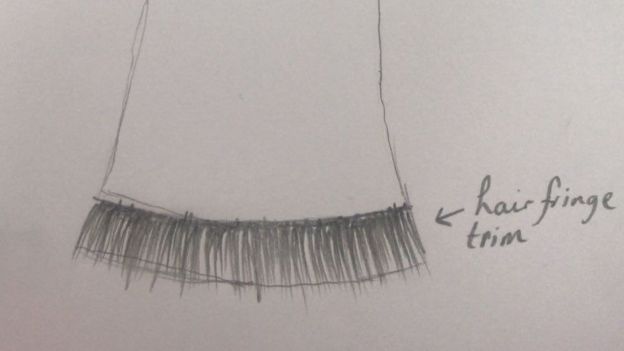 Image copyrightSEWPORT
The ideal design she says, would feature hair sewn into the sleeves, trim, collar and bodice of the ballroom-style dress.
She has sketched out a design and says she would like it to be as “authentic” as possible and feature the box of hair she started collecting in 2014.
Boris Hodakel, founder of the Sewport website, said most design requests were typically snapped up by manufacturers within six hours.
He said: “We deal with quirky and wonderful designs every day – that’s fashion.”
©BBC News


As we prowled the side paths bordering Brompton Cemetery’s celebrated Courtoy Mausoleum on an Exploring Butterflies day in June of the this year, we also discovered roughly half a dozen caterpillars. They were unconcernedly munching away on wildflowers or ambling along grass stalks. Usually caterpillars are always so well hidden and camouflaged, especially in long grass, but there they were.
These two attractive specimens would develop into day flying moths whose presence and colouring were very appropriate to a cemetery. In fact they could almost be known as the Goth Moths.
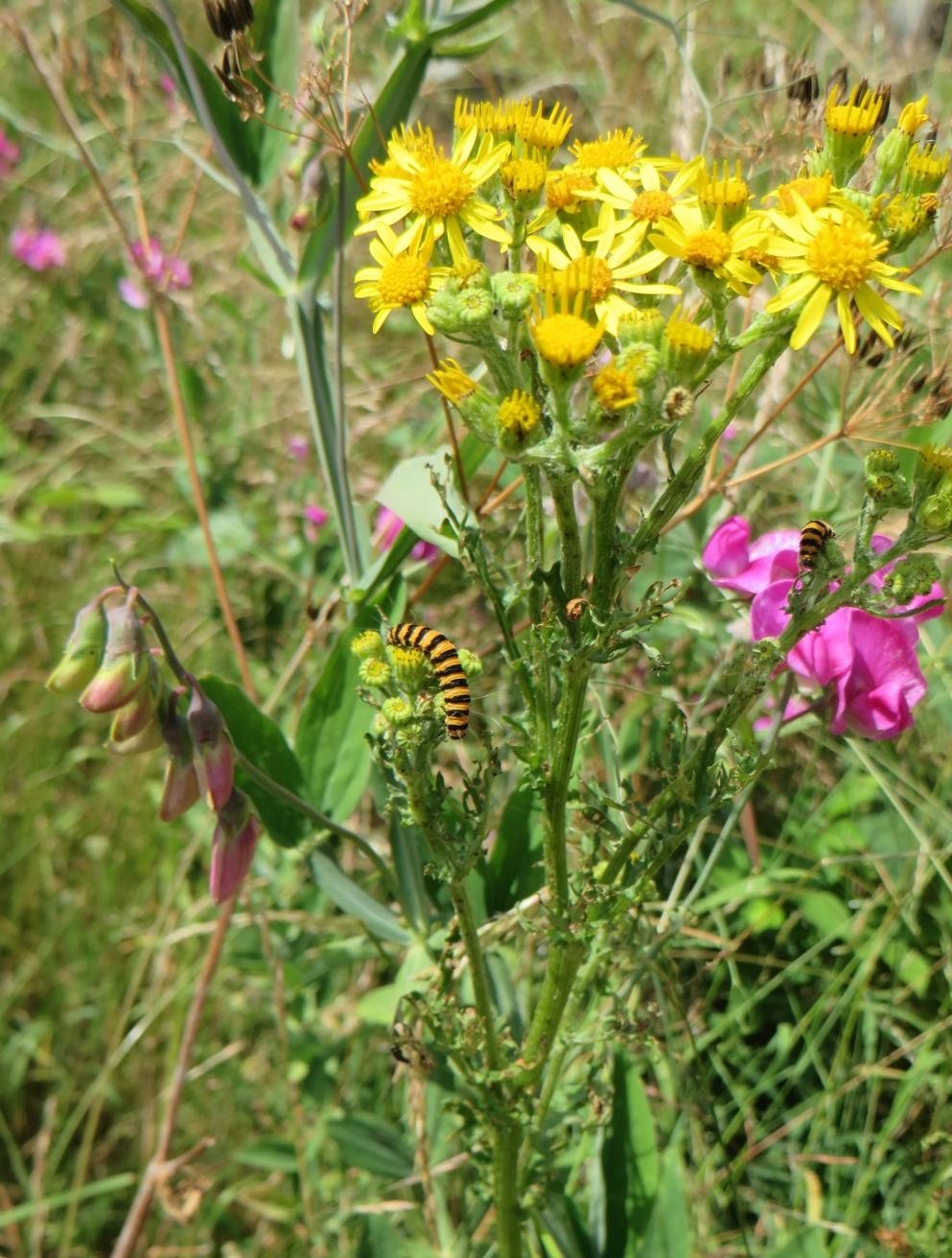
These stripey beasts feasting on ragwort are the caterpillars of the Cinnabar moth. When they transform into moths their colouring is very dramatic in scarlet and black:

The other caterpillar was nearby as it quietly made its way along a long stem of grass. In my opinion, it was another prettily patterned one, which will eventually become the Five Spotted Burnet moth.

This is another dramatically coloured moth in red and black and it gets its name from the number of red spots on its black wings and one appears at the top of this post.
As Goths like to roost in cemeteries and are known for their black clothes which are often contrasted with bright colours such as scarlet and purple it seemed entirely appropriate to find two examples almost named after them. It was also great to see caterpillars doing well in such an urban environment so obviously the cemetery’s management plan of leaving areas uncut and left to grow wild is working well for nature in 2018. Long may it continue!

©Text and photos Carole Tyrrell

At last the endless sorting out of boxes is over after the move. I’ve found some money I’d forgotten about, family photos and a lot of books. The Cancer r Research charity shop in the High Street is groaning under the weight of my donations and I have recycled a lot of stuff.
And now down to the important things in life – shadowsflyaway! I didn’t have an internet connection for a few weeks which was probably a good thing as it made me concentrate on emptying boxes and organising rooms.
But let’s begin with Symbol of the Month!
This month’s symbol comes from a post on Facebook’s Folk Horror Revival page and I was intrigued enough to make this one Symbol of the Month. I would describe it as a memento mori which is Latin for ‘Remember you must die.’

It’s a carving on a tombstone featuring a skeleton and a woman or girl facing the viewer. She is holding three flowers in one hand. In this photo, although the skeleton almost seems to be rising from the ground, he is actually holding a scythe in one hand and an hourglass in the other. This can be seen more clearly in the clipping from Northumberland’s Hidden History by Stan Beckensall which another reader on the strand of the post kindly attached.

She is wearing a tightly belted dress, perhaps fashionable in her time, and seems carefree despite having Death standing next to her in all his glory. I had the impression that this might have been on the grave of a young girl due to her dress and the flowers.
They reminded me of roses and I immediately thought of the famous phrase, ‘Gather ye rosebuds while you may’ which is a quotation from a poem by Robert Herrick, a 16th century poet.
The poem is entitled: To the Virgins to make much of time and the quotation comes from the first verse:
Gather ye rosebuds while ye may,
Old Time is still a-flying;
And this same flower that smiles today
Tomorrow will be dying.
So this little scene could be saying Enjoy life while you can as death will soon be here.’ It sounds a little depressing but life was shorter in earlier times. In the 19th century, for example, the average life of a working man was until their late 40’s and women often died in childbirth. I wander around cemeteries a lot as you can imagine and there are many monuments and memorials to wives and often children who have died young as a result. On the other hand it can be seen as uplifting in that it encourages the onlooker to enjoy life to the fullest.
Sadly I don’t know who’s buried here but she or he was obviously much missed to have such an impressive scene carved on their tombstone.
© text Carole Tyrrell photos use with permission.

I haven’t posted on here this month as I am moving house…..to Sevenoaks which has a church dedicated to St Nicholas. It’s a fine old church with a fascinating churchyard. It has a fine array of headstones and monuments with symbols on display that I hadn’t previously seen.
I knew instantly that I’d found a good place to live. (if I can survive climbing the hill to reach it.)
I will be offline during the move but hope to be posting August Symbol of the Month over the bank holiday.
See you all very soon.
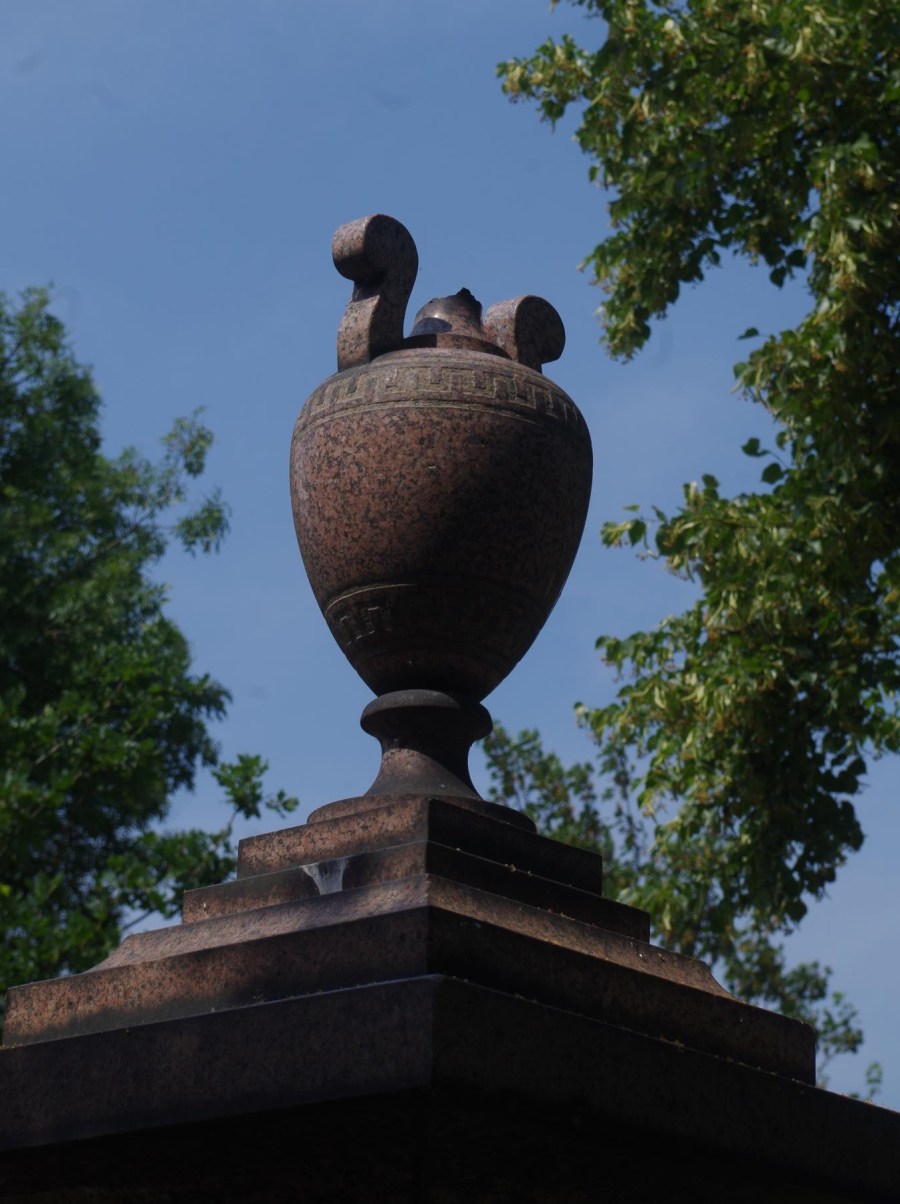

This month’s symbol is one that you frequently see in cemeteries. In fact, in most Victorian cemeteries you’re never more than a few steps from an urn… or two… or three……
These elegant sculptures are usually placed on top of a monument or can appear in 2D relief on a tombstone.

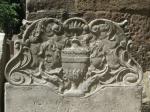
In marble, stone or plaster, they may also be draped with a sculpted piece of cloth or a flower garland. Urns may also have two handles, no handles or what looks like a lid to emphasise its use as a container. In Nunhead Cemetery there is a particularly elegant example with a lovely tassel on the sculpted drapery.


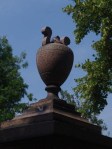

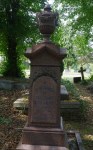
The Victorians loved urns which is why their cemeteries are clustered with them. They are examples of the Classical movement which was very much in vogue at the time when these large municipal cemeteries were created. This was an echo of the Greek and Roman eras but the urn as a funerary symbol was known long before them. However, according to theartofmourning website:
‘…the word ‘urn’ comes from the Latin word ‘uro’ which translates as ‘to burn’ so no matter what shape the vessel was, its title was always ‘urn’.
Urn was, therefore, the umbrella name for containers of ashes. It may have been a small box or an elegant vase but as the above quotation says, it was always known as an urn. Cremation was an early form of preparing the dead for burial as ancient civilisations cremated their dead and put the ashes into containers. In fact, some urns found in China have been dated to 7000BC. In Central Europe there was what has been described as an Urnfield culture from 1300BC – 750BC which is due to the large cemeteries of urn burials that have been excavated.
The Greeks adopted the use of urns in around 1000BC and the scattering ashes blog has suggested that this may have been:
‘because of soldiers dying abroad in wars or campaigns abroad and this was the only way to return their bodies home to their loved ones.’
After the Greeks, the Romans used cremation as a method to bury the dead until it was superseded by interment within a sarcophagus. But, even then, the urn maintained its status as a symbol of death and the body’s decay into dust. A reminder that, ultimately, we will return to the dust from which we were originally created. So the urn is also a link to the ancient world and its burial practices However, there is an alternative theory put forward on the Lakewood cemetery website in which it’s suggested:
‘The urn is also a symbol of a house or dwelling. When it’s draped this indicates a house of mourning.’
But, ironically, the Victorians weren’t all that enthusiastic about cremation, despite their love of urns, until at least the late 1880’s. This is when it was introduced into large London cemeteries such as Kensal Green and West Norwood.
But why are some urns draped? I often feel it’s almost as though the folds of the drapery are protecting the deceased from the world until Judgement Day although there’s nothing in the urns. The artofmourning website considers it to be an indication of the death of an older person but I’m not sure that I’d agree with that due to its prevalence in Victorian cemeteries.
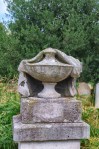
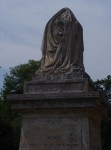

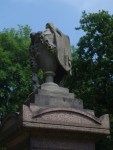

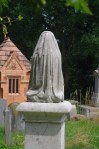

The draped cloth has also been seen as the division, the impenetrable curtain if you like, between life and death. Some drapes can almost resemble shrouds and this can indicate that the soul has departed from the shrouded body.
The urn also appears as a popular motif in mourning jewellery and George Hepplewhite also used it as a symbol on neo classical influenced furniture. It was an indication of taste and of a classical education.
So the next time you’re in a Victorian cemetery why not try and count how many urns you can see or how many times a draped urn appears? It’s a simple symbol to sculpt with and calls down the millennia to our Prehistoric forefathers as they buried their dead in the same way that we do. The ones that I featured in this blog post nearly all came from West Norwood cemetery and were within a short distance of each other. I was spoilt for choice as to which ones I decided to feature.
And you’ll be pleased to know that I’ve managed to refrain by working in the classic Morecambe and Wise joke on a Greek urn….
©Text and photos Carole Tyrrell unless otherwise stated.
References:
https://artofmourning.com/2011/04/10/symbolism-sunday-the-urn/
https://artofmourning.com/2011/04/10/symbolism-sunday-the-urn/
https://www.lakewoodcemetery.org/styles-sculptures-symbolism
http://historyinstone.blogspot.com/2012/12/the-draped-urn.html
http://www.bbc.co.uk/london/content/articles/2005/05/10/victorian_memorial_symbols_feature.shtml
https://www.thoughtco.com/photo-gallery-of-cemetery-symbolism-4123061
https://symbolsproject.eu/explore/others/objects0/drapes-/-drapery/draped-urn.aspx
https://www.furniturelibrary.com/the-urn-logo-from-antiquity/
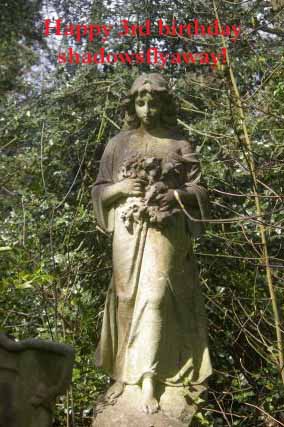
Yes, dear reader, it was three years ago in 2015 that I began this blog. A complete novice, I set it up in order to talk about primarily funerary symbols which are my main interest and to promote my work in progress which will be a book about them. One of my great pleasures in life is exploring cemeteries, graveyards and cemeteries to find new symbols to write about. But a word of warning, remember to take a camera with you and take photos of the graves around the one that you’ve chosen otherwise they can be difficult to relocate. I feel that symbols are the deceased’s final message to the world. It can either be a way to say goodbye or a message of comfort to those left behind. However, I can only speculate on the reasons for their choice.
But, while writing this blog, I’ve also become interested in the living residents of cemeteries – the wildlife. Often cemeteries are locked up at night and are usually quiet places which enable wildlife to flourish. There are often wild areas where the grass is left uncut and these can be a vital lifeline in an urban green space. They can support many different varieties of wildflowers, butterflies, moths, grasshoppers, dragonflies and also foxes and birds. At a recent Brompton Cemetery Exploring Butterflies day 13 species of Butterflies were found. It’s interesting how people use cemeteries as one man enthusiastically recommended Brompton Cemetery’s plentiful supply of blackberries for his smoothies!
So, thanks to my readers and visitors for staying with me over the last 3 years. I hope you’ve enjoyed my posts, photographs and theories on particular symbols. There’s plenty more to come including exploring what remains of the Necropolis Railway at Brookwood Cemetery in Surrey, a return visit to Chaldon Church to look at the churchyard memorials and also to the place where my interest in cemeteries began, St Lawrence’s Hospital burial ground also in Surrey and a Roman necropolis surrounded by back gardens in Italy.
And as always there will be Symbol of the Month. It’s always fascinating to undertake the research for these as there may be several different interpretations of meaning and it can also led into other directions.
So please come with me through either the cemetery gates or perhaps the lychgate to a churchyard and let’s explore together. There’s a symbol over there that I haven’t seen before and although I’m not sure what it means now I soon will…..
©Text and photo Carole Tyrrell
 shadows fly away