It’s behind you! – The Doom painting of Chaldon Church

The priest’s sermon has made you feel a little drowsy as you sit in your pew.  Then, as your eyelids begin to droop, suddenly you can smell burning and hear crackling flames….faint screams as well and devilish chuckling interspersed with angels singing…..there’s a sudden warmth behind your back and when you turn around, you’re confronted with gleeful demons faces on the whitewashed wall. Is one turning round and beckoning to you? Instantly you’re wide awake again with a nudge from your mother to sit up straight and you turn to face the priest again. But you can still hear the flames and the laughter…..

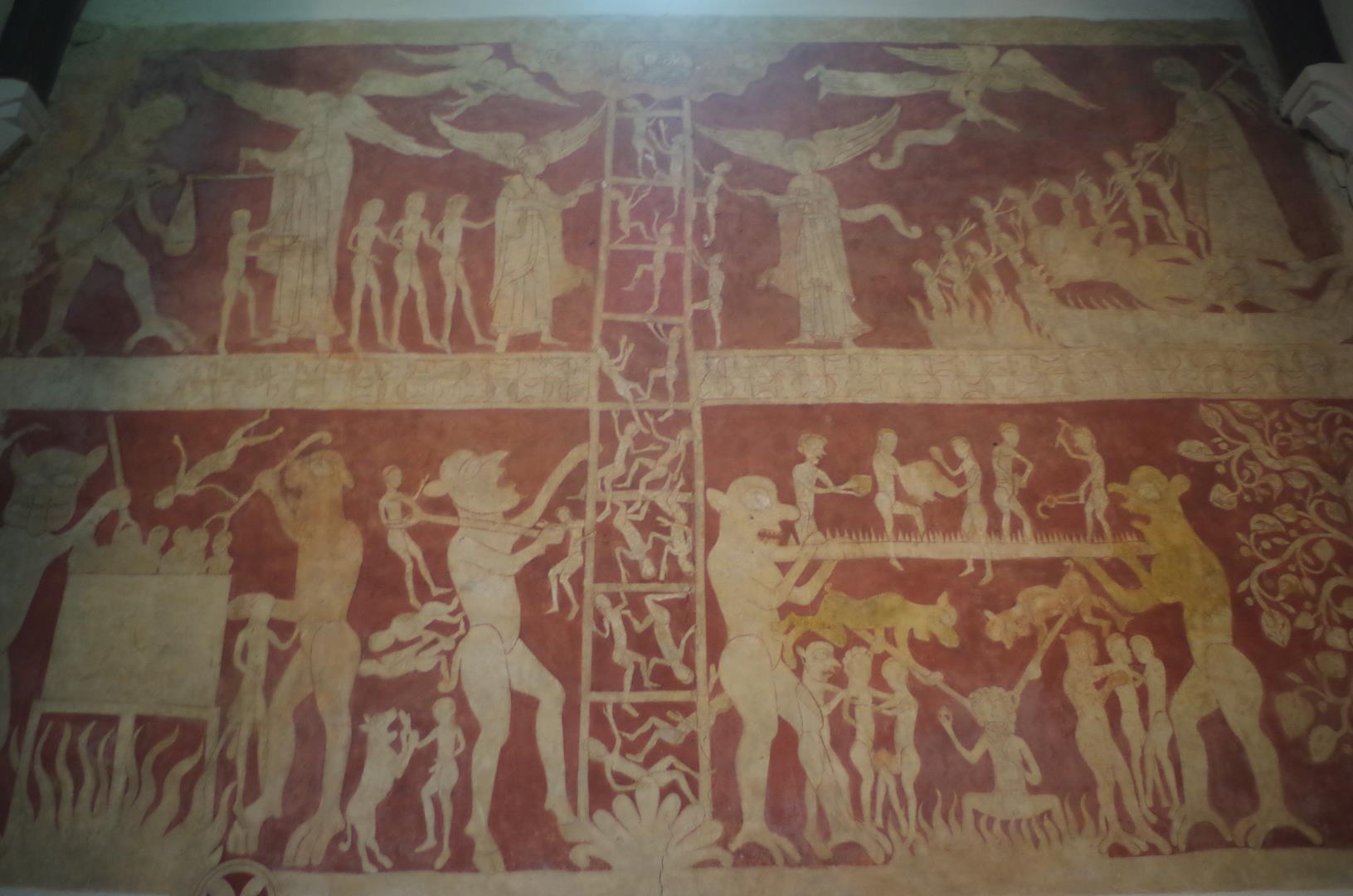
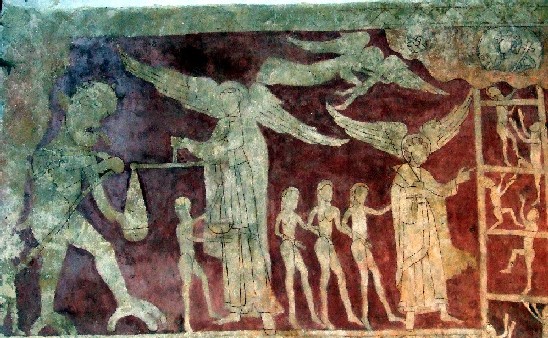
Chaldon’s Doom painting, or mural as the church prefers to call it, is reputed to be the oldest in England and has been dated to at least the 12th century.  It’s believed to be the work of an anonymous artist monk.    Until the 17th century it taught the local parishioners which was the right path to follow if you wanted to be going upwards to eternal bliss instead of down to hell for endless torment. The mural’s  official title, according to the church’s website  is The Purgatorial Ladder, or Ladder of Souls, with the Seven Deadly Sins.  However tastes and doctrines change and after the Reformation many of England’s Dooms were whitewashed over.  It was felt by zealous reformers that they didn’t follow strict Bible doctrine and were also considered to be ‘Popish’.

But Dooms have a habit of re-surfacing and so it was with the Chaldon Doom.  In 1869, the then Rector, Reverend Henry Shepherd was having the church walls prepared for whitewashing when he suddenly noticed signs of colour and halted the work. The mural was then cleaned and preserved.  There was a further conservation in 1989 by the Conservator and Director of the Canterbury Wall Paintings Workshop.

According to the painted church website, Dooms were the most commonly painted subject in the Middle Ages. Dooms were often placed on a church’s west wall as a reminder to parishioners as they were leaving the church.  But, as at Chaldon, they were also on the back wall or at the front on the chancel arch as at St Thomas’s Salisbury.  The Chaldon mural has the disturbing effect of constantly looking over your shoulder when you turn your back on it…..

The Chaldon Doom is large and measures 17ft x 11ft and stands out against the plain white washed walls. It’s painted entirely in red whereas other Dooms are in full colour. However it’s the only image in England of the Ladder of Salvation although it’s common in the Eastern Orthodox tradition. It’s behind the pews and would have been a constant reminder to the parishioners to be thinking of the afterlife.   A medieval congregation would have been illiterate and the Doom would have resembled a picture book or public information film on what could happen to sinners in eternity. They needed to prepare for the Final Judgement and, due to a shorter lifespan, the afterlife was much more to the forefront of the medieval mind than ours. A Doom is a traditional English term for a pictorial rendition of the Last Judgement or Doomsday which is the moment when Christ decides the eternal destination of human souls.  This is because the Church was very concerned with how to portray the afterlife in a visual way that could be easily understood.  After all a picture is worth a 1000 words…

There are roughly 40 surviving Dooms in Britain but in the 1880’s over 100 were recorded. They can often combine several themes: the parable of the sheep and the goats, assorted Biblical prophecies and other medieval traditions.  The Chaldon mural uses the Seven Deadly Sins.

There’s only two choices for the dead as they arise from their graves to go up to Heaven and sitting around on clouds playing harps or down to Hell and the eternal flames.  However Purgatory was also uppermost in the medieval mind as people believed that, prior to going to Heaven, a soul would have to spend time there before going up to Heaven. Chaldon’s Ladder represents Purgatory.
To interpret the Chaldon Doom and its crowded canvas you need to begin at the lower right of the painting and look for the serpent in the tree of life which is a metaphor for the fall of man.  This is a rough guide from a Chaldon church pamphlet and imagine the priest using it to preach to his flock:

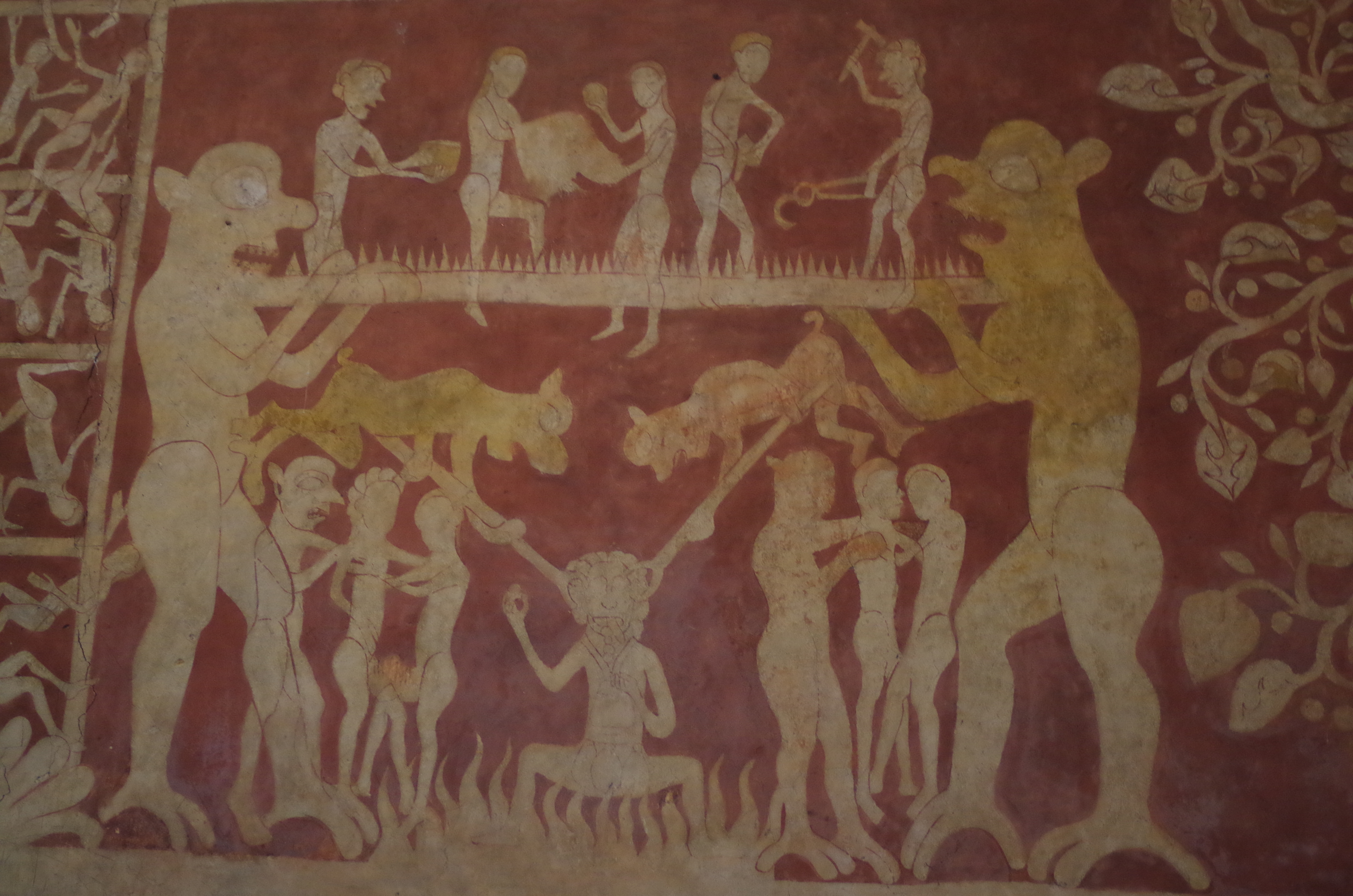
Detail of Chaldon Doom showing the bridge of spikes over which dishonest tradesmen have to walk over with a moneylender sitting in flames with Envy and Lust on either side of him.
©Carole Tyrrell

Two demons hold up a bridge of spikes over which dishonest tradesmen have to cross. These include a blacksmith, spinner, potter and mason who are all missing essential tools. The cheating milkman is about to climb the ladder with a brimming bowl of milk due to having given short measure in life.

Then we come onto the 7 Deadly Sins:

Avarice: A moneylender sits in flames as two demons hold him upright. He’s blind and money pours from his mouth. He has to count it all as it flows into his pouch.

Envy: There are two figures on the right hand side of the moneylender.  One of them has longer hair than the other.

Lust: On the moneylender’s left hand side are two figures embracing.

On the left hand side of the ladder a demon plucks souls from the ladder of salvation.

Pride: A woman is beside a demon as a devil wolf gnaws at her hands.  This could indicate either pride in her hands or that she fed her pets too well in life while ignoring the starving.

Anger: Above the woman two figures fight over a hunting horn.   Two demons throw what are considered to be murderers into a cauldron.

Detail of Chaldon Mural. Glottony clutching hi bottle of wine.
©Anne Mitchell. Used without permission

Gluttony: A drunken pilgrim lies at the feet of a demon.  He’s sold his cloak or badge of office in order to buy wine.

Sloth: At the far left 3 women dawdle.

A cloud bisects the picture to form a cross and the foot of the Ladder is the symbol of life.  The Archangel Michael is weighing the good and bad deeds as the Devil slyly has a hand on the scales trying to weigh it down with bad deeds as he holds a rope dragging souls to hell.   A penitent tries to point out to St Michael what the Devil is up to.  The 3 Marys are being led to Heaven by an angel as another one above them helps a remorseful thief ascend to the Pearly Gates.

Detail of Chadon Mural. The Weighing of the Souls. Three naked women walk towards the Ladder as an angel points the way.
©Anne Mitchell. Used without permission

Elijah and Enoch are also going upwards to bliss on the right of the ladder as an angel holds up a scroll of their good deeds.   Above them another of the heavenly host hold up a scroll which says ‘open ye the gates that the righteous may enter.’

Detail of Chaldon mural. Supposedly based on the Harrowing of Hell as Satan lies on top of a huge worm like creature and an angel tranfixes him with a banner/ Redeemed souls climb the Ladder as another angel helps one climb.
©Anne Mitchell. Used without permission

On the far right the Lord is mesmerizing the Devil with his cross while welcoming Old Testament characters into Heaven and finally above the ladder is the demi figure of Christ in the act of benediction.

He has the sun on his right hand side and the moon on the left.


For a fuller explanation I can recommend: http://www.paintedchurch.org/chaldon.htm


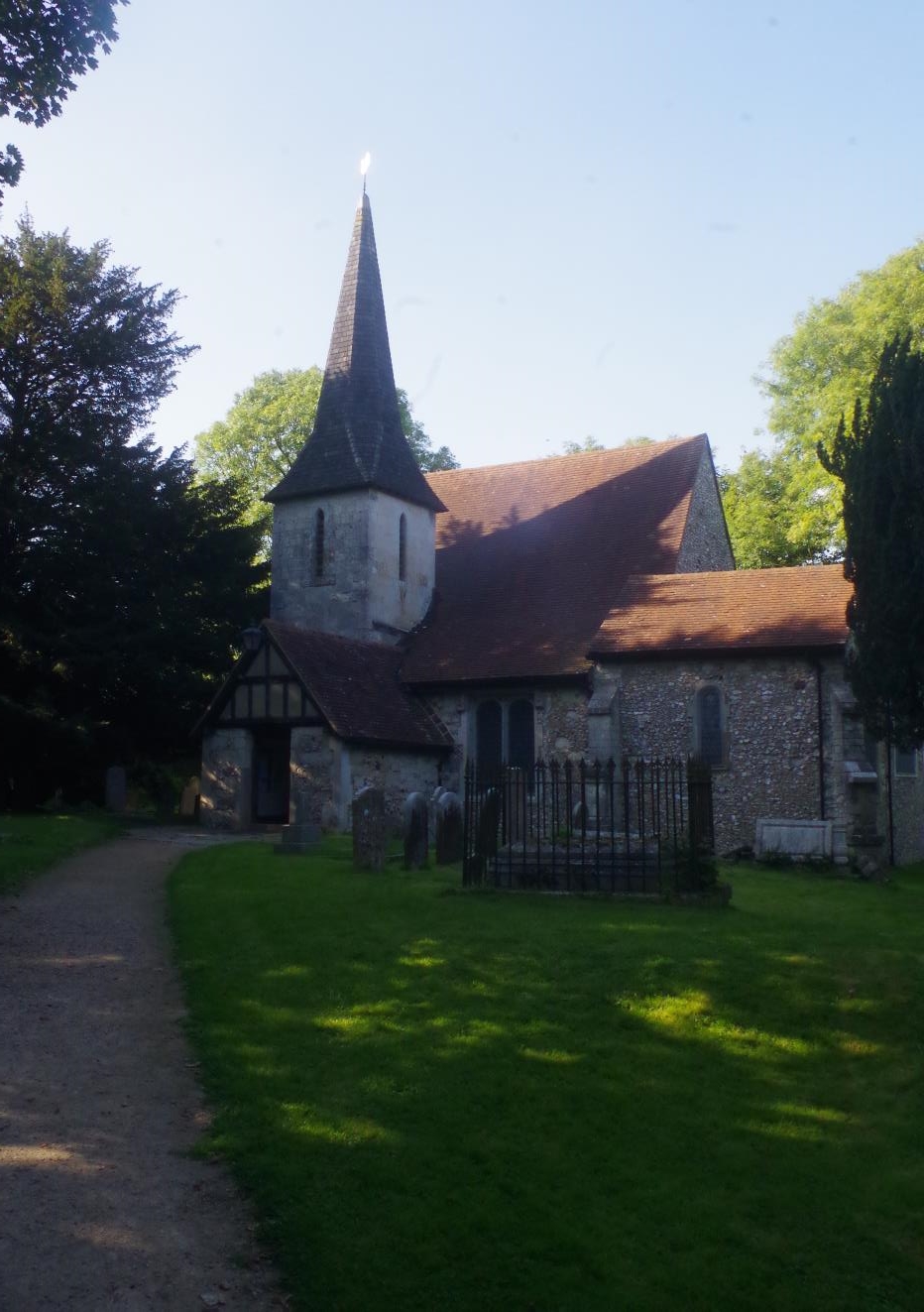
Chaldon church is near Coulsdon in Surrey and its correct name is St Peters & St Pauls.

View of Chadon church, Surrey.
©Carole Tyrrell

It’s a lovely picture, postcard church with a candle snuffer tower but it’s in the middle of nowhere except for a scattering of nearby houses. There’s no village attached to it and it’s on the notorious Ditches Lane which leads off Farthing Downs.    This can be a lonely road for walkers as there are no houses along it until you reach the church.  Chaldon church is rumoured to have been built on a pagan site and there has been a church here since 1086 AD.  Its foundations have been dated back to 727AD.   I find it strange that such a magnificent and dramatic mural was located in such an out of the way place.  It really took me by surprise when I first saw it as it’s so in your face. But as I turned away from it I thought I heard devilish sniggering and wondered what it must have look like under flickering candlelight.

There are other Doom paintings to be seen in England and these are:

South Leigh, Checkendon and Coombe – Oxfordshire

Wenhaston, Sufoollk

Dauntsey, Wilts

Patcham, Sussex

Penn, Bucks

Oddington, Glos

Symington, Beds

Lutterworth, Leics

Stratford upon Avon, Worcs (this is in glass)

York Minster  (a crypt carving)

St Thomas’s church, Salisbury

I have seen the one in Salisbury and was really impressed. It’s in full colour and is over the chancel arch to greet worshippers.  Christ sits on a rainbow at the centre of the chancel arch with the godly rising from their graves with angels whereas on the left the sinners are being helped by demons to go down below. This again was whitewashed over and then re appeared. Here are a small selection of images from it:

©Text and photos Carole Tyrrell unless otherwise stated

Reference and further reading

Dooms with a  View, Cathy Howard, FONC News Summer 2007

Chaldon Church mural leaflet

Restoration Village, Philip Wilkinson, English Heritage, 2006

Restoration Village, Philip Wilkinson, English Heritage, 2006

http://www.stthomassalisbury.co.uk/documents/history-heritage/9-the-doom-painting-guide/file

http://www.paintedchurch.org/doomcon.htm

http://www.paintedchurch.org/sleig7ds.htm – South Leigh Oxfordshire 7 Deadly Sins

http://oxoniensia.org/volumes/1972/long.pdf – overview of medieval wall paintings in Oxfordshire including Dooms

http://wasleys.org.uk/eleanor/churches/england/suffolk/suffolk_three/wenhaston/index.html

http://www.paintedchurch.org/dauntdoo.htm

http://www.allsaintspatcham.org.uk/page9.html

http://www.medievalchurchart.com/2017/10/the-penn-doom-buckinghamshire.html

http://wasleys.org.uk/eleanor/churches/england/cotswolds/gloucestershire/gloucestershire_two/lower_oddington/index.html

http://www.paintedchurch.org/mmoret1.htm – Marston Moretaine, Beds

https://www.leicestershirechurches.co.uk/lutterworth-church-st-marys/

https://www.stratfordguildchapel-friends.org.uk/the-wall-paintings

http://www.mondes-normands.caen.fr/angleterre/archeo/Angleterre/sculpture/doomstone.htm

https://www.quora.com/What-were-medieval-doom-paintings-and-what-were-they-used-for-What-is-their-importance

http://www.paintedchurch.org/doomcon.htm

http://www.lazerhorse.org/2014/06/08/medieval-doom-paintings/#

http://news.bbc.co.uk/local/cambridgeshire/hi/people_and_places/religion_and_ethics/newsid_8605000/8605860.stm


Symbol of the Month   – The Cadaver tomb

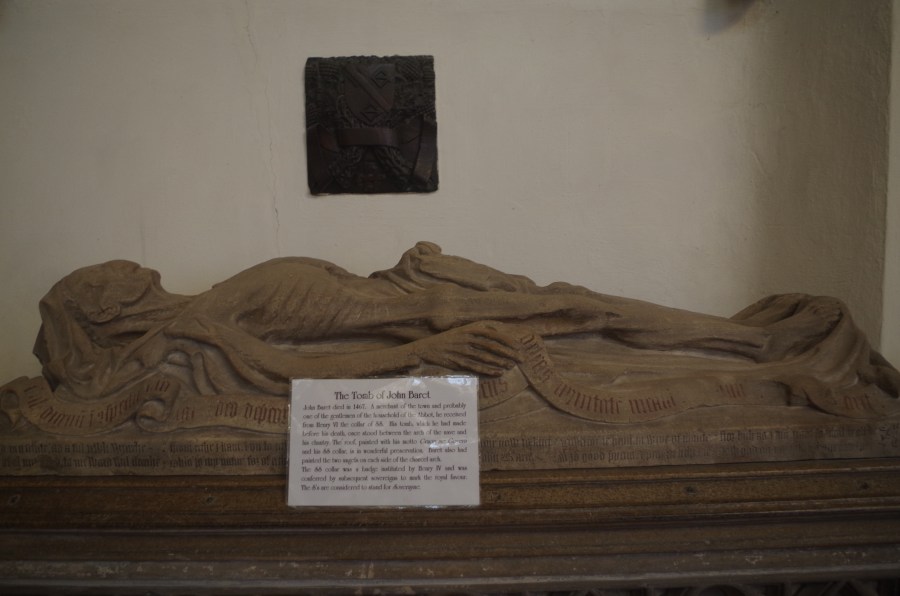
Full length view of John Benet’s cadaver tomb.
©Text and photos Carole Tyrrell

This month’s symbol is a cadaver or pardon tomb from St Mary’s in Bury St Edmunds.  These medieval tombs  were an extremely visual  way of reminding everyone that, despite what you had achieved during life, death would make you equal with all men.

It was as I stood in St Mary’s church, Bury St Edmunds after having  admired its magnificent hammerbeam with lifesize angels pinned to it like exotic butterflies that I saw John Benet’s tomb resting against a side wall.

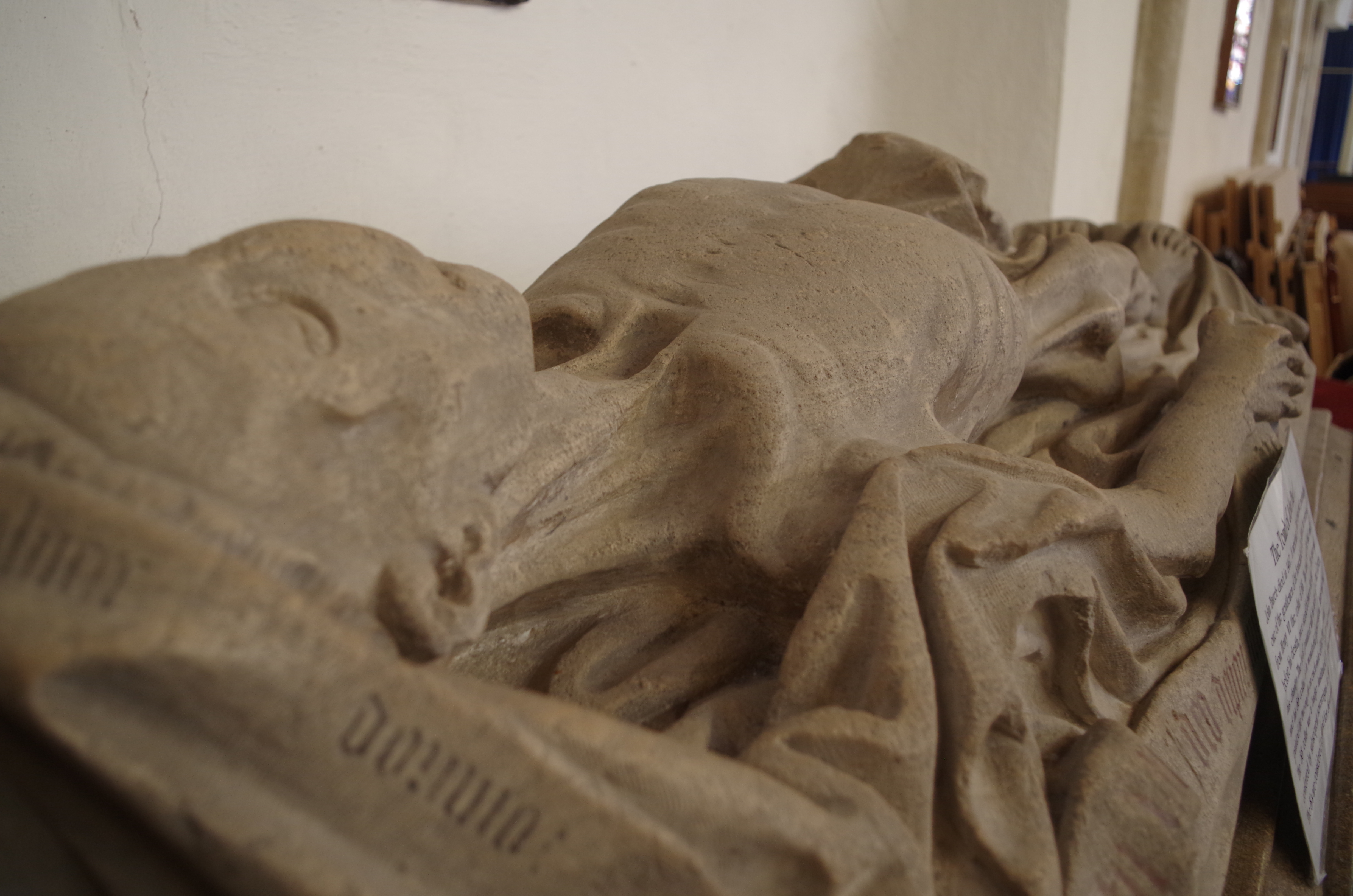
I’d seen two, somewhat worn, cadaver tombs in Winchester Cathedral but not one so close up and so well carved. Even now it’s still crisp and detailed but due to its current location it was difficult to take a full length photo. The tomb depicts John Benet lying on his back as a lifesize corpse with a shroud or towel protecting his modesty.

Another full length from the feet up of Benet’s cadaver tomb with the modesty cloth.
©Text and photos Carole Tyrrell

Although St Mary’s guidebook describes Benet’s tomb as a Pardon tomb, they are more often known as a transi or cadaver tomb.  This definition comes from Wikipedia who describe a transi or cadaver tomb, as a ‘memento mori’.  This is Latin for ‘remember you will die’ and a reminder of the inevitability of death.  Wiki goes onto add that this type of tomb is in the form of:

‘…a type of gisant or recumbent effigy tomb featuring an effigy in the macabre form of a decomposing corpse…’

This type of tomb is particularly associated with the Middle Ages which is roughly when Benet’s tomb was created and I’ve always known them as cadaver tombs. However, they’re not always in the form of a decomposing corpse as they can also be in the form of skeletons or the body of the deceased wrapped in a shroud. I am indebted to the flickeringlamps blog which featured transi tombs in the form of ‘double-deckers’.  This is where the top layer of the tomb portrays the gisant of the deceased as they were when alive and then below on the bottom layer as a decomposing corpse.  This is an extremely visual reminder of what the person once was and what they will inevitably become as earthly glory is fleeting and all must die.

Cadaver tombs can be found in several UK cathedrals and parish churches. The earliest surviving one is in Lincoln Cathedral and is dedicated to Richard Fleming. It dates from the 1430’s.  St Pauls’ cathedral has a later example from the 17th century which commemorates the poet John Donne.  Cadaver tombs are also known in Europe and particularly in Italy, France. Germany and the Netherlands.

But who was John Benet?

According to St Mary’s guidebook, John Benet was a medieval cloth trader and one of St Mary’s most important benefactors.  He financed the very ceiling that I’d been admiring and also his own private chancel chapel and tomb. Within his lifetime, Bury St Edmunds was a thriving town built on the local wool trade.  This led to the creation of a rising merchant class who were able to use their money to leave a lasting memorial to themselves in their local church as proof of their good and pious life.  Surely admittance to the Pearly Gates would be assured if you provided your church with some embellishments…. After they couldn’t take it with them but they could definitely prove that they’d had it while alive….

John Benet was a rich and powerful man within his local town  which is why he was able to afford to have a cadaver tomb made for him and one that was so well sculpted.   It originally lay in his own private chapel.  This has now gone but if you look up you can still see its glittering ceiling  which was restored in 1968.   You may just be fortunate enough to see the light glisten on the tiny pieces of concave mirror glass inserted into the gold stars to give the illusion of real stars twinkling.  Benet’s motto, ‘Grace me Governe’, his initials, coat of arms and SS collar are also part of the intricate decoration.  The latter, again from St Mary’s guidebook:

’….was a gift from the Lancastrian kings in recognition of a special or personal services.  It was in the form of a collar or chain in which the letter ‘S’ was engraved.  The letter ‘S’  which presumably stood for ‘Sovereign.’

The restored ceiling of what once was the ceiling of John Benet’s private chapel.
©Text and photos Carole Tyrrell

So Benet moved in high circles and wasn’t afraid to shout about it for all eternity.

There are Latin prayers on the ceiling’s edges which include ‘Pray for the soul of John Benet, ‘Let us praise the Lord gloriously’, Alleluia, Honour and glory to the only God.’, ‘My soul shall delight in the Lord’, ‘Seek only the highest’ and finally ‘May the pure Virgin Mary bless us with issue.’  Benet was not a man who stinted where his soul was concerned.

The tomb has moved around the church interior several times. But not of its own volition as far as I know. It has been surmised that the effigy of him portrayed as a decaying corpse was made during his lifetime.

Now there’s an  interior design feature for you…it would have been intended as a constant reminder of his own inevitable death and the need to make preparations for the afterlife. It’s in remarkable condition and is the best one that I’ve seen.  It may have been created in the  nearby Abbey’s master mason’s workshops.  This seems very likely given Benet’s powerful connections and the quality of the carving would also confirm this.

Originally he was positioned with his feet facing the east but, in 1884, the tomb was turned around so that the side inscription could be read.  In this, Benet’s motto is carved and a small figure of himself is in the middle of it, dressed in his finest clothes, and holding up the word ‘Me’.  Under one hand of the decaying corpse are the words:

‘He that will sadly beholde me with his ie, May he hyd own mirrour (and) lerne for to die. ‘

Full length view of John Benet’s cadaver tomb.
©Text and photos Carole Tyrrell

 A lifesize memento mori if you will. The guidebook, however, describes it as a Pardon Grave’ which isn’t a term that I’ve heard before. It’s meant to indicate that the person who was being commemorated has obtained a pardon or remission from purgatory.  Benet had also left instructions for his papal pardon to be displayed near his tomb for all to see.  I had the impression that Mr Benet was a bit of a show-off but if you don’t blow your own trumpet…. I sincerely hope that all this piety and expense achieved its aim.

The cadaver tomb iconography is based on the medieval Dance of Death or Danse Macabre.

Nobleman & Physician from the Lubeck Totentanz courtesy of UT Southwestern

This depicted a long line of people from Emperors to Popes right down to a beggar, each of whom had death in the form of a skeleton at their shoulder. This was a reminder that Death made all men equal.   The first one was recorded in St Paul’s Cathedral and in Long Melford, Suffolk, according to St Mary’s guidebook, long cloths were displayed depicting ‘the dance of Pauls’

It’s amazing that this survived the Reformation and Cromwell’s wrecking crews and still sits in St Mary’s reminding visitors of their inevitable fate.   But Mr Benet has a further claim to fame as, in 2003, he was loaned out to the Victoria and Albert Museum as part of their ‘Gothic: Art of England’ exhibition. Apparently, during conservation, traces of flesh coloured paint were discovered on the figure which included red and green veins especially in the neck.  So try and imagine Mr Benet in his original colouring – it must have quite a sight to see.    I think that he’d be very proud that his tomb, the hammerbeam ceiling and also his chapel ceiling are still in St Mary’s for all to enjoy and remember him.

©Text and photos Carole Tyrrell unless otherwise stated. 

References and further reading: 

St Mary’s, Bury St Edmunds A guidebook, Clive Paine, Honey Hill Publishing 1986.

Metamorphosis of a Death Symbol’ The Transi Tomb in the Late Middle Ages an d the Renaissance, Kathleen Cohen (Berkeley: University of California Press) 1973

https://flickeringlamps.com/2015/01/03/a-most-macabre-tomb-in-lincoln-cathedral/

https://en.wikipedia.org/wiki/Cadaver_tomb


Symbol of the Month – The Six Pointed Star

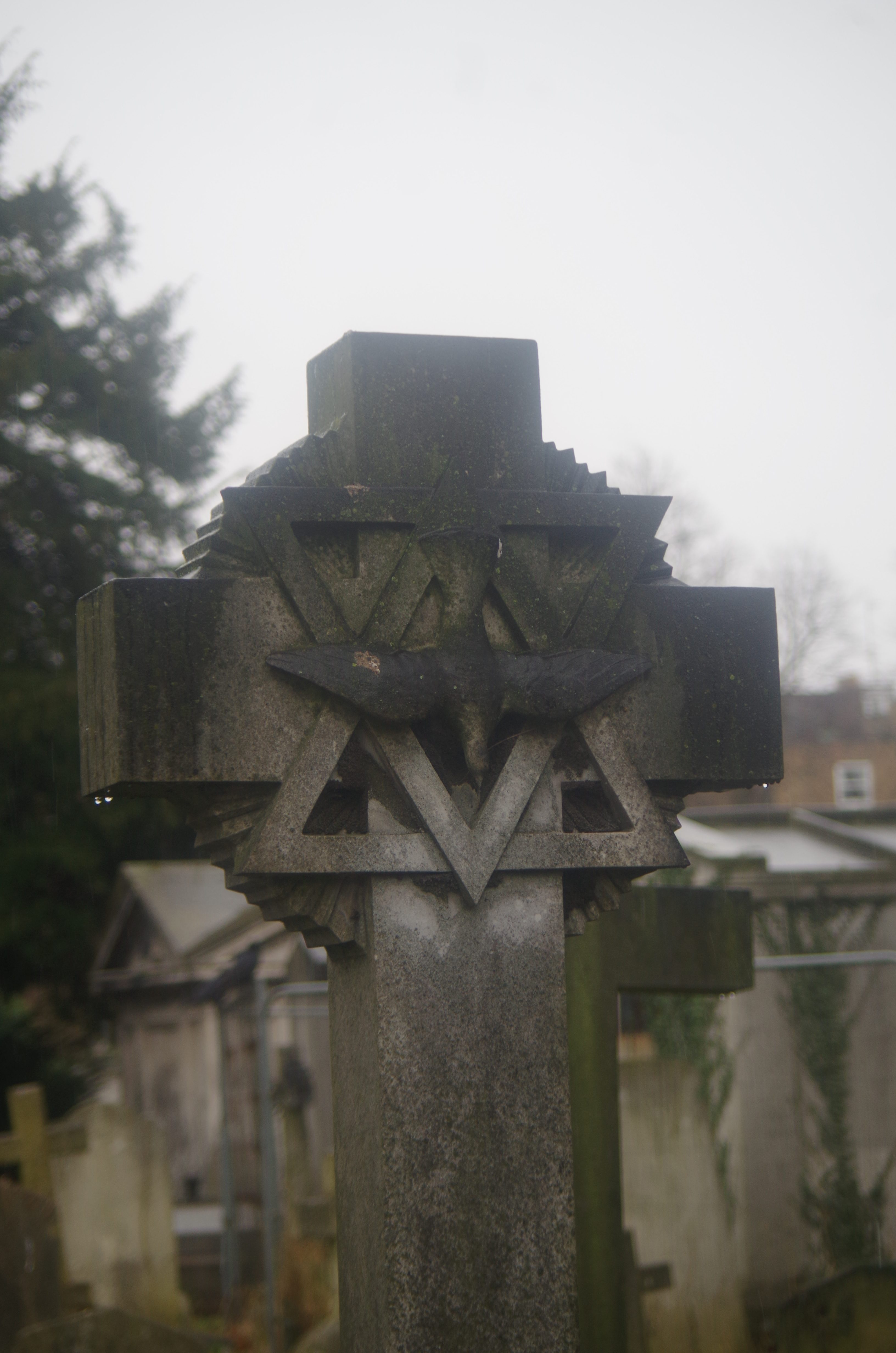
Another view of the 6 pointed star,Brompton Cemetery.
©Carole Tyrrell


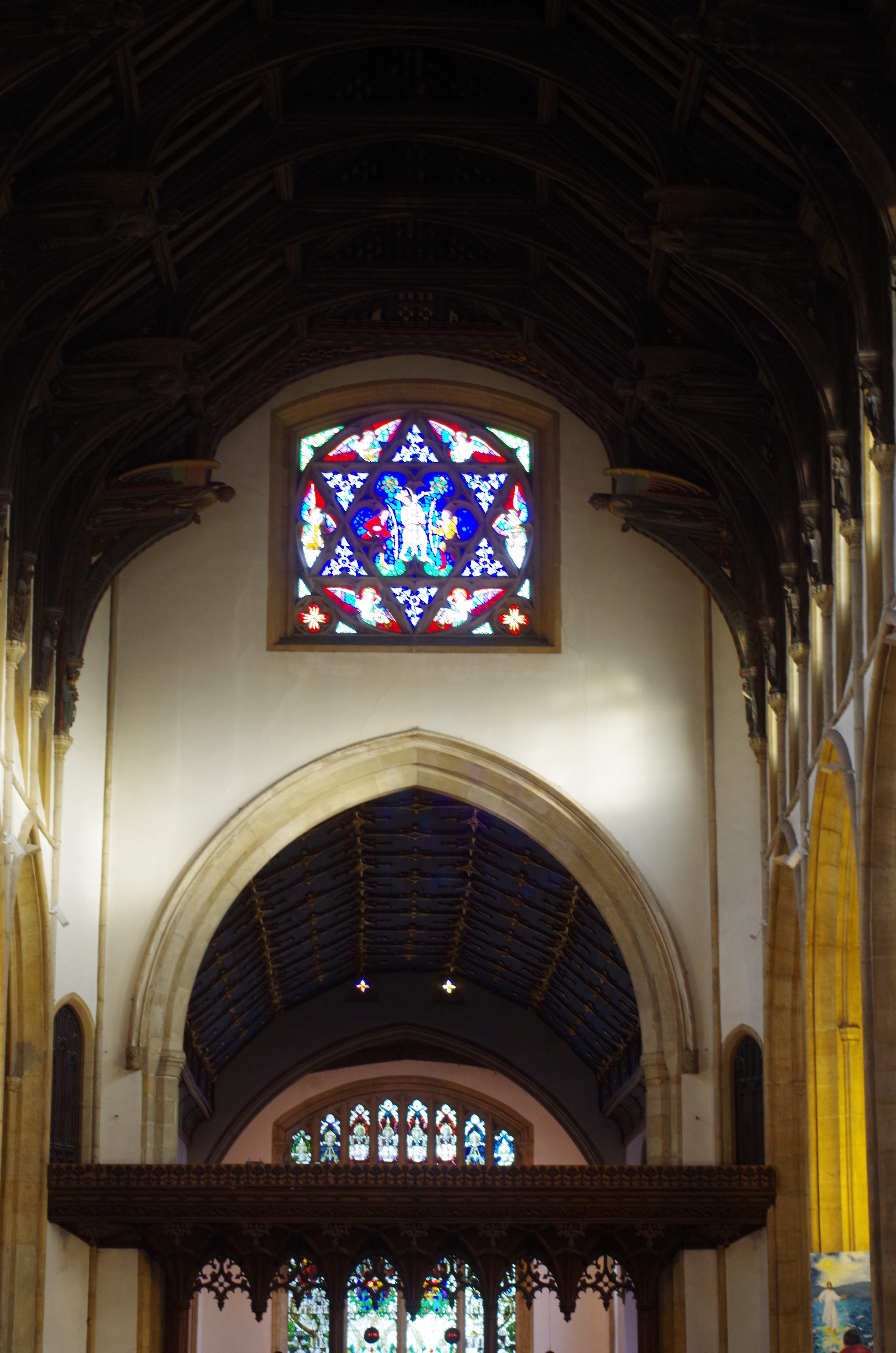
This month’s symbol is one that I’ve always associated with the Jewish faith where it’s known as the Star of David. But when I spotted a prominent example in Brompton Cemetery which isn’t a Jewish Cemetery I wondered why it was on that particular monument.  But on a recent visit to St Mary’s church in Bury St Edmunds I saw a six pointes tar in the East window and read in the guidebook of its significance with Christianity.  The window was part of the 1844 restoration and is based on a  14th century example on the nearby Abbey Gate.

Six pointed star in St Mary’s church, Bury St Edmunds
©Carole Tyrrell

According to St Mary’s guidebook the star is an important Christian symbol as:

‘Jesus was descended from David and is the Messiah for both Jews and Gentiles, the star of David is an important Christian symbol.’

This may account for the apparently Hebrew looking writing in the centre of a six pointed start dating from the 14th century on a window in Winchester cathedral.  Another one in the same building, dating from the same period on a choirstall canopy, was recorded by Pevsner.


6 pointed star from stained glass window in Winchester Cathedral
©https://www.simonarich.com – used without permissionThe six pointed star is a geometric shape and is formed from the intersection of two equilateral triangles.  At the centre of the intersection is a regular hexagon.  In Greek it’s known as a hexagram and in Latin it’s called a sexagram.

In Christianity it’s known as the Creator’s Star or the Star of Creation. The six points are alleged to represent the six days of the Creation and also the six attributes of God. These are:

  • Power
  • Wisdom
  • Majesty
  • Love
  • Mercy
  • Justice

But the six pointed star is a universal symbol.  No-one is quite sure where or when it first appeared bit it’s known and revered throughout both Eastern and Western religions and faiths.  For example, in Buddhism it has been found in the Tibetan Book of the Dead and has been used as decoration on Masonic temples, In Freemasonry the star is seen as a representation of the male and female.  This is also an important element  in Hinduism as the combination of triangles are also seen as motifs of male and female and the star becomes an emblem of Creation and divine union.


There is a darker side to the six pointed star as, in Occultism, the star is a powerful symbol for conjuring up spirits and as a talisman.  In this the star is seen as representing the 4 elements:


  • Fire         –             upwards pointing triangle
  • Air           –             opposite upwards pointing triangle
  • Water     –             downwards pointing triangle
  • Earth      –             opposite triangle pointing downwards


But the Rastafarian faith also uses the Star of David or the Magen David as a central motif. Here it’s coloured either black or appears in the Rastafarian colours of red, green and gold.   This is because the Rastafarians believe that their leader, the late King of Ethiopia, Haile Selassie, was a divine being.  He’s always been considered as being directly related to King Solomon’s father, King David, and therefore to Jesus.  This is based on a visit by the Queen of Sheba to the Israelite king, Solomon, as recorded in the Book of Kings 1 Kings 10 1:13. Rastafarians believe that during the visit they slept together and a child was born.  This child led to a direct line of descendants to Haile Selassie.

Although the Star of David is now seen as almost exclusively Jewish it wasn’t always so.  It is reputed to have originated in ancient Arabic Kabbalistic texts in which it was known as the Seal of Solomon and became the Star of David in the 17th century.   The Jews of Eastern Europe in the 19th century adopted it as a representation of their faith and Hitler used it as a badge to identify Jews during the Second World War. Today it is on the national flag of modern day Israel.

But what does it mean in funerary terms and why is it in this particular monument?   I looked more closely at the first epitaph beneath it.

The epitaph underneath the 6 pointed star – note Thomas Bower died.
©Carole Tyrrell

It was dedicated to a Thomas Henry Bowyer Bower, the son of Captain Thomas Bowyer Bower whose epitaph is lower down. Thomas died young, aged 24, at Port Palmerston, Darwin, Australia. I’m not sure if he’s actually buried there but, perhaps in this context, the star has been placed there as a symbol of the spirit that survives death. Over the centuries people have used the stars to guide their way and I thought that maybe the star was placed here as an eternal light guiding the deceased through the darkness back home again. Note the quotation on the epitaph from Deuteronomy 32.12,

‘The Lord alone shall lead him’

This  may be a reference to the to North or Pole Star which is traditionally associated with Jesus.

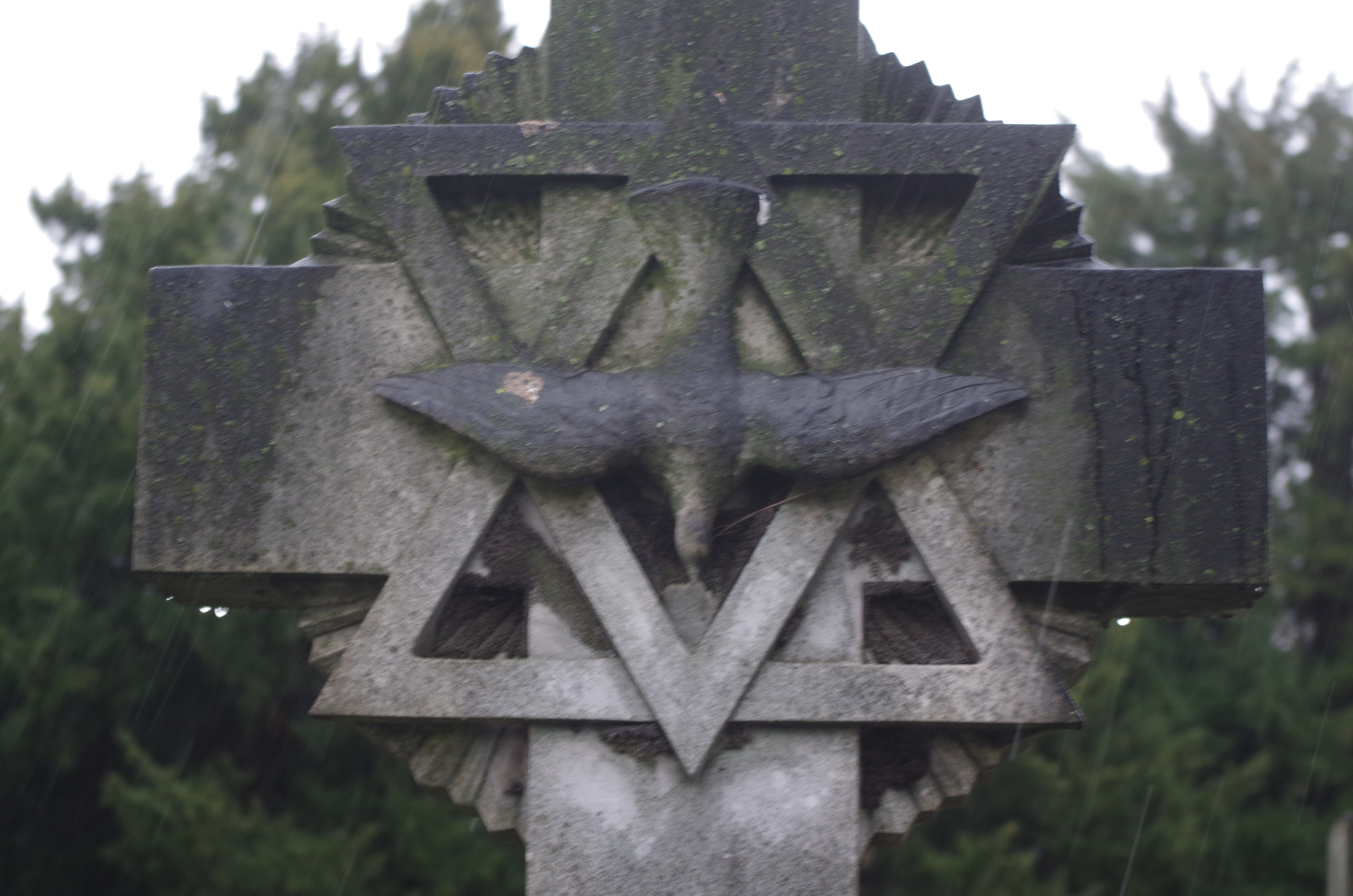
There is a downward pointing dove placed over the star which is a symbol of the Holy Ghost, part of the Holy Trinity: Father, Son and Holy Ghost.

6 pointed star on the Bower monument, Brompton Cemetery
©Carole Tyrrell


In the King James version of the Bible in Luke 3:22 :

‘And the Holy Ghost descended in a bodily shape like a dove upon him, and a voice came from heaven, which said, Thou art my beloved Son; in thee I am well pleased.’

 I wondered if the last words of this biblical verse referred to the father and son relationship.

My own interpretation of the star and the dove is that it may have been a final goodbye from a father to a son who died far from home and wanting him to know how much he was loved.

©Carole Tyrrell text and photos unless otherwise stated.


References and further reading:

www.religionfacts.com/six-point-star

http://www.thecemeteryclub.com/symbols.html

http://www.gmct.com.au

https://stoneletters.com/blog/gravestone-symbols

http://religionfacts/six-point-star

http://star-of-david.blogspot.co.uk/2006/06/rastafarians.html

http://bbc.co.uk/religion/rastafari

http://symbolism.co/dove-symbolism.html

https://en.wikipedia.org/wiki/Holy_Spirit_in_Christianity

http://www.biblegateway.com


Wildlife in Cemeteries No 8 – the dark side of the Snowdrop

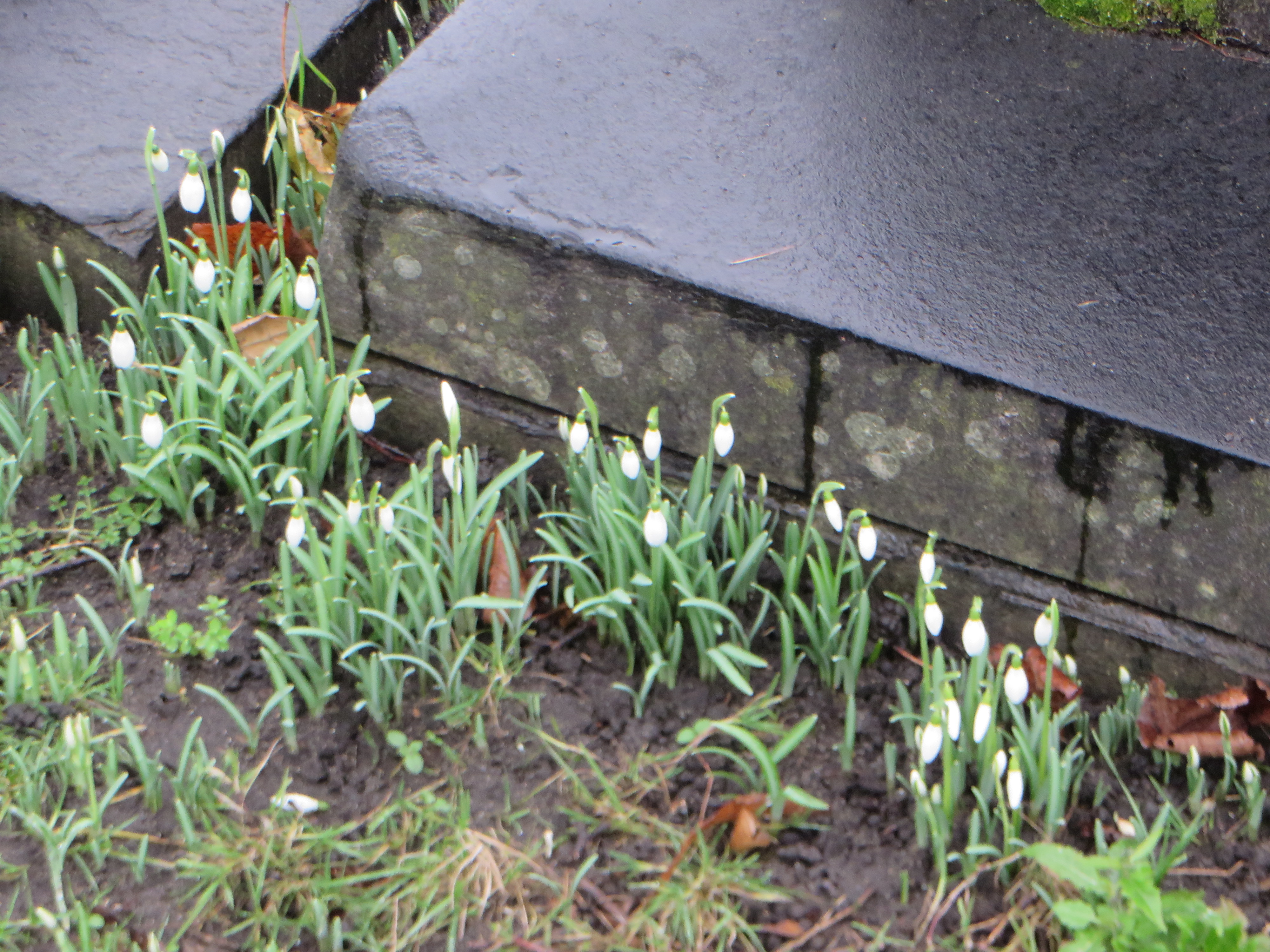
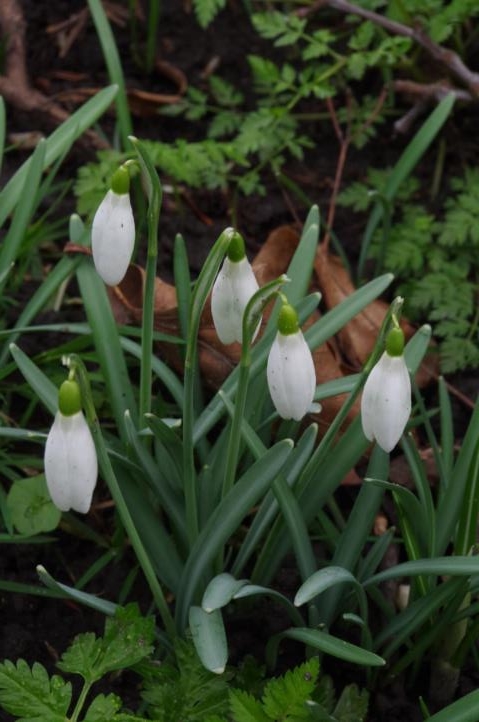
Snowdrops in St George’s churchyard, Beckenham.
©Carole Tyrrell

Imagine yourself in a gloomy medieval church on the festival of Candlemass. You, and your fellow parishioners, have each brought your candles to be blessed by the priest and, after the procession which will fill the church with light, they will all be placed in front of a statue of the Virgin Mary.   Candlemass marked the end of winter and the beginning of Spring and the blessing is to ward off evil spirits.  It traditionally falls on February 2 and is shared with the Celtic festival of Imbolc.  And in the churchyard outside you can see green shoots forcing their way up through the hard winter earth.  The snowdrop’s milk-white flowers show that spring is on its way as they begin to emerge into the light.

The placing of the lit candles in front of the Virgin Mary’s statue gave the snowdrop one of its many other names – Mary’s Tapers.  But there are many others such: Dingle Dangle, Candlemas Bells, Fair Maids of February, Snow Piercer, Death’s Flower and Corpse Flower.

Snowdrops, Brompton Cemetery, January 2018
©Carole Tyrrell


The snowdrop’s appearance has also inspired many comments . According to the Scottish Wildlife Trusts website they have been described as resembling 3 drops of milk hanging from a stem and they are also associated with the ear drop which is an old fashioned ear ring.  Anyone who has seen a group of snowdrops nodding in the wind will understand what they mean.   The snowdrop’s colour is associated with purity and they have been described as a shy flower with their drooping flowers.  However, the eco enchantments website reveals that the flower is designed in this way due:

‘to the necessity of their dusty pollen being kept dry and sweet in order to attract the few insects flying in winter.’

Snowdrops have been known since ancient times and, in 1597, appeared in Geralde’s ‘Great Herbal where they were called by the less than catchy name of ‘Timely Flowers Bulbous Violets’.  Its Latin name is Galanthus nivalis.  Galanthus means milk white flowers and the nivalis element translates as snowy according to the great botanist, Linnaeus in 1753.   In the language of flowers they’re associated with ‘Hope’ and the coming of spring and life reawakening.

However, yet despite all these positive associations, the elegant snowdrop has a much darker side. Monks were reputed to have brought them to the UK but it was the ever enthusiastic Victorians who copiously planted them in graveyards, churchyards and cemeteries which then linked them with death.  Hence the nickname name ‘Death’s Flower.’

They were described by Margaret Baker in the 1903 ‘Encyclopedia of Superstitions, Folklore and the Occult of the World’ as:

‘so much like a corpse in a shroud that in some counties  the people will not have it in the house, lest they bring in death.‘

Snowdrops, St George’s Beckenham.
©Carole Tyrrell

So that’s where the ‘Corpse Flower’ nickname came from.

Snowdrops are also seen as Death’s Tokens and there are several regional folk traditions of connecting death with them. For example in the 19th and early 20th centuries it was considered very unlucky to bring the flower into the house from outside as it was felt that a death would soon occur.  The most unlucky snowdrop was that with a single bloom on its stem.    Other folk traditions were described in a 1913 folklore handbook which claims that if a snowdrop was brought indoors it will make the cows milk watery and affect the colour of the butter.  Even as late as 1969 in ‘The Folklore of Plants’  it was stated that having a snowdrop indoors could affect the number of eggs that a sitting chicken might hatch.  A very powerful plant if these are all to be believed – you have been warned!

It’s amazing that this little flower has so many associations and legends connected with it but I always see it as a harbinger of spring, rebirth and an indication of warmer days to come.

But the snowdrop also has a surprise.  This came courtesy of the Urban Countryman page on Facebook – not all social media is time wasting!  If you very gently turn over a snowdrop bloom you will find that the underside is even prettier and they also vary depending on the snowdrop variety.

Here is a small selection from my local churchyard and one from Kensal Green cemetery.

So don’t underestimate the snowdrop – it’s a plant associated with life and death but watch out for your hens and the colour of your butter if you do decide to tempt fate…..


©Carole Tyrrell text and photos unless otherwise stated

References:

http://www.plantlore.com

http://www.independent.co.uk/environment/naturestudies/bright-in-winters-depths-why-the-flawless-flower-of-candlemas-is-ajoy-forever-8483967

http://www.flowermeaning.com/snowdrop-flower-meaning

http://www.ecoenchantments.co.uk/mysnowdropmagicpage.html

https://scottishwildlifetrust.org.uk/2014/03/natures-death-tokens/


Visit a Beard That Killed Its Owner – St Stephan’s Church, Braunau am Inn, Austria

I am indebted to Atlas Obscura for this one. Enjoy and definitely one to put on your tourist itinerary if you’re ever down that way !


Visit a Beard That Killed Its Owner

Over 450 years later, Hans Steininger’s deadly facial hair is still on display.

BY ERIC GRUNDHAUSER JANUARY 26, 2018

Hans Steininger’s epitaph in Braunau am Inn.

Hans Steininger’s epitaph in Braunau am Inn. BENUTZER: M.M/PUBLIC DOMAIN

Among the epitaphs displayed on the side of St Stephan’s church  in the town of Braunau am Inn on the Austrian-German border, there is a large stone relief of a man with an unusually long beard stretching down past his feet. At first glance it might seem a bit outlandish, but it’s a fitting monument to an important man who was killed by his own facial hair.

The likeness is that of Hans Steininger, a 16th-century burgomaster (town mayor) of Braunau am Inn, who’s since become somewhat of a folk figure. Much about his life and role as a leader have not survived the centuries since his death, but his incredible beard, which is said to have been over four and a half feet long, looms large in the town’s cultural memory.

Steininger was a popular mayor, serving multiple terms, but in 1567, he met an ignominious end. On September 28 of that year, there was a large fire in the town that caused a general panic. Steininger usually kept his prodigious beard hair rolled up and stuffed in a pocket, but during the commotion he was running around with it hanging free. In the midst of the chaos, he managed to step on his own beard, sending him tumbling down a flight of stairs and breaking his neck. Killed by his own beard.

The full-body illustration at the church shows Steininger’s beard bifurcated into two scraggly strands, stretching down past his feet. And tucked away in the local district museum is the town’s most hirsute artifact: the 450-year-old beard of Steininger.

Steininger’s beard today. MARKUS METZ/CC BY-SA 3.0


After his death, Steininger was honoured with the aforementioned epitaph, but that’s not all. Lest the years of work it must have taken for him to grow his beard be lost, the long length of facial hair was cut off and preserved separately, becoming an important town heirloom.

Over 450 years after Steininger’s death, his beard survives, currently on display at the District Museum Herzogsburg in Branau. The artifact has since been authenticated and chemically preserved so that future generations can continue to appreciate this sensational local story.

Today, Braunau am Inn is most often remembered as the birthplace of Adolf Hitler, but for understandable reasons, the local tourism board seems more keen to celebrate the mayor who was killed by his own beard. There have even been tours of teh  city given by a Steininger re-enactor decked out in a flowing fake beard. Hopefully no costume version will ever prove as deadly as the original.

©Eric Grundhauser and Atlas Obscura


BEARDSHAIROBJECTS OF INTRIGUE


Epitaph Exploring in East Anglia! Part 2 The Great Churchyard, Bury St Edmunds

And now the good and the bad….(although that can be debatable.)


Dedicated to Capt Gosnold and is self-explanatory – it looks quite recent as well.
©Carole Tyrrell

An unacknowledged  Founding Father who may have changed history 

Captain Bartholomew Gosnold(1571 – 1607) 

Although the memorial stone and epitaph is largely self-explanatory there is a lot more to Gosnold’s story.  The explorer and colonist isn’t buried here. Instead he is reputed to lie in Jamestown, Virginia.  This was the colony that he helped found and, where. according to Presevation Virgina he is regarded as being …’the prime mover of the colonisation of Virginia.’

Gosnold was originally a Suffolk man who studied law at Middle Temple after graduating from Cambridge.  He made an influential marriage and had seven children. But the sea and adventure were in his blood and he sailed with Sir Walter Raleigh whom he was soon to outstrip.

In 1602  Gosnold. on the ship Concord. made his first attempt to found a colony in Southern New England. Along the way they named Cape Cod after the large number of the fish they found there and then he continued to sail on along the coast to a place with an abundance of wild grapes.  He called the place Martha’s Vineyard because of the grapes and also in memory of his infant daughter who had died in 1598.  However the colony was abandoned when its settlers decided to return to England.

There was big money and fame to be made from exploring and colonising in the 17th century.  These were usually private ventures and so profit driven. But for Gosnold and his ambitions there was only one snag; Raleigh held the patent for Virginia.   But Queen Elizabeth I, who was on the throne at the time, was very interested in revenue and Raleigh’s star was descending.  He’d already lost £40k on the Roanoke disaster which was a huge sum at the time.  Soon Gosnold held an exclusive charter for a Virginia charter to settle there and this eventually became what is now Jamestown.

Sadly Gosnold wasn’t destined to enjoy his acheivements for long.  He died, aged only 36, on 22 August 1607 as the result of a 3 week illness after only 4 months after landing in the New World.  The burial was an honourable one ‘with many volleys of small shot’ fired over his coffin.

This is believed to be Gosnold’s grave in Virginia.
shared under Wiki Creative Commons
©Ser Amanho di Nicolao

He was one of the prime movers in Virginia’s colonisation and it has since been speculated that without him it might have been Spain that ended up colonising the Atlantic coast.  Elizabeth I’s successor, James 1, was extremely keen to maintain peace with Spain in the 1600’s and Spain was equally enthusiastic to explore the New World.  Without Gosnold who knows what might have happened?

For centuries the location of Gosnold’s grave was unknown.  But, in 2002, a body was excavated in Jamestown which has been presumed to be his.  Preservation Virginia  revealed that it appeared to be a person of high status as a captain’s staff had been placed in the coffin with the body and the coffin had an unusual gabled lid.  DNA was taken and compared with that from a distant descendant of Gosnold’s interred in a Suffolk church but the tests were inconclusive.

I note that his wife is recorded on this memorial plaque so either she didn’t go with him or returned after his death.

And the bad…..or unfortunate…….

Sarah LLoyd – a warning to the passer-by. Charnel House, The Great Churchyard.
©Carole Tyrrell

This epitaph is meant to be a cautionary tale for the passer-by.  The inscription tells Sarah Lloyd’s sad story and again the mason has earned his money if he was paid by the letter.   It’s almost like reading a penny dreadful written in stone.

Reader

Pause at this Humble Stone

a Record

The fall of unguarded Youth

By the allurements of vice

and the treacherous snares

of Seduction

SARAH LLOYD

on the 23d of April 1800

in the 22d Year of her Age

Suffered a Just but ignominous

Death

for admitting her abandoned seducer

into the Dwelling House of her Minstrefs

in the Night of 3rd Oct

1799

and becoming the Instrument

in his Hands of the crimes

of Robbery and Houseburning

These were her last Words

May my example be a

warning to Thousands.


This seemed to tell all of Sarah Lloyd’s story but did it?  I did further research and found that there was more to it than the epitaph states. I am indebted to Naomi Clifford’s excellent blog post for this.

The facts are that Sarah Lloyd was employed as a maidservant for Mrs Syer at her house in Hadleigh near Ipswich and had begun an illicit relationship with Joseph Clarke, a local man. On the night of the burglary, she let him into Mrs Syer’s house while Mrs Syer and her live-in companion slept.  The pair then stole various items from the house including a watch and 10 guineas in cash. They also managed to steal Mrs Syer’s pockets, which were small bags, from their hiding place under her pillow.  These contained cash and jewellery worth 40s (£2.00).  According to the court transcript, Clarke then set fire to the curtains in one of the rooms although other accounts state that they started a fire in a stairwell.   Both of them then fled the scene, hoping to have covered up their crime,  but unluckily for them neighbours managed to quickly put out the fire and the house was saved.  Clarke advised Sarah to leave him out of it and, instead, to say that two other men had been involved.

They lay low until Sarah was recognised as she ran across a field and she was eventually arrested by the local constable. She confessed and the stolen goods were recovered from her family home.  The cash was never found and soon Clarke was also arrested.

However, according to the account of the trial Clarke was found not guilty and acquitted whereas, Sarah, although found not guilty of the burglary was found guilty of stealing.  The strongest penalty was awarded.  This seemed harsh to say the least. According to Naomi Clifford  when Sarah appeared at the local Assizes on 20 March 1800 all she said in her defence was:

‘ It was not me, my lord, but Clarke that did it.

Here is a link to a contemporary account of the trial:    (However, be warned that it’s in 16th century phrasing where the ‘s’ has been replaced by a long ‘f’ which renders, for example, ‘passing’ as ‘paffing’.

https://books.google.co.uk/books?id=Wb1jAAAAcAAJ&pg=PA7&lpg=PA7&dq=sarah+lloyd+the+great+churchyard&source=bl&ots=VStZFRhEFa&sig=ykdosMHb6URQb08QcxF9IFel7RE&hl=en&sa=X&ved=0ahUKEwihhOSVgN3YAhUHIsAKHc7JAEAQ6AEISjAH#v=onepage&q=sarah%20lloyd%20the%20great%20churchyard&f=false

The charges against Clarke were dropped which may have been because he hadn’t confessed to his part in the crime whereas Lloyd had.  Also it was only her word that placed him at the scene as there was no other evidence.

The Assizes judge, Judge Grose, made several remarks which condemned Sarah:

A servant robbing a mistress is a very heinous crime; but your crime is greatly heightened; your mistress placed implicit confidence in your; you slept near her, in the same room, and you ought to have protected her… and though this crime was bad, yet it was innocence, compared with what followed: you were not content with robbing her mistress, but you conspired to set her house on fire, thereby adding to your crime death and destruction not only to the unfortunate Lady, but to all those whose houses were near by.  I have to announce to you that your last hour is approaching; and for the great and aggravated offence that you have committed, the law dooms you to die.’

There was a further twist to the case in that Sarah told the Rev Hay Drummond, the local vicar, when he visited her, that Clarke had seduced her and regularly visited for sex. She’d regarded him as her husband and on the night of the crime she had revealed that she was pregnant and he’d promised to marry her.  Rev Drummond felt that she’d been used and immediately set about organising a petition together with Capel Lofft, a lawyer and magistrate. to try to obtain a Royal Pardon.    Lofft moved in influential circles but the Home Secretary, the Duke of Portland refused any clemency as he considered that Sarah should be made an example as her alleged final words on the epitaph state. Although I think it more likely that she might have said ‘How did Joseph Clarke get off with not guilty?’

The pregnancy wasn’t mentioned again and she was executed on 22 April 1800 after it had been delayed for 14 days by the attempts to obtain a Royal Pardon.  Sarah was buried in the abbey churchyard  that evening with a crowd of 1000 people in attendance.  Mrs Lloyd. Sarah’s mother, had tried to commit suicide when she had heard that the execution was to proceed.

Although Sarah’s age is started as 22 on the epitaph she was unaware of her true age and was illiterate.

The epitaph also seems to have commented on Sarah;s morality although her ‘abandoned seducer’ isn’t named.However, her case has been seen as being part of a slow movement of change with capital punishment.  The first decades of the 1800’s brought significant reductions in the numbers of crimes punishable by death with other less harsh methods of punishment.  Sarah Lloyd was one of 7 women hanged in 1800. There were 6 in England and I in Ireland.  Only 3 more were to hang for stealing in a dwelling house and it ceased to be a capital offence after August 1834.

©Text and photos Carole Tyrrell unless otherwise stated.

Further reading and references:

https://en.wikipedia.org/wiki/Bartholomew_Gosnold

https://historicjamestowne.org/history/captain-bartholomew-gosnold-gosnoll/

https://britishheritage.com/bartholomew-gosnold-the-man-who-was-responsible-for-englands-settling-the-new-world/

http://anthropology.si.edu/writteninbone/unusual_case.html

https://www.buryfreepress.co.uk/news/hidden-treasures-brought-into-view-1-399134

https://books.google.co.uk/books?id=Wb1jAAAAcAAJ&pg=PA7&lpg=PA7&dq=sarah+lloyd+the+great+churchyard&source=bl&ots=VStZFRhEFa&sig=ykdosMHb6URQb08QcxF9IFel7RE&hl=en&sa=X&ved=0ahUKEwihhOSVgN3YAhUHIsAKHc7JAEAQ6AEISjAH#v=onepage&q=sarah%20lloyd%20the%20great%20churchyard&f=false

http://www.naomiclifford.com/sarah-lloyd/

http://www.capitalpunishmentuk.org/lloyd.html

http://www.eadt.co.uk/ea-life/bury-st-edmunds-and-sudbury-how-tragic-sarah-paid-a-terrible-price-for-seduction-1-3452212


Epitaph Exploring in East Anglia! The Great Churchyard in Bury St Edmunds

The Great Churchyard in Bury St Edmunds is big. Very big and forms a useful shortcut for the locals from an uninspiring car park (aren’t they all I hear you say) to Honey Hill. But the Great Churchyard is steeped in history and, according to a volunteer in nearby St Mary’s church, some of its pathways date back to Saxon times.  The church sits perched further up the hill and so looks  down and over the churchyard’s permanent residents.

St Mary’s and its elongated shape overlooking its part of the Great Churchyard.
©Carole Tyrrell

I came upon the Great Churchyard by chance on a day trip in 2006 while exploring the extensive Abbey ruins.  The Abbey’s ruins have eroded into strange shapes over the centuries and now look like lumpy fingers pointing accusingly at the sky.  But after Henry VIII dissolved the Abbey in 1539, much of its flint and mortar has been ‘recycled’  by the locals and can be seen in walls and nearby houses.   But it was the Churchyard’s memorable epitaphs that stayed  with me and so on a bright December day last year I returned.

There is a plethora of 18th century symbols on display: skull and crossbones, winged angels, open books and one memorial had its own duvet of moss on the coffin lid shaped top.

As I explored, I found this tombstone  and remembered that M R James had written  a book on the Abbey’s history. Ann Clarke is the name of the unfortunate character in his story ‘Martin’s Close. I did wonder if this was his inspiration……

An M R James connection? The Great Churchyard.
©Carole Tyrrell

But the real jewel of the Churchyard is undoubtedly the 13th century roofless Charnel House.  A rare survivor and its flint walls were lucky not to have suffered the same fate as the Abbey’s.  The Charnel House was where all the disinterred bones from the Churchyard were stored.  It’s empty now and is protected by iron railings.   The Charnel House  now acts as a roost for birds and also as a backdrop or gallery for the epitaphs that I remembered from 2006.


Amongst the collection are two 17th century tombstones placed on the walls. One is illegible although the symbols are still clear and the other is to a Sarah Worton, wife of Edward.  Under the epitaph is the verse:

Good people all as you

Pas by looked round

See how Corpes de lye

For as you are from time ware we

And as we were f(s)o must you be.

If you take a closer look you can see how the mason had to slightly squash the letters to get all the words in.

But there  are 4 significant epitaphs on the Charnel House walls and these are  dedicated to the good, the bad and the just plain unlucky.

Firstly, the unlucky……..

Henry Cockton (1807 – 1853)

Engraving of Henry Cockton from 1841 by James Warren Childe (1780 – 1862)
Shared under Wiki Creative Commons

No. I’d never heard of him either until I started researching this post.  This is not a name widely known today although his first and most successful novel, ‘The Life and Adventures of Valentine Vox the Ventriloquist ‘ is still available from various online booksellers.  Note the symbol of a blank scroll of paper and  quill pen above the epitaph which is the sign of a writer.

According to Wikipedia. Cockton was born in Shoreditch but ended up working in Bury St Edmunds where he married a local girl whose family were involved in the local pub trade. They had two children, Eleanor and Edward.  As we shall see alliteration was a theme of Henry’s life.  Valentine Vox  was a largely comic novel about a man who teaches himslef ventriloquism  and the jolly japes that ensue from this. It also involved social issues as, at one point,  the hero is incarcerated  in a private lunatic asylum and in the book’s preface Cockton rails against these places. Valentine Vox was a huge success and sold over 400, 000 copies and was published, like Dickens, in serial form.  After this Cockton should have gone onto greater things but he was destined never to make any money from his writing. Editors cheated him, publishers went out of business and  he was imprisoned for debt after being declared bankrupt.  In 1843 he wrote ‘Sylvester Sound, the Sonanambulist’ which was about a sleepwalker who performed daring feats during his sleep but it didn’t enjoy the success of its predecessor – see what I mean about alliteration?

But he kept on writing until 1845 when he announced to his readers that The Love Match would be his final novel.  Unfortunately bad luck continued to dog him – he was like King Midas in reverse as the song goes –  everything he touched turned to mud. He stood surety for his brother who thanked him by fleeing to Australia and a speculative malting venture collapsed and ruined him.  He and his family moved into his mother-in-law’s house and he wrote a further 3 unsuccessful novels.  Sadly, aged 46, he died of consumption and 4 days later was buried in an unmarked grave in the town churchyard without any obituaries.  Its exact location is still unknown.  The plaque was put up by admirers and friends.

Henry’s widow petitioned the Royal Literary Fund for financial assistance and in 1856 a local paper printed another appeal for his family. But Valentine Vox, his most successful novel. has enjoyed a life beyond its creator. Jack Riley, a performer and writer on ventriloquism uses it as his stage name and Chris Jagger’s 1974 album also borrowed it.   So a tragedy all round?  It certainly was for Henry but not so much for his family…….

While researching online  I found a blog on which there was a lively dialogue between the blogger and respondents who claimed to be Henry’s descendants.  According to them, Henry’s widow remarried, Eleanor became a teacher and Edward eventually became Professor of Music at the Greenwich Royal Naval College.

And the the victim of a somewhat unkind Act of God……

Mary Haselton (1776-1785)

This fulsome eptaph is dedeicated to the unfortunate Mary Haselton who, in 1785, was struck by lightning while saying her prayers. There was virtually nothing about her online but I may contact the town’s Local Studies department. The epitaph reads:

Here lies interred the Body

MARY HASELTON

A Young Maiden of this Town

Born of Roman Catholic Parents

And Virtuously brought up

Who being in the Act of Prayer

Repeating her Vespers

Was instantaneously killed by a flash

Of lightning August the 16 1785

Aged 9 years

Not Silom’ (?) ruinous tower the Vicoms slew

Because above the many sinn’d  the few

Nor here the fated lightning wreak its rage

Its Vengeance sent for crimes manned by age

For while the Thunder’s awful voice was heard

The little supplicant with its hand upraised

Answered her God in prayers the Priest had taught

His mercy (?) and his protection sought

The last 4 lines are unreadable even on Zoom view.  But it’s an amazing piece of verse and the mason who carved it really earned his money if he was paid by the letter.

It’s interesting that Mary’s parents religion is so openly stated. There had been a relaxing of attitudes towards Catholics in the 18th century despite the 1780 anti-Catholic Gordon Riots.

However there’s no way of knowing Mary’s actual burial place within the Great Cemetery but her memorial is in safekeeping on the wall of the Charnel House.


Part 2: The good and the bad…a Founding Father and a notorious crime.

 ©Text and photos Carole Tyrrell unless otherwise stated. 

 Further reading and references.


 https://bradspurgeon.com/brads-rejected-writings/impeccable-intuition-robertson-davies-on-henry-cockton/


https://en.wikipedia.org/wiki/Henry_Cockton

https://www.buryfreepress.co.uk/news/hidden-treasures-brought-into-view-1-399134


Symbol of the Month – The Chalice

Rev Murray’s chalice – note Communion wafer above it. St Nicholas churchyard, Chislehurst
©Carole Tyrrell

The first symbol of 2018 is the chalice.  It’s traditionally associated with the Church and the Communion and is often found on rectors and priests headstones for obvious reasons.   Almost like having the tools of their trade close at hand so to speak.

I found the fine example above in the churchyard of St Nicholas in Chislehurst.   Note the communion wafer on top of the well sculpted 3D sculpture of the goblet.   This headstone is dedicated to a former rector of the Church, Rev Francis Henry Murray and this little corner is almost an ecclesiastical enclave.  There are three other former Rectors buried here as well as a former Bishop of Singapore and an Archdeacon of Bromley. Rev Murray’s wife is buried alongside him under the grapevine and crown of thorns symbols and behind them is buried their son, Lieutenant  Herbert  Francis Murray  who was lost at sea on 7 September 1870 on the HMS Captain and his monument features a large anchor. There are two gleaming brass wall tablets inside the church dedicated to each of them respectively.

Chalices, goblets or cups – whatever you want to call them –  have been used in religious and other important ceremonies for thousands of years and are also associated with the Last Supper and the Holy Grail.  In Matthew 26:27:

While they were eating, Jesus took bread, and when he had given thanks, he broke it and gave it to his disciples, saying, “Take and eat; this is my body.”

Then he took a cup, and when he had given thanks, he gave it to them, saying, “Drink from it, all of you..”

During the Communion worshippers drink wine from the chalice as a representation of Christ’s blood and then eat the communion wafer

From Salinas, Spain
Shared from wikipedia. Creative Commons

after it has been dipped in the wine as an interpretation of his body.  Chalices are often made from gold or silver, hexagonal in shape and can be decorated with semi-precious stones as with this example from Spain.  It’s very ornate with the inscription ‘Sanguinis meus vere est petus’ . This translates to ;My blood is drink indeed’ from John 6:55.  This was made for the church of John the Baptist, Salinas Spain.


They can also be heavily decorated in other ways as with this one from 6th century Italy.

Etruscan chalice from Bucchero – 6th century BC.
Shared under Wikipedia Creative Commons


In the Sufi faith the chalice takes centre stage as it represents the sharing of blessings such as water and milk and this brings the desert nomad and steppe peoples together.  It also appears within Wicca and Paganism where it represents the Goddess as water is a feminine element.  In some Byzantine and Gothic imagery, the chalice can also be a protective symbol as, anyone holding a chalice is demonstrating that they are God’s servant and they have turned away from evil.

The Holy Grail is traditionally assumed to be the cup that Christ drank from during the Last Supper.  It remains unidentified although many chalices have been suspected as being the Grail.

The chalice can also appear with other symbols such as, for example, a white circle to represent the consecrated Eucharist. Also, a chalice with an X shaped cross on its front is an emblem of one of the disciples, Andrew, and a flaming chalice is the 

The flaming chalice – the symbol of the Unitarians.
Shared from Wikipedia Creative Commonsemblem of the Unitarian movement.

Chalices also feature heavily in heraldry and in some vanitas paintings.  These were still life paintings of the 16th and 17th centuries from Flanders and the Netherlands.  They invited the observer to ponder on the transcience and meaninglessness of earthly life and used symbols to indicate this. In Allegory of the Eucharist by the Flemish painter Alexander Coosemans (1627 – 1689) the chalice is the

Allegory of the Eucharist Aleaxander Coosemans
Shared under Wiki Creative Commons

centrepiece. But the items surrounding it have a deeper meaning.  The cornucopia is a symbol of creation and divine bounty, the wheat stalks and grapes are obviously representations of the Communion wine and bread and the pomegranate and quince are representations of plenty as well as fertility and immortality.

However, there is also a negative to the holiness of the chalice with the phrase ‘the poisoned chalice’.  This where a situation or item appears to be good on the surface and then turns out to be the opposite. Shakespeare refers to this in Macbeth Act 1 Scene VII as Macbeth contemplates the murder of King Duncan:

We still have judgment here, that we but teach

Bloody instructions, which, being taught, return

To plague th’ inventor: this even-handed justice

Commends the ingredients of our poisoned chalice

Seek and ye shall find is an old adage and it can often be applied to looking for symbols in a churchyard or cemetery.  I think I’ve found just one example of one and then they’re everywhere.  And so it was with St Nicholas – I found 4 examples within the churchyard.

Side view of Rev Murray’s chalice, St Nicholas churchyard, Chislehurst
©Carole Tyrrell

This is dedicated to a former rector of the church, Rev Francis Henry Murray (1820-1902). He was an energetic Rector at St Nicholas for over 56 years and wasn’t afraid to push forward church alterations or change styles of worship despite opposition from Diocesan Bishops.  The parishioners were inspired by him to agitate for the establishment of St Katherine’s Rotherhithe.  Rev Charles Fuge Lowder, the first vicar of St Peter’s, London Docks and Rev Murray were great friends as they were both leading members of the Society of the Holy Cross.  This was formed in February 1855 by a group of 6 Anglo-Catholic clergy.  Rev Murray was also responsible for the first publication of the now classic Hymns Ancient and Modern.


Rev Charles Lowder also has a memorial in the churchyard with a chalice portrayed on its other side.  He was another energetic, pioneering priest who devoted 24 years of his life to working with the poor in one of the most deprived dockland areas of East London.  In 1856, aged 36, he founded the St George’s Mission.  This was in response to a request for assistance to the Society of the Holy Cross from the vicar of St George’s in the East.  The Society is still in existence worldwide with a membership of over 1000 priests.  Every year, on the date of his death in 1880 on the 9 September he is commemorated.

A more modest chalice is on the Greatheed monument which is dedicated to Ellen and Stephen Greatheed.  The latter is merely recorded on the epitaph as ‘Priest’ but he wasn’t mentioned on the list of St Nicholas’ rectors inside the church so perhaps he was based at another local church..

This is dedicated to Edward Herbert Fuller  Jenner and he is also recorded on his epitaph as ‘Priest’ but isn’t  listed on the list of previous rectors. Again note the communion wafer above the chalice.

Finally, as I explored St Nicholas’ interior I looked up at the 19th century stained glass windows and there at the bottom of one window were two angels holding a chalice between them. The Holy Grail perhaps?

Detail from Victorian stained glass window of possibly the Holy Grail/ St Nicholas church Chislehurst
©Carole Tyrrell


©Text and photos Carole Tyrrell unless otherwise stated.

References and further reading:

Some graves of interest within the churchyard – St Nicholas Church Chislehurst publication

https://www.ancient-symbols.com/symbols-directory/chalice.html

http://www.lsew.org.uk/funerary-symbolism/

https://symbolsproject.eu/explore/others/objects0/cup-/-chalice.aspx

https://www.reference.com/world-view/chalice-symbolize-f6e394fff39e62f0

https://en.wikipedia.org/wiki/Chalice#Poisoned_chalice

https://en.wikipedia.org/wiki/Alexander_Coosemans

http://www.symbols.com/symbol/flaming-chalice

http://www.catholic-saints.info/catholic-symbols/chalice-christian-symbol.htm

https://www.biblegateway.com/passage/?search=Matthew+26-27&version=NIV

http://nfs.sparknotes.com/macbeth/page_40.html


Part 3 – a nurse’s enduring love and a patient’s remarkable artistic legacy – Netherne Hospital cemetery Aug 17.

One of  the most poignant stories from Netherne Cemetery is  that of Jean Barboni. He was an 8 year old who died in the hospital in 1915 and whose death haunted his nurse, Elizabeth Martin, for the rest of her life.   Ms Martin’s niece, Edith Kelly,  contacted her local paper to share her aunt’s memories and her own outrage at the then state of the cemetery.   Elizabeth had shared her still vivid memories of Jean with Edith 30 years later after his death.  She had devotedly nursed Jean who was born with what we would now call learning difficulties but then was classed as mentally defective.  Edgard Barboni, his father, was an officer in the French army and a physicist engaged in top secret chemical warfare work during the First World War.  They had had another little boy named Pierre and were finding it difficult to cope as Jean required specialist care.   Eventually he was admitted as a private patient in a house for the ‘mentally subnormal’ as the Victorians classed him at Netherne.  Edith discovered, through her aunt’s diaries that she had always felt that she had contributed to Jean’s death by allowing him to be put in a pauper hospital, Netherne, where he contracted TB.  After Jean’s  parents returned to France with Pierre Elizabeth tended Jean’s grave until her own death. Edith was quoted as saying

‘ For as long as I could remember, she regarded him as her own child.  I suppose the emotional involvement must have been that much greater because the parents were in France and possibly never visited the grave again.’

As I left the cemetery and walked back around the border of the field again I noticed the large number of flints on the ground.  I was tempted to take one home as a souvenir but it was too heavy. However, the local flints provided inspiration for a Netherne patient, Gwyneth Rowlands, who painted faces, usually of women directly onto the ones that she found in the fields around the hospital. She might have even found some in this very field.

Sadly, I could discover very little about Gwyneth, despite her work being on display at the Wellcome Collection recently.  She was admitted as a patient in 1946 and stayed there for 35 years probably until it closed in the 1990’s. But on a recent visit to the Wellcome Collection Reading Room I spoke with one of the volunteers, Rock, who told me that Gwyneth may still be alive and she had been in contact with a staff member up until 3 or 4 years ago.  She is considered to be part of the Outsider art movement.   Gwyneth’s technique was to paint directly onto the flint using watercolour, indian ink and varnish.

Art therapy which subsequently  became part of the Outsider or Art Brut movement began at Netherne in 1948 when the pioneering Edward Adamson (1911-1996) became the first artist to be employed full time as an Art Director.

Edward Adamson
Shared under Wikipedia Creative Commons licence.

He formed a huge collection of over 4000 pieces of artwork which is now housed at The Wellcome Collection in London. He believed that the creation of art was a healing process especially for those who could not speak or express themselves in any other way.  However, Adamson wasn’t a teacher or someone who used the artworks as a diagnostic tool.  Instead his approach was as a facilitator artist.  He worked at Netherne until his retirement in 1981. Art therapy was also called  ‘psychiatric art’ . The Outsider Art movement is concerned with artists who are outside the mainstream, usually self-taught and often living within institutions.  It often has no meaning except to the artist themselves although the raw power and emotion of some of these artworks can be really impressive as with Gwyneth’s flint heads.

View from Farthing Downs, 500ft up, across to Neherne Cemetry.
©Carole Tyrrell

As I walked over the top of Farthing Downs later on that afternoon heading for Sunday afternoon tea and cakes at Chaldon church I saw the cemetery on the opposite slope.   I hoped that it would always be surrounded by large green fields and that its incumbents would always rest in peace under the chestnut trees and wildflowers.

©Text and photos Carole Tyrrell unless otherwise stated.

Further Reading:

Outsider Art: From the Margins to te Marketplace, David Maclagan Reaktion Books 2009

Art as Healing, Edward Adamson, Coventure 1984

https://wellcomecollection.org/adamson-collection

http://www.mendiphospitalcemetery.org.uk/history.html

http://www.yourlocalguardian.co.uk/news/10494304.Campaign_victory_after_cemetery_with_war_dead_finally_cleared/

https://billiongraves.com/cemetery/Netherne-Asylum-Cemetery/292853

http://www.simoncornwell.com/urbex/hosp/n/e140106/1.htm

http://www.thisislocallondon.co.uk/indepth/nostalgia/8392020.Forgotten_graves_of_the_war_dead/

http://www.suttonguardian.co.uk/news/8437328.Diaries_of_Catholic_nun_reveal_tale_of_child_buried_at_Netherne_asylum/

 http://beyondthetrenches.co.uk/the-other-war-dead-asylum-patients-during-the-first-world-war/

 http://www.croydonguardian.co.uk/news/8421298.Developer_s_broken_promise_over_asylum_cemetery/

 https://www.genesreunited.co.uk/boards/board/ancestors/thread/1314646