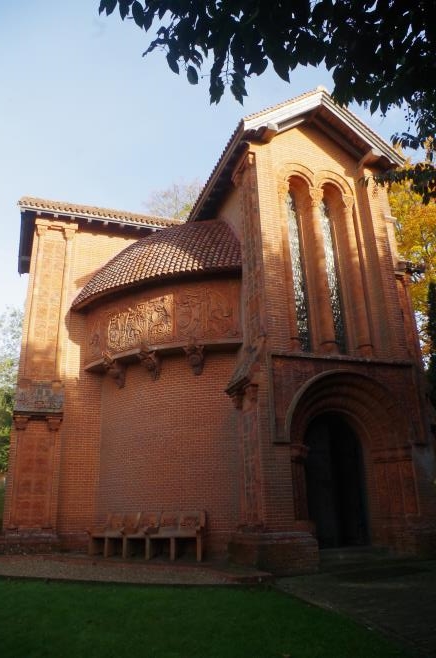
A unique gem in the Surrey hills – The Watts Memorial Chapel – Part 1 of a visit to Compton, UK

Exterior View of Compton Chapel in autumn. copyright Carole Tyrrell
Exterior View of Compton Chapel in autumn.
copyright Carole Tyrrell


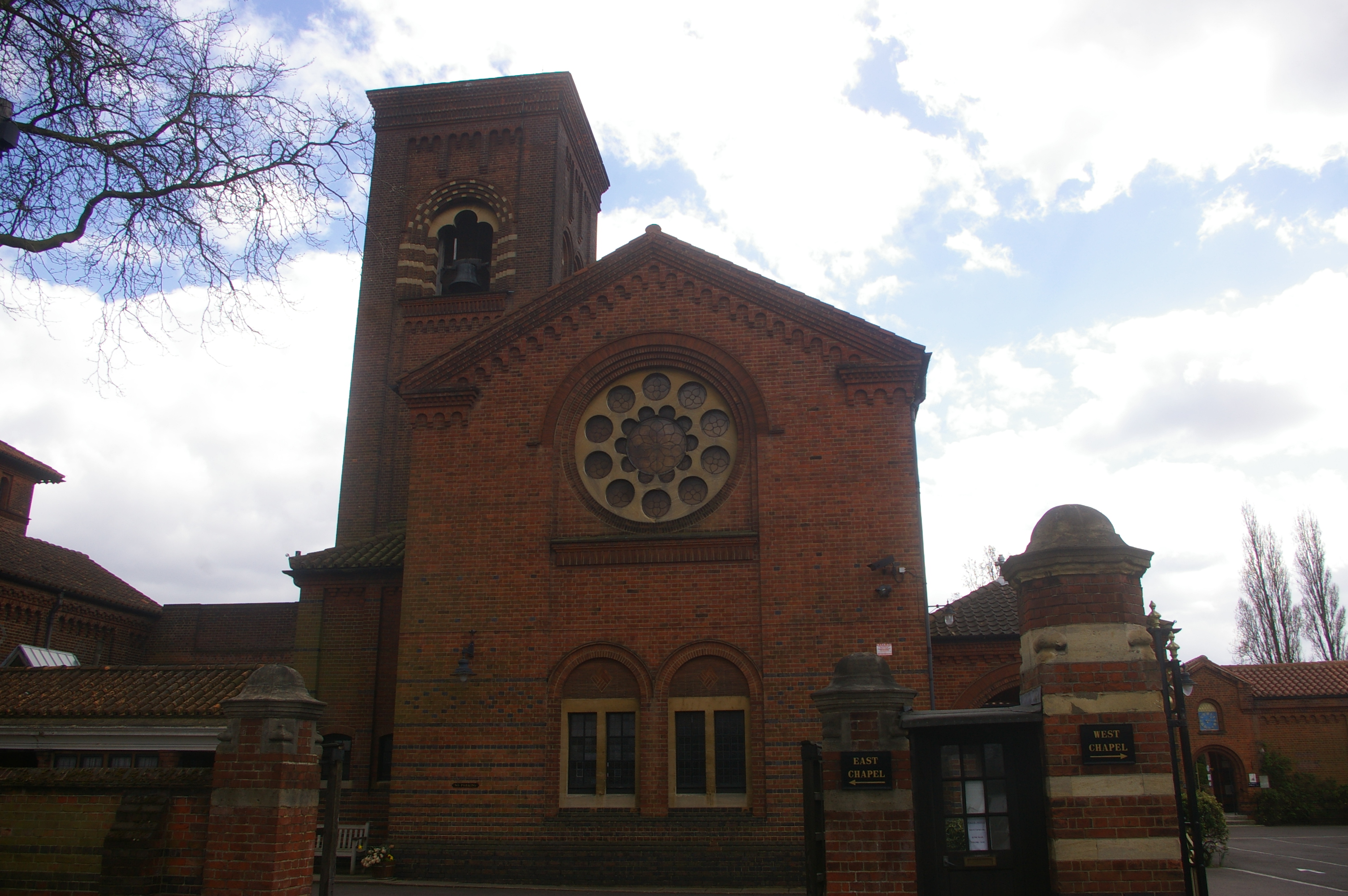
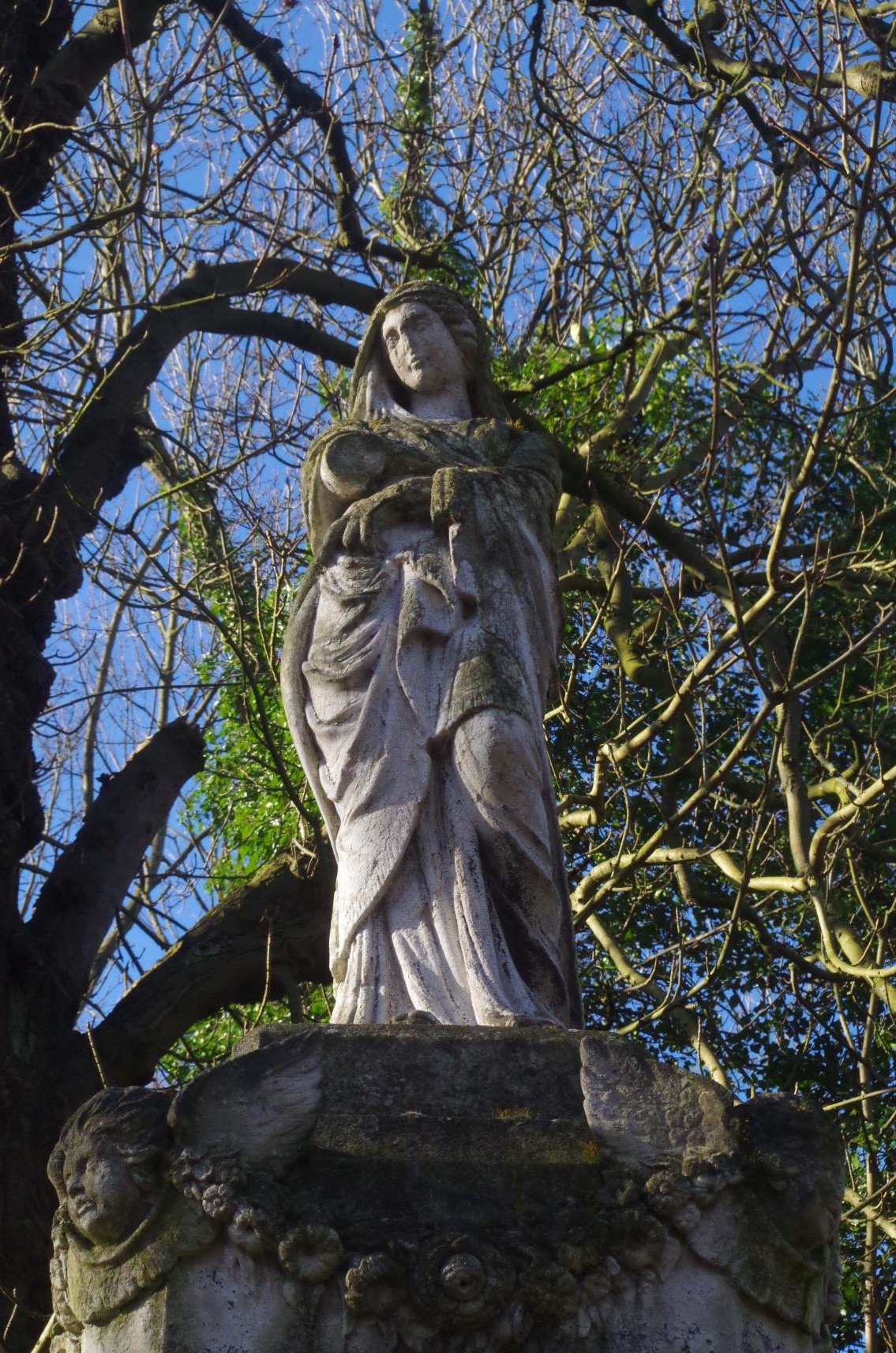
On a Surrey hillside near Guildford, hidden behind tall Irish yews, nestles a secret jewel of the Arts and Crafts movement.  It’s a short walk from the Watts Gallery along a busy road with no proper pavement so be careful but it will be worth it.  This leads you to Compton churchyard.   Walk in under the lychgate and climb the twisting, winding path that leads you up through the trees to a building that looks as though it belongs in Italy instead of England.  Unique is an often over-used word but here it’s the only one that adequately describes the beautiful structure before you.  It’s the exceptional  and intriguing Watts Memorial Chapel.

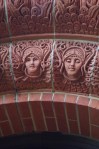
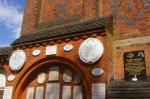
The Grade 1 listed chapel is best viewed on a sunny day when its terracotta walls turn to orange and the dazzling reliefs, figures and symbols on the frieze around its exterior become three dimensional. Walk around the outside of the chapel and marvel at the sumptuous combination of Celtic,  Art Nouveau and Romanesque patterns and styles. The calm faces of angels look down surrounded by stylised animals, birds and labyrinths.

Section of exterior frieze around Chapel. copyright Carole Tyrrell
Section of exterior frieze around Chapel.
copyright Carole Tyrrell

This is a building created by love and faith. The metal cross on the imposing Romanesque entrance door was inspired by one on Iona. The pillars on each side contain the letters ‘I AM’ symbolising God as creator guarding a kneeling, reading man surrounded by animals and insects. In many ways this doorway reminds me of the entrance to the little terracotta mausoleum at Nunhead  Cemetery . A carved border of angels’ faces looks down at you, as your eyes are drawn up to the Garment of Praise above them. This resembles an embroidered wall hanging but in clay, depicting angels blowing trumpets,  phoenixes and birds.

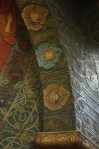
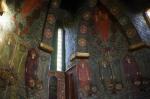
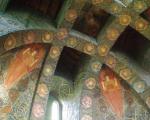
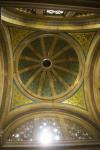
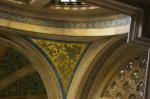
Entering the chapel, after ensuring that neither of the ginger and white cemetery cats, obviously art lovers, haven’t followed you in, is like going into darkness from light.  I’d seen the cats on previous visits but on my trip in October 2015 they were nowhere to be seen.  Take time for your eyes to adjust.  Pale faces suspended in the shadows watch you. Then suddenly the light through the tall narrow windows begins to illuminate the glittering, swirling ‘glorified wallpaper.’ All around the dome’s walls are lifesize pairs of angels in red and green, either staring towards or away from you.   The ones facing you are angels of light and the ones looking away are angels of darkness. Symbolic medallions around them intertwine with the sinuous Art Nouveau whiplash and golden tendrils of the Tree of Life. The upraised arms of the angels direct your eyes to the dome’s roof and to the 100 cherubs’ faces on the crosspieces, the four larger angels on each of the corbels and finally the sun in the roof’s centre.

interior view of Watts Chapel showing one of the Celtic inspired Angels of light. copyright Carole Tyrrell
interior view of Watts Chapel showing one of the Celtic inspired Angels of light.
copyright Carole Tyrrell


The gilded terracotta altar is opposite the entrance.


Incredibly, the Watts Chapel was created by an amateur.  Mary Watts, the devoted second wife of the Victorian painter, George Frederic Watts (1817-1904), designed the entire building without any prior experience.  It must be one of the very few 19th century buildings designed by a woman. Mary dedicated  it to:

the loving memory of all who find rest near its walls, and for the comfort and help of those to whom the sorrow of separation remains“.

She  formed the Compton Potters Guild with local villagers and they assisted with the carvings and gesso decorations. A coachman modelled the angels’ faces above the entrance. Even the local children each painted a leaf, a flower or fruit on the interior walls. She also saw the Guild as a way of keeping the locals occupied and away from bad influences such as drink. The chapel was her husband, G F Watts’, gift to the village of Compton.   He was also known as Signor and financed the building  by painting commissioned portraits.

The Chapel was begun in 1895 and the gesso interior painting was completed in 1904. The Archbishop of Canterbury attended the consecration ceremony, together with Signor, amongst others. The Watts  lived at ‘Limnerslease’ which was near the churchyard and it was from their grounds that the clay to build the chapel came.  Burne- Jones, the Pre-Raphaelite painter, somewhat unkindly, renamed the house ‘Dauber’s Den’ which reveals how G F Watts was viewed by some of his contemporaries.   The Gallery has had a refurbishment and Watts’  paintings now have interpretation boards and are better displayed with additional sculptures.

However, although G F Watts was a celebrated painter in his day he has fallen out of favour as have other artists of his time. He was notorious for marrying the actress Ellen Terry who was just 17 to his 47 and it barely lasted a year. Mary was his second wife and 36 years his junior. She was an inventive and accomplished artist in her own right and devoted herself to her husband and his memory. Signor painted Society portraits and subjects taken from mythology such as ‘Clytie’ and moral, storytelling pictures. But he was also an important precursor of Symbolism with such work as ‘The Sower of the Systems’. 2004 was his centenary year and he was commemorated with an exhibition at the nearby Watts Gallery and the National Portrait Gallery.

However the Watts Chapel isn’t for everyone. Some may find it too overpowering in its use of symbols and extravagant decoration and others may see it as an indulgent folly. But to me it’s a uniquely spiritual building. Mrs Watts used many sources for her creation including the Book of Kells and Egyptian sphinxes, and I find it fascinating to discover the symbols used and decipher their meaning or simply just enjoy them.

The Watts Gallery sells an excellent book on the meaning of the carvings and the chapel’s background, if you wish to explore further. They also have further examples of the work of the Potters Guild which finally closed in the 1950’s and their works are now collectors items.  West Norwood cemetery has a piece on a grave.  However, the Gallery does sell modern reproductions and had some on display on my visit in 2015.  There is also an excellent tea shop at the gallery.

 NB: Please remember that the chapel is also a parish building and may be in use on some days.

©Text and photos Carole Tyrrell

Reference:

Watts Chapel; An Arts & Crafts Memorial, Veronica Gould & Joanna Howse, Books for Dillons, published 2 October 1993  (NB: This may be out of print but the Gallery may still have a few copies)

http://compton-surrey.co.uk/watts-chapel/4518411494

Part 2 – A lasting memorial to a remarkable woman – Mary Seton Watts and Compton Cemetery.
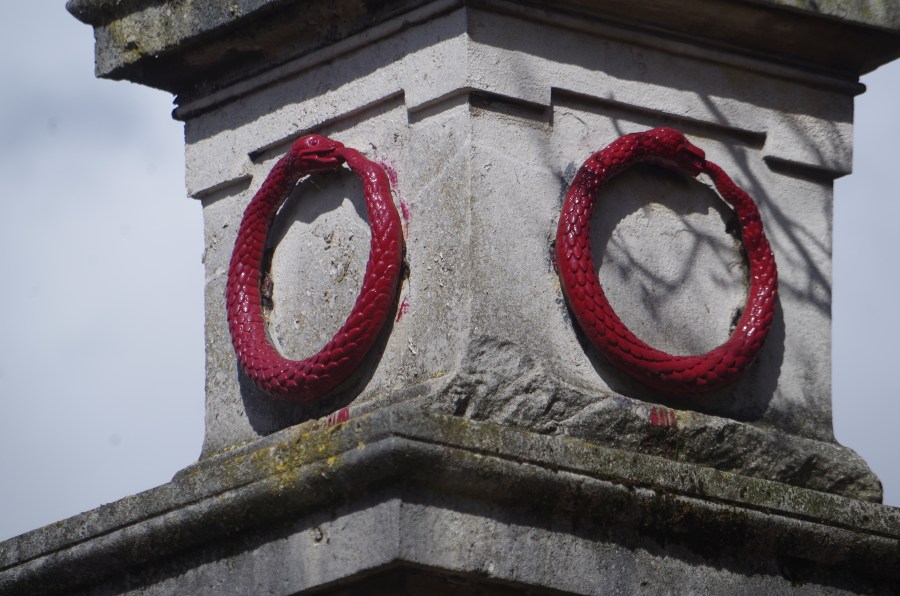


Symbol of the month – The Ouroboros


For every end there is a beginning.

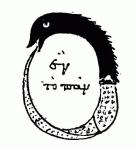
This is only one of the several  positive and powerful meanings  of the ouroboros which is one of the most ancient  symbols known to man.  It’s depicted as a snake eating its own tail to sustain its life in an eternal cycle of renewal and it usually forms a full circle.  It occurs in many cultures,   religions and beliefs.  The psychologist, Jung, called it an archetype which is best described as

a primitive mental image inherited from the earliest human ancestors, and supposed to be present in the collective unconscious.’

The ouroboros appears in Victorian cemeteries as a symbol of resurrection.  The snake is reborn as it sheds its skin and this fine example is on each of the 4 sides on top of the columns at the imposing entrance to Nunhead Cemetery,  London. Victorian visitors would have understood its meaning.   As a resurrection image it can be very positive as some of its other attributes are immortality, eternity and wisdom.  However, as with most symbols , it can have several meanings.  These include the Universe’s   cyclic nature and life out of death.  It constantly appears to return as it sheds its skin and, Phoenix-like, has a cycle of life, death and rebirth.

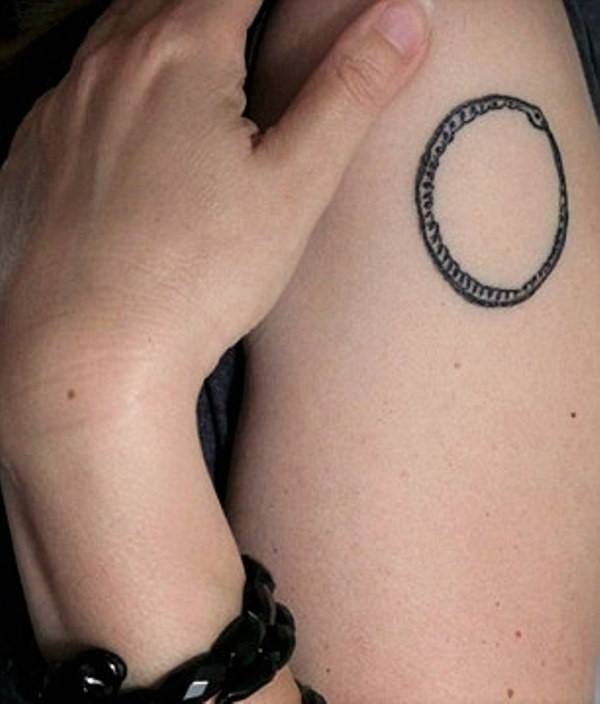
There is also a magnificent ouroboros on the gates of Sheffield General Cemetery and one in Highgate Cemetery West on the doors to a mausoleum.  It inspired the tattoo worn proudly by Jeane Trend-Hill a photographer and fellow cemetery explorer.

Photographer and fellow cemetery enthusiast, Jeane Trend-Hill's ouroboros tattoo and Whitby mourning bracelet based on one in Highgate. copyright Jeane Trend-Hill Used with kind permission.
Photographer and fellow cemetery enthusiast, Jeane Trend-Hill’s ouroboros tattoo and Whitby mourning bracelet based on one in Highgate.
copyright Jeane Trend-Hill Used with kind permission.


But the ouroboros’ origins lie in either ancient Greece or Egypt as both cultures have claimed it.  In Greece, Plato described it as ‘the first living thing, a self-eating, circular being’.  In fact, the Greek translation of ouroboros is ‘tail devouring snake’ and it’s associated with something constantly recreating itself and the eternal return.

In Egypt, the ouroboros reputedly appears for the first time in the 14th century BC in Tutenkhamen’s tomb on an ancient funerary text.  This depicts the Sun God Ra and his union with Osiris in the underworld and is illustrated with two serpents , holding their tails in their mouths, coiled around hands and feet. This may be a representation of the unified Ra-Osiris.  Both serpents are reputedly the manifestation of the god Mehen, who in other funerary texts protect Ra in his underworld journey.  I haven’t been able to find an image of this particular representation but I did find this one which purports to be even older.

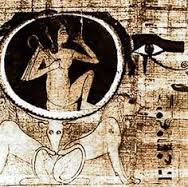
It’s from a papyrus dated 1077 – 943BC, from the papyrus of Dama and is of the ouroboros surrounding the Sun-Ra. http://earthmonsterworld.ning.com/groups/serpent-mysteries/serpent-world-mythology/ouroboros
It’s from a papyrus dated 1077 – 943BC, from the papyrus of Dama and is of the ouroboros surrounding the Sun-Ra.
http://earthmonsterworld.ning.com/groups/serpent-mysteries/serpent-world-mythology/ouroboros

It’s from a papyrus dated 1077 – 943BC, from the papyrus of Dama and is of the ouroboros surrounding the Sun-Ra.

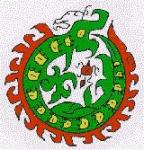
The ouroboros appears in Hindu, Norse, Aztec and Chinese religions.  It’s also a significant alchemical symbol as well and features in Cleopatra the Alchemist’s work.   There are also Masonic associations from seals dating from the 17th century.

The ouroboros is displayed on numerous Masonic seals, frontispieces and other imagery, especially during the 17th century. http://earthmonsterworld.ning.com/groups/serpent-mysteries/serpent-world-mythology/ouroboros
The ouroboros is displayed on numerous Masonic seals,
frontispieces and other imagery, especially during the 17th century. http://earthmonsterworld.ning.com/groups/serpent-mysteries/serpent-world-mythology/ouroboros

In fact, on a recent edition of BBC TV’s Antiques Roadshow shown on Sunday 1 May 2016, a triangular Masonic clock was shown and among its several motifs was an ouroboros.   In China it can also take the form of a dragon. In the Waite deck of Tarot cards it features on the Magician card.

I found this quote online:

‘In other myths the ouroboros encircles the whole world, a circumference of the waters surrounding the earth.  It can support and maintain the world and also inject death into life and life into death.  Although apparently immobile, it’s actually in perpetual motion, forever recoiling upon itself.’

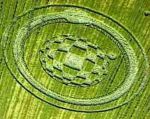
 Here is a selection of ouroboros  representations from other cultures:


One of the many fascinating myths surrounding the ouroboros is the experience of the chemist, August Kekule, who was trying to discover the structure of benzene.   This is how he described his Eureka moment :

‘I was sitting, writing at my text-book; but the work did not progress; my thoughts were elsewhere. I turned my chair to the fire and dozed. Again the atoms were gamboling before my eyes. This time the smaller groups kept modestly in the background. My mental eye, rendered more acute by the repeated visions of the kind, could now distinguish larger structures of manifold conformation: long rows, sometimes more closely fitted together; all twining and twisting in snake-like motion. But look! What was that? One of the snakes had seized hold of its own tail, and the form whirled mockingly before my eyes. As if by a flash of lightning I awoke; and this time also I spent the rest of the night in working out the consequences of the hypothesis.’

As I said earlier, Jung would see this dream as evidence of the ouroboros and its effect on the collective unconscious.

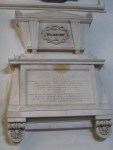
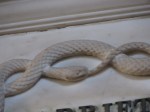
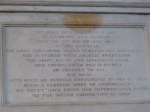
Although the ouroboros is usually depicted as a full circle, this is one that I found in my local church.  On first glance, it merely looks like an attractive, rippling border around the name Harriet and  It dates from 1815. But on a recent visit, I looked closer and realised that it was actually composed of 2 entwined snakes, each biting their own tail.  When I spoke to a churchwarden, she had always thought that, due to the patterning on the snakes’ bodies, that it was two entangled pieces of rope.   It is a memorial to a young wife who died aged 25 after suffering the ‘most acute and lingering pains.’   So it would have been a potent reminder of resurrection.

What initially looks like a simple pattern is two snakes entwined - tail to head. copyright Carole Tyrrell
What initially looks like a simple pattern is two snakes entwined – tail to head.
copyright Carole Tyrrell

The ouroboros is one of the most intriguing and interesting symbols that I have researched so far.  A universal image of rebirth and hope.

References;

http://tokenrock.com/explain-ouroboros-70.html

https://en.wikipedia.org/wiki/Ouroboros

http://www.crystalinks.com/ouroboros.html

http://mythologian.net/ouroboros-symbol-of-infinity/

Douglas Keister – Stories in Stone

Clare Gibson How to read symbols .

What is the Ouroboros – youtube

An Illustrated Encyclopedia of traditional symbols J C Cooper, Thames & Hudson originally pub 1979, reprinted 1993

©All photos and text Carole Tyrrell unless stated otherwise.


Edith O’Gorman – The Escaped Nun of West Norwood


An imposing memorial in West Norwood Cemetery to Edith O'Gorman and her husband. copyright Carole Tyrrell
An imposing memorial in West Norwood Cemetery to Edith O’Gorman and her husband.
copyright Carole Tyrrell

I encountered The Escaped Nun on a cold November day as I was wandering in West Norwood Cemetery.  It’s one of London’s Magnificent Seven Victorian cemeteries and there’s always something interesting to be found.  The vegetation had died down and so it was an ideal time to look for forgotten gems.
This is presumably a 3D relief of Edith's husband William Auffray. Quite spooky as his eyes seem to follow you round. copyright Carole Tyrrell
This is presumably a 3D relief of Edith’s husband William Auffray. Quite spooky as his eyes seem to follow you round.
copyright Carole Tyrrell


I was walking through a clearing near the columbarium when I saw a large monument which had a broken column in top of it with an anchor carved on it and, lower down, a 3D bust of a middle-aged Victorian gentleman which faced me.  He stared at me and I stared back. However, I was a little unnerved as his eyes seemed to follow me.  But it was the epitaph below that caught my attention.  It read:


The epitaph that started it all - Edith O'Gorman - The Escaped Nun. Who wouldn't want to know more? copyright Carole Tyrrell
The epitaph that started it all – Edith O’Gorman – The Escaped Nun. Who wouldn’t want to know more?
copyright Carole Tyrrell

EDITH O’GORMAN

(THE ESCAPED NUN)

WIDOW OF THE ABOVE

DIED 25TH MAY 1929

AGED 86 YEARS

LIFE’S RACE WELL RUN

LIFE’S WORK WELL DONE

THEN COMES REST


The Escaped Nun?  I was immediately intrigued and contacted Colin Fenn from the Friends of West Norwood Cemetery who very kindly set me off on my journey to find out more..


It was the story of a remarkable and controversial woman, the religious wars of the 19th century and a life full of drama and scandal on both sides of the Atlantic.


I found this online - what-when-how.com/new-jersey/ocean-county-observer-to-ogorman-edith-new-jersey
I found this online – what-when-how.com/new-jersey/ocean-county-observer-to-ogorman-edith-new-jersey

Edith O’Gorman, or Gorman, as she seems to have adapted her name at some point ,came from an Irish family who emigrated to the US and settled in Rhode Island.  She also may have originally been named Bridget or Biddie and became Edith, her middle name, at her baptism in 1870.  She was born on 20 August 1842 and, after being educated within a Protestant seminary, she received the calling to become a nun in August 1861 when she was 19..


On 1 October 1862 she entered St Elizabeth’s Convent, Madison, New Jersey and describes it as if she had died.  Six years later she ran away from the cloisters with $5, and set off on a new life.


Edith now had a new calling; to expose the truth about convent life and she did this in her best-selling book ‘The Trials and Persecutions of Miss Edith O’Gorman otherwise Sister Teresa de Chantal, of St Joseph’s Convent, Hudson, New Jersey’ which was first published in 1871.


It’s an amazing and often entertaining book to read as the pace and revelations never flag.  It was incredibly popular with many printings in the USA and abroad and was translated into several languages.   In it, Edith describes life behind convent walls which was anything but devotional.  She was bullied by older nuns and witnessed cruelty by them towards the orphans in their care.    However, on 16 July 1864 aged 22, Edith took her vows and was sent with two other sisters, Agnes and Josephine, to establish a new convent in St Joseph’s Parish, Jersey City, New Jersey.  Now Edith’s narrative gets into its stride as she reveals that priests are making money from parishioners paying them to say masses on their behalf and also the fate of many of the nuns.  They either left as Sister Agnes did, ended up in local asylums for the insane died or mysteriously disappeared.


A priest attempts to seduce her and eventually Edith runs away.    After taking refuge in  a  hotel she advertises for work as a governess and finds herself in a bordello.  She escapes again and, after some more adventures, she converts and becomes a Baptist.

After that she devoted the rest of her life to lecturing against Catholicism.  The rest of the book consists of reviews of her lectures.   Some of the book has the ring of truth because of what we now know about institutions such as the Magdalene Laundries for ‘fallen’ women and some orphanages.


Edith’s sensational book, which is still in print and available on amazon, entitled ‘Convent Life Unveiled’ has to be seen against the background of 19th century religious fervour.  Since Henry VIII founded the Church of England, Catholics had been side lined from public life and denied civil rights which included serving in Parliament ,owning all kinds of property and attending major universities such as Oxford and Cambridge. The cry of ‘No Popery’ was common and the same was true in the USA.


Anti-Catholic feelings of the time were spurred on by the popular press, novels and lurid exposes of life inside convents and monasteries.  They all shared common themes: secret tunnels connecting monasteries and convents, illicit affairs between nuns and monks and secret burial places for babies born to nuns.  There were other popular books on convent secrets which included Rebecca Reed’s ‘Six Months in a Convent.’ published in 1835 and Maria Monk;s ‘Awful Disclosures of the Hotel Dieu Nunnery of Montreal.’ which was also known as  ‘The Awful Disclosures of Maria Monk.’  The latter has never been out of print.  However, there was one drawback; neither Rebecca or Maria had ever actually been nuns.


But Edith was the real deal.  She travelled the world delivering her lectures.  But it was a dangerous business.  Edith’s lectures were often attended by devout, protesting Catholics and would often end up in a riot or a serious brawl. She was also the victim of several assassination attempts as she was seen as someone who should be ‘done for.’  One bullet just missed as it passed through her hat.  In fact Edith claimed that there had been over 70 attempts made on her and her husband’s lives.  This may just mean that the opposition kept hiring assassins with bad eyesight.

edith
I also found this online -www.courier.co.uk/nun-s-speech-sparked-riot/story-15120498-detail/story.html. This was story about Edith’s lecture in Kent causing a riot.

She married William Auffray on 17 June 1869 and they settled in England.  He was a Frenchman and rumoured to be a former priest who had resigned from the faith.


However, by 1915 she was penniless despite having sold 300, 000 copies of her book and undertaking a 15 year lecture tour with William.  After that, nothing more is heard.


But Edith could actually write and write well but she doesn’t seem to have written anything else.  If her book had been fiction I’m sure it would have sold even more copies.  The pace never slackens and I found myself turning pages faster and faster as each new peril or revelation leapt off the page.

Edith was a remarkable and resourceful woman who clearly believed in what she was doing and was not deterred by violence and threats.  She earned her own money and had the stamina to travel the world and spread the word.


Another view of the memorial - note the broken column and the anchor. copyright Carole Tyrrell
Another view of the memorial – note the broken column and the anchor.
copyright Carole Tyrrell

So now Edith rests in a corner of a Victorian cemetery with her husband’s bust keeping watch over her. Gone but not forgotten as long as there’s a passing visitor who reads her epitaph and thinks ‘

‘Why is she the Escaped Nun?’

With thanks to Colin Fenn, Friends of West Norwood Cemetery

Text and photos copyright Carole Tyrrell except for the 2 photos of Edith O’Gorman.

References:

http://www.academia.edu/1507333/The_Identity_of_Edith_O_Gorman_the_Escped_Nun_

https://archive.org/details/conventlifeunvei00ogor   (this is the online copy of her book)

http://www.courier.co.uk/nun-s-speech-sparked-riot/story-15120498-detail/story.html

http://diaryofamadgardener.blogspot.co.uk/2010/03/escaped-nun.html  (this is a blog by someone who was inspired to write a book about her.

An afternoon with the dead and famous – Part 2 of a visit to Golders Green – the crematorium


The front entrance to the crematorium. Built in the style of a Northern Italian monastery. copyright Carole Tyrrell
The front entrance to the crematorium. Built in the style of a Northern Italian monastery.
copyright Carole Tyrrell

Spring was in the air at last as we gathered in the West Memorial Court to await our guide, Eric Willis. We were in extremely good company as we were surrounded by  Marc Bolan, Bernie Winters, Hughie Green, Norman Vaughan, Ronnie Scott and Keith Moon amongst others.   Sadly it was only their memorial plaques that were there. But it was like a trip down memory lane as you had to be of a certain vintage to remember some of them.

I had been expecting a drab, municipal building but the Crematorium is built in the style of a Northern Italian Lombardic monastery in warm red brick.  It looks out onto Hoop Lane and its semi detached houses and if you didn’t know what it was you could be forgiven for thinking that it was a large church.  Its tall campanile tower actually houses the crematorium  chimney.  The impressive cloisters, 240 feet in length,  are also filled with the memorials of the great and good.

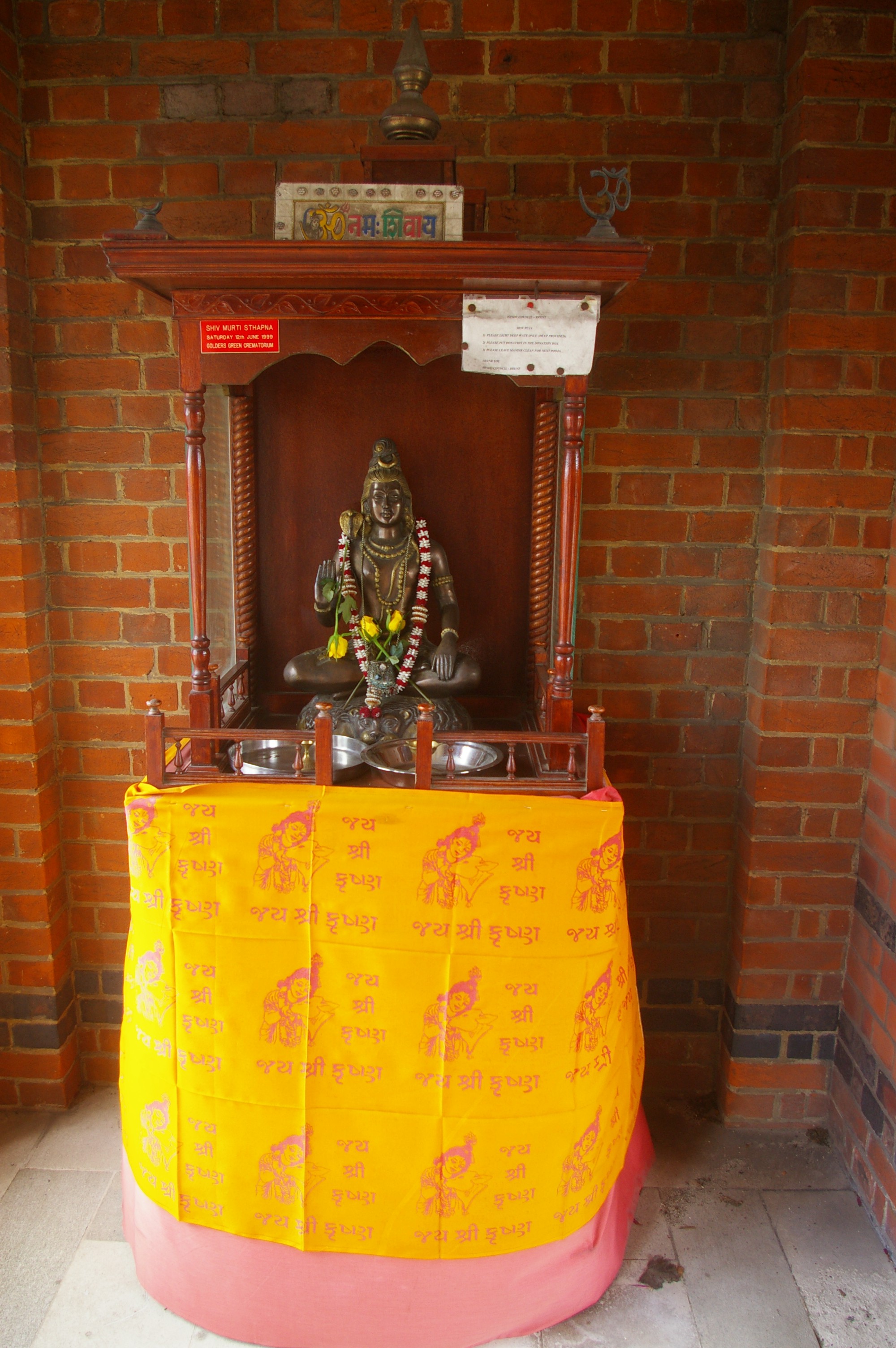
The Crematorium is the oldest in London opened in 1902, 17 years after cremation was legalised and in response to a growing demand for cremations. Although the crematorium was completed in 1939, buildings were added whenever money became available. The land had been purchased for £6000 and the architect, Sir Ernest George, also designed Claridges Hotel in Mayfair.  It’s still privately run and, to date, has conducted over 328,052 cremations  with the ashes of 100,000 people scattered over the dispersal lawn in the grounds. It’s estimated that 2000+ creations take place there every year. The Crematorium  is Grade II listed with 3 columbariums, 3 chapels and a and Hall of Memory. All religions are welcome and as we were shown the Jewish shrine I spotted a small altar to an Indian deity.

A little shrine to an India deity in the cloisters.  copyright Carole Tyrrell
A little shrine to an India deity in the cloisters.
copyright Carole Tyrrell

However, the crematorium is also secular which means that the service and music are the decision of the friends and family of the deceased.  It also caters for atheists with a ‘communists corner’ where the ashes of numerous ex-communists are held.

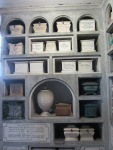
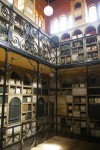
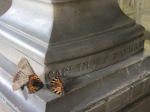
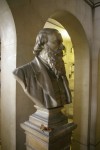
The word columbarium comes from the Latin for dovecot or niche for sepulchural urn. The West and East Columbariums are built in the form of towers and had the appearance inside of a reading room with urns deposited on the shelves instead of books. They stretched up to the ceiling. But each one told their own story.  Bram Stoker, of Dracula fame, had a plain and simple urn. But the ornate urns to two victims from the Titanic disaster were especially poignant as their grandchildren had recently visited due to the recent centenary.  In the East Columbarium, Eric revealed that he places every moth or butterfly that was trapped and died inside the columbarium very neatly under Captain Thomas B Hanham RN’s  impressive bust.

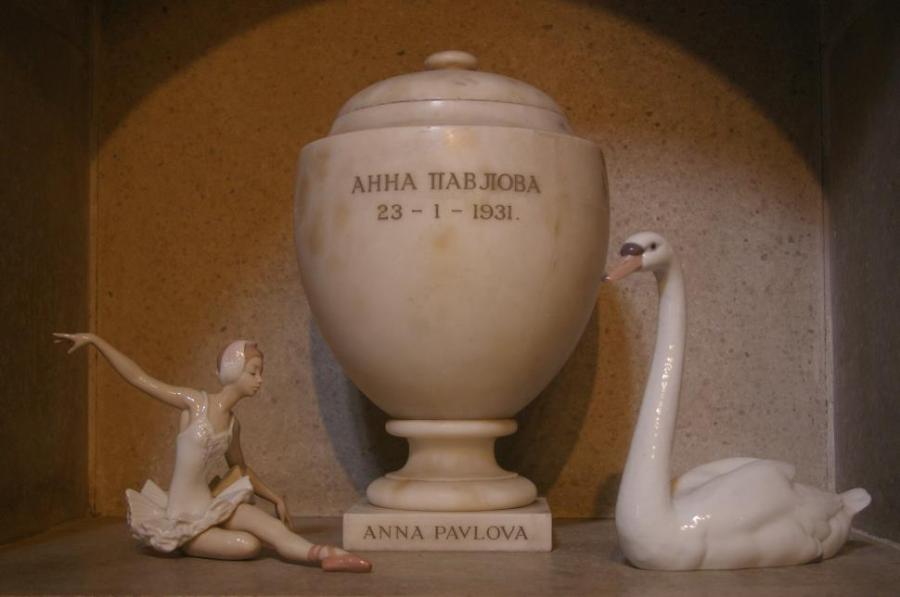
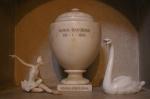
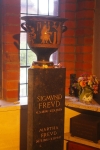
In the Ernest George Columbarium Eric showed us the ballerina Anna Pavlova’s urn in a small alcove.  It was flanked by a ceramic swan and a a ballet dancer.  Sadly her ballet shoes had also been on display but had recently been stolen and so, as a result, security had had to be tightened. And then we moved onto Sigmund Freud’s magnificent and large Grecian urn on top of a matching column surrounded by flowers. Please note that since my visit  Freud’s beautiful urn has been smashed.  I don’t think that it was a Freudian slip.

Afterwards we visited the West chapel which can seat 200 people and had a beautiful marble plaque to the Maharajah of Cooch Bahar and his family.  Eric then led us into the crematorium itself to see the business of reducing the dead to ashes with the staff patiently answering our questions and dispelling various myths about the process.

The 12 acres of grounds are beautifully kept and the crocus lawn in Spring is renowned. Sadly, we had just missed this splendid sight and, despite an exhaustive and informative tour, we ran out of time to explore them. Instead we admired the ornamental lily pond by the Victoria Cross memorial on which 2 mallard ducks paddled near the tea rooms. There are 14 holders of the Victoria Cross who are commemorated on the memorial who have been cremated at Golders Green.  We didn’t see the Marc Bolan Society’s gift of a bench with white swans as armrests.  They gather on 16 September every year to remember the singer and cosmic elf’s death in 1977. We also missed seeing the bronze statue, called ‘Into the Silent Land’ of a young girl being lifted heavenwards by a mysterious draped figure.  Apparently, at its previous site within the grounds, it had scared a staff member so much as it loomed out of the morning mists, it had had to be moved elsewhere in the grounds.  Eric showed us photos of the statue from his own collection together with some of his own paintings and his affection for the Crematorium was obvious.

Golders Green is well worth a visit or two  as there is so much to see and appreciate. My thanks to the very knowledgeable  and entertaining Eric Willis, and Golders Green Crematorium for their hospitality.  Even if we were, at times, reduced to celebrity spotting  as famous names leapt out at us at every turn.

I visited the Crematorium in 2013 and although I’ve always intended to return as there was still much to see such as the mausolea including the Philipson Family mausoleum designed by Sir Edwin Lutyens and the second pond but haven’t managed it yet.  Well worth a trip if you’re in London.

Copyright text and photos Carole Tyrrell

References:

http://crematorium.eu/golders_green_crematorium.html

http://www.independent.co.uk/news/uk/home-news/famous-names-whose-final-stop-was-golders-green-crematorium-1921813.html

https://en.wikipedia.org/wiki/Golders_Green_Crematorium

Silently slumbering in suburbia with a pebble for remembrance – Part 1 of a visit to Golders Green, London

Golders Green Jewish cemetery

I was in Hoop Lane, Golders Green for an organised visit to Golders Green Crematorium which had been organised by the Friends of Nunhead Cemetery.  But I had arrived early and so decided to explore the Jewish cemetery that was opposite its gates. Golders Green has a large Jewish community and so I wasn’t surprised to find such a large cemetery.  I’ve never visited one before and thought that it would be an interesting contrast to the Crematorium.
The Jewish Cemetery is an imposing, large space, bordered on three sides by suburbia and on the fourth the Lane.    It’s owned jointly by the West Synagogue of British Jews  and the Spanish & Portuguese Jews Congregation and managed on their behalf.  The first burial was in 1897 and it’s still in use today.

When I visited I noticed that in one large section, the East side,  that all the tombstones were horizontal and on the West side that they were all upright.   It wasn’t until doing the research for this piece that I discovered that the East Side belongs to the Spanish and Portuguese Jews and the West Side uprights are the province of the West London Synagogue.

The cemetery is one of the few London Sephardic Jewish cemeteries and this is a form of Judaism particular to Spanish and Portuguese Jews.  There are some very well know names buried here which include Jacqueline du Pre the cellist, Jack Rosenthal the playwright, Marjorie Proops the doyenne of agony aunts and Erich Segal author of the tear-jerking 1970’s best seller, ‘Love Story’.    Although I didn’t have much time to explore it fully I did find two famous names inscribed on a horizontal tombstone – Saatchi and Saatchi.

Two familiar names from the world of advertising and art. copyright Carole Tyrrell
Two familiar names from the world of advertising and art.
copyright Carole Tyrrell

The cemetery also contains 24 Commonwealth Service Personnel  graves here which are maintained by the  Commonwealth War Graves Commission.   There’s 10 from the First World War and 14 from the Second World War.  I didn’t see them on this visit but next time I will make sure that I have more time to look round.

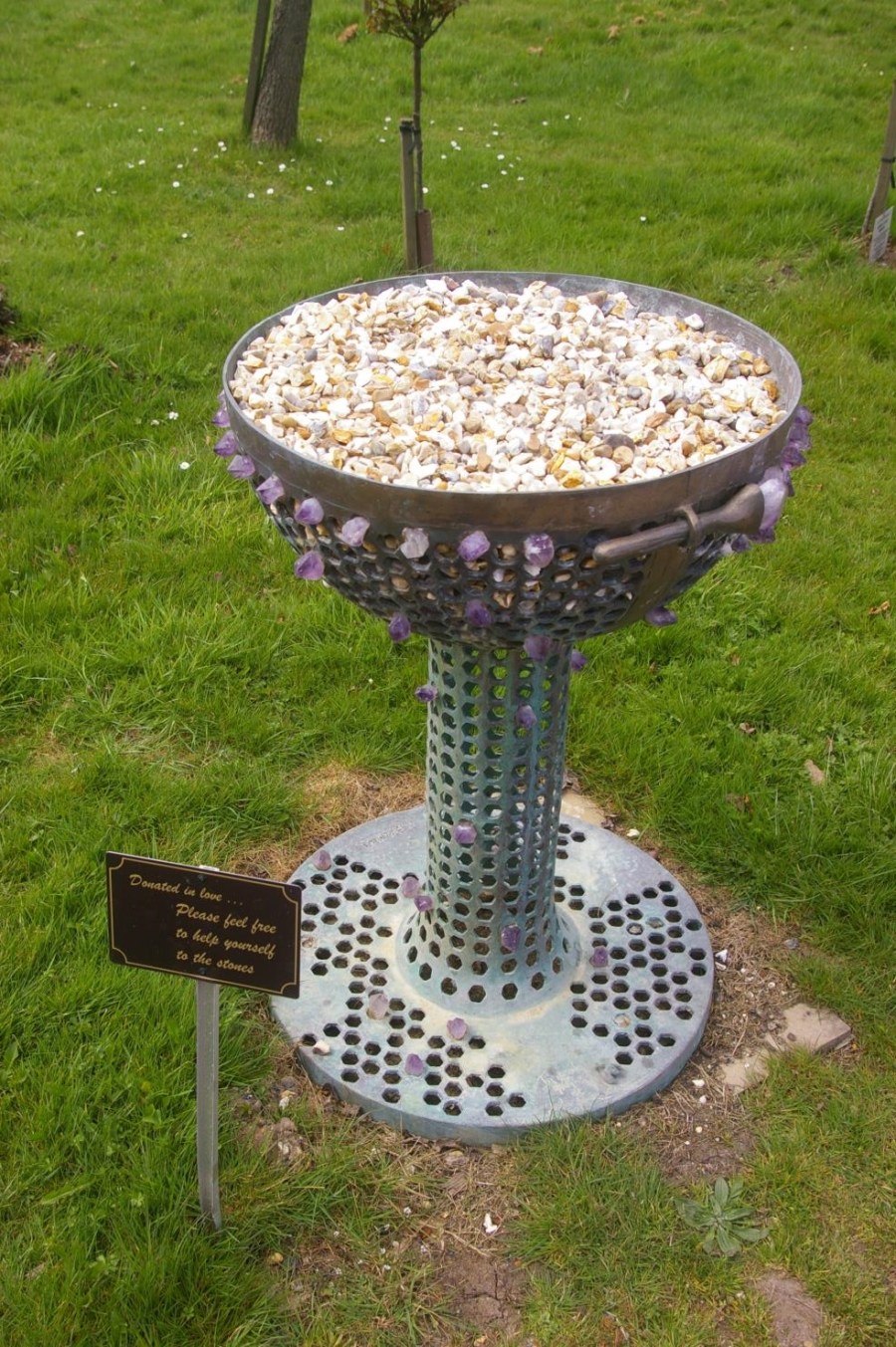
Near the entrance I noticed a bowl on a stand which contained small stones and pebbles. These are for visitors to place on their loved one’s grave.   It’s part of the Jewish faith and it’s customary for  people to leave  small stone on a grave.  I had already noticed several placed on various graves as I’d walked around the cemetery.     The protocol is for the visitor to position the stone on the grave using his or her left hand.  This demonstrates to other visitors of family members  that a grave has been recently visited and that the deceased hasn’t been forgotten.

There is a small building just inside the cemetery, near the entrance, which contains two halls for burial services but it wasn’t open when I visited.    It seemed a very plain cemetery without many floral tributes in evidence but I always find it fascinating how other cultures  and faiths bury and remember their dead.

I visited here in 2013 and despite my intentions to return I haven’t done so – yet.

©text and photographs Carole Tyrrell

References:

Symbol of the Month – The Spring of Life is Broken

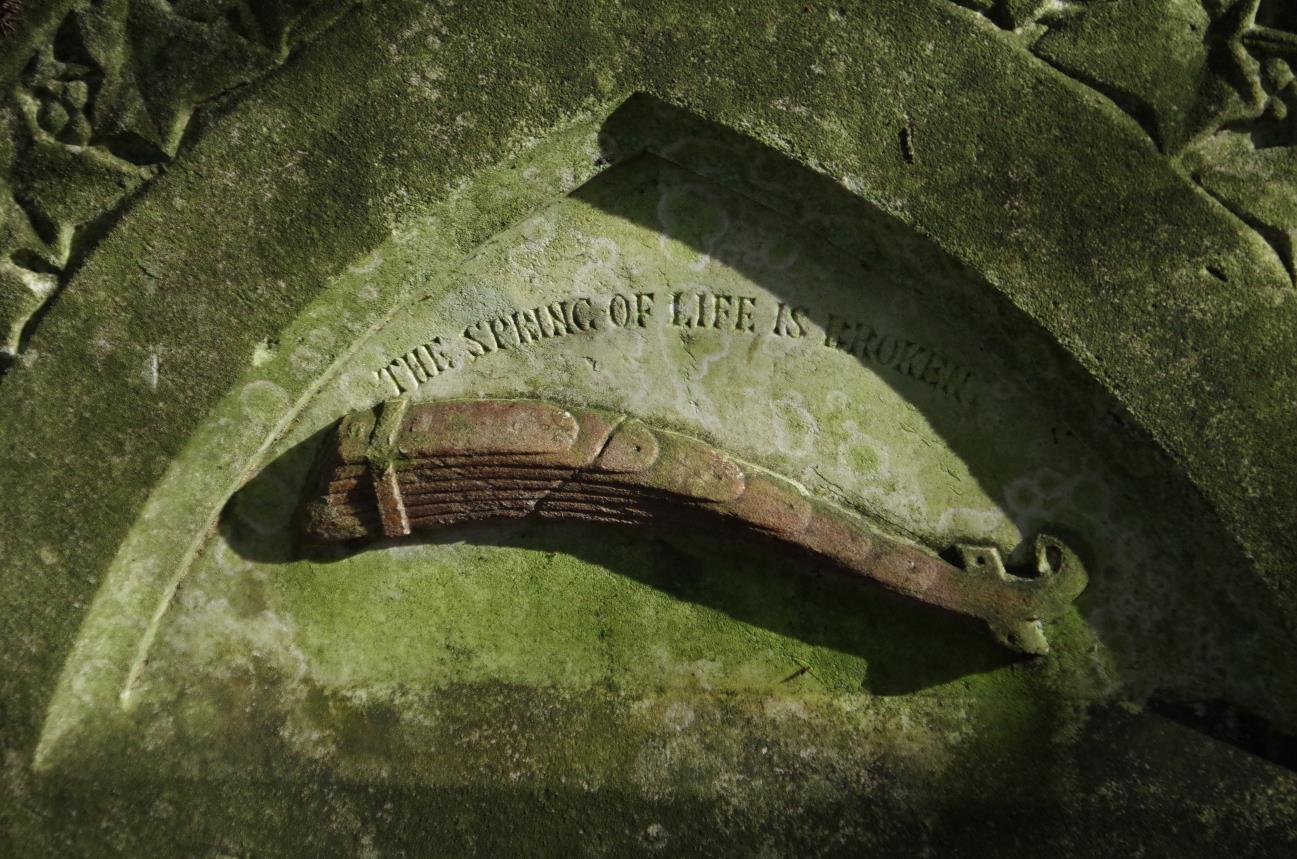
A unique symbol in Nunhead Cemetery - a carriage spring. copyright Carole Tyrrell
A unique symbol in Nunhead Cemetery – a carriage spring.
copyright Carole Tyrrell

This is one of the most intriguing and baffling symbols to be found in any cemetery.  Visitors are mystified as to its meaning and inspiration and there has been a lengthy discussion about it recently on a cemetery related Facebook page.

It’s tucked away in Nunhead Cemetery and, despite being given directions by Robert Reinhardt, a Facebook friend, I couldn’t find it.  He had posted images of it online and I was immediately intrigued.  But I couldn’t locate it despite making several visits.

But, as luck would have it, I was in Nunhead Cemetery again, looking for another memorial altogether when there it was, hiding in plain sight.

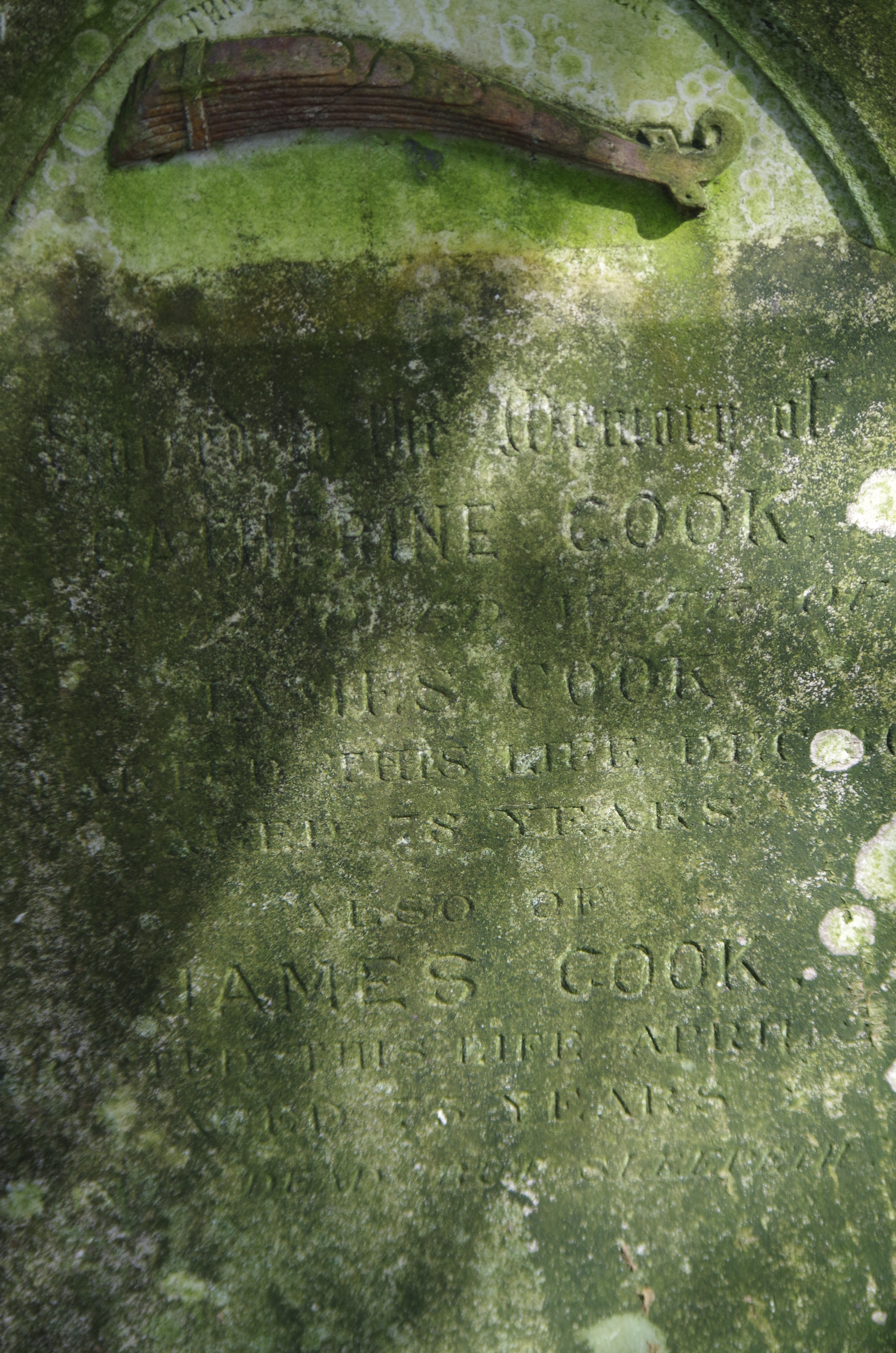
Epitaph on Catherine Cook's tombstone - beloved wife of James Cook. copyright Carole Tyrrell
Epitaph on Catherine Cook’s tombstone – beloved wife of James Cook.
copyright Carole Tyrrell

It’s a memorial to Catherine Cook, beloved wife of James Cook as it says on the epitaph, with the motto ‘The Spring of Life is broken’ and   the carving above it with a lovely border of carved ivy leaves  representing ‘evergreen’ or ‘eternal.’

But let’s digress for a moment.  This is a well carved leaf spring which is one of the earliest forms of suspension in a wheeled vehicle. Leonardo da Vinci used them in his own design for a self-propelled car.   The one of Mrs Cook’s tombstone is an example of a multi-leaf spring in which leaf springs of varying lengths have been stacked on top of each other, sometimes up to 20 at a time, to enable the vehicle’s load to spread more widely.

introduction-to-leaf-spring-3-638

I found the above diagram of a leaf spring online on various sites and it explains how it works.

But why is it depicted on an obviously much missed wife’s tombstone?

My own theory, and it is only my theory  is that it’s a variant on the  broken column.

This is an example of a broken column from Nunhead Cemetery.
copyright Carole Tyrrell


The column isn’t the result of vandalism but has been deliberately created like this.  It indicates that the departed, often a male, was the head of the house and now the support of the family, or its backbone, had gone.

So I feel that this could be a female version.  Mrs Cook was obviously the support to her husband and family in that the suspension, the object that made the family load easier to manage, has gone.

Since finally discovering it, I’ve come to admire it as a unique and affectionate tribute to a much loved woman.

You are completely free to disagree and to offer your own interpretation and I’d be very interested to receive them.

Text and photos copyright Carole Tyrrell

Sources:

Wikipedia

The much loved and never forgotten pets of the de Grey family – a visit to Wrest Park’s dog cemetery

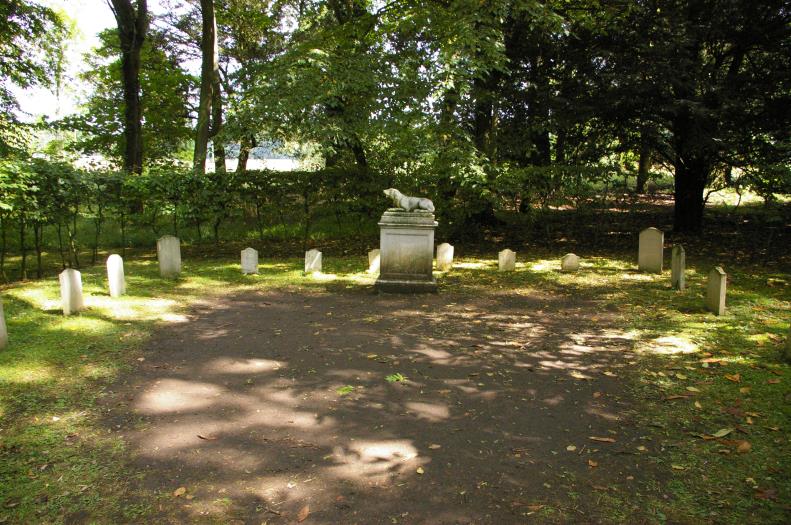
The Dog Monument  Made from Ketton Stone and erected by Earl Grantham in 1829. Copyright Carole Tyrrell
The Dog Monument Made from Ketton Stone and erected by Earl Grantham in 1829.
Copyright Carole Tyrrell


I visited Wrest Park on a beautiful summers’ day and it is one of the most beautiful stately homes and gardens that I’ve visited.  Located at Silsoe, near Luton in Bedfordshire, its 90 acres of formal gardens are impressive and contain features such as the elegant Long Water and the Chinese Bridge.

For over 600 years it belonged to the de Grey family.  It was Edward IV (1461-83) who made Edmund Grey the first Earl of Kent.  The formal gardens and Long Water were created during the 18th century by Annabel Benn with the 11th Earl of Kent, her son Anthony, and his wife Mary.  These were all the rage at the time and the celebrated Capability Brown, amongst others, helped design them.

In the 1830’s, Thomas Earl de Grey, a keen amateur architect decided to rebuild the house in the fashionable French style but retained the garden layout instead of replacing it with the style of the day.  He later became the first President of the Royal Institute of British Architects or RIBA. Since 1900, like most stately homes and country houses, Wrest has had mixed fortunes.  It was sold in 1917 and in 1948 became the National Institute of Agricultural Engineering and later the Silsoe Research Institute. Historic England, previously English Heritage, now own Wrest Park and have embarked on a 20 year restoration programme of the house and grounds.

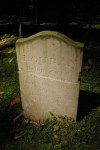
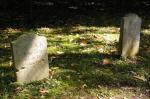
The de Grey family’s dogs’ cemetery is a distance from the house and near the Long Water. A grassed pathway bordered on each side by saplings leads you to a secluded glade.  A statue of a dog, the Dog Monument, made from Ketton stone rests on a stone pedestal surrounded by 16 headstones.  They are no longer in their original positions and the cemetery was officially Grade II listed on 10 January 1985.

View of Dog cemetery from path. copyright Carole Tyrrell
View of Dog cemetery from path.
copyright Carole Tyrrell

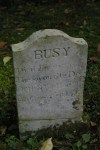
According to the guidebook, the area was first recorded on a 1735 surveyor’s plan of the gardens.  It was a square clearing at the end of a straight path leading from the Lady Duchess’s Walk.  The cemetery itself dates from 1829 when Earl Grantham, later to become Earl de Grey, erected the Dog Monument.  The headstones date from 1830-1860 and the dogs commemorated are:

Douban who died 24/11/1876 aged 17

Freuah who died in 1878 aged 10 and belonged to Countess Cowper

Una who died in 1891 and was the favourite dog of Lady Florence Cowper

Little Dick – the favourite dog of Lady Amabel Cowper

Lancey  who died in 1875

Busy

Fury

Dorrock

Phedra

Tiger

Nissy who died in 1816

Kelpie

Tottie who was a favourite dog

Dandy

Petsy

Pet – a favourite dog

The de Grey family’s love of their dogs can be seen in an 1865 photograph in the guide book.  Lady Amabel Cowper, the youngest daughter of Anne Florence, dowager Countess Cowper is standing on the terrace at Wrest with three of the family’s dogs who look like terriers.  One dog is obediently posing, lying at her feet, another is on his hind legs with his back to the camera looking up at her and a third, a small dog, is perched on her shoulder.  I did wonder if the one on her shoulder was Little Dick whose headstone records that he was her favourite dog.  Some of the stones are now partly illegible but the cemetery is still a poignant place to visit.   Two of the dogs, Dandy and Little Dick, are further commemorated as statues on two sculptures of the de Grey children.


However, dog cemeteries weren’t a Victorian invention. Instead they date back to the ancient Egyptians who created vast cemeteries containing 1000’s of mummified dogs.  These were linked to the cult of the jackal headed deity Anubis.  He was the god of embalming and the guide of the dead.  The City of Dogs was known as Hardai or Cynopolis to the Greeks.  The early Chinese emperors also established a palatial canine necropolis near Beijing in which the marble tombs were lavishly decorated with precious stones and metals such as gold and lapis lazuli.  It makes the Victorian version look very modest in comparison.  However, dog cemeteries were also seen as symbols of oppression by Russian Communists who denounced them. According to them, the ruling classes were lavishing money on these while their workers starved.


Dog cemeteries were most popular during the 19th century once Queen Victoria had established one at Osborne House on the Isle of Wight.   You can still find them at these houses:


Glamis Castle, Scotland

Haddo House, Aberdeenshire

Himley Hall, Stourton

Polesden Lacey, Great Bookham, Surrey

Mottisfont Abbey, Hampshire

Sandringham, Norfolk (where the Queen buries her corgis)


There may be others out there – I’ll have fun looking for them – but this is what I found on a quick look round the web.


Whatever your opinion of dog or pet cemeteries, I’ve always found them very touching.  The incumbents were obviously much loved and someone missed them enough to erect a stone in their memory and to record their passing.  RIP little ones you are not forgotten.


Sources:


http://www.blackcountrybugle.co.uk/Secluded-Stourton-woodland-unleashes-canine-secrets/story-20120404-detail/story.html

Wrest Park guidebook, English Heritage, 2011

http://www.georgianindex.net/dogs/dogs.html

https://www.history.org/Foundation/journal/Autumn04/dogs.cfm

https://uk.pinterest.com/gravedetective/pet-cemetery/

http://www.waymarking.com/waymarks/WM9DM0_Dog_Cemetery_Wrest_Park_Silsoe_Bedfordshire_UK

http://www.waymarking.com/waymarks/WM9CC0_De_Grey_Children_with_Dandy_and_Little_Dick_Wrest_Park_Silsoe_Bedfordshire_UK


 copyright and photos Carole Tyrrell

Nine symbols for the price of one! – The Daniel Vault, Nunhead, London,


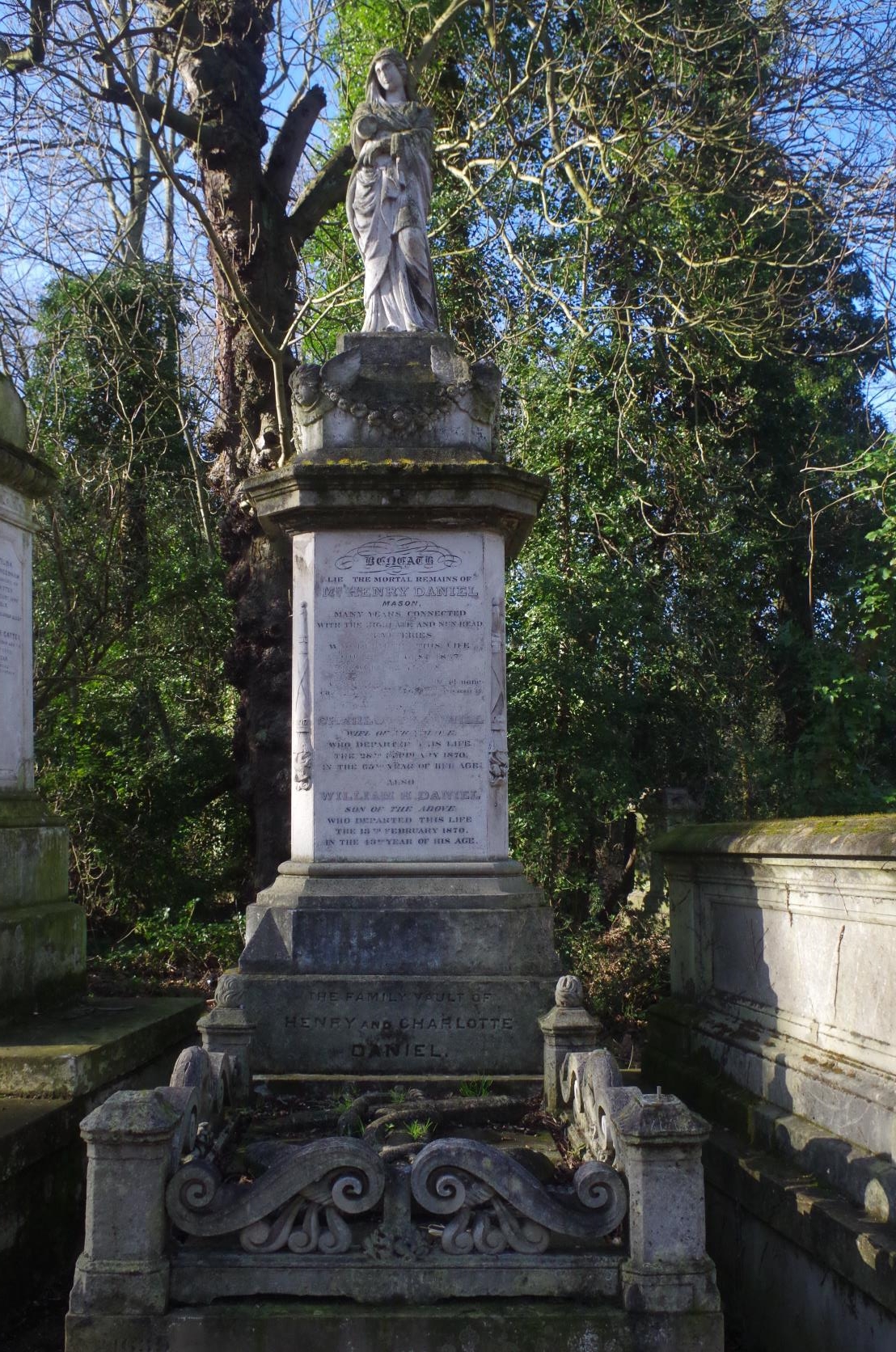
The Henry Daniel vault at Nunhead Cemetery, UK. He was a monumental mason who worked at the cemetery. copyright Carole Tyrrell
The Henry Daniel vault at Nunhead Cemetery, UK. He was a monumental mason who worked at the cemetery.
copyright Carole Tyrrell

This month instead of Symbol of the month I will be discussing a monument which is a gift to anyone interested in symbols and their meaning. Not one symbol but nine!

When you first look at the Daniel vault you may well be impressed by its extravagant decoration.  It’s absolutely studded with symbols and, due to its advantageous location close to the chapel and thus nearer to God, you can’t miss it.   In fact some of the larger monuments are in this area and the idea appeared to be that, even if you couldn’t take your money with you, at least you’d had it while you were alive and could prove it.

But there’s an interesting story behind each of the symbols and also of Henry Daniel himself.  He founded a dynasty of monumental masons who were closely associated with Nunhead Cemetery until its closure.  He established the first mason’s yard at Nunhead and two other firms followed.  These were Preston & Company and A Stogden.  Henry and his family lived opposite Nunhead’s imposing Linden Grove entrance gates in the imposing and rambling Gothic style residence that he built surrounded by his workshops and lived in it with his family until he died in 1867 aged 62.

The newly established large Victorian cemeteries meant that masons were kept busy and had a steady income.  They not only created monuments and memorials but also maintained graves and constructed vaults.    If you look along the edges and the bottom of graves and monuments in Nunhead and Highgate cemeteries you may well find the Daniel name.

Henry also had a workshop in Swains Lane at Highgate and according to an inscription on one of the monuments that his workmen helped to create, he was at one time the London Cemetery Company’s mason.  They owned both Nunhead and Highgate Cemeteries.

Daniel’s was in business until Nunhead closed, or was abandoned depending on your point of view, in 1969.  Afterwards, Henry’s  family home and yard was demolished after being a local landmark for over 100 years. It’s interesting to speculate if it would be preserved today after the fight to preserve the attractive and historic Lander monumental masons showroom near Kensal Green Cemetery’s imposing entrance.   It too was destined to be replaced by another bland apartment block.

It has been suggested that the vault is an advert for Daniel’s masons and I haven’t been able to find any proof of this.  However, to anyone interested in symbols it is a wonderful teaching aid as it has so many.
We begin at the top of the memorial with a woman swathed in draperies with her head looking down.  This is a mourning woman and a return to classical, especially Roman, themes.    They are often portrayed as leaning on an urn or a cross but as you can see this one stands alone.  The Historic England, formerly English Heritage, describes her as ‘a heavily swathed vestal figure.’
A classical Roman mourning figure swathed in robes on top of Daniel vault.. copyright Carole Tyrrell
A classical Roman mourning figure swathed in robes on top of Daniel vault..
copyright Carole Tyrrell

Now look beneath her feet.  There are winged cherubs or putti, one at each corner.  They have wings and so that makes them putti. They too are of classical origin and represent Eros or Cupid.   The flower garland than surround the base of the mourning woman features roses.

This is one of the four cherubs - one at each corner of the base on which the mourning woman stands.. Note flower garland. copyright Carole Tyrrell
This is one of the four cherubs – one at each corner of the base on which the mourning woman stands.. Note flower garland. copyright Carole Tyrrell

Garlands are a symbol of victory over death.

Roses:  This is one of the most popular flowers and means love, beauty and hope.  It has been said that they are associated with the rose without thorns – the Virgin Mary.  A rose is also known as the queen of flowers due to its fragrance and beauty.  Unopened roses still in their bud form often appear on children’s graves.  The longer a person lived, the more full blown the rose would be.  However I think that roses are used more as decoration these days.

Another view of the mourning woman, cherubs and garland. copyright Carole Tyrrell
Another view of the mourning woman, cherubs and garland.
copyright Carole Tyrrell

Now look at the two torches on either side of the epitaph.  These are downturned torches and you will also see cast-iron version on Nun head’s Linden Grove entrance pillars.  This is a common symbol and, when the flame which would normally go out when torch is inverted, it symbolises the eternal flame of life and the resurrection.  There is a variant with a torch that remains upright on a memorial in Kensal Green cemetery which I assume means eternal life.

Close-up of one of the downturned torches. copyright Carole Tyrrell
Close-up of one of the downturned torches.
copyright Carole Tyrrell

Now look down at the elegant Grecian style scrolled decoration and in particular the two very stylised wreaths.  I see them as laurel wreaths and they are again a return to classical symbols.  They symbolise eternal life as they are circular with no beginning or end and also made of evergreens which never die.   A symbol of victory over death and also military or intellectual glory. The word ‘laureate’ come from these and meant poetical or musical achievements.

Note the wreaths at the centre of the scrolling - stylised laurel wreaths. copyright Carole Tyrrell
Note the wreaths at the centre of the scrolling – stylised laurel wreaths.
copyright Carole Tyrrell

At each corner is an Eternal Flame which stands for everlasting life.

The Eternal Flame - originally there were 4 - one at each corner but now there are only 2. copyright Carole Tyrrell

Then we come to the snake wrapped around the anchor. A snake is a symbol of immortality and as such appears in many cultures over thousands of years. .  It’s not an ouroboros as are the ones on Nunhead cemetery’s  entrance pillars.  It has various associations including tattoos in which snakes are seen as potent symbols.

The Grecian scrolling along the sides. copyright Carole Tyrrell
The Grecian scrolling along the sides and the snake and anchor.
copyright Carole Tyrrell

Anchor:  This is a Biblical symbol and is a Christian one of hope.  The early Christians were reputed to have used the anchor as a disguised cross. It’s often set against a rock and so people often assume that it has a sea-faring connection but this isn’t always true.  The Hope and Anchor is a common pub name in the UK.  An anchor with a broken chain represents the end of life.

It’s rare to find so many symbols on one monument and also extremely well carved as well. Although the epitaph is now wearing thin the sentiments of eternal life, love, mortality and victory over death still remain for all to see.

Text and photos copyright Carole Tyrrell


Sources:

How to read Symbols, Clare Gibson, Herbert Press, 2008

Nunhead’s Monumental Masons, Ron Woollacott, Nunhead Cemetery An Illustrated Guide, FONC 1988

Stories in Stone, Douglas Keister, Gibbs Smith, 2004

http://historicengland.org.uk/listing/the-list-entry/1385649

http://www.lsew.org.uk/funerarysymbolism

http://www.oakdalecemetery.org/funerary-art-symbolism.asp

http://tchevelier.com/fallingangels/bckgrnd/cemeteries

http://www.thecemeteryclub.com  – useful resource, currently being updated (Feb 20160

http://www.whats-you-sign.com/snake-meaning-and-snake-tattoo-ideas.html    – tattoo site


Wildlife in Cemeteries No 3 – butterflies and moths.

Cemeteries, and in particular large Victorian ones, often have areas which are either a designated nature reserve or just left to run wild.  These are havens to insect and mini-beasts and also to the dedicated lepidopterist or butterfly fancier.  On a long, warm, summer afternoon their tiny, colourful, patterned wings can be seen fluttering over their favourite foods such as the humble ragwort.  No wonder a group of them are described as a kaleidoscope of butterflies.

Commas, common and holly blues, large skippers, meadow browns, red admirals, gatekeepers and, if you’re lucky, the magnificent Peacock , are all summer visitors to cemeteries.

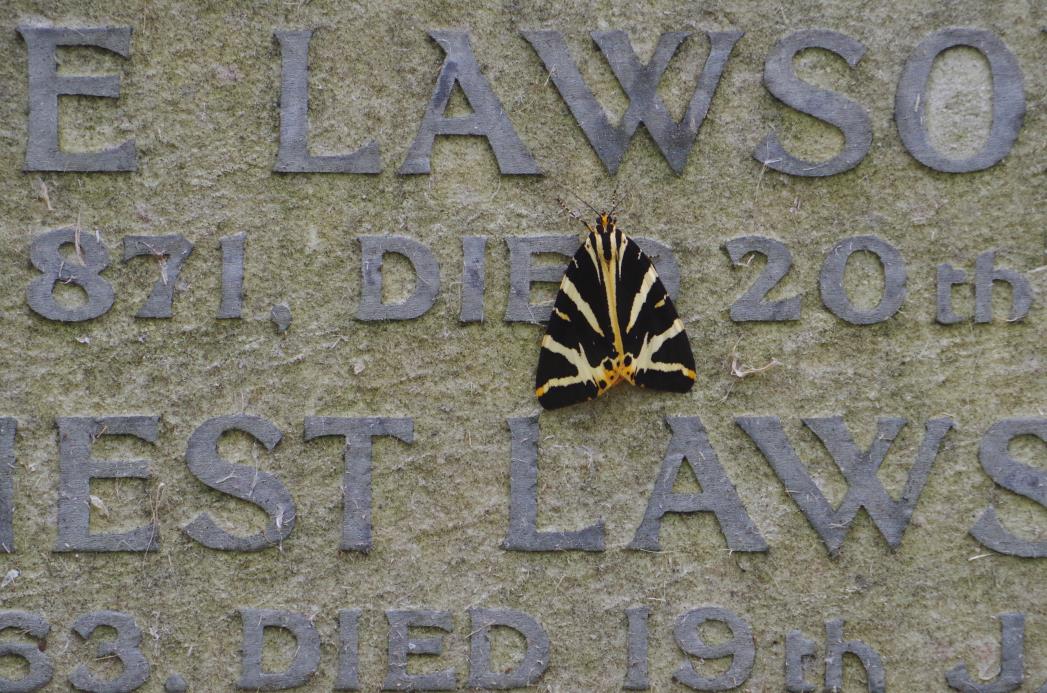
However, an increasingly common visitor, once rare, isn’t a butterfly at all but is, instead, a day-flying moth. This is a Jersey Tiger or Euplagia quadripunctaria to give it its Latin name. Its striped upper wings, when closed, give it the appearance of an African mask.  But it also has a surprise for, when in flight, it reveals its iridescent orange underwings.  When the sun catches them it’s like a small jewel on the wing.

This one obligingly posed on an inscription at Brompton Cemetery’s 2015 Open  Day.

Jersey Tiger day=flying moth - Brompton Cemetery Open Day 2015. copyright Carole Tyrrell
Jersey Tiger day=flying moth – Brompton Cemetery Open Day 2015.
copyright Carole Tyrrell

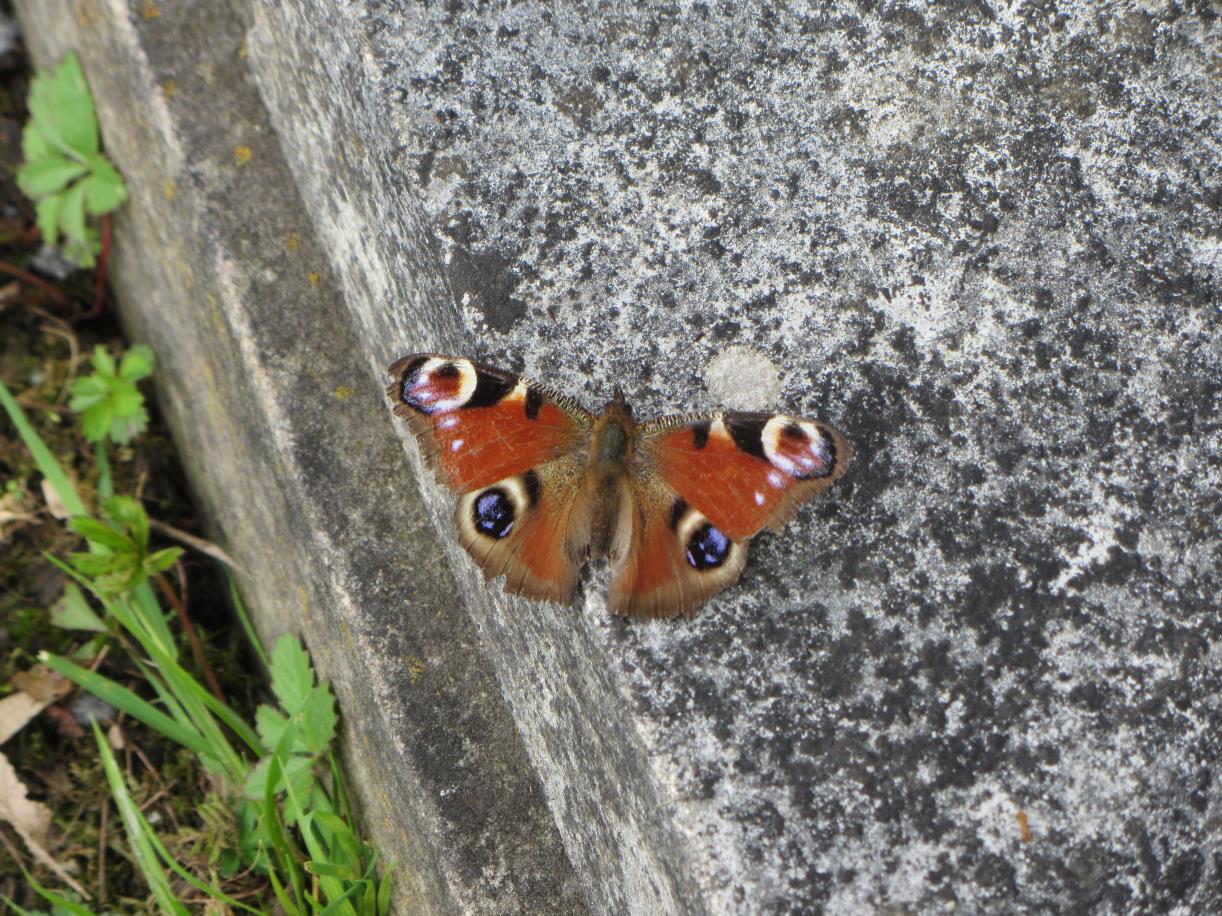
A lovely Peacock butterfly in Elmers End Cemetery.   When closed its wings are completely black and then open to show the beauty inside.

A beautiful peacock basking on a vault at Elmers End Cemetery, UK copyright Carole Tyrrell
A beautiful peacock basking on a vault at Elmers End Cemetery, UK
copyright Carole Tyrrell

This is a gatekeeper roosting on its favourite food, the ragwort.  Although a common butterfly and sitting on what is generally considered to be a weed it does make for an effective composition. Again from a Brompton Cemetery Open Day in 2013.

Gatekeeper on ragwort - its favourite food! copyright Carole Tyrrell
Gatekeeper on ragwort – its favourite food!
copyright Carole Tyrrell

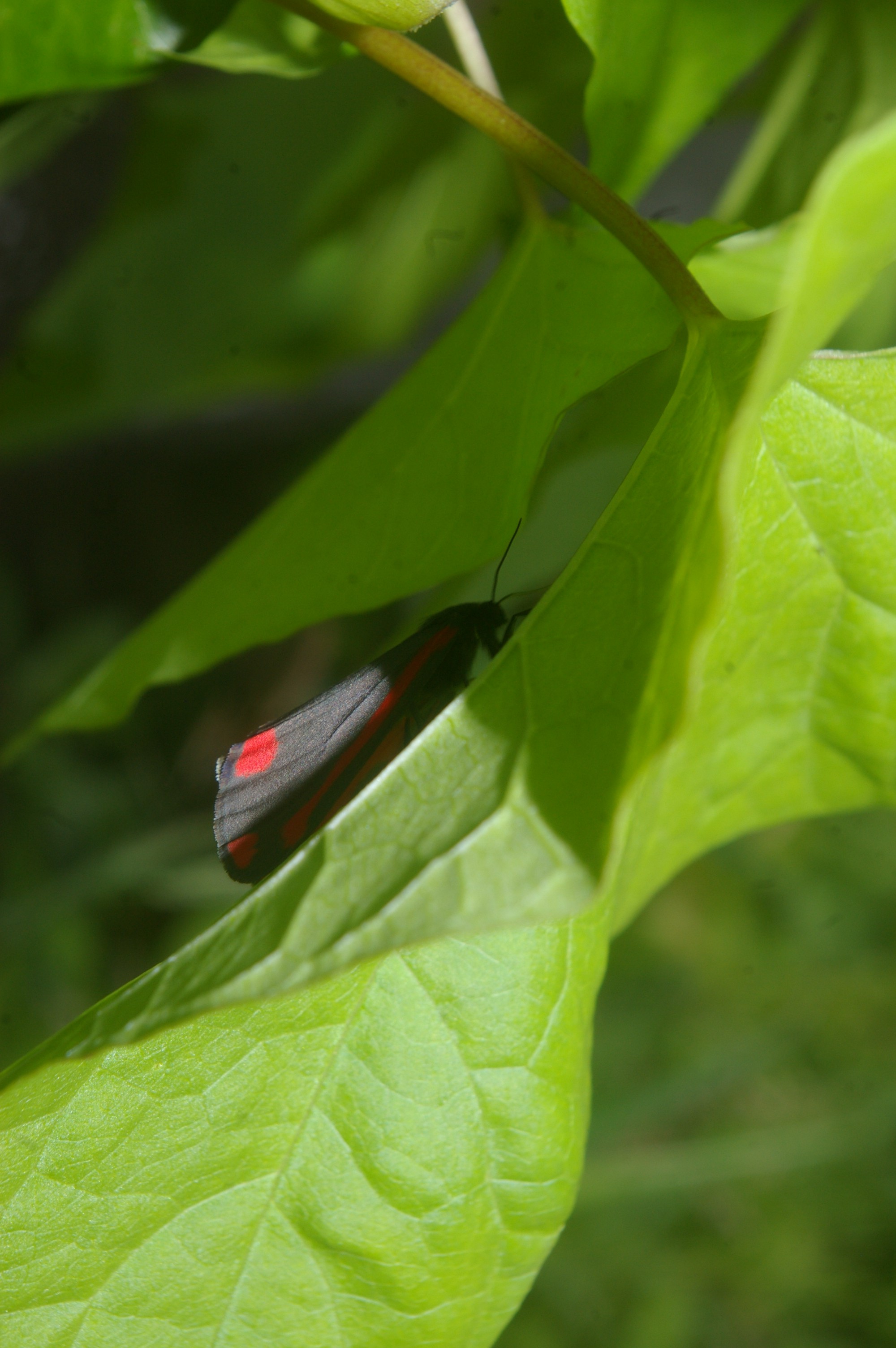
Below is a six spotted burnet – it’s dramatic red and black colouring always makes me think of it as a Goth Moth.   It is very impressive when it’s on the wing and is very fast.  I first saw it on an Open Day at Kensal Green Cemetery, London,  in 2013.  It was a warm and sunny July day and I was making my way to the open air colonnade when I saw a burnet fluttering past   I have only found it at one location within the cemetery so far but I always look out for it.

A six spotted burnet - a day flying moth. Latin name is: Zygaena filipendulae Copyright Carole Tyrrell
A six spotted burnet – a day flying moth.
Latin name is: Zygaena filipendulae
Copyright Carole Tyrrell

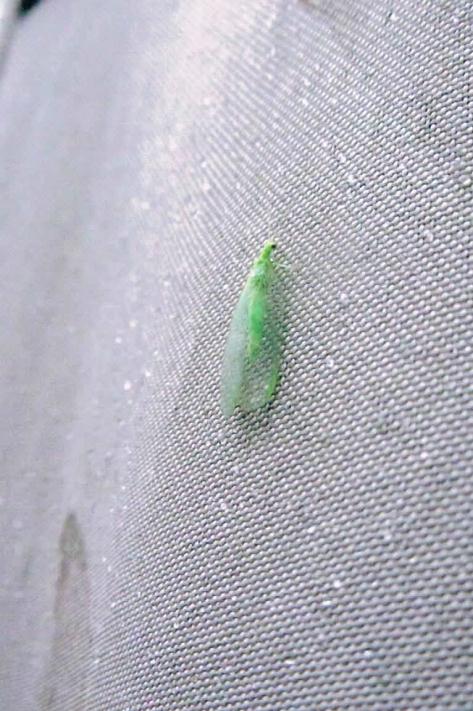
This was an unusual moth to find on a damp winter’s day in Nunhead Cemetery.  This is a lacewing.  Its Latin name is Neuroptera and it’s not known to be as a day flying moth.  It clung to the side of our gazebo for some time.
Lacewing moth at Nunhead Cemetery, UK. Usual to see on such a damp winters morning as it clung to our gazebo. copyright Carole Tyrrell
Lacewing moth at Nunhead Cemetery, UK. Usual to see one on such a damp winters morning as it clung to our gazebo.
copyright Carole Tyrrell

So although cemeteries are primarily to remember the dead, they can also provide a vital ecosystem as well.    Next time you visit one take some time to check out the wilder areas and you might be surprised at what you find!


All text and photographs © Carole Tyrrell

i

A morning with Marx and Spencer – A visit to Highgate Cemetery April 2014

Domino the Highgate cat - the first inhabitant of the Cemetery that we saw. copyright Carole Tyrrell
Domino the Highgate cat.  This is his kingdom.
copyright Carole Tyrrell

The first inhabitant of the West side of Highgate Cemetery to greet us was Domino, the cemetery cat, a white and black cat with an enviable domain in which to explore. He was also very vociferous and seemed to think that he would be leading our tour.

I’ve always found the West side to be very romantic and intriguing and last visited it in the 1990’s so a return visit was long overdue. I visited it this time with the Friends of Nunhead Cemetery. There is a connection between Highgate and Nunhead Cemetery in that they were both owned by the same cemetery company, the London Cemetery Company.   Highgate closed in 1975 and the Friends of Highgate Cemetery subsequently took over.

Dr Ian Dungevell  welcomed us and then John Shepperd, the current Chairman,  took over as tour leader  with Peter bringing up the rear.   The West side was looking its best with patches of bluebells and luxuriantly growing wild garlic.  The latter reminded me of the rumours of the Highgate vampire during the 1970’s and wondered if that was the reason for its abundance..

Originally the East and West sides were two separate cemeteries and the LCC had its own brickworks. The West side opened in May 1839 and the East in 1855 with its first burial in 1860. John revealed that there had been public complaints about the boisterous cheering at shareholders meetings as it was feared that they were profiting from death. Apparently the Magnificent 7 London cemeteries is a misnomer as there were originally 8. Meath Gardens in E3 was once Victoria Park Cemetery but was closed in 1885 due to its poor state and became a public park.  Its last burial was in 1876 having opened in 1842.

The imposing Anglican chapel on the West side still has its hydraulic lift and a tunnel under the road. It was rumoured that, after leaving the Dissenters chapel, hearses could go in two directions; the left hand path was for paupers and the other side was for the better off.  Like Nunhead, Highgate also had its own nursery, greenhouses and was originally landscaped. However, with its increasing popularity resulting in up to 30 burials a day, it was said that being buried in Highgate was like being buried in Piccadilly Circus.

John indicated the grave of the first resident, Elizabeth Jackson, who was interred in 1839 and paid 3 guineas. He reminded us that the views from Highgate at that time would have stretched to the South Downs as it’s on a hill.  It cost £2.10s to be buried there at a time when a working man was lucky to earn £1 a week.  Local residents had keys to the cemetery which became their personal park.

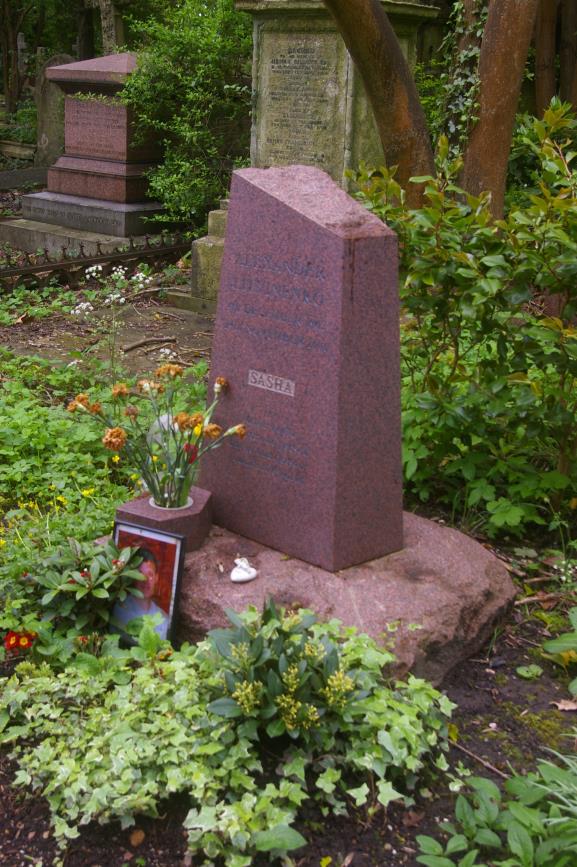
Alexander Litvinenko - a modern interpretation of the broken column symbol. copyright Carole Tyrrell

Alexander Litvinenko – a modern interpretation of the broken column symbol.
copyright Carole Tyrrell

The largest vault is that of Gen Sir Loftus Otway which can hold up to 30 coffins and was vandalised during the cemetery’s closure.  It currently holds 15.  The Russian dissident, Alexander Litvinenko, who died from  poisoning is here and John pointed out that his tombstone is a modern adaptation of the Victorian broken column which indicated that the head, or support, of the family has died.

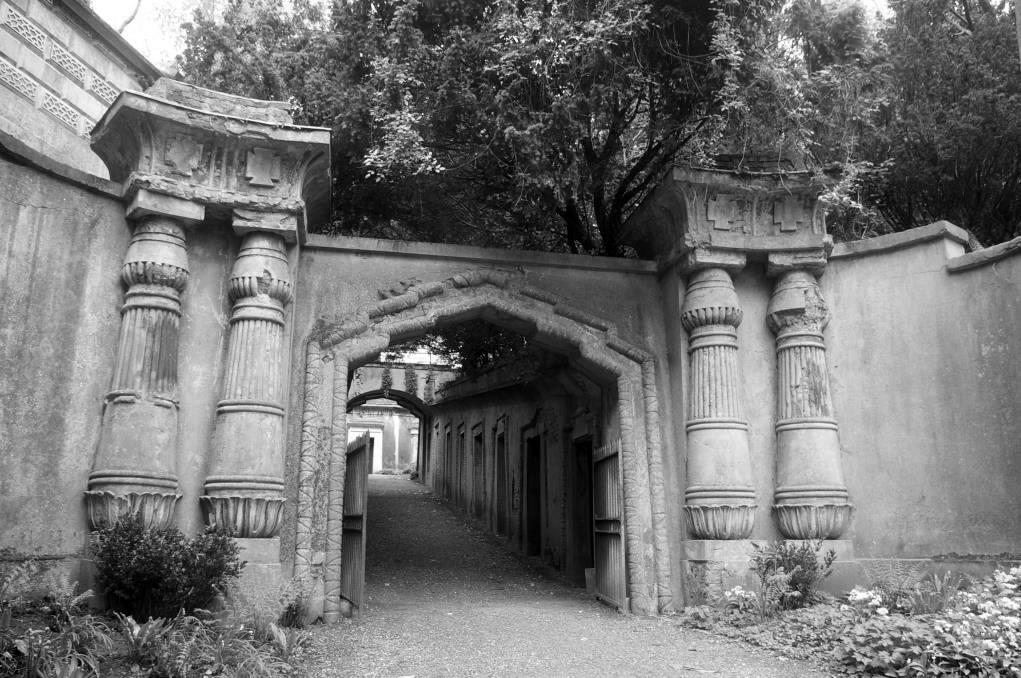
We all admired the celebrated Egyptian Avenue which capitalised on the 1820’s taste for all thing Egyptian after the first expeditions there. John explained that originally it had a roof which had made it very gloomy but it was considered to be a prestigious place for an eternal sleep. But it took 50 years to sell all 16 vaults as, with other Egyptian symbols like obelisks, it was viewed as pagan and so unpopular.  The Avenue is now roofless and is a much lighter place especially in the Spring sunshine.

The Egyptian Avenue - one of Highgate's highlights. copyright Carole Tyrrell
The Egyptian Avenue – one of Highgate’s highlights.
copyright Carole Tyrrell

However, on a Highgate Open day I nearly fell off the top of the Avenue.  I had lost my bearings and was walking along and suddenly realised where I was just as I was about to take more steps forward.  Although I might fancy being buried in Highgate I wasn’t intending to become part of it quite so soon!

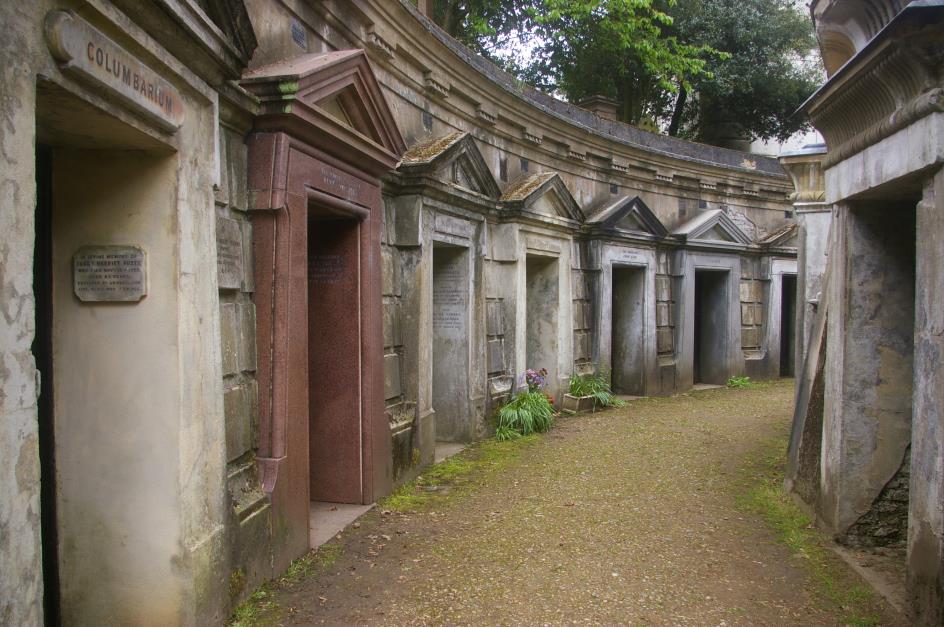
Another view of the Circle of Lebanon. copyright Carole Tyrrell
Another view of the Circle of Lebanon.
copyright Carole Tyrrell

The Circle of Lebanon, named after the beautiful Cedar of Lebanon on top if it, was another highlight. The tree came from a local, long vanished, house, Ashurst and no-one knows its exact age.  It is a lovely and magnificent centrepiece.  We also saw Radclyffe Hall’s vault which always has flowers . She wrote ‘‘The Well of Loneliness’ which was declared obscene due to its portrayal of a same sex relationship. However, Virginia Woolf, asserted that it was boring and gave it up.

Another inner view of the Circle of Lebanon showing the columbarium. copyright Carole Tyrrell
Another inner view of the Circle of Lebanon showing the columbarium.
copyright Carole Tyrrell

At the highest point on the West side stands the Beer Mausoleum. Fifteen feet high, it had been closed for years until 1993 when it was reopened.  Unfortunately the door wouldn’t budge due to roughly 2 and half feet of bird droppings and so this had to be cleared before anyone could actually get inside.  This really is a showpiece memorial.  No expense was spared on it and it would have cost £5million in today’s money.  It was built by Julius Beer who made money from selling cotton bonds. These were to be repaid when the Confederates won the US Civil War so they weren’t a good investment. The mausoleum’s walls are lined with Italian marble and the ceiling is gilded and painted.  It was dedicated to Ada, Beer’s daughter who died aged 8.   The beautiful sculpture on the back wall is of an angel and a small girl whose face is modelled from Ada’s death mask. One of the sculptors who worked on the Albert memorial , Henry Dew Armstead, worked on the mausoleum. However, it doesn’t contain any bodies as they were originally in the vault below which was vandalised during the cemetery’s closure.  The Beer family have died out.

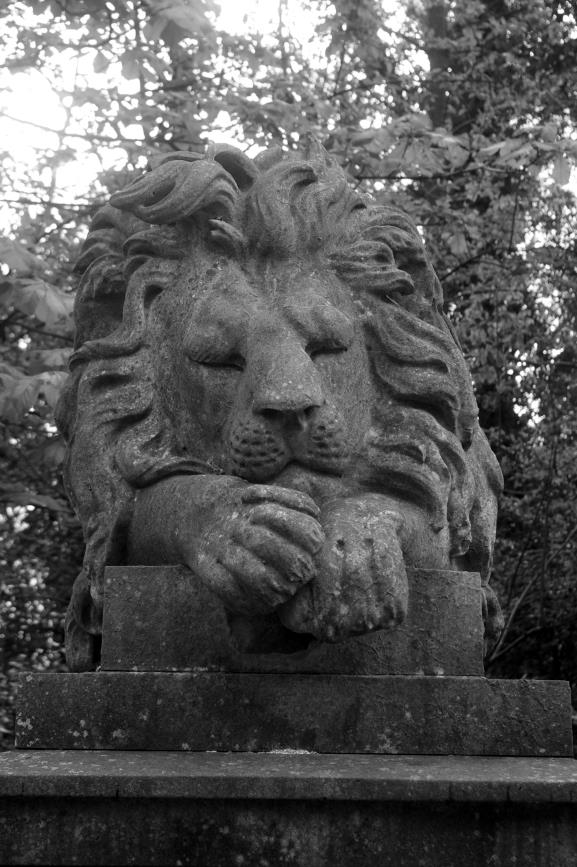
One of the best loved of all of Highgate’s many memorials is that of Nero, the sleeping Wombwell lion. George Wombwell was a zookeeper who, in 1810, owned a giraffe and a kangaroo amongst others which must have seemed very exotic to 19th century Londoners.  Children used to ride on Nero’s back and Wombwell’s travelling circus was in business until the First World War. However, some of his extended family didn’t fare so well with nature as his niece was killed by a tiger and his nephew was trampled to death by an elephant.

Nero, the lovely Wombwell lion - lions are a symbol of fortitude and bravery. copyright Carole Tyrrell
Nero, the lovely Wombwell lion – lions are a symbol of fortitude and bravery.
copyright Carole Tyrrell


Another highlight of our tour was the catacombs.  I hadn’t know that Highgate had any and these are on ground level. There are 825 spaces with 60 remaining. They were in use until the early 20th century.  Originally whitewashed, Charles Dickens had his young daughter placed there before removing her saying that it was too gloomy.  John added that coffins  are placed feet first into a  catacomb space or loculi so that visitors can talk to the head of the deceased and not their feet.

The Highgate catacombs - I hadn't realised that there were any there until this visit. copyright Carole Tyrrell
The Highgate catacombs – I hadn’t realised that there were any there until this visit.
copyright Carole Tyrrell

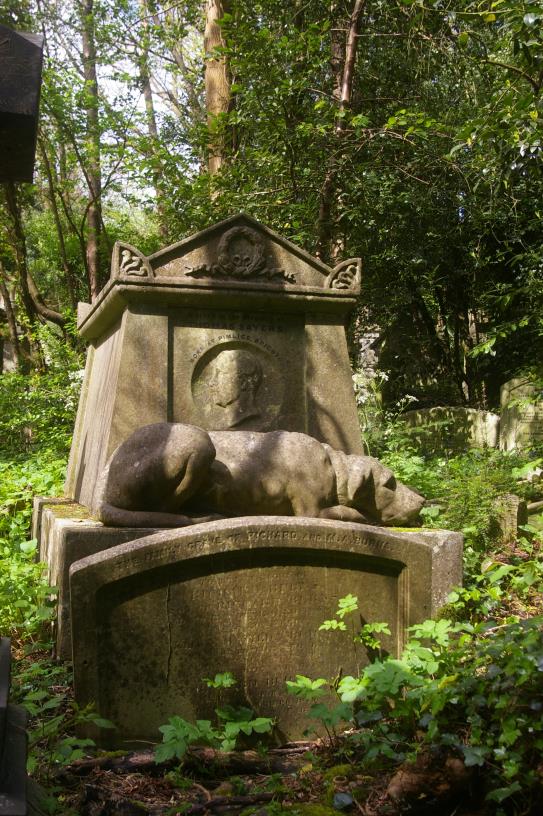
Animals have always been popular in cemeteries and John took us to the grave of Tom Sayers complete with a life size sculpture of his bull mastiff, Lion, keeping watch. Sayers was a Victorian boxer or pugilist. He was the English champion and originally hailed from Pimlico, a slum are of Brighton.  At Sayers’ funeral, Lion, wearing a black ruff, sat in the carriage behind the hearse which emphasised  that the dog had been more faithful than the wife. Lion was sold for £2 at the auction of Sayers belongings after his death. One hopes that he had a happy and long life.  The restored Acheler horse stood guard under a spreading horse chestnut tree and the sleeping angel on a bed of stone clouds slumbered on.

Tom Sayers the 19th century boxer and his faithful dog Lion.. copyright Carole Tyrrell
Tom Sayers the 19th century boxer and his faithful dog Lion..
copyright Carole Tyrrell

There are still burials taking place here and we saw novelist, Beryl Bainbridge’s, grave on our back to the entrance. Domino ignored us as he continued on his prowl and vanished into the ivy..

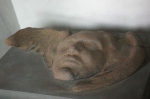
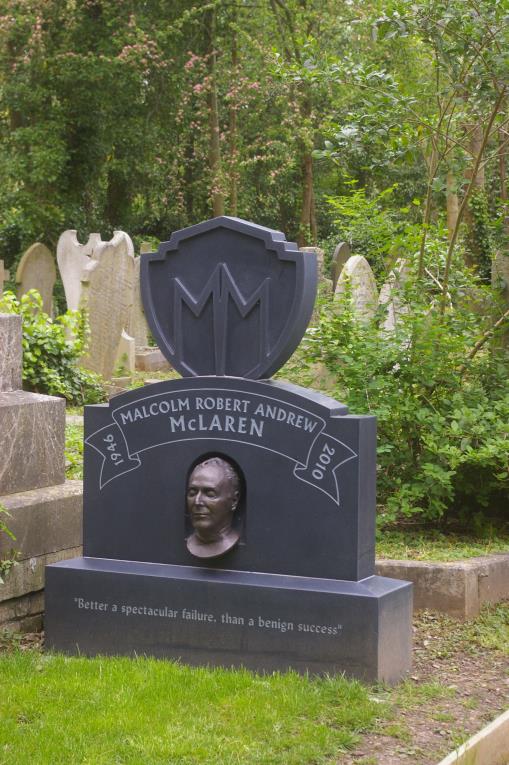
Then, after tea and excellent home-made biscuits, we crossed the road to the East side.   It is where most modern burials take place and it was busy with 21st century Londoners following the custom of Victorians by promenading in the cemetery on a Sunday afternoon.  Near the entrance John pointed out the monument to one of the Great Train Robbers, Bruce Reynolds, which was erected on the 50th anniversary of the event. It features a death mask of Reynolds between two columns with the phrases , ‘This is it.’ And ‘C’est la vie’.  The former was the one that Reynolds used to alert the rest of the gang that the robbery was on and the latter was the one used by Reynolds arresting officer.   Another death mask was on Malcolm McLaren’s grave so perhaps this is the start of a new fashion in funerary architecture.

Malcolm Mclaren - note the death mask. copyright Carole tyrrell
Malcolm Mclaren – note the death mask.
copyright Carole Tyrrell

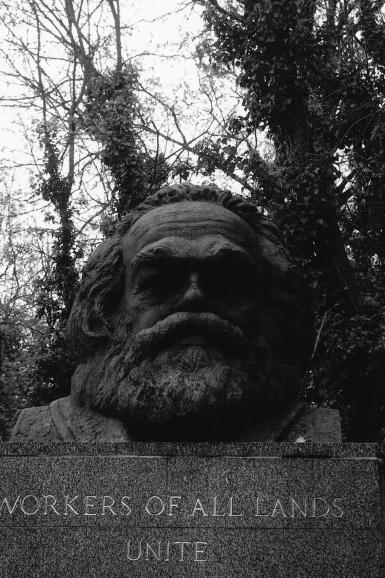
But the East side’s most famous incumbent is undoubtedly Karl Marx.  An enormous bust of the man sits staring out from on top of his column.  It’s a place of pilgrimage for worldwide communists but has suffered for it.  Poor Karl, he’s been blown up and daubed in blue paint but still stares serenely, if a little forbiddingly, from his plinth. Originally he and his family were buried a short distance away but were moved to their present location and their headstone incorporated in Karl’s monument.

The father of Communism - Karl Marx - a very imposing bust and memorial. copyright Carole Tyrrell
The father of Communism – Karl Marx – a very imposing bust and memorial.
copyright Carole Tyrrell

Nearby lies Herbert Spencer who was a prominent right-winger and coined the phrase ‘survival of the fittest’.   And so that little corner is known as Marx and Spencer.  Another close neighbour is Gloria Jones,  creator of the Notting Hill Carnival.   George Eliot is not far away and so the great and good jostle with the less well-known and there are too many to list.  Alas, the wallabies have gone elsewhere.   My favourite epitaph was pllaywright, Anthony Shaffer’s which simply read’ Grand Artificer of Mysteries.’

It was a fascinating tour and we left wishing that we had more time to explore both sides of Highgate Cemetery. And below is a gallery of some of the other memorials
we saw on our visit.


First published in Friends of Nunhead Cemetery News,

Text and photos copyright Carole Tyrrell