Out and about in a Kent churchyard – the Grave Rail

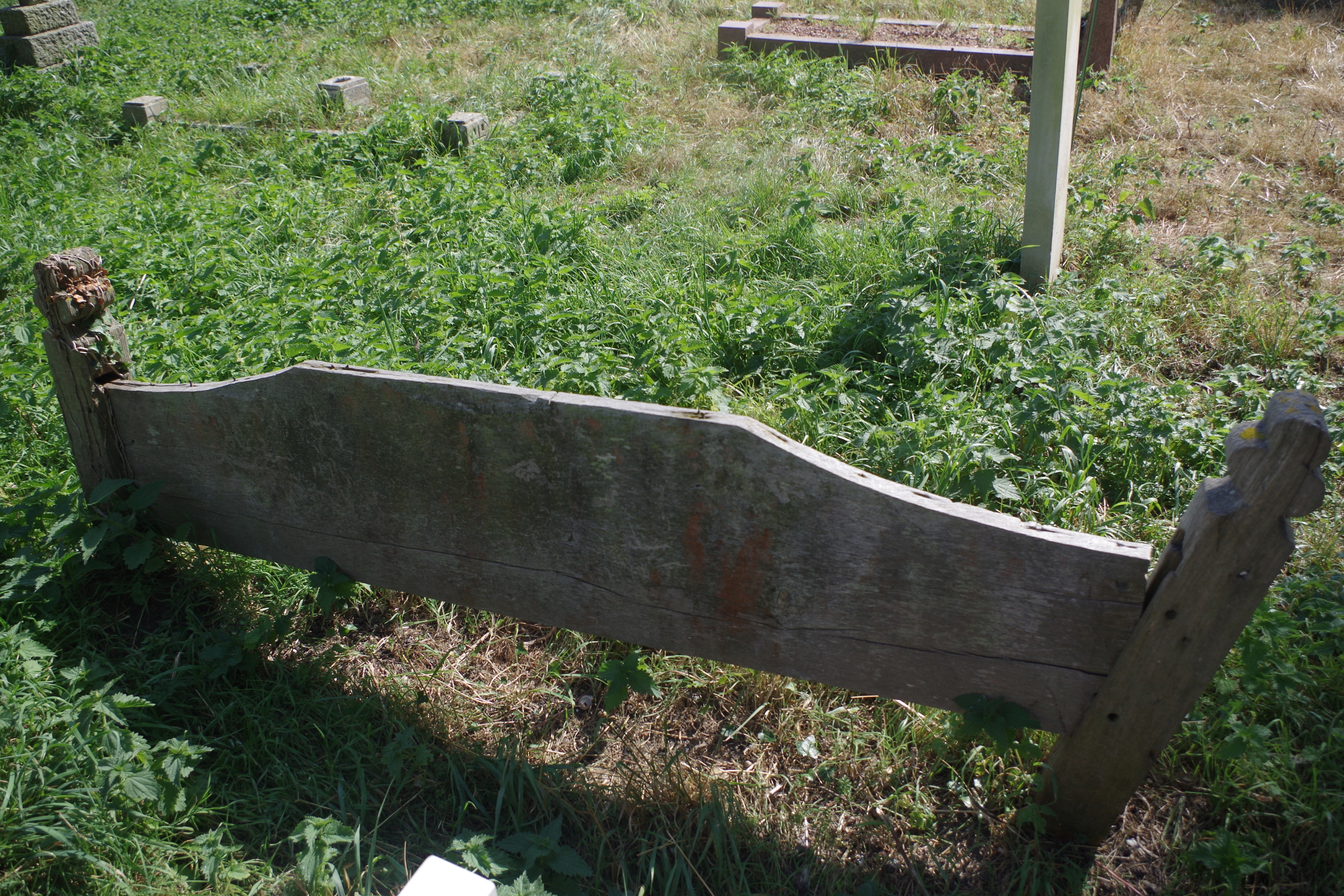
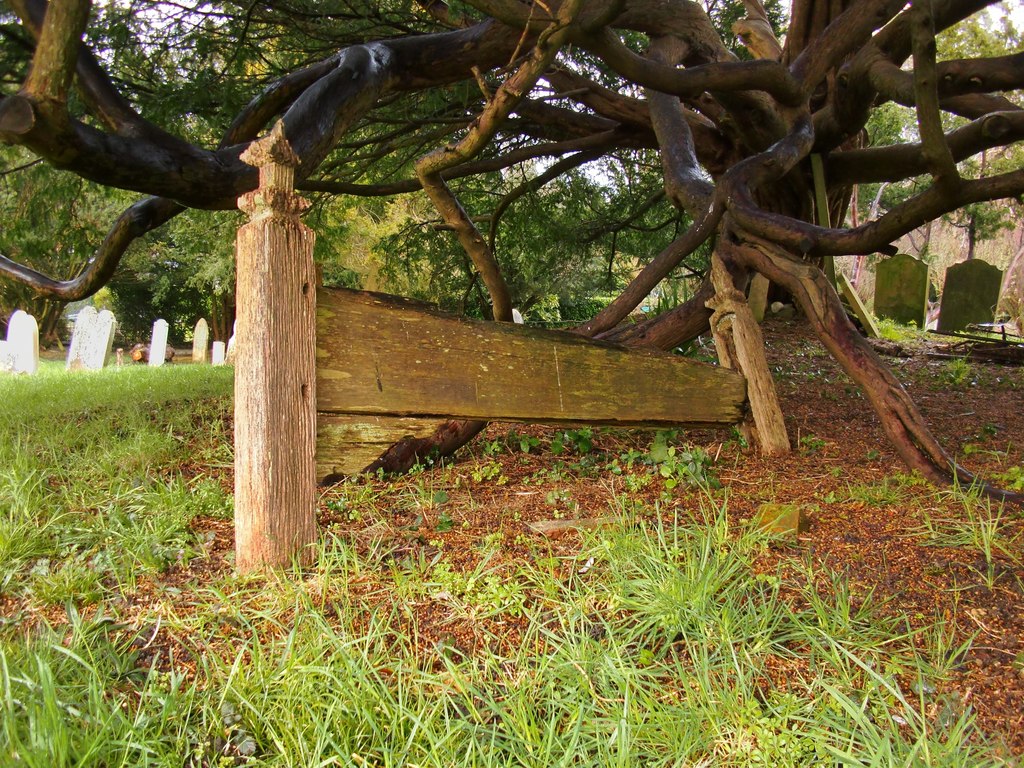
Grave rail, St Mary’s church, Higham, Kent. © Carole Tyrrell

Last month Heritage Open Days took place in the Medway towns. These are brilliant opportunities to explore places that are not always open to the public – last year I was lucky enough to finally see inside the Darnley Mausoleum!

This year I revisited St Mary’s church in Higham, Kent which is built on the site of a medieval priory with a dubious reputation. It was the home of the ‘naughty nuns’ of Higham and it would seem that their reputation lasts up to the present day.  It would have been a thriving community in contrast to the rather isolated spot it is now.

Refreshments and tours of the church and churchyard were on offer and it was on one of the hottest weekends of the year! The church is now closed and is the care of the Churches Conservation Trust. It’s the church where Charles Dickens daughter, Katy, married the great novelist, Wilkie Collins.

There are still traces of the Priory to be seen today and our guide pointed them out. According to him, the landscape surrounding  St Mary’s has not changed much since the Priory’s day. Fields stretched on into the distance and at the end of Church Lane the Priory’s fishpond could be seen. Last summer I saw huge blue Emperor dragonflies darting through the reeds but on this visit there were huge majestic bulrushes.

Despite the heat I decided to explore the churchyard and found this rare 19th century wooden grave rail. Wood doesn’t often survive as it obviously rots but this is in great condition. Unfortunately the epitaph hasn’t survived and so I visited the Kent Archaeological Society’s website to see if they had recorded one.

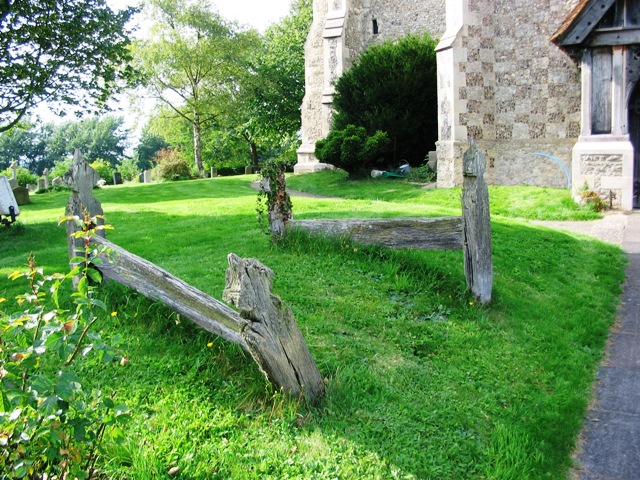
Another view of the grave rail, St Mary’s churchyard, Higham, Kent. © Carole Tyrrell

They had two surveys of the churchyard; one from 1922 and another from 2012.  In the first survey, several wooden crosses were recorded but none of these have survived in the present churchyard.  The wooden cross I had seen at the front of the churchyard by the road on my first visit in 2022 has collapsed and partially fallen into the grass.

The Society have presumed that the rail may have been dedicated to George Chapman who was a carter in Cobham Kent. He died on 10 December 1868 aged 38 and his daughter, Ann who died in 1860 aged 3 years and is presumably buried with him.

The rail consists of wooden boards set between upright posts. According to Roger Bowdler in his book ‘Churchyards’ they are also known as

‘graveboards or deadboards…these were the last common form of wooden churchyard memorials, and they form a link with the centuries old tradition of temporary timber grave markers.’  

Frederick Burgess in ‘English Churchyard Memorials’ describes them as:

‘an inscribed horizon post by upright posts resembles part of a fence. The grave board was a later form of grave rail. It was also called bed head, dead board and leaping board.’  

I can’t think how I missed it on my earlier visit as it’s a reminder that not everyone could afford a permanent marker and that it was generally the emerging merchant class and the wealthy who could.


However, I was visiting St John’s church In Hampstead as part of London Month of the Dead earlier in October 2023 and saw the George du Maurier grave rail in the churchyard extension. This still has its inscription. It also has Celtic Revival influenced end posts featuring elaborate Hiberno Saxon strapwork. This is in itself a sign of eternity as it has no beginning or end. Du Maurier is better known these days perhaps for being the grandfather of the novelist Daphne Du Maurier. However, he wrote the novel, ‘Trilby’ in 1894 in which

‘a poor artist’s model, Trilby O’Ferrall, is transformed into a diva under the spell of an evil musical genius, Svengali. Soap, songs, dances, toothpaste, and even the city of Trilby, Florida, were named after her, as was the variety of soft felt hat with an indented crown worn in the London stage dramatisation of the novel. The plot inspired Gaston Leroux ‘s 1910 novel ‘Phantom of the Opera’ and innumerable works derived from it. Du Maurier eventually came to dislike the persistent attention the novel was given. Wikipedia

George du Maurier (1834-1896) Shared under Wiki Creative Commons

The Du Maurier grave rail, St John’s, Hampstead, London © Carole Tyrrell

The epitaph on the Du Maurier grave rail. St John’s Hampstead, London © Carole Tyrrell

An example of Hiberno-Saxon strapwork. Du Maurier grave rail. © Carole Tyrrell

Metal epitaph on Du Maurier grave rail, St John’s Hampstead. © Carole Tyrrell

However, Du Maurier certainly wasn’t poor and his grave rail has been associated with the Arts and Crafts movement that flourished from 1880 – 1920. This movement declared a belief in craftmanship that stressed the the beauty of the material used within it and also its simplicity, utility and beauty.

There is another grave rail in the churchyard of St Peter and St Paul, Chaldon, Surrey.

Grave rail, St Peter & St Paul churchyard, Chaldon. Surrey. Shared under Wiki Commons. © Berat.

And here are some others in not such good condition.

Grave Board Marsworth churchyard ©Chris Reynolds shared under Creative Commons Licence Geograph

Grave Board, Ewhurst churchyard, © Stefan Czapski. Shared under Creative Commons Licence, Geograph

It may well be that there was an abundance of timber in these communities which led to grave rails becoming so popular as well as a lack of suitable stone or, indeed stone masons. But the fact that they have survived at all is incredible. So I will be looking out for more examples on my churchyard visits in future.

Text and photos © Carole Tyrrell unless otherwise stated.

References and further reading:

Roger Bowdler, Churchyards, Amberley Books, 2019

Fredrick Burgess, English Churchyard Memorials,  The Lutterworth Press, 1963,2004

Grave Boards in Marsworth Churchyard © Chris Reynolds cc-by-sa/2.0 :: Geograph Britain and Ireland

Grave-board under a yew tree, Ewhurst… © Stefan Czapski :: Geograph Britain and Ireland

Symbol of the Month – the hourglass

A headstone in St Mary’s churchyard, Chatham. © Carole Tyrrell

This month’s symbol often features on 18th century headstones as a memento mori a reminder of mortality.  But more recently, the hourglass was the irritating little symbol on your computer screen which announced that it was thinking about doing something or the glass container, one half filled with sand, which you upended in order to time the boiling of your egg. 

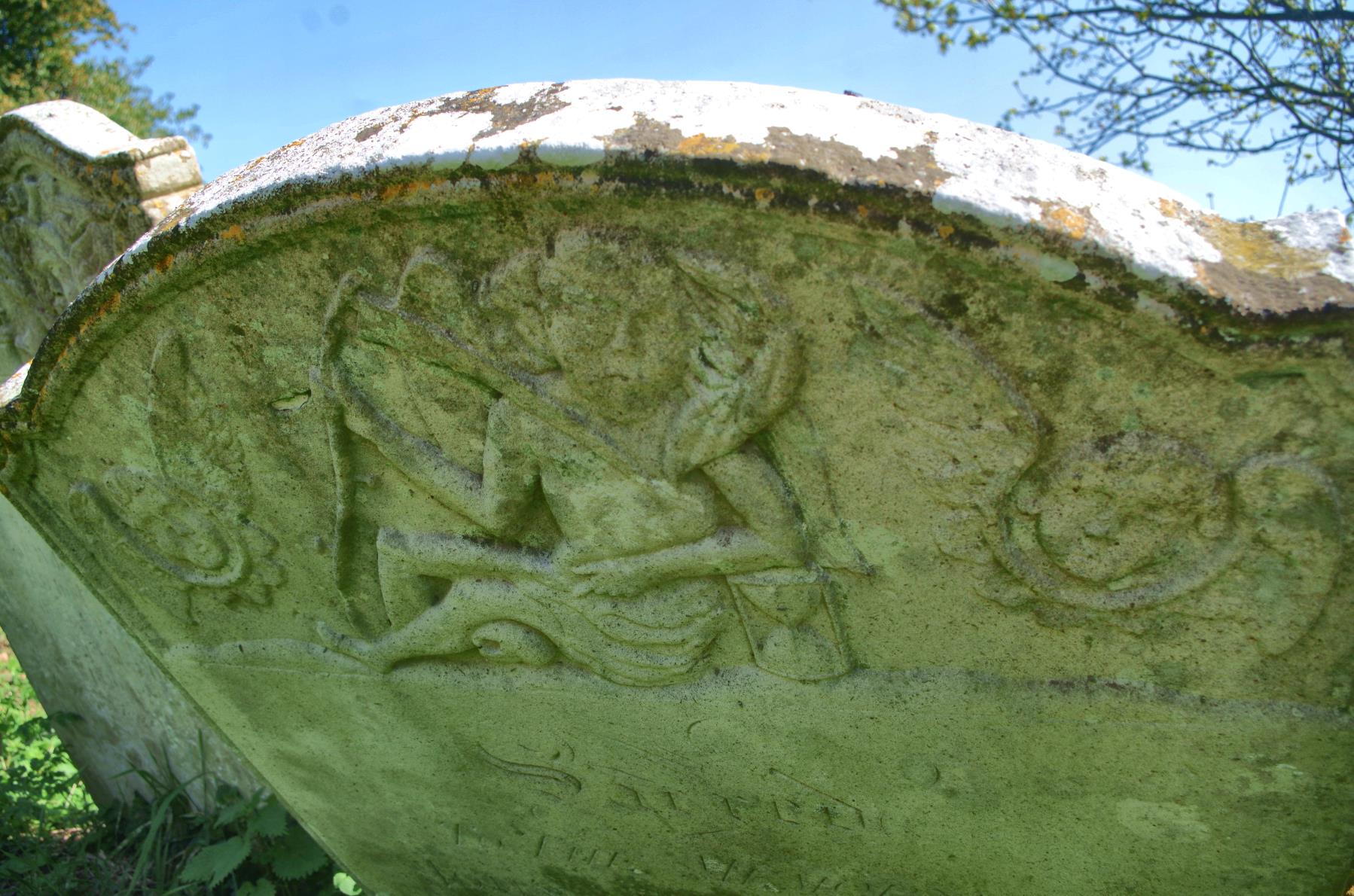
But an hourglass, sometimes with wings, on a tombstone is different.  Instead, it’s a reminder that the ‘sands of time’ have run out. A winged hourglass reminds us that time waits for no-one as ‘tempus fugit’ or ‘time flies’ literally.  An hourglass can often be seen in vanitas paintings as a reminder that life is fleeting, that time is rapidly passing and that every day one comes closer to death.

The winged hourglass encircled by an ouroboros on Brompton Cemetery’s catacomb doors ©Carole Tyrrell

Philppe de Champaigne Vanitas, 1671 Still Life with Skull ‘Life, Death & Time.’

Vanitas art, from the Latin for vanity, is a genre that flourished in the Netherlands during the early 17th century.  It’s a particular form of still-life and contains collections of objects that are symbolic of the inevitability of death, the transience of life and vainglory of earthly pursuits and pleasures.  The viewer is invited to look at the painting and to be reminded of their own mortality.  They also provided a moral justification for painting attractive objects. As with a lot of moralistic genre painting  the enjoyment evoked by the sensuous depiction of the subject is in a certain conflict with the moralistic message.  Vanitas pictures evolved from earlier simple paintings of skulls and other symbols of death which were often painted on the back of portraits during the late Renaissance. It’s height of popularity was during 1620 – 1650 and was centred in Leiden in the Netherlands and  Flanders, the Dutch speaking region of Belgium.

Very few vanitas picture contain figures and, instead, they contain certain standard items.  These are: symbols of arts and sciences (books, maps, and musical instruments), wealth and power (purses, jewellery, gold objects), and earthly pleasures (goblets, pipes, and playing cards); symbols of death or transience (skulls, clocks, burning candles, soap bubbles, and flowers); and, sometimes, symbols of resurrection and eternal life (usually ears of corn or sprigs of ivy or laurel).   And of course hourglasses to reflect the passing of time and the need to make the most of it.  Objects were often tumbled together in disarray, suggesting the eventual overthrow of the achievements they represent.

However, Douglas Keister, author of Stories in Stone, has suggested another, bolder interpretation of the symbol:

 ‘The hourglass can also be turned over or inverted over and over again which symbolises the cyclic nature of life and death, heaven and earth.  Inversion can be seen as the interplay of opposites in death giving rise to life and vice versa. ‘

In fact it wasn’t until I started researching for this piece that I realised how many interpretations the hourglass symbol could have. Pirates are reputed to use it on their flags as a warning to their victims and enemies that their time, or lives, were about to run out.  They can also feature in tattoos especially in prison where a tattoo of an hourglass may mean no parole.

There is also an association with old movies in that the hero/heroine has one span of the sand in which to make a decision or rescue.  The dramatic turning over of the great hourglass down to the spiralling of that last grain of sand adds to the mystery and drama.

A quick online search also revealed masonic and spiritual associations.  Two saints are traditionally pictured with hourglasses; St Ambrose and St Magdalene as is the Greek god, Chronos, the personification of time. The Grim Reaper or Death when depicted as a skeleton, often holds an hourglass with his scythe as does Old Father Time.

Old Father Time on an almost horizontal headstone with his elbow on an hourglass, Pluckley, Kent ©Carole Tyrrell

The hourglass is, in my opinion, one of the most graphic memento mori symbols.  At that time, most people were illiterate but would understand visual images and would know the significance of an hourglass, especially one with wings. I love memento mori symbols and enjoy finding them in the ancient churchyards of North Kent churches – what will I discover next?

Text and photos copyright Carole Tyrrell unless indicated otherwise.

References and further reading:

How to read symbols, Clare Gibson, A C Black, 2009

Stories in Stone – A Field Guide to Cemetery Symbolism and Iconography, Douglas Keister, Gibbs Smith, USA 2004

An Illustrated Encyclopaedia of Traditional Symbols, J C Cooper, Thames & Hudson, 1978

Vanitas | Tate

Vanitas – Wikipedia

Memento mori – Wikipedia

A final resting place?

I am currently suffering from Covid which is not the writers friend to say the least.

But this short piece came up on the BBC news website recently and it did raise the question, and not for the first time, about what happens to patients graves when the institution, hospital or asylum in which they lived closes.

The small iron crosses in Nayland cemetery seem to have a happy ending as local people, some of whom worked at the Jane Walker hospital, have taken on their upkeep for the foreseeable future. Follow the link for further information.

Nayland: The cemetery where iron crosses mark people with disabilities – BBC News

But not all patients graveyards have such a positive outcome and I have written in previous posts about Netherne Hospital cemetery which is abandoned and overgrown. Also, St Lawrence’s which was a hospital for disabled people, and now sits in the middle of a golf course. However, it is being cared for by a Friends group.  They are still acknowledged as burial places for patients or residents.

Others have not been so fortunate. In 1981, Cane Hill Hospital, a former Victorian lunatic asylum, was being prepared for redevelopment and their cemetery was cleared.  The remains of almost 6000 people were exhumed and cremated at Croydon Cemetery in Mitcham Road, Croydon. These included British First World War veterans who had had separate areas in the cemetery where they had been buried with full military honours. According to Wikipedia:

Research from plans indicated that there two designated main ‘service plots’ numbered 411 and 420, where six were buried in each grave. Eighteen of these, who had qualified for commemoration by the Commonwealth War Grave Commission (CWGC) are commemorated on a memorial that the CWGC erected in Croydon Cemetery, where their ashes had been scattered at ‘Location 1000’ in the grounds in 2015’

This is the unofficial memorial at Croydon Cemetery that records the servicemen interred there from Cane Hill. The original CWGC memorial was stolen and they do not recognise these.

In 2009, a headstone was placed at Location 1000 to record the patients buried there.

This was placed there due to patients families wanting to see the final resting place of their relatives and being directed to an

‘unmarked mound of earth in Croydon Cemetery’s Garden of Remembrance’

I have to say that it isn’t where I’d like my relatives last resting place to be.

However, a local councillor at the time felt:

‘sure that visitors will soon look on it as a suitable memorial area for those who died at Cane Hill.’

Anonymous in life and anonymous in death it would seem. There are some archive photos of the cemetery and the mound on www.simoncornwell.com     One wonders what memorials and information about patients was lost during this process especially as the NHS policy was to incinerate their records or leave them lying around in a derelict building. A local reporter did try and start a campaign to save them but it’s unsure what happened to it.

There is also the case of the Mendip Hospital Cemetery which I have written about in a previous post in which the NHS attempted to sell off a patients cemetery and Chapel as a ‘freehold development’. This was saved by local people who formed a friends group which appears to still be going strong. There are some lovely photos of it on TripAdvisor. The numbered iron markers, although long gone from the graves, are still there.

But who knows how many of these cemetery and graveyards have been lost over the years as the institutions close and no one knows what to do with them.  They are still someone’s relatives and as times change they may want to find out what happened to them. After all, local people saved the Mendip Hospital and St Lawrence’s and it was patients relatives who ensured that they finally had a proper headstone on the mound at Croydon Cemetery.  Someone cared enough to do something.

Text and photos© Carole Tyrrell unless otherwise stated.

Further reading:

Friends of Mendip Hospital Cemetery – Welcome

Cane Hill Hospital – Wikipedia

New headstone for Cane Hill paupers’ graves | Your Local Guardian

cane hill (simoncornwell.com)

The Forgotten Servicemen of Cane Hill | Surrey in the Great War:

‘And Bert’s gone syphilitic’ – The Real Tragedies Behind the Cane Hill Hospital Memorial at Croydon. | The Western Front Association

Symbol of the Month – The Final Curtain

Full view of the impressive Raikes headstone, West Norwood Cemetery/ ©Carole Tyrrell

The theatre is dark, the audience and backstage staff have all gone home or off to the pub and the final curtain has been brought down. The end of a show, the end of the evening and, in funerary symbolism, the end of a life.

This fine example is from West Norwood Cemetery where it commemorates the Raikes family.  Theatre was in their blood and so the sculpture of a theatrical curtain is very appropriate.

But curtains and draperies have always been associated with death and remembrance.  There is the old saying which is sometimes quoted on headstones and memorials that the deceased has ‘gone beyond the veil’.  An urn on top of a memorial will often have a sculpted piece of cloth draped across it which indicates the division between the living world and the realm of the dead.  

In the 19th century, and also well into the 20th century, drapes were hung over mirrors with curtains and blinds drawn down at windows during the period of mourning. It was as if they were hiding death from the world or containing it within the family. On the Friends of Oak Grove Cemetery website they mention mirrors being covered with black crepe fabric in order to prevent the deceased’s spirit being trapped in the looking glass.

Curtains also feature on headstones where they are depicted as parted in order to display a meaningful symbol or to draw attention to an epitaph that takes centre stage. However the Raikes one is very obviously a theatrical curtain and it’s beautifully detailed.  They were powerful players in that flamboyant world and the curtain is a direct reference to this. For example, in 1889, they had Sir Edward Elgar and his new wife, Caroline, as guests in their house, Northlands in College Road, Dulwich.  This was just prior to his Salut D’Amour being performed at the Crystal Palace.

View of the curtains and the quote from the Rubaiyyat of Omar Khayyam, Raikes headstone, West Norwood cemetery. ©Carole Tyrrell

But the family home had a secret in its basement. This was where Charles Raikes (1879-1945) had constructed his own private theatre.  He lived there with his mother, Vera, (1858-1942) and two sons, Raymond and Roynon, from his former marriage. Roynon’s wife, Greta, and their daughter Gretha were also part of the household. Charles lived and breathed theatre and he was ahead of his time when he converted a large billiard room into the Northlands Private Theatre. Nowadays it would be a lavish home cinema with comfy seats and popcorn on tap with his own home movies onscreen.  He extended his pride and joy by removing a couple of inconvenient bay windows and then converting a coal cellar and wine cellar into dressing rooms. He was a talented scenic artist and stage carpenter and from 1924 – 1939 the Theatre put on nearly 23 productions a year to an invited audience. This was made up of the Raikes’ friends and relations as well as the actors and actresses friends. The lavish after show parties were renowned. 

Charles’ sons continued the links to the entertainment world.  Raymond (1910-1998) became a professional actor in the 1930’s and played Laertes to Donald Wolfit’s Hamlet at Stratford upon Avon.

Raymond Raikes taken in 1945 Shared under Wiki Creative Commons

He eventually became a BBC producer, director and broadcaster. He won several awards over a long career which included pioneering the use of stereo sound in radio drama.  In 1975 he retired and is known as one of the three greatest radio drama producers. Roynon became a professional photographer specialising in theatre pictures and was also a stills photographer for the BBC. Greta, his wife, became a theatrical costumier and drama teacher and her daughter, Gretha, in turn became a speech and drama teacher. In a 1997 Dulwich Society article she was also credited with being the curator of the archives of the Northlands Private Theatre.

The quotation below the curtain is from the Rubaiyat of Omar Khayyam.  It comes from the 21st, 22nd  or 23rd stanza depending on which version you read.   This is the verse in full and is taken from the 1859 translation by Edward Fitzgerald

Lo! some we loved, the loveliest and best

That Time and Fate of all their Vintage prest,

Have drunk their Cup a Round or two before,

And one by one crept silently to Rest.

He saw them as a selection of quatrains or Rubaiyats that had been attributed to the Persian poet who was also known as the Astronomer Poet of Persia.  Although Fitzgerald’s translation was initially unsuccessful, by the 1880’s, it had become immensely popular.  It has influenced many creative people over the years including the Pre-Raphaelites and especially Dante Gabriel Rossetti. Oscar Wilde was also a fan and mentions ‘wise Omar’ in The Picture of Dorian Gray.   Agatha Christie, Isaac Asimov, H P Lovecraft and Daphne Du Maurier are amongst many who may have borrowed a line as a book title or used an Omar like figure within their works.  Interpretations of the Rubaiyat can be very free and as a result the quatrains can change their wording.  The underlying message of the Rubaiyat appears to be Seize the Day or Carpe Diem in Latin.  There are also several references to drinking with the implication that once drinking is over so is life.   But this particular line seems appropriate for its use on a headstone.

And so the curtain has been brought down on the Raikes family but, as I took my photos, I thought I detected a faint smell of greasepaint and the appreciative sound of applause……

©Text and photos Carole Tyrrell unless otherwise stated

References and further reading:

https://aeon.co/ideas/how-the-rubaiyat-of-omar-khayyam-inspired…

sleepinggardens.blogspot.co.uk/2011/06/fridays-funerarysymbols

https://en.wikipedia.org/wiki/Rubaiyat_of_Omar_Khayyam

schoolworkhelper.net › English

https://artofmourning.com/2010/11/14/symbolism-sunday-drapery/

 Rubáiyát of Omar Khayyám Summary – eNotes.com

https://www.enotes.com/topics/rubaiyat-omar-khayyam

https://dulwichsociety.com/2017-winter/1578-brief-encounter…

https://en.wikipedia.org/wiki/Raymond_Raikes

www.suttonelms.org.uk/raymond-raikes.html

https://en.wikipedia.org/wiki/Rubaiyat_of_Omar_Khayyam

Booking now – London Month of the Dead 30/09/23 -01/11/23

Now celebrating it’s 10th birthday , the London Month of the Dead is a permanent fixture on the social calendars of devotees of the dark side.

You can book now and early booking is advisable – there are 60 talks, walks, workshops and performances to choose from. Some within London cemeteries and churchyards, some within ossuaries and others in more unique settings.

Experience another side of the metropolis with writers, perf, artists, historians and academics and like minded souls! And, to finish it in celebration of its 10th decade, there will be a Halloween Ball inspired by the works of Edgar Allan Poe! Click the link for more info and to book.

London Month of the Dead

I have been a fan of London Month of the Dead ever since it started and it has taken me to places that I would, otherwise, not been able to access. And such knowledgeable speakers and unique venues. I have such anticipation when the new programme appears and it’s a pleasure to see how it has expanded over the years. Last year I explored ossuaries with them – and found myself in Spitalfields on a Sunday morning peering down from the pavement into the remains of a large medieval ossuary and then being admitted into it…

Let’s all drink to another 10 years of the London Month of the Dead – especially if it’s a gin punch! Hic!

In London on 3 September? Why not spend the day with the living and the dead?

Open Day 2023
More information here. 
Advance tour booking here.
 These tours of the cemetery last 60 min and will run on the hour from 12:00 noon. The last tour is at 17:00.
Advance catacombs tour booking here.  These last 25 mins and will run on the hour and half hour from 11:30 am. The last tour is at 17:30.
Further events (like ‘Herbal Heritage: Uses and Folklore of Cemetery Plants’ walk) are being planned and our Open Day Page will be updated as these firm up.

We look forward to seeing you!

It’s shadowsflyaway birthday!

Crying cherub, St John the Baptist’s church, Margate, Kent. © Carole Tyrrell

Yes, it is shadowsflyaway’s 8th birthday so there will be no Symbol of the Month this month.  Instead I hope to post some of my churchyard visits and what I found in them including this one which forms the background to this year’s birthday card from St John the Evangelist in Margate. This was a particularly fruitful churchyard in terms of symbols and, although it wasn’t open when I visited, I could see that there might be more interesting funerary memorials inside.

So thanks to all my readers for your comments and likes – they are very much appreciated. 

Here’s to shadowsflyaway’s 9th birthday!

© Text and photos Carole Tyrrell

Introduction to Cemetery Symbols guided tour – 14:00pm Saturday 8 July 2023 Brompton Cemetery

One of the snakes on the catacomb doors in Brompton Cemetery. copyright Carole Tyrrell

To any of you that live in London, I am leading an Introduction to Cemetery Symbols tour in Brompton Cemetery!

It will focus on the symbols within Brompton Cemetery of which there is a varied and fascinating collection amongst its 35,000 monuments from Celtic crosses to Egyptian gods and many others. Come and explore the lost language of Death with me!

Date and time: Sat, 8 July 2023, 14:00

Leaving from: Information Centre (Old Brompton Road entrance)
Duration: approx. 1 hour 30 minutes
Tickets are £10 per person (plus £1.50 booking fee if booked on Eventbrite)

Book at Eventbrite
(refundable up to 1 day before event; Eventbrite’s fee is nonrefundable)

Introduction to Cemetery Symbols Tickets, Sat 8 Jul 2023 at 14:00 | Eventbrite

A glimpse back into history – the oldest headstones that I have seen

Headstone dedicated to Robert Dadd dated 1640 – St Nicholas church, Sturry Kent © Carole Tyrrell

I was originally going to entitle this post ‘ the oldest headstone that I have seen – so far’. As I explore churchyards and cemeteries I sometimes find ancient tombstones and memorials dating back to the 17th century. But, more recently, I have found ones that are dated even earlier.

This one was in the porch of St Nicholas in Sturry which is a village in Kent and is a good example of early 17th century calligraphy.  Sadly, because it is in the porch, there is no way of knowing where Robert Dadd is buried within the large churchyard that surrounds the church. But it is incredible to think that this headstone has survived for over 400 years although obviously we don’t know when it was put in the porch. I couldn’t find the headstone on Kent Archaeological Society’s monumental inscriptions page but Dadd seems to be a fairly common name. They have been recorded as living in Sturry during the 18th century.

Catherine Lees headstone, St Mary the Virgin, Selling, Kent © Carole Tyrrell

Detail of symbols on Catherine Lees headstone, St Mary the Virgin. Selling, Kent © Carole Tyrrell

I was admiring the drifts of ox eye daisies, or moon daisies as they are also known, in the substantial churchyard of St Mary the Virgin in Selling in Kent. This was a fascinating church with wall paintings of saints and other painted decoration.  Sometimes I do have a real sense of what a medieval church must have looked like, pre-Reformation, with murals, wall paintings and other decoration. It would have been alive with colour in contrast to the plain interiors of churches that can be seen today. The beautiful painted medieval column at St Mary’s of Charity in Faversham is another indication with its still rich colours. The priest would have used the wall paintings as teaching aids to an illiterate congregation. 

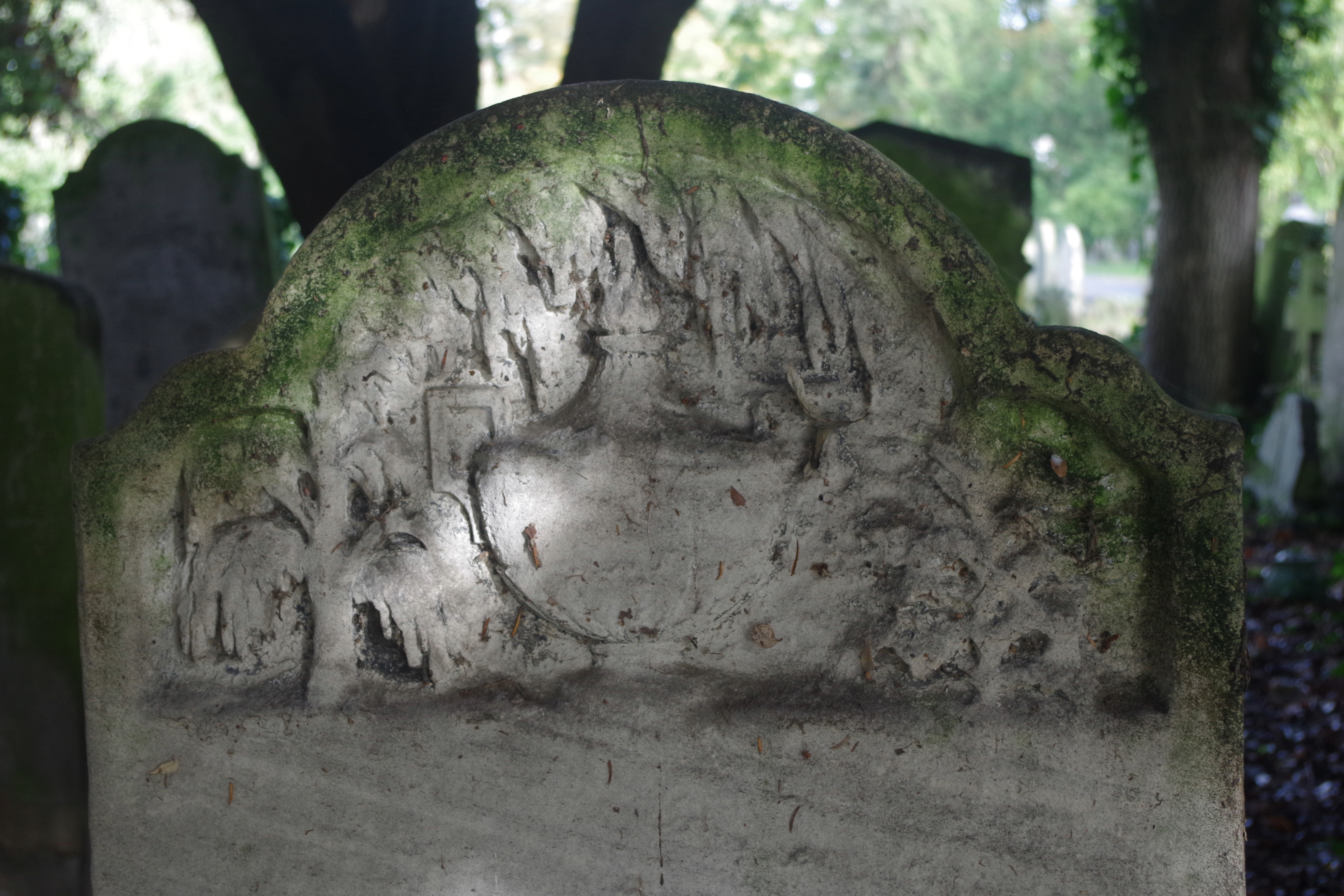
Under a spreading yew tree is the headstone dedicated to Catherine Lees who died in 1681. According  to the guidebook, it is the oldest legible tombstone in the churchyard, so there may be others even earlier that are not so readable now. Catherine was a member of an old Kent family, the Lees, and the guidebook says that there is ‘a house in the next parish of Shieldwich (which) is still called Lees Court after them.’ The inscriptions and symbols are very crudely cut into the stone which is part of its charm for me. However, I was a little surprised that such an old and venerable family could not afford a professional stonemason. There is an hourglass, skull and longbones and the epitaph reads:

‘My soule cleave fast to God above,

Nothing on earth deserves my love,

To live in all securite,

In heaven with thee,

Lord let me be.’

Medieval tomb markers, St Mary the Virgin, Selling, Kent © Carole Tyrrell

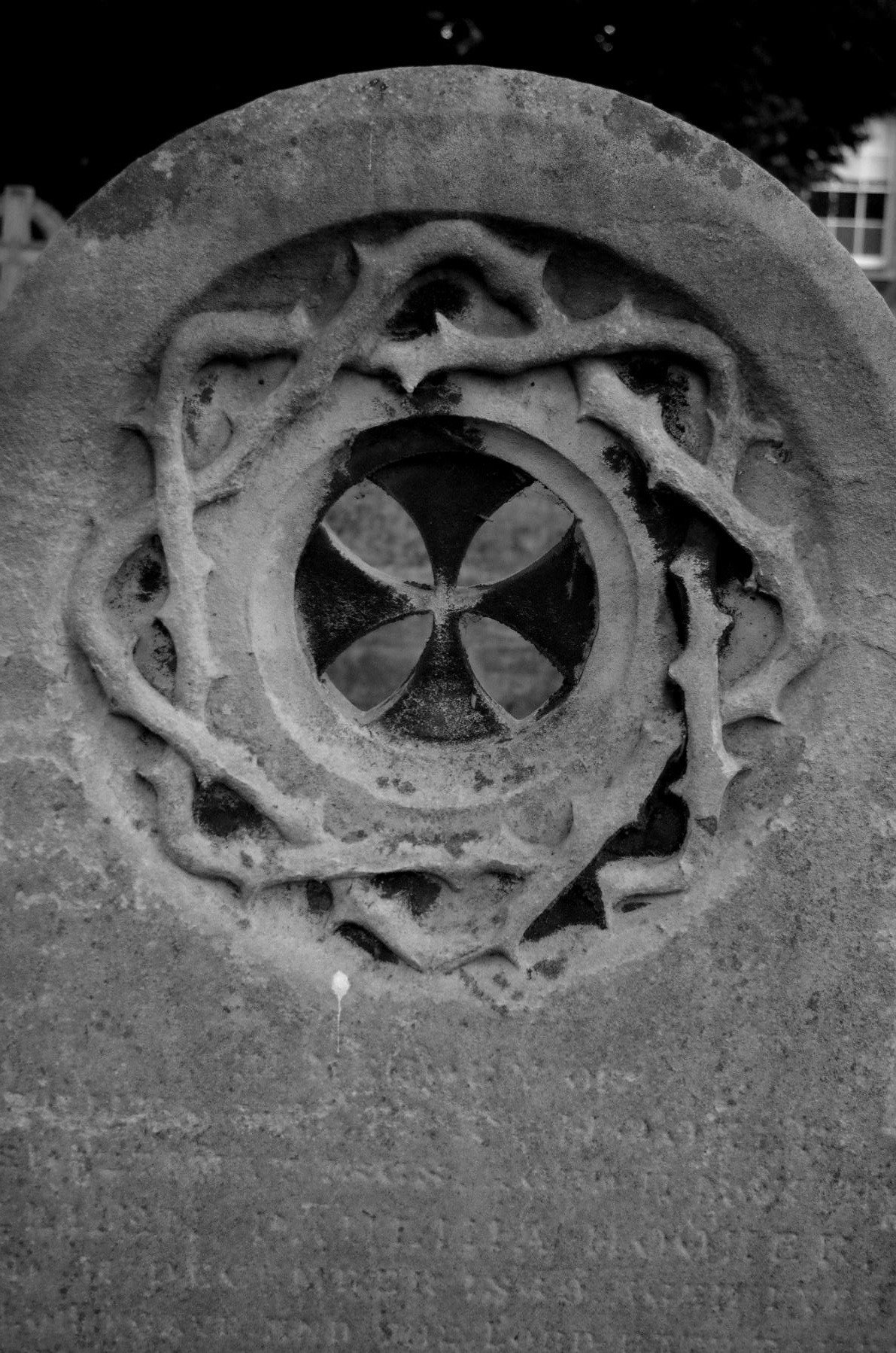
Also, in St Mary’s churchyard are its only surviving medieval tombstones according to the guidebook. Apparently, there were ‘many of them in a particular part of the churchyard’. These were ‘stone discs with a quatrefoil ornamentation on a short stone shank.’  But no names apparently. St Mary’s burial registers only began in 1558 so there may be no records of their medieval burials.  St Mary’s is an interesting church as the very first church was built on a Jutish holy place and their ‘savage dancing ground of beaten earth lies somewhere beneath the chancel floor of the tranquil and dignified building that is seen today.’ The   Jutes were one of the Germanic tribes that settled in Britain after the Romans left.  They were very powerful and a local pond, Ghost Hole Pond, has a sinister reputation.  There were several recorded cases of violent deaths associated with it and the Jutes were known for their human sacrifices.  These included the ‘ritual drowning of ….in ponds and meres.’  This seemingly quiet and peaceful part of Kent obviously hides a much more savage and brutal past. St Mary’s is another example of the Christianisation of pagan sites by building a church on top of one. An interesting brush with ancient history.

So now I have seen medieval examples of burial markers – can I find one that is even earlier? There are reputed to be some in the churchyard of St Peter and St Paul in Tonbridge, Kent but they were unsure of where they were. But I’m keeping a look out!

©Text and photos Carole Tyrrell unless otherwise stated

Further reading

A brief guide to the church of St Mary the VirgIn, Selling, Kent by Alan Neame

Jutes – Wikipedia

Selling, Kent – Wikipedia

A Brief Guide to the church of St Mary The Virgin, Selling Kent, Alan Neame, 1998 published by The Selling Parochial Church Council

Symbol of the Month – The Choice

Alice Stone’s tombstone, All Saints churchyard, Staplehurst, Kent ©Carole Tyrrell

You never know what little gems you might find in a country churchyard and I discovered one while exploring in Staplehurst in 2019.  All Saints church has a commanding hilltop position and looks down on the pretty half-timbered houses of the village.  Since 1100 it has stood on this site and has several ancient features.  These include the remnants of an anchorite’s cell.  This was a medieval form of penance in which the anchorite would live in a very small cell, if the size of the remaining floor of the cell is to be believed, and lived on offerings that parishioners and others would pass through a window set into the church and the cell.  The offering window is still there.  All I could think of was how cold it must have been in winter and how did they deal with their waste products.  They were effectively hermits and were declared as being dead to the world.  It was the Reformation brought the anchorite life to a close.  There is also a wooden door to the side of All Saints that has been definitively dated to 1050 and features scenes from Norse legends.  I could find no explanation for pagan elements being incorporated in a consecrated building and so it was very intriguing. Why here?

The churchyard was far larger than I expected and led to a more modern section at the back of the church.  But as I explored the older part of the churchyard I turned around and came face to face with this unusual symbol on a white headstone.   

Alice’s epitaph – a little ineligible in parts. ©Carole Tyrrell

It’s dedicated to Alice Stone, wife of James Stone of Sheerness.  There is no date of birth recorded but she died on 5 February 1787 aged 27.  Alice may have died in childbirth which was a frequent cause of death for women in past eras or maybe she was a victim of an epidemic. We’ll never know.  However, there is some barely legible lettering above the inscription which I have been unable to sufficiently enhance in order to read it so this may well warrant a second visit.

The deceased arises and casts off their shroud. ©Carole Tyrrell

The scene at the top of the tombstone is almost like a miniature Doom painting.  My interpretation of it is that it’s Judgement Day and the deceased has awoken from their eternal slumber.  They appear to be in a burial chamber and lying on a ledge or on a shelf within a vault.  They have partly cast off their burial clothes and appear to be slightly decayed.  Ribs are visible and the head appears skull-like.

But where are they destined to go next?  What will be their fate? 

There’s only the choice of two final destinations for them – Heaven or Hell which are depicted on either side of the figure.

The devil standing over a skeleton that’s lost it’s crown. ©Carole Tyrrell

On the right hand side of the carving as you face it, is a magnificently winged demon, or The Devil himself, standing over a grinning skeleton whose crown has fallen from his head.   The crown is a very significant symbol in that it can indicate the passage from the earthly life into the divine and I have written it about in a previous Symbol of the Month.  The demonic figure appears to be holding what looks like a besom or maybe it is a three pronged fork or even a large arrow.  Although there are no flames, here the Devil is triumphant in his domain.

Closer view of the angel in the clouds and his trumpet. ©Carole Tyrrell

On the left-hand side, an angel appears to be floating within clouds while blowing a large trumpet in the direction of the newly awoken deceased.   Underneath the angel is a brick house with an entrance or a small narrow gateway (I have to say the entrance does resemble a fireplace).   I interpret this as being a depiction of God’s House and there are numerous references to it within the Bible and also in Genesis 28: 16-17:

‘When Jacob awoke from his sleep, he thought,

“Surely the Lord is in this place, and I was not aware of it.”

 He was afraid and said, “How awesome is this place! This is none other than the house of God; this is the gate of heaven.”

It was difficult to find a specific Biblical verse that mentioned the Devil and Hell but I did find a reference in Matthew 10:28 :

‘And fear not them which kill the body,

But are not able to kill the soul:

But rather fear him which is able to destroy both soul and body in hell.’

(King James Version)

I am not a particularly religious person but the parishioners of All Saints at the time would have recognised the quotations.

The scene would have been a prompt to the passing viewer or mourner to live their lives in a righteous manner or face the alternative for eternity.   It’s very dramatic and, as Alice died at an early age, this reminder would have very pertinent at a time when the average life expectancy was far lower. 

So far I have not been able to find out more about Alice or James but for now she rests within part of the quintessential English country churchyard.  She’s amongst ancient stones, some protected or obscured by mosses and lichens, and the bright wildflowers of late Spring.    However, I would like to know more about her and what may have inspired the little scene on her headstone.

R I P Alice Stone.

Since I wrote this post I have discovered other versions of ‘The Choice’ in various North Kent churchyards.   There is a weathered one in the churchyard of St Nicholas at Strood and no less than 5 versions, all by different stone masons, in St Mary the Virgin’s graveyard in Newington Kent.

One of the five versions of the ‘The Choice’ seen in the churchyard of St Mary the Virgin, Newington, Kent. ©Carole Tyrrell.

Another version from St Mary the Virgin’s churchyard in Newington, Kent. ©Carole Tyrrell

©Text and images Carole Tyrrell unless otherwise stated

Anchorite – Wikipedia