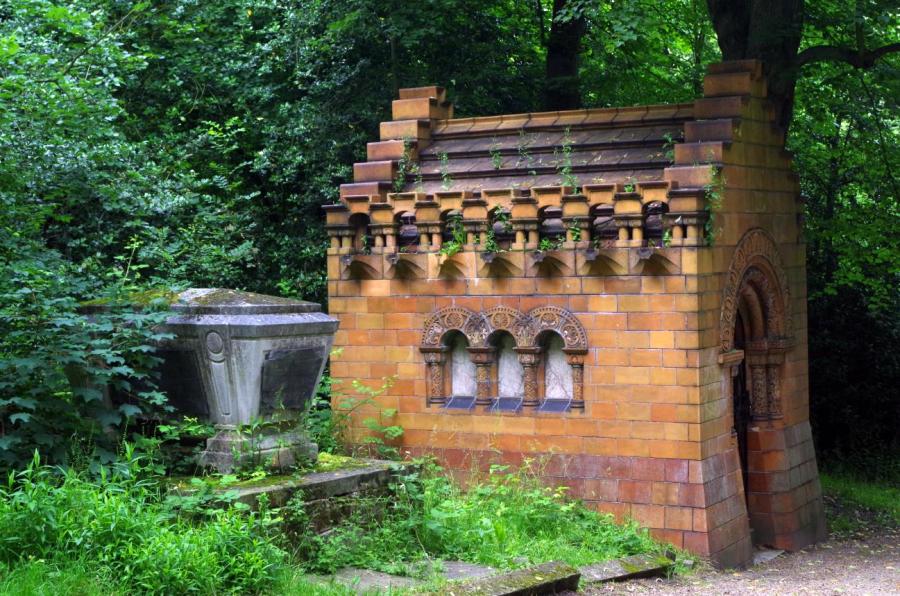
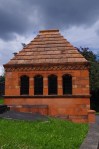
View of the Stearns mausoleum – note stepped roof and water spouts. copyright Carole Tyrrell
This is the last of the trio and, in contrast to the ones in West Norwood, wasn’t designed by Harold Peto. He had left Peto and Geoge by then and it has been suggested that the building was actually designed by an anonymous assistant who worked from previously rejected designs. It’s very different from the other two, both in style and decoration. It was built in 1901 to house the coffin of Mrs Laura Stearns. She died in 1900 and came from Twickenham. William Chillingworth, her father, is buried next to her in his own vault.
View of mausoleum with Mrs Stearns father, William Chillingworth’s sepulchre visible to the left.
copyright Carole Tyrrell
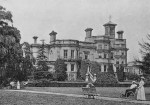
Radnor House Twickenham – owned by Mrs Laura Stearns and her father. Demolished in 1940 after being hit by a bomb.
He was a wine merchant and they owned Radnor House in Twickenham. It was known as Pope’s House as it was built on the site of Alexander Pope’s original house. It no longer exists as it was demolished in 1940 after being hit by a bomb. There seems to be no mention of a Mr Stearns. In the 1930’s Mrs Stearns’ coffin was removed from the mausoleum by her relatives and interred behind it.
The interior was never finished which is why it is so plain. However, 20 years later, an anonymous builder glazed it with bland tiles. There are two simple, unadorned stone coffin shelves set into each of the side walls. A trefoil shaped window on the back wall lets light in as the side windows are blocked up.
Trefoil window at the back of the mausoleum – the grille is a modern addition.
copyright Carole Tyrrell
Side windows of the mausoleum with relief and stylised Romanesque detailing.
copyright Carole Tyrrell
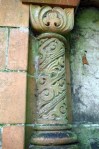
One of the side window columns with patterning.
copyright Carole Tyrrell
The mausoleum is decorated in the Romanesque style. This is an architectural style of medieval Europe which possibly dates from the 10th century and was characterised by the use of semi-circular arches. It was used extensively throughout Europe and in Britain is referred to as Norman Architecture. The word ‘Romanesque’ originally means descended from Roman and most surviving examples are on churches.
One of the 4 columns on either side of the entrance featuring stylised flowers and leaves.
copyright Carole Tyrrell
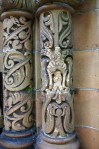
This is the other two columns which feature stylised birds, flowers and fruits in a quasi medieval style.
copyright Carole Tyrrell
The front view with stylised flowers and leaves and classic Romanesque semi circular arches.
copyright Carole Tyrrell
It is also characterised by its use of columns and, on the Stearns vault, we can see that the two small ones on either side of the entrance are carved with birds etc in a medieval style. The carvings are very tactile and I can never walk past within wanting to touch them. The side window columns are also patterned but not as beautifully as the entrance ones. Romanesque was also a highly decorative style as can be seen from the arched bands of stylised leaves over the entrance.
Close-up of Romanesque semi arch over entrance with stylised leaves. copyright Carole Tyrrell
The 19th century saw a Revival of Romanesque although it was decried by some writers as ‘barbaric ornament.’ The Natural History Museum in London is highly decorated in Romanesque Revival style and is well worth seeing.
It’s the only surviving mausoleum within Nunhead Cemetery and, although a tree tried to grow through it while the cemetery was abandoned, it’s still in good condition. When I first visited Nunhead in 1989, it was rumoured that the only person who now rested within the mausoleum was a passing tramp. It now has a wrought iron gate to protect it.
References:
Nunhead Cemetery, An Illustrated Guide by The Friends of Nunhead Cemetery . 1988, FONC Publications, London
The terracotta trio are all so different and unique and all three are Grade Ii listed and although, in comparison to other mausoleums such as Highgate’s Beer vault and Hannah Portnoy’s vast Egyptian Revival sepulchre in Brompton, they are relatively modest. However, I feel that they deserve their own special place in 19th century English funerary architecture..
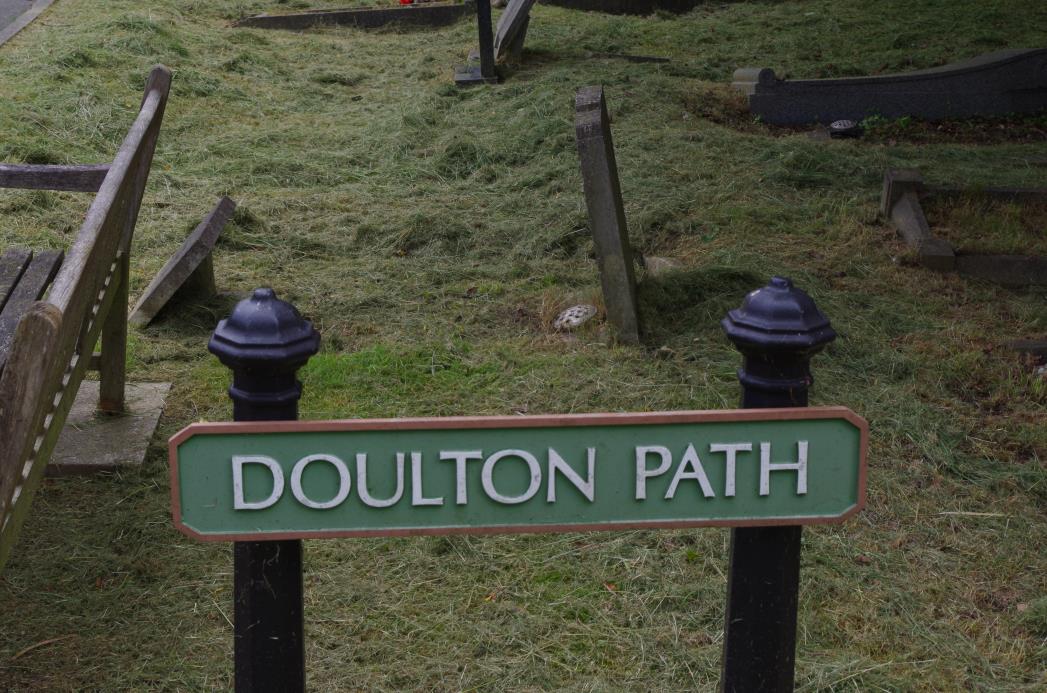
Path sign in West Norwood named after the Doulton mausoleum. copyright Carole Tyrrell
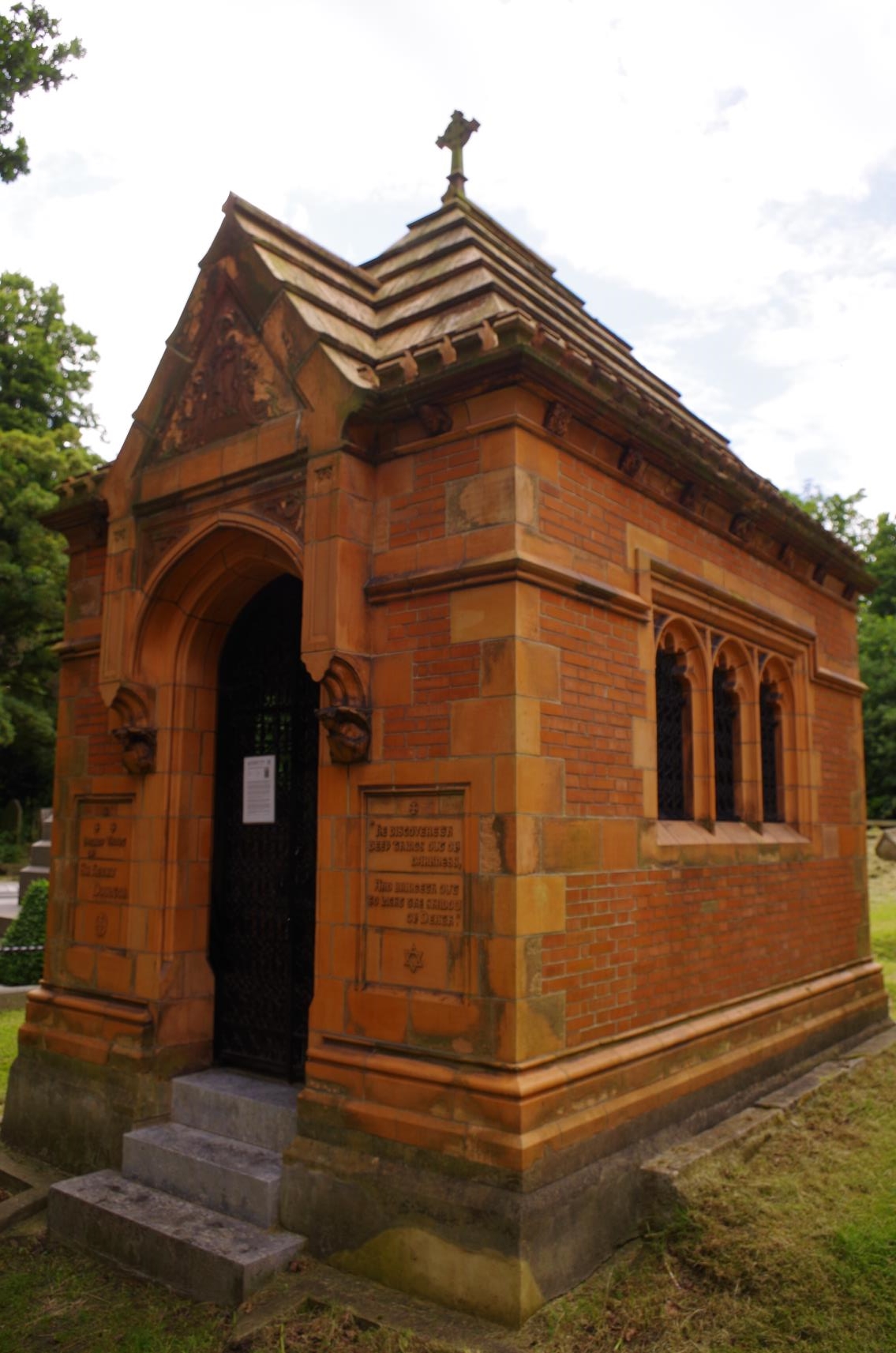
Doulton – note cross on roof and relief lettering on front. copyright Carole Tyrrell
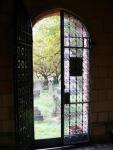
It’s easy to find the Doulton mausoleum in West Norwood Cemetery – just look for the Doulton Path sign and you’ll soon come to its lovely wrought iron doorway.
This is the second of the Doulton mausolea and, although similar in shape to the Tate Mausoleum, the external and interior decoration and style are very different.
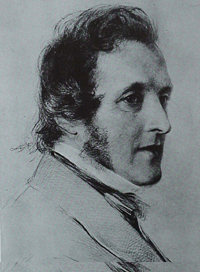
Sir Henry Doulton (1820 – 1897) commissioned this mausoleum after the death of his wife, Sarah, in 1888 and it was built in 1889. He entered the family firm of Doultons in 1835, enlarged its range of wares and took it over completely on his father’s death. In fact it was Sir Henry who invented the weather resistant type of terracotta used on all three vaults and he was knighted in 1887.
Sir Henry asked Harold Peto to design a similar building to the Tate mausoleum on a nearby plot and they are within walking distance of each other. Sir Henry’s son, Henry Lewis Doulton, followed him into the business and is also interred in the mausoleum. There is a memorial tablet to both Sarah and Sir Henry on the interior back wall of the building.
The sepulchre’s exterior is covered in relief ornamentation. This includes small busts of angels on either side of the entrance door, the Lamb of God on the back of the roof and Gothic revival medieval style heads along the roof border below it. Sir Henry ordered green glass for the windows on either side which are protected by wrought iron grilles and as, no expense was spared, the rear window is glazed with rippled Venetian glass.
Doulton – one of a pair of angels busts on either side of the entrance door.
copyright Carole Tyrrell
Doulton – damaged relief of angels over entrance.
copyright Carole Tyrrell
Doulton – damaged relief panel on back roof but Lamb of God is still visible.
copyright Carole Tyrrell
Doulton – back view with Venetian glass window and the relief of the Lamb of God on roof.
copyright Carole Tyrrell
Doulton – relief lettering on front which is a Biblical quote from the Book of Job 12.22.
copyright Carole Tyrrell
Doulton – close-up view of green glass windows on side of mausoleum. They resemble church windows.
copyright Carole Tyrrell
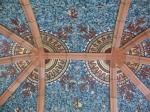
The external decoration has been credited to Mark Marshall who was Doulton’s chief artist but I have also seen George Tinsworth also mentioned which even I’ve heard of as he was one of Doulton’s most renowned artists. I am indebted to Jeane Trend-Hill for the lovely photos of the stunning marble interior and mosaic ceiling. The mausoleum is not open to the public.
A Doulton descendant still comes and mows the grass around the mausoleum every Sunday and so it always looks at its best.
Doulton – side view showing green glass side windows and grilles.
copyright Carole Tyrrell
Doulton – front view – note relief s of angels blowing trumpets on either side of the entrance.
copyright Carole Tyrrell
Both of the West Norwood mausolea were restored in 2002 and so are in very good condition. The architect, Harold Peto, is said to have also been responsible for the extensive use of terracotta in buildings along Pont Street in Mayfair.
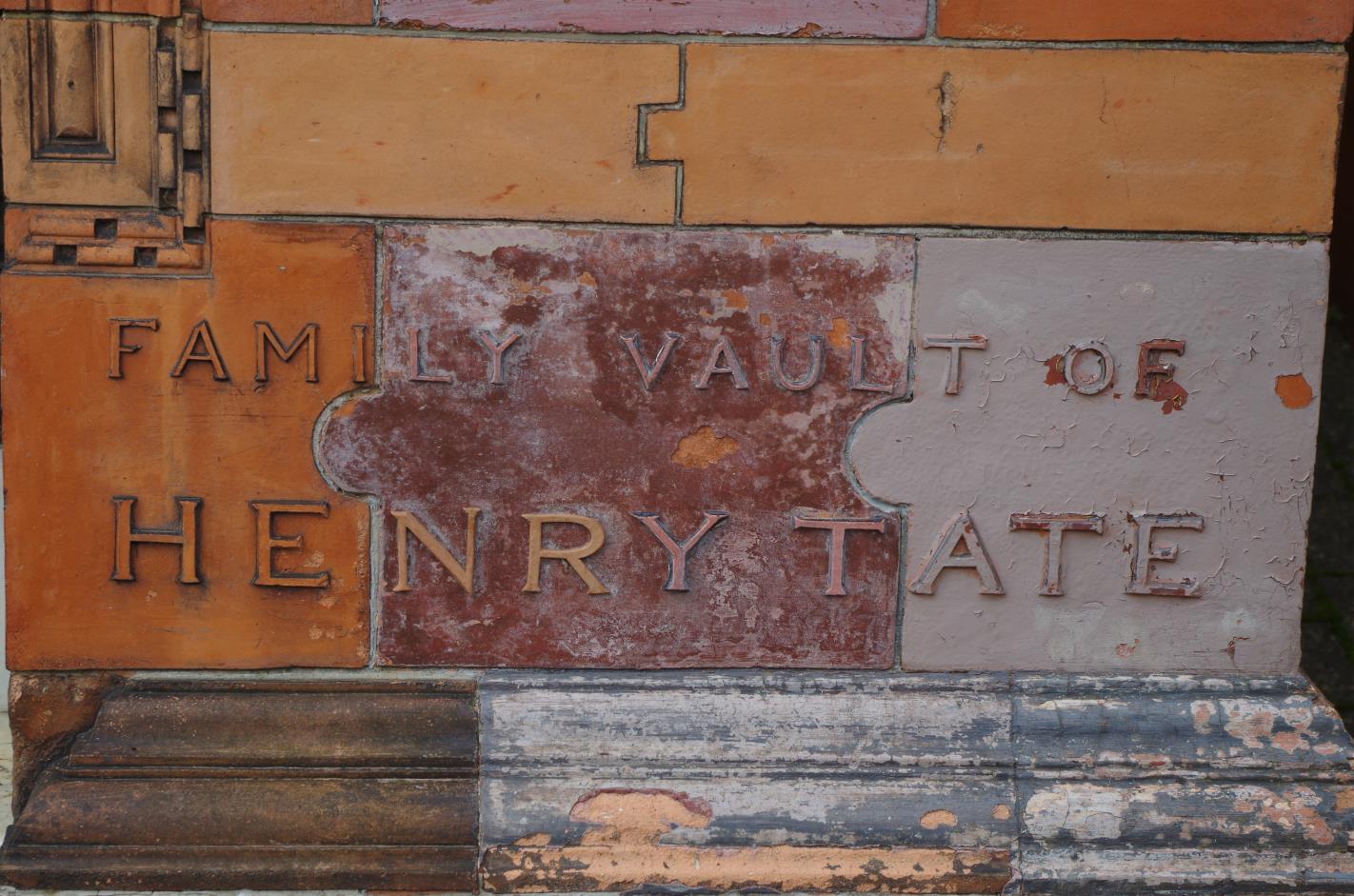
View of the Tate Mausoleum – note the patterning of the contrasting colours.
copyright Carole Tyrrell
Doulton – note cross on roof and relief lettering on front.
copyright Carole Tyrrell
View of mausoleum with Mrs Stearns father, William Chillingworth’s sepulchre visible to the left.
copyright Carole Tyrrell
My first encounter with the Doulton mausolea was seeing the charming Stearns mausoleum in Nunhead Cemetery. I fell in love with its dainty proportions and beautiful Romanesque decoration. When I first saw it in 1989, its coffin shelves were empty, the entrance was open and it was rumoured to be the preferred hotel of choice for any passing vagrants.
But first, a brief history of mausoleums. The word comes from the Mausoleum of Halicarnassus which was near the modern day city of Bodrum in Turkey. It was the 140ft high, highly decorated, last resting place of King Mausolea who was the Persian Satrap or Governor of Caria. It was created by his wife, Queen Artemesia Ii of Caria after he died in 353 BC and it was one of the Seven Wonders of the World.
Mausoleums were very popular with the Romans and were usually created for deceased leaders and other important people. The via Appia Antica near Rome contains the ruins of many private mausolea but the coming of Christianity made them fall out of favour.
A mausoleum is literally a house of the dead and usually contains a burial chamber either above ground or with a burial vault below the structure. This can contain the body or bodies. However, some mausolea contain coffin shelves above ground as with the Kilmorey Mausoleum near Richmond where the coffins are still in situ. One of the most famous mausoleums is the Taj Mahal in India.
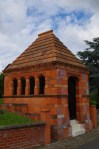
The three Doulton mausolea are all made of red brick with terracotta facing. It’s a surprisingly durable material and is a very warm colour. Indeed it almost seem to glow when the sun shines on it. As the name implies, they were all built by the famous firm of Doulton & Co – now Royal Doulton – who had a factory at Vauxhall. They made many ceramic items including stoneware and salt glaze sewer pipes and are still in existence today. The firm and especially Sir Henry Doulton pioneered the use for terracotta and provided unlimited amounts of it to the mausolea builders.
Mortal Remains; The History and Present State of The Victorian and Edwardian Cemetery, Chris Brooks, 1989, Wheaton Publishers
Here lies Mr Cube copyright Carole Tyrrell
Part 1 – The Tate Mausoleum – West Norwood
This is the first of the three and was commissioned t in 1884. It was designed by Harold Peto of the firm of Peto and George and Doulton craftsmen worked on it. It’s in the Perpendicular style which was the last breath of English Gothic from late 14th – mid 16th century and is characterised by its use of vertical lines. The patterning on the terracotta surface resembles that of a jigsaw especially with the contrasting bands of red and buff colours.
There is some lovely ornamentation including 2 angels in relief blowing trumpets in the upper corners of the door frame – one on either side.
Tate Mausoleum – note the reliefs of angels blowing trumpets on either side of the door frame. copyright Carole Tyrrell
It also has the famous quote from the Song of Solomon on one side of the door:
‘Until the day dawns and the shadows flee away’
Tate Mausoleum – note the famous quote from the Song of Solomon in relief. copyright Carole Tyrrell
This is where I first saw it and it was the inspiration for the name of this blog.
The interior, which I haven’t yet seen, is reputed to have a vaulted ceiling with the design of an angel at Sir Henry’s request.
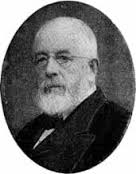
Sir Henry Tate (1819 – 1899) was originally from Lancashire and worked in the Liverpool sugar trade. He soon amassed a huge fortune and invented the sugar cube.
In fact he was known as ‘Mr Cube.’ Sir Henry was an avid art collector and, in 1897, donated his entire art collection the nation. He gave it to what was then known as The National Gallery of British Art before becoming The Tate Gallery and now finally as Tate Britain. It was built on the former site of Millbank Prison. Two of Tate Britain’s most popular paintings; Millais’ ‘Ophelia’ and Waterhouse’s ‘The Lady of Shalott’ came from Sir Henry’s collection.
He refused a knighthood on several occasions and only finally accepted it after being informed that the Royal Family would be offended if he refused again.
In 2012, as part of an art trail in West Norwood Cemetery in 2012, a Belfast based artist, Brendon Jamiston recreated a mini version of Mr Cube’s last resting place from 5,117 sugar cubes in homage to Sir Henry and his invention. It was displayed next to the real thing and I feel that Sir Henry would have approved.
An imposing memorial in West Norwood Cemetery to Edith O’Gorman and her husband. copyright Carole Tyrrell
I encountered The Escaped Nun on a cold November day as I was wandering in West Norwood Cemetery. It’s one of London’s Magnificent Seven Victorian cemeteries and there’s always something interesting to be found. The vegetation had died down and so it was an ideal time to look for forgotten gems.
This is presumably a 3D relief of Edith’s husband William Auffray. Quite spooky as his eyes seem to follow you round. copyright Carole Tyrrell
I was walking through a clearing near the columbarium when I saw a large monument which had a broken column in top of it with an anchor carved on it and, lower down, a 3D bust of a middle-aged Victorian gentleman which faced me. He stared at me and I stared back. However, I was a little unnerved as his eyes seemed to follow me. But it was the epitaph below that caught my attention. It read:
The epitaph that started it all – Edith O’Gorman – The Escaped Nun. Who wouldn’t want to know more? copyright Carole Tyrrell
EDITH O’GORMAN
(THE ESCAPED NUN)
WIDOW OF THE ABOVE
DIED 25TH MAY 1929
AGED 86 YEARS
LIFE’S RACE WELL RUN
LIFE’S WORK WELL DONE
THEN COMES REST
The Escaped Nun? I was immediately intrigued and contacted Colin Fenn from the Friends of West Norwood Cemetery who very kindly set me off on my journey to find out more..
It was the story of a remarkable and controversial woman, the religious wars of the 19th century and a life full of drama and scandal on both sides of the Atlantic.
I found this online – what-when-how.com/new-jersey/ocean-county-observer-to-ogorman-edith-new-jersey
Edith O’Gorman, or Gorman, as she seems to have adapted her name at some point ,came from an Irish family who emigrated to the US and settled in Rhode Island. She also may have originally been named Bridget or Biddie and became Edith, her middle name, at her baptism in 1870. She was born on 20 August 1842 and, after being educated within a Protestant seminary, she received the calling to become a nun in August 1861 when she was 19..
On 1 October 1862 she entered St Elizabeth’s Convent, Madison, New Jersey and describes it as if she had died. Six years later she ran away from the cloisters with $5, and set off on a new life.
Edith now had a new calling; to expose the truth about convent life and she did this in her best-selling book ‘The Trials and Persecutions of Miss Edith O’Gorman otherwise Sister Teresa de Chantal, of St Joseph’s Convent, Hudson, New Jersey’ which was first published in 1871.
It’s an amazing and often entertaining book to read as the pace and revelations never flag. It was incredibly popular with many printings in the USA and abroad and was translated into several languages. In it, Edith describes life behind convent walls which was anything but devotional. She was bullied by older nuns and witnessed cruelty by them towards the orphans in their care. However, on 16 July 1864 aged 22, Edith took her vows and was sent with two other sisters, Agnes and Josephine, to establish a new convent in St Joseph’s Parish, Jersey City, New Jersey. Now Edith’s narrative gets into its stride as she reveals that priests are making money from parishioners paying them to say masses on their behalf and also the fate of many of the nuns. They either left as Sister Agnes did, ended up in local asylums for the insane died or mysteriously disappeared.
A priest attempts to seduce her and eventually Edith runs away. After taking refuge in a hotel she advertises for work as a governess and finds herself in a bordello. She escapes again and, after some more adventures, she converts and becomes a Baptist.
After that she devoted the rest of her life to lecturing against Catholicism. The rest of the book consists of reviews of her lectures. Some of the book has the ring of truth because of what we now know about institutions such as the Magdalene Laundries for ‘fallen’ women and some orphanages.
Edith’s sensational book, which is still in print and available on amazon, entitled ‘Convent Life Unveiled’ has to be seen against the background of 19th century religious fervour. Since Henry VIII founded the Church of England, Catholics had been side lined from public life and denied civil rights which included serving in Parliament ,owning all kinds of property and attending major universities such as Oxford and Cambridge. The cry of ‘No Popery’ was common and the same was true in the USA.
Anti-Catholic feelings of the time were spurred on by the popular press, novels and lurid exposes of life inside convents and monasteries. They all shared common themes: secret tunnels connecting monasteries and convents, illicit affairs between nuns and monks and secret burial places for babies born to nuns. There were other popular books on convent secrets which included Rebecca Reed’s ‘Six Months in a Convent.’ published in 1835 and Maria Monk;s ‘Awful Disclosures of the Hotel Dieu Nunnery of Montreal.’ which was also known as ‘The Awful Disclosures of Maria Monk.’ The latter has never been out of print. However, there was one drawback; neither Rebecca or Maria had ever actually been nuns.
But Edith was the real deal. She travelled the world delivering her lectures. But it was a dangerous business. Edith’s lectures were often attended by devout, protesting Catholics and would often end up in a riot or a serious brawl. She was also the victim of several assassination attempts as she was seen as someone who should be ‘done for.’ One bullet just missed as it passed through her hat. In fact Edith claimed that there had been over 70 attempts made on her and her husband’s lives. This may just mean that the opposition kept hiring assassins with bad eyesight.
I also found this online -www.courier.co.uk/nun-s-speech-sparked-riot/story-15120498-detail/story.html. This was story about Edith’s lecture in Kent causing a riot.
She married William Auffray on 17 June 1869 and they settled in England. He was a Frenchman and rumoured to be a former priest who had resigned from the faith.
However, by 1915 she was penniless despite having sold 300, 000 copies of her book and undertaking a 15 year lecture tour with William. After that, nothing more is heard.
But Edith could actually write and write well but she doesn’t seem to have written anything else. If her book had been fiction I’m sure it would have sold even more copies. The pace never slackens and I found myself turning pages faster and faster as each new peril or revelation leapt off the page.
Edith was a remarkable and resourceful woman who clearly believed in what she was doing and was not deterred by violence and threats. She earned her own money and had the stamina to travel the world and spread the word.
Another view of the memorial – note the broken column and the anchor. copyright Carole Tyrrell
So now Edith rests in a corner of a Victorian cemetery with her husband’s bust keeping watch over her. Gone but not forgotten as long as there’s a passing visitor who reads her epitaph and thinks ‘
‘Why is she the Escaped Nun?’
With thanks to Colin Fenn, Friends of West Norwood Cemetery
Text and photos copyright Carole Tyrrell except for the 2 photos of Edith O’Gorman.
















 shadows fly away