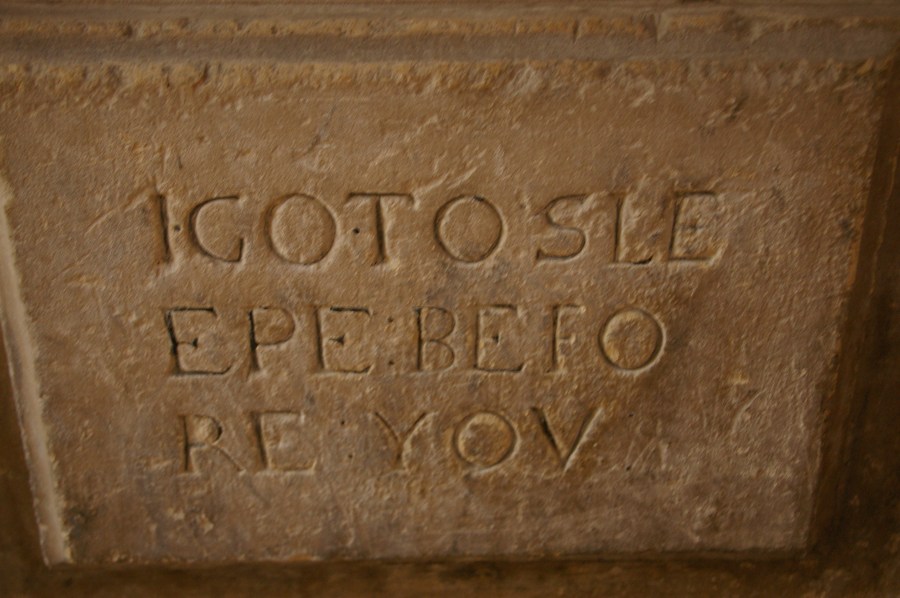
This was the inscription that made the most impression as it was so touching and heartfelt. It perfectly expressed the deceased’s belief, that although they had pre-deceased their partner, they believed that they would both wake again on Judgement Day and be reunited.
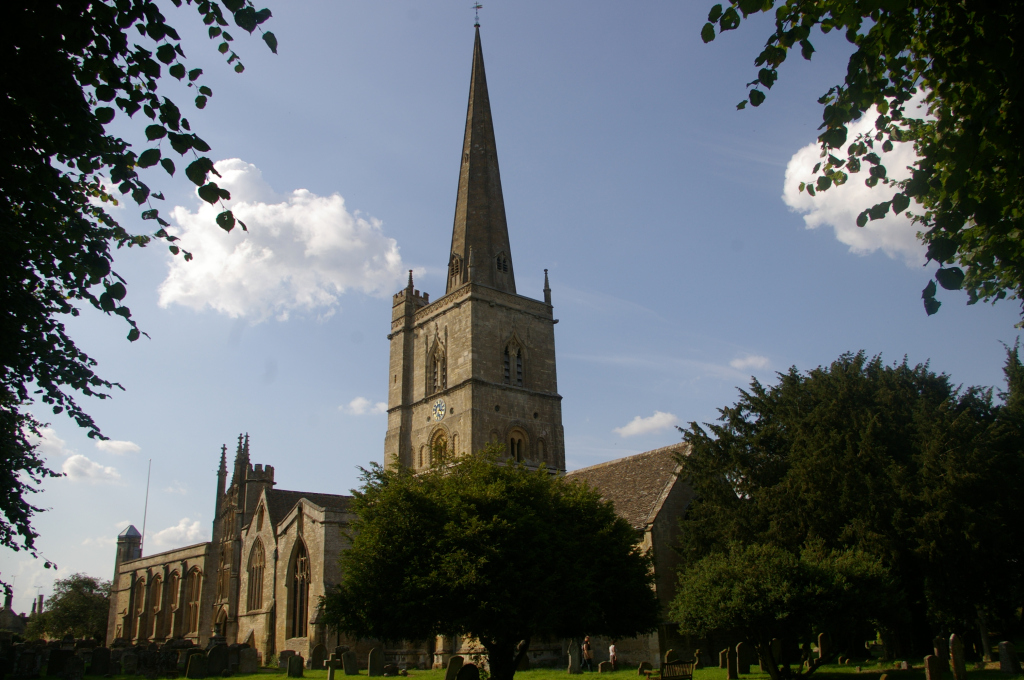
The first part of the epitaph on a unknown Monument, So John te Baptist, BurfordThe second part of the epitaph on an unknown monument, St John the Evangelist, Burford
Its simplicity is what makes it stand out simple and yet I have no idea on which monument the inscription was despite looking through my photos from the day. But it made a powerful impression. In many ways it was more powerful than far more ornate monuments and tombs.
However, when the Penguin Book Cover Generator was doing the rounds on social media just prior to Christmas last year it provided inspiration…
Hello all – I think I can just about get away with still wishing you all a Happy New Year!
Well, here we are in another lockdown and so I won’t be poking about in churchyards or cemeteries for a while.
So I took the opportunity to look through my photos from last year just before the first lockdown when I could still be out and about in local churchyards and cemeteries which I haven’t previously posted.
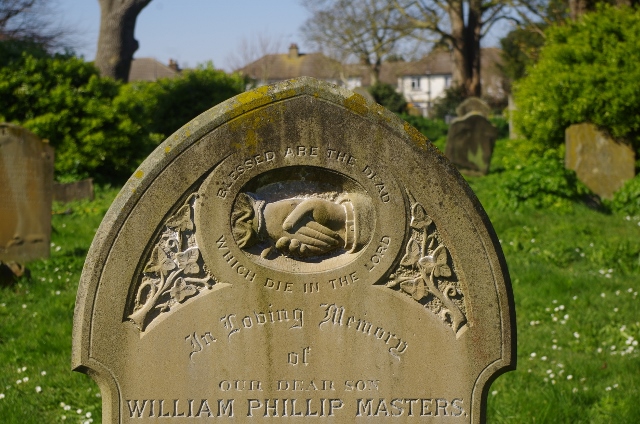
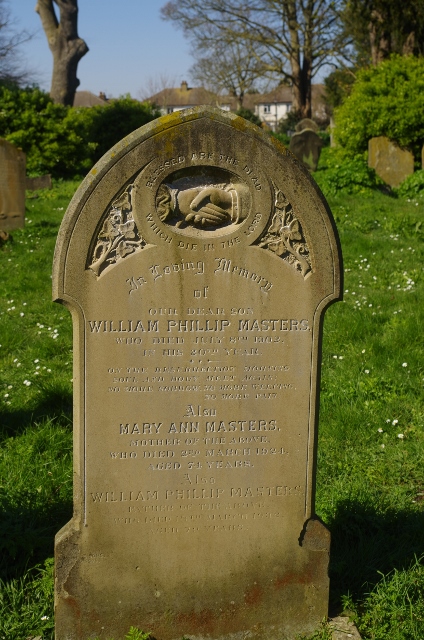
The above headstone is from All Saints in Frindsbury near Strood. The church perches on top of a hill looking down on the town and its churchyard was recommended to me by an old friend. There were some spectacular views of the River Medway down below as its sapphire stream glinted in the Spring sunshine.. When I got there, the trimming of the long grass around the memorials had literally stopped in mid cut and I had to be careful where I walked. I didn’t want to trip over kerb stones hidden in the long grass.
I found this and, although the shaking hands motif is usually associated with a man and wife saying goodbye, here it looks as though a mother and son are saying goodbye. The hands are those of a man and a woman and, although, the father has been added on at the bottom, the son was the first to be buried there. William Masters died young at only 20 and his mother died 22 years later.
In the shaking hands, the deceased is traditionally holding the hand of the living as they part. It can mean goodbye or the deceased guiding the living into eternal life later. It is usually associated with marriage with the visible cuffs delineating them. The frilly hand on the right hand side is a woman and the left hand one is the man with the plainer, more formal cuff.
It was an interesting churchyard and was also in the middle of two cemeteries – the East and the West. These were mainly 19th and 20th century burials but a bright Spring carpet of primroses and foaming white Blackthorn blossom made them appear colourful and bright.
I will be discussing one of the more enigmatic symbols that I found in All Saints in the next blog.
What a strange long trip it’s been as a member of the legendary ‘60’s band, The Grateful Dead, once said and it could apply so well to 2020.
At this time last year I suspect that hardly any of us were prepared for COVID and its devastating effects. Who could have predicted what was to come?
But here we are.
Still trying to make sense of it all and how our lives have changed.
But, when exploring cemeteries and churchyards, you often discover evidence of previous epidemics such as cholera or the Spanish flu. For example, Joseph Bonomi’s headstone in London’s Brompton Cemetery is inscribed with the names of 4 of his children who died of whooping cough in one week.
During this pandemic people have turned to cemeteries and churchyards as quiet places in which to exercise or just sit and enjoy the fine Spring weather and the reduced carbon emissions.
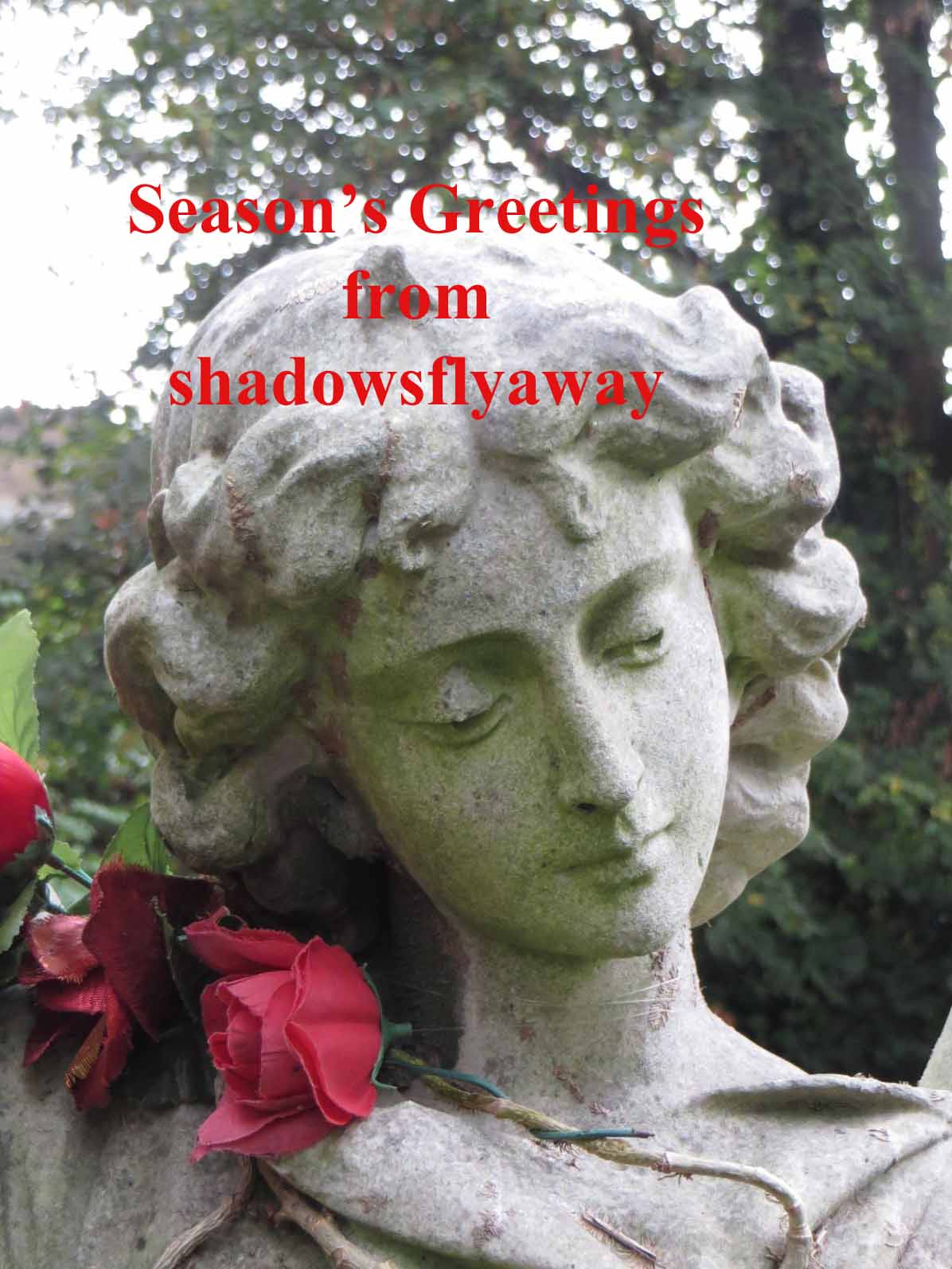
The angel on this year’s card comes from Brompton Cemetery and she often wears a coat of ivy.
I hope no-one thought that Shadowsflyaway was running out of steam with no Symbol of the Month last month for the first time in five years since this blog began. In October, I had teething troubles with an unexpected update from WordPress but that has resolved itself. But this time it’s the effects of lockdown, and travel restrictions and a lack of funds.
However, there are still so many stories to discover and share with you. I love the thrill of finding an undiscovered gem hidden under tendrils of ivy or beneath the spreading yew tree that has sheltered it for centuries.
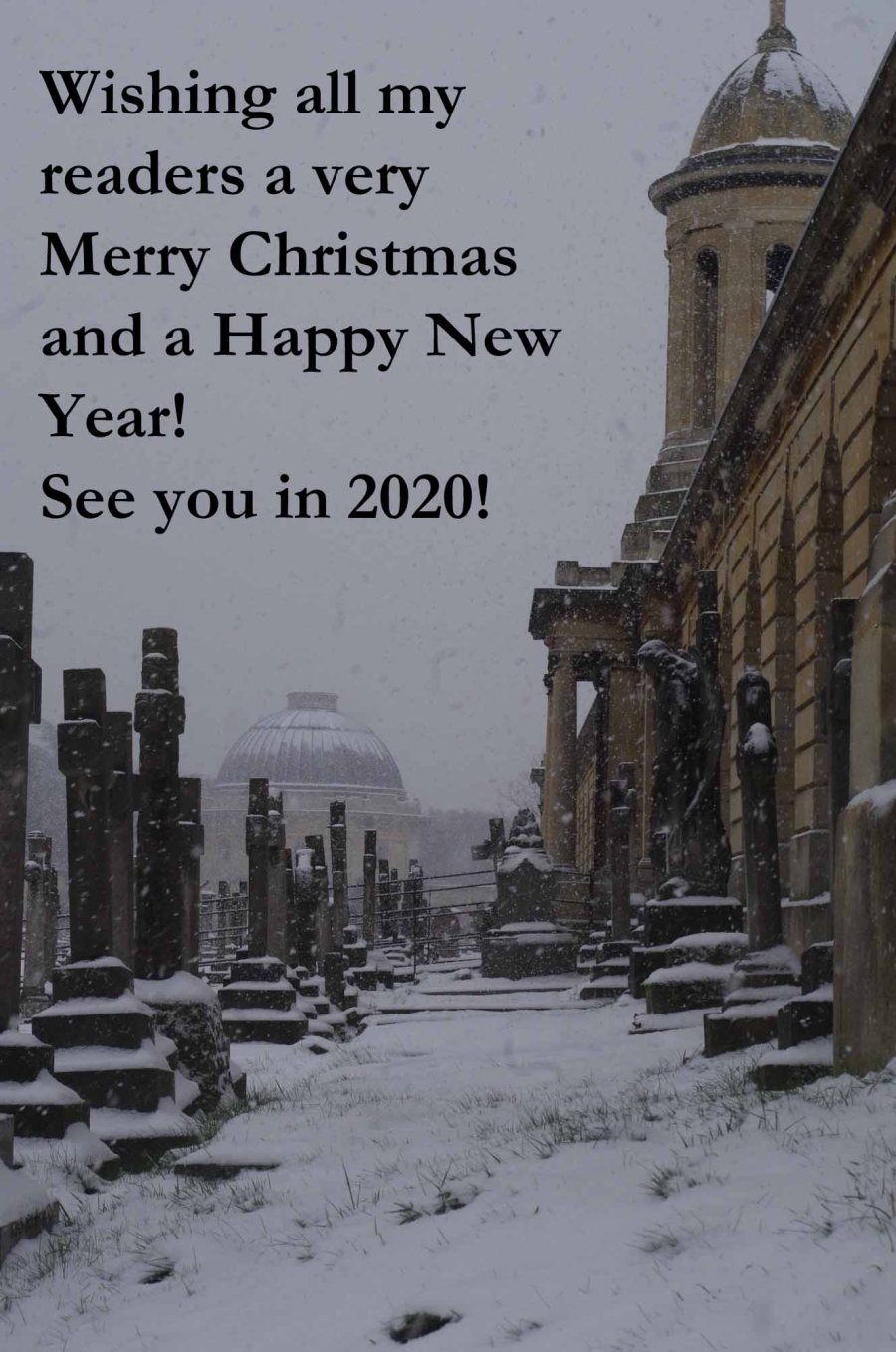
I would like to wish you all a very Merry Christmas and a brighter 2021.
The Egyptian Avenue on a Highgate Cemetery ‘free range
One of the greatest cemeteries in London is Highgate in North London. Crammed with the great and good and also some of the not so good it contains some of the most dramatic funerary architecture to be found in the capital.
The cemetery is bisected by Swain’s Lane with Highgate West on one side and Highgate East on the other. Usually the West side can only be accessed by being on an official tour but this year it was a little different……
Social distancing, in this case, was a good thing! As The Friends of Highgate Cemetery Trust(FOHCT) were unable to hold tours during the summer they cunningly decided to offer ‘free range’ tours instead. For £10 you could book a time, agree to follow a few sensible rules on safety etc and then wander round the West side at will. And if you had the energy, as Highgate West is large, have a look round the East side as well. The West is very overgrown and FOHCT like their visitors to be safe. They didn’t want their visitors to have a nasty accident and then haunt them forever more.
Please note that I have covered Highgate in a previous post – 16/2/2016 to be exact so some memorials mentioned here will have been covered more fully in that post.
So, on 10 July, I entered through the arch of the chapel and into the green cathedral of the West side. The trees had linked arms above the graves, monuments and memorials to form a canopy over the entire site. It felt as if everything was bathed in green light as I walked up the hill. At its highest point Highgate is 375 feet above sea level. Cemeteries are often built on these as their permanent residents are nearer ‘my God to thee.’
I passed the empty chair memorial to a young actress and spotted a pelican in her piety symbol amongst the undergrowth. The overgrown nature of the West side gives it a real charm and mystery. A helpful steward directed me to the Rossetti group of graves which I’d always wanted to see but he also pointed out the grave of a woman who had died when her dress had caught alight. Apparently this only ceased with the coming of the mini-skirt and possibly central heating.
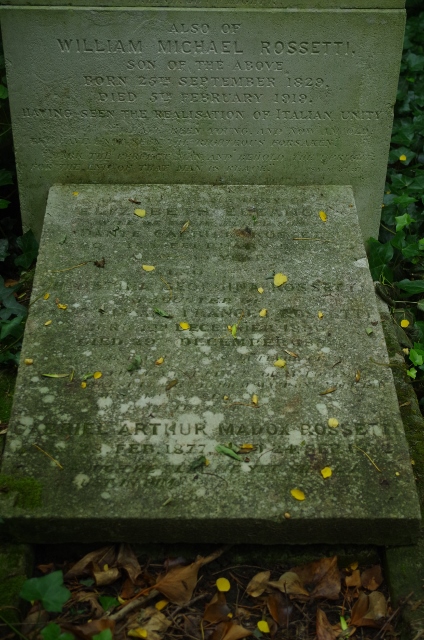
The Rossettis have their own path named after them but the Pre-Raphaelite painter, Dante Gabriel Rossetti is not buried with them. Instead his parents Gabriele (1783-1854) and Frances (1800-1886), his brother William (1829-1919) and William’s wife Lucy Madox Brown (1843-1894), who was the only daughter of Ford Madox Brown, his sister Christina Rossetti (1830-1894) and Dante’s wife Lizzie Siddal (1829-1862) occupy the plot.
Lizzie features as the model in several of Dante’s paintings and the Victorian web points out that she died aged 32 instead of at 30. She was addicted to laudanum which was derived from opium and was a Victorian cure-all. Laudanum was prescribed for morning sickness and cranky infants amongst others. It was easy to become addicted and she succumbed. Lizzie was pregnant at the time of her death, although she may not have known it, and had already had a stillborn child with Dante. It is still not known if she died of an overdose or a deliberate act of suicide. However, she was a talented artist in her own right and some of her work was featured in the 2019 exhibition ‘Pre-Raphaelite Sisters.’
But Lizzie has also been commemorated by an act that occurred after her death. One of Dante’s early biographers recorded it:
On the day of the funeral Rossetti walked into the chamber in which the body lay. In his hand was a book into which at her bidding he had copied his poems. Regardless of those present he spoke to her as though she were still living, telling her that the poems were written to her and were hers, and that she must take them with her. He then placed the volume beside her face in the coffin, leaving it to be buried with her in Highgate Cemetery. This touching scene will some day doubtless be the subject of a picture. Time, after its wont, hallowed and sanctified the memory of loss, but the bereavement was long and keenly felt. Meanwhile, the entombment of Rossetti’s poems had an effect upon which the writer had not calculated. They were familiar to many friends, and passages of them were retained in the recollection of some. These poems were during subsequent years the subject of much anxiety and wonderment, and the existence of the buried treasure was mentioned with reverence and sympathy, and with something of awe. Seven years later Rossetti, upon whom pressure to permit the exhumation of the volume had constantly been put, gave a reluctant consent With the permission of the Home Secretary the coffin was opened” by a friend of Rossetti and the volume was withdrawn. [Knight 76] from the Victorian Web site
It would haunt Dante for the rest of his life. In one of his most famous paintings ‘Beata Beatrix’ painted in 1869, which is an amalgam of several drawings of Lizzie, a white poppy features. The red dove represents their love and the poppy the laudanum that hastened her death. It’s derived from poppies. Dante died in 1882 and is buried at Birchington-on- Sea.
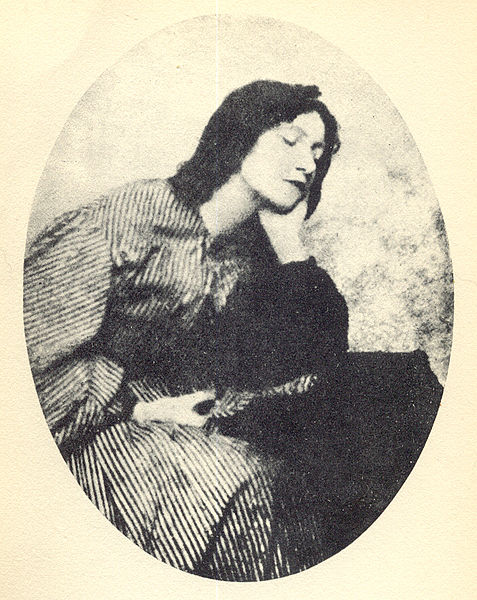
Elizabeth Siddal circa 1860 unknown photographer shared under Wiki CommonsBeata Beatrix Dante Gabriel Rossetti completed 1870.
William Rossetti was a founder member of the Pre-Raphaelite Brotherhood and wrote widely. He was also the biographer of his family. One of Christina’s most famous poems was ‘Goblin Market’ and she also featured in ‘Pre-Raphaelite Sisters.’
I returned to the path but discovered a selection of the rich and famous as I walked up to the Circle of Lebanon.
The epitaph says it allLucien Freud artistJean Simmons actress.- she starred with Kirk Douglas in Spartacus
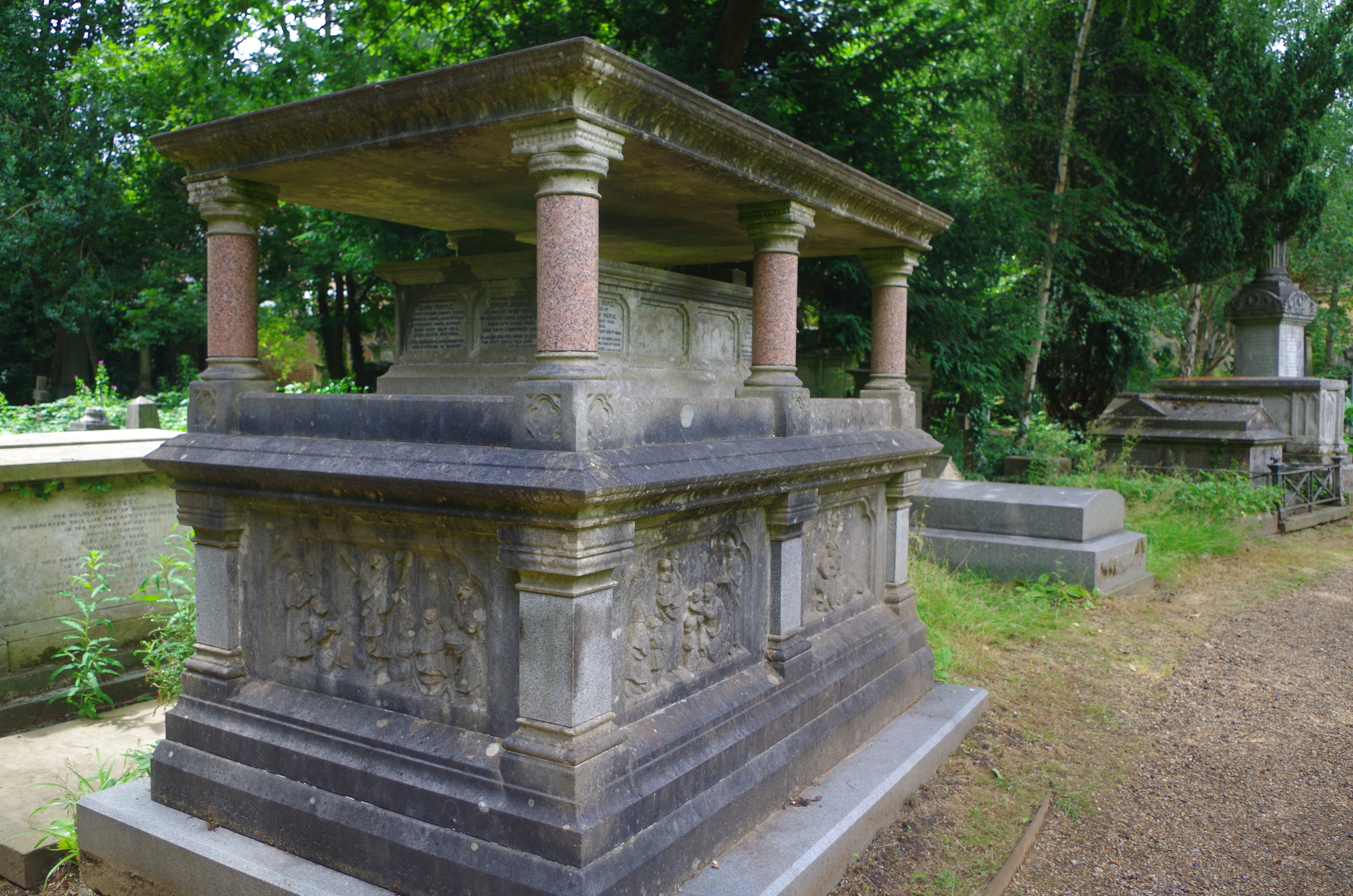
Alas, the venerable 250 year old Cedar of Lebanon after which it was named succumbed to old age in 2019. It was a survivor from the Ashurst estate on which Highgate West was built on and was an impressive sight. Now a wildflower garden stands on the spot. I had come out onto the upper terrace and from there I could see the layout of the Circle much more clearly. There are some impressive monuments here: Nero the lion eternally slumbers on the Wombwell monument. George Wombwell was a Victorian menagarist who owned 3 travelling animal shows. The monument to John Maple features low relief carvings from the life of Christ. He owned a very successful furniture business which occupied a large site on Tottenham Court Road. It no longer exists. The Circle is built in the Classical style and the inner circle contains 20 vaults and another 16 were added in 1870.
The Circle of Lebanon from the upper tier and note the wildflower garden that replaces the Cedar after which the Circle was named.Nero, the lion, guarding the Wombwell monument. The Maples monument on the upper tier of the Circle.
The Terrace catacombs were closed although I have been inside them on a previous visit. By contrast they are in the Gothic style and were built on an existing terrace from the Ashurst estate. The frontage is 8 yards long with room for 825 people in 55 vaults each containing 15 loculi or coffin spaces. I was reduced to peering through a doorway on this occasion before turning to the magnificent Beer mausoleum which was built for his 8 year old daughter, Ada.
The Gothic style terrace catacombsThe Beer mausoleum
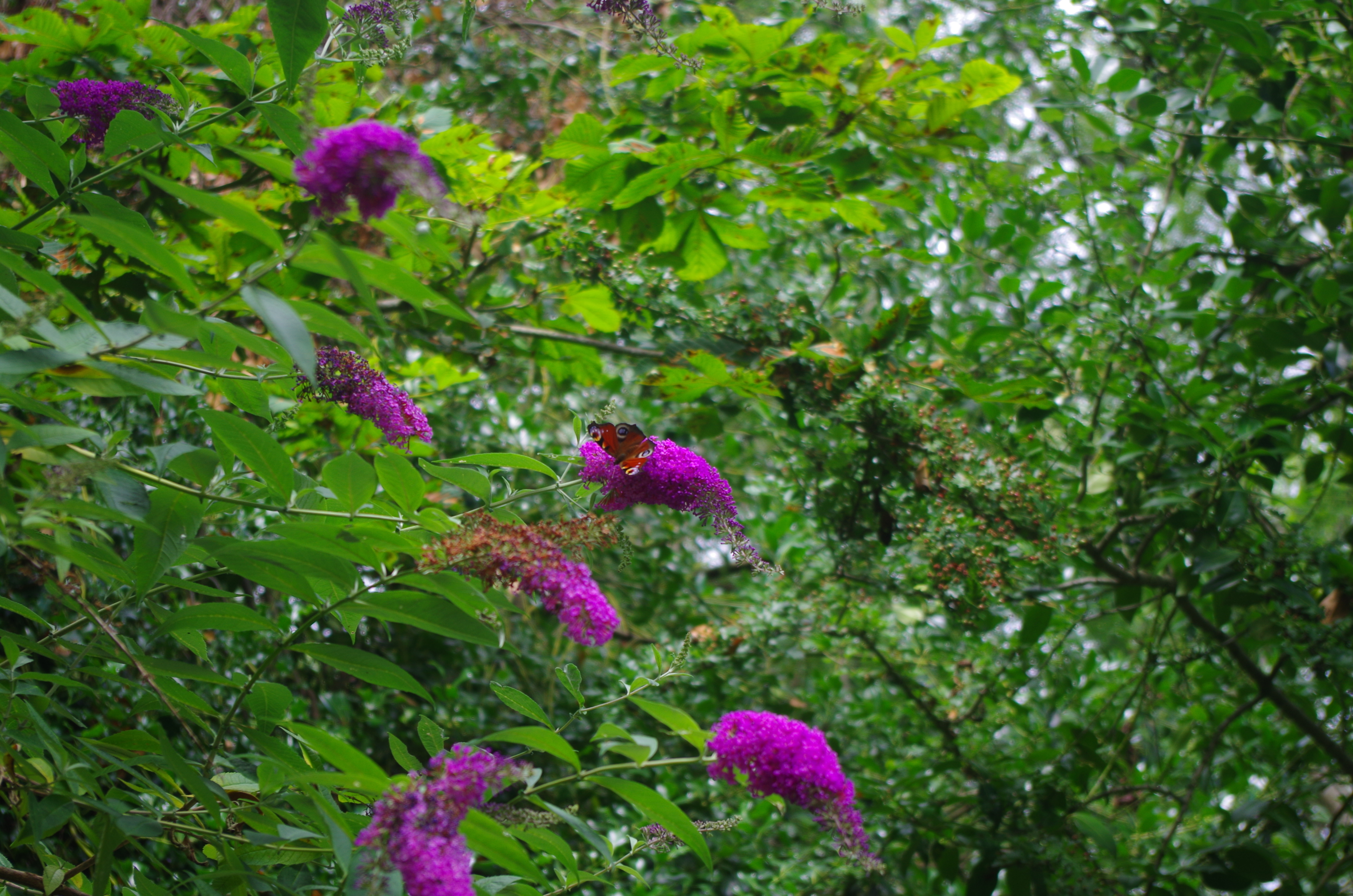
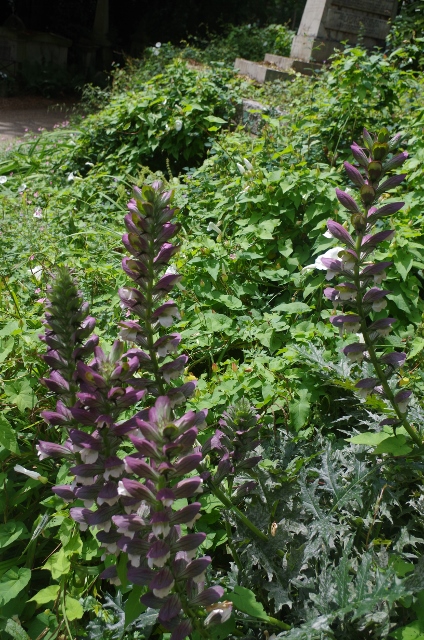
As it was a self-guided tour I had time to admire the summer wildflowers which were growing in profusion. Cemeteries are good places to find these; Acanthus, ragwort, verbena, Ladies Bedstraw, Vipers Bugloss, Rosemary Willowherb and also a buddleia in full bloom studded with Peacock butterflies on Faraday Path.
Peacock tucking into a Budleia blossom on Faraday path.Viper’s BuglossAcanthus
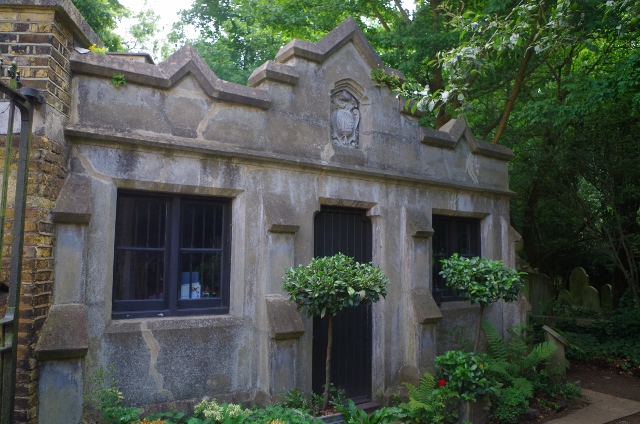
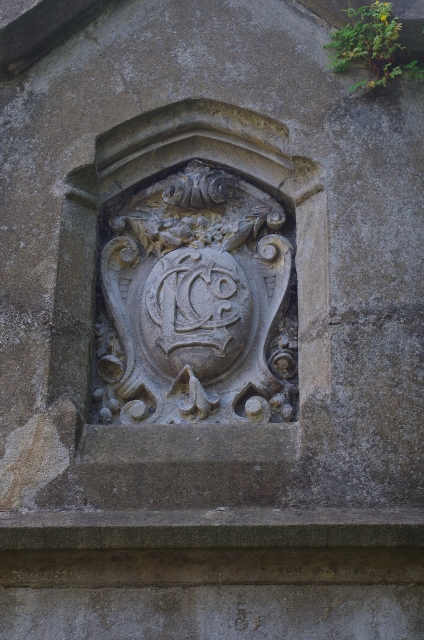
A sidepath from the Circle led me along another path which I’d not previously seen. The atmosphere seemed different and it was certainly darker, perhaps due to a thicker tree canopy, as I walked along it to a gate at the other end. This would have originally opened onto Swain’s Lane and there was what appeared to be a former gatekeeper’s lodge nearby. It still bore the monogram of the London Cemetery Company who were the original owners of Highgate cemetery. Time slips have been reported along this path and I wondered if it was the gate through which a man is reported to look out at unwary passers-by.
A possible former gatekeepers lodgeThe monogram of the London Cemetery Company
I retraced my steps towards the magnificent Egyptian Avenue one of Highgate’s highlights. Tom Sayer’s monument lay to my right with his faithful dog, Lion, eternally keeping guard and then the Sleeping Angel. This is dedicated to Mary Nichols who was a Londoner who died in 1909 from heart failure and diabetes. It’s a lovely tribute.
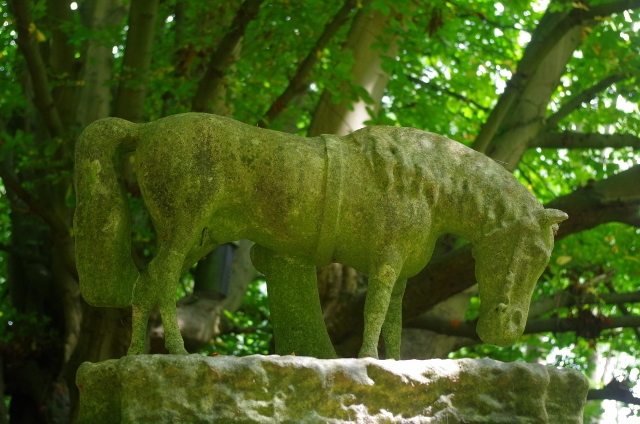
Lion guarding the gave of bare knuckle fighter Tom SayersThe Sleeping Angel on top of Mary NicholsThe Acheler memorial
The horse on top of the Acheler memorial records John Acheler who became wealthy and well known as a ‘Knacker’. He called himself ‘horse slaughterer to Queen Victoria’.
The Egyptian Avenue!
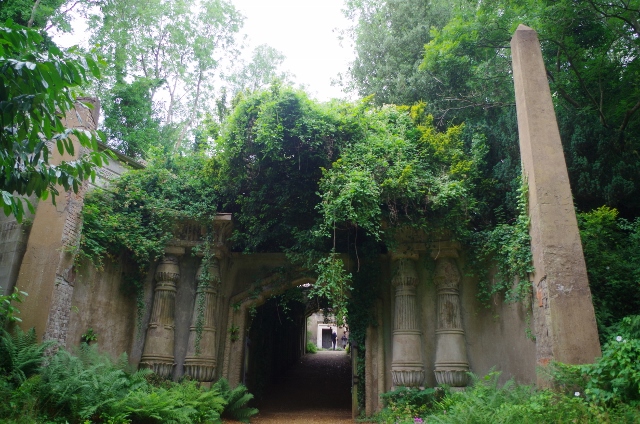
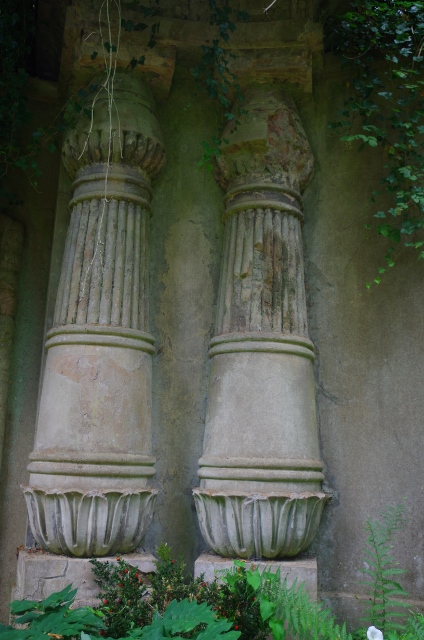
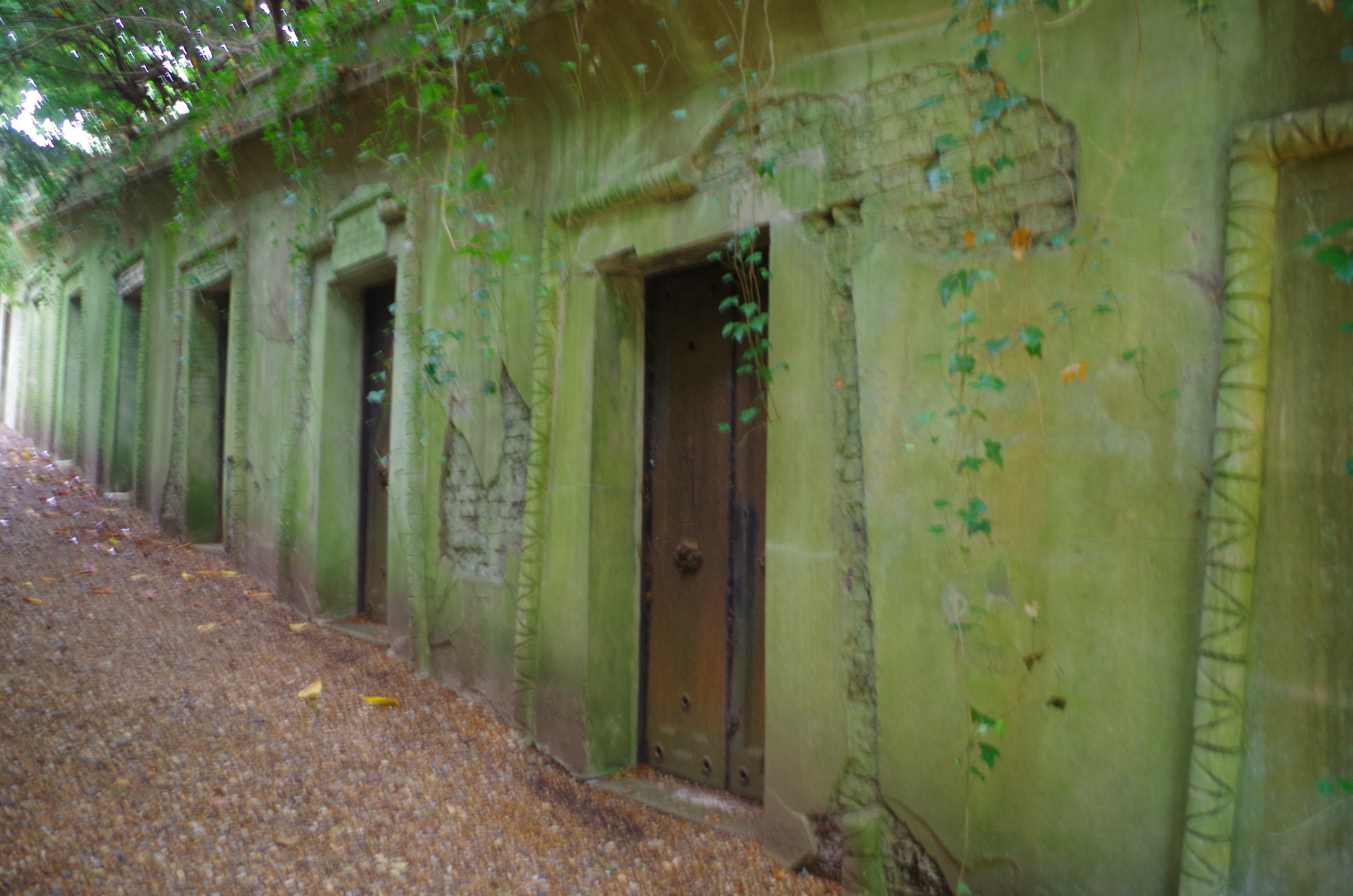
And then the Egyptian Avenue! The centrepiece of Highgate West in my opnion. It may be looking a little tired but it’s a magnificent example of how the Egyptian explorations of the 19th century influenced funerary architecture. Note the two large obelisks flanking the entrance and the stylised lotus flowers on the columns as you enter through the arch and into the passage that will take you into the lower tier of the Circle.
The Avenue was also a catacomb but they were never really popular as other London cemeteries soon realised. After all if Highgate couldn’t sell all theirs then who could? The passage contains 16 vaults on either side which were each fitted with shelves to hold 12 coffins. These were bought by individual families for their own use.
The passage from the Avenue entrance into the Circle of Lebanon.The vaults on either side of the passage.The Circle of Lebanon as you emerge from teh Egyptian Avenue.
By then I thought it was time to explore the East cemetery while I still had the energy.
Wildflowers were also in profusion here: clover, bird’s foot trefoil and vetch Butterflies flew about on the heat of a late summer afternoon.
Bird’s Foot Trefoil – Highgate East
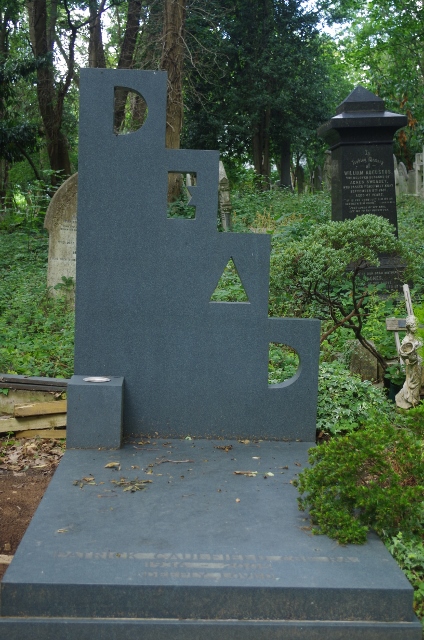
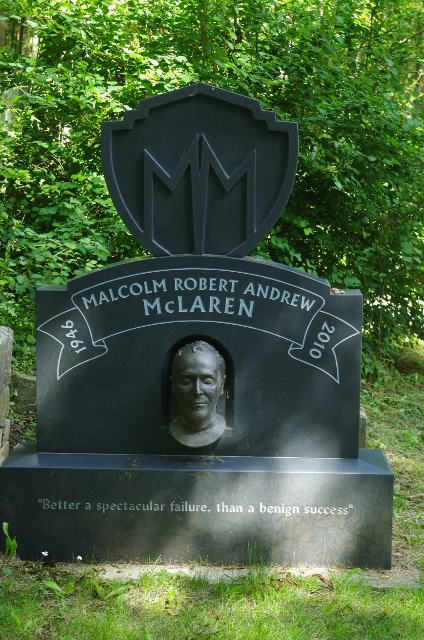
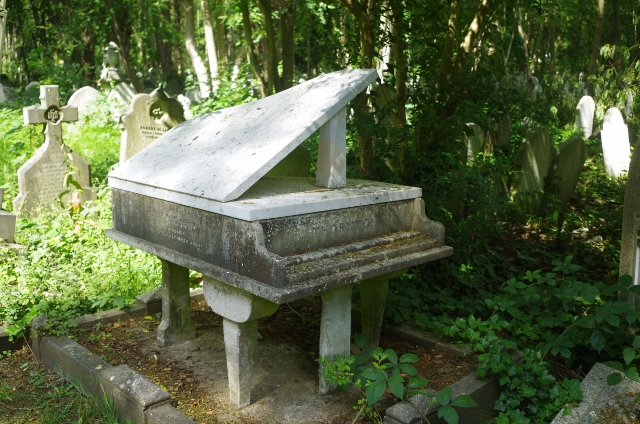
I saw my favourites; Jeremy Beadle, Malcolm McLaren, Karl Marx and Patrick Caulfield. There was also the grand piano dedicated surprisingly enough to a pianist, Henry Thornton, who died in 1918 during the ’flu epidemic.
Jeremy Beadle – Highgate EastPatrick Caulfield – a sense of humourMalcolm MclarenHenry Thornton, a pianist
The East side isn’t as overgrown as the West side and as I explored further I found a memorial which highlighted a dog. This was dedicated to Ann Jewson Crisp and her faithful dog Emperor.
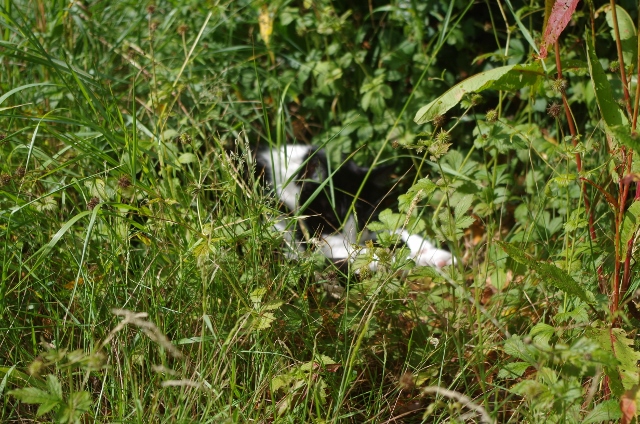
But as I left the East side I spotted another of its more celebrated residents settling down for a siesta behind the Great Train Robber, Bruce Reynolds’, memorial. It was a cemetery cat who was soon hidden deep in the grass and I didn’t want to disturb him or her. What a playground!
A cemetery cat having a kip in the last afternoon sunshine.
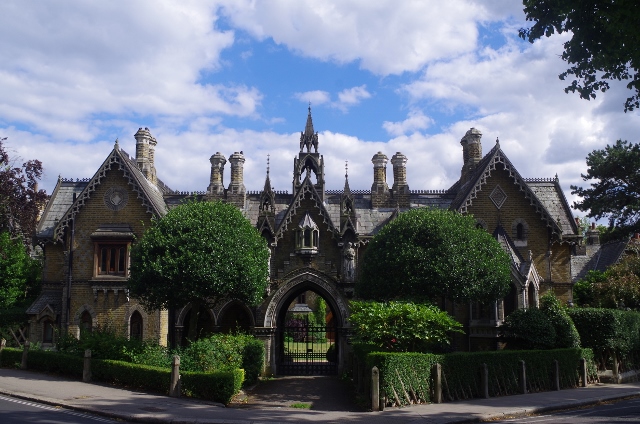
As I left the East Cemetery and walked down Swain’s Lane to Archway tube station I still had time to admire my ideal des res – Holly Village – which was built by Victorian philanthropist, Baroness Angela Burdett-Coutts. It is said that she planned it with Charles Dickens. She built the Burdett-Coutts Memorial Sundial in St Pancras Old Burying ground.
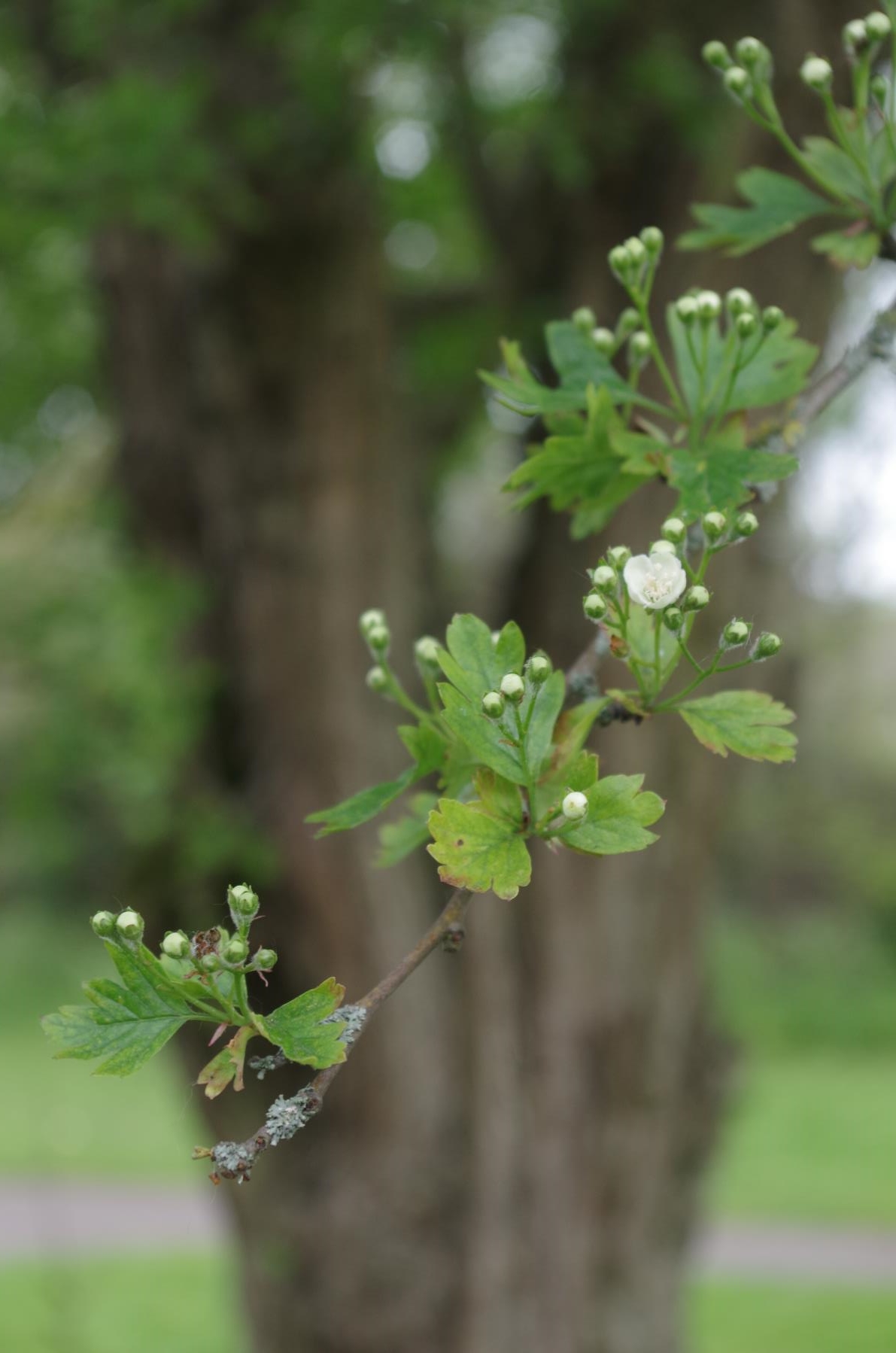
Bring hawthorn blossom indoors and death supposedly will follow.
This is from Folklore Thursday and is about the rural traditions of death omens in Herefordshire. I have always found it incredible that these traditions survive in our modern world. The one concerning Hawthorn blossom is one that I already knew about but you do wonder how they began.
Was it coincidence that, hundred of years ago for example, someone heard an owl screech and a death happened soon afterwards. So the two events became forever linked so that if an owl screeched our ancestors expected a death to happen soon after. Or were our ancestors more in tune with nature than perhaps we are and could read the signs and signals.
In case you were wondering why there hasn’t been much activity on shadowsflyaway recently, it’s because WordPress has had an upgrade. I apparently now have a website instead of a blog.
This wasn’t something that I had anticipated but they have upgraded or updated me so here we are. I’m trying to work out where everything is at the moment. But I’ll get there and be posting away before long.
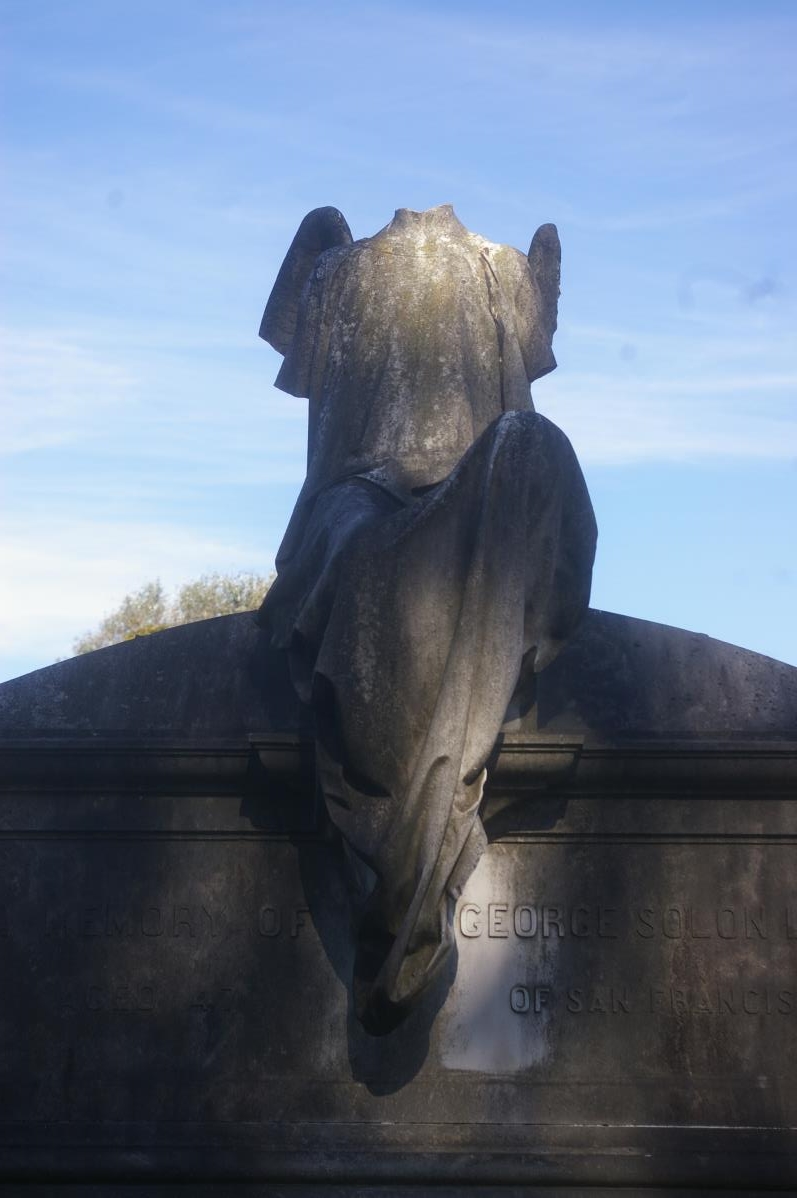
The angel up above is a male angel which is unusual in Victorian cemeteries. He is in Kensal Green Cemetery in London. If you think he look scary or a little creepy without his head, I have seen archive photos of him with a head and, believe me, he doesn’t look any less unnerving!
Unauthorised use or duplication of this material, either photos or text, without written permission from this blog’s author is strictly prohibited. Excerpts and links may be used, provided that full and clear credit is given to shadowsflyaway with a link to the original content.
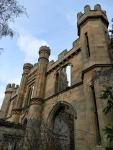
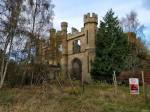
On windy nights, the derelict and romantic ruin that is Crawford Priory is reputed to have a familiar visitor. A wandering spirit walks through the estate which she once owned accompanied by a retinue of the per animals that she knew and loved. This is the ghost of Lady Mary Lindsay Crawford who is rumoured to walk the grounds when the wind is high.
Is she keeping a watch on the crumbling building or her crypt which is a mile away. Or does she see the Priory as it once was with its fine furnishings and decoration and a butler opening the front door to visitors as she, smiling, descends the sweeping staircase to meet them?
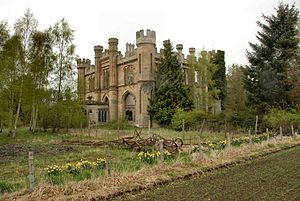
Deep in the Fife countryside lies the shell of a derelict, once grand country house. For over 25 years it has been abandoned to nature which is fast obscuring it from memory and the world. Ivy and saplings have thrust their way through broken windows and doors and a fire in 1995 was the final indignity. In 1997 its current owner applied to have it demolished but it may just eventually fall down by itself.
The cawing of crows or the wind whistling around what’s left of the Gothic styled Crawford Priory are the only sounds that the casual visitor will hear now.
However, it was never actually a priory and no religious order ever lived there. But the name went with the romantic Gothic touches such as the pointed windows and the battlements and so it became one.
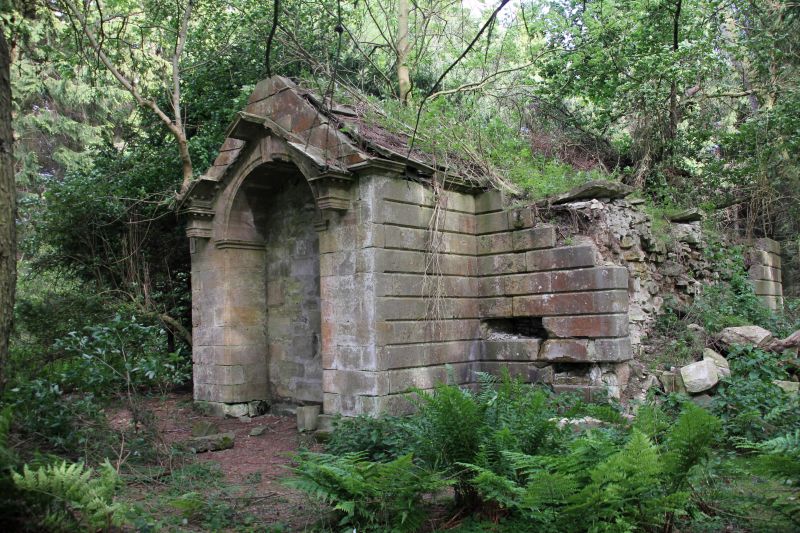
A mile away near Lady Mary’s Wood lies an equally ruinous crypt dedicated to the Priory’s creator and the last of her line, Lady Mary Lindsay Crawford. From urban explorers websites, the last great recorders and finders of the abandoned, the crypt is in no better state than the Priory. Its door is now bricked up although a hole has been made in it and the crypt is falling in on itself. The pet cemetery is rumoured to be still there but I haven’t seen any photos of that while researching this article.
To add to the romance of the place there is also a belief that the pale wraith of Lady Mary drifts across the site as she gathers her pet animals around her. She had the crypt built so that she would always have a good view of the Priory even in death.
I am indebted to a Facebook friend who lives in Scotland with her family. They like to go out and explore the local countryside and share their photos and adventures online. They have been kind enough to give me permission to use their photos to illustrate this article. Crawford Priory was a real gem as it’s the sort of place that I would like to explore myself.
Crawford Priory was originally merely a hunting lodge built by the Earl of Crawford in 1756 and then completely remodelled in the then fashionable style in the early 1800’s. Lady Mary employed well known architects of the time to create it. She died in 1833 and was known as a reclusive, religious woman. The pet cemetery was also created by her to remind her of her favourite animals. They flocked to her and she was frequently attended by tame foxes, birds, dogs, cats and even a pet deer. However, I have been unable to find any images of Lady Mary but she must have been formidable as well as kind. There is a tombstone near the outer wall of the Priory dedicated to a pet deer which is what caught my attention and intrigued me enough to research further.
Lady Mary lived alone, except for her servants, and administered a large country estate as well as the Priory. This included limestone kilns, coal mines and farms amongst other business interests. This was remarkable in the 19th century for a woman alone.
This keen business sense and her managerial abilities led to Lady Mary being regarded as odd and her obituary, according to alex cochrane’s blog, considered her eccentricities as
‘lean’d to the virtue’s side for the cause of humanity .’’
Also, according to adcochrane, a distant relative of the family, quotes from one of Lady Mary#s letters on his blog, in which she says:
‘this hall is raised under bad and awful auspices ‘
and then goes onto to describe how her dog:
‘howled in the most dreadful manner in the next room to the new building…yet in spite of its cries would not leave the dining-room’
It sounds like a page from a Gothic novel as the heroine eats her dinner at a candle-lit dining table while her dog howls and the wind picks up speed around the battlements.
Lady Mary left generous bequests to the local poor, friends, servants and her animals. The Priory then came into the possession of the Earls of Glasgow and the Cochranes The photos on adcochrane’s blog and now in the possession of the Royal Commission on the Ancient and Historical Monuments of Scotland (rcahms for short) reveal how lavishly decorated The Priory’s interior was:
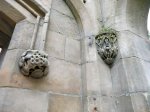
‘The grand hall was magnificently decorated with fan vaulting and hanging pendants; suits of armour stood under canopied gothic niches; medieval style stained glass lit the hall. The drawing room and morning room opened off a rib vaulted chamber decorated with gargoyles, both with gothic fireplaces inlayed with coloured marbles. The principal staircase…was decorated with gilded armorial panels and armorial stained glass of the Earls of Glasgow.” adcochrane
ADcochrane also goes onto recall that
‘The grand bedroom was hung with panels of wallpaper depicting the life of Psyche from the ancient Latin story by Apuleius.’
He adds that in 1990 a lot of the internal decoration was still there but now it’s all gone. Even the sweeping staircase has finally collapsed. To see archive photos of the Priory in its glamorous heyday please visit his blog:
Eventually the Priory became just too expensive to maintain like many country houses. They usually required a retinue of servants to maintain them and after the Second World War these were in short supply. Adcochrane adds that both his godfather and cousin remembered exploring huge unused rooms and clambering about dusty piles of trunks.
In the 1960’s the Prior needed an expensive and major restoration but this never happened. No use has been found for it since and so it was left to lie empty until it fell into its current state.
If Lady Mary does walk in her wood and the Priory grounds then one hopes that she sees the Priory as it was and not how it is now.
Like many others I turned out on a wet Sunday morning to look at the elusive artist, Banksy’s, temporary emporium of homewares in trendy ‘Tech City’ Croydon.
He created ‘Gross Domestic Product” in response to a greeting card company attempting to copyright his name. He was advised that in order to stop it happening he needed to create his own own homeware brand. This is how the shop came into being.
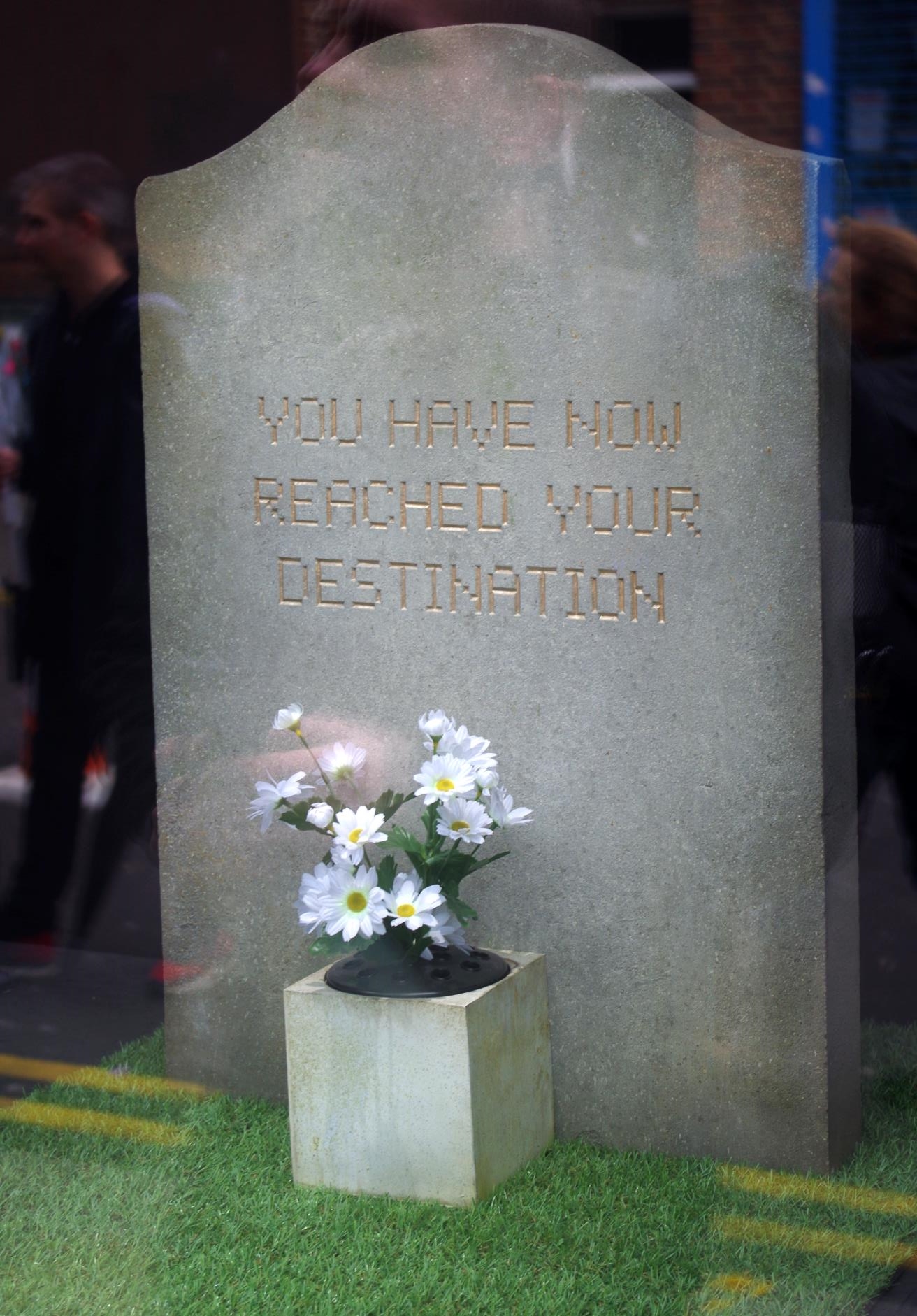
Amongst a baby’s cradle surrounded by CCTV monitors and the Union Jack vest worn by Stormzy at Glastonbury I found this. The epitaph said it all and this is the artists statement on it.
It may soon be available to buy on Banksy’s online store.































 shadows fly away