Symbol of the month – the Tetramorph

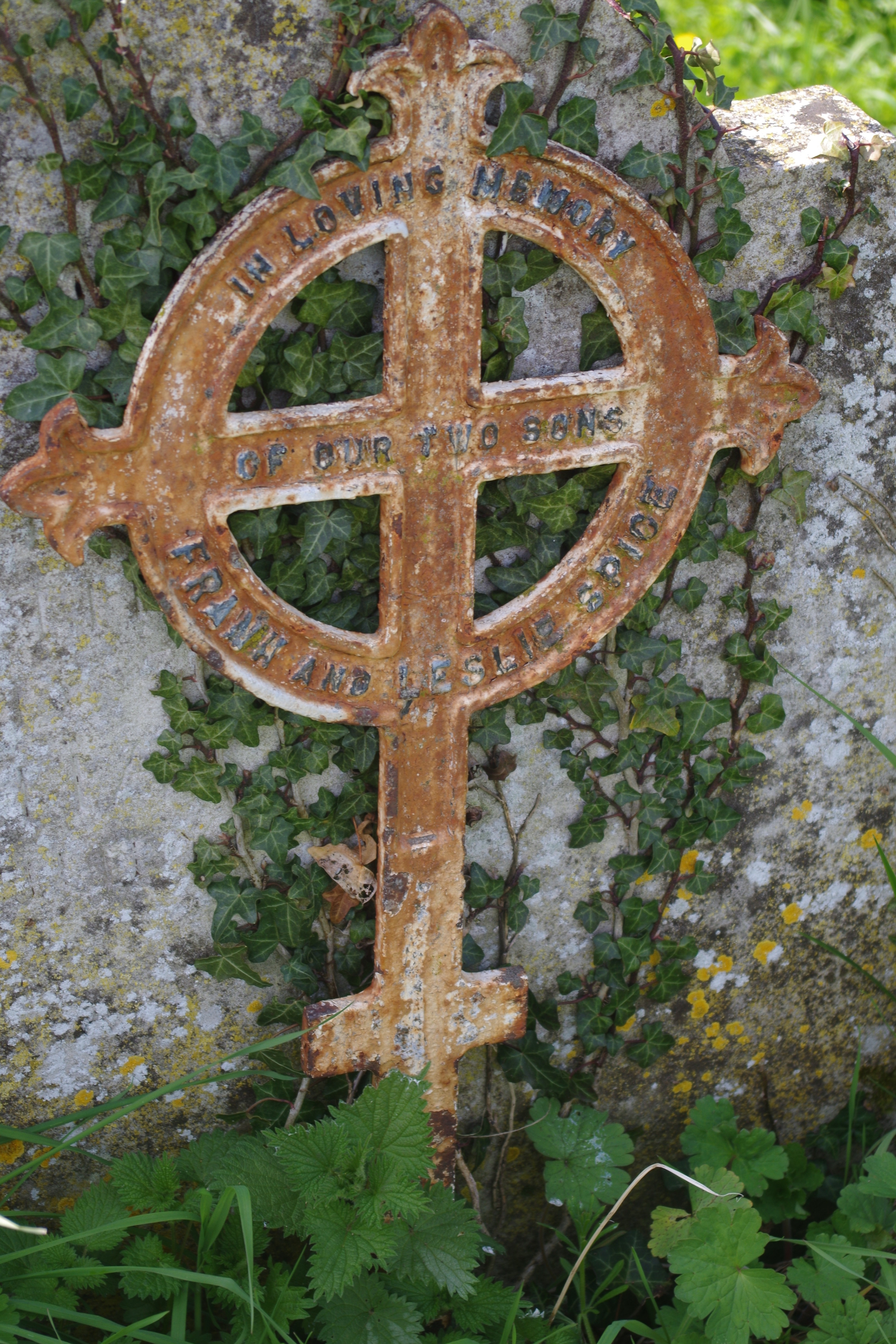
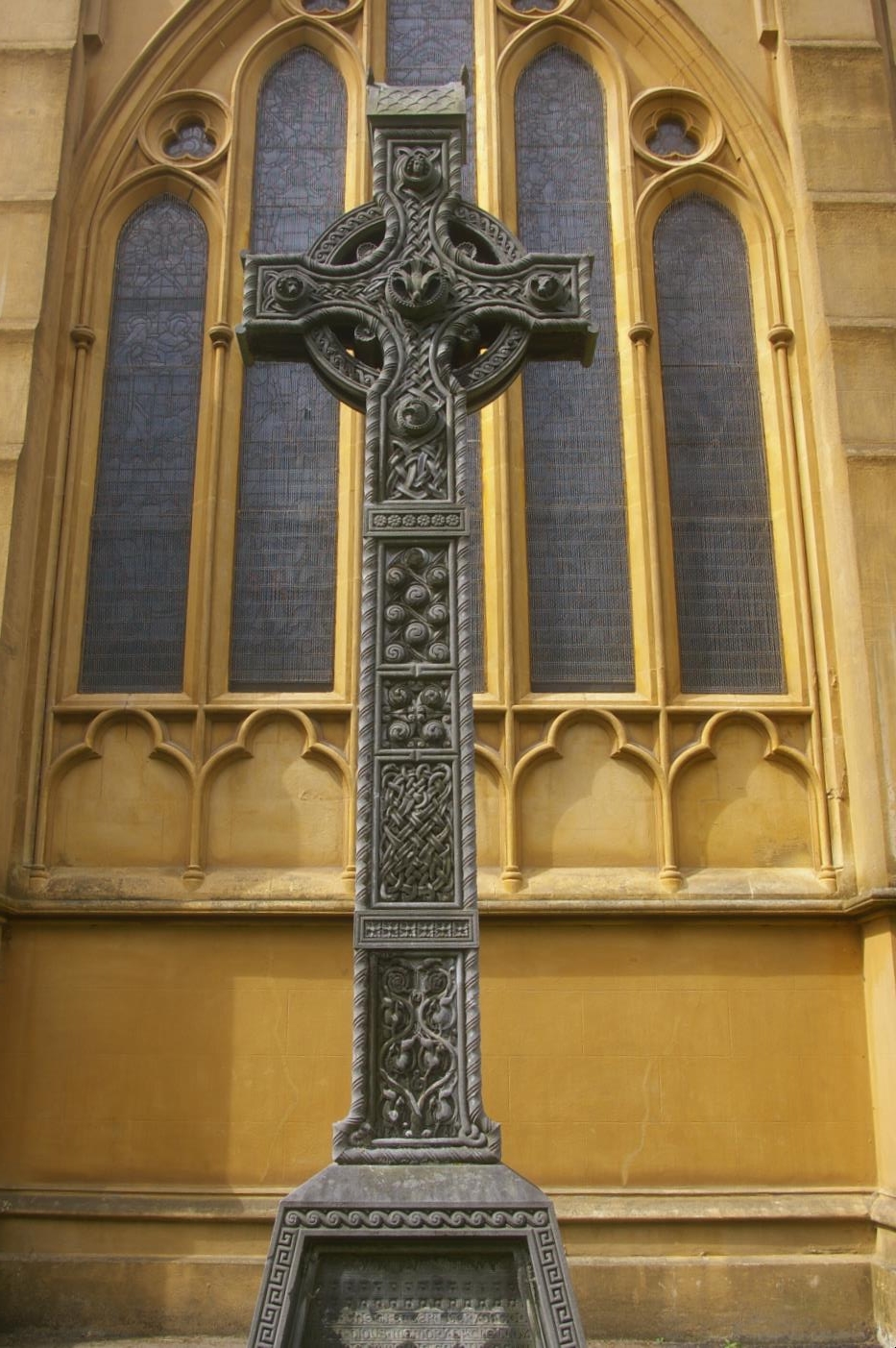
An imposing Celtic Cross Copyright Carole Tyrrell

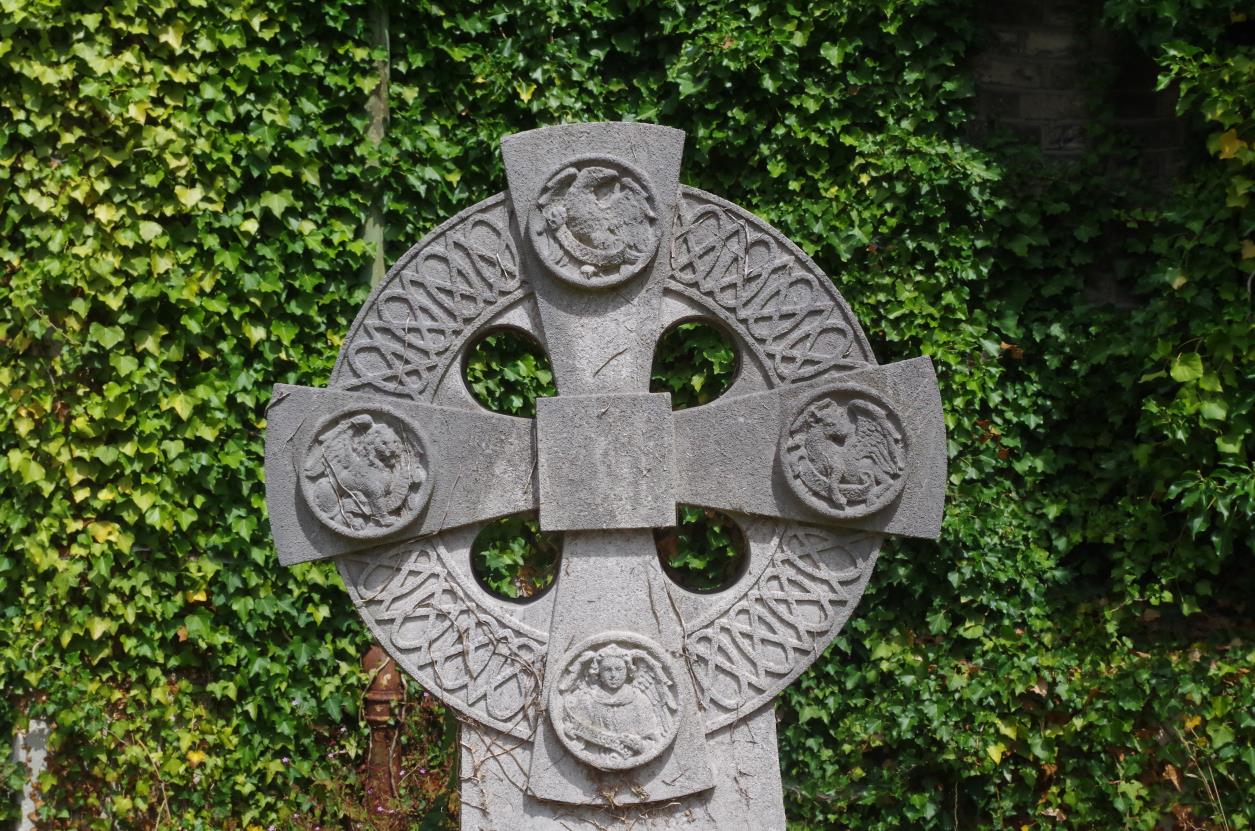
In 2012, I found this beautiful, imposing Celtic Cross in St Margaret’s churchyard which is in Lee, a suburb in south east London.   This is a church and churchyard in two halves.  The remnants of the older building and its churchyard is across the road from its much larger, Victorian replacement.  The older churchyard contains some interesting 18th century memorials and I can recommend exploring if it’s open.

The newer St Margaret’s is also worth exploring if it’s open as it contains Pre-Raphaelite style wall paintings and interesting stained glass. As you might expect, its churchyard mainly contains 19th century memorials as you might expect and then when I went around the back of the church I found this memorial.

This memorial is an example of the Celtic Revival that was popular from 1880-1910 and the Arts & Crafts movement. The epitaph is written in flowing Art Nouveau script and was well worn which rendered it virtually indecipherable. All I could make out was that it was in memory of a deceased wife. This was a real pity as I would have liked to have known more about the person who was buried there and what had happened to her.

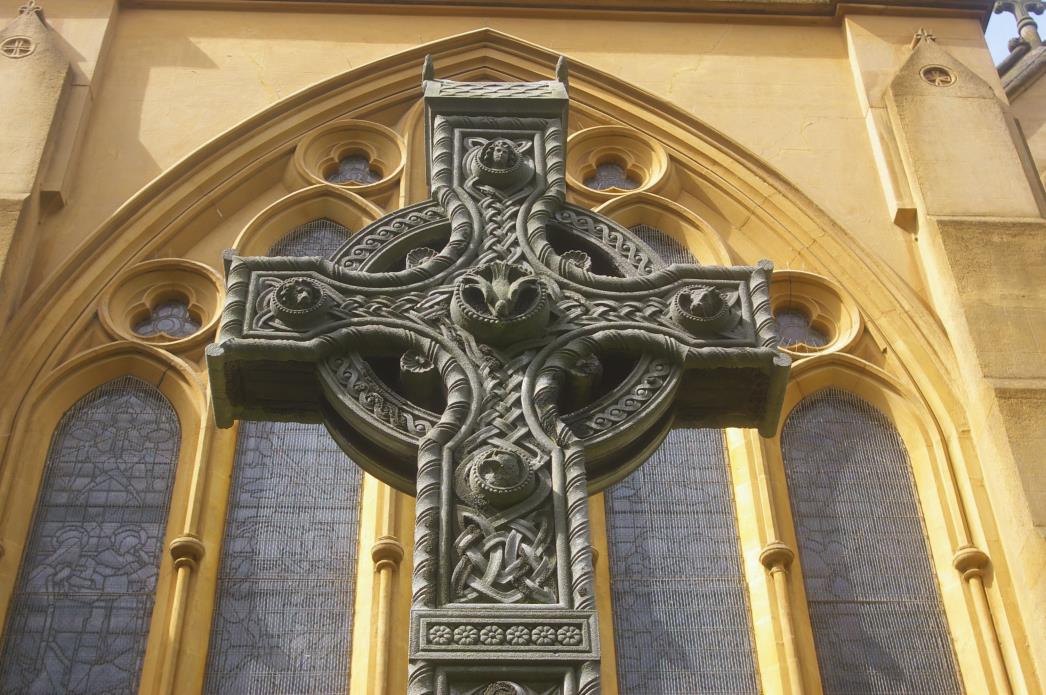
A closer view of the memorial .Copyright Carole Tyrrell
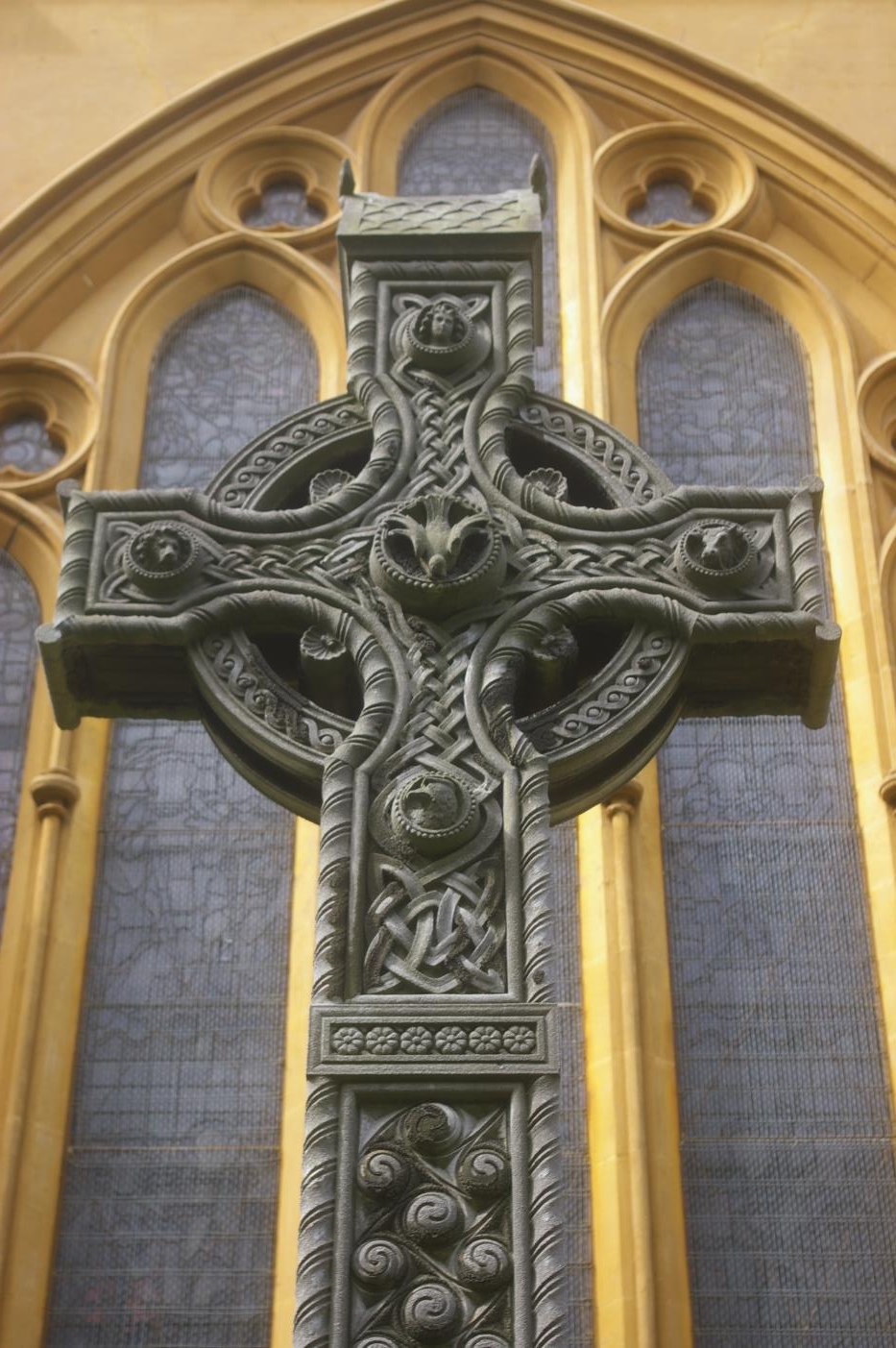
The for symbols of the Evangelists in each corner Copyright Carole Tyrrell

I noticed the four symbols; one on each corner of the cross. An ox, an eagle, a lion and an angel. I’d never previously seen this combination on a funerary monument and thought, in my ignorance, that it might have meant that the deceased had loved animals.

But, after posting my photos of the memorial onto The Cemetery Club Facebook page a fellow member replied saying that she thought that the symbols might represent the four evangelists:

Angel = Matthew
Lion = Mark
Ox = Luke
Eagle = John

These were ‘the four canonical gospels with the four living creatures that surround God’s throne’. I had to consult a Bible website for further information and it referred me to the Book of Revelations. In verses 5-8:

Around the throne, and on each side of the throne, are four living creatures, full of eyes in front and behind,  …the first living creature, like a LION, the second living creature like an OX, the third living creature with a face like a HUMAN face (the angel), and the fourth living creature like a flying EAGLE. King James Bible

The four living creatures are also mentioned in Ezekiel 1: verses 1-1 as well as in other religious texts such as St Irenaeus of Lyons and St Augustine of Hippo.

The four symbols are known as a tetramorph. This is a symbolic arrangement of four different elements and is derived from the Greek tetra, meaning four, and morph, which means shape.


In Christian art, the tetramorph is the union of the symbols of the Four Evangelists, the four living creatures into a single figure, or more commonly, a group of four figures. Portraits of the four evangelists are often accompanied by the tetramorphs or the symbols often used to represent them as in the image below.

Each symbol can be described as a tetramorph in the singular, and a group as the tetramorphs but usually only when all four are together. Tetramorphs were very common in early medieval art especially in illuminated Gospel books. They are still common in religious art up to the present day. Other examples of the combination of different elements are the Sphinx in Egypt which has the body of a lion and the head of a human.

The animals associated with the Christian tetramorph originated in the Babylonian symbols of the four fixed signs of the zodiac; the Ox representing Taurus; the lion representing Leo, the eagle representing Scorpio and the man or angel representing Aquarius. In Western astrology the four symbols are associated with the elements of, respectively Earth, Fire, Water and Air. The creatures of the Christian tetramorph were also common in Egyptian, Greek and Assyrian mythology. Early Christians adopted this symbolism and adapted it for the four Evangelists as the tetramorph, which first appears in Christian art in the 5th century.

There is a tetramorph in Ely Cathedral and also over the entrance door to St Augustine’s church in Kilburn, north London. I have also found two more in London’s Brompton Cemetery but not as well carved and, although large, not quite as imposing.

This was the nicer of the Brompton ones. Copyright Carole Tyrrell


But the one in St Margaret’s churchyard is a lovely monument which is beautifully carved and really stands out in the churchyard due to its size and position.

References and further reading

https://en.wikipedia.org/wiki/Tetramorph

The lion, the bull, the eagle and the angel: the Tetramorph | Museu Nacional d’Art de Catalunya

church history – How did the four living creatures become associated with the Gospel writers? – Christianity Stack Exchange

https://www.kingjamesbibleonline.org/

https://www.biblegateway.com/

https://faithhopebeliefprayersmiracles.blogspot.com/

Symbol of the Month – And With the Morn Those Angel Faces Smile

This is the first one, the Foster memorial, that I encountered in Beckenham Cemetery. The angels faces seem more individual and more finely carved. ©Carole Tyrrell

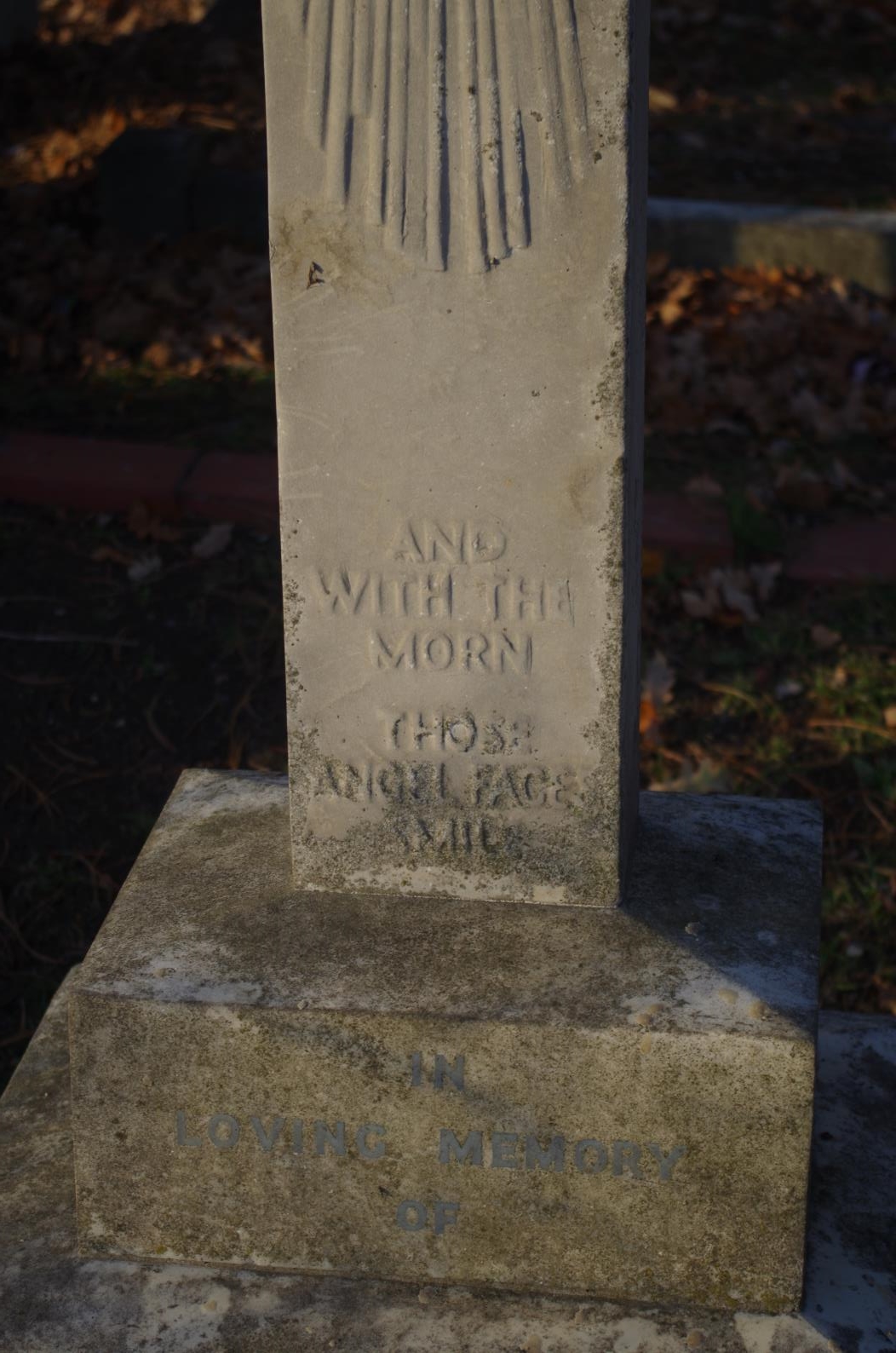
Five child angels, their faces turned to each other, framed by small wings, except for one that was staring out at me, I wanted to reach out and touch them but didn’t want to damage them.   They formed a roundel at the centre of a tall cross with the phrase ‘And with the morn those angel faces smile’ inscribed at the base of its stem.  I was on a tour of Beckenham Cemetery when I first saw them.

Our guide did not comment on them but the monument is in a prominent place on the main road through the cemetery and I often wondered about this pretty and poignant memorial.

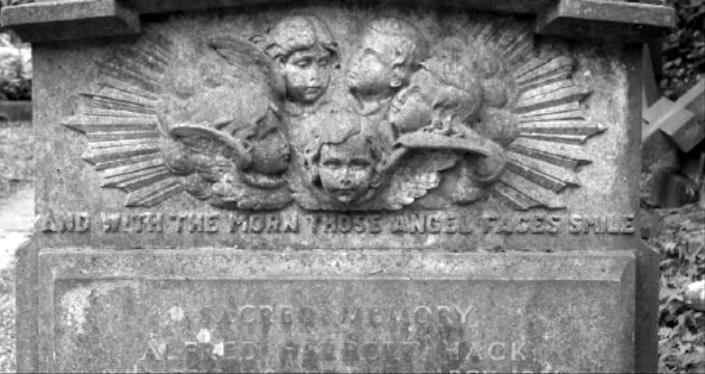
But on a visit to Highgate Cemetery East in 2014 I found another example but on a smaller scale which was on a tombstone dedicated to Alfred Hack and dated 1956. There is a distinctly 1930’s look about the angels from their hairstyles.

I also discovered another version which featured cherubs faces instead of childrens on a visit to Knebworth in 2016. But on a further visit to Beckenham Cemetery in the same year, I found another similar one which was a short distance away from the first.  In this the child angels seem to have more definite, individual faces and the one that has her head towards the viewer is looking downwards instead of outwards.

The line that led me on my quest to find out the origin of this symbol. ”And with the morn those angel faces smile.’ ©Carole Tyrrell

Now I wanted to find out more about the quotation and the angels and my research led me to a Victorian hymn that was sung on the Titanic at its final service on board and by the inmates of Ravensbruck concentration camp as the SS led them in.   The ‘angel faces’ is a quotation from ‘Lead, kindly Light’,  in fact it’s the penultimate line and like ‘Rock of Ages’ it caught the mood of its time.

These are the lyrics:

‘Lead, kindly Light, amid the encircling gloom
Lead thou me on;
The night is dark, and I am far from home,
Lead thou me on.
Keep thou my feet; I do not ask to see
The distant scene; one step enough for me.

I was not for ever thus, nor prayed that thou
Shouldst lead me on;
I loved to choose and see my path; but now
Lead thou me on,
I loved the garish day, and, spite of fears,
Pride ruled my will: remember not past years.

So long thy power hath blessed me, sure it still
Will lead me on,
O’er moor and fen, o’er crag and torrent, till
The night is gone;
And with the morn those angel faces smile,
Which I have loved long since, and lost awhile.’

However, the writer John Henry Newman (1801-90), always refused to reveal the meaning of the ‘angels faces’ or what the ‘kindly light’ actually was.

Originally a poem, it was written by Newman in 1833.  He was then a young theologian and Anglican vicar and was going through a challenging time in his life. Struck down by a fever which nearly killed him while travelling in the Mediterranean, Newman’s  servant was so convinced that he would die that he asked him for his last orders.  But in his autobiography, Newman told him ‘I shall not die, for I have not sinned against light’.

Newman recovered but that wasn’t the end of his troubles.  Desperate to return to England he then took a boat from Palermo to Marseilles only to end up stranded and becalmed in the Straits of Bonifacio. Exhausted and frustrated Newman wrote the poem, ‘The Pillar of the Cloud’ that, in 1845, became ‘Lead, Kindly Light’.  Newman was not happy about this as by then he’d converted to Catholicism and hymn singing wasn’t included as part of divine service.  He went onto become Cardinal Newman, one of the most important figures in English Catholicism, and also an important writer. In 1900 Elgar set Newman’s poem ‘The Dream of Gerontius’ to music.

Cardinal Newman as John Newman eventually became after his conversion to Catholicism. This celebrated portrait is by Sir John Everett Millais. In the public domain in UK – from the National Portrait Gallery wkipedia

‘Lead, Kindly Light’ has struck a chord with those in danger or about to enter the endless dark realm and needed the comfort of a light leading their way through it.  Miners awaiting rescue from deep underground  during the 1909 Durham mining disaster sang it  as did the  passengers on one of Titanic’s lifeboats  when the rescue ship, Carpathia,  was sighted the morning after.  It caught the Victorian mood perfectly as did ‘Rock of Ages’ and Queen Victoria asked for it to be read as she lay dying.  It also inspired a celebrated painting by the Scottish artist, Sir Joseph Noel Paton in 1894 in which the angels are pensive young woman.

But why did one line from this song inspire two monuments in Beckenham Cemetery and one in Highgate East?  I noticed that both of the Beckenham monuments were on children’s graves and that the carved angels were also children. Perhaps the mourning relatives left behind may have wanted the consolation that their beloved children would be waiting for them when their time came.

This is the Pace memorial which is sited on the main road through the cemetery. The epitaph was difficult to read as worn but it was also to much missed children. ©Carole Tyrrell

The first one is the Foster family monument.  The epitaph is now virtually unreadable but I could make out the name ‘Francis Frederick’ carved along the base.    There are two inscribed ‘Books of Life’ placed on top of the grave.  One is dedicated to John Francis Foster and Alice Gladys Alice Chapman and the other is dedicated to John Francis Foster and Alice Emma Foster.

The second one is the Pace family monument and is to the two daughters of Henry William and Elizabeth Pace.  These were Lilian Alice who died in 1888 and Grace Irene who died in 1903.  Strangely enough they both died at the same age and Elizabeth herself is commemorated here as she died at 33 in 1912.

The epitaph on the Pace monument. It’s dedicated to the 2 daughters of Henry and Elizabeth Page., Lilian died in 1888 and Grace in 1903 and at the same age. ©Carole Tyrrell

This is the one in Highgate East dedicated to Alfred Hack and dated 1956.

This is a much smaller version on a tombstone in Highgate East Cemetery. ©Carole Tyrrell

However the symbol has been adapted to feature cherubs as in St Mary’s, Knebworth’s churchyard. These are on the tombstone of the Lutyens family’s nanny, Alice Sleath.

This version is from St Mary’s churchyard, Knebworth. They are on the tombstone of Alice Louisa Sleath (1873-1938)who was ‘for forty years the beloved friend and nannie of the Lutyens family’. Sir Edwin Lutyens did much work on Knebworth House and in the surrounding area. Here they are more like cherubs. ©Carole Tyrrell

But I am indebted to Douglas Keister’s Stories in Stone for the possible origins on the image of the angels.

The composition of the five heads may have been adapted from  a painting by Sir Joshua Reynolds PRA entitled ‘Heads of Angels Miss Frances Gordon’ which was painted during July 1786 – March 1787.  The sitter was the then 5 year old Frances Isabella Keir Gordon (1782-1831) who was the only daughter of illustrious parents. They were Lord William Gordon (1744-1823) and his wife Frances Ingram (1761-1841), second daughter of Charles, 9th Viscount Irvine (1727-78), who were married on 6 March 1781. Her uncle was Lord George Gordon (1751-93), whose political activities had sparked the anti-Catholic riots of 1780.

‘Heads of Angels Miss Frances Gordon’ by Sir Joshua Reynolds PRA 1786-1787. . This is in public domain wilki creative commons

Frances’ mother outlived her by 10 years and the painting was then presented to the National Gallery.  It was enormously popular and was reproduced on numerous decorative items and photographic reproductions such as ‘The Cherub Choir.’

And so a poignant and powerful symbol was created from the combination of a great painting, an inspirational hymn and Victorian taste and led to the two lovely memorials to much missed children in Beckenham Cemetery..

©Text and photos Carole Tyrrell unless otherwise stated.

References and Further Reading

http://www.telegraph.co.uk/culture/music/3668066/The-story-behind-the-hymn.html

https://en.wikipedia.org/wiki/Lead,_Kindly_Light

http://www.thebeautybag.net/videos/angel-faces-smile/

‘A Child’s Portrait in Different Views: ‘Angel’s Heads’‘, Sir Joshua Reynolds, 1786–7 | Tate

Stories in Stone, Douglas Keister,  2006, Gibbs Smith

Symbol of the month – The Good Samaritan

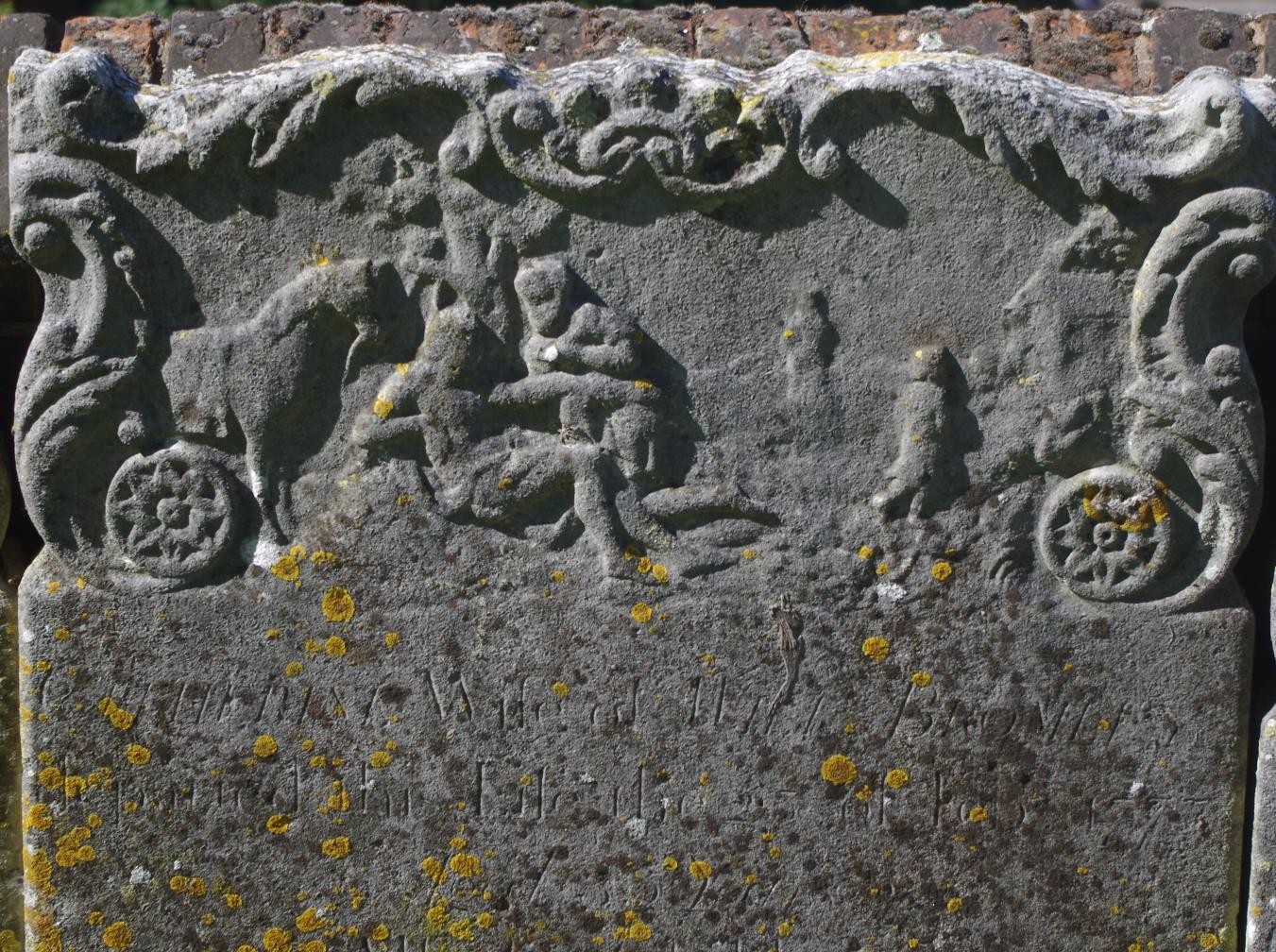
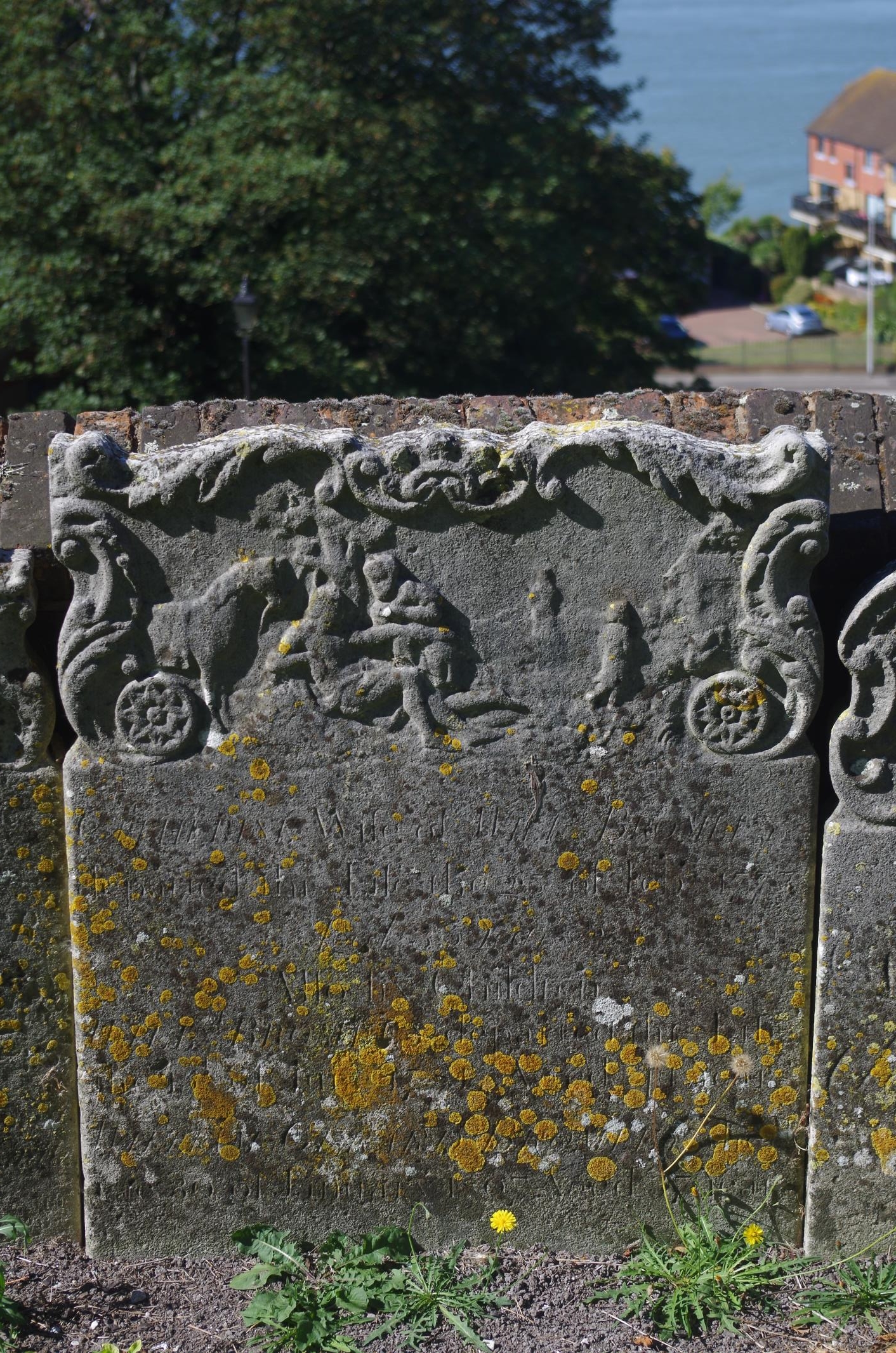
A Closer view of the Good Samaritan image. ©Carole Tyrrell
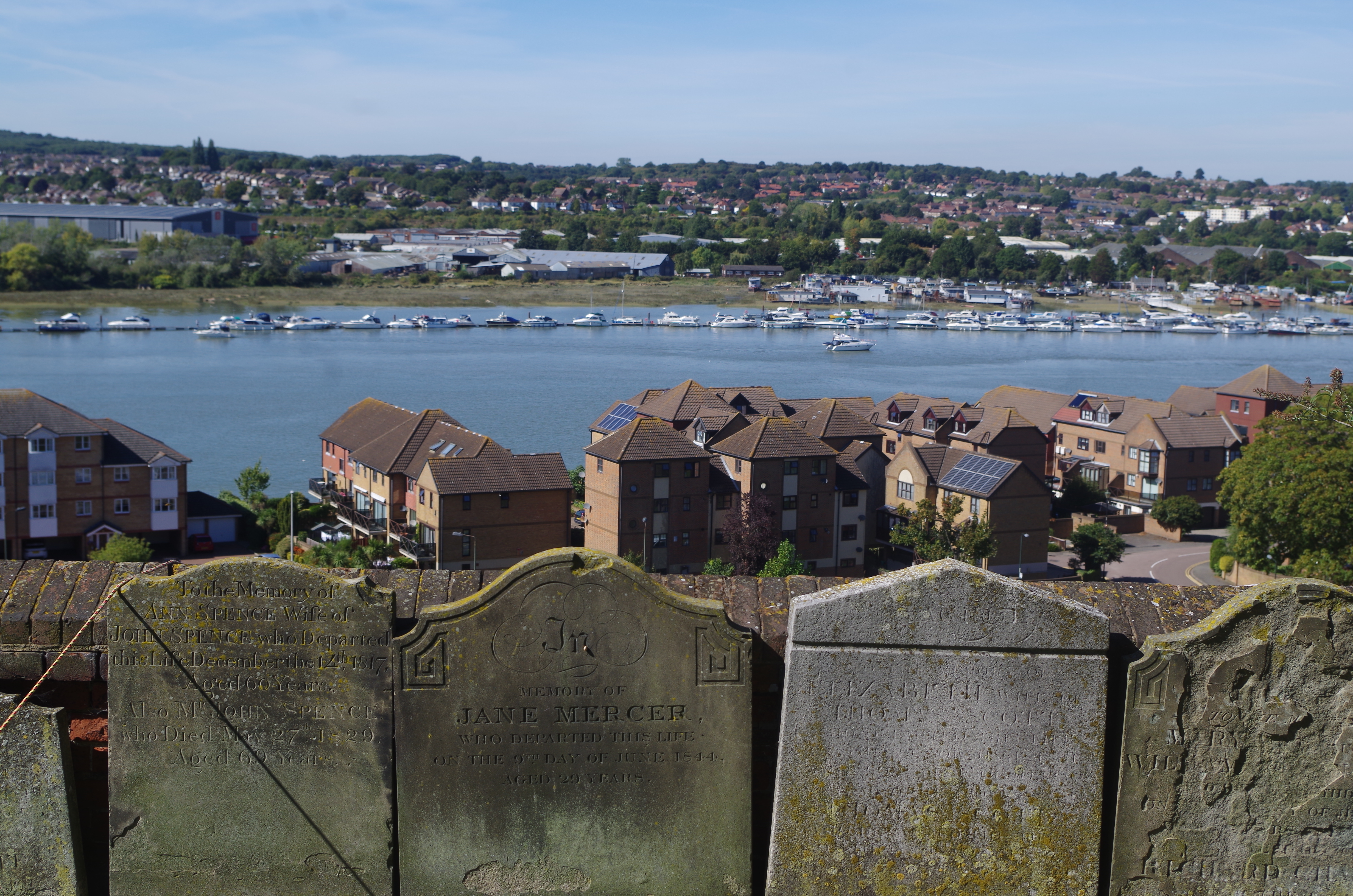
The row of tombstones along the wall of St Margaret’s Church, Rochester. ©Carole Tyrrell

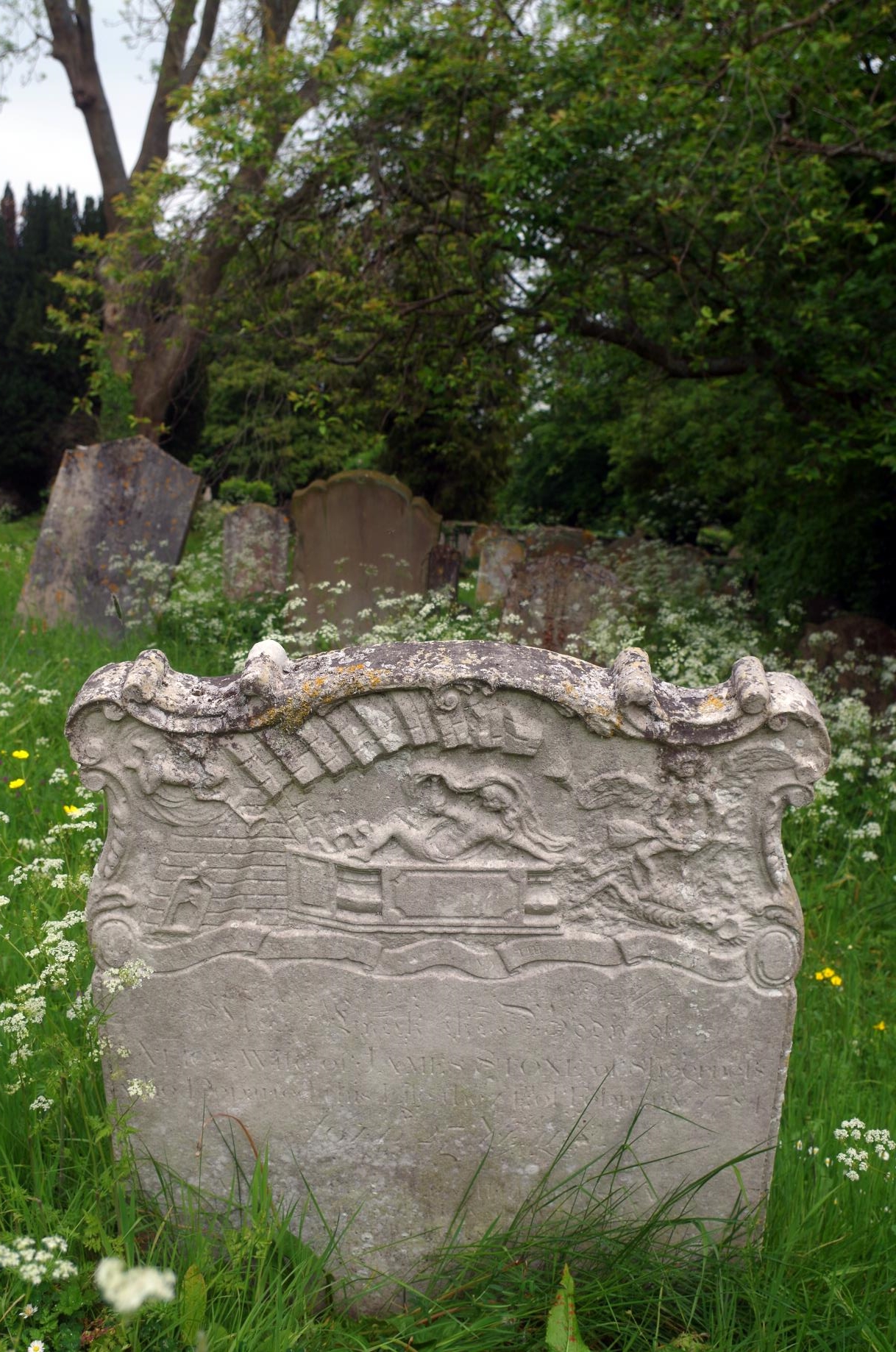
The tombstones in St Margaret’s churchyard, Rochester are arranged like teeth along one wall. It faces out onto the Medway and, if you’ve got the strength, to look over there’s also a steep slope beneath. But it was here that I found the Good Samaritan headstone.  Never underestimate the power of a lovely sunny day to really bring out the beauty of a good carving.

A man is depicted on it, lying half naked being comforted by another man while a horse, presumably the victim’s, stands nearby.  In the distance two figures, presumably men, walk away with their backs to the scene.  It’s a well carved little picture and  I immediately thought of Parable of the Good Samaritan.

The epitaph beneath the carving. ©Carole Tyrrell

I am indebted to the Kent Archaeological; Society for the transcript of the epitaph. .  Even at 400% magnification, all I could make out was

‘…….Wife….

….this life…

…1777…..

…Children..’

It actually reads:

(In memory of)

Catherine Wife of Will Bromley

Departed this life

The ( ) Feb 1777

aged 33 years

Also Six Children

Will Bromley

departed this life

( ) June 1783 aged 41 years

Also William Gerrad Bromley died

the 30th of January 180(7) aged (36 years)

The Parable of The Good Samaritan comes from the Gospel of Luke, verses 10:25-37 and here is a shortened version taken from the World English Bible:

‘Jesus answered, “A certain man was going down from Jerusalem to Jericho, and he fell among robbers, who both stripped him and beat him, and departed, leaving him half dead. By chance a certain priest was going down that way. When he saw him, he passed by on the other side. In the same way a Levite also, when he came to the place, and saw him, passed by on the other side. But a certain Samaritan, as he travelled, came where he was. When he saw him, he was moved with compassion, came to him, and bound up his wounds, pouring on oil and wine. He set him on his own animal, and brought him to an inn, and took care of him. On the next day, when he departed, he took out two denarii, gave them to the host, and said to him, ‘Take care of him. Whatever you spend beyond that, I will repay you when I return.’ Now which of these three do you think seemed to be a neighbor to him who fell among the robbers?”’

He said, “He who showed mercy on him.”

Then Jesus said to him, “Go and do likewise.”

The Samaritan who stopped to help is described as Good but in reality Jews and Samaritans hated each other. They were known to destroy each other’s temples but few people have heard of the Samaritans nowadays. According to Wikipedia, the parable is now:

…….often recast in a more modern setting where the people are ones in equivalent social groups known not to interact comfortably. Thus, cast appropriately, the parable regains its message to modern listeners: namely, that an individual of a social group they disapprove of can exhibit moral behaviour that is superior to individuals of the groups they approve.’

At the time in which the Parable is set, the Jerusalem to Jericho road was known as ‘The Way of Blood’ due to the amount of blood that was spilt on it from attacks on travellers by robbers.  It was extremely dangerous.  In fact Martin Luther King Jr in his ‘I’ve been to the Mountaintop’ speech given the day before his death, had more sympathy for the Levite and priest who ignored the victim and went on with their journeys. He described the road as:

‘As soon as we got on that road I said to my wife, “I can see why Jesus used this as the setting for his parable.” It’s a winding, meandering road … In the days of Jesus it came to be known as the “Bloody Pass.” And you know, it’s possible that the priest and the Levite looked over that man on the ground and wondered if the robbers were still around. Or it’s possible that they felt that the man on the ground was merely faking, and he was acting like he had been robbed and hurt in order to seize them over there, lure them there for quick and easy seizure. And so the first question that the priest asked, the first question that the Levite asked was, “If I stop to help this man, what will happen to me?’’]

Wikipedia

The old road from Jerusalem to Jericho. Shared under Wiki Commons

There are several other interpretations of the Good Samaritan parable and if you are interested you can find them here: https://en.wikipedia.org/wiki/Parable_of_the_Good_Samaritan

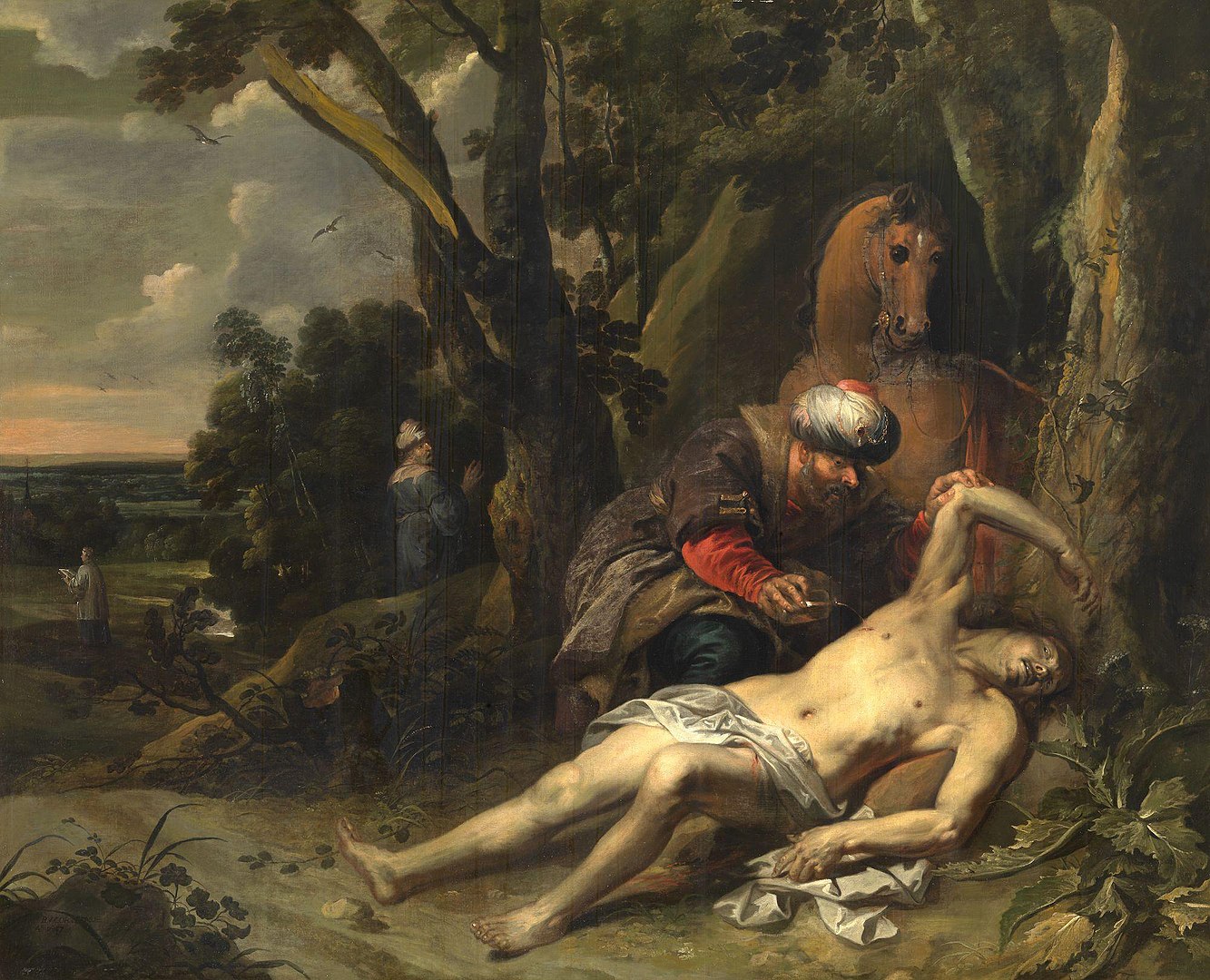
The phrase ‘Good Samaritan’ has become part of modern language and denotes someone who helps a stranger. There are several worldwide hospitals named after him and it has inspired art, fiction, photography and sculpture amongst others.   This is a 17th century painting from 1647

Bathasar van Cortbernde The Good Samaritan (1647) Shared under Wiki Commons

and here is a modern sculpture from Nova Scotia.

Monument to William Bruce Almon by Samuel Nixon St Paul’s Church Nova Scotia 2019 Shared under Wiki Commons

However, the only images that I could find that resembled the headstone carving were from 19th century bibles which were much later than the carving on the headstone. This is taken from the 1875 Children’s Picture Bible Book.

This image come from the Children’s Picture Bible Book 1875. Shared under Wiki Commons

So was the wife or the husband buried in St Margaret’s churchyard the Good Samaritan or was the image chosen to remind the viewer to be one to their fellow men?  We may never know.

©Text and photos Carole Tyrrell unless otherwise stated

References and further reading:

https://en.wikipedia.org/wiki/Parable_of_the_Good_Samaritan

https://www.kentarchaeology.org.uk/research/monumental-inscriptions/rochester-st-margarets-church#03

Wildlife in cemeteries – the dark side of the snowdrop

It’s snowdrop time again and already they are beginning to put out their heads and make passers by feel that Spring is finally on its way. But there’s more to snowdrops than their pristine white colour.

February 2 was Candlemass and it seemed appropriate to revisit an older post featuring one of the first, and perhaps one of the most symbolic, flowers to appear in the New Year….

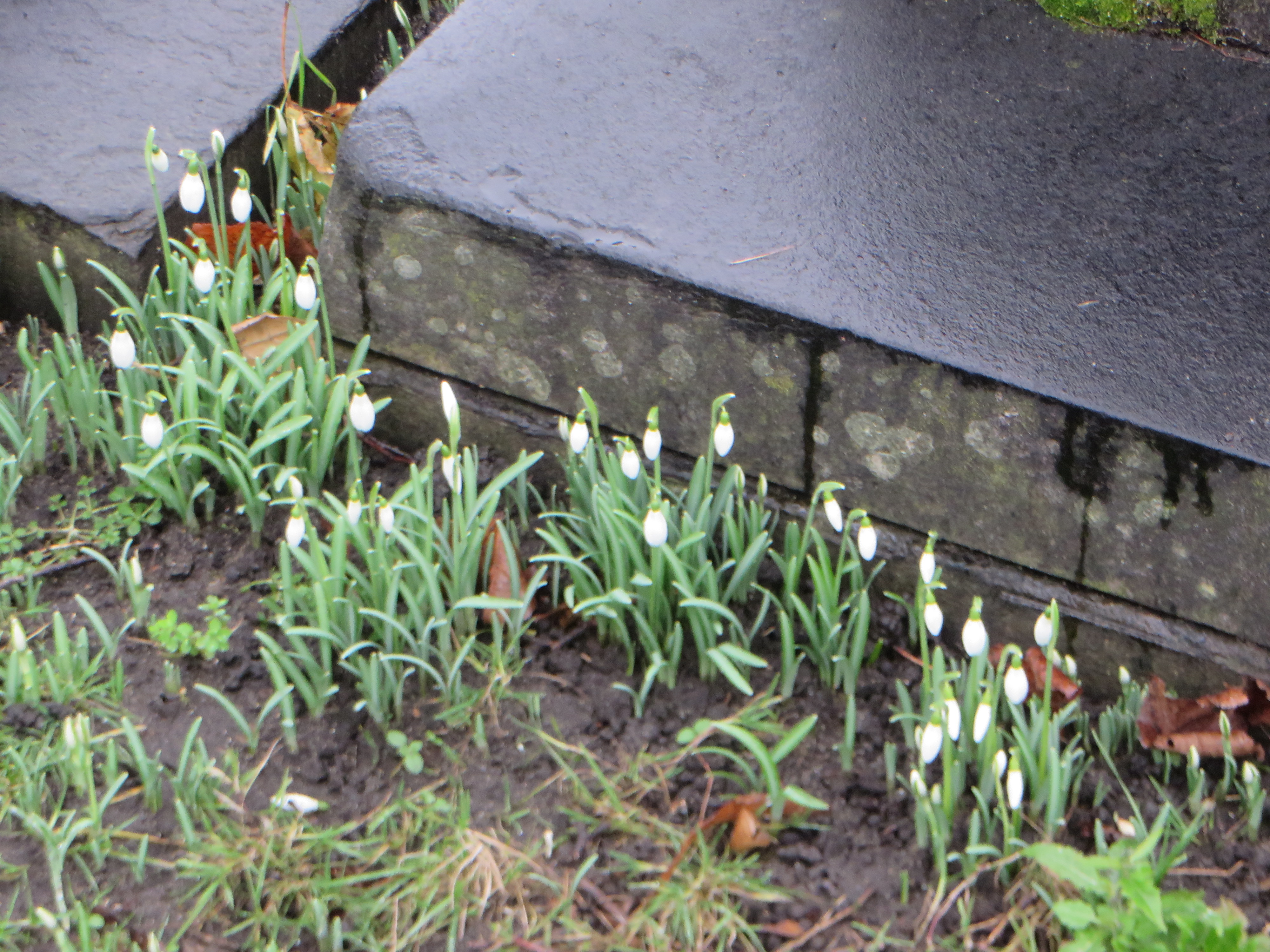
Snowdrops in St George’s churchyard, Beckenham. ©Carole Tyrrell

Imagine yourself in a gloomy medieval church on the festival of Candlemass. You, and your fellow parishioners, have each brought your candles to be blessed by the priest and, after the procession which will fill the church with light, they will all be placed in front of a statue of the Virgin Mary.   Candlemass marked the end of winter and the beginning of Spring and the blessing is to ward off evil spirits.  It traditionally falls on February 2 and is shared with the Celtic festival of Imbolc.  And in the churchyard outside you can see green shoots forcing their way up through the hard winter earth.  The snowdrop’s milk-white flowers show that spring is on its way as they begin to emerge into the light.

The placing of the lit candles in front of the Virgin Mary’s statue gave the snowdrop one of its many other names – Mary’s Tapers.  But there are many others such: Dingle Dangle, Candlemas Bells, Fair Maids of February, Snow Piercer, Death’s Flower and Corpse Flower.

Snowdrops, Brompton Cemetery, January 2018 ©Carole Tyrrell

The snowdrop’s appearance has also inspired many comments . According to the Scottish Wildlife Trusts website they have been described as resembling 3 drops of milk hanging from a stem and they are also associated with the ear drop which is an old fashioned ear ring.  Anyone who has seen a group of snowdrops nodding in the wind will understand what they mean.   The snowdrop’s colour is associated with purity and they have been described as a shy flower with their drooping flowers.  However, the eco enchantments website reveals that the flower is designed in this way due:

‘to the necessity of their dusty pollen being kept dry and sweet in order to attract the few insects flying in winter.’

Snowdrops have been known since ancient times and, in 1597, appeared in Geralde’s ‘Great Herbal where they were called by the less than catchy name of ‘Timely Flowers Bulbous Violets’.  Its Latin name is Galanthus nivalis.  Galanthus means milk white flowers and the nivalis element translates as snowy according to the great botanist, Linnaeus in 1753.   In the language of flowers they’re associated with ‘Hope’ and the coming of spring and life reawakening.

However, yet despite all these positive associations, the elegant snowdrop has a much darker side. Monks were reputed to have brought them to the UK but it was the ever enthusiastic Victorians who copiously planted them in graveyards, churchyards and cemeteries which then linked them with death.  Hence the nickname name ‘Death’s Flower.’

They were described by Margaret Baker in the 1903 ‘Encyclopedia of Superstitions, Folklore and the Occult of the World’ as:

‘so much like a corpse in a shroud that in some counties  the people will not have it in the house, lest they bring in death.‘

So that’s where the ‘Corpse Flower’ nickname came from.

Snowdrops, St George’s Beckenham. ©Carole Tyrrell

Snowdrops are also seen as Death’s Tokens and there are several regional folk traditions of connecting death with them. For example in the 19th and early 20th centuries it was considered very unlucky to bring the flower into the house from outside as it was felt that a death would soon occur.  The most unlucky snowdrop was that with a single bloom on its stem.    Other folk traditions were described in a 1913 folklore handbook which claims that if a snowdrop was brought indoors it will make the cows milk watery and affect the colour of the butter.  Even as late as 1969 in ‘The Folklore of Plants’  it was stated that having a snowdrop indoors could affect the number of eggs that a sitting chicken might hatch.  A very powerful plant if these are all to be believed – you have been warned!

It’s amazing that this little flower has so many associations and legends connected with it but I always see it as a harbinger of spring, rebirth and an indication of warmer days to come.

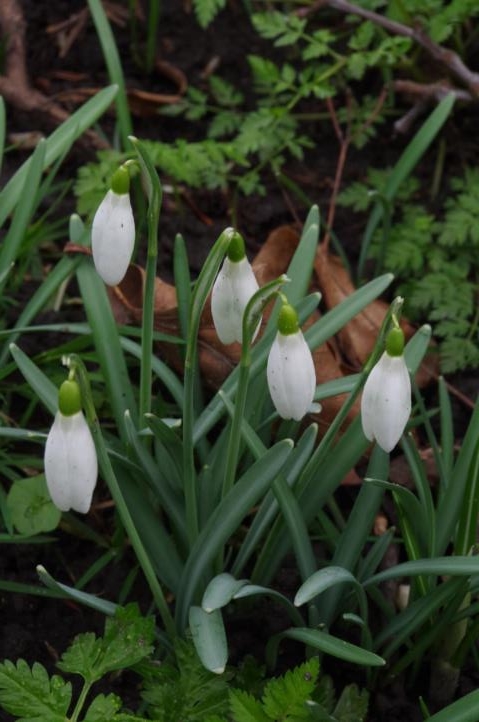
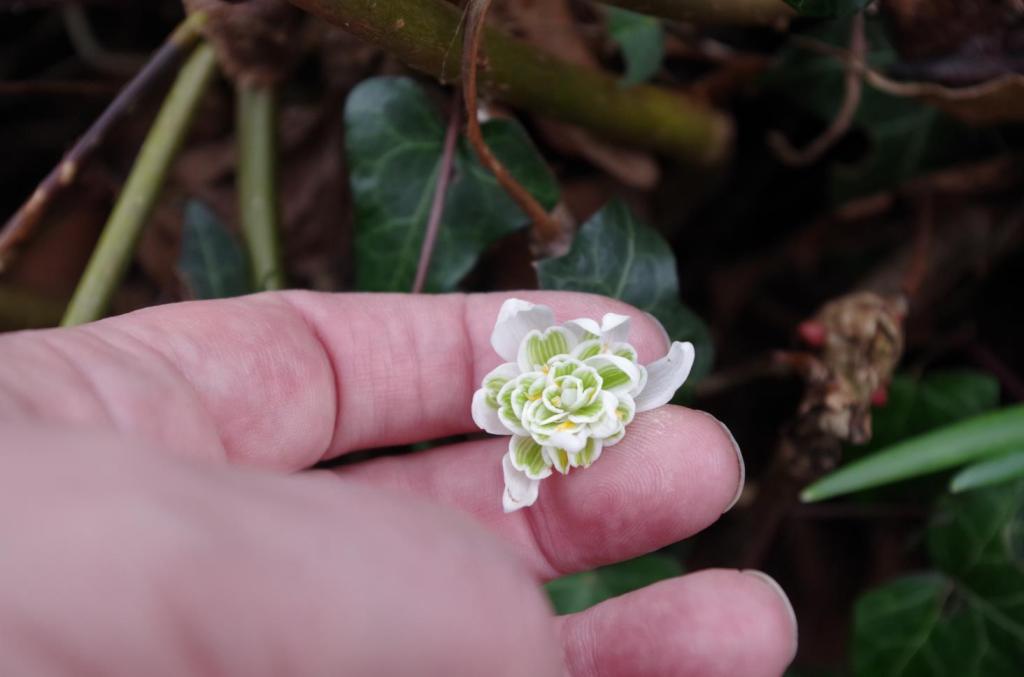
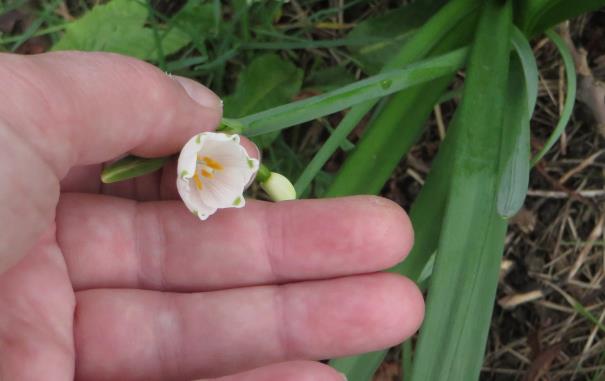
But the snowdrop also has a surprise.  This came courtesy of the Urban Countryman page on Facebook – not all social media is time wasting!  If you very gently turn over a snowdrop bloom you will find that the underside is even prettier and they also vary depending on the snowdrop variety.

Here is a small selection from my local churchyard and one from Kensal Green cemetery.

So don’t underestimate the snowdrop – it’s a plant associated with life and death but watch out for your hens and the colour of your butter if you do decide to tempt fate…..

©Carole Tyrrell text and photos unless otherwise stated

References:

http://www.plantlore.com

http://www.independent.co.uk/environment/naturestudies/bright-in-winters-depths-why-the-flawless-flower-of-candlemas-is-ajoy-forever-8483967

http://www.flowermeaning.com/snowdrop-flower-meaning

http://www.ecoenchantments.co.uk/mysnowdropmagicpage.html

Faith, Hope and Love – The Queen Alexandra memorial, Marlborough Road, London Part 2

Queen Alexandra’s memorial ©Carole Tyrrell

The memorial is set into the garden wall of Marlborough House which had been Queen Alexandra’s London home and was sculpted in bronze by Alfred Gilbert who also designed the Eros monument in London’s Piccadilly.  Alix’s memorial was his last great work and he worked on it during 1926-1932. It was his biographer who brought him back to England after his scandalous flight to Bruges with creditors chasing after him. He had left the tomb of Alix’s son, the Duke of Clarence, unfinished after going wildly over budget. It’s in Prince Albert’s Chapel near St George’s Chapel in Windsor. The tomb was also in the Art Nouveau style and is wildly extravagant. The Duke lies on top of the tomb dressed in a Hussar uniform while above him a kneeling angel bends over him to place a crown upon his head. Alix never fully recovered from his death and kept the room in which he had died as a shrine. So Gilbert was an obvious choice for Alix’s memorial despite Edward loathing him.  After 20 years of silence, it was presumed that Gilbert was dead.  However, he had been living in Rome on a Civil List pension. But, despite his antipathy to Gilbert, Edward knighted him and made the Royal Academy re-admit him. And, finally, the missing figures in the Duke’s tomb were completed.

Alfred Gilbert by Frederick Hollyer 1887. Shared under Wiki Commons

Arthur Sanderson, drawing of the tomb of the Duke of Clarence, Prince Albert’s Chapel, near St George’s Chapel, Windsor. from Pinterest.

Queen Alexandra’s memorial has been adapted from Perpendicular Gothic architecture with 3 buttressed and pinnacled canopies over the 4 allegorical figures and linenfold motifs on the screen behind them.  On either side of the central figure there are 2 more smaller figures; one holds a cross and represents Religion and the other has no attribute. The two pillars on either side of the figures have lamps in them at the top and I imagine the effect must be quite ghostly and mysterious at night.

The figure called ‘Religion’ ©Carole Tyrrell

The unattributed figure ©Carole Tyrrell

Faith ©Carole Tyrrell

Hope ©Carole Tyrrell

Love Enthroned ©Carole Tyrrell

I think it’s a Marmite statue in that you either love it or loathe it and, admittedly, it’s not for everyone. The four figures, all female, remind me almost of a Pieta as they surround a young girl whose arms are in the shape of a cross. I am indebted to the Victorian Web who quote Richard Dorment’s comments on the composition:

The four figures, all female, two of whom appear to be asleep, and three are crowned. In the central group, the crowned woman behind the young girl represents ‘Love Enthroned’ and she is supported by Faith and Hope on either side of her.  She is directing a young girl on the cusp of womanhood setting out across the river of Life which springs from beneath her throne.  This represented Alix’s charity to children and her coming to Great Britain across the water from Denmark.  

The three crowned women are bowing and ministering to the young girl and the central figure draws out the child’s limp arms to form a cross.’ The Victorian Web, Richard Dorment

Dorment then goes onto compare elements of the memorial’s composition to the depiction of the Lamentation which is:

‘where three women who either attend the prostrate Virgin Mary at the foot of the cross, or mourn over the body of the dead Christ at the Crucifixion.’

He also adds that:  

‘Now we come to the girl whom he positions between the legs of the figure of Charity. In Renaissance painting the placement of an infant or adult between its parent’s knees symbolises parturition and therefore descent from the preceding generation: the placement of the child in the Alexandra monument implies that she is born from a Trinity of Faith, Hope and Charity and that the Queen, who possessed, all these virtues, has passed them on to a younger generation of women’

The Victorian Web, Richard Dorment

I think that it’s an interesting interpretation and I haven’t found any others with different meanings.

The memorial was described at its unveiling in 1932 as having ‘

‘A ghostly, neo Gothic appearance’

and

‘inspected from across the road, it was of great bronze doors to an Italian cathedral’

On the bronze base are the words:

‘a tribute of the Empire’s love 1925.’

and

 ‘Faith, Hope and Love. The Guiding Virtues of Queen Alexandra

is inscribed on the granite base. and the memorial. in its enigmatic way, is a representation of it.  When I visited a cut rose and a bunch of roses lay on top of it, presumably in tribute.

Inscription to Queen Alexandra ©Carole Tyrrell

Survey of London – Whitechapel Volume New Royal London Hospital. Statue to Her Majesty Queen Alexandra.

There is a more conventional statue of Alix in the grounds of the London Hospital in Whitechapel. She was its President, was keenly involved in its work and was reputed to have visited the Elephant Man while he was a patient there.  In 1904 she introduced the Finsen light cure for Lupus to England and presented the first lamp to the hospital. The statue was erected by the Friends in 1908. But I know which one I prefer. 

Queen Alexandra memorial ©Carole Tyrrell

©Text and photos Carole Tyrrell unless otherwise stated.

References and further reading:

Alexandra Rose – Our mission is to give families access to fresh fruit and vegetables in their communities

https://www.londonremembers.com/memorials/queen-alexandra-statue

https://www.rct.uk/collection/people/queen-alexandra-of-the-united-kingdom-1844-1925#/type/subject

https://www.findagrave.com/memorial/7467/alexandra_of_denmark (info on children etc)

https://monumentaustralia.org.au/themes/people/imperial/display/33671-prince-and-princess-of-wales

https://cgregoryroses.com/princess-alexandra-potted-uk-rose  -the Alexandra rose

https://www.nationaltrustimages.org.uk/image/552667

https://www.lieder.net/lieder/get_text.html?TextId=45876  words to Ode written by John Masefield music by Elgar

https://www.hastings.gov.uk/parks_gardens_allotments/parks/alexandra/ Alexandra Park Hastings – details of opening

https://victorianweb.org/sculpture/gilbert/38.html

https://www.kat58.co.uk/the-marriage-of-the-prince-of-wales-with-princess-alexandra-of-denmark/ statue of Alexandra in Whitechapel within the ground sof the London Hospital

https://statues.vanderkrogt.net/object.php?webpage=ST&record=gblo194 useful quote

Queen Alexandra – SW1 : London Remembers, Aiming to capture all memorials in London

Caroline’s Miscellany: The guiding virtues of Queen Alexandra (carolineld.blogspot.com)

Queen Alexandra Memorial – Marlborough Road, London, UK – Figurative Public Sculpture on Waymarking.com  

Alfred Gilbert – Wikipedia

Faith, Hope and Love – The Queen Alexandra memorial, Marlborough Road, London Part 1

The Queen Alexendra memorial ©Carole Tyrrell

People pass by Queen Alexandra’s memorial every day on their way to and from the Mall.  It’s set back from the road in an alcove and is a rippling Art Nouveau composition, if bronze can be said to ripple.  I am indebted to the Tea and Morphine facebook page for featuring it and as soon as I saw it and found its location I knew I had to go and see it.  I love Art Nouveau and there was an air of mystery to the sculpture.  Who were the figures?  Who was Queen Alexandra? The memorial is very close to the royal monument section of the Mall and, on my way, I passed tourists busily snapping away at memorials of George VI and the Queen Mother as well as walking along the Diana, Princess of Wales, memorial walk. Buckingham Palace is only a short walk away.

But this particular monument is to a Queen who lives on in the many, many memorials to her in every road, avenue, street, park, hospital and even another palace high up in the North London hills that have been named after her. There are 67 Alexandra Roads in London alone. This memorial has a tale to tell of a scandalous sculptor who was persuaded back from exile and ignominy to create his last major work to commemorate the longest serving Princess of Wales in history.

Queen Alexandra as the Princess of Wales in 1881 by Alexander Bassano. Shared under Wiki Commons

Christian IX of Denmark with his family in 1862. From left to right Dagmar, Frederick, Valdemar, Christian IX, Queen Louise, Thyra, George and Alexandra. Shared under Wiki Commons

Princess Alexandra Caroline Marie Charlotte Louise Julia (1844-1925) or ‘Alix’ as her family knew her was chosen, aged 16, as the future wife of Albert Edward, Prince of Wales, the son and heir of Queen Victoria.  18 months later they married in 1863 and were crowned in 1902 after Queen Victoria’s death. Alix came from Danish royalty as her father was King Christian IX and her brother was appointed King of Greece as George I.  She was Princess of Wales for 38 years from 1863-1901 and was immensely popular. Fashion conscious women copied her dress sense but she had no political power. 

Instead, she worked tirelessly for various causes and founded her own charity, the Alexander Rose, in 1912 which aimed to support Londoners in poverty.   It’s still going today but, since 2014, it has issued Rose vouchers to enable families to access fruit and vegetables. Alix’s great, granddaughter, Princess Alexandra is its patron. I can still remember buying paper roses on stick pins in June in the 1970’s for Alexandra Rose Day and there is still an Alexandra Rose plant. Alix brought the idea of selling paper roses from her native Denmark.

Princess Alexandra Rose from an online seed catalogue.

But Alix’s marriage was not a happy one. Edward was openly unfaithful with several mistresses, one of which was the actress Lily Langtry. The public believed that their marriage was a love match but Queen Victoria and Prince Albert, Edward’s parents, had begun looking for a possible wife in 1858 believing that an early marriage would settle a ‘difficult’ son.  The couple had 6 children, one of whom died after a day and the Duke of Clarence, who had been second in line to the throne, died after an influenza pandemic, aged 28.  There were many rumours about the Duke including that he was thought of as a possible suspect for Jack the Ripper. Alix suffered from increasing deafness which was caused by hereditary otosclerosis and died at Sandringham in 1925 aged 81 from a heart attack. Poet John Masefield wrote an ode dedicated to her with music from Sir Edward Elgar called ‘So many true Princesses who have gone’:

So many true princesses who have gone

Over the sea, as love and duty bade,

To share abroad, Till Death a foreign throne,

Have given all things, and been ill repaid.

Hatred has followed them and bitter days.

But this most lovely woman and loved Queen

Filled all the English nation with her praise;

We gather now to keep her memory green.

Here, at this place, she often sat to mark

The tide of London life go roaring by,

The day-long multitude, the lighted dark,

The night-long wheels, the glaring in the sky.

Now here we set memorial of her stay,

That passers-by remember with a thrill:

This lovely princess came from far away

And won our hearts, and lives within them still.

Photo ©Carole Tyrrell

©Text and photos Carole Tyrrell unless otherwise stated.

Part 2 – The scandalous sculptor of the memorial, Alfred Gilbert, and the possible meaning of the figures.

Symbol(s) of the Month – A quiver of Arrows and garland of oak leaves

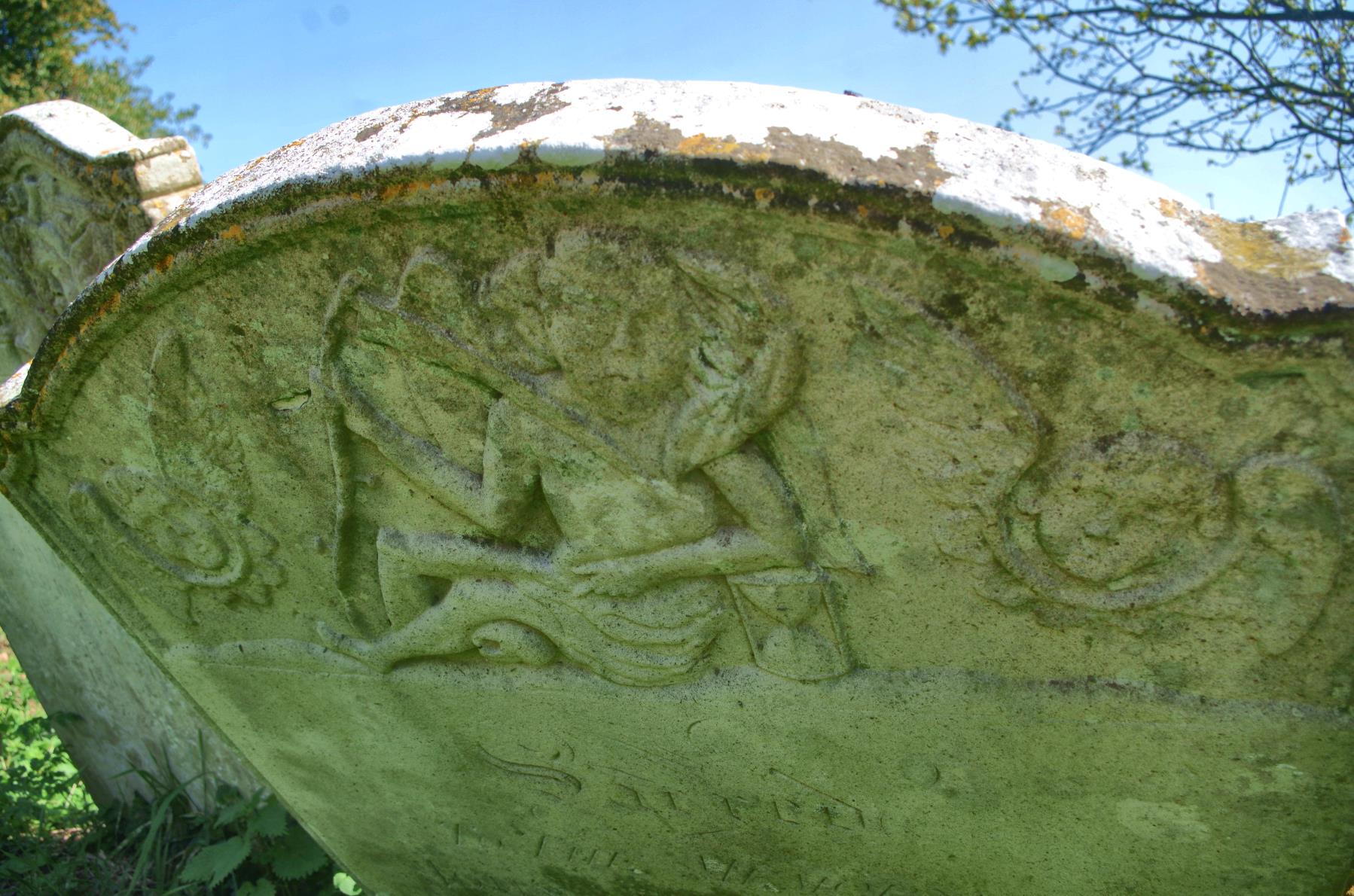
A closer view of the two symbols – the bow and quiver of arrows and the oak leaves. Note the acorn. ©Carole Tyrrell

A country churchyard on a warm, sunny May day can be a peaceful and interesting place to explore. All Saints churchyard in Staplehurst is one of those as it looks down over the village from its hilltop perch.

I have already discussed one of the symbols that I found in there which featured in a an earlier Symbol of the Month. This was ‘The Choice’ which I found in the older part of the churchyard.  After exploring the newer part of the churchyard and seeing ‘nature’s lawnmowers’ aka sheep in the field behind I returned to the older section.  I then discovered this headstone with a combination of two symbols on it.

At first glance you might be forgiven for thinking that this is the grave of a warrior or someone involved in warfare as the combination is formed from a bow, a quiver of arrows and a circlet of oak leaves.  The bow and arrows are a symbol that has been known for centuries and since the earliest times has been associated with hunting and survival.

The headstone is dedicated to Edwin Fitch who died at the fairly young age of 43 on 22 January 1869. The epitaph goes on to state that Edwin left behind a widow and two children; Marianne and Walter William.  There is also another inscription above it that states that the stone was erected as a mark of respect by the Staplehurst Cricket Club.

The epitaph to Edwin Fitch in Staplehurst churchyard. ©Carole Tyrrell

But, as with most symbols, there are other meanings and I am indebted to theartofmourning blog for reminding me of these.   For, although a cricket field can occasionally turn into a polite and gentlemanly battlefield, I was sure that there were softer connotations to the bow and quiver.

The other most obvious interpretation is of Cupid shooting his arrows of love straight to a lover’ s heart. Indeed, he is traditionally portrayed holding a bow with an arrow ready to aim and fire. There are also the famous lines in William Blake’s poem, ‘Jerusalem’:

‘Bring me my bow of burning gold

Bring me my arrows of desire.’

There is also a Biblical link with children. In Psalms 127:3-5 children are described as being:

‘Children are a heritage from the Lord,
offspring a reward from him.
Like arrows in the hands of a warrior
are children born in one’s youth.
Blessed is the man
whose quiver is full of them.

I interpret this to mean that a man’s children will continue his family line and achieve their place in the world.

The oak leaves underneath the quiver and bow are an ancient symbol of strength and the oak was known as the tree of life in pre-Christian times. According to memorials.com it is believed to have been the tree from which Christ’s cross was made.

Close-up of the acorn featured on the Fitch headstone. ©Carole Tyrrell

Edwin had an untimely death and we don’t know if he, his family or members of the Cricket Club chose the symbols.  But I believe that it was a final message from him to his family that he left behind and that this thoughts were of hope.

There is also a small verse underneath the epitaph:

‘My wife and children dear I bid you all adieu,

By God’s commands I leave this world and you

And trust my friends whom I have left behind

May give you comfort, and to you be kind.’

In this Edwin clearly hopes that his friends will support his family after he has gone. The Fitch family may have been in financial straits with the death of Edwin as the Cricket Club provided the headstone.

I have found out more about Edwin and his family.  He married Maria Wickings on 9 September 1852 and they had three children together.

  • Marianne born in 1853
  • Walter William born in 1855
  • Charles born in 1858

Sadly, Charles appears to have been stillborn or may have died in childbirth as he was born and christened on the same day and is not recorded on Edwin’s epitaph. Marianne followed her father to the grave in 1875 aged just 22.

I have approached the existing Staplehurst Cricket Club for further information on Edwin but the present club has only been in existence since the 1950’s.  They thought that Edwin might have been the very first member but are undertaking further research.  One current member thought that there might have been a private Staplehurst Cricket Club associated with the nearby Iden Manor.

This is now a nursing home but was once the house of the Hoare banking family. There are members of this family buried in the churchyard.  In 1904 they sold the manor due to impending bankruptcy and they were well known in the area for holding cricket and football matches, flower shows and other events for the village.

Finally, I think that this is a poignant combination of symbols that left a powerful and comforting message to his family.  A man whose last thoughts may have been of his family and now lies under the green canopy of the tall trees of Staplehurst churchyard with his beloved daughter.

©Text and photos Carole Tyrrell unless otherwise stated
References and further reading:

https://artofmourning.com/2011/01/09/symbolism-sunday-the-arrow-and-quiver/

https://www.memorials.com/Headstones-Symbolism-information.php

https://stoneletters.com/blog/gravestone-symbols

http://headstonesymbols.co.uk/headstone-meanings-and-symbols/acorn/

http://www.thecemeteryclub.com/symbols.html

http://www.staplehurstsociety.org

https://www.poetryfoundation.org/poems/54684/jerusalem-and-did-those-feet-in-ancient-time

https://biblehub.com/kjv/psalms/127.htm

http://mlesdes.eklablog.com/england-s-national-symbols-free-article-a92748989

The Hardy Tree – a London literary landmark finally falls.

New Year’s Day 2023 – a sad sight as the Hardy Tree is gone forever. ©Carole Tyrrell

When in Late December 2022, an ash tree finally fell down in Old St Pancras churchyard in central London, it made headlines around the world. For not only was it one of London’s famous cemetery landmarks, as was Highgate’s famous Cedar of Lebanon, but it was also a place of literary pilgrimage.

This was the Hardy tree, its base surrounded by headstones, some of which had become part of it as it had grown.  The legend was that Thomas Hardy, the novelist, when employed as an architectural assistant, had begun to pack headstones around the trunk. These were the stones that had been cleared to make way for the expansion of the Midland railway in the mid 1860’s.  Jon Snow in ‘The Great Trees of London, 2010 explained:

‘In the 1860’s the writer Thomas Hardy, was apprenticed to an architect, Arthur Blomfield, in Covent Garden.  The building of the Midland Railway had disrupted many of the graves in nearby churchyards.  Hardy was tasked with making an inventory and reburying them. He stacked the headstones around a convenient ash tree. (in St Pancras churchyard).’

At least this is the romantic myth.

The information board by the Hardy Tree. ©Carole Tyrrell

I am indebted to the blog ‘The London Dead’ for its research into the Hardy Tree which explored the legend.  The truth is that there is no evidence that Hardy had anything to do with it.  In fact, the tree wasn’t even there at the time.  It may have self seeded and was less than 100 years old.  In 1926 a photo was published in ‘Wonderful London’ edited by St John Adcock which shows ‘a rockery of headstones’ but without a tree.  So, the tree appears to have been much later.

The London Dead also quoted from a book on Hardy apparently written by his widow, Emily entitled ‘The Early Years of Thomas Hardy’.  In the 1860’s he was employed as an architectural assistant to Arthur Blomfield in Covent Garden.  In this she says that:

‘Hardy was not responsible for overseeing the exhumations.  This was the Clerk of Works role.  Hardy was instructed to drop by Blomfield in the evening to keep an eye on the Clerk of Works and make sure that all was proceeding in an appropriately seemly manner.  He was to report back to  Blomfield if it was not.’

There had been rumours of bodies being exhumed and bags ‘that rattled’ being sold onto bone mills from one city churchyard instead of being reinterred. Blomfield did not want this to happen at Old St Pancras. So Hardy was to visit at uncertain hours to check on the Clerk and Hardy’s manager was also to drop in at uncertain times during the week to check on Hardy and the Clerks. The plan was successful and Hardy attended during 5-6pm as well as at other hours.

The plan succeeded excellently, and throughout the late autumn and early winter (of probably the year 1865 or thereabouts) Hardy attended at the churchyard – each evening between five and six, as well as sometimes at other hours. There after nightfall, within a high hoarding that could not be overlooked, and by the light of flare-lamps, the exhumation went on continuously of the coffins that had been uncovered during the day, new coffins being provided for those that came apart in lifting, and for loose skeletons, and those that held together being carried to the new ground on a board merely: Hardy supervising these mournful processions when present, with what thoughts may be imagined, and Blomfield sometimes meeting him there. In one coffin that fell apart was a skeleton and two skulls. He used to tell that when, after some fifteen years of separation, he met Arthur Blomfield again and their friendship was fully renewed, among the latter’s first words were: ‘Do you remember how we found the man with two heads at St Pancras?’

Thomas Hardy (1840-19280 Shared under Wiki Creative Commons

In 2019, I visited the churchyard and was informed by the tour guide that the Hardy Tree was almost certainly going to fall.  It was infected with a fungus and a protective, temporary fence had been erected around it with a gap in the hedge for visitors to look through.  Iain Sinclair in, ‘Lights Out For the Territory’ described the headstones clustered around it as being:

‘like a school of grey fins circling the massive trunk feeding on the secretions of the dead.’

The tree’s final few years were being managed although it had been disturbed by recent storms at the time. It was an impressive sight with the tall ash tree or Fraximus Excelsior to give it the full Latin name, reaching for the sky.

A view of the Hardy Tree in 2019 with the church in the background. ©Carole Tyrrell
Closer view of the Hardy Tree from 2019 in which you can see how the stones and the tree had grown together. ©Carole Tyrrell

I visited the cemetery on New Year’s Day 2023 and the tree did look forlorn as it lay there. A visitor had placed a cut rose on top of a headstone in sympathy and tribute.  If you look closely at the base of the tree, headstones that had grown into it and had been uprooted with its fall can be seen. 

New Year’s Day 2023 and if you look at the end of the trunk you can see that the tree took some of the headstones embedded in it down with it. ©Carole Tyrrell

©Carole Tyrrell

Although the Hardy Tree seems to have ultimately been an urban myth; it is a tale of London and the great changes that the Industrial Revolution brought.  Someone collected the headstones so that the final record of their lives were not lost or broken up and forgotten.   It’s a record of the endless cycle of change and renewal of the capital as, chameleon like, it sheds its skin and becomes something else.  The tree was also part of literary London as Mary Wollstonecroft is buried in Old St Pancras.

But who knows?  Another tree may self seed itself and the Hardy Tree will be reborn again.

Dedicated to Jeane Trend-Hill, taphophile, Londoner and photographer who would have been the first on the scene with her camera. RIP.

©Text and photographs Carole Tyrrell unless otherwise stated
References and further reading

The London Dead: The Myth of the Hardy Tree; Old St. Pancras Churchyard

The Guardian view on the death of the Hardy Tree: a legend uprooted | Editorial | The Guardian

The Hardy Tree, a Beloved Fixture of a London Cemetery, Topples Over – The New York Times (nytimes.com)

Thomas Hardy: Gravestone-encircled tree falls in Camden – BBC News

A Christmas card from me to you

So here we are again – facing the end of another year and looking perhaps nervously at another new one. Old Father Time waits for us all.

I wish you all the best for 2023 and the festive season. The photo was taken in London’s Brompton Cemetery on a December afternoon after a frost. Some of the monuments were edged with it which made them look even more dramatic.

Let us raise a glass, mug, cup, water bottle to what ever lies ahead. Salut!

©©text and photos Carole Tyrrell

The Cemetery that Changed my Life – Death’s Garden

Angel Nunhead Cemetery 1989 ©Carole Tyrrell

Below is the article that I wrote for Death’s Garden and it has just been reprinted in Death’s Garden 2. I am no longer involved with the Friends of Nunhead Cemetery and have not visited the cemetery since 2017. However, it was by visiting Nunhead that I became involved with cemeteries and churchyards and which led to my interest in symbols. There is something about the wild, Gothic splendour of large Victorian cemeteries that attracts me; the large memorials, the art and sculpture and the space they give you in which to grieve and be alone despite being in the busy metropolis. they have given me so much and I have always tried to give them something in return.

The Cemetery that Changed my Life

It was the long, hot summer of 1989 when I first visited Nunhead Cemetery.  It was their annual Open Day, and I took the opportunity to enjoy its Gothic atmosphere and admire its overgrown, slightly mysterious monuments and memorials. My father had died unexpectedly earlier that year and it had been the first death of someone really close to me.  He’d been cremated and there was no resting place for me, or anyone else, to visit and grieve.

I was already drawn to Victorian cemeteries after reading Hugh Meller’s ‘London Cemeteries’ and Nunhead is one of London’s Magnificent 7.  Lucinda Lambton once described them as ‘a jet black necklace running through London.’  Nunhead was no tidy, municipal, neatly manicured, tombstones in neat rows like teeth, cemetery.  Instead, inside the imposing gates with their bronze downturned torches, was overgrown Gothic splendour; angels under dark canopies of leaves and ivy, the ruined, roofless chapel and a myriad of fascinating monuments, mausoleums and memorials.  I felt that I wanted to be amongst these reminders of the dead and departed and mourn. I was home.
The ruined chapel at that time was closed to the public and classed as a dangerous structure. Little did I know that, 20 years late on another Open Day, I would be watching the Dulwich Ukelele Band performing inside whilst 2 visitors jived on its tower roof roughly 100 feet up. I joined the Friends on that day in 1989 and began working on the monthly FONC publications stall which accompanied the general cemetery tours.  You never knew who would come up to the stall to speak to us.  Often it would be local residents who could remember playing in the cemetery when it was abandoned and locked up by its owners in 1969.  Its railings long gone for the war effort, there was nothing to prevent anyone going in and exploring – I wouldn’t have been able to resist it.  There were always eerie tales of mausoleums being broken into, coffins lying about after having been rifled for jewellery and skeletons as well.   Eventually questions were asked in the Houses of Parliament about what was going on and, as a result, the local council bought it for £1.  But the visitors often said that, although Nunhead felt creepy, it was an amazing place it was inside. 

One man told me that he was a psychic and that he could sense all the departed spirits around him.  He added that he was reassuring them and sending them on their way elsewhere.  He seemed co I’ve often wondered since what it must be like to have that kind of ability and he seemed completely sincere. 

Sometimes visitors would ask about a particular symbol as they couldn’t understand what it was doing in a cemetery.  One asked me why a dollar sign was on a headstone, and this led me onto do research into symbols for any future questions from visitors.  It was in fact the combination of the letters IHS which means ‘Jesus Honimum Salvator’ and led me into a fascination with symbols and their meanings.

In fact, as a result, I created the Symbols tour and so began my career as a tour guide. I shadowed an experienced guide, started taking the general tours and then a specialist Symbols tour.  Originally it was just going to be about symbols, but visitors also wanted the general history of the cemetery and the reasons behind the Magnificent 7’s creation.  I lead a Symbols tour in another of the Magnificent 7 now and it’s still always a little scary when you announce yourself to the gathered group, all eyes turn to you and your mind goes completely blank.   

But visitors are always very keen.  On one very wet Sunday afternoon I kept turning round thinking that the group behind me would all have given up but, no, they kept going right to the end.

Unfortunately, although the Victorians ‘borrowed’ from classical antiquity, Arts & Crafts, Celtic and Egyptian civilisations they didn’t put them in chronological order, so we do have to often zig zag around the cemetery to see as many as possible. I always emphasise on my Symbols tours that they are an introduction to the subject and there are many more to find. Even on modern memorials there is often a symbol, a way of individualising it and in Nunhead there was a 15 year old boy’s grave ornamented with a football and snooker board and the masks of comedy and tragedy on an actor’s grave.

I soon realised the value of visual material to hand round and spent an afternoon in the British Museum researching Nunhead’s largest monument; the John Allan tomb, based on the tomb of Payava in Lycia, near Turkey which is in there and takes up an entire room.

You never know what you might find in a cemetery despite how familiar you are with it.  I was updating my tour notes in winter 2014 and whilst walking along a familiar Nunhead path I looked up to see a small face carved at the centre of a cross which I had never seen before.  In 2013, during a long winter, an unusual anchor shaped tombstone was discovered that commemorated a sailor killed in the First World War although he wasn’t buried in Nunhead. 

I only had one strange experience in the cemetery or rather outside it. One Christmas I was on my way to a FONC Christmas social at a local community centre and, as I passed by the cemetery‘s high walls. Suddenly, I heard children’s voices from inside Nunhead at a particular spot.   I couldn’t  see anyone around and the road was deserted.  The houses opposite were dark and, as it was a cold night, I didn’t think children would be out playing.  I walked on and the voices faded behind me.  Interestingly enough, the voices were near the old, now bricked up entrance to the cemetery that led to the long gone Non-Conformist chapel which was bombed during WW2.  The entrance had to be closed as local children made fun of the non-conformist burials that entered through there.

It was during the winter of 1989, whilst exploring with my posh new film camera, that I took the picture of the angel.  At the time I thought she belonged to the grave on which she’s perched.  But my lady moved around on the path and, although the years weathered, she  is still there.  I used to always go and check on her on my visits.  Unfortunately, the child angel is long gone.  It was on top of a child’s grave dedicated to Albert Anthony Dufourg who was an only child and died aged 5 years and 3 months.  For several years I used the angel as a guide to where I was in the cemetery until one day it vanished – presumably stolen. It was a poignant reminder of unrealised hopes.

I have visited cemeteries in the UK, America, and Venice.  The way in which the dead are treated is often an indication of how the living are treated.  Tears pricked my eyes at Ground Zero and Calton Hill in Edinburgh was certainly the eeriest one I’ve visited.  Then there was the supernatural experience I had in Greyfriars Kirk but that’s another story.  But Nunhead always felt like home. There are no famous people, no royal connections but, instead, a place in which to wander, to reflect, admire the view of St Paul’s Cathedral from the top of the hill as butterflies flutter around you on a warm summer’s day.

But in all the cemeteries that I have visited I have never found the answer to the question of why, when angels are actually male, are the angels in cemeteries reflective young girls?

©Carole Tyrrell text and photograph