Only the thrashing wind through the trees and each other for company forever…… Part 3 of a visit to Knebworth – Elizabeth Lytton’s mausoleum

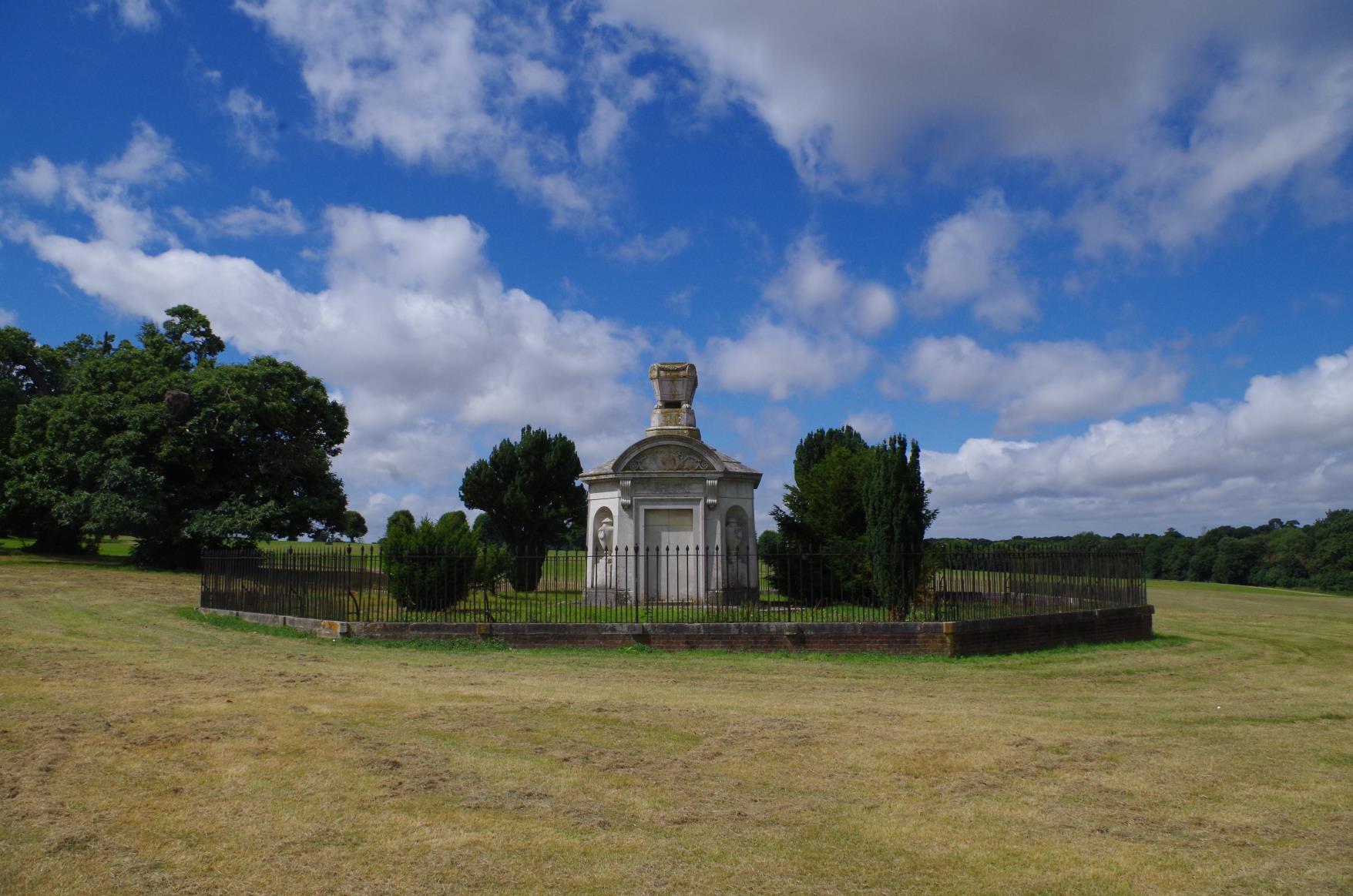
A view of the Lytton Mausoleum in its field. ©Text and photos Carole Tyrrell
A view of the Lytton Mausoleum in its field.
©Text and photos Carole Tyrrell


The wind thrashed through the small group of ancient oak trees in Mausoleum Field as I stood admiring the view of the surrounding hills.  It was a hot, but windy, August day and the gift shop assistant had been enthusiastic about the wonderful vistas.  But I felt that on a dark winter’s night it could be very eerie and lonely.

This field contains Elizabeth Bulwer-Lytton’s (1773-1843) mausoleum in which she rests with several other members of the Lytton family.  But why is she resting here eternally and not in the Lytton chapel in the nearby church?

Elizabeth was the mother of Edward Bulwer-Lytton, the novelist and she lived at Knebworth from 1811 -1843.  She is responsible for the House’s present Gothic style with its myriad of gargoyles, bats, towers and battlements after having had most of the old, ancient House demolished.  She inherited it from her father, Richard Warburton-Lytton who lived at Ramsgate and described the estate as ‘the old half-feudal pile. ‘   Or as we would describe it today ‘as having many original features and development potential.’

She lived with Edward, her third and favourite son, until she died and her rooms are still preserved exactly as she left them.  Edward had inscribed above the mantelpiece a reminder to future generations to maintain them in her memory.  He was very close to Elizabeth but one wonders if he was worried that she might return and haunt him if he didn’t.

Elizabeth had a powerful personality to say the least.  She disapproved of Edward’s marriage to Rosina Doyle Wheeler by cutting off his allowance and forcing him into a whole new career as a writer.    He was very prolific, as the section of his books in the library attests, and he coined the famous phrases ‘It was a dark and stormy night’ and ‘The pen is mightier than the sword.’   Edward also had a successful political career but found the pressure too much and after two children, his marriage collapsed.  Elizabeth’s thoughts on the situation that she had helped create aren’t known but he gained custody of the children after a nasty separation.  Rosina then embarked on her own literary career with a thinly veiled account of her marriage and followed this with other works on the theme of the wronged wife.  She was buried in an unmarked grave in Croydon which is certainly ‘out of sight, out of mind’ and was forgotten until her great-great-grandson erected a tombstone in her name in 1995.

Elizabeth quarrelled with every rector of St Mary’s about the tithe that the church claimed on all estate produce.  As a result, they all ended up preaching to an empty church while she insisted that her staff and tenants attended her own church services in Knebworth’s State Drawing Room.  The large Bible at the foot of her bed in her room is the one that she always used and carries her own initials EBBCL – Elizabeth Barbara Bulwer Lytton.  As a House tour guide told us, she planted trees around the church to hide it from the House and they’re still there but it was only partially successful.  She was also equally determined that she and her family wouldn’t be buried within the Lytton Chapel or the churchyard.

Of course with the compact size of the Chapel and the three 18th century Lytton gentlemen’s monuments which take up most of the space she may have felt that there simply wasn’t room for her.   Or at least room for her to be forever remembered in the way that she wanted and  so her own large sepulchre was the only way in which she could compete. Four of the five female statues in the Chapel decorate Sir William Lytton’s monument and it does feel like a gentlemen’s club. So Elizabeth had a mausoleum constructed a short distance from the church and in what is appropriately named Mausoleum Field.   Although the male incumbents of the Chapel may have life size facsimiles of themselves lolling about in rumpled sheets Elizabeth had gone farther in a game of one-upmanship.

A view of the Lytton mausoleum through the railings. It's in the Classical style and note the funerary urns in the niches. ©Text and photos Carole Tyrrell
A view of the Lytton mausoleum through the railings. It’s in the Classical style and note the funerary urns in the niches.
©Text and photos Carole Tyrrell

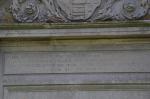
The octagonal mausoleum, reputedly based on an Italian design and built in 1817, has niches containing elegant funerary urns.

 

Elizabeth’s epitaph is on one side and there are other epitaphs to Lytton family members around the tomb.

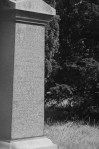
An obelisk surmounted with an urn commemorates Edward’s son, Robert who became the first Earl of Lytton,  and is near the entrance.

Another strong-minded Lytton woman who is interred here was Lady Constance Lytton (1869-1923) who was a noted suffragette under an assumed identity and was force-fed on several occasions.  The epitaph reads ‘…sacrificed her health and talents in helping to bring victory to this cause.’  The vault was restored in 2004 and has contemporary iron railings around it.    There is a sarcophagus on top of it with shell acroteria. However, these always remind me of old-fashioned baths.

The sarcophagus on top of the mausoleum with shell acroteria. ©Text and photos Carole Tyrrell
The sarcophagus on top of the mausoleum with shell acroteria.
©Text and photos Carole Tyrrell

But knowing Elizabeth’s determination and desire to have her own way one wonders if she and the other incumbents rest easily together or if they are all locked into an eternal argument……

©Text and photos Car0le Tyrrell unless otherwise stated.

http://www.mmtrust.org.uk/mausolea/view/76/Lytton_Mausoleum

https://historicengland.org.uk/listing/the-list/list-entry/1174579

Knebworth House guidebook, Heritage House Group ©Knebworth Estates 2005
https://books.google.co.uk/books?id=-M4HAAAAQAAJ&pg=PT109&lpg=PT109&dq=elizabeth+lytton%27s+mausoleum+knebworth&source=bl&ots=hulY1VuEjA&sig=CcDACH2yf0RB-C2ge9NOZiziomU&hl=en&sa=X&ved=0ahUKEwje-6Sf8_XOAhVBPRoKHd74BMYQ6AEIRzAI#v=onepage&q=elizabeth%20lytton’s%20mausoleum%20knebworth&f=false


The blank eyed stare of a marble congregation – Part 2 of a visit to Knebworth – The Lytton Chapel, St Mary’s Church


Sir William Lytton. ©Carole Tyrrell
Sir William Lytton.
©Carole Tyrrell

Everywhere I looked, as I stood in the Lytton Chapel, a well-upholstered, well dressed 18th century gentleman stared impassively back at me.  They seemed to jostle for space in the small chapel and, although these past members of the Lytton family, couldn’t take it with them, you certainly knew that they’d had it when they were alive.  These were powerful men and there’s plenty of beautifully sculpted marble on show in the Chapel.   Nowadays, people would ask an artist or sculptor to make them look slimmer but here the subjects are unashamedly larger than life.

All three of the memorials are in the baroque style which was made fashionable by the Italian sculptor, Bernini.  It was a technique that achieved effects in carving such as flesh, hair and textures that were remarkably realistic as well as other pictorial effects that had previously only been attempted in 2D paintings .  And yet English Baroque was dismissed as mundane.  However the three tombs in the chapel seem anything but that.

Both Pevsner and Simon Jenkins in ‘1000 Best Churches’ mention the Chapel.  Indeed the latter describes  it as having ‘the best of 17th and 18th century monumental art (is) on parade and ‘three of the Knebworth tombs are among the finest 18th century monuments  In England.’   It was originally built in 1520 and then rebuilt 200 years later.

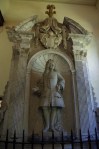
The first one as you enter is Lytton Strode Lytton who stands perfectly posed in his shell niche dressed fashionably in his coat and shoes with some of his coat buttons undone to display the buttoned up waistcoat beneath, Too many power lunches perhaps?  He died young at 21 as his epitaph reveals but he looks older with an almost feminine face and full lips. Lytton is guarded on either side by winged cherubs, or Cupids, as Historic England describes them..  One is copiously weeping and the other is in prayer and the whole memorial has been attributed to Thomas Green of Camberwell.here is a helpful English translation of the Latin epitaph:

‘Here lies Lytton Strode Lytton Esq., sole son and heir of Sir George Strode (of Etchinham in the County of Sussex_ and also heir of Sir William  Lytton of this parish, his great-uncle. He married Bridget Mostyn, the eldest daughter of Richard Mostyn, Eds., of Pembedwinthe county of Flint. He died without issue at the age of 21 in 1710.  He left the ancient patrimony of the Lytton family to his dearly beloved relative William Robinson, who erected this monument at his own expense as a pledge of his own affection.’


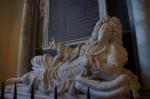
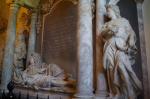
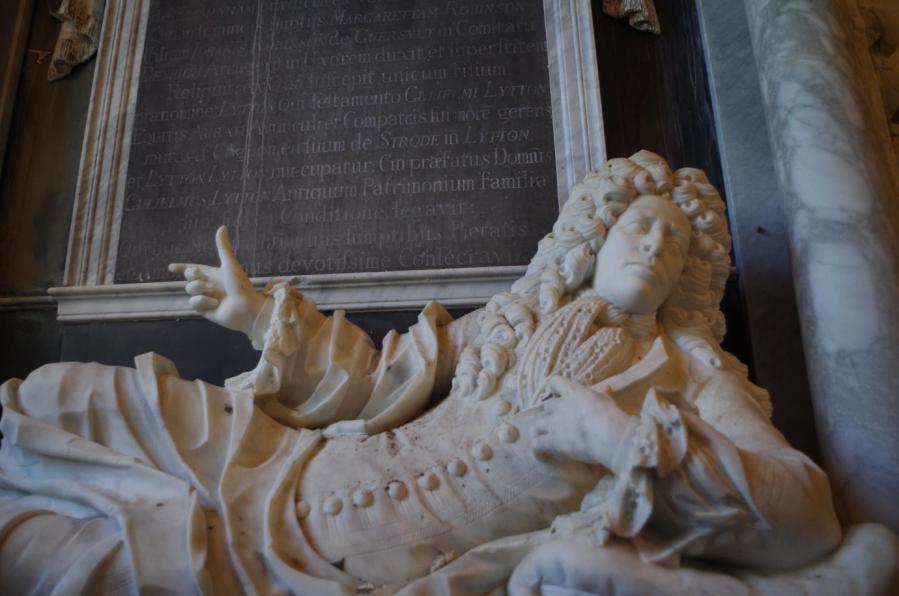
Then you turn and are almost crowded out by the other two:  Sir William Lytton to the left and Sir George Strode on your right. Their heads are both inclined towards Lytton Lytton as they lie semi-recumbent on marble beds, sheets rumpled and you almost feel as if you’ve disturbed them in conversation.  Sir George Strode was Lytton’s father and Sir William was his maternal great-uncle so it’s not surprising that they both look to their cherished heir and once the bearer of the Lytton dynasty hopes.

Both of these memorials are credited to Edward Stanton. (1681-1718).   He was a very successful mason who carved 40 monuments between 1699-1718 and in 1720  became a mason to Westminster Abbey where he remained until his death.  Stanton was married 3 times and one wondered where he found the energy.  He has his name prominently displayed at the base of one of the pillars on Sir William Lytton’s huge monument.

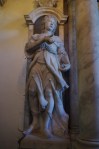
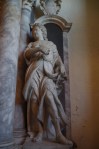
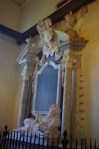
The carving on Sir William’s cravat, cuffs and wig as well as the delicate lacing of the Grecian style boots on two life size allegorical female figures or Virtues on either side of him is beautifully detailed. However, his opposite neighbour, Sir George Strode, has a wig that reminds me of waves of whipped cream.  Both men face each other and lie in the fashion of old style glamorous Hollywood stars with their rumpled marble sheets and supporting cushions.  But, perhaps in a feat of one-upmanship, William’s shrine is bigger than George’s as it’s laden down with figures and decoration such as the two Virtues dressed in flowing robes and showing a fair bit of leg.  There are also 3 winged cherubs heads under the cartouche decorated roof with swags of fruit and flowers.  But if you look up still further there are two small female figures, possibly children, perched on top of the roof and one appears to be playing an accordion.  The English translation of the Latin epitaph is:

‘Here lies Sir William Lytton, Knight, son and heir of Sir Rowland Lytton, Knight of the ancient family of the Lyttons de Lytton in the County of Derby (which has flourished happily in this neighbourhood since the time of King VII) in the direct line of descent.  He married first Mary the daughter of Sir John Harrison of Balls in the county of Hertford, then Philippa the daughter of Sir John Keyling of Southill in the county of Bedford; he died without issue, his second wife surviving him. 14th Jan AD 1704-5’

 By contrast, his neighbour, Sir George Strode, Lytton Lytton’s father, is far more restrained as there wouldn’t have been enough room in the chapel for another tomb as large as William’s.  George appears to be in mid-conversation with his hands making a gesture and one thumb indicating the epitaph above him.  This translates in English as:

‘Sacred to the memory of Sir George Strode of the ancient family of the Strodes, the eldest son of Sir Nicholas Strode of Etchinham in the county of Sussex, and his wife Judithe the oldest daughter  of Sir Rowland Lytton of Knebworth in the county of Hertfordshire, who piously and peacefully fell asleep in the Lord on the 9th of June, 1707, whose remains repose at his own wish in the Church at Etchinham aforesaid, who married Margaret Robinson (the daughter of John Robinson Esq., of Geursylt in the county of Denbigh). She survived him and from this union was born one son with the Christian name of Lytton, who by the will of Sir William Lytton his maternal great-uncle changed his family name from Strode to Lytton, and this became styled Lytton Lytton to whom the aforesaid Sir William Lytton bequeathed the ancient patrimony of his family.  He has dedicated this monument at his own expense as a tribute of piety and affection.’ 

The motto underneath George’s figure  reads:

‘Life is the gateway to death, and death in turn the gate of a new life and learn to die to the world, and live for God.’

 Comforting words for a man who lost his only son at an early age.

And so I left them, perhaps in an eternal interrupted, silent conversation, after marvelling at the skill of the mason’s work.  They are all behind iron railings, presumably to stop visitors touching them, but I also felt that the figures were so realistic that it might also be to stop them coming to life and lunging at sightseers.

 ©Text and photos unless otherwise indicated Carole Tyrrell

References

https://historicengland.org.uk/listing/the-list/list-entry/1295771

http://hetrfordshirechurches.blogspot.co.uk/2014/02/knebworth-1.html

https://en.wikipedia.org/wiki/Edward_Stanton_(sculptor)

http://217.204.55.158/henrymoore/sculptor/browserecord.php?-action=browse&-recid=2558

https://www.britannica.com/art/Western-sculpture/The-Baroque-period#ref401564

http://217.204.55.158/henrymoore/sculptor/browserecord.php?-action=browse&-recid=52

http://hertfordshirechurches.weebly.com/knebworth-churches-hertfordshire.html