The place that haunted me for nearly 30 years – the return visit to St Lawrence’s hospital burial ground

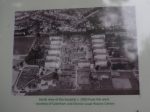
Scan as on film camera.
copyright Carole Tyrrell


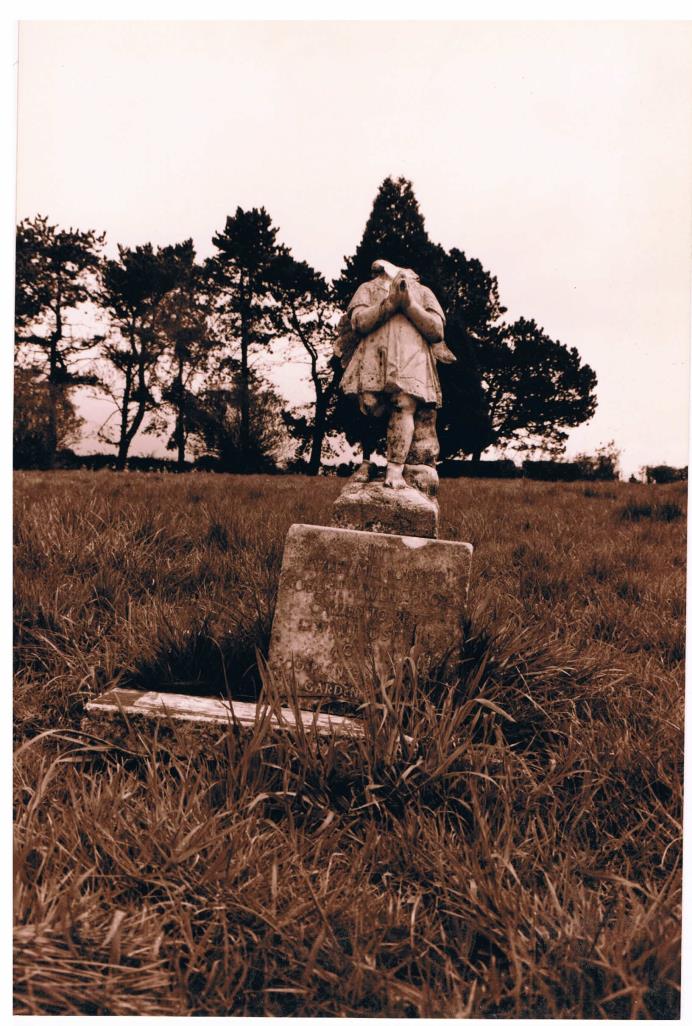
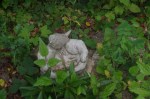
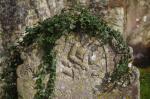
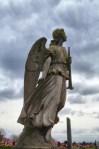
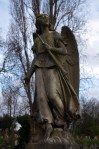
Where were we?  We’d come into a neatly mown clearing with a small statue of a headless angel on a plinth at its centre.  There were large stones arranged around the perimeter with names and ages inscribed on them. I don’t recall seeing any signs anywhere that indicated what it was.   The tall black trees seemed to whisper to each other around us but otherwise it was silent.  My companion wanted us to move on deeper into the surrounding countryside and so we did.  We’d already roamed around Happy Valley and he was keen to do more. But I had enough time to take one photo and it became an important, and the only, reminder of our visit.

The black pines that I remembered from my first visit.
©Carole Tyrrell

This was in 1990 and I had no idea where we were. In later years I discovered that we had been on Farthing Downs, near Coulsdon in Surrey.   Although I made several return visits and tried to retrace our walk I could never find the exact place. What was it? A farmer’s cemetery for beloved animals? The ages on the stones had been very young but I could never find it or any information online about it. Was it attached to one of the nearby asylums?  Cane Hill Asylum wasn’t that far away across the valley. I was nearly there.  In 2013 a magazine article and a map reference revealed it to be St Lawrence’s hospital burial ground. At last I knew where it was and what it was.

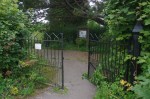
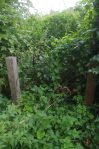
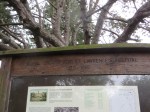
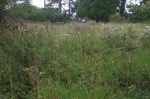
As the wind blew eerily through the bordering pine trees and passing, but invisible golfers, chatted to each other I knew that this was the place that had intrigued me for nearly 30 years.  No tidy clearing now and any memorials were half submerged in the overgrown undergrowth. But at last I knew that  I was standing in St Lawrence’s Hospital burial ground at Caterham which was now in the middle of a very upmarket golf course.  The golf course hadn’t been there in 1990 but its manicured lawns, water features and clubhouse surrounded the burial ground.  St Lawrence’s long, late summer overgrown grass, straggling and profuse bushes of blackberries and rose hips and uneven ground made a sharp contrast.  I trod very carefully. There were now two black painted metal gates at the entrance and an information board with photos and pictures of St Lawrence’s Hospital and the chapel.  This had long since been demolished, but the foundations and base could still be found amongst the long grass and clover.  An overcast day and spits of rain combined with the mournful wind made the burial ground feel abandoned.

As I stood there it seemed impossible that over 3100 people lay buried under my feet in this spot underneath the tussocks and unkempt long grass.  A burial register from 1916-1948 records 3100 people buried in 276 plots with 10-15 in each grave. However, the 1949 -1965 burial register is still missing so there may be 1000’s more buried here. The burial ground is the only surviving part of the Hospital as it closed in 1994 and was demolished to make way for a housing estate.

St Lawrence’s was originally the Caterham Metropolitan Asylum which opened in September 1870. It had a sister asylum at Leavesden, Herts.  They both took in the pauper insane from London’s workhouses as it was felt that the country air would be good for them and help improve their condition. This is probably why there is such a concentration of asylums in the Surrey area. However their location often led to staff shortages due to their remoteness.

According to Lost Hospitals of London:

 ‘There were 1560 patients which were housed in 6 three storey blocks for 860 females and 5 blocks for 700 males. The sexes were segregated as they were in all asylums. Children were also admitted and in 1881 St Lawrence’s also become known as the Caterham Lunatic Asylum for Safe Lunatics and Imbeciles.  The Victorians weren’t very PC and we would now say that these people had ‘learning difficulties’.  In 1913 under the Mental Deficiency Act it became responsible for mentally defective children pauper children or again children with learning disabilities. Children from another hospital and a Training Colony were also sent to Caterham.  It also had a large proportion of older patients who had no chance of improvement. 23.6% of its patients were epileptic. (Treatment for epilepsy was non-existent in the 19th century and even 40 years ago it was still in its infancy)

In 1981, St Lawrence’s and another hospital featured in a documentary called ‘Silent Minority’ which drew attention to the poor conditions in these places exacerbated by staff shortages. The media took an interest and patient care, amongst other areas, were investigated by government Inquiries.  It focused on the scant and impersonal natures of the wards, deficiencies in nursing care and staffing ratios for profoundly disabled patients. It was said that the hospital management had sanctioned the programme in the hope that public awareness of the extent of the problem might bring about change for the institution. Patients began to be moved out into homes and hostels and into the community.’

 When the burial ground was closed for burials in 1965 the memorial stones were removed from the main burial area and placed on the perimeter so that the grass could be mown. This is how it looked when I saw it in 1990 when the hospital was still in operation.  Like Netherne, the burial ground was almost forgotten and became overgrown and abandoned until in 2008, concerned locals took matters into their own hands and started tidying it up. Local residents, cub packs and schools all wanted to be involved and in 2010 13 memorials had been located either intact or in pieces.

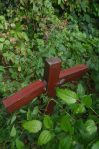
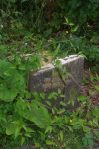
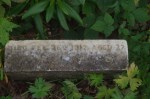
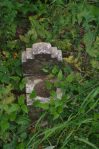
Here is a selection of the memorials that I saw:

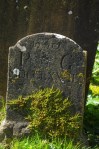
The overgrown uneven ground was obviously due for one of its two annual brush cuts and I trod carefully as I explored. I found a few memorials which were clustered in the overgrown memorial rose bed. I could make out dates and names on some of them and they were poignant reminders of the hospital’s patients.  According to the information board, these were the memorials that were found in 2011:

John                                                                  1945-1960

Valery Muriel Ann Howcroft                       1953-1962

Graham W Cleghorn                                     1936-1957

Brian W Udy                                                   1889-1917

Frederick Albert Houghton                        1948-1957

Ann Margaret Hazell

Bobby Wise

Terry                                                             aged 6 years

George Henry Hale                                    1884-1961

Edna Phyllis Millward                              1909-1953

Percy Herbert Goddard Barnes              1891-1963

Leslie Charles Alfred Nash                     1924-1963

Pattie (Patricia) Hill                                1912-1934

Donald Douglas Chamberlin                  1907-1924

Joseph H Wenderott                              1926-1942

Malcom Dow                                           1929-1938


I am indebted to The Downlander for information on two of the memorials:

‘Percy Barnes was in the 1890 Census where he was living at 98 Farringdon Road where his parents kept a coffee house.   By 1911 he was a kitchen porter and lived in Shoreditch with his parents, 2 sisters and 3 brothers.  But nothing is known of him from 1911-1963 so how did he end up being admitted to St Lawrence’s?

Leslie Nash’s memorial is under the black pines but I didn’t see it on my visit. ‘The burial ground restoration team were contacted by a cousin. He told them that Leslie’s brother was still alive and had been searching for Leslie’s memorial for many years. You can imagine how thrilled he was to know its location at last. Apparently Leslie had epilepsy and cerebral palsy and was sent to St Lawrence’s in 1938 when he had become too heavy for his parents to lift. They had three other children as well. Leslie’s epitaph reads:

Leslie Charles Alfred Nash

Born 6.6.24 – Died 20.9.63

Sweet the sleep you so much needed

Free from suffering care and pain on thy face so peaceful.’

The restoration team managed to make contact with a small number of relatives of those buried here so that they are not forgotten. As I wrote this, a relative was trying to trace her aunt who had been admitted to the hospital aged 18 and died there at 35. I was glad that the burial ground had been reclaimed by local people and that a few of the relatives had been located. As at Netherne they seemed to vanish once they were in the system unless a determined relative decided to look for them.

However, there would have been very few memorials and these would originally have been wooden markers which rot or simple metal markers bearing a number. Originally there were two angels marking the graves of two children and the one that I saw in 1990 may have been one of them. I found another one in the luxuriant undergrowth but it wasn’t the one in my photograph. .  The bodies of those who died without friends or family were given to the School of Anatomy to help doctors with medical research and training.

The information board also records:

‘that the Chapel was demolished in 1971 (and from the photo wasn’t a particularly decorative building). However it was large enough to house 8 coffins. The burial service took place in St Lawrence’s Hospital Chapel. A horse drawn hearse with a tarpaulin cover was led by the hospital porters through the gate at the back of the hospital farm and crossed the field to the burial ground. In later years the Head Gardener’s truck was used. It had an iron frame with a hood over the top and rollers for the coffin. But a former head Gardener recalled that the burials were ‘always done with dignity, never rushed.’

The burial ground is in an isolated spot and is reached by walking up a long, secluded lane. So unfortunately it attracts vandalism.

The memorial seat with the black pines behind it. I was able to confirm that this was the place by the trees.
©Carole Tyrrell

The lovely, very solid seat that I saw on my visit in 2017, surrounded by carved wooden animals, was set alight in an arson attack in 2019. It had been carved with a chainsaw by a local sculptor, Andris Bergs and weighed over a ton. The main seat was made from London Plane and its supports from oak wood. The animals were created from Douglas Fir and it seemed sad that these lovely creations were destroyed for no reason.  They had been part of the burial ground’s restoration.  It’s also seen as a haven for wildlife and newts have been found here.

However, I’m always surprised that asylum graveyards and burial places survive at all. Netherne Hospital Cemetery is also located in an out of the way place and maybe this is why it’s survived. The hospitals to which they were attached no longer exist and in time they might have been forgotten or just built over. In 1990 on my first visit all the big asylums in the area were about to close due to ‘care in the community’.  They had become too large, too overcrowded and once inside people seemed to find it difficult to get out of them and so became institutionalised.

But I had finally found the place that had haunted me since 1990. The Royal Surrey Golf Club didn’t open until 1999 and at that time it was just countryside for miles.  Paupers surrounded by posh golfers. It seemed almost ironic. Maybe after lockdown it’s time to make a return visit and pay my respects to the permanent residents of St Lawrence’s Burial Ground.

©Text and photos Carole Tyrrell unless otherwise stated.

References and further reading

The Downlander issue 51 Spring-Autumn 2011

http://www.caterham-independent.co.uk/latest-news/56-work-on-st-lawrences-hospital-burial-site-begins/

http://www.countyasylums.co.uk/caterham-mental-hospital/

http://www.aim25.ac.uk/cgi-bin/vcdf/detail?coll_id=11891&inst_id=118

http://www.caterham-independent.co.uk/latest-news/1466-nhs-gives-burial-ground-to-chaldon-village-council/

https://www.countyasylums.co.uk/caterham-mental-hospital/

https://ezitis.myzen.co.uk/stlawrence.html


Symbol of the Month – The Harp

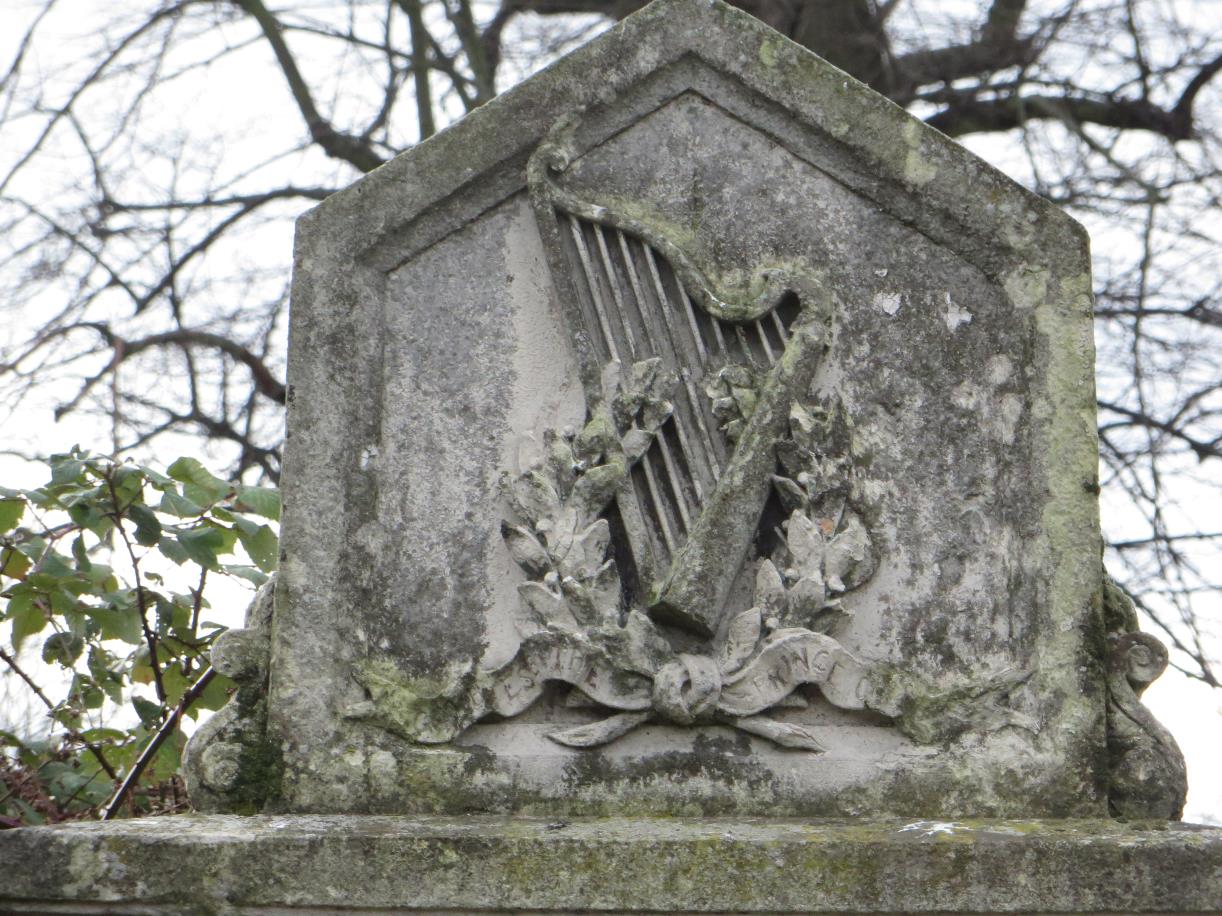
The harp on top of the monument to Henry Brinley Richards, Brompton Cemetery
©Carole Tyrrell

As you pass by a cemetery do you ever think that you hear celestial music drifting on the air?  Maybe it’s because there  are so many musical symbols to be found within them – violins, trumpets, guitars and harps to name a few.

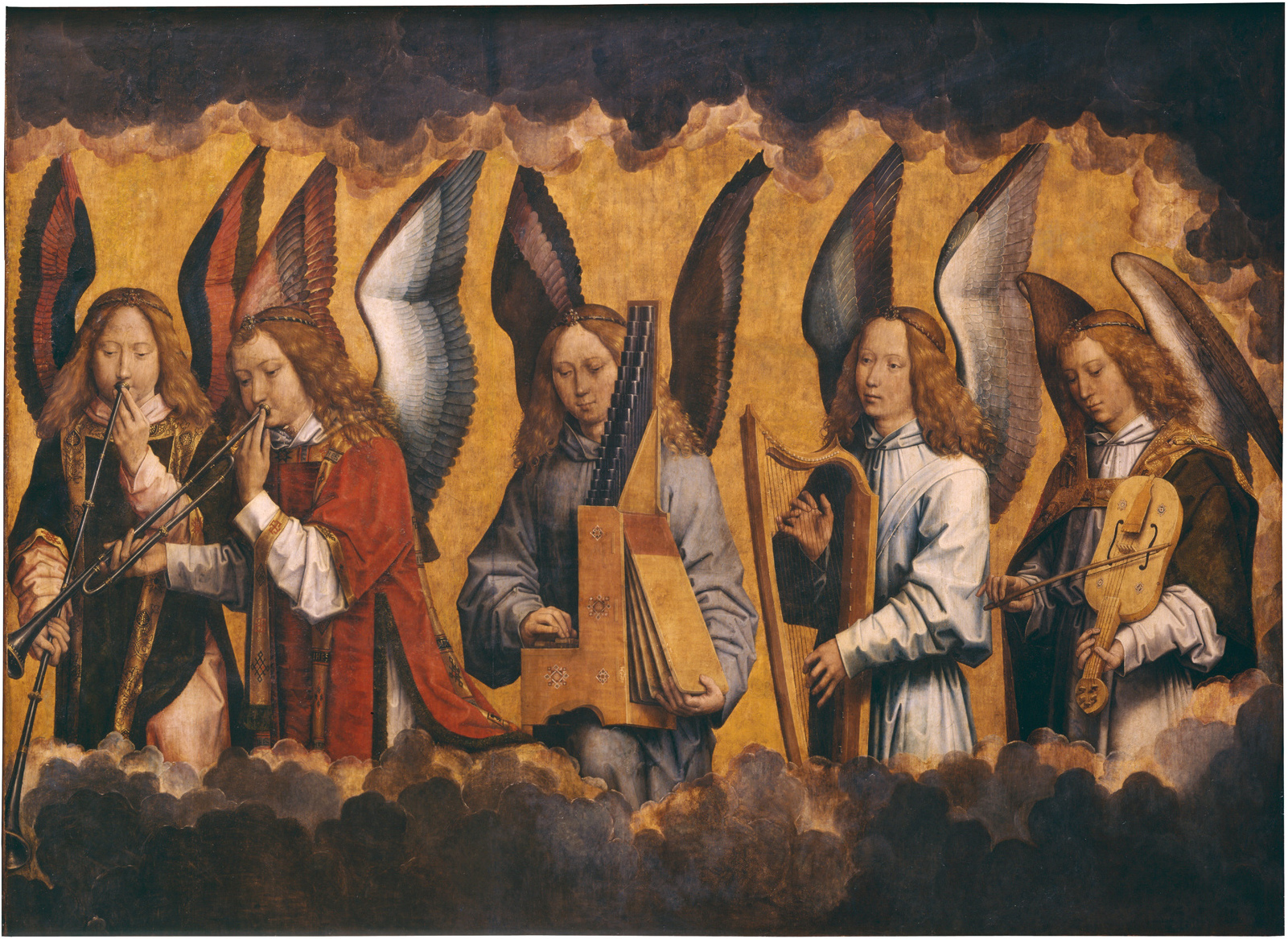
This month, I’m going to be discussing the harp.  It may immediately bring visions of angels in pristine white gowns, perched on clouds, plucking away on golden harps to mind.  Harps have that ethereal quality.

Hans Memling Music making angels – circa 1480’s.
Shared under Wiki Creative Commons

I found many online images of statues of angels playing harps in cemeteries worldwide but all on stock photography sites.  It’s a reassuring image of heaven as a place of peace and calm. According to Alison Vardy, a professional harpist, the word ‘Harp’ or ‘Harpa’ comes from Anglo-Saxon, Old German and Old Norse words for ‘pluck’ as in plucking the strings.

However, when I first considered writing about the harp as a symbol I did think about linking it with St Patrick’s Day.  After all, it is the national symbol of Ireland and also appears on Guinness cans and bottles.

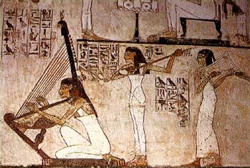
But this musical instrument has an ancient tradition and images of harps have been found in wall paintings in France dating from 15,000 BC. They also appear on Ancient Egyptian wall paintings from 3000 B.C.

Ancient Egyptian wall painting depicting a harp being played.

In fact, it’s one of the oldest musical instruments in the world and was originally developed from the hunting bow.  In this image the harp being played still resembles the hunting bow as it doesn’t yet have the pillar attached.  This didn’t appear until the Middle Ages and was added to support additional strings.  The earliest known image of a harp is a Pictish carving on an 8th century stone cross.

8th century Pictish carving of a harp.


‘Harps played an important part in Irish aristocratic life. Harpists were required to able to evoke three different emotions in their audience. Laughter, tears and sleep.’ Alison Vardy (the last emotion being very appropriate for a cemetery)


The harp is associated with St Cecilia who is the patron saint of music.  She was a Roman martyr who is reputed to have sung to God at her wedding and also as she lay dying after being beheaded.  You can read more about her life here;  https://www.britannica.com/biography/Saint-Cecilia.

St Cecilia’s feast day is 22 November but her association with music didn’t begin until the 15th century. She was then depicted as playing at an organ or either holding an organ or organ pipes.

The harp also appears as an instrument of healing in the Old Testament.  In Samuel verses 16-23, David plays the harp for Saul in order to drive out the evil spirit that afflicts him.  Harps are also mentioned in Genesis and Chronicles.

When I first saw this monument in Brompton Cemetery I thought that it had to be dedicated to an Irishman.  But it is in fact on the grave of a Welshman, Henry Brinley Richards (1817-1865), who was born in Carmarthen.

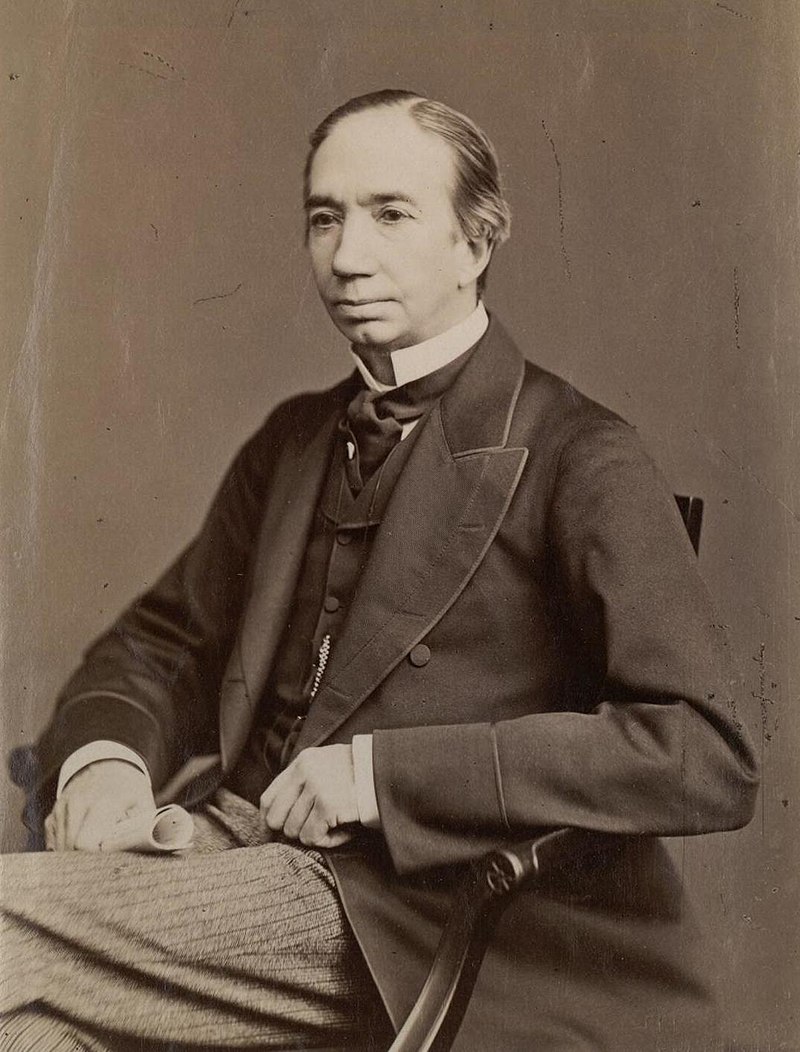
1880 photo of Henry Brinley Richards
Shared under Wiki Creative Commons

He was originally destined for a medical career but music was his real calling.  However,  he didn’t play the harp as, instead, he played the piano.  He was discovered after winning a prize for his arrangement of a traditional song, ‘The Ash Grove’, at the 1834 Eisteddford in Cardiff. This really opened doors for Henry as he was able to study at the Royal Academy of Music under the patronage of the Duke of Newcastle. Henry won two scholarships while studying at the Academy and after graduation he taught piano there.  He travelled to Paris and met Chopin and he has over 250 compositions listed in the British Museum catalogues of printed music.  But his most famous piece of music is ‘God Bless the Prince of Wales’ from 1862.   Henry never lost his Welsh connections. Pencerdd Towy is his bardic name and not, as I originally thought, another Welsh town. Bardic names were pseudonyms and part of the 19th century medieval revival.  I did research bardic names but I have to admit that I was none the wiser.  And the meaning of the harp that sits so resplendently on top of the monument?  It’s the national instrument of Wales which I didn’t know until I began researching this post.

The monument to Sarah Russell, The Rosary Cemetery, Norwich, Norfolk
©Carole Tyrrell

The other example is from the Rosary Cemetery in Norwich. This is a non-denominational cemetery and rises in tiers above the city.   It’s an interesting group of symbols and is dedicated to a woman, Sarah Russell nee O’Brien (1869-1899) and there may be an Irish reference with the harp and her maiden name.   She died young, aged 30, in Kansas City, USA.  Sarah was born into a performing family as her father, Archibald O’Brien, and siblings were all equestrians.  I found the family living in Leeds in the 1881 Census and they must have really stood out amongst their respectable, aspiring middle class neighbours.  Equestrian was listed as their occupation. She married into another family connected with animals as her husband, William, was part owner of a zoo. One of her sisters, Irma O’Brien, wrote the epitaph:

‘To my dear sister Sarah Russell,

‘Soeur bien aimee reposee en paix’ 

which translates as:

‘Beloved sister rest in peace.’

 On this monument note that the harp has no strings and so cannot be played.  This indicates that the music of life has ended.  There are also other variants in which a string on the harp is broken which again means that it can no longer be played. The music has been stilled by death. The cloth, nicely detailed to simulate lace with the holes, indicates the curtain between the world of the living and the dead.  However, the broken column is said to denote a life cut short.  I have always understood this to mean that the backbone of the family, the support of the family, had died and this is usually on a man’s grave.  But maybe Sarah was the support of the family after all.  For me, it’s the unstrung harp that is the most poignant symbol of the group.

So the harp can have several associations; a musical instrument, a symbol of national pride, a representation of life and death and also with angels. However, according to J C Cooper, it can also be viewed as the ladder leading to the next world with the harpist being Death – an interesting allusion.   There is also a link with the Celtic God of Fire, Dagda, who calls up the seasons and whose playing originally brought about the change of the seasons and made them appear in the correct order.  This is the harp as an instrument of power particularly with Dagda.   This is very different from pensive angels in a heavenly harp choir. However,  it’s good to understand the contrasts in how it is used and how it’s perceived in other cultures.

I hope that you all stay well and safe in these unprecedented times.

©Text and photos Carole Tyrrell unless otherwise stated.

References and further reading:

An Illustrated Encyclopaedia of Traditional Symbols, J C Cooper, Thames & Hudson, 1979

https://churchmonumentssociety.org/resources/symbolism-on-monuments

https://www.geograph.org.uk/photo/2109764

https://tuisnider.com/2015/10/12/historic-cemetery-symbols-what-does-a-harp-mean/

https://artofmourning.com/2010/11/21/symbolism-sunday-the-harp/

https://www.undercliffecemetery.co.uk/gallery/funerary-art/

http://www.thecemeteryclub.com/symbols.html

https://en.wikipedia.org/wiki/Saint_Cecilia

https://www.britannica.com/biography/Saint-Cecilia

https://bardmythologies.com/the-dagdas-harp/

http://www.internationalharpmuseum.org/visit/history.html

https://www.alisonvardy.com/harp-history.html

A pre-Coronavirus Spring Saunter though Kent churchyards – St Mildred’s and St John the Evangelist, Meopham, Kent

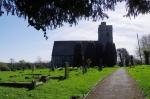
St Mildred’s Meopham
©Carole Tyrrell

The church in the field – St Mildred’s

The cawing of rooks in the bare trees kept me company as I walked towards St Mildred’s in Nurfield, just outside Meopham. It was a dark, wet, overcast day and St Mildred’s huddled surrounded by fields at the end of Church Lane. In fact, it’s known as ‘The Little Church in the Field’.

Kent has many of these picturesque churches and I hoped to discover more symbols or interesting headstones in the churchyard.  Coronavirus was snapping at my heels and I knew that all churches would soon be closed.

On the horizon of one field outside the churchyard I could see the bright yellow traces of a future rapeseed crop but the other field, alongside it, was still ploughed earth.  The bare trees tried to stretch up to the sky on the other side of it. I’ve always loved these in winter as you can really see the shape of the tree and the delicate pattern of branches and twigs.

St Mildred’s was closed but the church door was protected, or hidden, by four tall yew tree sentinels. A pot of purple pansies beside it were a splash of colour on such a grey day.

Pansies by church door of St Mildred’s, Meopham
©Carole Tyrrell

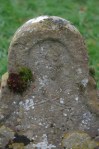
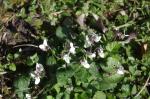
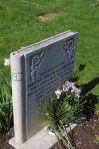
Despite the damp weather there were large patches of Spring flowers; Violets, both purple and white covered parts of the churchyard, together with smaller groups of Lesser Celandine which is one of the seven signs of Spring. Daffodils shuddered in the wind and a group of them huddled together for warmth by headstones.  But I was determined and found the symbol of a closed book on one grave to a man who had died young. The oldest headstone was now unreadable and was decorated with tiny pom-pom shapes of a lichen.  An imposing Celtic Cross was dedicated to a priest. The bright yellow flowers of lesser celandine had closed themselves up and who could blame them? Primroses kept their heads down but in one corner of the churchyard there were indications of living residents.  These were of the four legged kind who had dug deep holes and left pungent evidence…..

Nurstead was described 700 years ago as ‘a poor little parish with a church.’  St Mildred’s was originally a Saxon church and made of wood. The current flint structure dates from the 14th century and the guide leaflet says ’that together with the 14th century hall of nearby Nurstead Court it is the only surviving part of the Manor as it existed in 1349.’

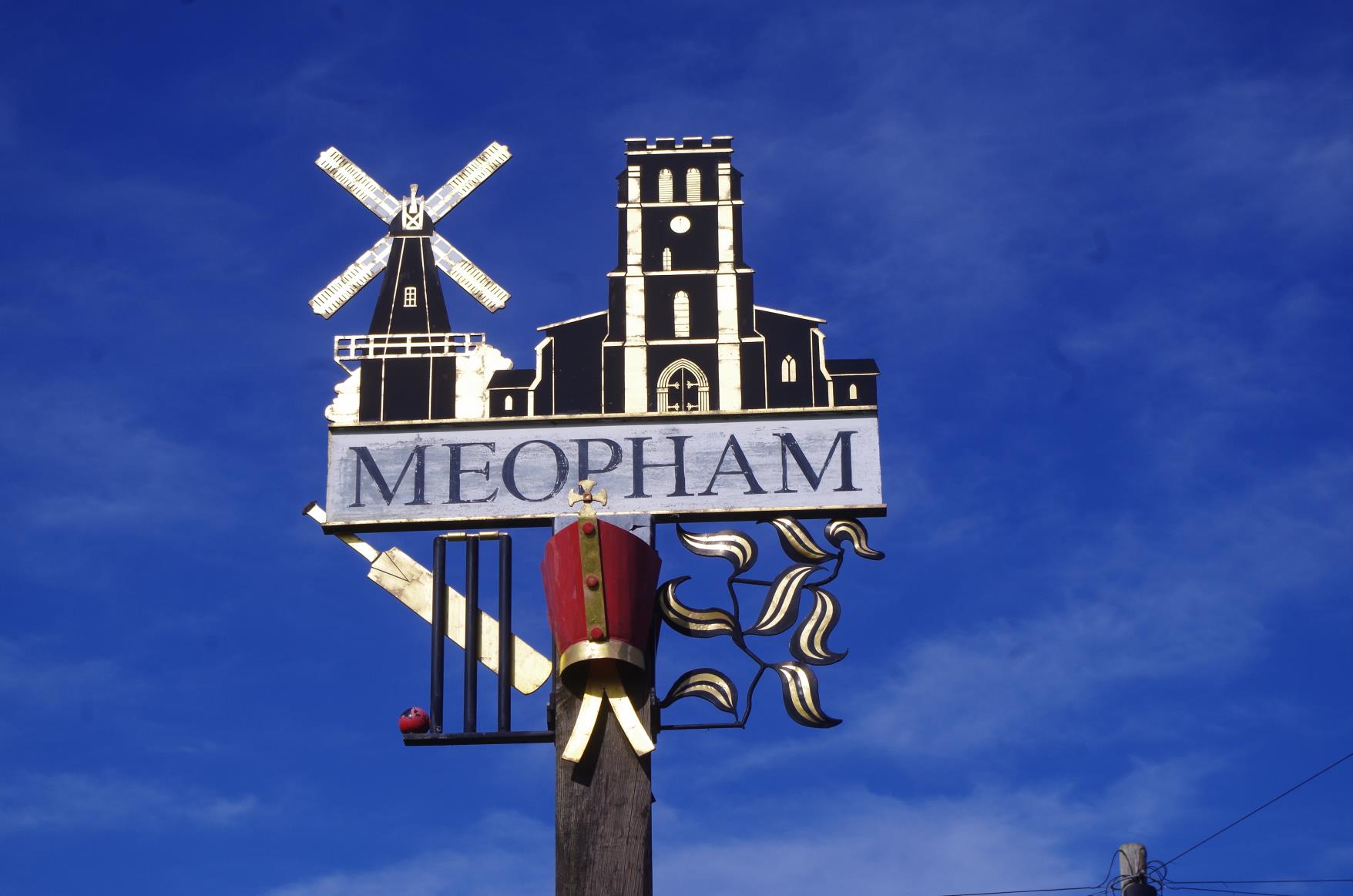
Meopham town sign featuring St John the Evangelist church.
©Carole Tyrrell

Meopham is pronounced Meppham and it’s more of a hamlet than a village.  But it does possess another, larger church at the other end of it.  This is dedicated to St John the Evangelist and appears on the village green town sign. St John’s was open and I gratefully sheltered inside glad of the respite from the weather.

The church on the sign – St John the Evangelist

Inside it was peaceful and St Johns had some interesting features. There was a very decorative wooden pulpit attributed to Grinling Gibbons and dated 1632 and the colourful and beautiful tiles decorating the chancel. They were uncredited in the guidebook. There was also a window containing fragments of medieval glass which have been dated to 1346.   Curling hazel branches had been placed on windowsills and I wondered if it was in honour of Branch Sunday. Outside in the churchyard I explored and my shoes soon became soaking wet. A bonfire had been lit  in an adjoining garden and the combination of that and the gloomy weather made it feel more like November. The Millais painting, ‘Autumn Leaves’, with its melancholy atmosphere sprang to mind.  A patch of primroses cuddled up to each other in a drift of fallen leaves and the Lesser Celandine flowers had closed themselves in response to the rain. A lone dog violet stood in defiantly in the middle of them. It was time to go home.

But when I returned two days on the Saturday it was under sunny blue skies.  St Mildred’s was now open and despite the wind that made the daffodils blow this way and that I noticed that the Spring flowers seemed to have colour again.  The crisp white blossom of blackthorn foamed in one corner as did the Wild Cherry blossom on the other side of the churchyard. Late snowdrops nodded in the wind as I entered the church. The interior was very plain and simple with large ledger stones providing the nave flooring.   The bare fields now looked as if they were impatiently waiting for the forthcoming crop to burst forth. I had hoped to see a March hare but no such luck. The headstones were bathed in the golden glow of the sun and the bright flowers of Lesser Celandine lifted their heads upwards and basked.

These were dedicated to past residents, the Edmeades, of nearby Nurstead Court, and dated back to the 17th century. They are actually buried in the vaults beneath the stones. A squint could be seen in the West Tower and the slow, regular ticking of the church clock was the only sound. St Mildred and her stag featured in the window above the altar and an ancient piscina was decorated with wheat ears and grapes. A reference to a farming community?  The wind howled round the little church as it had done for centuries, as if trying one last time to blow it down, but it still stood.

In contrast St Johns was closed but the bright sunshine revealed several headstones that I had missed.  I’m not quite sure what this figure represents but he does seem to be pointing to the small skull in the corner.

This is on the headstone dedicated to

‘Hannah, wife of Joseph Munn the elder Feb 15th 1715 in either the 34 or 54 year of her age.’

Mr Munn is buried beside in a separate grave with his second wife but not with such an intriguing symbol.

Also this naive head or skull on one headstone.

A Naive skull on a headstone, St John’s, .Meopham
©Carole Tyrrell


The sticky buds on a venerable Horse Chestnut tree at the entrance reminded me that despite the horrible weather we’ve had over the last couple of months Mother Nature was just getting on with it as she studded and carpeted churchyards with the bright colours of Spring flowers and blossom.

Sadly, my poking about in churchyards has had to be put on hold this Spring due to the virus. However I did manage to visit two Kent churches just before the lockdown and I will blog about this on a future post. One churchyard was awash with symbols!

I hope that you are keeping well and safe during these strange times.  Life has taken on a surreal quality for some of us as others, keyworkers, keep things going and risk their lives.  Will things return to normal  afterwards or will we not take so much for granted again? Who knows.

©Text and photos Carole Tyrrell unless otherwise stated

References and further reading:

https://kentarchaeology.org.uk/

Guide Leaflet, St Mildred’s church

Symbol of the Month – The Easter Sepulchre

A plain and simple Esater Sepulchre at St Mary’s Grendon, Northants
© Carole Tyrrell

I thought that for this month’s Symbol  it would be good to have one that was specifically linked to Easter. So April’s  Symbol is  the Easter Sepulchre.

Although this is a difficult time for all of us with the worldwide pandemic of COVID 19, life still has to go on despite it feeling a little strange.  Easter is one of the holiest weeks in the religious or faith calendar and in medieval times the Easter Sepulchre would have been an integral part of the celebrations.

However, there are now very few examples of these in churches and only within England and Wales. After the Reformation and Henry VIII’s break with Rome over his divorce from Catherine of Aragon most of them were destroyed. The ones that have survived are to be found in little country churches.    I discovered this lovely example completely by chance when I visited the church of St Bartholomew in Otford, Kent.

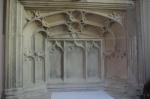
Initially I thought that it was a canopied tomb without an effigy.  But the guide leaflet confirmed  that is is a particularly good example of an Easter Sepulchre and bears two symbols; the pomegranate, which was the badge of Catherine of Aragon and the Tudor Rose.  The sepulchre was made from Caen stone and has been dated to the early 16th century. The guide leaflet for St Bartholomew also suggests that the symbols could be a reference to the visit of Henry VIII and Catherine to Otford in 1520 on their way to the Field of the Cloth of Gold in France.  There is a small ledge on the right of the Sepulchre which is assumed to represent Christ’s empty tomb.  As John Vigar says:

‘It was the tomb of an individual erected on the north side of the chancel which over each Easter weekend would be used as a focus for devotion, representing the entombment and resurrection of Christ. It always had a flat surface on which the sepulchre itself would be placed.

However, the stone canopy was not the actual the Sepulchre.  This was a wooden chest containing either the cross from the main altar or a consecrated Host in an ornate container known as a Pyx. Some of the sepulchres were so small that they could only hold the Host.  The sepulchres were part of Easter church rituals from the 13th to 15th centuries and were used in both Catholic and Anglican churches. Each church was only allowed to have one. According to https://www.encyclopedia.com/:

‘In this period the ritual burial of Christ was a solemn observance. At the end of the Liturgies of Good Friday, the priest would carry the pyx and the Cross, both wrapped in linen, to the north side of the chancel where a temporary sepulchre which was usually wooden and draped with a pall had been made ready and laid them within.  The sepulchre was then perfumed with incense and lit by numerous candles as a constant watch was kept to protect the Host and Pyx.  The Host would have been consecrated on Maundy Thursday. Early on Easter morning, candles  would illuminate the church, the clergy would come to the Sepulchre, the Host was removed to the Pyx above the high altar and the Cross was raised from the sepulchre and carried in procession around the church while church bells chimed and the Resurrection was celebrated’.

Henry VIII wanted to preserve the sepulchres after the break with Rome but Archbishop Cranmer passed laws ordering their destruction.  The wooden chests were then put to other uses such as dish racks!  Soon their actual purpose was forgotten.

A more permanent form of the Sepulchre was as a recess, often canopied over a tomb chest.  Wealthy patrons or local families who wanted to be associated with the Easter mysteries often built tombs for themselves that could also be used as Easter sepulchres.  They vary from the very plain to the very ornate as with the one in Lincoln Cathedral.  Often they are not inscribed with the name of the donor and a church could only have one.  It was wonderful to see such a fine example at Otford  as I explored the interior of the church.

Here are two fine surviving examples:

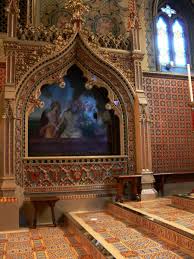
Augustus Welby Pugin, the celebrated Victorian architect and designer attempted to revive the Easter Sepulchre and there is a magnificent example in St Giles, Cheadle.  But it was seen as merely decorative.

A W Pugin’s richly decorated Esater Sepulchre in St Giles Cheadle/
©stgilescheadle

I’ve always associated Easter with a time or rebirth. Spring is usually on its way by Easter time; churchyards burst forth with Spring flowers and there’s a general feeling of Mother Nature getting on with it. This rebirth has never been so important as it is in 2020 in the light of the pandemic.

Please keep well and safe.

©Text and photos Carole Tyrrell unless otherwise stated

References and further reading:

Guide leaflet, St Bartholomew, Otford, Kent

https://en.wikipedia.org/wiki/Easter_Sepulchre

https://www.nationalchurchestrust.org/what-see-inside/easter-sepulchre

http://modernmedievalism.blogspot.com/2015/04/the-easter-sepulchre.html

https://www.encyclopedia.com/education/dictionaries-thesauruses-pictures-and-press-releases/easter-sepulchre

http://elfinspell.com/AndrewsEaster.html

https://www.britainexpress.com/church-history.htm?term=Easter+Sepulchre

https://www.johnevigar.com/john-e-vigar-blog/easter-sepulchres

http://www.threeabbeys.me.uk/research.html


Symbol of the Month – Angel with trumpet

This month’s Symbol of the Month is later than planned due to the Coronavirus snapping at my heels.   I was determined to have a Spring saunter through three local churches while I still could.  They have now all inevitably closed.

I hope all of you can stay well during this difficult time.


Full view of the du Bois headstone, West Norwood Cemetery
© Carole Tyrrell


It wasn’t until late in the 19th century that angels fluttered into large Victorian cemeteries and there is undoubtedly a story to be written as to how they changed sex once they had perched themselves on top of monuments.  There is a hierarchy of angels and they can be identified by what they hold in their hands; a sword, shield, a book or, in this case, a trumpet.   The angel holding a trumpet is the one that features as this month’s Symbol.

I have seen several examples and this one comes from West Norwood Cemetery.  It’s on the headstone dedicated to Edward who died aged only 13 years.  As the epitaph states,

‘Edward

THE ONLY SON

E. du Bois Esq

BARRISTER OF LAW’


I’ve always considered it to be a very striking, almost 3D image, with the detail on the angels wings, clothes and the clouds that surround her.  It depicts an angel blowing on a trumpet with a Biblical quotation surrounding her.  The angelic figure is definitely a woman. and it’s always intrigued me how angels which are traditionally male in the Bible became pretty, pensive young women when they appeared in cemeteries and churchyards.  The quotation reads:

WAITING

THE LAST TRUMPET (words unreadable)………

ALL SHALL RAISE AGAIN

In this case, the angel trumpeter on this headstone is a representation of the Last Judgement Day as she is the herald of the resurrection.

There are many references to angels blowing trumpets in the Bible and their association with the dead rising on the Day of Resurrection. For example in Corinthians 15:32, it says:

‘in a moment, in the twinkling of an eye,

At the last trumpet.

For the trumpet will sound, and the

Dead will be raised imperishable,

And we shall be changed.’


There are also references in the Book of Revelation and Matthew 24:32.

However, it is the archangel, Gabriel, who is most associated with blowing a trumpet to announce the resurrection of the dead and images of this began to appear in the 14th century.  There is a very stern and definitely male angel figure holding a trumpet at the entrance to Queen Victoria’s mausoleum at Frogmore.  There is also a geometric figure known as Gabriel’s horn or Torricelli’s trumpet. It has infinite surface area but finite volume. According to Wikipedia:

‘The name refers to the Abrahamic tradition identifying the archangel Gabriel as the angel who blows the horn to announce Judgment Day, associating the divine, or infinite, with the finite. The properties of this figure were first studied by Italian physicist and mathematician Evangelista Torricelli in the 17th century.’

Angels appear in most religions and it’s appropriate that one of the most well-known is associated with communication. In fact angels are usually seen as messengers as the word ‘angel’ is derived from the Greek word, ‘angelos’, which means ‘messengers.’    They also appear in Islam as the word for messenger, Mala’ika, is the Islamic term for angel.  The Koran, like the Bible, also has references to angels especially Djibril or Gabriel nd Mikhail or Michael. According to Douglas Keister:

‘Angels appeared to grow wings in a 5th century mosaic in Rome. After all they are seen as messengers between heaven and earth.’

Gabriel is is also associated with the Annunciation.  He is, with his trumpet blowing, an obvious choice for announcing the departure of a soul and its arrival in Heaven.

I have seen an example of an angel blowing a trumpet in Tower Hamlets Cemetery and this lovely example comes from St Mary’s Catholic cemetery which nestles next to its larger neighbour, Kensal Green. She is on top of the Abreu monument.

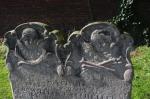
While exploring Kent churchyards prior to the Coronavirus outbreak I found 17th headstones with angel heads on them with trumpets surrounding them.  In this one the trumpets are crossed like long bones beneath the angel head.


So, in many ways this is a very ancient symbol which has come down through the centuries as a message of comfort to those left behind.  The one dedicated to Edward du Bois has an epitaph that expresses his father’s grief as well as his anger at his son’s untimely death.


©Text and photos Carole Tyrrell unless otherwise stated.

 References and further reading:


Stories in Stone, Douglas Keister, Gibbs Smith, 2004


https://en.wikipedia.org/wiki/Gabriel%27s_Horn

https://en.wikipedia.org/wiki/Gabriel

https://www.cityofgroveok.gov/building/page/angel-blowing-trumpet

https://www.openbible.info/topics/angels_trumpets

https://en.wikipedia.org/wiki/Gabriel

The mystery of two wonderful examples of medieval memento mori

I found the article below in the Church Times and thought that I would share it with you.  Although on first glance they may look a little macabre, I saw them as lovely examples of medieval iconogrpahy.  In many ways they are also very touching.  I love the mystery surrounding them as well.

Shrouded skeletons on brasses in medieval Durham church investigated

02 MARCH 2018


FRIENDS OF ST EDMUND’S CHURCH

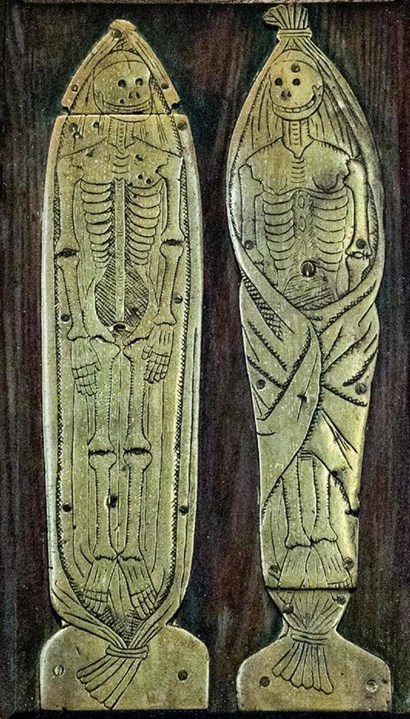
The two shrouded figures displayed on brasses at St Edmund’s, Sedgefield

PUBLIC curiosity about two shrouded skeletons in a medieval church has led to an investigation into their origins.

The figures — believed to be male and female — are depicted on brasses displayed on the wall at 13th-century St Edmund’s, Sedgefield, in Co. Durham, which is Grade I listed. The plates are singular in that they portray skeletons: normally, the figure is a likeness of the person in the tomb.

Little is known about them, and the Friends of St Edmund’s are trying to find out more. “We are asked about the origin of the skeletons on a fairly regular basis, and it would be nice to have an explanation for people who visit the church,” Alison Hodgson, a local historian and the secretary of the group, said.

They hope that documents held in the archives of the Society of Antiquaries of Newcastle upon Tyne will shed some light, and are aware of one record which says that the two figures were once on a tomb that had a shield and ribbon above, and a border — probably with an inscription — around the edge.

Brian Mutch, a churchwarden and the Friends’ membership secretary, is leading the investigation. “We don’t know how long they have been in the church,” he said. “One document from 1896 says they were there then; so we will have to go further back. There is no indication as to how old they are, but all the others in the church date from the 1300s; so it is quite likely they come from then.

“It is possible they were on a tomb in the north transept, but that has been altered two or three times over the years. However, we do have two stone effigies in the south transept — one of a man and the other of a woman — and I wonder if it is them. There are records of noble families in the area giving patronage to the church, but we have yet to examine them.

“There is a lot more work to do. I don’t know how long it will take, but we shall persevere.”

Two lives on the ocean waves – the wonderful Wimbles of West Norwood Cemetery

The path on which you will find the Wimble monument.
©Carole Tyrrell


There is a clearing along Ship Path in West Norwood Cemetery where, if you pause for a moment, you could almost swear that you can smell the sea.  For a moment you can hear the ceaseless ebb and flow of the tides, the relentless cries of seagulls and the smell of ozone.

View of the Wimble monument, West Norwood Cemetery with the SS Maidstone panel.
©Carole Tyrrell

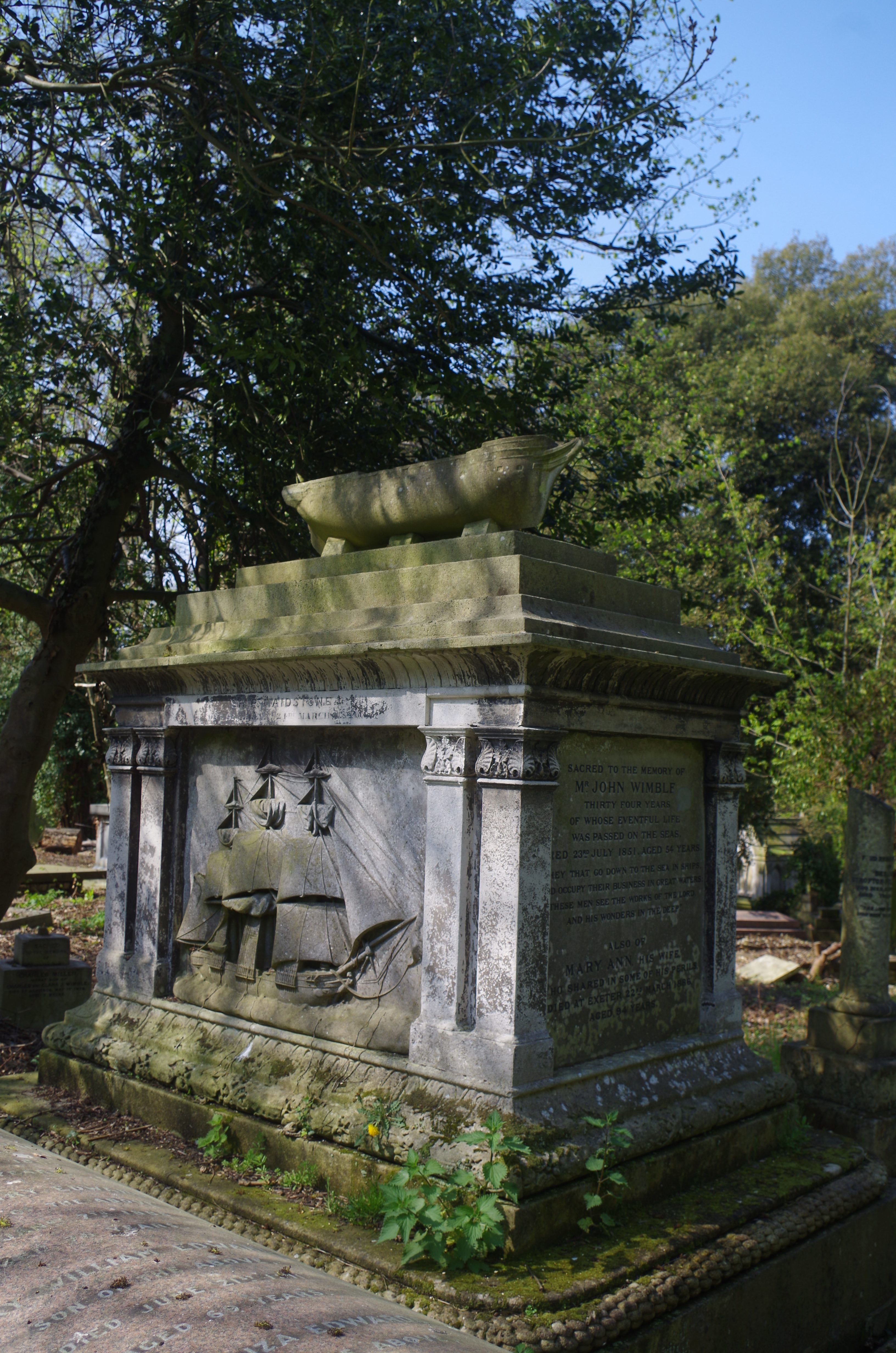
Then you’ll probably be standing in front of the exuberant and flamboyant monument to Captain Wimble (1797-1851) and his indomitable wife.  He was an employee of the East India Company and, Mary Ann, his wife, accompanied him on his many voyages which demonstrates that Captain Wimble didn’t subscribe to the old seafaring tradition that it’s unlucky to have a woman on board.  However, as sea voyages at the time could take over a year perhaps it was the only way that they could see each other.  He was born in 1797 and baptised at All Saints parish church, Maidstone in March of that year. Capt Wimble would have probably first gone to sea aged 12 or 13 and he was obviously ambitious. The East India Company who were extremely powerful and held a monopoly on the trade with India in importing items such as cotton and opium.  They were a precursor of the British administration in India. At 23, he became a ship’s captain with the Company by fulfilling their criteria and so his seafaring career began.

View of the Wimble monument, West Norowood Cemetery. Note the frieze at base that resembles rope and the ship on top.
©Carole Tyrrell

However, it’s immediately obvious that the monument is to a seafaring man. A boat, now sadly damaged, perches on top of the chest tomb.  It used to have iron masts but I have been unable to locate a photo with the ship intact. The nearest one is dated from 1968. Here is the link: https://www.architecture.com/image-library/RIBApix/image-information/poster/west-norwood-cemetery-london-the-sarcophagus-of-captain-john-wimble-decorated-with-ship-reliefs/posterid/RIBA48791.html

The epitaph on the front records his deeds and as you walk around you will see a sailing ship on each side.  They are still impressive and dramatic and the still crisp carving emphasises the sea scenes.  You almost feel that they could sail away at any moment.  These were all ships that Capt Wimble commanded. A sculptured length of rope decorates the base of the monument as a frieze.


On the east side is a 3 masted ship, the Maidstone, with furled topsails on a clam sea and is dated 24 June 1840.  He captained this ship on a round the world voyage in 1840.  It travelled to Calcutta, then New Zealand, onto New Jersey and then finally New York. The Maidstone, all 818 tons of her, was built in 1839 at the Blackwall Yard in London and owned by Green and Wigram. She was intended for the London – Bengal and London-Calcutta routes and was last recorded in 1860 when she was abandoned on the way to Australia. There is a painting of her in the National Maritime Museum.

The Florentia is depicted on the south side in stormy weather off the Cape on 24 June 1825 and to the west is the London, dramatically and perilously sailing in heavy seas with a broken mast off Gangam and this is dated 6th October 1832. Gangam is   a coastal district of Orissa in India which East India Company  ships would have passed through on their way to Calcutta.  The Florentia was the first ship that he captained and he would have sailed to the island of Madeira near Tenerife, turned towards Brazil for supplies, then onto South Africa and onto India.

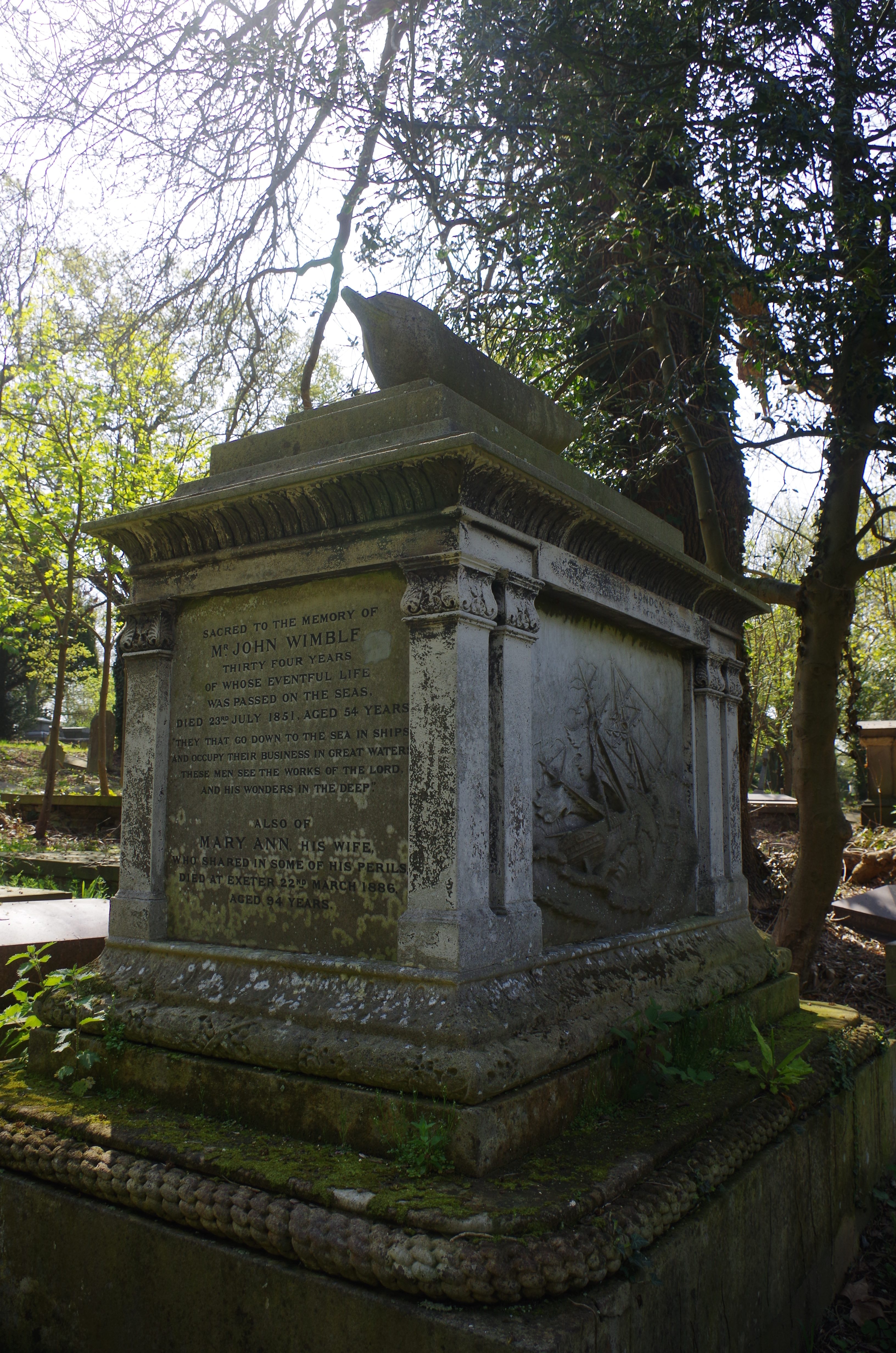
The three scenes emphasise the unpredictable ups and downs of a sea captain’s life which was completely at the mercy of the weather at that time.   There is a fulsome epitaph to the Wimbles on the north side of the monument:

‘Sacred to the memory of Mr John Wimble,

34 years of whose life was passed on the

seas. Died, 23rd July 1851, aged 54 years. ‘They

that go down to the seas in ships and occupy

their business in great waters; these men see the works

of the Lord and his wonders in the deep.’

Also of Mary Ann his wife who shared in some

of his perils. Died Exeter, 22nd March 1886

aged 94 years.’

Close up view of the Wimbles epitaph, West Norwood Cemetery.
©Carole Tyrrell

Capt Wimble was clearly a man of substance as this unique and imposing monument demonstrates.  It may be more than coincidence that Capt Wimble’s first ship as Master was called the Maidstone. He was born in the town of that name and when he retired he named his house in Upper Tulse Hill Maidstone Cottage. In the first Census taken in 1851 he was recorded as living at that address with Mary Ann, then aged 54, and two servants, Mary Iles and Elizabeth Sheffield, both aged 26. He died at Maidstone Cottage in 1851 with the cause stated as ‘heart disease’.
As you might have guessed by the size of the tomb and the quality of the bas-reliefs Capt Wimble was a man of means as it was the custom for wealthy travellers to give the captain of their ship expensive gifts at the end of the voyage.

I am indebted to Eloise Akpan’s 2005 article in The Norwood Review for the details of his will and also the Friends of West Norwood Cemetery’s newsletter, September 2020 for the details on his will and ships.   Capt Wimble’s will was signed 9 months prior to his death and in it he specified the intended destination of ‘every bit of his clothing, jewellery and furniture’, as well as the money. The debts of the relatives to which he lent money are all erased. As a result of the generosity of his well-heeled passengers there was an impressive collection of gold and silver items including 6 silver candlesticks.  These came down to a descendant of John’s brother, Charles. This was Derek Wimble who lived in Herne Hill until his death roughly 36 years ago.  The candlesticks with an accompanying candle snuffer were subsequently sold by his widow with an engraved inscription that stated they had been

‘given by the grateful passengers on a homeward voyage from Calcutta to London in 1840.’

Sadly, Derek had no idea that his illustrious ancestor was buried nearby which is sad.

Mary Ann was a woman of her own mind. The will also stipulated that ‘

I direct that my body may be decently and plainly interred at the discretion of my beloved wife. She alone shall have the ordering and regulation.’

Perhaps she had her own interpretation of this and so she created a magnificent monument to her husband and herself which is one of the most attractive and imposing within West Norwood.

An interesting postscript to this was in the Friends of West Norwood Cemetery’s 2010 newsletter in which the headstone and grave of a William Wimble had been located close to Capt Wimble’s.  William had also been born in Maidstone – a possible relative?

Sadly, I have been unable to find an image of either Captain Wimble or Mary-Ann which would have enabled me to put faces to them.  The monument is due to restoration this year and I am looking forward to seeing the results.

But I’m sure that when I next visit that I will still hear and feel sea breezes as I walk towards it along Ship Path.

©Text and photos Carole Tyrrell unless otherwise stated

References and further reading:

The Tomb of Captain John Wimble, Eloise Akpan, The Norwood Review, The Norwood Society, Spring 2005

https://www.discoveringbritain.org/content/discoveringbritain/walk%20booklets/West%20Norwood%20DB%20walk%20-%20written%20guide.pdf

https://historicengland.org.uk/advice/heritage-at-risk/search-register/list-entry/50185

https://www.fownc.org/pdf/newsletter69.pdf – this contains information about Capt Wimble’s ships, voyages and will.

Symbol of the Month – Lion’s Paws


This month’s Symbol is a little bit of fun.

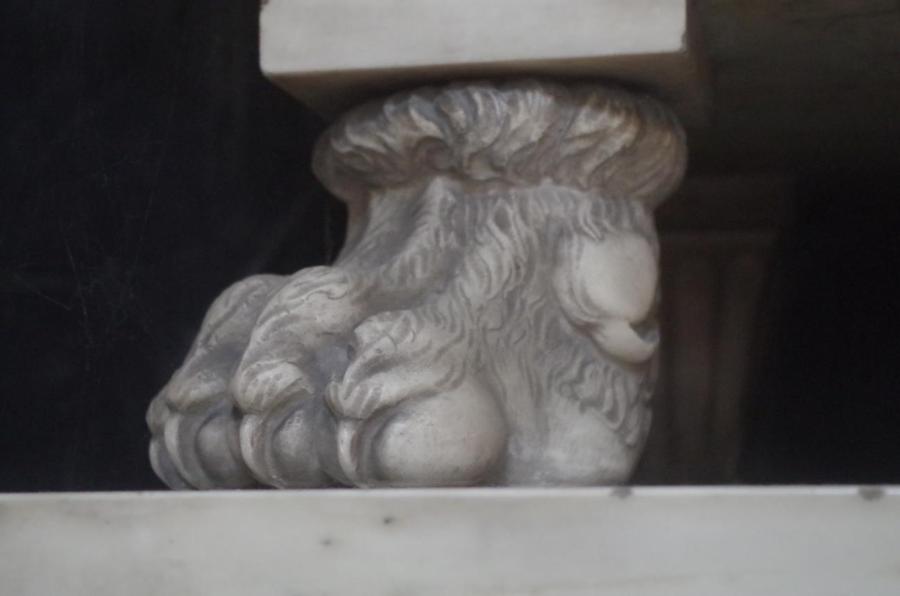
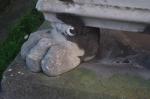
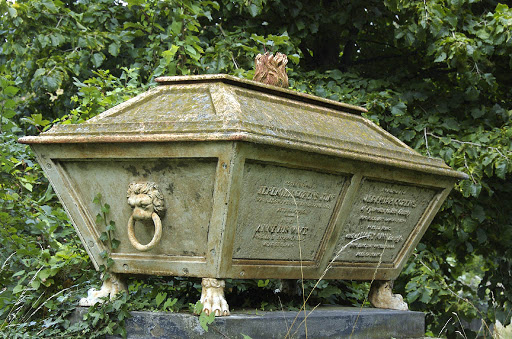
These lion’s feet supporting two sarcophagi within London’s Brompton Cemetery almost look comical – it’s as if they may just get up and run away at any moment carrying their cargo!

But, if you look closely, then you can see how detailed they are especially with the hair around the ankles and the claws. They are unusual as I don’t see them that often. But there are examples to be found in other cemeteries. For example, there is one within Norwich’s Rosary Cemetery.

The Cozens monument in the Rosary cemetery, Norwich. It’s made from cast iron which was originally painted black. It records Jeremiah Cozens and other members of the Cozens family.
© Recording Archive for Public Sculpture in Norfolk and Suffolk

The sarcophagus is made from cast iron and was originally painted black.  It is dedicated to the memory of Jeremiah Cozens who died aged 32 in 1849.  There are other members of the Cozens family commemorated on different sides of the sarcophagus.  Also, Mrs Bradley’s monument in Elmwood Cemetery, Memphis, Tennessee, USA features a magnificent set of paws.

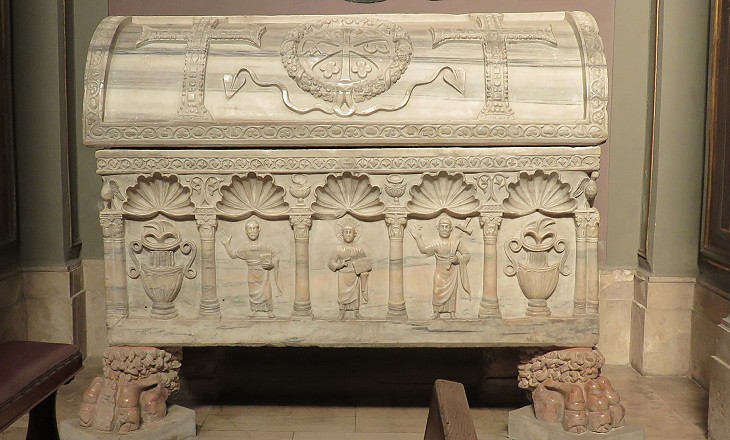
The lion represents strength which is demonstrated by the paws supporting the sarcophagus. They have appeared as decorative devices in Ancient Greece and Rome. These were often known as ‘claw feet’ or ‘paw feet’ and were usually either a lion or a bear’s foot.  They also appeared during the Renaissance and into the 17th and 18th century in French and English furniture.  This magnificent example dates from the Renaissance.  Although this sarcophagus has been dated to the 5th century the lions paws were added after the 15th century. It comes from Ravenna, Italy.

This sarcophagus was used as a grave for an Archbishop of Ravenna. The lion’s paws were added after the 15th century although the sarcophagus dates from the 5th century.
©://www.romeartlover.it/Ravenna4.html


So the use of lion’s paws probably originated in the Classical world as did the sarcophagus form itself. It’s a stone coffin that was used for burials and the word ‘sarcophagus’ comes from the Greek for ‘flesh-eater’.  With the rediscovery and use of Classicism within Victorian cemeteries such as Brompton it’s appropriate to find two elements from it.  Ancient Greece and Ancient Rome motifs appeared in many Victorian cemeteries and Classicism was one of the first major artistic movements to be represented within them.

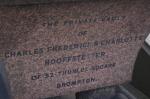
These two examples are very plain apart from the wildly extravagant carved hair on the ankles of the paws.  They are both dedicated to women; Catherine Ferrall Carmichael and Charlotte Hooffstetter.

Catherine who died, aged 88, on 21 April 1853 was the widow of Major Hugh Lyle Carmichael.  He was the Lieutenant Governor of British Guiana from 1812 until his death, aged 49, in 1813. According to Wikipedia:

 ‘He was a strong proponent of giving native Caribbean troops the same rights as ordinary British soldiers.’

He is buried in Demerara where there is a monument to him. This is the link to the wikipeadia page about him: https://en.wikipedia.org/wiki/Hugh_Lyle_Carmichael

Sadly, I’ve been unable to discover anything much about Catherine. There is an epitaph on one side of the sarcophagus of which I can only read two lines so she may have to be a Work in Progress.

Charlotte Hooffstetter is recorded on one side of her sarcophagus as being:

…’the 2nd wife of Charles Hooffstetter Esq

Nee Charlotte Gasquet

Obt on 31st August 1861 at 77.


According to an inscription on side of the sarcophagus she lived in Thurloe Square with Charles at what is still a swanky address.  They had one daughter, Sophia, who died in 1854 and Charles Hooffstetter died on 30 September 1870. The names of other family members are inscribed on the other sides of the sarcophagus.  But, again, I can find out nothing more about her. According to Find a Grave even her birth date is unknown and Charles proved to be just as illusory. So Charlotte will have to be another Work in Progress.


I also found a magnificent example on the Henniker monument within Rochester Cathedral.

The sarcophagus and lion’s feet were immensely popular and could be adapted to many other decorative uses.  I found several examples of much smaller sarcophagi and lion’s paws on vintage and antique websites where they were being offered as wine coolers and collarettes amongst other uses.  They would look very good on a sideboard or in a gentleman’s study.

But nowadays lion’s paws are more likely to be supporting an ‘antique’ revival bath tub which is a different container for a body altogether!

©Text and photos Carole Tyrrell unless otherwise stated

References and further reading

https://books.google.co.uk/books?id=X3FjAgAAQBAJ&pg=PA143&lpg=PA143&dq=paw+foot+furniture&source=bl&ots=adue3S9yfZ&sig=VPhDuMvb76W8LHyy02CZ-wzZKNE&hl=en&sa=X&ved=0ahUKEwi0yOu48NvYAhWjKMAKHWLfDFo4ChDoAQhRMAk#v=onepage&q=paw%20fo

https://en.wikipedia.org/wiki/Paw_feet

https://www.si.edu/ahhp/smithsons_symbolism

https://www.google.com/search?q=lsarcopahgi+with+lions+paws&tbm=isch&ved=2ahUKEwiYy63th9LnAhXF_IUKHZLEAy8Q2-cCegQIABAA&oq=lsarcopahgi+with+lions+paws&gs_l=img.3…190039.196641..197488…0.0..0.62.1335.27……0….1..gws-wiz-img…….0i67j0j0i131j0i5i10i30j0i5i30j0i24j0i10i24.peZ9RteRhGY&ei=IBtHXpi7GcX5lwSSiY_4Ag&bih=969&biw=1920#imgrc=r4Ue1MRSDSt5KM

https://www.romeartlover.it/Ravenna4.html

http://www.racns.co.uk/sculptures.asp?action=getsurvey&id=940

https://fineartamerica.com/featured/elmwood-cemetery-lions-paw-jon-woodhams.html

A Good Samaritan found in Rochester Cathedral

The relief of The good Samaritan with pointing finger on the tomb of Frederick Hill, Lady Chapel, Rochester Cathedral.
©Carole Tyrrell


I was exploring Rochester Cathedral recently after visiting The Museum of the Moon temporary exhibition. It featured the Luke Jerram artwork which had travelled there from the Natural History Museum.   This was my first opportunity to have a good look around the Cathedral since moving here in 2019. There was much to see; 14th century Green Men and a zodiac depicted in tiles in front of the altar amongst others.


But it was a guidebook to the Cathedral’s monuments that pointed me in the direction of the Lady Chapel and a grander version of the Good Samaritan symbol.  It’s usually covered by a rubber mat so passing visitors may not even know it’s there.  A helpful Cathedral guide lifted it for me and as it was so busy I only had time to take a few snaps. I have to apologise for the quality of the photos. exhibition.


Someone really wanted visitors to notice the relief as there is a carved pointing finger indicating it.  These are known as ‘manicules’ from the Latin root, ‘manicula’, meaning ‘little hand’  and you can just see it in one of the photos.


This is a wonderful depiction of the Good Samaritan in 3D.   I have read that the figure of the Good Samaritan is based on the incumbent, Frederick Hill, himself.    I can see the reason why it is protected by the mat as generations of visitors feet would soon start to wear it down.  However Mr Hill may not be buried directly underneath the ledger stone that bears his epitaph. But they are usually placed over an actual burial vault.
 

According to the booklet, the ledger is:


‘an incised stone slab set flush into a stone floor.


This one is considered to be:

‘one of the Cathedral’s finest’


The fulsome epitaph reveals a probable reason for the choice of symbol.   I have corrected the 18th century spelling in which an ‘s’  looks like an ‘f’.  This is called the medial S which was also known as the long ‘s’. This was a second form of the uppercase ‘S’.


Sacred

To the Memory of

FREDERICK HILL, Gent.

Who

Anno Domini 1720 Married the Widow of

His Bosom Friend

THOMAS KNACKSTON

To whose children

Two sons and Three Daughters

His CONDUCT

Was

Affectionate and Bountiful

In the most tender

Parental Sense

In his PUBLICK Trust

Providing for his Majesty’s Sick and Wounded Seamen

At this Port,

So Fair,

So Just

Such His Love and Care for them

As One

(Solely Observant of

The Seal of His Office)

That Thought for,

Or Justice to

Himself,

Was his last, as Least Concern;

He Departed this Life, the 20th  of May 1759.

Much Regretted as Greatly belov’d by all who knew him,

Being a Kind Neighbour, Sincere friend; in Disposition;

Above Guile, and in Practice; an Exemplary Christian.


As you can see, Mr Hill married his best friend’s widow and became stepfather to his children.  He was obviously an important figure in the town and he lived in the St Margaret’s area close to the Cathedral.


I have obtained a copy of his Will via The National Archives.  It’s dated 6 June 1750 and written in flowing calligraphy.  However, I could find no mention of his wife in it so maybe she pre-deceased him.  Mr Hill appears to have been quite well off as he owned land, or estates, in both Southfleet and in the Brompton area of Chatham both of which are in Kent. He appointed his son, Captain Thomas Snarkston, his daughter in law, and Mary Snarkston, spinster, as his joint executors.  The estates were to be sold and the resulting money to be divided between his daughters; Susanna Borthwick, wife of Edward Borthwick, Frances Powney, wife of Mr Powney and Frances Flight, wife of  Major Thomas Flight.  Mary Snarkston was to have the use of all of Mr Hill’s household goods included his plate, china etc for the rest of her natural life. After she died it would pass to Captain Thomas Snarkston, then to Frances Flight and then be sold by the executors and the money divided amongst the aforementioned children.

Susanna Borthwick was to have one of his diamond rings and Mary Snarkston would have the other one.  Two god-daughters, Henrietta Soames and Elizabeth Page were  to have £50 and £20 respectively. With the latter it would be paid on either her 21st birthday or her wedding day. Mr Hill’s gold repeater watch was bequeathed to Captain Thomas Snarkston and 5 guineas each went to Frances Powney and Frances Flight.  Finally after payment of any debts and funeral expenses Mr Hill bequeathed the rest and residue of monies to be divided equaly between Susanna Borthwick, Mary Snarkston, Captain Thomas Snarkston, Frances Powney and Frances Flight.


Mr Hill was a man who appeared to have been as generous in death as he was in life to his adopted children.

A Good Samaritan indeed.

©Text and photos Carole Tyrrell unless otherwise stated


References and Further Reading:

 A Trail of Rochester Cathedral’s Monuments, David Carder, The Association of the Friends of Rochester Cathedral, 2019

 Will of Frederick Hill, Gentleman of Saint Margaret Rochester , Kent, The National Archives

 https://en.wikipedia.org/wiki/Index_(typography)

https://www.onlinewritingjobs.com/fun-stuff/medial-s-the-old-english-s-that-looks-like-f/


The ships forever sailing in Rochester Cathedral

A ship scratched on one of the pillars in the nave of Rochester Cathedral
©Carole Tyrrell

Last month’s Symbol of the Month was devoted to the ship.  It’s a central symbol of Christianity and recently, on a visit to Rochester Cathedral, I found more evidence of this in the medieval graffiti etched on several of its pillars.

They are in the nave of the Cathedral and consist of at least a dozen scratched images of sailing ships.  They look almost as if a child has drawn them and you have to look very closely to see them.   Th eone above is the only one that I could find easily.

According to the Cathedral’s information board these were often drawn by :

‘…..crew members and sea captains with proximity to an altar, image or shrine dedicated to St Nicholas, the patron saint of those in peril on the sea. At times of trouble on a sea voyage, such as storm, a vow could be made to St Nicholas that, if they survived, a votive offering would be made in thanks, sometimes in the form of a model ship of wax and wood. Some of these models survive in coastal churches today but at Rochester this graffiti is the only surviving trace of this once common tradition.;

It goes onto add:

‘……..All recorded designs are located on the south face of the pillar, (this) may indicate the suspected  position of an altar or shrine to St Nicholas in the south nave aisle in the 12th of 13th centuries.’


There is a church dedicated to St Nicholas adjacent to the Cathedral but this is now the offices of the Board of Education of the Diocese of Rochester.  According to their website, there was a shrine to the saint within the Cathedral at which people worshipped until the 15th century. It was consecrated on 18 December 1423.   The current church dates from the 17th century with 19th century restoration.

So these little ships, symbols of protection, will sail on a sea of stone for as long as the Cathedral stands.  Let’s hope that all of the crews and captains, they who go down to the sea in ships, who created them came home safely back to port.

©Text and photographs Carole Tyrrell unless otherwise stated.

References and further reading

https://en.wikipedia.org/wiki/St_Nicholas_Church,_Rochester

https://www.kentarchaeology.org.uk/01/03/ROCN.htm