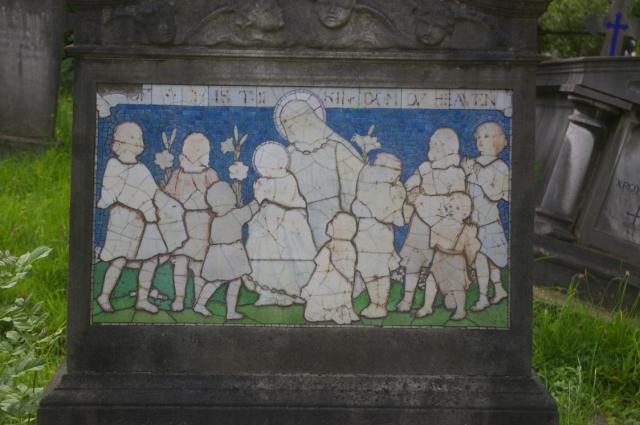
Symbol(s) of the Month – the Alpha and the Omega and the Chi-Rho

It’s a two for one offer on symbols this month folks as I feature two ancient symbols which are often combined together.  They both predate Christianity and were then  adopted by the newly emerging faith.  This was a time when Christians only communicated with fellow believers via a secret language of symbols and codes known only to each other.   Discovery would have meant death and so the codes were designed to keep outsiders away.

These symbols are the Alpha and Omega and the Chi-Rho.  They’re not all that common in cemeteries but I found these two examples in Brompton Cemetery, London.   They stood out because of their simplicity and classicism.

The Alpha and Omega

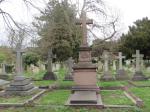
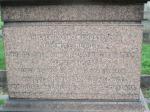
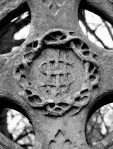
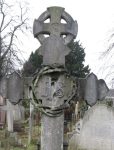
This fine example which also features the Chi-Rho is on the substantial Platt memorial in Brompton Cemetery.  I’ll write about the Chi-Rho later.   Thomas Platt was the first to be buried here in 1899 followed by his wife, Annie,  who outlived him and died in 1925. Two of their daughters are also buried and commemorated here – one died in 1935 and the other, also called Annie, in 1936. I haven’t been able to find out much about him or the family but this is a substantial memorial with space for more incumbents.  It’s made of pink granite in the classical style with a large cross on top and acroteria on each of the corners on the pedestal under the Alpha and Omega, Chi-Rho and cross.

The Alpha and Omega  are very similar in a way to an ouroboros as they both express eternity.  They are formed from the first and last letters of the Greek alphabet and represent God.  He is the first – the alpha – as there is no God before him and the last – the Omega – as there is no God after him.    The symbols also appear in several Bible verses including Revelation verses 1.8:

 “I am the Alpha and the Omega, the Beginning and the End,” says the Lord, “who is and who was and who is to come, the Almighty.” King James version

They also appear in Revelation verses 21.6 and verses 22.13 as well as Isiah verses 44.6.

Both the Jewish and Islamic faiths use the first and last letters of the alphabet to describe the name of their God.

The Alpha and Omega  have been represented  by an eagle and an owl.   There has also been a suggestion that the Omega is an ancient representation of the Goddess Ishtar’s headdress and  that the Alpha was derived from the ox horn headdress worn by male deities and kings but I would like to see more evidence of this.  However it’s an interesting theory on how these symbols might have come into being.

Interestingly, the two motifs are known as a merism.  This is a figure of speech that articulates the beginning of something and the ending of something with the implication that it also refers to all things in between. For example,  for better, for worse, for richer, for poorer etc.

However, Douglas Fielder in ‘Stories in Stone’ has suggested the Alpha and Omega may be the representation of the beginning and end of a life and that would certainly fit in with their use within cemeteries. J C Cooper’s definition is that they denote the beginning and end of all things.

The Chi-Rho

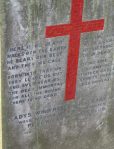
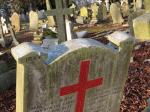
This is a striking example from Brompton Cemetery London and is on the grave of Matthew Boyd Bredon.  He was an Irishman who served in the 3rd Battalion Royal Irish Fusiliers and rose through the ranks.  He became a Lieutenant in 1875 and a Captain in 1878 and became a Major. The epitaph states that he died in Swatow, or Shantou is it was originally known, in China in 1900.  This was the time of the Boxer Rebellion in which treaty ports were imposed on China by the British and other foreign powers who wanted to open up trade. However, these ports weren’t strictly ports and instead were separate communities in which foreigners lived according to their own customs, traditions and rules of law.  Bredon was also the Deputy Commissioner of Customs in China at the time of his death.  In 1900 a brass eagle was presented to his local church, St Saviours in Co Armagh, Northern Ireland in his memory.

The Chi-Rho was created by using the first two capital letters from the Greek word for Christ:

ΧΡΙΣΤΟΣ

These are Chi and Rho and this is the earliest form of christogram.  The definition of a christogram is, according to Wikipedia,

 ‘ a monogram or combination of letters that forms an abbreviation for the name of Jesus Christ and is a traditionally used as a religious symbol within the Christian church.’

The combination of the letters have led to claims that the Chi Rho symbolises the status of Jesus as the risen Christ as the vertical stroke of the Rho intersects the centre of the Chi.  Thus it could be seen as a symbol of resurrection when used in cemeteries.

However, it wasn’t   originally a religious symbol and was, instead, used to mark an especially valuable or relevant passage in a page.  When used like this it was known as a Chresten which meant ‘good.’  It also appeared on ancient Egyptian coins.

Missorium depicting Emperor Constantine’s son Constantius II accompanied by a guardsman with the Chi-Rho depicted on his shield (at left behind horse) photograph © Ludwig von Sybel 1909
Shared under Wiki Creative Commons – in public domain in country of origin.

The Roman Emperor, Constantine, (306-337) used the Chi Rho as part of a military standard known as a Labarum.  He had a dream in which he felt that military success would follow if he put a heavenly and divine symbol on his soldiers shields to protect them

From 350 onwards The Chi Rho began to appear on Christian sarcophagi and frescoes and has been found in the celebrated Roman catacombs.    It came to Britain via the Roman invasion and can be seen on a mosaic at Lullingstone Roman Villa, Kent, UK.

Nowadays it has been adopted as a popular tattoo symbol.

I did try and discover the significance of these two symbols to these two men who both died relatively young but a search through coats of arms and regimental cap badges in the case of Bredon and other sites with Platt yielded no new information. But they have left us with impressive examples of these early and powerful symbols.

©Text and photographs Carole Tyrrell unless otherwise stated

References;

Stories in Stone; A Field Guide to Cemetery Symbolism and Iconography, Douglas Keister, Gibbs M Smith, 2008

An Illustrated Encyclopaedia of Traditional Symbols, J C Cooper, Thames & Hudson, 1978


http://grammar.about.com/od/mo/g/Merism.htm

https://en.wikipedia.org/wiki/Alpha_and_Omega

http://www.religionfacts.com/alpha-omega

http://biblehub.com/revelation/22-13.htm

http://symboldictionary.net/?p=2883

https://library.nd.edu/about/symbols_of_christ/alpha_omega.shtml

http://www.newadvent.org/cathen/01332a.htm

https://www.gotquestions.org/alpha-and-omega.html

https://en.wikipedia.org/wiki/Chi_Rho

https://en.wikipedia.org/wiki/Christogram
http://www.dailykos.com/story/2017/3/18/1636415/-The-Daily-Bucket-A-stroll-through-London-s-Brompton-Cemetery


Death parted them and then reunited them – The Pointing Finger Symbol update

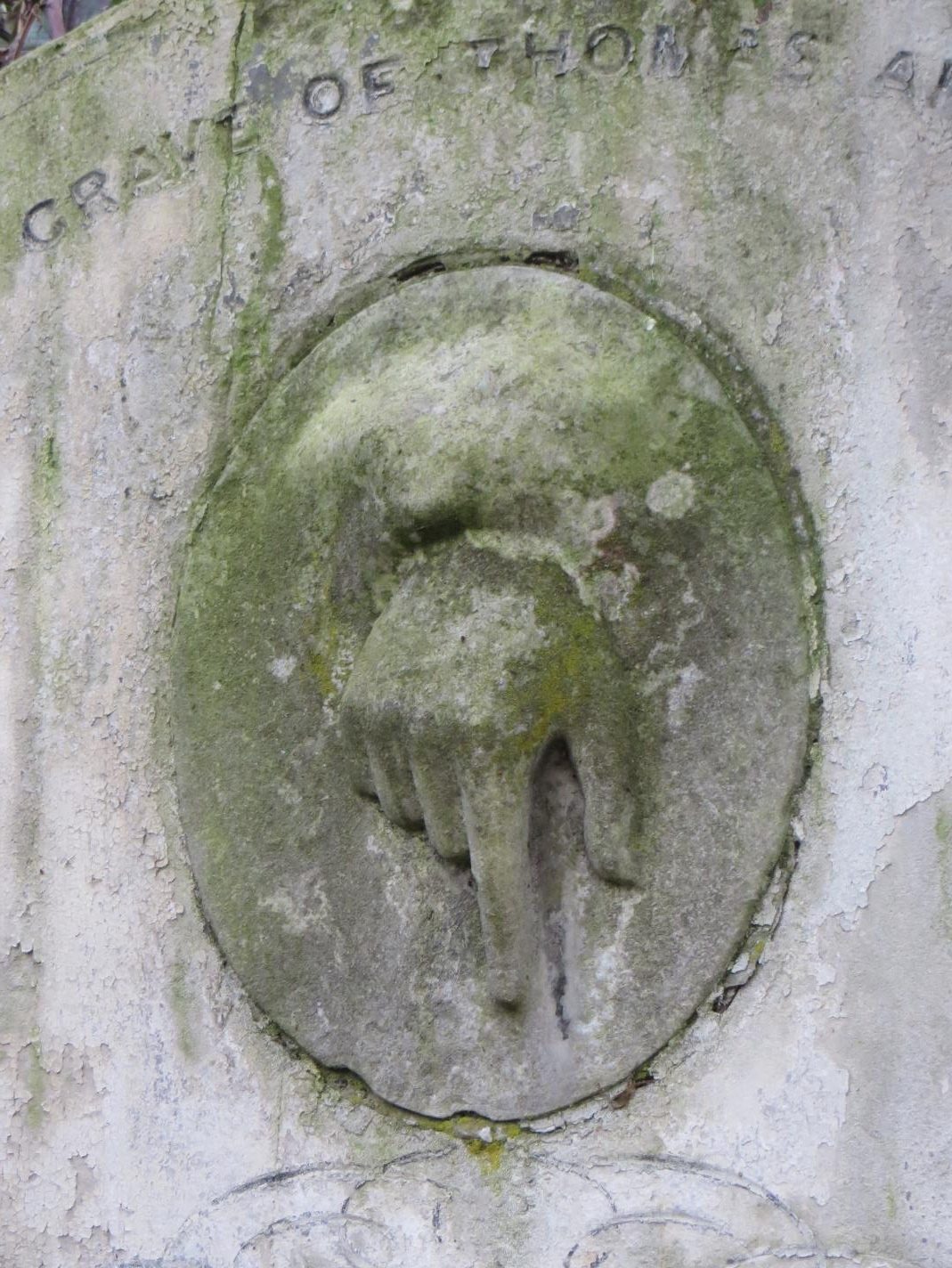
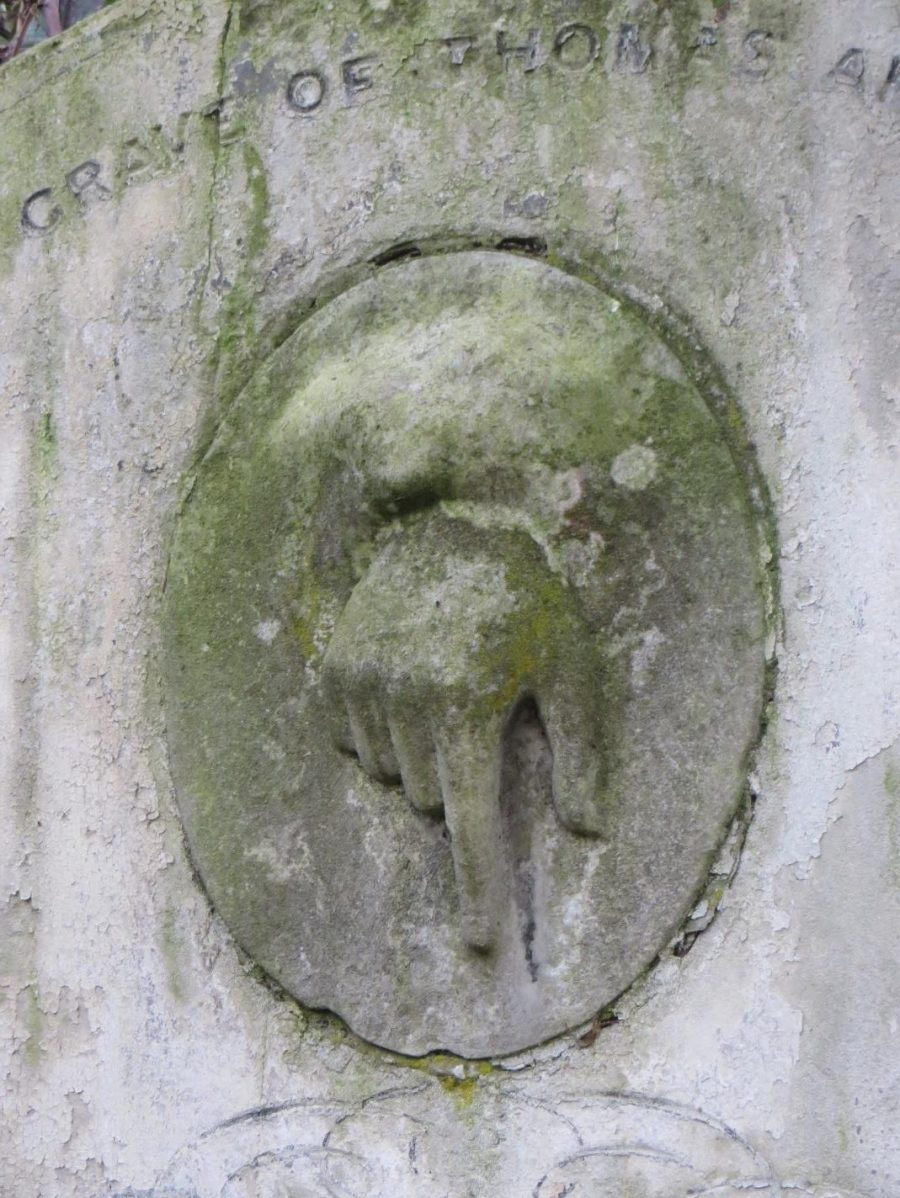
Anderson memorial - the downward pointing hand in detail. ©Carole Tyrrell
Anderson memorial – the downward pointing hand in detail.
©Carole Tyrrell

In my  recent post on the Pointing Finger symbol I was bemoaning that I hadn’t found an example of the downward pointing version.

Someone must have heard me because, lo and behold, as I was pottering through Brompton Cemetery I suddenly saw one.  It was on a side path and set back from it in front of a thick clump of brambles which probably engulf it when they’re in high season.  Winter is always a good time to  look for symbols as the encroaching ivy; brambles and long grass will have died down and don’t obscure them.

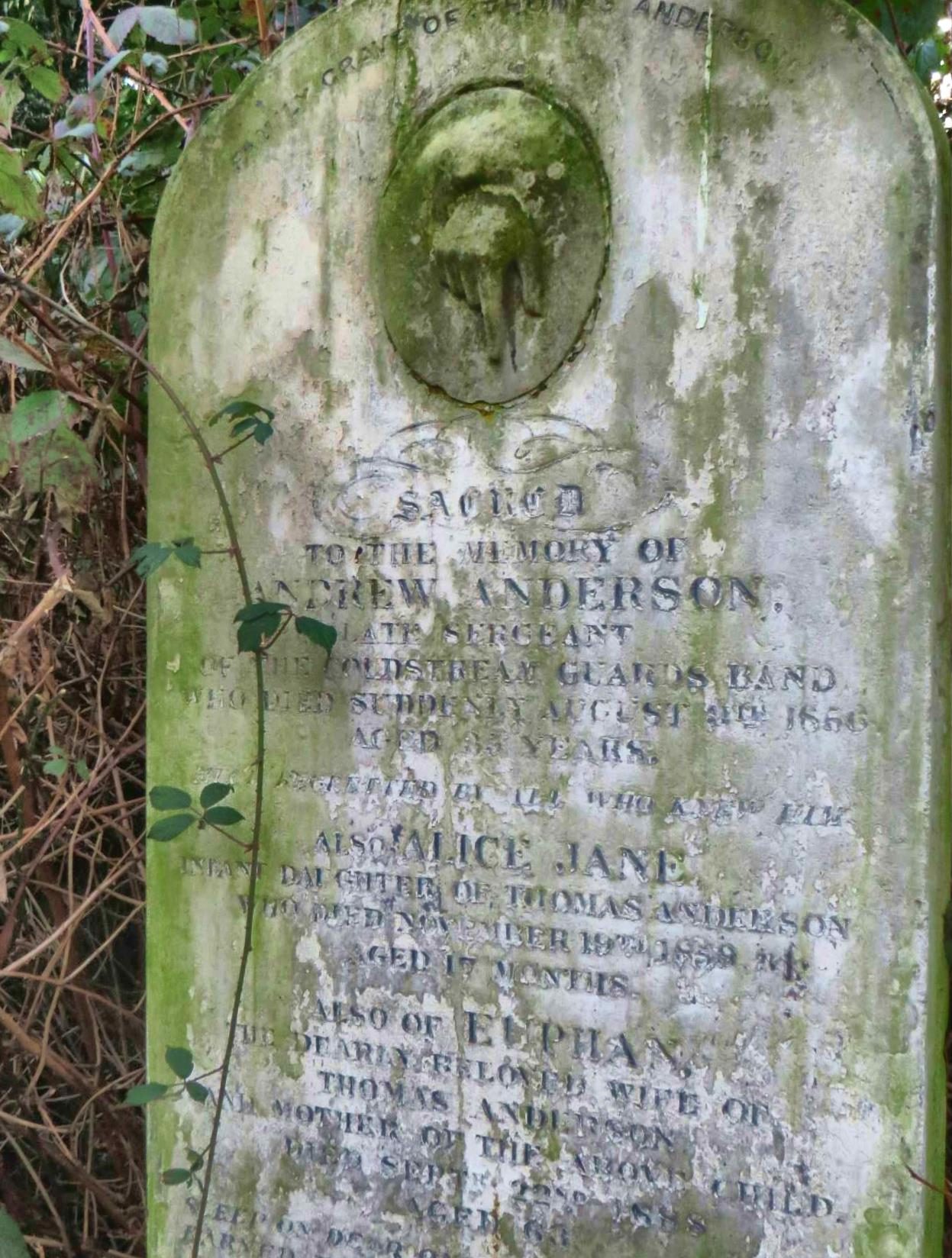
The Anderson family grave headstone.in Brompton Cemetery ©Carole Tyrrell
The Anderson family grave headstone.in Brompton Cemetery
©Carole Tyrrell

There is a fascinating story behind this memorial as it’s the tale of two Irish brothers who first enlisted together at the tender age of 11.  They both had action packed lives in military service together until one died before the other at a young age.  This confirms what I said in my previous post,  that the downward pointing finger denotes an untimely, sudden or unexpected death.

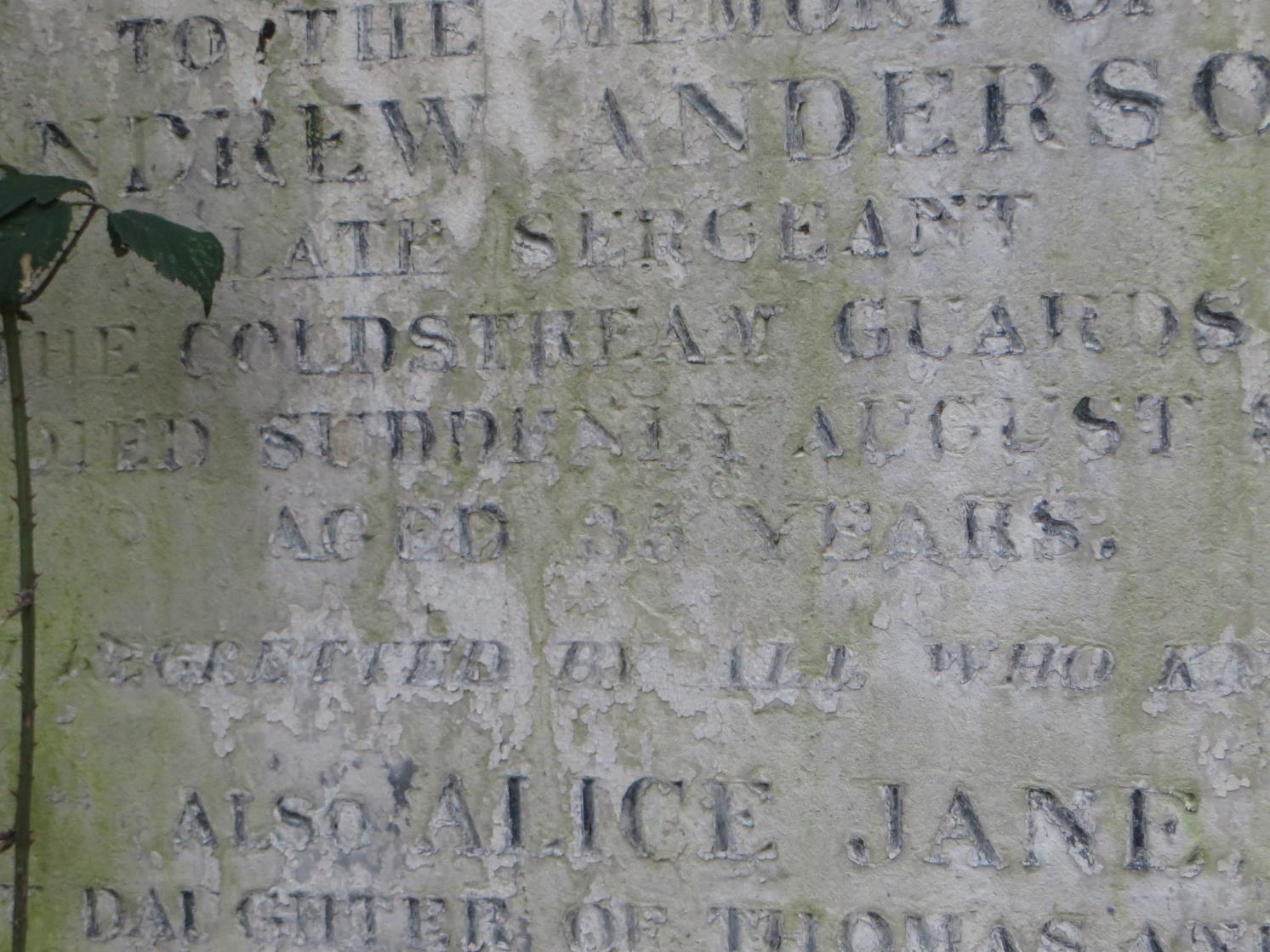
The headstone   announced that it was the ‘Family Grave of Thomas Anderson’ and there are six members of the family commemorated on it.  The first one was to Andrew Anderson, who was a sargeant in the Coldstream Guards Band until died suddenly, aged 35, on August 11th 1856.   Sadly it doesn’t give the cause of death so we can only guess at what might have happened to Andrew. The epitaph also says that his death was ‘regretted by all who knew him’ so he was obviously popular and much missed.  Accident?  Heart attack? Murder?  We may never know but I may do some further investigating.

Andrew Anderson's epitaph in detail. ©Carole Tyrrell
Andrew Anderson’s epitaph in detail.
©Carole Tyrrell

Underneath  Andrew’s epitaph are recorded two more members of the Anderson family.   These are Thomas Anderson’s  ‘infant daughter’,  Alice Jane, who died at 17 months on November 19th 1859 and also his wife and Alice’s mother, Euphan.   She died on September 22 1888 aged 63.   The quotation underneath reads ‘Sleep on dear one and take thy well earned rest.’

The Anderson memorial. Andrew, his brother, and Thomas's infant daughter, Alice Jane, and his wife Euphan are also commemorated. ©Carole Tyrrell
The Anderson memorial. Andrew, his brother, and Thomas’s infant daughter, Alice Jane, and his wife Euphan are also commemorated.
©Carole Tyrrell

And then underneath is Thomas himself.  He died on 15 July 1891 aged 70 with the motto ‘His end was peace.’

Initially I presumed that Thomas was Andrew’s father.   But, after doing some online delving, I discovered a post on an Irish library forum by a respondent who claimed to be Thomas’s great, great, great grandson. He was trying to carry out his own research into the family history.

According to him, Thomas and Andrew Anderson were actually brothers, probably twins, who were both born in 1821 and came from Ennis, County Clare.  This would fit in with Andrew’s age at death and there were other coincidences  between the information on the headstone and what the great, great, great grandson  was saying. The unusual name of Thomas’s wife was helpful and this led me to the Clan McFarlane website as McFarlane was her maiden name.

The brothers were very close and, aged 11, they both enlisted in the 40th Regiment of Foot on February 2 1832 and were then both discharged on 7 September 1839 aged 18.

It was the Royal Navy that beckoned next and they set off for adventure on the high seas aboard HMS Wellesley when they enlisted in 1839.  They both played their part in the Opium War of 1839 – 1842 and, as a result, they both received the China War Medal.  This was awarded to members of the Royal Navy who had ‘served with distinction’ between 5 July 1840 – 29 August 1842.


After that they moved on and back into the Army which is where the Coldstream Guards connection comes in.  As you might expect they both signed up: Thomas on 8 May 1850 and Andrew on 8 May 1844.  Thomas was discharged on 17 May 1860 after becoming a  lieutenant.  We know Andrew’s story but Thomas’s is less clear.

According to the family member he was living at 6 Hospital Street in Glasgow in 1845 and married Euphan McFarlane in 1863.  She came from the Gorbals which always had a reputation as a really tough area and so good preparation for the life of an Army wife.   She and Thomas had three more daughters; Elizabeth Euphan, Rosina Edith and Rosina Elizabeth.  But there’s no mention of Alice Jane.  Both Elizabeth and Rosina Edith married.

But the family member didn’t mention Alice Jane or John so one wonders where they fit in.

Thomas supposedly died in Middlesex  but after his death he joined Andrew in Brompton Cemetery.

Thomas Anderson's epitaph. ©Carole Tyrrell
Thomas Anderson’s epitaph.
©Carole Tyrrell

There are two more Anderson Family members recorded on the headstone; John, Thomas’s son, who died on 15 February 1925 aged 65 and John’s daughter, Isabella, but  her dates were too indistinct to read.

John Anderson's epitaph - not very readable now as it's near the base of the headstone. ©Carole Tyrrell
John Anderson’s epitaph – not very readable now as it’s near the base of the headstone.
©Carole Tyrrell


Family stories can change over time as they’re handed down through the generations   but this seemed to tally with the information on the headstone.   I am trying to contact the great, great, great grandson via the County Clare forum for more information.


The Anderson brothers seemed to have led exciting lives in military service and  certainly did their bit for King and Country. So rest in peace Andrew and Thomas – you have certainly earned it.

© Text and photographs Carole Tyrrell unless otherwise stated.


http://www.rootschat.com/forum/index.php?topic=379308.0

http://www.ourlibrary.ca/phpbb2/viewtopic.php?f=1&t=551

http://www.clanmacfarlanegenealogy.info/genealogy/TNGWebsite/getperson.php?personID=I769&tree=UL

http://www.clarelibrary.ie/eolas/coclare/genealogy/don_tran/mil_rec/rh_chelsea_clare_soldiers_service_docs.htm

https://en.wikipedia.org/wiki/China_War_Medal_(1842)


Symbol of the Month – The Pointing Finger


finger2

This is a more unusual symbol although hands often feature as motifs in cemeteries usually in the more familiar clasped hands..

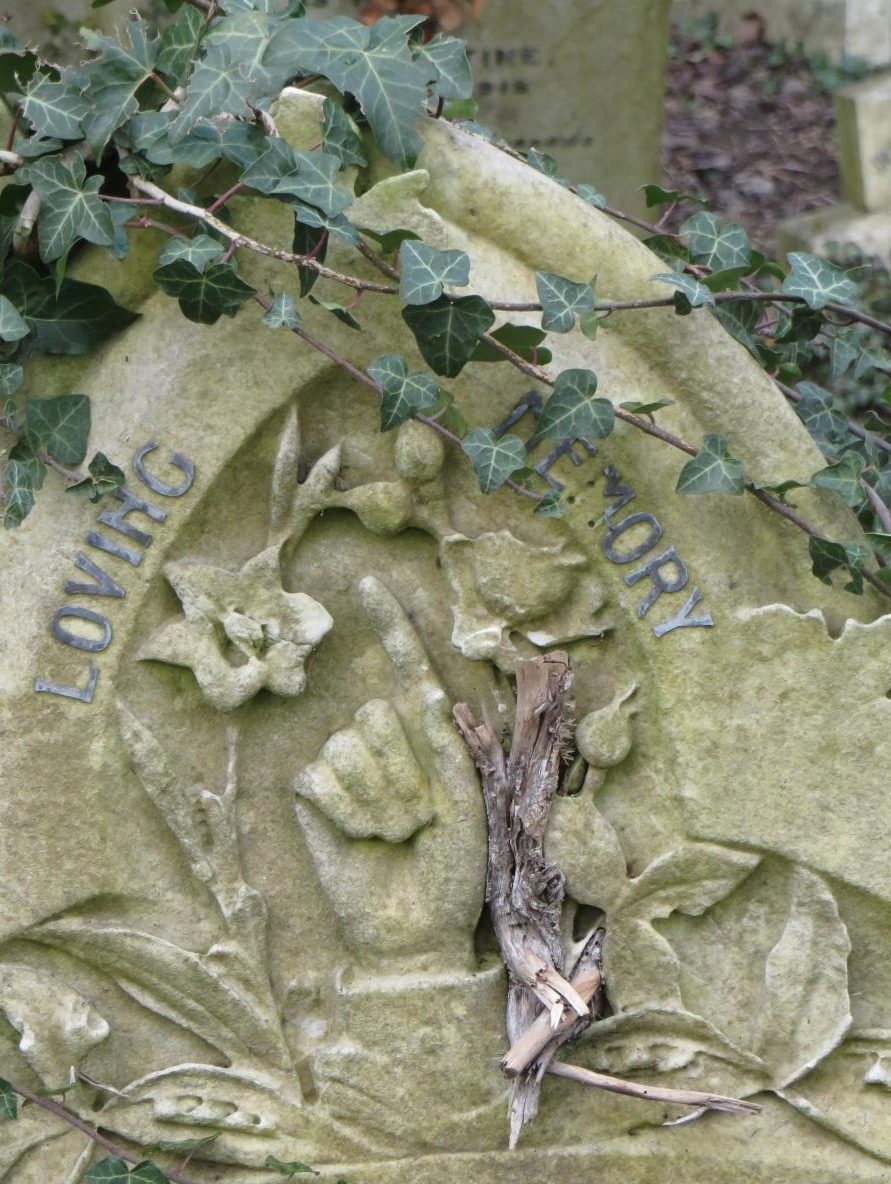
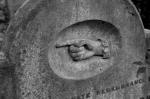
The Pointing Finger is usually  one finger,  the index one, pointing upwards or downwards. On the three that I saw, it was the right hand that was being depicted with the remaining fingers and thumb turned down into the palm.   I have yet to see the downward pointing version but rest assured that it doesn’t indicate that the departed is going ‘down below’ or to Hell.  Instead it can signify an untimely, sudden or unexpected death. As you’ve probably already guessed, the upwardly pointed finger is meant to reassure the grieving family that their loved one has ascended to Heaven and has received the reward of the righteous.

However, I found these three lovely examples in Beckenham Cemetery during a recent visit, much to my surprise, and they made me wonder why it isn’t more popular. In all of these the pointing finger and hand are surrounded by flowers.

The first one is  to John James Lumsden who died on 25 November 1903 aged 63.  It’s very well carved with a daffodil on one side of the hand and two sprays of Lily of the Valley flanking the hand.  When I first saw it, a thick branch of ivy obscured the flower on the other side of the daffodil. But on a return visit in January 2017 the branch had been trimmed back and a rose with one full blown bloom and a bud was now visible again. The bud is significant as it often appears on childrens  graves to symbolise a life unlived, that never fully bloomed and was ‘nipped in the bud.’ But not on this one.

In floriography or the language of flowers the daffodil is an important representation of resurrection.This is because of its association with Easter, rebirth and renewal.   The Lily of the Valley is also associated with Spring as its month is May. Other qualities that the Lily represents are chastity, purity and the return of happiness. It’s mentioned in The Song of Solomon 2.1

‘I am the rose of Sharon

And the lily of the valley.’

 There’s also the legend  that Mary’s tears turned into the lily of the valley at the exact spot when she cried at the Cross so an alternate name for the flowers is ‘Mary’s tears.’  The Lily is also meant to have healing powers and has other nicknames such as ‘Jacob’s Tears’ and ‘the ladder to heaven’.

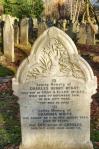
This is to Charles Henry McKay who died on 1 November 1910 at only 23 and was the only son of Charles and Ellen McKay as it states on the epitaph. Although the flowers surrounding the pointing finger and hand are the same here as on Lumden’s, on this one they are more stylised and 2D.  They would have mourned his short life and unfulfilled ambitions.  So there is an added poignancy to the rosebud as his was a life cut short.   There is also the word ‘GONE’ carved on the cuff of the hand which emphasises that he has gone to a better place.   It really stood out amongst its neighbouring grey stones so it may have been recently cleaned or restored.


There is a third memorial featuring the pointed finger which is in the same style as Lumsden’s but not as well kept.  .This was to  ‘Will, eldest son of William and Sarah Greenfield. Born 10 December 1874 died 1 August 1905’

This is the third example from Beckenham Cemetery dedicated to Will Greenfield. ©Carole Tyrrell
This is the third example from Beckenham Cemetery dedicated to Will Greenfield.
©Carole Tyrrell

Again, another memorial to a life cut short as Will died aged only 31.Three other members of the Greenfield family are also commemorated on the headstone.

To our eyes they could be seen as sentimental but I found them very touching with their aim to comfort those left behind through the use of flowers.

But here’s a mystery from my own local churchyard:

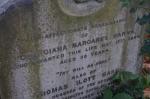
This is to a woman who died at 38 called Georgiana Margaret Barns and it has a pointing finger on the headstone. But instead of pointing upwards or downwards, it’s pointing to the left and apparently into thin air.  The hand appears to have a woman’s lacy cuff and I noticed that, although her husband’s dates are also recorded, he isn’t actually buried there. Instead he lies in Hilderstone churchyard in Stafford.  He died at 76 nearly 20 years after his wife.   Is the finger pointing towards his resting place?  Is it a personal symbol known only to them?  I found a few details about them online but not much more so I am intrigued and mystified by this one.

I have to admit that The Pointing Finger symbol does remind me a little of a palmist drawing of the hand but in the ones that I’ve seen it’s also very decorative and moving.

Text and photos Carole Tyrrell otherwise stated.

References:

http://www.lsew.org.uk/funerary-symbolism/

http://genealogy.about.com/cs/symbolism/p/hands.htm

https://mysendoff.com/2012/08/the-grave-secrets-of-symbols-and-iconography-of-the-cemetery/

http://mrssymbols.blogspot.co.uk/2012/08/hands-beyond-grave.html

http://www.john-attfield.com/paf_tree/attfield_current/fam3951.html

http://www.allaboutheaven.org/symbols/996/123/pointing-finger

https://www.verywell.com/headstone-symbols-finger-pointing-up-1132433


Part 2 – ‘Her lean and senile seducer’ – the Charles Bravo inquest and its aftermath


I found this on www.realcrimedaily but with no accreditation. Mrs Cox is giving evidence.
I found this on http://www.realcrimedaily but with no accreditation. Mrs Cox is giving evidence.

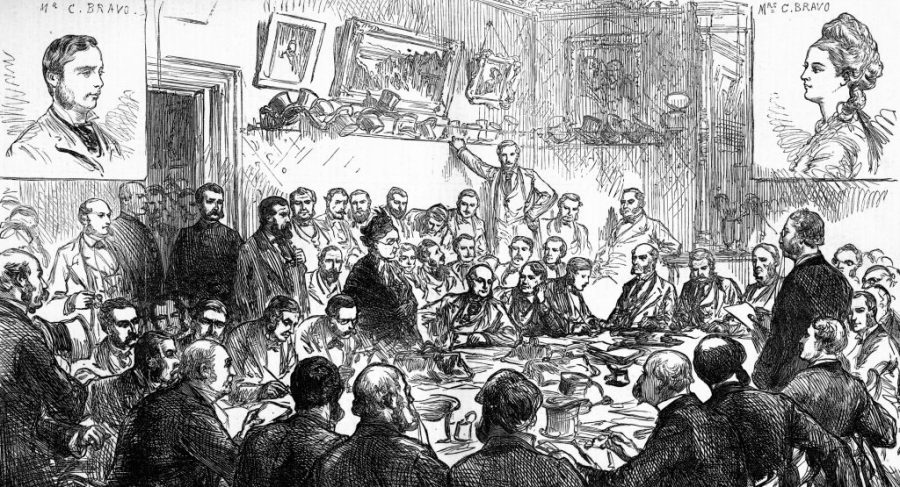
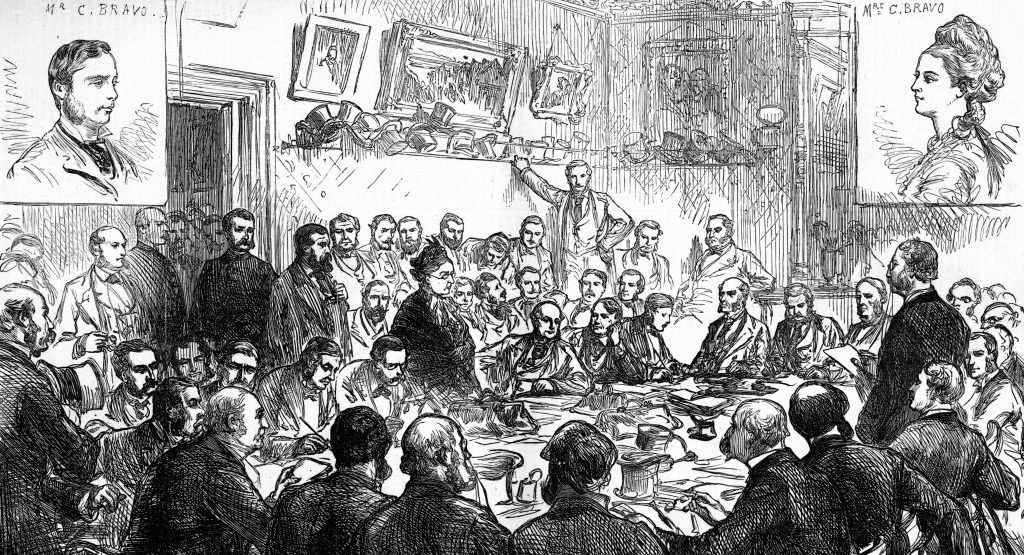
 The second inquest began on 11 July 1876 and lasted 5 weeks. It was a public sensation and finally ended Florence’s doomed attempt to regain her place in respectable society. Only men and boys were allowed into the inquest as the details revealed were considered to be so shocking.


Both Florence and Mrs Cox spoke of Bravo’s controlling and bullying nature which was countered by family and friends who described him as good-natured and happy.

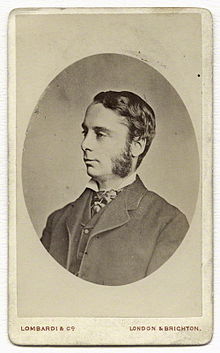
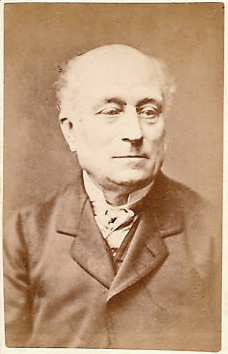
Charles Delaunay Turner Bravo Carte de Visite 1876 National Portrait Gallery, Lombardi Sahed under Wiko Creative Commons Attribute Share Alike 3.0
Charles Delaunay Turner Bravo Carte de Visite 1876
National Portrait Gallery, Lombardi
Sahed under Wiko Creative Commons Attribute Share Alike 3.0


The affair between Florence and Dr Gully became public knowledge because of the inquest and the papers of the day revelled in it while ostensibly taking a moral high ground.  The fact that she had enjoyed it and that it had been common knowledge throughout the area enraged the public and she was soon being pilloried. Much was made of its adulterous nature and the disparity in their ages – he was 67 to her 25.  The Times dubbed Gully as her ‘lean and senile seducer’ whereas in fact he was described as being charismatic with Charles Darwin calling him ‘a friend.’  He was quickly discounted as a suspect as he had not been anywhere near the scene at the time.


Photo of Florence Bravo http://murderpedia.org/female.B/b/bravo-florence-photos.htm
Photo of Florence Bravo
http://murderpedia.org/female.B/b/bravo-florence-photos.htm

Florence was questioned repeatedly about the affair until she finally broke down and tried to demand that the Coroner protect her from what she called ‘the impertinent’ cross examining.

‘I refuse to answer any more questions about Dr Gully!’ she shouted at one point to Joseph Bravo’s solicitor. ‘This inquiry is about the death of my husband and I appeal to the jury as men and Britons to protect me.’

Dr James Manby Gully ''Hydropathy'  cartoon in style of Spy from Vanity Fair 1876. Shared under Wiki Creative Commons Attribution 2.0 Generic
Dr James Manby Gully ”Hydropathy’ cartoon in style of Spy from Vanity Fair 1876.
Shared under Wiki Creative Commons Attribution 2.0 Generic


Dr Gully described the persistent questioning as ‘a gross impertinence’ and publicly denied any involvement or knowledge of Charles’ murder. Gully was now looking at the very likely destruction of all that he had built up – his good name, his practice and his clientele.  The novelist George Eliot, who had been one of his patients, had described him as a ‘quack’. But Gully was very advanced for his time in his use of mesmerism to induce sleep and clairvoyance to diagnose internal conditions. These ideas may seem a little quaint to us today, as X-rays replaced clairvoyance, but they did indicate the way in which medicine might go.  He had had a huge practice at Malvern between 1842-1871 but the inquest ruined him.


Joseph Bravo’s solicitor attempted to salvage Charles’ reputation by trying to prove that he had known nothing of Florence and Gully’s affair when he had married.  Otherwise he would have been revealed as a mere fortune hunter who saw a wealthy widow with a dubious reputation as easy prey. But to no avail – Florence’s pre-nuptial confession proved otherwise.


The Times, somewhat sanctimoniously, declared the affair as ‘the most disgusting exhibition to have been witnessed in this generation.’  It was as if Florence and Gully were on trial and that Charles’ murder was a sideshow.


But the inquest was against the background of the role of women in Victorian society and Florence had been a rebel.  At the time women had no rights and were expected to be only domestic goddesses; sexless, devoted to others and with no other outlets in their lives. However, thinkers such as William Acton thought differently and Gully himself saw womens neuroses as an unconscious response to the pressures of their lives and wrote ‘all these pressures are worsened by their boredom and lack of sexual satisfaction.’  This was very advanced for the time.


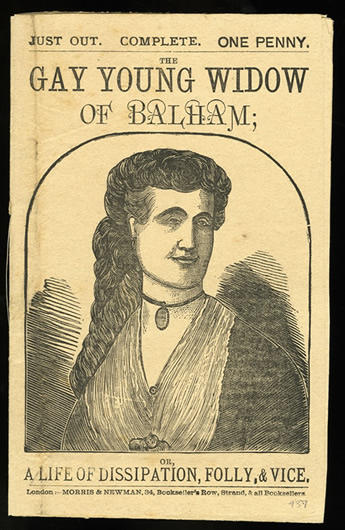
A pamphlet from the time featuring Florenc's past life.  http://murderpedia.org/female.B/b/bravo-florence-photos.htm
A pamphlet from the time featuring Florenc’s past life.
http://murderpedia.org/female.B/b/bravo-florence-photos.htm

Florence, by contrast, ran her own household and managed her own financial affairs.  She was independent of her parents and so could make choices which might have been denied to other women.  She had been estranged from them when she left Ricardo and during her affair with Gully and seemed willing to accept this as the price of having her own life.    However, her desire to be accepted into society again via marriage to Bravo was to bring about her downfall.

Middle-class Victorian women were fascinated by the sensational murder trials of the day and there were several prominent cases featuring wives who were accused of murdering their husbands or lovers – for example, Adelaide Bartlett, Madeline Smith and Florence Maybrick.  They saw their own situations reflected in these women who had been driven to take action to take control of their lives.

At the end of the inquest the jury’s verdict was:

We find that Charles Delaunay Turner Bravo did not commit suicide, that he did not meet his death of misadventure, that he was wilfully murdered by the administration of tartar emetic. But there is insufficient evidence to fix the guilt upon any person or persons.’

The jury were all male and may have thought that a woman couldn’t be a murderess or there just wasn’t enough hard evidence to enable them to point the finger at anyone. No-one was ever  charged with Charles Bravo’s murder although there has been much speculation even to this day.

Aftermath:

Florence sold the Priory and parted with Mrs Cox.  She died less than 2 years later at Southsea where she was living under the name of Florence Turner.  She died of alcoholism although the verdict at her inquest was ‘Death by Misadventure’.  Florence’s exact burial place at Challow is unknown.

Florence’s family of wealthy Scottish landowners were utterly ruined, both financially and socially, by the scandal.

Mrs Cox died in 1913 aged 90 from ‘exhaustion’. She returned to Jamaica after inheriting an estate and properties there valued at £7000 which was a large sum at the time.  She returned to England and was buried in Hither Green Cemetery.  However, her grave is unmarked although the plot is registered.  She had received death threats during the second inquest so maybe someone thought that she knew more than she was saying.

Dr Gully survived Florence by 5 years and died on 5 March 1883.  He stayed in Orwell Lodge near the Priory with his unmarried sisters.  But Susanna, his daughter, refused to have anything more to do with him.   The Malvern Clinic closed in 1913 and is now a hotel.  Dr Gully’s grave location is unknown as he was buried in secret.

Mrs Bravo supervised the building of a large stone surround over Charles’ grave at West Norwood and died a year later of grief.

Griffiths the coachman was quickly discounted as a suspect and faded from events.

Now only Charles himself still has a tangible reminder of this case which continues to fascinate.  But the inscription is now almost unreadable and, from the path, appears blank. It’s as if everyone involved with the case just wanted to vanish from the world, such was the scandal, and eventually even Bravo’s stone may vanish into thick, encroaching vegetation or fall by subsidence leaving no reminder of him.

My own theory is the one proposed by Professor Mary Hartman in which she proposes that Bravo’s death was a tragic accident. Florence was recovering from a second miscarriage and a third pregnancy could have killed her. Charles, however, wanted to resume marital relations as soon as possible as he wanted an heir and this determination does indicate a ruthless streak in him. Florence knew where the antimony was kept and may have slipped it into his water jug to make him unwell so as to avoid having sex with him.  Unfortunately on this occasion she got the dosage wrong as 3-4 grains were sufficient to make him ill and he’d taken 30-40 grams which was 10 times the lethal dose.   It was noted that Florence seemed extremely agitated on the night of 18 April 1876 as events unfolded – did she suddenly realise what she’d done? 9 years later Adelaide Bartlett used chloroform to avoid conjugal relations with her husband and it may have been a common method employed by wives but not usually with such lethal results.

I visited The Priory prior to writing this post and in Florence’s time it must have appeared very imposing.  At the time of Bravo’s murder it would have been surrounded by fields and on its own plot but now it seemed to be almost cowering between the newer houses and car parking that have sprung up around it and the unappealing line of large rubbish bins lined up in front of it. The Priory’s white walls and battlements contrasted with the blue sky as I tried to imagine the chaos and terror on that April night in 1876 as Bravo lay there, dying in extreme pain, in the shadowy candlelit rooms.

It was a tragic event for all concerned and one can only hope that they all now rest in peace.


©Text and photos Carole Tyrrell unless otherwise stated.

 References:

Death at the Priory: Love, Sex and Murder in Victorian England, James Ruddick, Atlantic Books, 2001

Dr Gully, Elizabeth Jenkins, Michael Joseph 1972

https://www.realcrimedaily.com/murder-at-the-priory-the-mysterious-death-of-charles-bravo-realcrimefriday/

http://news.bbc.co.uk/1/hi/england/2650651.stm

http://strangeco.blogspot.co.uk/2015/06/a-pearl-among-poisonings-mysterious.html

http://murderpedia.org/female.B/b/bravo-florence.htm

http://blueborage.blogspot.co.uk/2014/01/living-in-house-with-famous-victorian.html


Horrible Murder – Part 1 of the mysterious and unsolved killing of Charles Bravo

This now almost illegible tombstone is the only visible reminder of one of the most notorious and still unsolved murder cases of the 19th century.  It ruined reputations, destroyed great families and most of the chief suspects lie in unknown, unmarked graves such was the shame in being connected with it.

It’s the last resting place of Charles Delaunay Turner Bravo who died of antimony poisoning on 21 April 1876 aged 30.  It took him nearly 3 days to die an agonising death as the poison was so lethal. The memorial was erected by his sorrowing mother who died a year later of grief.  I first saw it on a guided tour of West Norwood when the guide indicated it and mentioned the name.  It’s now set back from the path and jostles for space with the other memorials and monuments that have grown up around it as if hiding it. In fact I had to wait until the winter die-back to be able to avoid the clinging embrace of long barbed tentacles of brambles and have a closer look. I could just about see his name on the memorial but the stone surround that was originally around it has long since collapsed.


This is the story of one of the notorious cases of the 19th century set against a background of money, womens rights or lack of them, and society’s punishment for those who transgress the rules.


It began on the night of 18 April 1876 after the Bravo household had retired for the night at the Priory on Bedford Hill near Balham.  At this time it was surrounded by fields and all would have been quiet.    Suddenly the night was disturbed by Charles Bravo, the head of the household, shouting ‘Florence! Florence! Hot water! Hot water!’  before collapsing and vomiting. 2 doctors were then called to the scene and so events began.  He had, as was his custom, drank water from his jug before retiring but on this night someone had added 30-40 grains of antimony, a deadly poison which is derived from tartar emetic.  Antimony has no taste in water and is an unusual method of killing someone.   It began by eating its way its way through his intestines which virtually disintegrated and his stomach.  After 3 days his central nervous system began to fail and Bravo knew that he was dying.  He managed to make a will in his wife, Florence’s favour which was witnessed by one of the doctors and the butler before being pronounced dead at 5.20am on 21 April.


It was a long and painful death and the post-mortem gave the cause of death as ‘heart failure from the effect of the poison on his central nervous system’. Incredibly it was first considered to be a suicide but I would have thought that there are far less painful methods. However the police soon decided that it was murder and soon began looking for suspects.  These were:

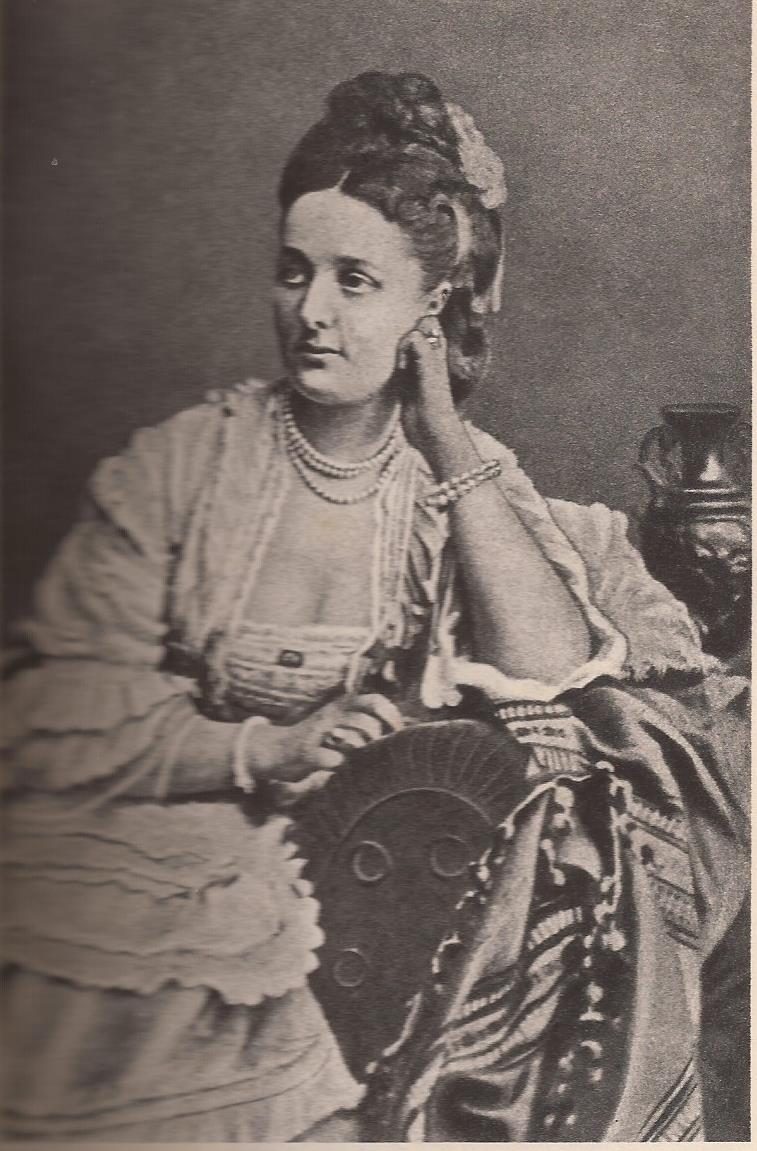
A contemporary photo of Florence Bravo.
A contemporary photo of Florence Bravo. (source unknown)

Florence his widow: She and Charles had married on 7 December 1875 at All Saints Church Kensington and it has been rumoured that she may have already been pregnant as the marriage was brought forward and she had a miscarriage very shortly afterwards.  It hadn’t been a happy marriage as she had already fled to her parents after 3 months alleging domestic abuse.  She had had quite a colourful and somewhat provocative life prior to her marriage.  Florence had been widowed before after her first husband, Captain Alexander Ricardo died in a Cologne hotel room of alcoholism in 1871 after 6 years of marriage.  She had persuaded him to give up his Army career and he struggled to establish another one before taking to the bottle.  However he left her £40,000 which was a huge sum when the average working man earned £30 p.a.

Unusually for the time, she was now an independently wealthy woman and soon established her own household at The Priory.  She met Dr James Manby Gully when she took the ‘water-cure’ at his hydrotherapy clinic in Malvern.  He had known her family for over 30 years and was the celebrity doctor of his day with several famous clients including Tennyson.  He was in a miserable second marriage to a Mrs Kibble who was 17 years older than him and from whom he was legally separated.  Nevertheless he and Florence embarked on a scandalous affair which made them notorious throughout the neighbourhood. Gully took a house on Bedford Hill Road, Orwell Lodge, which was conveniently near The Priory for secret trysts.  As a result Florence was ostracised by local society as people refused to call.  However she considered Gully to be ‘the cleverest man I have ever met.’  But she still yearned to be part of society again and after Gully performed an abortion on her the affair ended.

The only way that she could be admitted back into society and be reconciled with her parents was through marriage. She and Charles were introduced by Mrs Cox, her companion who knew his family.  There has been a suggestion that he was a fortune hunter and certainly no gentleman would have considered marrying someone with her reputation.   It was a marriage that proved to be a disaster.

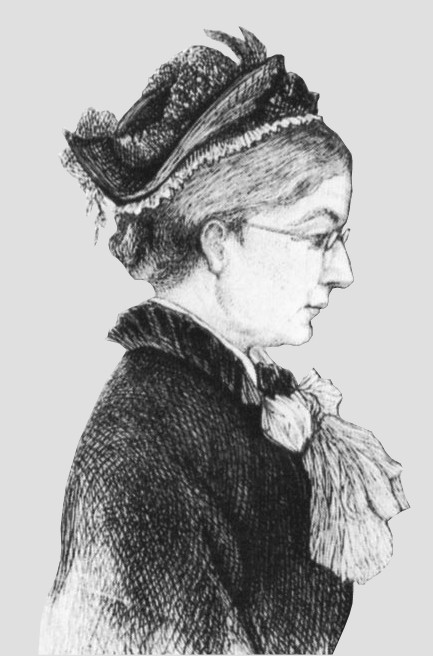
Mrs Jane Cox Florence's lady's companion at the inquest. (Source unknown)
Mrs Jane Cox Florence’s lady’s companion at the inquest.
(Source unknown)

Mrs Jane Cox – She was a widow with 3 young sons at school and was employed by Florence as her ‘lady’s companion’ at The Priory.  Mrs Cox had married in Jamaica and had returned to England after her husband had died.  She had been privy to Gully and Florence’s affair and local shopkeepers had refused to serve her. She had jet black hair and an olive coloured complexion which had led to rumours that she had ‘coloured blood.’ She was facing dismissal by Bravo who was on a mission to reduce household expenses and she was poor to say the least.  She didn’t want to be unemployed and destitute. There was also her behaviour during Bravo’s protracted death agonies. She told one doctor that he had swallowed chloroform whereas Bravo recovered consciousness long enough to refute this and instead claimed that he’d taken laudanum due to pain in his lower jaw. Mrs Cox then confused matters more when she told the second doctor, Harrison Royes Bell, that Bravo had also told her that ‘I have taken poison don’t tell Florence.’ One wonders if Bravo was in any fit state to confide this and it sounds as if Mrs Cox was trying to create a cover-up.   She had also received a bottle clearly marked ‘Poison’ from Dr Gully after he’d vowed never to speak to her again.


Griffiths – the coachman – He had already been dismissed by Bravo two weeks before the wedding and as a result had lost his tied cottage.  Griffiths had been heard making drunken threats in the Bedford Hotel on Bedford Hill in which he claimed that Bravo would be dead within a few months.  He kept antimony in the coach house to which the entire household had access.  A series of very insulting anonymous letters were received at The Priory over Christmas in which Charles was accused of being a fortune hunter and these stopped after Griffiths took a job in Kent.

Dr James Manby Gully (source unknown)
Dr James Manby Gully
(source unknown)


Dr James Manby Gully:  He was never a serious suspect although if Bravo had died then perhaps his affair with Florence could resume.  He publicly denied any involvement in the murder.

And what of Charles Bravo himself?

Charles Bravo (source unknown)

He was born in 1845 and was the only son of Augustus and Mary Turner.  Augustus died when Charles was small and Mary married a wealthy merchant, Joseph Bravo, who was 15 years older than her.  He’d made his money from fruit and tobacco and was well-off. After studying at Kings College, London Charles was called to the bar in 1868 and took on his stepfather’s surname when he was 23. But he wasn’t well off and was merely ‘jogging along’ on £200 p.a. This wasn’t the life that he craved.

Both he and Florence had something that the other wanted – she had money and he could give her respectability.  Florence confessed all of her affair with Dr Gully pre-marraige and Charles admitted that he had  supported a woman who had had his child in Maidenhead for 5 years.

But money was already an issue between them prior to marriage as Florence had invoked the right to keep her fortune after marriage.  Until 1870 this would automatically have gone to Bravo but now women could keep any assets they brought into the marriage as long as a legal settlement confirming their intention to do so had been ratified in court prior before the union had taken place.

When Charles discovered this he had threatened not to go through with the marriage  so she compromised by giving him The Priory’s lease and its furnishings, make her will in his favour and in return she would retain control of her money. Already he seemed to be after her money and displaying his domineering, ruthless side. However Bravo was determined to be in charge and decided to reduce household expenses by dismissing staff which Florence hated.  It was also a subtle way of controlling her by getting rid of a support like Mrs Cox and her horses which she loved.

The first inquest was held on 28 April 1876 and concluded that Charles had died from the effects of poisoning but did not know who administered it.  This was considered unsatisfactory. The stage was now set for the second 5 week public inquest which would change the lives of Florence, Dr Gully and Mrs Cox forever.

©Text and photos Carole Tyrrell unless otherwise stated

Part 2 – ‘Her lean and senile seducer’ – the second Charles Bravo inquest and its aftermath


References:

Death at the Priory: Love, Sex and Murder in Victorian England,  James Ruddick, Atlantic Books, 2001

Dr Gully, Elizabeth Jenkins, Michael Joseph 1972

https://www.realcrimedaily.com/murder-at-the-priory-the-mysterious-death-of-charles-bravo-realcrimefriday/

http://news.bbc.co.uk/1/hi/england/2650651.stm

http://blueborage.blogspot.co.uk/2014/01/living-in-house-with-famous-victorian.html

Symbol(s) of the Month – The Crown and the Crown of Thorns

Firstly, Happy New Year to my readers and happy symbol spotting!! This month I have two symbols for you to read about.

The Crown

I first saw this symbol during a visit to Beckenham Cemetery.  It’s a  less well-known symbol and stands for victory or truimph over death.  It has, from earliest times,  been a symbol  of leadership, distinction and  royalty.  A variety of saints also wore crowns to indicate  that they were either a martyr or of royal blood.  Also, according to Julian Litten, it  is ‘The Crown of Life’ which is a reward for those who stayed faithful until death.  There are 3 biblical quotes which illustrate this:

James 1:12 New International Version (NIV)

‘Blessed is the one who perseveres under trial because, having stood the test, that person will receive the crown of life that the Lord has promised to those who love him.’ https://www.biblegateway.com/passage/?search=James%201:12

and also Revelation 2 10 and Corinthians 24:27

Interestingly enough, J C Cooper says that it is also ‘an architectural emblem of the celestial world and form the point of exit from this world and entry into the divine.’  So the crown has several interesting connotations.

In the Jewish faith  it’s known as ‘The Crown of Good Name’ which alludes to the deceased as being of ‘exceptionally noble character.’   However, it can also be a representation of the head of the family or of a household.

This eye-catching example comes from Beckenham Cemetery.

Baker memorial, Beckenham Cemetery to a husband and wife. Amelia, who died at 61 and her husband John who died after her at 79. Dates of death are both unreadable ©Carole Tyrrell
Baker memorial, Beckenham Cemetery to a husband and wife. Amelia, who died at 61 and her husband John who died after her at 79. Dates of death are both unreadable
©Carole Tyrrell


This example comes from Brompton where it is at the top of a very ornate and beautiful memorial.  This is a radiate crown and, according to J C Cooper, it can represent ‘ the energy and power contained in the head which was regarded as the seat of life-soul, …an attribute of sun gods,….of supernatural people and the points of the crown symbolise the rays of the sun…’ or it may just be an attractive decorative device.

Crown of thorns:

This is a variant on the crown as it is a representation of suffering, passion and martyrdom.  It’s based on the ‘crown plaited  by the soldiers and imposed upon Jesus during his trial before Pontius Pilate’ according to Julian Litten.  J C Cooper asserts that this was a ’parody of the Roman Emperor’s crown of roses’. The soldiers then mocked Jesus by kneeling in front of him and hailing him as ‘Hail, King of the Jews!’ A potent emblem of royalty and power had been turned into one of pain and degradation.  But the crown of thorns is a prelude to Jesus being given a far worthier crown in Heaven. This is confirmed in Hebrews 2:9: “

But we see Him who for a little while was made lower than the angels, namely Jesus, crowned with glory and honour because of the suffering of death, so that by the grace of God He might taste death for everyone”

In a famous painting of the executed King Charles 1, the Eikon Basilike, he has abandoned his earthly crown, the symbol of majesty, for the crown of thorns that he is holding in his hand as a representation of his suffering.


This is the Eikon Basilike of 1649 in which King Charles 1 is depicted as a Christian mratyr. https://commons.wikimedia.org/wiki/Commons:Copyright_tags#United_States
This is the Eikon Basilike of 1649 in which King Charles 1 is depicted as a Christian mratyr.
https://commons.wikimedia.org/wiki/Commons:Copyright_tags#United_States

These are both deeply religious symbols and are examples of both the deceased’s faith and also their belief in an everlasting life beyond the grave.
©Text and photos Carole Tyrrell
References:

http://www.graveaddiction.com/symbol.html

http://www.sztetl.org.pl/en/term/131,funerary-symbolism/

http://www.thecemeteryclub.com/symbols.html

https://metrolondonguides.wordpress.com/2014/06/04/a-glossary-of-victorian-memorial-symbols-2/

http://www.undercliffecemetery.co.uk/undercliffesymbolism.pdf

http://www.lsew.org.uk/funerary-symbolism/ (Julian Litten)

https://www.gotquestions.org/crown-of-thorns.html

https://en.wikipedia.org/wiki/Eikon_Basilike


Stories in Stone; A Field Guide to Cemetery Symbolism and Iconography, Douglas Keister, Gibbs M Smith, 2008

An Illustrated Encyclopaedia of Traditional Symbols, J C Cooper, Thames & Hudson, 1978


More peacock splashes of colour amongst the grey and the black – mosaics from Beckenham Cemetery


This vase with mosiac decoration has been incoorporated in the headstone to Margery Alice Thompson in Beckenham Cemetery. ©Carole Tyrrell
This vase with mosiac decoration has been incoorporated in the headstone to Margery Alice Thompson in Beckenham Cemetery.
©Carole Tyrrell

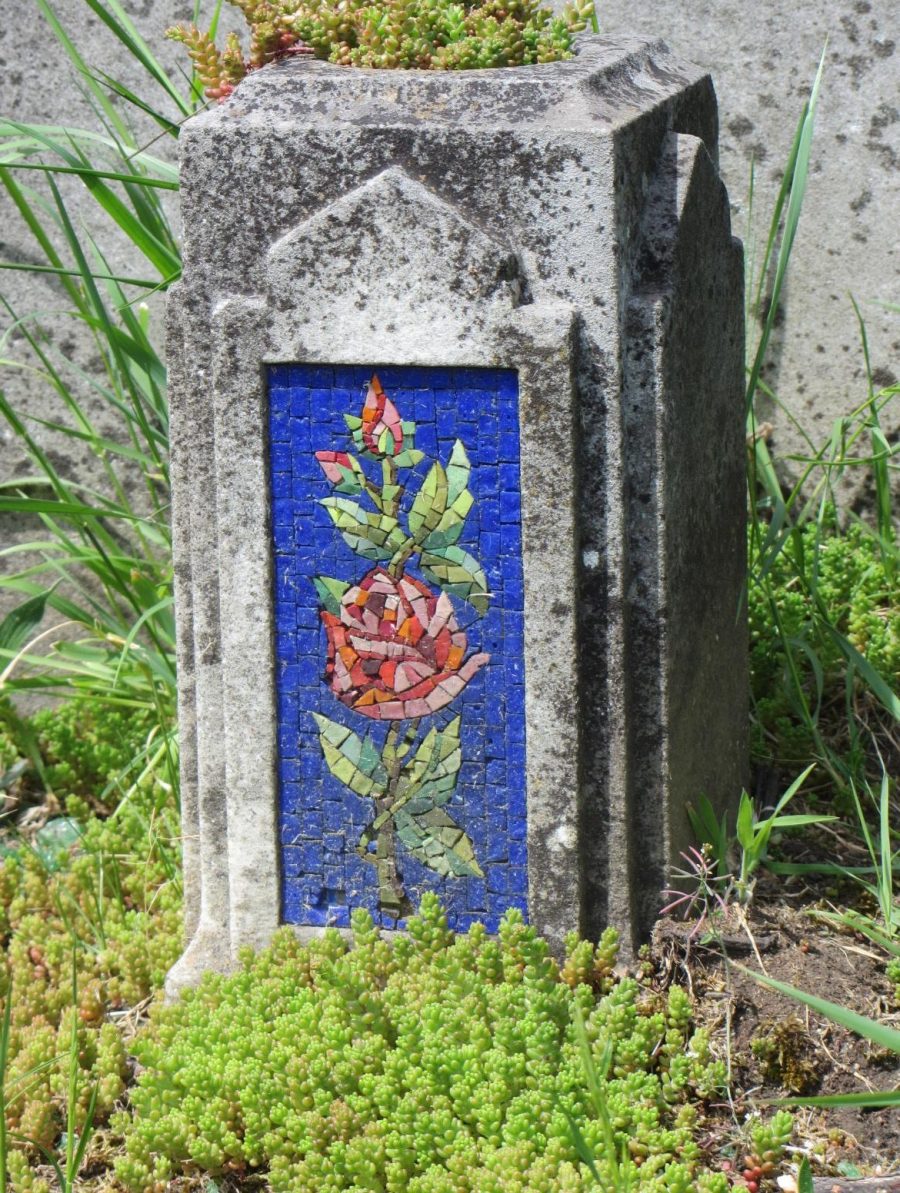
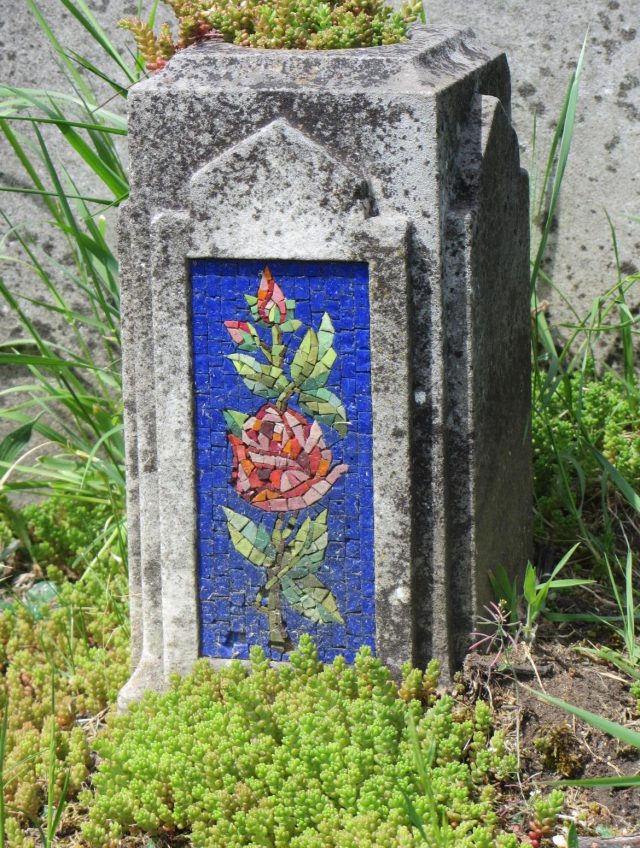
On another recent return visit to Beckenham cemetery in order to research symbols I discovered some more mosaics  on memorials.  They were mainly small colourful crosses, either at the corners of a memorial or, in the case of one larger cross, the centrepiece of the epitaph.


This is the simple but moving Denson memorial.  It’s dedicated to Gladys Winifred and baby Mary who were ‘the well beloved wife and daughter of Percy Clifford Denson.  The scarlet cross really stood out amid the other plainer granite tombstones.  The verses that surround the cross read:

There is no death an angel shape

Walks over the earth with silent tread

He bears our best love thins away

And then we call them dead.


Born into that undying life

Thy leave us but to come again

And ever near us though unseen

The dear immortal spirits tread

For all the boundless universe is life

There is no dead’


This has been adapted from the well know 19th century poem ‘There is no Death’ by John Luckey McCreery (1835-1906) although it has been mistakenly credited to Sir Edward Bulwer-Lytton.  It was written in 1863 and, in 1893, McCreery wrote to an Iowa newspaper to remind readers that it was his work.

This is the poem in full with the relevant quotations from the Denson epitaph marked in bold:

There is no death! The stars go down

To rise upon some other shore

And bright in heaven’s jewelled crown

They shine for evermore


There is no death! The dust we tread

Shall change beneath the summer showers

To golden grain or mellow fruit

Or rainbow-tinted flowers


The granite rocks disorganise

To feed the hungry moss they bear:

The forest leaves drink daily life

From out the viewless air.


There is no death! The leaves may fall,

And flowers may fade and pass away –

They only wait, through wintry hours,

The coming of the May.


There is no death! An angel form

Walks o’er the earth with silent tread

He bears our best-loved things away,

And then we call them “dead”.


He leaves our hearts all desolate –

He plucks our fairest, sweetest flowers,

Transplanted into bliss, they now

Adorn immortal bowers.


The bird-like voice, whose joyous tones

Made glad this scene of sin and strife,

Sings now an everlasting song

Amid the tree of life.


Where’er He sees a smile too bright,

Or soul too pure for taint of vice,

He bears it to that world of light,

To dwell in Paradise.


Born unto that undying life,

They leave us but to come again:

With joy we welcome them –the same

Except in sin and pain.


And ever near us, though unseen,

The dear immortal sprits tread,

For all the boundless universe

Is Life –there is no dead!

This is one of a pair of gold crosses that are on either side of Harold Chenowith’s (1898-1934) tombstone.

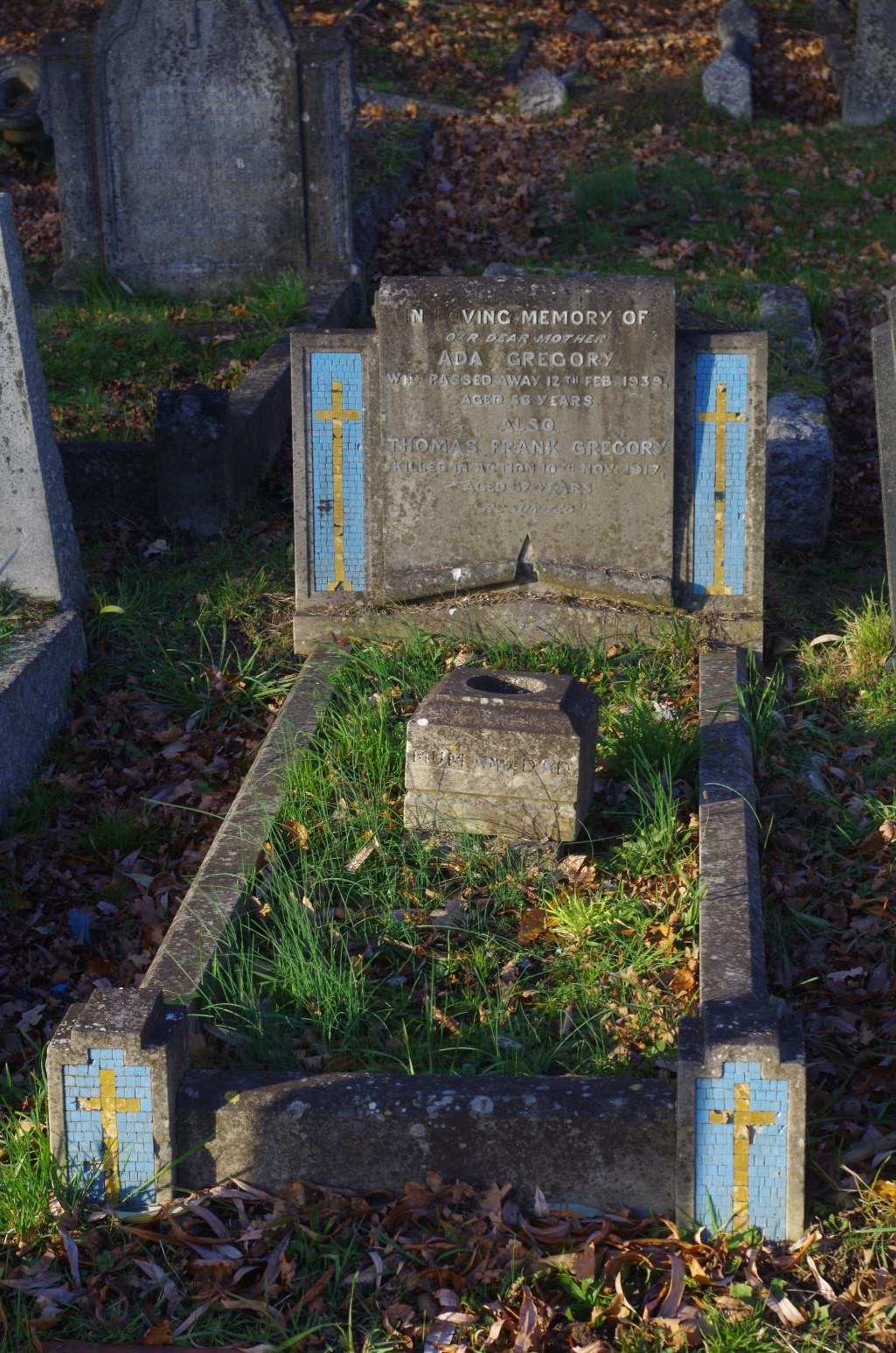
And more golden crosses on each of the corners of Ada Gregory’s monument.  She died in February 1939 but her husband, Thomas, who was killed in action in November 1917 is also commemorated here.  As the final line of the epitaph states ‘ Reunited.’

This is the Ada George memorial and dates from 1939. ©Carole Tyrrell
This is the Ada George memorial and dates from 1939.
©Carole Tyrrell


Finally, this is a vase which has been incorporated into the headstone of Margery Alice, ‘beloved wife of Frank Thompson, who ‘passed peacefully away on 6 October 1934 aged 39.’

This vase with mosiac decoration has been incoorporated in the headstone to Margery Alice Thompson in Beckenham Cemetery. ©Carole Tyrrell
This vase with mosiac decoration has been incoorporated in the headstone to Margery Alice Thompson in Beckenham Cemetery.
©Carole Tyrrell


These mosaics decorations all seem to date from the 1930’s and so are pre-Second World War.  So far I have been unable to discover the reason behind the vogue for this embellishment and so I will continue to look for them whenever I visit a cemetery.


© Text and photos Carole Tyrrell

http://ir.uiowa.edu/cgi/viewcontent.cgi?article=1932&context=annals-of-iowa

http://funeralhelper.org/there-is-no-death-john-luckey-mccreery.html


Symbol of the Month – And With The Morn Those Angel Faces Smile


This is the other version which is sited on the main road through the cemetery. The epitaph was difficult to read as worn but it was also to much missed children. ©Carole Tyrrell
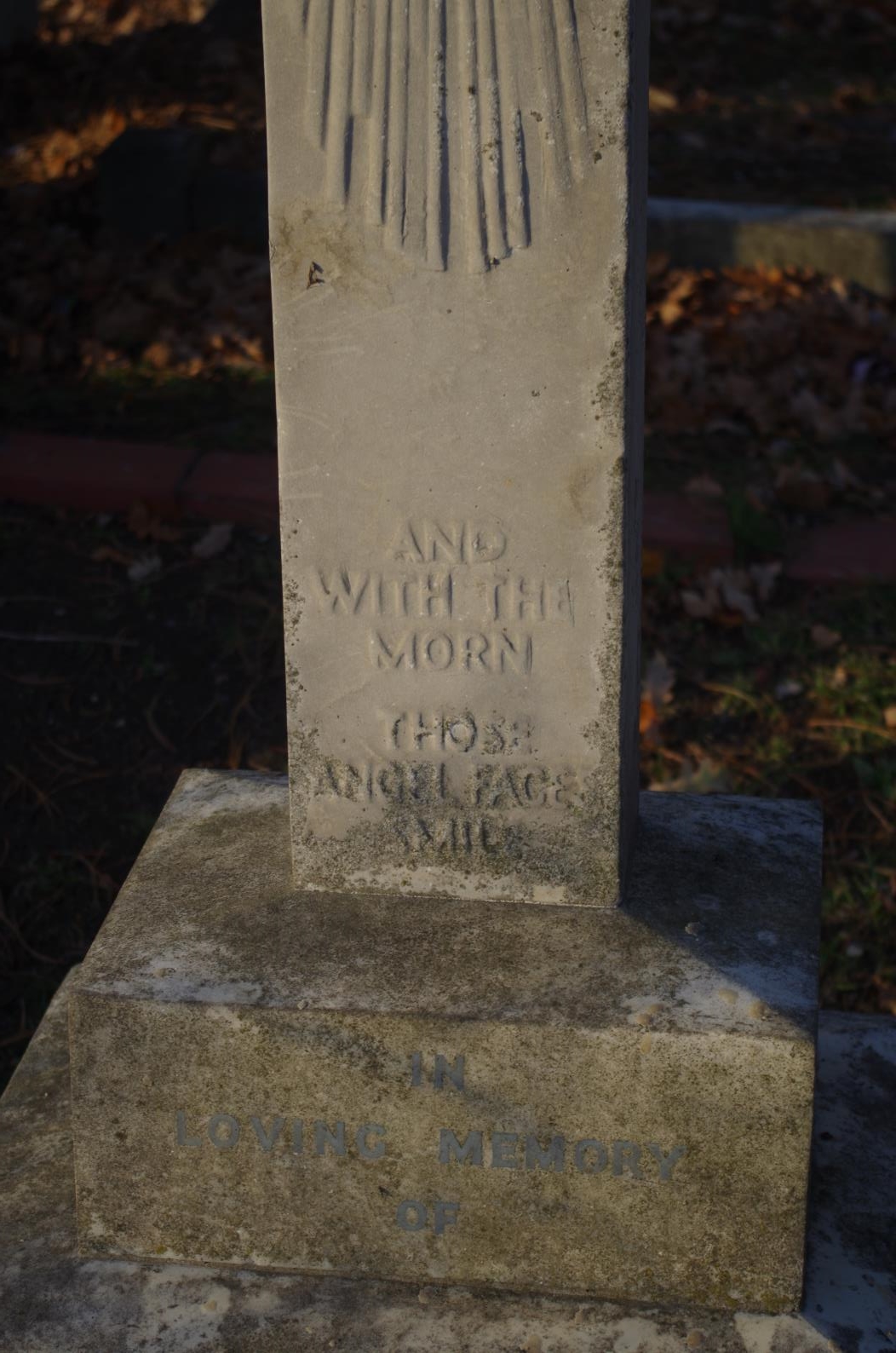
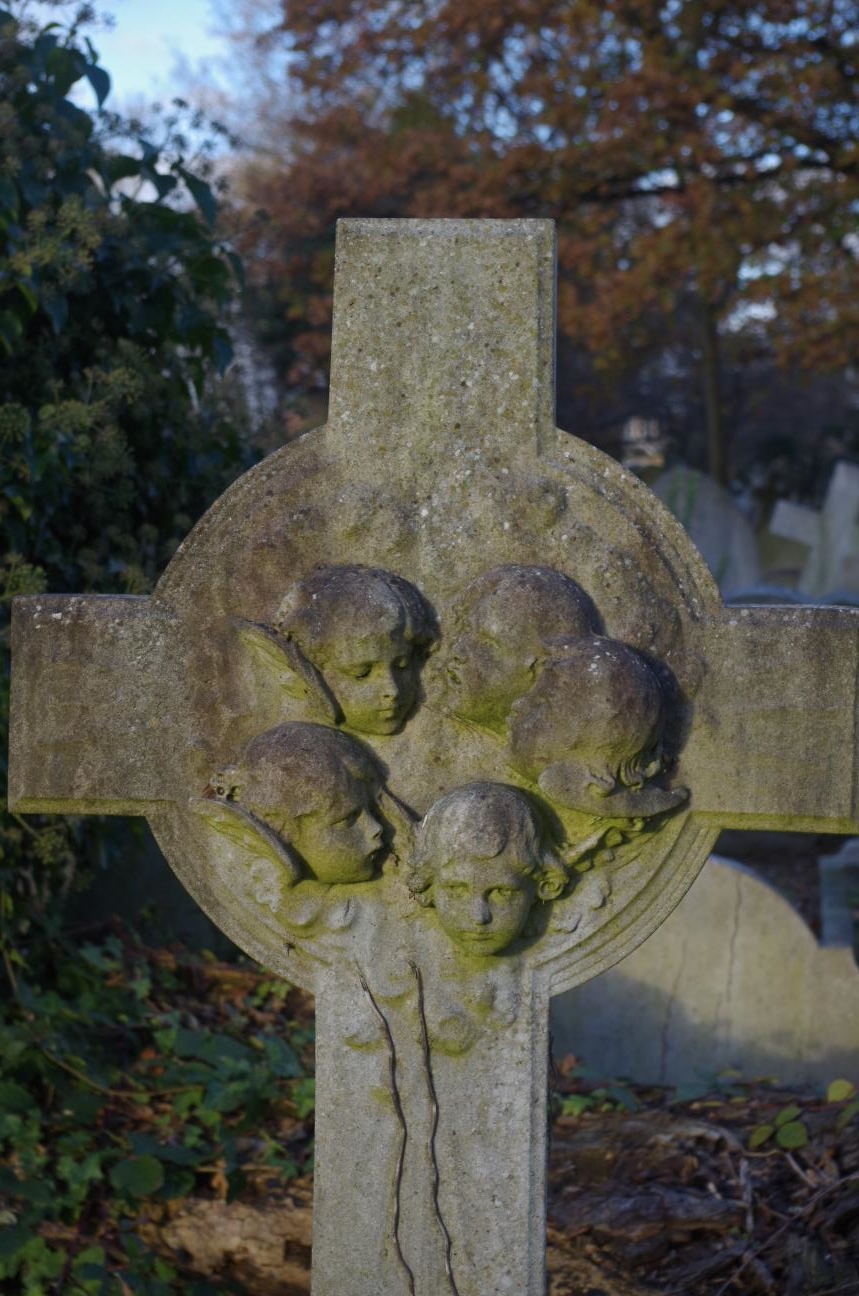
This is the first one that I saw on a guided tour of Beckenham Cemetery.  The Foster family monument which is sited on the main road through the cemetery.
©Carole Tyrrell

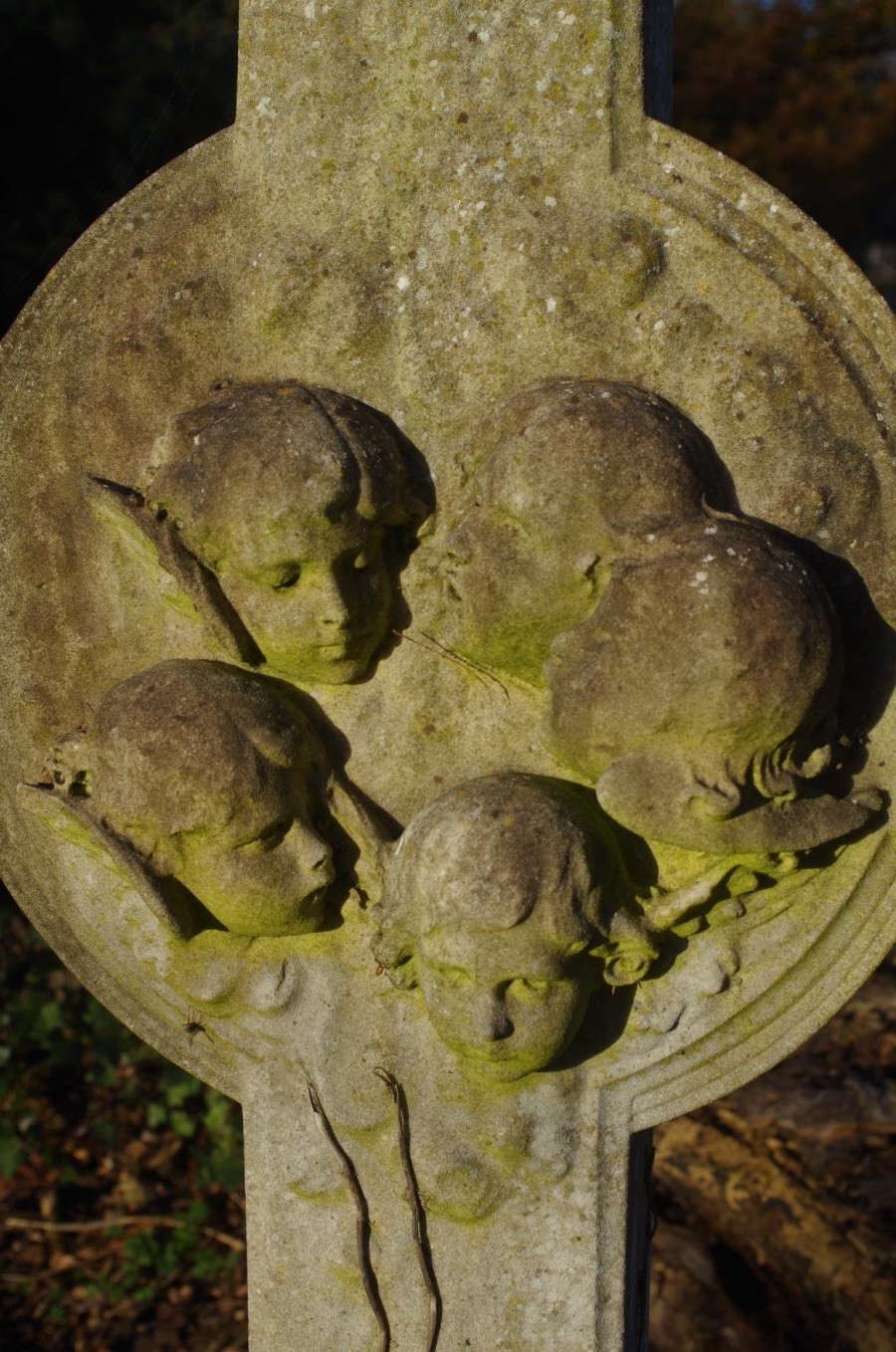
Five child angels, their faces turned to each other, framed by small wings, except for one that was staring out at me, I wanted to reach out and touch them but didn’t want to damage them.   They formed a roundel at the centre of a tall cross with the phrase ‘And with the morn those angel faces smile’ inscribed at the base of its stem.  I was on a tour of Beckenham Cemetery when I first saw them.

The line that led me on my quest to find out the origin of this symbol. ''And with the morn Those Angel Faces Smile.'. ;©Carole Tyrrell
The line that led me on my quest to find out the origin of this symbol. ”And with the morn Those Angel Faces Smile.’. ;©Carole Tyrrell

Our guide didn’t comment on them but the monument is in a prominent place on the main road through the cemetery and I often wondered about this pretty and poignant memorial.

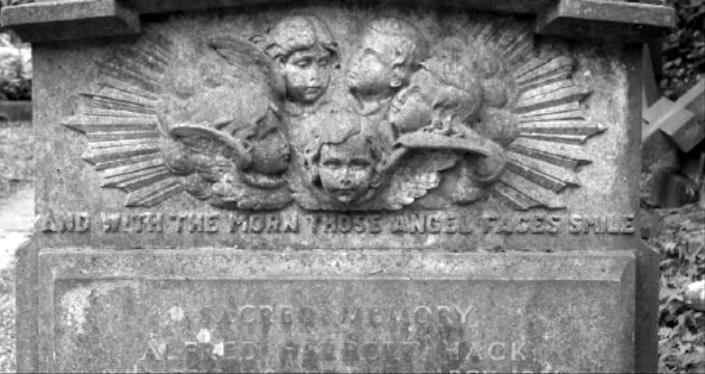
On a visit to Highgate East in 2014 I found another example but on a smaller scale on a tombstone in the name of Alfred Hack and dated 1956.  There is a distinctly 1930’s look about the angels from  their hairstyles.

I also found another version which featured cherubs faces instead of childrens on a visit to Knebworth this summer.

Then , on a more recent visit to Beckenham Cemetery,  I found another similar one which was only a short distance away from the first.  In this the child angels seem to have more definite, individual faces and the one that has her head towards the viewer is looking down instead of outwards.  Now I wanted to find out more about the quotation and the angels and my research led me to a Victorian hymn that was sung on the Titanic at its final service on board and by the inmates of Ravensbruck concentration camp as the S.S led them in.   The ‘angel faces’ is a quotation from ‘Lead, kindly Light’,  in fact it’s the penultimate line and like ‘Rock of Ages’ it caught the mood of its time.

These are the lyrics:

‘Lead, kindly Light, amid the encircling gloom
Lead thou me on;
The night is dark, and I am far from home,
Lead thou me on.
Keep thou my feet; I do not ask to see
The distant scene; one step enough for me.

I was not for ever thus, nor prayed that thou
Shouldst lead me on;
I loved to choose and see my path; but now
Lead thou me on,
I loved the garish day, and, spite of fears,
Pride ruled my will: remember not past years.

So long thy power hath blessed me, sure it still
Will lead me on,
O’er moor and fen, o’er crag and torrent, till
The night is gone;
And with the morn those angel faces smile,
Which I have loved long since, and lost awhile.’


However, the writer John Henry Newman (1801-90), always refused to reveal the meaning of the ‘angels faces’ or what the ‘kindly light’ actually was.

Originally a poem, it was written by Newman in 1833.  He was then a young theologian and Anglican vicar and was going through a challenging time in his life. Struck down by a fever which nearly killed him while travelling in the Mediterranean, Newman’s  servant was so convinced that he would die that he asked him for his last orders.  But in his autobiography, Newman told him ‘I shall not die, for I have not sinned against light’.

Newman recovered but that wasn’t the end of his troubles.  Desperate to return to England he then took a boat from Palermo to Marseilles only to end up stranded and becalmed in the Straits of Bonifacio. Exhausted and frustrated Newman wrote the poem, ‘The Pillar of the Cloud’ that, in 1845, became ‘Lead, Kindly Light’.  Newman was not happy about this as by then he’d converted to Catholicism and hymn singing wasn’t included as part of divine service.  He went onto become Cardinal Newman, one of the most important figures in English Catholicism, and also an important writer. In 1900 Elgar set Newman’s poem ‘The Dream of Gerontius’ to music.

Cardinal Newman as John Newman eventually became after his conversion to Catholicism. This celebrated portrait is by Sir John Everett Millais. In the public domain in UK - from the National Portrait Gallery wkipedia
Cardinal Newman as John Newman eventually became after his conversion to Catholicism.
This celebrated portrait is by Sir John Everett Millais.
In the public domain in UK – from the National Portrait Gallery wkipedia


‘Lead, Kindly Light’ has struck a chord with those in danger or about to enter the endless dark realm and needed the comfort of a light leading their way through it.  Miners awaiting rescue from deep underground  during the 1909 Durham mining disaster sang it  as did the  passengers on one of Titanic’s lifeboats  when the rescue ship, Carpathia,  was sighted the morning after.  It caught the Victorian mood perfectly as did ‘Rock of Ages’ and Queen Victoria asked for it to be read as she lay dying.  It also inspired a celebrated painting by the Scottish artist, Sir Joseph Noel Paton in 1894 in which the angels are pensive young woman.


But why did one line from this song inspire two monuments in Beckenham Cemetery and one in Highgate East?  I noticed that both of the Beckenham monuments were on children’s graves and that the carved angels were also children. Perhaps the mourning relatives left behind may have wanted the consolation that their beloved children would be waiting for them when their time came.


The first one is the Foster family monument.  The epitaph is now virtually unreadable but I could make out the name ‘Francis Frederick’ carved along the base.    There are two inscribed ‘Books of Life’ placed on top of the grave.  One is dedicated to John Francis Foster and Alice Gladys Alice Chapman and the other is dedicated to John Francis Foster and Alice Emma Foster.

The Pace monument in Beckenham Cemetery. ©Carole Tyrrell
The Pace monument in Beckenham Cemetery.
©Carole Tyrrell


The second one is the Pace family monument and is to the two daughters of Henry William and Elizabeth Pace.  These were Lilian Alice who died in 1888 and Grace Irene who died in 1903.  Strangely enough they both died at the same age and Elizabeth herself is commemorated here as she died at 33 in 1912.

The epitaph on the Page monument. It's dedicated to the 2 daughters of Henry and Elizabeth Page., Lilian died in 1888 and Gr ace in 1903 and at the same age. ©Carole Tyrrell
The epitaph on the Page monument. It’s dedicated to the 2 daughters of Henry and Elizabeth Page., Lilian died in 1888 and Gr ace in 1903 and at the same age.
©Carole Tyrrell


This is the one in Highgate East dedicated to Alfred Hack and dated 1956.

This is a much smaller version on a tombstone in Highgate East Cemetery. ©Carole Tyrrell
This is a much smaller version on a tombstone in Highgate East Cemetery.
©Carole Tyrrell

So, a line from a hymn that even its writer was unsure of its meaning, became a symbol of comfort to sorrowing families.

However the symbol has been adapted to feature cherubs as in St Mary’s, Knebworth’s churchyard. These are on the tombstone of the Lutyens family’s nanny, Alice Sleath.

But I am indebted to Douglas Keister’s Stories in Stone for the possible origins on the image of the angels.

The composition of the five heads may have been adapted from  a painting by Sir Joshua Reynolds PRA entitled ‘Heads of Angels Miss Frances Gordon’ which was painted during July 1786 – March 1787.  The sitter was the then 5 year old Frances Isabella Keir Gordon (1782-1831) who was the only daughter of illustrious parents. They were Lord William Gordon (1744-1823) and his wife Frances Ingram (1761-1841), second daughter of Charles, 9th Viscount Irvine (1727-78), who were married on 6 March 1781. Her uncle was Lord George Gordon (1751-93), whose political activities had sparked the anti-Catholic riots of 1780.

'Heads of Angels Miss Frances Gordon' by Sir Joshua Reynolds PRA 1786-1787. . This is in public domain wilki creative commons
‘Heads of Angels Miss Frances Gordon’ by Sir Joshua Reynolds PRA 1786-1787. . This is in public domain wiki creative commons

Frances’ mother outlived her by 10 years and the painting was then presented to the National Gallery.  It was enormously popular and was reproduced on numerous decorative items and photographic reproductions such as ‘The Cherub Choir.’

And so a poignant and powerful symbol was created from the combination of a great painting, an inspirational hymn and Victorian taste and led to these three lovely memorials to much missed children.

©Text and photos Carole Tyrrell unless otherwise stated.


http://www.telegraph.co.uk/culture/music/3668066/The-story-behind-the-hymn.html

https://en.wikipedia.org/wiki/Lead,_Kindly_Light

http://www.thebeautybag.net/videos/angel-faces-smile/

http://www.tate.org.uk/art/artworks/reynolds-a-childs-portrait-in-different-views-angels-heads-n00182

Stories in Stone, Douglas Keister,  2006, Gibbs Smith

Peacock splashes of colour in between the grey and the black – mosaics in cemeteries (and a few other places)

1654mosiacelmersend
A charming mosiac on a grave in Beckenham Cemetery, Elmers End dating from 1930’s. ©Carole Tyrrell
NB-please click on images without an obvious caption and it should come up. Please let me know if it doesn’t.

It’s always the little bright patch of colour that catches your eye.  In a sea of grey Portland stone, black, grey or, for the more adventurous, pink granite or terracotta, the sun always catches a small mosaic.  They aren’t plentiful but most large Victorian cemeteries have a couple or two if you know where to look.

Most have survived very well and  mostly seem to date from the 1920-1930’s.   However, there is one in St Mary Catholic Cemetery in Kensal Green which is on a 1950’s tombstone and is religious in nature.

Mosaics and me

When I visited Venice I explored San Michele cemetery, its Isle of the Dead, and, despite not having much time, saw some lovely examples.  It was my first experience of seeing mosaics in situ since a school visit to Lullingstone Roman Villa.  These are two examples from Venice;

In the same year I also visited Aquileia which is in Northern Italy near the Slovakia border.  Once a thriving Roman port it is now 10km from the Adriatic Sea.  The Romans left many artefacts including a necropolis which is now surrounded by back gardens and the celebrated mosaic floor in the Cathedral.

Visitors can admire the detailed and colourful figures of birds, fish, reptiles, women and fishermen amongst others from an elevated glass walkway over the floor.   Here are a bison and an octopus from the floor:

So it was exciting to be able to go mosaic spotting in the UK and West Norwood Cemetery has a wonderful and large example in its Greek Necropolis.  The delicacy and beauty of these creations must be time consuming and expensive so we should appreciate the ones that we have.

On my list to visit  – Rudolf Nureyev’s tomb.

I am indebted to Rod Humby from the Joy of Shards website for kindly giving me a link to one of the most spectacular mosaic memorials of all – Rudolf Nureyev’s tomb in Sainte Genevieve des Bois Russian Cemetery, Sainte Genevieve des Bois France.  It has a mosaic Oriental carpet draped across it.  Nureyev was an enthusiastic collector of beautiful carpets and antique textiles and so it seems fitting that one protects him in his eternal sleep.  It was designed by the sculptor Ezio Frigerio who had  worked with Nureyev for many years on designing ballet sets.


A brief history of mosaics

The Joy of Shards defines the word mosaic as:

‘The word ‘mosaic’ is as you might expect, Italian in origin. It derives from the Latin ‘mosaicus’ which in turn comes from the Greek ‘mouserus’ or belonging to the Muses and so artistic.’ (reproduced by kind permission)

According to Wikipedia mosaics are:

‘a piece of art or image made from assembling small pieces of coloured glass, stone

or other materials.  They are usually made of small flat, roughly square, pieces of

stone or glass of different colours, known as tesserae.’


Again from The Joy of Shards


‘Mosaics were first created roughly 4,000 years ago in Mesopotamia which included what are now Iraq, Syria and Kuwait. At first they were simple and consisted of pushing terracotta cones point first into a background as decoration.  In the 8th century pebble pavements appeared which incorporated differently coloured stones to create patterns. But it was the Ancient Greeks, flowed by the Romans who began to incorporate pictures and patterns into their designs. ‘

(reproduced by kind permission)

Mosaic making flourished throughout the Byzantine Empire from the 6th-15th century and soon spread throughout East and Western Europe.  Ravenna in Italy was its centre of mosaic making from the 6th century and pieces still survive in place such as The Great Palace in Constantinople, now Istanbul.

The Christian and Islamic faiths have also used mosaics extensively in their basilicas and mosques.  These include the Umayyad Mosque in Damascus and the Great Mosque in Cordoba.   Ely Cathedral also boasts a mosaic floor in one of its chapels. There are also notable examples in Venice’s St Mark’s and also on the islands of Torcello and Murano. The Jewish faith also used mosaics to embellish their synagogues.

Mosaics fell out of favour and were replaced by paintings around the time of the Renaissance. But they enjoyed a revival in the 19th century as the Victorians re-discovered them. Westminster Cathedral is a fine example and is decorated in the Byzantine style.

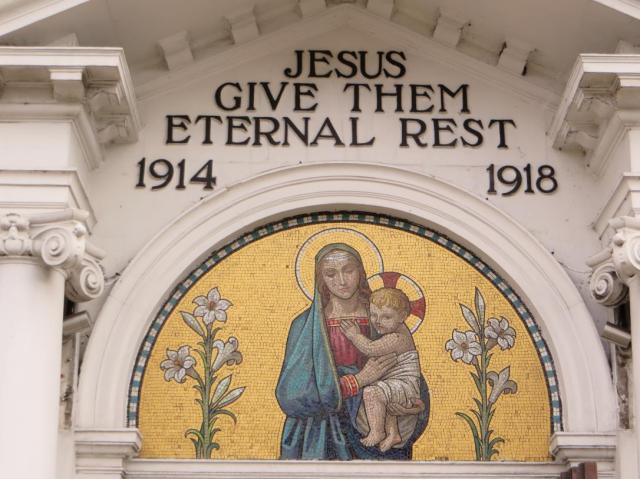
This one is from  St Saviour and St John Baptist and Evangelist Roman Catholic church in Lewisham High Street and dates from 1919. It’s over the entrance but I was unable to find out the name of its creator.

mosaiclewisham
Mosaic over entrance of St Saviour and St John the Baptist and Evangelist, Lewisham – dated 1919 ©Carole Tyrrell

This lovely one is from Salisbury Cathedral and features an exquisite border of passionflowers around an 1894 memorial.

There are also the celebrated mosaic interiors of the Beer mausoleum in Highgate and the Doulton sepulchre at West Norwood.

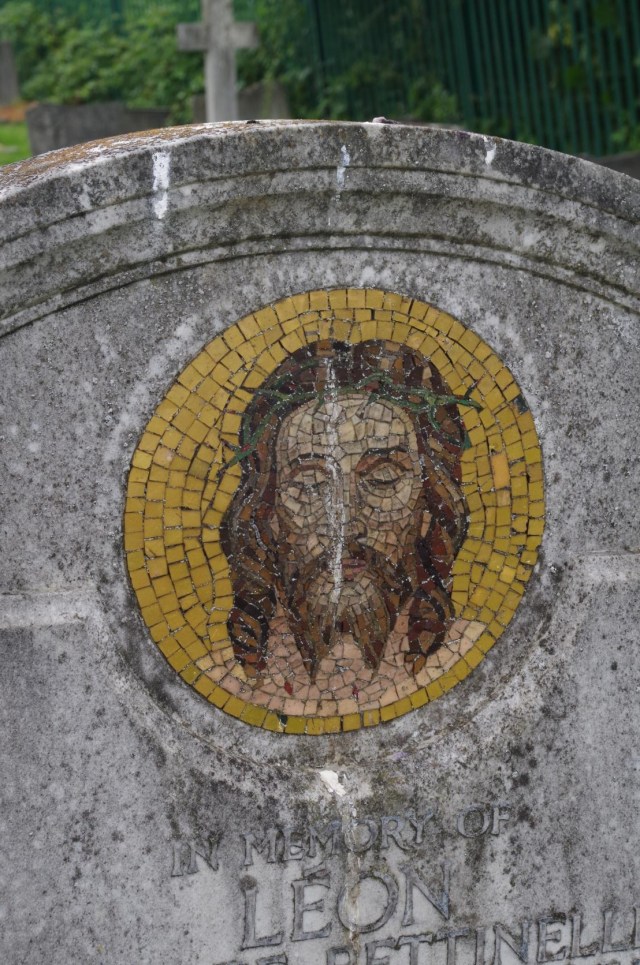
The Bettinelli grave in St Mary’s Catholic Cemetery features the colourful head of Jesus wearing the crown of thorns and is very striking.

kgmosiac3
A beautiful example from St Mary’s Catholic cemetery, Kensal Green – it’s on the grave of an Italian couple, the Bettinell. Leon died in 1954 and presumably it dates from then. ©Carole Tyrrell

Most of the mosaics that I’ve seen appear to have worn very well with only a few tesserae missing here and there. However, there is one in West Norwood’s Greek section in which the tesserae have completely vanished leaving only a ghostly outline of the figures.  There is however, a plain blue mosaic slab beneath it.

1264damagaedgreekmosiacwn

This is another from the Greek Necropolis; the Maria Michalinos monument and is based on a stele discovered at a site near Athens and displayed at the British Museum. It features a seated woman dressed in classical dress looking at a jewellery casket held by a servant.

1263mosaicgreekwn

I am compiling a gallery of these little jewels whenever and wherever I find them and here is a selection so far:

Text and photos ©Carole Tyrrell unless otherwise stated or attributed

http://www.thejoyofshards.co.uk/history/

https://en.wikipedia.org/wiki/Mosaic

http://helenmilesmosaics.org/mosaics-miscellaneous/mosaic-headstones/

http://victoriafunerals.com.au/mosiacs-headstones-mausolea.php

http://weburbanist.com/2009/11/01/drop-dead-gorgeous-ten-types-of-tombstones-to-die-for/

http://parisandbeyond-genie.blogspot.co.uk/2011/11/pilgrimage-to-saint-genevieve-des-bois.html

West Norwood Cemetery’s Greek Necropolis – Friends of West Norwood publication, 2011