Symbol of the Month – The Spring of Life is Broken

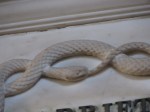
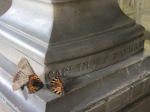
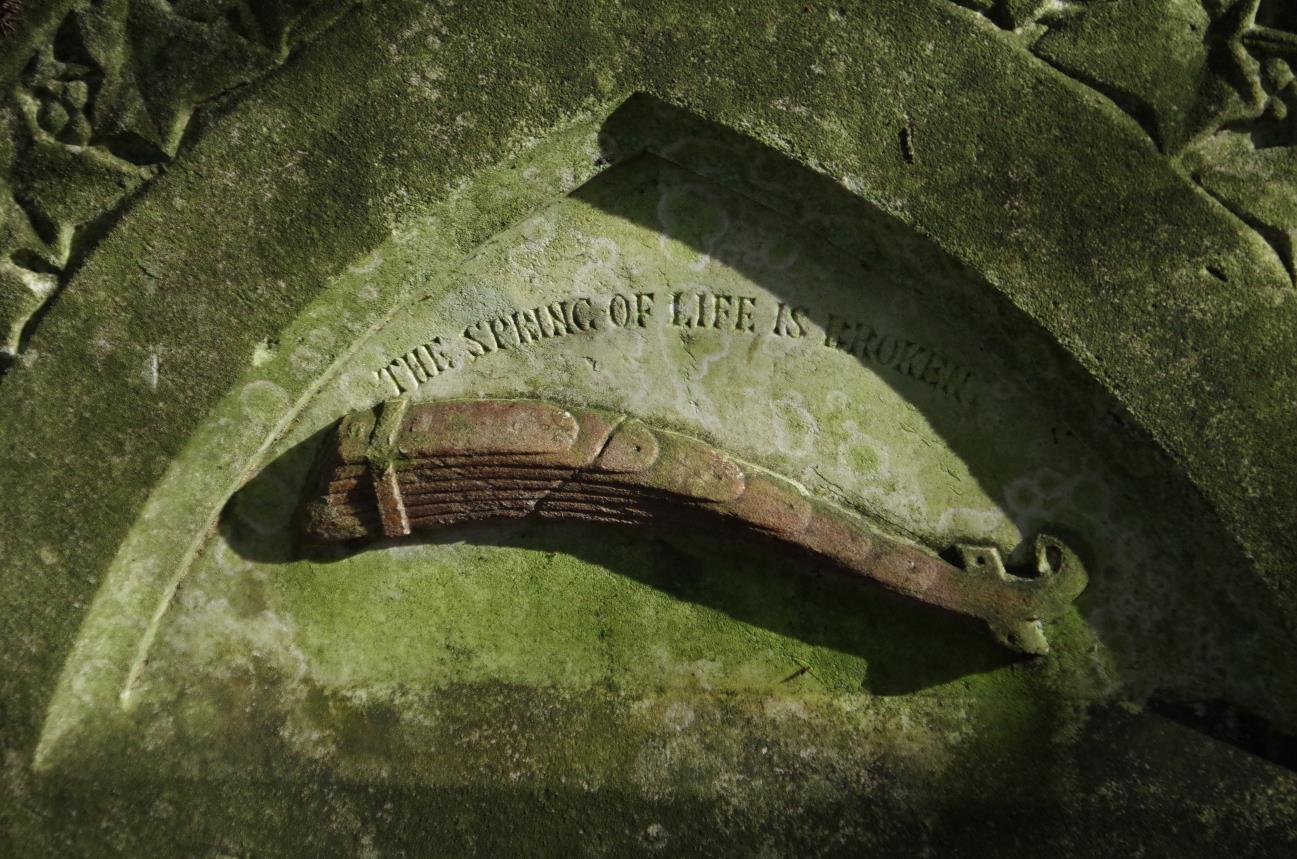
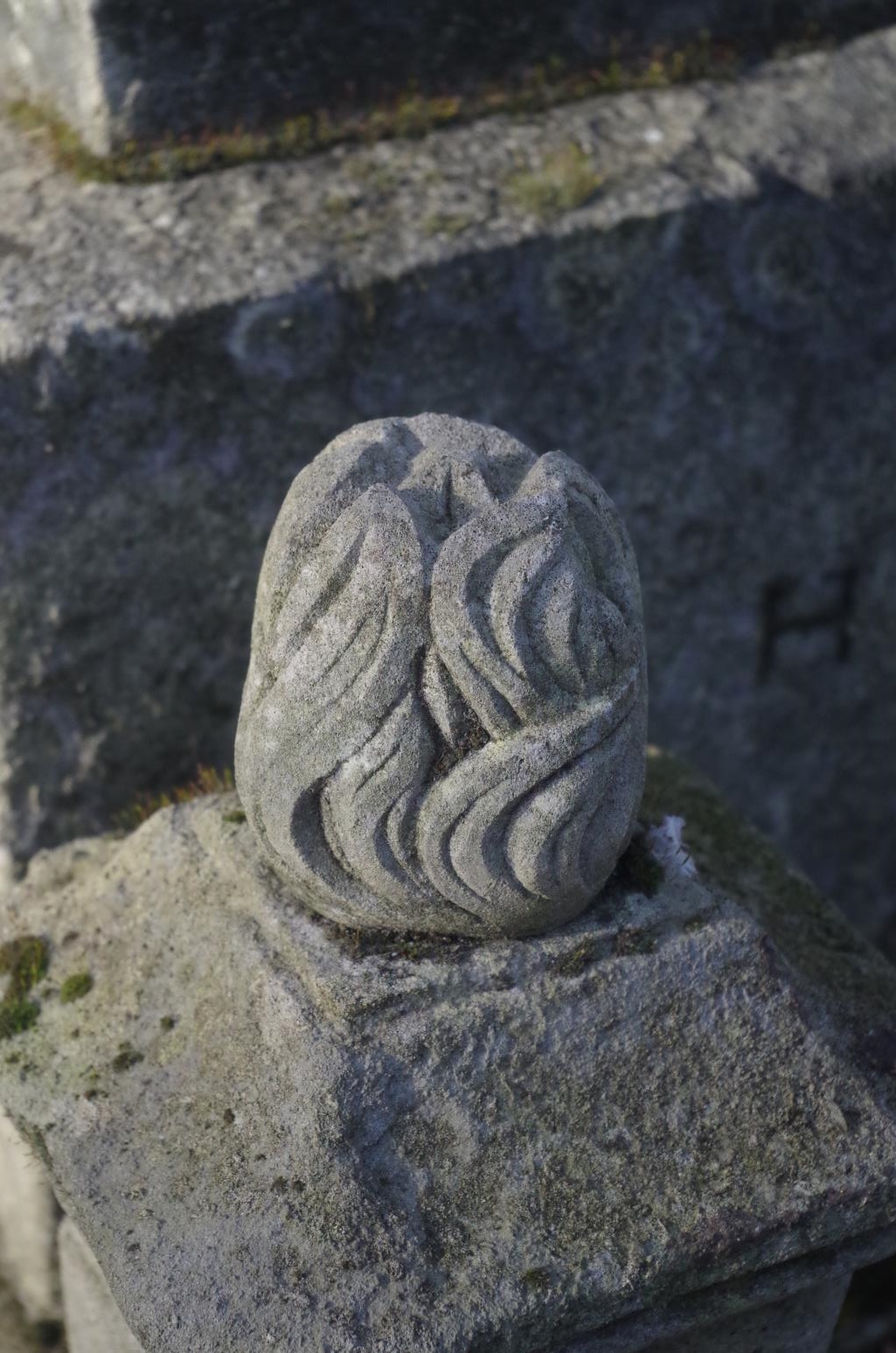
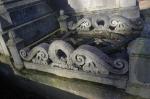
A unique symbol in Nunhead Cemetery - a carriage spring. copyright Carole Tyrrell
A unique symbol in Nunhead Cemetery – a carriage spring.
copyright Carole Tyrrell

This is one of the most intriguing and baffling symbols to be found in any cemetery.  Visitors are mystified as to its meaning and inspiration and there has been a lengthy discussion about it recently on a cemetery related Facebook page.

It’s tucked away in Nunhead Cemetery and, despite being given directions by Robert Reinhardt, a Facebook friend, I couldn’t find it.  He had posted images of it online and I was immediately intrigued.  But I couldn’t locate it despite making several visits.

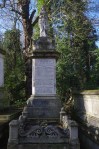
But, as luck would have it, I was in Nunhead Cemetery again, looking for another memorial altogether when there it was, hiding in plain sight.

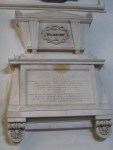
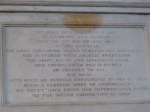
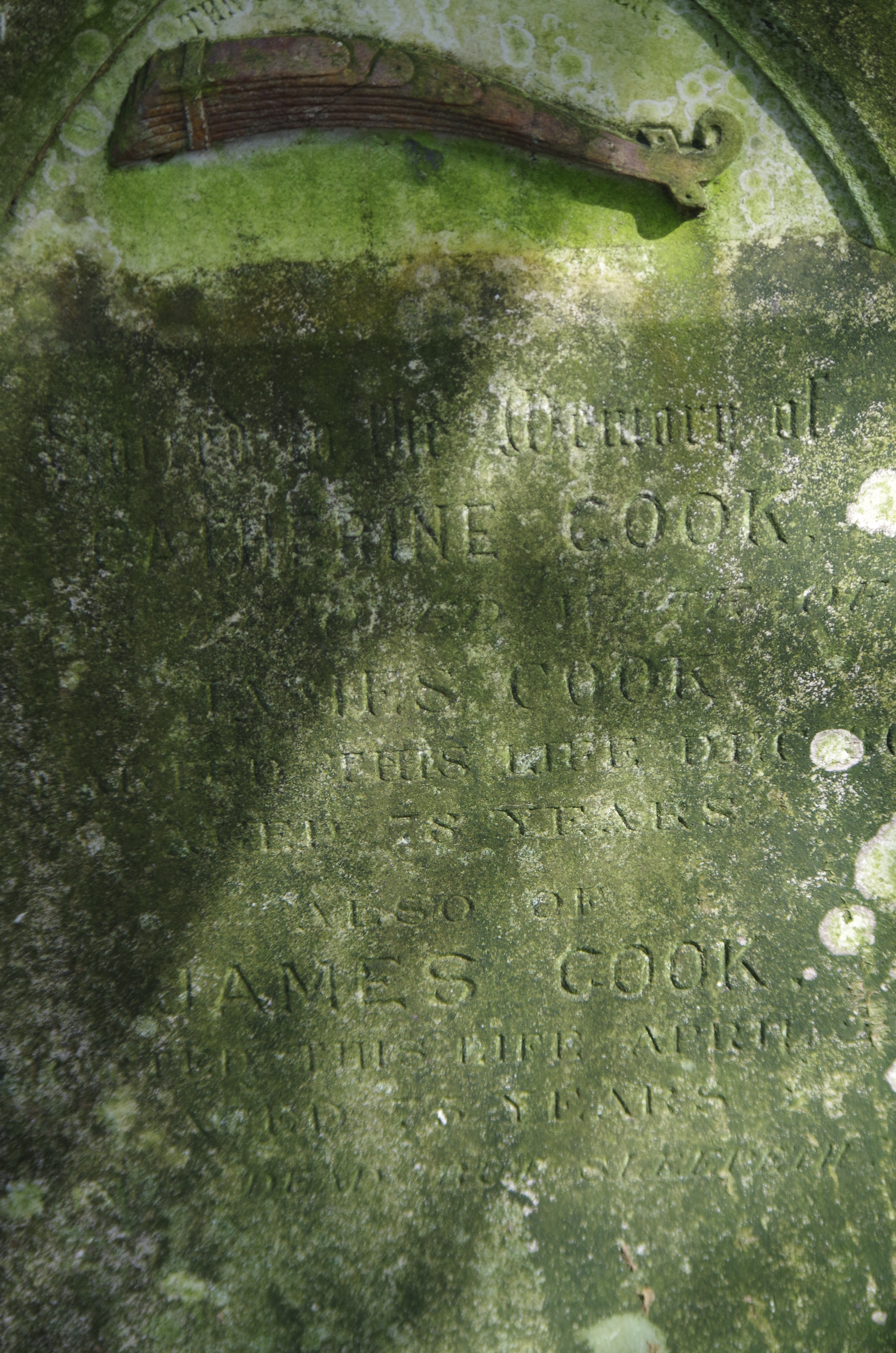
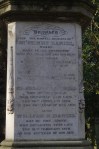
Epitaph on Catherine Cook's tombstone - beloved wife of James Cook. copyright Carole Tyrrell
Epitaph on Catherine Cook’s tombstone – beloved wife of James Cook.
copyright Carole Tyrrell

It’s a memorial to Catherine Cook, beloved wife of James Cook as it says on the epitaph, with the motto ‘The Spring of Life is broken’ and   the carving above it with a lovely border of carved ivy leaves  representing ‘evergreen’ or ‘eternal.’

But let’s digress for a moment.  This is a well carved leaf spring which is one of the earliest forms of suspension in a wheeled vehicle. Leonardo da Vinci used them in his own design for a self-propelled car.   The one of Mrs Cook’s tombstone is an example of a multi-leaf spring in which leaf springs of varying lengths have been stacked on top of each other, sometimes up to 20 at a time, to enable the vehicle’s load to spread more widely.

introduction-to-leaf-spring-3-638

I found the above diagram of a leaf spring online on various sites and it explains how it works.

But why is it depicted on an obviously much missed wife’s tombstone?

My own theory, and it is only my theory  is that it’s a variant on the  broken column.

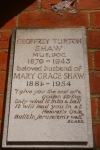
This is an example of a broken column from Nunhead Cemetery.
copyright Carole Tyrrell


The column isn’t the result of vandalism but has been deliberately created like this.  It indicates that the departed, often a male, was the head of the house and now the support of the family, or its backbone, had gone.

So I feel that this could be a female version.  Mrs Cook was obviously the support to her husband and family in that the suspension, the object that made the family load easier to manage, has gone.

Since finally discovering it, I’ve come to admire it as a unique and affectionate tribute to a much loved woman.

You are completely free to disagree and to offer your own interpretation and I’d be very interested to receive them.

Text and photos copyright Carole Tyrrell

Sources:

Wikipedia

The much loved and never forgotten pets of the de Grey family – a visit to Wrest Park’s dog cemetery

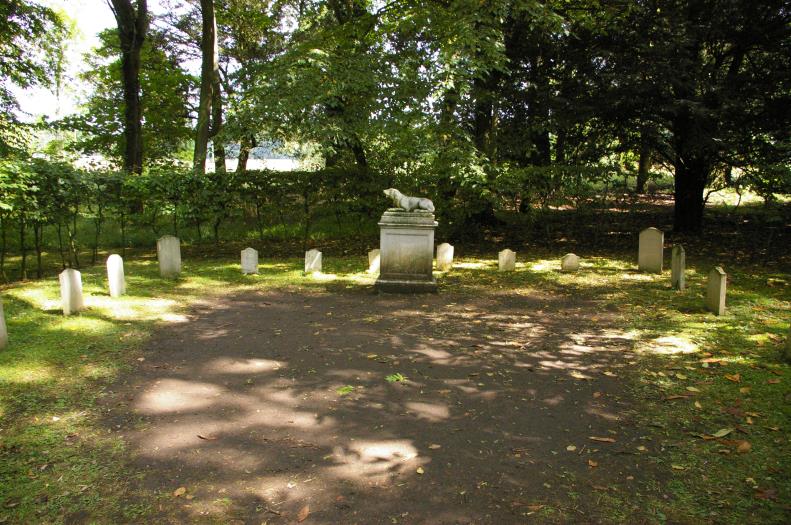
The Dog Monument  Made from Ketton Stone and erected by Earl Grantham in 1829. Copyright Carole Tyrrell
The Dog Monument Made from Ketton Stone and erected by Earl Grantham in 1829.
Copyright Carole Tyrrell


I visited Wrest Park on a beautiful summers’ day and it is one of the most beautiful stately homes and gardens that I’ve visited.  Located at Silsoe, near Luton in Bedfordshire, its 90 acres of formal gardens are impressive and contain features such as the elegant Long Water and the Chinese Bridge.

For over 600 years it belonged to the de Grey family.  It was Edward IV (1461-83) who made Edmund Grey the first Earl of Kent.  The formal gardens and Long Water were created during the 18th century by Annabel Benn with the 11th Earl of Kent, her son Anthony, and his wife Mary.  These were all the rage at the time and the celebrated Capability Brown, amongst others, helped design them.

In the 1830’s, Thomas Earl de Grey, a keen amateur architect decided to rebuild the house in the fashionable French style but retained the garden layout instead of replacing it with the style of the day.  He later became the first President of the Royal Institute of British Architects or RIBA. Since 1900, like most stately homes and country houses, Wrest has had mixed fortunes.  It was sold in 1917 and in 1948 became the National Institute of Agricultural Engineering and later the Silsoe Research Institute. Historic England, previously English Heritage, now own Wrest Park and have embarked on a 20 year restoration programme of the house and grounds.

The de Grey family’s dogs’ cemetery is a distance from the house and near the Long Water. A grassed pathway bordered on each side by saplings leads you to a secluded glade.  A statue of a dog, the Dog Monument, made from Ketton stone rests on a stone pedestal surrounded by 16 headstones.  They are no longer in their original positions and the cemetery was officially Grade II listed on 10 January 1985.

View of Dog cemetery from path. copyright Carole Tyrrell
View of Dog cemetery from path.
copyright Carole Tyrrell

According to the guidebook, the area was first recorded on a 1735 surveyor’s plan of the gardens.  It was a square clearing at the end of a straight path leading from the Lady Duchess’s Walk.  The cemetery itself dates from 1829 when Earl Grantham, later to become Earl de Grey, erected the Dog Monument.  The headstones date from 1830-1860 and the dogs commemorated are:

Douban who died 24/11/1876 aged 17

Freuah who died in 1878 aged 10 and belonged to Countess Cowper

Una who died in 1891 and was the favourite dog of Lady Florence Cowper

Little Dick – the favourite dog of Lady Amabel Cowper

Lancey  who died in 1875

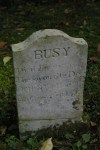
Busy

Fury

Dorrock

Phedra

Tiger

Nissy who died in 1816

Kelpie

Tottie who was a favourite dog

Dandy

Petsy

Pet – a favourite dog

The de Grey family’s love of their dogs can be seen in an 1865 photograph in the guide book.  Lady Amabel Cowper, the youngest daughter of Anne Florence, dowager Countess Cowper is standing on the terrace at Wrest with three of the family’s dogs who look like terriers.  One dog is obediently posing, lying at her feet, another is on his hind legs with his back to the camera looking up at her and a third, a small dog, is perched on her shoulder.  I did wonder if the one on her shoulder was Little Dick whose headstone records that he was her favourite dog.  Some of the stones are now partly illegible but the cemetery is still a poignant place to visit.   Two of the dogs, Dandy and Little Dick, are further commemorated as statues on two sculptures of the de Grey children.


However, dog cemeteries weren’t a Victorian invention. Instead they date back to the ancient Egyptians who created vast cemeteries containing 1000’s of mummified dogs.  These were linked to the cult of the jackal headed deity Anubis.  He was the god of embalming and the guide of the dead.  The City of Dogs was known as Hardai or Cynopolis to the Greeks.  The early Chinese emperors also established a palatial canine necropolis near Beijing in which the marble tombs were lavishly decorated with precious stones and metals such as gold and lapis lazuli.  It makes the Victorian version look very modest in comparison.  However, dog cemeteries were also seen as symbols of oppression by Russian Communists who denounced them. According to them, the ruling classes were lavishing money on these while their workers starved.


Dog cemeteries were most popular during the 19th century once Queen Victoria had established one at Osborne House on the Isle of Wight.   You can still find them at these houses:


Glamis Castle, Scotland

Haddo House, Aberdeenshire

Himley Hall, Stourton

Polesden Lacey, Great Bookham, Surrey

Mottisfont Abbey, Hampshire

Sandringham, Norfolk (where the Queen buries her corgis)


There may be others out there – I’ll have fun looking for them – but this is what I found on a quick look round the web.


Whatever your opinion of dog or pet cemeteries, I’ve always found them very touching.  The incumbents were obviously much loved and someone missed them enough to erect a stone in their memory and to record their passing.  RIP little ones you are not forgotten.


Sources:


http://www.blackcountrybugle.co.uk/Secluded-Stourton-woodland-unleashes-canine-secrets/story-20120404-detail/story.html

Wrest Park guidebook, English Heritage, 2011

http://www.georgianindex.net/dogs/dogs.html

https://www.history.org/Foundation/journal/Autumn04/dogs.cfm

https://uk.pinterest.com/gravedetective/pet-cemetery/

http://www.waymarking.com/waymarks/WM9DM0_Dog_Cemetery_Wrest_Park_Silsoe_Bedfordshire_UK

http://www.waymarking.com/waymarks/WM9CC0_De_Grey_Children_with_Dandy_and_Little_Dick_Wrest_Park_Silsoe_Bedfordshire_UK


 copyright and photos Carole Tyrrell

Nine symbols for the price of one! – The Daniel Vault, Nunhead, London,


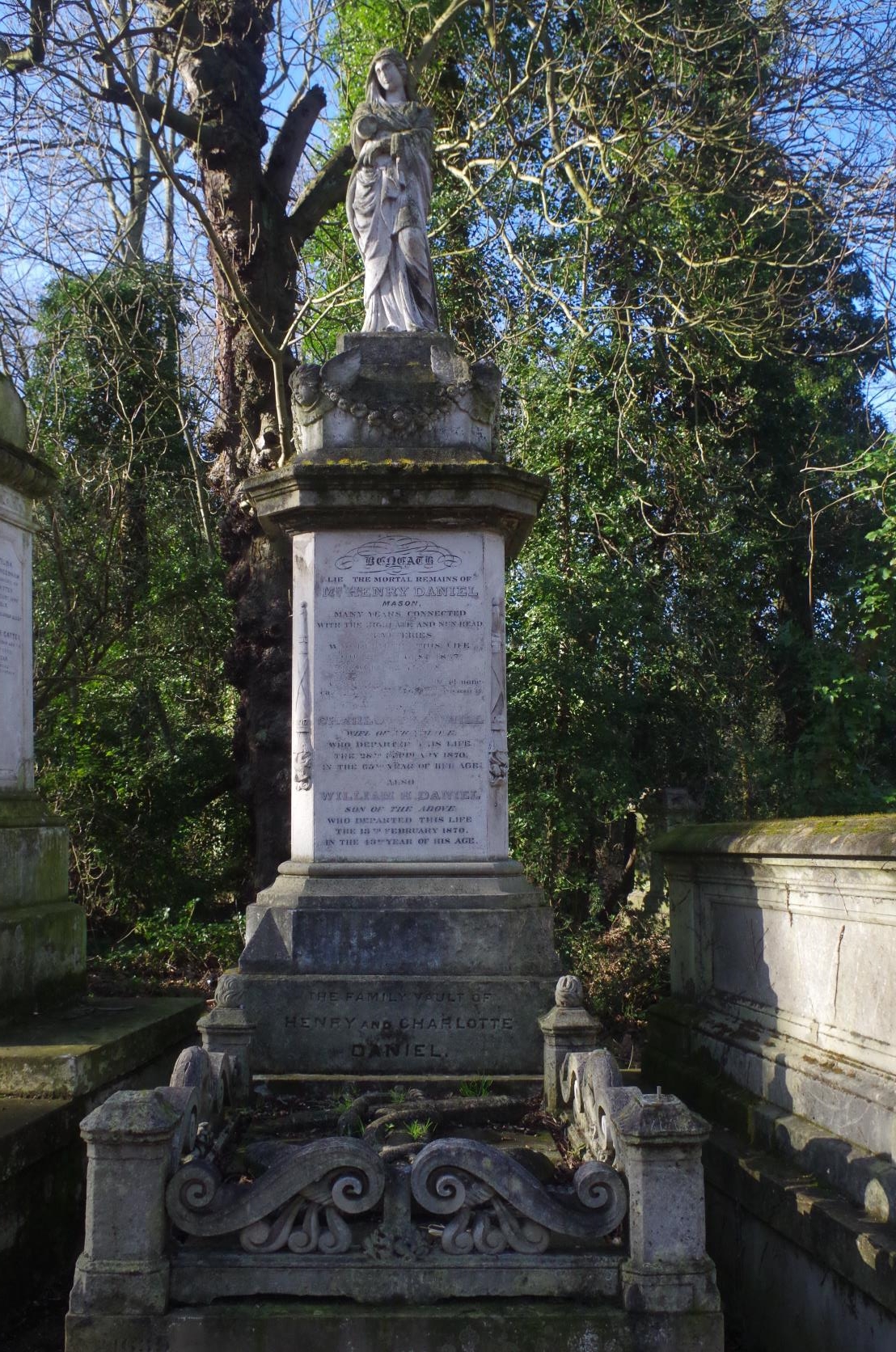
The Henry Daniel vault at Nunhead Cemetery, UK. He was a monumental mason who worked at the cemetery. copyright Carole Tyrrell

The Henry Daniel vault at Nunhead Cemetery, UK. He was a monumental mason who worked at the cemetery.
copyright Carole Tyrrell

This month instead of Symbol of the month I will be discussing a monument which is a gift to anyone interested in symbols and their meaning. Not one symbol but nine!

When you first look at the Daniel vault you may well be impressed by its extravagant decoration.  It’s absolutely studded with symbols and, due to its advantageous location close to the chapel and thus nearer to God, you can’t miss it.   In fact some of the larger monuments are in this area and the idea appeared to be that, even if you couldn’t take your money with you, at least you’d had it while you were alive and could prove it.

But there’s an interesting story behind each of the symbols and also of Henry Daniel himself.  He founded a dynasty of monumental masons who were closely associated with Nunhead Cemetery until its closure.  He established the first mason’s yard at Nunhead and two other firms followed.  These were Preston & Company and A Stogden.  Henry and his family lived opposite Nunhead’s imposing Linden Grove entrance gates in the imposing and rambling Gothic style residence that he built surrounded by his workshops and lived in it with his family until he died in 1867 aged 62.

The newly established large Victorian cemeteries meant that masons were kept busy and had a steady income.  They not only created monuments and memorials but also maintained graves and constructed vaults.    If you look along the edges and the bottom of graves and monuments in Nunhead and Highgate cemeteries you may well find the Daniel name.

Henry also had a workshop in Swains Lane at Highgate and according to an inscription on one of the monuments that his workmen helped to create, he was at one time the London Cemetery Company’s mason.  They owned both Nunhead and Highgate Cemeteries.

Daniel’s was in business until Nunhead closed, or was abandoned depending on your point of view, in 1969.  Afterwards, Henry’s  family home and yard was demolished after being a local landmark for over 100 years. It’s interesting to speculate if it would be preserved today after the fight to preserve the attractive and historic Lander monumental masons showroom near Kensal Green Cemetery’s imposing entrance.   It too was destined to be replaced by another bland apartment block.

It has been suggested that the vault is an advert for Daniel’s masons and I haven’t been able to find any proof of this.  However, to anyone interested in symbols it is a wonderful teaching aid as it has so many.

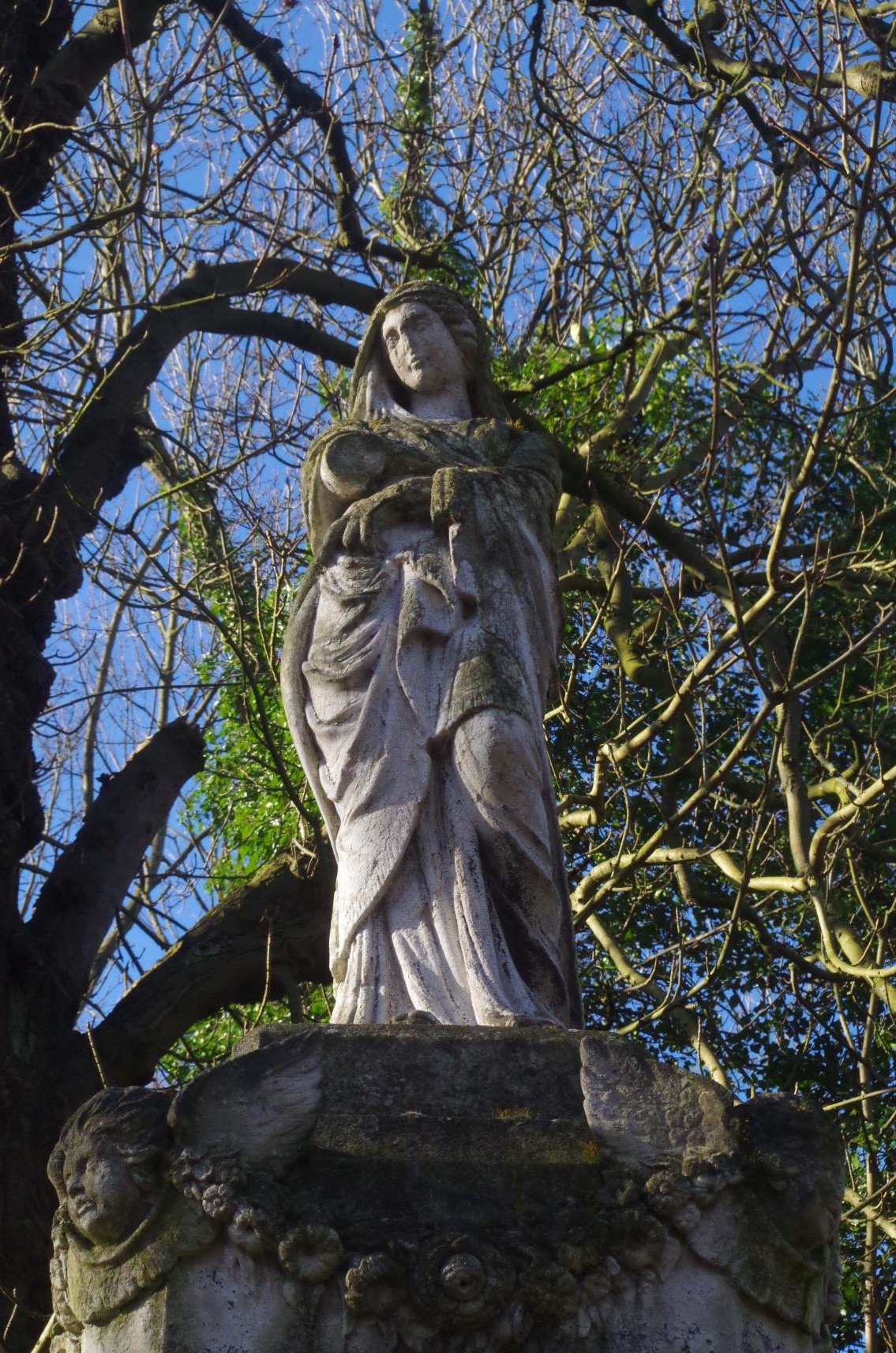
We begin at the top of the memorial with a woman swathed in draperies with her head looking down.  This is a mourning woman and a return to classical, especially Roman, themes.    They are often portrayed as leaning on an urn or a cross but as you can see this one stands alone.  The Historic England, formerly English Heritage, describes her as ‘a heavily swathed vestal figure.’

A classical Roman mourning figure swathed in robes on top of Daniel vault.. copyright Carole Tyrrell
A classical Roman mourning figure swathed in robes on top of Daniel vault..
copyright Carole Tyrrell

Now look beneath her feet.  There are winged cherubs or putti, one at each corner.  They have wings and so that makes them putti. They too are of classical origin and represent Eros or Cupid.   The flower garland than surround the base of the mourning woman features roses.

This is one of the four cherubs - one at each corner of the base on which the mourning woman stands.. Note flower garland. copyright Carole Tyrrell
This is one of the four cherubs – one at each corner of the base on which the mourning woman stands.. Note flower garland. copyright Carole Tyrrell

Garlands are a symbol of victory over death.

Roses:  This is one of the most popular flowers and means love, beauty and hope.  It has been said that they are associated with the rose without thorns – the Virgin Mary.  A rose is also known as the queen of flowers due to its fragrance and beauty.  Unopened roses still in their bud form often appear on children’s graves.  The longer a person lived, the more full blown the rose would be.  However I think that roses are used more as decoration these days.

Another view of the mourning woman, cherubs and garland. copyright Carole Tyrrell
Another view of the mourning woman, cherubs and garland.
copyright Carole Tyrrell

Now look at the two torches on either side of the epitaph.  These are downturned torches and you will also see cast-iron version on Nun head’s Linden Grove entrance pillars.  This is a common symbol and, when the flame which would normally go out when torch is inverted, it symbolises the eternal flame of life and the resurrection.  There is a variant with a torch that remains upright on a memorial in Kensal Green cemetery which I assume means eternal life.

Close-up of one of the downturned torches. copyright Carole Tyrrell
Close-up of one of the downturned torches.
copyright Carole Tyrrell

Now look down at the elegant Grecian style scrolled decoration and in particular the two very stylised wreaths.  I see them as laurel wreaths and they are again a return to classical symbols.  They symbolise eternal life as they are circular with no beginning or end and also made of evergreens which never die.   A symbol of victory over death and also military or intellectual glory. The word ‘laureate’ come from these and meant poetical or musical achievements.

Note the wreaths at the centre of the scrolling - stylised laurel wreaths. copyright Carole Tyrrell
Note the wreaths at the centre of the scrolling – stylised laurel wreaths.
copyright Carole Tyrrell

At each corner is an Eternal Flame which stands for everlasting life.

The Eternal Flame - originally there were 4 - one at each corner but now there are only 2. copyright Carole Tyrrell

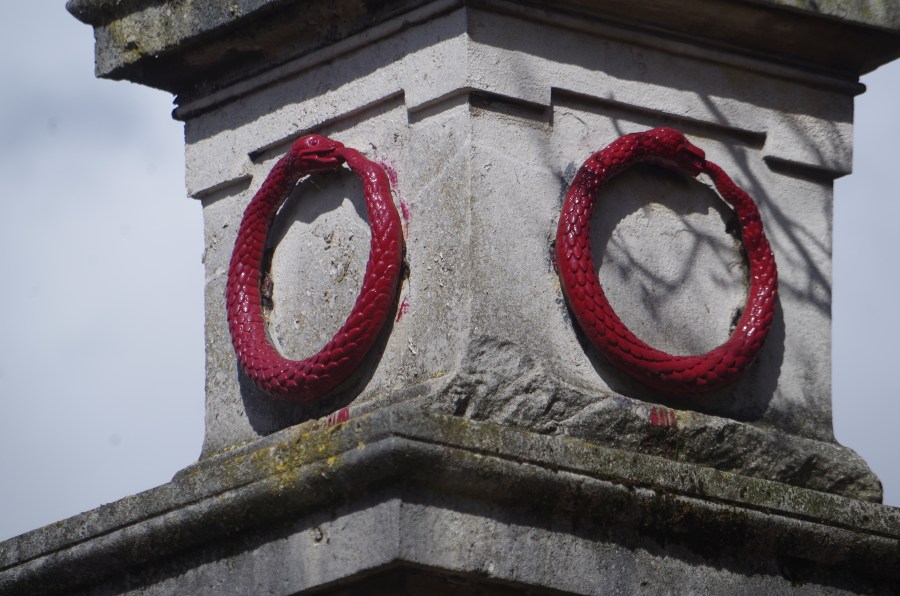
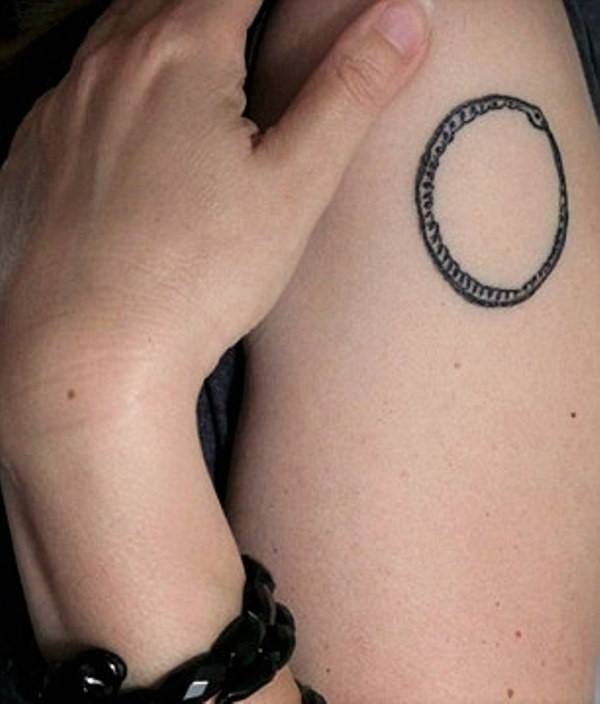
Then we come to the snake wrapped around the anchor. A snake is a symbol of immortality and as such appears in many cultures over thousands of years. .  It’s not an ouroboros as are the ones on Nunhead cemetery’s  entrance pillars.  It has various associations including tattoos in which snakes are seen as potent symbols.

The Grecian scrolling along the sides. copyright Carole Tyrrell
The Grecian scrolling along the sides and the snake and anchor.
copyright Carole Tyrrell

Anchor:  This is a Biblical symbol and is a Christian one of hope.  The early Christians were reputed to have used the anchor as a disguised cross. It’s often set against a rock and so people often assume that it has a sea-faring connection but this isn’t always true.  The Hope and Anchor is a common pub name in the UK.  An anchor with a broken chain represents the end of life.

It’s rare to find so many symbols on one monument and also extremely well carved as well. Although the epitaph is now wearing thin the sentiments of eternal life, love, mortality and victory over death still remain for all to see.

Text and photos copyright Carole Tyrrell


Sources:

How to read Symbols, Clare Gibson, Herbert Press, 2008

Nunhead’s Monumental Masons, Ron Woollacott, Nunhead Cemetery An Illustrated Guide, FONC 1988

Stories in Stone, Douglas Keister, Gibbs Smith, 2004

http://historicengland.org.uk/listing/the-list-entry/1385649

http://www.lsew.org.uk/funerarysymbolism

http://www.oakdalecemetery.org/funerary-art-symbolism.asp

http://tchevelier.com/fallingangels/bckgrnd/cemeteries

http://www.thecemeteryclub.com  – useful resource, currently being updated (Feb 20160

http://www.whats-you-sign.com/snake-meaning-and-snake-tattoo-ideas.html    – tattoo site


Wildlife in Cemeteries No 3 – butterflies and moths.

Cemeteries, and in particular large Victorian ones, often have areas which are either a designated nature reserve or just left to run wild.  These are havens to insect and mini-beasts and also to the dedicated lepidopterist or butterfly fancier.  On a long, warm, summer afternoon their tiny, colourful, patterned wings can be seen fluttering over their favourite foods such as the humble ragwort.  No wonder a group of them are described as a kaleidoscope of butterflies.

Commas, common and holly blues, large skippers, meadow browns, red admirals, gatekeepers and, if you’re lucky, the magnificent Peacock , are all summer visitors to cemeteries.

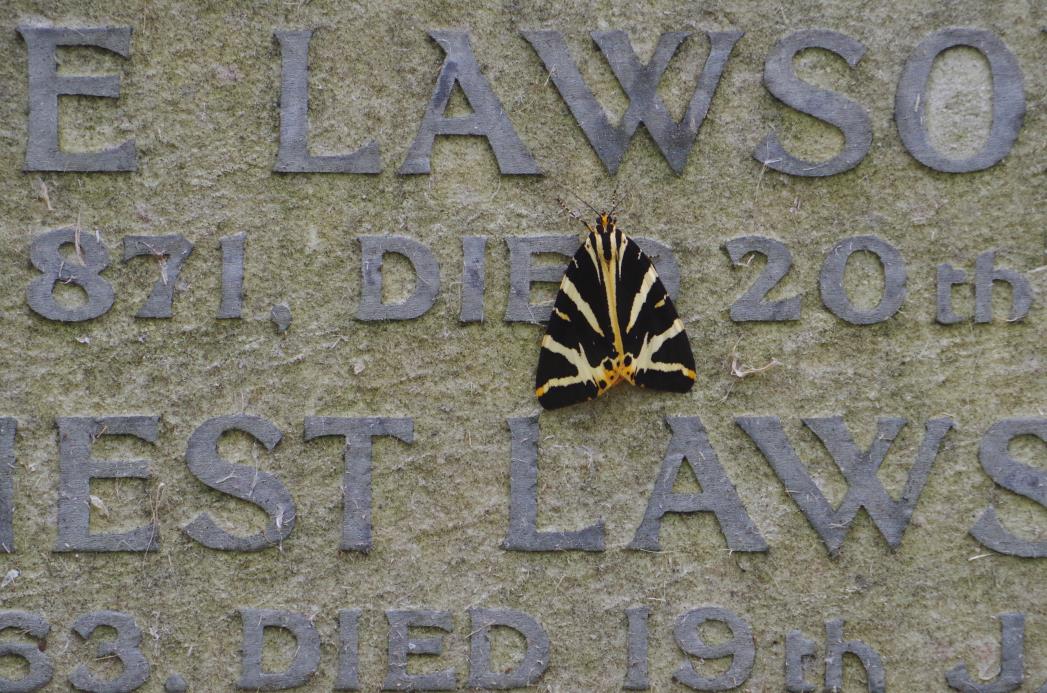
However, an increasingly common visitor, once rare, isn’t a butterfly at all but is, instead, a day-flying moth. This is a Jersey Tiger or Euplagia quadripunctaria to give it its Latin name. Its striped upper wings, when closed, give it the appearance of an African mask.  But it also has a surprise for, when in flight, it reveals its iridescent orange underwings.  When the sun catches them it’s like a small jewel on the wing.

This one obligingly posed on an inscription at Brompton Cemetery’s 2015 Open  Day.

Jersey Tiger day=flying moth - Brompton Cemetery Open Day 2015. copyright Carole Tyrrell
Jersey Tiger day=flying moth – Brompton Cemetery Open Day 2015.
copyright Carole Tyrrell

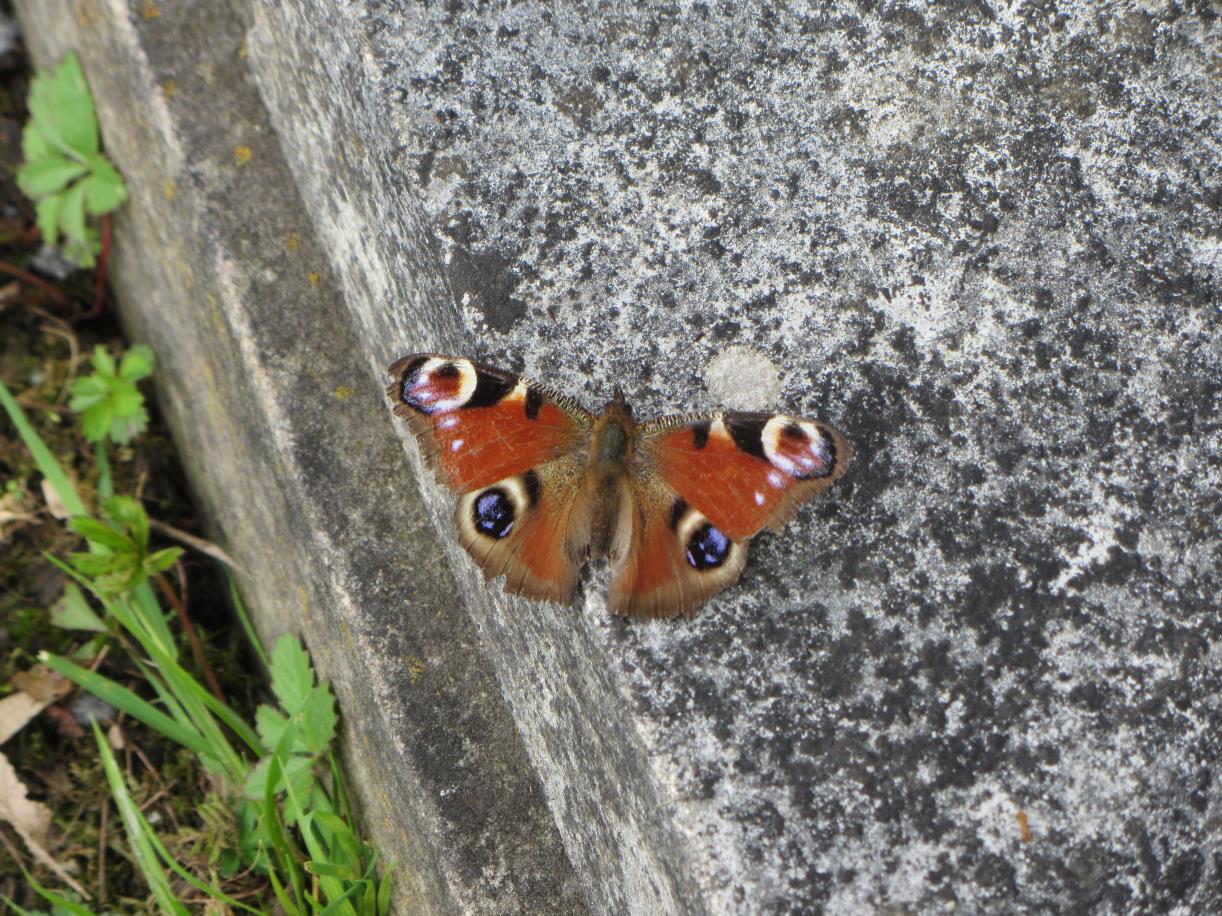
A lovely Peacock butterfly in Elmers End Cemetery.   When closed its wings are completely black and then open to show the beauty inside.
A beautiful peacock basking on a vault at Elmers End Cemetery, UK copyright Carole Tyrrell
A beautiful peacock basking on a vault at Elmers End Cemetery, UK
copyright Carole Tyrrell

This is a gatekeeper roosting on its favourite food, the ragwort.  Although a common butterfly and sitting on what is generally considered to be a weed it does make for an effective composition. Again from a Brompton Cemetery Open Day in 2013.

Gatekeeper on ragwort - its favourite food! copyright Carole Tyrrell
Gatekeeper on ragwort – its favourite food!
copyright Carole Tyrrell

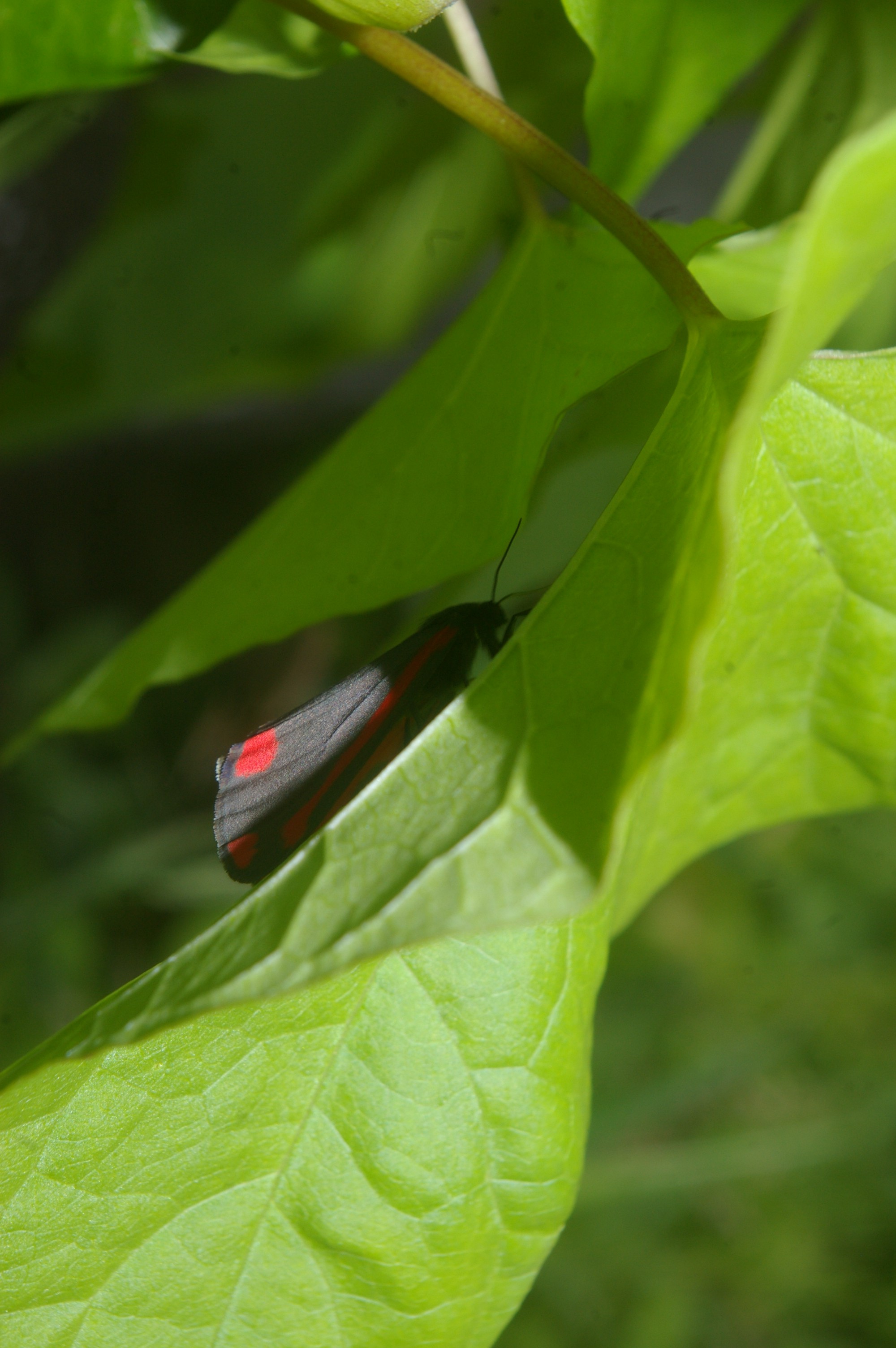
Below is a six spotted burnet – it’s dramatic red and black colouring always makes me think of it as a Goth Moth.   It is very impressive when it’s on the wing and is very fast.  I first saw it on an Open Day at Kensal Green Cemetery, London,  in 2013.  It was a warm and sunny July day and I was making my way to the open air colonnade when I saw a burnet fluttering past   I have only found it at one location within the cemetery so far but I always look out for it.

A six spotted burnet - a day flying moth. Latin name is: Zygaena filipendulae Copyright Carole Tyrrell
A six spotted burnet – a day flying moth.
Latin name is: Zygaena filipendulae
Copyright Carole Tyrrell

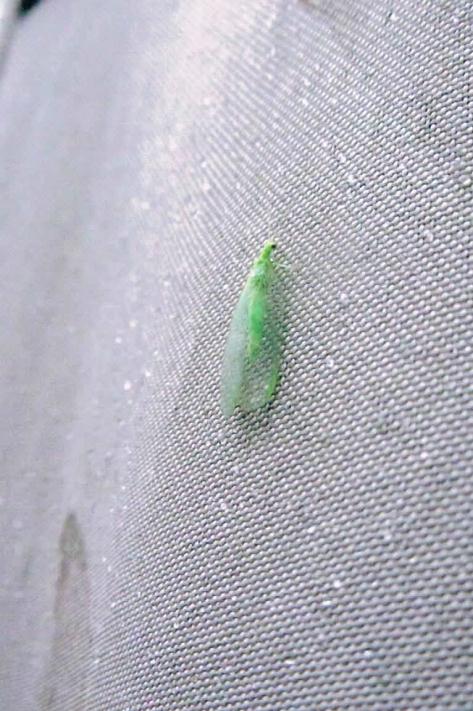
This was an unusual moth to find on a damp winter’s day in Nunhead Cemetery.  This is a lacewing.  Its Latin name is Neuroptera and it’s not known to be as a day flying moth.  It clung to the side of our gazebo for some time.
Lacewing moth at Nunhead Cemetery, UK. Usual to see on such a damp winters morning as it clung to our gazebo. copyright Carole Tyrrell
Lacewing moth at Nunhead Cemetery, UK. Usual to see one on such a damp winters morning as it clung to our gazebo.
copyright Carole Tyrrell

So although cemeteries are primarily to remember the dead, they can also provide a vital ecosystem as well.    Next time you visit one take some time to check out the wilder areas and you might be surprised at what you find!


All text and photographs © Carole Tyrrell

i

A morning with Marx and Spencer – A visit to Highgate Cemetery April 2014

Domino the Highgate cat - the first inhabitant of the Cemetery that we saw. copyright Carole Tyrrell
Domino the Highgate cat.  This is his kingdom.
copyright Carole Tyrrell

The first inhabitant of the West side of Highgate Cemetery to greet us was Domino, the cemetery cat, a white and black cat with an enviable domain in which to explore. He was also very vociferous and seemed to think that he would be leading our tour.

I’ve always found the West side to be very romantic and intriguing and last visited it in the 1990’s so a return visit was long overdue. I visited it this time with the Friends of Nunhead Cemetery. There is a connection between Highgate and Nunhead Cemetery in that they were both owned by the same cemetery company, the London Cemetery Company.   Highgate closed in 1975 and the Friends of Highgate Cemetery subsequently took over.

Dr Ian Dungevell  welcomed us and then John Shepperd, the current Chairman,  took over as tour leader  with Peter bringing up the rear.   The West side was looking its best with patches of bluebells and luxuriantly growing wild garlic.  The latter reminded me of the rumours of the Highgate vampire during the 1970’s and wondered if that was the reason for its abundance..

Originally the East and West sides were two separate cemeteries and the LCC had its own brickworks. The West side opened in May 1839 and the East in 1855 with its first burial in 1860. John revealed that there had been public complaints about the boisterous cheering at shareholders meetings as it was feared that they were profiting from death. Apparently the Magnificent 7 London cemeteries is a misnomer as there were originally 8. Meath Gardens in E3 was once Victoria Park Cemetery but was closed in 1885 due to its poor state and became a public park.  Its last burial was in 1876 having opened in 1842.

The imposing Anglican chapel on the West side still has its hydraulic lift and a tunnel under the road. It was rumoured that, after leaving the Dissenters chapel, hearses could go in two directions; the left hand path was for paupers and the other side was for the better off.  Like Nunhead, Highgate also had its own nursery, greenhouses and was originally landscaped. However, with its increasing popularity resulting in up to 30 burials a day, it was said that being buried in Highgate was like being buried in Piccadilly Circus.

John indicated the grave of the first resident, Elizabeth Jackson, who was interred in 1839 and paid 3 guineas. He reminded us that the views from Highgate at that time would have stretched to the South Downs as it’s on a hill.  It cost £2.10s to be buried there at a time when a working man was lucky to earn £1 a week.  Local residents had keys to the cemetery which became their personal park.

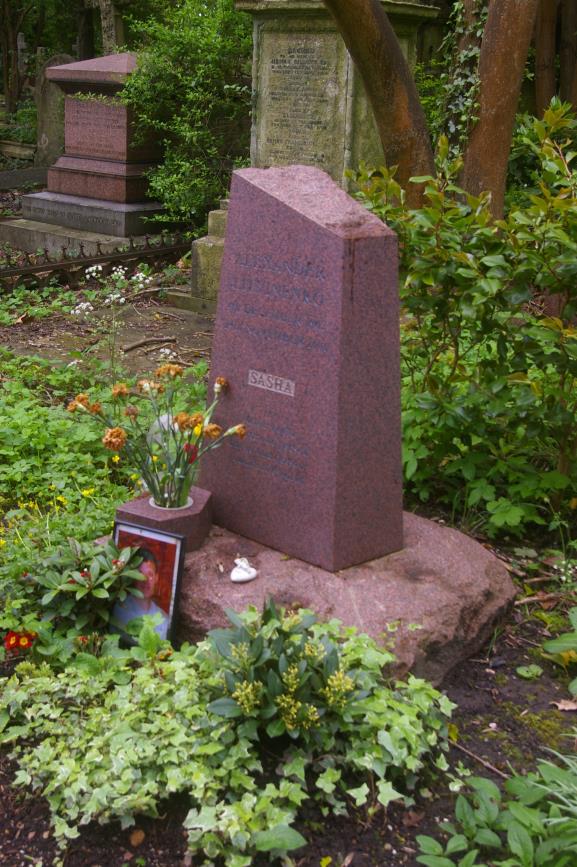
Alexander Litvinenko - a modern interpretation of the broken column symbol. copyright Carole Tyrrell

Alexander Litvinenko – a modern interpretation of the broken column symbol.
copyright Carole Tyrrell

The largest vault is that of Gen Sir Loftus Otway which can hold up to 30 coffins and was vandalised during the cemetery’s closure.  It currently holds 15.  The Russian dissident, Alexander Litvinenko, who died from  poisoning is here and John pointed out that his tombstone is a modern adaptation of the Victorian broken column which indicated that the head, or support, of the family has died.

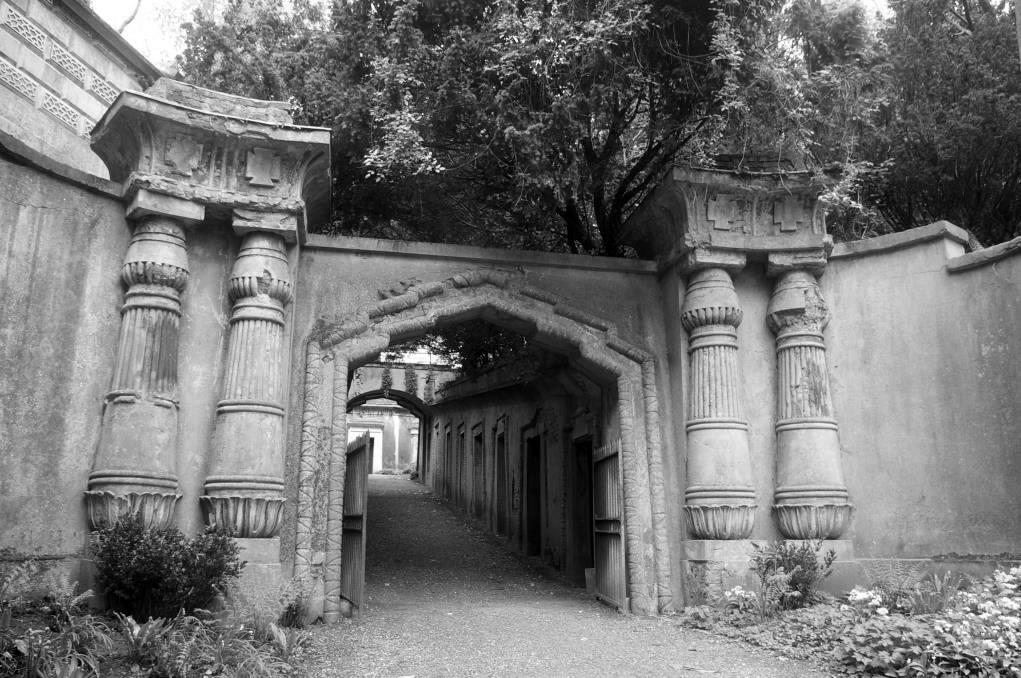
We all admired the celebrated Egyptian Avenue which capitalised on the 1820’s taste for all thing Egyptian after the first expeditions there. John explained that originally it had a roof which had made it very gloomy but it was considered to be a prestigious place for an eternal sleep. But it took 50 years to sell all 16 vaults as, with other Egyptian symbols like obelisks, it was viewed as pagan and so unpopular.  The Avenue is now roofless and is a much lighter place especially in the Spring sunshine.

The Egyptian Avenue - one of Highgate's highlights. copyright Carole Tyrrell
The Egyptian Avenue – one of Highgate’s highlights.
copyright Carole Tyrrell

However, on a Highgate Open day I nearly fell off the top of the Avenue.  I had lost my bearings and was walking along and suddenly realised where I was just as I was about to take more steps forward.  Although I might fancy being buried in Highgate I wasn’t intending to become part of it quite so soon!

Another view of the Circle of Lebanon. copyright Carole Tyrrell
Another view of the Circle of Lebanon.
copyright Carole Tyrrell

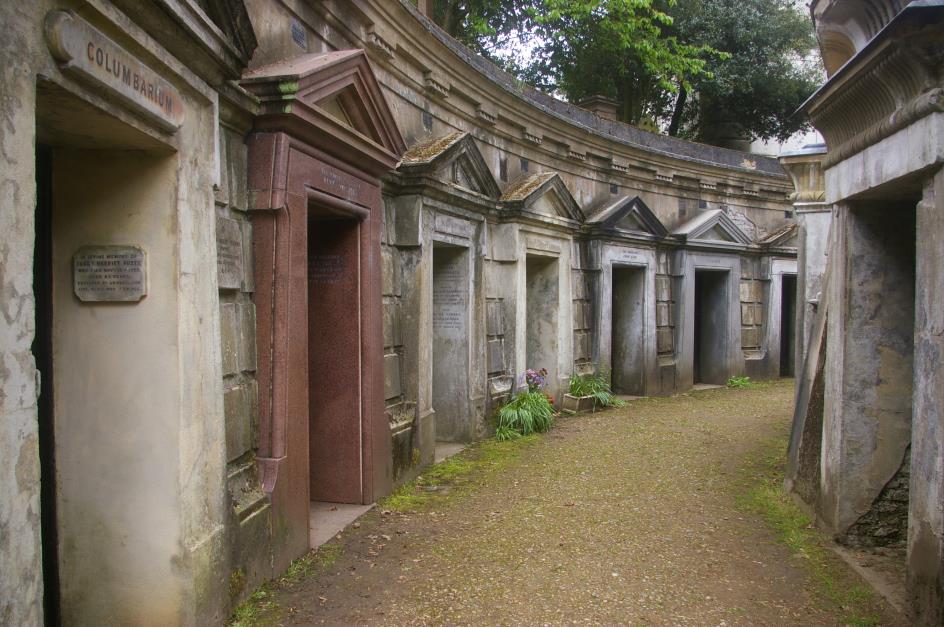
The Circle of Lebanon, named after the beautiful Cedar of Lebanon on top if it, was another highlight. The tree came from a local, long vanished, house, Ashurst and no-one knows its exact age.  It is a lovely and magnificent centrepiece.  We also saw Radclyffe Hall’s vault which always has flowers . She wrote ‘‘The Well of Loneliness’ which was declared obscene due to its portrayal of a same sex relationship. However, Virginia Woolf, asserted that it was boring and gave it up.

Another inner view of the Circle of Lebanon showing the columbarium. copyright Carole Tyrrell
Another inner view of the Circle of Lebanon showing the columbarium.
copyright Carole Tyrrell

At the highest point on the West side stands the Beer Mausoleum. Fifteen feet high, it had been closed for years until 1993 when it was reopened.  Unfortunately the door wouldn’t budge due to roughly 2 and half feet of bird droppings and so this had to be cleared before anyone could actually get inside.  This really is a showpiece memorial.  No expense was spared on it and it would have cost £5million in today’s money.  It was built by Julius Beer who made money from selling cotton bonds. These were to be repaid when the Confederates won the US Civil War so they weren’t a good investment. The mausoleum’s walls are lined with Italian marble and the ceiling is gilded and painted.  It was dedicated to Ada, Beer’s daughter who died aged 8.   The beautiful sculpture on the back wall is of an angel and a small girl whose face is modelled from Ada’s death mask. One of the sculptors who worked on the Albert memorial , Henry Dew Armstead, worked on the mausoleum. However, it doesn’t contain any bodies as they were originally in the vault below which was vandalised during the cemetery’s closure.  The Beer family have died out.

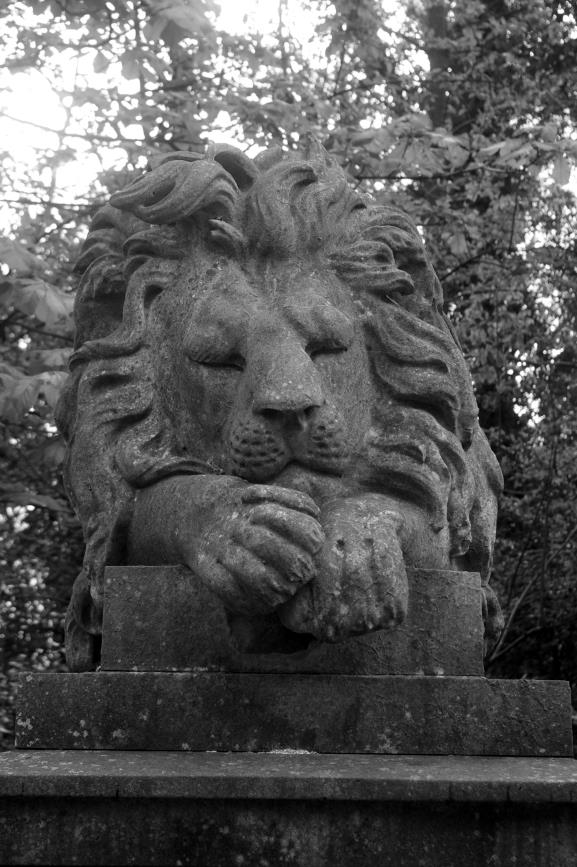
One of the best loved of all of Highgate’s many memorials is that of Nero, the sleeping Wombwell lion. George Wombwell was a zookeeper who, in 1810, owned a giraffe and a kangaroo amongst others which must have seemed very exotic to 19th century Londoners.  Children used to ride on Nero’s back and Wombwell’s travelling circus was in business until the First World War. However, some of his extended family didn’t fare so well with nature as his niece was killed by a tiger and his nephew was trampled to death by an elephant.

Nero, the lovely Wombwell lion - lions are a symbol of fortitude and bravery. copyright Carole Tyrrell
Nero, the lovely Wombwell lion – lions are a symbol of fortitude and bravery.
copyright Carole Tyrrell


Another highlight of our tour was the catacombs.  I hadn’t know that Highgate had any and these are on ground level. There are 825 spaces with 60 remaining. They were in use until the early 20th century.  Originally whitewashed, Charles Dickens had his young daughter placed there before removing her saying that it was too gloomy.  John added that coffins  are placed feet first into a  catacomb space or loculi so that visitors can talk to the head of the deceased and not their feet.

The Highgate catacombs - I hadn't realised that there were any there until this visit. copyright Carole Tyrrell
The Highgate catacombs – I hadn’t realised that there were any there until this visit.
copyright Carole Tyrrell

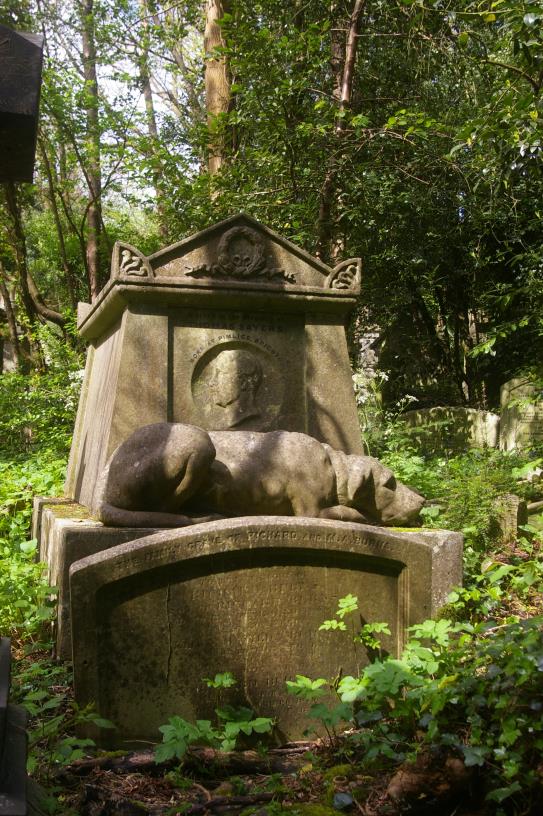
Animals have always been popular in cemeteries and John took us to the grave of Tom Sayers complete with a life size sculpture of his bull mastiff, Lion, keeping watch. Sayers was a Victorian boxer or pugilist. He was the English champion and originally hailed from Pimlico, a slum are of Brighton.  At Sayers’ funeral, Lion, wearing a black ruff, sat in the carriage behind the hearse which emphasised  that the dog had been more faithful than the wife. Lion was sold for £2 at the auction of Sayers belongings after his death. One hopes that he had a happy and long life.  The restored Acheler horse stood guard under a spreading horse chestnut tree and the sleeping angel on a bed of stone clouds slumbered on.

Tom Sayers the 19th century boxer and his faithful dog Lion.. copyright Carole Tyrrell
Tom Sayers the 19th century boxer and his faithful dog Lion..
copyright Carole Tyrrell

There are still burials taking place here and we saw novelist, Beryl Bainbridge’s, grave on our back to the entrance. Domino ignored us as he continued on his prowl and vanished into the ivy..

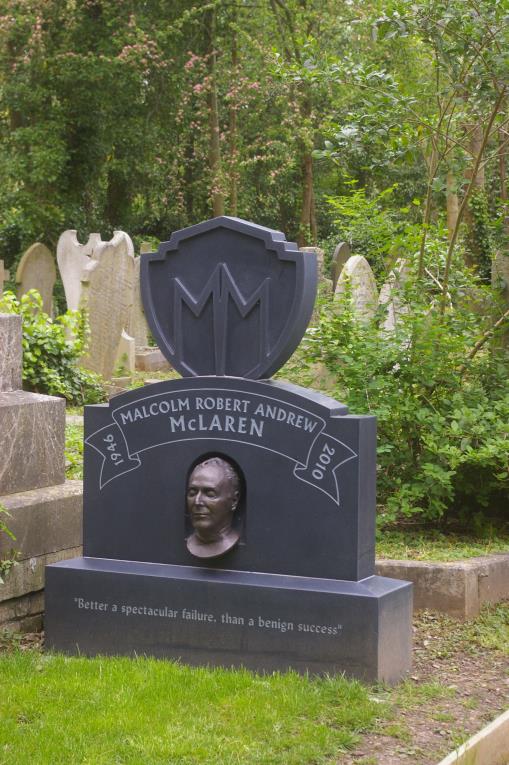
Then, after tea and excellent home-made biscuits, we crossed the road to the East side.   It is where most modern burials take place and it was busy with 21st century Londoners following the custom of Victorians by promenading in the cemetery on a Sunday afternoon.  Near the entrance John pointed out the monument to one of the Great Train Robbers, Bruce Reynolds, which was erected on the 50th anniversary of the event. It features a death mask of Reynolds between two columns with the phrases , ‘This is it.’ And ‘C’est la vie’.  The former was the one that Reynolds used to alert the rest of the gang that the robbery was on and the latter was the one used by Reynolds arresting officer.   Another death mask was on Malcolm McLaren’s grave so perhaps this is the start of a new fashion in funerary architecture.

Malcolm Mclaren - note the death mask. copyright Carole tyrrell
Malcolm Mclaren – note the death mask.
copyright Carole Tyrrell

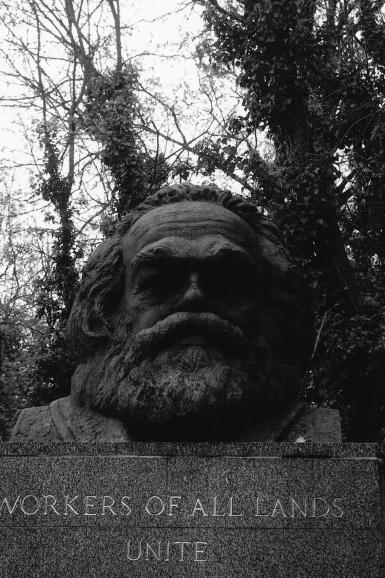
But the East side’s most famous incumbent is undoubtedly Karl Marx.  An enormous bust of the man sits staring out from on top of his column.  It’s a place of pilgrimage for worldwide communists but has suffered for it.  Poor Karl, he’s been blown up and daubed in blue paint but still stares serenely, if a little forbiddingly, from his plinth. Originally he and his family were buried a short distance away but were moved to their present location and their headstone incorporated in Karl’s monument.

The father of Communism - Karl Marx - a very imposing bust and memorial. copyright Carole Tyrrell
The father of Communism – Karl Marx – a very imposing bust and memorial.
copyright Carole Tyrrell

Nearby lies Herbert Spencer who was a prominent right-winger and coined the phrase ‘survival of the fittest’.   And so that little corner is known as Marx and Spencer.  Another close neighbour is Gloria Jones,  creator of the Notting Hill Carnival.   George Eliot is not far away and so the great and good jostle with the less well-known and there are too many to list.  Alas, the wallabies have gone elsewhere.   My favourite epitaph was pllaywright, Anthony Shaffer’s which simply read’ Grand Artificer of Mysteries.’

It was a fascinating tour and we left wishing that we had more time to explore both sides of Highgate Cemetery. And below is a gallery of some of the other memorials

we saw on our visit.


First published in Friends of Nunhead Cemetery News,

Text and photos copyright Carole Tyrrell

Symbol of the Month – The Passionflower

This month I am looking at the passionflower as a symbol.  It is so called because it’s been  claimed that it symbolised Christ’s suffering on the cross.

But first, let’s digress for a moment and discuss Floriography or the language of flowers.  This is very pertinent to the study of Victorian funerary symbols although some visitors may just see them as charming and pretty decoration.

Floriography is a way of communicating through the use of arrangement of flowers.   It has been used for thousands of years in various cultures, most notably in 17th century Turkey and throughout the Middle East.

But it reached its zenith in Victorian England.  The Victorians love of flowers coincided with their love of cyphers and coded messages.  Anyone who has ever watched TV’s Antiques Roadshow jewellery expert, Geoffrey Munn, revealing the hidden meanings behind the seemingly innocuous combination and arrangement of stones in a brooch will know what I mean.

The strict etiquette of the 19th century that was expected of the upper and middle classes meant that people had to find other, more secretive means to express feelings and messages that couldn’t be openly shared.  And so flowers became the most popular method.   Floral decoration was already extremely popular in the home with William Morris’s wallpapers, for example, so they became the preferred choice.

Floral dictionaries were extremely popular.  The first official one, entitled The Language de Fleurs, was published in Paris in 1819. It was written by Louise Contambert who wrote under a pen name. However, in 1879 a Scotswoman, Miss Carruthers, wrote one that rapidly became an essential guide.

Today some of the original meanings have been lost but eventually I hope to post a guide to Victorian floral funerary decoration and its meanings.

Now back to the Passionflower.  It is a symbol of faith and suffering.  The story goes that it is so named, because of  a Scholar in Rome called Jacomo Bosio who was writing a treatise on the Crucifixion.  A Mexican friar showed him a passionflower and Jacomo included it in his work.

These are the symbols of  Christ’s Passion within the passionflower:

.

The unique corona Christ’s crown of thorns
The sepals and petals The Apostles excluding Judas and peter who distanced themselves from Christ before the Crucifixion.
The five anthers The five wounds on Christ’s body.
The three stigmas The three nails that pierced Christ’s body on the Cross
The leaves The spears that pierced Christ’s side
The tendrils The scourges which flayed Christ’s flesh.


It’s a deeply religious flower and I include two well carved examples on memorials from Nunhead Cemetery, one of London’s Magnificent Seven, UK.

Mills1
Another good example of passionflowers – Mills Nunhead Cemetery UK copyright Carole Tyrrell

This is the Mills memorial.  A Celtic Cross filled with sculpted blooms which are beginning to erode under an inner city climate.

Blackburn
A well carved border of passionflowers on a tomb in Nunhead Cemetery UK copyright Carole Tyrrell

This is the Blackburn tombstone with a lovely 2 dimensional frieze of the flowers.

passionflower
An actual passionflower displaying the elements that have made it such a powerful religious symbol. copyright Carole Tyrrell

This is the real thing.

Sources:

www.wikipedia

www.proflowers.com

www.fleursantamonica.com

Text and photos copyright Carole Tyrrell


My Ba-Ba Never Forgotten, Never Replaced – A visit to Hyde Park Pet Cemetery

Alongside the busy Bayswater Road, on the way down from Marble Arch, there is a secret place behind one of the gate lodges. It’s protected by an iron railing and thick hedges and the casual passer-by wouldn’t know what lies behind them. But this is a special place where 300 much loved pets sleep in an eternal slumber. Curio, Ruby Heart, Prince and Ba-Ba are just some of the names of the family pets that are commemorated on the Lilliputian tombstones. This is the tiny Victorian Hyde Park Pet Cemetery.
The first view of the cemetery
300 little burials copyrights Carole Tyrrell

It was a burial space for the local residents and their beloved animals It’s mainly dogs that are buried here as they often fell victim to the Park’s horse riders hooves. However, there are also three small monkeys as well as several cats and birds. The first burial, Cherry, a Maltese terrier, was in 1881. Cherry belonged to the Lewis-Berned family who lived nearby. They were frequent visitors to the Park and knew Mr Winbridge, the lodge gatekeeper. Mr and Mrs Lewis-Berned approached him after Cherry had died of old age and enquired if Cherry could be buried in what was his back garden at the lodge. He and his employer agreed and Cherry’s tombstone reads ‘Poor Cherry. Died April 26 1881.’ Word must have got round as, before long, other local families were also having their deceased pets interred in the lodge’s back garden and it soon became an unofficial pets cemetery. There is even a royal dog there. This is a Yorkshire terrier which belonged to the wife of HRH Prince George, the Duke of Cambridge, who lived in Mayfair. ‘Poor Prince’ was crushed under a carriage wheel and actually died in the Lodge. The subsequent burial was recorded in the Duke’s diary on 29th June 1882 and made Prince the second incumbent in the cemetery. In contrast, there were also low-lifes in there and I am indebted to the London-In-Sight blog for the background information on a police dog, Topper, who is buried within the cemetery. He was obviously a dog with attitude and was described as being: ‘insufferably vulgar, a snob of the lowest kind and most contemptible, a bad strain in him which seems to have run through very line of his character.’ He died of over-eating. I have to admit that I would have liked to have met Topper to see if he lived up to his description. When you first enter by the side gate the first thing that really impresses you is how many of them there are in the little garden and how poignant some of the epitaphs on the small headstones are. Who has owned a pet, loved it dearly, and not wanted to commemorate its life and passing like other family members? The little plots are arranged in rows, each with an area bordered by rope edge tiles to allow the families to place flowers if they wished.
View2
A smaller group nearer the Bayswater Road side copyright Carole Tyrrell

We visited the cemetery as part of a tour arranged by London Month of the Dead and had roughly thirty mins inside which didn’t leave much time to explore the epitaphs. I can only show a few of them here. But it was a good introduction to the cemetery. So next time we may book an hour long tour. We didn’t find Cherry’s grave despite looking for it. . One of our guides did point out that at the time of the first burials the average expectancy of a working man was forty or less.

Lodgeview
View towards Victoria Lodge copyright Carole Tyrrell

The gate was locked behind us as the little residents slumbered on. Access is limited for obvious reasons and needs to be booked via The Royal parks website; http://www.royalparks.org.uk. Tickets cost £50 +VAT  for a visit lasting one hour  for up to 6 people. Text and photos copyright Carole Tyrrell

Sources and further reading:

Barking Blondes – Will you book a grave plot for your dog? The Independent blogs  18/01/14

Fun London Tours – The Victorian Pet Cemetery of Hyde Park, 20/10/11

London-In-Sight blog, The Pet Cemetery of Hyde Park, 06/10/10

Below is a selection of the epitaphs

The Comfort of Strangers – impromptu shrines and the passing of icons

This was originally going to be a short piece on roadside shrines.  These are the impromptu response to remember road traffic victims. Grieving relatives and friends place flowers and messages so that casual passers-by would at least know the name of the deceased and that they were missed.  The shrines were also originally intended to remind drivers to slow down and to be more careful with their driving.  However, as a blog from the New York Times said, they can also be a distraction and  may actually cause accidents rather than prevent them.

But a piece in my local freesheet in 2012 made me think.  The Editor commented that roadside shrines had become ‘a tide of detritus left behind in the dead’s memory.’ He went onto say that ‘in times past different cultures had felt it essential to send the dead on their way with appropriate objects, if you were lucky they even killed a goat.’ He continued by saying  that he had seen bottles of Smirnoff Ice, four cans of Stella, a packet of cigarettes, a West Ham shirt, a picture of a dead cat, and a meat pie and called them  ‘ evidence of ‘a modern obsession with proving food for the dead.’  He questioned the object of leaving items that will attract thieves and vandals.

I have seen several roadside shrines and found them very touching but it’s sad when the flowers wilt, they become sodden by rain and then fade completely.   The extra items that the Editor complained about may be the only way that the grief stricken can make the impersonal more personal and make sense of  an inexplicable and sudden death. The shrines almost become a way of sharing the deceased with the world in that the casual observer knows that they liked a certain football team.  They become a person again and not just a statistic.

But what finally prompted me to write this piece was the death of the rock icon, David Bowie on 10 January 2016 and the unofficial shrines that have been created in his memory and the items that  fans left at them.   I found out the news via the internet by logging onto Facebook and there it was.  I was stunned and felt as if I’d been punched hard.  After an hour of reading tributes   I really felt that I wanted to do something.  When Princess Diana died, I had been one of the many who had laid flowers at Kensington Palace in her memory.  It was a public way of displaying sympathy for a woman who I genuinely felt had had a hard time.  As Peter Watts says in his blog article on London Shrines:
‘What fascinated me also about all this was that it had a seditious, outlaw aspect. There was a lot of noise in the press about whether the Queen was treating Diana’s death with sufficient respect, and this huge impromptu shrine – by the people, against the establishment – was given the atmosphere of an almost revolutionary act. It was a fascinating combination – the privacy of remembrance, carried out on a larger scale with political implications.’

It was a once in a lifetime event.

According to social media and news sites people were already laying flowers at a mural of David in Brixton.  I went out to buy flowers.  However, Bowie had been a local lad to me in Beckenham in the early ‘70’s and the suburb also wanted to remember hm.  At what had been the Three Tuns, now a Zizzi’s,  pub in the High Street, where a wall plaque reminded us that he’d played there pre-Ziggy,  a few people had already laid flowers.  There were several people standing around looking completely stunned. I laid my daffodils in front of a large framed picture of the Bowie poster from the V & A show on Bowie and moved onto Brixton.

The Bowie mural painted at one end of a Brixton department store. copyright Carole Tyrrell
The Bowie mural painted at one end of a Brixton department store.
copyright Carole Tyrrell

I’d been aware of other rock star shrines such as Marc Bolan’s on Barnes Common and Jim Morrison’s grave in Paris but this time it was for one of my all time heroes.

The mural was in full colour and features Bowie in his Aladdin Sane period.  On the wall next to it was a large colour ad for Iman’s, Bowie’s second wife’s cosmetics. When I arrived at around 10am there was already a  media frenzy taking place. TV crews, people being interviewed, journalists with microphones looking for people to interview, professional photographers, and people of all ages.  People had been laying flowers on their way to work and there were already more than a few.  There were the casual passers-by who glanced over and moved on or took a photo on their phone and others who must have wondered what it was all about.  A pavement evangelist informed us that Bowie had had no fear about dying. I wondered if that was true.  But most of all there was an atmosphere of disbelief and shock.

An iconic album. Outsidepub in Beckenham where he used to play. copyright Carole Tyrrell
An iconic album. Outside the pub in Beckenham where he used to play and now a Zizzi’s.
copyright Carole Tyrrell

Since then the floral tributes at Zizzi’s have continued to grow and the overall feeling seemed to be one of fans thanking Bowie for being such a part of their lives and making such wonderful music. LP’s, props, and photos have also been left and so far none have been stolen.    He was also commemorated at the Beckenham Croydon Road Recreation Ground bandstand which was where, in 1969, he had held a free festival and wrote the song, ‘Memories of a Free Festival’ to commemorate it.   Candles had been lit here and a sympathetic council employee was keeping them lit.

The bandstand in Beckenham where Bowie played at a free festival copyright Carole Tyrrell
The bandstand in Beckenham where Bowie played at a free festival
copyright Carole Tyrrell

Fans were sharing their memories.  At the bandstand someone had left a framed copy of the flyer for the free festival and it was interesting seeing the line-up for the first time.  Photos, album covers, scribbled memories – to some they may well be detritus but they are personal recollections  and I was fascinated by reading them. Parents were there with their grown up children who had probably grown up on Bowie’s music.

Some of the tributes left by fans at the bandstand. copyright Carole Tyrrell
Some of the tributes left by fans at the bandstand.
copyright Carole Tyrrell

The Brixton Shrine continued to be a focus.  When I returned 2 days later to see it again and to visit Bowie’s birthplace at Stansfield Road, messages had been written  on Iman’s advert and the two models had had Aladdin Sane flashes drawn on their faces.  I added my little message.   There was less of a media presence this time and more people adding to or looking at the flowers.

David Bowie was a pivotal figure for me. I remembered Space Oddity around the time of the moon landings and I’d picked up on Hunky Dory, the LP before he became really big. The early 70’s were such a grey time. The glittering dayglow Sixties were over.  The Age of Aquarius had dimmed, the Beatles had split up and no one seemed to know what to do next. We wanted out own music, something different, harder and in 1972 when I saw Bowie singing Starman on Top of the Pops in 1972 I knew it had arrived. Glam rock as it came to be called may have ended up as bad make up jobs and Bacofoil l but it defined my generation.   From then on I followed him as each successive LP became a major event.  Bowie re-invented himself time and time again and along the way he introduced me to Andy Warhol, Iggy Pop, the Velvet Underground, William Burroughs, Kraftwerk and Jean Genet amongst others.   And if he sometimes made an LP that wasn’t as great, well I simply that thought he would pull it off next time.

For many of us, David Bowie’s passing has been a huge event in our lives.  We may not have met him but his music and his many personas made a deep impression.  They don’t post rest in peace messages on the BT Tower to just anyone.    It made me realise how powerful these collective mourning places can be as they were an important focus for us all.  A way to pay our respects, to express our thanks at his music being such a part of our lives, and to acknowledge his existence.  It was being with strangers, complete strangers, who we joined with for a brief moment, united by a  common bond and then we became strangers again.  A spontaneous event that marked the passing of an icon who had gone too soon.

The flowers will fade and be cleared away, the scribbled messages may also vanish and the mural, Zizzi’s, the bandstand will all go back to being milestones on Bowie’s journey.  As with the roadside shrines, life has to go on.

My experience at the Bowie shrines was to think about my own future. He was a man who made his life count right up to the end.   How long have I got?  Is this what I want to be doing? Make the most of life it may be shorter than you think.  And maybe that’s the oft used word, legacy, of them.  A memento mori for a new generation – As I am now, so you will be.  He didn’t waste his time on this earth and neither should you.

And maybe that’s what all shrines, roadside or otherwise do, remind you that life is fleeting and death is forever so make the most of it while you have it.


Sources:

‘Stella, fags, footie shirt, dead cat, meat pie.’ Andrew Parkes, Editor, Newshopper, 17/10/12

http://roomfordebate.blogs.nytimes.com/2009/07/12/should-roadside-memorials-be-banned/?_r=0

Further reading:

Rock http://greatwen.com/2016/01/21/shrines-of-london/Shrines Thomas H Green


The dark secret of an English field – a visit to Amersham Part 2

2935
An Amersham barley field with a sinister secret? copyright Carole Tyrrell

The late afternoon sun shone down on us as we crossed the huge field of barley towards the Amersham Martyrs monument. We would never have known that it was there except for a knowledgeable member of our party who led the way. Butterflies were still fluttering about; a large white and the first meadow brown of the summer accompanied us we followed the path though the rustling crop.

amershammartyrs

The Amersham memorial is a tall, grey, granite obelisk behind a tall hedge which faces out towards the village and church below. It’s surrounded by tall box hedges and the field. It’s a reminder of past religious differences.

The memorial is to commemorate the six Martyrs, local men. who were burned at the stake in 1521. Their crime was wanting to read the Bible in English, amongst other ambitions, and their cruel deaths were meant to deter others. The six were burned high above Amersham so that the flames and smoke would be visible to all in the village below as a warning. The daughter of one of the Martyrs and the children of another were forced to light their fires.

The inscription on the monument reads –

“In the shallow of depression at a spot 100 yards left of this monument seven Protestants, six men and one woman were burned to death at the stake. They died for the principles of religious liberty,
for the right to read and interpret the Holy Scriptures and to worship God according to their consciences as revealed through God’s Holy Word. Their names shall live for ever”

The list of Martyrs is then displayed.

On the left hand side of the memorial are displayed the names of 4 more Martyrs who were burned, or, as in one case, strangled elsewhere.

Amersham3
The names of the Amersham men killed elsewhere. copyright Carole Tyrrell

The monument was erected in 1931 by The Protestant Alliance who still exist today.

Amersham1
The Protestant Alliance who erected the monument. copyright Carole Tyrrell

They maintain two other Martyr monuments: Smithfield erected in 1870 and Norwich which was erected in 1994.
Suburbia lies behind the memorial area and I wondered if there had ever been any echoes of these brutal killings. Suddenly the field which had seemed so idyllic on that hot summer’s day seemed to have long shadows and I wondered to myself if I would like to be here alone on a dark, cold night.

Robert MacFarlane recently wrote an article on the eeriness of the English countryside for The Guardian Books section and it seemed to express this mood and feeling completely. Despite its rural charms, the English countryside has its own atmosphere, a ‘folk-horror’ and who hasn’t had that unsettling feeling of dread when in the midst of a dark wood or on a lonely road late at night. I once went exploring in the midst of the Wiltshire landscape near Salisbury and wandered up to a Stone Age hillfort. We had a map and instructions for the return journey but I got lost. I couldn’t explain it but the countryside around it looked different when we were on the other side of the fort. Eventually we found our way back to the road and got home but we heard later that other visitors to the site had also got lost. I’ve visited the fort again since and never had that experience again. To read the article follow this link:

http://www.theguardian.com/books/2015/apr/10/eeriness-english-countryside-robert-macfarlane

For further reading: http://www.amersham.org.uk/martyrsmemorial/index.htm

Our visit to Amersham was fascinating and proves that you can never predict what jewels you might find in a country church and what secrets you might uncover.

©texts and photos Carole Tyrrell

Symbol of the month – the lychgate

comptonlychgate
The lychgate to Compton Churchyard, Guildford, UK. copyright Carole Tyrrell

English country churches and lychgates seem to go hand in hand. There is something rustic and romantic about them. Perhaps you’ve seen one at the entrance to a church and thought that they were created as handy shelters or been lucky enough to see a bridal couple paying local children to untie the gates and allow them through.
But the picturesque lychgate has a darker side as it’s also the gate through which the happy couple could be entering in a few decades but on a more sombre occasion.
The word lychgate is derived from the old English or Saxon word, lich, which means corpse. The body would have already been carried along footpaths or the local corpse road to the church. Corpse roads can still be seen in the countryside if you know where to look. Coffins were for the wealthy until the 1700’s and so the less well to do deceased would have been wrapped in a shroud and then laid on a bier under the lychgate. The priest would have then come out of the church to the bier to conduct the first part of the funeral service. The pall bearers would have been able to shelter under the gate. Some lychgates have large, flat stones under them on which the shrouded body would be laid. These are known as lich stones.

lychgate1
St George’s Church Beckenham copyright Carole Tyrrell
lychgate4
Side view of lychgate showing construction. copyright Carole Tyrrell

A lyhgate is roofed porch-like, almost shed-like, over agate and were often built of wood. They were usually made of 4 or 6 upright wooden posts in a rectangular shape. Above are beams to hold up a pitched roof covered either in thatch or wooden or clay tiles.
Although usually plain, they can sometimes have decorative carvings. For example, St Oswald’s in Peover, Cheshire has these words inscribed on its lychgate:
‘Grant O Lord that through the grave and gate of death we may pass to our joyful resurrection.”
A sobering though for all those who passed beneath.
Some lychgates also have recessed seats in either side of the gate and lychgates were often erected in a local person’s memory. In 2000, the Millenium year, several lychgates were erected to commemorate it. Lychgates are thought to date from the 7th century but were more widely popular in the 15th century.
As they were usually made from wood many lychgates have vanished over the centuries or the remains have been incorporated into modern reproductions.
Whilst researching this article I discovered that my local church, St Georges in Beckenham, may have the oldest lychgate in the country as parts of it date from the 13th century. In 9124, it was restored by a local man who lost both of his sons in the 1st World War. There Is an information panel on a roof beam to commemorate this which reads:
“To the glory of God and in proud memory of Hedley and Stanley Thornton who gave their lives for King and Country in the Great War. This ancient Lych Gate was restored by their father. A.D. 1924”

lychgate5
Dedication panel on roof beam. copyright Carole Tyrrell

and there is another one which informs the reader of its age and restoration work done on the lychgate:
“This lychgate is probably the oldest remaining in England was erected in the 13th century and repaired in August 1924, when the framework was left untouched. But the decayed ground cills and the bottoms of the side posts were renewed on new foundations and the spurs to thebrackets which had long been absent were restored.”

lychgate2
Information panel inside lychgate. copyright Carole Tyrrell

St Georges is a Victorian church which is built on the site of an earlier church and there are some interesting 18th century tombstones in the churchyard.
However, lychgates aren’t often found in big city churchyards and so have become associated with picturesque, romantic country and small town churchyards.
A lychgate is ultimately the entrance by which all must pass to enter the church. Christenings, weddings, funerals; all the stages of life and death go through the gate. It is one of the most enduring and unique symbols and image of Britain.
Sources:Wikipedia
http://www.brittania,com
http://www.BritainExpress.com
http://www.peoverchurches
http://www.ianvisits.co.uk
©texts and photos Carole Tyrrell

lychgate3
View of lychgate from church door copyright Carole Tyrrell