This month I am looking at the passionflower as a symbol. It is so called because it’s been claimed that it symbolised Christ’s suffering on the cross.
But first, let’s digress for a moment and discuss Floriography or the language of flowers. This is very pertinent to the study of Victorian funerary symbols although some visitors may just see them as charming and pretty decoration.
Floriography is a way of communicating through the use of arrangement of flowers. It has been used for thousands of years in various cultures, most notably in 17th century Turkey and throughout the Middle East.
But it reached its zenith in Victorian England. The Victorians love of flowers coincided with their love of cyphers and coded messages. Anyone who has ever watched TV’s Antiques Roadshow jewellery expert, Geoffrey Munn, revealing the hidden meanings behind the seemingly innocuous combination and arrangement of stones in a brooch will know what I mean.
The strict etiquette of the 19th century that was expected of the upper and middle classes meant that people had to find other, more secretive means to express feelings and messages that couldn’t be openly shared. And so flowers became the most popular method. Floral decoration was already extremely popular in the home with William Morris’s wallpapers, for example, so they became the preferred choice.
Floral dictionaries were extremely popular. The first official one, entitled The Language de Fleurs, was published in Paris in 1819. It was written by Louise Contambert who wrote under a pen name. However, in 1879 a Scotswoman, Miss Carruthers, wrote one that rapidly became an essential guide.
Today some of the original meanings have been lost but eventually I hope to post a guide to Victorian floral funerary decoration and its meanings.
Now back to the Passionflower. It is a symbol of faith and suffering. The story goes that it is so named, because of a Scholar in Rome called Jacomo Bosio who was writing a treatise on the Crucifixion. A Mexican friar showed him a passionflower and Jacomo included it in his work.
These are the symbols of Christ’s Passion within the passionflower:
.
The unique corona
Christ’s crown of thorns
The sepals and petals
The Apostles excluding Judas and peter who distanced themselves from Christ before the Crucifixion.
The five anthers
The five wounds on Christ’s body.
The three stigmas
The three nails that pierced Christ’s body on the Cross
The leaves
The spears that pierced Christ’s side
The tendrils
The scourges which flayed Christ’s flesh.
It’s a deeply religious flower and I include two well carved examples on memorials from Nunhead Cemetery, one of London’s Magnificent Seven, UK.
Another good example of passionflowers – Mills Nunhead Cemetery UK copyright Carole Tyrrell
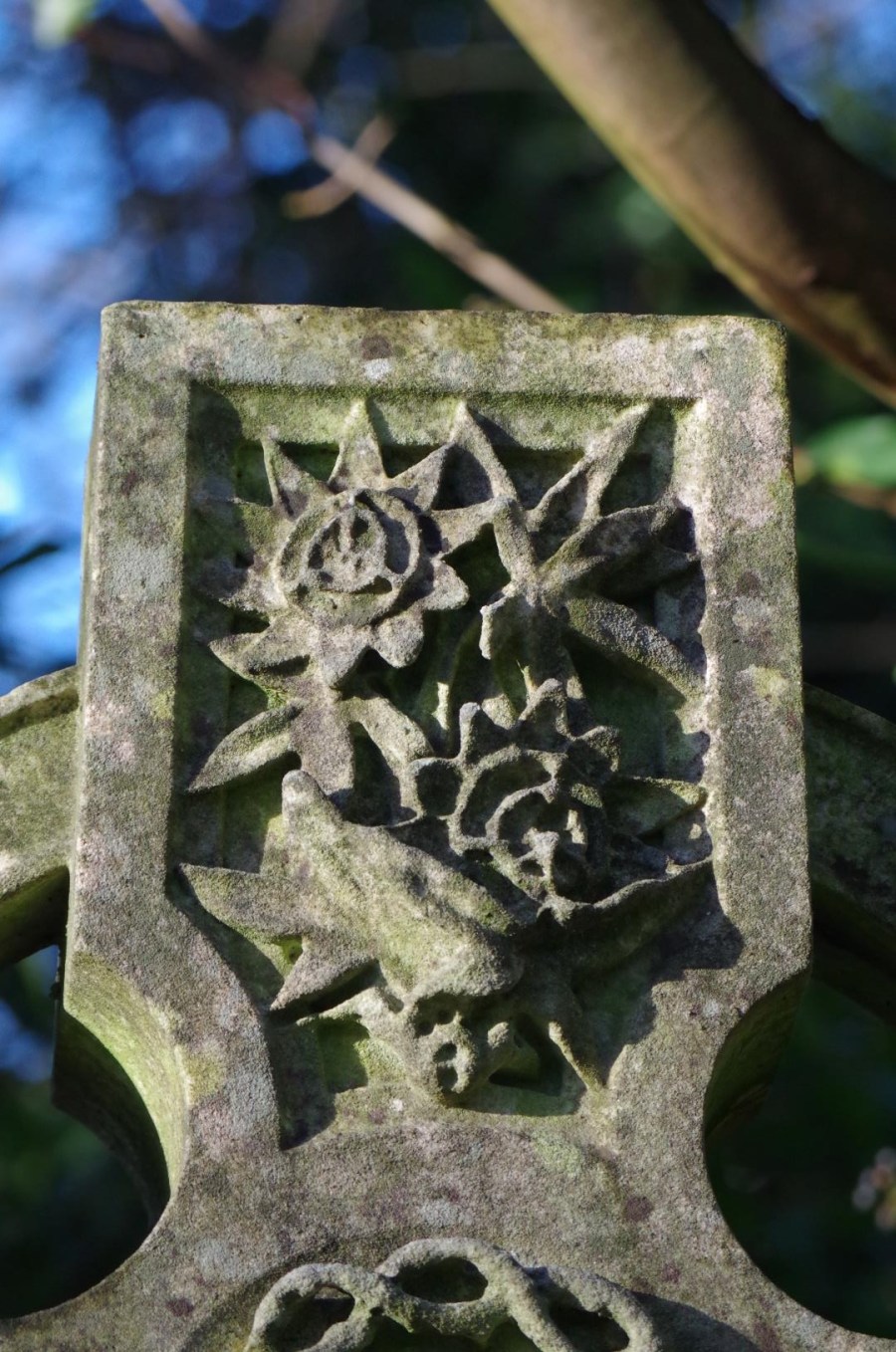
This is the Mills memorial. A Celtic Cross filled with sculpted blooms which are beginning to erode under an inner city climate.
A well carved border of passionflowers on a tomb in Nunhead Cemetery UK copyright Carole Tyrrell
This is the Blackburn tombstone with a lovely 2 dimensional frieze of the flowers.
An actual passionflower displaying the elements that have made it such a powerful religious symbol. copyright Carole Tyrrell
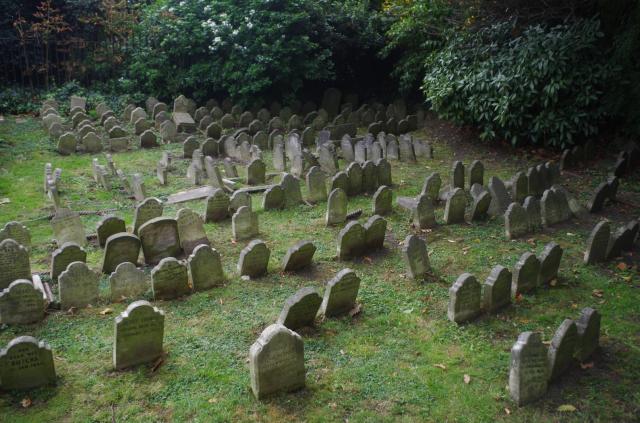
Alongside the busy Bayswater Road, on the way down from Marble Arch, there is a secret place behind one of the gate lodges. It’s protected by an iron railing and thick hedges and the casual passer-by wouldn’t know what lies behind them. But this is a special place where 300 much loved pets sleep in an eternal slumber. Curio, Ruby Heart, Prince and Ba-Ba are just some of the names of the family pets that are commemorated on the Lilliputian tombstones. This is the tiny Victorian Hyde Park Pet Cemetery.
300 little burials copyrights Carole Tyrrell
It was a burial space for the local residents and their beloved animals It’s mainly dogs that are buried here as they often fell victim to the Park’s horse riders hooves. However, there are also three small monkeys as well as several cats and birds. The first burial, Cherry, a Maltese terrier, was in 1881. Cherry belonged to the Lewis-Berned family who lived nearby. They were frequent visitors to the Park and knew Mr Winbridge, the lodge gatekeeper. Mr and Mrs Lewis-Berned approached him after Cherry had died of old age and enquired if Cherry could be buried in what was his back garden at the lodge. He and his employer agreed and Cherry’s tombstone reads ‘Poor Cherry. Died April 26 1881.’ Word must have got round as, before long, other local families were also having their deceased pets interred in the lodge’s back garden and it soon became an unofficial pets cemetery. There is even a royal dog there. This is a Yorkshire terrier which belonged to the wife of HRH Prince George, the Duke of Cambridge, who lived in Mayfair. ‘Poor Prince’ was crushed under a carriage wheel and actually died in the Lodge. The subsequent burial was recorded in the Duke’s diary on 29th June 1882 and made Prince the second incumbent in the cemetery. In contrast, there were also low-lifes in there and I am indebted to the London-In-Sight blog for the background information on a police dog, Topper, who is buried within the cemetery. He was obviously a dog with attitude and was described as being: ‘insufferably vulgar, a snob of the lowest kind and most contemptible, a bad strain in him which seems to have run through very line of his character.’ He died of over-eating. I have to admit that I would have liked to have met Topper to see if he lived up to his description. When you first enter by the side gate the first thing that really impresses you is how many of them there are in the little garden and how poignant some of the epitaphs on the small headstones are. Who has owned a pet, loved it dearly, and not wanted to commemorate its life and passing like other family members? The little plots are arranged in rows, each with an area bordered by rope edge tiles to allow the families to place flowers if they wished.
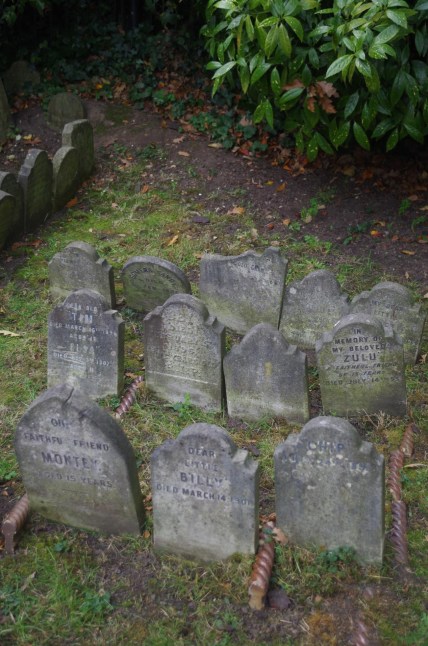
A smaller group nearer the Bayswater Road side copyright Carole Tyrrell
We visited the cemetery as part of a tour arranged by London Month of the Dead and had roughly thirty mins inside which didn’t leave much time to explore the epitaphs. I can only show a few of them here. But it was a good introduction to the cemetery. So next time we may book an hour long tour. We didn’t find Cherry’s grave despite looking for it. . One of our guides did point out that at the time of the first burials the average expectancy of a working man was forty or less.
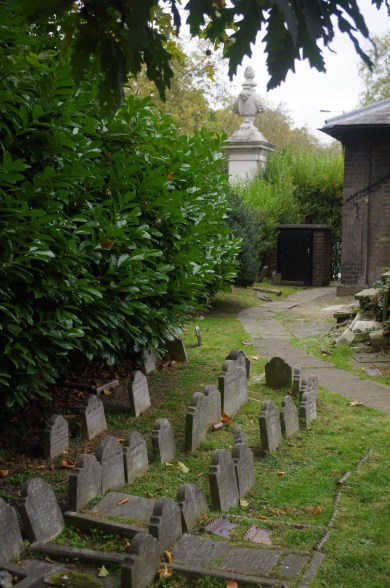
View towards Victoria Lodge copyright Carole Tyrrell
The gate was locked behind us as the little residents slumbered on. Access is limited for obvious reasons and needs to be booked via The Royal parks website; http://www.royalparks.org.uk. Tickets cost £50 +VAT for a visit lasting one hour for up to 6 people. Text and photos copyright Carole Tyrrell
Sources and further reading:
Barking Blondes – Will you book a grave plot for your dog? The Independent blogs 18/01/14
Fun London Tours – The Victorian Pet Cemetery of Hyde Park, 20/10/11
London-In-Sight blog, The Pet Cemetery of Hyde Park, 06/10/10
Below is a selection of the epitaphs
Spot’s last resting place copyright Carole Tyrrell
Snow and Smut Two cats buried there copyrght Carole Tyrrell
The epitaph to Snip says it all – note the little border so that owners could leave flowers. copyright Carole Tyrrell
A lovely and poignant epitpah copyrights Carole Tyrrell
Prince and Scum 0 imagine calling that out at night copyright Carole Tyrrell
Just inside the entrance – a touching epitaph copyright Carole tyrrell
A noble name indeed – Pepys copyright Carole Tyrrell
A sad ending for a much missed dog – Monty copyright Carole tyrrell
I would have loved to know what Curio looked like. copyright Carole Tyrrell
two long lived companions – Zeno and Clytie copyright Car9ole tyrrell
A perfect pug Chin-Chin copyright Carole Tyrrell
A much missed pet – Ba-Ba copyright Carole Tyrrell
A much missed local resident – Jack copyright Carole Tyrrell
This was originally going to be a short piece on roadside shrines. These are the impromptu response to remember road traffic victims. Grieving relatives and friends place flowers and messages so that casual passers-by would at least know the name of the deceased and that they were missed. The shrines were also originally intended to remind drivers to slow down and to be more careful with their driving. However, as a blog from the New York Times said, they can also be a distraction and may actually cause accidents rather than prevent them.
But a piece in my local freesheet in 2012 made me think. The Editor commented that roadside shrines had become ‘a tide of detritus left behind in the dead’s memory.’ He went onto say that ‘in times past different cultures had felt it essential to send the dead on their way with appropriate objects, if you were lucky they even killed a goat.’ He continued by saying that he had seen bottles of Smirnoff Ice, four cans of Stella, a packet of cigarettes, a West Ham shirt, a picture of a dead cat, and a meat pie and called them ‘ evidence of ‘a modern obsession with proving food for the dead.’ He questioned the object of leaving items that will attract thieves and vandals.
I have seen several roadside shrines and found them very touching but it’s sad when the flowers wilt, they become sodden by rain and then fade completely. The extra items that the Editor complained about may be the only way that the grief stricken can make the impersonal more personal and make sense of an inexplicable and sudden death. The shrines almost become a way of sharing the deceased with the world in that the casual observer knows that they liked a certain football team. They become a person again and not just a statistic.
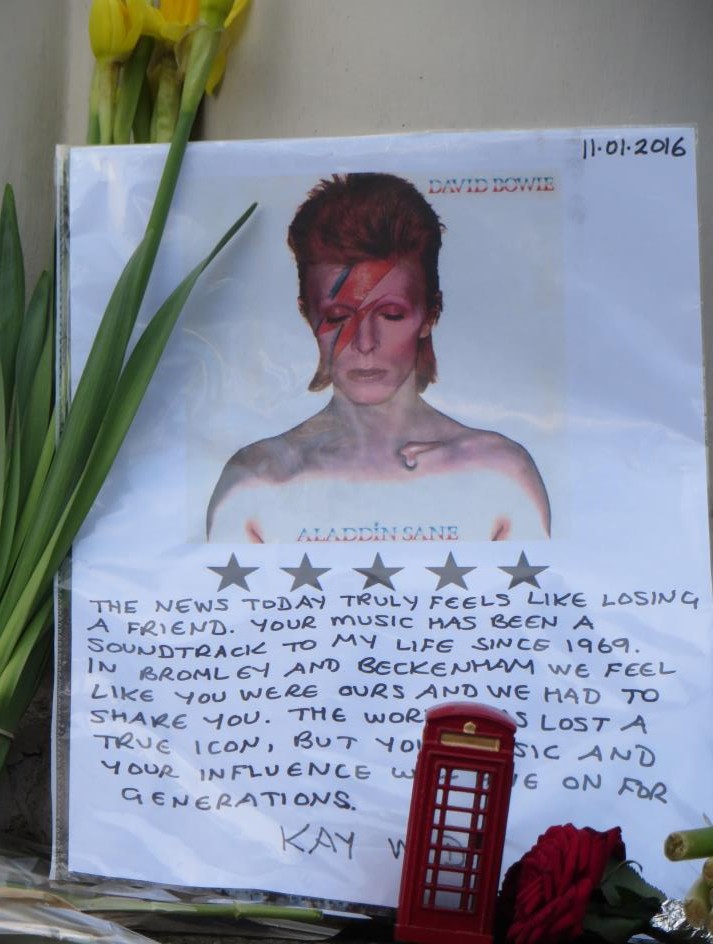
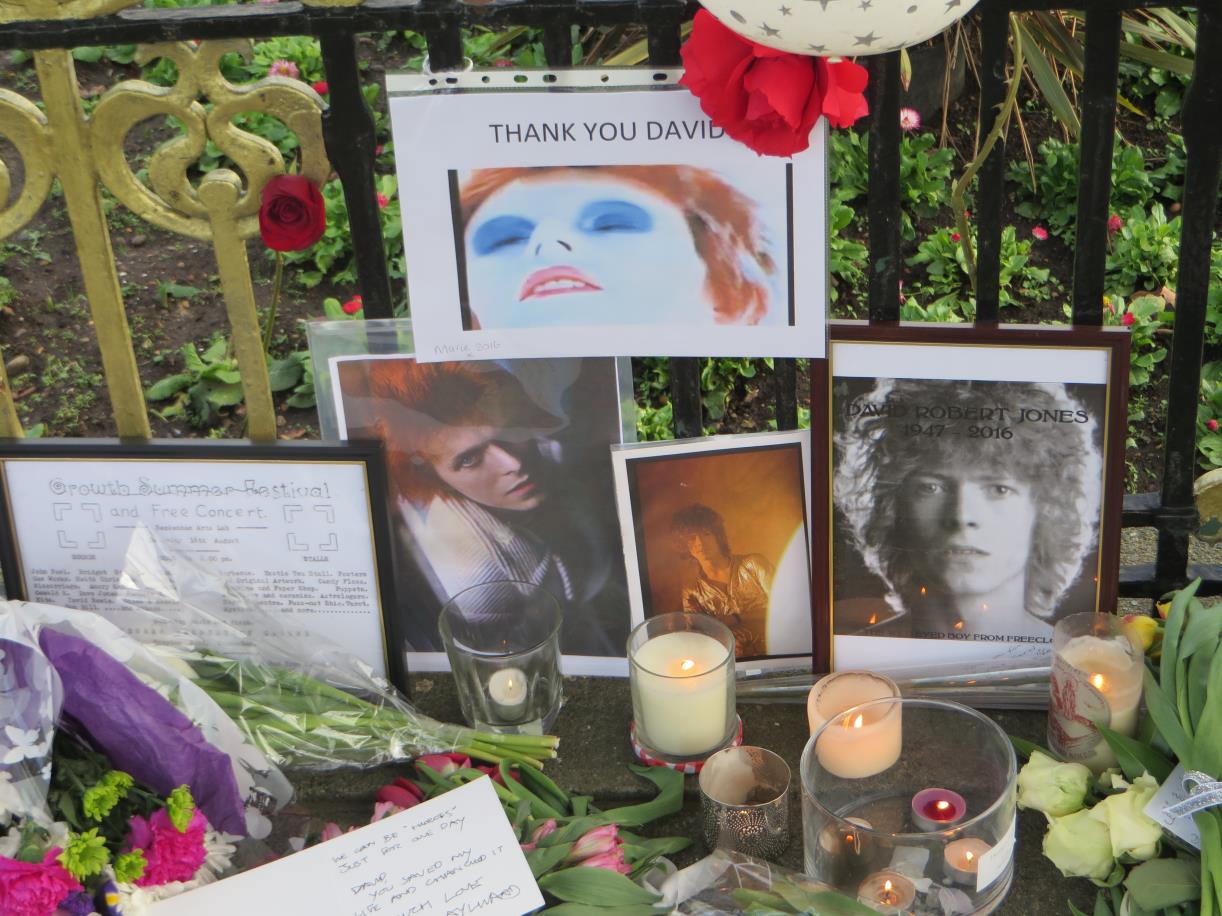
But what finally prompted me to write this piece was the death of the rock icon, David Bowie on 10 January 2016 and the unofficial shrines that have been created in his memory and the items that fans left at them. I found out the news via the internet by logging onto Facebook and there it was. I was stunned and felt as if I’d been punched hard. After an hour of reading tributes I really felt that I wanted to do something. When Princess Diana died, I had been one of the many who had laid flowers at Kensington Palace in her memory. It was a public way of displaying sympathy for a woman who I genuinely felt had had a hard time. As Peter Watts says in his blog article on London Shrines:
‘What fascinated me also about all this was that it had a seditious, outlaw aspect. There was a lot of noise in the press about whether the Queen was treating Diana’s death with sufficient respect, and this huge impromptu shrine – by the people, against the establishment – was given the atmosphere of an almost revolutionary act. It was a fascinating combination – the privacy of remembrance, carried out on a larger scale with political implications.’
It was a once in a lifetime event.
According to social media and news sites people were already laying flowers at a mural of David in Brixton. I went out to buy flowers. However, Bowie had been a local lad to me in Beckenham in the early ‘70’s and the suburb also wanted to remember hm. At what had been the Three Tuns, now a Zizzi’s, pub in the High Street, where a wall plaque reminded us that he’d played there pre-Ziggy, a few people had already laid flowers. There were several people standing around looking completely stunned. I laid my daffodils in front of a large framed picture of the Bowie poster from the V & A show on Bowie and moved onto Brixton.
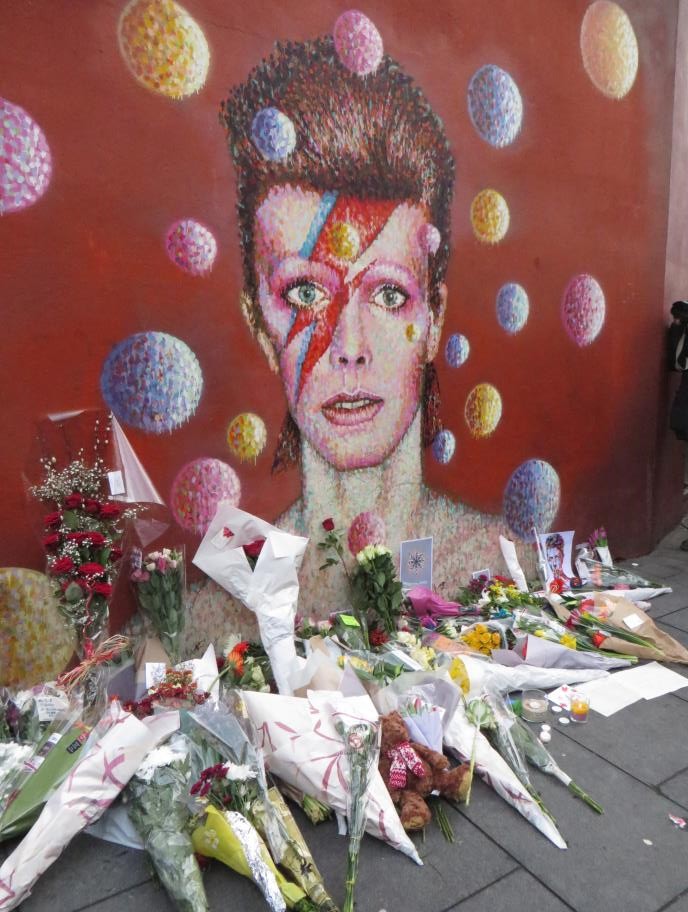
The Bowie mural painted at one end of a Brixton department store. copyright Carole Tyrrell
I’d been aware of other rock star shrines such as Marc Bolan’s on Barnes Common and Jim Morrison’s grave in Paris but this time it was for one of my all time heroes.
The mural was in full colour and features Bowie in his Aladdin Sane period. On the wall next to it was a large colour ad for Iman’s, Bowie’s second wife’s cosmetics. When I arrived at around 10am there was already a media frenzy taking place. TV crews, people being interviewed, journalists with microphones looking for people to interview, professional photographers, and people of all ages. People had been laying flowers on their way to work and there were already more than a few. There were the casual passers-by who glanced over and moved on or took a photo on their phone and others who must have wondered what it was all about. A pavement evangelist informed us that Bowie had had no fear about dying. I wondered if that was true. But most of all there was an atmosphere of disbelief and shock.
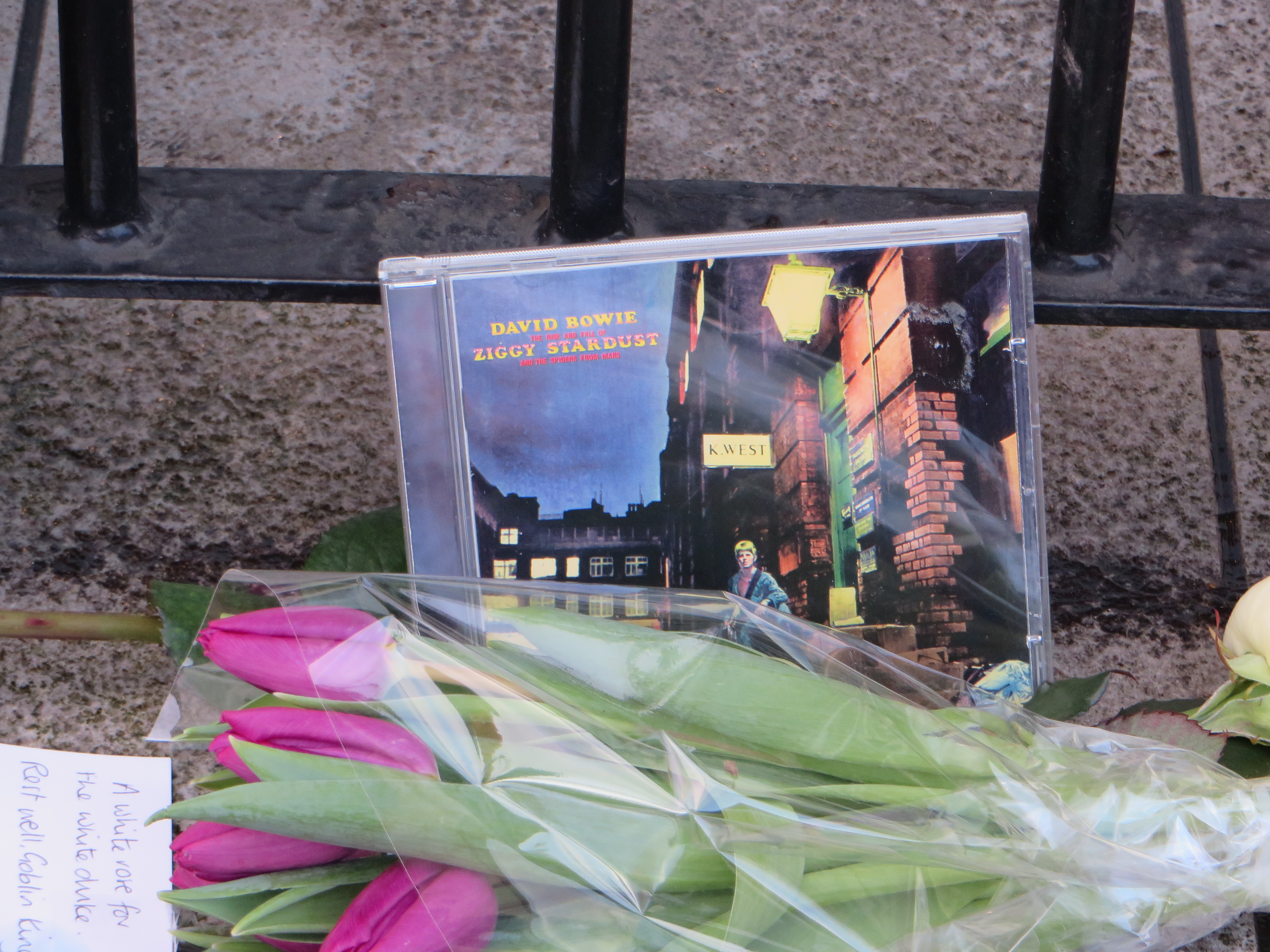
An iconic album. Outside the pub in Beckenham where he used to play and now a Zizzi’s. copyright Carole Tyrrell
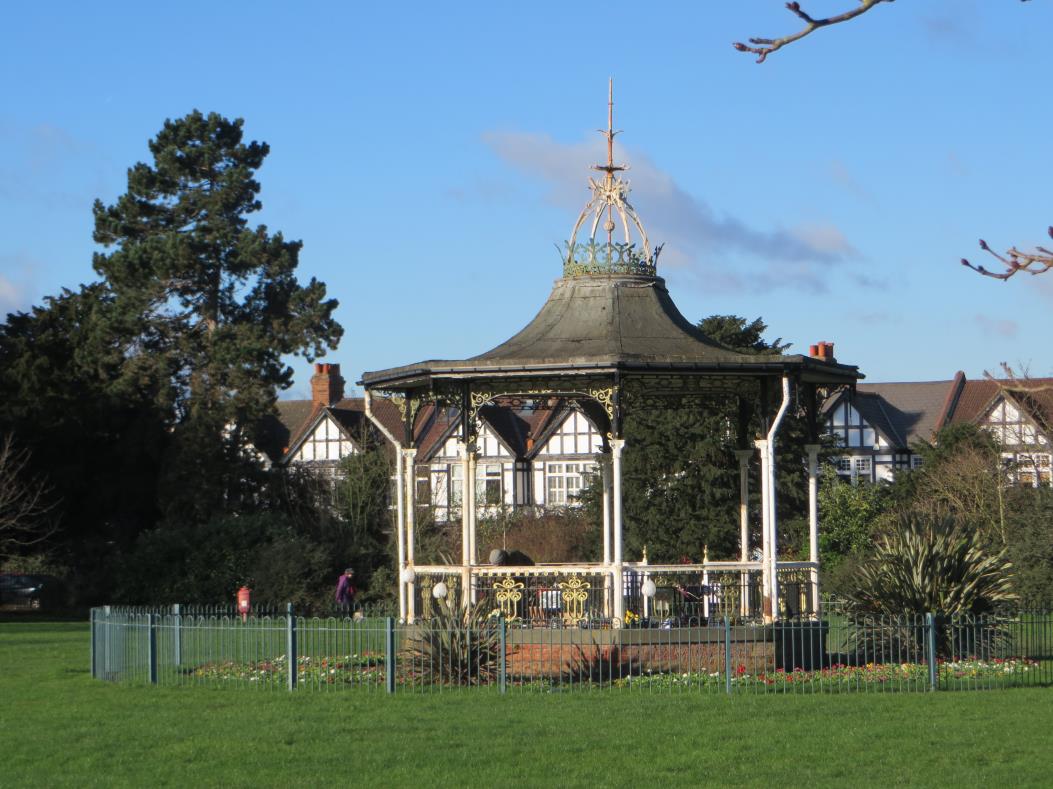
Since then the floral tributes at Zizzi’s have continued to grow and the overall feeling seemed to be one of fans thanking Bowie for being such a part of their lives and making such wonderful music. LP’s, props, and photos have also been left and so far none have been stolen. He was also commemorated at the Beckenham Croydon Road Recreation Ground bandstand which was where, in 1969, he had held a free festival and wrote the song, ‘Memories of a Free Festival’ to commemorate it. Candles had been lit here and a sympathetic council employee was keeping them lit.
The bandstand in Beckenham where Bowie played at a free festival copyright Carole Tyrrell
Fans were sharing their memories. At the bandstand someone had left a framed copy of the flyer for the free festival and it was interesting seeing the line-up for the first time. Photos, album covers, scribbled memories – to some they may well be detritus but they are personal recollections and I was fascinated by reading them. Parents were there with their grown up children who had probably grown up on Bowie’s music.
Some of the tributes left by fans at the bandstand. copyright Carole Tyrrell
The Brixton Shrine continued to be a focus. When I returned 2 days later to see it again and to visit Bowie’s birthplace at Stansfield Road, messages had been written on Iman’s advert and the two models had had Aladdin Sane flashes drawn on their faces. I added my little message. There was less of a media presence this time and more people adding to or looking at the flowers.
David Bowie was a pivotal figure for me. I remembered Space Oddity around the time of the moon landings and I’d picked up on Hunky Dory, the LP before he became really big. The early 70’s were such a grey time. The glittering dayglow Sixties were over. The Age of Aquarius had dimmed, the Beatles had split up and no one seemed to know what to do next. We wanted out own music, something different, harder and in 1972 when I saw Bowie singing Starman on Top of the Pops in 1972 I knew it had arrived. Glam rock as it came to be called may have ended up as bad make up jobs and Bacofoil l but it defined my generation. From then on I followed him as each successive LP became a major event. Bowie re-invented himself time and time again and along the way he introduced me to Andy Warhol, Iggy Pop, the Velvet Underground, William Burroughs, Kraftwerk and Jean Genet amongst others. And if he sometimes made an LP that wasn’t as great, well I simply that thought he would pull it off next time.
For many of us, David Bowie’s passing has been a huge event in our lives. We may not have met him but his music and his many personas made a deep impression. They don’t post rest in peace messages on the BT Tower to just anyone. It made me realise how powerful these collective mourning places can be as they were an important focus for us all. A way to pay our respects, to express our thanks at his music being such a part of our lives, and to acknowledge his existence. It was being with strangers, complete strangers, who we joined with for a brief moment, united by a common bond and then we became strangers again. A spontaneous event that marked the passing of an icon who had gone too soon.
The flowers will fade and be cleared away, the scribbled messages may also vanish and the mural, Zizzi’s, the bandstand will all go back to being milestones on Bowie’s journey. As with the roadside shrines, life has to go on.
My experience at the Bowie shrines was to think about my own future. He was a man who made his life count right up to the end. How long have I got? Is this what I want to be doing? Make the most of life it may be shorter than you think. And maybe that’s the oft used word, legacy, of them. A memento mori for a new generation – As I am now, so you will be. He didn’t waste his time on this earth and neither should you.
And maybe that’s what all shrines, roadside or otherwise do, remind you that life is fleeting and death is forever so make the most of it while you have it.
Sources:
‘Stella, fags, footie shirt, dead cat, meat pie.’ Andrew Parkes, Editor, Newshopper, 17/10/12
An Amersham barley field with a sinister secret? copyright Carole Tyrrell
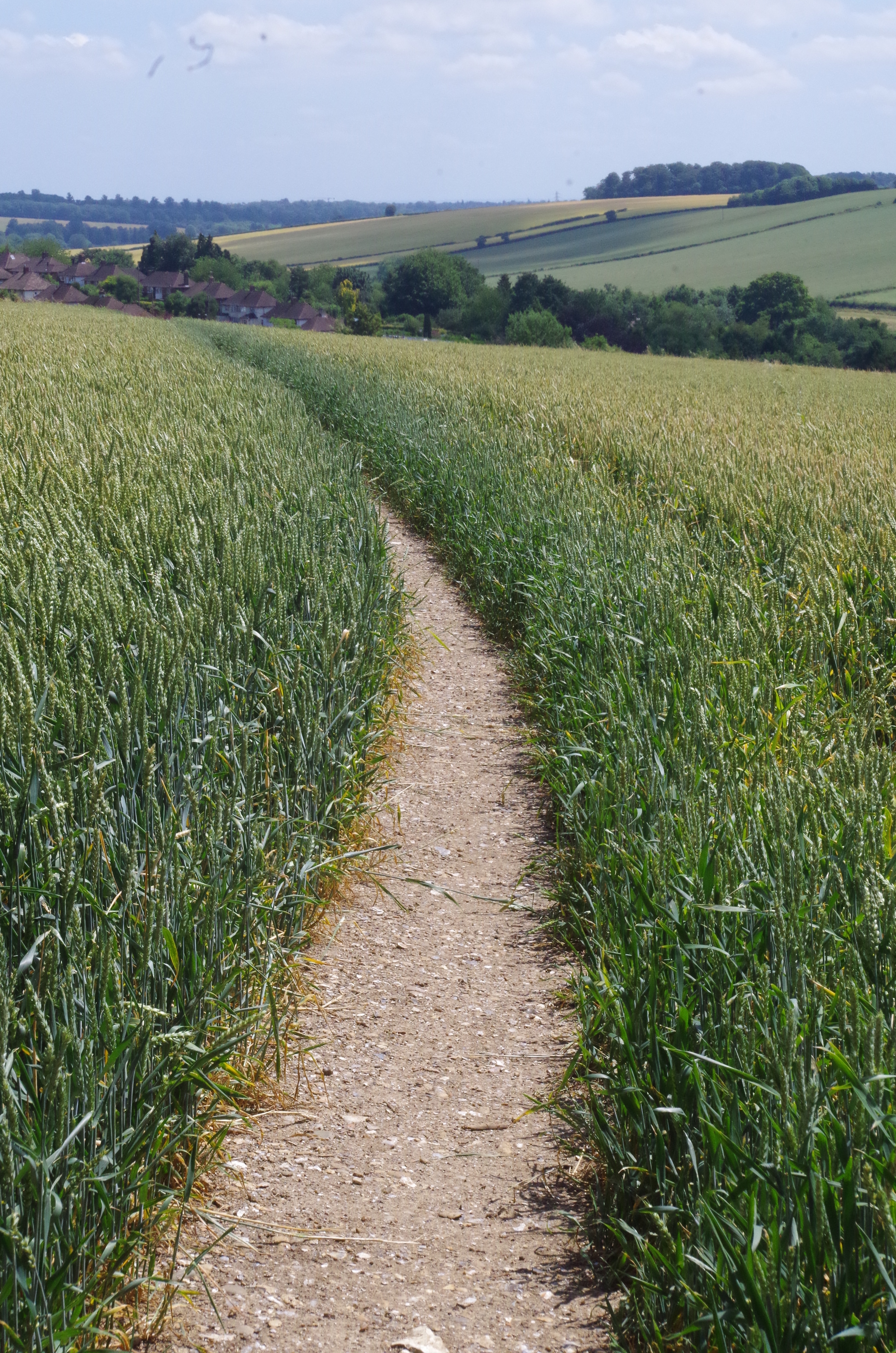
The late afternoon sun shone down on us as we crossed the huge field of barley towards the Amersham Martyrs monument. We would never have known that it was there except for a knowledgeable member of our party who led the way. Butterflies were still fluttering about; a large white and the first meadow brown of the summer accompanied us we followed the path though the rustling crop.
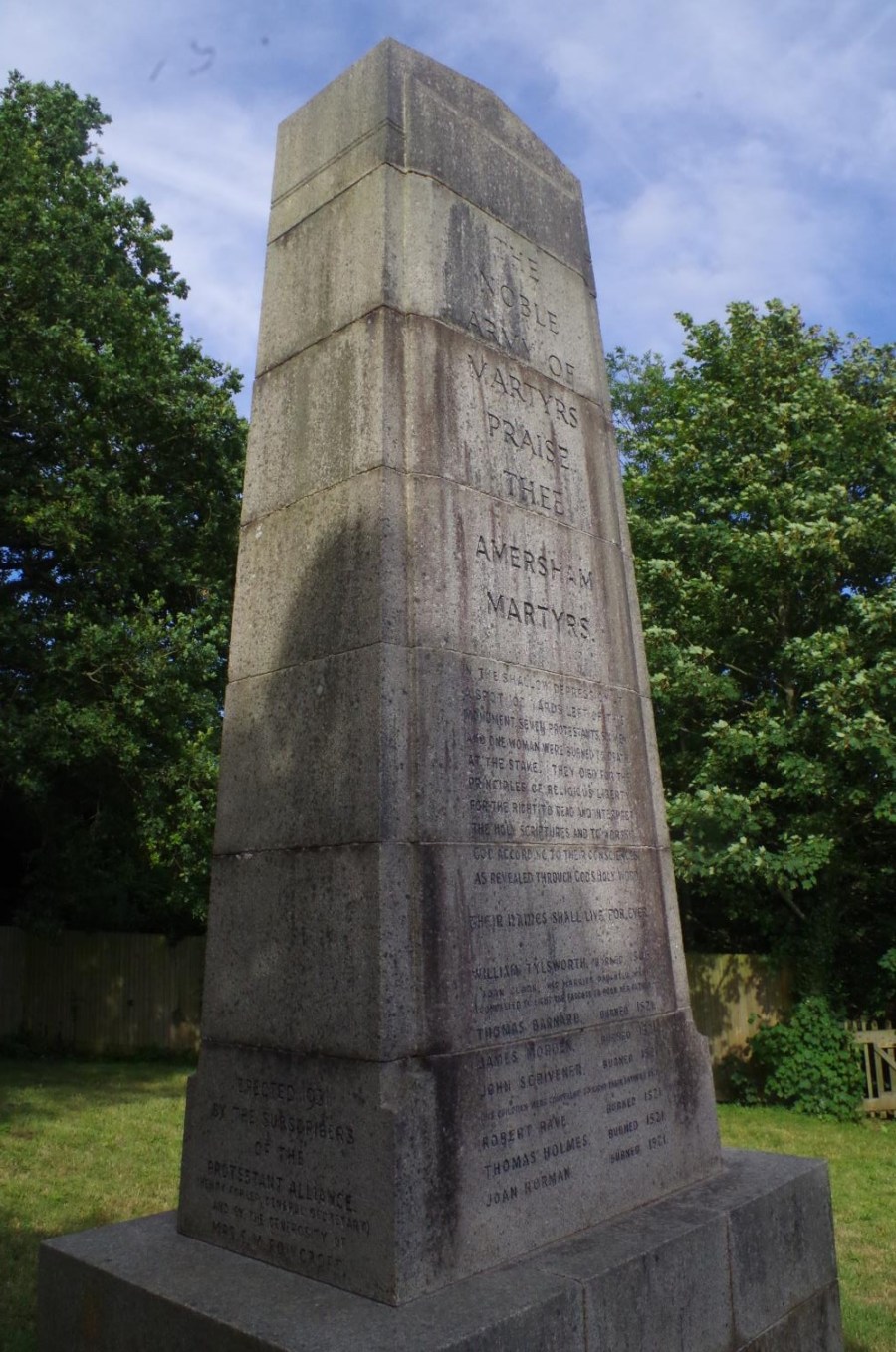
The Amersham memorial is a tall, grey, granite obelisk behind a tall hedge which faces out towards the village and church below. It’s surrounded by tall box hedges and the field. It’s a reminder of past religious differences.
The memorial is to commemorate the six Martyrs, local men. who were burned at the stake in 1521. Their crime was wanting to read the Bible in English, amongst other ambitions, and their cruel deaths were meant to deter others. The six were burned high above Amersham so that the flames and smoke would be visible to all in the village below as a warning. The daughter of one of the Martyrs and the children of another were forced to light their fires.
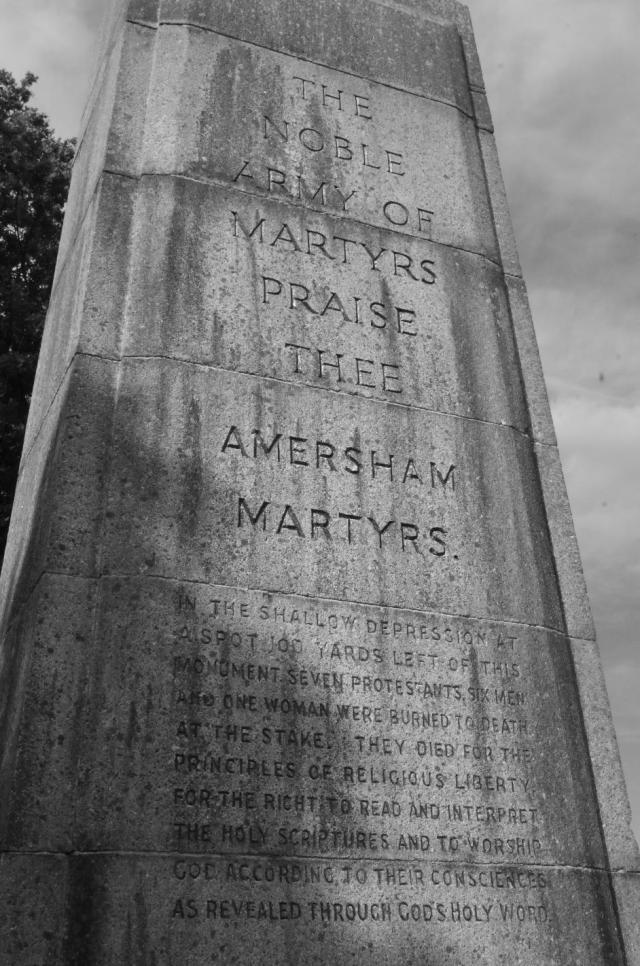
The inscription on the monument reads –
“In the shallow of depression at a spot 100 yards left of this monument seven Protestants, six men and one woman were burned to death at the stake. They died for the principles of religious liberty,
for the right to read and interpret the Holy Scriptures and to worship God according to their consciences as revealed through God’s Holy Word. Their names shall live for ever”
The list of Martyrs is then displayed.
On the left hand side of the memorial are displayed the names of 4 more Martyrs who were burned, or, as in one case, strangled elsewhere.
The names of the Amersham men killed elsewhere. copyright Carole Tyrrell
The monument was erected in 1931 by The Protestant Alliance who still exist today.
The Protestant Alliance who erected the monument. copyright Carole Tyrrell
They maintain two other Martyr monuments: Smithfield erected in 1870 and Norwich which was erected in 1994.
Suburbia lies behind the memorial area and I wondered if there had ever been any echoes of these brutal killings. Suddenly the field which had seemed so idyllic on that hot summer’s day seemed to have long shadows and I wondered to myself if I would like to be here alone on a dark, cold night.
Robert MacFarlane recently wrote an article on the eeriness of the English countryside for The Guardian Books section and it seemed to express this mood and feeling completely. Despite its rural charms, the English countryside has its own atmosphere, a ‘folk-horror’ and who hasn’t had that unsettling feeling of dread when in the midst of a dark wood or on a lonely road late at night. I once went exploring in the midst of the Wiltshire landscape near Salisbury and wandered up to a Stone Age hillfort. We had a map and instructions for the return journey but I got lost. I couldn’t explain it but the countryside around it looked different when we were on the other side of the fort. Eventually we found our way back to the road and got home but we heard later that other visitors to the site had also got lost. I’ve visited the fort again since and never had that experience again. To read the article follow this link:
Our visit to Amersham was fascinating and proves that you can never predict what jewels you might find in a country church and what secrets you might uncover.
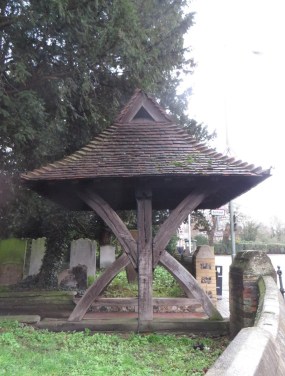
The lychgate to Compton Churchyard, Guildford, UK. copyright Carole Tyrrell
English country churches and lychgates seem to go hand in hand. There is something rustic and romantic about them. Perhaps you’ve seen one at the entrance to a church and thought that they were created as handy shelters or been lucky enough to see a bridal couple paying local children to untie the gates and allow them through.
But the picturesque lychgate has a darker side as it’s also the gate through which the happy couple could be entering in a few decades but on a more sombre occasion.
The word lychgate is derived from the old English or Saxon word, lich, which means corpse. The body would have already been carried along footpaths or the local corpse road to the church. Corpse roads can still be seen in the countryside if you know where to look. Coffins were for the wealthy until the 1700’s and so the less well to do deceased would have been wrapped in a shroud and then laid on a bier under the lychgate. The priest would have then come out of the church to the bier to conduct the first part of the funeral service. The pall bearers would have been able to shelter under the gate. Some lychgates have large, flat stones under them on which the shrouded body would be laid. These are known as lich stones.
St George’s Church Beckenham copyright Carole TyrrellSide view of lychgate showing construction. copyright Carole Tyrrell
A lyhgate is roofed porch-like, almost shed-like, over agate and were often built of wood. They were usually made of 4 or 6 upright wooden posts in a rectangular shape. Above are beams to hold up a pitched roof covered either in thatch or wooden or clay tiles.
Although usually plain, they can sometimes have decorative carvings. For example, St Oswald’s in Peover, Cheshire has these words inscribed on its lychgate:
‘Grant O Lord that through the grave and gate of death we may pass to our joyful resurrection.”
A sobering though for all those who passed beneath.
Some lychgates also have recessed seats in either side of the gate and lychgates were often erected in a local person’s memory. In 2000, the Millenium year, several lychgates were erected to commemorate it. Lychgates are thought to date from the 7th century but were more widely popular in the 15th century.
As they were usually made from wood many lychgates have vanished over the centuries or the remains have been incorporated into modern reproductions.
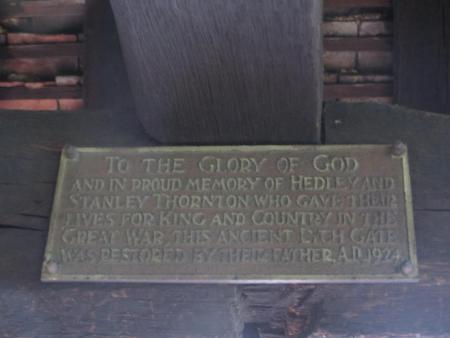
Whilst researching this article I discovered that my local church, St Georges in Beckenham, may have the oldest lychgate in the country as parts of it date from the 13th century. In 9124, it was restored by a local man who lost both of his sons in the 1st World War. There Is an information panel on a roof beam to commemorate this which reads:
“To the glory of God and in proud memory of Hedley and Stanley Thornton who gave their lives for King and Country in the Great War. This ancient Lych Gate was restored by their father. A.D. 1924”
Dedication panel on roof beam. copyright Carole Tyrrell
and there is another one which informs the reader of its age and restoration work done on the lychgate:
“This lychgate is probably the oldest remaining in England was erected in the 13th century and repaired in August 1924, when the framework was left untouched. But the decayed ground cills and the bottoms of the side posts were renewed on new foundations and the spurs to thebrackets which had long been absent were restored.”
Information panel inside lychgate. copyright Carole Tyrrell
This was a visit organised by the Friends of Nunhead Cemetery in 2015.
The path through the field towards Amersham copyright Carole Tyrrell
We could see St Mary’s church below the hill as we skirted the outside of the huge field of barley. Red kites wheeled above our heads and a skylark sang to accompany us. Butterflies; tortoiseshells, meadow browns and gate keeper, led our way to Amersham on a hot July day. On the way we passed St Mary’s Graveyard in old Amersham where the last woman to be hanged in England, Ruth Ellis, is rumoured to lie, buried in and unmarked grave. A pair of banded demoiselle dragonflies danced on the air over the small stream nearby, their wings glittering in the sun like tiny jewels.
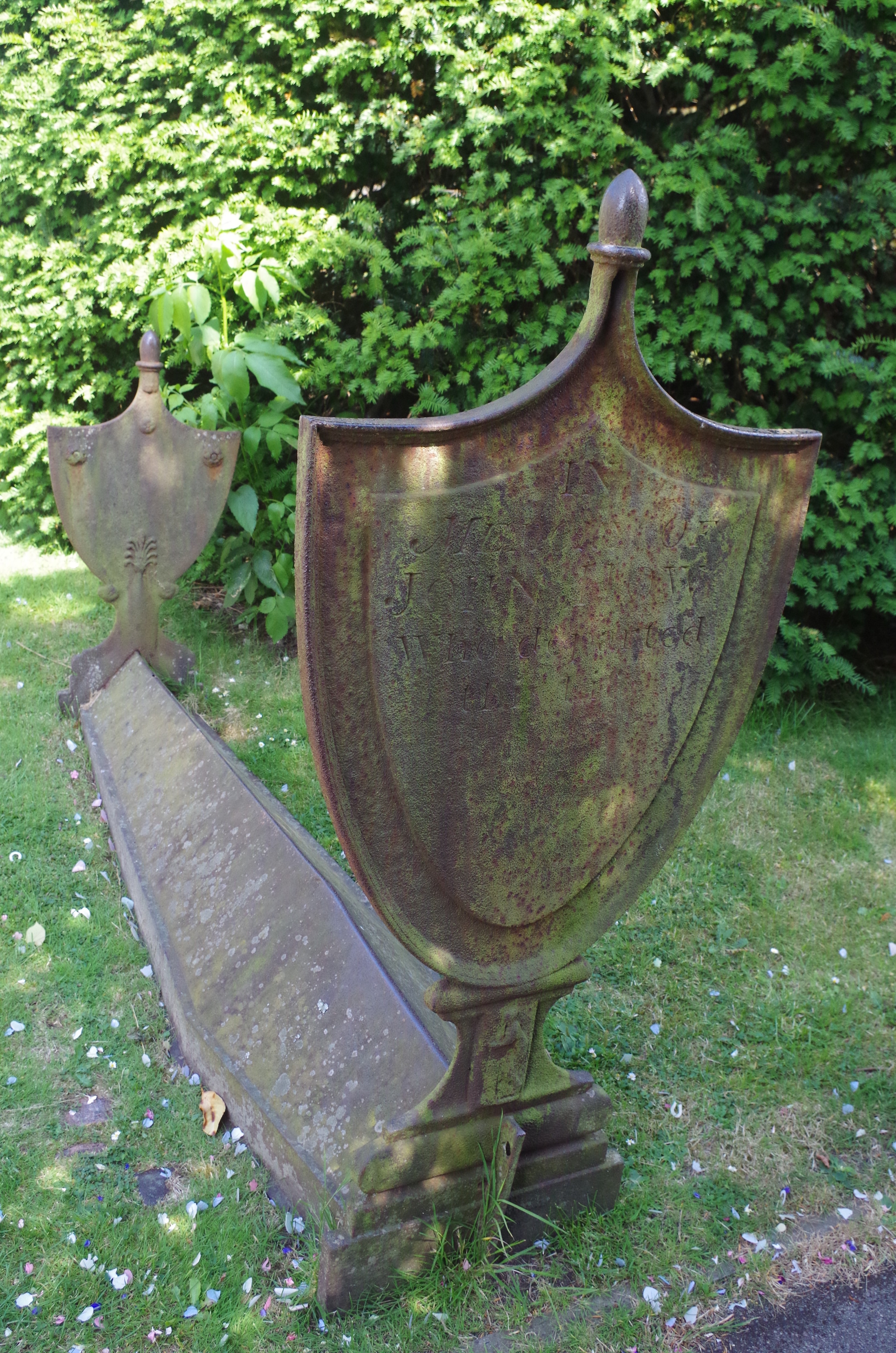
St Mary’s church under a lovely blue sky. copyright Carole TyrrellAn interesting iron memorial within St Mary’s churchyard copyright Carole Tyrrell
St Mary’s is the church that featured in the film ‘4 Weddings and a Funeral’ and we briefly explored its surrounding churchyard and interesting monuments. There has been a church on the site since 1140 with many historical features such as the medieval font and a 17th century Flemish stained glass window.
‘ In about 1620, the Drake family (distant cousins of Vice-Admiral Sir Francis Drake) bought the town and its estates. They remain patrons of the Parish to this day, many of their younger sons serving as Rector over the centuries. In 1870, Rector Edward Drake persuaded his brother the Squire to reorder and restore St Mary’s to something like its mediaeval interior layout. It was also at this point that the church was clad in flint.’ http://stmaryschurchamersham.com/history
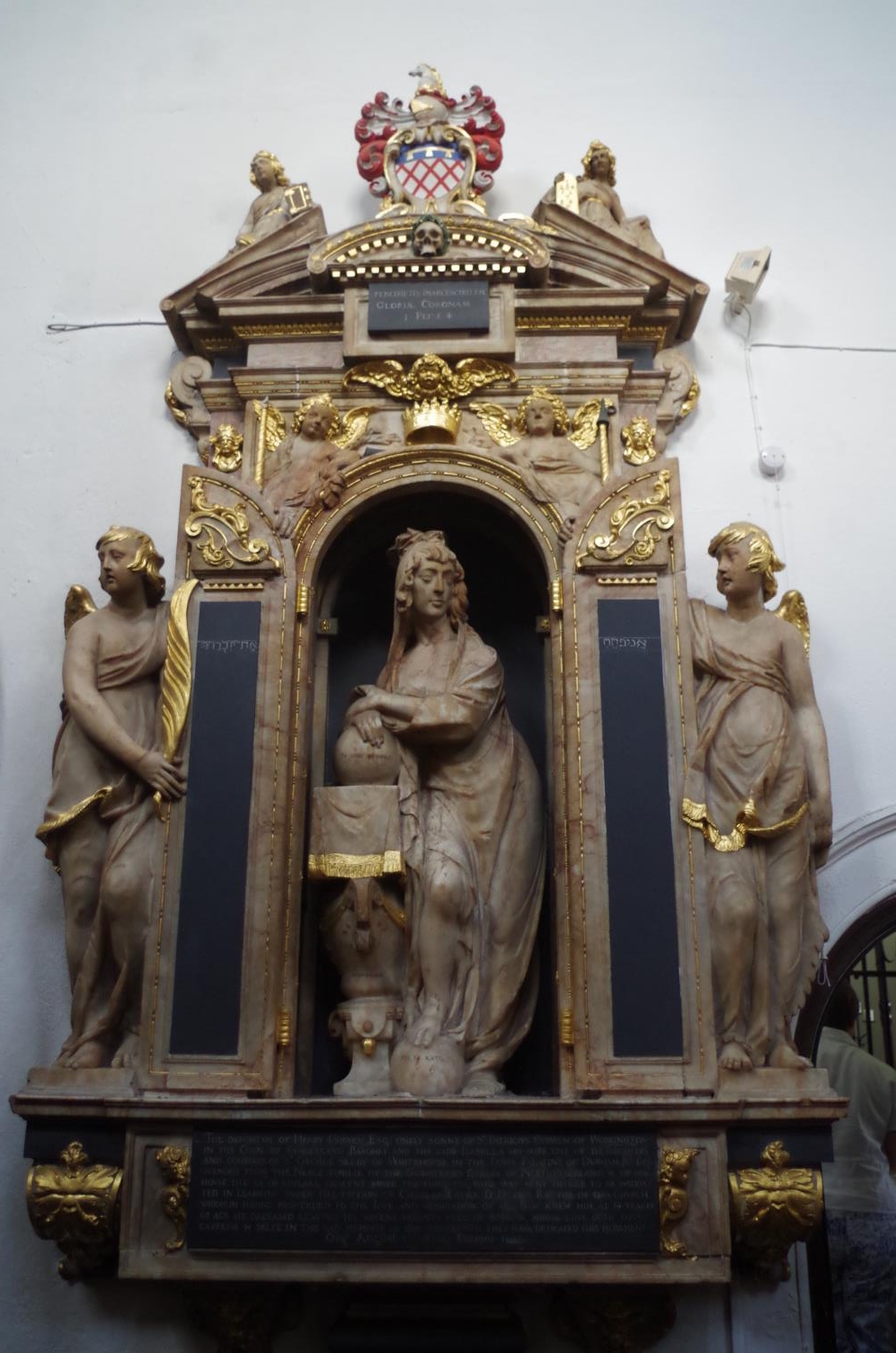
Our guide had the memorable name of Howard Hughes and he led us through the chancel with its large memorials. One was to a 14 year old boy, Henry Curwen Workington, who died in Amersham in 1636 and another featured 2 lifesize sculptures of a married couple who didn’t look very happy. There was also a wall memorial with a bust of man which, within the frame, made him look as if he was in a Punch and Judy tent.
The Henry Curwen Workington memorial copyright Carole Tyrrell
Memorial, chancel, St Marys copyright Carole TyrrellMemorial, St Marys chancel copyright Carole Tyrrell
But the Drake chapel, once a vestry, was our destination. It was an unexpected jewel. The room is light and airy and lined with fascinating and poignant memorials. It’s normally closed, but Howard opened it especially for us and for a lover of symbols , like myself it was a wonderful feast. The Drake family had South London connections due to the land they owned and several or our local road names bear witness such as Drakefell and Shardeloes. In the 18th century they added Tyrwhitt in order to inherit lands.
The Drake Chapel was converted into a monument room in 1728 with the interment of Mountague Garrard Drake as there was insufficient space to accommodate him and his memorial. Mountague was laid to rest in the vaults below and Peter Scheneermakers carved his lavish and flamboyant memorial carved which was erected at the then huge cost of 500 guineas. The tomb features a lifesize reclining statue of himself, we presumed, with 2 winged cherubs.
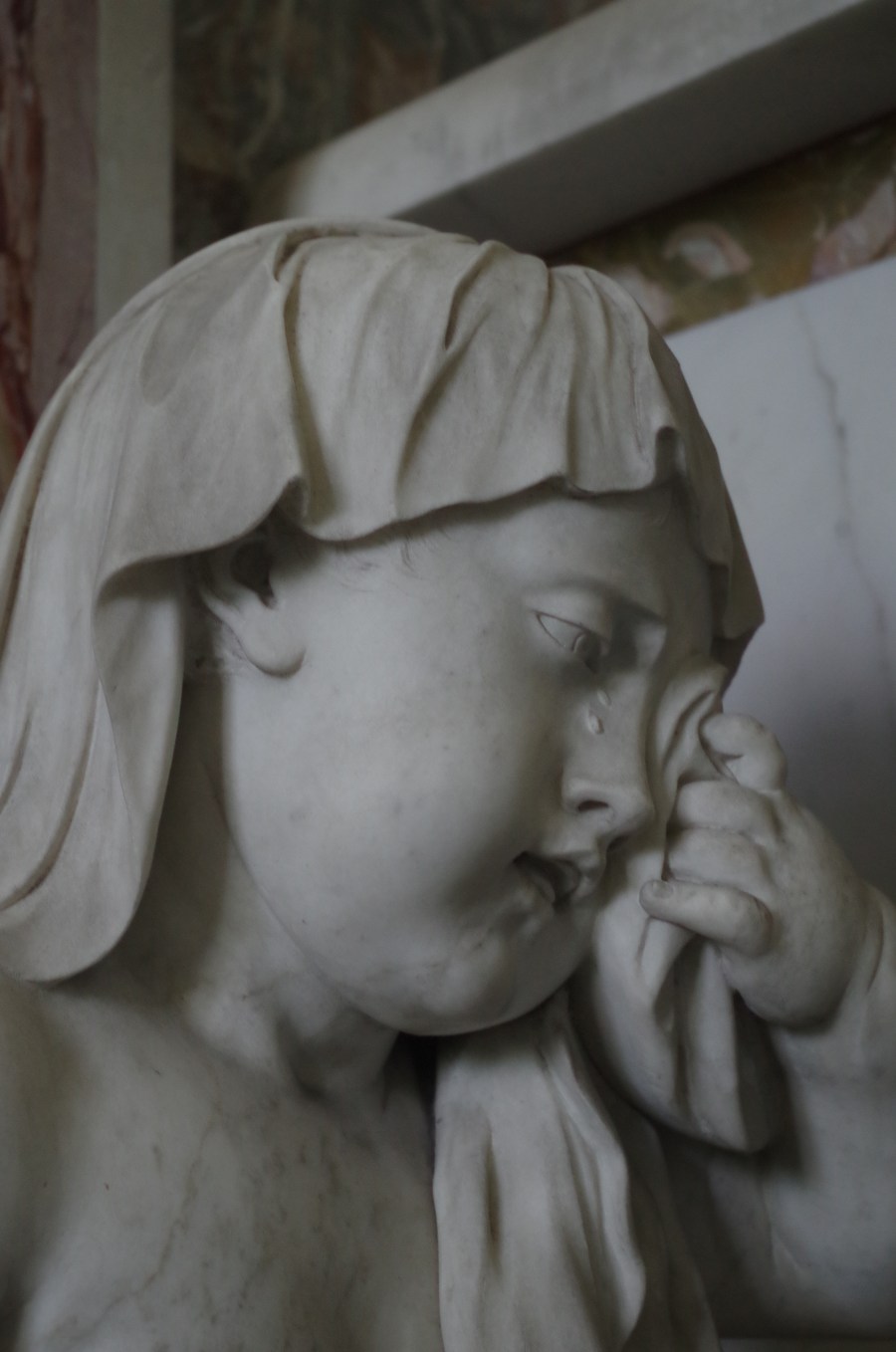
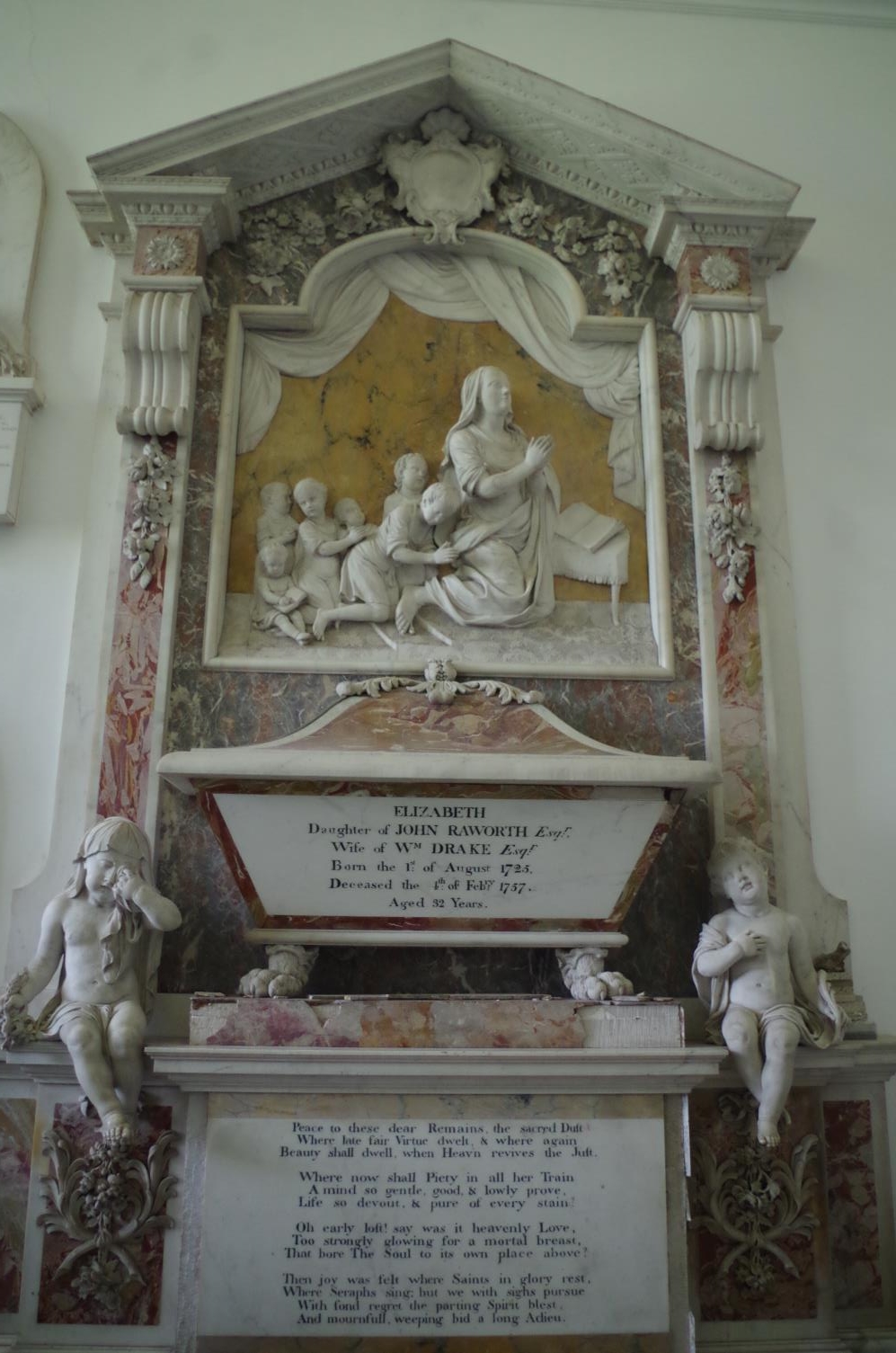
Elizabeth, his son’s wife, who died at 32 in 1757, monument faced him. In a carved panel she is praying with her six surviving children with two other deceased children who may be represented by a weeping cherub beneath.
A carved panel from Elizabeth’s memorial. copyright Carole TyrrellThe weeping cherub on Elizabeth’s memorial. copyright Carole TyrrellThe weeping cherub. copyright Carole TyrrellElizabeth’s memorial in full. copyright Carole Tyrrell
Another epitaph to a young wife said simply that: she had left behind 2 infant daughters and ‘Her circle of life tho’ small was complete
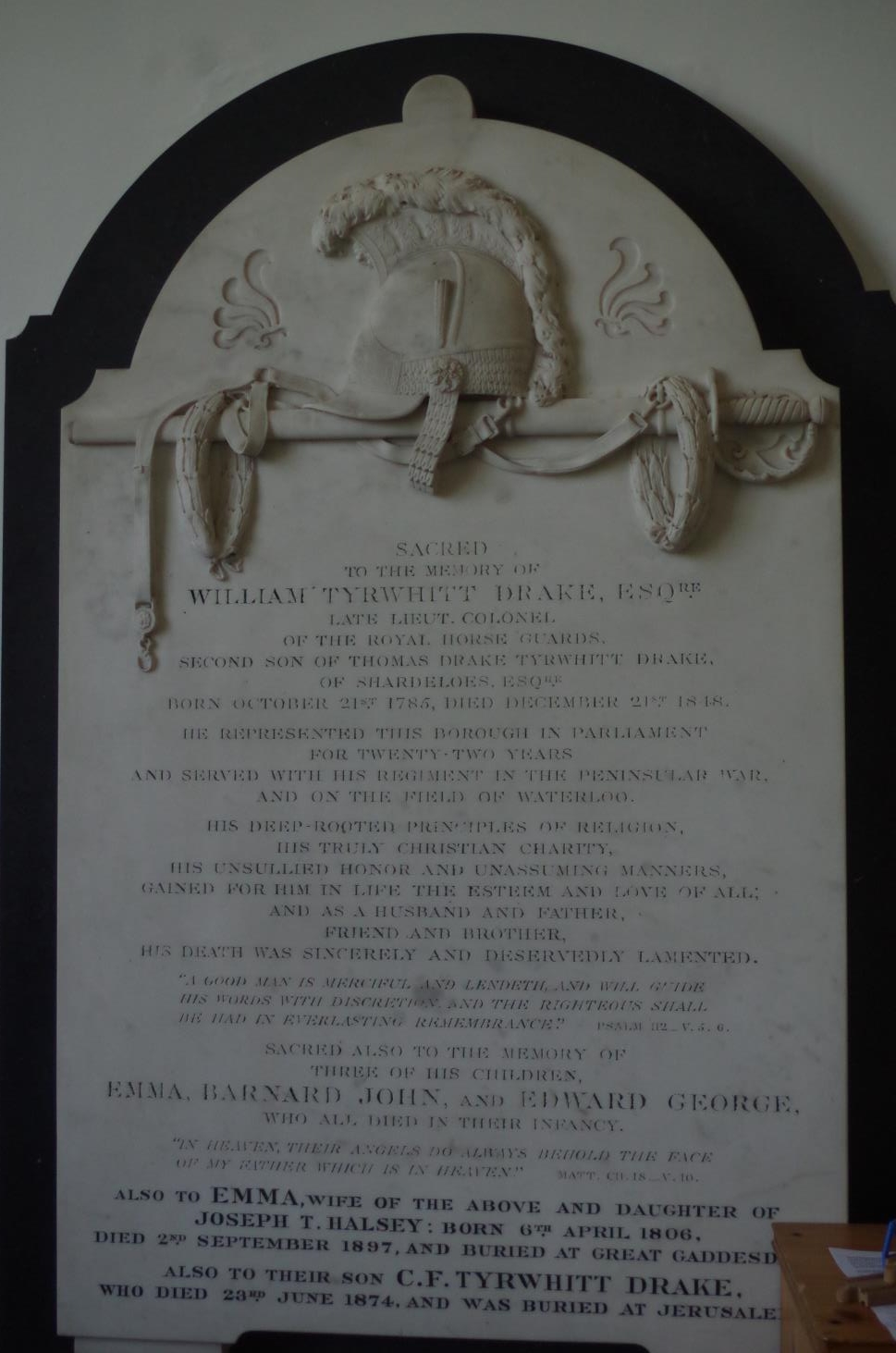
It seemed appropriate that in; this Waterloo bi-centennial year that there was a Waterloo veteran, William Tyrwhitt-Drake, who was commemorated.
A memorial to a Waterloo veteran copyright Carole Tyrrell
Note the laurel wreaths suspended from his sword indicating victory, eternity and immortality. He also has his helmet carved onto it.
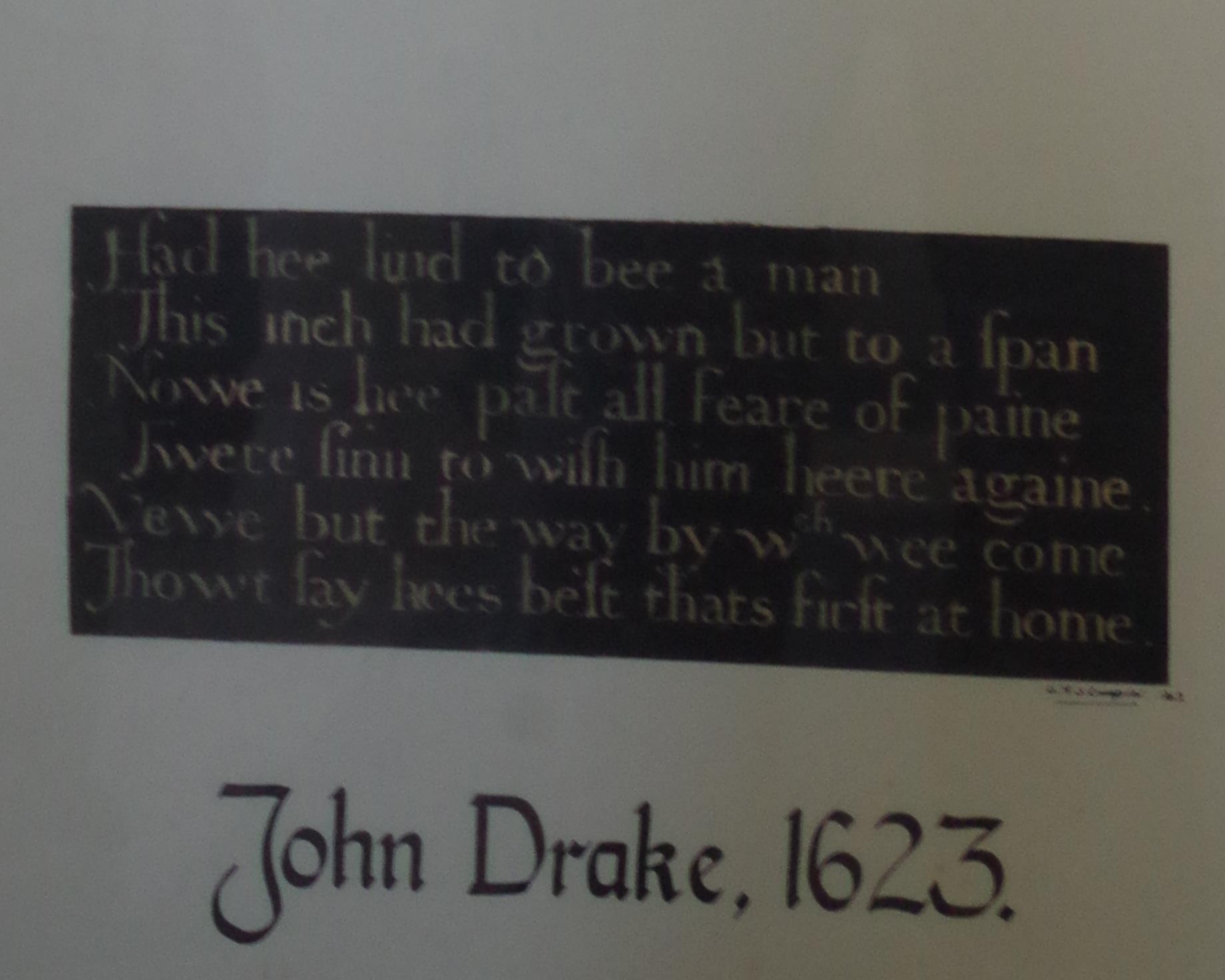
Howard kindly showed us an unusual monumental brass to John Drake, a child who died aged 4 in 1623, with a moving epitaph:
Had he liv’d to be a man
This inch had grown but to a span
Now is he past all fear of pain
It were fine to with him here again
View but the way by which we all come
Thought by he’s best that’s first home.
The poignant brass memorial to a child. copyright Carole Tyrrell
Howard had been inspired to read our Symbols guide on the FONC website and pointed out downturned torches and also the pelican and her babies. She strikes her breast with her beak to allow the young to feed on her blood to prevent starvation and this is a symbol of Jesus giving his life to his followers.
Two interesting symbols on this memorial. copyright Carole Tyrrell
There is an elegant turn and, to the right hand side, a pelican feeding her babies.
On the 16 year old Elizabeth Drake’s memorial is a hen and her chicks which was a more unusual one.
Elizabeth Drake’s memorial with mourning woman and hen copyright Carole Tyrrell
There was also a magnificently carved weeping willow, a dove with an olive branch and poppies. On William Drake’s memorial was an exquisitely carved mourning woman with the signature John Bacon Jnr. We wondered if this was the same John Bacon who worked on St Pauls Cathedral.
A mourning woman attributed to John Bacon. copyright Carole Tyrrell
The memorials took us through the centuries from the 18th to the 20th and they became smaller and plainer as we did. The Drakes and Drake-Tyrwhitts could afford the best sculptors. Interments in the Room continued until the death of Thomas Tyrwhitt-Drake . In 1811 the room was enlarged and doubled in size. Interments into the vault continued until the early 20th century.
Several of the FONC party climbed the narrow and dark stairs to the top of the church tower to admire the views of the surrounding countryside before we thanked Howard and continued on our visit.
‘The Drake Chapel, containing many memorials to the family is one of the finest examples of its kind in the county, second only to that of the Dukes of Bedford in Chenies Church and is well worth a visit if you’re in the area.. It is open on Sunday mornings after the 10.15am service, or by appointment via the Parish Office.’ http://stmaryschurchamersham.com/history
Originally published in Friends of Nunhead News, 2015
Part 2 to follow in which you find out why there is a monument to the Amersham Martyrs in the corner of an English field………
An Amersham barley field with a sinister secret? copyright Carole Tyrrell
An angel in the snow from a Victorian cemetery copyright Carole Tyrrell
This angel is in Elmers End cemetery which is in Beckenham, Kent, UK. It’ s very close to my home and is the last resting place for several well-known figures. These include the renowned cricketer, W. G. Grace and Thomas Crapper who invented the flushing toilet. There is also a life-size figure of a First World War soldier and a small pond in the remembrance gardens which attracts dragonflies and has beautiful water lilies in the summer.
Thank you for your comments and observations on the blog and I hope you’ll visit in 2016
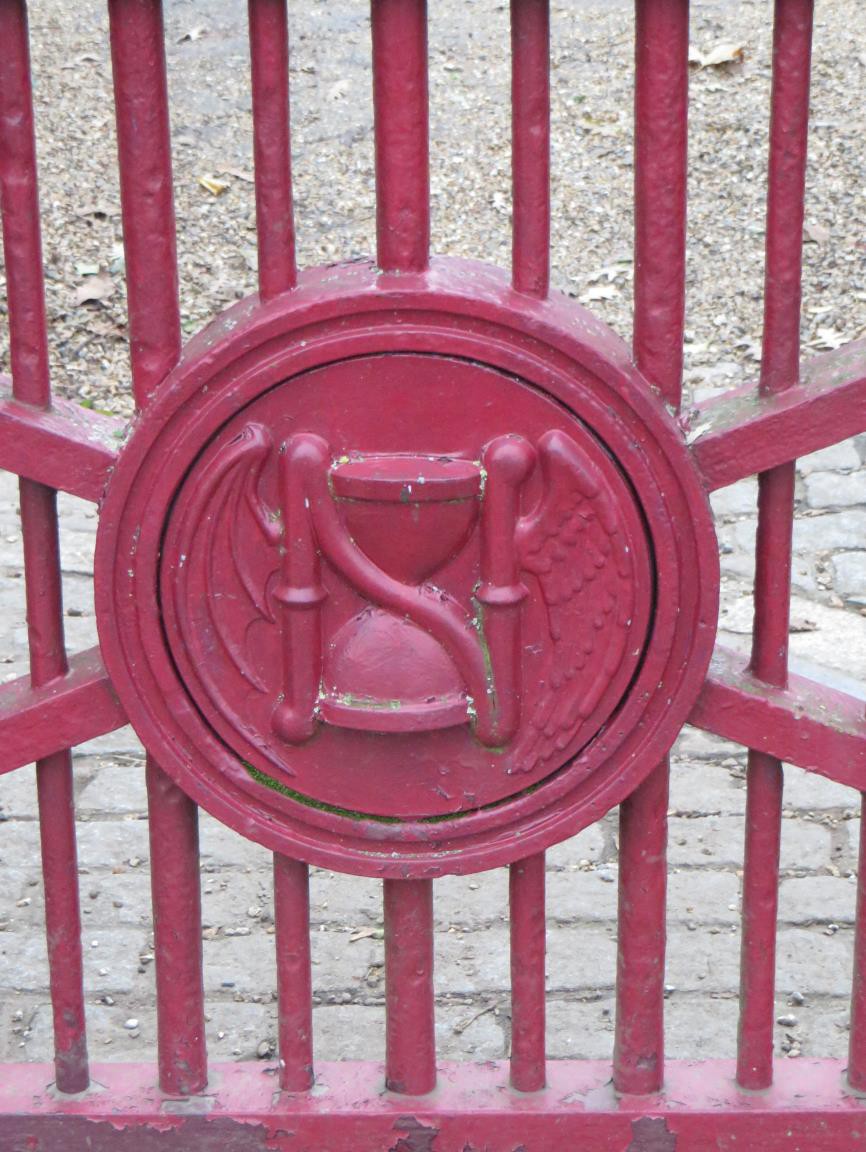
A splendid, modern example of a winged hourglass . copyright Carole Tyrrell
Nowadays, most people associate the hourglass symbol with the irritating little symbol on your computer screen that announces that the PC or laptop is thinking about doing something or the one that times the boiling of your egg to boil. It’s a traditional symbol of waiting nowadays.
But an hourglass, sometimes with wings, on a tombstone is different. Instead, it’s a reminder of mortality in that the ‘sands of time’ have run out. A winged hourglass reminds us that time waits for no-one as time flies literally. It can often be seen in vanitas paintings as a reminder that life is fleeting, that time is passing rapidly and that every day, one comes closer to death.
Philppe de Champaigne Vanitas, 1671
Still Life with Skull ‘Life, Death & Time’
Vanitas, from the Latin for vanity, is a genre of art that flourished in the Netherlands during the early 17th century. It’s a particular form of still-life and contains collections of objects that are symbolic of the inevitability of death, the transience of life and vainglory of earthly pursuits and pleasures. The viewer is invited to look at the picture and to be reminded of their own mortality. They also provided a moral justification for painting attractive objects. As in much moralistic genre painting the enjoyment evoked by the sensuous depiction of the subject is in a certain conflict with the moralistic message. Vanitas pictures evolved from earlier simple paintings of skulls and other symbols of death which were frequently painted on the back of portraits during the late Renaissance. It’s height of popularity was from 1620 – 1650 and was centred in Leiden in the Netherlands, Flanders.
Very few vanitas picture contain figures; instead they contain certain standard items. These are: symbols of arts and sciences (books, maps, and musical instruments), wealth and power (purses, jewellery, gold objects), and earthly pleasures (goblets, pipes, and playing cards); symbols of death or transience (skulls, clocks, burning candles, soap bubbles, and flowers); and, sometimes, symbols of resurrection and eternal life (usually ears of corn or sprigs of ivy or laurel). And of course hourglasses to reflect the passing of time and the need to make the most of it. Objects were often tumbled together in disarray, suggesting the eventual overthrow of the achievements they represent.
However, Douglas Keister, author of Stories in Stone, has suggested another, bolder interpretation. ‘The hourglass can also be turned over or inverted over and over again which symbolises the cyclic nature of life and death, heaven and earth.’ Inversion can be seen as the interplay of opposites in death giving rise to life and vice versa. ‘
In fact it wasn’t until I started researching for this piece that I realised how many interpretations the hourglass symbol could have. Pirates are reputed to use it on their flags as a warning that their time, or lives, were about to run out, to scare their victims and enemies. Hourglasses were often placed in coffins. They can also feature in tattoos especially in prison where a tattoo of an hourglass can mean no parole.
There is also an association with old movies in that the hero/heroine has one span of the sad in which to make a decision or rescue. The dramatic turning over of the great hourglass down to the spiralling of that last grain of sand adds to the mystery and drama.
A quick online search revealed masonic and spiritual associations. 2 saints are pictured with hourglasses; St Ambrose and St Magdalene. And Chronos, the personification of time, is also associated with it. But always with the same connotation of time passing and the need to be aware that life is fleeting and to make the most of it. The Grim Reaper or Death when depicted as a skeleton often holds an hourglass with his scythe.
The splendid example at the top of this page is on the roundels on the Linden Grove entrance gates to Nunhead Cemetery. This is one of London’s Magnificent 7 Victorian cemeteries. They were created and cast by Robert Stephenson who is a lecture on death and funerary commemoration and is also known as ‘Dr Death’.
Sources:
How to read symbols, Clare Gibson, A C Black, 2009
A Guide to the Grave Symbols in Nunhead Cemetery, Ron Woollacott, FONC Publications, 2004, republished 2006.
Stories in Stone – A Field Guide to Cemetery Symbolism and Iconography, Douglas Keister, Gibbs Smith, USA 2004
An Illustrated Encyclopaedia of Traditional Symbols, J C Cooper, Thames & Hudson, 1978
Although very much a controversial figure to some, the red fox or Vulpes Vulpes, its Latin name, has increasingly moved into towns and other urban areas. Like Marmite, you either love them or loathe them. I think you can guess which side I’m on.
However, as the concrete sprawl reaches out further and further their habitat grows smaller and they move into our territory as we moved into theirs.
About 10 or 15 years ago it was unusual to see foxes in towns but now it’s almost commonplace. Increased access to ready food sources such as takeaways etc mean that they know when a quick meal is easily available.
I myself have seen dozing foxes very close to railway lines and once had the privilege of seeing a vixen shepherding her little cubs, still in their dark brown coats, along a tram platform in SE London.
I saw this particular fox in a large central London Victorian cemetery over 2 weekends in October 2015. He didn’t seem to be too bothered about being in the presence of nearby humans and I managed to get up reasonably close to him.
Here’s looking at you copyright Carole Tyrrell
But, on the second weekend, he did start becoming agitated about being pursued by photographers. I really felt sorry for him when a small dog started chasing him whilst barking furiously and, as he ran for shelter, hearing the dog’s owner say loudly ‘That fox is a coward’ Presumably if the fox had turned and retaliated then he would have been seen as the aggressor.
Urban nature can be very random. Earls Court was only 10 minutes walk away and the busy Kings Road a short bus ride from one of the entrance gates. To see a fox so near to the centre of London was quite a surprise.
The skull and crossbones symbol is a ‘memento mori’ which is Latin for ‘Remember that you have to die’ or ‘Remember that you are mortal.’ It’s a reminder of the temporary, transient nature of human life. We are all born to die and should try to make the most of life.
The skull and long bones crossed together are the survivors after death along with the other bones as they are the body parts that survive after the flesh has gone. It originated in ‘The Danse Macabre’, a medieval European allegory, in which the universality of death invites everyone, from all walks of life, to dance along to the grave. They are often accompanied by a pope, emperor, king, child, or
The Danse Macabre Nobleman and Physician from the Lübeck Totentanz courtesy UT Southwestern
labourer as key symbols and people. It was intended to remind people of the fragility of their lives and that earthy glories were i n vain. Skeletons lead them to their death. The images of the Danse Macabre were not only reminders of the ultimate fate for us all but they were often humourous as well. But its most powerful theme is of death’s indiscriminate nature. In the Danse, Death wears many faces, as he brandishes his scythe, sounds the death toll bell or plays a violin – he is a friend as well as the inevitable.
The skull and crossbones was also a reminder that, on the Day of Judgement, the bones and skull would attach themselves together and the deceased would be able to walk again.
This symbol has appeared in other, more ancient cultures such as the Mayans. This example comes from Mexico.
The skull and crossbones was also appropriated in the 18th century by sea pirates and rechristened as The Jolly Roger. This emphasises the skull’s eternal wide open grin. There are also military connections and also counter culture with Hells Angels etc claiming it for their own. According to blogger, Amy Johnson Crow, there is also a Christian connection as she claims that the crossed long bones resemble the Christian cross.
The skull and crossbones is one of the most potent and universal symbols that has come down through the centuries. It will always remind us that the skull looking back at us reveals our own ultimate fate. Sources:
Wikipedia
‘Death’ Richard Harris, Wellcome Collection
An Illustrated encyclopedia of traditional symbols, J C Cooper, Thames & Hudson, 1978
UT Southwestern Digital Services website
Text and photos copyright Carole Tyrrell unless indicated otherwise.




















 shadows fly away