From West Norwood cemetery copyright Carole Tyrrell
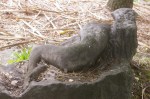
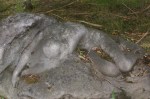
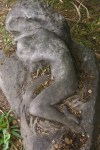
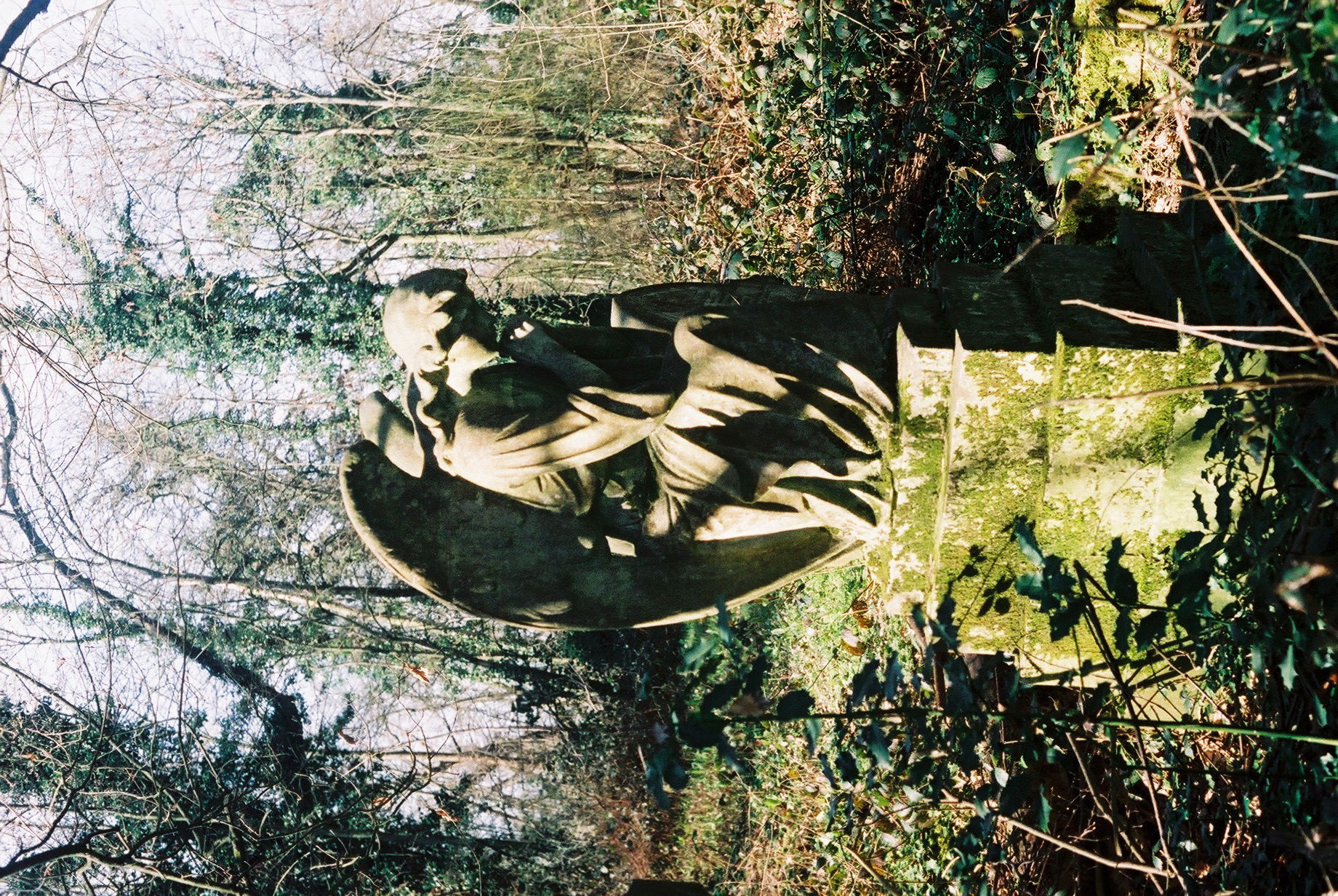
This is the voluptuous, but homeless, mourning woman of West Norwood cemetery. I first noticed her on a visit in 2013 when I found her under bushes in the front courtyard of the cemetery. I was immediately intrigued. After all, It’s not every day that you find a naked woman on her own with no identification. I emailed Colin Fenn of the Friends of West Norwood Cemetery and he was kind enough to reply that no-one knew which grave or memorial she had originally belonged to.
This was because. in 1965. Lambeth Council made a compulsory purchase of the cemetery. Like the others in London’s Magnificent Seven cemeteries, the cemetery company that owned had gone bankrupt and left it to deteriorate. Lambeth then claimed ownership over the existing graves after extinguishing past rights. But even worse, they then embarked on a ‘lawn conversion’ which was a euphemistic term for a drastic and catastrophic clearance of the cemetery. As we know, some councils are very keen to make it easy for their parks and gardens department to mow round tombstones etc cemeteries and so they embarked on a free-for-all. Memorials, monuments, statues, – all were cleared away and smashed beyond repair. From old postcards it can be seen that the cemetery was heavily populated with weeping angels, crosses, mausolea, etc and it has been estimated that up to 10,000 monuments including some of the listed ones. The cemetery had been closed to new burials as it was full but Lambeth didn’t let this deter them and so they restarted new burials by reselling existing plots for re-use. As a result, the new burials were stopped and a handful of the damaged or memorials had to be restored. Lambeth were also required to publish an index of cleared and resold plots so the descendants of historic owners can identify and request restitution of their family’s plot.
But this poor lady has lost her place in the cemetery. She obviously had a place on which to grieve somewhere on the cemetery once but not now. She has a slightly Art Nouveau look about her so she may date from the turn of the century, perhaps around 1900. We are lucky that she hasn’t been stolen altogether as in other cemeteries.
Since then she has moved again, further inside the cemetery near the entrance which is where this photograph was taken.
And so she is condemned to grieve and mourn, now an anonymous memorial, a eternal symbol of sadness.
Acknowledgement: Wikipedia and Colin Fenn.
Text and photo copyright Carole Tyrrell
Update:
I was going through my memory cards recently and found some more photos of this lonely lady when she had been placed on the lawn at the front entrance of West Norwood cemetery.
The back view of her.
copyright Carole Tyrrell
A view of this lady when she was on the front lawn of the entrance.
copyright Carole Tyrrell
View from Venice across the lagoon to San Michele. copyright Carole Tyrrell
As the boat neared San Michele, the gleaming white walls of San Isola came into view, almost as if it was floating on the water. An elderly lady fellow passenger enquired as to my reason for being the only person disembarking at the Cimiterro stop. The crowded waterbus quickly sped away on its way to Murano, the glassmakers island. Then I entered the place where the dead rule, where silence is absolute and there was a strong sense of ‘Enter if you dare’.
The hurly burly of San Marco was far behind me as the atmosphere of San Michele, the true Isle of the Dead surrounded me. Once away from the crowds the streets were deserted under the glaring sun. De Chirico images seemed to around every corner. I had been able to see San Michele’s high walls and tall cypress trees from the Fondamente Nuovo quayside on the main island. I wasn’t sure if they were to keep the living out or the dead in.
San Michele is the closest island to Venice and was a former fishing port. Its creation was, like London’s Magnificent 7 Victorian cemeteries, a response to overcrowded city graveyards which resulted in Napoleon issuing a decree on burials. Due to the lack of space most burials are disinterred after 12 years and taken to the ossuary island of Sant ‘Angelo. However its most famous residents,Stravinsky, Ezra Pound, Diaghilev and Joseph Brodsky all most definitely rest in peace. Venice has two cemeteries; San Michele mainly for Protestants and Catholics and a Jewish one on the Lido.
San Michele Isola church copyright Carole Tyrrell
Coducci designed its grand Renaissance church, San Michele Isola, which was the first one built in Venice and commissioned by Franciscan monks in 1469. The monastery on the island was established in the 10th century and was extremely successful and wealthy. The cloister and funerary chapel still remain and more recently political prisoners were housed in the now former monastery.
There were only a few other visitors exploring and it seemed as if every inch of space had been utilised. There are wall graves, conventional graves and huge columbariums with their contents placed in large drawers stacked on top of each other. The effect is rather like a succession of filing cabinets.
A memorial in the columbarium. copyright Carole Tyrrell
It was difficult to navigate my way around as there didn’t seem to be any site plans or maps visible and I wandered into the main part and was surprised by how the monuments and mausolea stretch on into the distance. Poppies brightly stud the grassy gaps between them. On November 1, All Soul’s Day, chrysanthemums, the Italian flowers of the dead, are everywhere on the island. Diaghilev and Stravinsky lie in the Greek and Russian Orthodox sections and Ezra Pound is in the Evangelic or Protestant part. Jan Morris, the travel writer, has written of being enchanted by the island’s ‘seductive isolation’ and it is absolutely silent here. The only sounds during my visit was the water lapping at the steps of a three window doorway and a fight between what sounded like a cat and a seagull on the other side of one dividing wall. I could almost understand the claim that tourists commit suicide in Venice just so they can be buried on the island. An Englishman from Staffordshire is said to have ‘left us in peace Feb 2 1920.’
In many ways it’s very like a British Victorian cemetery with its carvings and statues of mourning women and sorrowing angels. One wall grave had putti or cherubs holding flowers as decoration. One seemed to be screwing his eyes up against the sun even though his luxuriantly carved locks cast a shadow
Putti or small cherubs on a large wall monument. copyright Carole Tyrrell
A mourning woman in beautifully carved robes, her hand clasped around her face as if she had toothache stood by a grille as if waiting to be admitted to a seedy club.
A mourning woman. copyright Carole Tyrrell
In the columbarium Elisa Marcosanti’s columbarium drawer is decorated by putti with oddly awkward legs to ensure that they fit into the space.
Another columbarium memorial copyright Carole Tyrrell
Venice has always been celebrated for its mosaics and the Mazzega memorial boasted a particularly lovely example in a portrait of the deceased.
An older mosaic on a monument dating from the 19th century. copyright Carole TyrrellA modern mosaic on a memorial. copyright Carole Tyrrell
There didn’t seem to be the same quality to more contemporary examples which looked amateurish in comparison in my opinion. A huge statue of a woman in a hooded robe stood in the centre of one section and looked as if she was clutching her stomach in pain.
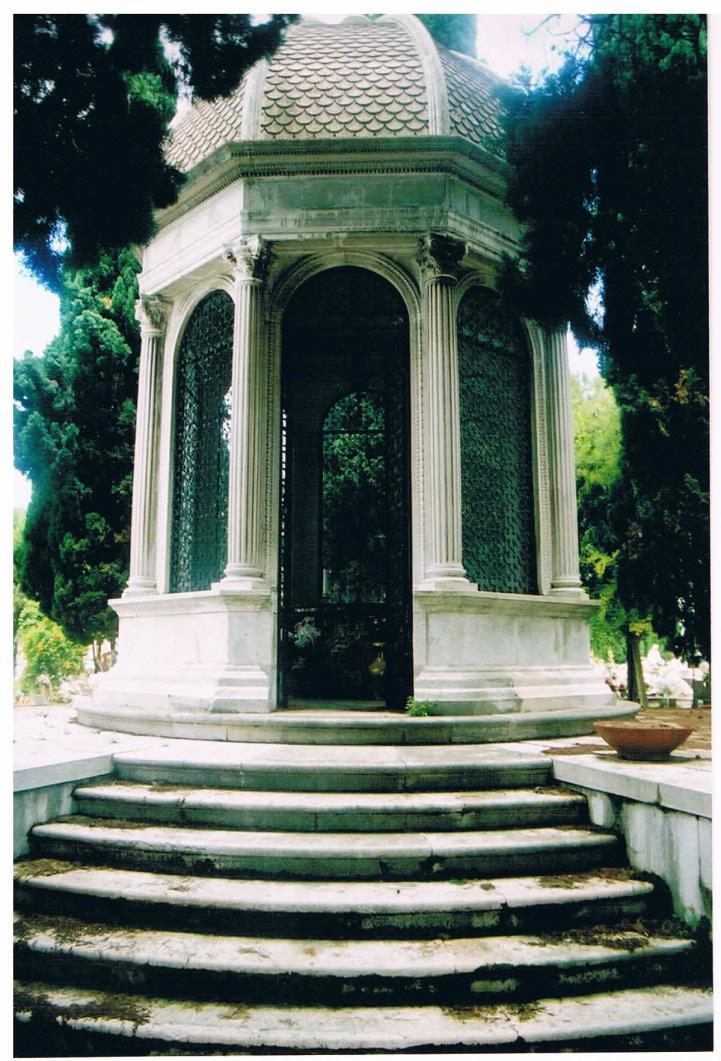
As I wandered amongst the tightly packed memorials and monuments looking for the famous incumbents I came across a plain little mausoleum with its own set of steps leading up to it. The couple coming towards me seemed oblivious to my presence and so I ventured inside. There was an ornate and painted table with candles, a crucifix, small statue of St Anthony and cards and envelopes. There was no indication as to whom it commemorated, no family name and , as I felt I was intruding I crept away.
A mausoleum which had an open door. copyright Carole TyrrellThe altar inside the mausoleum. copyright Carole Tyrrell
A sculpture of a couple kissing mystified me; was it Death and the Maiden or the departed saying goodbye to the sorrowing mourner? Certainly the figure of Death looked female…
A large female statue gazing heavenwards. copyright Carole TyrrellAn angel that appears to be floating in thin air. copyright Carole TyrrellAnother view over the cemetery. copyright Carole Tyrrell
…
A view along one of the paths in San Michele copyright Carole Tyrrell
But San Michele didn’t feel crowded and I wouldn’t agree that the statues and memorials are grotesque as one writer stated. Some of the larger statues were very plain. A huge statue of Gabriel, looking like a piece municipal architecture, dominated an area as he held his trumpet on one hand and looked hopefully skyward. He looked as if he’d been bought off the peg compared to the riot of angels, Franciscan friars, angels and weeping women. As I explored further I came across a stack of numbered concrete posts and photographs which I assumed came from disinterred burials.
Pile of photos taken from memorials. copyright Carole Tyrrell
There was so much to see in San Michele and I was aware that I only saw a fraction of it due to lack of time. I never found any of the famous incumbents as it was easier to let my feet and camera wander where they wanted to. The cloister also eluded me but on a return visit….
As the waterbus sped away back to the mainland I saw a modern sculpture in the waters of the lagoon. It seemed to portray St Peter on a boat afloat on the waves. From the quayside San Michele vanished behind it s anonymous walls again and you could easily pass it by with no idea of what its purpose was. I hope to make a return visit one day and wander once more amongst the silent mourning women to look out through the triptych window out onto the ceaselessly flowing water and hear nothing but the waves.
A large Venetian window looks out onto the water. copyright Carole Tyrrell
All images are scans from prints from films.
All images and text copyright Carole Tyrrell
First published in Friends of Nunhead Cemetery quarterly journal.
Please let me know what you think and check out Loren’s blog as well.
My involvement with cemeteries changed my life for the better – I made new friends, got involved with heritage and conservation and came to appreciate the beauty of many of the memorials and the poignancy of their epitaphs. These people had lived and loved and their friends and family wanted to remember them forever. My involvement with Nunhead Cemetery has been over 25 years no wand I still find new things to see.
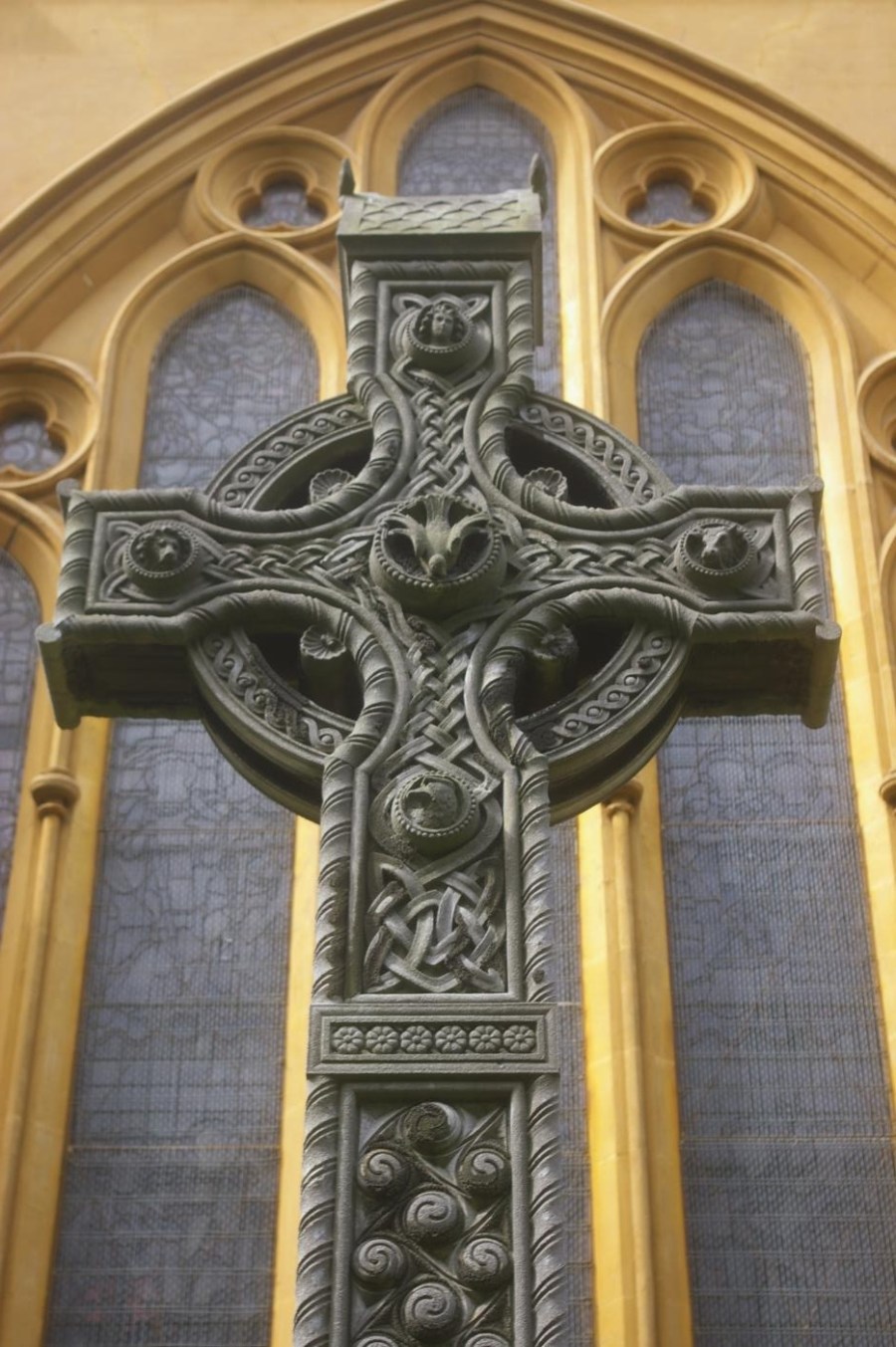
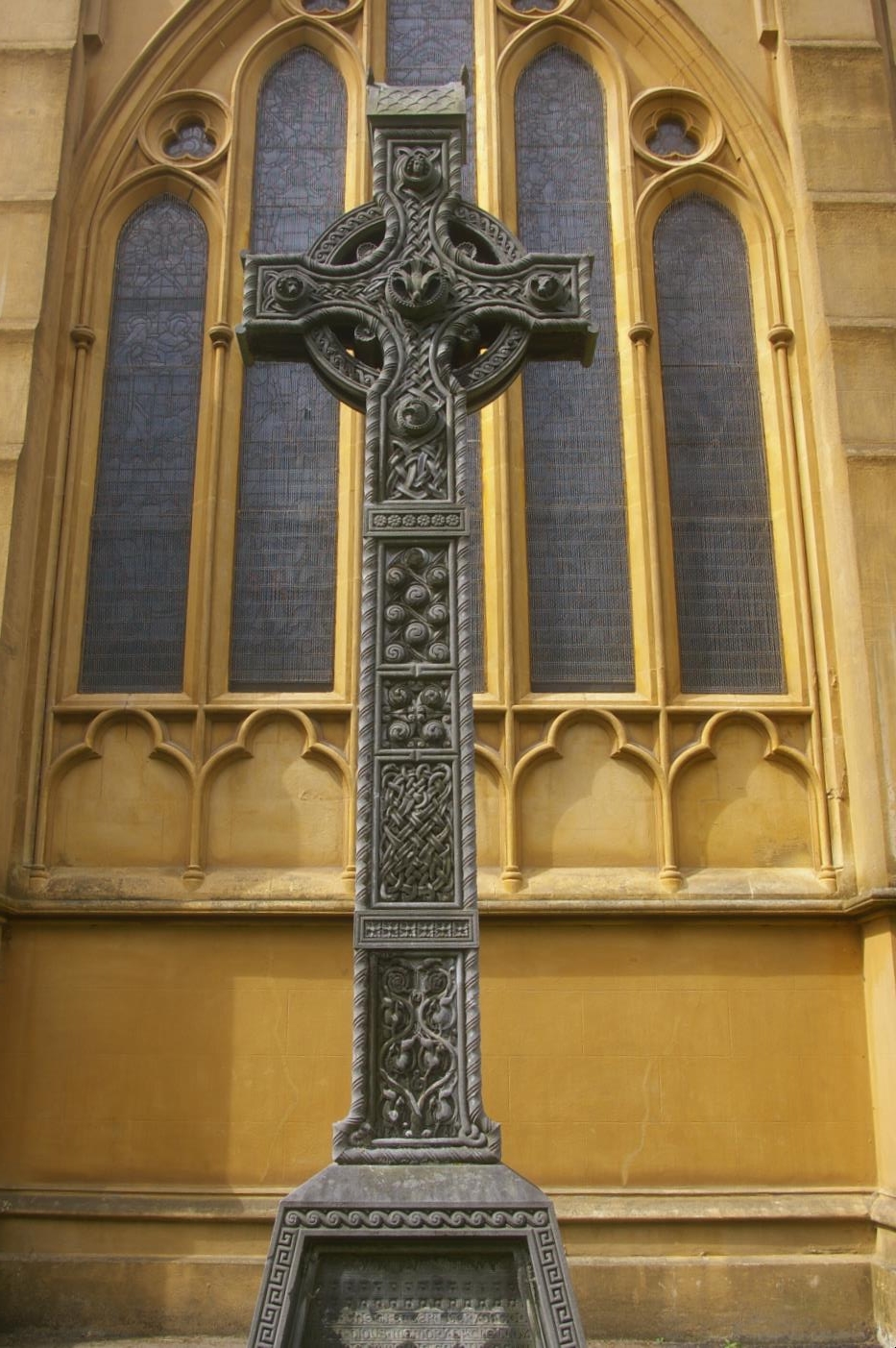
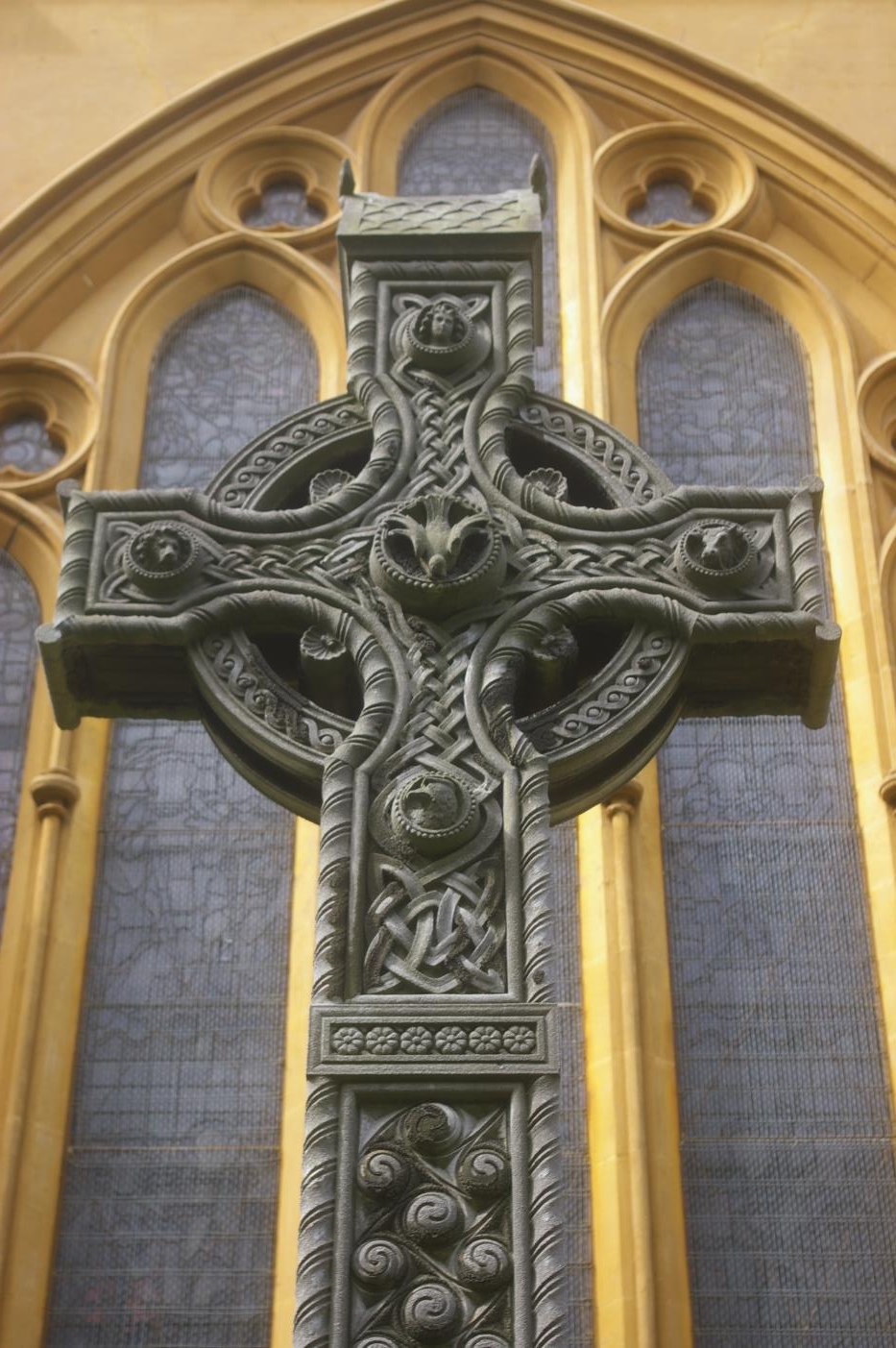
This beautiful and large Celtic Cross was found in St Margarets Churchyard in Lee, SE London. I had been exploring the old St Margarets churchyard which is across the road. This contained the original St Margarets church, now a ruin, and some very interesting tombstones and memorials.
But the current St Margarets is a large Victorian building with some very colourful 19th century stained glass and, more unusually, beautiful wall paintings. These are pre-Raphaelite in style and well worth seeing if you’re in the area and the church is open. St Margarets also has windows made from pieces of broken stained glass which gives a jigsaw effect and kaleidoscope patterns on the floor when the sun shines through.
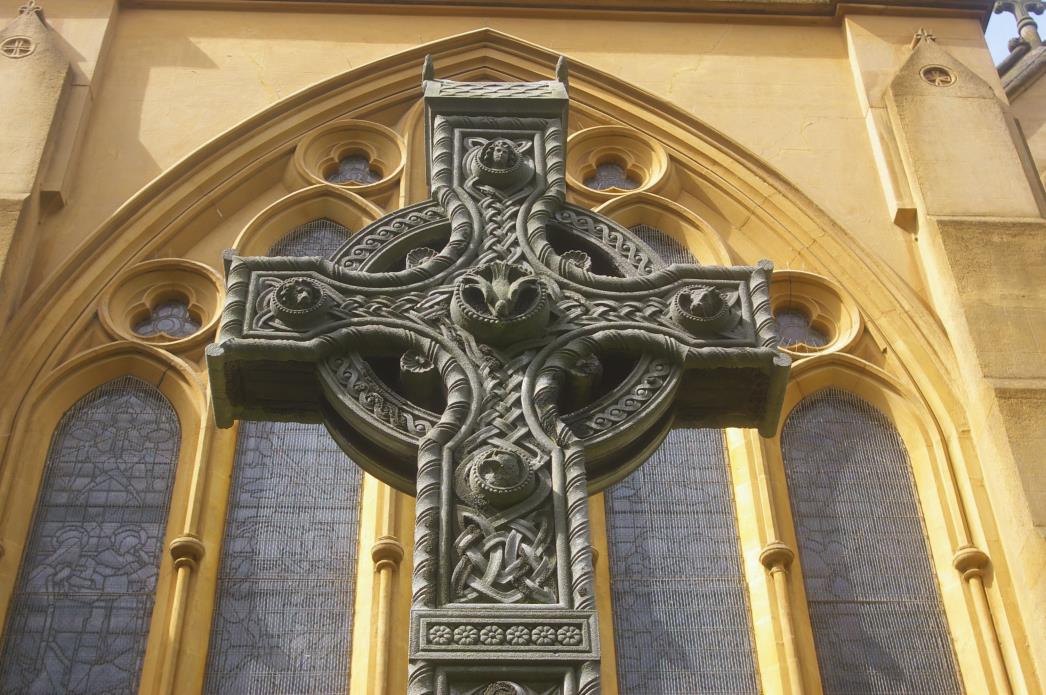
This memorial is a Celtic Cross in style and a symbol of the Arts & Crafts movement that was popular from 1880-1910 when there was a Celtic revival. The epitaph is written in curvy Art Nouveau writing and was well worn which rendered it virtually indecipherable. All I could make out was that it was in memory of a deceased wife. This was a real pity as I would have liked to have known more about the person who was buried there.
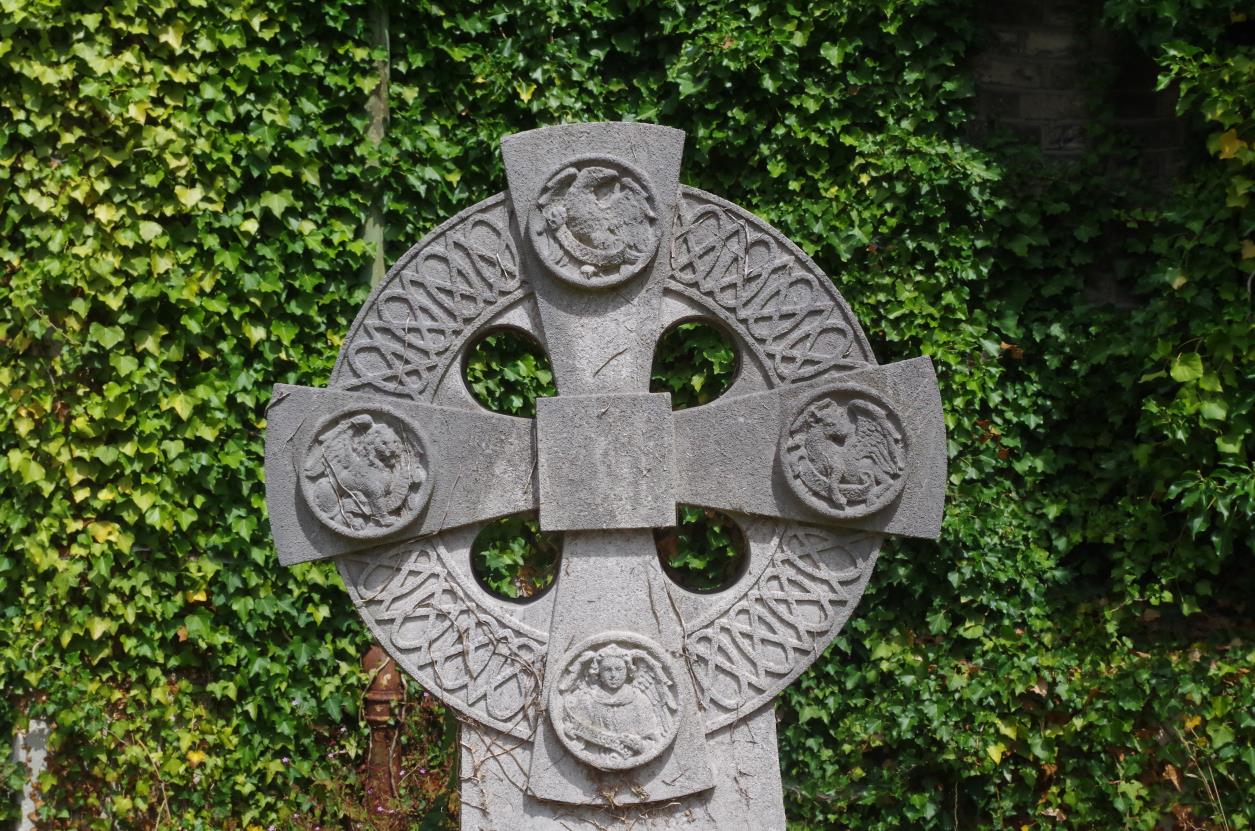
A closer view of the memorial .Copyright Carole TyrrellThe for symbols of the Evangelists in each corner Copyright Carole Tyrrell
I noticed the four symbols; one on each corner of the cross within the wheel. An ox, an eagle, a lion and an angel.. I’d never previously seen this combination on a funerary monument and thought, in my ignorance, that it might have meant that the deceased had loved animals.
But, after posting my photos of the memorial onto The Cemetery Club Facebook page a fellow member, Connie Fairchild, replied saying that she thought that the symbols might represent the four evangelists. She was kind enough to post a link to a relevant site which was enormously helpful.
The four symbols are:
Human/Angel = Matthew
Lion = Mark
Ox = Luke
Eagle = John
These were the four canonical gospels with the for living creatures that surround God’s throne. In the Book of Revelations chapter 4: verses 5-11
‘Around the throne, and on each side of the throne, are four living creatures, full of eyes in front and behind .
Verses 4:7 Apocalypse of Revelation of John
‘…the first living creature, like a LION, the second living creature like an OX, the third living creature with a face like a HUMAN face, and the fourth living creature like a flying EAGLE.
The four living creatures are also mentioned in Ezekiel Chapter One verses 1-14, Ezekiel, Chapter 10, verses 1-22 and Daniel Chapter 7, verses 1-8. The creatures are also mentioned in other religious texts such as St Irenaeus of Lyons and St Augustine of Hippo.
Wikipedia has quite a lot to say on tetramorphs
‘The four symbols are also known as a tetramorph. This is a symbolic arrangement of four different elements. Tetramorph is derived from the Greek tetra, meaning four, and morph, shape. Also four forms or shapes.
In Christian art, the tetramorph is the union of the symbols of the Four Evangelists, the four living creatures derived from the Book of Ezekiel into a single figure, or more commonly, a group of four figures. The Evangelists portraits are often accompanied by the tetramorphs or the symbols often used to represent them. Each symbol can be described as a tetramorph in the singular, and a group as ‘the tetramorphs but usually only when all four are together. Tetramorphs were very common in early medieval art especially in illuminated Gospel books, They are still common in religious art up to the present day.
Other examples of the combination of different elements are the Sphinx in Egypt which has the body of a lion and the head of a human.’
The animals associated wit the Christian tetramorph originate in the Babylonian symbols of the four fixed signs of the zodiac; the Ox representing Taurus; the lion representing Leo, the eagle representing Scorpio; the man or angel representing Aquarius. In Western astrology the four symbols are associated with the elements of, respectively Earth, Fire, Water and Air. The creatures of the Christian tetramorph were also common in Egyptian, Greek and Assyrian mythology. The early Christians adopted this symbolism and adapted it for the four Evangelists as the tetramorph, which first appears in Christian art in the 5th century.’
I have also personally seen a tetramorph in Ely Cathedral.
So this is a deeply religious monument. The Cross and the evangelistic symbols are beautifully carved and it really stands out in the churchyard due to its size and position.
Since seeing this one I have found two more in Brompton Cemetery but not as well carved and, although large, not as imposing.
This was the nicer of the Brompton ones. Copyright Carole Tyrrell
The top of the mausoleum is just visible over the top of the high wall. Copyright Carole Tyrrell
An anonymous, high brick wall with a small green wooden door set into it would not alert a Twickenham visitor to the prize it conceals. You can glimpse something by just peeping over the top of the wall and behind the sheltering trees, but there’s a better view from the top of a double decker bus if you know where to look. if you do, then you will see one of the most unusual and enduring monuments to a 19th century love story in which the two lovers rest for all eternity. It is usually only open to the lucky few who tend its garden.
But once a year, during Open House weekend, the little green door in the high wall is opened to admit visitors into the secret sanctuary.
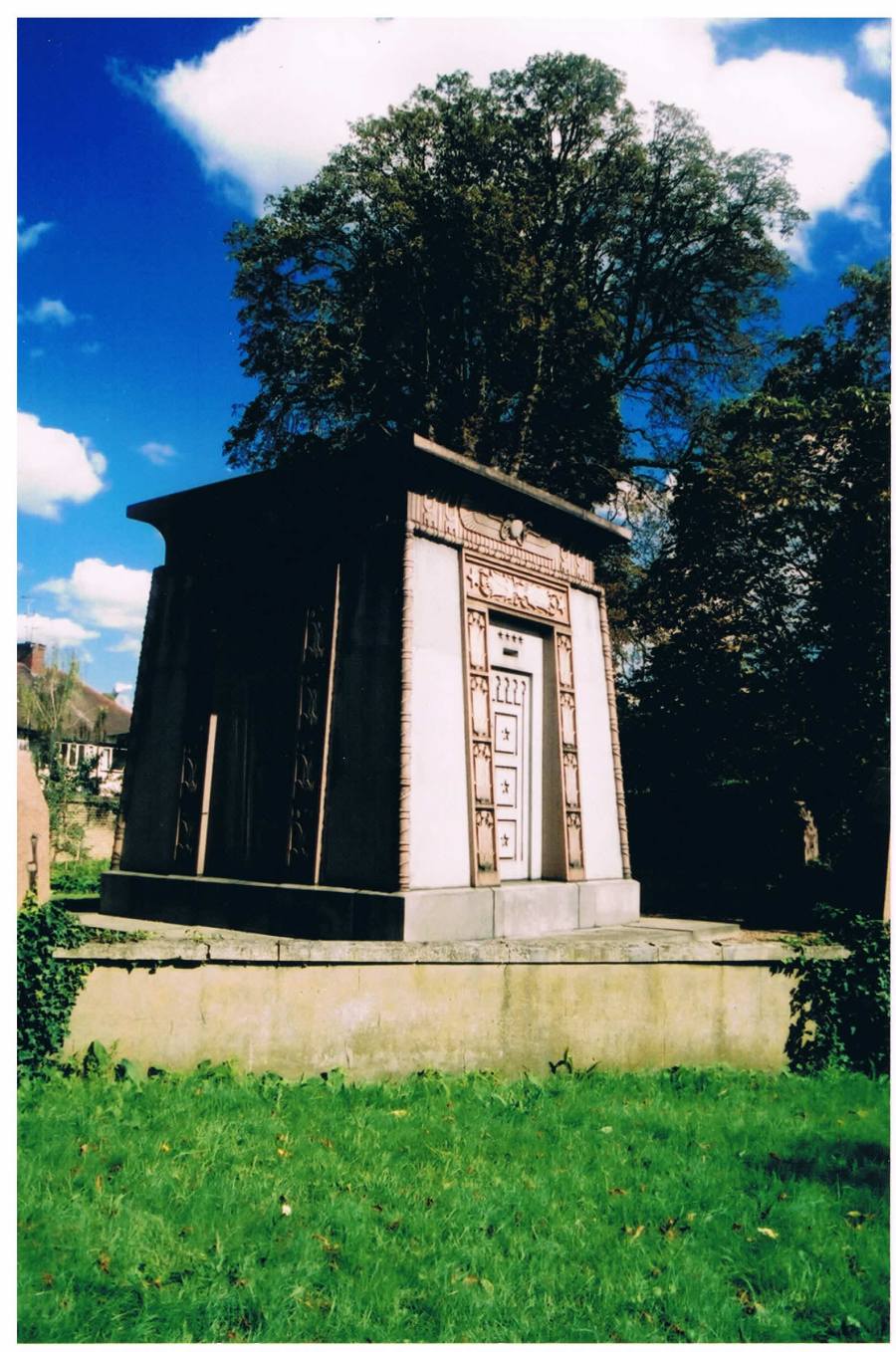
The mausoleum is built in the Egyptian style and in contrasting pink and grey graniteUnder the Heathrow flight path the incumbents slumber serenely on. Copyright Carole Tyrrell
An anonymous, high brick wall with a small green wooden door set into it would not alert a Twickenham visitor to the prize it conceals. You can glimpse something by just peeping over the top of the wall and behind the sheltering trees, but there’s a better view from the top of a double decker bus if you know where to look. if you do, then you will see one of the most it is only open to the lucky few who tend its garden.
But once a year, during Open House weekend, the little green door is opened to admit visitors into the secret sanctuary.
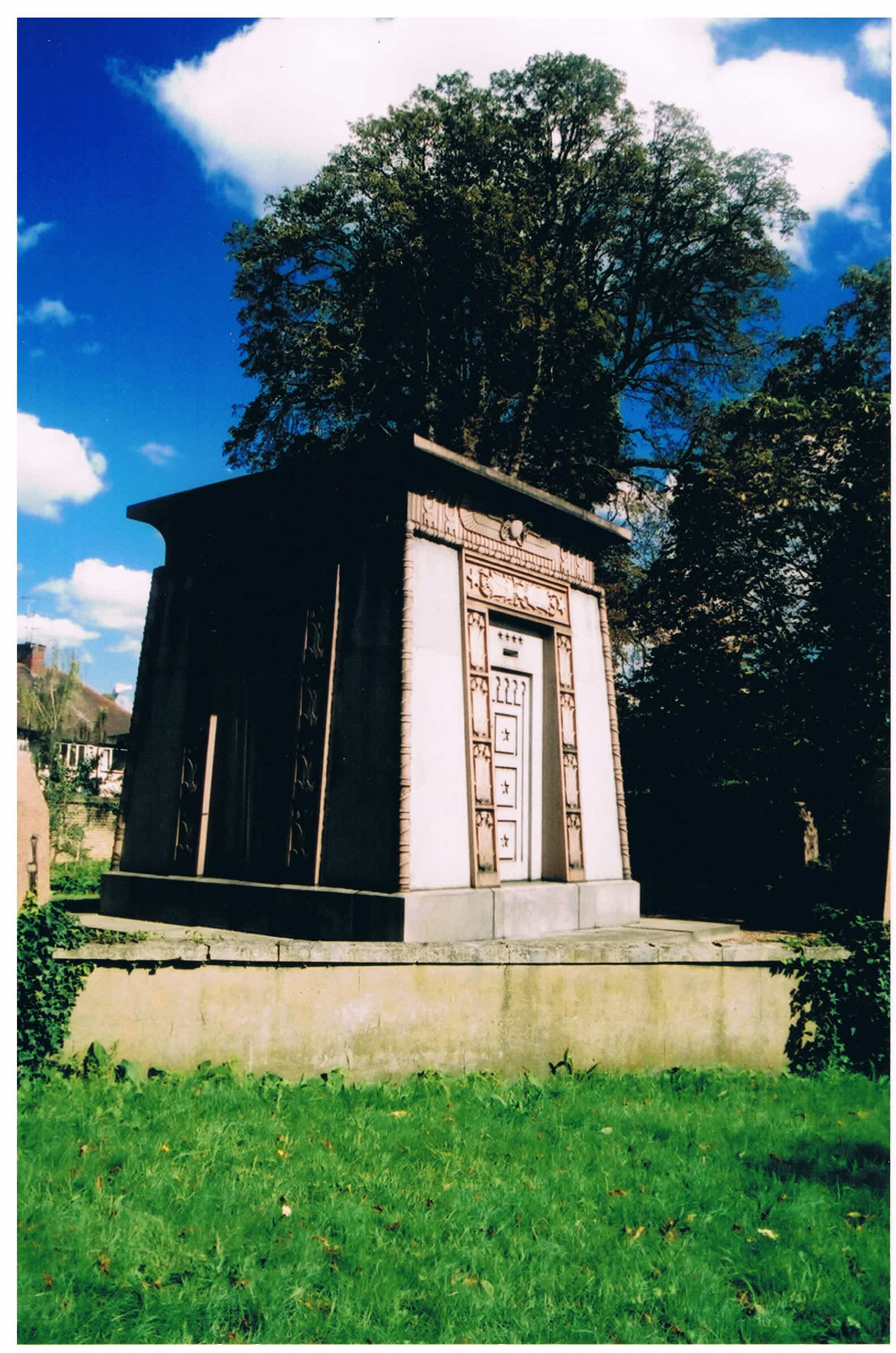
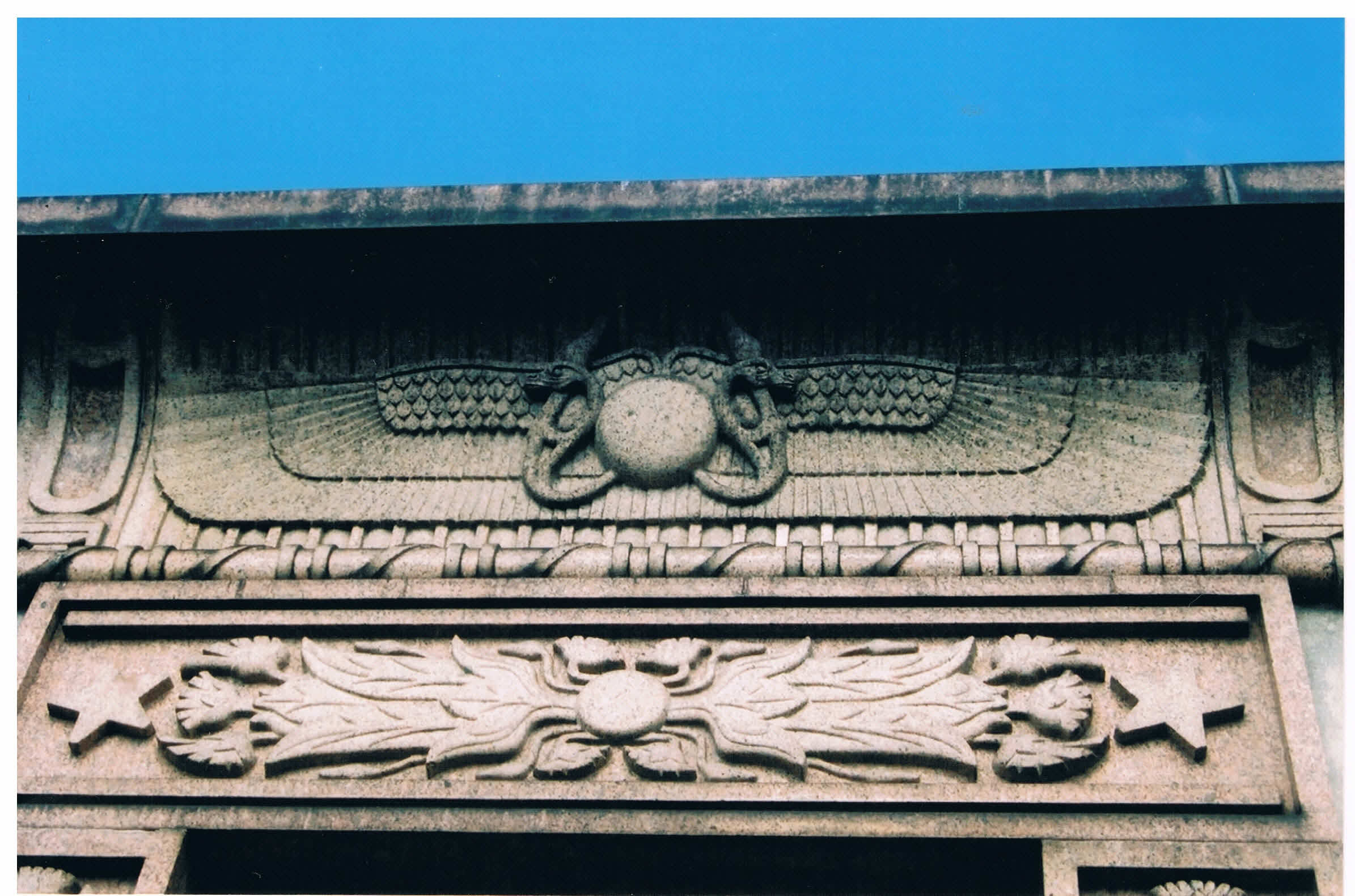
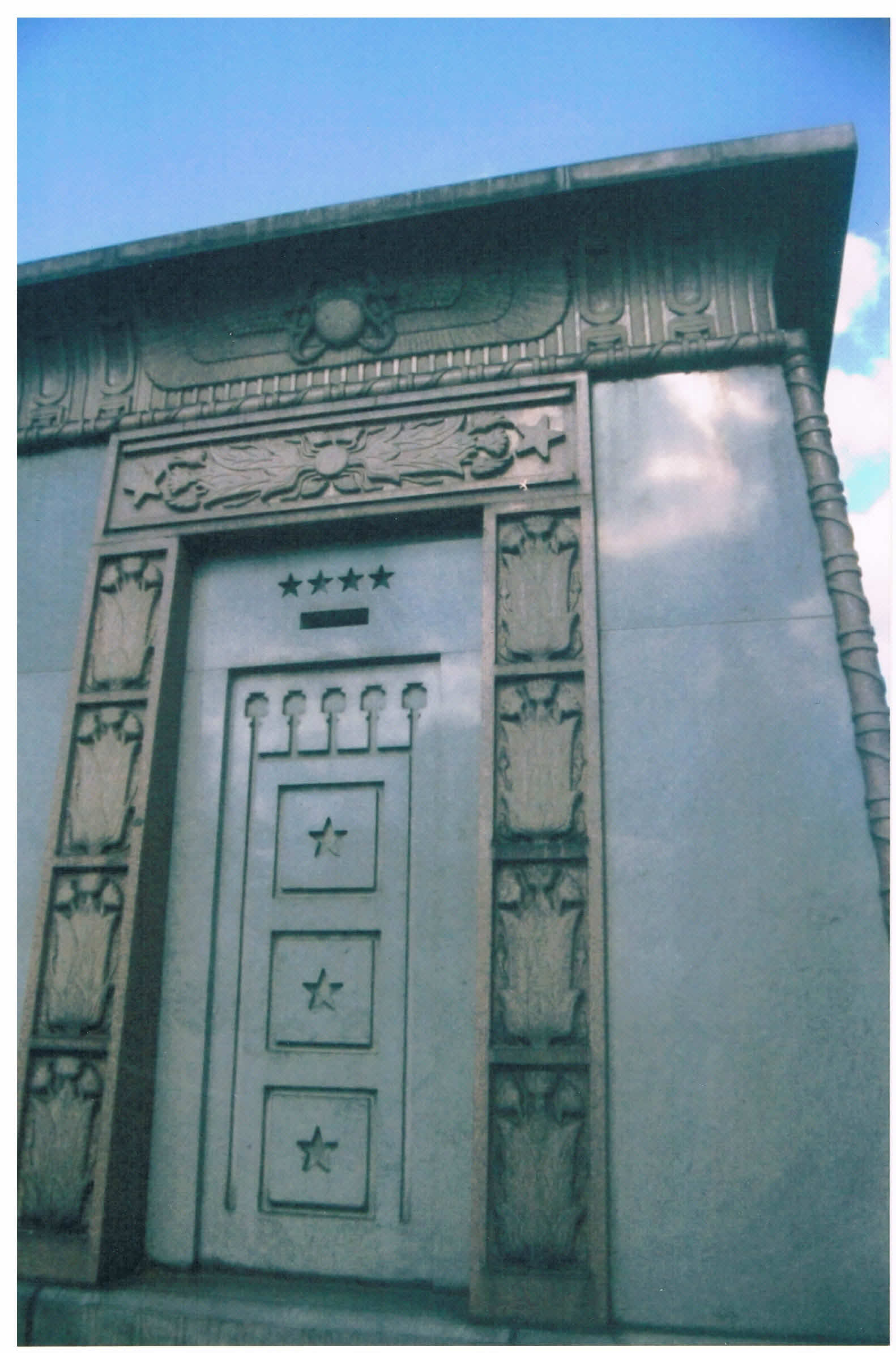
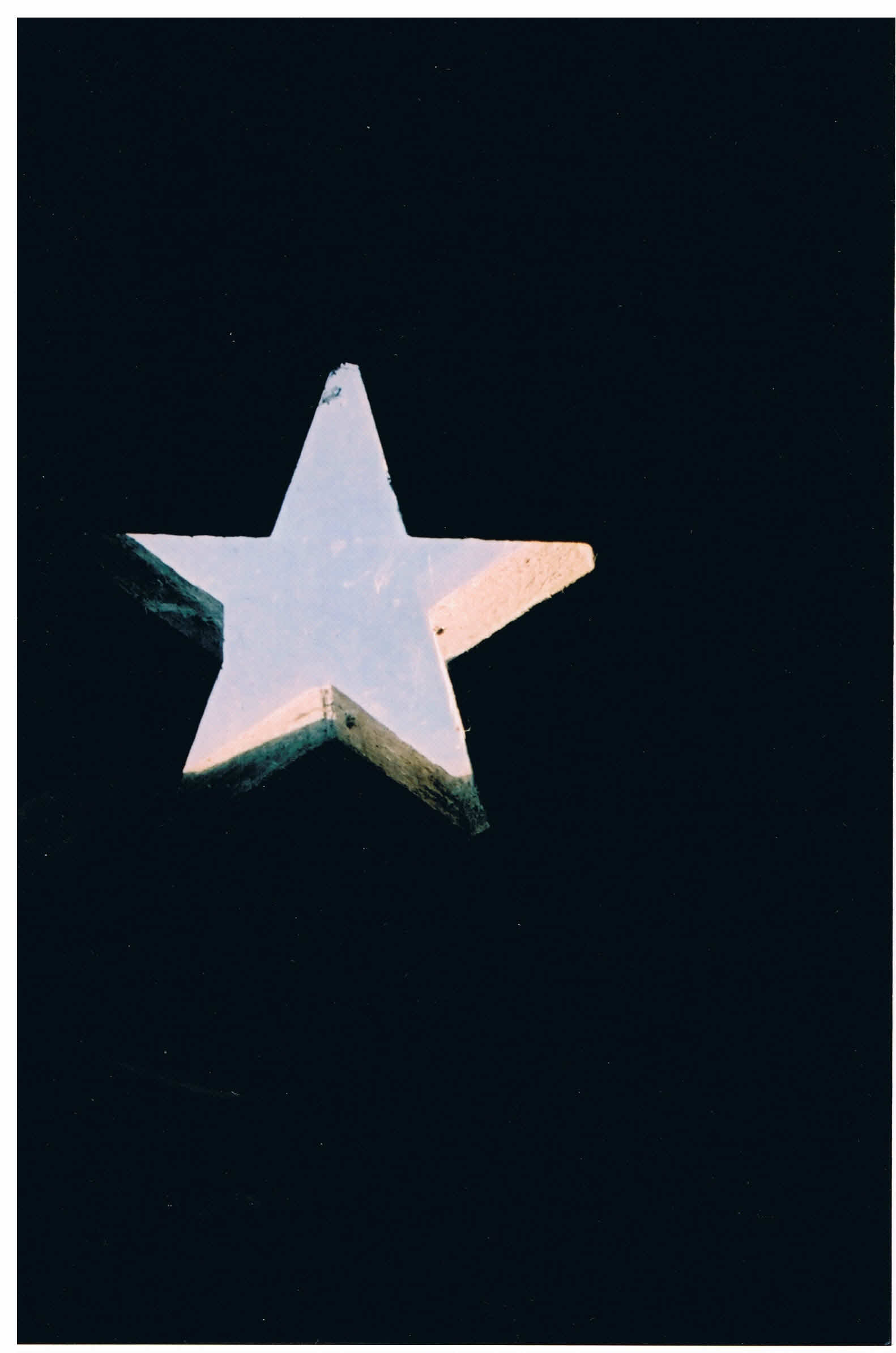
Once inside you are greeted by the Kilmorey Mausoleum which stands in the centre of a clearing. It towers up to 30 feet high: a masterpiece in pink and grey granite built in the fashionable Egyptian style of the mid-19th century. The stylised designs of flowers and other symbols are reputedly based on those at Kom Ombo and supposedly taken from the book called ‘Description de Egypte’ published in 1809. A low wall surrounds the vault, with iron railings waiting to be re-erected , and beyond that there are wildflowers and fresh plantings adding to the peaceful atmosphere. Two substantial coffins lie behind its ornate and imposing front door, resting beneath four star-shaped holes cut into the roof.
The shrine was built by Francis Jack Needham, who was usually known as ‘Black Jack’ because of his dark complexion. He became the second Earl of Kilmorey in 1832 and was a very wealthy man, owning several estates locally and elsewhere. Amongst others, he owned Gordon House which was part of the Brunel University and now sold off for housing. Black Jack was unconventional and lived up to his family motto ‘nune aut numquam’ which means ‘now or never’. In the early 1840s he eloped to marry his ward, Priscilla Hoste, and they fled abroad. Charles, his son, was born in 1844.
But their happiness was short-lived when Priscilla became terminally ill in 1851. Black Jack bought a substantial burial plot in Brompton Cemetery for £1,000. The entire mausoleum eventually cost £30,000, and the architect, Henry Kendall, designed it to fit the circular plot at Brompton, hence the shape of the site. Priscilla died in 1854 and was interred within the burial chamber. There is an exquisite marble relief, carved in Rome, facing the door which depicts Priscilla on her deathbed, the Earl at her feet and their son at her side. Black Jack joined Priscilla in 1880 to rest together for eternity. It’s not recorded what his second wife though of it all.
The monument has been moved twice which must have been a massive undertaking. Firstly, in 1862, when It accompanied Jack to his home at Chertsey, and again in 1868 to Gordon House. There is a secret tunnel which runs from the latter to the tomb. It’s rumoured that Black Jack would dress himself in white, place himself in his coffin, and then make his servants push him on a trolley as practice for his final journey. Today the area above the tunnel is crammed with prim Edwardian semis, unaware of the shenanigans that used to go on beneath them.
Although the building is under the Heathrow flight path and planes fly over at 6 minute intervals, the secret garden is surprisingly tranquil and secluded. The staff of Orleans House, who look after the place, have recently planted flowers and shrubs and keep the two lovers’ final resting place beautifully. The mausoleum’s occupants slumber on serenely as the oblivious traffic races past outside and the jet planes fly overhead..
The Egyptian influence is obvious.Stylised lotus flowers border the bronze entrance door Copyright Carole TyrrellThe bronze entrance door Copy right Carole Tyrrell
Once inside you are greeted by the Kilmorey Mausoleum which stands in the centre of a clearing. It towers up to 30 feet high: a masterpiece in pink and grey granite built in the fashionable Egyptian style of the mid-19th century. The stylised designs of flowers and other symbols are reputedly based on those at Kom Ombo and supposedly taken from the book called ‘Description de Egypte’ published in 1809. A low wall surrounds the vault, with iron railings waiting to be re-erected and beyond that there are wildflowers and fresh plantings adding to the peaceful atmosphere. Two substantial coffins lie behind its ornate and imposing front door, resting beneath four star-shaped holes cut into the roof.
The roof is made of glass. Copyright Carole Tyrrell
The shrine was built by Francis Jack Needham, who was usually known as ‘Black Jack’ because of his dark complexion. He became the second Earl of Kilmorey in 1832 and was a very wealthy man, owning several estates locally and elsewhere. Amongst others, he owned Gordon House which was part of the Brunel University and has now been sold off for housing. Black Jack was unconventional and lived up to his family motto ‘nune aut numquam’ which means ‘now or never’. In the early 1840s he eloped to marry his ward, Priscilla Hoste, and they fled abroad. Charles, his son, was born in 1844.
But their happiness was short-lived when Priscilla became terminally ill in 1851. Black Jack bought a substantial burial plot in Brompton Cemetery for £1,000. The entire mausoleum eventually cost £30,000, and the architect, Henry Kendall, designed it to fit the circular plot at
Brompton, hence the shape of the site. Priscilla died in 1854 and was interred within the burial chamber. There is an exquisite marble relief, carved in Rome, facing the door which depicts Priscilla on her deathbed, the Earl at her feet and their son at her side. Black Jack joined Priscilla in 1880 to rest together for eternity. It’s not recorded what his second wife though of it all.
The monument has been moved twice which must have been a massive undertaking. Firstly, in 1862, when It accompanied Jack to his home at Chertsey, and again in 1868 to Gordon House. There is a secret tunnel which runs from the latter to the tomb. It’s rumoured that Black Jack would dress himself in white, place himself in his coffin, and then make his servants push him on a trolley as practice for his final journey. Today the area above the tunnel is crammed with prim Edwardian semis, unaware of the shenigans that used to go on beneath them.
Although the building is under the Heathrow flight path and planes fly over at 6 minute intervals, the secret garden is surprisingly tranquil and secluded. The staff of Orleans House, who look after the place, have recently planted flowers and shrubs and keep the two lovers’ final resting place beautifully. The mausoleum’s occupants slumber on serenely as the oblivious traffic races past outside.
One of the two incumbents Copyright Carole Tyrrell
Copyright Text and photos Carole Tyrrell
Reference:
The Second Earl of Kilmorey and his Mausoleum in St Margarets, A C R Urwin, Borough of Twickenham Local History Society, Paper Number 78, October 1997
The Green Man Nunhead Cemetery. A powerful and pagan image on consecrated ground. Copyright Carole Tyrrell
This is a pagan symbol associating with the earth spirit and often found in older churches. Rosslyn chapel near Edinburgh has several notable examples. According to Green Man enthusiast, Mike Harding, there are considered to be four types of Green Man; the foliate head in which the face becomes leaves, the spewing or uttering head where leaves and foliage emerge from the mouth, the ‘bloodsucker’ head where branches and leaves spring from the eyes, ears and mouth and ‘Jack in the Green’ which is often simply a head peering at us from a frame of foliage. The Green Man is also a very popular name for pubs – there are several that I can think of and also the Jack in the Green Mayday festival in Hastings.
I have always enjoyed looking for Green Men when visiting churches and cathedrals as he is often so well hidden. Canterbury and Gloucester Cathedrals have some notable examples and Rosslyn Chapel near Edinburgh has a very celebrated one.
The Victorians in their return to earlier symbols sometimes incorporated a Green Man or two in their churches and sometimes on the outside of their houses as decoration. There are notable examples in New Eltham, Brockley and Peckham. I always get a sense of satisfaction whenever I spot one as they can be so well hidden.
This one is very well disguised and it took several years of visiting Nunhead Cemetery before anyone pointed it out to me. It’s just beneath the top of the memorial on which it’ s placed but once you’ve seen it you know it’s there. It can be seen as a cross but I always have seen it as the Green Man of Nunhead. As far as I am aware there is not another one in the other Magnificent 7 cemeteries.
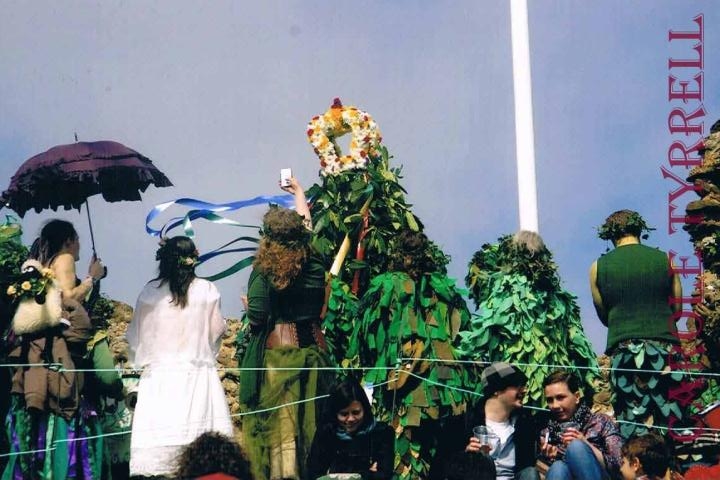
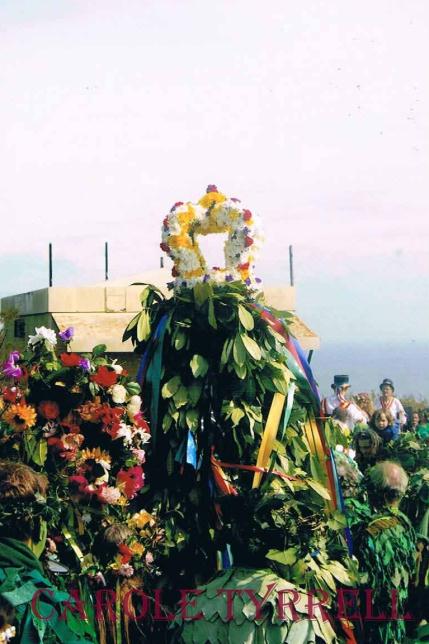
Below are images from the Hastings Jack in the Green Festival held on Mayday. The Jack or Green man is led down from the cliff top castle to the arena where as the climax to the day’s festivities. There he is torn apart and his body, made of leaves, is scattered to the audience as the precursor of Spring. A dramatic end to a great day,
Further reading;
Kathryn Basford The Green Man, 1978
A Little Book of the Green Man, Mike Harding, Aurum Press.1998
Mayday Festival in Hastings, UK Copyright Carole TyrrellThe Jack or the Green Man at Hastings May Day. Copyright Carole TyrrellThe Jack in the Green at the Hastings MayDay festival Copyright Carole Tyrrell
When you think of a Victorian cemetery what do you think of most? Angels atop of monuments pointing dramatically upwards? Crosses? As you walk around Nunhead Cemetery you will certainly see these symbols but there’s a story to be told of 19th century religious and art movements and the Victorian language of cyphers and motifs.
They loved double meanings and secret codes. For example, the stones in many a Victorian piece of jewellery were often selected to form words from the first letters of the stones or the colours chosen as in Suffragette pieces. In art, symbols and items within a painting often said more than what appeared to be the main composition as in ‘The Awakening Conscience’ by William Holman Hunt.
19th century Britain was also in the grip of religious conformity. ‘No Popery’ was the cry and any good Anglican studiously avoided crosses and angels and anything else that might even hint at Catholicism. Instead Victorians turned to ancient Rome and Greece’s classicism and so urns, draped or undraped, made their appearance. As the Romans practiced cremation it seemed appropriate. After Napoleon’s Egyptian explorations obelisks became all the rage. Nunhead has several fine examples of urns and obelisks.
However, as the 19th century wore on, the rules slowly relaxed and in the 1880s angels began to roost. Some were copied from Italian originals as is a magnificent and sensuous example in West Norwood Cemetery. The revival in Celtic arts meant that Celtic crosses, in which the arms formed a wheel, came back into fashions. There was also the language in which every flower had a meaning as with ivy which was a symbol of immortality or evergreen memories.
These are the Top 10 symbols to be found in Nunhead or other Victorian cemeteries. NB: Interpretations are not definitive – please let me know if you disagree.
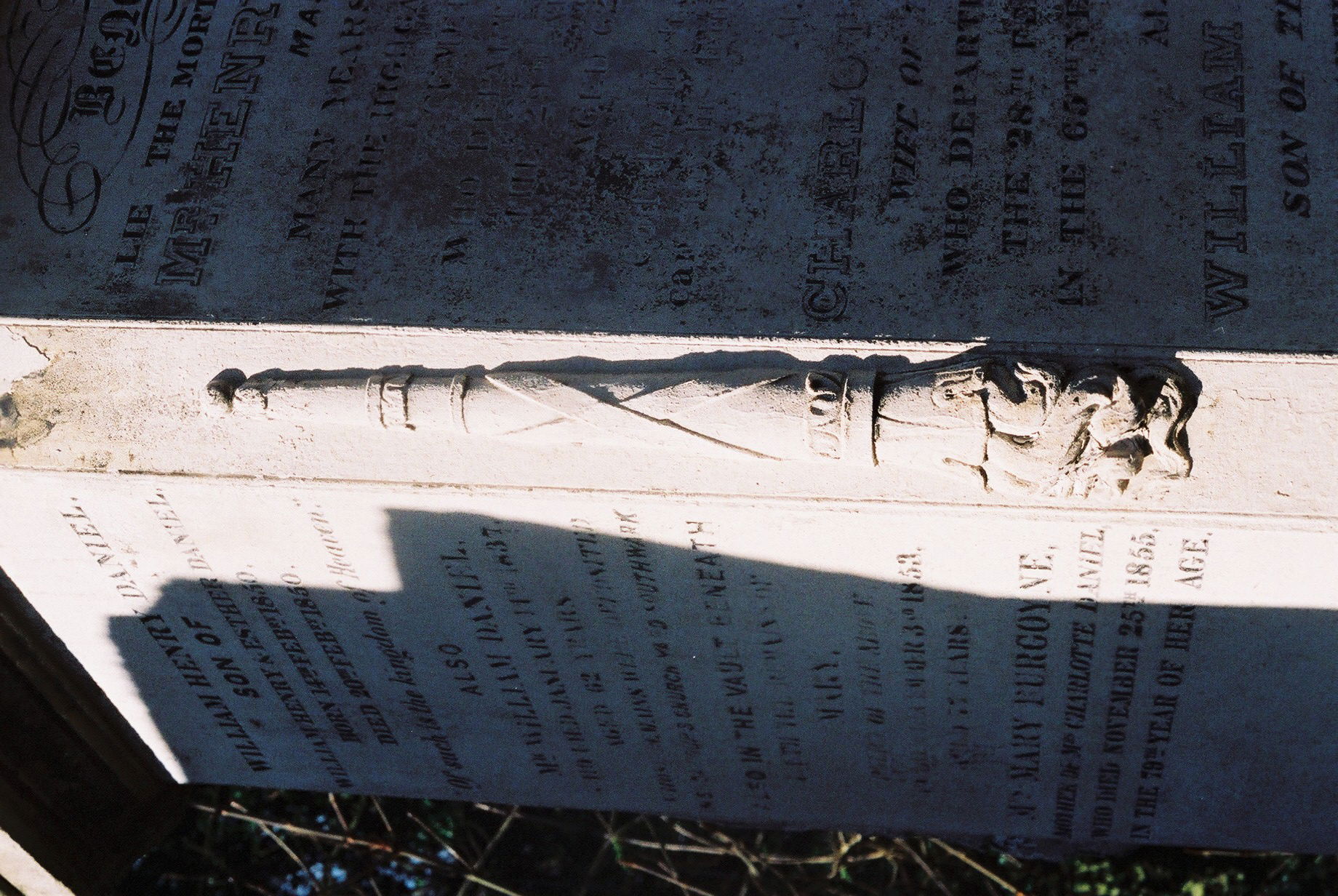
Downturned torches. These can be found on the main gates at Limesford Road and on other monuments within Nunhead including the Daniels one near the chapel. These are a Greek symbol which means ‘life extinguished’.
Ouroboros/snake swallowing its own tail. These can be found on top of the pillars at the Limesford Road entrance. They are an ancient Egyptian symbol of eternal life and let the visitor know that they were entering a place of death and memorial. The Friends of Nunhead Cemetery have adopted this emblem as their symbol.
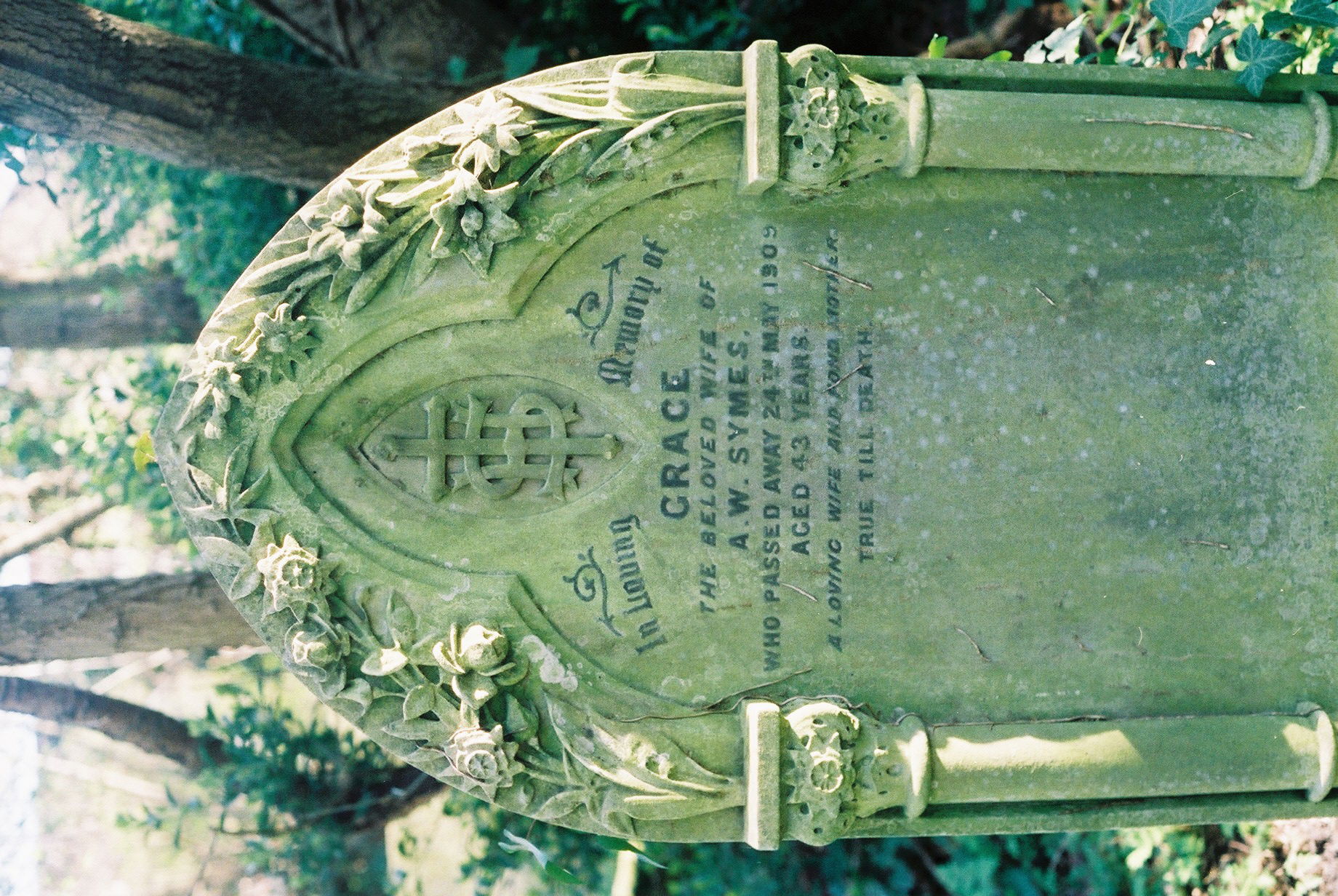
IHS/ also known as the dollar sign. A lovely example can be found on the Symes memorial. It means ‘Iesus Honinum Salvator’ or translated as ‘Jesus the saviour of Man.’
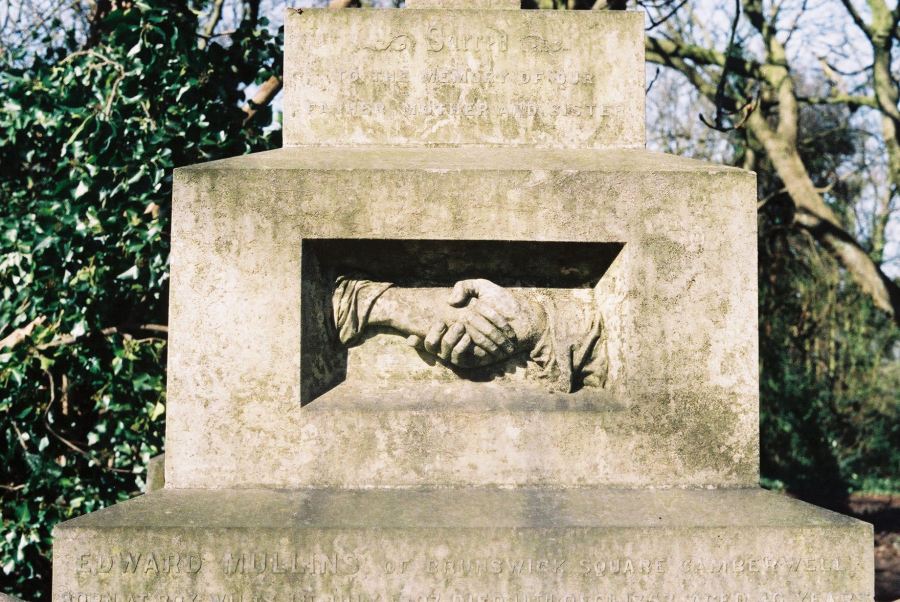
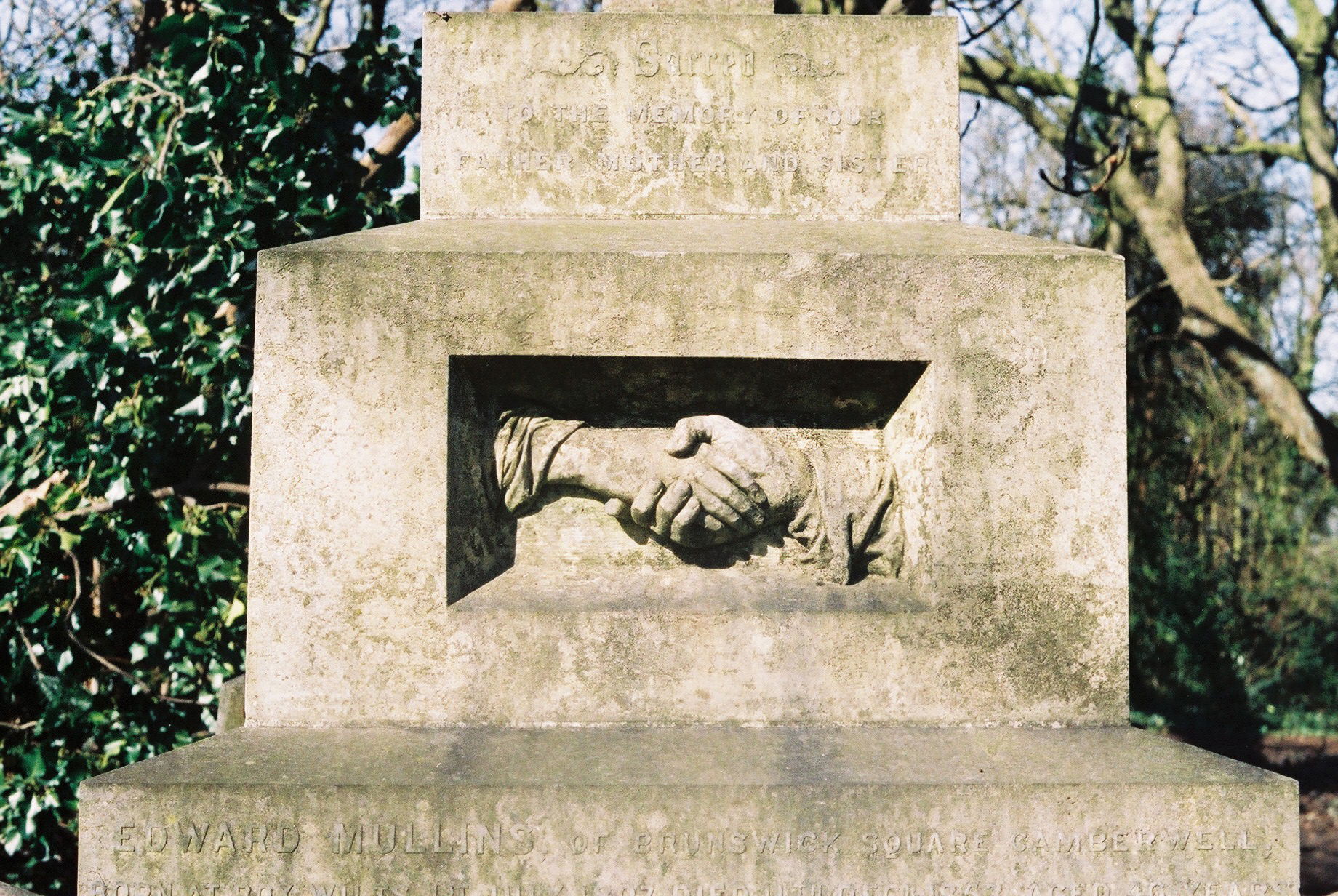
4.Shaking hands. A particularly striking and beautifully carved example is on the Edward Mullins vault. There are several examples within Nunhead but these are the best in my opinion. There are several interpretations of this image: they may mean ‘Farewell’, marriage, a close bond lasting until death or the first one to die holds the surviving spouse’s hand guiding them to heaven. If on a family tomb, as they usually are, they can mean either hope or reunification in the next life or simply ‘see you soon’ which may not be as comforting as it sounds with the Victorians high mortality rate.
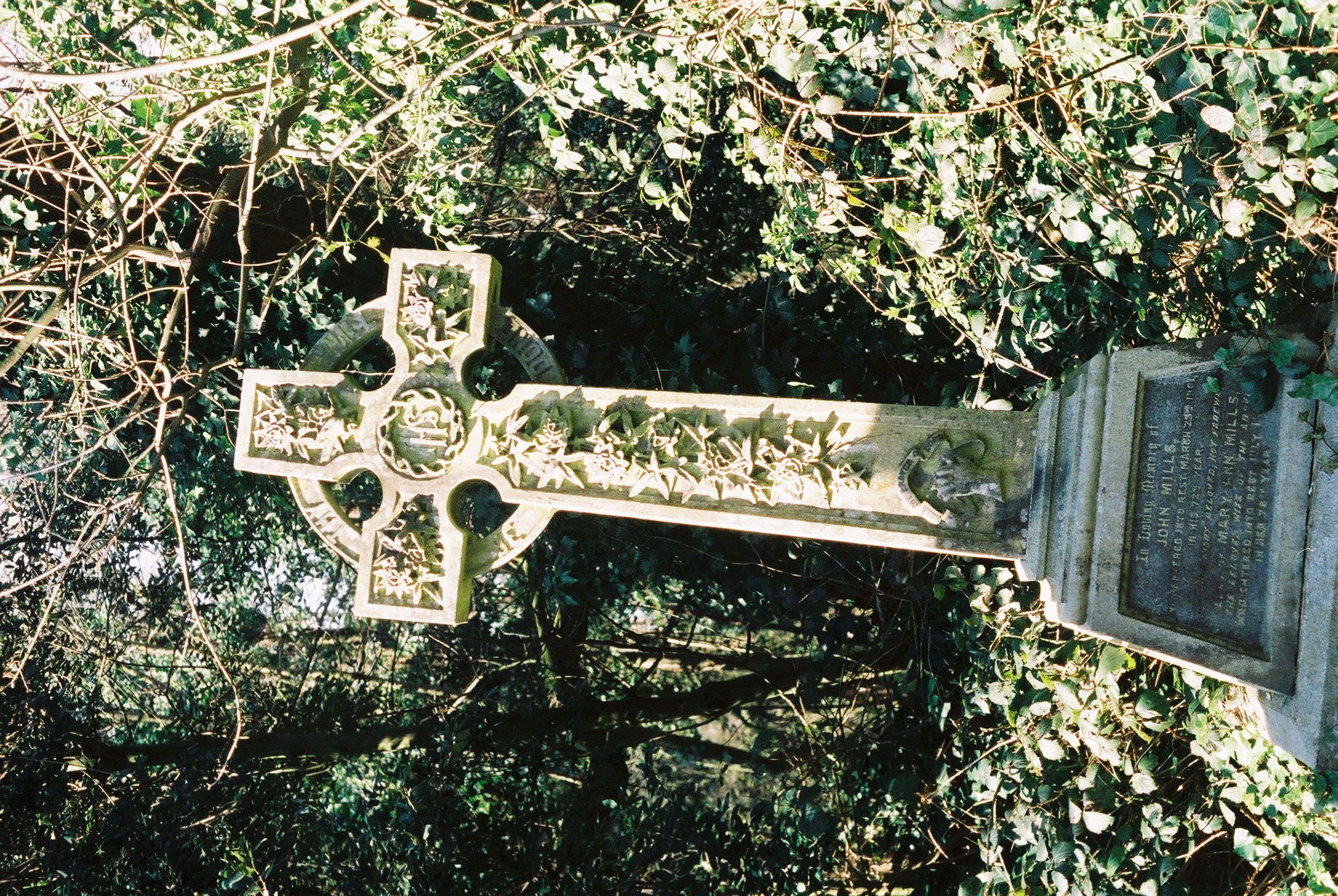
5. Celtic Cross. Nunhead has several fine examples decorated with Celtic strapwork or plain. However the Mills cross near the Chapel is especially lovely with it’s fine carving of passion flowers and the hand at their base with the motto ‘Thy Will be Done’. This is a deeply religious memorial as passion flowers symbolised Christ’s passion, hence their name, in passion, sacrifice and redemption. Its 5 stamen represent the 5 wounds inflicted on Christ on the cross and the 10 petals are the 10 disciples that remained faithful to him. The flower’s corona is said to be the crown of thorns.
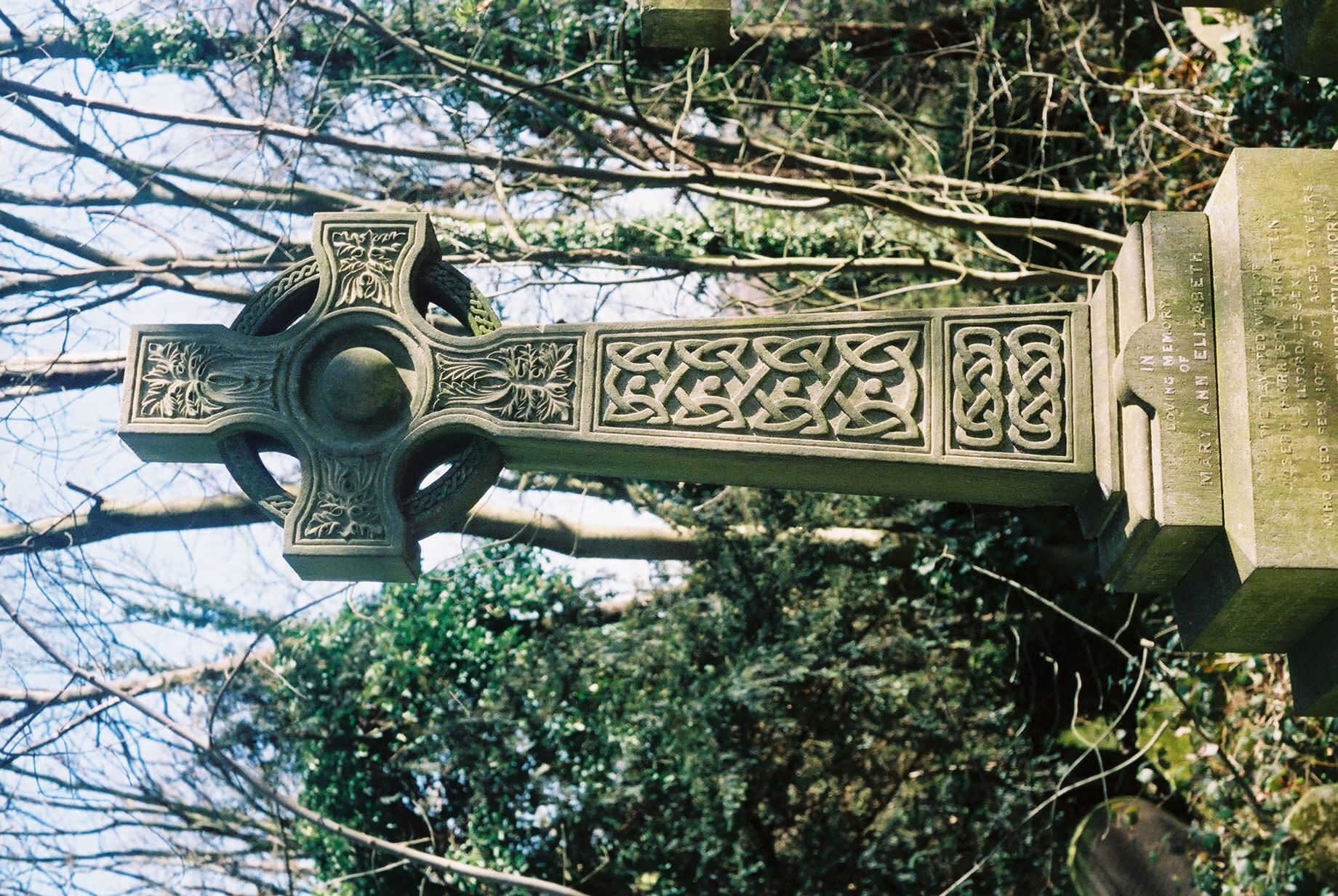
A more conventional strapwork Celtic cross
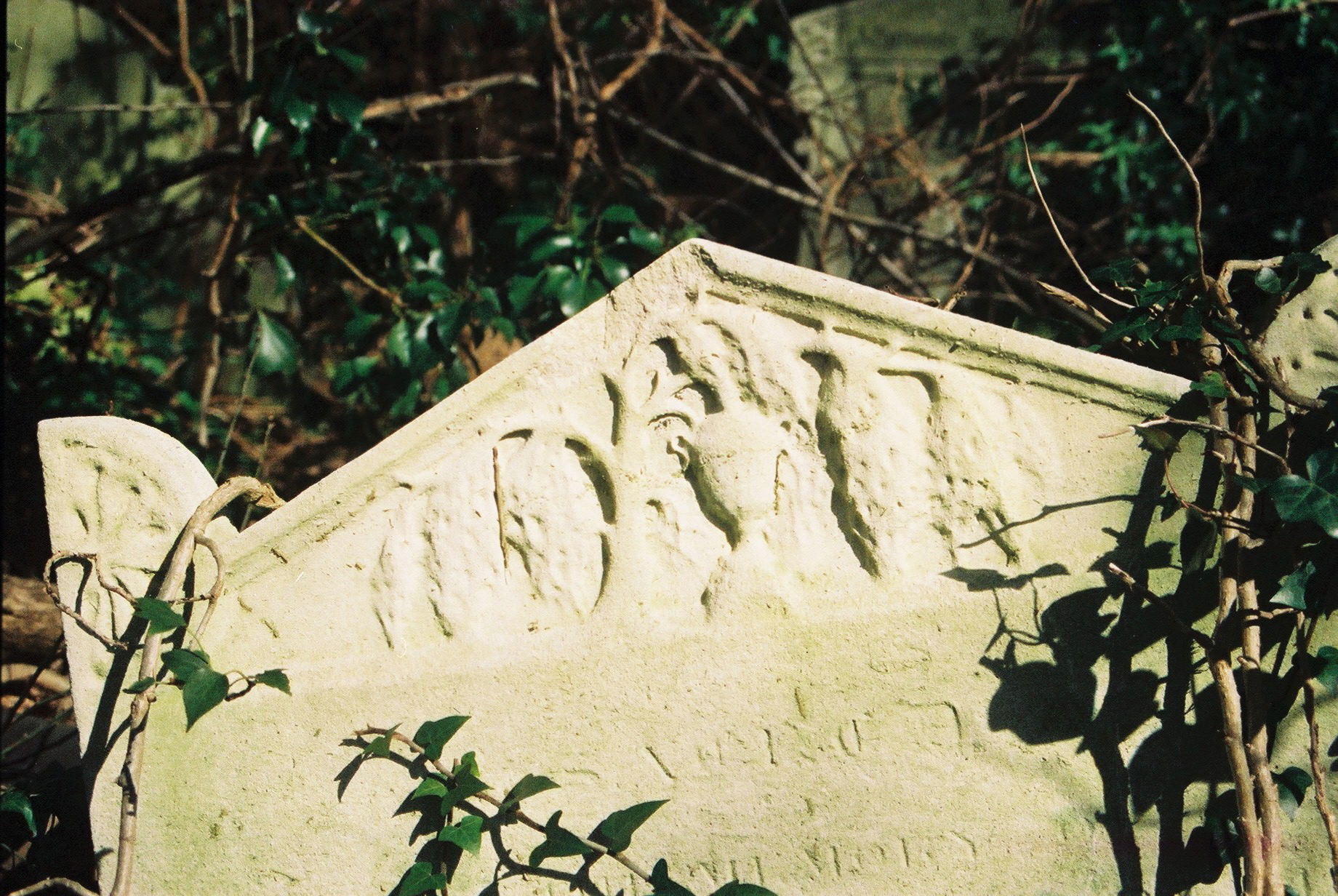
Urns. These are an ancient Roman symbol and there are several within Nunhead.
7. Flowers. The language of flowers is something that we’ve lost but to the Victorians it was of great importance. Ivy is an evergreen and means’ everlasting memories’ and the weeping willow is obvious.
Mourning women. This was another symbol borrowed from Ancient Rome and a fine example is on the Daniels monument on the main avenue near the chapel.
9. Angels. Most angels in the Bible and other sources are male but in Victorian cemeteries they are usually pretty young women. There is a whole mythology around angels and what they are carrying in their hands. On the Hershel tombstone there is an angel carrying a wreath and on the Williams vault there is one pointing upwards and carrying an anchor, perhaps symbolising hope.
Broken column. Nunhead has several examples and at first it can look like deliberate vandalism. These could mean mortality, the support of life being broken and maybe the grave of the head of the family. A variation is the empty chair in Highgate cemetery whose meaning is obvious, The Hawker memorial boasts a lovely example. Although damaged, and in its swirling garland of roses is very reminiscent of the Apprentice Pillar in the Rosslyn Chapel near Edinburgh.
There are many other symbols within Nunhead; chrysanthemums, fireman’s helmets, shells and even a Green Man. So keep looking and let me know if you find any unusual ones.
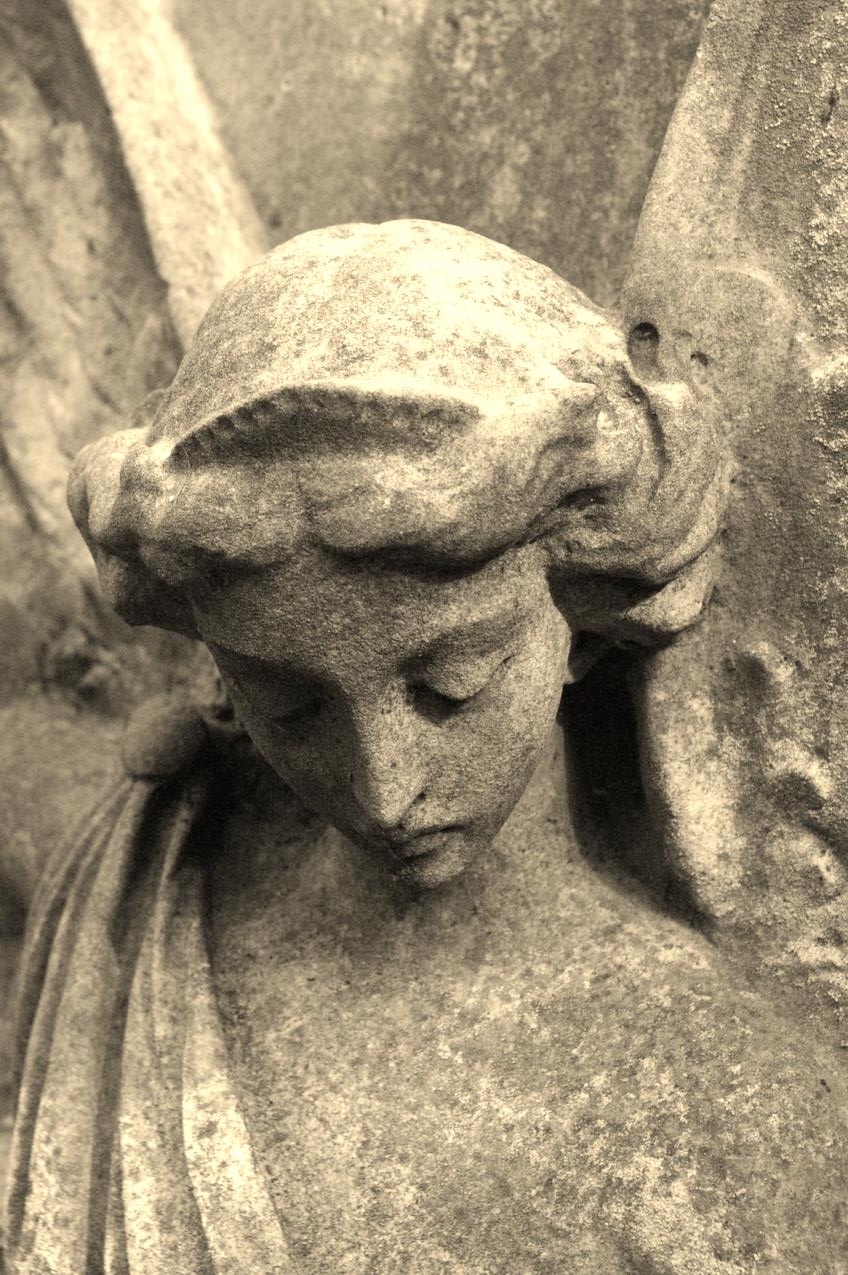
A close-up of her calm , enigmatic face. Copyright Carole Tyrrell
Although there are many beautiful, intriguing and, sometimes poignant, memorials to be found in large Victorian cemeteries you can often find them in your local churchyard as well.
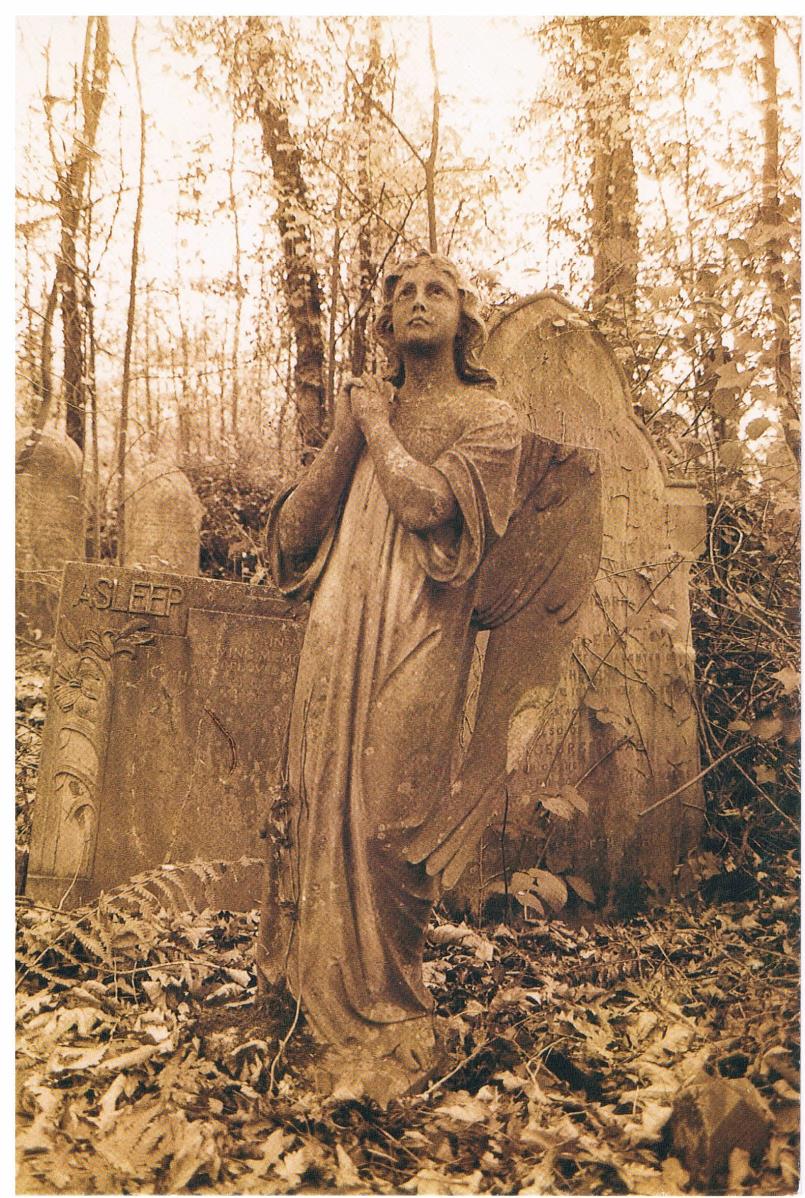
My nearest one is 15 minutes walk away from my house and features this lovely angel in a quiet corner of the churchyard under the shade of a huge and spreading tree. It is undoubtedly this little spot that has protected her as she cannot be seen by passers-by from the road or the casual stroller through the churchyard. It’s in memory of a wife and there are no further details on the epitaph. The date of interment is in 1905 which is the Art Nouveau period and there is a definite nuance to it in this lovely angel as she hangs poised on the cross.
There are other interesting memorials within the churchyard and I will be discussing these in a future article. But this is the one I wanted to reveal first as she is so lovely and, as far as I know, unique. Victorian angels in cemeteries are usually selected from a pattern book, carved and then shipped over from Italy and you will see and recognise the same variations. You could also send a photograph and the angel’s face would be carved into a likeness of the loved one. There is one in Nunhead Cemetery which is almost certainly carved from the life. But I haven’t seen this particular angel before and maybe she has also been carved as a likeness of the deceased.
The epitaph reads:
‘Christian Whittingham Little
Wife of Robert little
Of Christ’s Hospital , London
Entered into rest 10 Sept 1905.
Poised on her cross, keeping watch, in a quiet corner of the churchyard Copyright Carole Tyrrell
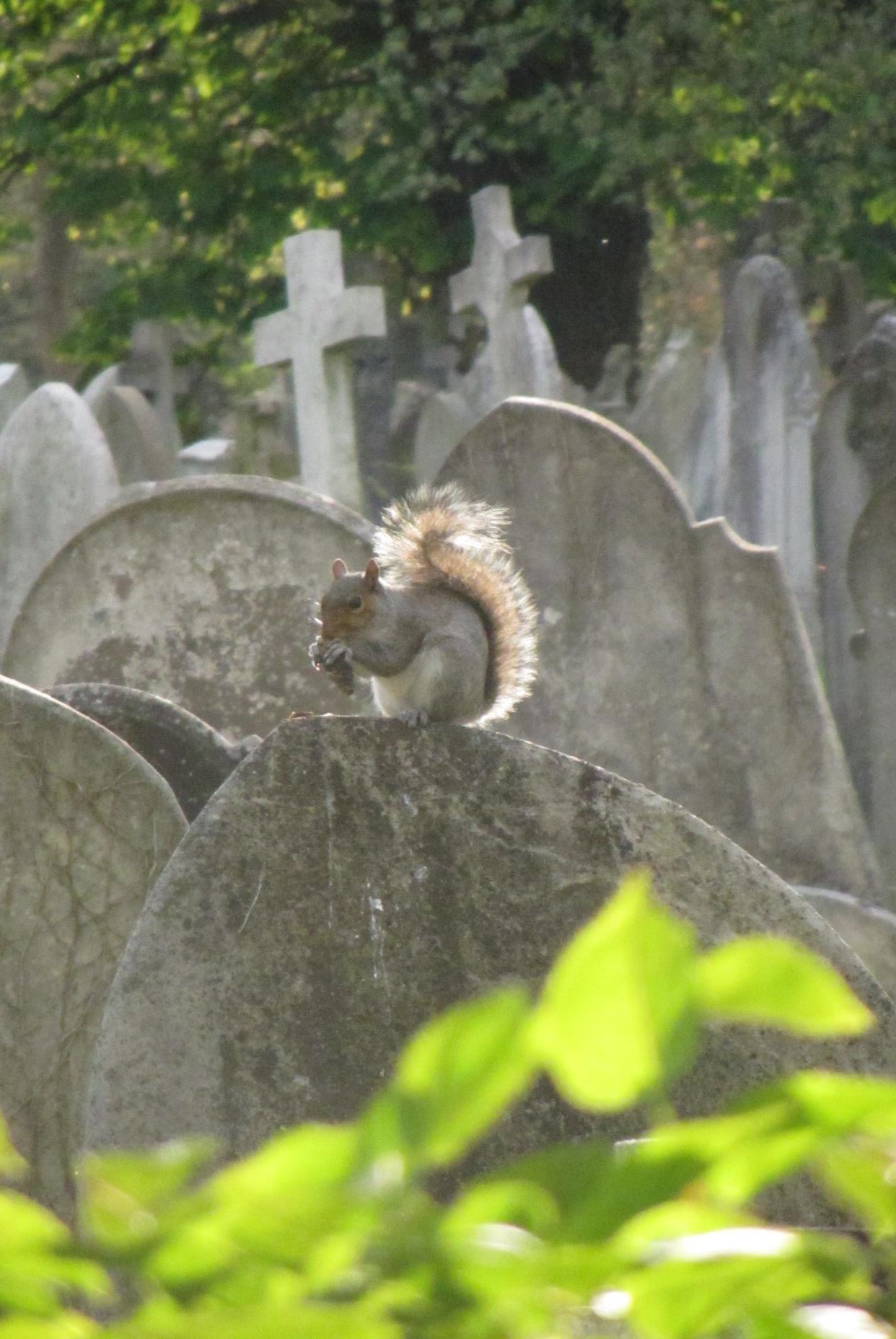
There’s always squirrels in cemeteries but watch out for the ones in Brompton Cemetery, London, UK – they’re smart. They’ll pose on a tombstone for you and then form a pincer action until you’re surrounded. Resistance is futile. I spotted the one above on a late summer’s evening in 2014 and liked the way that the sun shone through his tail.
I’ve seen more coffins than most people unless you include undertakers. For the last 25 years I’ve been involved with cemeteries. Firstly, as a visitor to my nearest large Victorian cemetery, Nunhead, and then as a helper on the publications stall, contributor to the quarterly journal.and finally tour guide. My speciality is symbols.
It’s a lost language in some ways and there are often several interpretations for each one. But more on this in future blogs.
When I visit a cemetery I don’t think ‘Oh scary place full of dead people.’ I usually think that yes, it’s a cemetery and full of dead people but people with their own stories who lived their lives and afterwards someone cared enough about them to erect a memorial, a mausoleum, a vault or just a very simple plain stone in their memory. I often feel a lot of love in cemeteries especially when I read some of the epitaphs.. Even though the huge Victorian monuments are beyond the reach of us today we often still like to individualise our loved ones final resting place with something that was personal to them.
Death is the last great mystery. We may not have any control over when it occurs or how. But We are all going to die and it’s how you live your life that’s important.
In this blog I will share some of my favourite memorials, epitaphs, and photos and also reveal the hidden language of symbols.
Enjoy!
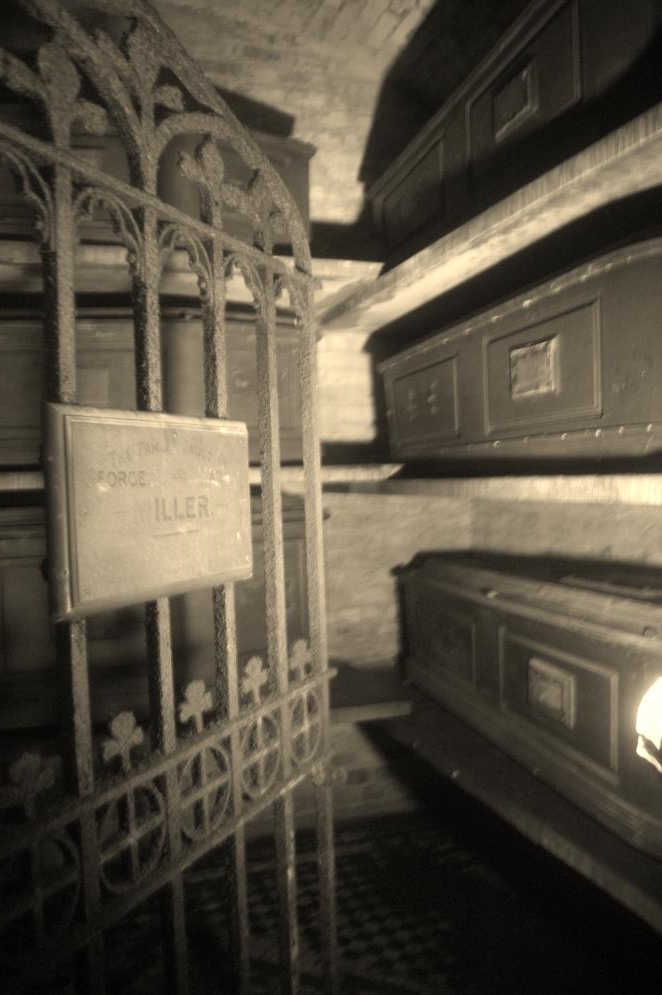
The image above is from West Norwood Cemetery catacombs.



















 shadows fly away