Symbol of the Month – The Final Curtain

Full view of the impressive Raikes headstone, West Norwood Cemetery/ ©Carole Tyrrell

The theatre is dark, the audience and backstage staff have all gone home or off to the pub and the final curtain has been brought down. The end of a show, the end of the evening and, in funerary symbolism, the end of a life.

This fine example is from West Norwood Cemetery where it commemorates the Raikes family.  Theatre was in their blood and so the sculpture of a theatrical curtain is very appropriate.

But curtains and draperies have always been associated with death and remembrance.  There is the old saying which is sometimes quoted on headstones and memorials that the deceased has ‘gone beyond the veil’.  An urn on top of a memorial will often have a sculpted piece of cloth draped across it which indicates the division between the living world and the realm of the dead.  

In the 19th century, and also well into the 20th century, drapes were hung over mirrors with curtains and blinds drawn down at windows during the period of mourning. It was as if they were hiding death from the world or containing it within the family. On the Friends of Oak Grove Cemetery website they mention mirrors being covered with black crepe fabric in order to prevent the deceased’s spirit being trapped in the looking glass.

Curtains also feature on headstones where they are depicted as parted in order to display a meaningful symbol or to draw attention to an epitaph that takes centre stage. However the Raikes one is very obviously a theatrical curtain and it’s beautifully detailed.  They were powerful players in that flamboyant world and the curtain is a direct reference to this. For example, in 1889, they had Sir Edward Elgar and his new wife, Caroline, as guests in their house, Northlands in College Road, Dulwich.  This was just prior to his Salut D’Amour being performed at the Crystal Palace.

View of the curtains and the quote from the Rubaiyyat of Omar Khayyam, Raikes headstone, West Norwood cemetery. ©Carole Tyrrell

But the family home had a secret in its basement. This was where Charles Raikes (1879-1945) had constructed his own private theatre.  He lived there with his mother, Vera, (1858-1942) and two sons, Raymond and Roynon, from his former marriage. Roynon’s wife, Greta, and their daughter Gretha were also part of the household. Charles lived and breathed theatre and he was ahead of his time when he converted a large billiard room into the Northlands Private Theatre. Nowadays it would be a lavish home cinema with comfy seats and popcorn on tap with his own home movies onscreen.  He extended his pride and joy by removing a couple of inconvenient bay windows and then converting a coal cellar and wine cellar into dressing rooms. He was a talented scenic artist and stage carpenter and from 1924 – 1939 the Theatre put on nearly 23 productions a year to an invited audience. This was made up of the Raikes’ friends and relations as well as the actors and actresses friends. The lavish after show parties were renowned. 

Charles’ sons continued the links to the entertainment world.  Raymond (1910-1998) became a professional actor in the 1930’s and played Laertes to Donald Wolfit’s Hamlet at Stratford upon Avon.

Raymond Raikes taken in 1945 Shared under Wiki Creative Commons

He eventually became a BBC producer, director and broadcaster. He won several awards over a long career which included pioneering the use of stereo sound in radio drama.  In 1975 he retired and is known as one of the three greatest radio drama producers. Roynon became a professional photographer specialising in theatre pictures and was also a stills photographer for the BBC. Greta, his wife, became a theatrical costumier and drama teacher and her daughter, Gretha, in turn became a speech and drama teacher. In a 1997 Dulwich Society article she was also credited with being the curator of the archives of the Northlands Private Theatre.

The quotation below the curtain is from the Rubaiyat of Omar Khayyam.  It comes from the 21st, 22nd  or 23rd stanza depending on which version you read.   This is the verse in full and is taken from the 1859 translation by Edward Fitzgerald

Lo! some we loved, the loveliest and best

That Time and Fate of all their Vintage prest,

Have drunk their Cup a Round or two before,

And one by one crept silently to Rest.

He saw them as a selection of quatrains or Rubaiyats that had been attributed to the Persian poet who was also known as the Astronomer Poet of Persia.  Although Fitzgerald’s translation was initially unsuccessful, by the 1880’s, it had become immensely popular.  It has influenced many creative people over the years including the Pre-Raphaelites and especially Dante Gabriel Rossetti. Oscar Wilde was also a fan and mentions ‘wise Omar’ in The Picture of Dorian Gray.   Agatha Christie, Isaac Asimov, H P Lovecraft and Daphne Du Maurier are amongst many who may have borrowed a line as a book title or used an Omar like figure within their works.  Interpretations of the Rubaiyat can be very free and as a result the quatrains can change their wording.  The underlying message of the Rubaiyat appears to be Seize the Day or Carpe Diem in Latin.  There are also several references to drinking with the implication that once drinking is over so is life.   But this particular line seems appropriate for its use on a headstone.

And so the curtain has been brought down on the Raikes family but, as I took my photos, I thought I detected a faint smell of greasepaint and the appreciative sound of applause……

©Text and photos Carole Tyrrell unless otherwise stated

References and further reading:

https://aeon.co/ideas/how-the-rubaiyat-of-omar-khayyam-inspired…

sleepinggardens.blogspot.co.uk/2011/06/fridays-funerarysymbols

https://en.wikipedia.org/wiki/Rubaiyat_of_Omar_Khayyam

schoolworkhelper.net › English

https://artofmourning.com/2010/11/14/symbolism-sunday-drapery/

 Rubáiyát of Omar Khayyám Summary – eNotes.com

https://www.enotes.com/topics/rubaiyat-omar-khayyam

https://dulwichsociety.com/2017-winter/1578-brief-encounter…

https://en.wikipedia.org/wiki/Raymond_Raikes

www.suttonelms.org.uk/raymond-raikes.html

https://en.wikipedia.org/wiki/Rubaiyat_of_Omar_Khayyam

Booking now – London Month of the Dead 30/09/23 -01/11/23

Now celebrating it’s 10th birthday , the London Month of the Dead is a permanent fixture on the social calendars of devotees of the dark side.

You can book now and early booking is advisable – there are 60 talks, walks, workshops and performances to choose from. Some within London cemeteries and churchyards, some within ossuaries and others in more unique settings.

Experience another side of the metropolis with writers, perf, artists, historians and academics and like minded souls! And, to finish it in celebration of its 10th decade, there will be a Halloween Ball inspired by the works of Edgar Allan Poe! Click the link for more info and to book.

London Month of the Dead

I have been a fan of London Month of the Dead ever since it started and it has taken me to places that I would, otherwise, not been able to access. And such knowledgeable speakers and unique venues. I have such anticipation when the new programme appears and it’s a pleasure to see how it has expanded over the years. Last year I explored ossuaries with them – and found myself in Spitalfields on a Sunday morning peering down from the pavement into the remains of a large medieval ossuary and then being admitted into it…

Let’s all drink to another 10 years of the London Month of the Dead – especially if it’s a gin punch! Hic!

In London on 3 September? Why not spend the day with the living and the dead?

Open Day 2023
More information here. 
Advance tour booking here.
 These tours of the cemetery last 60 min and will run on the hour from 12:00 noon. The last tour is at 17:00.
Advance catacombs tour booking here.  These last 25 mins and will run on the hour and half hour from 11:30 am. The last tour is at 17:30.
Further events (like ‘Herbal Heritage: Uses and Folklore of Cemetery Plants’ walk) are being planned and our Open Day Page will be updated as these firm up.

We look forward to seeing you!

It’s shadowsflyaway birthday!

Crying cherub, St John the Baptist’s church, Margate, Kent. © Carole Tyrrell

Yes, it is shadowsflyaway’s 8th birthday so there will be no Symbol of the Month this month.  Instead I hope to post some of my churchyard visits and what I found in them including this one which forms the background to this year’s birthday card from St John the Evangelist in Margate. This was a particularly fruitful churchyard in terms of symbols and, although it wasn’t open when I visited, I could see that there might be more interesting funerary memorials inside.

So thanks to all my readers for your comments and likes – they are very much appreciated. 

Here’s to shadowsflyaway’s 9th birthday!

© Text and photos Carole Tyrrell

Introduction to Cemetery Symbols guided tour – 14:00pm Saturday 8 July 2023 Brompton Cemetery

One of the snakes on the catacomb doors in Brompton Cemetery. copyright Carole Tyrrell

To any of you that live in London, I am leading an Introduction to Cemetery Symbols tour in Brompton Cemetery!

It will focus on the symbols within Brompton Cemetery of which there is a varied and fascinating collection amongst its 35,000 monuments from Celtic crosses to Egyptian gods and many others. Come and explore the lost language of Death with me!

Date and time: Sat, 8 July 2023, 14:00

Leaving from: Information Centre (Old Brompton Road entrance)
Duration: approx. 1 hour 30 minutes
Tickets are £10 per person (plus £1.50 booking fee if booked on Eventbrite)

Book at Eventbrite
(refundable up to 1 day before event; Eventbrite’s fee is nonrefundable)

Introduction to Cemetery Symbols Tickets, Sat 8 Jul 2023 at 14:00 | Eventbrite

A glimpse back into history – the oldest headstones that I have seen

Headstone dedicated to Robert Dadd dated 1640 – St Nicholas church, Sturry Kent © Carole Tyrrell

I was originally going to entitle this post ‘ the oldest headstone that I have seen – so far’. As I explore churchyards and cemeteries I sometimes find ancient tombstones and memorials dating back to the 17th century. But, more recently, I have found ones that are dated even earlier.

This one was in the porch of St Nicholas in Sturry which is a village in Kent and is a good example of early 17th century calligraphy.  Sadly, because it is in the porch, there is no way of knowing where Robert Dadd is buried within the large churchyard that surrounds the church. But it is incredible to think that this headstone has survived for over 400 years although obviously we don’t know when it was put in the porch. I couldn’t find the headstone on Kent Archaeological Society’s monumental inscriptions page but Dadd seems to be a fairly common name. They have been recorded as living in Sturry during the 18th century.

Catherine Lees headstone, St Mary the Virgin, Selling, Kent © Carole Tyrrell

Detail of symbols on Catherine Lees headstone, St Mary the Virgin. Selling, Kent © Carole Tyrrell

I was admiring the drifts of ox eye daisies, or moon daisies as they are also known, in the substantial churchyard of St Mary the Virgin in Selling in Kent. This was a fascinating church with wall paintings of saints and other painted decoration.  Sometimes I do have a real sense of what a medieval church must have looked like, pre-Reformation, with murals, wall paintings and other decoration. It would have been alive with colour in contrast to the plain interiors of churches that can be seen today. The beautiful painted medieval column at St Mary’s of Charity in Faversham is another indication with its still rich colours. The priest would have used the wall paintings as teaching aids to an illiterate congregation. 

Under a spreading yew tree is the headstone dedicated to Catherine Lees who died in 1681. According  to the guidebook, it is the oldest legible tombstone in the churchyard, so there may be others even earlier that are not so readable now. Catherine was a member of an old Kent family, the Lees, and the guidebook says that there is ‘a house in the next parish of Shieldwich (which) is still called Lees Court after them.’ The inscriptions and symbols are very crudely cut into the stone which is part of its charm for me. However, I was a little surprised that such an old and venerable family could not afford a professional stonemason. There is an hourglass, skull and longbones and the epitaph reads:

‘My soule cleave fast to God above,

Nothing on earth deserves my love,

To live in all securite,

In heaven with thee,

Lord let me be.’

Medieval tomb markers, St Mary the Virgin, Selling, Kent © Carole Tyrrell

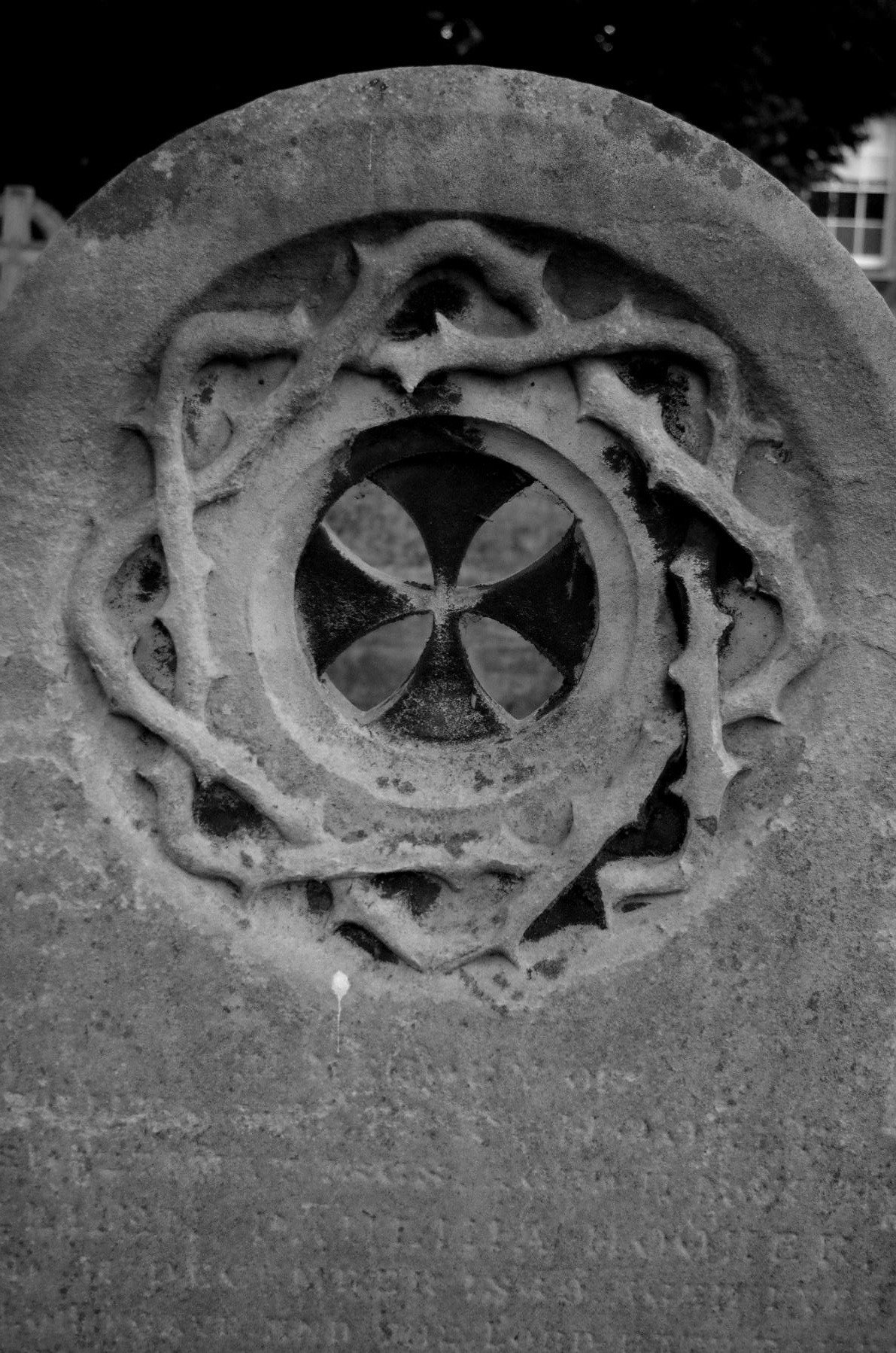
Also, in St Mary’s churchyard are its only surviving medieval tombstones according to the guidebook. Apparently, there were ‘many of them in a particular part of the churchyard’. These were ‘stone discs with a quatrefoil ornamentation on a short stone shank.’  But no names apparently. St Mary’s burial registers only began in 1558 so there may be no records of their medieval burials.  St Mary’s is an interesting church as the very first church was built on a Jutish holy place and their ‘savage dancing ground of beaten earth lies somewhere beneath the chancel floor of the tranquil and dignified building that is seen today.’ The   Jutes were one of the Germanic tribes that settled in Britain after the Romans left.  They were very powerful and a local pond, Ghost Hole Pond, has a sinister reputation.  There were several recorded cases of violent deaths associated with it and the Jutes were known for their human sacrifices.  These included the ‘ritual drowning of ….in ponds and meres.’  This seemingly quiet and peaceful part of Kent obviously hides a much more savage and brutal past. St Mary’s is another example of the Christianisation of pagan sites by building a church on top of one. An interesting brush with ancient history.

So now I have seen medieval examples of burial markers – can I find one that is even earlier? There are reputed to be some in the churchyard of St Peter and St Paul in Tonbridge, Kent but they were unsure of where they were. But I’m keeping a look out!

©Text and photos Carole Tyrrell unless otherwise stated

Further reading

A brief guide to the church of St Mary the VirgIn, Selling, Kent by Alan Neame

Jutes – Wikipedia

Selling, Kent – Wikipedia

A Brief Guide to the church of St Mary The Virgin, Selling Kent, Alan Neame, 1998 published by The Selling Parochial Church Council

Symbol of the Month – The Choice

Alice Stone’s tombstone, All Saints churchyard, Staplehurst, Kent ©Carole Tyrrell

You never know what little gems you might find in a country churchyard and I discovered one while exploring in Staplehurst in 2019.  All Saints church has a commanding hilltop position and looks down on the pretty half-timbered houses of the village.  Since 1100 it has stood on this site and has several ancient features.  These include the remnants of an anchorite’s cell.  This was a medieval form of penance in which the anchorite would live in a very small cell, if the size of the remaining floor of the cell is to be believed, and lived on offerings that parishioners and others would pass through a window set into the church and the cell.  The offering window is still there.  All I could think of was how cold it must have been in winter and how did they deal with their waste products.  They were effectively hermits and were declared as being dead to the world.  It was the Reformation brought the anchorite life to a close.  There is also a wooden door to the side of All Saints that has been definitively dated to 1050 and features scenes from Norse legends.  I could find no explanation for pagan elements being incorporated in a consecrated building and so it was very intriguing. Why here?

The churchyard was far larger than I expected and led to a more modern section at the back of the church.  But as I explored the older part of the churchyard I turned around and came face to face with this unusual symbol on a white headstone.   

Alice’s epitaph – a little ineligible in parts. ©Carole Tyrrell

It’s dedicated to Alice Stone, wife of James Stone of Sheerness.  There is no date of birth recorded but she died on 5 February 1787 aged 27.  Alice may have died in childbirth which was a frequent cause of death for women in past eras or maybe she was a victim of an epidemic. We’ll never know.  However, there is some barely legible lettering above the inscription which I have been unable to sufficiently enhance in order to read it so this may well warrant a second visit.

The deceased arises and casts off their shroud. ©Carole Tyrrell

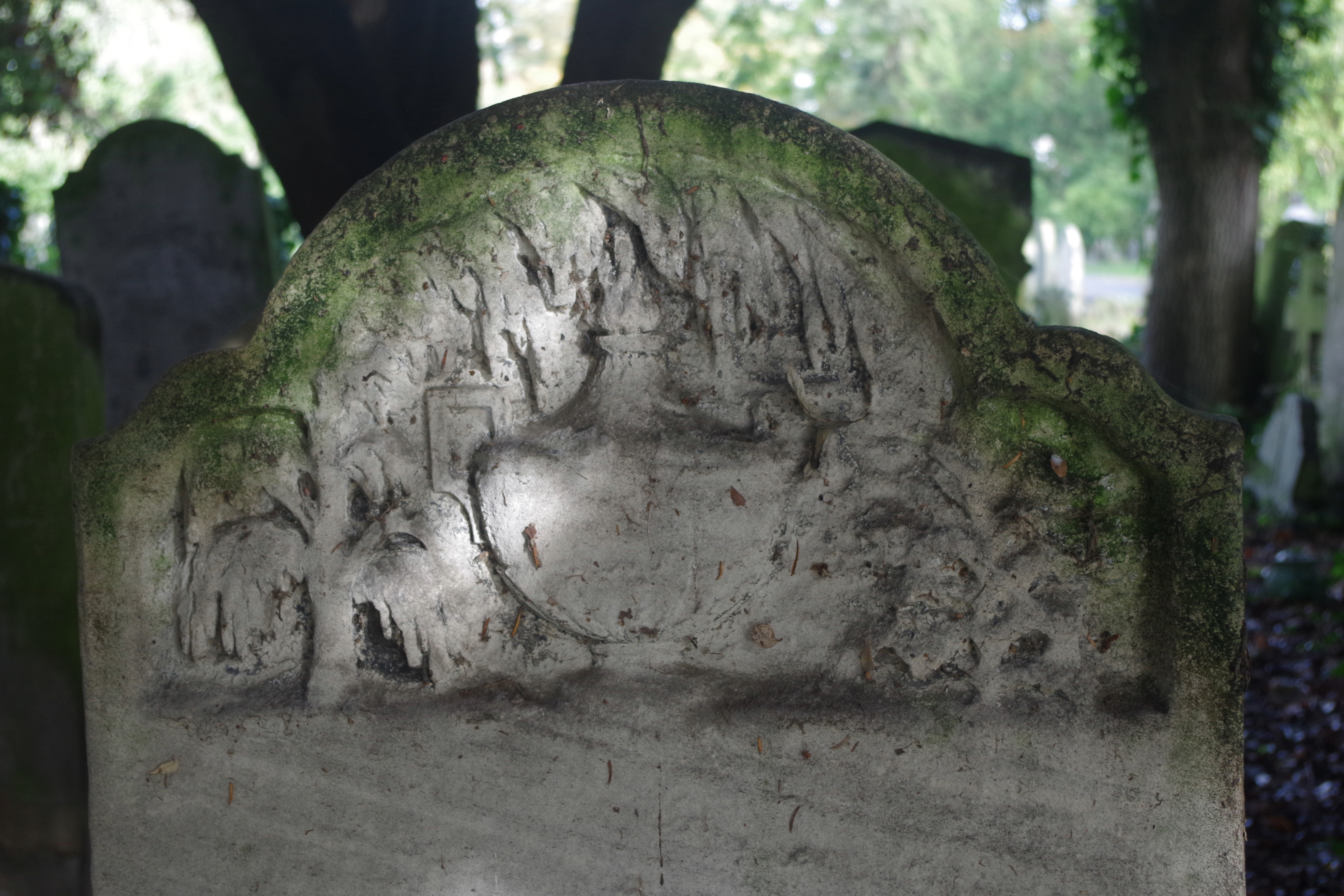
The scene at the top of the tombstone is almost like a miniature Doom painting.  My interpretation of it is that it’s Judgement Day and the deceased has awoken from their eternal slumber.  They appear to be in a burial chamber and lying on a ledge or on a shelf within a vault.  They have partly cast off their burial clothes and appear to be slightly decayed.  Ribs are visible and the head appears skull-like.

But where are they destined to go next?  What will be their fate? 

There’s only the choice of two final destinations for them – Heaven or Hell which are depicted on either side of the figure.

The devil standing over a skeleton that’s lost it’s crown. ©Carole Tyrrell

On the right hand side of the carving as you face it, is a magnificently winged demon, or The Devil himself, standing over a grinning skeleton whose crown has fallen from his head.   The crown is a very significant symbol in that it can indicate the passage from the earthly life into the divine and I have written it about in a previous Symbol of the Month.  The demonic figure appears to be holding what looks like a besom or maybe it is a three pronged fork or even a large arrow.  Although there are no flames, here the Devil is triumphant in his domain.

Closer view of the angel in the clouds and his trumpet. ©Carole Tyrrell

On the left-hand side, an angel appears to be floating within clouds while blowing a large trumpet in the direction of the newly awoken deceased.   Underneath the angel is a brick house with an entrance or a small narrow gateway (I have to say the entrance does resemble a fireplace).   I interpret this as being a depiction of God’s House and there are numerous references to it within the Bible and also in Genesis 28: 16-17:

‘When Jacob awoke from his sleep, he thought,

“Surely the Lord is in this place, and I was not aware of it.”

 He was afraid and said, “How awesome is this place! This is none other than the house of God; this is the gate of heaven.”

It was difficult to find a specific Biblical verse that mentioned the Devil and Hell but I did find a reference in Matthew 10:28 :

‘And fear not them which kill the body,

But are not able to kill the soul:

But rather fear him which is able to destroy both soul and body in hell.’

(King James Version)

I am not a particularly religious person but the parishioners of All Saints at the time would have recognised the quotations.

The scene would have been a prompt to the passing viewer or mourner to live their lives in a righteous manner or face the alternative for eternity.   It’s very dramatic and, as Alice died at an early age, this reminder would have very pertinent at a time when the average life expectancy was far lower. 

So far I have not been able to find out more about Alice or James but for now she rests within part of the quintessential English country churchyard.  She’s amongst ancient stones, some protected or obscured by mosses and lichens, and the bright wildflowers of late Spring.    However, I would like to know more about her and what may have inspired the little scene on her headstone.

R I P Alice Stone.

Since I wrote this post I have discovered other versions of ‘The Choice’ in various North Kent churchyards.   There is a weathered one in the churchyard of St Nicholas at Strood and no less than 5 versions, all by different stone masons, in St Mary the Virgin’s graveyard in Newington Kent.

One of the five versions of the ‘The Choice’ seen in the churchyard of St Mary the Virgin, Newington, Kent. ©Carole Tyrrell.

Another version from St Mary the Virgin’s churchyard in Newington, Kent. ©Carole Tyrrell

©Text and images Carole Tyrrell unless otherwise stated

Anchorite – Wikipedia

#LoveYourBurialGround – 03/06/23 -11/06/23

This is an initiative run by the God’s Own Acre organisation whose aim is to encourage ‘all who help to look after churchyards, chapel yards and cemeteries to celebrate these fantastic places in the lovely month of June – in any way they choose.’ I visited a little churchyard last week that was maintained by God’s Own Acre in that there was no mowing to encourage wildlife and biodiversity. As a result, it was alive with moths, butterflies, moon daisies and dragonflies. So here is a small gallery of my favourite finds in churchyards.

One of my personal favourites! A stylised winged soul with skull and crossbones beneath and a cloud above. St Peter & St Paul, Seal, Kent on the grave of a widow. The skull has been compared to a Jack o Lantern ©Carole Tyrrell
Old Father Time on an almost horizontal headstone, Pluckley, Kent ©Carole Tyrrell

In 2019 I was dared to visit the allegedly most haunted village in Britain – Pluckley in Kent. It was full of disappointed ghost hunters but in the churchyard of St Nicholas I found a new symbol – Old Father Time which I have found in other Kent churchyards such as St John the Baptist in Meopham and the former All Saints in Chatham. I was just hoping that the headstone didn’t fall on me and I would join the other permanent residents.

This is the Good Samaritan carving in St Margaret’s churchyard, Rochester.©Carole Tyrrell

This is now under ivy which may preserve it. I have found it in other Kent churchyards such as at Strood.

It’s dedicated to a woman, Catherine Bromley who was married to Will and died aged 33. If you would like to know more about her, the carving featured as a Symbol of the Month.

Alice Stone’s tombstone, All Saints churchyard, Staplehurst, Kent ©Carole Tyrrell

This one also featured as a Symbol of the Month as it was such a surprise to turn around in a pretty country churchyard and suddenly there it was. A carving that I had never seen before. Sadly, I could find out nothing about Alice Stone. I called it ‘The Choice’ and recently found it in the churchyard of St Mary the Virgin at Newington, Kent in five different versions!

Although headless, I thought that this was similar to a lady on a headstone at All Saints, Frindsbury and they became Symbols of the Month. I thought that they might be representations of the Greek Goddess Hebe which set me thinking about pagan symbols in churchyards and, as a result, I gave an online presentation on it to a myths group. photo ©Carole Tyrrell

This is the oldest tombstone that I have seen so far in the porch of St Nicholas, Sturry, Kent Photo ©Carole Tyrrell

However, this smiley little imp looks down on all those using the outdoor loo at St James’s church in Cooling, Kent – does he know something we don’t? Photo ©Carole Tyrrell

Text and photos ©Carole Tyrrell unless otherwise stated.

#National Cemeteries Week 2023 – 03/06/23 -11/06/23

This is organised by the National Federation of Cemetery Friends and is intended to encourage cemeteries to put on events. In its honour, I thought that I would share some of my favourite monuments and memorials from cemeteries that I have visited as a gallery of images.

This is one of the fearsome snakes on the catacomb doors at Brompton cemetery, London. They are modern versions of memento mori.©Carole Tyrrell

This angel is one of four on the Holland monument in London’s Kensal Green cemetery. ©Carole Tyrrell

The Italian Boy as I call him, Brompton Cemetery Feb18 ©Carole Tyrrell
View of the exuberant Wimble monument, West Norwood Cemetery. ©Carole Tyrrell

The sleeping angel on the monument to Mary Nichols, Highgate Cemetery, London ©Carole Tyrrell

and finally, another from Kensal Green cemetery on the Foster headstone.

Photos and text ©Carole Tyrrell unless otherwise stated.

A Spring saunter – St Margaret’s of Antioch, Ifield, Kent

View of the church along the churchyard path.©Carole Tyrrell

It was a glorious Easter Saturday this year and so I thought I’d go for a springtime walk in the Kent countryside near my home. On an earlier visit to St Mildred’s in Nurstead near Meopham in 2019, a local man had recommended visiting Ifield church which was just ‘a mile down the road’.  I assumed he meant ‘a country mile’ which may not be the standard length of a mile as we know it. I travelled to Meopham by train and then put my trust in Google maps.  I was feeling lucky that day…

Esater bunnies in St Mildred’s churchyard, Nurstead. ©Carole Tyrrell

Daffodils in St Mildred’s churchyard, Nurstead. ©Carole Tyrrell

As I sat in St Mildred’s churchyard I saw real easter bunnies pottering about who then adroitly vanished when they realised that a human was about. ‘Very wise.’ I thought and then set off to Ifield. The local ‘big house’ is Nurstead Manor which is across the road from St Mildred’s and it is surrounded by fields with some magnificent horses in them. St Mildred’s was closed but spring flowers were in the churchyard. Daffodils seemed to burst forth on one grave and there were patches of wild violets, purple and white. Spring was in full swing. Due to the lack of street signs, I hoped that I was on the right road when I took a left hand turn and walked on until I saw a sign. Along the road, on the verges, there were great patches of Lesser Celandine which is one of the seven signs of Spring.

Lesser Celandine on a roadside verge. ©Carole Tyrrell

 As I stood there wondering in what direction I should be going as there was no sign of a church, a passer by advised me to follow the signs to the lambing farm 100 yards ahead.

©Carole Tyrrell

©Carole Tyrrell

©Carole Tyrrell

Intrigued, I did so and, after paying £4, I was directed to a shed in which there was an assortment of lambs and ewes in pens.  Some of the lambs were only 2 days old and others were playful, climbing onto their mum’s thick woolly coats or having a kip.  But they were not destined for Sunday lunch as they were a rare breed, the Cobham Longwool, of which there are only 500 in the country. ‘So not for eating.’  the farmers wife comfortingly told another visitor which was a relief. I had held a lamb and felt a little guilty.  We were also shown their two pigs who were very lively and, after a pizza and being given directions, ‘It’s quite a way further on.’ I resumed my walk. One of her companions said as I moved on, ‘Oh she’s one of those people who like visiting churches, they’ll walk miles to see one.’

They weren’t kidding.  The road was empty, devoid of houses and cars and other walkers. It seemed strange to have a church so far out of town but I have become accustomed to isolated churches in North Kent.   Ifield is recorded in the Domesday 1086 and is a hamlet of only 12 houses with no sign of any shops and St Margaret’s is at the very end.  Unknowingly I was on the ancient village street, Ifield Street, which was an isolated empty road and unlit at night.  I can’t imagine too many late night services being held there during winter.

View over the fields from the churchyard. ©Carole Tyrrell

View of church from churchyard. ©Carole Tyrrell

Despite the website saying it was open daily, on my visit it was closed, which seemed odd at Easter. So, I was unable to see the interior and the remaining medieval features.  The nave and chancel date from the 13th century and there is a 12th century font.  It’s a quiet location although I could hear the endless traffic on the A2 that separate the church from the hamlet. Its rough stone walls are now covered by modern cement which makes it look younger than it actually is and gave it, in my opinion, a slightly American look. In fact St Margaret’s is known by the locals as the ‘Little church on the Prairie and I could see why as it’s surrounded by fields which contained tall yellow flowers which I assumed were rapeseed. By now the fields would be a bright acid yellow.  Quite a sight to see.It is thought that Chaucer’s pilgrims on their way to Canterbury would have passed by the church, and standing here in this isolated spot I could believe that the landscape might not have changed much.

War memorial just outside the lychgate.©Carole Tyrrell

Names inscribed on the memorial from the First World War. ©Carole Tyrrell

The impressive War Memorial just outside the lychgate dates from 1919 and originally commemorated the village’s fallen of the First World War.  There was

 ‘ a service of dedication for the memorial on 20th June 1919 which was a week prior to the end of the First World War with the signing of the Treaty of Versailles.’

www.ifieldparish.org

It’s built of Cornish silver-grey granite and cost £120 at the time which was raised through subscriptions from parishioners.  Names from the Second World War are also inscribed on it and a full list of names is on the www.ifieldparish.org  website.

The churchyard contains mostly 19th, 20th and 21st memorials and was a symphony in yellow. Dandelions abounded and these can be seen as symbols of astral bodies. The flowerhead in full bloom is emblematic of the sun, the dandelion clock is the moon and the scattering seedheads are the stars.  Lesser celandine was still there in abundance and near the lychgate there was a small patch of cowslips.  I also saw tulips and grape hyacinths.  

More Lesser celandine swarming over the churchyard.©Carole Tyrrell

A patch of dandelions. ©Carole Tyrrell

Grape hyacinths. ©Carole Tyrrell

Cowslips. ©Carole Tyrrell

More cowslips. ©Carole Tyrrell

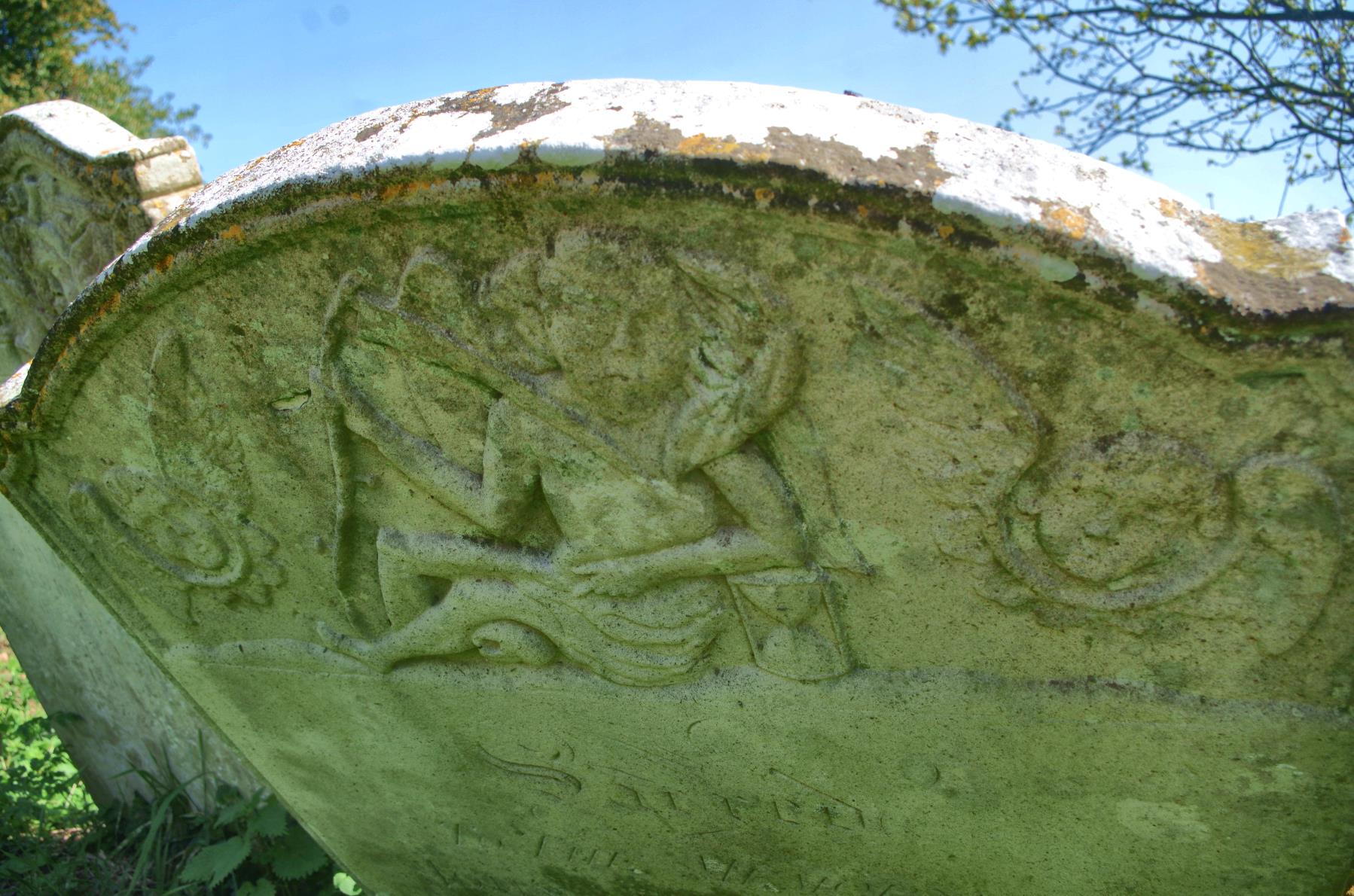
There were a sprinkling of 18th headstones on which pairs of winged messengers  and also an impressive winged skull could be seen.

18th century headstone showing winged messengers. ©Carole Tyrrell

18th century winged skull on a headstone. ©Carole Tyrrell

On this one, it can be seen very clearly what the departed’s hobbies or occupation was. A clear example of ‘the tools of the trade’.  And there was an unusual cast iron memorial to ‘our two sons’ on one headstone.

©Carole Tyrrell

©Carole Tyrrell

©Carole Tyrrell

This is the largest and most significant group of memorials and commemorates the Colyer Fergusson family who were associated with Ightham Mote, now a National Trust property. It’s a

‘medieval moated manor house roughly 7 miles from Sevenoaks’ according to the National Trust website.  Thomas Colyer-Fergusson, eventually to assume the title of ‘Sir’ when he assumed the additional name of Colyer in 1890 and his bride, Beatrice, set up home at Ightham in 1889 and were keen to make their mark on the house.  They were very forward thinking and introduced:

‘central heating, electricity and bathrooms connected to the mains water supply.’ Ightham Mote | Kent | National Trust

These amenities were undoubtedly appreciated by their retinue of indoor servants and gardeners.  In addition, the Colyer-Fergussons introduced the opening of rooms to visitors on one afternoon a week for the price of 2 shillings.  Octavia Hill, one of the founders of the National Trust was a visitor.

But the carnage and of the 2 World wars badly affected the Colyer-Fergussons.  In the first World War, Thomas’s second son, Billy suffered shell shock and the youngest son, Riversdale was killed at Ypres aged 21.  Riverdale’s death had a profound effect on Thomas in that he would not allow the gardeners to

‘make any changes to the garden, asking them not to cut back any plants or remove dying trees.’

 Ightham Mote | Kent | National Trust

During the Second World War, Max, Thomas’s eldest son, was killed in a bombing raid on an Army training school in 1940.

Thomas died in 1951 and Ightham Mote was inherited by Max’s son, James.  He had no children and was only too well aware of the huge expense that would be incurred in maintaining the house. So he sold it and its contents leaving it with an uncertain future and eventually it was taken over by the National Trust. The baronetcy became extinct with the death of the 4th Baronet in 2004.

There is an obituary on the Kent Archaeological Society website to Sir Thomas in which he is thanked for his ‘patient and persistent work’ in transcribing parish registers.  This was no mean task as they were largely handwritten and not indexed.  He was very involved with the Society and eventually became its Vice-President. 


©Carole Tyrrell

The last Baronet, after this the title died out. ©Carole Tyrrell

And so here the Colley-Fergussons rest in this serene churchyard surrounded by the other departed villagers and parishioners and the Spring flowers that indicate Mother Nature is returning to life.  It was interesting to see a connection between Ifield and Ightham Mote as the house is one of my favourite places to visit and I based a short story on a particular painting on display there.

I retraced my steps back to Meopham and St Mildred’s churchyard resisting the urge to ask any passing horse and rider a lift for some of the way.  The clip clopping of horses hooves had let me know that there was an equestrian establishment close by. Already the long shadows of the early evening were racing over the fields but it had felt so wonderful to be outside and exploring once again after a long winter.

©Text and photos Carole Tyrrell unless otherwise stated.

References and further reading

History of St. Margaret’s Church | Parish of Ifield (ifieldparish.org)

Ifield St Margaret of Antioch | National Churches Trust

Ightham Mote | Kent | National Trust

Colyer-Fergusson baronets – Wikipedia

Obituary – Sir Thomas Colyer-Fergusson 1865-1951 – Archaeologia Cantiana, Vol. 64  1951  page 186 (kentarchaeology.org.uk)