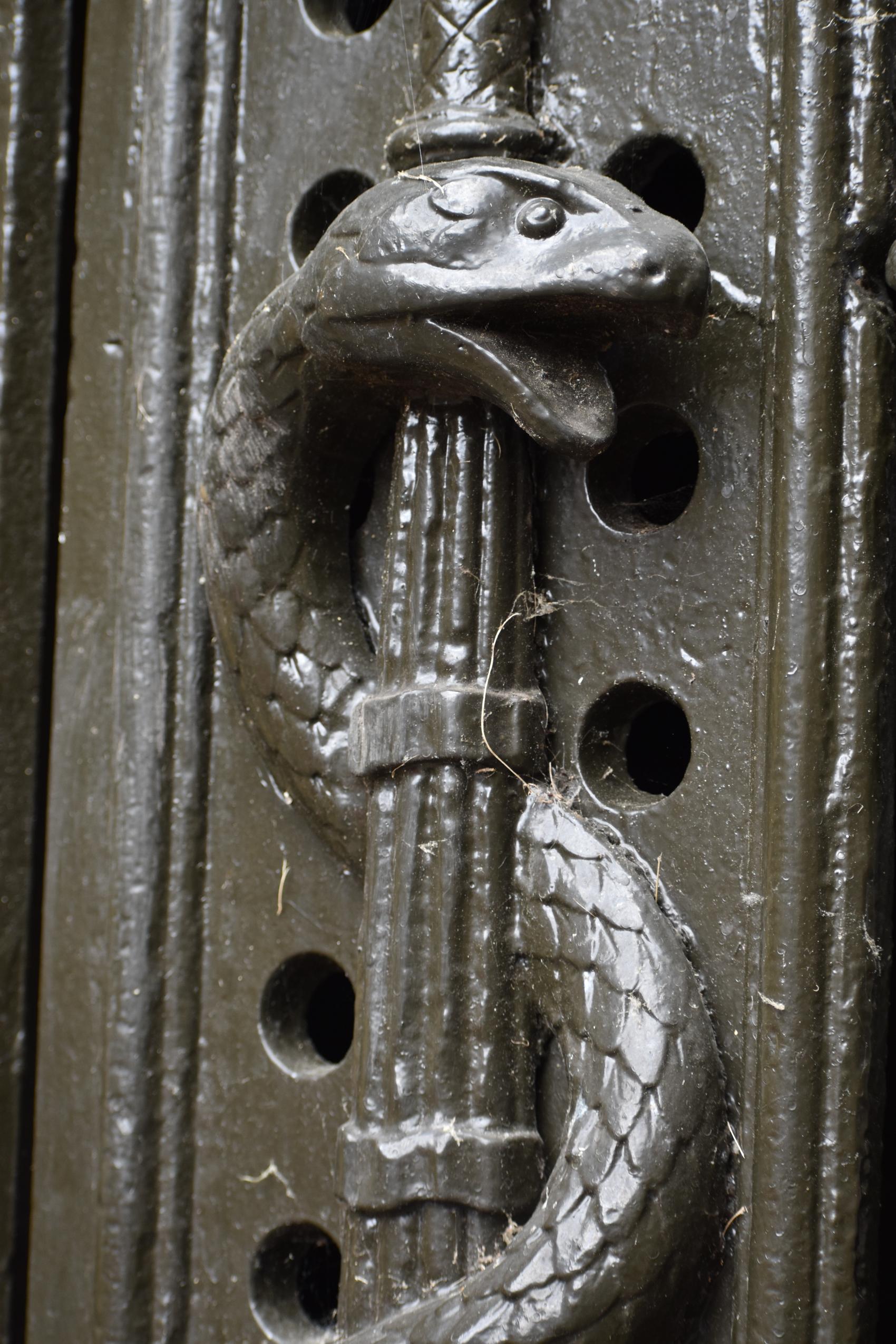
One of the snakes on the catacomb doors in Brompton Cemetery. copyright Carole Tyrrell
To any of you that live in London, I am leading an Introduction to Cemetery Symbols tour in Brompton Cemetery!
It will focus on the symbols within Brompton Cemetery of which there is a varied and fascinating collection amongst its 35,000 monuments from Celtic crosses to Egyptian gods and many others. Come and explore the lost language of Death with me!
Date and time: Sat, 8 July 2023, 14:00
Leaving from: Information Centre (Old Brompton Road entrance) Duration: approx. 1 hour 30 minutes Tickets are £10 per person (plus £1.50 booking fee if booked on Eventbrite)
Book at Eventbrite (refundable up to 1 day before event; Eventbrite’s fee is nonrefundable)
I was originally going to entitle this post ‘ the oldest headstone that I have seen – so far’. As I explore churchyards and cemeteries I sometimes find ancient tombstones and memorials dating back to the 17th century. But, more recently, I have found ones that are dated even earlier.
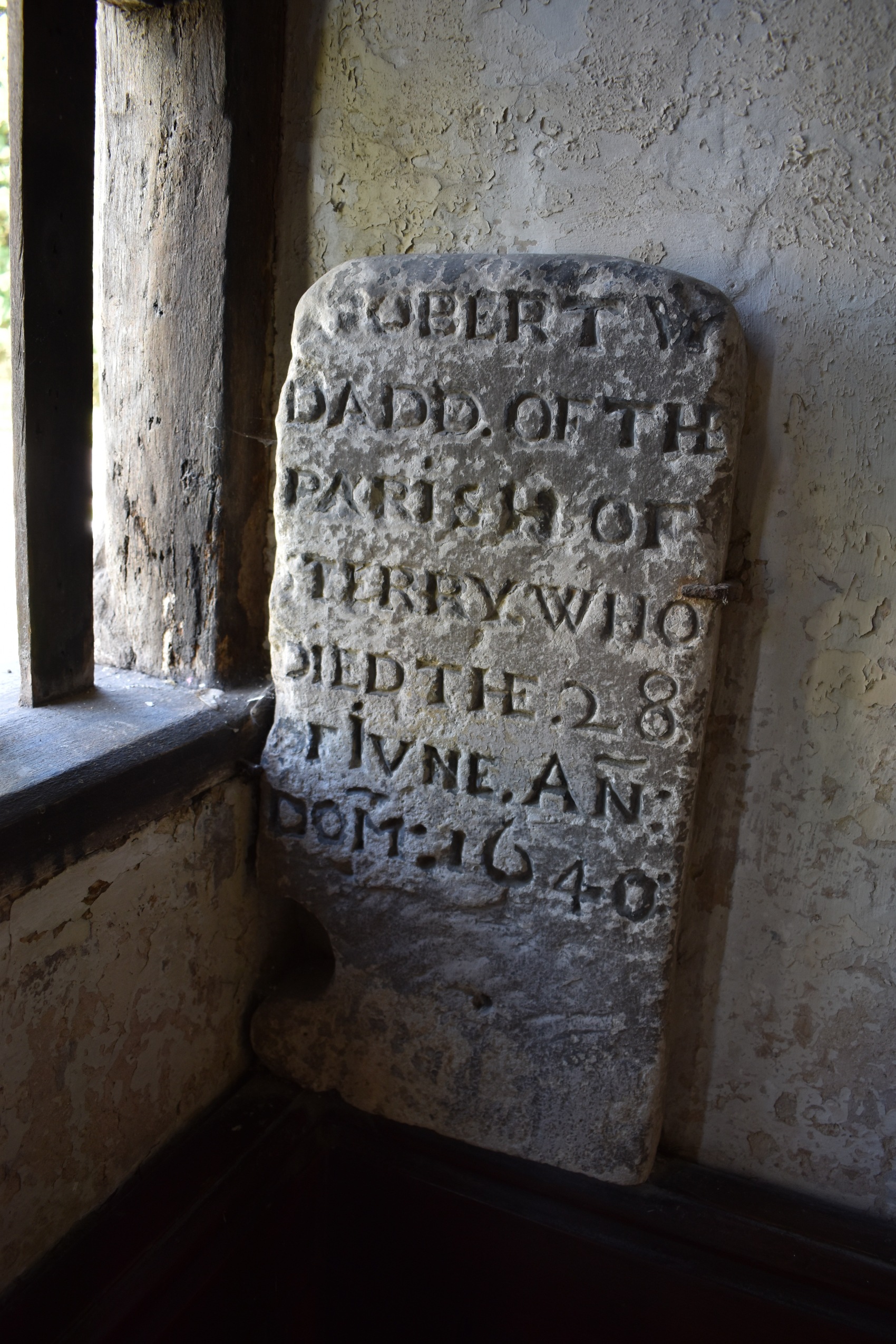
This one was in the porch of St Nicholas in Sturry which is a village in Kent and is a good example of early 17th century calligraphy. Sadly, because it is in the porch, there is no way of knowing where Robert Dadd is buried within the large churchyard that surrounds the church. But it is incredible to think that this headstone has survived for over 400 years although obviously we don’t know when it was put in the porch. I couldn’t find the headstone on Kent Archaeological Society’s monumental inscriptions page but Dadd seems to be a fairly common name. They have been recorded as living in Sturry during the 18th century.
I was admiring the drifts of ox eye daisies, or moon daisies as they are also known, in the substantial churchyard of St Mary the Virgin in Selling in Kent. This was a fascinating church with wall paintings of saints and other painted decoration. Sometimes I do have a real sense of what a medieval church must have looked like, pre-Reformation, with murals, wall paintings and other decoration. It would have been alive with colour in contrast to the plain interiors of churches that can be seen today. The beautiful painted medieval column at St Mary’s of Charity in Faversham is another indication with its still rich colours. The priest would have used the wall paintings as teaching aids to an illiterate congregation.
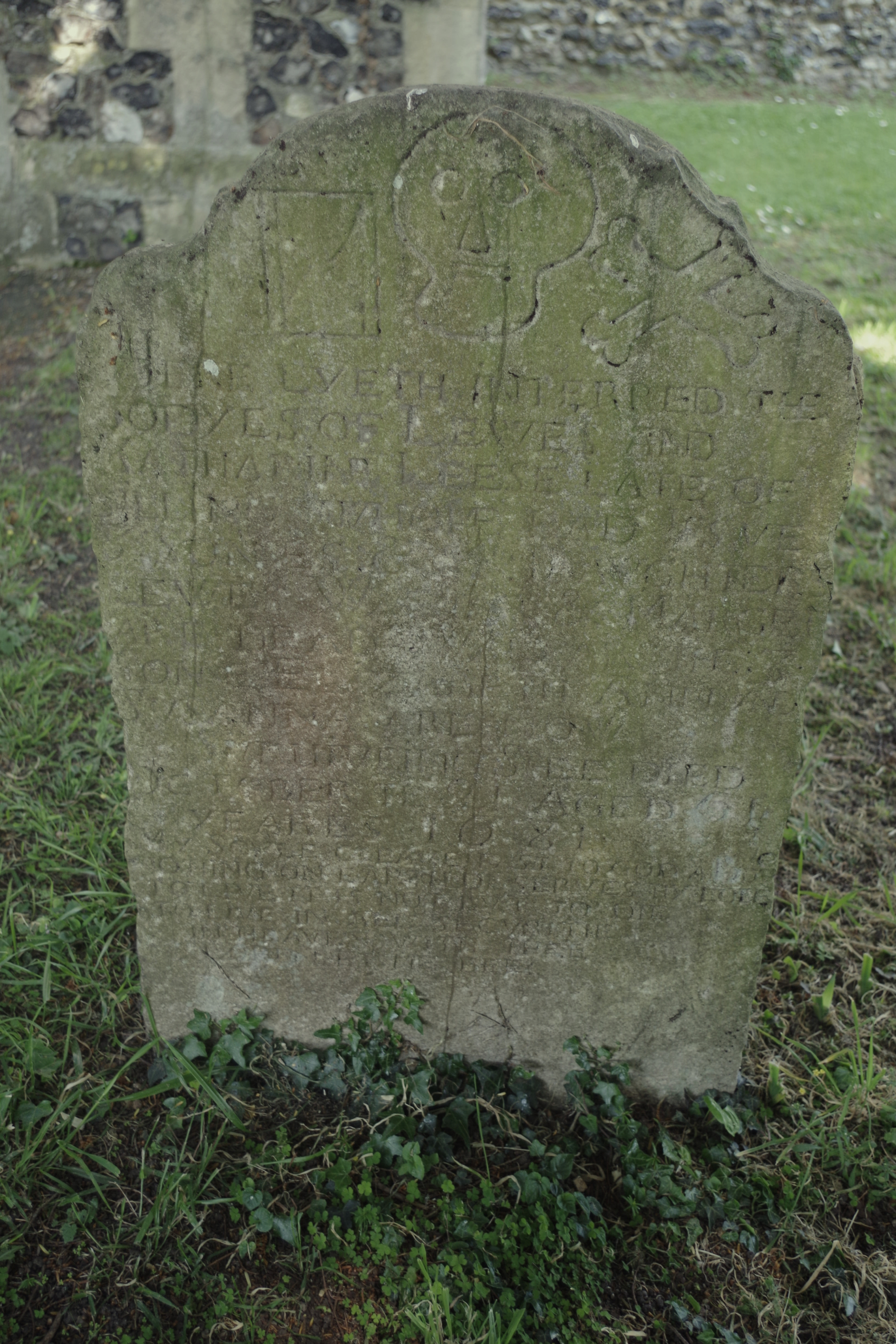
Under a spreading yew tree is the headstone dedicated to Catherine Lees who died in 1681. According to the guidebook, it is the oldest legible tombstone in the churchyard, so there may be others even earlier that are not so readable now. Catherine was a member of an old Kent family, the Lees, and the guidebook says that there is ‘a house in the next parish of Shieldwich (which) is still called Lees Court after them.’ The inscriptions and symbols are very crudely cut into the stone which is part of its charm for me. However, I was a little surprised that such an old and venerable family could not afford a professional stonemason. There is an hourglass, skull and longbones and the epitaph reads:
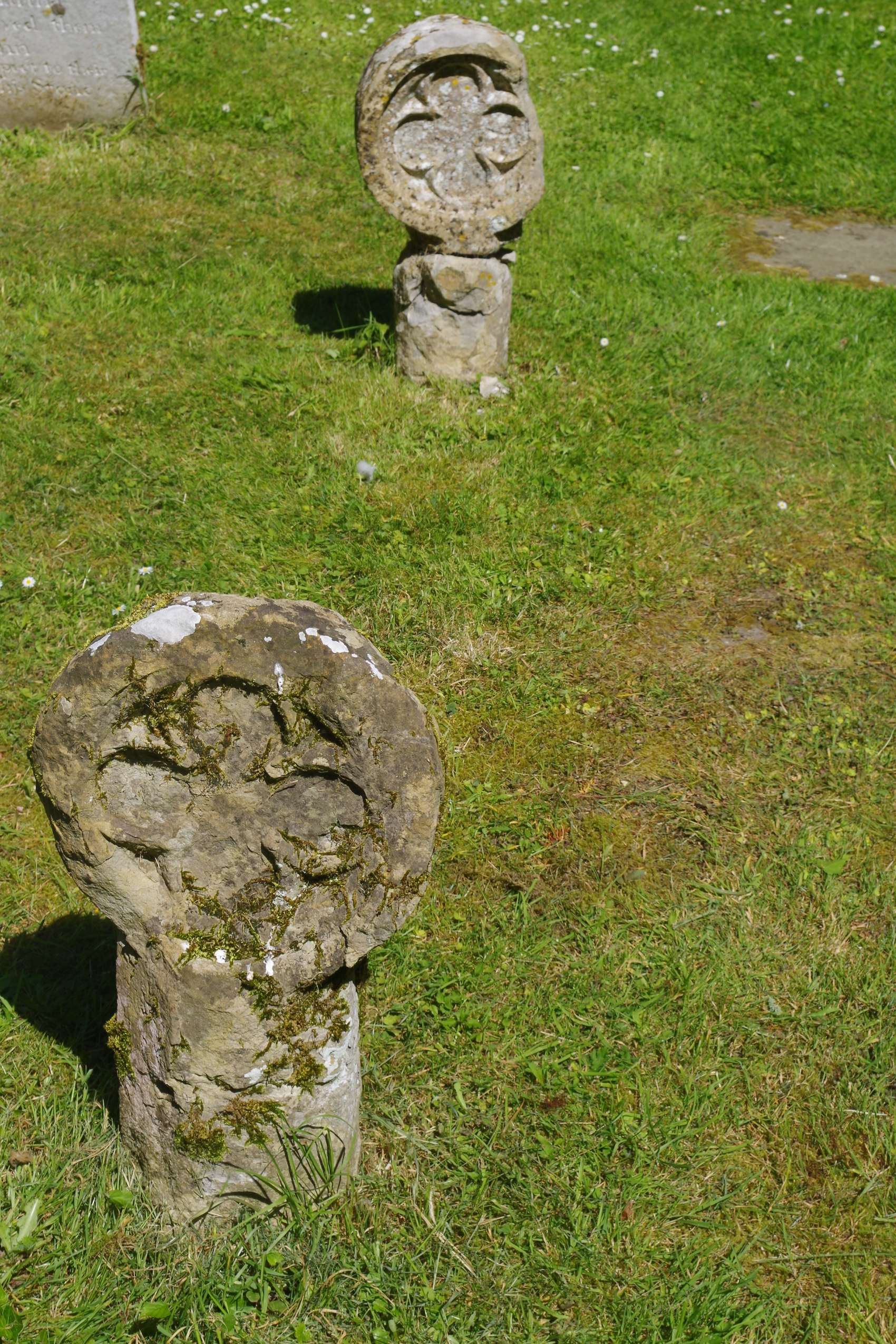
Also, in St Mary’s churchyard are its only surviving medieval tombstones according to the guidebook. Apparently, there were ‘many of them in a particular part of the churchyard’. These were ‘stone discs with a quatrefoil ornamentation on a short stone shank.’ But no names apparently. St Mary’s burial registers only began in 1558 so there may be no records of their medieval burials. St Mary’s is an interesting church as the very first church was built on a Jutish holy place and their ‘savage dancing ground of beaten earth lies somewhere beneath the chancel floor of the tranquil and dignified building that is seen today.’ The Jutes were one of the Germanic tribes that settled in Britain after the Romans left. They were very powerful and a local pond, Ghost Hole Pond, has a sinister reputation. There were several recorded cases of violent deaths associated with it and the Jutes were known for their human sacrifices. These included the ‘ritual drowning of ….in ponds and meres.’ This seemingly quiet and peaceful part of Kent obviously hides a much more savage and brutal past. St Mary’s is another example of the Christianisation of pagan sites by building a church on top of one. An interesting brush with ancient history.
So now I have seen medieval examples of burial markers – can I find one that is even earlier? There are reputed to be some in the churchyard of St Peter and St Paul in Tonbridge, Kent but they were unsure of where they were. But I’m keeping a look out!
You never know what little gems you might find in a country churchyard and I discovered one while exploring in Staplehurst in 2019. All Saints church has a commanding hilltop position and looks down on the pretty half-timbered houses of the village. Since 1100 it has stood on this site and has several ancient features. These include the remnants of an anchorite’s cell. This was a medieval form of penance in which the anchorite would live in a very small cell, if the size of the remaining floor of the cell is to be believed, and lived on offerings that parishioners and others would pass through a window set into the church and the cell. The offering window is still there. All I could think of was how cold it must have been in winter and how did they deal with their waste products. They were effectively hermits and were declared as being dead to the world. It was the Reformation brought the anchorite life to a close. There is also a wooden door to the side of All Saints that has been definitively dated to 1050 and features scenes from Norse legends. I could find no explanation for pagan elements being incorporated in a consecrated building and so it was very intriguing. Why here?
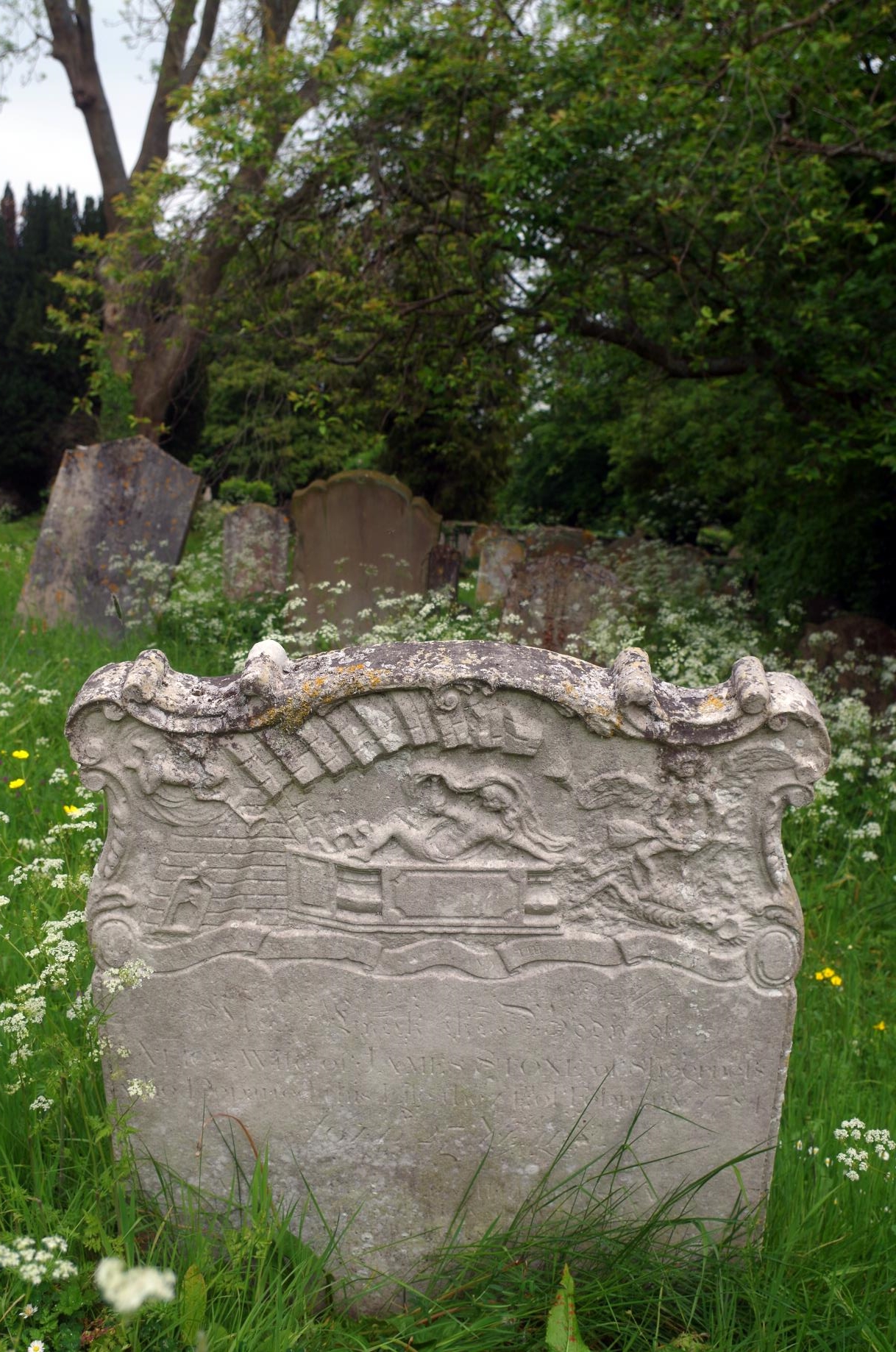
The churchyard was far larger than I expected and led to a more modern section at the back of the church. But as I explored the older part of the churchyard I turned around and came face to face with this unusual symbol on a white headstone.
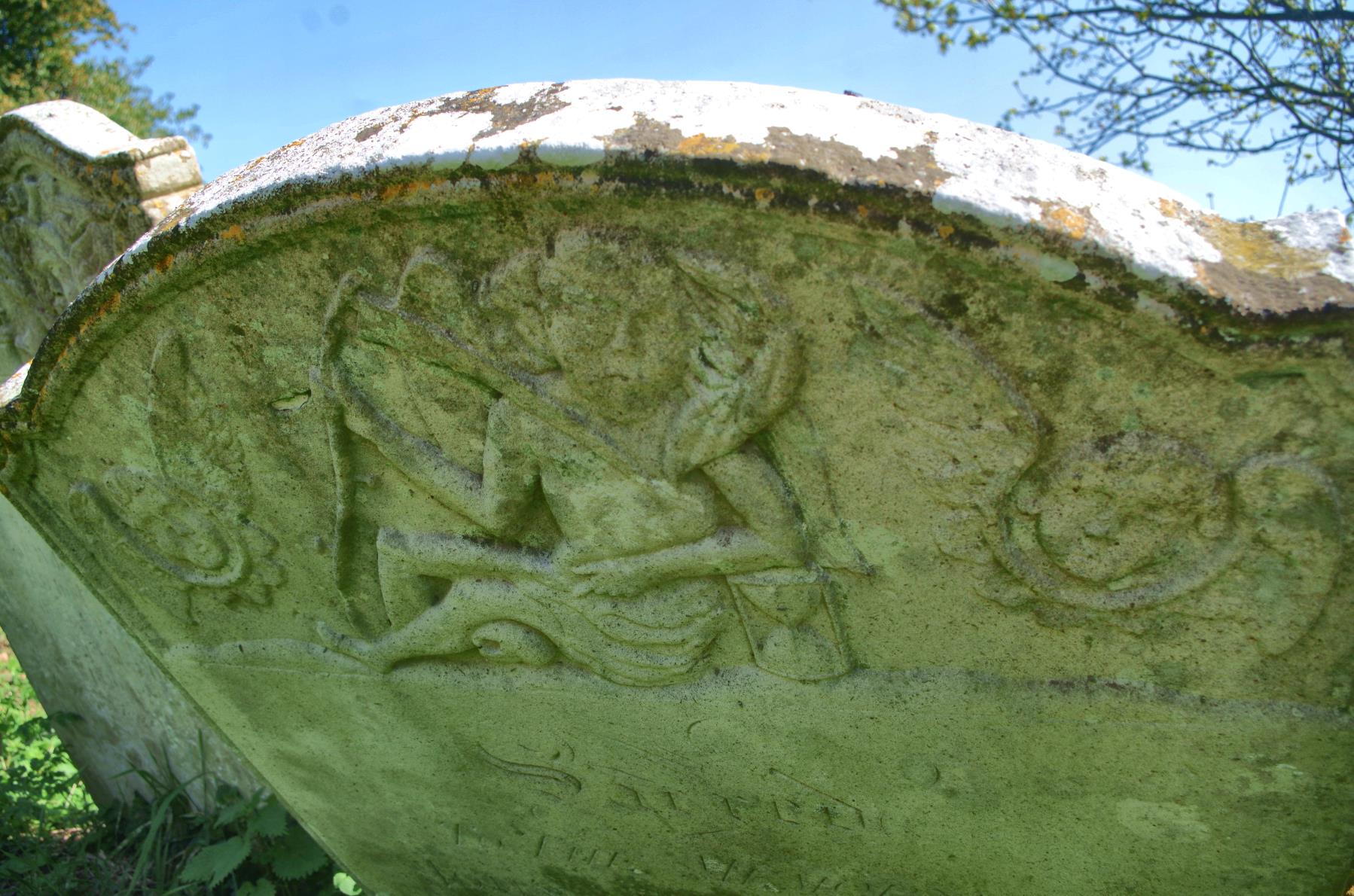
It’s dedicated to Alice Stone, wife of James Stone of Sheerness. There is no date of birth recorded but she died on 5 February 1787 aged 27. Alice may have died in childbirth which was a frequent cause of death for women in past eras or maybe she was a victim of an epidemic. We’ll never know. However, there is some barely legible lettering above the inscription which I have been unable to sufficiently enhance in order to read it so this may well warrant a second visit.
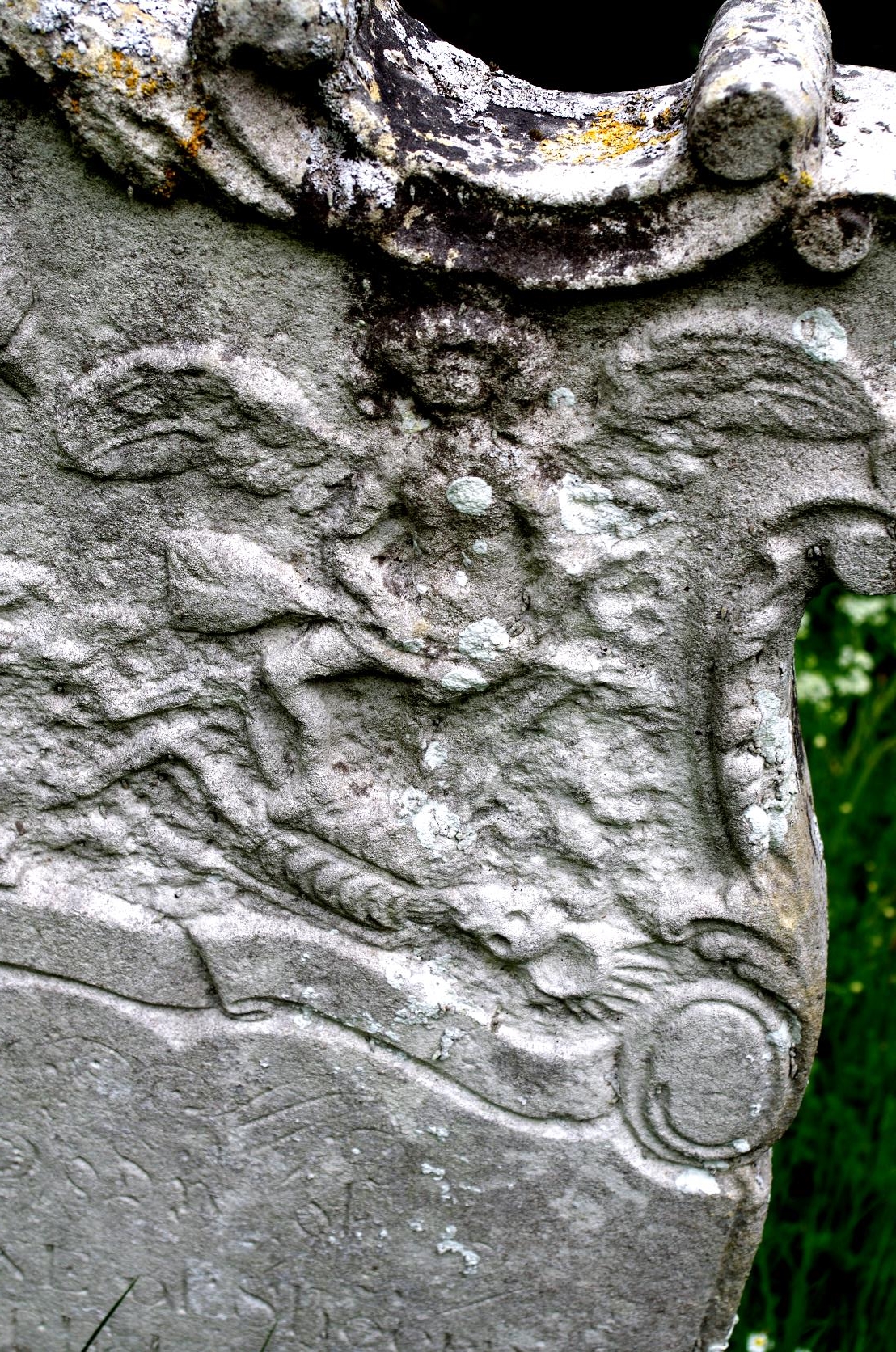
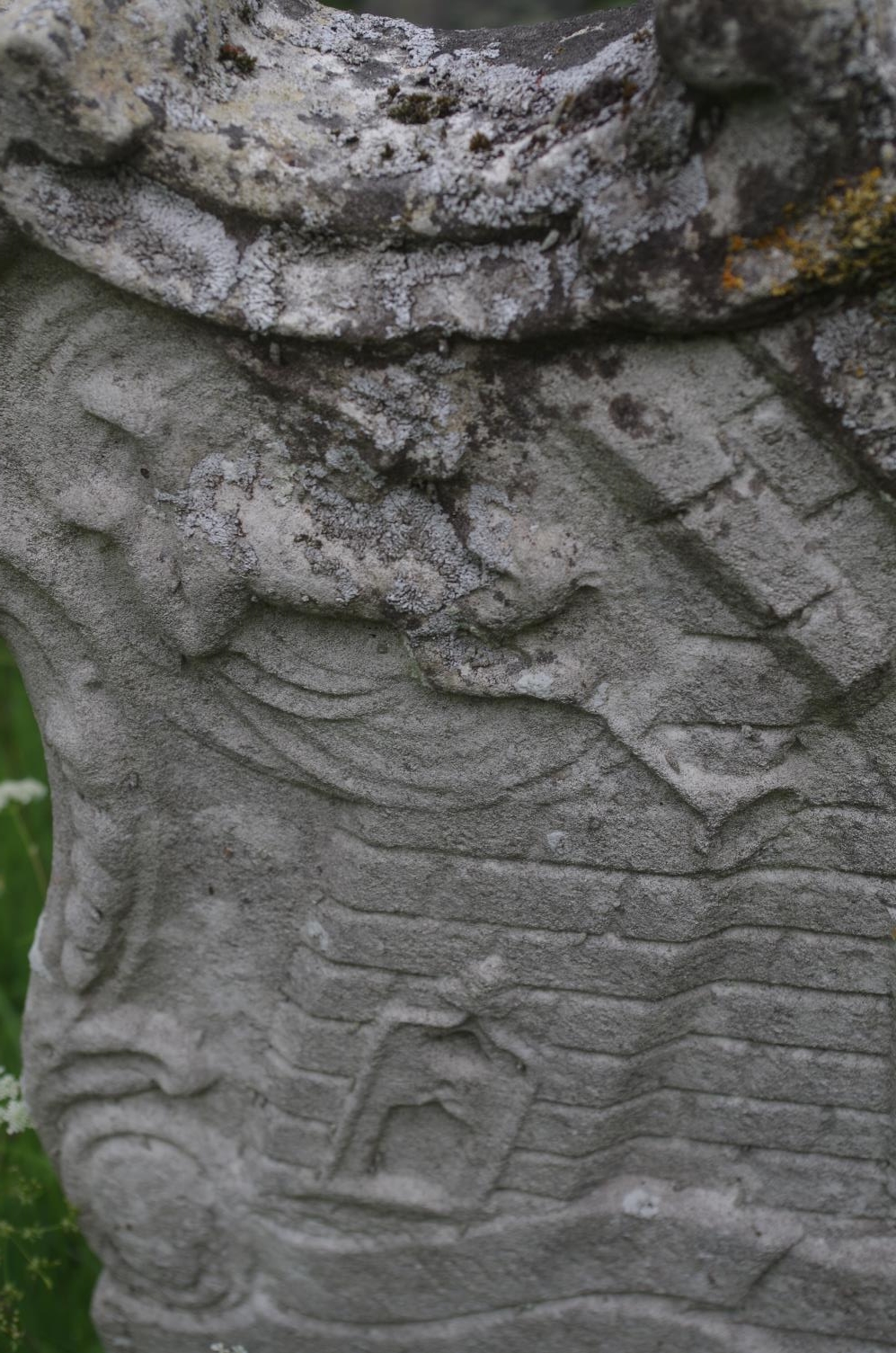
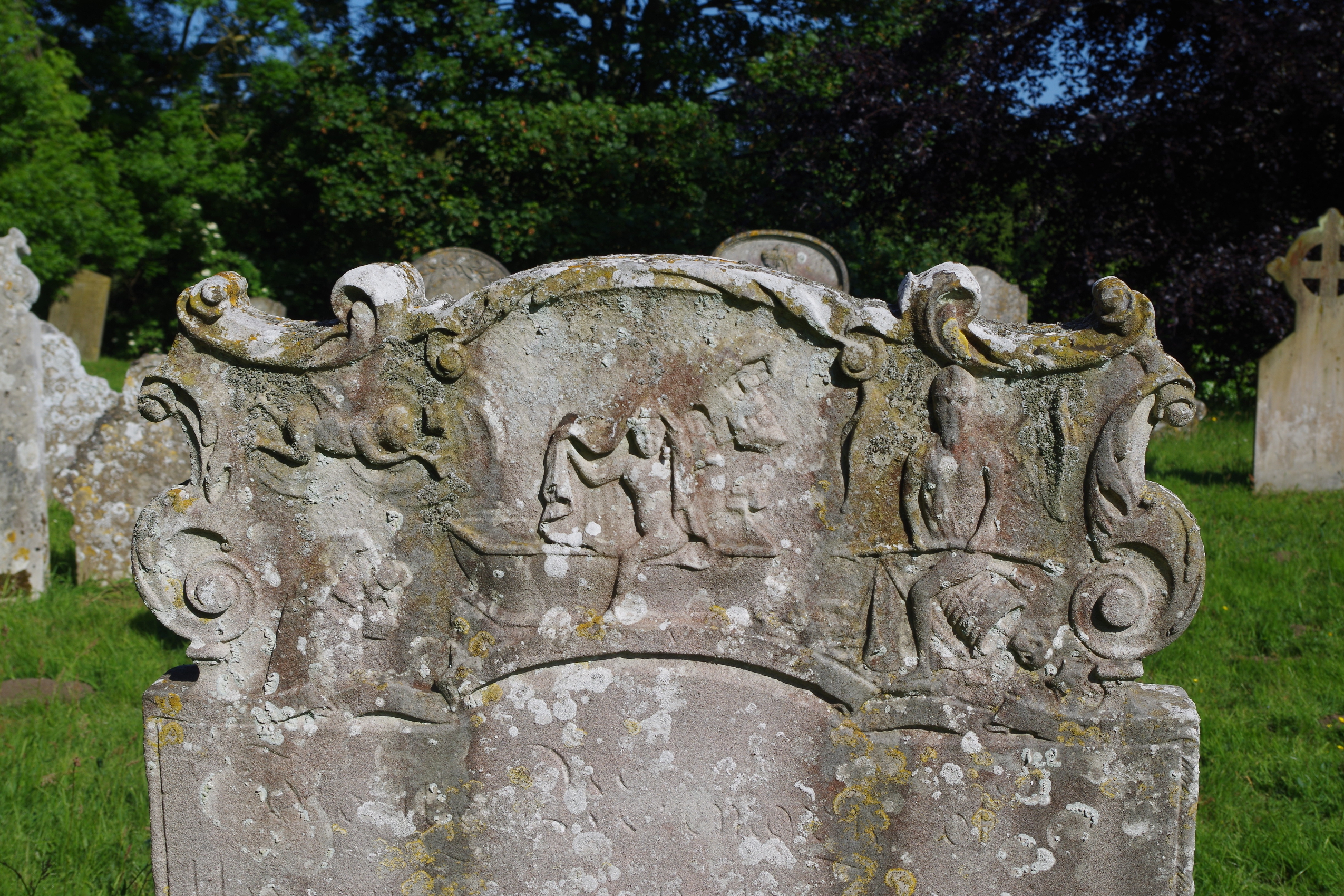
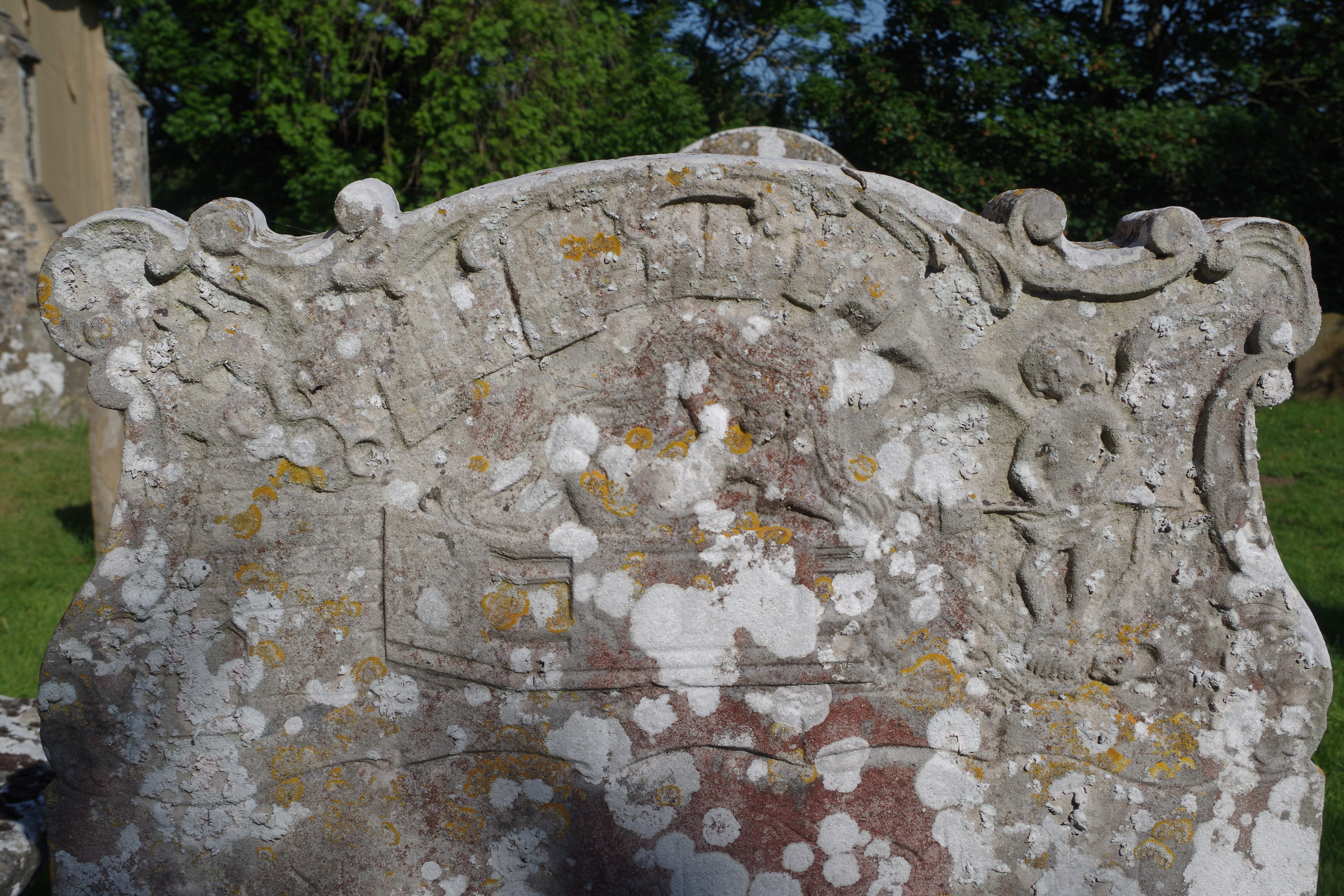
The scene at the top of the tombstone is almost like a miniature Doom painting. My interpretation of it is that it’s Judgement Day and the deceased has awoken from their eternal slumber. They appear to be in a burial chamber and lying on a ledge or on a shelf within a vault. They have partly cast off their burial clothes and appear to be slightly decayed. Ribs are visible and the head appears skull-like.
But where are they destined to go next? What will be their fate?
There’s only the choice of two final destinations for them – Heaven or Hell which are depicted on either side of the figure.
On the right hand side of the carving as you face it, is a magnificently winged demon, or The Devil himself, standing over a grinning skeleton whose crown has fallen from his head. The crown is a very significant symbol in that it can indicate the passage from the earthly life into the divine and I have written it about in a previous Symbol of the Month. The demonic figure appears to be holding what looks like a besom or maybe it is a three pronged fork or even a large arrow. Although there are no flames, here the Devil is triumphant in his domain.
On the left-hand side, an angel appears to be floating within clouds while blowing a large trumpet in the direction of the newly awoken deceased. Underneath the angel is a brick house with an entrance or a small narrow gateway (I have to say the entrance does resemble a fireplace). I interpret this as being a depiction of God’s House and there are numerous references to it within the Bible and also in Genesis 28: 16-17:
‘When Jacob awoke from his sleep, he thought,
“Surely the Lord is in this place, and I was not aware of it.”
He was afraid and said, “How awesome is this place! This is none other than the house of God; this is the gate of heaven.”
It was difficult to find a specific Biblical verse that mentioned the Devil and Hell but I did find a reference in Matthew 10:28 :
‘And fear not them which kill the body,
But are not able to kill the soul:
But rather fear him which is able to destroy both soul and body in hell.’
(King James Version)
I am not a particularly religious person but the parishioners of All Saints at the time would have recognised the quotations.
The scene would have been a prompt to the passing viewer or mourner to live their lives in a righteous manner or face the alternative for eternity. It’s very dramatic and, as Alice died at an early age, this reminder would have very pertinent at a time when the average life expectancy was far lower.
So far I have not been able to find out more about Alice or James but for now she rests within part of the quintessential English country churchyard. She’s amongst ancient stones, some protected or obscured by mosses and lichens, and the bright wildflowers of late Spring. However, I would like to know more about her and what may have inspired the little scene on her headstone.
R I P Alice Stone.
Since I wrote this post I have discovered other versions of ‘The Choice’ in various North Kent churchyards. There is a weathered one in the churchyard of St Nicholas at Strood and no less than 5 versions, all by different stone masons, in St Mary the Virgin’s graveyard in Newington Kent.
This is an initiative run by the God’s Own Acre organisation whose aim is to encourage ‘all who help to look after churchyards, chapel yards and cemeteries to celebrate these fantastic places in the lovely month of June – in any way they choose.’ I visited a little churchyard last week that was maintained by God’s Own Acre in that there was no mowing to encourage wildlife and biodiversity. As a result, it was alive with moths, butterflies, moon daisies and dragonflies. So here is a small gallery of my favourite finds in churchyards.
In 2019 I was dared to visit the allegedly most haunted village in Britain – Pluckley in Kent. It was full of disappointed ghost hunters but in the churchyard of St Nicholas I found a new symbol – Old Father Time which I have found in other Kent churchyards such as St John the Baptist in Meopham and the former All Saints in Chatham. I was just hoping that the headstone didn’t fall on me and I would join the other permanent residents.
This is now under ivy which may preserve it. I have found it in other Kent churchyards such as at Strood.
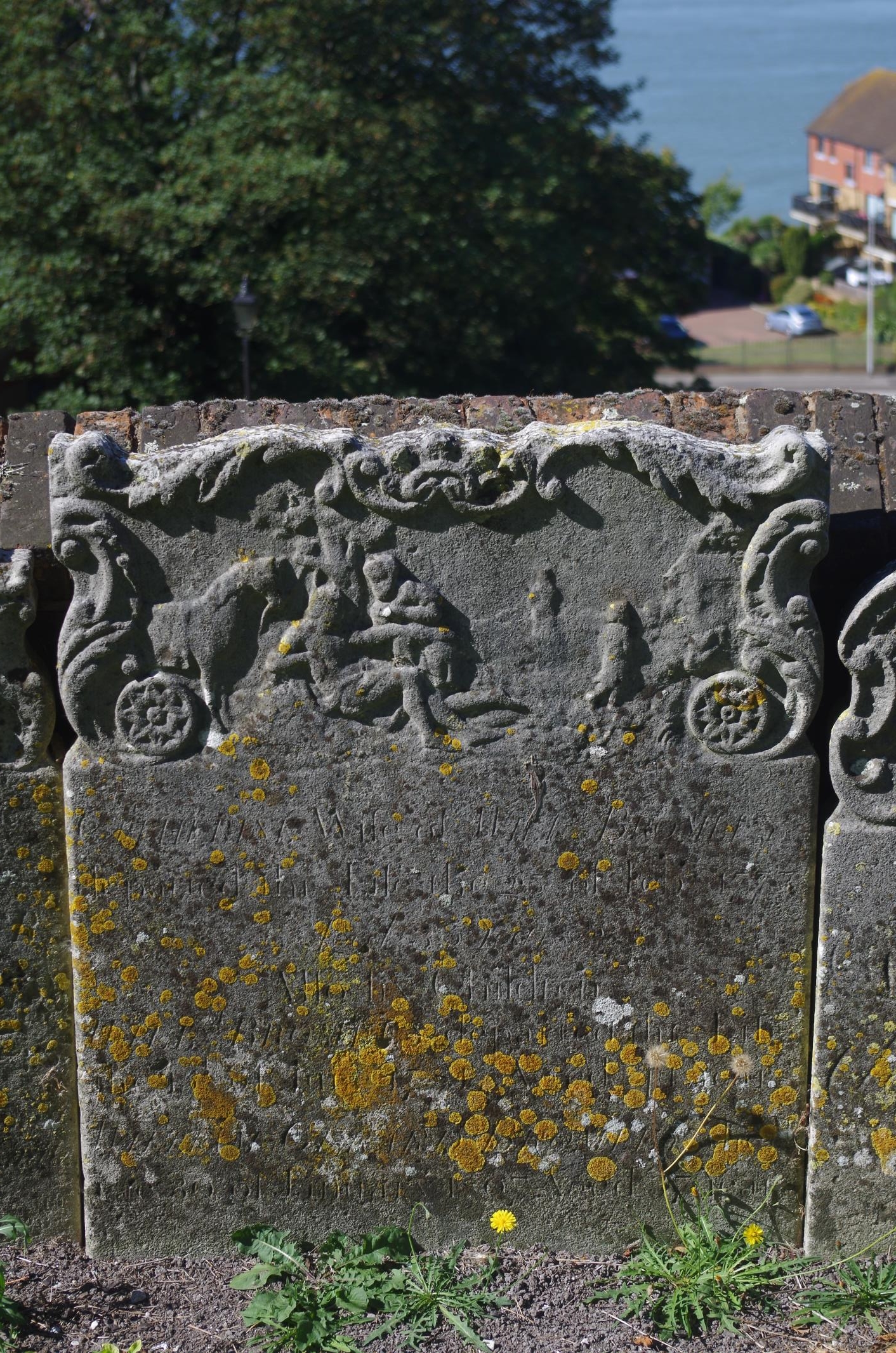
It’s dedicated to a woman, Catherine Bromley who was married to Will and died aged 33. If you would like to know more about her, the carving featured as a Symbol of the Month.
This one also featured as a Symbol of the Month as it was such a surprise to turn around in a pretty country churchyard and suddenly there it was. A carving that I had never seen before. Sadly, I could find out nothing about Alice Stone. I called it ‘The Choice’ and recently found it in the churchyard of St Mary the Virgin at Newington, Kent in five different versions!
This is organised by the National Federation of Cemetery Friends and is intended to encourage cemeteries to put on events. In its honour, I thought that I would share some of my favourite monuments and memorials from cemeteries that I have visited as a gallery of images.
It was a glorious Easter Saturday this year and so I thought I’d go for a springtime walk in the Kent countryside near my home. On an earlier visit to St Mildred’s in Nurstead near Meopham in 2019, a local man had recommended visiting Ifield church which was just ‘a mile down the road’. I assumed he meant ‘a country mile’ which may not be the standard length of a mile as we know it. I travelled to Meopham by train and then put my trust in Google maps. I was feeling lucky that day…
As I sat in St Mildred’s churchyard I saw real easter bunnies pottering about who then adroitly vanished when they realised that a human was about. ‘Very wise.’ I thought and then set off to Ifield. The local ‘big house’ is Nurstead Manor which is across the road from St Mildred’s and it is surrounded by fields with some magnificent horses in them. St Mildred’s was closed but spring flowers were in the churchyard. Daffodils seemed to burst forth on one grave and there were patches of wild violets, purple and white. Spring was in full swing. Due to the lack of street signs, I hoped that I was on the right road when I took a left hand turn and walked on until I saw a sign. Along the road, on the verges, there were great patches of Lesser Celandine which is one of the seven signs of Spring.
As I stood there wondering in what direction I should be going as there was no sign of a church, a passer by advised me to follow the signs to the lambing farm 100 yards ahead.
Intrigued, I did so and, after paying £4, I was directed to a shed in which there was an assortment of lambs and ewes in pens. Some of the lambs were only 2 days old and others were playful, climbing onto their mum’s thick woolly coats or having a kip. But they were not destined for Sunday lunch as they were a rare breed, the Cobham Longwool, of which there are only 500 in the country. ‘So not for eating.’ the farmers wife comfortingly told another visitor which was a relief. I had held a lamb and felt a little guilty. We were also shown their two pigs who were very lively and, after a pizza and being given directions, ‘It’s quite a way further on.’ I resumed my walk. One of her companions said as I moved on, ‘Oh she’s one of those people who like visiting churches, they’ll walk miles to see one.’
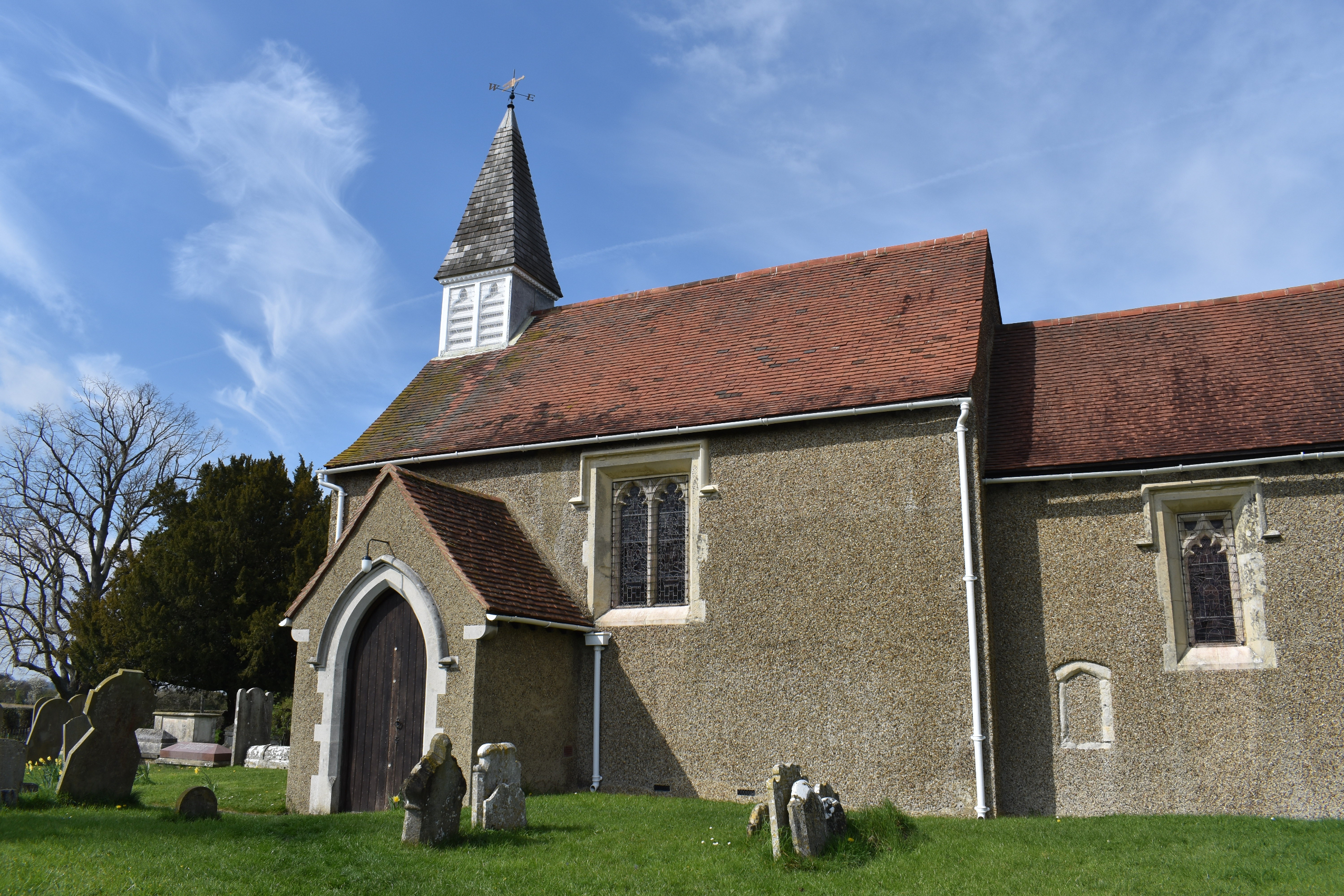
They weren’t kidding. The road was empty, devoid of houses and cars and other walkers. It seemed strange to have a church so far out of town but I have become accustomed to isolated churches in North Kent. Ifield is recorded in the Domesday 1086 and is a hamlet of only 12 houses with no sign of any shops and St Margaret’s is at the very end. Unknowingly I was on the ancient village street, Ifield Street, which was an isolated empty road and unlit at night. I can’t imagine too many late night services being held there during winter.
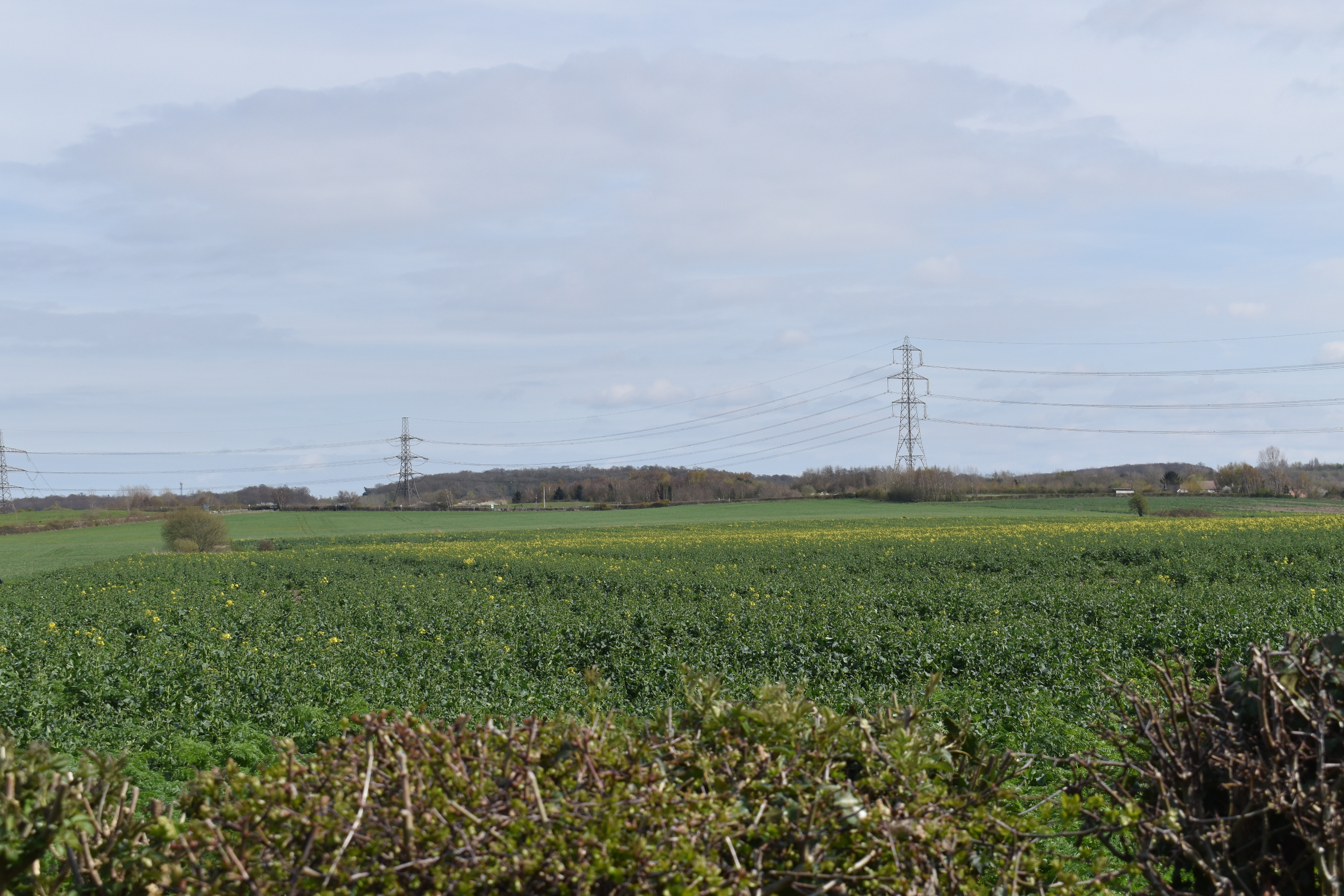
Despite the website saying it was open daily, on my visit it was closed, which seemed odd at Easter. So, I was unable to see the interior and the remaining medieval features. The nave and chancel date from the 13th century and there is a 12th century font. It’s a quiet location although I could hear the endless traffic on the A2 that separate the church from the hamlet. Its rough stone walls are now covered by modern cement which makes it look younger than it actually is and gave it, in my opinion, a slightly American look. In fact St Margaret’s is known by the locals as the ‘Little church on the Prairie and I could see why as it’s surrounded by fields which contained tall yellow flowers which I assumed were rapeseed. By now the fields would be a bright acid yellow. Quite a sight to see.It is thought that Chaucer’s pilgrims on their way to Canterbury would have passed by the church, and standing here in this isolated spot I could believe that the landscape might not have changed much.
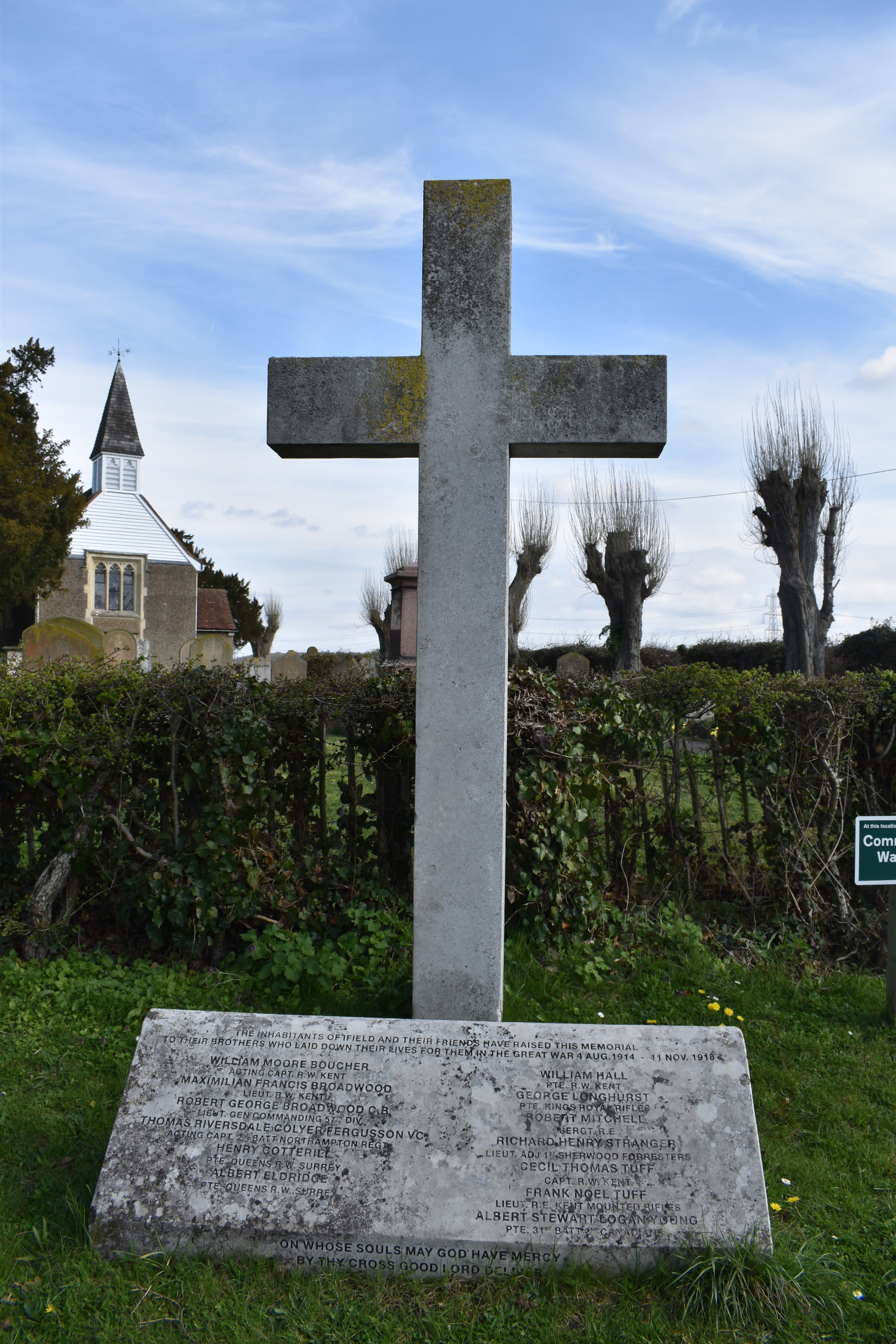
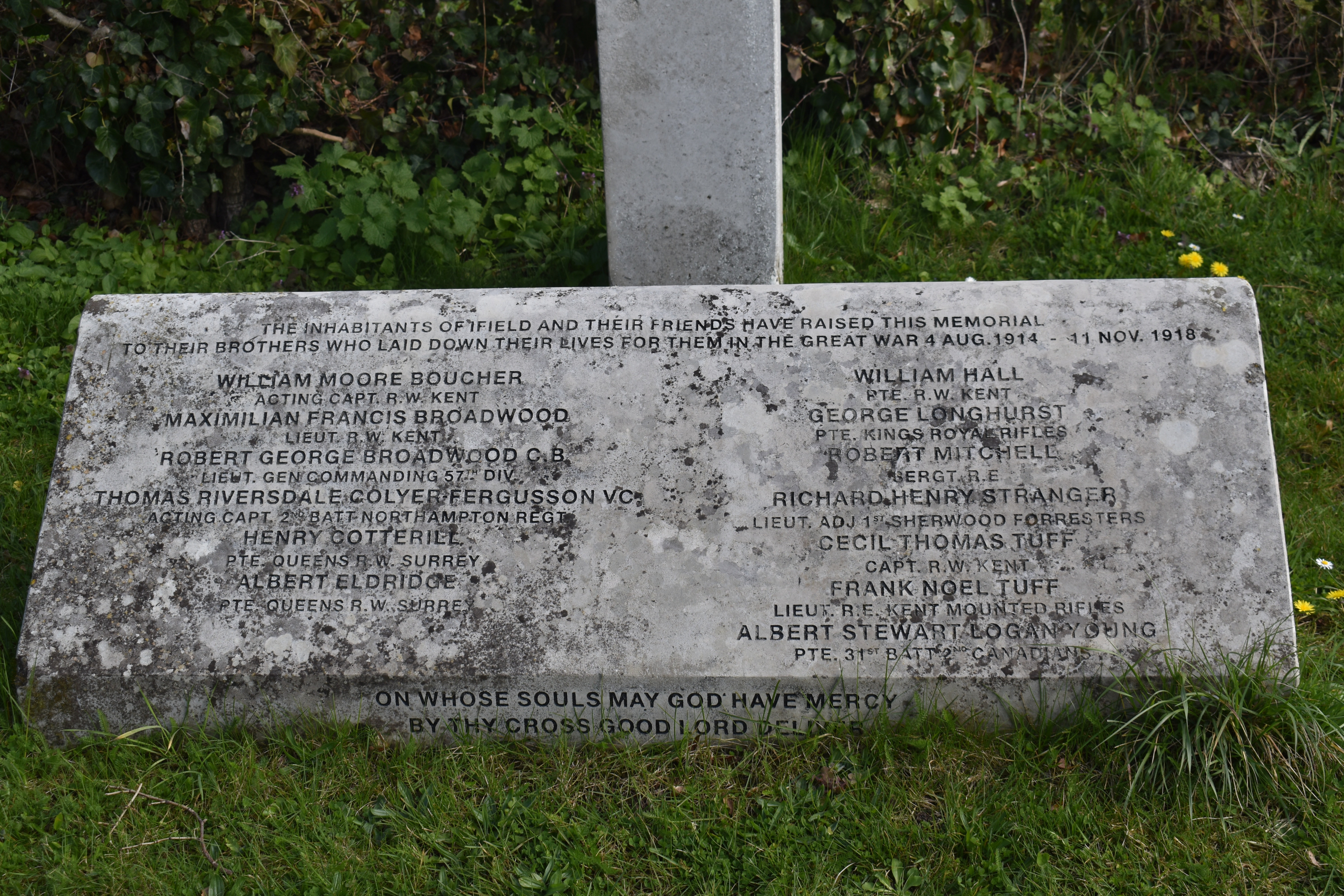
The impressive War Memorial just outside the lychgate dates from 1919 and originally commemorated the village’s fallen of the First World War. There was
‘ a service of dedication for the memorial on 20th June 1919 which was a week prior to the end of the First World War with the signing of the Treaty of Versailles.’
It’s built of Cornish silver-grey granite and cost £120 at the time which was raised through subscriptions from parishioners. Names from the Second World War are also inscribed on it and a full list of names is on the www.ifieldparish.org website.
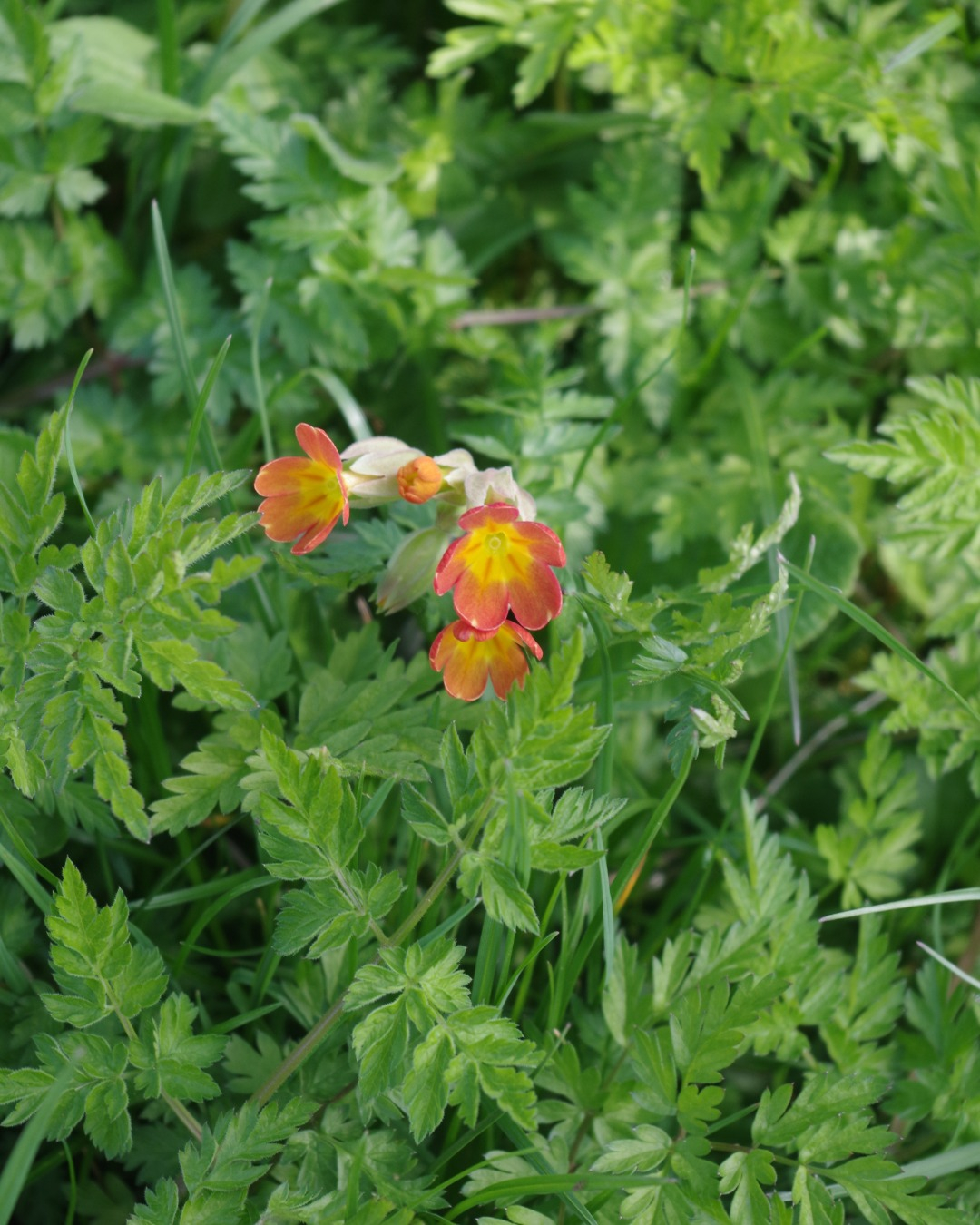
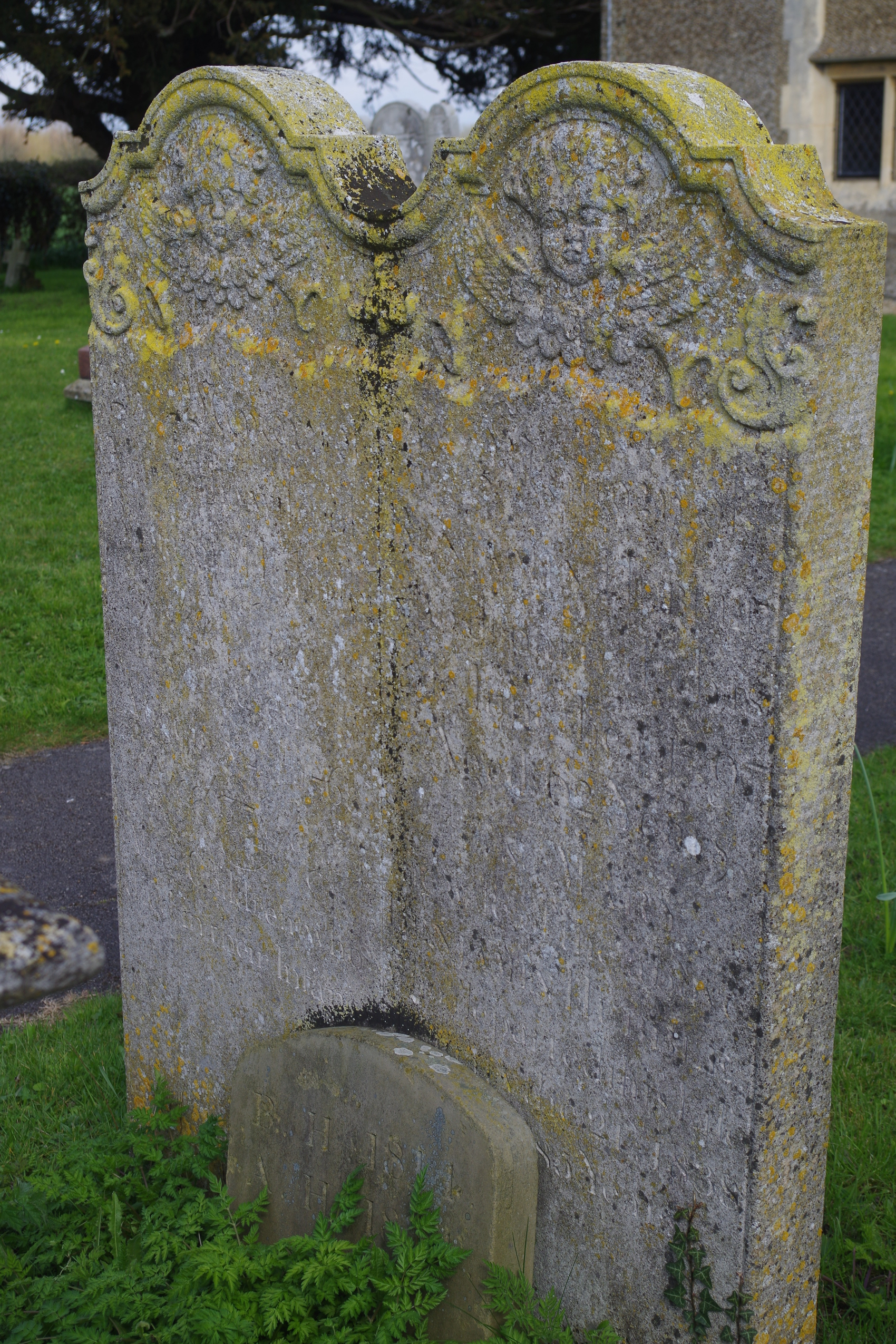
The churchyard contains mostly 19th, 20th and 21st memorials and was a symphony in yellow. Dandelions abounded and these can be seen as symbols of astral bodies. The flowerhead in full bloom is emblematic of the sun, the dandelion clock is the moon and the scattering seedheads are the stars. Lesser celandine was still there in abundance and near the lychgate there was a small patch of cowslips. I also saw tulips and grape hyacinths.
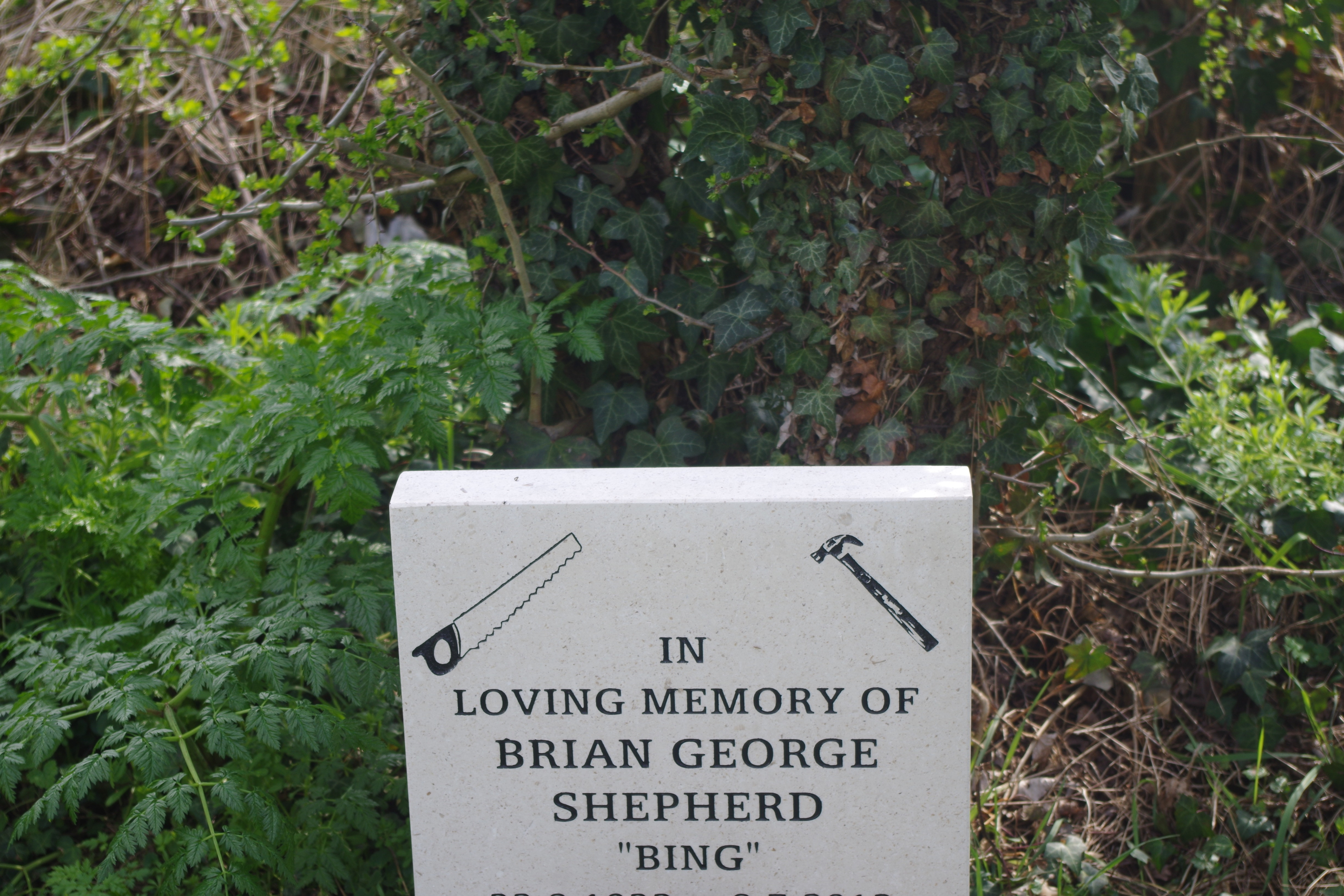
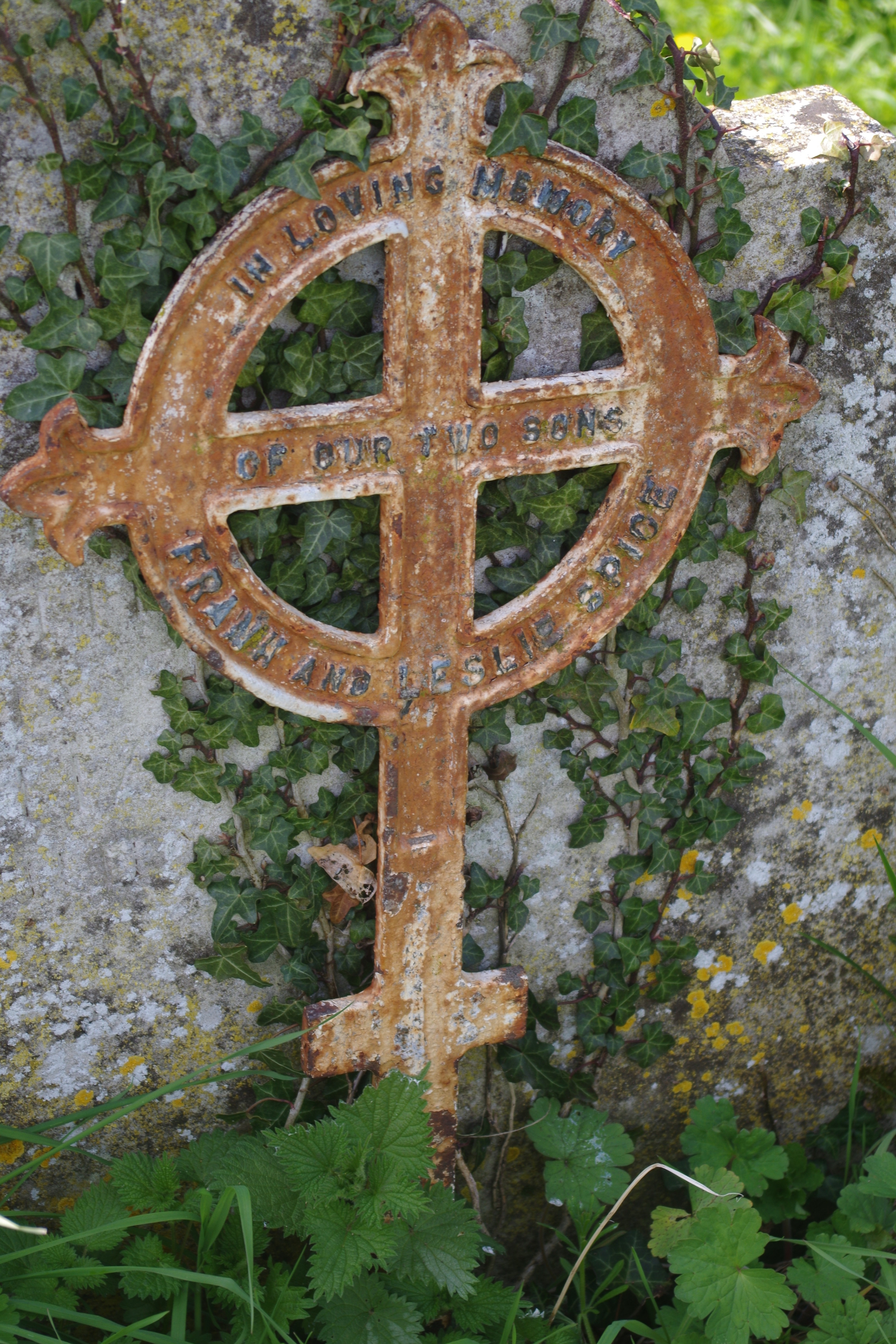
On this one, it can be seen very clearly what the departed’s hobbies or occupation was. A clear example of ‘the tools of the trade’. And there was an unusual cast iron memorial to ‘our two sons’ on one headstone.
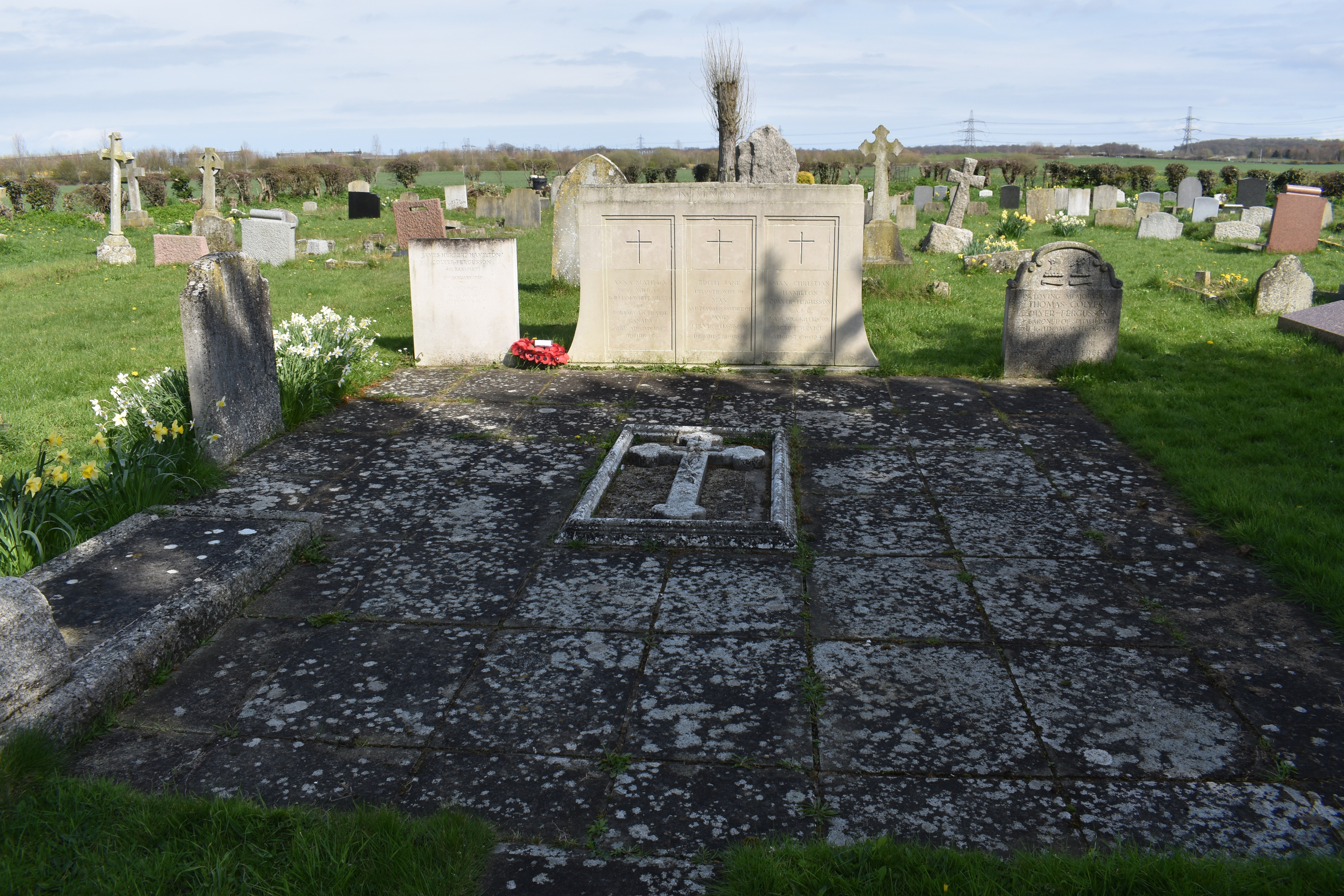
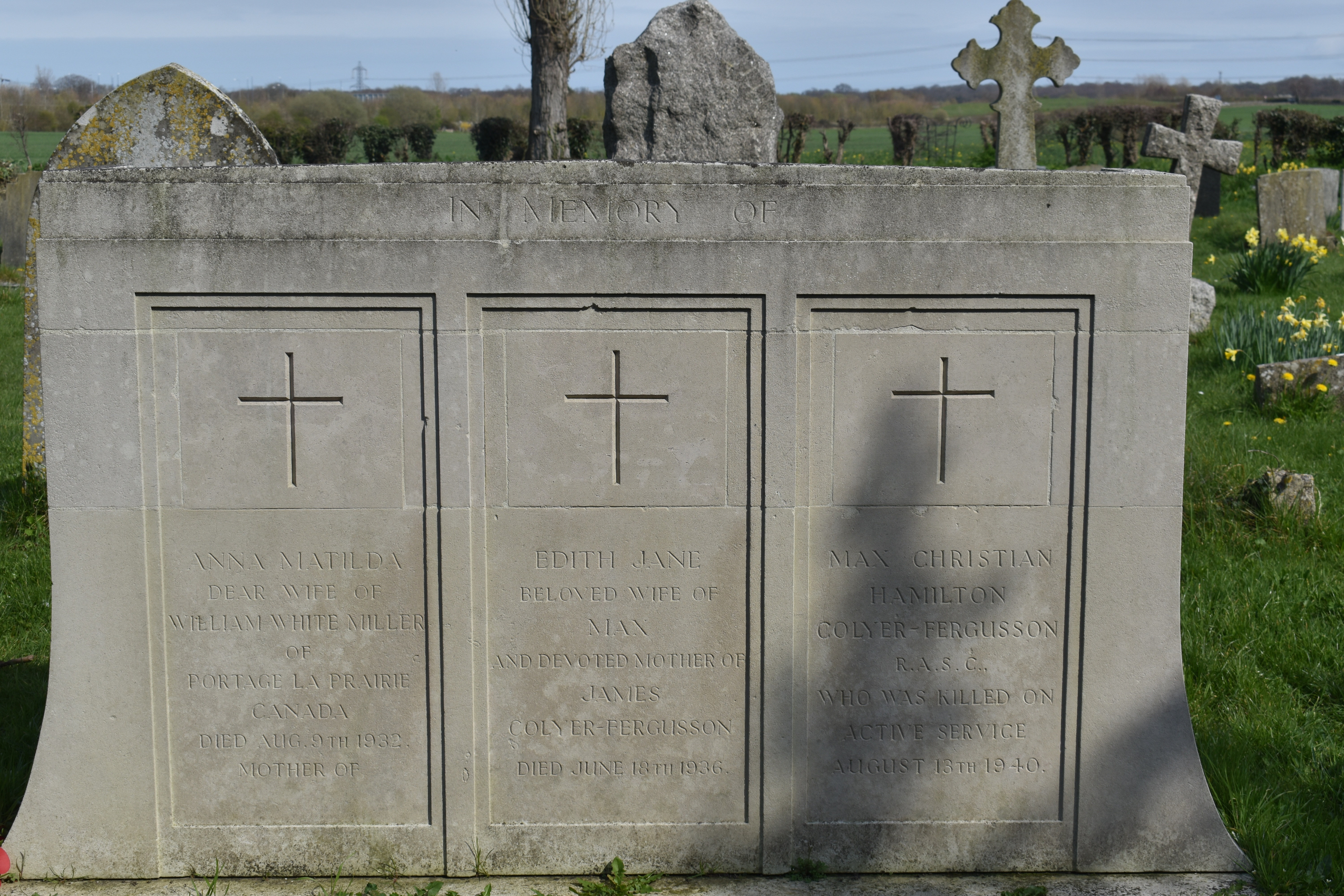
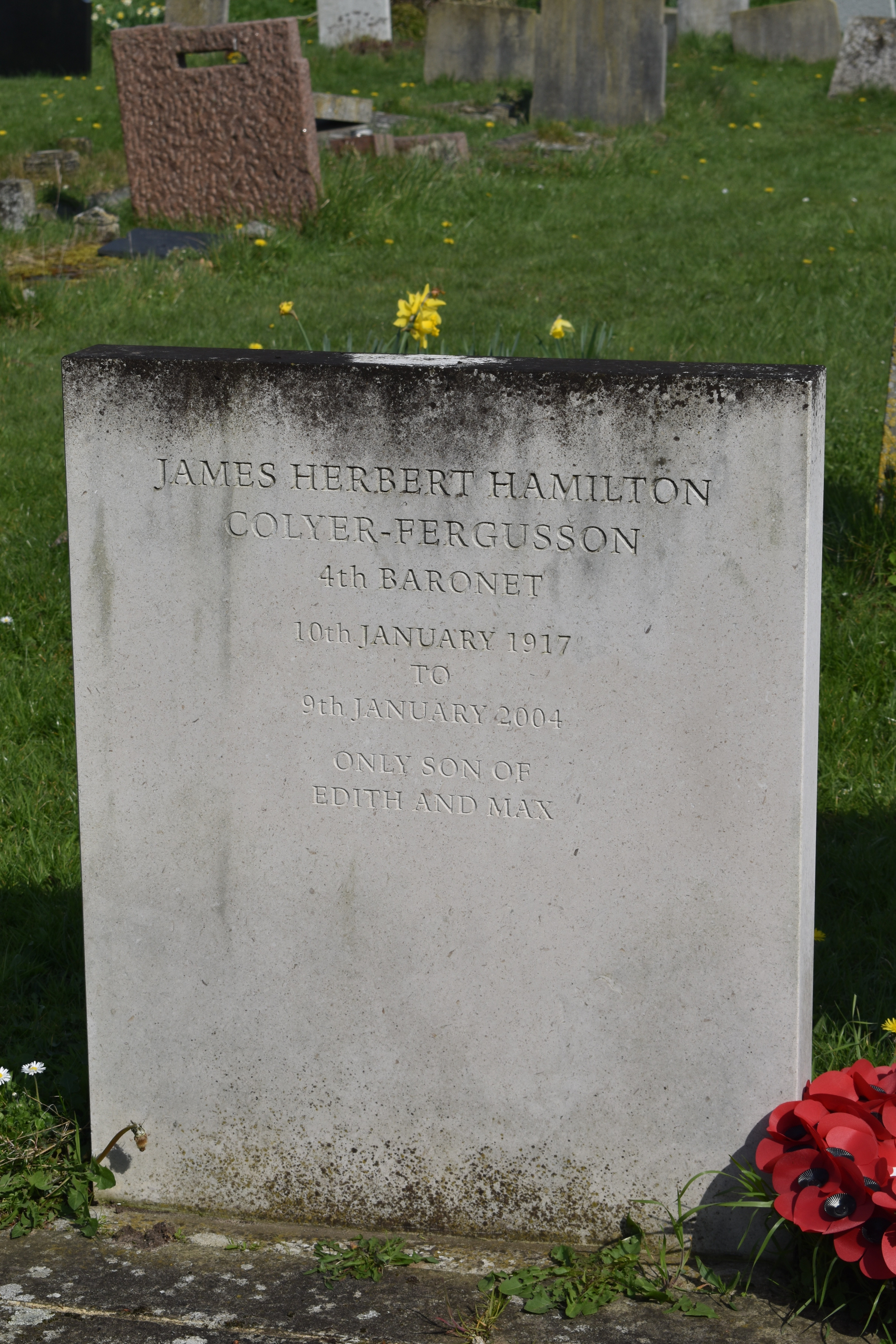
This is the largest and most significant group of memorials and commemorates the Colyer Fergusson family who were associated with Ightham Mote, now a National Trust property. It’s a
‘medieval moated manor house roughly 7 miles from Sevenoaks’ according to the National Trust website. Thomas Colyer-Fergusson, eventually to assume the title of ‘Sir’ when he assumed the additional name of Colyer in 1890 and his bride, Beatrice, set up home at Ightham in 1889 and were keen to make their mark on the house. They were very forward thinking and introduced:
These amenities were undoubtedly appreciated by their retinue of indoor servants and gardeners. In addition, the Colyer-Fergussons introduced the opening of rooms to visitors on one afternoon a week for the price of 2 shillings. Octavia Hill, one of the founders of the National Trust was a visitor.
But the carnage and of the 2 World wars badly affected the Colyer-Fergussons. In the first World War, Thomas’s second son, Billy suffered shell shock and the youngest son, Riversdale was killed at Ypres aged 21. Riverdale’s death had a profound effect on Thomas in that he would not allow the gardeners to
‘make any changes to the garden, asking them not to cut back any plants or remove dying trees.’
During the Second World War, Max, Thomas’s eldest son, was killed in a bombing raid on an Army training school in 1940.
Thomas died in 1951 and Ightham Mote was inherited by Max’s son, James. He had no children and was only too well aware of the huge expense that would be incurred in maintaining the house. So he sold it and its contents leaving it with an uncertain future and eventually it was taken over by the National Trust. The baronetcy became extinct with the death of the 4th Baronet in 2004.
There is an obituary on the Kent Archaeological Society website to Sir Thomas in which he is thanked for his ‘patient and persistent work’ in transcribing parish registers. This was no mean task as they were largely handwritten and not indexed. He was very involved with the Society and eventually became its Vice-President.
And so here the Colley-Fergussons rest in this serene churchyard surrounded by the other departed villagers and parishioners and the Spring flowers that indicate Mother Nature is returning to life. It was interesting to see a connection between Ifield and Ightham Mote as the house is one of my favourite places to visit and I based a short story on a particular painting on display there.
I retraced my steps back to Meopham and St Mildred’s churchyard resisting the urge to ask any passing horse and rider a lift for some of the way. The clip clopping of horses hooves had let me know that there was an equestrian establishment close by. Already the long shadows of the early evening were racing over the fields but it had felt so wonderful to be outside and exploring once again after a long winter.
It was Mayday and I wanted to be outside watching people dancing for all they were worth on the West Cliff at Hastings. The seaside town holds a lot of memories for me as my maternal grandmother had a cottage down there and we would have family holidays there when I was a child.
Hastings has changed a lot since then. It’s still a fishing town and the catch is still sold on the beach, fresh off the boats. But like a lot of coastal towns it became very run down when people started to prefer foreign holidays to traditional bucket and spade ones.
On Mayday, two lifestyles collide. There’s the 25,000 bikers on the seafront, parading up and down, and the Mayday revellers and Morris dancing up on the West Cliff. 20 years ago when I first came across it, it was held in the Castle but it then became too large for it and so the West Cliff is now its home. As you can imagine Hasting is absolutely packed until roughly 4pm. The queue for the funicular lift up to the top of the West Cliff was even longer than usual and so I started to explore the picturesque Old Town. St Clement’s attracted me as I thought I could explore the church.
It’s an ancient church and there may have been one on this site since 1080. It was rebuilt in 1380 and is the civic church of Hastings. The other local church is All Saints and together they form the old town parish of Hastings. A bomb dropped on St Clement’s and a nearby pub during the Second World War which inspired an episode of the TV series ‘Foyle’s War.’ It blew out two of St Clement’s windows.
But there is also an artistic connection in that Dante Gabriel Rossetti married Elizabeth Siddal here in 1860 and his sister, Christina, is believed to have worshipped at St Clement’s whenever she visited. But alas, the church was closed on my visit and the churchyard was full of people enjoying themselves sitting on tombs and the church steps.
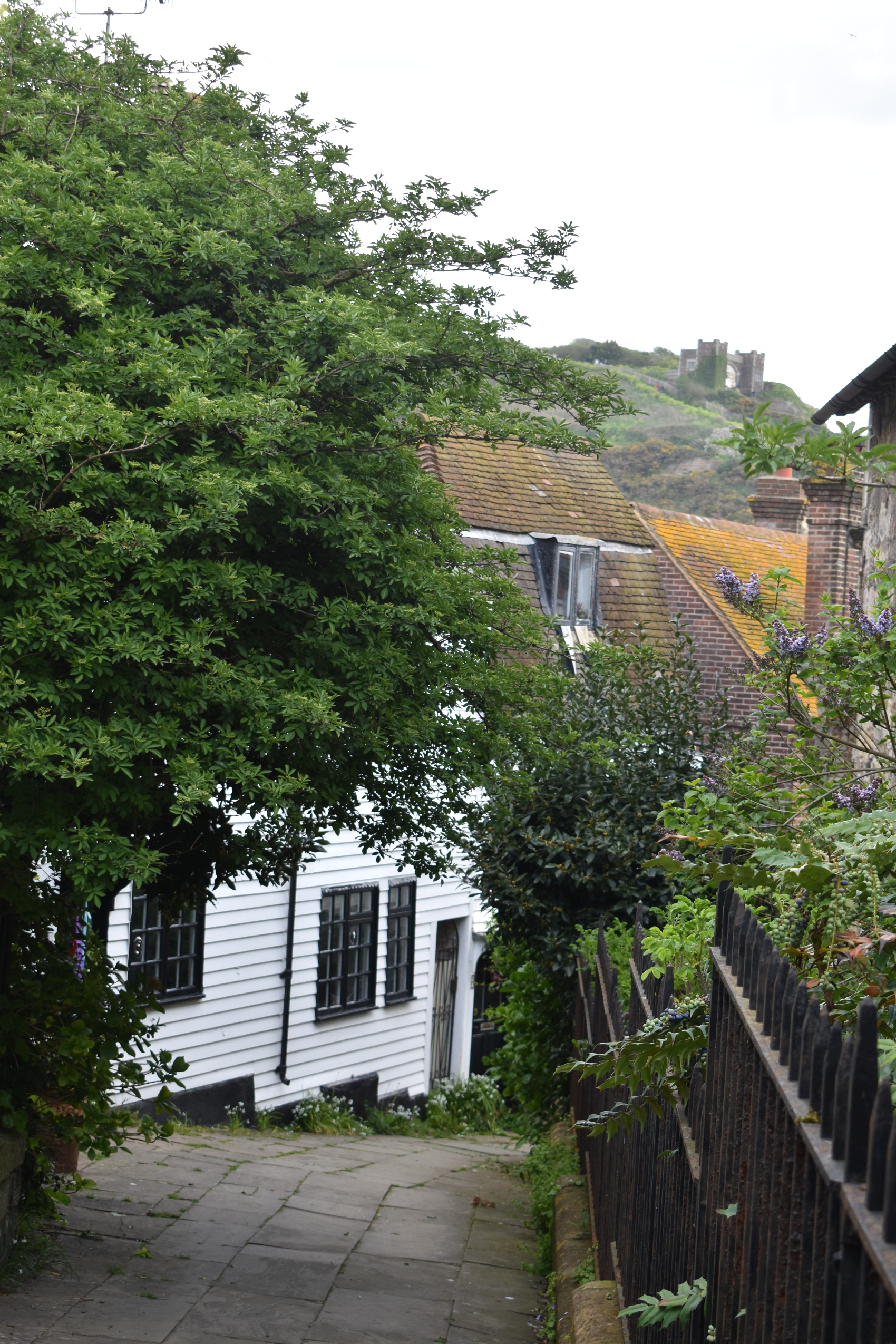
So I wandered on and then smelled something pungent on the breeze. ‘Wild garlic.’ I thought and so I followed it. The pungent aroma led me to behind St Clement’s church and on the other side of a picturesque alleyway I discovered a tiny, pocket sized churchyard tucked into a corner. There was hardly anyone about as they were all wending their way up to the Mayday celebrations and it was so peaceful. This is part of the closed St Clement’s churchyard.
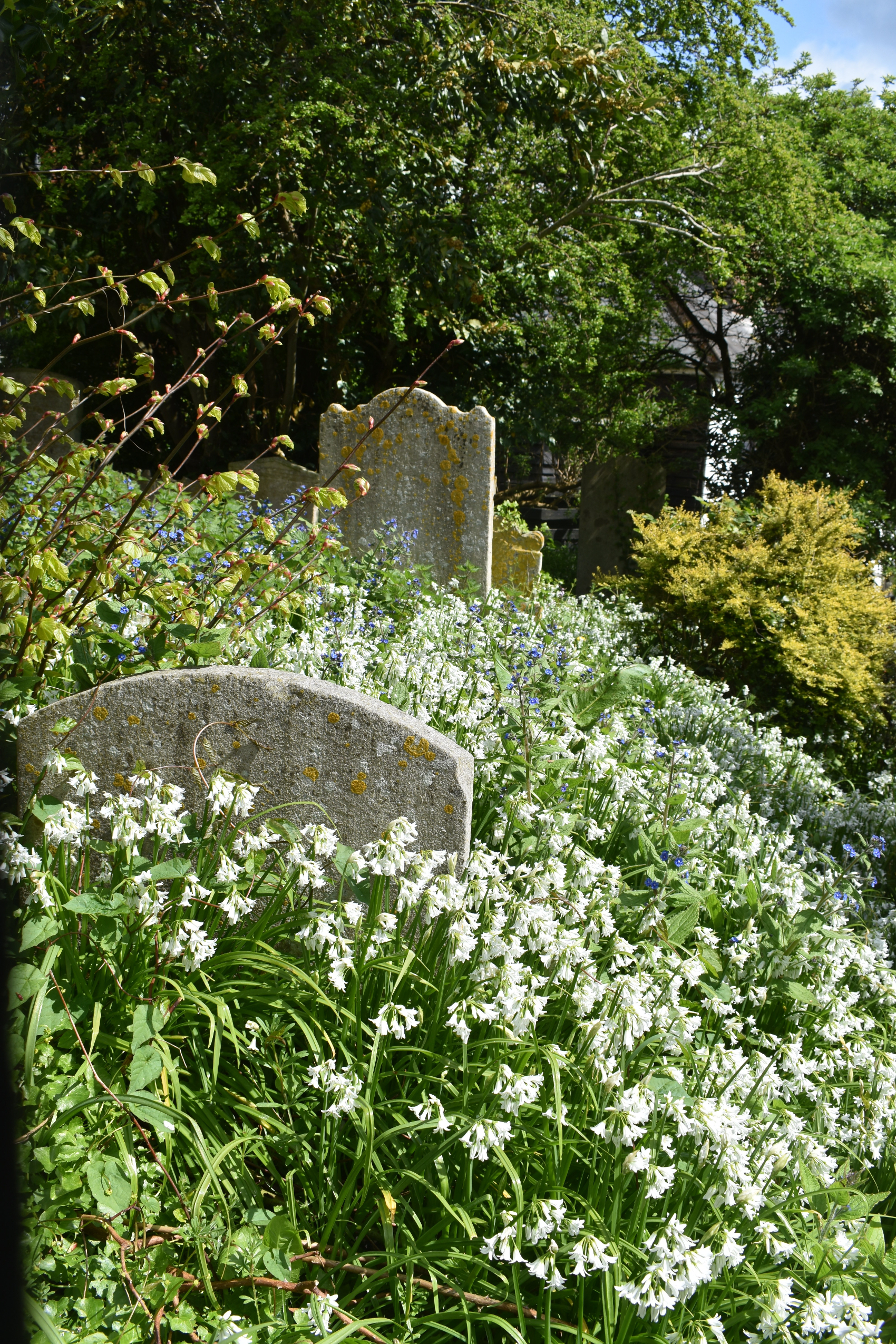
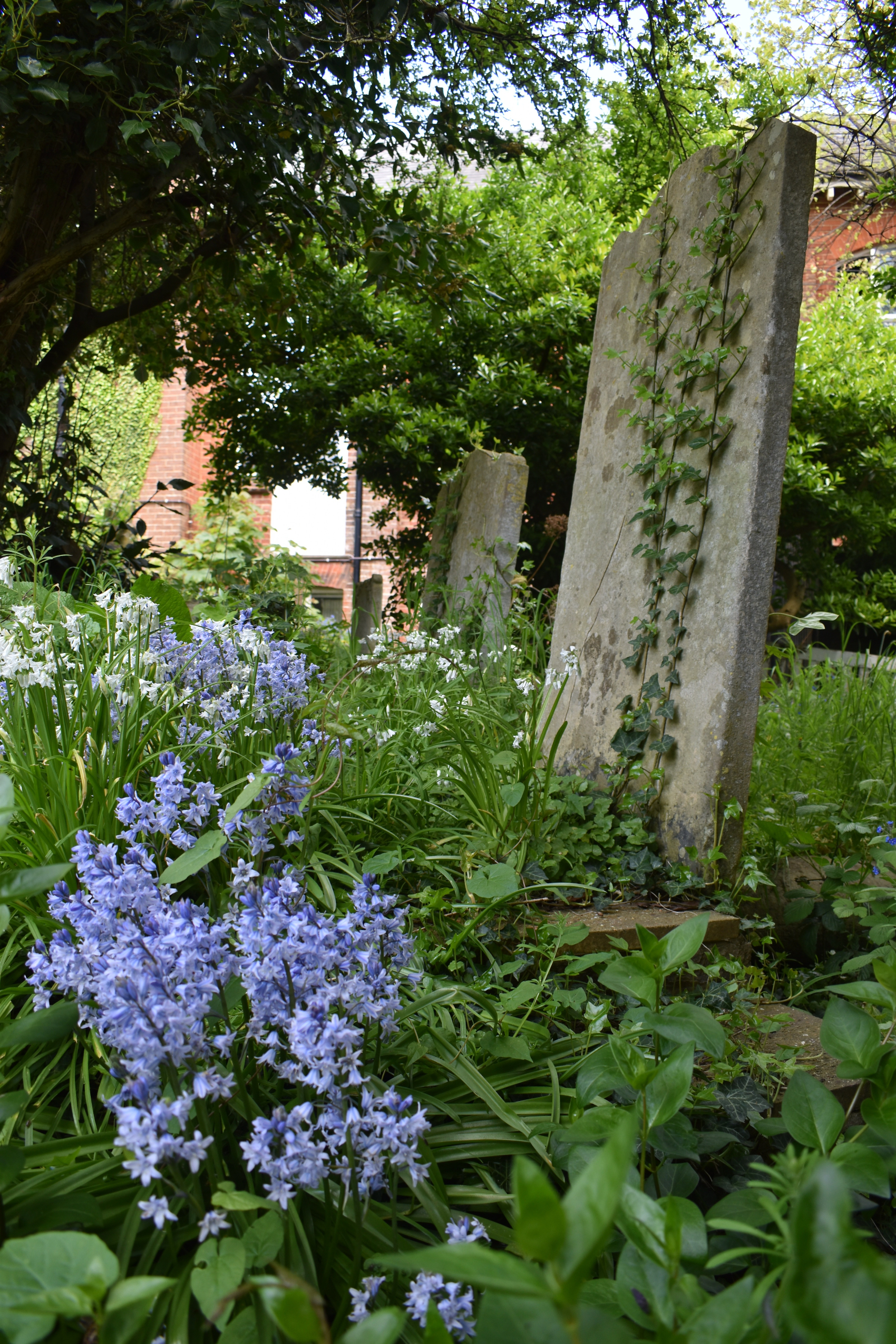
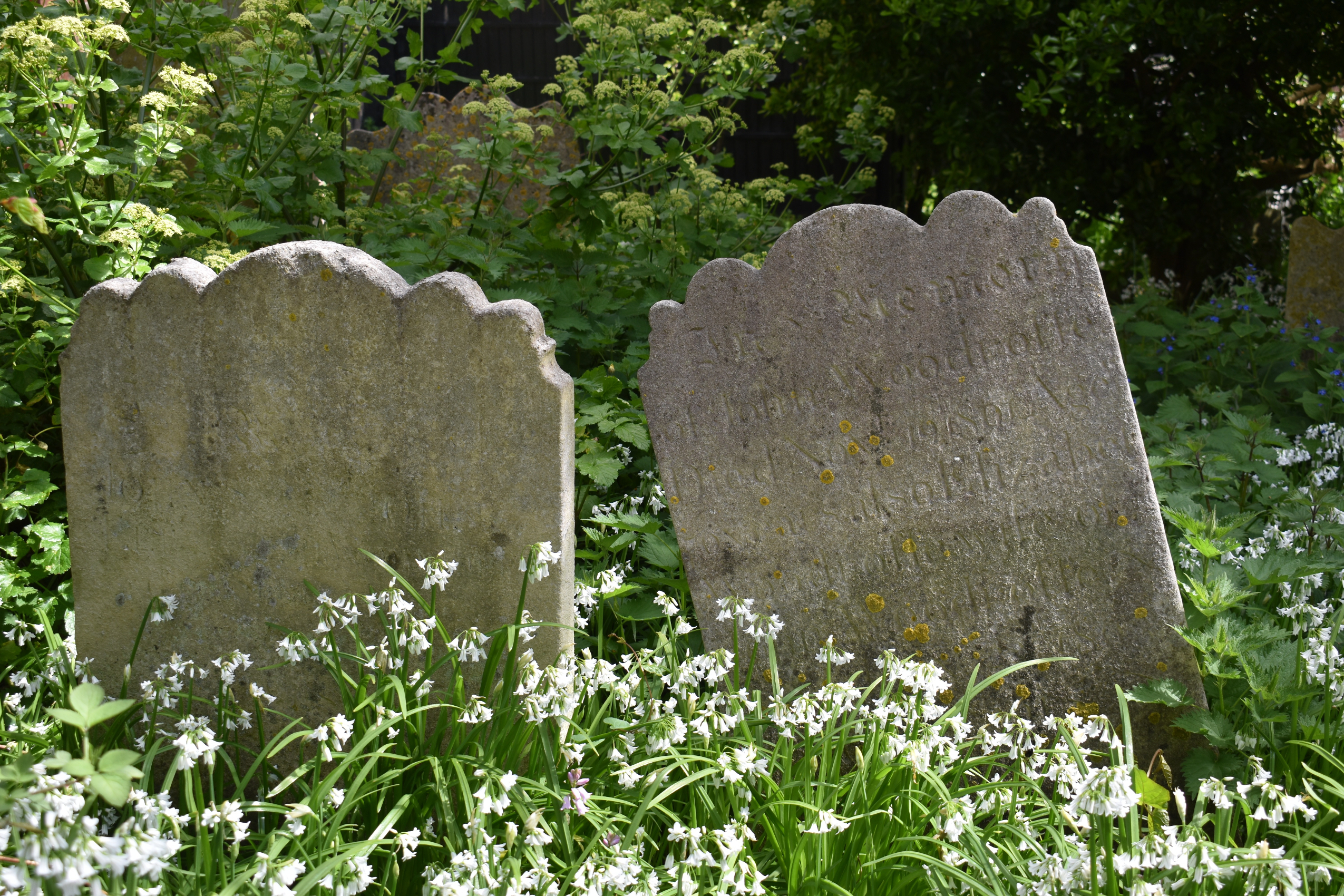
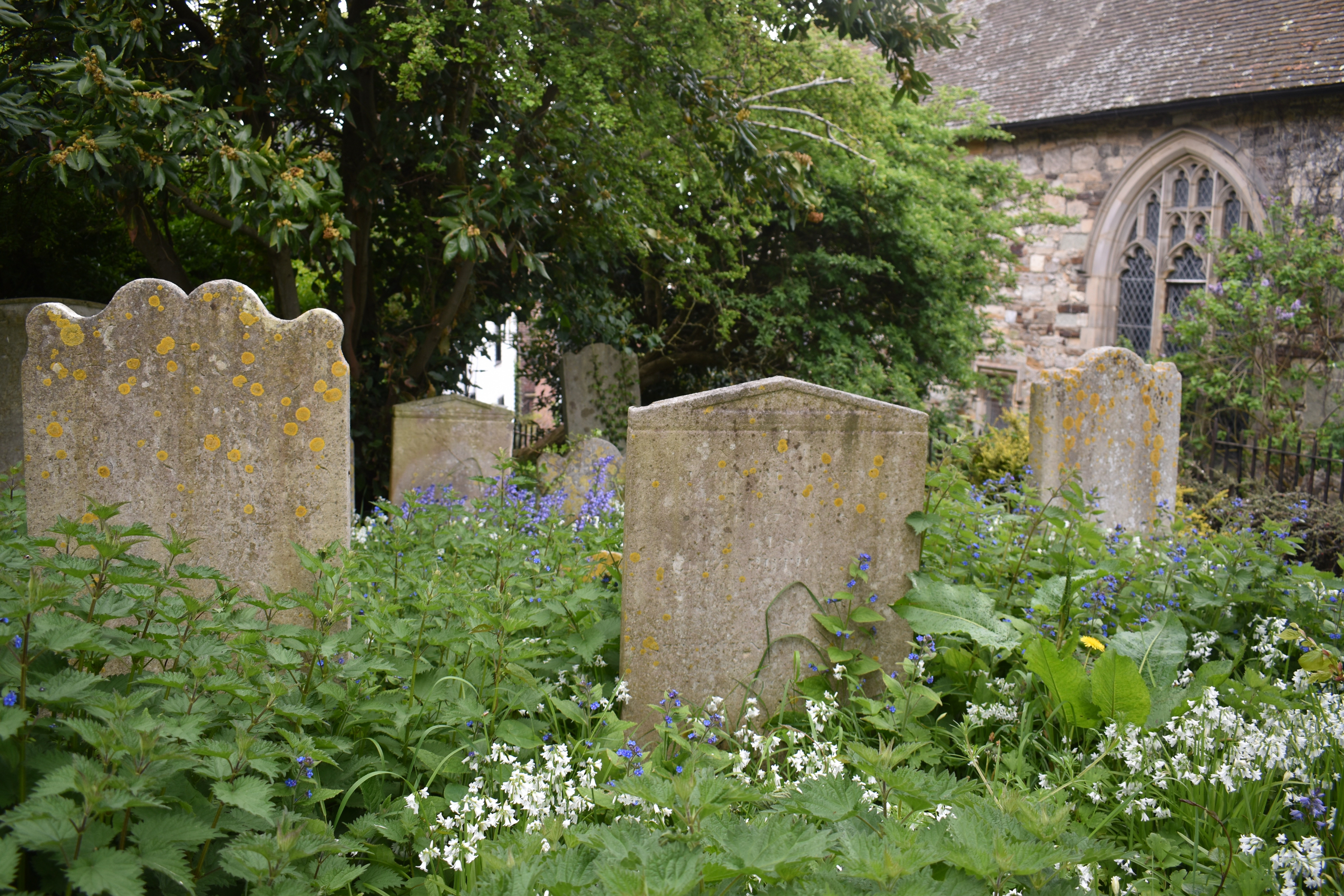
The intoxicating smell of wild garlic was coming from the bountiful flowers inside the churchyard and I was tempted to take a couple of sprigs home with me. The white flowers contrasted with the abundant alkanet and blubells and headstones poked up from the mass of flowers. One or two were faintly legible and I thought I could see a symbol on one but most were now weathered and illegible. I moved further down the alleyway and found that the churchyard gate was padlocked but there was a wooden bench inside and I thought ‘What a quiet, calm place in which to spend a lunch hour.’
Turning away from the small oasis of calm, I braced myself for the walk up the West Hill and told myself not to look down while climbing.
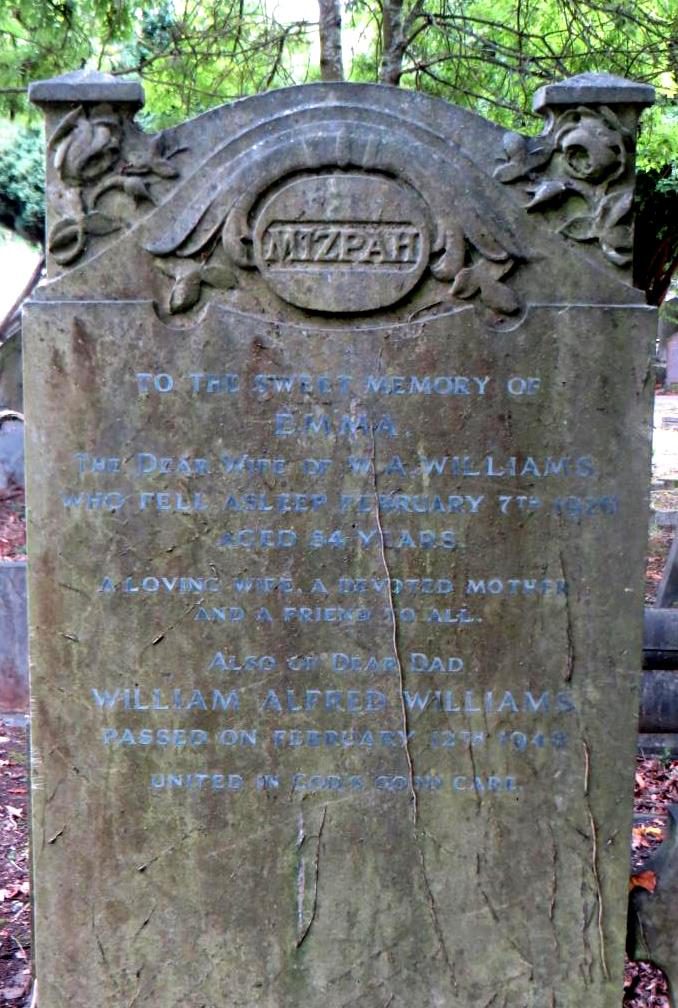
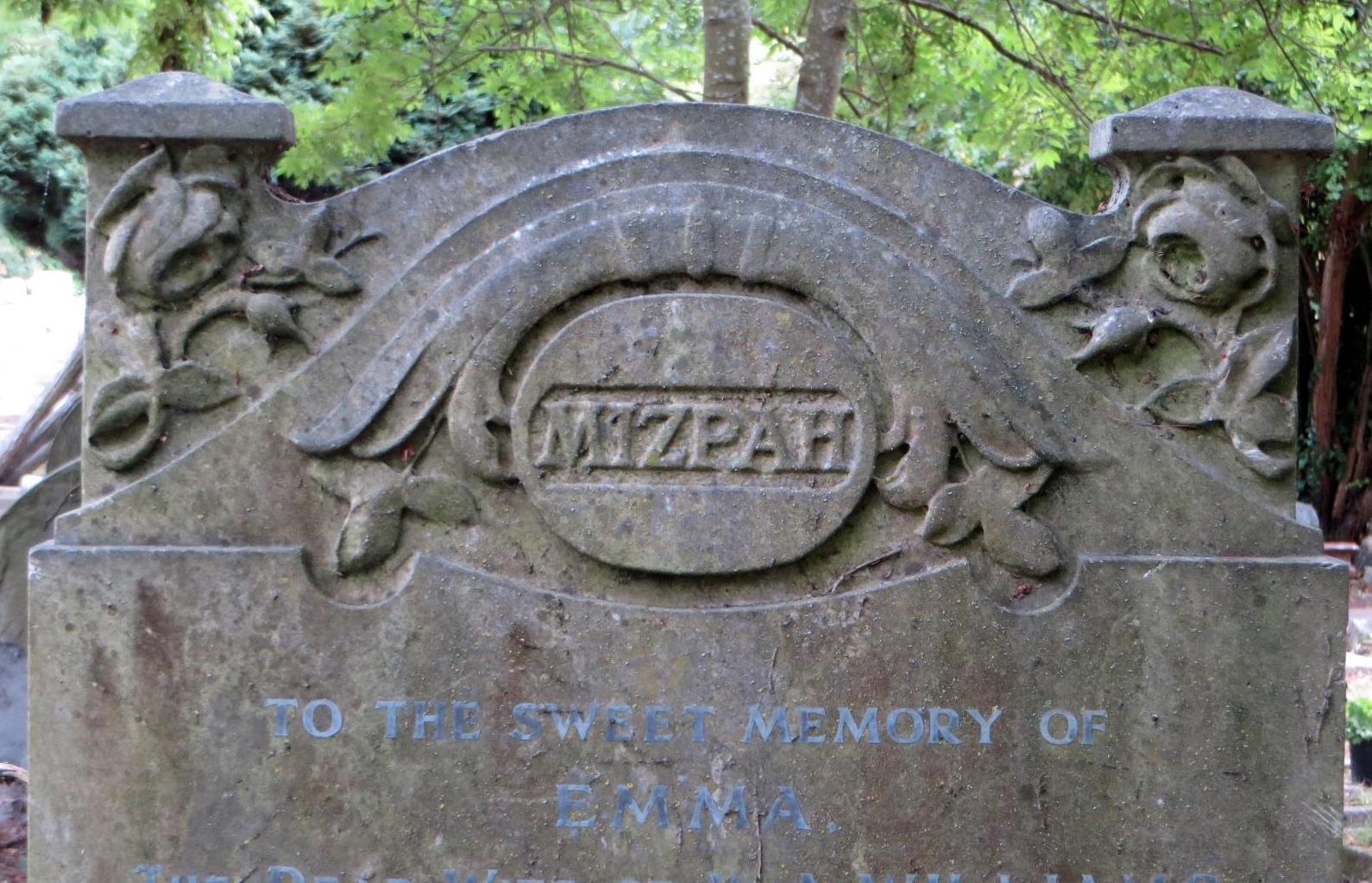
This month’s symbol features a single word, Mizpah, which is a representation of an emotional bond that goes beyond the grave. It isn’t a common symbol and I have seen only a few examples in cemeteries while out exploring.
However, during the 1980’s and 80’s, I often used to see Mizpah inscribed on old fashioned jewellery such as brooches when browsing in charity shops and jumble sales. At that time, I thought that it might have been another word for ‘Mother’.
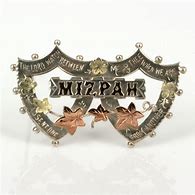
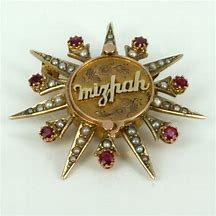
These two examples date from the late 19th century and were found on Etsy. Images used without permission.
But, it was on an Open House visit to St Nicholas church in Chislehurst that I discovered its real meaning. I had read somewhere that Napoleon III was buried there but, alas, it was the wrong church and he had long since been re-interred elsewhere. However, on a churchyard tour that afternoon led by a volunteer I finally learned what it actually signified as he indicated Mizpah on the Campbell monument. He said that it came from an Old Testament phrase ‘I will set around you a mountain which will keep you and protect you.’ I haven’t been able to find this particular Biblical quotation yet.
The word, Mizpah, appears in the Old Testament in Genesis 31:49:
‘And Mizpah, for he said, the Lord watch between you and me, when we are out of another’s sight.’ King James Bible
In other words, the one left behind is still protected and watched over even though their loved one has gone. A touching link between two people or an entire family who have been separated by death or another force.
But there is another version, according to Wikipedia, in which it’s claimed that Mizpah stands for ’Lord watch over me’ and relates to the story of Jacob and Laban. Jacob fled with from Laban’s house in the middle of the night with all of his earthly possessions including animals, wives and children and Laban was soon in pursuit. But the two men came to an agreement and built a watchtower or Mizpah. This would be a border between their respective territories, and neither would pass the watchtower, which was reputed to be merely a pile of stones, to visit the other to do evil. God would be the only witness to their pact and would protect one from the other. Today a modern village stands on the supposed site called Metullah which means lookout.
However, I prefer the more poignant reference to the affectionate ties between the departed and the bereaved and the wish to leave them with the feeling that they were still being supported and protected as exemplified by the one simple word.
Mizpah jewellery is still available and is often in the form of a coin shaped pendant, cut in two, with a zig-zag line bearing the words that I quoted in the first paragraph.
Here are two examples that I found online; one is vintage and the other is contemporary.
MIZPAH brooch found on Jewelry Nerd. Used without permission.Example of MIZPAH medal/coin. Found on Jewelry Nerd. Used without permission
This first example is from Beckenham Cemetery and the Victorian epitaph is an affectionate tribute to a much loved and missed wife, Emma.
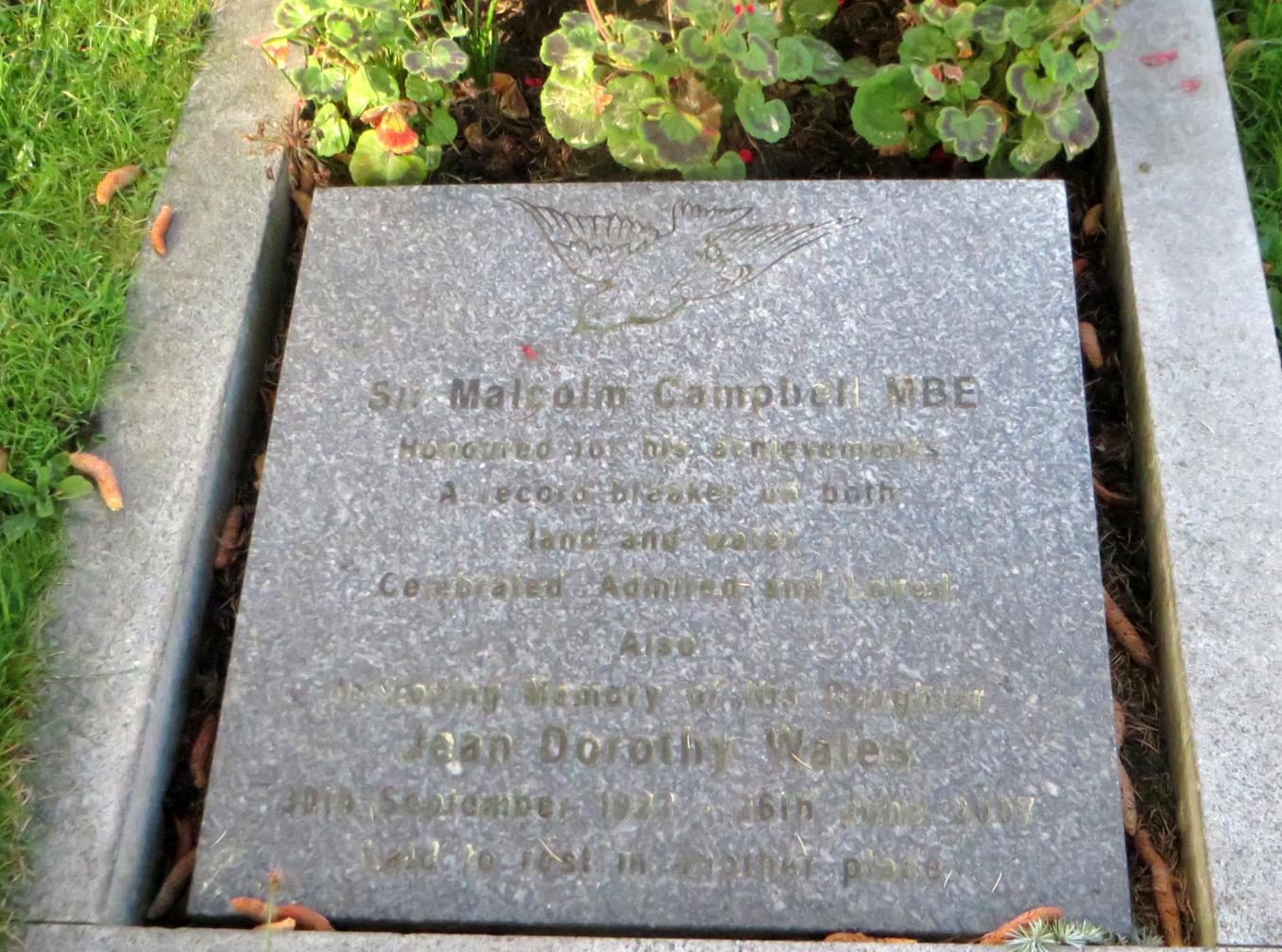
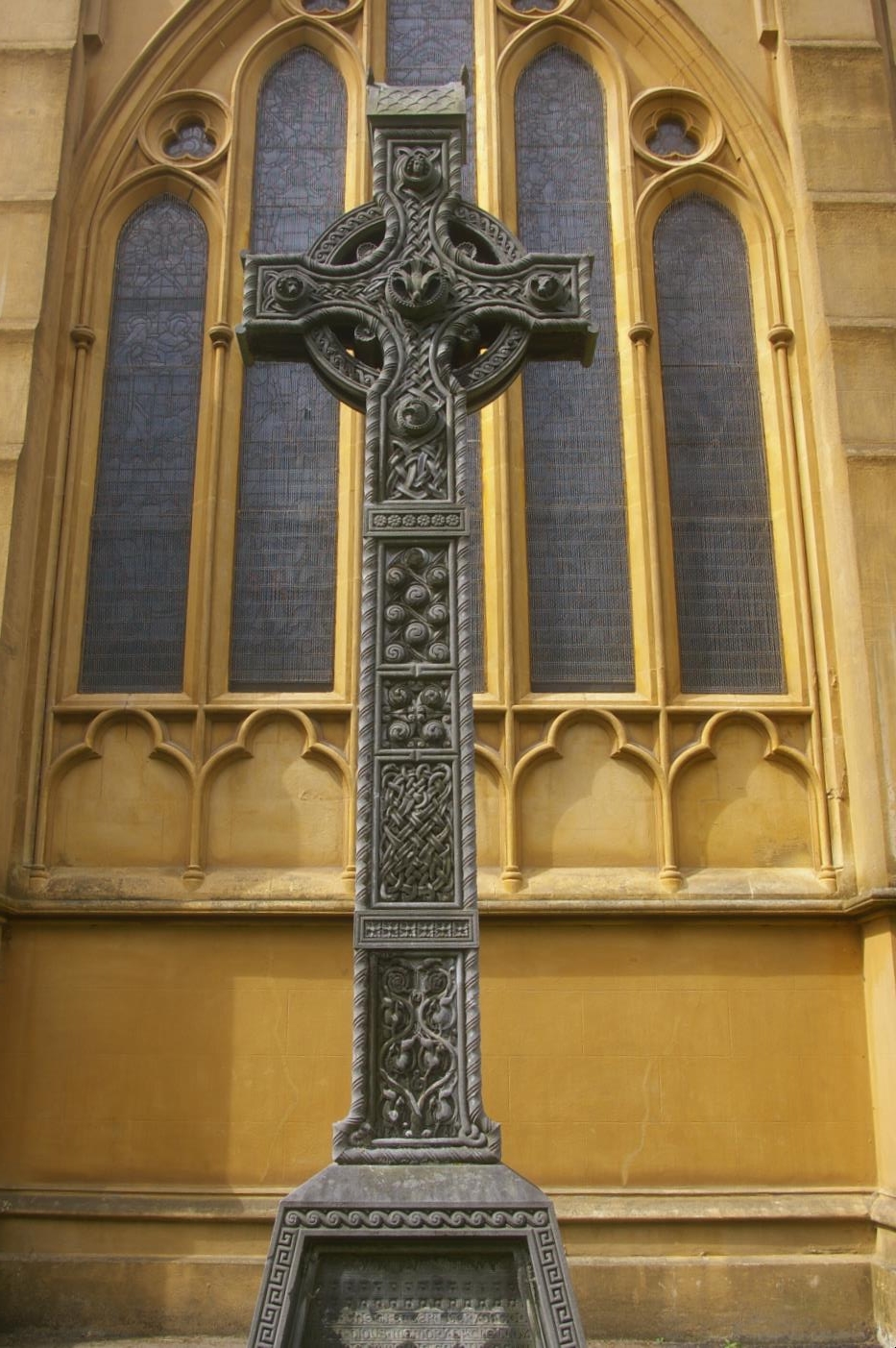
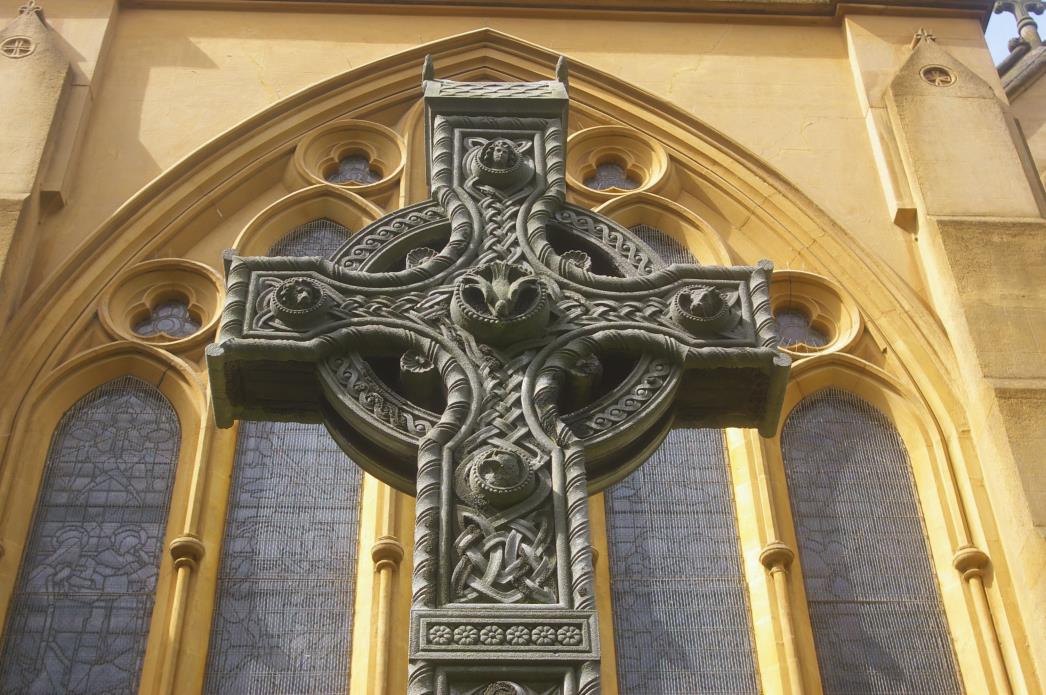
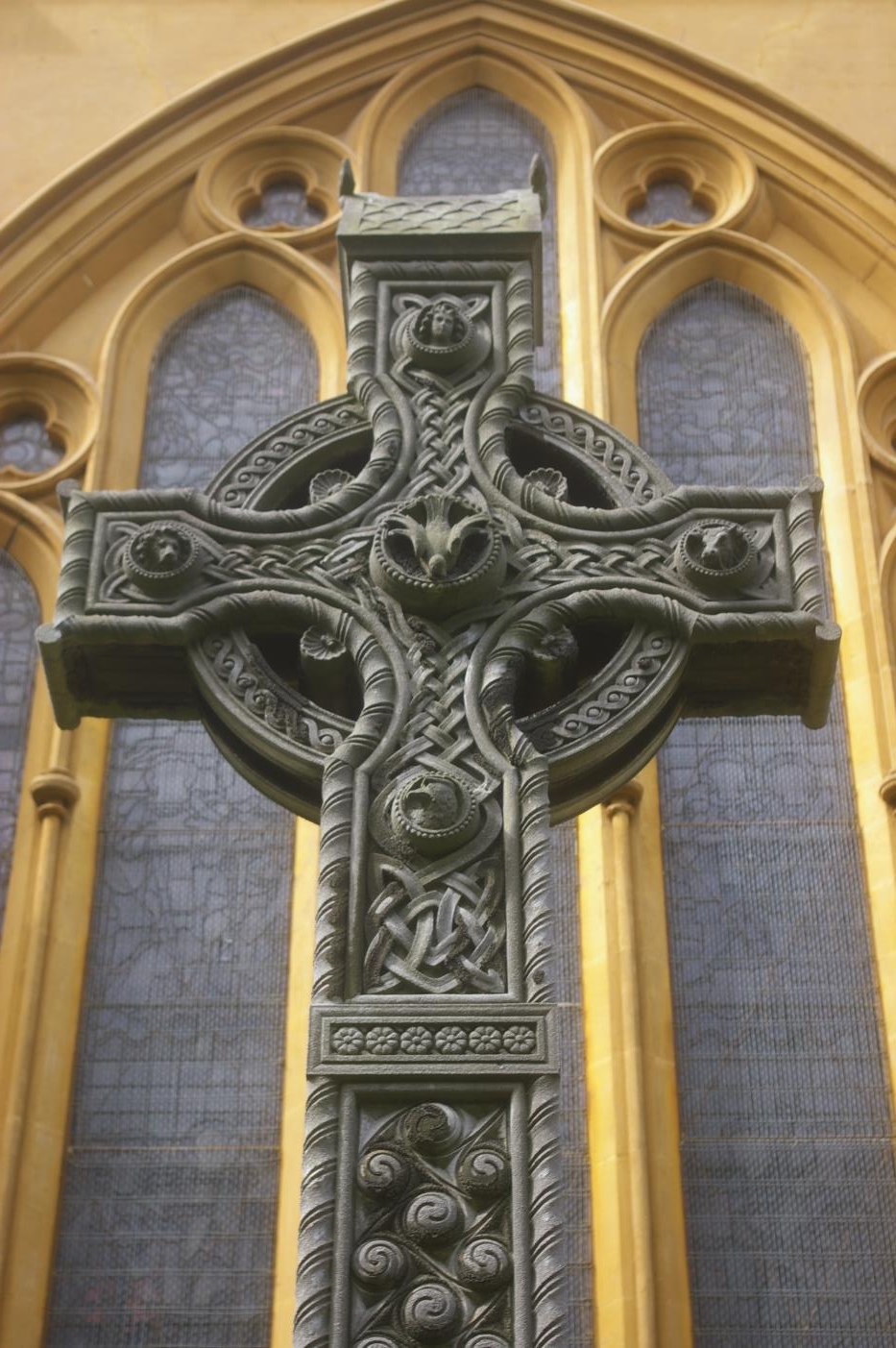
The second is from the Campbell monument in St Nicholas churchyard. The Celtic cross above the grave is also of interest as it has strapwork on it made from entwined snakes, themselves symbols of eternity and mortality. The Campbells had two famous sons: Sir Malcolm Campbell and his son Donald. Note the small motif of a bluebird in one corner above the epitaph. This was the name of the vehicles on which both Sir Malcolm and Donald achieved several world speed records during their lifetimes. Donald was tragically killed in 1967 when another world speed record breaking attempt on Coniston Water went tragically wrong and both he and Bluebird sank to the bottom of the lake. It wasn’t until 2001 that his remains were discovered and buried in Coniston cemetery. Nick Wales, his son, maintains the grave and also holds the world record for the fastest lawnmower. Donald Campbell’s Bluebird has been restored and was taken out for a trip on Bewl Water, near Tunbridge Wells by its new owner Paul Foulkes-Halbard in 2017.
In 2012, I found this beautiful, imposing Celtic Cross in St Margaret’s churchyard which is in Lee, a suburb in south east London. This is a church and churchyard in two halves. The remnants of the older building and its churchyard is across the road from its much larger, Victorian replacement. The older churchyard contains some interesting 18th century memorials and I can recommend exploring if it’s open.
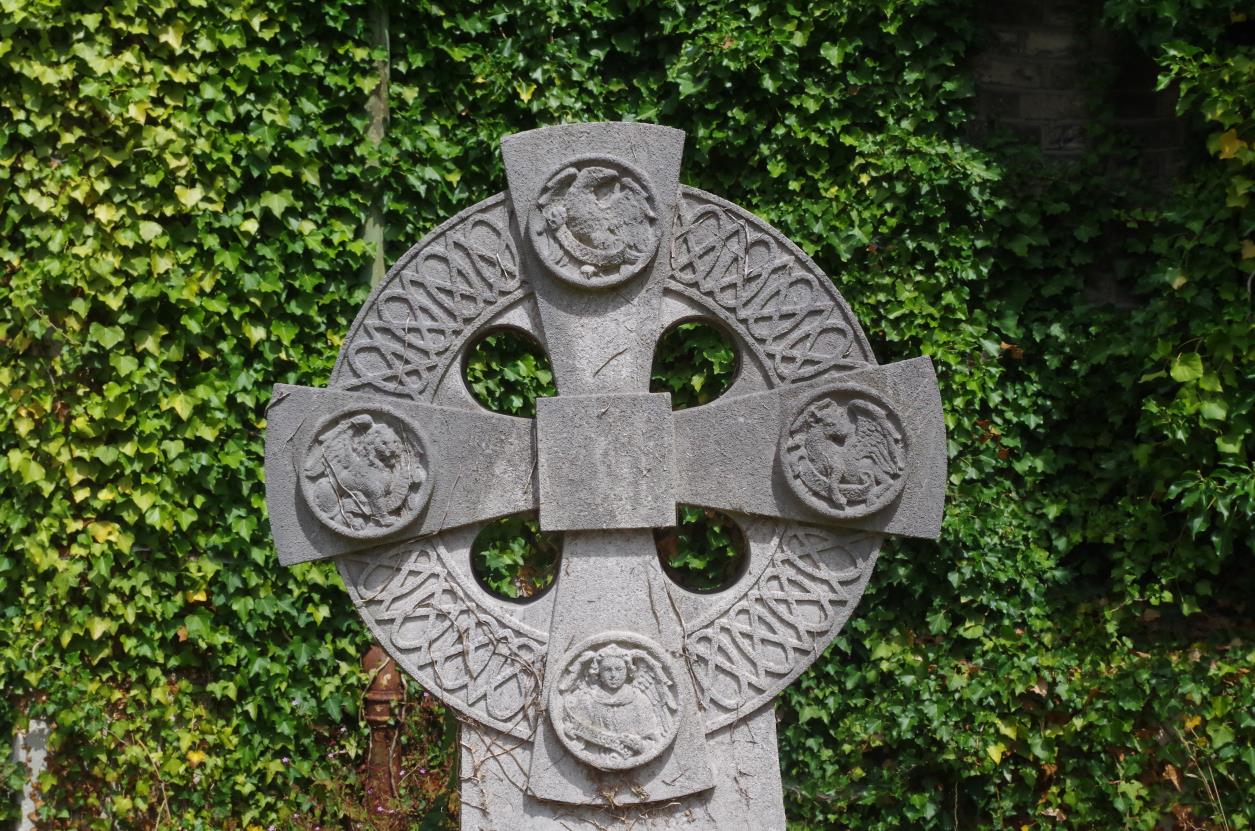
The newer St Margaret’s is also worth exploring if it’s open as it contains Pre-Raphaelite style wall paintings and interesting stained glass. As you might expect, its churchyard mainly contains 19th century memorials as you might expect and then when I went around the back of the church I found this memorial.
This memorial is an example of the Celtic Revival that was popular from 1880-1910 and the Arts & Crafts movement. The epitaph is written in flowing Art Nouveau script and was well worn which rendered it virtually indecipherable. All I could make out was that it was in memory of a deceased wife. This was a real pity as I would have liked to have known more about the person who was buried there and what had happened to her.
A closer view of the memorial .Copyright Carole Tyrrell
The for symbols of the Evangelists in each corner
Copyright Carole Tyrrell
I noticed the four symbols; one on each corner of the cross. An ox, an eagle, a lion and an angel. I’d never previously seen this combination on a funerary monument and thought, in my ignorance, that it might have meant that the deceased had loved animals.
But, after posting my photos of the memorial onto The Cemetery Club Facebook page a fellow member replied saying that she thought that the symbols might represent the four evangelists:
Angel = Matthew Lion = Mark Ox = Luke Eagle = John
These were ‘the four canonical gospels with the four living creatures that surround God’s throne’. I had to consult a Bible website for further information and it referred me to the Book of Revelations. In verses 5-8:
‘Around the throne, and on each side of the throne, are four living creatures, full of eyes in front and behind, …the first living creature, like a LION, the second living creature like an OX, the third living creature with a face like a HUMAN face (the angel), and the fourth living creature like a flying EAGLE. King James Bible
The four living creatures are also mentioned in Ezekiel 1: verses 1-1 as well as in other religious texts such as St Irenaeus of Lyons and St Augustine of Hippo.
The four symbols are known as a tetramorph. This is a symbolic arrangement of four different elements and is derived from the Greek tetra, meaning four, and morph, which means shape.
In Christian art, the tetramorph is the union of the symbols of the Four Evangelists, the four living creatures into a single figure, or more commonly, a group of four figures. Portraits of the four evangelists are often accompanied by the tetramorphs or the symbols often used to represent them as in the image below.
Each symbol can be described as a tetramorph in the singular, and a group as the tetramorphs but usually only when all four are together. Tetramorphs were very common in early medieval art especially in illuminated Gospel books. They are still common in religious art up to the present day. Other examples of the combination of different elements are the Sphinx in Egypt which has the body of a lion and the head of a human.
The animals associated with the Christian tetramorph originated in the Babylonian symbols of the four fixed signs of the zodiac; the Ox representing Taurus; the lion representing Leo, the eagle representing Scorpio and the man or angel representing Aquarius. In Western astrology the four symbols are associated with the elements of, respectively Earth, Fire, Water and Air. The creatures of the Christian tetramorph were also common in Egyptian, Greek and Assyrian mythology. Early Christians adopted this symbolism and adapted it for the four Evangelists as the tetramorph, which first appears in Christian art in the 5th century.
There is a tetramorph in Ely Cathedral and also over the entrance door to St Augustine’s church in Kilburn, north London. I have also found two more in London’s Brompton Cemetery but not as well carved and, although large, not quite as imposing.
This was the nicer of the Brompton ones.
Copyright Carole Tyrrell
But the one in St Margaret’s churchyard is a lovely monument which is beautifully carved and really stands out in the churchyard due to its size and position.
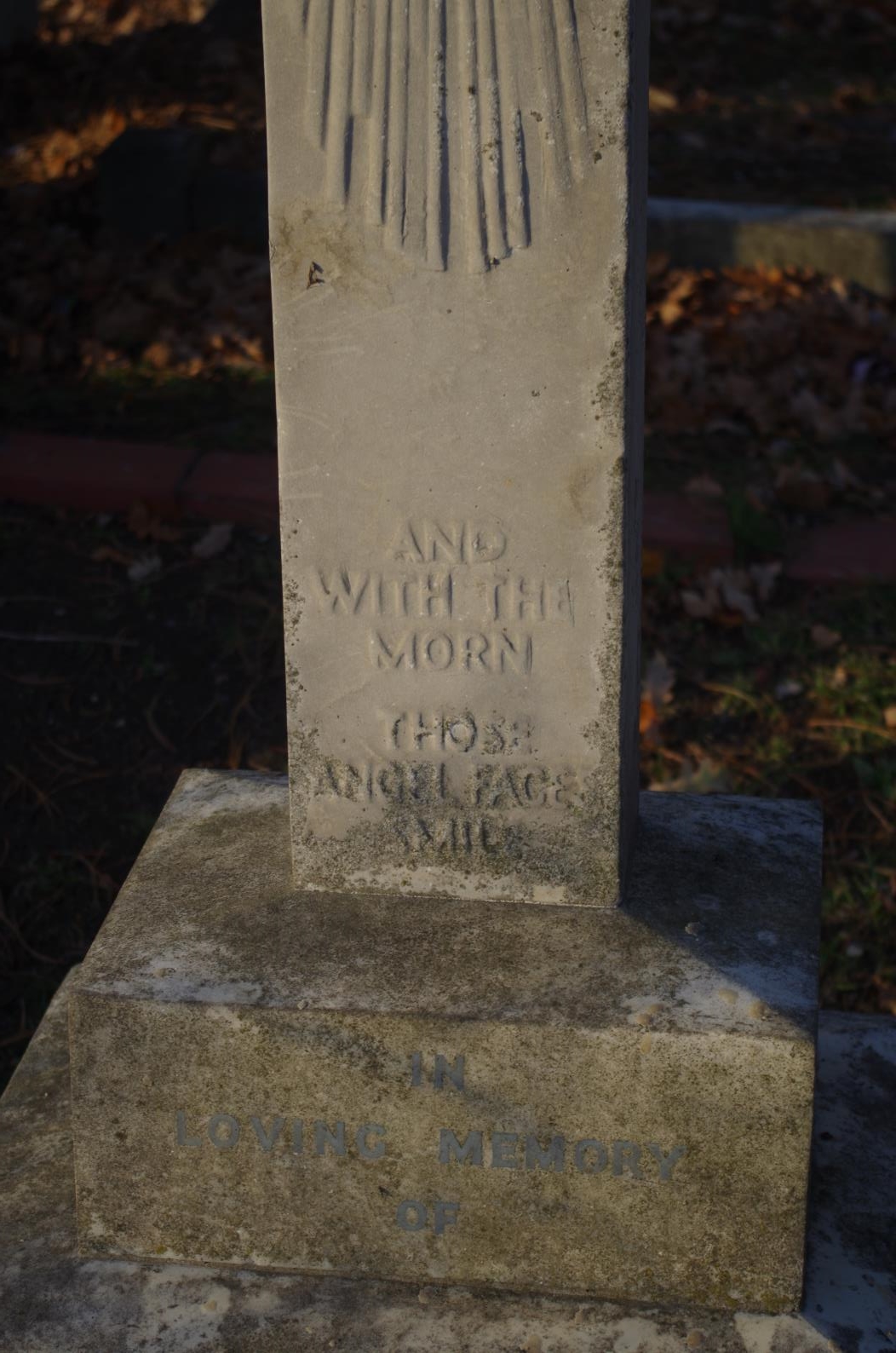
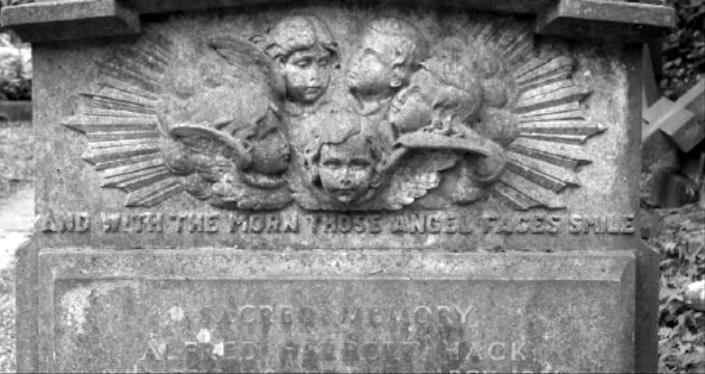
Five child angels, their faces turned to each other, framed by small wings, except for one that was staring out at me, I wanted to reach out and touch them but didn’t want to damage them. They formed a roundel at the centre of a tall cross with the phrase ‘And with the morn those angel faces smile’ inscribed at the base of its stem. I was on a tour of Beckenham Cemetery when I first saw them.
Our guide did not comment on them but the monument is in a prominent place on the main road through the cemetery and I often wondered about this pretty and poignant memorial.
But on a visit to Highgate Cemetery East in 2014 I found another example but on a smaller scale which was on a tombstone dedicated to Alfred Hack and dated 1956. There is a distinctly 1930’s look about the angels from their hairstyles.
I also discovered another version which featured cherubs faces instead of childrens on a visit to Knebworth in 2016. But on a further visit to Beckenham Cemetery in the same year, I found another similar one which was a short distance away from the first. In this the child angels seem to have more definite, individual faces and the one that has her head towards the viewer is looking downwards instead of outwards.
Now I wanted to find out more about the quotation and the angels and my research led me to a Victorian hymn that was sung on the Titanic at its final service on board and by the inmates of Ravensbruck concentration camp as the SS led them in. The ‘angel faces’ is a quotation from ‘Lead, kindly Light’, in fact it’s the penultimate line and like ‘Rock of Ages’ it caught the mood of its time.
These are the lyrics:
‘Lead, kindly Light, amid the encircling gloom Lead thou me on; The night is dark, and I am far from home, Lead thou me on. Keep thou my feet; I do not ask to see The distant scene; one step enough for me.
I was not for ever thus, nor prayed that thou Shouldst lead me on; I loved to choose and see my path; but now Lead thou me on, I loved the garish day, and, spite of fears, Pride ruled my will: remember not past years.
So long thy power hath blessed me, sure it still Will lead me on, O’er moor and fen, o’er crag and torrent, till The night is gone; And with the morn those angel faces smile, Which I have loved long since, and lost awhile.’
However, the writer John Henry Newman (1801-90), always refused to reveal the meaning of the ‘angels faces’ or what the ‘kindly light’ actually was.
Originally a poem, it was written by Newman in 1833. He was then a young theologian and Anglican vicar and was going through a challenging time in his life. Struck down by a fever which nearly killed him while travelling in the Mediterranean, Newman’s servant was so convinced that he would die that he asked him for his last orders. But in his autobiography, Newman told him ‘I shall not die, for I have not sinned against light’.
Newman recovered but that wasn’t the end of his troubles. Desperate to return to England he then took a boat from Palermo to Marseilles only to end up stranded and becalmed in the Straits of Bonifacio. Exhausted and frustrated Newman wrote the poem, ‘The Pillar of the Cloud’ that, in 1845, became ‘Lead, Kindly Light’. Newman was not happy about this as by then he’d converted to Catholicism and hymn singing wasn’t included as part of divine service. He went onto become Cardinal Newman, one of the most important figures in English Catholicism, and also an important writer. In 1900 Elgar set Newman’s poem ‘The Dream of Gerontius’ to music.
Cardinal Newman as John Newman eventually became after his conversion to Catholicism.
This celebrated portrait is by Sir John Everett Millais.
In the public domain in UK – from the National Portrait Gallery wkipedia
‘Lead, Kindly Light’ has struck a chord with those in danger or about to enter the endless dark realm and needed the comfort of a light leading their way through it. Miners awaiting rescue from deep underground during the 1909 Durham mining disaster sang it as did the passengers on one of Titanic’s lifeboats when the rescue ship, Carpathia, was sighted the morning after. It caught the Victorian mood perfectly as did ‘Rock of Ages’ and Queen Victoria asked for it to be read as she lay dying. It also inspired a celebrated painting by the Scottish artist, Sir Joseph Noel Paton in 1894 in which the angels are pensive young woman.
But why did one line from this song inspire two monuments in Beckenham Cemetery and one in Highgate East? I noticed that both of the Beckenham monuments were on children’s graves and that the carved angels were also children. Perhaps the mourning relatives left behind may have wanted the consolation that their beloved children would be waiting for them when their time came.
The first one is the Foster family monument. The epitaph is now virtually unreadable but I could make out the name ‘Francis Frederick’ carved along the base. There are two inscribed ‘Books of Life’ placed on top of the grave. One is dedicated to John Francis Foster and Alice Gladys Alice Chapman and the other is dedicated to John Francis Foster and Alice Emma Foster.
The second one is the Pace family monument and is to the two daughters of Henry William and Elizabeth Pace. These were Lilian Alice who died in 1888 and Grace Irene who died in 1903. Strangely enough they both died at the same age and Elizabeth herself is commemorated here as she died at 33 in 1912.
However the symbol has been adapted to feature cherubs as in St Mary’s, Knebworth’s churchyard. These are on the tombstone of the Lutyens family’s nanny, Alice Sleath.
But I am indebted to Douglas Keister’s Stories in Stone for the possible origins on the image of the angels.
The composition of the five heads may have been adapted from a painting by Sir Joshua Reynolds PRA entitled ‘Heads of Angels Miss Frances Gordon’ which was painted during July 1786 – March 1787. The sitter was the then 5 year old Frances Isabella Keir Gordon (1782-1831) who was the only daughter of illustrious parents. They were Lord William Gordon (1744-1823) and his wife Frances Ingram (1761-1841), second daughter of Charles, 9th Viscount Irvine (1727-78), who were married on 6 March 1781. Her uncle was Lord George Gordon (1751-93), whose political activities had sparked the anti-Catholic riots of 1780.
‘Heads of Angels Miss Frances Gordon’ by Sir Joshua Reynolds PRA 1786-1787. . This is in public domain wilki creative commons
Frances’ mother outlived her by 10 years and the painting was then presented to the National Gallery. It was enormously popular and was reproduced on numerous decorative items and photographic reproductions such as ‘The Cherub Choir.’
And so a poignant and powerful symbol was created from the combination of a great painting, an inspirational hymn and Victorian taste and led to the two lovely memorials to much missed children in Beckenham Cemetery..




























 shadows fly away