Wildlife in Cemeteries no 6 – a summer Sunday saunter

A wonderful and colourful display of hollyhocks over a grave in a clearing behind the Anglican chapel at Kensal Green Cemetery.
©Carole Tyrrell

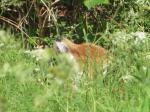
Summer is when you can really appreciate the wild corners and places within cemeteries.  Often spaces between tombstones and monuments will be left unmown or unscythed which allows grasses to grow tall.  The rapidly expanding bramble stands are good hiding places for foxes to hide in or use to travel between.   Already ripe, plump blackberries are dessert for hungry birds and jam makers.

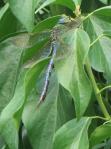
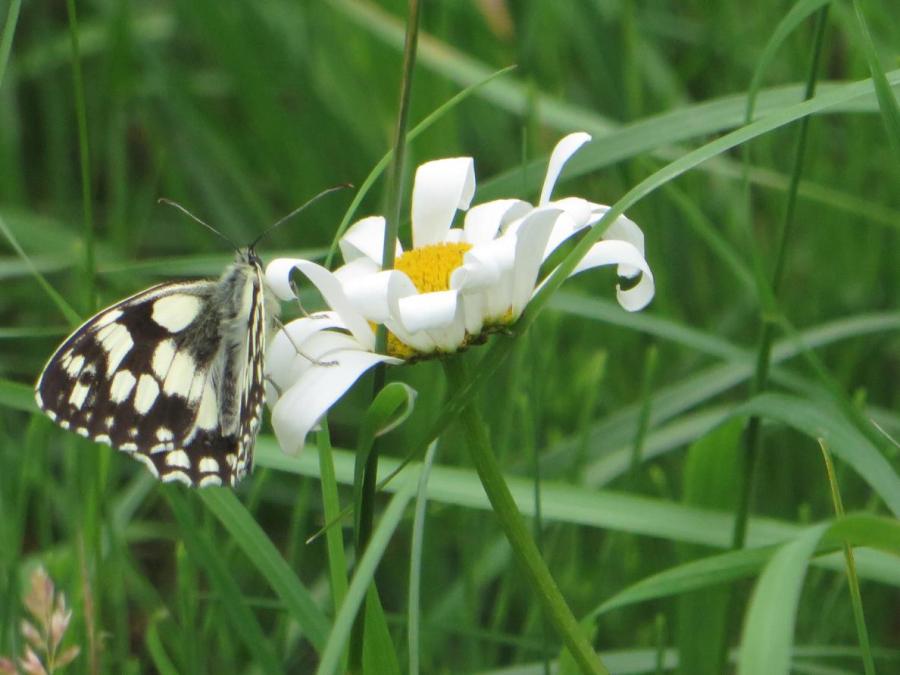
Wildflowers begin to stud the grass and undergrowth with bright dots of colour as they bud and begin to flower under the summer sun’s rays.  These create dazzling combinations of colour as they grow together. At Kensal Green one area near the closed catacomb terrace is designated as a meadow.  I stood inside it in early July of this year, almost waist high in grass and flowers,  surrounded by flitting butterflies and day flying moths, leaping grasshoppers and even a large blue Emperor dragonfly.  The latter was a complete surprise.  There was even a pair of courting Small White butterflies as well.  I just felt so happy to be there with the sun on my face and nature getting on with itself regardless of me.

Ragwort, a bright yellow plant which is rampant at the moment, divides opinion in some quarters. It  has been described as a weed and a wildflower.  Butterflies love it but it’s poisonous to cattle and horses.  I counted 8 Gatekeepers on one Ragwort flower head munching away quite contentedly.  The cemeteries that I explored teamed with wildlife and sometimes unusual or uncommon specimens.

I am a Citizen Scientist (not the most catchiest of titles I must admit and it sounds somewhat po-faced)which means that I go about recording wildlife and what I see on my urban ramblings for various websites including irecord and the LondonButterflyProject. Cemeteries are highly recommended by the latter organisation as great places in which to find butterflies and now, I go to a cemetery or graveyard first, in order to do my count.

So here’s a gallery of what you might find on a sunny afternoon wander through a marble orchard.

NB: Be careful and take care if walking through or exploring areas of long grass and wildflowers as monuments can be camouflaged by them. So wear appropriate footwear – not flips-flops – and watch out for kerbstones and the edges of graves so that you don’t trip over them. Also, due to subsidence monuments can also be at odd angles so again take care.

©Photos and text Carole Tyrrell

©Photos and text Carole Tyrrell

Lotta – the dachshund with the waggiest tail…….Knebworth House’s pet cemetery

Henna. ©Text and photos Carole Tyrrell
A poignant tribute to Henna.
©Text and photos Carole Tyrrell

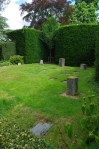
As you enter the formal gardens at Knebworth, please take a moment to visit  the eternally slumbering residents of its pet cemetery which is nearby.   Although not signposted it does appear on the Knebworth map.Most stately homes have one if you know where to look and they give another insight into the lives of the owners and the animals who shared their lives however briefly.

However, although  Knebworth House has been the home of the Lytton family since the 1400’s it wasn’t until the 19th century that the family’s pets were formally interred in their own private resting place.

There are varying dates as to when the cemetery came into being.   Apparently it started in 1825. but the official Knebworth map has it as dating from 1852.  The cemetery not only contains the beloved pets of the Bulwer-Lytton family but also those of their tenants.  All are equal in the small well tended  graveyard.

But I’m sure that most visitors don’t notice it.  It nestles in front of the yew hedge which is known as the Iron Hedge.  Yew is traditionally associated with places of burial and death such as churchyards and there are supposedly many traditions associated with this.  It’s also seen as a symbol of everlasting life as yew trees have been known to live for centuries.  Most of the epitaphs are laid flat so can easily missed by the casual passer-by but a closer look reveals some marvellous memories.

As with other pet cemeteries, it’s the touching epitaphs that I find most interesting as well as the names that owners give their pets.

Beau was Edward Bulwer-Lytton’s cherished pet dog

A better view of Beau's epitaph. ©Text and photos Carole Tyrrell
A better view of Beau’s epitaph.
©Text and photos Carole Tyrrell

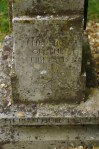
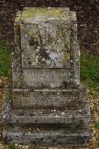
There is a small monument to ‘The first of the Tibetans’, Chumbi and Ruby.  It goes onto say that they were both found in the Chumbi Valley in 1929.  It also adds, sadly, that Chumbi was ‘Lost on the Great North Road 1929.’ and that Ruby ‘Died at Knebworth in 1929’.   There is also an inscription around the base of the monument.  It reads ‘May the love they had and gave help them even beyond the grave.’  Short lives but much missed.

© Text and photos Carole Tyrrell

Here is a selection of the epitaphs: