Murder memorials: A grisly history written in stone

Here’s another interesting piece from the BBC news website on murder memorials dating from the early 19th century.  They are usually found in country areas as the victim and murderer would often be known to the community.
  • 26 October 2018
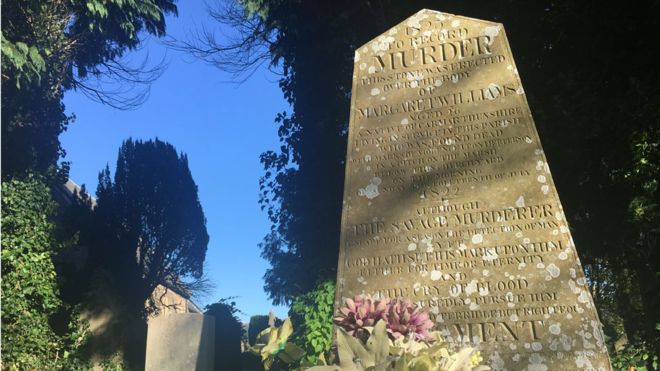
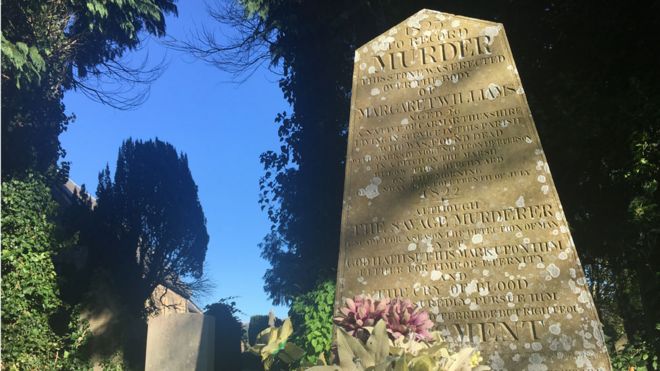
Murder stone in St Catwg's church
The tragic tale of Margaret Williams is hinted at on the stone which condemns her murderer

Wandering around the picturesque cemetery at St Catwg’s church in Cadoxton, Neath, a first-time visitor might be startled out of their gentle stroll by the stark message on top of one tall, weathered stone – MURDER.

This memorial in south Wales is one of a handful of “murder stones” erected around the UK, the majority over a period of about 100 years, to commemorate violent deaths that shocked the local communities.

The Cadoxton stone is dated 1823, and recounts the death of Margaret Williams, 26, who was from Carmarthenshire but was working “in service in this parish” and was found dead “with marks of violence on her person in a ditch on the march below this churchyard”.

Miss Williams’ story, such as is known from contemporary reports, tells of an unmarried young woman who had been working for a local farmer in Neath when she became pregnant.
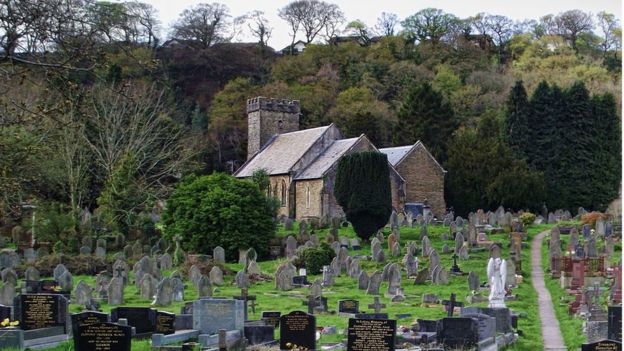
St Catwg's Church, CadoxtonImage copyrightCR LEWIS/GEOGRAPH
Image captionThe peaceful graveyeard of St Catwg’s in Neath hides a harrowing tale in its midst

She had declared the father of the child was the farmer’s son, and when her apparently strangled body was discovered head down in a watery inlet in marshes near the town, he was the prime suspect.

But whatever local opinion may have believed, there was no evidence to tie him or anyone else to the crime, and her murder remained unsolved.

However, the murderer was left in no doubt as to the feelings of the local community after this stone, part gravestone and part warning, was erected over poor Margaret’s body.

Giving the details of her fate and the date of her death, the stone, erected by a local Quaker, continues: “Although the savage murderer escaped for a season the detection of man yet God hath set his mark upon him either for time or eternity, and the cry of blood will assuredly pursue him to certain and terrible righteous judgement.”

This unsolved killing is unusual in the history of the surviving murder stones in that the murderer escaped justice. Most of the other memorials are to people whose killers were quickly detected, sentenced and dispatched via the gallows.

Dr Jan Bondeson, a retired senior lecturer at Cardiff University and a consultant physician, has made a study of the history of crime alongside his medical career and has written a number of books on the subject.

He became interested in murder stones after editing a book which featured them.

He said: “The murder stone in Cadoxton is the only one in Wales. There are plenty of them in England.

“There was an instinct for the local people to erect them. There was a strong instinct to commemorate a tragic murder.”

Dr Bondeson has documented several further murder stones across the English counties, and one early example of the type in Scotland.

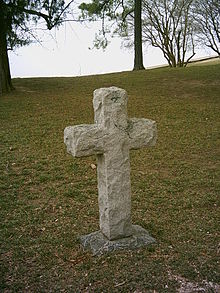
One murder stone has been immortalised by no less a writer than Charles Dickens himself. In the novel Nicholas Nickleby, the eponymous hero walks through the ominously named Devil’s Punch Bowl at Hindhead in Surrey.
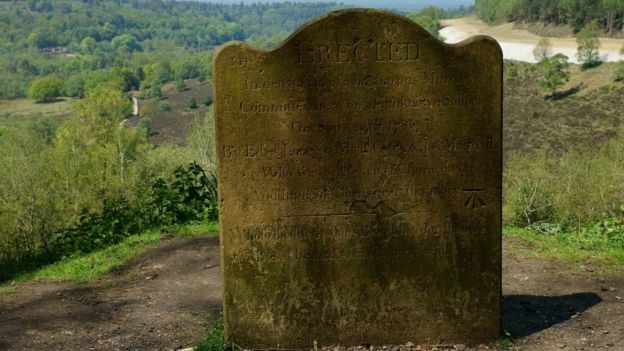
Stone to unknown sailor, Hindhead, SurreyImage copyrightPETER TRIMMING/GEOGRAPH
Image captionThe murder stone at the Devil’s Punchbowl, Surrey, features in Charles Dickens’ Nicholas Nickleby

There, he and his companion come across the real-life stone marking the 1786 murder of a man known only as the Unknown Sailor.

The unnamed man was en route to his ship in Portsmouth when he visited a local pub in Thursley. There he fell in with three fellow sailors, and paid for their drinks and food before leaving with them.

The sailor was repaid for his generosity in the following way: They “nearly severed his head from his body, stripped him quite naked and threw him into a valley”.

The three did not get far. The sailor’s body was found soon after, and James Marshall, Michael Casey and Edward Lonegon were chased and captured after trying to sell the dead man’s clothes at a pub.

They were hanged from a triple gibbet near the murder scene, and the unknown man was buried in Thursley with a stone paid for by local people.

But the local mill owner, James Stillwell, went a step further. He placed a stone in Devil’s Punch Bowl itself, with this grim warning to future generations:

“ERECTED, In detestation of a barbarous Murder, Committed here on an unknown Sailor, On Sep, 24th 1786, By Edwd. Lonegon, Mich. Casey & Jas. Marshall

“Who were all taken the same day, And hung in Chains near this place, Whoso sheddeth Man’s Blood by Man shall his, Blood be shed. Gen Chap 9 Ver 6”

Dr Bondeson said the majority of the stones appeared around the 1820s, adding “That was the high level for the erecting of murder stones. All of them are in the country – none are in urban areas.”
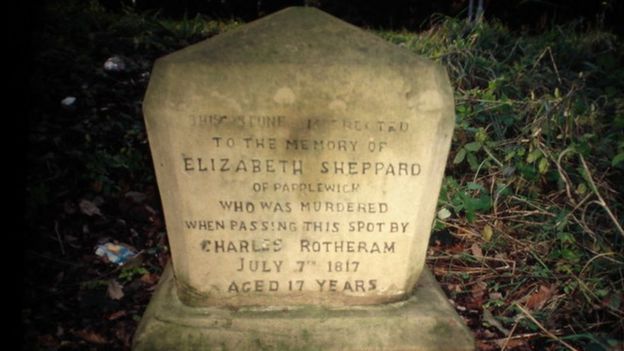
Elizabeth Sheppard murder stoneImage copyrightDEBORAH MCDONALD/GEOGRAPH
Image captionBessie Sheppard was murdered on her way home after going to look for work

Elizabeth – Bessie – Sheppard was just 17 when she set out from her home in Papplewick, Nottingham, on 7 July 1817, to seek work as a servant in Mansfield, seven miles away. She found a job, but she never found her way back home, because on her return journey, a travelling knife grinder found her.

Charles Rotherham, a man in his early 30s, had served as a soldier in the Napoleonic wars for 12 years before beginning this new stage in his life.

He was seen on the road coming from Mansfield after drinking several pints where his path crossed Bessie’s.

Her severely battered body was found in a ditch by quarrymen the next day. Her shoes and distinctive yellow umbrella were missing and there was evidence her attacker had tried to remove her dress but had failed.

Rotherham had sold Bessie’s shoes and was on his way to Loughborough when he was arrested. He confessed to the crime and was returned to the scene where he showed a constable the hedge stake he had used to kill Bessie.

Like all murderers at the time, Rotherham swung for his crime. Local people, outraged by the attack, banded together to raise money for a stone to commemorate Bessie, which was placed on the site where she was attacked.

Bessie’s stone simply honours the memory of the dead girl, but another stone erected to a female victim of violence has more of a moral tone, seemingly warning women against certain behaviour as much as expressing anger with the killer.

“As a warning to Female Virtue, and a humble Monument to Female Chastity: this Stone marks the Grave of MARY ASHFORD, who, in the twentieth year of her age, having incautiously repaired to a scene of amusement, without proper protection, was brutally violated and murdered on the 27th of May, 1817.”

The story behind Mary Ashford’s death and its aftermath is one which left a permanent mark on English legal history.
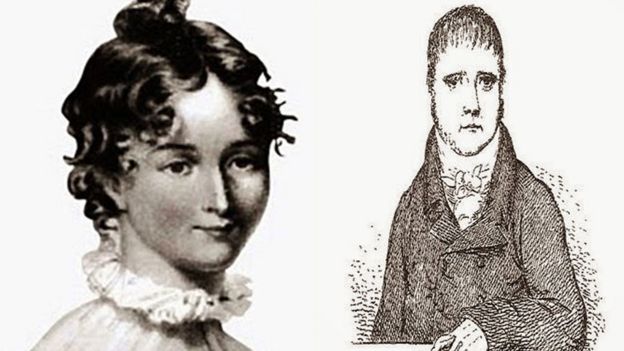
Mary Ashford and Abraham Thornton
Mary Ashford and the man accused of her murder, Abraham Thornton

She had gone to a dance in Erdington, Birmingham, with her friend Hannah Cox, whom she planned to stay with overnight before returning to her place of work at her uncle’s house in a neighbouring village.

At the dance, she met a local landowner’s son, Abraham Thornton, and later reports confirmed the pair spent most of the night dancing together and having fun.

When they left the dance, Mary told her friend she would spend the night at her grandparents’ home – possibly a ploy to spend more time with Thornton – and Mary and he went off together.

Mary returned to Hannah’s house at 4am, changed her dancing clothes for her working clothes, collected some parcels and set out for her uncle’s home.

About two hours later a labourer found a bundle of clothing and parcels on the path leading to Mary’s home. The alarm was raised and her body was found submerged in a water-filled pit.

An autopsy showed she had drowned and had been raped shortly before her death.

People believed Thornton, having been rebuffed by Mary during their hours together, had lain in wait for her to return home and raped her before throwing her into the pit to drown.

He was duly arrested and tried, but a number of witnesses placed him at another location at the time of Mary’s death and he was acquitted.

But the story does not end there. Mary’s brother William Ashford began a private prosecution under an obscure ancient law, which allowed relatives of murder victims to bring an “appeal of murder” following an acquittal.

Thornton had a surprise up his sleeve though. In response, he demanded a trial by combat as was his right under that law, under which he could legally have killed Ashford, or if he defeated him, gone free.

Ashford was much smaller than Thornton, and declined the battle. Thornton was a free man, and the case was swiftly followed by a change in the law in 1819, banning such appeals and therefore trial by battle.
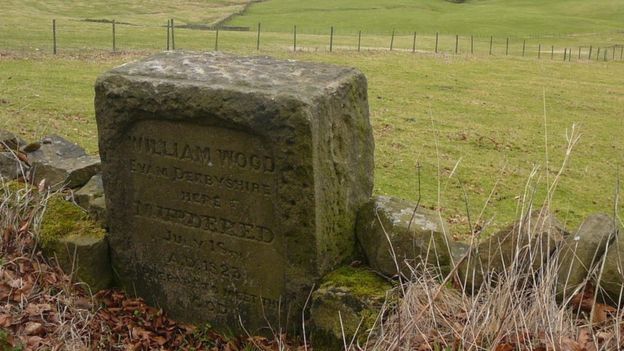
Murder stone commemorating William WoodImage copyrightCOLIN PARK/GEOGRAPH
Image captionThis murder stone at Disley in Cheshire commemorating William Wood was erected 50 years after the crime

Other victims include:

  • William Wood, of Eyam, Derbyshire, murdered by three men who robbed him of £100 in 1823 – his head was “beaten in the most dreadful manner possible”. Two men were caught, one escaped justice. A permanent memorial was erected over 50 years after the crime after earlier versions were destroyed or removed, which showed the strength of feeling still present in the community about the murder.
  • Father and son William and Thomas Bradbury, who were brutally attacked in William’s pub The Cherry Arms, known as Bill O’Jacks locally, on 2 April 1832 in Greenfield, Saddleworth. Their unsolved killings were recorded on a stone which noted their “dreadfully bruised and lacerated bodies”.
  • The Marshall family – the “special horror”, as noted in The Spectator at the time, of the Denham murders in Buckinghamshire, where a family of seven including three young girls were beaten to death at their home attached to their father’s blacksmith’s premises. The youngest, Gertrude, four, was found still clutched in her grandmother Mary Marshall’s arms. Killer John Jones was found a few days after the killings on 22 May 1870 and speedily tried and executed. They are buried in one grave in St Mary’s Church, Denham, where the original worn murder stone has been supplemented by a modern plaque to remember the victims.

The last word goes to those who chose to commemorate Nicholas Carter, a 55-year-old farmer from Bedale, Yorkshire, killed by a farm labourer as he rode home from market.

The stone laid at the murder site in Akebar – later to become a Grade II listed monument which hit the headlines earlier this year when it was badly broken in a car crash – had a very simple message, along with the date of his death, May 19, 1826.

Do No Murder.


Epitaph Exploring in East Anglia! Part 2 The Great Churchyard, Bury St Edmunds

And now the good and the bad….(although that can be debatable.)


Dedicated to Capt Gosnold and is self-explanatory – it looks quite recent as well.
©Carole Tyrrell

An unacknowledged  Founding Father who may have changed history 

Captain Bartholomew Gosnold(1571 – 1607) 

Although the memorial stone and epitaph is largely self-explanatory there is a lot more to Gosnold’s story.  The explorer and colonist isn’t buried here. Instead he is reputed to lie in Jamestown, Virginia.  This was the colony that he helped found and, where. according to Presevation Virgina he is regarded as being …’the prime mover of the colonisation of Virginia.’

Gosnold was originally a Suffolk man who studied law at Middle Temple after graduating from Cambridge.  He made an influential marriage and had seven children. But the sea and adventure were in his blood and he sailed with Sir Walter Raleigh whom he was soon to outstrip.

In 1602  Gosnold. on the ship Concord. made his first attempt to found a colony in Southern New England. Along the way they named Cape Cod after the large number of the fish they found there and then he continued to sail on along the coast to a place with an abundance of wild grapes.  He called the place Martha’s Vineyard because of the grapes and also in memory of his infant daughter who had died in 1598.  However the colony was abandoned when its settlers decided to return to England.

There was big money and fame to be made from exploring and colonising in the 17th century.  These were usually private ventures and so profit driven. But for Gosnold and his ambitions there was only one snag; Raleigh held the patent for Virginia.   But Queen Elizabeth I, who was on the throne at the time, was very interested in revenue and Raleigh’s star was descending.  He’d already lost £40k on the Roanoke disaster which was a huge sum at the time.  Soon Gosnold held an exclusive charter for a Virginia charter to settle there and this eventually became what is now Jamestown.

Sadly Gosnold wasn’t destined to enjoy his acheivements for long.  He died, aged only 36, on 22 August 1607 as the result of a 3 week illness after only 4 months after landing in the New World.  The burial was an honourable one ‘with many volleys of small shot’ fired over his coffin.

This is believed to be Gosnold’s grave in Virginia.
shared under Wiki Creative Commons
©Ser Amanho di Nicolao

He was one of the prime movers in Virginia’s colonisation and it has since been speculated that without him it might have been Spain that ended up colonising the Atlantic coast.  Elizabeth I’s successor, James 1, was extremely keen to maintain peace with Spain in the 1600’s and Spain was equally enthusiastic to explore the New World.  Without Gosnold who knows what might have happened?

For centuries the location of Gosnold’s grave was unknown.  But, in 2002, a body was excavated in Jamestown which has been presumed to be his.  Preservation Virginia  revealed that it appeared to be a person of high status as a captain’s staff had been placed in the coffin with the body and the coffin had an unusual gabled lid.  DNA was taken and compared with that from a distant descendant of Gosnold’s interred in a Suffolk church but the tests were inconclusive.

I note that his wife is recorded on this memorial plaque so either she didn’t go with him or returned after his death.

And the bad…..or unfortunate…….

Sarah LLoyd – a warning to the passer-by. Charnel House, The Great Churchyard.
©Carole Tyrrell

This epitaph is meant to be a cautionary tale for the passer-by.  The inscription tells Sarah Lloyd’s sad story and again the mason has earned his money if he was paid by the letter.   It’s almost like reading a penny dreadful written in stone.

Reader

Pause at this Humble Stone

a Record

The fall of unguarded Youth

By the allurements of vice

and the treacherous snares

of Seduction

SARAH LLOYD

on the 23d of April 1800

in the 22d Year of her Age

Suffered a Just but ignominous

Death

for admitting her abandoned seducer

into the Dwelling House of her Minstrefs

in the Night of 3rd Oct

1799

and becoming the Instrument

in his Hands of the crimes

of Robbery and Houseburning

These were her last Words

May my example be a

warning to Thousands.


This seemed to tell all of Sarah Lloyd’s story but did it?  I did further research and found that there was more to it than the epitaph states. I am indebted to Naomi Clifford’s excellent blog post for this.

The facts are that Sarah Lloyd was employed as a maidservant for Mrs Syer at her house in Hadleigh near Ipswich and had begun an illicit relationship with Joseph Clarke, a local man. On the night of the burglary, she let him into Mrs Syer’s house while Mrs Syer and her live-in companion slept.  The pair then stole various items from the house including a watch and 10 guineas in cash. They also managed to steal Mrs Syer’s pockets, which were small bags, from their hiding place under her pillow.  These contained cash and jewellery worth 40s (£2.00).  According to the court transcript, Clarke then set fire to the curtains in one of the rooms although other accounts state that they started a fire in a stairwell.   Both of them then fled the scene, hoping to have covered up their crime,  but unluckily for them neighbours managed to quickly put out the fire and the house was saved.  Clarke advised Sarah to leave him out of it and, instead, to say that two other men had been involved.

They lay low until Sarah was recognised as she ran across a field and she was eventually arrested by the local constable. She confessed and the stolen goods were recovered from her family home.  The cash was never found and soon Clarke was also arrested.

However, according to the account of the trial Clarke was found not guilty and acquitted whereas, Sarah, although found not guilty of the burglary was found guilty of stealing.  The strongest penalty was awarded.  This seemed harsh to say the least. According to Naomi Clifford  when Sarah appeared at the local Assizes on 20 March 1800 all she said in her defence was:

‘ It was not me, my lord, but Clarke that did it.

Here is a link to a contemporary account of the trial:    (However, be warned that it’s in 16th century phrasing where the ‘s’ has been replaced by a long ‘f’ which renders, for example, ‘passing’ as ‘paffing’.

https://books.google.co.uk/books?id=Wb1jAAAAcAAJ&pg=PA7&lpg=PA7&dq=sarah+lloyd+the+great+churchyard&source=bl&ots=VStZFRhEFa&sig=ykdosMHb6URQb08QcxF9IFel7RE&hl=en&sa=X&ved=0ahUKEwihhOSVgN3YAhUHIsAKHc7JAEAQ6AEISjAH#v=onepage&q=sarah%20lloyd%20the%20great%20churchyard&f=false

The charges against Clarke were dropped which may have been because he hadn’t confessed to his part in the crime whereas Lloyd had.  Also it was only her word that placed him at the scene as there was no other evidence.

The Assizes judge, Judge Grose, made several remarks which condemned Sarah:

A servant robbing a mistress is a very heinous crime; but your crime is greatly heightened; your mistress placed implicit confidence in your; you slept near her, in the same room, and you ought to have protected her… and though this crime was bad, yet it was innocence, compared with what followed: you were not content with robbing her mistress, but you conspired to set her house on fire, thereby adding to your crime death and destruction not only to the unfortunate Lady, but to all those whose houses were near by.  I have to announce to you that your last hour is approaching; and for the great and aggravated offence that you have committed, the law dooms you to die.’

There was a further twist to the case in that Sarah told the Rev Hay Drummond, the local vicar, when he visited her, that Clarke had seduced her and regularly visited for sex. She’d regarded him as her husband and on the night of the crime she had revealed that she was pregnant and he’d promised to marry her.  Rev Drummond felt that she’d been used and immediately set about organising a petition together with Capel Lofft, a lawyer and magistrate. to try to obtain a Royal Pardon.    Lofft moved in influential circles but the Home Secretary, the Duke of Portland refused any clemency as he considered that Sarah should be made an example as her alleged final words on the epitaph state. Although I think it more likely that she might have said ‘How did Joseph Clarke get off with not guilty?’

The pregnancy wasn’t mentioned again and she was executed on 22 April 1800 after it had been delayed for 14 days by the attempts to obtain a Royal Pardon.  Sarah was buried in the abbey churchyard  that evening with a crowd of 1000 people in attendance.  Mrs Lloyd. Sarah’s mother, had tried to commit suicide when she had heard that the execution was to proceed.

Although Sarah’s age is started as 22 on the epitaph she was unaware of her true age and was illiterate.

The epitaph also seems to have commented on Sarah;s morality although her ‘abandoned seducer’ isn’t named.However, her case has been seen as being part of a slow movement of change with capital punishment.  The first decades of the 1800’s brought significant reductions in the numbers of crimes punishable by death with other less harsh methods of punishment.  Sarah Lloyd was one of 7 women hanged in 1800. There were 6 in England and I in Ireland.  Only 3 more were to hang for stealing in a dwelling house and it ceased to be a capital offence after August 1834.

©Text and photos Carole Tyrrell unless otherwise stated.

Further reading and references:

https://en.wikipedia.org/wiki/Bartholomew_Gosnold

https://historicjamestowne.org/history/captain-bartholomew-gosnold-gosnoll/

https://britishheritage.com/bartholomew-gosnold-the-man-who-was-responsible-for-englands-settling-the-new-world/

http://anthropology.si.edu/writteninbone/unusual_case.html

https://www.buryfreepress.co.uk/news/hidden-treasures-brought-into-view-1-399134

https://books.google.co.uk/books?id=Wb1jAAAAcAAJ&pg=PA7&lpg=PA7&dq=sarah+lloyd+the+great+churchyard&source=bl&ots=VStZFRhEFa&sig=ykdosMHb6URQb08QcxF9IFel7RE&hl=en&sa=X&ved=0ahUKEwihhOSVgN3YAhUHIsAKHc7JAEAQ6AEISjAH#v=onepage&q=sarah%20lloyd%20the%20great%20churchyard&f=false

http://www.naomiclifford.com/sarah-lloyd/

http://www.capitalpunishmentuk.org/lloyd.html

http://www.eadt.co.uk/ea-life/bury-st-edmunds-and-sudbury-how-tragic-sarah-paid-a-terrible-price-for-seduction-1-3452212