


Cobham Wood can feel like a haunted place. This is where the 19th century artist, Richard Dadd, murdered his father in a spot still known as Dadd’s Hole and so began his journey to a lifetime in Broadmoor. But before Mr Dadd gave into his murderous impulses, there was another place associated with death that sits alone in the woodland. Once intended as a grand and capacious building to house the dead of the Earls of Darnley, it was never used and, for a long time during the 1980’s and 1990’s, it was surrounded by piles of burnt out cars and motorbike scramblers. The hilltop location was ideal for these nocturnal sports.
But on 5 November 1980 someone went too far and lit a pile of tyres and petrol cans in an attempt to blow the mausoleum up. It brought down the chapel floor and the Mausoleum was open to the elements. But it survived.
However, it was a sorry sight in 2003 when it featured on BBC TV’s ‘Restoration’ programme as an appeal was launched for funds to restore it. However, the Mausoleum’s future looked bleak and even I thought that, due to its location, any restoration would be destroyed again. You can see how it looked at the time: https://www.bbc.co.uk/programmes/p01mvbfj
But in June 2020 I made the pilgrimage through the poppy field of Ranscombe Nature Reserve and up through the woods to the Mausoleum. As I emerged from under the tree canopy I was amazed by the Mausoleum’s size. It is big, very big and was designed to hold 32 coffins in a lower crypt. It’s an extraordinary building and was originally sat at the highest point of the Darnley estate. It became an important feature of the landscape, almost an eyecatcher folly.


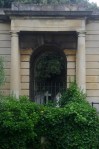
The Mausoleum is square in shape with a pyramid shaped roof, a dry moat and a vandal proof fence.
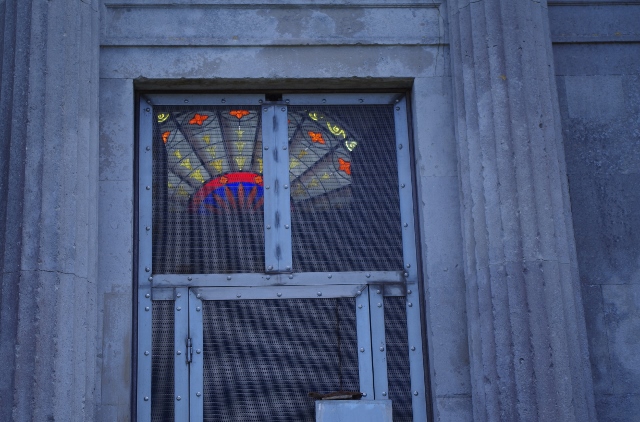
©Carole Tyrrell
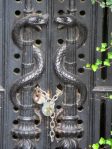
It’s Grade 1 listed and a rather unlovely door keeps it secure from unwelcome visitors. Just above it I could see one of the 4 lunettes or half-moon windows as the sun shone through the amber stained glass. This was a tantalising taste of what lay inside as the light shining through them is intended to create an ethereal light inside. But, alas, the building is closed to visitors at present due to COVID-19. The building is made of brick and faced with Portland stone. It can be seen as
‘a very grand classical temple that emphasised the Age of Enlightenment’s preoccupation with a classical way of death’ according to the National Trust’s website.
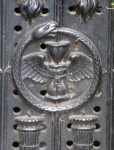
It drips with symbols of death and remembrance. The square, circle and pyramid are classical motifs of eternity, the downturned torches indicate a life extinguished and there are 4 little sarcophagi on each corner. These were stone coffins designed to hold the dead and the word comes from the Greek for ‘flesh eater’. I was in my element as you can imagine.
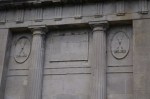

But who built it and chose its location? It was the 4th Earl of Darnley who commissioned the fashionable and exacting architect, James Wyatt (1746-1813) to design the Mausoleum according to detailed instructions in the 3rd Earl’s will. The Earls of Darnley had always been buried in Westminster Abbey but after the 3rd Earl’s death in 1731 the Abbey was full. So the Mausoleum was to be the solution and would hold the coffins of the Earls and their family members. The 3rd Earl:
‘left detailed instructions in his will in which he clearly stated that he wanted a square stone building with a ‘prominent pyramid’ surrounded by a dry moat. He left £5000 or £10,000 if the first amount wasn’t sufficient.’ National Trust
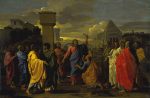
The source of the pyramid might have come from the Earl’s Grand Tour when he may have seen the tomb of Caius Cestius in the Protestant Cemetery in Rome. There is also a building with a pyramid roof in the background of a 1647 painting by Nicholas Poussin, ‘The Sacraments of Ordination’. He was a highly regarded painter in the 18th century and there were several paintings by him included in the sale of Cobham Hall.
As the journal of the Mausolea and Monuments Society says:
‘Pyramids were rare in in English Georgian architecture and made their first appearance at Castle Howard;….Wyatt and Darnley trying to recreate the solemn grandeur of the ancients…’ Masusolus


Another source of inspiration may have been the famous tomb of King Mausolus at Halicarnassus in Asia Minor. He died in 353BC and such was the fame of his tomb that his name became synonymous with all subsequent stately tombs. As a result they became known as mausoleums.
The Darnleys lived at nearby Cobham Hall so the Mausoleum it would have been handy to have your loved ones nearby for eternity. Of course you may have been looking at it and wondering when you might be joining them. In 1786, at its completion, the Mausoleum cost, in total, £9000 which in today’s money is £1million. It is a lavish building with a marvellous interior from photos I have seen.
Wyatt’s designs were exhibited at the Royal Academy in 1783 and a modified design completed in 1786. However, it was George Dance the Younger (1741-1825) who supervised the work as Wyatt was renowned for having a bad reputation in erecting his own work. After completion, Humphry Repton (1752-1818), considered to be the last great landscape designer of the 18th century spent the next 30 years designing the landscapes around Cobham Hall for the 4th Earl.
But the Mausoleum was never consecrated and so couldn’t be used for its intended purpose. According to Mausolus, the journal of the Mausolea and Monuments Society,
‘the Bishop of Rochester was disapproving of buildings in secular sites and refused to consecrate a building that so brazenly evoked pagan arcadia.’
Repton himself suggested that it be converted to a viewing platform so that it could be put to some use and the views would have been amazing but it didn’t happen.
But instead of being laid out in the Mausoleum as intended the Earls of Darnley have been interred in the vaults and churchyard of St Mary Magdalene in Cobham village. There is a fine display of their memorials at the rear of the church and in the churchyard.
The Darnleys income came from a 25,000 acre estate in County Meath, Ireland. However their fortunes declined and in 1957 they sold Cobham Hall. After the arson attack there were many suggestions and schemes for the Mausoleum’s future. A developer bought it, intending to convert it into a residence but went bankrupt. He was presumably hoping to find a buyer who liked seclusion and could find a use for 32 coffin spaces in a crypt. The building passed into the hands of the official Receiver and HM Government became its new owner. The 4th Earl’s creation’s future looked bleak, its interior blackened from the arson attack and covered in graffiti and surrounded by a rusty junkyard.
What would happen to this fine building?
Part 2: The resurrection of the Darnley Mausoleum
©Text and photos Carole Tyrrell unless otherwise stated.
References and further reading:
https://www.nationaltrust.org.uk/cobham-wood-and-mausoleum/features/saved-from-the-brink—the-restoration-story contains a photo of how the mausoleum looked after the arson attack.
https://en.wikipedia.org/wiki/Darnley_Mausoleum
http://www.mmtrust.org.uk/mausolea/view/87/Darnley_Mausoleum
http://docs.gravesham.gov.uk/AnitePublicDocs/00294841.pdf
http://www.discovergravesham.co.uk/cobham/darnley-mausoleum.html
http://www.mmtrust.org.uk/assets/docs/articles/2009_mmt_news_march0001.pdf
http://www.mmtrust.org.uk/assets/docs/articles/2004_mmt_news_april.pdf
https://abinger-stained-glass.co.uk/portfolio-item/darnley-mausoleum/ – a piece about the ceration of the lunettes.




 shadows fly away