Symbol(s) of the Month – Ritual Protection Marks

Cross, St Nicholas at Wade, Kent © Carole Tyrrell

Imagine if you will a medieval church.  Inside it would be brightly painted and very colourful in contrast to the whitewashed interiors that we are familiar with today. Faded vestiges of these colours can sometimes be seen on monuments or pillars. The church porch might be used for other activities besides keeping out of inclement weather.  They were used for ceremonies such as marriages or the ‘churching’ of women and churches were often the hub of community life. But they also had a dark side as they were seen, surprisingly,  as places where evil lurked. In fact, it was believed that the Devil and his horde lived within the church on the ‘north’ or sinister side.  

The medieval world was often harsh and the forces of evil were supposedly everywhere. A bad harvest, plague or fires were all attributed to them. Witches were also believed to be real.  Meanwhile the Church taught that the world was full of evil spirits who were always looking for unwary souls to tempt or possess. 

Even churches needed protection despite priests performing blessings and masses and so the local parishioners took action into their own hands and relied on the use of apotropaic symbols.  This is a Greek word that comes from ‘apotrepein’ which means ‘to ward off’ i.e. ‘apo’ = away and ‘trepein’ = ‘to turn.’ It was a secret language which its medieval creators firmly believed could protect them from evil. They were a way of their creators taking back control  over their world. The marks  were often inscribed near vulnerable places such as doorways, windows, fireplaces and even fonts. In other words, wherever an evil presence might try to enter. But they were not confined to churches as they also appeared in other historic and ancient buildings.

Daisy wheel on fragment of a demolished house in Essex, Southend Central museum. © Carole Tyrrell

But by the 18th century, belief in protective marks had declined. However, they were inscribed into buildings and churches up until the 19th century and have been described as ‘folk magic’ or superstition. But in rural areas the tradition continued and was handed down through generations.

I have seen many medieval survivors of the 17th century iconoclasts in Kent churches such as wall paintings at Selling and a Doom painting at Newington but more recently I have been finding the most enigmatic survivors of all, ritual protection marks. You have to know where to look as they are often well hidden.  I did wonder if the priest knew what was going on and turned a blind eye. But we will never know. However, this is a huge subject and I can only scratch the surface. I’m just intrigued by them and their variety.  In this post I am giving you a selection of what I’ve found so far and possible meanings. I have visited 3 churches so far: St Nicholas, Sturry, St Nicholas at Wade and Hoo St Werberga who all have these marks. As you might imagine crosses feature heavily.

Figure on pillar, St Nicholas, Sturry.© Carole Tyrrell

I first found marks in St Nicholas church, Sturry, near Canterbury in 2023. The churchwarden pointed them out as they’d just had someone in to do a survey of them. There were crosses on pillars near the entrance and on the other side of the church. So, I made a return visit this year and this time found a figure which may be the Virgin Mary as it seems to be wearing a skirt and has a halo.

There was a little note on a pillar indicating a M or Marian mark but I couldn’t find it and then I was distracted by a cream tea.  I also saw circles which appear to have been appear to have been drawn with a compass as well as dots. The small circles are also referred to as hexafoils and are the most common.

Circle, St Nicholas, Sturry, © Carole Tyrrell

According to their information leaflet on the marks;

‘They can range from simple circles, to six petalled flower designs and highly complex geometric designs which are known as daisywheels.’

They are usually small as at St Nicholas, but they can be up to a metre across. It was originally believed that they were created by the masons who built the churches but there are too many for them to be attributed to one trade. It has been suggested that:

‘they may have been created in order to trap the demons that roamed the world within their complex structure by quite literally pinning them to the walls.’ Information leaflet, St Nicholas, Sturry.

Also at Sturry , there are five ‘dots’ on a pillar which could easily be missed but they have significance:

Dots on pillar, St Nicholas, Sturry. © Carole Tyrrell

‘the dots appear to follow numerical values, being found in generally uneven numbers, and commonly in groups of three, five, seven and nine. Certain uneven numbers had considerable significance in the medieval church, such as the Trinity and the seven sacraments, and numbers were also regarded as powerful within aspects of medieval magic’.  Information leaflet, St Nicholas, Sturry

But this is only one interpretation and, as with most ritual protection marks, there can be several and it’s not possible to say definitively which is the correct one.

I visited St Nicholas at Wade at Easter 2025 and the church was bustling as it was being decked with flowers for the celebrations. They very proudly showed me their ‘daisy wheel’ on a pillar. 

Daisy Wheel, St Nicholas at Wade. © Carole Tyrrell

A daisy wheel is a stylised flower pattern and according to English Heritage ‘

‘they are the most easily recognisable. They have been found in early medieval English buildings from the early medieval period right up to the 19th century. Followers of Wicca see them as sun symbols’

Histories and Castles describe them as:

‘geometric rosettes, often with 6 petals that symbolised eternity and divine protection. The medieval mind believed that evil travelled in straight lines and so could be trapped by circular forms, the looping unbroken line of a hexafoil was thought to confuse evil spirits or trap them in an endless journey.’

I previously visited Hoo St Werberga in September 2024. But this time I was looking specifically for ritual protection marks and found them despite being led astray by another excellent cream tea. This time I found a large ship on a pillar which is possibly a reference to St Werberga’s position on the River Dee and the lantern in its tower to guide shipping. My photo did not come out too well although the body of the ship can be seen. So, I attach a copy of a far better photograph that was displayed on the local history desk with their kind permission.

Ship on pillar, Hoo St Werberga. © Carole Tyrrell

In fact it was one of the local history people who proudly indicated one of the most enigmatic and mysterious marks I’ve seen so far. It was a bullseye on a pillar.  It was partly obscured by the organ and other pieces of church furniture and so I might have missed it.   He told me that they know nothing about it and it’s certainly an unusual item to find in a church. .  However, the circles inside each other may have been another method of trapping demons.

Bullseye, Hoo St Werberga. © Carole Tyrrell

I will undoubtedly find more as I explore other churches in Kent especially as I now know where to look for them. They are the traces of a medieval belief system of protection from the threat of unknown demonic forces from which no one was safe not even the rich and powerful. They were seen as holding protective powers and were a way of empowering their creators.

They are a fascinating glimpse into the world and beliefs of our ancestors.

©Text and photos Carole Tyrrell unless otherwise stated.

References and further reading:

392 WITCH MARKS v2.indd (the Fortean Times article on witches marks from 2019)

Witch marks: Medieval graffiti for protection

Witches, Carpenters & Masons – what’s in a mark?

What Are Witches’ Marks? | Historic England

APOTROPAIC / RITUAL PROTECTION MARKS – GAUDIUM SUB SOLE . SUNDIALS . MEDIEVAL TO MODERN

Witch Marks and Secret Symbols: Discover Medieval Witchcraft Protection in England’s Castles and Churches

Apotropaios – Home (one of the best sites on these marks.)

Magical House Protection – the archaeology of Counter-Witchcraft – Brian Hoggard, Berghahn, 2019

Information leaflet, St Nicholas, Sturry, Kent

Symbol of the Month – The Pierced Heart

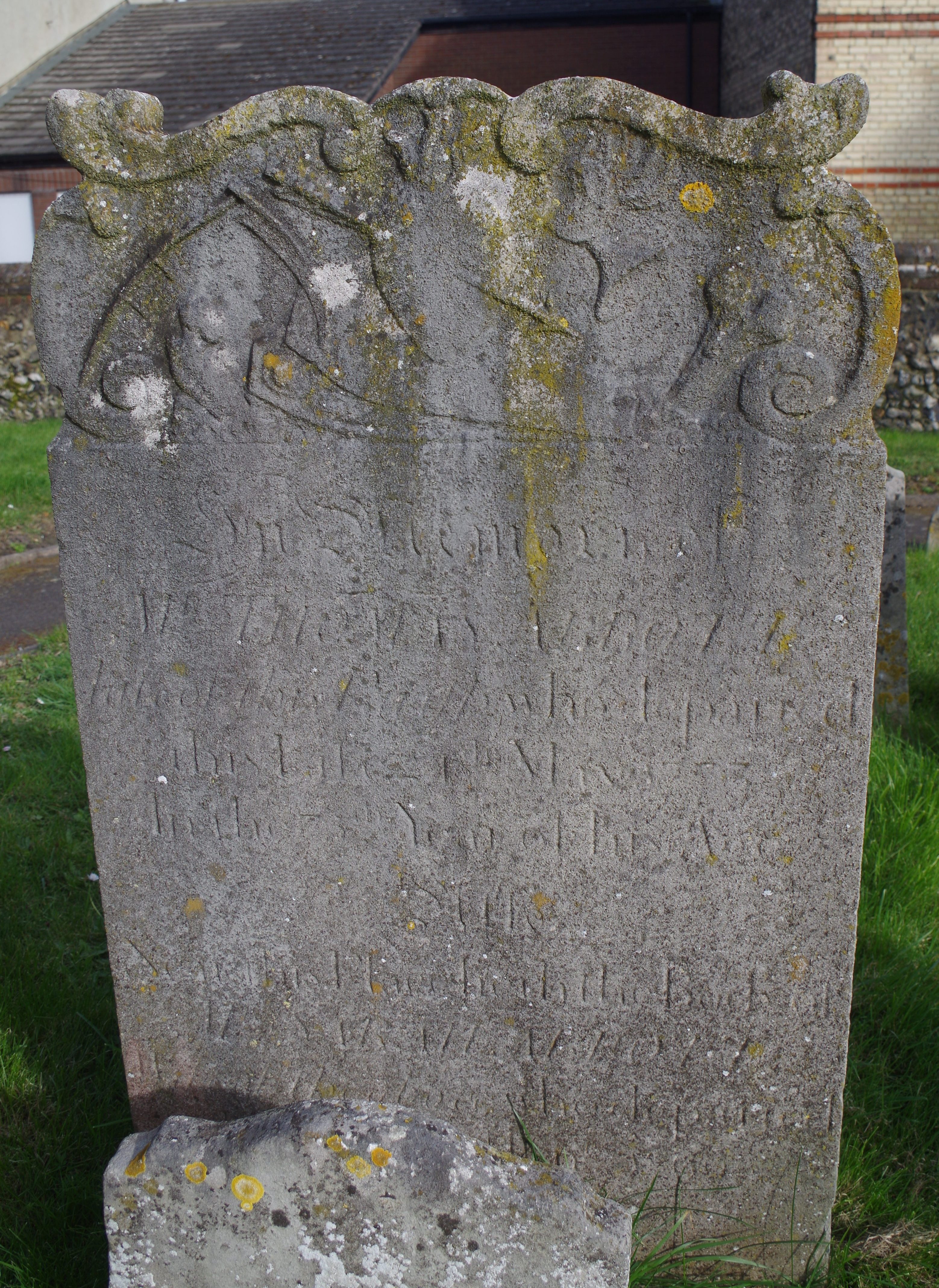
A fine display of symbols on the headstone of Mr Thomas Abbott, St Marys church, St Mary Cray, Kent. ©Carole Tyrrell

The distinctive ‘candlesnuffer’ steeple of St Mary’s church in St Mary Cray has long beckoned to me and I thought that it was time I paid a visit. I didn’t expect to find much and my first impression confirmed it. A few ivy clad altar tombs greeted me and then I wandered around the side of the closed church. What a surprise! A gallery of 18th century headstones placed in lines with some of the more familiar symbols depicted on them. Ouroboros’s, angel heads, skulls, crossbones and then the fine selection in the above photo.


As you can see, it boasts a large, sharp scythe, a half open coffin with the incumbent visible, a trumpet blowing from what seems to be a heavenly cloud and, in the centre, a heart pierced by an arrow. We usually associate a pierced heart with the ones found on millions of St Valentine’s cards as a representation of Cupid’s love darts. You may be thinking that it doesn’t have the usual heart shape but there may be how the stonemason interpreted it. This is the Symbol of the Month – the Pierced Heart

The headstone‘s epitaph reads:

‘In Memory of

Mr THOMAS ABBOTT

Late of this PARISH who departed this life

24 May 1773

In the 75th Year of his life

Also

Near lieth the body of

MRS SARAH ABBOTT  his wife

,,,,who departed ….22 January 1769 aged 69’

Although there are other Abbotts buried in the same churchyard I couldn’t find any sign of a headstone or monument dedicated to Sarah Abbott and there was none recorded on the Kent Archaeological Society survey of the churchyard So whether it has vanished over time we will never know.

A full view of the headstone dedicated to Mr Thomas Abbott, St Marys church, St Mary Cray, Kent
©Carole Tyrrell

On Thomas’s headstone, the heart is surrounded by symbols of resurrection and the Day of Judgement when all of the dead will rise. This is the meaning of the half open coffin lid. So is the pierced heart a symbol of everlasting love which means that the Abbotts will be reunited on that day?  After all, Keister suggests that it’s a sign of matrimony which would fit in with both husband and wife being mentioned on the headstone. However, Cooper comments that the pierced heart is also a sign of contrition so perhaps Mr Abbott felt guilty or sad about outliving Sarah by 6 years.

But let’s discuss other representations and interpretations of the pierced heart as well as the heart in general. It’s one of the most powerful symbols and resonates through many cultures and faiths both ancient and modern. Without it, none of us would be alive as it pumps our lifeblood through our bodies.  This is why it has been a central part of religions and cultures since the beginning of time.

Heart symbolism is significant in, Chinese, Hindu and most religions and cultures. For example, it is one of the eight precious organs of Buddha and also the Aztecs whose rituals involved human sacrifice. In these the chests of the victims were sliced open and their still-beating hearts were offered to the gods.  The Aztecs believed that the heart was the seat of the individual and also a fragment of the Sun’s heart.
Section from the Book of the Dead depicting the Weighing of the Heart showing the heart on one side of the scales and the feather of Maat in the other. Osiris is between them.
Shared under Wiki Creative Commons

In Ancient Egypt, the heart was considered to be the source of human wisdom and the centre of emotions and memory. It could reveal a person’s true character, even after death, and was left in the body after mummification. The ancient Egyptians believed that it would survive death where it would give evidence against or for its owner and so was integral to the afterlife.  This culminated in the Weighing of the Heart which appears in the Book of the Dead.  The heart was given to Osiris, the god of the dead and the underworld who placed it on one of a pair of great golden scales.  On the other was a feather which represented Maat the goddess of order, truth and what was right. If the heart was lighter than the feather then the deceased passed on into eternal bliss.  But if it was heavier, due to past misdeeds, then it was thrown onto the floor of the Hall of Truth where Amut, a god with the face of a crocodile, the front of a leopard and the back of a rhinoceros who was also known as ‘The Gobbler’.  Once he had devoured the heart then the individual ceased to exist. The Egyptians concept of hell was non-existence.

But the heart has an even greater significance in the Judaeo-Christian tradition. There are many references to it in the Bible with over a hundred in Psalms alone.  One of the most famous quotations is in 1 Samuel 16.7 in which it is seen as the seat of emotion:

But the Lord said unto Samuel, Look not on his countenance, or on the height of his stature; because I have refused him: for the Lord seeth not as man seeth; for man looketh on the outward appearance, but the Lord looketh on the heart.’ (King James Bible).

The heart is seen as revealing the inner person but not only as the centre of human life. It also expresses spiritual or emotional feelings, wisdom, piety and righteousness.  There is also the famous quote from Matthew 5:8;

‘blessed are the pure in heart’

However, the heart also has a darker side as an evil person is often described as being ‘blackhearted.’  In Ecclesiastes 8:11 it’s seen as evil:

‘ Because sentence against an evil work is not executed speedily, therefore the heart of the sons of men is fully set in them to do evil.’ (King James Bible).

In Christian iconography the heart took on a symbolic role as an indication of God and piety particularly in the Catholic church where Christ displaying a heart in his hands or on his breast is a key image. It’s known as the Sacred Heart and is one of the most practiced and well known of the Catholic devotions.  The sacred heart is seen as a symbol of ‘God’s boundless and passionate love for mankind.’ The pierced heart was also included in the five wounds that Christ suffered during the crucifixion.

Catholic Holy card depicting the Sacred Heart of Jesus circa 1880. shared under Wiki Creative Commons
The Pierced Heart of Jesus 19th century Portuguese painting. Shared under Wiki Creative Commons
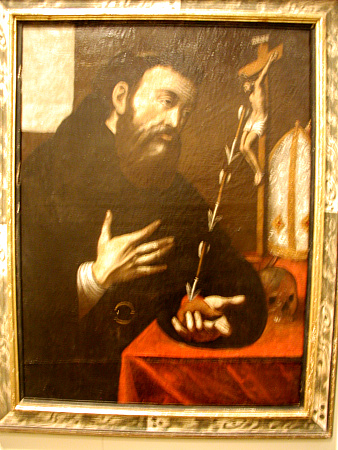
St Augustine 17th century Portuguese painting Museum of Church Paio of San Santiago de Compostela, Spain. Shared under Wiki Creative Commons

One saint in particular, St Augustine, seen above has a special relationship with the pierced heart. He is often shown holding a heart, in some cases topped by a flame and in others pierced by an arrow. Another passage from the Confessions IX, 2:3 may explain the significance of the pierced heart:

‘Thou hadst pierced (sagittaveras) our heart with thy love, and we carried thy words, as it were, thrust through our vitals.’ 

 (The word sagittaveras means literally ‘ shot arrows’ into as in this 17th century painting.

St Valentine’s Day was originally derived from a much darker and bawdier Roman festival called Lupercalia. This took place in Rome from 13-15 February and was intended to avert evil spirits and purify the city.  However, it didn’t involve the giving of chocolates and bouquets of roses. Instead there was animal sacrifice, random matchmaking and couplings which were intended to ward off infertility.  In reality, it was a fertility festival dedicated to Faunus, the Roman god of agriculture and also to the founders of Rome, Romulus and Remus.  It was finally outlawed as ‘unChristian’ in the 5th century by Pope Gelasius who declared the 14 February to be St Valentine’s Day.   There were two actual St Valentines who were both martyrs.

However, the first person to mention the famous day for lovers was actually Geoffrey Chaucer in his 1375 poem, ‘A Parliament of Fowles (or Fowls)’. In this he says:

‘For this was sent on Seynt Valentyn’es day

When every fowl cometh here to choose his mate.’

During the Middle Ages it was believed in both France and England that February 14 was the beginning of the mating season for birds and so an ideal date for romance for all.

However, the heart also has a darker side as an evil person is often described as being ‘blackhearted.’  In Ecclesiastes 8:11 it’s seen as evil:

‘ Because sentence against an evil work is not executed speedily, therefore the heart of the sons of men is fully set in them to do evil.’ (King James Bible).

But it was during the early medieval and early Renaissance when the heart began to resemble the more stylised symbol that we know today.  It took on the shape of a converted A and represented  Amor or Love. Since the 19th century it has been associated with love and romance and the pierced heart has also been known as the wounded heart due to Cupid’s arrows.

But, due to its placing within other potent symbols of resurrection, I interpret the pierced heart on Mr Abbott’s headstone to be a token of love.  Although he wasn’t buried with his wife he may have hoped that they would be reunited on the Day of Judgement when the angels trumpets sounded and the dead met the living again.

It was one of the most potent symbols that I have found in my explorations and I haven’t seen another one – yet.  The pierced heart has also been one of the most fascinating symbols to research because of its many connotations and associations.  Who would have thought that Chaucer might be the father of the St Valentine’s Day industry that we know so well today. 

Was the pierced heart a token of love or a hope of a meeting in the after-life? We will never know but a fascinating collection of symbols for the passer-by to admire.

©Text and photos Carole Tyrrell unless otherwise stated.

References and further reading:

Stories in Stone, Douglas Keister, Gibbs Smith 2004

An illustrated Encyclopedia of Traditional Symbols, J C Cooper, Thames & Hudson, 1979

http://www.thecemeteryclub.com/symbols.html

https://www.kentarchaeology.org.uk/research/monumental-inscriptions/st-mary-cray

https://www.gresham.ac.uk/lectures-and-events/affairs-of-the-heart-an-exploration-of-the-symbolism-of-the-heart-in-art

https://www.midwestaugustinians.org/the-augustinian-emblem

https://www.ncbi.nlm.nih.gov/pmc/articles/PMC3960665/#:~:text=In%20the%20weighing%20of%20the,were%20placed%20with%20the%20deceased.

https://en.wikipedia.org/wiki/Sacred_Heart

https://www.christianiconography.info/augustine.html

https://en.wikipedia.org/wiki/Heart_symbol

Symbol of the Month – An Angel with Trumpet

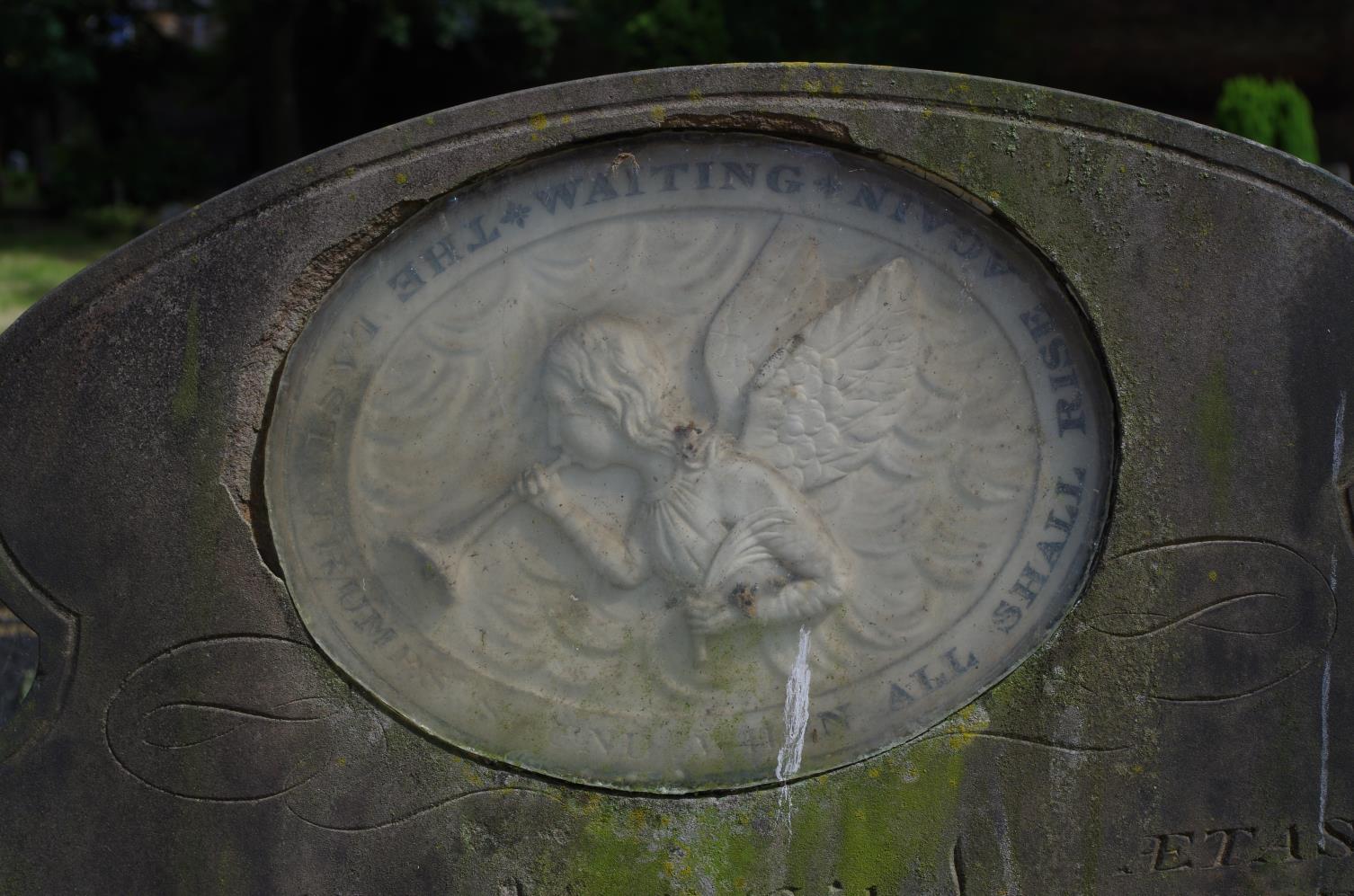
Close-up of relief on the headstone of Edward Du Bois who died aged 13. West Norwood Cemetery © Carole Tyrrell

It wasn’t until late in the 19th century that angels fluttered into large Victorian cemeteries and there is undoubtedly a story to be written as to how they changed sex once they had perched themselves on top of monuments. Prior to that they had been seen as ‘Popish’ symbols and I have visited cemeteries where there is a lone angel or maybe just a scattering of them. There is a hierarchy of angels and they can be identified by what they hold in their hands; a sword, shield, a book or, in this case, a trumpet.   The angel holding a trumpet is the one that features as this month’s Symbol.

I have seen several examples and this one comes from West Norwood Cemetery.  It’s on the headstone dedicated to Edward who died aged only 13 years.  As the epitaph states,

‘Edward

THE ONLY SON

E. du Bois Esq

BARRISTER OF LAW’

I’ve always considered it to be a very striking, almost 3D image, with the detail on the angels wings, clothes and the clouds that surround her.  It depicts an angel blowing on a trumpet with a Biblical quotation surrounding her.  The angelic figure is definitely a woman. and it’s always intrigued me how angels which are traditionally male in the Bible became pretty, pensive young women when they appeared in cemeteries and churchyards.  The quotation reads:

WAITING

THE LAST TRUMPET (words unreadable)………

ALL SHALL RAISE AGAIN

In this case, the angel trumpeter on this headstone is a representation of the Last Judgement Day as she is the herald of the resurrection. 

Full view of the du Bois headstone, West Norwood Cemetery © Carole Tyrrell

There are many references to angels blowing trumpets in the Bible and their association with the dead rising on the Day of Resurrection. For example in Corinthians 15:32, it says:

‘in a moment, in the twinkling of an eye,

At the last trumpet.

For the trumpet will sound, and the

Dead will be raised imperishable,

And we shall be changed.’

There are also references in the Book of Revelation and Matthew 24:32.

However, it is the archangel, Gabriel, who is most associated with blowing a trumpet to announce the resurrection of the dead and images of this began to appear in the 14th century.  There is a very stern and definitely male angel figure holding a trumpet at the entrance to Queen Victoria’s mausoleum at Frogmore.  There is also a geometric figure known as Gabriel’s horn or Torricelli’s trumpet. It has infinite surface area but finite volume. According to Wikipedia:‘The name refers to the Abrahamic tradition identifying the archangel Gabriel as the angel who blows the horn to announce Judgment Day, associating the divine, or infinite, with the finite. The properties of this figure were first studied by Italian physicist and mathematician Evangelista Torricelli in the 17th century.’

Angel with trumpet on the Abreu monument, St Mary’s Catholic Cemetery, Kensal Green © Carole Tyrrell
Another view of the angel trumpeter on the Abreu monument, St Mary’s Catholic Cemetery, Kensal Green © Carole Tyrrell

Angels appear in most religions and it’s appropriate that one of the most well-known is associated with communication. In fact angels are usually seen as messengers as the word ‘angel’ is derived from the Greek word, ‘angelos’, which means ‘messengers.’    They also appear in Islam as the word for messenger, Mala’ika, is the Islamic term for angel.  The Koran, like the Bible, also has references to angels especially Djibril or Gabriel nd Mikhail or Michael. According to Douglas Keister:

‘Angels appeared to grow wings in a 5th century mosaic in Rome. After all they are seen as messengers between heaven and earth.’

Gabriel is also associated with the Annunciation.  He is, with his trumpet blowing, an obvious choice for announcing the departure of a soul and its arrival in Heaven. 

I have seen an example of an angel blowing a trumpet in Tower Hamlets Cemetery and this lovely example above comes from St Mary’s Catholic cemetery which nestles beside its larger neighbour, Kensal Green.

Crossed trumpets on a 17th century headstone, St Andrews, Strood
©Carole Tyrrell
Detail of tombstone showing trumpet, St Andrews, Strood ©Carole Tyrrell
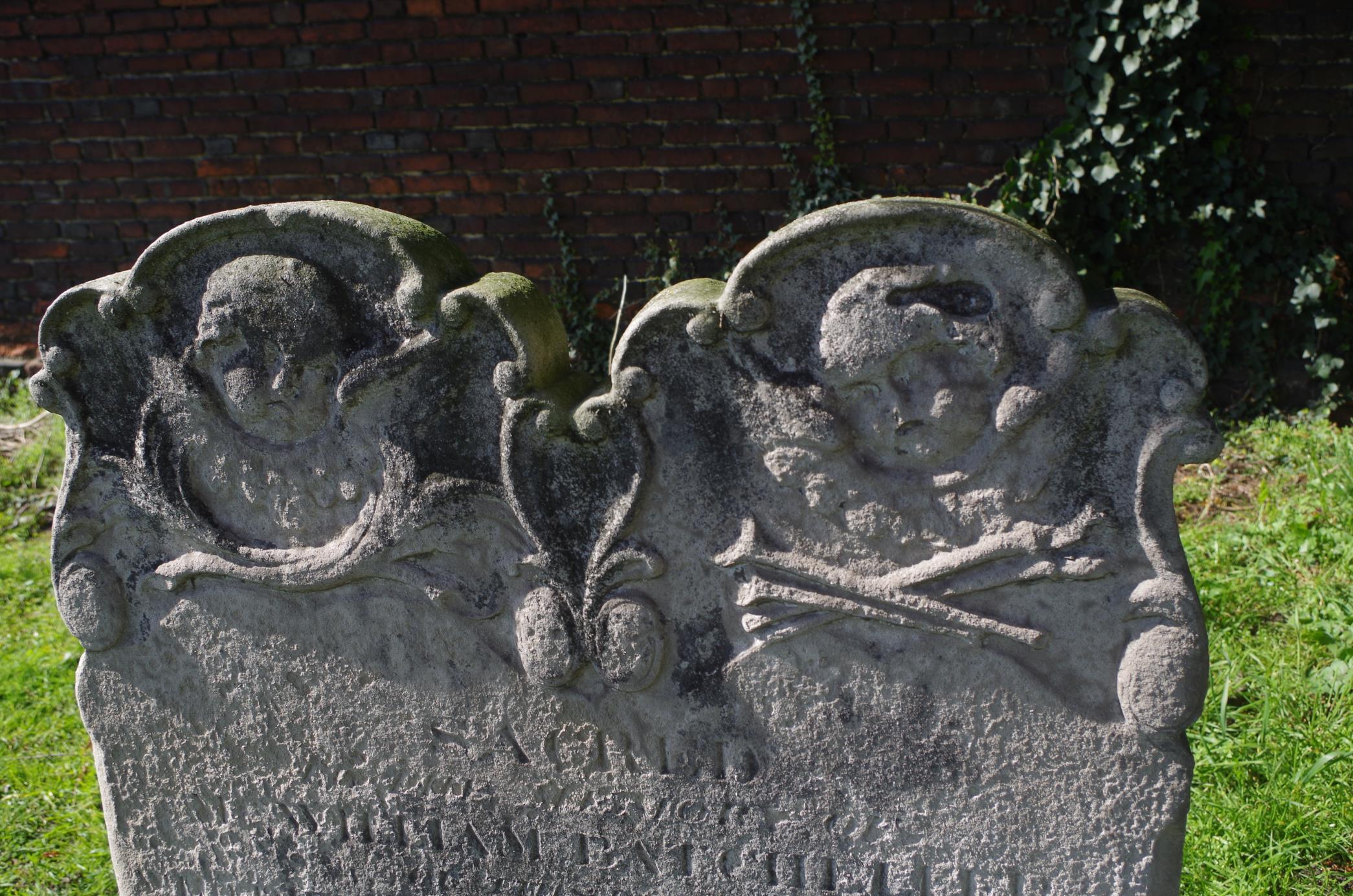
Another headstone with an angelhead and trumpets radiating out. St Mary’s, St Mary Cray, Kent © Carole Tyrrell

While exploring Kent churchyards prior to the Coronavirus outbreak I found 17th headstones with angel heads on them with trumpets surrounding them.  In this one the trumpets are crossed like long bones beneath the angel head.   So, in many ways this is a very ancient symbol which has come down through the centuries as a message of comfort to those left behind.  The one dedicated to Edward du Bois has an epitaph that expresses his father’s grief as well as his anger at his son’s untimely death.

©Text and photos Carole Tyrrell unless otherwise stated.

References and further reading:

Stories in Stone, Douglas Keister, Gibbs Smith, 2004

https://en.wikipedia.org/wiki/Gabriel%27s_Horn

https://en.wikipedia.org/wiki/Gabriel

https://www.cityofgroveok.gov/building/page/angel-blowing-trumpet

https://www.openbible.info/topics/angels_trumpets

https://en.wikipedia.org/wiki/Gabriel

Symbol of the Month – The All Seeing Eye

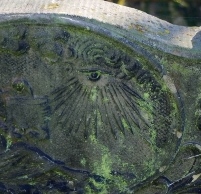
Detail of the All Seeing eye on the Caryer headstone, All Saints Frindsbury © Carole Tyrrell

Poking about in churchyards as is my wont is how I discover symbols to write about. It was while exploring two churchyards in Kent, All Saints in Frindsbury and St Martin of Tours in Eynsford, that I discovered this month’s symbol.

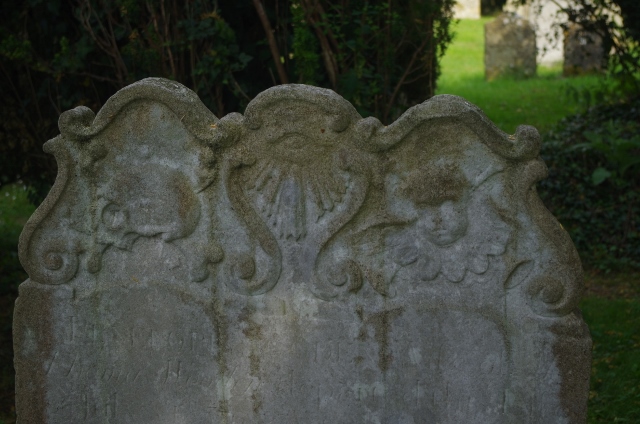
This is the All Seeing Eye, also known as The Eye of Providence, and is usually depicted as a single realistic eye within a triangle or within a burst of light. I’ve always associated it with Freemasons as it appears on their documents. But neither of these headstones had any other symbols linked with Freemasons such as the square and compass. So what was the story?

The one in the churchyard of St Martin of Tours in Eynsford was bordered by what looked like two snakes with a skull and crossbones and a winged spirit on either side, familiar memento mori symbols. Sadly the epitaph is now illegible.

Headstone with All Seeing Eye, Eynsford, Kent.© Carole Tyrrell

The second one is in the churchyard of All Saints in Frindsbury and this intriguing version is on the grave of the Caryer family. The Kent Archaeological Society thought that it might represent the Woman of Samuria as featured in John 4.4-26 but I’m not sure about that. (see Symbol of the month – the womand from Samaria or a Greek goddess? 27 January 2021) The epitaph reads:
Sacred
To the memory of
Hannah wife of John Caryer
Died 9th Sept 1809 aged 30 years
Also Robert her son
Died 28th June 1801 aged 8 years
Also the above John Caryer
Died 11th March 1814 aged (4)2 years.’

Full view of the Caryer headstone, All Saints Frindsbury, Kent.© Carole Tyrrell

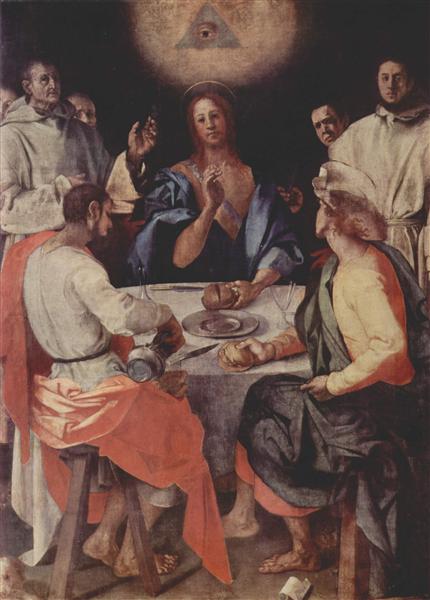
The earliest known representation of The Eye is in a painting called ‘The Supper at Emmaus’ by the Italian painter Jacopo Pontormo in 1525. This was painted during the Renaissance and it depicts the second part of the Second Appearance story in Luke 24: verses 13.35:


And they drew nigh unto the village, whither they went: and he made as though he would have gone further.
But they constrained him, saying, Abide with us: for it is toward evening, and the day is far spent. And he went in to tarry with them.
And it came to pass, as he sat at meat with them, he took bread, and blessed it, and brake, and gave to them.
And their eyes were opened, and they knew him; and he vanished out of their sight.
And they drew nigh unto the village, whither they went: and he made as though he would have gone further.
But they constrained him, saying, Abide with us: for it is toward evening, and the day is far spent. And he went in to tarry with them.
And it came to pass, as he sat at meat with them, he took bread, and blessed it, and brake, and gave to them.
And their eyes were opened, and they knew him; and he vanished out of their sight.’

As you can see the Eye is above Christ’s head which shows that God is watching the event and so can be seen as a Christian symbol. On the Ancient Origins website it’s claimed that

the elements surrounding the eye also have a Christian meaning. For example, the triangle surrounding the eye also have a Christian meaning in that it’s a clear reference to the Holy Trinity – the Father, the Son and the Holy Spirit. The burst of light is meant to symbolise divinity, holiness and God himself’

Within the Bible there are many references to The Eye in the context of God keeping watch and observing in Proverbs and Ecclesiasticus and also from Psalms 33: verse 18:


The LORD is in his holy temple, the LORD’s throne is in heaven:
his eyes behold, his eyelids try, the children of men.
Behold, the eye of the LORD is upon them that fear him,
upon them that hope in his mercy . . . . 
The eyes of the LORD are upon the righteous,
and his ears are open unto their cry.’

But older religions and faiths such as Hinduism and the Ancient Egyptians also had an important eye symbol.

In Egypt it was known as the Eye of Horus. Even today it’s still used as an emblem of protection and good health. The Eye was also known as a wadjet (the whole one), wedjat or udjat. Sailors would often paint the Eye of Horus on the prows of their ships to ensure a safe voyage. I’m sure that I’ve seen this on a boat or two in some of Hollywood’s classic sword and sandal epics! The depiction of the Eye of Horus is said to resemble the markings on a falcon’s eye due to the teardrop marking which is sometimes found below the eye as here. This would make sense as Horus is usually shown as a falcon. There are several myths about Horus and his eye. For instance, in one of them Horus fought with Set who gouged out Horus’s left eye which was later restored by a goddess.

The Eye also appears on the US one dollar bill. But it made its first appearance as a Freemason symbol on the personal seal of Robert Moray (1609-1673) who was a Scottish Freemason. Then during the 18th century it appeared again in two Freemason books, one of which was Thomas Smith Webb’s ‘Freemasonry Monitor’ and, by the 19th century, it had become part of the permanent hieroglyphical emblems of the Freemasons. There are other associations with the Illuminati and, if you’re interested, there is more information online.

But with these two All Seeing Eye symbols I think that they were meant, as they often are, to be a comforting message. The departed, and the bereaved, were all being watched over and supported at a time of sorrow and grief.

©Text and photos Carole Tyrrell unless otherwise stated.

References and further reading
https://www.undercliffecemetery.co.uk/gallery/funerary-
https://www.ancient-origins.net/human-origins-religions/eye-providence-0013057
http://www.thecemeteryclub.com/symbols.html
https://cemeteries.wordpress.com/2006/10/18/all-seeing-eye-eye-of-providence
https://en.wikipedia.org/wiki/Eye_of_Providence (this has some more examples from around the world.)
https://www.biblegateway.com/passage/?search=Luke%2024%3A13-35&version=KJV
https://gwmemorial.org/blogs/news/the-eye-of-providence

Symbol of the Month – The Six Pointed Star

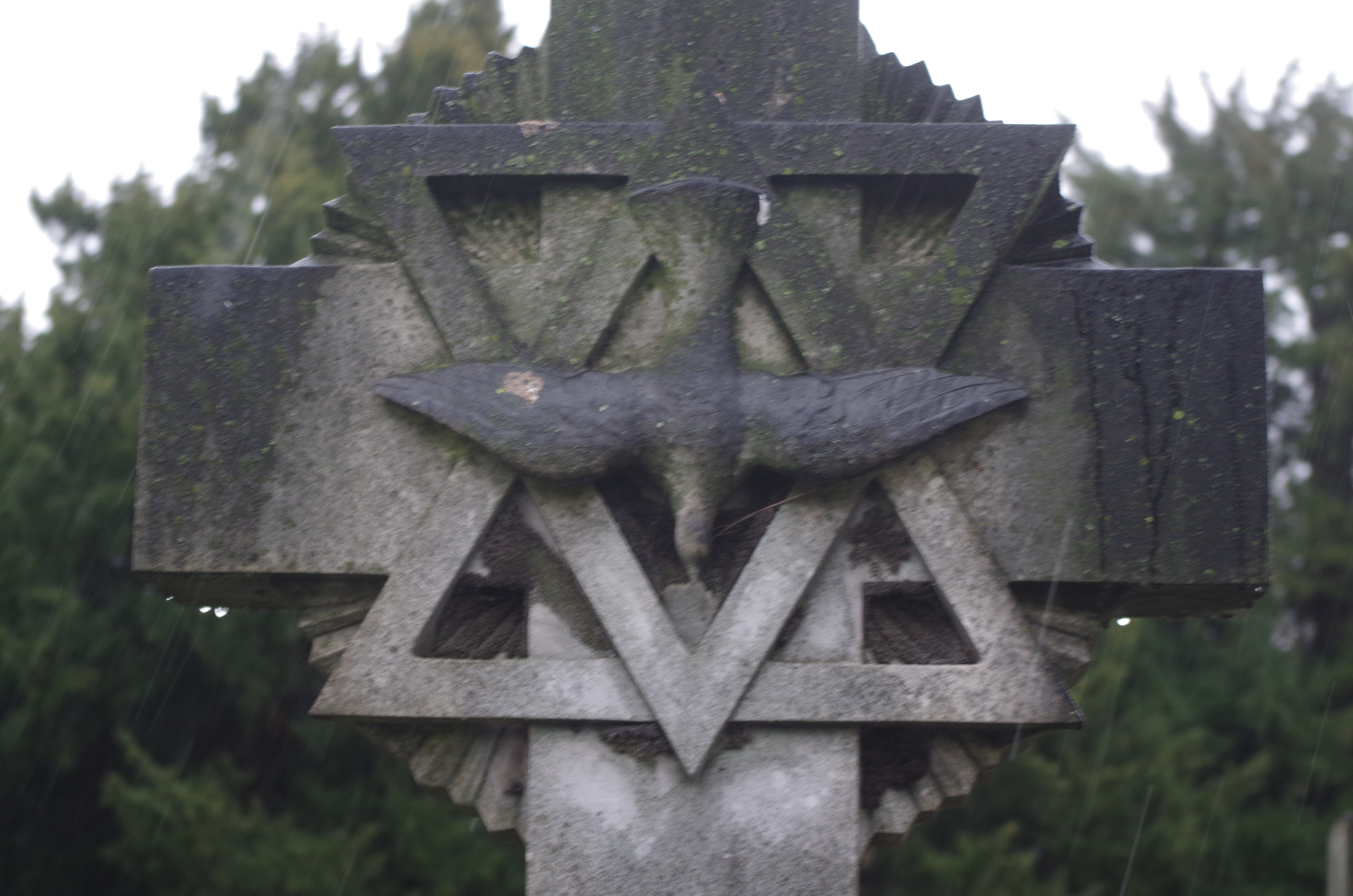
Another view of the 6 pointed star,Brompton Cemetery.
©Carole Tyrrell


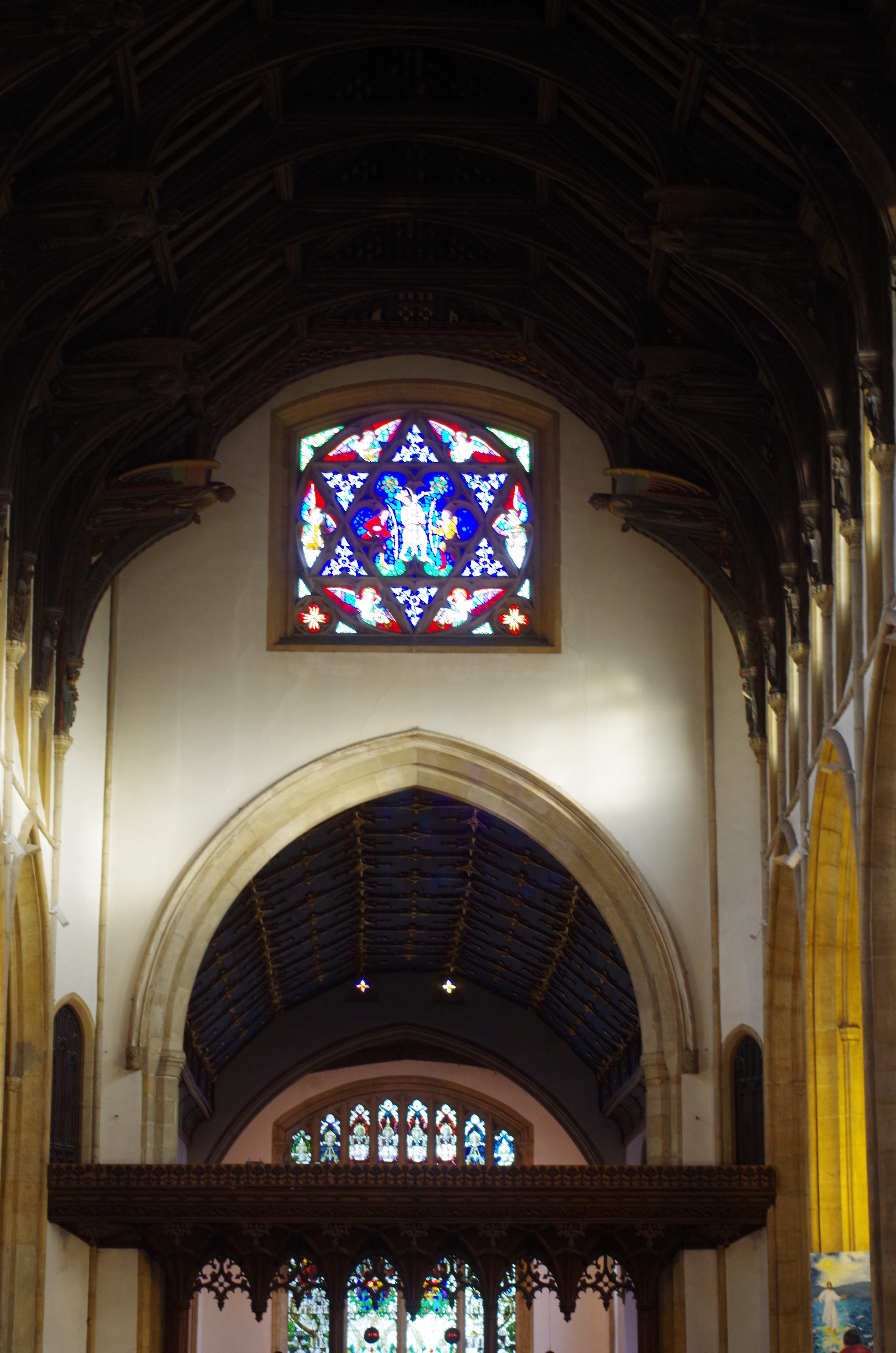
This month’s symbol is one that I’ve always associated with the Jewish faith where it’s known as the Star of David. But when I spotted a prominent example in Brompton Cemetery which isn’t a Jewish Cemetery I wondered why it was on that particular monument.  But on a recent visit to St Mary’s church in Bury St Edmunds I saw a six pointes tar in the East window and read in the guidebook of its significance with Christianity.  The window was part of the 1844 restoration and is based on a  14th century example on the nearby Abbey Gate.

Six pointed star in St Mary’s church, Bury St Edmunds
©Carole Tyrrell

According to St Mary’s guidebook the star is an important Christian symbol as:

‘Jesus was descended from David and is the Messiah for both Jews and Gentiles, the star of David is an important Christian symbol.’

This may account for the apparently Hebrew looking writing in the centre of a six pointed start dating from the 14th century on a window in Winchester cathedral.  Another one in the same building, dating from the same period on a choirstall canopy, was recorded by Pevsner.


6 pointed star from stained glass window in Winchester Cathedral
©https://www.simonarich.com – used without permissionThe six pointed star is a geometric shape and is formed from the intersection of two equilateral triangles.  At the centre of the intersection is a regular hexagon.  In Greek it’s known as a hexagram and in Latin it’s called a sexagram.

In Christianity it’s known as the Creator’s Star or the Star of Creation. The six points are alleged to represent the six days of the Creation and also the six attributes of God. These are:

  • Power
  • Wisdom
  • Majesty
  • Love
  • Mercy
  • Justice

But the six pointed star is a universal symbol.  No-one is quite sure where or when it first appeared bit it’s known and revered throughout both Eastern and Western religions and faiths.  For example, in Buddhism it has been found in the Tibetan Book of the Dead and has been used as decoration on Masonic temples, In Freemasonry the star is seen as a representation of the male and female.  This is also an important element  in Hinduism as the combination of triangles are also seen as motifs of male and female and the star becomes an emblem of Creation and divine union.


There is a darker side to the six pointed star as, in Occultism, the star is a powerful symbol for conjuring up spirits and as a talisman.  In this the star is seen as representing the 4 elements:


  • Fire         –             upwards pointing triangle
  • Air           –             opposite upwards pointing triangle
  • Water     –             downwards pointing triangle
  • Earth      –             opposite triangle pointing downwards


But the Rastafarian faith also uses the Star of David or the Magen David as a central motif. Here it’s coloured either black or appears in the Rastafarian colours of red, green and gold.   This is because the Rastafarians believe that their leader, the late King of Ethiopia, Haile Selassie, was a divine being.  He’s always been considered as being directly related to King Solomon’s father, King David, and therefore to Jesus.  This is based on a visit by the Queen of Sheba to the Israelite king, Solomon, as recorded in the Book of Kings 1 Kings 10 1:13. Rastafarians believe that during the visit they slept together and a child was born.  This child led to a direct line of descendants to Haile Selassie.

Although the Star of David is now seen as almost exclusively Jewish it wasn’t always so.  It is reputed to have originated in ancient Arabic Kabbalistic texts in which it was known as the Seal of Solomon and became the Star of David in the 17th century.   The Jews of Eastern Europe in the 19th century adopted it as a representation of their faith and Hitler used it as a badge to identify Jews during the Second World War. Today it is on the national flag of modern day Israel.

But what does it mean in funerary terms and why is it in this particular monument?   I looked more closely at the first epitaph beneath it.

The epitaph underneath the 6 pointed star – note Thomas Bower died.
©Carole Tyrrell

It was dedicated to a Thomas Henry Bowyer Bower, the son of Captain Thomas Bowyer Bower whose epitaph is lower down. Thomas died young, aged 24, at Port Palmerston, Darwin, Australia. I’m not sure if he’s actually buried there but, perhaps in this context, the star has been placed there as a symbol of the spirit that survives death. Over the centuries people have used the stars to guide their way and I thought that maybe the star was placed here as an eternal light guiding the deceased through the darkness back home again. Note the quotation on the epitaph from Deuteronomy 32.12,

‘The Lord alone shall lead him’

This  may be a reference to the to North or Pole Star which is traditionally associated with Jesus.

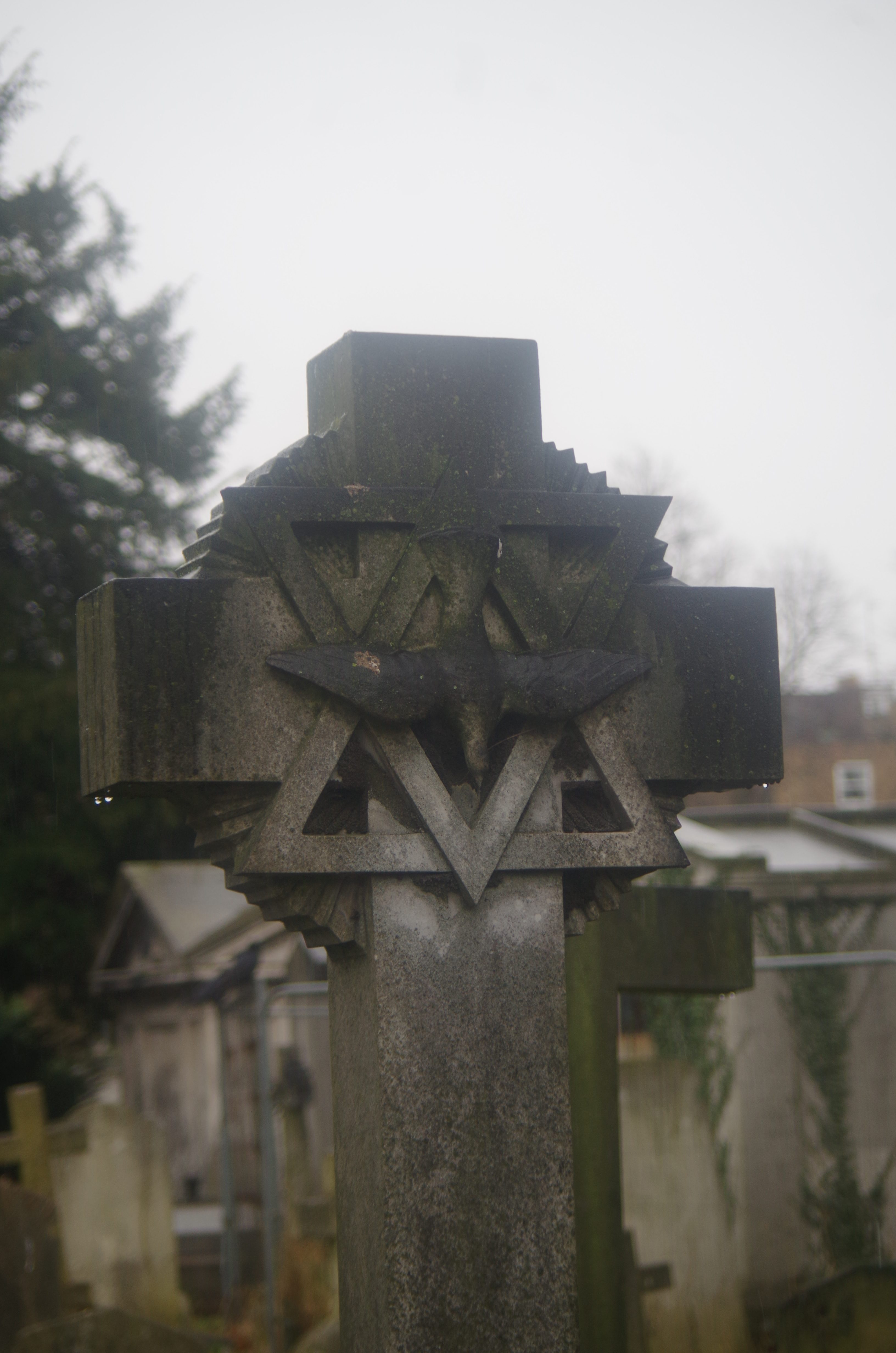
There is a downward pointing dove placed over the star which is a symbol of the Holy Ghost, part of the Holy Trinity: Father, Son and Holy Ghost.

6 pointed star on the Bower monument, Brompton Cemetery
©Carole Tyrrell


In the King James version of the Bible in Luke 3:22 :

‘And the Holy Ghost descended in a bodily shape like a dove upon him, and a voice came from heaven, which said, Thou art my beloved Son; in thee I am well pleased.’

 I wondered if the last words of this biblical verse referred to the father and son relationship.

My own interpretation of the star and the dove is that it may have been a final goodbye from a father to a son who died far from home and wanting him to know how much he was loved.

©Carole Tyrrell text and photos unless otherwise stated.


References and further reading:

www.religionfacts.com/six-point-star

http://www.thecemeteryclub.com/symbols.html

http://www.gmct.com.au

https://stoneletters.com/blog/gravestone-symbols

http://religionfacts/six-point-star

http://star-of-david.blogspot.co.uk/2006/06/rastafarians.html

http://bbc.co.uk/religion/rastafari

http://symbolism.co/dove-symbolism.html

https://en.wikipedia.org/wiki/Holy_Spirit_in_Christianity

http://www.biblegateway.com